Novellas in November, Part 1: 3 Nonfiction, 2 Super-Short Fiction
Short books; short reviews.
Nonfiction:
The Measure of My Days by Florida Scott-Maxwell (1968)
[150 pages]
 I learned about this from one of May Sarton’s journals, which shares its concern with ageing and selfhood. The author was an American suffragist, playwright, mother and analytical psychologist who trained under Jung and lived in England and Scotland with her Scottish husband. She kept this notebook while she was 82, partly while recovering from gallbladder surgery. It’s written in short, sometimes aphoristic paragraphs. While I appreciated her thoughts on suffering, developing “hardihood,” the simplicity that comes with giving up many cares and activities, and the impossibility of solving “one’s own incorrigibility,” I found this somewhat rambly and abstract, especially when she goes off on a dated tangent about the equality of the sexes. (Free from The Book Thing of Baltimore)
Hope in the Dark: Untold Histories, Wild Possibilities by Rebecca Solnit (2004)
[143 pages]
 “Activism is not a journey to the corner store, it is a plunge into the unknown. The future is always dark.” This resonated with the Extinction Rebellion handbook I reviewed earlier in the year. Solnit believes in the power of purposeful individuals working towards social justice, even in the face of dispiriting evidence (the largest protests the world had seen didn’t stop the Iraq War). Instead of perfectionism, she advises flexibility and resilience; things could be even worse had we not acted. At first I thought it depressing that 15 years on we’re still dealing with many of the issues she mentions here, and the environmental crisis has only deepened. But her strong and stirring writing is a reminder that, though injustice is always with us, so is everyday heroism. (Free from The Book Thing of Baltimore)
Lama by Derek Tangye (1966)
[160 pages]
 Tangye wrote a series of cozy animal books similar to Doreen Tovey’s. He and his wife Jean ran a flower farm in Cornwall and had a succession of cats, along with donkeys and a Muscovy duck named Boris. After the death of their beloved cat Monty, Jean wanted a kitten for Christmas but Tangye, who considered himself a one-cat man rather than a wholesale cat lover, hesitated. The matter was decided for them when a little black stray started coming round and soon made herself at home. (Her name is a tribute to the Dalai Lama’s safe flight from Tibet.) Mild adventures ensue, such as Lama going down a badger sett and Jeannie convincing herself that she’s identified another stray as Lama’s mother. Pleasant, if slight; I’ll read more by Tangye. (From Kennet Centre free bookshop)
Fiction:
The Small Miracle by Paul Gallico (1951)
[47 pages]
 Like Tangye, Gallico is known for writing charming animal books, but fables rather than memoirs. Set in postwar Assisi, Italy, this stars Pepino, a 10-year-old orphan boy who runs errands with his donkey Violetta to earn his food and board. When Violetta falls ill, he dreads losing not just his livelihood but also his only friend in the world. But the powers that be won’t let him bring her into the local church so that he can pray to St. Francis for her healing. Pepino takes to heart the maxim an American corporal gave him – “don’t take no for an answer” – and takes his suit all the way to the pope. This story of what faith can achieve just manages to avoid being twee. (From Kennet Centre free bookshop)
Birthday Girl by Haruki Murakami (2002; English translation by Jay Rubin, 2003)
[42 pages]
 Reprinted as a stand-alone pamphlet to celebrate the author’s 70th birthday, this is about a waitress who on her 20th birthday is given the unwonted task of taking dinner up to the restaurant owner, who lives above the establishment. He is taken with the young woman and offers to grant her one wish. We never hear exactly what that wish was. It’s now more than 10 years later and she’s recalling the occasion for a friend, who asks her if the wish came true and whether she regrets what she requested. She surveys her current life and says that it remains to be seen whether her wish will be fulfilled; I could only assume that she wished for happiness, which is shifting and subjective. Encountering this in a larger collection would be fine, but it wasn’t particularly worth reading on its own. (Public library)
I’ve also had a number of novella DNFs so far this month, alas: Atlantic Winds by William Prendiville (not engaging in the least), By Grand Central Station I Sat Down and Wept by Elizabeth Smart (fascinating autobiographical backstory; pretentious prose) and The Dream Life of Balso Snell by Nathanael West (even more bizarre and crass than I’m used to from him).
Onwards!
Have you read any of these novellas? Which one takes your fancy?
Reviews for Shiny New Books & TLS, Plus Simon’s “My Life in Books”
I recently participated in the one-week “My Life in Books” extravaganza hosted by Simon Thomas (Stuck in a Book), where he asks bloggers to choose five books that have been important to them at different points in their reading lives. The neat twist is that he puts the bloggers in pairs and asks them to comment anonymously on their partner’s reading choices and even come up with an apt book recommendation or two. A few of my selections will be familiar from the two Landmark Books posts I wrote in 2016 (here and here), but a couple are new, and it was fun to think about what’s changed versus what’s endured in my reading taste.
Shiny New Books
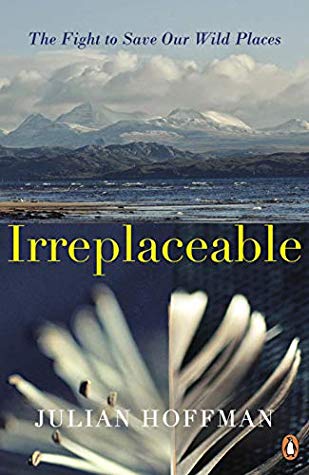 Irreplaceable by Julian Hoffman: If you read one 2019 release, make it this one. (It’s too important a book to dilute that statement with qualifiers.) Species and habitat loss are hard to comprehend even when we know the facts. This book is a way of taking stock, taking responsibility, and going beyond the numbers to tell the stories of front-line conservation work. From the Kent marshes to the Coral Triangle off Indonesia, Hoffman discovers the situation on the ground and talks to the people involved in protecting places at risk of destruction. Reassuringly, these aren’t usually genius scientists or well-funded heroes, but ordinary citizens who are concerned about preserving nearby sites that mean something to them. Irreplaceable is an elegy of sorts, but, more importantly, it’s a call to arms. It places environmentalism in the hands of laypeople and offers hope that in working together in the spirit of defiance we can achieve great things. It takes local concerns seriously, yet its scope is international. But what truly lifts Hoffman’s work above most recent nature books is the exquisite prose.
Times Literary Supplement
These three reviews are forthcoming.
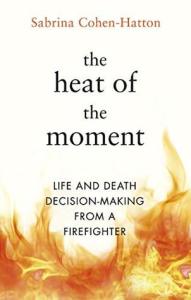 The Heat of the Moment: Life and Death Decision-Making from a Firefighter by Sabrina Cohen-Hatton: Cohen-Hatton is one of the UK’s highest-ranking female firefighters. A few perilous situations inspired her to investigate how people make decisions under pressure. For a PhD in Psychology from Cardiff University, she delved into the neurology of decision-making. Although there is jargon in the book, she explains the terms well and uses relatable metaphors. However, the context about her research can be repetitive and basic, as if dumbed down for a general reader. The book shines when giving blow-by-blow accounts of real-life or composite incidents. Potential readers should bear in mind, though, that this is ultimately more of a management psychology book than a memoir.
Henry David Thoreau’s Walden (1854), a record of his two-year experiment living alone in a cabin near a Massachusetts pond, has inspired innumerable back-to-nature adventures, including these two books I discuss together in a longer article.
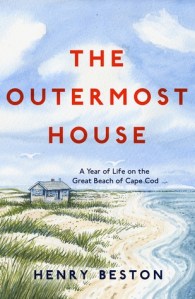 The Outermost House: A Year of Life on the Great Beach of Cape Cod by Henry Beston: Beston had a two-room wooden shack built at Cape Cod in 1925. Although he only intended to spend a fortnight of the following summer in the sixteen-by-twenty-foot dwelling, he stayed a year. The chronicle of that year, The Outermost House (originally published in 1928 and previously out of print in the UK), is a charming meditation on the turning of the seasons and the sometimes terrifying power of the sea. The writing is often poetic, with sibilance conjuring the sound of the ocean. Beston will be remembered for his statement of the proper relationship between humans and the natural world. “We need another and a wiser and perhaps a more mystical concept of animals,” he declares; “they are not underlings; they are other nations.” One word stands out in The Outermost House: “elemental” appears a dozen times, evoking the grandeur of nature and the necessity of getting back to life’s basics.
(See also Susan’s review of this one.)
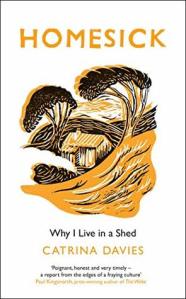 Homesick: Why I Live in a Shed by Catrina Davies: Davies crosses Thoreauvian language – many chapter titles and epigraphs are borrowed from Walden – with a Woolfian search for a room of her own. Penniless during an ongoing housing crisis and reeling from a series of precarious living situations, she moved into the shed near Land’s End that had served as her father’s architecture office until he went bankrupt. Like Raynor Winn’s The Salt Path, this intimate, engaging memoir is a sobering reminder that homelessness is not so remote, and education is no guarantee of success. There is, understandably, a sense of righteous indignation here against a land-owning class – including the lord who owns much of the area where she lives and works – and government policies that favour the wealthy.
20 Books of Summer, #11–13: Harrison, Pym, Russell
It’s cats and butterflies in the spotlight this time, adding in a gazelle as a metaphor for Freddie Mercury’s somebody to love.
Travelling Cat: A Journey round Britain with Pugwash by Frederick Harrison (1988)
If Tom Cox had been born 20 years earlier, this is the sort of book he might have written. In 1987, saddened more by his cat Podey being run over than by the end of his marriage, Harrison set out from South London in his Ford Transit van for a seven-month drive around the country. He decided to take Pugwash, one of his local (presumably ownerless) cats, along as a companion.
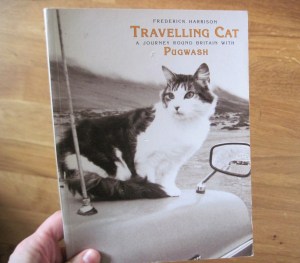 They encountered Morris dancers, gypsies, hippies at Stonehenge for the Summer Solstice, sisters having a double wedding, and magic mushroom collectors. They went to a county fair and beaches in Suffolk and East Yorkshire, and briefly to Hay-on-Wye. And on the way back they collected Podey, whom he’d had stuffed. Harrison muses on the English “vice” of nostalgia for a past that probably never existed; Pugwash does what cats do, and very well.
It’s all a bit silly and dated and lightweight, but enjoyable nonetheless. Plus there are tons of black-and-white photos of “Pugs” and other feline friends. This was a secondhand purchase from The Bookshop, Wigtown.
Favorite lines:
“Cats hate to make prats of themselves. But then, don’t we all?”
(last lines) “Warm, fed, contented, unemployable, and entirely at peace with the world. Yes indeed. Cats certainly know something we don’t.”
Some Tame Gazelle by Barbara Pym (1950)
(An example of a book that just happens to have an animal in the title.) I’d only read one other Pym novel, Quartet in Autumn, a late and fairly melancholy story of four lonely older people. With her first novel I’m in more typical territory, I take it. The middle-aged Bede sisters are pillars of the church in their English village. Harriet takes each new curate under her wing, making of them a sort of collection, and fends off frequent marriage proposals from the likes of a celebrity librarian and an Italian count.
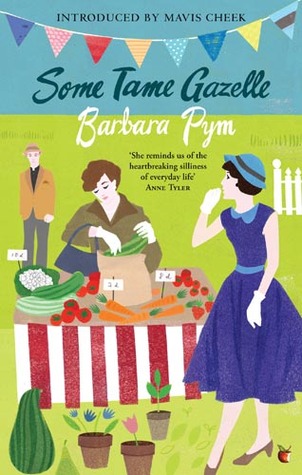 Belinda, on the other hand, only has eyes for one man: Archdeacon Hochleve, whom she’s known and loved for 30 years. They share a fondness for quoting poetry, the more obscure the better (like the title phrase, taken from “Some tame gazelle, or some gentle dove: / Something to love, oh, something to love!” by Thomas Haynes Bayly). The only problem is that the archdeacon is happily married. So single-minded is Belinda that she barely notices her own marriage proposal when it comes: a scene that reminded me of Mr. Collins’s proposal to Lizzie in Pride and Prejudice. Indeed, Pym is widely recognized as an heir to Jane Austen, what with her arch studies of relationships in a closed community.
There were a handful of moments that made me laugh, like when the seamstress finds a caterpillar in her cauliflower cheese and has to wipe with a Church Times newspaper when the Bedes run out of toilet paper (such mild sacrilege!). This is enjoyable, if fluffy; it was probably a mistake to have read one of Pym’s more serious books first: I expected too much of this one. If you’re looking for a quick, gentle and escapist read in which nothing awful will happen, though, it would make a good choice. Knowing most of her books are of a piece, I wouldn’t read more than one of the remainder – it’ll most likely be Excellent Women.
An Obsession with Butterflies: Our Long Love Affair with a Singular Insect by Sharman Apt Russell (2003)
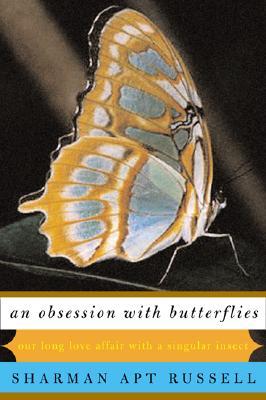 This compact and fairly rollicking book is a natural history of butterflies and of the scientists and collectors who have made them their life’s work. There are some 18,000 species and, unlike, say, beetles, they are generally pretty easy to tell apart because of their bold, colorful markings. Moth and butterfly diversity may well be a synecdoche for overall diversity, making them invaluable indicator species. Although the history of butterfly collecting was fairly familiar to me from Peter Marren’s Rainbow Dust, I still learned or was reminded of a lot, such as the ways you can tell moths and butterflies apart (and it’s not just about whether they fly in the night or the day). And who knew that butterfly rape is a thing?
The final third of the book was strongest for me, including a trip to London’s Natural History Museum; another to Costa Rica’s butterfly ranches, an example of successful ecotourism; and a nicely done case study of the El Segundo Blue butterfly, which was brought back from the brink of extinction by restoration of its southern California dunes habitat. Russell, a New Mexico-based author of novels and nonfiction, also writes about butterflies’ cultural importance: “No matter our religious beliefs, we accept the miracle of metamorphosis. One thing becomes another. … Butterflies wake us up.”
 I also recently read the excellent title story from John Murray’s 2003 collection A Few Short Notes on Tropical Butterflies. Married surgeons reflect on their losses, including the narrator’s sister in a childhood accident and his wife Maya’s father to brain cancer. In the late 1800s, the narrator’s grandfather, an amateur naturalist in the same vein as Darwin, travelled to Papua New Guinea to collect butterflies. The legends from his time, and from family trips to Cape May to count monarchs on migration in the 1930s, still resonate in the present day for these characters. The treatment of themes like science, grief and family inheritance, and the interweaving of past and present, reminded me of work by Andrea Barrett and A.S. Byatt.
(I’ve put the book aside for now but will go back to it in September as I focus on short stories.)
Other butterfly-themed books I have reviewed:
- Four Wings and a Prayer: Caught in the Mystery of the Monarch Butterfly by Sue Halpern (one of last year’s 20 Books of Summer)
- Ruins by Peter Kuper (a graphic novel set in Mexico, this also picks up on monarch migration)
- Magdalena Mountain by Robert Michael Pyle (a novel about butterfly researchers in Colorado)
Women in Translation Month 2019, Part I: Ernaux and Poschmann
Two rather different books to start off #WITMonth: a brief (c. 70 pp.) account of a mother’s decline with dementia; and a haiku-inspired novel of the quest for life and death in disorienting modern Japan. Both are admirable but detached – a judgment I seem more likely to make about work in translation – so don’t earn my wholehearted recommendation. My rating for both:
I Remain in Darkness by Annie Ernaux (1997; English translation, 1999)
[Translated from the French by Tanya Leslie]
 This is the second short, somewhat harrowing autobiographical work I’ve read by Ernaux this year (after Happening, her account of her abortion, in March). A collection of mostly present-tense fragments, it’s drawn from the journal she kept during her mother’s final years, 1983–6. “I Remain in Darkness” were the last words her mother wrote, in a letter to a friend (“Je ne suis pas sortie de ma nuit,” which more literally means “I have not left my night,” strikes me as cryptic and poetic, though maybe I’m missing a colloquialism). Slipping into Alzheimer’s, her mother spent these years in a long-term hospital geriatric ward. Ernaux could see her mother becoming like a child again:
This morning she got up and, in a timid voice, said: ‘I wet the bed. I couldn’t help it.’ The same words I would use when I was a child.
Now her room is on the third floor. A bunch of women circle us, addressing my mother with the familiar tu form: ‘You’re going to be in our group?’ They are like kids talking to the ‘new girl’ at school. When I take leave of her, she looks at me in panic and confusion: ‘You’re not leaving, are you?’
—and herself becoming like her mother: “It’s crystal-clear: she is me in old age and I can see the deterioration of her body threatening to take hold of me – the wrinkles on her legs, the creases in her neck”. Ernaux vacillates between guilt, fear and cruelty in how she approaches her mother. She tenderly shaves the older woman’s face every week when she visits, and buys her all manner of sweets. Food is one of her mother’s last remaining pleasures, though she often misses her mouth when she tries to eat the cakes her daughter brings.
Superficially, this is very similar to another book I’ve reviewed this year, Be With by Mike Barnes, a series of short letters written during his time as a caregiver to his mother, who also has Alzheimer’s. But where Barnes is reassuring and even humorous at times, Ernaux refuses to give any comfort, false or otherwise. This hospital is a bleak place that reeks of urine and is hiding excrement everywhere (really). A lazier reviewer than I generally try to be would brandish the word “unflinching.”
The entries from a few days after her mother’s death explain what the author is trying to do with her work, whether memoir or autofiction: “I am incapable of producing books that are not precisely that – an attempt to salvage part of our lives, to understand, but first to salvage … I’ll have to tell her story in order to ‘distance myself from it’.” That dual purpose, saving and distancing, makes her work honest yet unemotional, such that I have trouble warming to it.
This is easily read in a sitting. I may try again to get into Ernaux’s novel The Years, which, like the Poschmann (below), was on this past year’s Man Booker International Prize shortlist.
I Remain in Darkness will be released on September 18th. With thanks to Fitzcarraldo Editions for the free copy for review.
The Pine Islands by Marion Poschmann (2017; English translation, 2018)
[Translated from the German by Jen Calleja]
(Though I read this mostly in July, I finished it on August 1st, so I’m including it in my WIT Month coverage. It’s the first of the author’s books to be made available in English.)
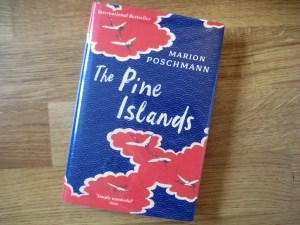 A man wakes up from a dream convinced that his wife is cheating on him, and sets off for Tokyo on a whim, where he embarks on a Bashō-inspired pilgrimage to the pine islands of Matsushima. This Gilbert Silvester, a beard historian, acquires an unlikely companion: a young man named Yosa, who’s looking for the best place to kill himself and takes Gilbert along to cliffs and forests famous for their suicide rates. Although there are still cherry blossoms and kabuki theatre, Gilbert soon learns that this isn’t Bashō’s Japan anymore.
From the haikus he composes and the letters he writes to Mathilda back home, we track his inward journey as it contrasts with the outward ones he undertakes. I enjoyed the surreal touches – Yosa says he once dated a woman who was actually a fox – and the Murakami setup (the wife’s adultery and the hair patterns are reminiscent of The Wind-Up Bird Chronicle).
Somehow, though, for me this is a book that succeeds more in its ideas (searching for the essence of a place but only finding the clichés; coniferous versus deciduous trees as a metaphor for what lasts in life versus what fades) than in its actual execution. It never all quite comes together, and the inconclusive ending makes you question how much of this has been a dream or a fantasy. It’s ambitious and intellectually impressive, but something about its dignified aloofness is hard to be enthusiastic about.
Do watch Lost in Translation, one of my favorite films, afterwards…
And a DNF: The Days of Abandonment by Elena Ferrante. The time has come to admit that I simply do not appreciate Ferrante’s work. I could only make it 25 pages into this one; I’ve read a different short novel of hers (The Lost Daughter), and skimmed another (My Brilliant Friend). While I enjoyed the narrator’s voice well enough, and loved the scene in which her errant husband finds broken glass in his dinner, I found that I had no interest in how this seemingly predictable story of the end of a marriage might play out.
Up next for Part II: The Wind that Lays Waste by Selva Almada, on its way from Charco Press, and The Awakening of Miss Prim by Natalia Sanmarin Fenollera.
Are you doing any special reading for Women in Translation month this year?
Too Male! (A Few Recent Reviews for Shiny New Books and TLS)
I tend to wear my feminism lightly; you won’t ever hear me railing about the patriarchy or the male gaze. But there have been five reads so far this year that had me shaking my head and muttering, “too male!” While aspects of these books were interesting, the macho attitude or near-complete dearth of women irked me. Two of them I’ve already written about here: Ernest Hemingway’s The Garden of Eden was a previous month’s classic and book club selection, while Chip Cheek’s Cape May was part of my reading in America. The other three I reviewed for Shiny New Books or the Times Literary Supplement; I give excerpts below, with links to visit the full reviews in two cases, plus ideas for a book or two by a woman that should help neutralize the bad taste these might leave.
Shiny New Books
The Way Home: Tales from a Life without Technology by Mark Boyle
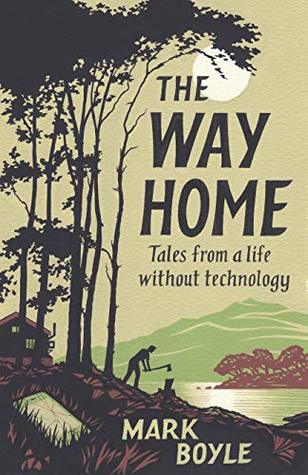 Boyle lives without electricity in a wooden cabin on a smallholding in County Galway, Ireland. He speaks of technology as an addiction and letting go of it as a detoxification process. For him it was a gradual shift that took place at the same time as he was moving away from modern conveniences. The Way Home is split into seasonal sections in which the author’s past and present intermingle. The writing consciously echoes Henry David Thoreau’s. Without even considering the privilege that got Boyle to the point where he could undertake this experiment, though, there are a couple of problems with this particular back-to-nature model. One is that it is a very male enterprise. Another is that Boyle doesn’t really have the literary chops to add much to the canon. Few of us could do what he has done, whether because of medical challenges, a lack of hands-on skills or family commitments. Still, the book is worth engaging with. It forces you to question your reliance on technology and ask whether making life easier is really a valuable goal.
 The Remedy: Homesick: Why I Live in a Shed by Catrina Davies, which I’m currently reading for a TLS review. Davies crosses Boyle’s Thoreauvian language about solitude and a place in nature with a Woolfian search for a room of her own. Penniless during the ongoing housing crisis, she moves into the shed near Land’s End that once served as her father’s architecture office and embarks on turning it into a home.
Doggerland by Ben Smith
 This debut novel has just two main characters: ‘the old man’ and ‘the boy’ (who’s not really a boy anymore), who are stationed on an enormous offshore wind farm. The distance from the present day is indicated in slyly throwaway comments like “The boy didn’t know what potatoes were.” Smith poses questions about responsibility and sacrifice, and comments on modern addictions and a culture of disposability. He has certainly captured something of the British literary zeitgeist. From page to page, though, Doggerland grew tiresome for me. There is a lot of maritime vocabulary and technical detail about supplies and maintenance. The location is vague and claustrophobic, the pace is usually slow, and there are repetitive scenes and few conversations. To an extent, this comes with the territory. But it cannot be ignored that this is an entirely male world. Fans of the themes and style of The Old Man and the Sea and The Road will get on best with Smith’s writing. I most appreciated the moments of Beckettian humor in the dialogue and the poetic interludes that represent human history as a blip in the grand scheme of things.
 The Remedy: I’m not a big fan of dystopian or post-apocalyptic fiction in general, but a couple of the best such novels that I’ve read by women are Station Eleven by Emily St. John Mandel and Gold Fame Citrus by Claire Vaye Watkins.
Times Literary Supplement
The Knife’s Edge: The Heart and Mind of a Cardiac Surgeon by Stephen Westaby
 In this somewhat tepid follow-up to Fragile Lives, Westaby’s bravado leaves a bad taste and dilutes the work’s ostensibly confessional nature. He has a good excuse, he argues: a head injury incurred while playing rugby in medical school transformed him into a risk taker. It’s widely accepted that such boldness may be a boon in a discipline that requires quick thinking and decisive action. So perhaps it’s no great problem to have a psychopath as your surgeon. But how about a sexist? Westaby’s persistent references to women staff as “lady GP” and “registrar lady” don’t mitigate surgeons’ macho reputation. It’s a shame to observe such casual sexism, because it’s clear Westaby felt deeply for his patients of any gender. And yet any talk of empathy earns his derision. It seems the specific language of compassion is a roadblock for him. The book is strongest when the author recreates dramatic sequences based on several risky surgeries. Alas, at its close he sounds bitter, and the NHS bears the brunt of his anger. Compared to Fragile Lives, one of my favorite books of 2017, this gives the superhero surgeon feet of clay. But it’s a lot less pleasing to read. (Forthcoming in TLS.)
 The Remedy: I’m keen to read Direct Red by Gabriel Weston, a memoir by a female surgeon.
(Crikey! This was my 600th blog post.)
Classic of the Month: Down and Out in Paris and London by George Orwell (1933)
I’d of course read Animal Farm and Nineteen Eighty-Four, but this was my first taste of George Orwell’s nonfiction. It was his first book, published when he was 30, and is an excellent first-hand account of the working and living conditions of the poor in two world cities. I started it on the Eurostar between London and Paris and have enjoyed dipping into it over the past couple of weeks. I most appreciated the first two-thirds, in which Orwell is working as a dishwasher and waiter in Paris hotel restaurants for up to 80 hours a week and has to pawn his clothes to scrape together enough money to ward off starvation. Chapter 3 is a masterful piece of writing that, with its second-person address, puts the reader right into this desperate situation with him. The matter-of-fact words about poverty and hunger are incisive:
Hunger reduces one to an utterly spineless, brainless condition, more like the after-effects of influenza than anything else. It is as though one had turned into a jellyfish, or as though all one’s blood had been pumped out and luke-warm water substituted. Complete inertia is my chief memory of hunger
Two bad days followed. We had only sixty centimes left, and we spent it on half a pound of bread, with a piece of garlic to rub it with. The point of rubbing garlic on bread is that the taste lingers and gives one the illusion of having fed recently.
It is disagreeable to eat out of a newspaper on a public seat, especially in the Tuileries, which are generally full of pretty girls, but I was too hungry to care.
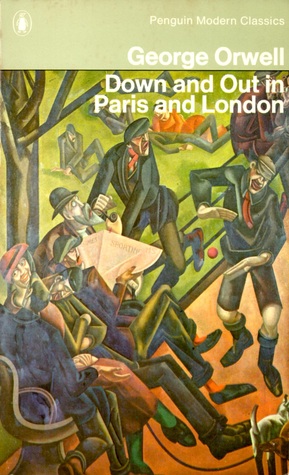 Even as he’s conveying the harsh reality of exhaustion and indignity, Orwell takes a Dickensian delight in people and their eccentricities. His pen portraits of those he associates with – Boris, a former captain in the Russian Army who is always coming up with new money-making schemes in Paris; Paddy, a tramp he falls in with in London; and Bozo, a “screever” (street painter) who “managed to keep his brain intact and alert, and so nothing could make him succumb to poverty” – are glistening passages enhanced by recreated dialogue. There are a few asides, such as a chapter about London slang and swearing, that break up the flow, and I might have liked more context about Orwell’s earlier and later life – how he slipped into poverty and how he worked his way out of it again – but he more than succeeds in his aim of exposing the truth of what it was like to be poor at that time.
Depressingly, though, this is not merely a period piece: well over 80 years later, the poor are still in danger of homelessness and enslavement to low wages and zero-hours contracts. No doubt it is still what Orwell refers to as a “dismal, demoralizing way of life,” and the poor “are ordinary human beings … if they are worse than other people it is the result and not the cause of [that] way of life.”
Our town has its fair share of the down-and-out, as was brought home to me just yesterday. My husband had an unpleasant encounter with a group of them when he tried remonstrating with a man who was cutting flowers in the community garden we’ve volunteered our time to create – the very day before the Britain in Bloom competition! When I dropped by later to help get the garden tidy for judging, they were still hanging about on the other side of the canal, smoking and drinking. Then I spotted with them an older woman who goes to our church. I’ve broken bread with her on a regular basis. She borrowed a couple of books from the theological library last week. And she must be a hair’s breadth away from homelessness, if not actually homeless. It felt like a wake-up call, a reminder that these people whose lives seem so hopelessly foreign are not as distant or as different as we might like to think.

George Orwell’s 1943 press photo. Branch of the National Union of Journalists (BNUJ). [Public domain]
My rating: 
Next month: The Go-Between by L.P. Hartley
Three Review Books: Brian Kimberling, Jessica Pan & Francesca Segal
Three May–June releases: A fish-out-of-water comic novel about teaching English in Prague; and memoirs about acting like an extrovert and giving birth to premature twins.
Goulash by Brian Kimberling
 “Look where we are. East meets West. Communism meets capitalism.” In 1998 Elliott Black leaves Indiana behind for a couple of years to teach English in Prague. The opening sequence, in which he discovers that his stolen shoes have been incorporated into an art installation, is an appropriate introduction to a country where bizarre things happen. Elliott doesn’t work for a traditional language school; his students are more likely to be people he meets in the pub or tobacco company executives. Their quirky, deadpan conversations are the highlight of the book.
Elliott starts dating a fellow teacher from England, Amanda (she “looked like azaleas in May and she spoke like the BBC World Service”), who also works as a translator. They live together in an apartment they call Graceland. Much of this short novel is about their low-key, slightly odd adventures, together and separately, while the epilogue sees Elliott looking back at their relationship from many years later.
I was tickled by a number of the turns of phrase, but didn’t feel particularly engaged with the plot, which was inspired by Kimberling’s own experiences living in Prague.
With thanks to Tinder Press for a proof copy to review.
Favorite passages:
“Sorrowful stories like airborne diseases made their way through the windows and under the doorframe, bubbled up like the bathtub drain. It was possible to fill Graceland with light and color and music and the smell of good food, and yet the flat was like a patient with some untreatable condition, and we got tired of palliative care.”
“‘It’s good to be out of Prague,’ he said. ‘Every inch drenched in blood and steeped in alchemy, with a whiff of Soviet body odor.’ ‘You should write for Lonely Planet,’ I said.”
Sorry I’m Late, I Didn’t Want to Come: An Introvert’s Year of Living Dangerously by Jessica Pan
 Like Jessica Pan, I’m a shy introvert (a “shintrovert”) as well as an American in the UK, so I was intrigued to see the strategies she employed and the experiences she sought out during a year of behaving like an extrovert. She forced herself to talk to strangers on the tube, give a talk at London’s Union Chapel as part of the Moth, use friendship apps to make new girlfriends, do stand-up comedy and improv, go to networking events, take a holiday to an unknown destination, eat magic mushrooms, and host a big Thanksgiving shindig.
Like Help Me!, which is a fairly similar year challenge book, it’s funny, conversational and compulsive reading that was perfect for me to be picking up and reading in chunks while I was traveling. Although I don’t think I’d copy any of Pan’s experiments – there’s definitely a cathartic element to reading this; if you’re also an introvert, you’ll feel nothing but relief that she’s done these things so you don’t have to – I can at least emulate her in initiating deeper conversations with friends and pushing myself to attend literary and networking events instead of just staying at home.
With thanks to Doubleday UK for a proof copy to review.
Mother Ship by Francesca Segal
I’m a big fan of Segal’s novels, especially The Innocents, one of the loveliest debut novels of the last decade, so I was delighted to hear she was coming out with a health-themed memoir about giving birth to premature twins. Mother Ship is a visceral diary of the first eight weeks in the lives of her daughters, who were born by Caesarean section at 29 weeks in October 2015 and spent the next two months in the NICU, “an extremely well-funded prison or perhaps more accurately a high-tech zoo.”
Segal strives to come to terms with this unnatural start to motherhood. “Taking my unready daughters from within me felt not like a birth but an evisceration,” she writes; “my children do not appear to require mothering. Instead they need sophisticated medical intervention.” She describes with tender precision the feeling of being torn: between the second novel she’d been in the middle of writing and the all-consuming nature of early parenthood; and between her two girls (known for much of the book as “A-lette” and “B-lette”), who are at one point separated in different hospitals.

Spotted at Philadelphia airport.
As well as portraying her own state of mind, Segal crafts twinkly pen portraits of the others she encountered in the NICU, including the staff but especially her fellow preemie mums, who met in a “milking shed” where they pumped breast milk for the babies they were so afraid of losing that they resisted naming. (Though it was touch and go for a while, A-lette and B-lette finally earned the names Raffaella and Celeste and came home safely.) Female friendship is a subsidiary theme in this exploration of desperate love and helplessness. The layman’s look at the inside workings of medicine would have made this one of my current few favorites for next year’s Wellcome Book Prize (which, alas, is on hiatus). After encountering some unpleasant negativity about the NHS in a recent read, I was relieved to find that Segal’s outlook is pure gratitude.
With thanks to Chatto & Windus for the free copy for review.
Would you be interested in reading one or more of these?
America Reading & Book Haul, Etc.
The wedding of a college friend – who I calculated I’ve known at least half my life – was the excuse we needed to book a trip back to the States for the last two weeks of May. Along with the classy nuptials in the Fell’s Point area of Baltimore, we enjoyed a day’s sightseeing in Philadelphia, a couple of outings to watch birds and other wildlife on Cape May (a migration hotspot in New Jersey), two meet-ups with other friends, and plenty of relaxation time with my mom and sister, including a Memorial Day picnic at my mom’s retirement community and a tour of Antietam Battlefield. It was much hotter than anticipated, including some days in the high 80s or even 90s, and the hayfever, ticks and mosquitoes were bad, too, but we survived.


While back in Maryland I continued the intermittent downsizing process I’ve been going through for a while now. After being on the market for nearly a year, my family home finally sold and went to closing while we were over there. So that provided a scrap of closure, but my current estrangement from my father (we don’t even know where he’s living) means there’s a lot of continuing uncertainty.
In any case, I managed to reduce the number of boxes I’m storing with my sister from 29 to 20 by recycling lots of my old schoolwork, consolidating my mementos, reselling one box of books and donating another, donating a box of figurines and decorative bottles to a thrift store, displaying some at my mom’s place, giving away a few trinkets to a friend’s kids, and packing a bunch of stuff – photo albums and decorations as well as 64 books – in our various suitcases and hand luggage to take back to the UK.


And I also acquired more books, of course! A whopping 46 of these were free: eight review copies were waiting for me at my mom’s place; three were from the outdoor free bin at 2nd & Charles, a secondhand bookstore; one was found in a Little Free Library near our friends’ place in New Jersey (Emerald City by Jennifer Egan, not pictured); and the rest were from The Book Thing of Baltimore, a legendary volunteer-run free bookshop. I mostly raided the biography section for an excellent selection of women’s life writing; the fiction is unalphabetized so harder to find anything in, but I picked up a few novels, too. My only purchases were new (remainder) copies of one novel and one memoir from Dollar Tree. Total book spending on the trip: just $2.12.
What I Read:
Two that I’d already started but finished on the plane ride over:
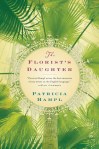 The Florist’s Daughter by Patricia Hampl: (As featured in my spring reading list.) “Love and flowers, death and flowers.” Poetic writing about small-town Minnesota life, a tense relationship with her late mother, and her late father’s flower shop.
 - The Girls by Lori Lansens: I love reading about sister relationships, and the Darlen girls’ situation is an extreme case of love and jealousy given that they literally can’t get away from each other. Not as good as the two other conjoined-twin novels I’ve read, Chang and Eng by Darin Strauss and Cutting for Stone by Abraham Verghese, but I would read more from Lansens, a solid Oprah Book Club sort of author.
Three review books that will be featuring here in the near future:
- Goulash by Brian Kimberling
- Sorry I’m Late, I Didn’t Want to Come: An Introvert’s Year of Living Dangerously by Jessica Pan
- Mother Ship by Francesca Segal
A few quick reads:
 A Certain Loneliness: A Memoir by Sandra Gail Lambert: (A proof copy passed on by an online book reviewing friend.) A memoir in 29 essays about living with the effects of severe polio. Most of the pieces were previously published in literary magazines. While not all are specifically about the author’s disability, the challenges of life in a wheelchair seep in whether she’s writing about managing a feminist bookstore or going on camping and kayaking adventures in Florida’s swamps. I was reminded at times of Constellations by Sinéad Gleeson.
  No Happy Endings: A Memoir by Nora McInerny: (Borrowed from my sister.) I didn’t appreciate this as much as the author’s first memoir, It’s Okay to Laugh, though it’s in the same style: lots of short, witty but bittersweet essays reflecting on life’s losses. Within a year of being widowed by cancer, she met a new partner and soon was – surprise! – pregnant with his baby. Together they formed a blended family of four children ranging from 0 to 15 and two wounded adults. McInerny also writes about her newfound spirituality and feminism. The problem with the essay format is that she cycles through aspects of the same stories multiple times.
  Native Guard by Natasha Trethewey: (Free from 2nd & Charles.) Trethewey writes beautifully disciplined verse about her mixed-race upbringing in Mississippi, her mother’s death and the South’s legacy of racial injustice. She occasionally rhymes, but more often employs forms that involve repeated lines or words. The title sequence concerns a black Civil War regiment in Louisiana. Two favorites from this Pulitzer-winning collection by a former U.S. poet laureate were “Letter” and “Miscegenation”; stand-out passages include “In my dream, / the ghost of history lies down beside me, // rolls over, pins me beneath a heavy arm” (from “Pilgrimage”) and “I return / to Mississippi, state that made a crime // of me — mulatto, half-breed” (from “South”).
 I also read the first half or more of: The Music Shop by Rachel Joyce, my June book club book; Hungry by Jeff Gordinier, a journalist’s travelogue of his foodie journeys with René Redzepi of Noma fame, coming out in July; and the brand-new novel In West Mills by De’Shawn Charles Winslow – these last two are for upcoming BookBrowse reviews.
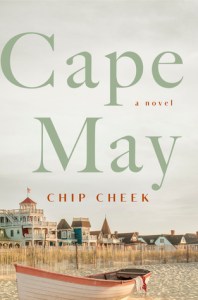
But the book I was most smug to have on my reading list for the trip was the recent novel Cape May by Chip Cheek. What could be more perfect for reading on location? I asked myself. Unfortunately, it stood out for the wrong reasons. In October 1957 a young pair of virgins, Effie and Henry, travel from Georgia to New Jersey for an off-season honeymoon in her uncle’s vacation home. They’re happy enough with each other but underwhelmed with the place (strangely, this matched my experience of Cape May), and even consider going home early until they fall in with Clara, a friend of Effie’s cousin; Clara’s lover, Max; and Max’s younger sister, Alma. Effie and Henry join the others for nightly drunken revelry.
[SPOILERS!] As the weeks pass Effie, ill and dejected, almost seems to disappear as Cheek delves into Henry’s besotted shenanigans, described in unnecessarily explicit sexual detail. When Effie makes a bid or two for her own sexual freedom late on, it only emphasizes the injustice of spending so much time foregrounding Henry’s perspective. Despite the strength of the period atmosphere and seaside location, this ends up being dull and dated. If you’re after a typically ‘trashy’ beach read and don’t mind lots of sex scenes, you may get on with it better than I did. 

Reading a few pages of Cape May over an ice-cold G&T at the wedding reception.
Bonus bookishness:
Vineland, New Jersey was on the way from our friends’ house to Cape May, so we stopped to take my proof copy of Barbara Kingsolver’s Unsheltered to its spiritual home. Alas, Vineland is an utterly boring small American town. However, Mary Treat at least appears on a painted mural on a building on the main street. The Historical Society, where Kingsolver did her research, was closed, but we photographed the outside.


What’s the last book you read ‘on location’? Did it work out well for you?
Four Recent Review Books: Flanery, James, Tota and Yuknavitch
Memoirs of adoption and a life steeped in trauma and sex; a metafictional mystery about an inscrutable artist and his would-be biographer; and a European graphic novel about a thief. You can’t say I don’t read a wide variety of books! See if one or more of these can tempt you.
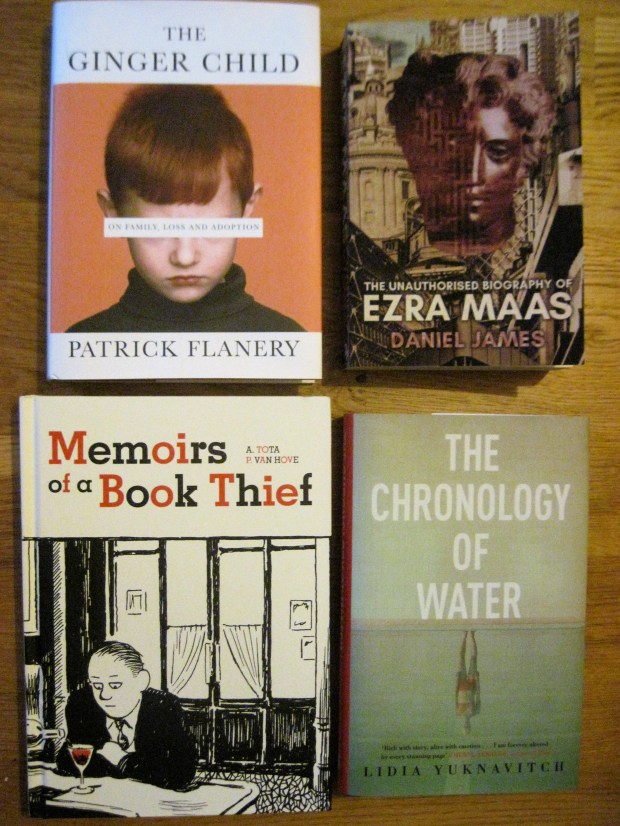
The Ginger Child: On Family, Loss and Adoption by Patrick Flanery
Patrick Flanery is a professor of creative writing at Queen Mary University of London and the author of four novels. In his first nonfiction book, he chronicles the arduous four-year journey he and his husband took to try and become parents. For a short time they considered surrogacy, but it’s so difficult in the UK that they switched tracks to domestic adoption.
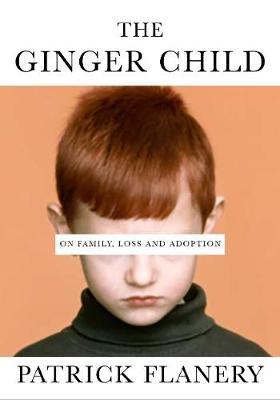 The resulting memoir is a somber, meditative book that doesn’t gloss over the difficulties of queer family-making, but also sees some potential advantages: to an extent, one has the privilege of choice – he and Andrew specified that they couldn’t raise a child with severe disabilities or trauma, but were fine with one of any race – whereas biological parents don’t really have any idea of what they’re going to get. However, same-sex couples are plagued by bureaucracy and, yes, prejudice still. Nothing comes easy. They have to fill out a 50-page questionnaire about their concerns and what they have to offer a child. A social worker humiliates them by forcing them to do a dance-off video game to prove that a pair of introverted, cultured academics can have fun, too.
Eventually there’s a successful match and they have tentative meetings with four-year-old O—, his parents’ fifth child, now in foster care. But this is not a blithe story of everything going right. I enjoyed the glimpses of Flanery’s growing-up years in Nebraska and the occasional second-person address to O—, but there is a lot more theory and cultural criticism than I expected, and much of the film talk, at least, feels like irrelevant asides.
With thanks to Atlantic Books for the free copy for review.
The Unauthorised Biography of Ezra Maas by Daniel James
This is a twisty, clever meta novel about “Daniel James” desperately trying to write a biography of Ezra Maas, an enigmatic artist who grew up a child prodigy in Oxford and attracted a cult following in 1960s New York City, where he was a friend of Warhol et al. But, with rumors abounding that The Maas Foundation is preparing to announce Ezra’s death in 2011, James finds that his subject’s story keeps shifting shape and even disappearing around him – as one interviewee tells him, “Maas is a black hole. His presence draws everything in, warps, destroys, changes, and rewrites it.”
 The book’s epistolary style deftly combines fragments of various document types: James’s biography-in-progress and an oral history he’s assembled from conversations with those who knew Maas, his narrative of his quest, transcripts of interviews and phone conversations, e-mails and more. All of this has been brought together into manuscript form by an anonymous editor whose presence is indicated through coy but increasingly tiresome long footnotes.
Look at the sort of authors who get frequent mentions in the footnotes, though, and you’ll get an idea of whether this might appeal to you: Paul Auster, Samuel Beckett, George Orwell and Thomas Pynchon. I enjoyed the noir atmosphere – complete with dream sequences and psychiatric evaluations – and the way that James the “writer-detective” has to careen around Europe and America looking for answers; it all feels rather like a superior Jason Bourne film.
My thanks to the author for sending a free signed copy for review.
Memoirs of a Book Thief by Alessandro Tota (illustrated by Pierre Van Hove)
[translated from the French by Edward Gauvin]
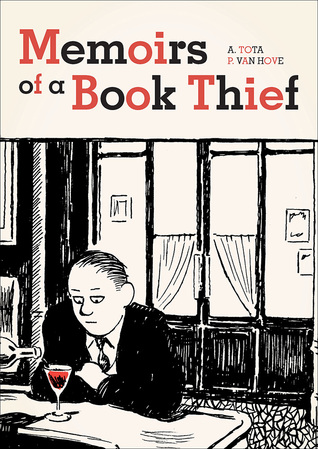 In April 1953, Daniel Brodin translates an obscure Italian poem in his head to recite at a poetry reading but, improbably, someone recognizes it. Soon afterwards, he’s also caught stealing a book from a shop. Just a little plagiarism and shoplifting? It might have stayed that way until he met Gilles and Linda, fellow thieves, and their bodyguard, Jean-Michel, a big blond goon with Gérard Dépardieu’s nose and haircut. Now he’s known as “Klepto” and is part of a circle that drinks at the Café Sully and mixes with avant-garde and Existentialist figures. He’s content with being a nobody and writing his memoirs (the book within the book) – until Jean-Michel makes him a proposition.
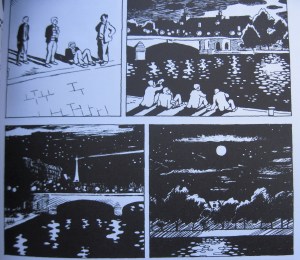
The book is entirely in black and white, which makes it seem unfinished, and the style is a little grotesque. For instance, Brodin is almost always depicted with beads of sweat rolling off his head. The intricate outdoor scenes were much more to my taste than the faces. The plot is also slightly thin and the ending abrupt. So, compared with many other graphic novels, this is not one I’m likely to recommend.
With thanks to SelfMadeHero for the free copy for review.
The Chronology of Water by Lidia Yuknavitch
This really blew me away. “Out of the sad sack of sad shit that was my life, I made a wordhouse,” Yuknavitch writes. Her nonlinear memoir ranges from her upbringing with an alcoholic, manic-depressive mother and an abusive father via the stillbirth of her daughter and her years of alcohol and drug use through to the third marriage where she finally got things right and allowed herself to feel love again after so much numbness. Reading this, you’re amazed that the author is still alive, let alone thriving as a writer.
 Ken Kesey, who led a collaborative novel-writing workshop in which she participated in the late 1980s, once asked her what the best thing was that ever happened to her. Swimming, she answered, because it felt like the only thing she was good at. In the water she was at home and empowered. Kesey reassured her that swimming wasn’t her only talent: there is some truly dazzling writing here, veering between lyrical stream-of-consciousness and in-your-face informality.
There are so many vivid sequences, but two that stood out for me were cutting down a tree the Christmas she was four and the way her mother turned her teeth-chattering crisis into a survival game, and the drunken collision she had after her second ex-husband told her he was seeing a 23-year-old. With the caveat that this is extremely explicit stuff (the author is bisexual; there’s an all-female threesome and S&M parties), I would still highly recommend it to readers of Joan Didion, Anne Lamott and Maggie Nelson. The watery metaphor flowing through, as one woman learns to float free of what once threatened to drown her, is only part of what makes it unforgettable. You’ll marvel at what a memoir can do. 
A couple of favorite passages:
“It is possible to carry life and death in the same sentence. In the same body. It is possible to carry love and pain. In the water, this body I have come to slides through the wet with a history. What if there is hope in that?”
“Make up stories until you find one you can live with. Make up stories as if life depended on it.”
With thanks to Canongate for the free copy for review.
Would you be interested in reading one or more of these?
A Bouquet of Spring Reading
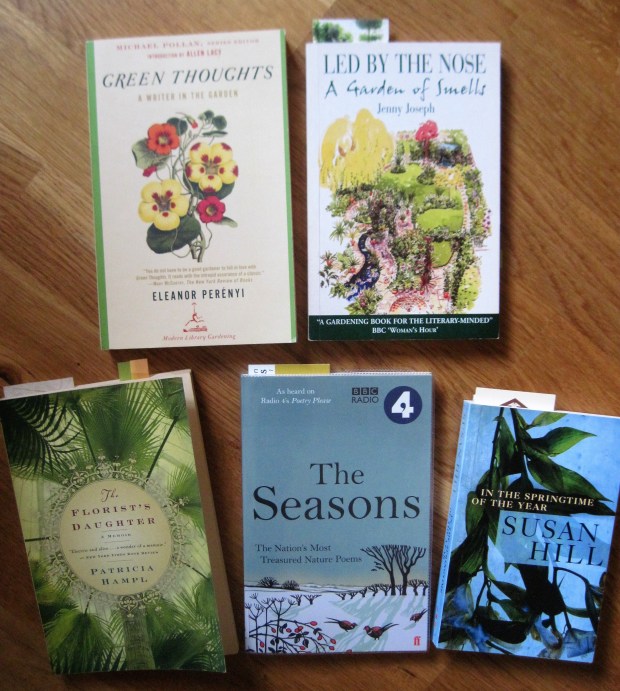
In March through May I often try to read a few gardening-themed books and/or ones with “spring” in the title. Here are some of the ones that I have on the go as occasional reading:
Flowers and gardens
The Florist’s Daughter by Patricia Hampl: Her mother’s final illness led Hampl to reflect on her upbringing in St. Paul, Minnesota as the daughter of an Irish Catholic library clerk and a Czech florist. I love how she writes about small-town life and helping out in her father’s flower shop:
“These apparently ordinary people in our ordinary town, living faultlessly ordinary lives … why do I persist in thinking—knowing—they weren’t ordinary at all? … Nostalgia is really a kind of loyalty”
“it was my father’s domain, but it was also marvelously other, this place heavy with the drowsy scent of velvet-petaled roses and Provençal freesias in the middle of winter, the damp-earth spring fragrance of just-watered azaleas and cyclamen”
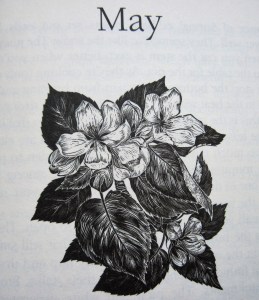 Led by the Nose: A Garden of Smells by Jenny Joseph: Joseph’s name might not sound familiar, but she was the author of the famous poem “Warning: When I Am an Old Woman I Shall Wear Purple” and died early last year. This is a pleasant set of short pieces about what you might see and sense in your garden month by month. “Gardeners do indeed look before and after, at the same time living, as no one else, in the now of the nose,” she maintains. I’m particularly fascinated by the sense of smell and how a writer can describe odors, so I was delighted to find this in a charity shop in Edinburgh last year and have been reading it a few pages at a time as a bedside book. I especially like the wood engravings by Yvonne Skargon that head each chapter.
Green Thoughts: A Writer in the Garden by Eleanor Perényi: A somewhat dense collection of few-page essays, arranged in alphabetical order, on particular plants, tools and techniques. I tried reading it straight through last year and only made it as far as “Beans.” My new strategy is to keep it on my bedside shelves and dip into whichever pieces catch my attention. I don’t have particularly green fingers, so it’s not a surprise that my eye recently alighted on the essay “Failure,” which opens, “Sooner or later every gardener must face the fact that certain things are going to die on him. It is a temptation to be anthropomorphic about plants, to suspect that they do it to annoy.”
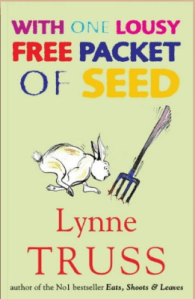 With One Lousy Free Packet of Seed by Lynne Truss (DNF at page 131 out of 210): A faltering gardening magazine is about to be closed down, but Osborne only finds out when he’s already down in Devon doing the research for his regular “Me and My Shed” column with a TV actress. Hijinks were promised as the rest of the put-out staff descend on Honiton, but by nearly the two-thirds point it all still felt like preamble, laying out the characters and their backstories, connections and motivations. My favorite minor character was Makepeace, a pugnacious book reviewer: “he used his great capacities as a professional know-all as a perfectly acceptable substitute for either insight or style.”
Spring
The Seasons, a Faber & Faber / BBC Radio 4 poetry anthology: From Chaucer and other Old English poets to Seamus Heaney (“Death of a Naturalist”) and Philip Larkin (“The Trees”), the spring section offers a good mixture of recent and traditional, familiar and new. A favorite passage was “May come up with fiddle-bows, / May come up with blossom, / May come up the same again, / The same again but different” (from “Nuts in May” by Louis MacNeice). Once we’re back from America I’ll pick up with the summer selections.
In the Springtime of the Year by Susan Hill: Early one spring, Ruth Bryce’s husband, Ben, dies in a forestry accident. They had only been married a year and here she is, aged twenty-one and a widow. Ben’s little brother, 14-year-old Jo, is a faithful visitor, but after the funeral many simply leave Ruth alone. I’m 100 pages in and still waiting for there to be a plot as such; so far it’s a lovely, quiet meditation on grief and solitude amid the rhythms of country life. Ben’s death is described as a “stone cast into still water,” and here at nearly the halfway point we’re seeing how some of the ripples spread out beyond his immediate family. I’m enjoying the writing more than in the three other Hill books I’ve read.
 Absent in the Spring by Mary Westmacott: (The title doesn’t actually have anything to do with the season; it’s a quotation from Shakespeare’s Sonnet 98: “From you have I been absent in the spring.”) From 1944, this is the third of six novels Agatha Christie published under the alias Mary Westmacott. Joan Scudamore, traveling back to London from Baghdad after a visit to her adult daughter, encounters bad weather and misses her train, which leaves her stranded in the desert for days that feel more like weeks. We’re led back through scenes from Joan’s earlier life and realize that she’s utterly clueless about what those closest to her want and think. Rather like Olive Kitteridge, Joan is difficult in ways she doesn’t fully acknowledge. Like a desert mirage, the truth of who she’s been and what she’s done is hazy, and her realization feels a little drawn out and obvious. Once she gets back to London, will she act on what she’s discovered about herself and reform her life, or just slip back into her old habits? This is a short and immersive book, and a cautionary tale to boot. It examines the interplay between duty and happiness, and the temptation of living vicariously through one’s children.
 Bookish Beck = Rebecca Foster. American transplant to England. Freelance proofreader and book reviewer.
