My Top 10 Nonfiction Reads of 2017
Below I’ve chosen my seven favorite nonfiction books published in 2017, followed by three older titles that I only recently discovered. Many of these books have already featured on the blog in some way over the course of the year. To keep it simple for myself as well as for all of you who are figuring out whether you’re interested in these books or not, I’m mostly limiting myself to two sentences per title: the first is a potted summary; the second tells you why you should read it. I also link to any full reviews.
-
 Landslide: True Stories by Minna Zallman Proctor: This gorgeous set of autobiographical essays circles through some of the overarching themes of the author’s life: losing her mother, a composer; the importance Italy had for both of them; a love for the work of Muriel Spark; their loose connection to Judaism; and the relentless and arbitrary nature of time. Proctor provides a fine example of how to write a non-linear memoir that gets to the essence of what matters in life.
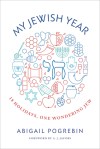 My Jewish Year by Abigail Pogrebin: From September 2014 to September 2015, Pogrebin celebrated all the holidays in the Jewish calendar, drawing thematic connections and looking for the resonance of religious rituals might have in her daily life. This bighearted, open-minded book strikes me as a perfect model for how any person of faith should engage with their tradition: not just offering lip service and grudgingly showing up to a few services a year, but knowing what you believe and practice, and why.
-

The U.S. cover
In Pursuit of Memory: The Fight against Alzheimer’s by Joseph Jebelli: With the world’s population aging, it is expected that by 2050 Alzheimer’s will be the second leading cause of death after heart disease. Research neurologist Joseph Jebelli gives a thorough survey of the history of Alzheimer’s and the development of our efforts to treat and even prevent it, but balances his research with a personal medical story any reader can relate to – his beloved grandfather, Abbas, succumbed to Alzheimer’s back in Iran in 2012. (See my full review for BookBrowse.)
 My Life with Bob by Pamela Paul: Whether she was hoarding castoffs from her bookstore job, obsessing about ticking off everything in the Norton Anthology, despairing that she’d run out of reading material in a remote yurt in China, or fretting that her new husband took a fundamentally different approach to the works of Thomas Mann, Paul (the editor of the New York Times Book Review) always looks beyond the books themselves to ask what they say about her. It’s just the sort of bibliomemoir I wish I had written.
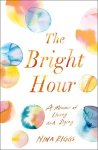 The Bright Hour by Nina Riggs: Beautiful prose enhances this literary and philosophical approach to terminal cancer. Riggs was a great-great-great-granddaughter of Ralph Waldo Emerson and quotes from her ancestor’s essays as well as from Michel de Montaigne’s philosophy to put things into perspective; she’s an expert at capturing the moments that make life alternately euphoric and unbearable – and sometimes both at once.
 Fragile Lives by Stephen Westaby: This is a vivid, compassionate set of stories culled from the author’s long career in heart surgery with the Grim Reaper looking on. I am not a little envious of all that Westaby has achieved: not just saving the occasional life despite his high-mortality field – as if that weren’t enough – but also pioneering various artificial heart solutions and a tracheal bypass tube that’s named after him.
And my nonfiction book of the year was:
1. The Shadow in the Garden: A Biographer’s Tale by James Atlas: I read this in August, planning to contrast it with Claire Tomalin’s A Life of My Own, another biographer’s memoir, for the LARB. It would have been a brilliant article, believe me. But they didn’t bite, and by the time I approached the TLS they’d already arranged coverage of the books. Alas! Such is the life of a freelancer. Since then I’ve struggled to know what to say about Atlas’s book that would explain why I loved it so much that my paperback proof is riddled with Post-It flags. (It’s going to take more than a couple of sentences…)
Much more so than Tomalin, Atlas gave me a real sense of what it’s like to immerse yourself in another person’s life. He made it up as he went along: he was only 25 when he got the contract to write a biography of the poet Delmore Schwartz, who died a penniless alcoholic at age 52. Writing about the deceased was a whole different matter to engaging with a living figure, as Atlas did when he wrote his biography of Saul Bellow in the 1990s.
 Atlas perceptively explores the connections between Schwartz and Bellow (Schwartz was the model for the protagonist of Bellow’s 1975 Pulitzer winner, Humboldt’s Gift) and between Bellow and himself (a Chicago upbringing with Russian Jewish immigrant ancestors), but also sets his work in the context of centuries of biographical achievement – from Boswell’s The Life of Samuel Johnson through master biographers like Richard Holmes, Leon Edel and Richard Ellmann (Atlas’s supervisor during his fellowship at Oxford) to recent controversial biographies of Robert Frost and Vladimir Nabokov.
This book deals with the nitty-gritty of archival research and how technology has changed it; Atlas also talks story-telling strategies and the challenge of impartiality, and ponders how we look for the patterns in a life that might explain what, besides genius, accounts for a writer’s skill. Even the footnotes are illuminating, and from the notes I learned about a whole raft of biographies and books on the biographer’s trade that I’d like to read. After I finished reading it I spent a few days dreamily wondering if I might write a biography some day. For anyone remotely interested in life writing, pick this up with my highest recommendation.
I’ll make it up to an even 10 with a few backlist titles I also loved:
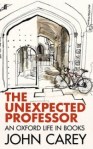 The Unexpected Professor: An Oxford Life in Books by John Carey (2014): Carey gives a thorough picture of events from his personal and professional life, but the focus is always on his literary education: the books that have meant the most to him and the way his taste and academic specialties have developed over the years. Ultimately what this book conveys is the joy of being a lifelong reader.
 A Sand County Almanac and Sketches Here and There by Aldo Leopold (1949): So many of Leopold’s musings ring true today: how we only appreciate wildlife if we can put an economic value on it, the troubles we get into when we eradicate predators and let prey animals run rampant, and the danger of being disconnected from the land that supplies our very life. And all this he delivers in stunning, incisive prose.
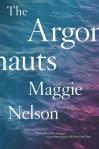 The Argonauts by Maggie Nelson (2015): An exquisite interrogation of gender identity and an invaluable reminder that the supposed complications of making a queer family just boil down to your basic human experiences of birth, love and death. I preferred those passages where Nelson allows herself to string her fragments into more extended autobiographical meditations, like the brilliant final 20 pages interspersing her memories of giving birth to her son Iggy with an account of the deathbed vigil her partner (artist Harry Dodge) held for his mother; it had me breathless and in tears, on a plane of all places.
What were some of your top nonfiction reads of the year?
Tomorrow I’ll be posting my Library Checkout a few days early.
Next week’s planned posts:
26th: Doorstopper of the Month
27th: Top fiction of the year list
28th: Runners-up and other superlatives
29th: Early 2018 recommendations
30th: Final statistics on my 2017 reading
Christmas Gift Recommendations for 2017
Something tells me my readers are the sort of people who buy books for their family and friends at the holidays. Consider any rating of 3.5 or above on this blog a solid recommendation; 3 stars is still a qualified recommendation, and by my comments you should be able to tell whether the book would be right for you or a friend. I’ll make another plug for the books I’ve already mentioned here as gift ideas and highlight other books I think would be ideal for the right reader. I read all these books this year, and most were released in 2017, but I have a few backlist titles, too – in those cases I’ve specified the publication year. Since I recommend fiction all the time through my reviews, I’ve given significantly more space to nonfiction.
General suggestions:
 For the Shiny New Books Christmas special I chose two books I could see myself giving to lots of people. One was A Glorious Freedom: Older Women Leading Extraordinary Lives by Lisa Congdon, my overall top gift idea. It’s a celebration of women’s attainments after age 40, especially second careers and late-life changes of course. There’s a lively mixture of interviews, first-person essays, inspirational quotes, and profiles of figures like Vera Wang, Laura Ingalls Wilder and Grandma Moses, with Congdon’s whimsical drawings dotted all through. This would make a perfect gift for any woman who’s feeling her age, even if that’s younger than 40. (An essay on gray hair particularly hit home for me.) It’s a reminder that great things can be achieved at any age, and that with the right attitude, we will only grow in confidence and courage over the years. (See my full Nudge review.)
 One Year Wiser: An Illustrated Guide to Mindfulness by Mike Medaglia
Drawn like an adult coloring book, this mindfulness guide is divided into color-block sections according to the seasons and tackles themes like happiness, gratitude, fighting anxiety and developing a healthy thought life. The layout is varied and unexpected, with abstract ideas represented by bodies in everyday situations. It’s a fresh delivery of familiar concepts.


My thanks to SelfMadeHero for the free copy for review.
An Almost Perfect Christmas by Nina Stibbe
 With its short chapters and stocking stuffer dimensions, this is a perfect book to dip into over the holidays. The autobiographical pieces involve Stibbe begrudgingly coming round to things she’s resisted, from Slade’s “Merry Xmas Everybody” to a flaming Christmas pudding. The four short stories, whether nostalgic or macabre, share a wicked sense of humor. You’ll also find an acerbic shopping guide and – best of all – a tongue-in-cheek Christmas A-to-Z. Nearly as funny as Love, Nina. (I reviewed this for the Nov. 29th Stylist “Book Wars” column.)
For some reason book- and nature-themed books seem to particularly lend themselves to gifting. Do you find that too?
For the fellow book and word lovers in your life:
 The Diary of a Bookseller by Shaun Bythell
It’s a pleasure to spend a vicarious year running The Book Shop in Wigtown, Scotland with the curmudgeonly Bythell. I enjoyed the nitty-gritty details about acquiring and pricing books, and the unfailingly quirky customer encounters. This would make a great one-year bedside book. (See my full review.)
The Cabinet of Linguistic Curiosities: A Yearbook of Forgotten Words by Paul Anthony Jones
 Another perfect bedside book: this is composed of daily one-page entries that link etymology with events from history. I’ve been reading it a page a day since mid-October. A favorite word so far: “vandemonianism” (rowdy, unmannerly behavior), named after the penal colony of Van Diemen’s Land (Tasmania), first sighted by Europeans on 24 November 1642.
“The Gifts of Reading” by Robert Macfarlane (2016)
 This was my other Christmas recommendation for Shiny New Books. A love of literature shared with friends and the books he now gifts to students and a new generation of nature writers are the main themes of this perfect essay. First printed as a stand-alone pamphlet in aid of the Migrant Offshore Aid Station, this is just right for slipping in a stocking.
A Girl Walks into a Book: What the Brontës Taught Me about Life, Love, and Women’s Work by Miranda K. Pennington
 This charming bibliomemoir reflects on Pennington’s two-decade love affair with the work of the Brontë sisters, especially Charlotte. It cleverly gives side-by-side chronological tours through the Brontës’ biographies and careers and her own life, drawing parallels and noting where she might have been better off if she’d followed in Brontë heroines’ footsteps.
For the nature enthusiasts in your life:
A Sand County Almanac and Sketches Here and There by Aldo Leopold
Few know how much of our current philosophy of wilderness and the human impact on the world is indebted to Aldo Leopold. This was first published in 1949, but it still rings true. A month-by-month account of life in Wisconsin gives way to pieces set everywhere from Mexico to Manitoba. Beautiful, incisive prose; wonderful illustrations by Charles W. Schwartz.
The History of Bees by Maja Lunde
 Blending historical, contemporary and future story lines, this inventive novel, originally published in Norway in 2015, is a hymn to the dying art of beekeeping and a wake-up call about the environmental disaster the disappearance of bees signals. The plot strands share the themes of troubled parenthood and the drive to fulfill one’s purpose. Like David Mitchell, Lunde juggles her divergent time periods and voices admirably. It’s also a beautifully produced book, with an embossed bee on the dust jacket and a black and gold honeycomb pattern across the spine and boards. (See my full Bookbag review.)
 Epitaph for a Peach: Four Seasons on My Family Farm by David Mas Masumoto (1995)
Masumoto is a third-generation Japanese-American peach and grape farmer in California. He takes readers on a quiet journey through the typical events of the farming calendar. It’s a lovely, meditative book about the challenges and joys of this way of life. I would highly recommend it to readers of Wendell Berry.
A Wood of One’s Own by Ruth Pavey
 This pleasantly meandering memoir, an account of two decades spent restoring land to orchard in Somerset, will appeal to readers of modern nature writers. Local history weaves through this story, too: everything from the English Civil War to Cecil Sharp’s collecting of folk songs. Bonus: Pavey’s lovely black-and-white line drawings. (See my full review.)
It’s not just books…
There are terrific ideas for other book-related gifts at Sarah’s Book Shelves and Parchment Girl.
 With this year’s Christmas money from my mother I bought the five-disc back catalogue of albums from The Bookshop Band. I crowdfunded their nine-disc, 100+-track recording project last year; it was money extremely well spent. So much quality music, and all the songs are based on books. I listen to these albums all the time while I’m working. I look forward to catching up on older songs I don’t know. Check out their Bandcamp site and see if there’s a physical or digital album you’d like to own or give to a fellow book and music lover. They played two commissioned songs at the launch event for The Book of Dust: La Belle Sauvage, so if you’re a Philip Pullman fan you might start by downloading those.
Would you like to give – or get – any of my recommendations for Christmas?
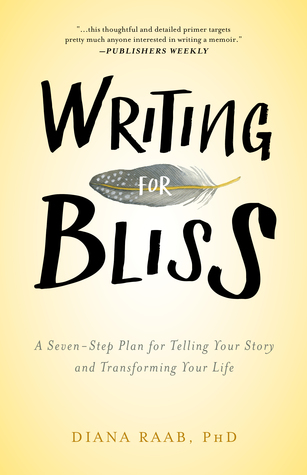
Writing for Bliss by Diana Raab
For Diana Raab, writing has been a way of coping with all that life has thrown at her, starting with her grandmother’s suicide and also including her daughter’s drug addiction and two bouts with cancer. She’s written poetry, memoir, and various books on the writer’s craft, with the latest, Writing for Bliss, specifically centered around life writing and mindfulness. In particular, I could see this one being helpful supplementary reading for those who have enjoyed Francine Prose’s Reading like a Writer and Mary Karr’s The Art of Memoir.
 Some keywords Raab emphasizes are patience, journey, healing, and transformation. Writing is often a long process, but it can also be a therapeutic one. It’s important to find a sacred space of one’s own – whether literal like Virginia Woolf’s room of one’s own, or simply a repurposed space that has been made conducive with candles and family photos. Raab encourages would-be memoir writers to look at the patterns in their lives and to focus on writing about moments that are relevant to the story of their personal growth.
As to the nitty-gritty of getting words onto the page, she insists that life writing is just as much about storytelling as fiction is. Fleshing out a story is more important than chronological accuracy, and she advises striving for a mixture of narrative, dialogue, scenes and reflection so that the resulting book does not seem like just a list of facts and events.
Raab also issues warnings. One is about causing offense by revealing family secrets. She suggests consulting the family members you intend to write about beforehand, and later running a rough draft past them for their approval. Another is about the danger of seeking one’s self-worth in publishing. Not all books lead to traditional publication, so it’s better if you write out of love and for yourself, simply because you find fulfillment in creativity.
This is a practical as well as a theoretical guide: 50 writing prompts are dotted through the text, and there’s also an appendix full of more. I’m someone who doesn’t necessarily aspire to write fiction, so I usually skip over such sections in a book about writing, but I think many of these could make a great launch pad for writing a personal essay. The book also ends with a terrific 15-page inventory of further reading, including a list of recommended memoirs.
My rating: 
Writing for Bliss was published by Loving Healing Press on September 1st. My thanks to the author for the free e-copy for review.
I’ve hoarded a number of books about writing on my Kindle, including:
- The Hero Is You by Kendra Levin
- Scratch, ed. by Manjula Martin
- Part Wild by Deb Norton
- Process by Sarah Stodola
Have you read any of these? What other books about writing have you read that you can vouch for?
I’ve read a lot of the classics – Dorothea Brande, Stephen King, Anne Lamott et al. – but I’m always interested to hear what similar books people have found to be helpful.
Four Recommended September Releases
Here are four enjoyable books due out this month that I was lucky enough to read early. The first two are memoirs that are linked by a strong theme of mothers and children, though one has a primary topic of mental illness; the third is a quirky bibliomemoir partially written in letters; and the last is an elegant poetry collection. I’ve pulled 150–200-word extracts from my full reviews and hope you’ll be tempted by one or more of these.
Gorilla and the Bird: A Memoir of Madness and a Mother’s Love, by Zack McDermott
(Coming from Little, Brown [USA] and Piatkus [UK] on the 26th)
 As a public defender in New York City, Zack McDermott worked with seemingly crazy people every day at Legal Aid, little knowing that he was on his way to a psychotic break himself. Soon he’d covered the walls of his apartment with marker scrawl and fully taken on his stand-up comedian persona, Myles. Convinced that he was in a Truman Show-style reality show, he ended up half-naked and crying on a subway platform. That’s when police showed up to take him to Bellevue mental hospital.
McDermott takes readers on a wild tour through his life: from growing up with a no-good drug addict father and a Superwoman high school teacher mother in Wichita, Kansas “a baloney sandwich throw from the trailer park” to finally getting medication and developing strategies that would keep his bipolar disorder under control. His sense of pace and ear for dialogue are terrific. Despite the vivid Cuckoo’s Nest-style settings, this book is downright funny where others might turn the subject matter achingly sad. It’s a wonderful memoir and should attract readers who don’t normally read nonfiction. (An explanatory note: “Gorilla” is McDermott’s nickname and “The Bird” is his mother’s; she’s the real hero of this book.)
My rating: 
Landslide: True Stories, by Minna Zallman Proctor
(Coming from Catapult on the 19th)
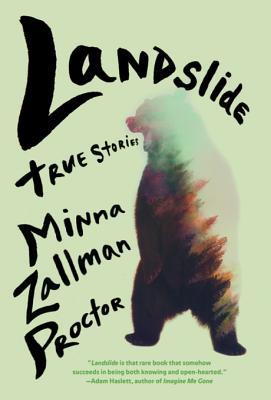 This gorgeous set of autobiographical essays circles through some of the overarching themes of Proctor’s life: losing her mother, a composer – but only after three bouts with cancer over 15 years; the importance Italy had for both of them, including years spent in Tuscany and her work as a translator; a love for the work of Muriel Spark; their loose connection to Judaism; and the relentless and arbitrary nature of time. She ponders the stories she heard from her mother, and the ones she now tells her children. “We all have totemic stories. The way we choose them—and then choose to tell them—is more important ultimately than the actual events.” Proctor provides a fine model of how to write non-linear memoir that gets to the essence of what matters in life.
Another favorite line:
“I was never good at making stuff up; I’m much more interested in parsing the density, inanity, confusion, and occasional brilliance of life around me.”
My rating:
Dear Fahrenheit 451: Love and Heartbreak in the Stacks, by Annie Spence
(Coming from Flatiron Books on the 26th, and in the UK on Oct. 13th)
Dear Annie Spence,
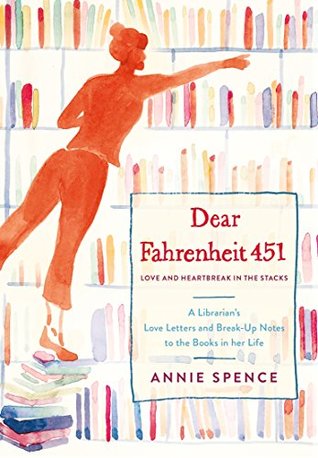 You’re on your way to being the next Nancy Pearl, girlie. Your book recommendations are amazeballs! How have you read so many books I’ve never even heard of?! Thanks to you I’ve added 13 books to my TBR when I’m desperately trying to cull it. Argh!
Anyway, gotta be honest here: I wasn’t digging the snarky, sweary style of the letter section of your book. True, it’s super clever how you use the epistolary format for so many different purposes – to say sayonara to books weeded from your public library’s stock, declare undying love for The Virgin Suicides and other faves, express mixed feelings about books you abandoned or didn’t get the appeal of, etc. – but, I dunno, the chatty, between-girlfriends style was irking me.
But then I got to Part II, where you channel Ms. Pearl and the authors of The Novel Cure with these original suggestions for themed and paired reading. Here’s books to read after making various excuses for not joining a social event, recommended sci-fi and doorstoppers (aka “Worth the Weight”), etc. I freakin’ loved it.
When’s your full-length Book Lust-style thematic recommendations guide coming out??
Happy reading until then!
Bookish Beck
My rating:
Panicle, by Gillian Sze
(Coming from ECW Press on the 19th)
 Gillian Sze is a Montreal poet with five collections to her name. Panicle contains many responses to films, photographs, and other poems, including some classical Chinese verse. Travel and relationships are recurring sources of inspiration, and scenes are often described as if they are being captured by a camera. There are a number of prose paragraphs, including the “Sound No. 1–5” series. As lovely as the writing is, I found few individual poems to latch onto. Two favorites were “Nocturne,” which opens “When I can’t sleep I think of the lupines that grow in the country, their specific palette, a mix of disregard and generosity” [the line breaks are unclear in my Kindle book], and “Dawning.” My favorite lines were “memory is a wicker chair that creaks in the wind” (from “To the Photographer in the Countryside”) and “I age / as it is typically done: slowly / unconsciously / surprisingly” (from the title poem).
My rating:
In case you’re curious, here are some September releases I can’t recommend quite as highly, with links to my Goodreads reviews:
- bone by Yrsa Daley-Ward [poetry]

- Afterglow (a Dog Memoir) by Eileen Myles
- George and Lizzie by Nancy Pearl

Have you read any September releases that you would recommend? Which of these appeal to you?
Some Accidental Thematic Overlaps in My Recent Reading
Five of the books I’ve read recently (most of them while traveling to and from the States) have shared an overarching theme of loss, with mental illness, alcoholism, suicide, and dogs as subsidiary topics running through two or more of them. I hadn’t deliberately chosen these books for their commonalities, so it was uncanny to see the same elements keep popping up. I wanted to come up with some kind of impressively complex Venn diagram to show off these unexpected connections but couldn’t quite manage it, so you’ll have to imagine it instead.
Mental Illness
The Archivist by Martha Cooley
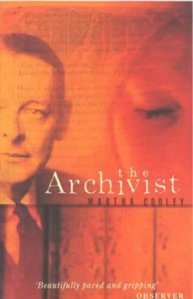 Matthias Lane is the archivist of the Mason Room, a university collection of rare books and literary papers. One of its treasures is a set of letters that passed between T.S. Eliot and his friend Emily Hale (held at Princeton in real life). Matt is haunted by memories of his late wife, Judith, a poet incarcerated in a mental hospital for over five years. A reckoning comes for Matt when he’s approached by Roberta Spire, a graduate student determined to view the Eliot–Hale letters even though they’re legally sealed until 2020. The more time Matt spends with Roberta, the more similarities start to arise between her and Judith; and between his situation and Eliot’s when the latter also put his wife away in a mental hospital. The novel asks what we owe the dead: whether we conform to their wishes or make our own decisions.
The Summer without Men by Siri Hustvedt
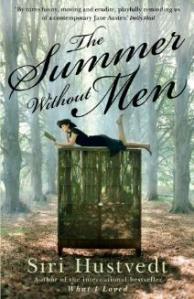 Thirty years on, poet Mia Fredricksen’s husband Boris asks her for a pause in their marriage so he can explore his feelings for his young French lab assistant. First things first: Mia goes crazy and ends up in a mental hospital for a short time. But then she sucks it up and goes back to her Minnesota hometown to teach poetry writing to teen girls for a summer, getting sucked into a bullying drama. This is a capable if not groundbreaking story of the shifts that occur in a long marriage and the strange things we all do as we face down the possibility of death. There are also wry comments about the unappreciated talents of the female artist. However, compared to the other two novels I’ve read from Hustvedt, this seemed feeble. Still, a quick and enjoyable enough read.
The Dogs of Babel by Carolyn Parkhurst
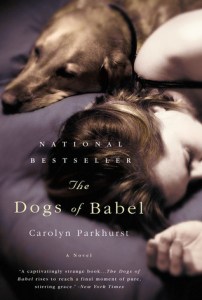 A delicious debut novel intellectual enough to bypass labels like ‘women’s fiction’ and ‘mystery’. One thing that sets it apart is how successfully Parkhurst writes from the perspective of a male narrator, Paul Iverson, who’s been knocked for six by the sudden death of his wife Lexy, a mask designer. While he was at the university where he teaches linguistics, she climbed to the top of the apple tree in their backyard and – what? fell? or jumped? The only ‘witness’ was their Rhodesian Ridgeback, Lorelei; in his grief Paul uses his sabbatical to research efforts to teach dogs to communicate, hoping one day Lorelei might tell all. Woven through are scenes from Paul and Lexy’s courtship and marriage; though Lexy occasionally struggled with her mental health, their dialogue is fun and zippy, like you might hear on The Gilmore Girls.
Suicide
The Archivist by Martha Cooley & The Dogs of Babel by Carolyn Parkhurst


Alcoholism
Don’t Let’s Go to the Dogs Tonight by Alexandra Fuller
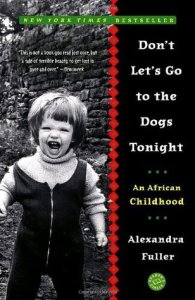 A classic memoir that conjures up all the sights, sounds, smells and feelings of Africa on the cusp of a colonial to postcolonial transition. Fuller’s family were struggling tobacco and cattle farmers in Rhodesia (Zimbabwe), Malawi and Zambia. She had absorbed the notion that white people were there to benevolently shepherd the natives, but came to question it when she met Africans for herself. While giving a sense of the continent’s political shifts, she mostly focuses on her own family: the four-person circus that was Bobo (that’s her), Van (older sister Vanessa), Dad, and Mum (an occasionally hospitalized manic-depressive alcoholic who lost three children) – not to mention an ever-changing menagerie of horses, dogs and other pets. This really takes you away to another place and time, as the best memoirs do, and the plentiful black-and-white photos are a great addition.
Let’s Take the Long Way Home by Gail Caldwell
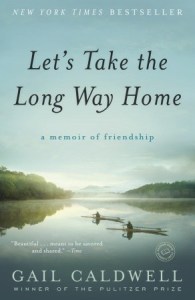 If you loved Ann Patchett’s Truth and Beauty, pick this up immediately. It’s a similar story of best friends: one who dies and one who survives. Caldwell’s best friend was Caroline Knapp (author of Drinking: A Love Story, among other nonfiction), whom she met via puppy ownership in Cambridge, Massachusetts. They were both single and childless, full-time authors with a history of alcoholism. Besides long walks with their dogs, they loved swimming and rowing together. In 2002 Caroline was diagnosed with stage-four lung cancer, inoperable and already metastasized. Despite all their proactive optimism, she was dead a matter of weeks later. In this moving and accessible short memoir, Caldwell drifts through her past, their friendship, Caroline’s illness, and the years of grief that followed the loss of Caroline and then her beloved Samoyed, Clementine, sharing what she learned about bereavement.
Dogs
The Dogs of Babel, Don’t Let’s Go to the Dogs Tonight & Let’s Take the Long Way Home


Do you ever find coincidental thematic connections in your reading?
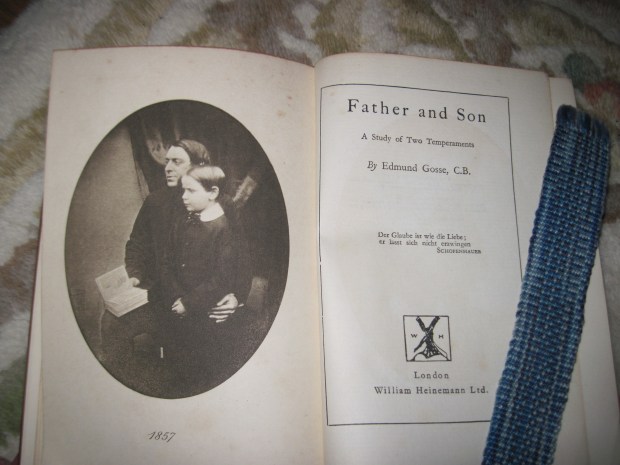
Classic of the Month: Father and Son by Edmund Gosse
I can’t believe how long it’s taken me to get to this splendid evocation of 1850s–60s family life in an extreme religious sect. I’d known about Edmund Gosse’s Father and Son (1907) for ages, and even owned a copy. Two of its early incidents – the son’s anticlimactic birth announcement in the father’s diary, and the throwing out of a forbidden Christmas pudding – were famously appropriated by Peter Carey for creating Oscar’s backstory in his Booker Prize-winning novel Oscar and Lucinda (1988), which I read in 2008 but didn’t much like. I was reminded of that literary debt when I worked for King’s College London’s library system and did a summer placement in the Special Collections department in 2011. For my “In the Spotlight” article about a book in particular need of conservation, I chose Philip Henry Gosse’s Omphalos, his well-meaning but half-baked contribution to the Victorian science versus religion debate, and did a lot of secondary reading about the Gosses and their milieu.
The book’s subtitle, “A Study of Two Temperaments,” gives an idea of the angle Gosse takes here: this is not a straightforward biography (after all, he’d already written his father’s life story in 1890) or a comprehensive memoir, but a snapshot of his early years and an emotional unpicking of the personality clash that results from fundamentally different approaches to life. While Gosse père (1810–88) was a devoted naturalist as well as a dogged believer in the literal truth of the Bible, even in adolescence his son (1849–1928) was a literature aficionado and troubled skeptic. Philip Gosse was a minister with the Plymouth Brethren and married late, at 38; his wife was 42, very late for contemplating motherhood in those days. Like Thomas Hardy, the infant Edmund was presumed dead at birth and set aside, so it’s thanks to keen-eyed nurses that we have these two late Victorians’ significant literary output today.
Although his first word was “book” and he could read by age four, Edmund was initially forbidden to read fiction. His mother quashed her own love of making up stories because she believed fiction was in some way sinful. It was always taken for granted that Edmund would follow his father into the ministry, and early on he had a sense of a split self: the external persona he put on to please his parents, and the deeper self that struggled to divine its purpose. He would cheekily test the limits of his familial faith by petitioning the Almighty for an expensive toy that he ‘needed’ and praying to a wooden chair to see if he’d be struck down for idolatry. The absurdity of such scenes is a welcome foil to the sadness of his mother’s death when Gosse was just seven. A year later the boy and his father moved from London to Devon, where both were captivated by the sea. (Indeed, if Philip Gosse is remembered as a natural historian today, it’s largely for his work on marine life – he discovered a new genus of sea anemones in 1859.) After Philip remarried, Edmund began attending a weekday boarding school and fell in love with literature, especially Shakespeare and the Romantic poets.
There’s a stretch of the book at about the two-thirds point that I found less compelling; much of it describes the other members of his father’s congregation (“the saints”) and the tedium of Sundays. It’s also a shame there isn’t a brief afterword that continues the story through to his father’s death. But for much of its length this is a riveting investigation of how the conflict between reason and religion plays out both within individual souls and between family members. The purpose here is to chart the course that led him out of religion and made the supernatural rift between him and his father permanent by the time he was 15 or so, and Gosse fulfills that aim admirably. In doing so he maintains a delicately balanced tone: Although he vividly recreates funny moments from his childhood, he also makes clear-eyed, scathing assessments of a religion that is ostensibly based on love but all too often veers towards judgment instead:
Here was perfect purity, perfect intrepidity, perfect abnegation; yet here was also narrowness, isolation, an absence of perspective, let it be boldly admitted, an absence of humanity. And there was a curious mixture of humbleness and arrogance; entire resignation to the will of God and not less entire disdain of the judgment and opinion of God.
[H]e allowed the turbid volume of superstition to drown the delicate stream of reason.
He who was so tender-hearted that he could not bear to witness the pain or distress of any person, however disagreeable or undeserving, was quite acquiescent in believing that God would punish human beings, in millions, for ever, for a purely intellectual error of comprehension.
Even so, this is a loving portrait, as well as a nuanced one, and a model of how to write family memoir. I enjoyed it immensely, and will no doubt read it again.
My rating: 
Further reading:
- Glimpses of the Wonderful: The Life of Philip Henry Gosse 1810–1888 by Ann Thwaite
- In the Days of Rain, Rebecca Stott’s memoir of growing up in the Plymouth Brethren in the 1960s
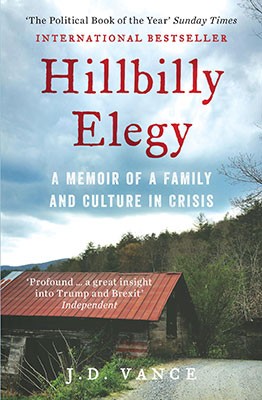
Review: Hillbilly Elegy by J.D. Vance
“Americans call them hillbillies, rednecks, or white trash. I call them neighbors, friends, and family.”
This is one of those books I’d heard high praise about from America but never thought I’d be able to get hold of in the UK. I looked into borrowing it from the public library on my last trip to the States, but even nearly a year after its publication the reservation list was still a mile long. So I was delighted to hear that Hillbilly Elegy was being released in paperback in the UK last month. For British readers, it will provide a welcome window onto a working-class world that is easily caricatured but harder to understand in a nuanced way.
J.D. Vance knows hillbilly America from the inside but also has the necessary distance to be able to draw helpful conclusions about it: born in the “Rust Belt” of Ohio to parents who didn’t complete high school, he served in the Marine Corps in Iraq, attended Ohio State University and Yale Law School, and became a successful investor with a venture capital firm. He was one of the lucky ones who didn’t give into lower-middle-class despair and widespread vices like alcoholism and hard drugs, even though his mother was an addict and installed a “revolving door of father figures” in his life after his father abandoned them.
 Vance attributes his success to the stability provided by his grandparents, his beloved Mamaw and Papaw. They were part of a large wave of migration from Kentucky to Ohio, where they moved so Papaw could work in the Armco Steel mill. Prejudice assaulted the couple from both sides: Kentucky folk thought they’d grown too big for their britches, while in Ohio they were maligned as dirty hillbillies. Mamaw, in particular, is a wonderful character so eccentric you couldn’t make her up, with her fierce love backed up by a pistol.
The book is powerful because it gives concrete, personal examples of social movements: it’s no dry history of how the Scots-Irish residents of Appalachia switched allegiance from the Democratic Party to the Republican after Richard Nixon, though Vance does fill in these broad brushstrokes, but a family memoir that situates Mamaw and Papaw’s experience, and later his own, in the context of the history of the region and the whole country.
I most appreciated the author’s determined use of the first-person plural, especially later in the book: he includes himself in the hillbilly “we” such that he’s not some newly gentrified snob denouncing welfare queens: he knows these people and this lifestyle and recognizes its contradictions; he also knows that but for the grace of God he could have slipped into the same bad habits.
Jackson [Kentucky] is undoubtedly full of the nicest people in the world; it is also full of drug addicts and at least one man who can find the time to make eight children but can’t find the time to support them. It is unquestionably beautiful, but its beauty is obscured by the environmental waste and loose trash that scatters the countryside. Its people are hardworking, except of course for the many food stamp recipients who show little interest in honest work.
At Yale Law School Vance felt out of place for the first time in his life. One of the most important things he learned from professors like Amy Chua was the value of social capital: in his new world of lawyers, senators and judges it really was all about who you know. At law firm interviews, he had no idea what cutlery to use in restaurants and had to text his girlfriend for help. For as much as he’s adapted to non-hillbilly life in the intervening years, he still notices in himself the hallmarks of a stressful, impoverished upbringing: a fight or flight approach to conflict and an honor culture that makes him prone to nurturing feuds.
Although I enjoyed it simply as a memoir, I can see this book especially appealing to people who are interested in the politics and psychology of the lower middle class (perhaps an American equivalent to Owen Jones’s Chavs, a book I never got through). British readers will, I think, be surprised to learn that Vance is on the conservative end of the spectrum and has political aspirations. Essentially, he doesn’t think the government can fix things for struggling country folk, though certain social policies might help. He seems to think it’s more a question of personal responsibility – and also that churches have a major role to play.
There is a cultural movement in the white working class to blame problems on society or the government, and that movement gains adherents by the day.
Mamaw always had two gods: Jesus Christ and the United States of America. I was no different, and neither was anyone else I knew.
(These strike me as alien ideas in the UK, apart from short-lived strategies like David Cameron’s “Big Society” – except, perhaps, if one goes all the way back to Thatcherism.)
Much has been made in the British press about this book’s ability to explain the rise of Donald Trump. This is an overstatement, and perhaps even misleading, when you consider the author’s conservatism; he never mentions Trump, and never engages in any specific political discussions. But what it is helpful for is exposing a mindset of rugged, defiant individualism that often shades into hopelessness. I have my own share of redneck relatives, and though I feel far removed from the world Vance depicts, I can see its traces in my family tree. I’m glad he had the guts to draw on his experience and write this hard-hitting book.
My rating:
Hillbilly Elegy: A Memoir of a Family and Culture in Crisis was first published in the UK by William Collins in September 2016. My thanks to Katherine Patrick for sending a free paperback for review.
Note: Ron Howard is to direct and produce a movie version of the book.
I Found My Tribe by Ruth Fitzmaurice
Ruth Fitzmaurice’s husband, a filmmaker named Simon, was diagnosed with motor neurone disease in 2008. Like Stephen Hawking, he is wheelchair-bound and motionless, communicating only through the mechanical voice of an eye gaze computer.
My husband is a wonder to me but he is hard to find. I search for him in our home. He breathes through a pipe in his throat. He feels everything but cannot move a muscle. I lie on his chest counting mechanical breaths. I hold his hand but he doesn’t hold back. His darting eyes are the only windows left. I won’t stop searching.
Between their five children under the age of 10 (including twins conceived after Simon’s diagnosis), an aggressive basset hound, and Simon’s army of nurses coming and going 24 hours a day, this is one chaotic household. The recurring challenge is to find pockets of stillness – daydreaming, staring at trees outside her window – and to learn what things can bring her back from the brink of despair, again and again.
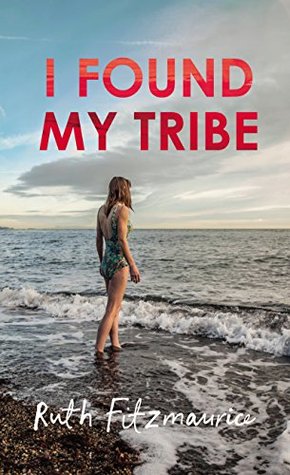 Often these are outdoor experiences: a last hurrah of a six-month holiday in Australia, running, and especially plunging into the Irish Sea with her “Tragic Wives’ Swimming Club” – a group that includes her friend Michelle, whose husband is also in a wheelchair after a motorbike crash, and her favorite of Simon’s nurses, Marian, who has a serious car accident.
Rather than a straight chronological narrative, this is a set of brief thematic essays with titles like “Dancing,” “Fear,” “Twins” and “Holidays.” Fitzmaurice’s story is one you piece together through vivid vignettes from her home life. Her prose is generally composed of short, simple phrases; as with Cathy Rentzenbrink’s The Last Act of Love, you can tell there is deep emotion pulsing under the measured sentences. With such huge questions in play – How much can one person take? What would losing one’s mind look like? – there’s no need for added drama, after all. Instead, the author turns to whimsy, toying with the superhero cliché for caregivers and wondering what magic might be at work in her situation.
I was particularly impressed by how Fitzmaurice holds the past and present in her mind, and by how she uses an outsider’s perspective to imagine herself out of her circumstances. At times she uses the third person for these visions of herself as a younger woman newly in love:
The young wife at her kitchen table knows about deep magic. But I know her future. Life is going to push and pull her like a wave. She doesn’t have a choice and neither do I. Come with me, dear girl, sit at my tablecloth. The journey is upon us and to survive it, you can’t just ride the wave, you have to become one. Can we do this? Let’s go. Becoming a wave just might be the deepest magic of them all.
There are so many poignant moments in this book: memories of their determinedly vegetarian wedding; pulling out all the stops for Simon’s fortieth birthday with customized art installations to brighten his view; leaving the marital bed – now a “hospital contraption” – after six years of MND being a part of their lives; a full moon swim with the Tragic Wives on her and Simon’s anniversary. But all the quiet, everyday stuff has power too, especially her interactions with her precocious children, who are confused about why Dadda is like this.
If I had one tiny complaint, it’s that Simon feels like something of a shadowy figure. In flashbacks we get a real sense of his forceful personality, but this new, silent Simon in the wheelchair is a mystery. Only once or twice does she record words he ‘says’ to her via his computer. Perhaps this is inevitable given how locked into himself he’s become. However, he was still capable of becoming the first person with MND to direct a feature film, on location in County Wicklow (My Name Is Emily). He has told his own story elsewhere; in his wife’s telling, their ventures now seem so separate that they rarely appear as equal partners.
It’s my tenth wedding anniversary tomorrow; as I was reading this I kept thinking that, for as much as I complain (to myself) about how hard marriage is, I’ve had it so easy. The stresses a couple face when caregiving of one partner is involved are immense. Fitzmaurice has found herself part of a tribe she probably never wanted to join: the walking wounded, with pain behind their eyes and worry never far from their minds. But in the midst of it she’s also found the band of family and friends who help her pull through each time. Her lovely book – wry, wise, and realistic – will strike a chord with anyone who has faced illness and family tragedy.
My rating:
I Found My Tribe is published in the UK today, July 6th, by Chatto & Windus. My thanks to the publisher for the review copy.
Note: Fitzmaurice got her book deal on the strength of a series of pieces she wrote for the Irish Times. You can read an extract from the book here. Film rights to her story have been sold to Element Pictures; more details are here. A documentary about Simon’s life, It’s Not Yet Dark, based on his memoir of the same title, has recently been released. For more information see here (this article also showcases multiple family photos).
Update: Simon Fitzmaurice died on October 26, 2017, aged 43.
Brain vs. Heart Surgery: Admissions and Fragile Lives
It’s never too early to start thinking about which books might make it onto next year’s Wellcome Book Prize nominees list, open to any medical-themed books published in the UK in calendar year 2017. I’ve already read some cracking contenders, including these two memoirs from British surgeons.
Brain surgeon Henry Marsh’s first book, Do No Harm, was one of my favorite reads of 2015. In short, enthrallingly detailed chapters named after conditions he had treated or observed, he reflected on life as a surgeon, expressing sorrow over botched operations and marveling at the God-like power he wields over people’s quality of life. That first memoir saw him approaching retirement age and nearing the end of his tether with NHS bureaucracy.
Admissions: A Life in Brain Surgery serves as a sort of sequel, recording Marsh’s last few weeks at his London hospital and the projects that have driven him during his first years of retirement: woodworking, renovating a derelict lock-keeper’s cottage by the canal in Oxford, and yet more neurosurgery on medical missions to Nepal and the Ukraine. But he also ranges widely over his past, recalling cases from his early years in medicine as well as from recent memory, and describing his schooling and his parents. If I were being unkind, I might say that this feels like a collection of leftover incidents from the previous book project.
However, the life of a brain surgeon is so undeniably exciting that, even if these stories are the scraps, they are delicious ones. The title has a double meaning, of course, referring not only to the patients who are admitted to the hospital but also to a surgeon’s confessions. And there are certainly many cases Marsh regrets, including operating on the wrong side in a trapped nerve patient, failing to spot that a patient was on the verge of a diabetic coma before surgery, and a young woman going blind after an operation in the Ukraine. Often there is no clear right decision, though; operating or not operating could lead to equal damage.

Once again I was struck by Marsh’s trenchant humor: he recognizes the absurdities as well as the injustices of life. In Houston he taught on a neurosurgery workshop in which students created and then treated aneurysms in live pigs. When asked “Professor, can you give us some surgical pearls?” he “thought a little apologetically of the swine in the nearby bay undergoing surgery.” A year or so later, discussing the case of a twenty-two-year-old with a fractured spine, he bitterly says, “Christopher Reeve was a millionaire and lived in America and he eventually died from complications, so what chance a poor peasant in Nepal?”
Although some slightly odd structural decisions have gone into this book – the narrative keeps jumping back to Nepal and the Ukraine, and a late chapter called “Memory” is particularly scattered in focus – I still thoroughly enjoyed reading more of Marsh’s anecdotes. The final chapter is suitably melancholy, with its sense of winding down capturing not just the somewhat slower pace of his retired life but also his awareness of the inevitable approach of death. Recalling two particularly hideous deaths he observed in his first years as a doctor, he lends theoretical approval for euthanasia as a way of maintaining dignity until the end.
What I most admire about Marsh’s writing is how he blends realism and wonder. “When my brain dies, ‘I’ will die. ‘I’ am a transient electrochemical dance, made of myriad bits of information,” he recognizes. But that doesn’t deter him from producing lyrical passages like this one: “The white corpus callosum came into view at the floor of the chasm, like a white beach between two cliffs. Running along it, like two rivers, were the anterior cerebral arteries, one on other side, bright red, pulsing gently with the heartbeat.” I highly recommend his work to readers of Atul Gawande and Paul Kalanithi.
My rating:
Admissions: A Life in Brain Surgery was published in the UK by Weidenfeld & Nicolson on May 4th. My thanks to the publisher for sending a free copy for review. It will be published in the USA by Thomas Dunne Books on October 3rd.
What Marsh does for brain surgery in his pair of memoirs, Professor Stephen Westaby does for heart surgery in Fragile Lives, a vivid, compassionate set of stories culled from his long career. A working class lad from Scunthorpe who watched his grandfather die of heart failure, he made his way up from hospital porter to world-leading surgeon after training at Charing Cross Hospital Medical School.
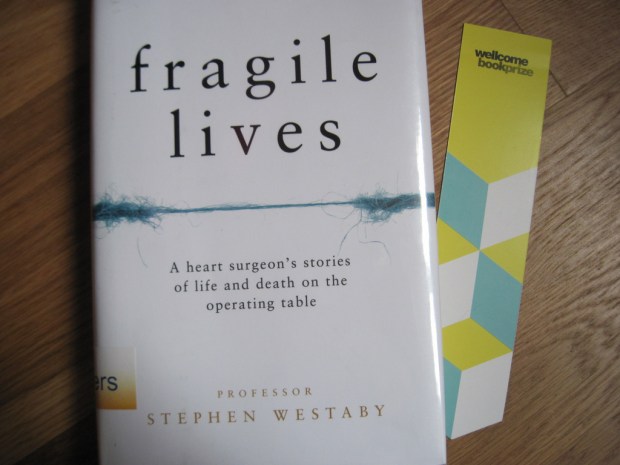
Each of these case studies, from a young African mother and her sick child whom he met while working in Saudi Arabia in the 1980s to a university student who collapses not far from his hospital in Oxford, is told in impressive depth. Although the surgery details are not for the squeamish, I found them riveting. Westaby conveys a keen sense of the adrenaline rush a surgeon gets while operating with the Grim Reaper looking on. I am not a little envious of all that he has achieved: not just saving the occasional life despite his high-mortality field – as if that weren’t enough – but also pioneering various artificial heart solutions and a tracheal bypass tube that’s named after him.
Like Marsh, he tries not to get emotionally attached to his patients, but often fails in this respect. “Surgeons are meant to be objective, not human,” he shrugs. But, also like Marsh, at his retirement he feels that NHS bureaucracy has tied his hands, denying necessary funds and equipment. Both authors come across as mavericks who don’t play by the rules, but save lives anyway. This is a fascinating read for anyone who enjoys books on a medical theme.
A few favorite lines:
“We stop life and start it again, making things better, taking calculated risks.”
“We were adrenaline junkies living on a continuous high, craving action. From bleeding patients to cardiac arrests. From theatre to intensive care. From pub to party.”
My rating: 
Fragile Lives: A Heart Surgeon’s Stories of Life and Death on the Operating Table was published in the UK by HarperCollins on February 9th. I read a public library copy. It will be published in the USA, by Basic Books, under the title Open Heart on June 20th.
The Folded Clock by Heidi Julavits
I keep a long list of books that I’d love to read but know are only currently available in the USA. Occasionally I manage to chip away at it through my public library borrowing during trips back to visit my family, but I’m adding more titles all the time. I was pleased, then, to learn that The Folded Clock, a book I’ve wanted to get hold of ever since it was first released in the States in 2015, was recently published in the UK.
Heidi Julavits is a founding editor of The Believer magazine as well as a novelist and an associate professor of writing at Columbia University. She lives in New York City during the academic year and spends the rest of the time in Maine, where she was born and raised. The Folded Clock is a diary of two fairly average years in her life, but its dated entries (month and day only) are not in order; they’ve been rearranged into what at times feels like an arbitrary sequence. Yet this is in keeping with the overall theme of time’s fluidity.
The title comes from her daughter’s mishearing of “folded cloth” but is apt in that it suggests time stretching and collapsing back on itself. Indeed, one reason for starting the journal was that Julavits felt time had started to pass differently from how it did in her childhood. Whereas she once thought in terms of days, she realized in her forties that she now worked in weeks and months. She was also inspired by digging out her adolescent diary – though it was not nearly as profound or revelatory about her future writing career as she might have hoped.
Every single entry begins with “Today,” reflecting a determination to live in the present. But of course, that format still offers a broad scope for memory, with certain activities and objects provoking flashbacks. For instance, she finds her ten-year-old marriage vows in the pocket of an old coat, and rereads a biography of Edie Sedgwick (from Andy Warhol’s circle, she died of a drug overdose at 28), as she periodically does to gauge how her response changes as she ages.
Julavits also situates her writing in the context of other famous diarists, such as the Goncourt brothers and Henry David Thoreau. As the latter did in Walden, she’s seeking to live deliberately, though within her regular life and without venturing into nature all that much; “I am an outdoorsman of the indoors,” she quips.
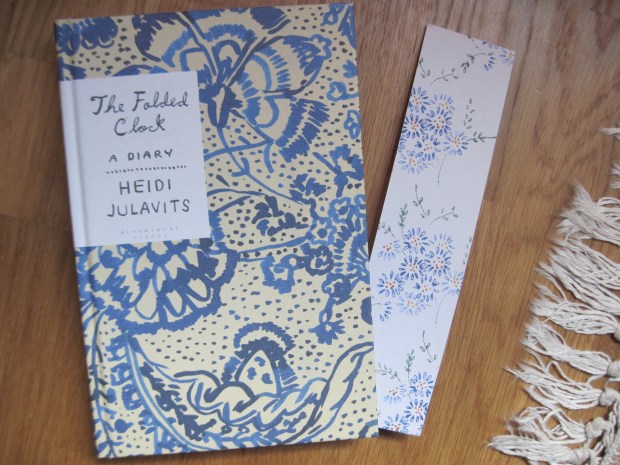
The cover design is by Leanne Shapton.
There’s a huge variety of topics here. She writes about being afraid of sharks, stealing names to use for characters in her novels, entering her small Maine town’s Fourth of July parade float competition, visiting E.B. White’s grave, mourning a tree half-lost to a hurricane, her insistence on dwelling in west-facing rooms, and regretting never telling her doctor how much she appreciated him before he died in a cycling accident. Travel features heavily, too, what with accompanying her husband to a fellowship in Germany and spending time at an art colony in Italy. Often it’s the tiny encounters and incidents that remain in her mind, though, like accidentally buying bitter apricot kernels instead of almonds at a German market and worrying that her husband might have given himself cyanide poisoning by eating 14 at once.
Some of these pieces would function well as stand-alone essays, like the one about her obsession with The Bachelor, an American reality television franchise, which leads into her belief that crushes are fostered by small spaces – she fell for her second husband (author Ben Marcus) at an arts colony even though they were both attached to other people at the time.
I was delighted to see Julavits quote the Julian Barnes passage on episodicism versus narrativism that inspired my post on that topic back in January. Unsurprisingly, Julavits sees herself as a narrativist, drawing connections between different points in her life. She’s always pondering what small incidents reveal about her character. We learn that she’s so averse to inconveniencing others that she continued a phone call while nursing a wasp sting and once planned to pee in an airsickness bag rather than wake the two sleepers between her and the aisle on a flight. She avoids yard sales because she’s so cutthroat, and she’s been known to romanticize her daily life when e-mailing a friend in London: “I probably didn’t tell the truthiest truths. I never made stuff up. But I did strive to be entertaining. Such embellishments do not constitute lies. They constitute your personality.”
In one of the pieces that stood out most for me, Julavits feels typecast as a woman of a certain age when she attends a Virginia Woolf reading. “I am of that age now where I am looking for the next age I will be. How will I dress? How will I act?” It’s a good example of how she uses these mini-essays to negotiate the stages of life and contemplate her changing roles. Elsewhere she sums up her composite identity and what she seeks from her writing:
I am a jack-of-all-trades. I edit and teach and at times desire to be a clothing designer or an artist … and I write everything but poetry and I am a mother and a social maniac and a misanthrope and a burgeoning self-help guru and a girl who wants to look pretty and a girl who wants to look sexy and a girl who wants to look girly and a woman in her middle forties who wishes not to look like anything at all, who wishes sometimes to vanish.
I sometimes think this is why I became a writer. Here was a way to regularly exercise my desire. I could desire to do this thing that no one does perfectly, and by doing it and doing it I could learn how to desire more, and better. Here was an activity that would always leave me wanting … not youth exactly, but the opposite of death. That to me is a way to always feel like I am nowhere near the end.
Inevitably, some entries are more interesting than others, and Julavits’ neuroticism may grate for some readers, but I found this book to be chock-full of quotable lines and insights into what it means to be a time-bound human being. Like one of May Sarton’s journals, I read it slowly, just a few pieces at a time over the course of weeks, and I’ll be keeping it on the shelf to flick through if I ever need an example of how to write a piercing, bite-sized fragment of autobiography. I highly recommend it.
(See also this brief Guardian interview with Julavits.)
The Folded Clock: A Diary was published by Bloomsbury Circus on March 9th. My thanks to the publisher for the free copy for review.
My rating:
 Bookish Beck = Rebecca Foster. American transplant to England. Freelance proofreader and book reviewer.
 Bookish Beck