Reading Ireland Month, Part II: Dowd, Enright, Madden & Nugent
I’m catching up with a final set of reviews for #ReadingIrelandMonth26. I read two novels set at least partially during the Troubles, one of them for teenagers; a quiet novel about adultery and bereavement; and a thriller about consent and family legacy. I also read the first half of one more novel, a sombre one about the aftermath of a mental health crisis. Between this post and my first one, I covered 6.5 novels by Irish women, which I’ll call a win.
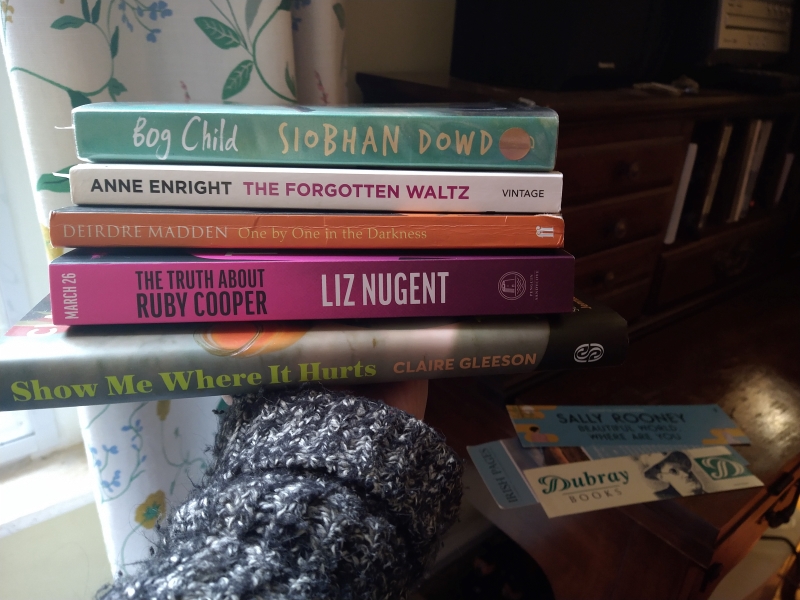
Bog Child by Siobhan Dowd (2008)
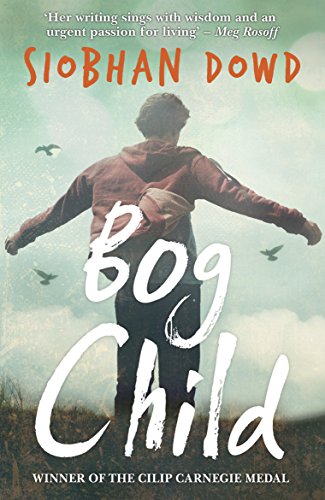 Fergus McCann is 18 and taking A levels; if he can only get three Bs, he’ll have his ticket out of Northern Ireland to study medicine at Aberdeen. This is no ordinary summer, though. He loves running on the hills at the border and here he makes a landmark discovery and embarks on a risky mission. The plot opens with Fergus and his uncle stumbling on the corpse of a girl while cutting peats. It’s a case for archaeologists rather than the police: the body is from the Iron Age and there’s evidence that the girl was sacrificed. An acquaintance then pressures Fergus into running parcels up and down the hill, right under the noses of the British at the checkpoint. He makes friends with Owain, a Welsh soldier, but gets a horrible feeling he’s partially responsible for the bombings he soon hears about on the radio. His family is enmeshed in the IRA anyway: his brother is among the hunger strikers in the local prison. There’s every chance that Joey could die before the summer is out, as much a victim of injustice as “Mel” (as Fergus names the girl from the bog, whose story he dreams).
This was Dowd’s third novel, published posthumously after her death from cancer, and won the Carnegie Medal. I’d say it’s one of the few best young adult novels I’ve ever read. (It’s shelved under Teenage Fiction at my library.) It’s an excellent peripheral glance at history ancient and modern – Fergus’s letter to Margaret Thatcher is brilliant – and effectively recreates a teen’s divided attention: friends, schooling, family drama, the future, and romance (via the daughter of the archaeologist). I searched my library catalogue for further books on bog bodies after reading Anna North’s Bog Queen and it really paid off! (Public library)
The Forgotten Waltz by Anne Enright (2011)
 I’ve only read a handful of Enright novels and wanted to experience more, so picked this one because it was shortlisted for the Orange Prize. On the face of it, it’s a fairly straightforward adultery story, but the unshowy potency of Enright’s writing and her realistic insight into relationships set it apart. While married to Conor, Gina has an affair with Seán, who’s older and married to Aileen. Seán is part of their social circle but also someone she knows through work, and business trips are an easy excuse. “The office game was another game for us to play, after the suburban couples game, and before the game of hotel assignations and fabulous, illicit lust, and neither of us thought there might come a moment when all the games would stop. It was a lot of fun.” Gina narrates matter-of-factly, rejecting cause-and-effect language. She doesn’t defend herself, or fool herself that Seán is perfect. This new relationship involves as many challenges as her marriage, what with her mother’s death and Seán’s preteen daughter, Evie, who appears to be autistic and epileptic. The short chapters are all headed with song lyrics, mostly from love songs (“Will You Love Me Tomorrow,” “Stop! In the Name of Love”) whose ironic optimism underlines the novel’s gently melancholy tone. This reminded me most of Maggie O’Farrell’s early work, and more than justified delving into Enright’s back catalogue. (Secondhand – Awesomebooks.com)
{SPOILERS IN THE REST!!}
One by One in the Darkness by Deirdre Madden (1996)
 Louise Kennedy’s Trespasses was our book club selection for March; I’d read it just two years ago, so skimmed back through and was impressed by its construction. Some were less convinced by the framing story and not emotionally engaged with Michael and Cushla’s affair, but we all appreciated it as a sideways look at Northern Irish history. One by One in the Darkness, which was also shortlisted for the Women’s (then Orange) Prize, is set close to its publication in the 1990s but returns to the Troubles through memories and flashbacks. Set over one week – Saturday to Friday – it’s the story of the three Quinn sisters. Cate is a journalist in London who flies home to Antrim to break the news that she’s pregnant out of wedlock. Helen is a lawyer and Sally a schoolteacher. They, their mother, and Uncle Brian have all gotten on with life as best they could, but their father’s murder is something they can’t forget and won’t ever get over. By saving that scene for the very last page of this novella, she keeps the horror of it fresh. Through one family’s story, she gives a sense of the scope of the country’s loss. But the book is not without a dark sense of humour, either. Madden was a new author for me. I found her work profound at the sentence level (see below for some favourite lines) rather than engaging at the plot level. (Secondhand – Awesomebooks.com)
“‘What’s wrong with Uncle Peter?’ ‘Two things,’ [Granny] said. ‘He thinks too much, and then he drinks too much.’”
“Once when [Cate] was home she’d remarked to Helen that she thought the forecasts were often inaccurate in Northern Ireland. ‘It’s probably deliberate,’ Helen had replied. ‘If they read out the average day’s news here and then said at the end of it, “Oh, and by the way, it’s going to bucket rain for the next twenty-four hours,” it might be more than people could take.’”
“Cate had remarked once that it was only when you lived away from Northern Ireland that you realised on returning how deeply divided a society it was, and how strange the effect of that could be.”
“There’d been well over three thousand people killed since the start of the Troubles, and every single one of them had parents or husbands and wives and children whose lives had been wrecked. It would be written about in the paper for two days, but as soon as the funeral was over it was as if that was the end, when it was really only the beginning.”
The Truth about Ruby Cooper by Liz Nugent (2026)
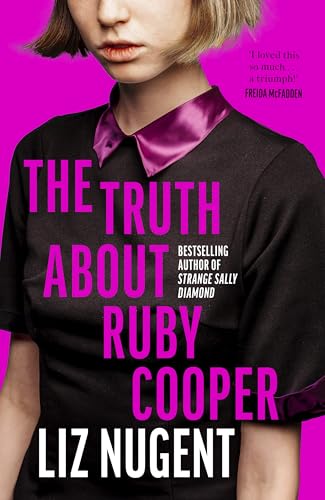 We read Nugent’s Strange Sally Diamond for book club a couple years ago and it was a great Northumberland holiday read for me, with a deliciously off-kilter narrator whose traumatized (and perhaps neurodivergent) perspective carried the novel. Here again Nugent prioritizes unreliable women’s voices and dark happenings, but Ruby is awfully hard to like. At age 16, she falsely accuses her older sister Erin’s boyfriend Milo of raping her. Milo maintains his innocence all along, but goes to jail for the crime; after all, DNA evidence can’t lie, right? Years of his life – and a heartbroken Erin’s – are stolen, his mother dies by suicide, Ruby becomes dependent on alcohol: all of this because of sisterly jealousy and an elaborate lie that their mother upholds rather than expose the family to further shame.
Narration alternates between Erin in Boston and Ruby, who’s moved back to Ireland with their mother. For Ruby’s confession to work, readers are kept in the dark about the truth of the incident, though only for 76 pages. Together the sisters give a tedious blow-by-blow of the intervening years – until Ruby’s daughter, Lucy, is raped by her boss on a drunken night out. Ruby refuses to believe her “because if it was true, that was karma coming to bit me on the ass.” This is where things finally get interesting, as Nugent explores ironies and familial patterns. But I’m sure I won’t be the only one to find the whole thing distasteful. Nugent clearly anticipates a backlash, stating in a prefatory letter, “I need to be very clear about the fact that girls and women like Ruby Cooper are extremely rare.” Was it worth undermining the #BelieveWomen campaign to explore a certain state of mind? Nah.
With thanks to Sandycove (Penguin) for the proof copy for review.
I’d also hoped to finish one more, but ran out of time. Here are my thoughts on the first half:
Show Me Where It Hurts by Claire Gleeson (2025)
 Rachel knew Tom had recurring problems with depression, but had no idea he was on the verge of a breakdown when he deliberately drove their car off the road with the intention of killing his entire family. Their two young children die in the crash but they both survive – Tom held in a psychiatric hospital and Rachel resuming her life as a nurse. The chapters alternate between “After” and “Before,” giving relative date markers in weeks, months or years out from the incident. Gleeson’s understated prose makes it possible for readers to face a tragedy so awful we’d otherwise look away; it never tips over into mawkishness.
Reading Ireland Month, Part I: Wendy Erskine and Niamh Ní Mhaoileoin
St. Patrick’s Day is a good occasion for my first set of contributions to Cathy’s Reading Ireland Month. Today I have two 2025 debut novels by women, one about the ripples caused by a sexual assault; the other about grief, queerness and unease with the Catholic Church. Both come with a Women’s Prize seal of approval. As I write, I happen to be listening to the new Foy Vance album I picked up today, which has inspired me to choose a few relevant (Northern) Irish songs to accompany each book.
The Benefactors by Wendy Erskine
I loved Erskine’s short story collection Dance Move so was looking forward to this before it appeared on the Women’s Prize longlist. We’re introduced to three middle-aged Belfast women whose 18-year-old sons are charged with sexual assault: Frankie Levine, stepmother to Chris; Miriam Abdel Salam, mother of Rami; and Bronagh Farrell, mum of Lyness or “Line-up.” Frankie grew up in care but is now rich beyond her wildest dreams, Miriam was recently widowed by a car accident, and Bronagh heads a children’s services charity. Misty, the classmate who accused the boys of the assault at a party, lives with her stepfather, cab driver Boogie. As rumours spread, the mothers have confabs to prepare a united front. At one level they’re horrified by what their sons were capable of (Rami used a bottle), but on another they’ve decided that it’s just a hullabaloo – Bronagh’s word – that will die down soon.
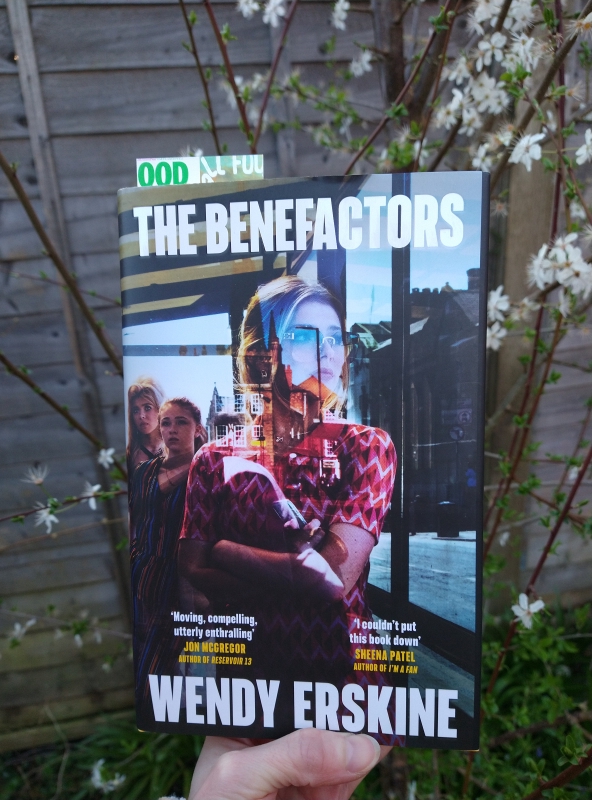
Slut-shaming of Misty starts early: she has a “Bennyz” amateur porn account and did phone or video chats, very mild stuff, with men all over the world. It’s uncomfortable, though realistic, how money and class steer what happens next. The book’s title comes from the soft-porn site, but in a wider sense invites the question of who funds lifestyles and so who’s really in control. People who have compassion in general can’t find it in this situation. Erskine intersperses short sections from anonymous voices, such as policemen and partygoers, with the narrative. These are well done, and sometimes quite funny, but Erskine’s meta joke – “There can be just too many perspectives” – proves true in that the interludes add little we haven’t already grasped about the direction of the local gossip. Apart from Misty, I felt I’d hardly gotten to know any of the characters by the end. The novel also suffered from being the second novel about the aftermath of a gang rape I’ve read in three months (after Who Killed Bambi? by Monika Fagerholm, translated from Swedish). But I reckon its blend of grit and heart is likely to please readers of Colin Barrett and Lisa McInerney.
Northern Irish songs for Misty:
- “Collect Yourself” by Iain Archer
- “At Least My Heart Was Open” by Foy Vance (beware the F-bomb)
& an Irish one: “The Blower’s Daughter” by Damien Rice
Ordinary Saints by Niamh Ní Mhaoileoin
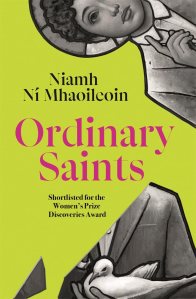 This was one of my Most Anticipated titles in 2025. It was shortlisted for the Women’s Prize Discoveries Award (for manuscripts in progress) in 2022 and won the PFD Queer Fiction Prize. Jacinta, who prefers to be known as Jay, is in her late twenties, living in London, working in marketing and half-serious about her relationship with her girlfriend, Lindsay. She tries not to think about Ireland, religion, or the past: her mother’s mental health struggles, her extended family’s casual homophobia, and the fact that her older brother, Ferdia, who was a trainee Catholic priest in Rome, died in a freak accident when she was 16. But it all comes back for her when her parents tell her that there is a campaign to have Ferdia canonized. While her mother scurries around making speeches and verifying miracles, Jay seeks the opposite for her brother: to be remembered as a normal, flawed and perhaps closeted human.
It took me ages to read this, despite the undemanding first-person, present-tense narration, because the early London material is so monotonous. Unlike the Erskine (probably because that is her third book), this felt very much like a debut, where a lot of earnest apprentice work has had to go into getting characters from A to B, literally and emotionally. Any time the author wants to advance the plot, she has Jay meet someone in a bar for a conversation. Without fail, there will be drinks involved. This felt to me like a stereotype of the Irish. It’s only really in the last quarter, as Jay has honest conversations with both parents, deals with her grief over Ferdia and accepts how much Lindsay means to her, that the book soars. For me, that was too little too late, even though the themes were irresistible.
A Northern Irish song for Jay:
- “Freewheel” by Duke Special
- and (for Jay and Lindsay) “Crack the Shutters” by Snow Patrol
& an Irish one: “The Trailing Skirts of God” by Bell X1
I loved the premise of both of these novels, but the execution left me slightly disappointed. Still, I wouldn’t discourage you from picking them up if they’ve caught your eye; I know that some blogger friends have liked one or the other much better than I did.
I’ll raise a cheeky glass of Bailey’s tonight to the greatness of Irish literature. Speaking of which, I’ll have another, bigger batch of reviews coming up before the end of the month!
Reading Ireland Month: Seán Hewitt, Maggie O’Farrell
Reading Ireland Month is hosted each year by Cathy of 746 Books. I’m wishing you all well on St. Patrick’s Day with this first of two planned tie-in posts. Today I have a poetry collection that sets grief and queer longing amid nature, and my last unread novel – a somewhat middling one, unfortunately – by one of my favourite authors.

Rapture’s Road by Seán Hewitt (2024)
 The points of reference are so similar to his 2020 debut collection, Tongues of Fire, that parts of what I wrote about that one are fully applicable here: “Sex and grief, two major themes, are silhouetted against the backdrop of nature. Fields and forests are loci of meditation and epiphany, but also of clandestine encounters between men.” Perhaps inevitably, then, this felt less fresh, but there was still much to enjoy. I particularly loved two poems about moths (the merveille du jour as an “art-deco mint-green herringbone. Soft furred little absinthe warrior”), “To Autumn,” and “Alcyone,” which likens a kingfisher to “a rip / in the year’s old fabric”.
In “Two Apparitions,” the poet’s late father seems visible again. Many of the scenes take place at dusk or dark. There’s a layer of menace to “Night-Scented Stock,” about an abusive relationship, and the account of a slaughter in “Pig.” But the stand-out is “We Didn’t Mean to Kill Mr Flynn,” based on the 1982 murder of a gay man in a Dublin park. Hewitt drew lines from court proceedings and periodicals in the Irish Queer Archive at the National Library of Ireland, where he was poet in residence. He voices first the gang of killers, then Flynn himself. The trial kickstarted Ireland’s Pride movement.
More favourite lines:
Come out, make a verb of me, let
my body do your speaking tonight —
(from “A Strain of the Earth’s Sweet Being”)
awestruck, bright,
a child in the bell-tower of beauty —
(from “Skylarks”)
Love, the world is failing:
come and fail with me.
(from “Nightfall”)
With thanks to Jonathan Cape (Penguin) for the free copy for review.
My Lover’s Lover by Maggie O’Farrell (2002)
I was so excited, a few years ago, to find battered copies of this and After You’d Gone in a local charity shop for 50 pence each, even though it appears a mouse had a nibble on one corner here. They were her first two books, but the last that I managed to source. Whereas After You’d Gone is a surprisingly confident and elegant debut novel about a woman in a coma and the family and romantic relationships that brought her to this point, My Lover’s Lover ultimately felt like a pretty run-of-the-mill story about two women finding out that (some) men are dogs and they need to break free.
 Lily meets Marcus, an architect, at a party and almost before she knows it has moved into the spare room of his apartment, a Victorian factory space he renovated himself, and become his lover. But there’s an uncomfortable atmosphere in the flat: She can still smell perfume from Marcus’s ex, Sinead; one of her dresses hangs in the closet. We, along with Lily, get the impression Sinead has died. She haunts not just the flat but also the streets of London. It becomes Lily’s obsession to find out what happened to Sinead and why Marcus is so morose. Part Two gives Sinead’s side of things, in a mix of third person/present tense and first person/past tense, before we return to Lily to see what she’ll do with her new knowledge.
As in some later novels, there are multiple locales (here, NYC, the Australian desert, and China – a country O’Farrell often revisits in fiction) and complicated point-of-view shifts, but I felt the sophisticated craft was rather wasted on a book that boils down to a self-explanatory maxim: past relationships always have an effect on current ones. I also found the writing overmuch in places (“the grass swooshing, sussurating, cleaving open to her steps”; “letting fall a box of cereal into its [a shopping trolley’s] chrome meshing”; “her fingertips meeting the ceraceous, heated skin of his cheek”). However, this was an engrossing read – I read most of it in two days. It’s bottom-tier O’Farrell, though, along with The Distance Between Us and Hamnet – sorry, I know many adore it. (If you’re interested: middle tier = The Vanishing Act of Esme Lennox, Instructions for a Heatwave, her two children’s books, and The Marriage Portrait; top tier = After You’d Gone, The Hand that First Held Mine, This Must Be the Place, and I Am, I Am, I Am.)
I’ve gotten in the habit of reading one of Maggie O’Farrell’s works per year, so I will just have to reread my favourites until we get a new one. I’m already tapping a foot in impatience. (Secondhand from Bas, Newbury) 
Have you read any Irish literature this month?
Introducing the 2023 McKitterick Prize Shortlist
For the second year in a row, I was a first-round judge for the McKitterick Prize (for a first novel by a writer over 40), helping to assess the unpublished manuscripts. Perhaps lockdowns gave people time to achieve a long-held goal of writing a novel, because submissions were up by 50%. None of the manuscripts made it through to the shortlist this year or last, but one day it could happen!

The Society of Authors kindly sent me a parcel with five of the shortlisted novels, and I picked up the remaining one from the library this week. Below are synopses from Goodreads and author bios from the SoA:
 The Return of Faraz Ali by Aamina Ahmad (Sceptre): “Sent back to his birthplace—Lahore’s notorious red-light district—to hush up the murder of a girl, a man finds himself in an unexpected reckoning with his past. … Profoundly intimate and propulsive, The Return of Faraz Ali is a spellbindingly assured first novel that poses a timeless question: Whom do we choose to protect, and at what price?”
Aamina Ahmad was born and raised in London, where she worked for BBC Drama and other independent television companies as a script editor. Her play The Dishonoured was produced by Kali Theatre Company in 2016. She has an MFA from the Iowa Writers’ Workshop and is a recipient of a Stegner Fellowship from Stanford University, a Pushcart Prize and a Rona Jaffe Writers Award. Her short fiction has appeared in journals including One Story, the Southern Review and Ecotone. She teaches creative writing at the University of Minnesota.
 When We Were Birds by Ayanna Lloyd Banwo (Hamish Hamilton): “Yejide and Darwin will meet inside the gates of Fidelis, Port Angeles’s largest and oldest cemetery, where the dead lie uneasy in their graves and a reckoning with fate beckons them both. A masterwork of lush imagination and immersive lyricism, When We Were Birds is a spellbinding novel about inheritance, loss, and love’s seismic power to heal.”
Ayanna Lloyd Banwo is a writer from Trinidad and Tobago. She is a graduate of the University of the West Indies and holds an MA in Creative Writing from the University of East Anglia, where she is now a Creative and Critical Writing PhD candidate. Her work has been published in Moko Magazine, Small Axe and PREE, among others, and shortlisted for the Small Axe Literary Competition and the Wasafiri New Writing Prize. When We Were Birds, Ayanna’s first novel, was shortlisted for the Jhalak Prize and won the OCM Bocas Prize for Fiction. She is now working on her second novel. Ayanna lives with her husband in London.
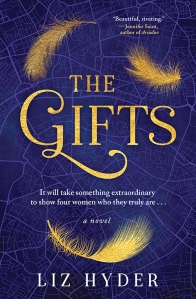 The Gifts by Liz Hyder (Manilla Press): “October 1840. A young woman staggers alone through a forest in the English countryside as a huge pair of impossible wings rip themselves from her shoulders. In London, rumours of a “fallen angel” cause a frenzy across the city, and a surgeon desperate for fame and fortune finds himself in the grips of a dangerous obsession. … [A] spellbinding tale told through five different perspectives …, it explores science, nature and religion, enlightenment, the role of women in society and the dark danger of ambition.”
Liz Hyder has been making up stories for as long she can remember. She has a BA in drama from the University of Bristol and, in early 2018, won the Bridge Award/Moniack Mhor Emerging Writer Award. Bearmouth, her debut young adult novel, won a Waterstones Children’s Book Prize, the Branford Boase Award and was chosen as the Children’s Book of the Year by The Times. Originally from London, she now lives in South Shropshire. The Gifts is her debut adult novel.
 Trespasses by Louise Kennedy (Bloomsbury Publishing): “Set in Northern Ireland during the Troubles, a shattering novel about a young woman caught between allegiance to community and a dangerous passion. … As tender as it is unflinching, Trespasses is a heart-pounding, heart-rending drama of thwarted love and irreconcilable loyalties, in a place what you come from seems to count more than what you do, or whom you cherish.”
Louise Kennedy grew up a few miles from Belfast. She is the author of the Women’s Prize-shortlisted novel Trespasses, and the acclaimed short story collection The End of the World is a Cul de Sac, and is the only woman to have been shortlisted twice for the Sunday Times Audible Short Story Award (2019 and 2020). Before starting her writing career, she spent nearly thirty years working as a chef. She lives in Sligo.
 The Whalebone Theatre by Joanna Quinn (Fig Tree): “One blustery night in 1928, a whale washes up on the shores of the English Channel. By law, it belongs to the King, but twelve-year-old orphan Cristabel Seagrave has other plans. She and the rest of the household … build a theatre from the beast’s skeletal rib cage. … As Cristabel grows into a headstrong young woman, World War II rears its head.”
Joanna Quinn was born in London and grew up in the southwest of England, where her bestselling debut novel, The Whalebone Theatre, is set. Joanna has worked in journalism and the charity sector. She is also a short story writer, published by The White Review and Comma Press, among others. She lives in a village near the sea in Dorset.
 Other Names for Love by Taymour Soomro (Harvill Secker): “A seductive coming-of-age story about queer desire, Other Names for Love is a charged, hypnotic debut novel about a boy’s life-changing summer in rural Pakistan: a story of fathers, sons, and the consequences of desire. … Decades later, Fahad is living abroad when he receives a call from his mother summoning him home. … [A] tale of masculinity, inheritance, and desire set against the backdrop of a country’s violent history, told with uncommon urgency and beauty.”
Taymour Soomro is the author of Other Names for Love and co-editor of Letters to a Writer of Colour. His writing has been published in the New Yorker, the New York Times and elsewhere. He is the recipient of fellowships from the Wisconsin Institute for Creative Writing, Bread Loaf Writers’ Conference and the Sozopol Fiction Seminars. He has degrees from Cambridge University and Stanford Law School and a PhD in creative writing from the University of East Anglia. He currently teaches on the MFA program at Bennington College.
Fellow judge Selma Dabbagh summarises the shortlist thus: “Family estates in rural Pakistan (Other Names for Love) and England (The Whalebone Theatre) fall into decline reflecting the hubris and short-sightedness of their owners[;] in The Return of Faraz Ali, it is the decaying grandeur of the courtesans of Lahore that is lovingly depicted. Whereas in both The Gifts and When We Were Birds, the otherworldly brings new possibilities to the tawdry and impoverished as mystical wings fly over the slums of Victorian London and the graveyards of Trinidad.”
I was already interested in reading a couple of these novels, and was pleased to discover a few new-to-me titles. As it’s also shortlisted for the Women’s Prize (which will be awarded on Wednesday), it seems to make sense to start with Trespasses, and I’m also particularly keen on The Gifts, which sounds like a great holiday read and right up my street, so I’m packing it for our trip to Scotland later this month. One or more of the others might end up on my 20 Books of Summer list. I’ll be sure to follow up with reviews of any I manage to read this summer.
The winner and runner-up will be announced at the SoA Awards ceremony in London on 29 June. I’ll be away at the time but will hope to watch part of the livestream. For more on all of the SoA Awards, see the press release on their website.
See any nominees you’ve read? Who would you like to see win?
Reading Ireland Month: Erskine, O’Farrell, Quinn and Tóibín
Reading Ireland Month is hosted each year by Cathy of 746 Books. I’m sneaking in on the final day of March (there’s a surprise snow squall out the window as I write this) with four short reviews and feeling rather smug that my post covers lots of bases: short stories, a novel, a book of autobiographical pieces, and a poetry collection.
Dance Move by Wendy Erskine (2022)
 The 11 stories in Erskine’s second collection do just what short fiction needs to: dramatize an encounter, or moment, that changes life forever. Her characters are ordinary, moving through the dead-end work and family friction that constitute daily existence, until something happens, or rises up in the memory, that disrupts the tedium.
Erskine being from Belfast, evidence of the Troubles is never far away. In “Nostalgie,” a washed-up rocker is asked to perform his hit song at a battalion’s party. A woman and her lodger are welded together by a violent secret in “Bildungsroman,” which reminded me of a tale from Bernard MacLaverty’s Blank Pages and Other Stories. “Gloria and Max” struck me most of all: a drive to a film festival becomes a traumatic flashback when they’re first on the scene of an accident.
Erskine’s writing is blunt and edgy, the kind that might be stereotyped as male but nowadays is also, inevitably for Irish authors, associated with Sally Rooney: matter-of-fact; no speech marks, flat dialogue and slang. A couple of other favourites: “Mathematics,” in which a cleaner finds an abandoned child in a hotel room and tries to do right by her; and “Memento Mori,” about two deaths, one drawn out and one sudden; both equally unexpected; and only enough compassion to cope with one. (Public library) 
After You’d Gone by Maggie O’Farrell (2000)
 In form this is similar to O’Farrell’s The Distance Between Us, one of my Reading Ireland selections from last year: short sections of a few pages flit between times and perspectives. (There’s also an impulsive trip from London to Scotland in both.) But whereas in her third novel I found the jump cuts confusing and unnecessary, here they just work, and elegantly, to build a portrait of Alice Raikes, in a coma after what may have been a suicide attempt. That day she’d taken a train from London to Edinburgh at the last minute, met her sisters at the station, seen something that threw her, and gotten right on a return train. Back in London and on the way to the shop for cat food, she stepped off the kerb and into the path of a car.
Scenes from Alice’s childhood in Scotland are interspersed with her love affairs; her parents’ disappointing marriage serves as a counterpoint to her great passion for John. The setup of three female generations in North Berwick and the question of sexual autonomy reminded me strongly of Evie Wyld’s The Bass Rock.
This is a bold debut novel, refusing to hold readers’ hands through shifts from now to near past to further ago, from third to second to first person (even Alice from her coma: “my body still clings to life, and I find myself suspended like Persephone between two states … I am somewhere. Drifting. Hiding.”). Loss, secrets and family inheritance may be familiar themes, but when this was published at the millennium it must have seemed thrillingly fresh; it still does now.
I only have one unread O’Farrell novel awaiting me now, My Lover’s Lover. I’ll be saving that up, maybe for this time next year. Having not much enjoyed Hamnet, I’m disappointed that her forthcoming novel will also be historical and will probably skip it; I miss her stylish contemporary commentary. (Secondhand from a charity shop)
A Portrait of the Artist as a Young Girl, ed. John Quinn (1986)
 These autobiographical essays were compiled by Quinn based on interviews he conducted with nine women writers for an RTE Radio series in 1985. I’d read bits of Dervla Murphy’s and Edna O’Brien’s work before, but the other authors were new to me (Maeve Binchy, Clare Boylan, Polly Devlin, Jennifer Johnston, Molly Keane, Mary Lavin and Joan Lingard). The focus is on childhood: what their family was like, what drove these women to write, and what fragments of real life have made it into their books.
I read the first couple of pieces but then started to find the format repetitive and didn’t want to read out-of-context illustrative passages from novels I’d never heard of, so only skimmed through the rest. You can work out what Quinn’s questions were based on how the essays spin out: What is your earliest memory? What was your relationship with your parents? What was your schooling? Were you lonely? What part did books and writing play in your childhood? Distant fathers, a strict Catholic upbringing, solitude/boredom and escaping into novels are common elements. Some had happier childhoods than others, but all are grateful for the life of the mind: A solid base of familial love and the freedom to explore were vital.
The best passage comes from Seamus Heaney’s foreword: “The woman writer, like everybody else, is in pursuit of coherence, attempting to bring into significant alignment the creature she was and the being she is striving to become.” (Secondhand from Bookbarn International) 
Vinegar Hill by Colm Tóibín (2022)
 I didn’t realize when I started it that this was Tóibín’s debut collection; so confident is his verse that I assumed he’s been publishing poetry for decades. He’s one of those polymaths who’s written in many genres – contemporary fiction, literary criticism, travel memoir, historical fiction – and impresses in all. I’ve been finding his recent Folio Prize winner, The Magician, a little too dry and biography-by-rote for someone with no particular interest in Thomas Mann (I’ve only ever read Death in Venice), so I will likely just skim it before returning it to the library, but I can highly recommend his poems as an alternative.
There’s such a range of tone, structures and topics here. Bereavements and chemotherapy are part of a relatable current events background, as in “Lines Written After the Second Moderna Vaccine at Dodgers’ Stadium Los Angeles, 27 February 2021.” Irish-Catholic nostalgia animates the very witty sequence from “The Nun” to “Vatican II.” You can come along on some armchair travels: “In Washington DC,” “In San Clemente,” “Canal Water” (Venice), “Jericho,” and so on. The poems are based around anecdotes or painterly observations; there are both short phrases and prose paragraphs. The line breaks are unfailingly fascinating (any other enjambment geeks out there?). I particularly loved “Kennedy in Wexford,” “In the White House,” “Eccles Street” and “Eve.”

With thanks to Carcanet Press for the e-copy for review.
Have you read any Irish literature this month?
How Not to Be Afraid (of Everything): Gareth Higgins and Jane Wong
I’ve done a couple of other dual review posts this year (and I have another planned for Friday) where the books’ titles are so similar that I couldn’t resist discussing them together, even if the books themselves were extremely different. First I featured two books called Ex Libris; later I reviewed The Still Point with The Still Point of the Turning World. This time I have two 2021 releases: How Not to Be Afraid, Gareth Higgins’s self-help/theology book about resisting despair and living in faith; and Chinese American poet Jane Wong’s collection How to Not Be Afraid of Everything, which draws on her family history. Together the titles seemed like a perfect antidote to R.I.P. (more coming up for that on Halloween!).
How Not to Be Afraid: Seven Ways to Live When Everything Seems Terrifying by Gareth Higgins
 I saw Higgins at the online Church Times Festival of Faith and Literature in April, after which I promptly ordered all the speakers’ books; I’m still reading the other three. He grew up in Northern Ireland in the waning days of the Troubles and has been involved in peacemaking projects as well as in artistic expressions of progressive Christianity such as Wild Goose Festival, which he co-founded, and The Porch, an online magazine he edits. Fear was ingrained in him from his upbringing and reinforced by the bullying he experienced over his sexuality. He writes that it took him decades to learn that fear is a story, one often based on false assumptions about our powerlessness, and that we can change the story.
There’s a psychological/self-help bent to the book as Higgins invites readers, through the exercises at the end of each chapter, to ponder what myths about the true self and its possibilities are limiting their lives. The “seven” of the subtitle actually refers to seven main types of fear, each addressed in turn, such as “fear of having done something that can’t be fixed,” “fear of not having enough,” and “fear of a meaningless life.” There’s a good mix of memoir, theory, anecdotes and therapy speak (though it’s never jargon-y), and while the perspective is Christian, the content is not so religious as to turn off anyone – unless they’re dead set against faith. Many passages hit me right in the solar plexus and made me long to work out how my life can be bigger and part of telling a better story. Particularly recommended to fans of Barbara Brown Taylor, Brian McLaren and Richard Rohr. (New purchase) 
How to Not Be Afraid of Everything by Jane Wong
 Wong is an assistant professor of creative writing at Western Washington University. The centerpiece of her second collection is “When You Died,” a 20-page epic about her grandparents’ experience during China’s “Great Leap Forward,” a 1950s–60s Maoist campaign of agricultural reform that led to severe famine. Her grandfather survived it and her mother was born at the tail end of it. Wong was born to immigrant parents in New Jersey and the atmosphere and imagery she uses to describe her living situation there reminded me of Qian Julie Wang’s in her memoir Beautiful Country.
Foodstuffs provide the figurative palette, with decay never far behind. I most enjoyed the multi-part poem “The Frontier” (“The frontier arranges itself / around me like a moat. / The frontier drops fruit / upon my head. I break open, / hot cantaloupe in winter. / I wobble around, spilling fruit / everywhere. All day, fruit flies / pay their respects.”) and “The Cactus,” about her spiky self-preservation instincts. This is the theme of the title poem as well:
How to not punch everyone in the face.
How to not protect everyone’s eyes from
my own punch. I have been practicing
my punch for years, loosening my limbs.
My jaw unhinged creates a felony I refuse
to go to court for.
There are many unusual metaphors and word choices, and a lot of the alliteration I love. Opening poem “Mad” is playfully set up like a Mad Libs game with all the key words as blanks. But at the same time, there are loads of prose poems – never my favourite thing to come across in a collection – and some long ones that I kept getting lost in.
Released by Alice James Books on the 12th. With thanks to Nectar Literary for the free e-copy for review.
The Lonely Passion of Judith Hearne by Brian Moore (1955)
The readalong that Cathy of 746 Books is hosting for Brian Moore’s centenary was just the excuse I needed to try his work for the first time. My library had a copy of The Lonely Passion of Judith Hearne, his most famous work and the first to be published under his own name (after some pseudonymous potboilers), so that’s where I started.
Judith Hearne is a pious, set-in-her-ways spinster in Belfast. As the story opens, the piano teacher is moving into a new boarding house and putting up the two portraits that watch over her: a photo of her late aunt, whom Judith cared for in her sunset years; and the Sacred Heart. This establishment is run by a nosy landlady, Mrs. Henry Rice, and her adult son Bernard, who is writing his poetic magnum opus and carrying on with the maid. Recently joining the household is James Madden, the landlady’s brother, who is back from 30 years in New York City. Disappointed in his career and in his adult daughter, he’s here to start over.
Moore’s third-person narration slips easily between the viewpoints of multiple characters, creating a dramatic irony between their sense of themselves and what others think of them. Initially, we spend the most time in Judith’s head – an uncomfortable place to be because of how simultaneously insecure and hypercritical she is. She’s terrified of rejection, which she has come to expect, but at the same time she has nasty, snobbish thoughts about her fellow lodgers, especially overweight Bernard. The dynamic is reversed on her Sunday afternoons with the O’Neills, who, peering through the curtains as she arrives, groan at their onerous duty of entertaining a dull visitor who always says the same things and gets tipsy on sherry.
 An unfortunate misunderstanding soon arises between Judith and James: in no time she’s imagining romantic scenarios, whereas he, wrongly suspecting she has money stashed away, hopes she can be lured into investing in his planned American-style diner in Dublin. “A pity she looks like that,” he thinks. Later we get a more detailed description of Judith from a bank cashier: “On the wrong side of forty with a face as plain as a plank, and all dressed up, if you please, in a red raincoat, a red hat with a couple of terrible-looking old wax flowers in it.”
Oh how the heart aches for this figure of pathos. James’s situation, what with the ultimate failure of his American dream, echoes hers in several ways. Something happens that lessens our sympathy for James, but Judith remains a symbol of isolation and collapse. The title also reflects the spiritual aspect of this breakdown: Judith feels that she’s walking a lonely road, like Jesus did on the way to the crucifixion, and the Catholic Church to which she’s devoted, far from being a support in time of despair, is only the source of more judgment.
Alcoholism, mental illness, and religious doubt swirl together to make for a truly grim picture of life on the margins. The novel also depicts casual racism and a scene of sexual assault. No bed of roses here. But Moore’s writing, unflinching yet compassionate, renders each voice and perspective distinct in an unforgettable character study full of intense scenes. I especially loved how the final scene returns full circle. I’d particularly recommend this to readers of Tove Ditlevsen, Muriel Spark and Elizabeth Taylor, and fans of Barbara Pym’s Quartet in Autumn. I’ll definitely try more from Moore – I found a copy of The Colour of Blood in a Little Free Library in Somerset, so will add that to my stack for 20 Books of Summer.
My rating:
The “P.S.” section of the Harper Perennial paperback I borrowed from the library contains a lot of interesting information on Moore’s life and the composition of Judith Hearne. After time as a civilian worker in the British army, Moore moved to Canada and became a journalist. Later he would move to Malibu and write the screenplay for Alfred Hitchcock’s Torn Curtain.
The protagonist was based on a woman Moore’s parents invited over for Sunday diners in Belfast. Like Judith, she loved wearing red and went on about the aunt who raised her. Moore said, “When I wrote Judith Hearne I was very lonely, writing in a rented caravan, I had almost no friends, I’d given up my beliefs, was earning almost no money as a reporter and I didn’t see much of a future. So I could identify with a dipsomaniac, isolated spinster.” The novel was rejected by 12 publishing houses before the firm André Deutsch, namely reader Laurie Lee and co-director Diana Athill, recognized its genius and accepted it for publication.
Autumn Reading: Two Gems by MacNeice and Teale
With bare trees leading down to the canal and frosty temperatures forecast for the weekend, it’s starting to feel more like winter here. I journeyed through a fine autumn with two obscure classics that ended up being  gems.
gems.
Autumn Journal by Louis MacNeice (1939)
 MacNeice, a poet and man of letters from Northern Ireland, wrote this long verse narrative between August 1938 and the turn of the following year. It’s simultaneously about everything and nothing, about everyday life for the common worker and the political rumblings that suggest all is not right in the world. As summer fades and Christmas draws closer, he reflects on his disconnection from Ireland; and on fear, apathy and the longing for purpose.
Two in every four lines rhyme, but the rhyme scheme is so subtle that I was far into the book before I recognized it. I tend not to like prose poems, but this book offers a nice halfway house between complete sentences and a stanza form, and it voices the kinds of feelings we can all relate to. How can this possibly be 80 years old? It is so relevant to our situation now.
we think ‘This must be wrong, it has happened before,
Just like this before, we must be dreaming…’
now it seems futility, imbecility,
To be building shops when nobody can tell
What will happen next.
There are only too many who say ‘What difference does it make
One way or the other?
To turn the stream of history will take
More than a by-election.’
Still there are … the seeds of energy and choice
Still alive even if forbidden, hidden,
And while a man has voice
He may recover music.
The university library copy I borrowed smells faintly of incense, so reading it was rather like slipping into the back pew of an old church and pondering timelessness.
Autumn Across America by Edwin Way Teale (1950)
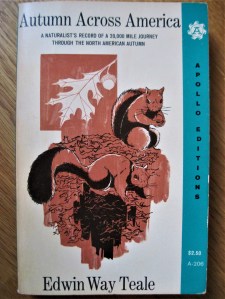 Teale is a lesser-known naturalist who specialized in insects and edited or introduced works by famous natural historians of a previous era like Thoreau, Fabre, Hudson and Muir. In the late 1940s he and his wife Nellie set out on a meandering 20,000-mile road trip from Cape Cod on the Atlantic coast to Point Reyes on the Pacific to track autumn from its first hints to its last gasp. It was the third of four seasonal journeys the Teales undertook in part to distract them from their grief over their son David, who was killed in Germany during WWII. Their route passes through about half the states and experiences nearly every landscape you can imagine, some that are familiar to me and others that would be totally new. They delve in rockpools; observe bird and monarch migration; cross desert, mountains and prairie; and watch sea otters at play.
Although there is a sense of abundance – they see a million ducks in one day, and pass dozens of roadkill jackrabbits – like Aldo Leopold, Teale was an early conservationist who sounded the alarm about flora and fauna becoming rarer: “So much was going even as we watched.” His descriptions of nature are simply gorgeous, while the scientific explanations of leaf color, “Indian summer” and animal communication are at just the right level for the average reader. This was a lucky find at the Book Thing of Baltimore this past spring, and if I ever get the chance, I will delight in reading the other three in the quartet.
Some favorite lines:
“The stars speak of man’s insignificance in the long eternity of time; the desert speaks of his insignificance right now.”
“Those to whom the trees, the birds, the wildflowers represent only ‘locked-up dollars’ have never known or really seen these things. They have never experienced an interest in nature for itself. Whoever stimulates a wider appreciation of nature, a wider understanding of nature, a wider love of nature for its own sake accomplishes no small thing.”
I’m also still reading Led by the Nose: A Garden of Smells by Jenny Joseph, a book about what you see and smell in the garden month by month. I only have the December chapter still to read, followed by some lists of plants set out by ‘when they smell’ and when you plant them. I’ve also been slowly working through A Country Year: Living the Questions by Sue Hubbell, another Book Thing find. After her divorce, Hubbell lived alone on her 90 acres in the Ozarks of Missouri, keeping bees and conscientiously rebuilding a life in communion with nature. I still have the final two sections, “Winter” and “Spring,” left to read.
How’s the weather where you are?
Have you read any “Autumn” books lately?
Reading Ireland Month 2018: Seamus Deane and Edna O’Brien
It’s my first time participating in Reading Ireland Month, run each March by Cathy of 746 Books and Niall of The Fluff is Raging. I enjoyed scouring my shelves for Irish reads – though in the end I only had time for two.

Reading in the Dark by Seamus Deane (1996)
I don’t recall how I first heard about this book, but its title was familiar to me when I picked it up for a matter of pence at a charity shop last year. When I saw it on Cathy’s recent list of her top five Irish books of all time, I knew I was in for something special. These vivid vignettes of childhood and young adulthood are so convincing that I could have been fooled into believing I was reading a memoir. Indeed, this debut novel has generally been interpreted as heavily autobiographical, with the anonymous narrator, the third of seven children born to Catholic parents in Derry, Northern Ireland, taken to be a stand-in for Deane.
 Ireland’s internecine violence is the sinister backdrop to this family’s everyday sorrows, including the death of a child and the mother’s shaky mental health. The narrator also learns a family secret from his dying maternal grandfather that at first thrills him – he knows something his father doesn’t! – but later serves to drive him away from his parents. The short chapters take place between 1945 and 1971: starting when the boy is five years old and encountering a household ghost on the stairs and ending as, in his early thirties, he lays his father to rest in the midst of the Troubles.
The Irish have such a knack for holding humor and tragedy up side by side – think John Boyne, James Joyce and Frank McCourt. The one force doesn’t negate the other, but the juxtaposition reminds you that life isn’t all gloom or laughs. There are some terrifically funny incidents in Reading in the Dark, like the individual sex ed. chat with Father Nugent (“And semen is the Latin for seed. Do you have to know Latin to do this?”) and going to investigate the rumor of a brothel by the football ground. But there is also perhaps the best ghost story I’ve ever read, an eerie tale of shape-shifting children he hears from his aunt.
This book captures all the magic, uncertainty and heartache of being a child, in crisp scenes I saw playing out in my mind. If I have one small, strange complaint, it’s that there’s too much plot – most of the chapters function perfectly well as stand-alone short stories, so, particularly in the last third, the growing obsession with the family secret feels like an unnecessary attempt to tie everything together. That plus the slight irrelevance of the title are the only reasons this misses out on 5 stars from me.
Still, I’d agree with Cathy: this is probably one of my favorite Irish reads, along with Boyne’s The Heart’s Invisible Furies, Mary Costello’s Academy Street, Anne Enright’s The Green Road, and Joyce’s A Portrait of the Artist as a Young Man. It’s no wonder Deane won so many prizes for this: the Irish Times International Fiction Prize, the Guardian Fiction Prize, and the Irish Literature Prize; he was also shortlisted for the 1996 Booker Prize.
Favorite lines:
“Child, she’d tell me, I think sometimes you’re possessed. Can’t you just let the past be the past?”
“He looked up at me, smiling, to say: ah well, it was all blood under the bridge now”
“Politics destroyed people’s lives in this place, he said. People were better not knowing some things”
My rating: 
Mother Ireland by Edna O’Brien (1976)
 This slim volume combines travel writing, history and memoir, with plentiful black and white photographs (by Fergus Bourke) along the way. Often, even where O’Brien is clearly drawing on autobiographical material, she resists saying “I”, instead opting for “one,” “you,” or “we.” I think she was aiming at the universalities of the Irish experience, but instead it ends up coming off as generic. That and a long opening chapter on Ireland’s history set me to skimming. (Also, the book is maddeningly underpunctuated, and the photos in particular seem very dated.) By far my favorite of the seven essays was the last, “Escape to England.” In just three pages, she explains what it’s like to start a new life in another country and how the experience allowed her to appreciate home all the more. Should I try O’Brien’s fiction?
Favorite lines:
“Irish people do not like to be contradicted. Foiled again and again[,] they have in them a rage that comes at you unawares like a briar jutting out of a hedge.”
“You are Irish[,] you say lightly, and allocated to you are the tendencies to be wild, wanton, drunk, superstitious, unreliable, backward, toadying and prone to fits, whereas you know that in fact a whole entourage of ghosts resides in you, ghosts with whom the inner rapport is as frequent, as perplexing, as defiant as with any of the living.”
My rating:
No time for these this year – maybe next year, if not sooner?

 Bookish Beck = Rebecca Foster. American transplant to England. Freelance proofreader and book reviewer.
 Bookish Beck