The Orange Grove by Larry Tremblay (Peirene)
Larry Tremblay is a Francophone writer, theatre director and actor based in Montreal. In addition to three novels, he has published a short story collection and many books of poetry and plays. The Orange Grove (2013), which was longlisted for the 2017 International Dublin (formerly IMPAC) literary award, is the fable-like story of one family in the war-torn Middle East and the way notions of justice and sacrifice drive them to make extreme choices.
Tamara and Zahed live with their twin sons, nine-year-old Aziz and Ahmed, alongside an orange grove planted by Zahed’s father. Soulayed, a militant elder from the next village, describes it thus:
Your father, Mounir, worked his whole life on this arid soil. It was desert here. With God’s help your father worked a miracle. Made oranges grow where there had been only sand and stones.
When Mounir and his wife Shahina are killed in a bombing, Soulayed stands among the ruins and counsels Zahed to seek revenge against their enemies by sending one of his sons to be a suicide bomber. There’s no doubt Soulayed is manipulating this grief-stricken family to his own ends, but he isn’t solely to blame when their culture at large romanticizes martyrdom.
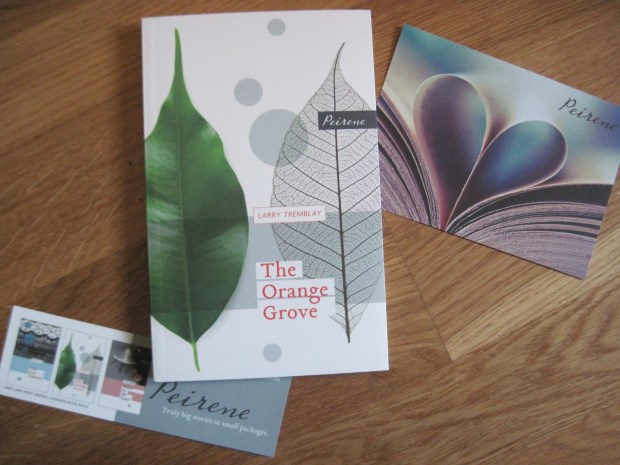
Zahed makes his choice, but Tamara won’t accept it. In a clever reprise of the Genesis story of Jacob and Esau, she helps the boys to make a switch right under their father’s nose. The last third of the book, like a coda, zooms ahead 11 years to show us the surviving brother, coming to the end of a four-year theatre training program in Montreal. He’s given a starring role in his teacher’s wartime play but the story line cuts a little too close to the bone, and for the first time he tells a stranger the story of two brothers: one who died and one who lived.
Peirene Press issues novellas in trios. This is the second in the “East and West: Looking Both Ways” series; I’ve also reviewed the first, The Last Summer by Ricarda Huch. Tremblay and Huch both tackle the theme of betrayal and the practice of choosing one person to die for the crimes of the many. The Orange Grove has a simple style that edges towards flatness but is saved by the occasional striking metaphor (e.g. “Minutes stretched out as if made of dough”). A book about suicide bombing could easily turn mawkish, but the restrained narration reins it in to create a tight and fairly engrossing tale of family ties and religious motivations.
[The third book in the series, Dance by the Canal by Kerstin Hensel, will be released later in 2017.]
The Orange Grove was published in the UK on May 1st. Translated from the French by Sheila Fischman. With thanks to James Tookey of Peirene Press for the free copy for review.
My rating: 
The Last Summer by Ricarda Huch (Peirene)
Originally published in 1910, The Last Summer is a suspenseful epistolary novella by Ricarda Huch (1864–1947), one of the first German women to earn a PhD. She wrote widely across many fields – history, poetry, fiction, and religion – and had an asteroid named after her, earning Thomas Mann’s accolade of “the First Lady of Germany.” I’m grateful to Peirene for resurrecting this German classic as I have a special love for epistolary novels – traditionally told through nothing but letters. You have to be on the lookout for little clues dotted through the correspondence that will tell you who these characters are, how they’re connected to one another, what you need to know about their pasts, and what’s happening now.
 Set across one May to August in the early 1900s, the book joins the von Rasimkara family at their summer home. In response to student protests, patriarch Yegor, the governor of St. Petersburg, has shut down the university and left for the country. With him are his wife, Lusinya; their three twenty-something children, Velya, Jessika and Katya; and Yegor’s new secretary-cum-bodyguard, Lyu. What the family don’t know, but readers do from the first letter onward, is that Lyu is in league with the student revolutionaries and is in on a plot to assassinate the governor at his summer home.
This central dramatic irony is what fuels much of the book’s tension. All of the von Rasimkaras persist in believing the best about Lyu, even when the evidence seems to point to his deception. Both daughters fall in love with him, Velya calls him their “guardian angel,” and Lusinya is sure of his loyalty even after odd incidents she can’t explain, like finding him standing in their bedroom doorway in the middle of the night and a mysterious letter appearing under her pillow. “In case of doubt, one ought to hold back with one’s judgement,” Lusinya opines.
I wouldn’t go so far as to call this a “psychological thriller,” as the back cover blurb does, but I do think it’s a compelling picture of how different groups and ideologies can be fundamentally incompatible. In my favorite passage, Lyu describes the von Rasimkara family to his friend Konstantin:
My stay here is fascinating from a psychological viewpoint. The family has all the virtues and defects of its class. Perhaps one cannot even talk of defects; they merely have the one: belonging to an era that must pass and standing in the way of one that is emerging. When a beautiful old tree has to be felled to make way for a railway line, it’s painful to watch; you stand beside it like an old friend, gazing admiringly and in grief until it comes down. It is undeniably a shame about the governor, who is a splendid example of his kind, but I believe that he has already passed his peak.
As I sometimes feel about novellas, the plot is fairly thin and easily could have been spun out to fill a book of twice the length or more. But that is not what Peirene Press books are about. They’re meant to be quick reads that introduce European novellas in translation. This one has a terrific ending – which I certainly won’t spoil, though the title and cover could be read as clues – and is a perfectly enjoyable way to spend a winter evening.
[Peirene issues books in trios. This is the first of the three books in the “East and West: Looking Both Ways” series. The other two, The Orange Grove by Larry Tremblay and Dance by the Canal by Kerstin Hensel, will be released later in 2017.]
The Last Summer was published in the UK on February 1st. Translated from the German by Jamie Bulloch.
With thanks to James Tookey of Peirene Press for the free copy for review.
My rating: 
Other Peirene titles I’ve reviewed:
- Mr. Darwin’s Gardener by Kristina Carlson
- The Looking-Glass Sisters by Gøhril Gabrielsen
- Her Father’s Daughter by Marie Sizun
- The Man I Became by Peter Verhelst
Novellas in November
Taking a lead from Laura over at Reading in Bed, I’ve trawled my shelves and my current library pile for some blissfully short books. For this challenge I limited myself to books with fewer than 150 pages and came up with four fiction books and two ‘nonfiction novellas’.
The Library of Unrequited Love by Sophie Divry
[92 pages]
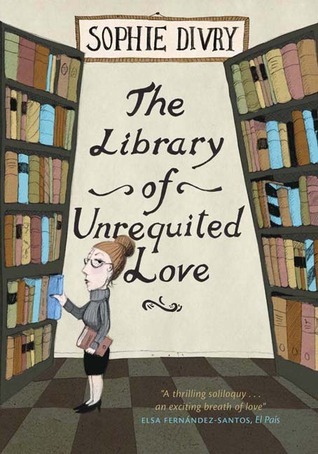 This one-sitting read is a monologue by an embittered librarian who arrives one morning to discover a patron has been locked into the basement overnight—a captive audience. Responsible for Geography, she hopes for a promotion to History, her favorite subject. Alas, no one seems to appreciate this library as a bastion of learning anymore; they only come for DVDs and a place to keep warm. That is, except for Martin, a young PhD researcher who’s caught her eye. But he doesn’t even seem to notice she exists. In one uninterrupted paragraph, this celebrates all that books do for us but suggests that they still can’t fix a broken heart.
My verdict: There are lots of great one-liners about the value of books (“You’re never alone if you live surrounded by books”), but overall it’s a somewhat aimless little experiment and not particularly well translated. 
The All of It by Jeannette Haien
[145 pages]
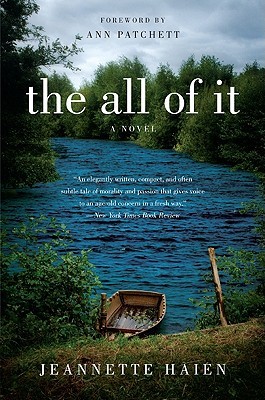 When this won the Sue Kaufman Prize for First Fiction in 1987, the author was in her sixties. It’s since been championed by Ann Patchett, who contributed a Foreword to this 2011 edition. Father Declan de Loughry, fishing for salmon, reflects on the recent death of parishioner Kevin Dennehy. Before he died, Kevin admitted that he and Enda were never properly married. Yet Enda begs the priest to approve a death notice calling Kevin her “beloved husband,” promising she’ll then explain “the all of it” – the very good reason they never married. As she tells her full story, which occupies the bulk of the novella, Father Declan tries to strike a balance between the moral high ground and human compassion.
My verdict: Enda’s initial confession on page 27 is explosive, but the rest of this quiet book doesn’t ever live up to it. I was reminded of Mary Costello’s Academy Street, a more successful short book about an Irish life.
Favorite passage: “One thing I’ve learned, Father—that in this life it’s best to keep the then and the now and the what’s-to-be as close together in your thoughts as you can. It’s when you let gaps creep in, when you separate out the intervals and dwell on them, that you can’t bear the sorrow.”
Thirteen Ways of Looking by Colum McCann
[143 pages]
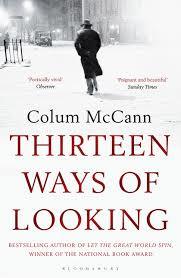 This starts off as the simple story of J. Mendelssohn, an octogenarian who wakes up on a snowy morning in his New York City apartment, contemplating his past – Lithuanian/Polish ancestry, work as a judge and marriage to Eileen, whom he met as a boy in Dublin – and planning to meet his son at a restaurant for lunch. But all of a sudden it turns into a murder mystery on page 24: “Later the homicide detectives will be surprised…” In 13 sections headed by epigraphs from the Wallace Stevens poem “Thirteen Ways of Looking at a Blackbird,” McCann flits through Mendelssohn’s thoughts and flips between the events preceding and immediately following the murder. A late interrogation scene is particularly strong – “unlike our poetry, we like our murders to be fully solved.”
My verdict: This is the first I’ve read from McCann, and it’s terrific. He stuffs so much plot and characterization into not many pages. Mendelssohn’s thought life is rich with allusions and wordplay. I was particularly intrigued to read about the autobiographical overlap in the Author’s Note. I haven’t yet read the short stories included in the volume, but for the novella on its own it’s  .
.
As We Are Now by May Sarton
[134 pages]
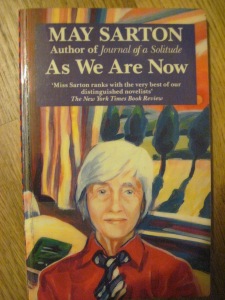 On the surface this is similar to a novel I reviewed earlier in the month, The Secret Diary of Hendrik Groen, 83¼ Years Old. But where spunky Hendrik determines to outwit his care home’s sullen staff, Sarton’s narrator, seventy-six-year-old Caroline Spencer, has given in. A retired high school math teacher, she’s landed in a New England old folks’ home because during her recovery from a heart attack she failed to get along with her brother’s younger wife. She finds kindred spirits in Standish Flint, a tough old farmer, and Reverend Thornhill, but her growing confusion and the home’s pretty appalling conditions drive her to despair.
My verdict: This is enjoyable for the unreliable narrator and the twist ending, but overall it struck me as rather melodramatic. However, I appreciated a lot of Caro’s sentiments.
Favorite passages: “Am I senile, I wonder? The trouble is that old age is not interesting until one gets there, a foreign country with an unknown language to the young, and even to the middle-aged. I wish now that I had found out more about it.” & “And what is left of you? A lapis lazuli pin, a faded rose petal, once pink, slipped into the pages of this copybook.”
And two short works of nonfiction:
Excerpts from a Family Medical Dictionary by Rebecca Brown
[113 pages]
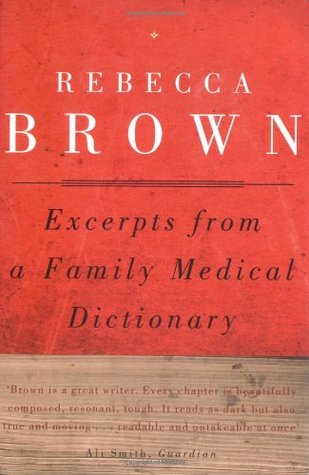 Brown is a novelist from Seattle. This is an account of her mother’s death from what sounds like stomach cancer. The disease progressed quickly and her mother died at home, under hospice care, in New Mexico in 1997. As the title suggests, the brief thematic chapters are arranged around vocabulary words like “anemia” and “metastasis.” My favorite chapters were about washing: her mother’s habit of reading while taking long baths, and the ways Brown and her sister tried to care for their mother’s disintegrating body, including a plan to prepare the corpse themselves. Clinical descriptions of vomiting alternate with magical thinking to accompany her mother’s hallucinations: “You’re packed, Mom, but all of us aren’t going, just you. But you’ve got everything you need.”
My verdict: Brown covers a lot of emotional ground in a very few pages, but I prefer my medical/bereavement memoirs to have more of a narrative and more detail than “when she died it was not peacefully or easy, it was hard.”
Ruined by Reading: A Life in Books by Lynne Sharon Schwartz
[119 pages]
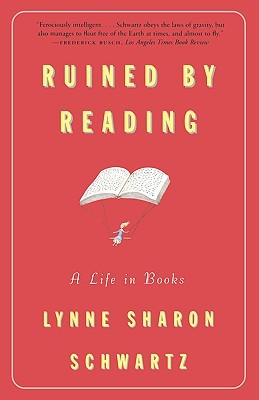 This 1996 memoir was sparked by reading a quote from a Chinese Buddhist in a New York Times article: he suggested that reading is dangerous as it imposes others’ ideas on you and doesn’t allow you to use your own mind freely. Schwartz, of course, begs to differ. As a novelist, reading has been her lifeline. She looks back at her childhood reading and her pretentious college student opinions on Franz Kafka and Henry James, and explains that she lets serendipity guide her reading choices nowadays, rather than a strict TBR list: “reading at random – letting desire lead – feels like the most faithful kind.”
My verdict: It’s a bibliomemoir; I should have loved it. Instead I thought it unstructured and thin. There are some great lines dotted through, but I wasn’t very interested in the examples she focuses on. Five pages about a children’s book by Eleanor Farjeon? Yawn! 
Favorite passages: “Like the bodies of dancers or athletes, the minds of readers are genuinely happy and self-possessed only when cavorting around, doing their stretches and leaps and jumps to the tune of words.” & “How are we to spend our lives, anyway? That is the real question. We read to seek the answer, and the search itself – the task of a lifetime – becomes the answer.”
Have you read any of these? Which one takes your fancy?
How do you feel about novellas in general?
Three Cancer Patient Memoirs
There can’t be many of us whose lives haven’t been touched by cancer. Siddhartha Mukherjee, author of The Emperor of All Maladies, estimates that one in three of us will have cancer at some point in life, and that figure is steadily rising to one in two. Cancer hit home for me in late 2010 with my brother-in-law’s diagnosis of a brain tumor and his subsequent death in early 2015. Since then I have been reading cancer and bereavement memoirs almost compulsively, looking for clues to how we can deal with this near-universal phenomenon. Here are three personal stories of cancer that have stuck with me lately.
This Is Cancer: Everything You Need to Know, from the Waiting Room to the Bedroom
By Laura Holmes Haddad
 A stage IV inflammatory breast cancer survivor, Laura Holmes Haddad wrote the “What to Expect” guide she wishes she could have found at the time of her diagnosis in 2012. Throughout this comprehensive, well-structured book, she uses her own experience to set out practical advice for dealing with the everyday medical and emotional realities of cancer. On the technical side, she gives an alphabetical glossary of “Cancerspeak” vocabulary, as well as explanations of different types of scans, chemo drugs, radiation treatments, methods of coping with pain, and options for reconstruction surgery. But she also goes deep into the less obvious aspects of the disease, like hidden financial costs, little-known side effects, and complications that could affect your sleep and travel. Her tips range from the dead simple—bring your own pen for filling out hundreds of pages of forms; schedule little pick-me-ups like a mini-makeover—to major issues like marriage and parenting with cancer.
“Don’t be surprised if this thing—this cancer road trip—leads to places you never could have imagined,” Holmes Haddad writes. “I’m trying to pay it forward to other patients, to help ease some angst, to comfort.” You might be surprised to learn that this is a very pleasant read. It fluidly mixes anecdote with facts and maintains an appropriate tone: forthright and reassuring yet wry, as in the ‘Devil’s Dictionary’ type translations (“DOCTOR: ‘You might feel some discomfort.’ MEANING: ‘This will hurt like hell.’”).
No cancer patient should be without this book. That statement needs no qualifying. Yes, it might be geared more towards women, specifically breast cancer patients, and there’s some U.S.-specific information about health insurance, but much of the guidance is universally applicable. Whether for yourself or to help a family member or friend, you’ll want a copy.
My thanks to publicist Eva Zimmerman for the free e-copy for review. This Is Cancer will be released by Seal Press on Tuesday.
My rating: 
Late Fragments: Everything I Want to Tell You (About This Magnificent Life)
By Kate Gross
 By the end of this charming memoir, I felt I knew Kate Gross as a friend. A high-flying British civil servant who helped Tony Blair found an NGO in Africa, she was shocked to learn in her early thirties that her occasional ‘bottom trouble’ was end-stage colon cancer with liver metastases. “I’m a golden girl, a people-pleaser, something who is used to graft and a pleasant smile being rewarded,” she writes, yet here was a situation she could not control. She died at age 36 in 2014.
In this short, clear-eyed book, she balances a brief recounting of her life with observations about terminal illness and trying to ensure a good future for her five-year-old twin sons. Memoirs by people facing death can often skirt close to cliché, but I felt Gross had fresh things to tell me about many subjects:
Cultivating “bitter gratitude”: “How strange, how brilliant it is that this awareness of wonder, this sense of the sublime, has been so closely intertwined with my illness as it has progressed.”
The value of literature: “Reading is an experience by which we connect ourselves to what we are, to this magnificent, awful life, in which the same grooves are being scored over and over again in different times and tongues.”
How to act around the dying: “we don’t expect great words of wisdom or solace. I just want this shit to be acknowledged”
Gross doesn’t believe in an afterlife beyond her children’s memory and this book—“nothingness-with-benefits.” I could sympathize with her picture of death, “me in the back of a black taxi, leaving an awesome party before the end, just when everyone else was starting to have real fun.” I wish she’d had longer at the party, but I’m glad she left these thoughts behind.
My rating: 
Haematemesis: How One Man Overcame a Fear of Things Medical and Learned to Navigate His Way Around Hospital
By Henry G. Sheppard
 This is a mordantly funny account of one Australian man’s experience with recurrent cancer. In remission since 2007, Sheppard discovered in 2015 that he was once more riddled—that awful word—with leukemia. Having vowed never to go through chemo again, he learned that it had somewhat improved in the intervening years, with the drip treatments now partially replaced by tablets. This time around he ran into a lot of what he calls “Big Hospital Attitude”: scheduling issues with his bone marrow biopsy, nurses who didn’t think he could manage his own insulin treatments, and constant problems with finding veins for his many injections. Was this the much-touted “Patient-Centered Care”? Would he be better off with the “quick and relatively-painless death offered when one is mauled by a pack of wild dogs”?
“Haematemesis” means vomiting blood, and be warned: there is a lot of blood here; if you’re squeamish about needles you may struggle. There is also plenty of scatological humor. But in general I found the tone to be reminiscent of Bill Bryson in a hospital gown, especially when he’s describing squeezing his belly into a CT scanner or recounting his flatulence.
My main complaint is that at 80 pages this feels incomplete, like it’s telling just part of the story. What about his first bout with leukemia, or his earlier life (which, from a look at his Goodreads biography, seems very eventful indeed)? I understand that Sheppard wanted to get this book released while he was still able. I wish him well and hope for a sequel.
My thanks to the author for the free e-copy for review.
My rating: 
Her Father’s Daughter (Peirene)
Originally issued in 2005, Her Father’s Daughter was French author Marie Sizun’s first of seven novels, published when she was 65. It’s an autobiographical reflection on a painful experience from her childhood: in 1945, when she was four and a half, the father she had never met returned from the war and reentered the family, only to leave again two years later. That is the essential storyline of this spare novella, told from the perspective of a four-year-old girl whose name is France but who is usually just referred to as “the child.”
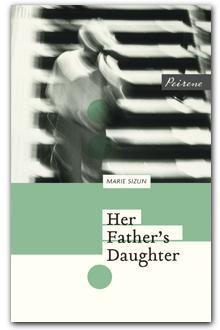 “Of the outside world, the child still knows pretty much nothing.” Her universe is limited to her Paris neighborhood and apartment; her mother, Liliane (Li), is the star around which she orbits. Li gives her daughter free rein, even leaving her alone in the apartment while she goes shopping. When the child learns that her father, a prisoner of war, is soon to return from Germany, she is anxious and resentful. The “secret, intimate world” she has with her mother looks fragile, and she is jealous of anyone who tries to encroach. Meanwhile her father and grandmother both think France has been spoiled and seek to instill a new sense of discipline.
There’s a secret at the heart of the book, something big that the mother and grandmother are covering up. It involves a trip to Normandy, yet whenever the girl tries to speak of the event later on, they deny it and tell her she’s only dreaming. My favorite passages of the book recount her helpless anger as she tries to expose their lies: “Fury from the child, who ploughs on, incredulous. Protests. Persists. In vain.” All she can do in retaliation for this deception and the increasing tension between her parents is pour her mother’s perfumes down the sink.
Sizun’s style is characterized by short, simple phrases. The child is not the narrator, yet the prose imitates the straightforward language that a child might use: “A very strange thing for the child, having a father. A father who’s there. At home. All the time. Morning, noon and night.” The compact chapters chronicle the family’s descent into silence, ignoring each other and walking away – which eventually the father does for good.
Peirene issues books in trios. This one is part of the “Fairy Tale: End of Innocence” series, along with The Man I Became by Peter Verhelst. It’s interesting to think about the book in that context, with the Eden of the mother and daughter being shattered by the entry of the father. “Fathers are found in fairy tales, and they’re always slightly unreal and not very kind,” the child thinks. Unfortunately, I found this novella to be slightly monotonous, with a particularly flat ending. I’ll leave you with a few words from the author about what she was trying to do with the book:
I needed to tell this story. To speak about that wound. … As my writing progressed and the book took shape, I felt this therapy wasn’t only for my personal use but spoke to everyone who, like me, may have been immersed in misunderstandings, in emotional distortions with loved ones, for example being forced to choose between a father and a mother.
It’s not exactly a cheery Father’s Day read, but an intriguing little book all the same.
Translated from the French by Adriana Hunter. With thanks to Peirene Press for the free copy.
My rating: 
Note: I’m traveling until the 24th so won’t be responding to comments right away, but will be sure to catch up soon after I’m back. I always welcome your thoughts!
The Man I Became (Peirene)
The latest book from Peirene Press is narrated by a gorilla. That’s no secret: it’s an explicit warning given in the blurb. Yet the narrator doesn’t remain a gorilla. The clue is in the title: in The Man I Became, the eleventh novel by Belgian Flemish author Peter Verhelst (translated from the Dutch by David Colmer), various species are captured and forcibly humanized. Our narrator – whose name we never know – remembers his happy life in Africa:
We caught termites by pushing long twigs, as flexible as blades of grass, into their mounds and then licking the twigs clean. … We hung from branches one-handed to show off our muscles. We felt like princes and princesses. We were young and beautiful and our bliss was never going to end.
But soon his fellows start disappearing, and eventually the riders come for him too. He’s captured and marched across the desert to the sea to be shipped to the New World. The gorillas’ training begins soon after they arrive.
We learned to walk upright. ‘Faster! Taller!’ said the human. … Then we learned how to shave. … We learned a new language word by word. We learned to eat from a bowl and then with knife and fork. … We learned to powder our skin to make it lighter.
 At this point I started to get a bit nervous about the book’s racial connotations. Especially as the gorillas-in-transition become sexual objects, I wondered what Verhelst could be attempting to say about the notions of the noble savage and the purification of the race.
The creatures’ progress is carefully documented. They carry phones that function as identification as well as an external memory. The art of conversation is something they practice at cocktail parties, where the narrator learns that he and his kind are not the only ones; giraffes, buffalo, leopards, parrots, lions and bonobos have all been subjected to the same experiment. With all of them together in the same room, the animals have to suppress their natural fear reactions.
The narrator becomes an animal trainer for the evolution-in-action show at Dreamland, an amusement park with roller coasters and fast food. There are different classes of animals, you see; some remain animals and do menial duties, while a chosen few are transformed into humans. He halfheartedly looks for his brother and has a brief affair with Emily. When a violent incident leaves several dead and the narrator’s human is caught acquiring animals through the black market, Dreamland’s very existence is threatened. (If you know the history of the real Dreamland, a longtime Coney Island attraction, you may have an inkling.)
This novella is scarcely 120 pages. Short books can be wonderful, but that’s not the case if there’s no space to craft a believable plot. The pace is so quick here that there’s no chance to bed into scenes and settings, and the narrator is never entirely convincing – whether as a gorilla, a man or something in between. Too much of the book feels dreamlike and fragmentary.
Meanwhile, the ideology bothered me. Is this simply a social satire à la Animal Farm, to which it’s compared in the prefatory material? A sort of ‘some animals are more equal than others’ message? If so, then, well, that’s been done before. Nor is there any shortage of books mocking caste systems and eugenic experimentation. Apart from a handful of memorable lines, the prose is quite simplistic, and the overall storyline doesn’t feel original.
Verhelst has written that he was inspired by three things: a troop of cheeky baboons encountered in South Africa, the history of the early-twentieth-century Dreamland, and news of the completed human genome project. “What is a human? Is it a creature that can smile while walking on two legs? A creature with a signature and a mobile phone?” he asks. These are interesting questions, certainly, but I felt they were not explored with particular depth or panache here.
The Man I Became was my third Peirene book, after The Looking-Glass Sisters. This one was a disappointment, but I will not let that deter me from trying more, including the other two in the “Fairy Tale series: End of Innocence”: Marie Sizun’s Her Father’s Daughter and Linda Stift’s The Empress and the Cake.
With thanks to Peirene Press for the free copy.
My rating: 
Small Books Are Good, Too
Last week I wrote in praise of doorstoppers – books over 500 pages. But I also love really short books: there’s just as much writing skill involved in making a narrative concise, and it can be supremely satisfying to pick up a book and polish it off within a couple hours, especially if you’re in a situation of captured attention as on a plane. Being honest and slightly selfish for a moment, short books are also a great way to build up a flagging year list.
Below I highlight poetry collections, memoirs, short stories and novellas that should be on your agenda if you’re looking for a quick read (number of pages in brackets after each title):
Poetry
I try to always have a book of contemporary poetry on the go, usually by a British poet since I pluck these at random from my local public library shelves. Poetry collections aren’t always ‘quick’ reads, nor should they be, because you often have to read a poem more than once to understand it or truly appreciate its techniques. Still, with most poetry books numbering somewhere between 45 and 90 pages, even if you parcel them out over days or weeks they’ll take much less time than a novel. Pick up something by Mark Doty, Kathleen Jamie, David Harsent or Christopher Reid and you’ll have plenty of beautiful verse to ponder.
Recently reviewed and recommended:
- Learning to Make an Oud in Nazareth by Ruth Padel [80]
- All One Breath by John Burnside [96]
- Praise in Which I Live and Move and Have My Being by Paul Durcan [176]
Short Memoirs
Depending on how thorough they are, autobiographies can often hover around 300 or 400 pages. Looking through my shelves, though, I’ve spotted a few in the 140–160 page range: My Movie Business by John Irving [158], The Diving-Bell and the Butterfly by Jean-Dominique Bauby [139], and Winter by Rick Bass [162]. Another short one well worth reading is the unusual The Sound of a Wild Snail Eating by Elisabeth Tova Bailey [170], a story about debilitating illness and taking comfort from nature.
Abigail Thomas, one of my favorite memoirists, writes in an episodic style that makes her 200-page books fly by as if they were half that length. Also, Anne Lamott has written two very short faith memoirs that would serve as a good introduction to her style and content for those who haven’t read Traveling Mercies et al.: Help Thanks Wow [102] and Stitches [112].
Recently reviewed and recommended:
- The Two Kinds of Decay by Sarah Manguso [192]
- The Light of the World by Elizabeth Alexander [208]
- What Comes Next and How to Like It by Abigail Thomas [240] – also included on my BookTrib list of mother–daughter memoirs to read for Mother’s Day
Short Stories
I used to shy away from short stories because I didn’t think they were worth the emotional investment, but recently I’ve decided I really like the rhythm of picking up a set of characters, a storyline and a voice and then, after 20 or so pages, following an epiphany or an aporia (or utter confusion), trading them in for a whole new scenario. Short stories are also the perfect length for reading during a quick meal or car ride. Two short story collections made it onto my “Best of 2014” list: White Man’s Problems by Kevin Morris and The Heaven of Animals by David James Poissant.
Recently reviewed and recommended (no page numbers listed here because each story can stand alone):
- Wallflowers by Eliza Robertson
- Funny Once by Antonya Nelson
- Thunderstruck and Other Stories by Elizabeth McCracken
Novellas
With some credits for free Penguin books I got hold of Borges and the Eternal Orang-Utans by Luis Fernando Verissimo (translated from the Portuguese by Margaret Jull Costa) [135], a book I’d been hankering to read ever since I came across that terrific title. It’s an enjoyable academic comedy and locked room mystery, with nods to Borges and Poe (though I probably didn’t get them all).
I also recently discovered Peirene Press, which exclusively publishes novellas in translation. Their motto is “Contemporary European Literature. Thought provoking, well designed, short.” They publish the novellas in thematic trilogies, with headings such as “Male Dilemma: Quests for Intimacy” and “Small Epic: Unravelling Secrets.” The book I own from Peirene (scored from a secondhand bookshop in Henley-on-Thames for £1), from the “Turning Point: Revolutionary Moments” series, is Mr. Darwin’s Gardener by Kristina Carlson [122] (translated from the Finnish by Emily and Fleur Jeremiah).
It’s an odd little book, with a mixture of past and present tense and first-, third- and first-person plural narration. Set in the village of Downe, it’s peripherally about the title character, Charles Darwin’s gardener Thomas Davies, a new widower with two children, one of whom has Duchenne muscular dystrophy (newly identified). It’s thin on plot, it must be said. Daniel Lewis, the verger of Downe for five years, was dismissed for stealing from the church and is beaten up when he comes back to town; some characters think and talk about Darwin’s theory and Davies’s bereavement; there’s an overturned cart.
My favorite section, “At the Anchor,” is composed of conversations at the village pub, and my favorite individual lines reflect on Darwin’s influence on contemporary thought:
“Mr Darwin is a tree that spreads light, Thomas Davies thinks.”
“Great men are remembered, like Mr Darwin, a genuine monolith. We small folk are mere sand, washed by the waves as they go back and forth.”
“People in future decades and centuries will react to our ideas superciliously, as if we were children playing at thinking. We shall look most amusing in the light of new thoughts and inventions.”
If you’re looking to get through a classic in an afternoon, why not try one of these (full text available for free online through Project Gutenberg or other initiatives): Animal Farm by George Orwell [95], Ethan Frome by Edith Wharton [181] or Flush by Virginia Woolf (her spoof ‘biography’ of Elizabeth Barrett Browning’s cocker spaniel) [108]. E. M. Forster’s novels also read very quickly, and several of John Steinbeck’s novels are quite short. Whether or not you’ve seen the Audrey Hepburn movie, you’ll want to read the sparkling, bittersweet Breakfast at Tiffany’s by Truman Capote [100]; my edition also includes several of his best known short stories, including the wonderful “A Christmas Memory.”
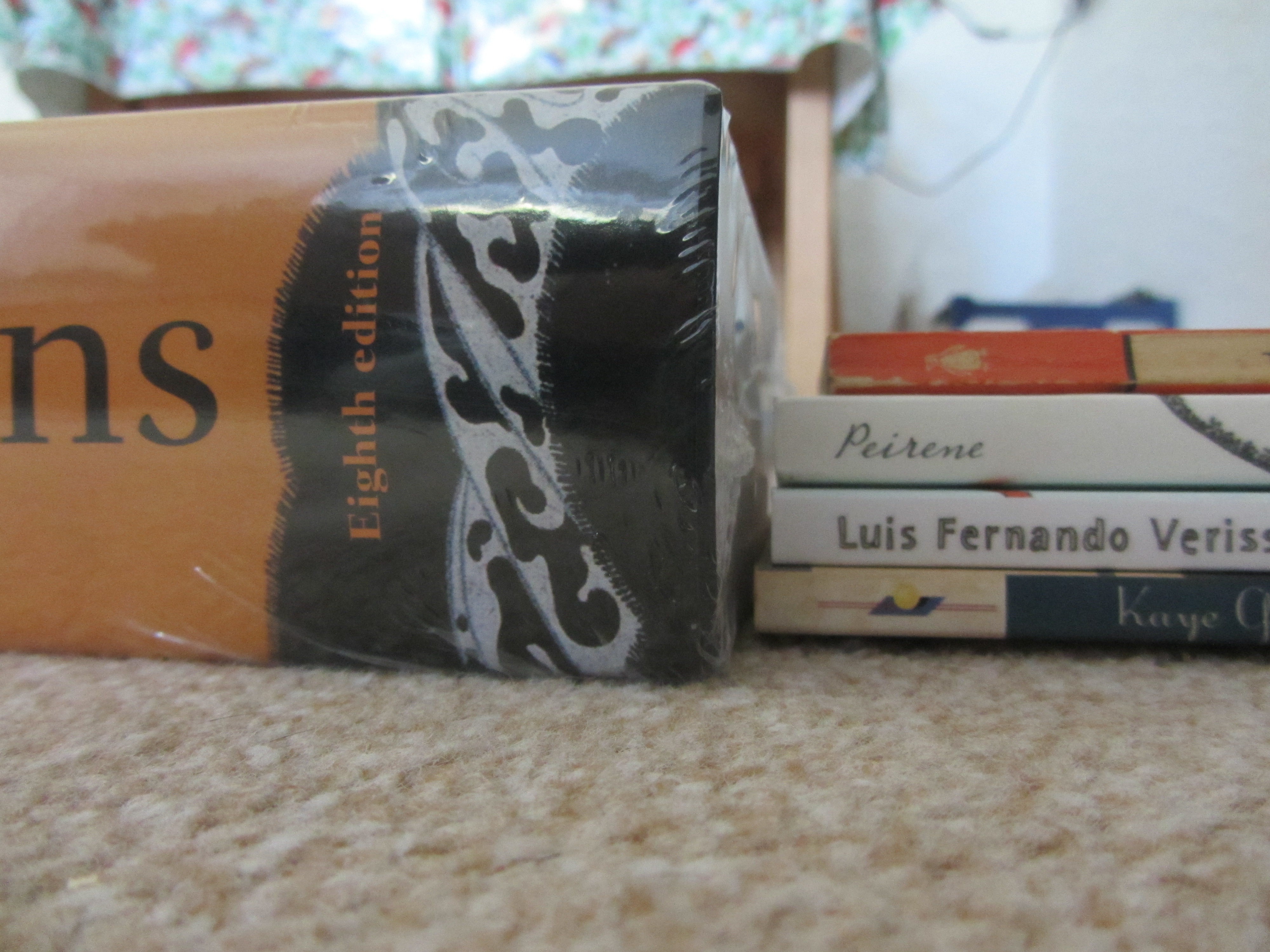
Even four novellas put together don’t stack up very far compared to the Oxford Dictionary of Quotations.
I recently finished The Bookshop by Penelope Fitzgerald [123]; all her books are similarly concise, so you may want to give her a try. The next novella on the pile for me is Ellen Foster by Kaye Gibbons [126]. I had never heard of the author, but the title and description lured me into buying it from a library book sale on a trip back to America (for 25 cents, why not?!). It’s a Southern Gothic story with an eleven-year-old narrator whom Walker Percy likened to Holden Caulfield. The alluring first line: “When I was little I would think of ways to kill my daddy.”
For more ideas, see these two Publishers Weekly’s lists:
“10 Best Books Shorter than 150 Pages” (only repeats one of my suggestions)
“10 Best Short Story Collections You’ve Never Read”
Off topic, but today is a milestone for me: it marks exactly two years that I’ve been a freelance writer!
Are you fond of short books? Do you prefer them to doorstoppers? What are some of your favorite novellas? All comments welcome!
 Bookish Beck = Rebecca Foster. American transplant to England. Freelance proofreader and book reviewer.
 Bookish Beck