November Releases Including #NovNov24: Bennett, Pimlott, Rishøi, Shattuck
Two belated novellas: one a morbid farce set at an old folks’ home; the other a sweet Norwegian tale that offers sisterhood and magic as ways to survive a rough upbringing. Plus a lovely poetry pamphlet about the early days of widowhood and a linked short story collection spanning several centuries of art and relationships in New England.
Killing Time by Alan Bennett
I’d only previously read The Uncommon Reader by Alan Bennett; I perpetually have him confused with Arnold Bennett, by whom I know more. It could be debated whether this is a novella by word count, but even if more of a short story, for me it counts for #NovNov24 because it’s in a stand-alone volume, as publishing partner Faber produced for Claire Keegan’s So Late in the Day last year.
I polished this off in one sitting. Bennett’s black comedy is set at a posh home for the elderly, the Edwardian mansion Hill Topp House. (Residents know to be on their best behaviour lest they be demoted to an inferior neighbouring facility, Low Moor.) When a prospective client calls, Mrs McBryde enthusiastically lists the assets:
We have a choir and on special occasions a glass of dry sherry. It’s less of a home and more of a club and very much a community. We go on frequent trips out. Only last week we went to a local farm where they have a flamingo. … We don’t vegetate at Hill Topp. And the cuisine is not unadventurous. It’s not long since we had a Norwegian evening.
 The dialogue is sparkling, just like you’d expect from a playwright. As in the Hendrik Groen books and Elizabeth Taylor’s Mrs Palfrey at the Claremont, the situation invites cliques and infantilizing. The occasional death provides a bit more excitement than jigsaws and knitting. Ageing bodies may be pitiable (the incontinence!), but sex remains a powerful impulse.
Here is where readers might start to feel disconnected from Bennett’s dated humour. The window cleaner turned gigolo is somewhat amusing; the repeated gag of a flasher, not so much. “Has she seen the sights yet?” two ladies ask. And a jesting conversation about clerical sexual abuse scandals seems particularly ill considered given recent news.
The story is most interesting and fresh once Covid comes onto the scene. Some perish early on; the survivors, ungoverned, do their best. I loved the detail of a resident turning a velvet dress into 60 masks. Two objects, one of them depicted on the cover (it’s not a grenade as I thought at first!), come to have particular importance. I liked this but thought by favouring broad humour it sacrificed characterization or compassion. You’ll enjoy it if you’re fond of wicked comedy by the likes of Alan Ayckbourn. [112 pages]
With thanks to Profile Books for the free copy for review.
After the Rites and Sandwiches: Poems by Kathy Pimlott
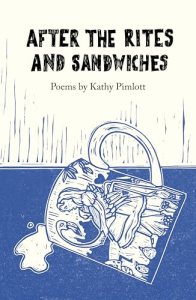 The 18 poems in this pamphlet (in America it would be called a chapbook) orbit the sudden death of Pimlott’s husband a few years ago. By the time she found Robert at the bottom of the stairs, there was nothing paramedics could do. What next? The callousness of bureaucracy: “Your demise constitutes a quarter off council tax; / the removal of a vote you seldom cast and then / only to be contrary; write-off of a modest overdraft; / the bill for an overpaid pension” (from “Death Admin I”). Attempts at healthy routines: “I’ve written my menu for the week. Today’s chowder. / I manage ten pieces of the 1000-piece jigsaw’s scenes / from Jane Austen. Tomorrow I’ll visit friends and say // it’s alright, it’s alright, seventy, eighty percent / alright” (from “How to be a widow”). Pimlott casts an eye over the possessions he left behind, remembering him in gardens and on Sunday walks of the sort they took together. Grief narratives can err towards bitter or mawkish, but this one never does. Everyday detail, enjambment and sprightly vocabulary lend the wry poems a matter-of-fact grace. I plan to pass on my copy to a new book club member who was widowed unexpectedly in May – no doubt she’ll recognise the practical challenges and emotional reality depicted.
With thanks to The Emma Press for the free copy for review.
Brightly Shining by Ingvild Rishøi (2021; 2024)
[Translated from the Norwegian by Caroline Waight]
 Ten-year-old Ronja and her teenage sister Melissa have to stick together – their single father may be jolly and imaginative, but more often than not he’s drunk and unemployed. They can’t rely on him to keep food in their Tøyen flat; they subsist on cereal. When Ronja hears about a Christmas tree seller vacancy, she hopes things might turn around. Their father lands the job but, after his crew at a local pub pull him back into bad habits, Melissa has to take over his hours. Ronja hangs out at the Christmas tree stand after school, even joining in enthusiastically with publicity. The supervisor, Tommy, doesn’t mind her being around, but it’s clear that Eriksen, the big boss, is uncomfortable with even a suggestion of child labour.
It’s touching to see Melissa take on a caring role and to meet the few indisputably good people who help the sisters, such as their elderly neighbour, Aronsen. Ronja’s innocent narration emphasizes her disbelief at their father’s repeated failings and also sets the story up for a late swerve into what seems like magic realism. I’m genuinely not sure what’s supposed to happen at the end, but the sisters find themselves alone in a wintry storm and the language of miracles is used. Rishøi’s debut will surely be compared to Small Things Like These and other classic holiday novellas. I found it a little obvious and saccharine, but if you find the right mood and moment it might just tug at your heart in the run-up to Christmas. [182 pages]
With thanks to Grove Press UK for the free copy for review.
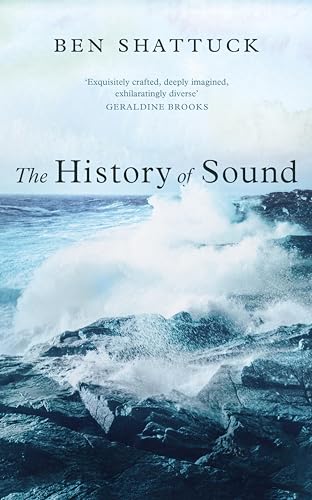
The History of Sound by Ben Shattuck
“history is personal, even when it isn’t”
The dozen stories of Shattuck’s fiction debut form a “hook-and-chain” structure of five couplets, bookended by a first and last story that are related to each other. The links are satisfyingly overt: A pair might take place in the same house in different centuries, or the second will fill in the history of the characters from the first. In “Edwin Chase of Nantucket,” the eponymous figure recognizes his bereaved mother’s loneliness and does her a kindness. “Silver Clip,” which follows, is separated by 200 years, but its accounts of a young painter living in his ancestral island home reprises the motifs of grief, compassion and memory. “Graft,” about a woman spurned in the 1880s, and “Tundra Swan,” in which a man concocts a swindle to pay for his son’s rehab in the present day, are connected by a Cape Cod orchard. Artefacts and documents also play important roles: a journal accounts for a mysterious mass death, a radio transcript and a photograph explain a well-meaning con, and an excerpt from a history textbook follows up on the story of the religious cult in “The Children of New Eden.”
 My favourite individual story was “August in the Forest,” about a poet whose artist’s fellowship isn’t all it cracked up to be – the primitive cabin being no match for a New Hampshire winter. His relationships with a hospital doctor, Chloe, and his childhood best friend, Elizabeth, seem entirely separate until Elizabeth returns from Laos and both women descend on him at the cabin. Their dialogues are funny and brilliantly awkward (“Sorry not all of us are quietly chiseling toward the beating heart of the human experience, August. One iamb at a time”) and it’s fascinating to watch how, years later, August turns life into prose. But the crowning achievement is the opening title story and its counterpart, “Origin Stories,” about folk music recordings made by two university friends during the First World War – and the afterlife of both the songs and the men.
From the start I was reminded strongly of North Woods by Daniel Mason, and particular sequences recall Shoot the Horses First by Leah Angstman and An Account of the Decline of the Great Auk, According to One Who Saw It by Jessie Greengrass. It’s a slight shame for Shattuck that what he was doing here didn’t seem as original to me because of my familiarity with these predecessors. Yet, to my surprise, I found that The History of Sound was more consistent than any of those. With the exception of a few phrases from “Graft” (“living room,” “had sex” and “boring” don’t strike me as 1880s lingo), all of the stories are historically convincing, and the very human themes of lust, parenthood, sorrow and frustrated ambition resonate across centuries and state lines. Really beautiful. (See Susan’s review too.)
[Some you-couldn’t-make-it-up trivia about Shattuck: he’s married to Jenny Slate (author of Little Weirds et al., as well as an actress known to me as Mona Lisa from Parks and Recreation); and he runs the oldest general store in America, built in 1793.]
With thanks to Swift Press for the free copy for review.
Which of these November releases catches your eye? What others can you recommend?
July Releases: Speak to Me & The Librarianist
I didn’t expect these two novels to have anything in common, but in fact they’re both about lonely, introverted librarians who have cause to plunge into memories of a lost relationship. (They also had a couple of random tiny details in common, for which see my next installment of Book Serendipity.) Tonally, however, they couldn’t be more different, and while the one worked for me the other did not at all. You might be surprised which! Read on…
Speak to Me by Paula Cocozza
I adored Cocozza’s debut, How to Be Human, so news of her follow-up was very exciting. The brief early synopses made it sound like it couldn’t be more up my street what with the theme of a woman frustrated by her husband’s obsession with his phone – I’m a smartphone refusenik and generally nod smugly along to arguments about how they’re an addiction that encourages lack of focus and time wasting. But it turns out that was only a peripheral topic; the novel is strangely diffuse and detached.
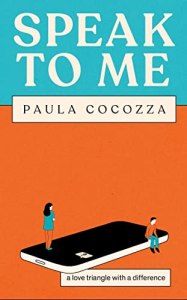 Susan is a middle-aged librarian and mother to teenage twin boys. She lives with them and her husband Kurt on a partially built estate in Berkshire full of soulless houses of various designs. Their “Beaufort” is not a happy place, and their marriage is failing, for several reasons. One is tech guru Kurt’s phone addiction. Susan refers to each new model as “Wendy,” and for her the last straw is when he checks it during the middle of sex on her 50th birthday. She joins a forum for likeminded neglected family members, and kills several Wendys by burial, washing machine, or sledgehammer.
But as the story goes on, Kurt’s issues fade into the background and Susan becomes more obsessed with the whereabouts of a leather suitcase that went missing during their move. The case contains letters and souvenirs from her relationship with Antony, whom she met at 16. She’s convinced that Kurt is hiding it, and does ever odder things in the quest to get it back, even letting herself into their former suburban London home. Soon her mission shifts: not only does she want Antony’s letters back; she wants Antony himself.
The message seems a fairly obvious one: the characters have more immediate forms of communication at their disposal than ever before, yet are not truly communicating with each other about what they need and want from life, and allowing secrets to come between them. “We both act as if talking will destroy us, but surely silence will, more slowly, and we will be undone by all the things we leave unsaid,” Susan thinks about her marriage. Nostalgia and futurism are both held up as problematic. Fair enough.
However, Susan is unforthcoming and delusional – but not in the satisfying unreliable narrator way – and delivers this piecemeal record with such a flat affect (reminding me of no one more than the title character from Kazuo Ishiguro’s Klara and the Sun; Susan even says, “Why do I feel scared that someone will find me out every time I tick the box that says ‘I am not a robot’?”) that I lost sympathy early on and couldn’t care what happened. A big disappointment from my Most Anticipated list.
With thanks to Tinder Press for the proof copy for review.
The Librarianist by Patrick deWitt
Bob Comet, a retired librarian in Portland, Oregon, gets a new lease on life at age 71. One day he encounters a lost woman with dementia and/or catatonia in a 7-Eleven and, after accompanying her back to the Gambell-Reed Senior Center, decides to volunteer there. A plan to read aloud to his fellow elderly quickly backfires, but the resident curmudgeons and smart-asses enjoy his company, so he’ll just come over to socialize.
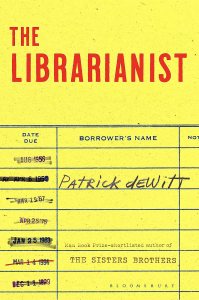 If it seems this is heading in a familiar A Man Called Ove or The Secret Diary of Hendrik Groen direction, think again. Bob has a run-in with his past that leads into two extended flashbacks: one to his brief marriage to Connie and his friendship with his best man, Ethan, in 1960; the other to when he ran away by train and bus at age 11.5 and ended up in a hotel as an assistant to two eccentric actresses and their performing dogs for a few days in 1945.
Imagine if Wes Anderson directed various Dickens vignettes set in the mid-20th-century Pacific Northwest – Oliver Twist with dashes of Great Expectations and Nicholas Nickleby. That’s the mood of Bob Comet’s early adventures. Witness this paragraph:
The next day Bob returned to the beach to practice his press rolls. The first performance was scheduled to take place thirty-six hours hence; with this in mind, Bob endeavored to arrive at a place where he could achieve the percussive effect without thinking of it. An hour and a half passed, and he paused, looking out to sea and having looking-out-to-sea thoughts. He imagined he heard his name on the wind and turned to find Ida leaning out the window of the tilted tower; her face was green as spinach puree, and she was waving at him that he should come up. Bob held the drum above his head, and she nodded that he should bring it with him.
(You can just picture the Anderson staginess: the long establishing shots; the jump cuts to a close-up on her face, then his; the vibrant colours; the exaggerated faces. I got serious The Grand Budapest Hotel vibes.) This whole section was so bizarre and funny that I could overlook the suspicion that deWitt got to the two-thirds point of his novel and asked himself “now what?!” The whole book is episodic and full of absurdist dialogue, and delights in the peculiarities of its characters, from Connie’s zealot father to the diner chef who creates the dubious “frizzled beef” entrée. And Bob himself? He may appear like a blank, but there are deep waters there. And his passion for books was more than enough to endear him to me:
“Bob was certain that a room filled with printed matter was a room that needed nothing.”
[Ethan:] “‘I keep meaning to get to books but life distracts me.’ ‘See, for me it’s just the opposite,’ Bob said.”
“All his life he had believed the real world was the world of books; it was here that mankind’s finest inclinations were represented.”
Weird and hilariously deadpan in just the way you’d expect from the author of The Sisters Brothers and French Exit, this was the pop of fun my summer needed. (See also Susan’s review.)
With thanks to Bloomsbury for the proof copy for review.
Would you read one or both of these?
Books of Summer, 2: The Story of My Father by Sue Miller
I followed up my third Sue Miller novel, The Lake Shore Limited, with her only work of nonfiction, a short memoir about her father’s decline with Alzheimer’s and eventual death. James Nichols was an ordained minister and church historian who had been a professor or dean at several of the USA’s most elite universities. The first sign that something was wrong was when, one morning in June 1986, she got a call from police in western Massachusetts who had found him wandering around disoriented and knocking at people’s doors at 3 a.m. On the road and in her house after she picked him up, he described vivid visual delusions. He still had the capacity to smile “ruefully” and reply, when Miller explained what had happened and how his experience differed from reality, “Doggone, I never thought I’d lose my mind.”
Until his death five years later, she was the primary person concerned with his wellbeing. She doesn’t say much about her siblings, but there’s a hint of bitterness that the burden fell to her. “Throughout my father’s disease, I struggled with myself to come up with the helpful response, the loving response, the ethical response,” she writes. “I wanted to give him as much of myself as I could. But I also wanted, of course, to have my own life. I wanted, for instance to be able to work productively.” She had only recently found success with fiction in her forties and published two novels before her father died; she dedicated the second to him, but too late for him to understand the honor. Her main comfort was that he never stopped being able to recognize her when she came to visit.
Although the book moves inexorably towards a death, Miller lightens it with many warm and admiring stories from her father’s past. Acknowledging that she’ll never be able to convey the whole of his personality, she still manages to give a clear sense of who he was, and the trajectory of his illness, all within 170 pages. The sudden death of her mother, a flamboyant lyric poet, at age 60 of a heart attack, is a counterbalance as well as a potential contributing factor to his slow fading as each ability was cruelly taken from him: living alone, reading, going outside for walks, sleeping unfettered.

Sutton Hill, the nursing home where he lived out his final years, did not have a dedicated dementia ward, and Miller regrets that he did not receive the specialist care he needed. “I think this is the hardest lesson about Alzheimer’s disease for a caregiver: you can never do enough to make a difference in the course of the disease. Hard because what we feel anyway is that we have never done enough. We blame ourselves. We always find ourselves deficient in devotion.” She conceived of this book as a way of giving her father back his dignity and making a coherent story out of what, while she was living through it, felt like a chaotic disaster. “I would snatch him back from the meaninglessness of Alzheimer’s disease.”
And in the midst of it all, there were still humorous moments. Her poor father fell in love with his private nurse, Marlene, and believed he was married to her. Awful as it was, there was also comedy in an extended family story Miller tells, one I think I’m unlikely to forget: They had always vacationed in New Hampshire rental homes, and when her father learned one of the opulent ‘cottages’ was coming up for sale, he agreed to buy it sight unseen. The seller was a hoarder … of cats. Eighty of them. He had given up cleaning up after them long ago. When they went to view the house her father had already dropped $30,000 on, it was a horror. Every floor was covered inches deep in calcified feces. It took her family an entire summer to clean the place and make it even minimally habitable. Only afterwards could she appreciate the incident as an early sign of her father’s impaired decision making.
I’ve read a fair few dementia-themed memoirs now. As people live longer, this suite of conditions is only going to become more common; if it hasn’t affected one of your own loved ones, you likely have a friend or neighbor who has had it in their family. This reminded me of other clear-eyed, compassionate yet wry accounts I’ve read by daughter-caregivers Elizabeth Hay (All Things Consoled) and Maya Shanbhag Lang (What We Carry). It was just right as a pre-Father’s Day read, and a novelty for fans of Miller’s novels. (Charity shop) 
April Releases: Motherhood, Medicine, Wine … And an Aardvark
I’m averaging four new releases a month: a nicely manageable number. In April I read a memoir about a mother’s dementia, a bizarre little novel about a stuffed aardvark linking two centuries, a history of medicine in graphic novel form, and a sommelier’s memoir.
My top recommendation for the month is:
What We Carry by Maya Shanbhag Lang
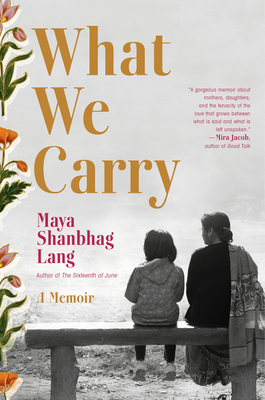 Maya Lang’s novel The Sixteenth of June* was one of my top three novels of 2014, so I was eager to read her next book, a forthright memoir of finding herself in the uncomfortable middle (the “sandwich generation”) of three generations of a female family line. Her parents had traveled from India to the USA for her mother’s medical training and ended up staying on permanently after she became a psychiatrist. Lang had always thought of her mother as a superwoman who managed a career alongside parenthood, never asked for help, and reinvented herself through a divorce and a career change.
When Lang gave birth to her own daughter, Zoe, this model of self-sufficiency mocked her when she had postpartum depression and needed to hire a baby nurse. It was in her daughter’s early days, just when she needed her mother’s support the most, that her mother started being unreliable: fearful and forgetful. Gradually it became clear that she had early-onset Alzheimer’s. Lang cared for her mother at home for a year before making the difficult decision to see her settled into a nearby nursing home.
Like Elizabeth Hay’s All Things Consoled, this is an engaging, bittersweet account of obligation, choices and the secrets that sometimes come out when a parent enters a mental decline. I especially liked how Lang frames her experiences around an Indian folktale of a woman who enters a rising river, her child in her arms. She must decide between saving her child or herself. Her mother first told this story soon after Zoe’s birth to acknowledge life’s ambiguity: “Until we are in the river, up to our shoulders—until we are in that position ourselves, we cannot say what the woman will do. We must not judge. That is the lesson of the story. Whatever a woman decides, it is not easy.” The book is a journey of learning not to judge her mother (or herself), of learning to love despite mistakes and personality changes.
*One for me to reread in mid-June!
Published by Dial Press on the 28th. I read an e-copy via NetGalley.
Full disclosure: Maya and I are Facebook friends.
Other April releases to look out for:
(All:  )
)
Enter the Aardvark by Jessica Anthony
 On a scoreboard of the most off-the-wall, zany and fun novels I’ve read, this one would be right up there with Ned Beauman’s Boxer, Beetle and Alex Christofi’s Glass. The two story lines, one contemporary and one set in the 1870s, are linked by a taxidermied aardvark that makes its way from Namibia to the Washington, D.C. suburbs by way of Victorian England.
The aardvark was collected by naturalist Sir Richard Ostlet and stuffed by Titus Downing, his secret lover. Ostlet committed suicide in Africa, but his wife could still sense him walking up and down outside her London home. In the present day, Republican congressman Alexander Paine Wilson, who emulates Ronald Reagan in all things, gets a FedEx delivery of a taxidermied aardvark – an apparent parting gift from Greg Tampico before the latter committed suicide. To keep his gay affair from becoming public knowledge, Wilson decides it’s high time he found himself a trophy wife. But the damned aardvark keeps complicating things in unexpected ways.
A scene where a police officer stops Wilson for texting and driving and finds the stuffed aardvark in the back of his SUV had me laughing out loud (“Enter the aardvark, alight on its mount. Enter the aardvark, claw raised, head covered with a goddamned gourmet $22 dish towel that suddenly looks incredibly suspicious hanging over the head of an aardvark, like it’s an infidel”). History repeats itself amusingly and the aardvark is an entertaining prop, but Wilson is too obviously odious, and having his narrative in the second person doesn’t add anything. This is not a debut novel but reads like one: full of bright ideas, but falling a bit short in the execution.
Published by Doubleday on the 23rd. I won a proof copy in a Twitter giveaway.
Medicine: A Graphic History by Jean-Noël Fabiani
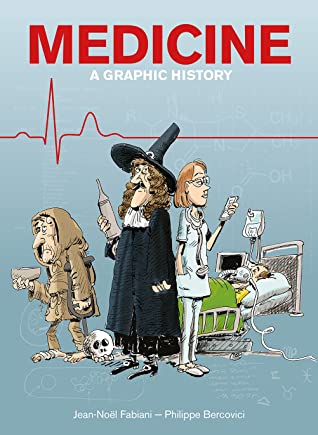 [Illustrated by Philippe Bercovici; translated from the French by Edward Gauvin]
From prehistory to nanotechnology, this is a thorough yet breezy survey of what people have learned about the body and how to treat it. (In approach it reminded me most of another SelfMadeHero graphic novel I reviewed last year, ABC of Typography.) Some specific topics are the discovery of blood circulation, the development of anesthesia, and the history of mental health treatment.
Fabiani, a professor as well as the head of cardiac surgery at Georges Pompidou European Hospital in Paris, focuses on the key moments when ideas became testable theories and when experiments gave groundbreaking results. While he provided the one-page introduction to each chapter and the expository writing at the head of each comic pane, I suspect it was illustrator Philippe Bercovici who added most of the content in the speech bubbles, including plenty of jokes (especially since Fabiani thanks Bercovici for bringing his talent and humor to the project).
This makes for a lighthearted book that contains enough detail so that you feel like you are still getting the full story. Unsurprisingly, I took the most interest in chapters entitled The Great Epidemics and A Few Modern Plagues. I would especially recommend this to teenagers with an interest in medicine.
Published by SelfMadeHero on the 9th. My thanks to the publisher for the free copy for review.
Wine Girl by Victoria James
 In 2012, at age 21, Victoria James became America’s youngest certified sommelier. Still in her twenties, she has since worked in multiple Michelin-starred restaurants in New York City and became the only American female to win the Sud de France Sommelier Challenge. But behind all the competition wins, celebrity sightings, and international travel for wine festivals and conferences is a darker story.
This is a tell-all about a toxic restaurant culture of overworked employees and casual sexism. James regularly worked 80-hour weeks in addition to her wine school studies, and suffered multiple sexual assaults. In addition, sexual harassment was common – even something as seemingly harmless as the title epithet a dismissive diner launched at her when he ordered a $650 bottle of wine for his all-male table and then told her it was corked and had to be replaced. “Wine girl” was a slur against her for her age, her gender and her presumed lack of experience, even though by that point she had an encyclopedic knowledge of wine varieties and service.
That incident from the prologue was my favorite part of the book; unfortunately, nothing that came afterwards really lived up to it. The memoir goes deep into James’s dysfunctional upbringing (her parents’ bitter divorce, her mother’s depression, her father’s alcoholism and gambling, her own battle with addictions), which I found I had little interest in. It’s like Educated lite, but with a whiney tone: “I grew up in a household of manipulation and neglect, left to fend for myself.”
For those interested in reading about wine and restaurant culture, I’d recommend Cork Dork by Bianca Bosker and Sweetbitter by Stephanie Danler (one of my pairings here) instead.
A favorite line: “Like music, the wonders of art, food, and beverage can transcend all boundaries. … I wanted to capture that feeling, the exhilaration of familiarity, and bring people together through wine.”
Published by Fleet on the 16th. My thanks to the publisher for the free copy for review.
 Bookish Beck = Rebecca Foster. American transplant to England. Freelance proofreader and book reviewer.
 Bookish Beck