Reading Ireland Month, Part II: Dowd, Enright, Madden & Nugent
I’m catching up with a final set of reviews for #ReadingIrelandMonth26. I read two novels set at least partially during the Troubles, one of them for teenagers; a quiet novel about adultery and bereavement; and a thriller about consent and family legacy. I also read the first half of one more novel, a sombre one about the aftermath of a mental health crisis. Between this post and my first one, I covered 6.5 novels by Irish women, which I’ll call a win.
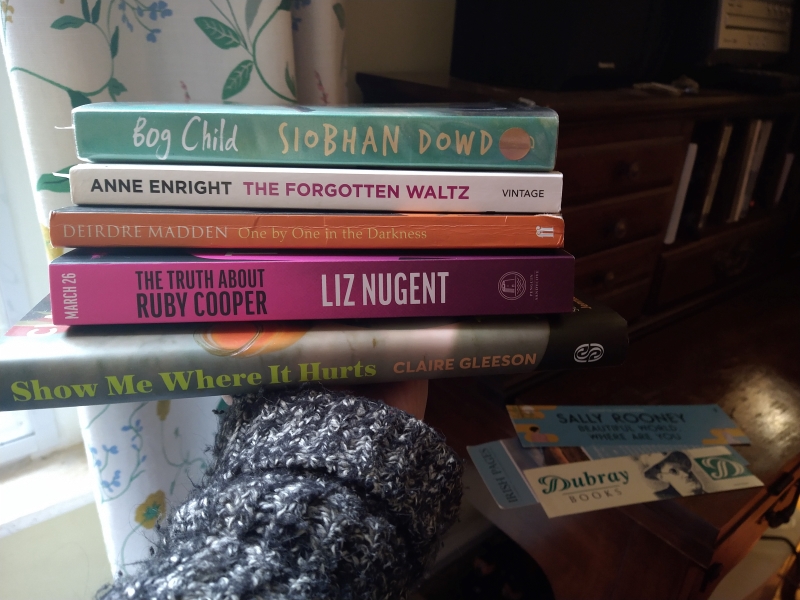
Bog Child by Siobhan Dowd (2008)
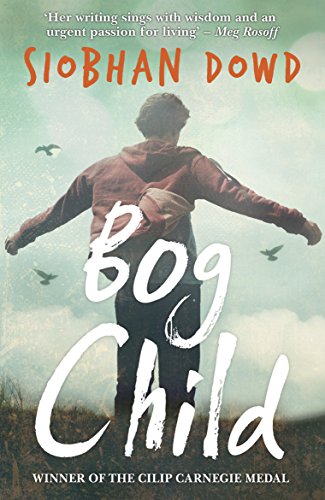 Fergus McCann is 18 and taking A levels; if he can only get three Bs, he’ll have his ticket out of Northern Ireland to study medicine at Aberdeen. This is no ordinary summer, though. He loves running on the hills at the border and here he makes a landmark discovery and embarks on a risky mission. The plot opens with Fergus and his uncle stumbling on the corpse of a girl while cutting peats. It’s a case for archaeologists rather than the police: the body is from the Iron Age and there’s evidence that the girl was sacrificed. An acquaintance then pressures Fergus into running parcels up and down the hill, right under the noses of the British at the checkpoint. He makes friends with Owain, a Welsh soldier, but gets a horrible feeling he’s partially responsible for the bombings he soon hears about on the radio. His family is enmeshed in the IRA anyway: his brother is among the hunger strikers in the local prison. There’s every chance that Joey could die before the summer is out, as much a victim of injustice as “Mel” (as Fergus names the girl from the bog, whose story he dreams).
This was Dowd’s third novel, published posthumously after her death from cancer, and won the Carnegie Medal. I’d say it’s one of the few best young adult novels I’ve ever read. (It’s shelved under Teenage Fiction at my library.) It’s an excellent peripheral glance at history ancient and modern – Fergus’s letter to Margaret Thatcher is brilliant – and effectively recreates a teen’s divided attention: friends, schooling, family drama, the future, and romance (via the daughter of the archaeologist). I searched my library catalogue for further books on bog bodies after reading Anna North’s Bog Queen and it really paid off! (Public library)
The Forgotten Waltz by Anne Enright (2011)
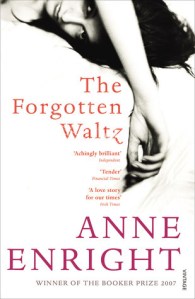 I’ve only read a handful of Enright novels and wanted to experience more, so picked this one because it was shortlisted for the Orange Prize. On the face of it, it’s a fairly straightforward adultery story, but the unshowy potency of Enright’s writing and her realistic insight into relationships set it apart. While married to Conor, Gina has an affair with Seán, who’s older and married to Aileen. Seán is part of their social circle but also someone she knows through work, and business trips are an easy excuse. “The office game was another game for us to play, after the suburban couples game, and before the game of hotel assignations and fabulous, illicit lust, and neither of us thought there might come a moment when all the games would stop. It was a lot of fun.” Gina narrates matter-of-factly, rejecting cause-and-effect language. She doesn’t defend herself, or fool herself that Seán is perfect. This new relationship involves as many challenges as her marriage, what with her mother’s death and Seán’s preteen daughter, Evie, who appears to be autistic and epileptic. The short chapters are all headed with song lyrics, mostly from love songs (“Will You Love Me Tomorrow,” “Stop! In the Name of Love”) whose ironic optimism underlines the novel’s gently melancholy tone. This reminded me most of Maggie O’Farrell’s early work, and more than justified delving into Enright’s back catalogue. (Secondhand – Awesomebooks.com)
{SPOILERS IN THE REST!!}
One by One in the Darkness by Deirdre Madden (1996)
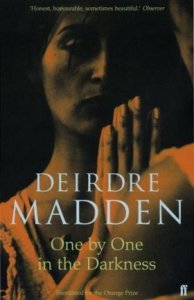 Louise Kennedy’s Trespasses was our book club selection for March; I’d read it just two years ago, so skimmed back through and was impressed by its construction. Some were less convinced by the framing story and not emotionally engaged with Michael and Cushla’s affair, but we all appreciated it as a sideways look at Northern Irish history. One by One in the Darkness, which was also shortlisted for the Women’s (then Orange) Prize, is set close to its publication in the 1990s but returns to the Troubles through memories and flashbacks. Set over one week – Saturday to Friday – it’s the story of the three Quinn sisters. Cate is a journalist in London who flies home to Antrim to break the news that she’s pregnant out of wedlock. Helen is a lawyer and Sally a schoolteacher. They, their mother, and Uncle Brian have all gotten on with life as best they could, but their father’s murder is something they can’t forget and won’t ever get over. By saving that scene for the very last page of this novella, she keeps the horror of it fresh. Through one family’s story, she gives a sense of the scope of the country’s loss. But the book is not without a dark sense of humour, either. Madden was a new author for me. I found her work profound at the sentence level (see below for some favourite lines) rather than engaging at the plot level. (Secondhand – Awesomebooks.com)
“‘What’s wrong with Uncle Peter?’ ‘Two things,’ [Granny] said. ‘He thinks too much, and then he drinks too much.’”
“Once when [Cate] was home she’d remarked to Helen that she thought the forecasts were often inaccurate in Northern Ireland. ‘It’s probably deliberate,’ Helen had replied. ‘If they read out the average day’s news here and then said at the end of it, “Oh, and by the way, it’s going to bucket rain for the next twenty-four hours,” it might be more than people could take.’”
“Cate had remarked once that it was only when you lived away from Northern Ireland that you realised on returning how deeply divided a society it was, and how strange the effect of that could be.”
“There’d been well over three thousand people killed since the start of the Troubles, and every single one of them had parents or husbands and wives and children whose lives had been wrecked. It would be written about in the paper for two days, but as soon as the funeral was over it was as if that was the end, when it was really only the beginning.”
The Truth about Ruby Cooper by Liz Nugent (2026)
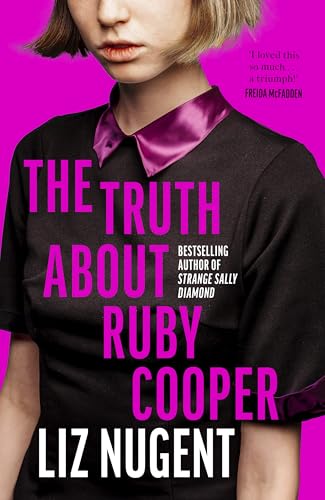 We read Nugent’s Strange Sally Diamond for book club a couple years ago and it was a great Northumberland holiday read for me, with a deliciously off-kilter narrator whose traumatized (and perhaps neurodivergent) perspective carried the novel. Here again Nugent prioritizes unreliable women’s voices and dark happenings, but Ruby is awfully hard to like. At age 16, she falsely accuses her older sister Erin’s boyfriend Milo of raping her. Milo maintains his innocence all along, but goes to jail for the crime; after all, DNA evidence can’t lie, right? Years of his life – and a heartbroken Erin’s – are stolen, his mother dies by suicide, Ruby becomes dependent on alcohol: all of this because of sisterly jealousy and an elaborate lie that their mother upholds rather than expose the family to further shame.
Narration alternates between Erin in Boston and Ruby, who’s moved back to Ireland with their mother. For Ruby’s confession to work, readers are kept in the dark about the truth of the incident, though only for 76 pages. Together the sisters give a tedious blow-by-blow of the intervening years – until Ruby’s daughter, Lucy, is raped by her boss on a drunken night out. Ruby refuses to believe her “because if it was true, that was karma coming to bit me on the ass.” This is where things finally get interesting, as Nugent explores ironies and familial patterns. But I’m sure I won’t be the only one to find the whole thing distasteful. Nugent clearly anticipates a backlash, stating in a prefatory letter, “I need to be very clear about the fact that girls and women like Ruby Cooper are extremely rare.” Was it worth undermining the #BelieveWomen campaign to explore a certain state of mind? Nah.
With thanks to Sandycove (Penguin) for the proof copy for review.
I’d also hoped to finish one more, but ran out of time. Here are my thoughts on the first half:
Show Me Where It Hurts by Claire Gleeson (2025)
 Rachel knew Tom had recurring problems with depression, but had no idea he was on the verge of a breakdown when he deliberately drove their car off the road with the intention of killing his entire family. Their two young children die in the crash but they both survive – Tom held in a psychiatric hospital and Rachel resuming her life as a nurse. The chapters alternate between “After” and “Before,” giving relative date markers in weeks, months or years out from the incident. Gleeson’s understated prose makes it possible for readers to face a tragedy so awful we’d otherwise look away; it never tips over into mawkishness.
#DoorstoppersInDecember: Book of Lives by Margaret Atwood & The End of Mr. Y by Scarlett Thomas
Later than intended, I’m reporting back on Margaret Atwood’s memoir, which I started in late November, and a long-neglected 500+-page novel I plucked from my shelves. Both offered page-turning intrigue and a blend of history, magic, and pure weirdness. Many thanks to Laura for hosting Doorstoppers in December, which encouraged me to pick them up!
Book of Lives: A Memoir of Sorts by Margaret Atwood (2025)
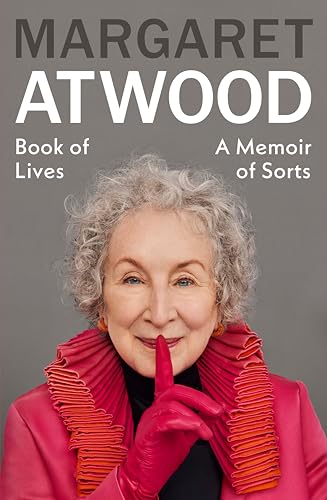 I gave some initial thoughts about the book here to tie in with Margaret Atwood Reading Month. What I said then proved true of the book as a whole: it’s delightful though dense with detail and historical context. I did get a little bogged down in the names and details of decades worth of publishing, but there is some tasty gossip, such as the fact that Margaret Laurence spread mean rumours about her (and was a drunk) but later changed her ways. It’s been a lucky window of time for Atwood to live through: she has known simplicity and the need for do-it-yourself practicality, but has also experienced privilege, even luxury (multiple homes and worldwide travel). Mostly, she had the good fortune of being at the start of Canada’s literary boom. In the early 1960s, only five Canadian novels were published per year. Through her involvement with literary magazines and House of Anansi Press and her books on Susanna Moodie and the tropes of Canadian literature, she helped create the scene.
There are frequent mentions of how people or events made their way into her fiction and poetry. Coyly, she writes, “I just have a teeming imagination. Also, like all novelists, I’m a kleptomaniac.” The page or two of context on each book is illuminating and it never becomes the tedious “I published this book … then I published this book” that she mentioned wanting to avoid in the introduction. Rather, these sections made me want to go reread lots of her books to appreciate them anew. I was also reminded how often she’s been ahead of her time, with topics and details that seem prophetic (she proposed Payback before the financial crisis hit, for instance). Some elements felt particularly timely: she experienced casual misogyny and an alarming number of near-misses – she says things like “I won’t give his name … you know who you are … though you’re probably dead” – and, through her involvement in bird conservation, she’s well aware of the disastrous environmental trajectory we’re on.
For a memoir, this is not especially forthcoming about the author’s inner life and emotions. Where it is, she masks the material in a layer of technique. So when she’s confessing to having an affair while married to Jim Polk (whom she met at Harvard), she writes it like a fairytale scene in which she went into the woods with a wolf. When she was fretting about Graeme Gibson’s reluctance to divorce her first wife and marry her, she imagines letters to her ‘inner advice columnist’. (Note: Gibson was her long-time partner and his sons were like her stepchildren but they never did marry – and he only ‘allowed’ her the one child, though she wanted two of her own. One ‘Jess Gibson’ has a speculative short story collection, The Good Eye, coming out in May 2026. No doubt her work will be compared with her mother’s, but bully for her for not using the name Atwood to try to ride her coattails.)
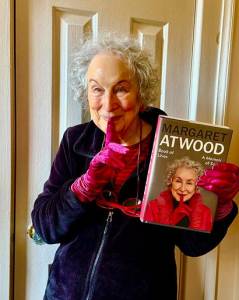
A cute pic from her Substack in November
One of the successful literary touches is the recurring “We Nearly Lose Graeme” segments about his risky behaviour and various mishaps. He had dementia and mini strokes before suffering a major one while in London with her for The Testaments tour; he died five days later. Her reflections on his death are poignant, but generic: “We can all believe three things simultaneously: The person is in the ground. The person is in the Afterlife. The person is in the next room. You keep expecting to see him. Even when you know it’s coming, a death is a shock.” At the crucial moment, she turns to the first-person plural and the second person.
I skimmed some of the bits about Graeme’s earlier life and the behind-the-scenes of publishing; I felt that he and many of her literary pals are more important to her than they are to readers. But that’s okay. The same goes for her earlier life; I noted that the account of her time as a summer camp counsellor felt more detailed than necessary. However, with her gift for storytelling, even the smallest incident can be rendered amusing. She looks for the humour, coincidence, or irony in any situation, and her summations and asides are full of dry humour. Some examples:
- “Spoiler: Jim and I eventually got married, one of the odder things to happen to both of us.”
- “After a while, the hand [at the window of her Harvard student accommodation] went away. It’s what you wish for in a disembodied hand.”
- “Eventually the iguana [inherited from her roommate] was given a new home at a zoo among other iguanas, where it was probably happier. Hard to tell.”
It’s not a book for the casual reader who kinda liked one or two Atwood novels; it’s more for the diehard fans among us, and offers a veritable trove of stories and photographs. But don’t expect a tell-all. Think of this more as a companion to her oeuvre. The title feels literal in that it’s as if she’s lived several lives: the wilderness kid, the literary ingénue, the family and career woman, the philanthropist and elder stateswoman. She doesn’t try to pull all of her incarnations into one, instead leaving all of the threads trailing into the beyond. If anything, “Peggy Nature” (her name from summer camp) is the role that has persisted. I probably liked the childhood material most, which makes sense as it’s what she’s looking back on with most fondness. Towards the close, Atwood mentions her heart condition and seems perfectly accepting of the fact that she won’t be around for much longer. But her body of work will endure. I’m so grateful for it and for the gift of this self-disclosure, however coy. (Can I be greedy and hope for another novel?) She leaves this message: “We scribes and scribblers are time travellers: via the magic page we throw our voices, not only from here to elsewhere, but also from now to a possible future. I’ll see you there.” [570 pages] (Public library) 
The End of Mr. Y by Scarlett Thomas (2006)
 This is a mash-up of the campus novel, the Victorian pastiche, and the time travel adventure. Ariel Manto is a PhD student working on thought experiments. Inciting incidents come thick and fast: her supervisor disappears, the building that houses her office partially collapses as it’s on top of an old railway tunnel, and she finds a copy of Thomas Lumas’s vanishingly rare The End of Mr. Y in a box of mixed antiquarian stock going for £50 at a secondhand bookshop. Rumour has it the book is cursed, and when Ariel realises that the key page – giving a Victorian homoeopathic recipe for entering the “Troposphere,” a dream/thought realm where one travels through time and space – has been excised, she knows the quest has only just begun. It will involve the book within a book, Samuel Butler novels, a theologian and a shrine, lab mice plus the God of Mice, and a train line whose destinations are emotions.
The plot is pretty bonkers and I’m not sure I can satisfactorily explain its internal logic now, but as is true of the best doorstoppers, it absorbed me completely. I read it very quickly (for me) and even read 120 pages in one sitting thanks to my cat pinning me to the sofa. It also felt prescient in discussing “machine consciousness” – a topic adjacent to artificial intelligence. Ariel is a Disaster Woman avant la lettre, living on noodles and cut-price wine. Her current ‘relationship’ consisting of rough sex with a married professor is the latest in a string of unhealthy connections. But time travel offers the possibility not just of reversing her own mistakes, but of going right back to the start of humanity. Verging on steampunk, this was much better than the other Thomas novels I’ve read, The Seed Collectors and Oligarchy. It was longlisted for the Orange (Women’s) Prize and would be a great choice for readers of Nicola Barker and Susanna Clarke. [502 pages] (Secondhand – Book-Cycle, Exeter; it’s been on my shelves since 2016!) 
A Bookshop of One’s Own by Jane Cholmeley (Blog Tour)
Silver Moon, one of the Charing Cross Road bookshops, was a London institution from 1984 until its closure in 2001. “Feminism and business are strange bedfellows,” Jane Cholmeley soon realised, and this book is her record of the challenges of combining the two. On the spectrum of personal to political, this is much more manifesto than memoir. She dispenses with her own story (vicar’s tomboy daughter, boarding school, observing racism on a year abroad in Virginia, secretarial and publishing jobs, meeting her partner) via a 10-page “Who Am I?” opening chapter. However, snippets of autobiography do enter into the book later on; in one of my favourite short chapters, “Coming Out,” Cholmeley recalls finally telling her mother that she was a lesbian after she and Sue had been together nearly a decade.
The mid-1980s context plays a major role: Thatcherite policies (Section 28 outlawing the “promotion of homosexuality”), negotiations with the Greater London Council, and trying to share the landscape with other feminist bookshops like Sisterwrite and Virago. Although there were some low-key rivalries and mean-spirited vandalism, a spirit of camaraderie generally prevailed. Cholmeley estimates that about 30% of the shop’s customers were men, but the focus here was always on women. The events programme featured talks by an amazing who’s-who of women authors, Cholmeley was part of the initial roundtable discussions in 1992 that launched the Orange Prize for Fiction (now the Women’s Prize), and the café was designated a members’ club so that it could legally be a women-only space.

I’ve always loved reading about what goes on behind the scenes in bookshops (The Diary of a Bookseller, Diary of a Tuscan Bookshop, The Sentence, The Education of Harriet Hatfield, The Little Bookstore of Big Stone Gap, and so on), and Cholmeley ably conveys the buzzing girl-power atmosphere of hers. There is a fun sense of humour, too: “Dyke and Doughnut” was a potential shop name, and a letter to one potential business partner read, “you already eat lentils, and ride a bicycle, so your standard of living hasn’t got much further to fall, we happen to like you an awful lot, and think we could all work together in relative harmony”.
However, the book does not have a narrative per se; the “A Day in the Life of… (1996)” chapter comes closest to what those hoping for a bookseller memoir might be expecting, in that it actually recreates scenes and dialogue. The rest is a thematic chronicle, complete with lists, sales figures, profitability charts, and excerpted documents, and I often got lost in the detail. The fact that this gives the comprehensive history of one establishment makes it a nostalgic yearbook that will appeal most to readers who have a head for business, were dedicated Silver Moon customers, and/or hold a particular personal or academic interest in the politics of the time and the development of the feminist and LGBT movements.
With thanks to Random Things Tours and Mudlark for the free copy for review.
Buy A Bookshop of One’s Own from Bookshop.org [affiliate link]
I was happy to be part of the blog tour for the release of this book. See below for details of where other reviews have appeared or will be appearing soon.

Completing the Women’s Prize Winners Reading Project and Voting
In this 25th anniversary year of the Women’s (previously Orange/Baileys) Prize, people have been encouraged to read all of the previous winners. I duly attempted to catch up on the 11 winners I hadn’t yet read, starting with Fugitive Pieces by Anne Michaels; Half of a Yellow Sun by Chimamanda Ngozi Adichie and A Crime in the Neighborhood by Suzanne Berne as part of a summer reading post; and When I Lived in Modern Times by Linda Grant, Property by Valerie Martin and Larry’s Party by Carol Shields (a reread) in this post.
This left just four for me to read before voting for my all-time favorite in the web poll. I managed two as recent buddy reads but had to admit defeat on the others, giving them just the barest skim before sending them back to the library.
The Idea of Perfection by Kate Grenville (1999; 2001 prize)
(Buddy read with Laura T.; see her review here)
 This is essentially an odd-couple romance, but so awkward I don’t think any of its scenes could accurately be described as a meet-cute. Harley Savage, a thrice-married middle-aged widow, works for the Applied Arts Museum in Sydney. The tall, blunt woman is in Karakarook, New South Wales to help the little town launch a heritage museum. Douglas Cheeseman is a divorced engineer tasked with tearing down a local wooden bridge and building a more suitable structure in its place. Their career trajectories are set to clash, but the novel focuses more on their personal lives. From the moment they literally bump into each other outside Douglas’ hotel, their every meeting is so embarrassing you have to blush – she saves him from some angry cows, while he tends to her after a bout of food poisoning.
Grenville does well to make the two initially unappealing characters sympathetic, primarily by giving flashes of backstory. Douglas is the posthumous child of a war hero, but has never felt he’s a proper (macho) Australian man. In fact, he has a crippling fear of heights, which is pretty inconvenient for someone who works on tall bridges. Harley, meanwhile, is haunted by the scene of her last husband’s suicide and is also recovering from a recent heart attack.
The title is, I think, meant to refer to how the protagonists fail to live up to ideals or gender stereotypes. However, it more obviously applies to the subplot about Felicity Porcelline, a stay-at-home mother who has always sought to be flawless – a perfect pregnancy, an ageless body (“Sometimes she thought she would rather be dead than old”), the perfect marriage – but gets enmired in a dalliance with the town butcher. I was never convinced Felicity’s storyline was necessary. Without it, the book might have been cut from 400 pages to 300.
Still, this was a pleasant narrative of second chances and life’s surprises. The small-town setting reminded Laura of Olive Kitteridge in particular, and I also thought frequently of Anne Tyler and her cheerfully useless males (“There was a lot to be said for being boring, and it was something [Douglas] was good at”). But I suspect the book won’t remain vivid in my memory, especially with its vague title that doesn’t suggest the contents. I enjoyed Grenville’s writing, though, so will try her again. In my mind she’s more known for historical fiction. I have a copy of The Secret River, so will see if she lives up to that reputation.
My rating: 
How to Be Both by Ali Smith (2014)
(Buddy read with Marcie of Buried in Print.)
 A book of two halves, one of which I thoroughly enjoyed; the other I struggled to engage with. I remembered vaguely as I was reading it that this was published in two different versions. As it happened, my library paperback opened with the contemporary storyline.
New Year’s Day marks the start of George’s first full year without her mother, a journalist who died at age 50. Her mother’s major project was “Subvert,” which used Internet pop-ups to have art to comment on politics and vice versa. George remembers conversations with her mother about the nature of history and art, and a trip to Italy. She’s now in therapy, and has a flirty relationship with Helena (“H”), a mixed-race school friend.
Smith’s typical wordplay comes through in the book’s banter, especially in George and H’s texts. George is a whip-smart grammar pedant. Her story was, all in all, a joy to read. There is even a hint of mystery here – is it possible that her mother was being monitored by MI5? When George skips school to gaze at her mother’s favorite Francesco del Cossa painting in the National Gallery, she thinks she sees Lisa Goliard, her mother’s intense acquaintance, who said she was a bookbinder but acted more like a spy…
The second half imagines a history for Francesco del Cossa, who rises from a brick-making family to become a respected portrait and fresco painter. The artist shares outward similarities with George, such as a dead mother and homoerotic leanings. There are numerous tiny connections, too, some of which I will have missed as my attention waned. The voice felt all wrong for the time period; I sensed that Smith wasn’t fully invested in the past, so I wasn’t either. (In dual-timeline novels, I pretty much always prefer the contemporary one and am impatient to get back to it; at least in books like Unsheltered and The Liar’s Dictionary there are alternate chapters to look forward to if the historical material gets tedious.)
An intriguing idea, a very promising first half, then a drift into pretension. Or was that my failure to observe and appreciate? Smith impishly mocks: “If you notice, it changes everything about the picture.” With her format and themes, she questions accepted binaries. There are interesting points about art, grief and gender, even without the clever links across time. But had the story opened with the other Part 1, I may never have gotten anywhere.
My rating: 
Skims
I made the mistake of leaving the three winners that daunted me the most stylistically – McBride, McInerney and Smith – for last. I eventually made it through the Smith, though the second half was quite the slog, but quickly realized these two were a lost cause for me.
 A Girl Is a Half-formed Thing by Eimear McBride: I’d glanced at the first few pages in a shop before and found the style immediately off-putting. When I committed to this #ReadingWomen project, I diligently requested a copy from the university library even though I seriously doubted I’d have the motivation to read it. It turns out my first impression was correct: I would have to be paid much more than I’ve ever been paid for writing about a book just to get through this one. From the first paragraph on, it’s deliberately impenetrable in a sub-Joycean way. Ron Charles, the Washington Post book critic and one of my literary heroes/gurus, found the subject matter relentlessly depressing and the obfuscating style elitist. (Might it work as an audiobook? I can’t say; I’ve never listened to one.)
 The Glorious Heresies by Lisa McInerney: Not as stylistically difficult as expected, though there is mild dialect and long passages in italics (one of my reading pet peeves). But I’m not drawn to gangster stories, and after a couple of chapters didn’t feel like pushing myself through the book. I did enjoy the setup of Maureen killing an intruder with a holy stone, eliciting this confession: “I crept up behind him and hit him in the head with a religious ornament. So first I suppose God would have to forgive me for killing one of his creatures and then he’d have to forgive me for defiling one of his keepsakes.” For Anna Burns and Donal Ryan fans, perhaps?
It’s been many years since I’ve read some of these novels, such that all I have to go on is my vague memories and Goodreads ratings, and there are a handful there towards the bottom that I couldn’t get through at all, but I still couldn’t resist having a go at ranking the 25 winners, from best to least. My completely* objective list:
(*not at all)
Larry’s Party by Carol Shields
Half of a Yellow Sun by Chimamanda Ngozi Adichie
We Need to Talk about Kevin by Lionel Shriver
An American Marriage by Tayari Jones
The Tiger’s Wife by Téa Obreht
On Beauty by Zadie Smith
Home Fire by Kamila Shamsie
A Crime in the Neighborhood by Suzanne Berne
The Road Home by Rose Tremain
When I Lived in Modern Times by Linda Grant
The Idea of Perfection by Kate Grenville
Fugitive Pieces by Anne Michaels
The Lacuna by Barbara Kingsolver
Bel Canto by Ann Patchett
May We Be Forgiven by A.M. Homes
Property by Valerie Martin
Small World by Andrea Levy
Home by Marilynne Robinson
How to Be Both by Ali Smith
The Power by Naomi Alderman
Hamnet by Maggie O’Farrell
A Spell of Winter by Helen Dunmore
The Glorious Heresies by Lisa McInerney
The Song of Achilles by Madeline Miller
A Girl Is a Half-formed Thing by Eimear McBride
You can see the arbitrary nature of prizes at work here: some authors I love have won for books I don’t consider their best (Adichie, Kingsolver, O’Farrell, Patchett), while some exceptional female authors have been nominated but never won (Toni Morrison, Elizabeth Strout, Anne Tyler). Each year the judges are different, and there are no detailed criteria for choosing the winner, so it will only ever be the book that five people happen to like the best.
As she came out top of the heap with what is, coincidentally, the only one of the winning novels that I have managed to reread, my vote goes to Carol Shields for Larry’s Party. (People’s memory for prize winners is notoriously short, so I predict that one of the last two years’ winners, Tayari Jones or Maggie O’Farrell, will win the public’s best of the best vote.)

You have until midnight GMT on Sunday November 1st to vote for your favorite winner at this link. That’s less than a week away now, so get voting!
Note: If you’re interested in tracking your Women’s Prize reading over the years, check out Rachel’s extremely helpful list of all the nominees. It comes in spreadsheet form for you to download and fill out. I have read 138 nominees (out of 477) and DNFed another 19 so far.
Who gets your vote?
Women’s Prize Winners Reading Project: Grant, Martin, Shields et al.
In this 25th anniversary year of the Women’s Prize, readers are being encouraged to catch up on all the previous winners. I’d read 14 of them (including Hamnet) as of mid-April and have managed five more since then – plus a reread, a DNF and a skim. I recently reviewed Fugitive Pieces by Anne Michaels, and Half of a Yellow Sun by Chimamanda Ngozi Adichie and A Crime in the Neighborhood by Suzanne Berne as part of this summer reading post. This leaves just four more for me to read before voting for my all-time favorite in November.
When I Lived in Modern Times by Linda Grant (2000)
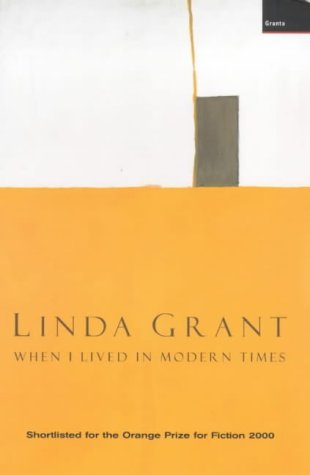 Some settings have been done to death, but here’s one I don’t think I’d ever encountered before: Israel in the final year before statehood. Grant dramatizes the contrast between Palestine, a doomed British colony, and the Jewish hope of a homeland. In 1946 twenty-year-old Evelyn Sert leaves her home in London, masquerading as a Gentile tourist (though she has Latvian Jewish ancestry) so as to jump ahead of thousands of displaced persons awaiting entry visas. With her mother recently dead of a stroke, she takes advice and money from her mother’s married boyfriend, “Uncle Joe,” a Polish Jew and Zionist, and heads to Palestine.
After six weeks on a kibbutz, Evelyn sets out to make her own life in Tel Aviv as a hairdresser and falls in with Johnny, a Jew who fought for the British. It’s safer to be part of the colonial structure here, so she once again passes as Gentile, dyeing her hair blonde and going by Priscilla Jones. In a land where all kinds of people have been thrown together by the accident of their ethnicity and the suffering it often entailed, one man’s terrorist is another’s freedom fighter. For Evelyn, who’s never known anywhere apart from suburban London and arrived in Palestine a virgin, the entire year is a journey of discovery. Will a place of ancient religious significance embrace modern architecture, technology and government? Grant really captures this period of transition for an individual and for a nascent nation of exiles. I loved the supporting characters and the nostalgic look back from half a century on. 
Favorite passages:
In a country with its face turned towards the future, our stories sat on our shoulders like a second head, facing the way we had come from. We were the tribe of Janus, if there is such a thing.
With hindsight it always seems easy to do the right thing, but we were trying to decide something in those days that people don’t often get a chance to have a say in and it was this: would we be a free nation after two thousand years of wandering or would we always be a subject race? Would we be ghetto Jews or new Jews?
Property by Valerie Martin (2003)
 A compact study of slavery that unfolds through the relationship between a New Orleans plantation owner’s wife and her husband’s mistress. Manon Gaudet has never been happy in her marriage, but when their slave girl, Sarah, bears her husband a second child, she decides she has had enough of silently condoning his behavior. A slave uprising and cholera and yellow fever outbreaks provide some welcome drama, but the bulk of this short novel is an examination of the psyche of a woman tormented by hatred and jealousy. Ownership of another human being is, if not technically impossible, certainly not emotionally tenable. Manon’s situation is also intolerable because she has no rights as a woman in the early nineteenth century: any property she inherits will pass directly to her husband. Though thoroughly readable, for me this didn’t really add anything to the corpus of slavery fiction.
A reread (as well as a buddy read with Buried in Print):
Larry’s Party by Carol Shields (1997)
“The whole thing about mazes is that they make perfect sense only when you look down on them from above.”
 Larry Weller is an Everyman: sometimes hapless and sometimes purposeful; often bewildered with where life has led him, but happy enough nonetheless. From the start, Shields dwells on the role that “mistakes” have played in making Larry who he is, like a floral arts catalogue coming in the mail from the college instead of one on furnace repair and meeting Dorrie at a Halloween party he attended with a different girl. Before he knows it he and a pregnant Dorrie are getting married and he’s been at his flower shop job for 12 years. A honeymoon tour through England takes in the Hampton Court Palace maze and sparks an obsession that will change the course of Larry’s life, as he creates his first maze at their Winnipeg home and gradually becomes one of a handful of expert maze-makers.
The sweep of Larry’s life, from youth to middle age, is presented roughly chronologically through chapters that are more like linked short stories: they focus on themes (family, friends, career, sex, clothing, health) and loop back to events to add more detail and new insight. I found the repetition of basic information about Larry somewhat off-putting in that it’s as if we start over with this character with each chapter – the same might be said of Olive Kitteridge, but that book’s composition was drawn out and it involves a multiplicity of perspectives, which explains the slight detachment from Olive. Here the third-person narration sticks close to Larry but gives glimpses into other points of view, tiny hints of other stories – a man with AIDS, a woman trying to atone for lifelong selfishness, and so on.
From my first reading I remembered a climactic event involving the Winnipeg maze; a ribald chapter entitled “Larry’s Penis,” about his second marriage to a younger woman and more; and the closing dinner party, a masterful sequence composed almost entirely of overlapping dialogue (like the final wedding reception scene in her earlier novel, The Box Garden) as Larry hosts his two ex-wives, his current girlfriend, his sister and his partner, and a colleague and boss. What is it like to be a man today? someone asks, and through the responses Shields suggests a state of uneasiness, of walking on eggshells and trying not to be a chauvinist in a world whose boundaries are being redrawn by feminism. That process has continued in the decades since, though with predictable backlash from those who consider women a threat.
It seems slightly ironic that Shields won the Women’s Prize for this episodic fictional biography of a man, but I found so much to relate to in Larry’s story – the “how did I get here?” self-questioning, the search for life’s meaning, “the clutter of good luck and bad” – that I’d say Larry is really all of us.
One of Shields’s best, and quite possibly my winner of winners.
My original rating (2008?):
My rating now: 
Currently rereading: Gilead by Marilynne Robinson
A skim:
A Spell of Winter by Helen Dunmore (1995)
 An annoying thing happened with this one: the back cover blurb gave away a central theme. It’s one I’m keen to avoid yet feel I have encountered disproportionately often in fiction, especially recently (I won’t name any titles as that would give it away instantly). Dunmore writes nicely – from my quick skim of this one it seemed very atmospheric – but I am not particularly drawn to her plots. I’ve read Exposure for book club and own two more of her novels, Talking to the Dead and Zennor in Darkness, so by the time I’ve read those I will have given her a solid try. So far I’ve preferred her poetry – I’ve read three of her collections.
A favorite passage:
“It is winter in the house. This morning the ice on my basin of water is so thick I can not break it. The windows stare back at me, blind with frost. … I can see nothing through the frost flowers on the glass. I wonder if it is snowing yet, but I think it is too cold. … I look at the house, still and breathless in the frost. I have got what I wanted. A spell of winter hangs over it, and everyone has gone.”
And a DNF:
The Song of Achilles by Madeline Miller (2011)
 Patroclus is a disappointment of a prince. He has no chance of winning Helen of Troy’s hand in marriage, and exile awaits him when he is responsible for an accidental death. As a foster child in the household of another king, he becomes obsessed with Achilles. The two young men take part in music lessons and military training, and Patroclus follows Achilles away from the palace to be taught by a centaur. That’s as far as I got before I couldn’t bear any more. The homoerotic hints are laughably unsubtle: (of a lyre) “‘You can hold it, if you like.’ The wood would be smooth and known as my own skin” & (fighting) “he rolled me beneath him, pinning me, his knees in my belly. I panted, angry but strangely satisfied.”
I got a free download from Emerald Street, the Stylist magazine e-newsletter. The ancient world, and Greek mythology in particular, do not draw me in the least, and I have had bad experiences with updates of Greek myths before (e.g. Bright Air Black by David Vann). I never thought this would be a book for me, but still wanted to attempt it so I could complete the set of Women’s Prize winners. I read 77 pages out of 278 in the e-book, but when I have to force myself to pick up a book, I know it’s a lost cause. As with the Dunmore, I think it’s safe to say this one never would have gotten my vote anyway.
The final four to complete my project:
(On the stack to read soon)
The Idea of Perfection by Kate Grenville – free from mall bookshop
The Glorious Heresies by Lisa McInerney – public library copy
How to Be Both by Ali Smith – public library copy; a planned buddy read with B.I.P.
(To get from the university library)
A Girl Is a Half-formed Thing by Eimear McBride
Read any Women’s Prize winners lately?
Summery Reads, Part II: Sun and Summer Settings
Typically for the late August bank holiday, it’s turned chilly and windy here, with a fair bit of rain around. The past two weeks have felt more like autumn, but I’ve still been seeing out the season with a few summery reads.
What makes for good summer reading? I love reading with the seasons, picking up a book set during a heat wave just as the temperature is at a peak, but of course there can also be something delicious about escaping by reading about Arctic cold. Marcie of Buried in Print wrote here that she likes her summer books to offer just the right combination of the predictable and the unexpected, and that probably explains why I’m more likely to dip into genre fiction in the summer than at any other time of year. To her criteria I would also add addictiveness and a strong sense of place so as to be transporting – especially important this year when so many of us haven’t been able to have the vacations we might have planned on.
My best two summer binge reads this year were Rodham and Americanah; my two summery classics, though more subtle, were also perfect. Mostly Dead Things by Kristen Arnett, which I’m reading for a Shiny New Books review, has also felt apt for its swampy Florida setting. More recently, I picked up a couple of books with “sun” in the title, plus two novels set entirely in the course of one summer. Two of my selections are also towards my project of reading all of the Women’s Prize winners by November so I can vote on my all-time favorite.
Here comes the sun…
Half of a Yellow Sun by Chimamanda Ngozi Adichie (2006)
 Adichie filters an epic account of Nigeria’s civil war through the experience of twin sisters, Olanna and Kainene, and those closest to them. The wealthy chief’s daughters from Lagos drift apart: Olanna goes to live with Odenigbo, a math professor; Kainene is a canny businesswoman with a white lover, Richard Churchill, who is fascinated by Igbo art and plans to write a book about his experiences in Africa. Gradually, though, he realizes that the story of Biafra is not his to tell.
The novel alternates between the close third-person perspectives of Olanna, Richard and Ugwu, Odenigbo’s houseboy, and moves between the early 1960s and the late 1960s. These shifts underscore stark contrasts between village life and sophisticated cocktail parties, blithe prewar days and witnessed atrocities and starvation. Kainene runs a refugee camp, while Ugwu is conscripted into the Biafran army. Violent scenes come as if out of nowhere, as suddenly as they would have upturned real lives. A jump back in time reveals an act of betrayal by Odenigbo, and apparently simple characters like Ugwu are shown to have hidden depths.
In the endmatter of my paperback reissue, Adichie writes, “If fiction is indeed the soul of history, then I was equally committed to the fiction and the history, equally keen to be true to the spirit of the time as well as to my artistic vision of it.” Copious research must have gone into a book about events that occurred before her birth (both of her grandfathers died in the conflict), but its traces are light; this is primarily about storytelling and conveying emotional realities rather than ensuring readers grasp every detail of the Biafran War. This was my second attempt to read the novel, and while again I did not find it immediately engaging, by one-quarter through it had me gripped. I’m a firm Adichie fan now, and look forward to reading her other three new-to-me books sooner rather than later.
Orange Prize (now Women’s Prize) for Fiction winner, 2007
Source: Birthday gift from my wish list some years back
My rating:
The Shadow of the Sun: My African Life by Ryszard Kapuściński (1998)
[Translated from the Polish by Klara Glowczewska in 2001]
 Kapuściński was a foreign correspondent in Africa for 40 years and lent his name to an international prize for literary reportage. This book of essays spans several decades and lots of countries, yet feels like a cohesive narrative. The author sees many places right on the cusp of independence or in the midst of coup d’états – including Nigeria, a nice tie-in to the Adichie. Living among the people rather than removed in some white enclave, he develops a voice that is surprisingly undated and non-colonialist. While his presence as the observer is undeniable – especially when he falls ill with malaria and then tuberculosis – he lets the situation on the ground take precedence over the memoir aspect. I’m only halfway through, but I fully expect this to stand out as one of the best travel books I’ve ever read.
Evocative opening lines:
“More than anything, one is struck by the light. Light everywhere. Brightness everywhere. Everywhere, the sun.”
Source: Free bookshop
It happened one summer…
A Crime in the Neighborhood by Suzanne Berne (1997)
 Berne, something of a one-hit wonder, is not among the more respected Women’s Prize alumni – look at the writers she was up against in the shortlist and you have to marvel that she was considered worthier than Barbara Kingsolver (The Poisonwood Bible) and Toni Morrison (Paradise). However, I enjoyed this punchy tale. Marsha remembers the summer of 1972, when her father left her mother for Aunt Ada and news came of a young boy’s sexual assault and murder in the woods behind a mall. “If you hadn’t known what had happened in our neighborhood, the street would have looked like any other suburban street in America.”
Laid up with a broken ankle from falling out of a tree, 10-year-old Marsha stays out of the way of her snide older twin siblings and keeps a close eye on the street’s comings and goings. Like Harriet the Spy or Jimmy Stewart’s convalescent character in Rear Window, she vows to note anything relevant in her Book of Evidence to pass on to the police. Early on, her suspicion lands on Mr. Green, the bachelor who lives next door. Feeling abandoned by her father and underappreciated by the rest of her family, Marsha embellishes the facts to craft a more exciting story, not knowing or caring that she could ruin another person’s life.
The novel is set in Montgomery County, Maryland, where I grew up, and the descriptions of brutally humid days fit with my memory of the endless summer days of a childhood in the Washington, D.C. area. Although I usually avoid child narrators, I’ve always admired novels that can point to the dramatic irony between what a child experiences at the time and what a person can only understand about their situation when looking back. Stylish and rewarding.
Orange Prize (now Women’s Prize) for Fiction winner, 1999
Source: Free bookshop
My rating:
Modern Lovers by Emma Straub (2016)
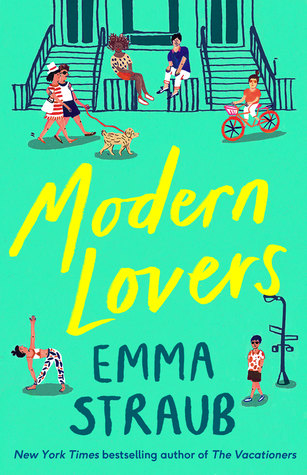 Just as the Berne is a coming-of-age story masquerading as a mystery, from the title and cover this looked like it would be chick lit, but – though it has an overall breezy tone – it’s actually pretty chewy New York City literary fiction that should please fans of The Nest and/or readers of Jennifer Egan and Ann Patchett.
Elizabeth Marx and Zoe Kahn-Bennett have been best friends ever since starting the student band Kitty’s Mustache at Oberlin. Now in their forties with a teenager each, they live half a block apart in Brooklyn. Zoe and her wife Jane run a neighborhood restaurant, Hyacinth; their daughter Ruby is dragging her feet about college and studying to retake the SAT over the summer. Elizabeth, a successful real estate agent, still keeps the musical flame alive; her husband Andrew, her college sweetheart from the band, is between jobs, not that his parents’ money isn’t enough to keep him afloat forever; their son, Harry, is in puppy love with Ruby.
Several things turn this one ordinary-seeming summer on its head. First, a biopic is being made about the Kitty’s Mustache singer turned solo star turned 27 Club member, Lydia, and the filmmaker needs the rest of the band on board – and especially for Elizabeth to okay their use of the hit song she wrote that launched Lydia’s brief career. Second, Andrew gets caught up in a new cult-like yoga studio run by a charismatic former actor. Third, the Kahn-Bennetts have marital and professional difficulties. Fourth, Harry and Ruby start sleeping together.
Short chapters flip between all the major characters’ perspectives, with Straub showing that she completely gets each one of them. The novel is about reassessing as one approaches adulthood or midlife, about reviving old dreams and shoring up flagging relationships. It’s nippy and funny and smart and sexy. I found so many lines that rang true:
Elizabeth was happy in her marriage, she really was. It was just that sometimes she thought about all the experiences she’d never gotten to have, and all the nights she’d listened to the sound of her husband’s snores, and wanted to jump out a window and go home with the first person who talked to her. Choices were easy to make until you realized how long life could be.
Andrew was always surprised by people’s ages now. When he was a teenager, anyone over the age of twenty looked like a grown-up, with boring clothes and a blurry face, only slightly more invisible than Charlie Brown’s teacher, but life had changed. Now everyone looked equally young, as if they could be twenty or thirty or even flirting with forty, and he couldn’t tell the difference. Maybe it was just that he was now staring in the opposite direction.
“I mean, it’s never too late to decide to do something else. Becoming an adult doesn’t mean that you suddenly have all the answers.”
I’ll definitely read more by Straub. I’d especially recommend picking this up if you enjoyed Writers & Lovers.
Source: Free bookshop
My rating:
What was your best summery read this year?
Six Degrees of Separation: From Normal People to The Bass Rock
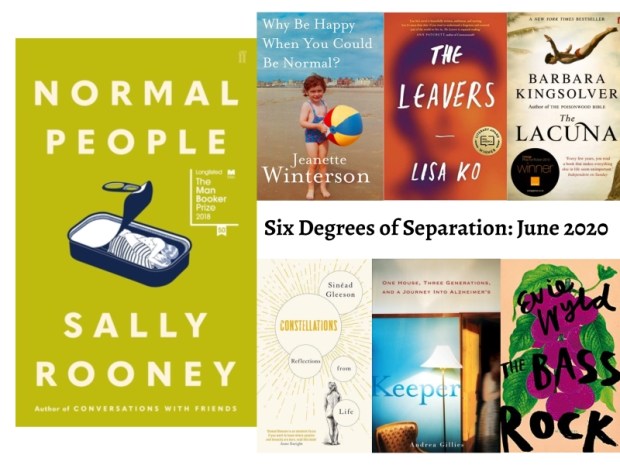
I’m a #6Degrees regular now: this is my fifth time participating. This month (see Kate’s introductory post) we start with Sally Rooney’s Normal People (2018). I loved Conversations with Friends but wasn’t so enamored with Rooney’s second novel (see my review), so I haven’t been tempted to watch the television adaptation; I don’t have a TV anyway.
#1 Picking out one of the words from the book title, and echoing the question that Rooney’s characters seem to be asking themselves, I’ll hop over to a memoir I enjoyed a lot in late 2011, Why Be Happy When You Could Be Normal? by Jeanette Winterson. Adopted into a strict religious household, Winterson had to hide her sexuality. Here you get the full story behind her autobiographical debut novel, Oranges Are Not the Only Fruit.

#2 Adoption is my link to The Leavers by Lisa Ko. When he’s abandoned by his mother, an undocumented Chinese immigrant in the USA, Daniel is adopted by a pair of white professors. This is an achingly beautiful story of searching for a mother and a sense of belonging. It won the 2016 PEN/Bellwether Prize for Socially Engaged Fiction.
#3 Barbara Kingsolver created and funds the biennial Bellwether Prize for unpublished fiction that addresses issues of social justice. I have vague ambitions to read as many Bellwether and Women’s Prize winners as I can. While it’s not one of my favorites by Kingsolver, The Lacuna (2009) won her the (then) Orange Prize. A historical novel, it’s largely set in the household of Diego Rivera and Frida Kahlo.
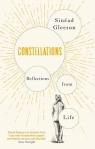
#4 Frida Kahlo is my link to Constellations by Sinéad Gleeson, autobiographical essays about the female body in pain. Kahlo is one of Gleeson’s gurus in that she turned her chronic pain and pregnancy loss into art – “making wounds the source of inspiration.” Constellations was our Not the Wellcome Prize winner during this hiatus year for the official prize.
#5 The first winner of the Wellcome Book Prize, in 2009, was Keeper by Andrea Gillies, a memoir of her mother-in-law Nancy’s struggle with Alzheimer’s disease. I also intend to read as many WBP winners and nominees as possible, so I recently ordered a secondhand copy of this and read the introduction before setting it aside for another time. Already I can tell it will be an engaging if harrowing book; Gillies pulls no punches in her depiction of the misery of the years when Nancy lived with her family and then in an institution.


[#5.5 Another book called Keeper, this one by Jessica Moor, provides my cheaty half-step. I found this debut novel to be a gripping and grimly fascinating story of why women stay with their abusers and what finally drives them to leave.]
 #6 Violence against women is also the theme of The Bass Rock by Evie Wyld, my novel of 2020 so far. While it ranges across the centuries, it always sticks close to the title location, an uninhabited island off the east coast of Scotland. It cycles through its three strands in an ebb and flow pattern that is appropriate to the coastal setting and creates a sense of time’s fluidity. This is not a puzzle book where everything fits together. Instead, it is a haunting echo chamber where elements keep coming back, stinging a little more each time. A must-read, especially for fans of Claire Fuller, Sarah Moss and Lucy Wood. (See my full Shiny New Books review.)
I’ve featured only books by women this month, and there have been quite a number of prize winners in here, too.
Join us for Six Degrees of Separation if you haven’t already!
 Bookish Beck = Rebecca Foster. American transplant to England. Freelance proofreader and book reviewer.
 Bookish Beck