My Patchy Experience with Book Clubs
I know that a number of you have long-term, faithful book clubs. Boy, am I envious! You might find it surprising that I’ve only ever been in one traditional book club, and it wasn’t a resounding success. Partway through my time working for King’s College, London, an acquaintance from another library branch started the club. A group of five to eight of us from Library Services aimed to meet after work one evening a month at a Southbank venue or a staff room to discuss our latest pick. By poring over old e-mails and my Goodreads library, I’ve managed to remember 10 of the books we read between November 2011 and June 2013:
- Do Androids Dream of Electric Sheep?, Philip K. Dick [classic science fiction]
- The Little Shadows, Marina Endicott [Canadian historical fiction]
- A Spot of Bother, Mark Haddon [contemporary fiction]
- The Talented Mr. Ripley, Patricia Highsmith [classic suspense]
- The Vintner’s Luck, Elizabeth Knox [bizarre historical fiction/magic realism]
- What Was Lost, Catherine O’Flynn [contemporary fiction]
- Franny and Zooey, J.D. Salinger [classic short fiction]
- The Rabbi’s Cat, Joann Sfar [graphic novel in translation]
- Girl Meets Boy, Ali Smith [an update of Greek myth]
- Angel, Elizabeth Taylor [an obscure English classic]
That may well be the complete list. Although I was a member for 20 months until I quit to go freelance, we often only managed to meet every other month because we couldn’t find a mutually convenient free evening or no one had read the book in time. I was consistently frustrated that – even when our selections were only about 200 pages long – I was often one of the only people to have read the whole book.
Overall, the quality of books we chose struck me as mediocre: I rated half of these books 2 stars, and the rest 3 stars. (I think I was a harsher rater then, but it’s not a good sign, is it?) Perhaps this is part of the inevitable compromising that goes with book clubs, though: You humor other people in their choices and hope they’ll be kind about yours? My suggestion, for the record, was the pretty dismal Little Shadows, for which I got a free set of book club copies to review for Booktime magazine. But I also voted in favor of most of the above list.
Looking back, I am at least impressed by how varied our selections were. People were interested in trying out different genres, so we ranged from historical fiction to sci-fi, and even managed a graphic novel. But when we did get together for discussion there was far too much gossipy chat about work, and when we finally got around to the book itself the examination rarely went deeper than “I liked it” or “I hated all the characters.”
If it was profound analysis I was after, I got that during the years I volunteered at Greenbelt, an annual summer arts festival with a progressive Christian slant. I eagerly read the eclectic set of three books the literature coordinator chose for book club meetings in 2010 – Star of the Morning: The Extraordinary Life of Lady Hester Stanhope by Kirsten Ellis, The First Person and Other Stories by Ali Smith, and The Bridge of San Luis Rey by Thornton Wilder – and then as a literature volunteer for the next three years I read and prepared copious notes and questions about our festival “Big Read.” We did Exile by Richard North Patterson in 2011, Dark Eden by Chris Beckett in 2012 and So Many Ways to Begin by Chris Beckett in 2013, and each time I offered to chair the book club meetings.
Unfortunately, due at least in part to logistical considerations, these were run in the way many festival events are: a panel of two to five talking heads with microphones was at the front of the tent, sometimes on a raised dais, while the audience of whatever size sat towards the back. This created a disconnect between the “experts” and the participants, and with the exception of the McGregor meeting I don’t recall much audience input. I’ve mostly blanked out the events – as I tend to for anything that entails public speaking and nervous preparation for something you can’t control – but I was pleased to be involved and I should probably make more of this on my CV. It wasn’t your average book club setting, that’s for sure.
In recent years the closest thing I’ve had to a book club has been online buddy reading. The shadow panels for the Wellcome Book Prize and Sunday Times Young Writer of the Year Award fall into this category, as do online readalongs I’ve done for several Iris Murdoch novels and for C.S. Lewis’s Mere Christianity with various female family members. A few of us book bloggers chatted about Andrea Levy’s Small Island in an online document earlier this year, and my mom and I e-mailed back and forth while reading W. Somerset Maugham’s The Painted Veil in May. I’m also doing my last three of the #20BooksofSummer as online buddy reads, checking in occasionally on Twitter.
Of course, there are some inherent limitations to this kind of discussion – people read at different paces and don’t want to spoil the plot for others, and at some point the back-and-forth fizzles out – but it’s always been easier for me to organize my thoughts in writing, so I likely feel more comfortable contributing than I might in an in-person meeting.
This is all context for my decision to join my neighborhood book club next month. The club arose some months back out of our community’s Facebook group, a helpful resource run by a go-getting lady a few doors down from us. So far it’s turning out to be a small group of thirty- and fortysomething women who alternate meetings at each other’s houses, and the name they’ve chosen gives an idea of the tone: “Books, Booze and Banter.”
I made the mistake of not getting involved right at the start; I wanted to hang back and see what kind of books they’d choose. This means I wasn’t part of the early process of putting titles in a hat, so I’ve looked on snobbishly for several months as they lurched between crime and women’s fiction, genres I generally avoid. (Still, there were actually a couple books I might have joined them for had I not been in America and had they been readily available at the public library.) For many people a book club selection will be the only book they get through that month, so I can understand how they’d want it to be something ‘readable’ that they’d be happy to pick up anyway. Even though statistically I read 27 books a month, I’m still jealously protective of my reading time; I want everything I read to be worthwhile.
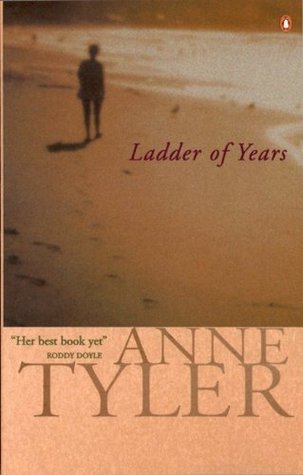 So for September I managed to steer the group away from a poorly received historical novel of over 400 pages and the new Joël Dicker and onto Ladder of Years by Anne Tyler, which the bookstore chain Waterstones has been promoting heavily as one of their books of the month. I already had a charity shop copy in hand and the others liked the sound of it, so we’re all set for September 12th! Future months’ literary fiction choices look promising, too, so provided I enjoy the discussion and the camaraderie I plan to stick with it: a backlist Pat Barker novel I’ve not read, and Kirsty Logan and Jonathan Coe novels I’ve read before and won’t reread but will remind myself about briefly before the meetings.
I’m out of practice with this book club thing. My mother tells me that I have a lot to contribute but that I must also be open to what I’ll learn from other people – even if I don’t expect to. So I don’t want to set myself up as some kind of expert. In fact, I probably won’t even mention that I’m a freelance book reviewer and book blogger. Mostly I’m hoping to find some friendly faces around the neighborhood, because even though we’ve lived here just over two years I still only know a handful of names and keep myself to myself as I work from home. Even if I have to read books I wouldn’t normally, it’ll be worth it to meet more people.
What has your experience with book clubs (in person and online) been?
Novellas in November, Part 1
This is my second year of joining Laura (Reading in Bed) and others in reading mostly novellas in November. I’ve trawled my shelves and my current library pile for short books, limiting myself to ones of around 150 pages or fewer. First up: four short works of fiction. (I’m at work on various ‘nonfiction novellas’, too.) For the first two I give longer reviews as I got the books from the publishers; the other two are true minis.

Swallowing Mercury by Wioletta Greg
(translated from the Polish by Eliza Marciniak)
[146 pages]
I heard about this one via the Man Booker International Prize longlist. Quirkiness is particularly common in indie and translated books, I find, and while it’s often off-putting for me, I loved it here. Greg achieves an impressive balance between grim subject matter and simple enjoyment of remembered childhood activities. Her novella is, after all, set in Poland in the 1980s, the last decade of it being a Communist state in the Soviet Union.
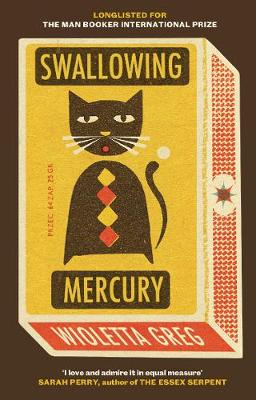 The narrator (and autobiographical stand-in?) is Wiolka Rogalówna, who lives with her parents in a moldering house in the fictional town of Hektary. Her father, one of the most striking characters, was arrested for deserting from the army two weeks before she was born, and now works for a paper mill and zealously pursues his hobbies of hunting, fishing, and taxidermy. The signs of their deprivation – really the whole country’s poverty – are subtle: Wiolka has to go selling hand-picked sour cherries with her grandmother at the market even though she’s embarrassed to run into her classmates; she goes out collecting scrap metal with a gang of boys; and she ties up her hair with a rubber band she cut from an inner tube.
Catholicism plays a major role in these characters’ lives: Wiolka wins a blessed figure in a church raffle, the Pope is rumored to be on his way, and a picture of the Black Madonna visits the town. A striking contrast is set up between the threat of molestation – Wiolka is always fending off unwanted advances, it seems – and lighthearted antics like school competitions and going to great lengths to get rare matchbox labels for her collection. This almost madcap element balances out some of the difficulty of her upbringing.
What I most appreciated was the way Greg depicts some universalities of childhood and adolescence, such as catching bugs, having eerie experiences in the dark, and getting one’s first period. This is a book of titled vignettes of just five to 10 pages, but it feels much more expansive than that, capturing the whole of early life. The Polish title translates as “Unripe,” which better reflects the coming-of-age theme; the English translator has gone for that quirk instead. 
A favorite passage:
“Then I sat at the table, which was set with plates full of pasta, laid my head down on the surface and felt the pulsating of the wood. In its cracks and knots, christenings, wakes and name-day celebrations were in full swing, and woodworms were playing dodgeball using poppy seeds that had fallen from the crusts of freshly baked bread.”
Thanks to Portobello Books for the free copy for review.
A Field Guide to the North American Family by Garth Risk Hallberg
[126 pages]
 Written somewhat in the style of a bird field guide, this is essentially a set of flash fiction stories you have to put together in your mind to figure out what happens to two seemingly conventional middle-class families: the Harrisons and the Hungates, neighbors on Long Island. Frank Harrison dies suddenly in 2008, and the Hungates divorce soon after. Their son Gabe devotes much of his high school years to drug-taking before an accident lands him in a burn unit. Here he’s visited by his girlfriend, Lacey Harrison. Her little brother, Tommy, is a compulsive liar but knows a big secret his late father was keeping from his wife.
The chapters, each just a paragraph or two, are given alphabetical, cross-referenced headings and an apparently thematic photograph. For example, “Entertainment,” one of my favorite stand-alone pieces, opens “In the beginning was the Television. And the Television was large and paneled in plastic made to look like wood. It dwelled in a dim corner of the living room and came on for national news, Cosby, Saturday cartoons, and football.”
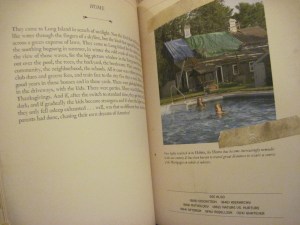 This is a Franzen-esque take on family dysfunction and, like City on Fire, is best devoured in large chunks at a time so you don’t lose momentum: as short as this is, I found it easy to forget who the characters were and had to keep referring to the (handy) family tree at the start. Ultimately I found the mixed-media format just a little silly, and the photos often seem to bear little relation to the text. It’s interesting to see how this idea evolved into the mixed-media sections of City on Fire, which is as epic as this is minimalist, though the story line of this novella is so thin as to be almost incidental.
Favorite lines:
“Depending on parent genotype, the crossbreeding of a Bad Habit and Boredom will result in either Chemistry or Entertainment.”
“Though hardly the most visible member of its kingdom, Love has never been as endangered as conservationists would have us believe, for without it, the Family would cease to function.”
Thanks to Vintage Books for the free copy for review.
The Comfort of Strangers by Ian McEwan
[100 pages]
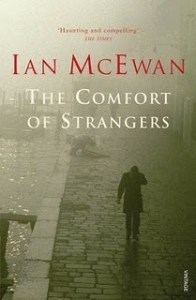 This is the earliest McEwan work I’ve read (1981). I could see the seeds of some of his classic themes: obsession, sexual and otherwise; the slow building of suspense and awareness until an inevitable short burst of violence. Mary and Colin are a vacationing couple in Venice. One evening they’ve spent so long in bed that by the time they get out all the local restaurants have shut, but a bar-owner takes pity and gives them sustenance, then a place to rest and wash when they get lost and fail to locate their hotel. Soon neighborly solicitude turns into a creepy level of attention. McEwan has a knack for presenting situations that are just odd enough to stand out but not odd enough to provoke an instant recoil, so along with the characters we keep thinking all will turn out benignly. This reminded me of Death in Venice and The Talented Mr. Ripley.
First Love by Gwendoline Riley
[167 pages – on the long side, but I had a library copy to read anyway]
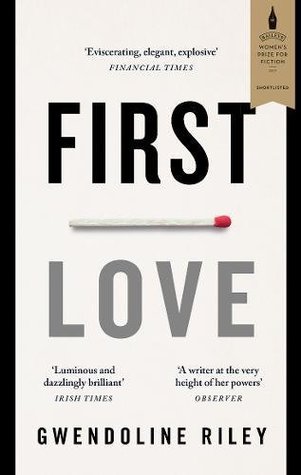 Neve tells us about her testy marriage with Edwyn, a Jekyll & Hyde type who sometimes earns our sympathy for his health problems and other times seems like a verbally abusive misogynist. But she also tells us about her past: her excess drinking, her unpleasant father, her moves between various cities in the north of England and Scotland, a previous relationship that broke down, her mother’s failed marriages, and so on. There’s a lot of very good dialogue in this book – I was reminded of Conversations with Friends – and Neve’s needy mum is a great character, but I wasn’t sure what this all amounts to. As best I can make out, we are meant to question Neve’s self-destructive habits, with Edwyn being just the latest example of a poor, masochistic decision. Every once in a while you get Riley waxing lyrical in a way that suggests she’s a really great author who got stuck with a somber, limited subject: “Outside the sunset abetted one last queer revival of light, so the outlook was torched; wet bus stop, wet shutters, all deep-dyed.”
Other favorite lines:
“An illusion of freedom: snap-twist getaways with no plans: nothing real. I’d given my freedom away. Time and again. As if I had contempt for it. Or was it hopelessness I felt, that I was so negligent? Or did it hardly matter, in fact? … Could I trust myself? Not to make my life a lair.”
Have you read any of these novellas? Which one takes your fancy?
Jacob’s Room Is Full of Books by Susan Hill
Susan Hill has published dozens of books in multiple genres, but is probably best known for her perennially popular ghost story, The Woman in Black (1983). Apart from that and two suspense novellas, the only book I’d read by her before is Howards End Is on the Landing (2009), a sort of prequel to this work. Both are bookish memoirs animated by the specific challenge to spend more time reading from her shelves and revisiting the books that have meant the most to her in the past. Though not quite a journal, this is set up chronologically and also incorporates notes on the weather, family events and travels, and natural phenomena encountered near her home in Norfolk.
The Virginia Woolf reference in the title is fitting, as Hill realizes she has four shelves’ worth of books about Woolf and her Bloomsbury set. It’s just one of many mini-collections she discovers in her library on regular “de-stocking” drives when she tries to be realistic about what, at age 75, she’s likely to reread or reference in the future. “A book that cannot be returned to again and again, and still yield fresh entertainment and insights, is only half a book,” Hill contends. Some authors who merit frequent rereading for her are Edith Wharton, Muriel Spark, W. Somerset Maugham and Olivia Manning, while other passions had a time limit: she’s gone off E.F. Benson, and no longer reads about Antarctica or medieval theology.
 Hill is unashamedly opinionated, though she at least has the humility to ask what individual taste matters. Her substantial list of no-nos includes fairy tales, science fiction, Ethan Frome, Patricia Highsmith and e-readers, and she seems strangely proud of never having read Jane Eyre. She’s ambivalent about literary festivals and especially about literary prizes: they were a boon to her as a young author, but she was also on the infamous 2011 Booker Prize judging panel, and disapproves of that prize being opened up to American entries.
As well as grumpy pronouncements, this book is full of what seems like name-dropping: encounters with Iris Murdoch, J.B. Priestley, Susan Sontag and the like. (To be fair, the stories about Murdoch and Sontag are rather lovely.) Although aspects of this book rubbed me the wrong way, I appreciated it as a meditation on how books are woven into our lives. I took note of quite a few books I want to look up, and Hill ponders intriguing questions that book clubs might like to think about: Can we ever enjoy books as purely as adults as we did as children, now that we have to “do something” with our reading (e.g. discussing or reviewing)? Is it a lesser achievement to turn one’s own life experiences into fiction than to imagine incidents out of thin air? Will an author unconsciously “catch the style” of any writer they are reading at the time of their own compositions? Is it better to come to a book blind, without having read the blurb or anything else about it?
You’ll applaud; you’ll be tempted to throw the book at the wall (this was me with the early page disparaging May Sarton). Perhaps on consecutive pages. But you certainly won’t be indifferent. And a book that provokes a reaction is a fine thing.
Some favorite lines:
“Cold room, warm bed, good book.”
“I have had fifty-five years of experience but still every book is like walking a tightrope. I might fall off.”
“People say they can never part with a book. I can. As fast as I get one out of the back door, two new ones come in through the front anyway.”
“How many people are there living in the books here? Only take the complete novels of Dickens and add up all the characters in each one and then multiply by … and I already need to lie down. Overall, there must be thousands of imaginary people sharing this house with us.”
“One of the best presents anyone can give you is the name of a writer whose books they believe will be ‘you’ – and they are. Someone you would almost certainly never have found for yourself.”
My rating:
Jacob’s Room Is Full of Books was released in the UK on October 5th. My thanks to Profile Books for the free copy for review.
Books in Brief: Five I Loved Recently
Novels about Patricia Highsmith and a prison production of The Tempest; a true-life account of opening a secondhand bookstore; a faux memoir setting ancestors’ memories in the context of twentieth-century history; and an exposé of the happiness movement in America: these five very different books are all 4-star reads I can highly recommend.
The Crime Writer
By Jill Dawson
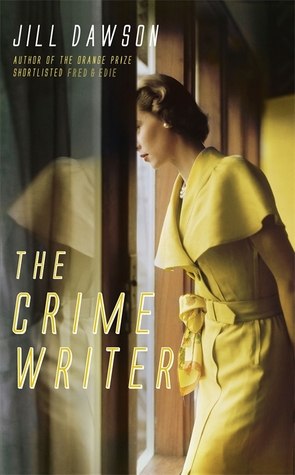 Patricia Highsmith hated the term “crime writer”; she preferred to speak of her work as “suspense novels,” animated by the threat of danger. Dawson’s terrific pastiche is set in the early 1960s, when the nomadic Highsmith was living in a remote cottage in Suffolk, England. Beyond the barest biographical facts, though, Dawson has imagined the plot based on Highsmith’s own preoccupations: fear of a stalker, irksome poison-pen letters, imagining what it would be like to commit murder … and snails. In a combination of third- and first-person narration, she shows “Pat” succumbing to alcoholism and paranoia as she carries on affairs with Sam, a married woman, and Ginny, a young journalist who’s obsessed with her. You’re never quite sure as you’re reading what is actually happening in the world of the novel and what only occurs in Highsmith’s imagination; I’m sure that’s deliberate. This counts as one of the most gripping, compulsive books I’ve encountered this year.
The Little Bookstore of Big Stone Gap
By Wendy Welch
 Everyone told Wendy Welch and her husband that they were crazy when they decided to open a used bookstore in a small Appalachian Coalfields town in the middle of a recession. They lived above the shop and initially stocked it with their own library plus books picked up cheap at yard sales – though Welch later learned to be much more choosy about what they added to their inventory and to tailor their selections to the tastes of country readers. Essentially, they were making it all up as they went along, but eight years later they’re still a community fixture in Big Stone Gap, Virginia. (I’d love to visit someday.) For the most part that’s because they branched out to fill other roles: hosting cultural events, murder mystery evenings, a writing group, a crafting circle, and regular Quaker meetings. I appreciated the details about the nitty-gritty of running a bookstore (like a chapter on pricing) more than the customer interactions. A warm and fuzzy book-lover’s delight.
Hag-Seed: The Tempest Retold
By Margaret Atwood
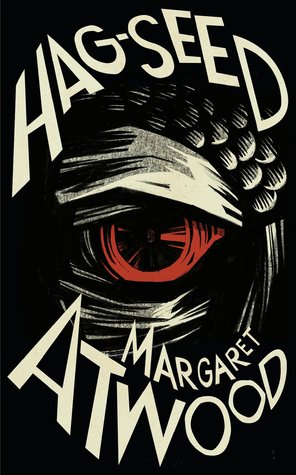 Margaret Atwood looks more like a good witch every year, and here she works her magic on The Tempest to produce the most satisfying volume of the Hogarth Shakespeare series yet. There’s a really clever play-within-the-play-within-the-play thing going on, and themes of imprisonment and performance resonate in multiple ways. It’s fun to see the disgraced Felix’s second act as a director of inmate plays at Fletcher Correctional – “I don’t care why you’re in here or what they say you’ve done: for this course the past is prologue.” Part V gets a little tedious/didactic as the cast hash out the characters’ afterlives, and at times (mainly the raps) you’re painfully aware that this is an old white lady trying to approximate how seasoned criminals might speak, but in general I thoroughly enjoyed this. Even though you see behind the scenes (e.g. my favorite chapter was about Felix wandering the streets of Toronto to buy props and costumes), you still get caught up in the magic. (See also Carolyn’s wonderful review at Rosemary and Reading Glasses.)
The Pursuit of Happiness: Why are we driving ourselves crazy and how can we stop?
By Ruth Whippman
 I call this niche genre anti-self-help. (Two other great examples are Smile or Die by Barbara Ehrenreich and Promise Land by Jessica Lamb-Shapiro.) Whippman has a particularly interesting perspective as a British Jew who moved to California for her husband’s work. With sharp humor and natural British cynicism, she investigates various manifestations of the American obsession with happiness, including the cult-like Landmark Forum, Zappos shoes HQ, Facebook’s encouragement of shallow social interaction, and the positive psychology movement. I especially liked her visit to Mormons in Salt Lake City (the nation’s happiest group, it seems, but also the most highly medicated against depression), but the funniest chapter is on happiness-focused parenting. The basic message is that the happiness movement went wrong by making it a matter of personal responsibility, of mental and spiritual triumph over circumstances. It gives no easy answers, but it’s a very enjoyable book.
Moonglow
By Michael Chabon
 Chabon’s seventh novel was inspired by his maternal grandfather’s deathbed confessions in 1989—or was it? A tongue-in-cheek author’s note refers to this as a “memoir,” and it’s narrated by “Mike Chabon,” but he and “Grandfather” (never named) are characters here in the same way that Jonathan Safran Foer and his ancestors are in Everything Is Illuminated. Space travel and explosives are Grandfather’s lifelong obsessions, but the chronology moves back and forth seemingly haphazardly, as if we are hearing this story exactly as it emerged. Chabon offers a rich meditation on how Jewishness and family secrets influence the creation of identity. With a seam of dark humor that brings to mind Jonas Jonasson’s The Hundred-Year-Old Man…, Moonglow inventively fuses family history and fiction but leaves cracks for happiness and meaning to shine through. (See my full review on the Pittsburgh Post-Gazette website.)
Have you read any of these? Which one takes your fancy?
Six from My Shelves
My resolution to read just my own books for the summer largely fell by the wayside, but I did manage to get through another handful of print books from the shelves. Below I give brief write-ups of what I’ve finished lately and recall how these books came to be in my collection.
 In Fond Remembrance of Me by Howard Norman: A strange, short book that blends memoir and Inuit legends. In 1977 Norman travelled to Churchill, Manitoba to transcribe an oral storyteller’s folktales. Most of these were about Noah coming into contact with the peoples of the far north and displeasing them by refusing to give over the exotic animals of his ark as food. Helen Tanizaki, a scholar in her late thirties who tried half-heartedly to hide the fact that she was dying of stomach cancer, was also there to translate stories into Japanese. It’s easy to see why she impressed Norman with her mystical stoicism. She was a keen birdwatcher, and declared she wanted to be reincarnated as a seabird. The portrait of Helen is compelling, but the book doesn’t hang together well, especially because the interspersed legends are so repetitive. [From my Amazon wish list last Christmas.]
 An Anthology of Animal Poetry, ed. Kenneth A. Mason: This was assembled in 1940 by a 19-year-old, and it shows. The choices are obvious and old-fashioned; too many of the poems are long and insist on rhyming. However, I discovered some real gems. Three poems in a row are about skylarks – by Gerard Manley Hopkins, Wordsworth and Shelley – and they’re all brilliant, using the bird as an emblem of freedom. Shelley’s “To a Skylark,” in particular, I can’t believe I’ve never encountered before. Its 21 stanzas praise the bird’s pure joy and wonder how careworn humans might emulate it: “We look before and after, / And pine for what is not … Teach me half the gladness / That thy brain must know.” My vintage Pelican copy has ads for chocolate and cigarettes that made me laugh. [Bought from a secondhand bookstore in Tunbridge Wells for 10 pence.]


 The Mistress’s Daughter by A.M. Homes: This grew out of a New Yorker article Homes published about meeting her biological parents in her early 30s. Her mother carried on an affair with her married boss, starting when she was just a teenager – Homes learned that she was the mistress’s daughter. This is the story of how her birth mother tried to get involved in her life, in a really rather stalker-ish way, and the occasional contact she had from her birth father. The blow-by-blow gets a little boring, especially when it’s Homes and her father only communicating via lawyers. Homes doesn’t really make much of a contribution to the literature of adoption, though this is a pleasant enough read. “I am an amalgam. I will always be something glued together, something slightly broken.” [Bought from a library book sale in America for $1.]
 Summertime by Vanessa Lafaye: An enjoyable historical novel based on several true-life elements: a work camp of army veterans based at the Florida Keys, segregation and lynching, and a massive hurricane that hit in 1935. Main characters Missy and Henry are well drawn, but beyond them I thought Lafaye splits the perspective too far: I didn’t need to see through the eyes of lots of the veterans, the shopkeeper, or the policeman investigating the brutal beating of a local white woman. As for this crime, I knew whodunit pretty much right away, so there wasn’t any suspense regarding that plot point. However, Lafaye does do a great job of building tension in the novel’s final third as the storm approaches. The U.S. title (Under a Dark Summer Sky) is much better; “Summertime” evokes strangely rosy images and so is inappropriate. [I won a copy in a Goodreads giveaway.]
 So Many Books, So Little Time: A Year of Passionate Reading by Sara Nelson: Nelson is forthright about what she likes and doesn’t like; she also ruefully reflects on the gap between what she meant to read and what she actually read in 2002. Her reading diary tells a lot about her personal life too: having a non-reading spouse and a novelist sister; memories of her late father; and the struggle to instill a love of reading into her young son. Inevitably a little dated as it engages with ‘It’ books of the time like A Million Little Pieces and Kitchen Confidential, the book has staying power because in each chapter Nelson broadens out from her discussion of one or more books to craft a thematic essay. This was meant to be my bedside book for the second half of the year, but I devoured it in less than seven weeks. It’s full of lines bibliophiles can relate to. [Free from The Book Thing of Baltimore.]
 The Debt to Pleasure by John Lanchester: Tarquin Winot, the snobby Francophile who narrates Lanchester’s debut novel, has a voice reminiscent of Oliver in Julian Barnes’s Talking It Over and Love etc. His opinionated, verbose speech provides much of the book’s wit. “This is not a conventional cookbook,” the first line warns, but a foodie’s tribute to traditional English and French dishes that compose the best seasonal menus. As we travel with Tarquin from Portsmouth to Provence we learn more about this peculiar character through the memories dishes elicit: about his Irish nanny, his sculptor brother’s boarding school years, etc. Lanchester subtly introduces notes of doubt about the narrator’s reliability, until we have to wonder how much his tale resembles Perfume or The Talented Mr. Ripley. Deliciously clever and sinuous. [Bought from a London charity shop for 20 pence.]
I spent much of the summer bogged down in several very good but not particularly page-turning works of nonfiction. I’ll review those in due course.
Up next, though, are a few Booker Prize longlist mini-reviews in advance of the shortlist announcement on Tuesday.
 Bookish Beck = Rebecca Foster. American transplant to England. Freelance proofreader and book reviewer.
 Bookish Beck