Review Book Catch-Up: Dennis, Galloway, Leland-St. John and Sampson
Capsule reviews today, of four books I am inexcusably late in reviewing. I have a record of personal experience with species reintroductions, a memoir about living among reindeer herders in the far north of Norway, a set of elegiac poems, and a biography of a Victorian woman poet who struggled with poor health for most of her life.
Restoring the Wild: Sixty Years of Rewilding Our Skies, Woods and Waterways by Roy Dennis
 Rewilding is a big buzz word in current nature and environmental writing. Few could be said to have played as major a role in the UK’s successful species reintroduction projects as Roy Dennis, who has been involved with the RSPB and other key organizations since the late 1950s. He trained as a warden at two of the country’s most famous bird observatories, Lundy Island and Fair Isle. Most of his later work was to focus on birds: white-tailed eagles, red kites, and ospreys. Some of these projects extended into continental Europe. He also writes about the special challenges posed by mammal reintroductions; beavers get a chapter of their own. Every initiative is described in exhaustive detail, full of names and dates, whereas I would have been okay with an overview. This feels like more of an insider’s history rather than a layman’s introduction. I have popped it on my husband’s bedside table in hopes that, with his degree in wildlife conservation, he’ll be more interested in the nitty-gritty.
Favourite lines:
“Tenacity and a long view to the future are important in wildlife conservation.”
“for every successful project that gets the go-ahead, there are others into which people put great effort but which then run up against problems.”
With thanks to William Collins for the free copy for review.
Dálvi: Six Years in the Arctic Tundra by Laura Galloway
 The title is the word for winter in the Northern Sámi language. Galloway, a journalist, traded in New York City for Arctic Norway after a) a DNA test told her that she had Sámi blood and b) she met and fell for Áilu, a reindeer herder, at a wedding. She enrolled in an intensive language learning course at university level and got used to some major cultural changes: animals were co-workers here rather than pets (like the two cats she brought with her); communal meals and drawn-out goodbyes were not the done thing; and shamans were still active (one helped them find a key she lost). Footwear neatly sums up the difference. The Prada heels she brought “just in case” ended up serving as hammers; instead, she helped Áilu’s mother make reindeer skins into boots. Two factors undermined my enjoyment: Alternating chapters about her unhappy upbringing in Indiana don’t add much of interest, and, after her relationship with Áilu ends, the book feels aimless. However, I appreciated her words about DNA not defining you, and family being what you make it.
With thanks to Atlantic Books for the free copy for review.
A Raga for George Harrison by Sharmagne Leland St.-John (2020)
 Native American poet Sharmagne Leland St.-John’s fifth collection is a nostalgic and bittersweet look at people and places from one’s past. There are multiple elegies for public figures – everyone from Janis Joplin to Virginia Woolf – as well as for some who aren’t household names but have important stories that should be commemorated, like Hector Pieterson, a 12-year-old boy killed during the Soweto Uprising for protesting enforced teaching of Afrikaans in South Africa in 1976. Many of the elegies are presented as songs. Personal sources of sadness, such as a stillbirth, disagreements with a daughter, and ageing, weigh as heavily as tragic world events.
Rhyming and alliteration create inviting rhythms throughout the book, and details of colour and fashion animate poems like “La Kalima.” Leland St.-John remembers meeting street children in Mexico, while bamboo calls to mind time spent in Japan. “Promised Land” is an ironic account of land being seized from natives and people of colour. I especially liked “Things I Would Have Given to My Mother Had She Asked” (some literal and some more abstract), which opens “A piece of my liberal mind. 5 more minutes of my time”, and the sombre “Cat’s Cradle” (“Drenched starlings perch on a cat’s cradle of telephone wires”).
You can read “I Said Coffee” and a few more of her poems online.
With thanks to the author for sending a free e-copy for review.
Two-Way Mirror: The Life of Elizabeth Barrett Browning by Fiona Sampson
 Coming in at under 260 pages, this isn’t your standard comprehensive biography. Sampson instead describes it as a “portrait,” one that takes up the structure of EBB’s nine-book epic poem, Aurora Leigh, and is concerned with themes of identity and the framing of stories. Elizabeth, as she is cosily called throughout the book, wrote poems that lend themselves to autobiographical interpretation – “her body of work creates a kind of looking glass in which, dimly, we make out the person who wrote it,” Sampson asserts.
Nicknamed “Ba,” Elizabeth was born in 1806 and brought up with 11 younger siblings at a Herefordshire estate, Hope End. Her father, Edward, had been born in Jamaica and the family fortune was based on sugar – and slavery. Sampson makes much of this inherited guilt, and also places an emphasis on EBB’s lifelong ill health, which involved headaches, back and side pain, and depression. She also suffered from respiratory complaints. The modern medically minded reader tries to come up with a concrete diagnosis. Tardive dystonia? Post-viral syndrome? The author offers many potential explanations, and notes that her subject was the very type of the Victorian female invalid. She would also suffer from miscarriages, but had one son, Pen. The Brownings were in the unusual position of the wife being the more famous partner.
Sampson draws heavily on correspondence and earnestly interrogates scenes and remembrances, but her use of the present tense is a bit odd for a historical narrative, and I found my casual curiosity about the Brownings wasn’t enough to sustain my interest. However, this did make me eager to try more of EBB’s poetry. I wonder if I still have that copy of Sonnets from the Portuguese in a box in the States?
Favourite lines:
“Within the continual process of reputation-making and remaking that is literary history, Elizabeth Barrett Browning remains a bellwether for the rising and sinking stock of women writers. … Elizabeth dramatizes the two-way creation of every writing self, from without and from within. That the life of the body both enables and limits the life of the mind is the paradox of the thinking self.”
With thanks to Profile Books for the free copy for review.
Would you be interested in reading one or more of these?
Three for Novellas in November: Bythell, Carey and Diop
I started my reading for Novellas in November early with these three review books, one nonfiction and two fiction. They have in common the fact that they are published today –although I believe two were released early to beat the lockdown. Don’t worry, though; there are still plenty of ways of getting hold of new books: most publishers and bookshops are still filling orders, or you can use the UK’s newly launched Bookshop.org site and support your local indie.
Seven Kinds of People You Find in Bookshops by Shaun Bythell
[137 pages]
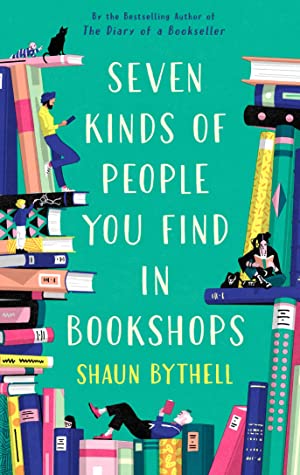 Cheerfully colored and sized to fit into a Christmas stocking, this is a fun follow-up to Bythell’s accounts of life at The Bookshop in Wigtown, The Diary of a Bookseller and Confessions of a Bookseller. Within his seven categories are multiple subcategories, all given tongue-in-cheek Latin names as if naming species. When I saw him chat with Lee Randall at the opening event of the Wigtown Book Festival, he introduced a few, such as the autodidact who knows more than you and will tell you all about their pet subject (the Homo odiosus, or bore). This is not the same, though, as the expert who shares genuinely useful knowledge – of a rare cover version on a crime paperback, for instance (Homo utilis, a helpful person).
There’s also the occultists, the erotica browsers, the local historians, the self-published authors, the bearded pensioners (Senex cum barba) holidaying in their caravans, and the young families – now that he has one of his own, he’s become a bit more tolerant. Setting aside the good-natured complaints, who are his favorite customers? Those who revel in the love of books and don’t quibble about the cost. Generally, these are not antiquarian book experts looking for a bargain, but everyday shoppers who keep a low-key collection of fiction or maybe specifically sci-fi and graphic novels, which fly off the shelves for good prices.
So which type am I? Well, occasionally I’m a farter (Crepans), but you won’t hold that against me, will you? I’d like to think I fit squarely into the normal people category (Homines normales) when I visited Wigtown in April 2018: we went in not knowing what we wanted but ended up purchasing a decent stack and even had a pleasant conversation with the man himself at the till – he’s much less of a curmudgeon in person than in his books. I do recommend this to those who have read and loved his other work.
With thanks to Profile Books for the free copy for review.
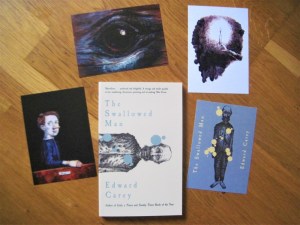
The Swallowed Man by Edward Carey
[160 pages]
 Carey’s historical novel Little was one of my highlights of 2018, so I jumped at the chance to read his new book. Interestingly, this riff on the Pinocchio story, narrated by Geppetto from the belly of a giant shark, originally appeared in Italian to accompany an exhibition hosted by the Fondazione Nazionale Carlo Collodi at the Parco di Pinocchio in Collodi. Geppetto came from a pottery-painting family but turned to wood when creating a little companion for his loneliness, the wooden boy who astounded him by coming to life. Now a son rather than a mere block of wood, Pinocchio sets off for school but never comes home. When he gets word that a troublesome automaton has been thrown into the sea, Geppetto sets out in a dinghy to find his son but is swallowed by the enormous fish that has been seen off the coast.
The picture of this new world-within-a-world is enthralling. Geppetto finds himself inside a swallowed ship, the Danish schooner Maria. Within the vessel is all he needs to occupy himself, at least for now: wood on which to paint the women he has loved; candle wax and hardtack for sculpting figures. Seaweed to cover his bald spot. Squid ink for his pen so he can write this notebook. A crab that lives in his beard. Relics of the captain’s life to intrigue him.
As a narrator, Geppetto is funny and gifted at wordplay (“This tome is my tomb”; “I unobjected him. Can you object to that?”), yet haunted by his decisions. Carey deftly traces Geppetto’s state of mind as he muses on his loss and imprisonment. The Afterword adds a sly pseudohistorical note to the fantasy. There are black-and-white illustrations throughout, as well as photos of the objects described in the text (and, presumably, featured in the exhibition). For me this didn’t live up to Little, but it would be a great introduction to Carey’s work.
With thanks to Gallic Books for the free copy for review.
At Night All Blood Is Black by David Diop
[145 pages; translated from the French by Anna Moschovakis]
 I had no idea that Africans (“Chocolat soldiers”) fought for France in World War I. Diop’s second novel, which has already won several major European prizes, is about two Senegalese brothers-in-arms caught up in trench warfare. Alfa Ndaiye, aged 20, considers Mademba Diop his blood brother or “more-than-brother” (the novel’s French title is “Soul Brother”). From the start we know that Mademba has died. Gravely injured in battle, entrails spilling out, he begged Alfa to end his misery; three times Alfa refused. Having watched his friend die in agony, he knows he did the wrong thing. Slitting the man’s throat would have been the compassionate choice. From now on, Alfa will atone by brutally wreaking Mademba’s method of death on Germans. “The captain’s France needs our savagery, and because we are obedient, myself and the others, we play the savage.” Alas, I thought this bleak exploration of (in)humanity was marred by the repetitive language and unpleasantly sexualized metaphors.
With thanks to Pushkin Press for the proof copy for review.
Do any of these novellas take your fancy?
What November releases can you recommend?
Signs of Life: To the Ends of the Earth with a Doctor by Stephen Fabes
Stephen Fabes is an emergency room doctor at St Thomas’s Hospital, London. Not exciting enough for you? Well, he also spent six years of the past decade cycling six continents (so, all bar Antarctica). His statistics are beyond impressive: 53,568 miles, 102 international borders, 1000+ nights of free camping, 26 bicycle tires, and 23 journals filled with his experiences. A warm-up was cycling the length of Chile with his brother at age 19. After medical school in Liverpool and starting his career in London, he found himself restless and again longing for adventure. The round-the-world cycle he planned fell into four sections: London to Cape Town, the West Coast of the Americas, Melbourne to Mumbai, and Hong Kong to home.
Signs of Life is a warm-hearted and laugh-out-loud funny account of Fabes’ travels, achieving a spot-on balance between major world events, the everyday discomforts of long-distance cycling and rough camping, and his humanitarian volunteering. He is a witness to the Occupy movement in Hong Kong, the aftermath of drought and tribal conflict in Africa, and the refugee crisis via the “Jungle” migrant camp in Calais. The desperate situations he saw while putting his medical expertise to good use in short bursts – e.g., at a floating clinic on a Cambodian lake, a malaria research center in Thailand, a leper hospital in Nepal, and a mental health rehabilitation clinic in Mumbai – put into perspective more minor annoyances like fire ants in El Salvador, Indonesian traffic, extreme cold in Mongolia, and camel spiders.

Wherever he went, Fabes met with kindness from strangers, even those who started off seeming hostile – having pitched his tent by a derelict cabin in Peru, he was alarmed to awake to a man pointing a gun at him, but the illicit gold miner soon determined he was harmless and offered him some soup. (Police officers and border guards were perhaps a bit less hospitable.) He also had occasional companions along the route, including a former housemate and a one-time girlfriend. Even limited shared language was enough to form common ground with a stranger-turned-fellow cyclist for a week or so. We get surprising glimpses of how Anglo-American culture permeates the developing world: For some reason, in the ‒Stans everyone’s point of reference when he introduced himself was Steven Seagal.
At nearly 400 pages, the memoir is on the long side, though I can see that it must have felt impossible to condense six years of adventures any further. I was less interested in the potted histories of other famous cyclists’ travels and would have appreciated a clearer sense to the passing of time, perhaps in the form of a date stamp at the head of each chapter. One of my favorite aspects of the book, though, was the use of medical metaphors to link geography to his experiences. Most chapters are titled after health vocabulary; for instance, in “Membranes” he ponders whether country borders are more like scars or cell membranes.
Fabes emphasizes, in a final chapter on the state of the West upon his return in early 2016, that, in all the most important ways, people are the same the world over. Whether in the UK or Southeast Asia, he sees poverty as the major factor in illness, perpetuating the inequality of access to adequate healthcare. Curiosity and empathy are his guides as he approaches each patient’s health as a story. Reflecting on the pandemic, which hit just as he was finalizing the manuscript, he prescribes global cooperation and innovation for this time of uncertainty.
We’re all armchair travelers this year, but this book is especially for you if you enjoy Bill Bryson’s sense of humor, think Dervla Murphy was a badass in Full Tilt, and enjoyed War Doctor by David Nott and/or The Crossway by Guy Stagg. It’s one of my top few predictions for next year’s Wellcome Book Prize – fingers crossed it will go ahead after the 2020 hiatus.
My rating: 
With thanks to Dr Fabes and Profile Books for the free copy for review.
Four Recent Review Books: Butler, Hunt, Paralkar and Vestre
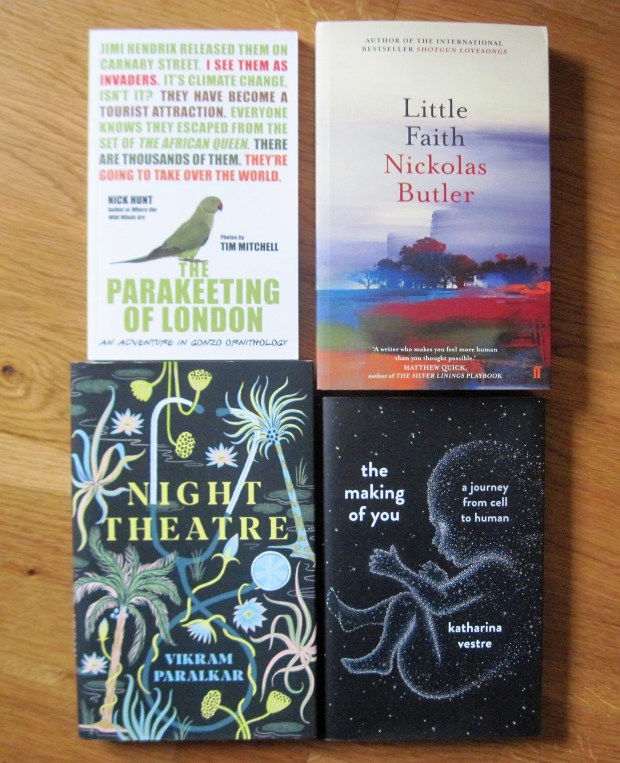
Four February–April releases: A quiet novel about the clash of religion and reason; a birdwatching odyssey in London; a folktale-inspired story of the undead descending on an Indian medical clinic; and a layman’s introduction to fetal development – you can’t say I don’t read a wide variety of books! See if any of these tempt you.
Little Faith by Nickolas Butler
Butler follows in Kent Haruf’s footsteps with this quiet story of ordinary Midwesterners facing a series of small crises. Lyle Hovde works at a local Wisconsin orchard but is more interested in spending time with Isaac, his five-year-old grandson. Lyle has been an atheist since he and Peg lost a child in infancy, making it all the more ironic that their adopted daughter, Shiloh, has recently turned extremely religious. She attends a large non-denominational church that meets in an old movie theatre and is engaged to Pastor Steven*, whose hardline opinions are at odds with his hipster persona.
 Steven and Shiloh believe Isaac has a healing gift – perhaps he can even help Lyle’s old pal, Hoot, who’s just been diagnosed with advanced cancer? The main story line reminded me most of Emily Fridlund’s History of Wolves (health and superstition collide) and Carolyn Parkhurst’s Harmony (the dangers of a charismatic leader). It’s all well and good to have faith in supernatural healing, but not if it means rejecting traditional medicine.
This is the epitome of a slow burner, though: things don’t really heat up until the final 35 pages, and there were a few chapters that could have been cut altogether. The female characters struck me as underdeveloped, but I did have a genuine warm feeling for Lyle. There are some memorable scenes, like Lyle’s heroic effort to save the orchard from an ice storm – a symbolic act that’s more about his desperation to save his grandson from toxic religion. But mostly this is a book to appreciate for the slow, predictable rhythms of a small-town life lived by the seasons. 
[*So funny because that’s my brother-in-law’s name! I’ve also visited a Maryland church that meets in a former movie theatre. I was a part of somewhat extreme churches and youth groups in my growing-up years, but luckily nowhere that would have advocated foregoing traditional medicine in favor of faith healing. There were a few false notes here that told me Butler was writing about a world he wasn’t familiar with.]
A favorite passage:
“‘Silent Night’ in a darkened country chapel was, to Lyle, more powerful than any atomic bomb. He was incapable of singing it without feeling his eyes go misty, without feeling that his voice was but one link in a chain of voices connected over the generations and centuries, that line we sometimes call family. Or memory itself.”
With thanks to Faber & Faber for the free copy for review.
The Parakeeting of London: An Adventure in Gonzo Ornithology by Nick Hunt
 Rose-ringed parakeets were first recorded in London in the 1890s, but only in the last couple of decades have they started to seem ubiquitous. I remember seeing them clustered in treetops and flying overhead in various Surrey, Kent and Berkshire suburbs we’ve lived in. They’re even more noticeable in London’s parks and cemeteries. “When did they become as established as beards and artisan coffee?” Nick Hunt wonders about his home in Hackney. He and photographer Tim Mitchell set out to canvass public opinion about London’s parakeets and look into conspiracy theories about how they escaped (Henry VIII and Jimi Hendrix are rumored to have released them; the set of The African Queen is another purported origin) and became so successful an invasive species.
A surprising cross section of the population is aware of the birds, and opinionated about them. Language of “immigrants” versus “natives” comes up frequently in the interviews, providing an uncomfortable parallel to xenophobic reactions towards human movement – “people had a tendency to conflate the avian with the human, turning the ornithological into the political. Invading, colonizing, taking over.” This is a pleasant little book any Londoner or British birdwatcher in general would appreciate.
With thanks to Paradise Road for the free copy for review.
Night Theatre by Vikram Paralkar
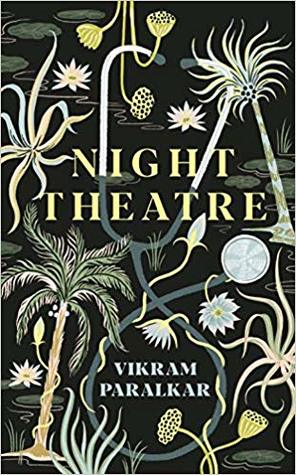 This short novel has an irresistible (cover and) setup: late one evening a surgeon in a rural Indian clinic gets a visit from a family of three: a teacher, his pregnant wife and their eight-year-old son. But there’s something different about this trio: they’re dead. They each bear hideous stab wounds from being set upon by bandits while walking home late from a fair. In the afterlife, an angel reluctantly granted them a second chance at life. If the surgeon can repair their gashes before daybreak, and as long as they stay within the village boundaries, their bodies will be revivified at dawn.
Paralkar draws on dreams, folktales and superstition, and the descriptions of medical procedures are vivid, as you would expect given the author’s work as a research physician at the University of Pennsylvania. The double meaning of the word “theatre” in the title encompasses the operating theatre and the dramatic spectacle that is taking place in this clinic. But somehow I never got invested in any of these characters and what might happen to them; the précis is more exciting than the narrative as a whole. 
A favorite passage:
“Apart from the whispering of the dead in the corridor, the silence was almost deliberate – as if the crickets had been bribed and the dogs strangled. The village at the base of the hillock was perfectly still, its houses like polyps erupting from the soil. The rising moon had dusted them all with white talc. They appeared to have receded in the hours after sunset, abandoning the clinic to its unnatural deeds.”
With thanks to Serpent’s Tail for the free copy for review.
The Making of You: A Journey from Cell to Human by Katharina Vestre
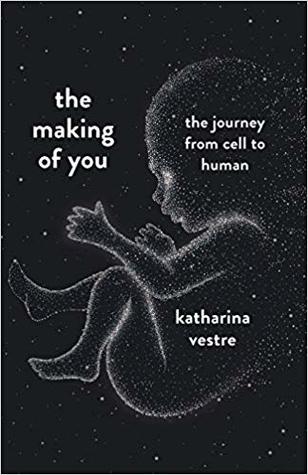 A sprightly layman’s guide to genetics and embryology, written by Doctoral Research Fellow at the University of Oslo Department of Biosciences. Addressed in the second person, as the title suggests, the book traces your development from the sperm Leeuwenhoek studied under a microscope up to labor and delivery. Vestre looks at all the major organs and the five senses and discusses what can go wrong along with the normal quirks of the body.
I learned all kinds of bizarre facts. For instance, did you know that sperm have a sense of smell? And that until the 1960s pregnancy tests involved the death of a mouse or rabbit? Who knew that babies can remember flavors and sounds experienced in utero?
Vestre compares human development with other creatures’, including fruit flies (with whom we share half of our DNA), fish and alligators (which have various ways of determining gender), and other primates (why is it that they stay covered in fur and we don’t?). The charming style is aimed at the curious reader; I rarely felt that things were being dumbed down. Most chapters open with a fetal illustration by the author’s sister. I’m passing this on to a pregnant friend who will enjoy marveling at everything that’s happening inside her.
A representative passage:
“This may not sound terribly impressive; I promised you dramatic changes, and all that’s happened is that a round plate has become a triple-decker cell sandwich. But you’re already infinitely more interesting than the raspberry you were a short while ago. These cells are no longer confused, needy newcomers with no idea where they are or what they’re supposed to do. They have completed a rough division of labour. The cells on the top layer will form, among other things, skin, hair, nails, eye lenses, nerves and your brain. From the bottom layer you’ll get intestines, liver, trachea and lungs. And the middle layer will become your bones, muscles, heart and blood vessels.”
With thanks to Wellcome Collection/Profile Books for the free copy for review.
Would you be interested in reading one or more of these?
Three Books that Originated on the Radio
As the end of the year approaches and I try to get through a final handful of review books, I’m looking for ways to combine posts. It may seem like a fairly arbitrary connection, but all three of these books originated as essays or short stories that were aired on British radio. I never listen to the radio so I miss out on these projects the first time around, but I’ve been interested to note how short forms and conversational styles lend themselves to oral performance.
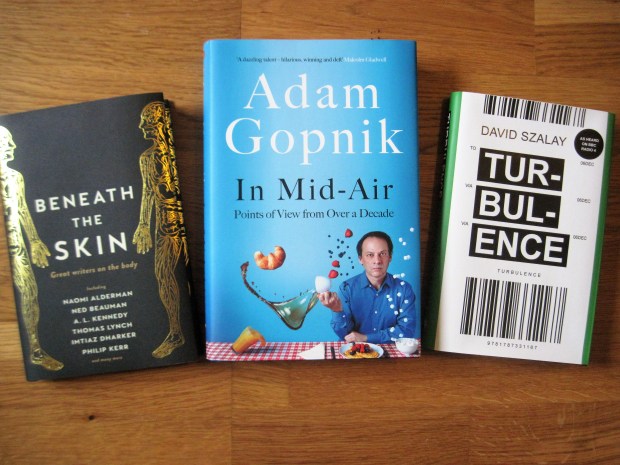
Beneath the Skin: Great Writers on the Body
These 15 pieces were commissioned for the BBC Radio 3 series “A Body of Essays.” Thomas Lynch, a small-town American undertaker and wonderful, unjustly obscure writer, opens and closes the volume. In his introduction he remarks – appropriately as Christmas draws near – that “We are an incarnate species”: we experience the world only through our bodies, which are made of disparate parts that work together as a whole. This project considers single organs by turn “in hopes that by knowing the part we might better know the whole of our predicament and condition.”
 Naomi Alderman, musing on the intestines, draws metaphorical connections between food, sex and death, and gives thanks that digestion and excretion are involuntary processes we don’t have to give any thought. Ned Beauman reports on misconceptions about the appendix as he frets about the odds of his bursting while he’s in America without health insurance. The late Philip Kerr describes the checkered history of the lobotomy, which used to reduce patients to a vegetative state but can now quite effectively treat epilepsy.
The pieces incorporate anatomical knowledge, medical history, current research, cultural connections, and sometimes observation of a hospital procedure. These threads are elegantly woven together, as in Patrick McGuinness’s essay on the ear, which skips between Hamlet’s father’s death, the secretive delight of mining for earwax, Beethoven’s ear trumpet, and what we know about in utero sounds.
 Most authors chose a particular organ because of its importance to their own health. Christina Patterson’s acne was so bad she went to the UK’s top skin specialist for PUVA light treatments, Mark Ravenhill had his gallbladder removed in an emergency surgery, and Daljit Nagra’s asthma led his parents to engage Sikh faith healers for his lungs. Two of my favorite chapters were by William Fiennes, whose extreme Crohn’s disease caused him to have a colostomy bag for two years in his early twenties, and poet Kayo Chingonyi, who has always been ashamed to admit that his parents both died of complications of HIV in Zambia. Such personal connections add poignancy to what could have been information dumps.
As is usual for essay collections, my interest varied somewhat. I had my hopes too high so was disappointed with a scattered piece on the kidneys. But the overall quality is terrific. If you enjoy medical reads to any extent, I recommend this as a bedside book to read occasionally.
Some favorite lines:
“It’s a strange and shifting thing – this sense I have that I am my body, of which some bits are essential and some expendable.” (Mark Ravenhill)
“There are things we only think about when they go wrong: the fan belt, the combi boiler, the bowel.” (William Fiennes)
“Like most of us, I take my body for granted. I live in the most complex, intricate machine and as long as it wakes up in the morning, and goes to bed at night, I am uninterested in its inner workings.” (Chibundu Onuzo, “Thyroid”)
My rating: 
Beneath the Skin was published by the Wellcome Collection imprint of Profile Books on October 25th. My thanks to the publisher for a free copy for review.
In Mid-Air by Adam Gopnik
New Yorker writer Gopnik contributed to BBC Radio 4’s A Point of View for over a decade. These essays date from 2012 to 2017 and are grouped into three loosely thematic sections on family, culture and politics. Gopnik self-deprecatingly sees himself as “offering measured ambivalences on everything.” As an American who was raised in Canada and has lived in Paris and spent significant time in London, he has a refreshingly cosmopolitan outlook and can appreciate the nuances in different countries’ identities. At the same time, he brings out what’s universal: being annoying to one’s teenage children, gauging the passing of time by family members’ changes, the desire to die with dignity (remembering his father-in-law’s death at age 95), and lessons in a happy marriage from Charles and Emma Darwin – he boils it down to lust, laughter and loyalty.
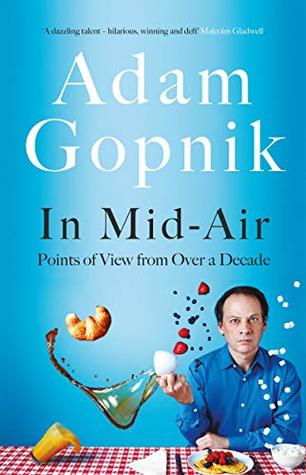 During the weeks that I spent with these essays I was frequently reminded of Jan Morris’s In My Mind’s Eye, which casts a similarly twinkling eye over the absurdities of modern life and the aging body. Gopnik endures shingles and shrugs over his funny last name (“drunken lout” in Russian) and short stature. He mostly ignores Twitter and decries our dependence on smartphones. As he’s never learned to drive, he’s amused by the idea of self-driving cars.
My favorite pieces were on significantly more trivial matters, though: the irony of famous Christmas songs being written by Jews, and a satire on society’s addiction to DVD box sets. Other arts references vary from the Beatles and Bob Dylan’s Nobel Prize to Cubism and literary festivals. It’s a quirky blend of high and low culture here. Bizarrely, Gopnik has recently written an oratorio on Alan Turing and a musical about a New York City restaurant.
The author is an unabashed liberal who prizes pluralism above all else but warns how fragile it is. In the final section he prophesies catastrophe under Trump and, afterwards, can only say that at least his election puts lesser issues into perspective. I valued the diagnosis of American insularity and British inwardness – this particular essay was written in 2013 but seems all the more relevant post-Brexit. This was my fifth book from Gopnik. While I didn’t engage with every essay and would have liked them to be chronological so there was a mix of topics all the way through, it was a pleasant and often thought-provoking read.
Some favorite lines:
“Watching the people we love die bit by bit is the hardest thing life demands until we recall that watching the people we love die bit by bit is in a certain sense what life simply is. It just usually takes more time for the bits to go by.”
“We should never believe that people who differ from us about how we ought to spend public money want to commit genocide or end democracy, and we should stop ourselves from saying so, even in the pixellated heat of internet argument. But when we see the three serpents of militarism, nationalism and hatred of difference we should never be afraid to call them out, loudly, by name”
My rating:
In Mid-Air was published by riverrun, a new Quercus imprint, on October 18th. My thanks to the publisher for a free copy for review.
Turbulence by David Szalay
These 12 linked short stories, commissioned for BBC Radio 4, focus on travel and interconnectedness. Each is headed by a shorthand route from one airport to another, and at the destination we set out with a new main character who has crossed paths with the previous one. For instance, in “YYZ – SEA” the writer Marion Mackenzie has to cancel a scheduled interview when her daughter Annie goes into labor. There’s bad news about the baby, and when Marion steps away from the hospital to get Annie a few necessaries from a supermarket and is approached by a pair of kind fans, one of whom teaches Marion’s work back in Hong Kong, she’s overcome at the moment of grace-filled connection. In the next story we journey back to Hong Kong with the teacher, Jackie, and enter into her dilemma over whether to stay with her husband or leave him for the doctor she’s been having an affair with.
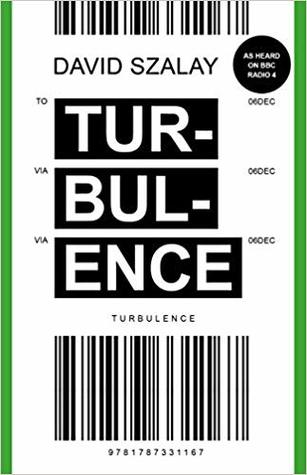 As he ushers readers around the world, Szalay invites us to marvel at how quickly life changes and how – improbable as it may seem – we can have a real impact on people we may only meet once. There’s a strong contrast between impersonal and intimate spaces: airplane cabins and hotel rooms versus the private places where relationships start or end. The title applies to the characters’ tumultuous lives as much as to the flight conditions. They experience illness, infidelity, domestic violence, homophobia and more, but they don’t stay mired in their situations; there’s always a sense of motion and possibility, that things will change one way or another.
My favorite story was “DOH – BUD,” in which Ursula goes to visit her daughter Miri and gains a new appreciation for Miri’s fiancé, Moussa, a Syrian refugee. I also liked how the book goes full circle, with the family from the final story overlapping with that of the first. Though a few of the individual stories are forgettable, I enjoyed this more than Szalay’s Booker-shortlisted All that Man Is, another globe-trotting set of linked stories.
Like Beneath the Skin, this acknowledges the many parts making up the whole of humanity; like In Mid-Air, it encourages a diversity of opinion and experience rather than narrow-mindedness. Maybe the three books had more in common than I first thought?
A favorite line:
“In fact it was hard to understand quite what an insignificant speck this aeroplane was, in terms of the size of the ocean it was flying over, in terms of the quantity of emptiness which surrounded it on all sides.”
My rating:
Turbulence is published by Jonathan Cape today, December 6th. My thanks to the publisher for a free copy for review.
Jacob’s Room Is Full of Books by Susan Hill
Susan Hill has published dozens of books in multiple genres, but is probably best known for her perennially popular ghost story, The Woman in Black (1983). Apart from that and two suspense novellas, the only book I’d read by her before is Howards End Is on the Landing (2009), a sort of prequel to this work. Both are bookish memoirs animated by the specific challenge to spend more time reading from her shelves and revisiting the books that have meant the most to her in the past. Though not quite a journal, this is set up chronologically and also incorporates notes on the weather, family events and travels, and natural phenomena encountered near her home in Norfolk.
The Virginia Woolf reference in the title is fitting, as Hill realizes she has four shelves’ worth of books about Woolf and her Bloomsbury set. It’s just one of many mini-collections she discovers in her library on regular “de-stocking” drives when she tries to be realistic about what, at age 75, she’s likely to reread or reference in the future. “A book that cannot be returned to again and again, and still yield fresh entertainment and insights, is only half a book,” Hill contends. Some authors who merit frequent rereading for her are Edith Wharton, Muriel Spark, W. Somerset Maugham and Olivia Manning, while other passions had a time limit: she’s gone off E.F. Benson, and no longer reads about Antarctica or medieval theology.
 Hill is unashamedly opinionated, though she at least has the humility to ask what individual taste matters. Her substantial list of no-nos includes fairy tales, science fiction, Ethan Frome, Patricia Highsmith and e-readers, and she seems strangely proud of never having read Jane Eyre. She’s ambivalent about literary festivals and especially about literary prizes: they were a boon to her as a young author, but she was also on the infamous 2011 Booker Prize judging panel, and disapproves of that prize being opened up to American entries.
As well as grumpy pronouncements, this book is full of what seems like name-dropping: encounters with Iris Murdoch, J.B. Priestley, Susan Sontag and the like. (To be fair, the stories about Murdoch and Sontag are rather lovely.) Although aspects of this book rubbed me the wrong way, I appreciated it as a meditation on how books are woven into our lives. I took note of quite a few books I want to look up, and Hill ponders intriguing questions that book clubs might like to think about: Can we ever enjoy books as purely as adults as we did as children, now that we have to “do something” with our reading (e.g. discussing or reviewing)? Is it a lesser achievement to turn one’s own life experiences into fiction than to imagine incidents out of thin air? Will an author unconsciously “catch the style” of any writer they are reading at the time of their own compositions? Is it better to come to a book blind, without having read the blurb or anything else about it?
You’ll applaud; you’ll be tempted to throw the book at the wall (this was me with the early page disparaging May Sarton). Perhaps on consecutive pages. But you certainly won’t be indifferent. And a book that provokes a reaction is a fine thing.
Some favorite lines:
“Cold room, warm bed, good book.”
“I have had fifty-five years of experience but still every book is like walking a tightrope. I might fall off.”
“People say they can never part with a book. I can. As fast as I get one out of the back door, two new ones come in through the front anyway.”
“How many people are there living in the books here? Only take the complete novels of Dickens and add up all the characters in each one and then multiply by … and I already need to lie down. Overall, there must be thousands of imaginary people sharing this house with us.”
“One of the best presents anyone can give you is the name of a writer whose books they believe will be ‘you’ – and they are. Someone you would almost certainly never have found for yourself.”
My rating:
Jacob’s Room Is Full of Books was released in the UK on October 5th. My thanks to Profile Books for the free copy for review.
 Bookish Beck = Rebecca Foster. American transplant to England. Freelance proofreader and book reviewer.
 Bookish Beck