Winter Reads, Part II: Au, Glück, Hall, Rautiainen, Slaght
In the week before Christmas I reviewed a first batch of wintry reads. We’ve had hardly any snowfall here in southern England this season, so I gave up on it in real life and sought winter weather on the page. After we’ve seen the back of Storm Franklin (it’s already moved on from Eunice!), I hope it will feel appropriate to start right in on some spring reading. But for today I have a Tokyo-set novella, sombre poems, an OTT contemporary Gothic novel, historical fiction in translation from the Finnish, and – the cream of the crop – a real-life environmentalist adventure in Russia.
Cold Enough for Snow by Jessica Au (2022)
 This slim work will be released in the UK by Fitzcarraldo Editions on the 23rd and came out elsewhere this month from New Directions and Giramondo. I actually read it in December during my travel back from the States. It’s a delicate work of autofiction – it reads most like a Chloe Aridjis or Rachel Cusk novel – about a woman and her Hong Kong-raised mother on a trip to Tokyo. You get a bit of a flavour of Japan through their tourism (a museum, a temple, handicrafts, trains, meals), but the real focus is internal as Au subtly probes the workings of memory and generational bonds.
The woman and her mother engage in surprisingly deep conversations about the soul and the meaning of life, but these are conveyed indirectly rather than through dialogue: “she said that she believed that we were all essentially nothing, just series of sensations and desires, none of it lasting. … The best we could do in this life was to pass through it, like smoke through the branches”. Though I highlighted a fair few passages, I find that no details have stuck with me. This is just the sort of spare book I can admire but not warm to. (NetGalley) 
Winter Recipes from the Collective by Louise Glück (2021)
 The only other poetry collection of Glück’s that I’d read was Vita Nova. This, her first release since her Nobel Prize win, was my final read of 2021 and my shortest, at 40-some pages; it’s composed of just 15 poems, a few of which stretch to five pages or more. “The Denial of Death,” a prose piece with more of the feel of an autobiographical travel essay, was a standout; the title poem, again in prose paragraphs, and the following one, “Winter Journey,” about farewells, bear a melancholy chill. Memories and dreams take pride of place, with the poet’s sister appearing frequently. “How heavy my mind is, filled with the past.” There are also multiple references to Chinese concepts and characters (as on the cover). The overall style is more aphoristic and reflective than expected. Few individual lines or images stood out to me.
With thanks to Carcanet Press for the e-copy for review.
The Snow Collectors by Tina May Hall (2020)
 Henna is alone in the world since her parents and twin sister disappeared in a boating accident. She lives a solitary existence with her sister’s basset hound Rembrandt in a New England village, writing encyclopaedia entries on the Arctic, until she stumbles on a corpse and embarks on an amateur investigation involving scraps of 19th-century correspondence. The dead woman asked inconvenient questions about a historical cover-up; if she takes up the thread, Henna could be a target, too. Her collaboration with the police chief, Fletcher, turns into a flirtation. After her house burns down, she ends up living with him – and his mother and housekeeper – in a Gothic mansion stuffed with birds of prey and historical snow samples. She’s at the mercy of this quirky family and the weather, wearing ancient clothing from Fletcher’s great-aunts and tramping through blizzards looking for answers.
This is a kitchen-sink novel with loads going on, as if Hall couldn’t decide which of her interests to include so threw them all in. Yet at only 221 pages, it might actually have been expanded a little to flesh out the backstory and mystery plot. It gets more than a bit ridiculous in places, but its Victorian fan fiction vibe is charming escapism nonetheless. What with the historical fiction interludes about the Franklin expedition, this reminded me most of The Still Point, but also of The World Before Us and The Birth House. I’d happily read Hall’s 2010 short story collection, too. (Christmas gift) 
Land of Snow and Ashes by Petra Rautiainen (2022)
[Translated from the Finnish by David Hackston]
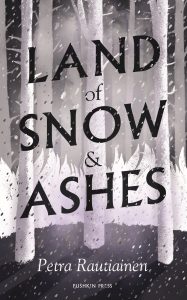 In the middle years of World War II, Finland was allied with Nazi Germany against Russia, a mutual enemy. After the Moscow Armistice, the Germans retreated in disgrace, burning as many buildings and planting as many landmines as they could (“the Lapland War”). I gleaned this helpful background information from Hackston’s preface. The story that follows is in two strands: one is set in 1944 and told via diary entries from Väinö Remes, a Finnish soldier called up to interpret at a Nazi prison camp in Inari. The other, in third person, takes place between 1947 and 1950, the early years of postwar reconstruction. Inkeri, a journalist, has come to Enontekiö to find out what happened to her husband. An amateur photographer, she teaches art to the local Sámi children and takes on one girl, Bigga-Marja, as her protégée.
Collusion and secrets; escaped prisoners and physical measurements being taken of the Sámi: there are a number of sinister hints that become clearer as the novel goes on. I felt a distance from the main characters that I could never quite overcome, such that the reveals didn’t land with as much power as I think was intended. Still, this has the kind of forthright storytelling and precise writing that fans of Hubert Mingarelli should appreciate. For another story of the complexities of being on the wrong side of history, see The Women in the Castle by Jessica Shattuck.
With thanks to Pushkin Press for the proof copy for review.
Winter words:
“Fresh snow has fallen, forming drifts across the terrain. White. Grey. Undulating. The ice has cracked here and there, raising its head in the thawed sections of the river. There is only a thin layer of ice left.”
Owls of the Eastern Ice: The Quest to Find and Save the World’s Largest Owl by Jonathan C. Slaght (2020)
Slaght has become an expert on the Blakiston’s fish owl during nearly two decades of fieldwork in the far east of Russia – much closer to Korea and Japan than to Moscow, the region is also home to Amur tigers. For his Master’s and PhD research at the University of Minnesota, he plotted the territories of breeding pairs of owls and fit them with identifying bands and data loggers to track their movements over the years. He describes these winter field seasons as recurring frontier adventures. Now, I’ve accompanied my husband on fieldwork from time to time, and I can tell you it would be hard to make it sound exciting. Then again, gathering beetles from English fields is pretty staid compared to piloting snowmobiles over melting ice, running from fire, speeding to avoid blockaded logging roads, and being served cleaning-grade ethanol when the vodka runs out.
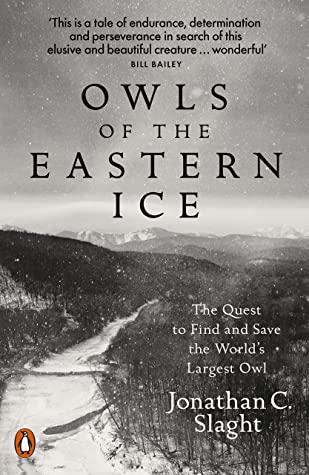 The sorts of towns Slaght works near are primitive places where adequate food and fuel is a matter of life and death. He and his assistants rely on the hospitality of Anatoliy the crazy hermit and also stay in huts and caravans. Tracking the owls is a rollercoaster experience, with expensive equipment failures and trial and error to narrow down the most effective trapping methods. His team develops a new low-tech technique involving a tray of live fish planted in the river shallows under a net. They come to know individuals and mourn their loss: the Sha-Mi female he’s holding in his author photo was hit by a car four years later.
Slaght thinks of Russia as his second home, and you can sense his passion for the fish owl and for conservation in general. He boils down complicated data and statistics into the simple requirements for this endangered species (fewer than 2000 in the wild): valleys containing old-growth forest with large trees and rivers that don’t fully freeze over. There are only limited areas with these characteristics. These specifications and his ongoing research – Slaght is now the Northeast Asia Coordinator for the Wildlife Conservation Society – inform the policy recommendations given to logging companies and other bodies.
Amid the science, this is just a darn good story, full of bizarre characters like Katkov, a garrulous assistant exiled for his snoring. (“He fueled his monologue with sausage and cheese, then belched zeppelins of aroma into that confined space.”) Slaght himself doesn’t play much of a role in the book, so don’t expect a soul-searching memoir. Instead, you get top-notch nature and travel writing, and a ride along on a consequential environmentalist quest. This is the kind of science book that, like Lab Girl and Entangled Life, I’d recommend even if you don’t normally pick up nonfiction. (Christmas gift) 
And a bonus children’s book:
If Winter Comes, Tell It I’m Not Here by Simona Ciraolo (2020)

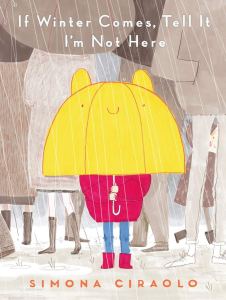 The little boy loves nothing more than to spend hours at the swimming pool and then have an ice cream cone. His big sister warns him the carefree days of summer will be over soon; it will turn cold and dark and he’ll be cooped up inside. Her words come to pass, yet the boy realizes that every season has its joys and he has to take advantage of them while they last. Cute and colourful, though the drawing style wasn’t my favourite. And a correction is in order: as President Biden would surely tell you, ice cream is a year-round treat! (Public library)
Any snowy or icy reading (or weather) for you lately?
Autumn Reading: The Pumpkin Eater and More
I’ve been gearing up for Novellas in November with a few short autumnal reads, as well as some picture books bedecked with fallen leaves, pumpkins and warm scarves.
An Event in Autumn by Henning Mankell (2004)
[Translated from the Swedish by Laurie Thompson, 2014]
 My first and probably only Mankell novel; I have a bad habit of trying mystery series and giving up after one book – or not even making it through a whole one. This was written for a Dutch promotional deal and falls chronologically between The Pyramid and The Troubled Man, making it #9.5 in the Wallander series. It opens in late October 2002. After 30 years as a police officer, Kurt Wallander is interested in living in the countryside instead of the town-center flat he shares with his daughter Linda, also a police officer. A colleague tells him about a house in the country owned by his wife’s cousin and Wallander goes to have a look.
Of course things aren’t going to go smoothly with this venture. You have to suspend disbelief when reading about the adventures of investigators; it’s like they attract corpses. So it’s not much of a surprise that while he’s walking the grounds of this house he finds a human hand poking out of the soil, and eventually the remains of a middle-aged couple are unearthed. The rest of the book is about finding out what happened on the property at the time of the Second World War. Wallander says he doesn’t believe in ghosts, but victims of wrongful death are as persistent as ghosts: they won’t be ignored until answers are found.
This was a quick and easy read, but nothing about it (setting, topics, characterization, prose) made me inclined to read further in the author’s work.
My rating: 
The Pumpkin Eater by Penelope Mortimer (1962)
 (Classic of the Month, #1)
Like a nursery rhyme gone horribly wrong, this is the story of a woman who can’t keep it together. She’s the woman in the shoe, the wife whose pumpkin-eating husband keeps her safe in a pumpkin shell, the ladybird flying home to find her home and children in danger. Aged 31 and already on her fourth husband, the narrator, known only as Mrs. Armitage, has an indeterminate number of children. Her current husband, Jake, is a busy filmmaker whose philandering soon becomes clear, starting with the nanny. A breakdown at Harrods is the sign that Mrs. A. isn’t coping, and she starts therapy. Meanwhile, they’re building a glass tower as their countryside getaway, allowing her to contemplate an escape from motherhood.
An excellent 2011 introduction by Daphne Merkin reveals how autobiographical this seventh novel was for Mortimer. But her backstory isn’t a necessary prerequisite for appreciating this razor-sharp period piece. You get a sense of a woman overwhelmed by responsibility and chafing at the thought that she’s had no choice in what life has dealt her. Most chapters begin in medias res and are composed largely of dialogue, including with Jake or her therapist. The book has a dark, bitter humor and brilliantly recreates a troubled mind. I was reminded of Janice Galloway’s The Trick Is to Keep Breathing and Elizabeth Hardwick’s Sleepless Nights. If you’re still looking for ideas for Novellas in November, I recommend it highly.
My rating: 
Snow in Autumn by Irène Némirovsky (1931)
[Translated from the French by Sandra Smith, 2007]
(Classic of the Month, #2)
 I have a copy of Suite Française, Némirovsky’s renowned posthumous classic, in a box in America, but have never gotten around to reading it. This early tale of the Karine family, forced into exile in Paris after the Russian Revolution, draws on the author’s family history. The perspective is that of the family’s old nanny, Tatiana Ivanovna, who guards the house for five months after the Karines flee and then, joining them in Paris after a shocking loss, longs for the snows of home. “Autumn is very long here … In Karinova, it’s already all white, of course, and the river will be frozen over.” Nostalgia is not as innocuous as it might seem, though. This gloomy short piece brought to mind Gustave Flaubert’s story “A Simple Heart.” I wouldn’t say I’m taken by Némirovsky’s style thus far; in fact, the frequent ellipses drove me mad! The other novella in my paperback is Le Bal, which I’ll read next month.
My rating:
Plus a quartet of children’s picture books from the library:

Pumpkin Soup by Helen Cooper: A cat, a squirrel and a duck live together in a teapot-shaped cabin in the woods. They cook pumpkin soup and make music in perfect harmony, each cheerfully playing their assigned role, until the day Duck decides he wants to be the one to stir the soup. A vicious quarrel ensues, and Duck leaves. Nothing is the same without the whole trio there. After some misadventures, when the gang is finally back together, they’ve learned their lesson about flexibility … or have they? Adorably mischievous.
Moomin and the Golden Leaf by Richard Dungworth: Beware: this is not actually a Tove Jansson plot, although her name is, misleadingly, printed on the cover (under tiny letters “Based on the original stories by…”). Autumn has come to Moominvalley. Moomin and Sniff find a golden leaf while they’re out foraging. He sets out to find the golden tree it must have come from, but the source is not what he expected. Meanwhile, the rest are rehearsing a play to perform at the Autumn Ball before a seasonal feast. This was rather twee and didn’t capture Jansson’s playful, slightly melancholy charm. 
Little Owl’s Orange Scarf by Tatyana Feeney: Ungrateful Little Owl thinks the orange scarf his mother knit for him is too scratchy. He tries “very hard to lose his new scarf” and finally manages it on a trip to the zoo. His mother lets him choose his replacement wool, a soft green. I liked the color blocks and the simple design, and the final reveal of what happened to the orange scarf is cute, but I’m not sure the message is one to support (pickiness vs. making do with what you have).
Christopher Pumpkin by Sue Hendra and Paul Linnet: The witch of Spooksville needs help preparing for a big party, so brings a set of pumpkins to life. Something goes a bit wrong with the last one, though: instead of all things ghoulish, Christopher Pumpkin loves all things fun. He bakes cupcakes instead of stirring gross potions and strums a blue ukulele instead of inducing screams. The witch threatens to turn Chris into soup if he can’t be scary. The plan he comes up with is the icing on the cake of a sweet, funny book delivered in rhyming couplets. Good for helping kids think about stereotypes and how we treat those who don’t fit in.
Have you read any autumn-appropriate books lately?
The Secrets We Kept by Lara Prescott Blog Tour
“this was not just a book, but a weapon”
 It’s the latest Reese Witherspoon book club selection and film rights have been sold to the producers of La La Land; if you haven’t already heard about The Secrets We Kept, you’ll be hearing a lot more soon. Prescott’s debut novel is an offbeat spy thriller set mostly in the 1950s and based on the international reception of Boris Pasternak’s Doctor Zhivago. Considered to express anti-Soviet opinions, Pasternak’s love story is suppressed in his native country but published widely in Western Europe and further afield. The Central Intelligence Agency, in the belief that books are one way to change ideologies in the long term (“They had their satellites, but we had their books”), decides it is important to make Doctor Zhivago available in its original Russian in the motherland, and duly enrolls two female spies – who have been masquerading as a typist and a receptionist – in the scheme.
First-person narration duties are shared by Olga Vsevolodovna, Pasternak’s lover and the inspiration for Lara in Doctor Zhivago; Irina Drozdova, a new secretary at the Agency; Sally Forrester, the more experienced spy who takes Irina under her wing; Teddy Helms, Irina’s first trainer and would-be romantic interest; and the typist pool as a whole. I have a special love for the first-person plural voice, used as a kind of observant chorus. Here it doesn’t work perfectly: Chapter 17 unnecessarily recaps information readers had already gleaned, while Chapter 20 is a clunky way of revealing more. But the ‘we’ of the title is not just these all-seeing typists (who reminded me of the secretaries in Mad Men), but also Sally and Irina, as well as Olga and her family, who often suffer for their connection with Pasternak. The epilogue carries things through to the present in a hopeful, almost whimsical way.
There’s a lot to appreciate about The Secrets We Kept, including the prominent roles played by women, the surprising place given to a same-sex relationship, and the glimpses into publishing and literary history. Prescott might have included more about Doctor Zhivago itself, though. The plot will most likely be unfamiliar to today’s readers. (I saw the film nearly 20 years ago and remember nothing.) Including more passages and some careful plot summary might have tempted more readers to try Pasternak’s work as we approach the 60th anniversary of his death in 2020. Still, this is in a very easy-reading style that lends itself to binges, and it nicely bridges the gap between literary fiction and spy stories.
Recommended to: Readers of Jessie Burton and Whitney Scharer; viewers of The Americans.
My rating: 
The Secrets We Kept was published by Hutchinson on September 3rd. My thanks to the publisher for the proof copy for review.
 Bookish Beck = Rebecca Foster. American transplant to England. Freelance proofreader and book reviewer.
 Bookish Beck