May Releases, Part II (Fiction): Le Blevennec, Lynch, Puchner, Stanley, Ullmann, and Wald
A cornucopia of May novels, ranging from novella to doorstopper and from Montana to Tunisia; less of a spread in time: only the 1980s to now. Just a paragraph on each to keep things simple. I’ll catch up soon with May nonfiction and poetry releases I read.
Friends and Lovers by Nolwenn Le Blevennec (2023; 2025)
[Translated from French by Madeleine Rogers]
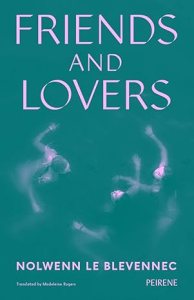 Armelle, Rim, and Anna are best friends – the first two since childhood. They formed a trio a decade or so ago when they worked on the same magazine. Now in their mid-thirties, partnered and with children, they’re all gripped by a sexual “great awakening” and long to escape Paris and their domestic commitments – “we went through it, this mutiny, like three sisters,” poised to blow up the “perfectly executed choreography of work, relationships, children”. The friends travel to Tunisia together in December 2014, then several years later take a completely different holiday: a disaster-prone stay in a lighthouse-keeper’s cottage on an island off the coast of Brittany. They used to tolerate each other’s foibles and infidelities, but now resentment has sprouted up, especially as Armelle (the narrator) is writing a screenplay about female friendship that’s clearly inspired by Rim and Anna. Armelle is relatably neurotic (a hilarious French blurb for the author’s previous novel is not wrong: “Woody Allen meets Annie Ernaux”) and this is wise about intimacy and duplicity, yet I never felt invested in any of the three women or sufficiently knowledgeable about their lives.
With thanks to Peirene Press for the free copy for review.
A Family Matter by Claire Lynch
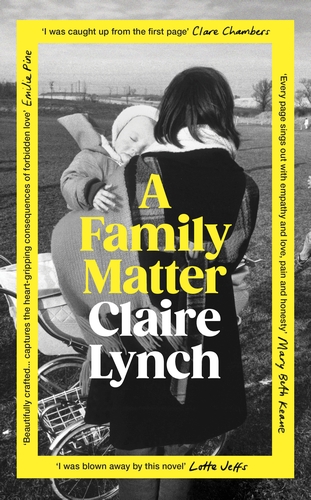 “The fluke of being born at a slightly different time, or in a slightly different place, all that might gift you or cost you.” At events for Small, Lynch’s terrific memoir about how she and her wife had children, women would speak up about how different their experience had been. Lesbians born just 10 or 20 years earlier didn’t have the same options. Often, they were in heterosexual marriages because that’s all they knew to do; certainly the only way they thought they could become mothers. In her research into divorce cases in the UK in the 1980s, Lynch learned that 90% of lesbian mothers lost custody of their children. Her aim with this earnest, delicate debut novel, which bounces between 2022 and 1982, is to imagine such a situation through close portraits of Heron, an ageing man with terminal cancer; his daughter, Maggie, who in her early forties bears responsibility for him and her own children; and Dawn, who loved Maggie desperately but felt when she met Hazel that she was “alive at last, at twenty-three.” How heartbreaking that Maggie knew only that her mother abandoned her when she was little; not until she comes across legal documents and newspaper clippings does she understand the circumstances. Lynch made the wise decision to invite sympathy for Heron from the start, so he doesn’t become the easy villain of the piece. Her compassion, and thus ours, is equal for all three characters. This confident, tender story of changing mores and steadfast love is the new Carol for our times. (Such a lovely but low-key novel was liable to make few ripples, so I’m delighted for Lynch that the U.S. release got a Read with Jenna endorsement.)
With thanks to Chatto & Windus (Penguin) for the proof copy for review.
Dream State by Eric Puchner
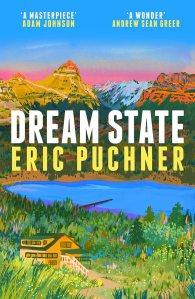 If it starts and ends with a wedding, it must be a comedy. If much of the in between is marked by heartbreak, betrayal, failure, and loss, it must be a tragedy. If it stretches towards 2050 and imagines a Western USA smothered in smoke from near-constant forest fires, it must be an environmental dystopian. Somehow, this novel is all three. The first 163 pages are pure delight: a glistening romantic comedy about the chaos surrounding Charlie and Cece’s wedding at his family’s Montana lake house in the summer of 2004. First half the wedding party falls ill with norovirus, then Charlie’s best friend, Garrett (who’s also the officiant), falls in love with the bride. Do I sound shallow if I admit this was the section I enjoyed the most? The rest of this Oprah’s Book Club doorstopper examines the fallout of this uneasy love triangle. Charlie is an anaesthesiologist, Cece a bookstore owner, and Garrett a wolverine researcher in Glacier National Park, which is steadily losing its wolverines and its glaciers. The next generation comes of age in a diminished world, turning to acting or addiction. There are still plenty of lighter moments: funny set-pieces, warm family interactions, private jokes and quirky descriptions. But this feels like an appropriately grown-up vision of idealism ceding to a reality we all must face. I struggled with a lack of engagement with the children, but loved Puchner’s writing so much on the sentence level that I will certainly seek out more of his work. Imagine this as a cross between Jonathan Franzen and Maggie Shipstead.
With thanks to Sceptre (Hodder) for the proof copy for review.
Consider Yourself Kissed by Jessica Stanley
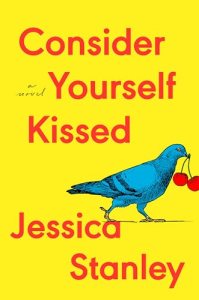 Coralie is nearing 30 when her ad agency job transfers her from Australia to London in 2013. Within a few pages, she meets Adam when she rescues his four-year-old, Zora, from a lake. That Adam and Coralie will be together is never really in question. But over the next decade of personal and political events, we wonder whether they have staying power – and whether Coralie, a would-be writer, will lose herself in soul-destroying work and motherhood. Adam’s job as a political journalist and biographer means close coverage of each UK election and referendum. As I’ve thought about some recent Jonathan Coe novels: These events were so depressing to live through, who would want to relive them through fiction? I also found this overlong and drowning in exclamation points. Still, it’s so likable, what with Coralie’s love of literature (the title is from The Group) and adjustment to expat life without her mother; and secondary characters such as Coralie’s brother Daniel and his husband, Adam’s prickly mother and her wife, and the mums Coralie meets through NCT classes. Best of all, though, is her relationship with Zora. This falls solidly between literary fiction and popular/women’s fiction. Given that I was expecting a lighter romance-led read, it surprised me with its depth. It may well be for you if you’re a fan of Meg Mason and David Nicholls.
With thanks to Hutchinson Heinemann for the proof copy for review.
Girl, 1983 by Linn Ullmann (2021; 2025)
[Translated from Norwegian by Martin Aitken]
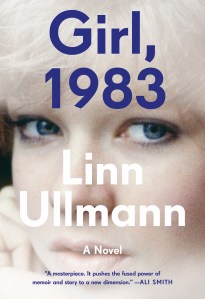 Ullmann is the daughter of actress Liv Ullmann and film director Ingmar Bergman. That pedigree perhaps accounts for why she got the opportunity to travel to Paris in the winter of 1983 to model for a renowned photographer. She was 16 at the time and spent the whole trip disoriented: cold, hungry, lost. Unable to retrace the way to her hotel and wearing a blue coat and red hat, she went to the only address she knew – that of the photographer, K, who was in his mid-forties. Their sexual relationship is short-lived and unsurprising, at least in these days of #MeToo revelations. Its specifics would barely fill a page, yet the novel loops around and through the affair for more than 250. Ullmann mostly pulls this off thanks to the language of retrospection. She splits herself both psychically and chronologically. There’s a “you” she keeps addressing, a childhood imaginary friend who morphs into a critical voice of conscience and then the self dissociated from trauma. And there’s the 55-year-old writer looking back with empathy yet still suffering the effects. The repetition made this something of a sombre slog, though. It slots into a feminist autofiction tradition but is not among my favourite examples.
With thanks to Hamish Hamilton (Penguin) for the proof copy for review.
The Bayrose Files by Diane Wald
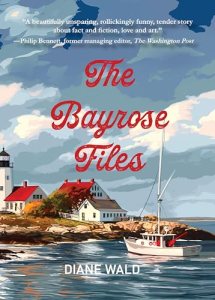 In the 1980s, Boston journalist Violet Maris infiltrates the Provincetown Home for Artists and Writers, intending to write a juicy insider’s exposé of what goes on at this artists’ colony. But to get there she has to commit a deception. Her gay friend Spencer Bayrose has a whole sheaf of unpublished short stories drawing on his Louisiana upbringing, and he offers to let her submit them as her own work to get a place at PHAW. Here Violet finds eccentrics aplenty, and even romance, but when news comes that Spence has AIDS, she has to decide how far she’ll go for a story and what she owes her friend. At barely over 100 pages, this feels more like a long short story, one with a promising setting and a sound plot arc, but not enough time to get to know or particularly care about the characters. I was reminded of books I’ve read by Julia Glass and Sara Maitland. It’s offbeat and good-natured but not top tier.
Published by Regal House Publishing. With thanks to publicist Jackie Karneth of Books Forward for the advanced e-copy for review.
A Family Matter was the best of the bunch for me, followed closely by Dream State.
Which of these do you fancy reading?
Fathers: Reflections by Daughters (Virago Anthology)
Books that dwell on family bonds often spotlight mothers and daughters, or fathers and sons; it seems a bit less common to examine the relationship with the parent of the opposite sex. In advance of Father’s Day, I picked up Fathers: Reflections by Daughters (1983; 1994) and read the first third. As I once did for Mother’s Day with another Virago anthology, Close Company: Stories of Mothers and Daughters, I’ll end up reading it across several years. Where that was a short fiction collection, though, this is all autobiographical pieces.
The section I’ve read so far contains seven essays counting editor Ursula Owen’s introduction, plus a retelling of the fairy tale “Cap o’ Rushes.” Most of the authors were born in the 1940s or 1950s, so a common element is having a father who served in the Second World War – or the First (for Angela Carter and Doris Lessing). There’s a sense, therefore, of momentous past experience that will never be disclosed. As Lessing writes of her father, “I knew him when his best years were over” – that is, after he had lost a leg, given up his favourite foods due to diabetes, and undertaken a doomed farming enterprise in colonial Africa.

Freudian interpretation seems like a given for several of the memoirists. Anne Boston was a posthumous child whose father was killed in the last days of WWII; in “Growing Up Fatherless,” she explores how this might have affected her.
I’ve always tended to discount the effects of being without a father – quite wrongly, I think now. There were effects, and they continued to influence my entire life, if anything increasingly so.
Among these effects, she enumerates a lack of proper “sexual conditioning.” Anthropologist Olivia Harris, too, wonders how a father determines a woman’s relationships with other men:
How far do women choose in their spouses, encourage in their sons, the ideal remembrance of the father? Am I, but not being married, refusing to exchange my father, or am I diffusing that chain of being?
Two authors specifically interrogate the alignment of the father with God. In “Heavenly Father,” Harris compares visions of fatherhood in various cultures, including in Anglican Christianity. Here the father, in parallel with the deity, is something of a distant moral arbiter. Sara Maitland felt the same about her father:
he really did correspond to the archetype of the Father. Many women grow out of their father when they discover that he is not really like what fathers are supposed, imaginatively, mythologically to be: he is weak, or a failure, or dishonest, or uninterested, or goes away. My father was not a perfect person, but he was very Father-like.
Unknown, aloof, a disciplinarian … I wonder if those descriptions resonate with you as much as they do with me?
In between pieces, Owen has reprinted 1–4 quotes from novels or academic sources that are relevant to fathers and daughters. The result is, as she acknowledges in the introduction, “a sort of collage.” She also remarks on the fact that it was difficult for more than one contributor to find a photo of herself with her father because “Dad always takes the photograph.” The essay I haven’t yet mentioned is a sweet but inconsequential two-pager by 13-year-old Kate Owen; it’s just occurred to me that that’s probably the editor’s daughter.
I’ll be interested to see how Michèle Roberts, Adrienne Rich, Alice Munro and more will clarify or complicate the picture of father–daughter relationships in the rest of the volume. (Secondhand from a National Trust bookshop)
Three on a Theme (and #ReadIndies): Nonfiction I Sponsored Last Year
Here in the UK we’re hunkering down against the high winds of Storm Eunice. We’ve already watched two trees come down in a neighbour’s garden (and they’re currently out there trying to shore up the fence!), and had news on the community Facebook page of a huge conifer down by the canal. Very sad. I hope you’re all safe and well and tucked up at home.
Today I’m looking back at several 2021 nonfiction releases I helped come into existence. The first and third I sponsored via Unbound, and the second through Dodo Ink. Supporting small publishers also ties this post into Karen and Lizzy’s February Read Indies initiative. All: 

This Party’s Dead: Grief, Joy and Spilled Rum at the World’s Death Festivals by Erica Buist
A death tourism book? I’m there! This is actually the third I’ve read in recent years, after From Here to Eternity by Caitlin Doughty and Near the Exit by Lori Erickson. Buist’s journey was sparked off by the sudden death of her fiancé Dion’s father, Chris – he was dead for a week before his cleaner raised the alarm – and her burden of guilt. It’s an act of atonement for what happened to Chris and the fact that she and Dion, who used to lodge with him, weren’t there when he really needed it. It’s also her way of discovering a sense of the sacred around death, instead of simply fearing and hiding from it.
 This takes place in roughly 2018. The author travelled to eight festivals in seven countries, starting with Mexico for the Day of the Dead and later for an exploration of Santa Muerte, a hero of the working class. Other destinations included Nepal, Sicily (“bones of the dead” biscotti), Madagascar (the “turning of the bones” ceremony – a days-long, extravagant party for a whole village), Thailand and Kyoto. The New Orleans chapter was a standout for me. It’s a city where the dead outnumber the living 10 to 1 (and did so even before Katrina), and graveyard and ghost tours are a common tourist activity.
Buist is an entertaining writer, snappy and upbeat without ever seeming flippant as she discusses heavy topics. The mix of experience and research, the everyday and the momentous, is spot on and she recreates dialogue very well. I appreciated the earnest seeking here, and would happily read a book of hers on pretty much any subject. (New purchase from Unbound)
Trauma: Essays on Art and Mental Health, ed. Thom Cuell & Sam Mills
I’ll never learn: I left it nearly 10 months between finishing this and writing it up. And took no notes. So it’s nearly impossible to recreate the reading experience. What I do recall, however, is how wide-ranging and surprising I found this book. At first I had my doubts, thinking it was overkill to describe sad events like a break-up or loss as “traumatic”. But an essay midway through (which intriguingly trades off autobiographical text by Kirsty Logan and Freudian interpretation by Paul McQuade) set me straight: trauma cannot be quantified or compared; it’s all about the “unpreparedness of the subject. A traumatic event overwhelms all the defences laid out in advance against the encroachment of negative experience.”
 The pieces can be straightforward memoir fragments or playful, experimental narratives more like autofiction. (Alex Pheby’s is in the second person, for instance.) Within those broad branches, though, the topics vary widely. James Miller writes about the collective horror at the Trump presidency. Emma Jane Unsworth recounts a traumatic delivery – I loved getting this taste of her autobiographical writing but, unfortunately, it outshone her full-length memoir, After the Storm, which I read later in the year. Susanna Crossman tells of dressing up as a clown for her clinical therapy work. Naomi Frisby (the much-admired blogger behind The Writes of Womxn) uses food metaphors to describe how she coped with the end of a bad relationship with a narcissist.
As is inevitable with a collection this long, there are some essays that quickly fade in the memory and could have been omitted without weakening the book as a whole. But it’s not gracious to name names, and, anyway, it’s likely that different pieces will stand out for other readers based on their own experiences. (New purchase from Dodo Ink)
Four favourites:
- “Inheritance” by Christiana Spens (about investigating her grandparents’ lives through screen prints and writing after her father’s death and her son’s birth)
- “Blank Spaces” by Yvonna Conza (about the lure of suicide)
- “The Fish Bowl” by Monique Roffey (about everyday sexual harassment and an assault she underwent as a teenager; I enjoyed this so much more than her latest novel)
- “Thanks, I’ll Take the Chair” by Jude Cook, about being in therapy.
Women on Nature: 100+ Voices on Place, Landscape & the Natural World, ed. Katharine Norbury
It was over three years between when I pledged support and held the finished book in my hands; I can only imagine what a mammoth job compiling it was for Katharine Norbury (author of The Fish Ladder). The subtitle on the title page explains the limits she set: “An anthology of women’s writing about the natural world in the east Atlantic archipelago.” So, broadly, British and Irish writers, but within that there’s a lot of scope for variety: fragments of fiction (e.g., a passage from Jane Eyre), plenty of poetry, but mostly nonfiction narratives – some work in autobiographical reflection; others are straightforward nature or travel writing. Excerpts from previously published works trade off with essays produced specifically for this volume. So I encountered snippets of works I’d read by the likes of Miriam Darlington, Melissa Harrison, Sara Maitland, Polly Samson and Nan Shepherd. The timeline stretches from medieval mystics to today’s Guardian Country Diarists and BIPOC nature writers.
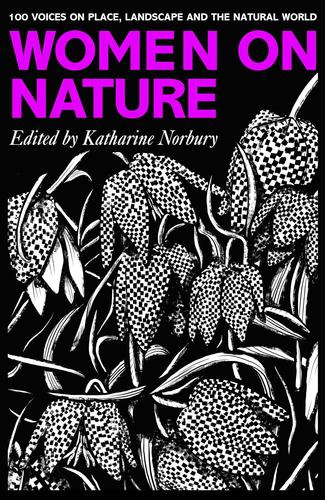 For most of the last seven months of 2021, I kept this as a bedside book, reading one or two pieces on most nights. It wasn’t until early this year that I brought it downstairs and started working it into my regular daily stacks so that I would see more progress. At first I quibbled (internally) with the decision to structure the book alphabetically by author. I wondered if more might have been done to group the pieces by region or theme. But besides being an unwieldy task, that might have made the contents seem overly determined. Instead, you get the serendipity of different works conversing with each other. So, for example, Katrina Porteous’s dialect poem about a Northumberland fisherman is followed immediately by Jini Reddy’s account of a trip to Lindisfarne; Margaret Cavendish’s 1653 dialogue in verse between an oak tree and the man cutting him down leads perfectly into an excerpt from Nicola Chester’s On Gallows Down describing a confrontation with tree fellers.
I’d highly recommend this for those who are fairly new to the UK nature writing scene and/or would like to read more by women. Keep it as a coffee table book or a bedside read and pick it up between other things. You’ll soon find your own favourites. (New purchase from Unbound)
Five favourites:
- “Caravan” by Sally Goldsmith (a Sheffield tree defender)
- “Enlli: The Living Island” by Pippa Marland (about the small Welsh island of Bardsey)
- “An Affinity with Bees” by Elizabeth Rose Murray (about beekeeping, and her difficult mother, who called herself “the queen bee”)
- “An Island Ecology” by Sarah Thomas (about witnessing a whale hunt on the Faroe Islands)
- My overall favourite: “Arboreal” by Jean McNeil (about living in Antarctica for a winter and the contrast between that treeless continent and Canada, where she grew up, and England, where she lives now)
“It occurred to me that trees were part of the grammar of one’s life, as much as any spoken language. … To see trees every day and to be seen by them is a privilege.”
Stay strong, trees!
Sponsored any books, or read any from indie publishers, recently?
Pandemic Reading Strategies & Recommendations, Serious or Tongue-in-Cheek
If you’ve been spending time blog-hopping or on Twitter over the last few weeks, you will have seen countless riffs on this topic. Everyone’s pondering what’s best to read in these times. All we can get our hands on about plagues (Boccaccio, Camus, Defoe)? Allegories of similarly challenging worldwide disasters (WWII, 9/11)? Childhood favorites? Comfort reads? Funny books? Light, undemanding stuff? Rereads?
My general answer would be: as always, read whatever you want or can – anything that captures your attention is worthwhile. We’re under so much stress that our reading should be entirely unpressured. But to be a little more specific, I’ve gathered reading recommendations on a variety of topics, drawing on lists that others have made and linking to my own blog reviews where applicable.
(Some of these ideas are less serious than others.)
If you are brave enough to learn about zoonotic diseases:
 Spillover: Animal Infections and the Next Human Pandemic by David Quammen: This is top-notch scientific journalism: pacey, well-structured, and gripping. The best chapters are on Ebola and SARS; the SARS chapter, in particular, reads like a film screenplay, if this were a far superior version of Contagion. It’s a sobering subject, with some quite alarming anecdotes and statistics, but this is not scare-mongering for the sake of it; Quammen is frank about the fact that we’re still all more likely to get heart disease or be in a fatal car crash.
If you can’t look away from pandemic stories, historical or imagined:


I already had Philip Roth’s Nemesis (set in 1940s New Jersey amid a polio epidemic) out from the library because it was on the Wellcome Book Prize shortlist in 2011. I was also inspired to take Year of Wonders by Geraldine Brooks (set in the 1660s and featuring an English village that quarantined itself during the Plague) off the shelf. I’m nearing the end of these two and should have my reviews up next week.
You will see no one book referenced more than Station Eleven by Emily St. John Mandel. It’s a wholly believable dystopian novel in which 99% of the population has been wiped out by a pandemic. The remnant bands together not just to survive but to create and preserve art. “What was lost in the collapse: almost everything, almost everyone, but there is still such beauty.” (My full BookBrowse review from December 2014.)
See also this Publishers Weekly list of “13 Essential Pandemic Novels.”
If you’re feeling cooped up…
 Infinite Home by Kathleen Alcott: “Edith is a widowed landlady who rents apartments in her Brooklyn brownstone to an unlikely collection of humans, all deeply in need of shelter.” (I haven’t read it, but I do have a copy; now would seem like the time to read it!)
…yet want to appreciate the home you’re stuck in:


Years ago I read and loved At Home: A Short History of Private Life by Bill Bryson and Happier at Home by Gretchen Rubin. I can’t tell you anything more than that because it was before the days when I reviewed everything I read, but these are both reliable authors.
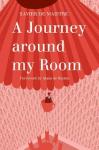 I love the sound of A Journey Around My Room by Xavier de Maistre: “Finding himself locked in his room for six weeks, a young officer journeys around his room in his imagination, using the various objects it contains as inspiration for a delightful parody of contemporary travel writing and an exercise in Sternean picaresque.”
I’m also drawn to Home: The Story of Everyone Who Ever Lived in Our House by Julie Myerson, who combed archives for traces of all the former residents of her 1870s terraced house in Clapham.
If you’re struggling with being on your own:


The Lonely City by Olivia Laing: This remarkable book on outsider artists interweaves biography, art criticism and memoir. Laing is a tour guide into the peculiar, lonely crowdedness you find in a world city.
How to Be Alone by Sara Maitland: Maitland argues that although being alone is easy to achieve, there is an art to doing it properly, and solitude and loneliness are by no means the same thing. Profiling everyone from the Desert Fathers of early Christianity to the Romantic poets, she enumerates all the benefits that solitude confers.
Journal of a Solitude by May Sarton: A one-year account of her writing life in New Hampshire, this is Sarton’s best. The book dwells on the seasonal patterns of the natural world (shovelling snow, gardening, caring for animals) but also the rhythms of the soul – rising in hope but also falling into occasional, inevitable despair.
See also this Penguin UK list of books to read in self-isolation.
If you’ve been passing the time by baking…
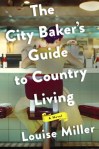 The City Baker’s Guide to Country Living by Louise Miller: As chief baker at the Sugar Maple Inn in Guthrie, Vermon, Olivia Rawlings settles into a daily routine of baking muffins, bread and cakes. This is a warm, cozy debut novel full of well-drawn secondary characters and romantic possibilities. There’s nothing clichéd about it, though. Livvy is a sassy narrator, and I loved how Miller documents the rhythms of the small-town country year, including tapping the maple trees in the early spring and a pie baking contest at the summer county fair.
 Sourdough by Robin Sloan: Lois Clary, a Bay Area robot programmer, becomes obsessed with baking. “I needed a more interesting life. I could start by learning something. I could start with the starter.” She attempts to link her job and her hobby by teaching a robot arm to knead the bread she makes for a farmer’s market. Madcap adventures ensue. It’s a funny and original novel and it makes you think, too – particularly about the extent to which we should allow technology to take over our food production.
…but can’t find yeast or eggs in the shop:
Yeast: A Problem by Charles Kingsley (1851). Nope, I haven’t read it, but our friend has a copy in his Everyman’s Library collection and the title makes us laugh every time we see it.
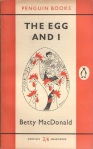 The Egg & I by Betty Macdonald: MacDonald and her husband started a rural Washington State chicken farm in the 1940s. Her account of her failure to become the perfect farm wife is hilarious. The voice reminded me of Doreen Tovey’s: mild exasperation at the drama caused by household animals, neighbors, and inanimate objects. “I really tried to like chickens. But I couldn’t get close to the hen either physically or spiritually, and by the end of the second spring I hated everything about the chicken but the egg.” Perfect pre-Easter reading.
And here are a few lists I put together for Hungerford Bookshop:
If you need a laugh:
Fiction:
Lucky Jim by Kingsley Amis
The Darling Buds of May (and sequels) by H.E. Bates
Ella Minnow Pea by Mark Dunn
Heartburn by Nora Ephron
 Cold Comfort Farm by Stella Gibbons
Anything by Nick Hornby
Three Men in a Boat by Jerome K. Jerome
Anything by David Lodge
Dear Committee Members by Julie Schumacher
The Rosie Project (and sequels) by Graeme Simsion
To Say Nothing of the Dog by Connie Willis
Nonfiction:
 Anything by Bill Bryson
21st-Century Yokel by Tom Cox
Anything by Gerald Durrell
Anything by Nora Ephron (essays)
This Is Going to Hurt by Adam Kay
Priestdaddy by Patricia Lockwood
Dear Lupin by Roger Mortimer
Anything by David Sedaris
Little Failure by Gary Shteyngart
If you want to disappear into a long book:


The Heart’s Invisible Furies by John Boyne
Jonathan Strange & Mr Norrell by Susanna Clarke
David Copperfield by Charles Dickens
Middlesex by Jeffrey Eugenides
The Crimson Petal and the White by Michel Faber
The Signature of All Things by Elizabeth Gilbert
The Nix by Nathan Hill
We, the Drowned by Carsten Jensen
Mary Ann Sate, Imbecile by Alice Jolly
The Poisonwood Bible by Barbara Kingsolver
The Wind-Up Bird Chronicle by Haruki Murakami
The Sparrow by Mary Doria Russell
American Wife by Curtis Sittenfeld
East of Eden by John Steinbeck
The Goldfinch by Donna Tartt
Cutting for Stone by Abraham Verghese
The Paying Guests by Sarah Waters
If you’re looking for some hope:
 Almost Everything: Notes on Hope by Anne Lamott
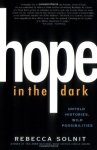
Hope in the Dark by Rebecca Solnit
Hope Dies Last: Making a Difference in an Indifferent World by Studs Terkel
I’ve been doing a combination of the above strategies, reading about historical plagues in fiction and nonfiction but also doing some rereading and consuming lighter genre stuff like mysteries. I continue to dip into new releases, and I enjoy the ongoing challenge of my reading projects. Right now, I’m working through a few current Women’s Prize longlistees, as well as some past Wellcome Book Prize nominees and Women’s Prize winners, and I’m about to start a third #1920Club title. Plus I’m already thinking about my 20 Books of Summer (I’m considering an all-foodie theme).
Further reading:
- Book Riot pinpoints seven categories of books to read during a pandemic.
- Clare surveys the post-pandemic literary landscape.
- Elle logs her pandemic reading and viewing.
- Laura discusses pandemic reading strategies and distraction reading.
- Literary Hub looks at parallel situations, including post-9/11 reads, to make predictions, and asks what your “go-to quarantine read” says about you. (I’ve read Kindred most recently, but I wouldn’t say that describes me.)
- Simon thinks about what we can and should read.
- Susan highlights some comfort reads.
What are your current reading strategies?
Review & Giveaway: Hame by Annalena McAfee
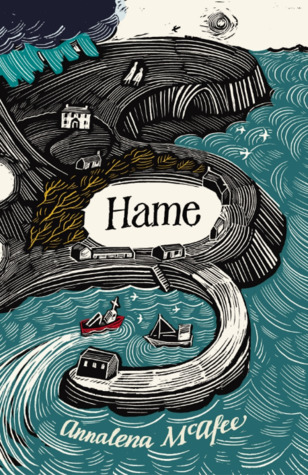 As I mentioned on Tuesday, I previously knew of Annalena McAfee only as Mrs. Ian McEwan, though she has a distinguished literary background: she founded the Guardian Review and edited it for six years, was Arts and Literary Editor of the Financial Times, and is the author of multiple children’s books and one previous novel for adults, The Spoiler (2011).
Well, anyone who reads Hame will be saying “Ian who?” as this is on such a grand scale compared to anything McEwan has ever attempted. The subtitle, “The Fascaray Archives,” gives an idea of how thorough McAfee means to be: the life of fictional poet Grigor McWatt is her way into everything that forms the Scottish identity. Her invented island of Fascaray is a carefully constructed microcosm of Scotland from ancient times to today. I loved the little glimpses of recent history, like the referendum on independence and a Donald Trump figure, billionaire “Archie Tupper,” bulldozing an environmentally sensitive area to build his new golf course (this really happened, in Aberdeenshire in 2012).
Narrator Mhairi McPhail arrives on Fascaray in August 2014, her nine-year-old daughter Agnes in tow. She’s here to oversee the opening of a new museum, edit a seven-volume edition of McWatt’s magnum opus, The Fascaray Compendium (a 70-year journal detailing the island’s history, language, flora, fauna and customs), and complete a critical biography of the poet. Over the next four months she often questions the feasibility of her multi-strand project. She also frets about her split from Marco, whom she left back in New York City after their separate infidelities. And her rootlessness – she’s Canadian via Scotland but has spent a lot of time in the States, giving her a mixed-up heritage and accent – is a constant niggle.
Mhairi’s narrative sections share space with excerpts from her biography of McWatt and extracts from McWatt’s own writing: The Fascaray Compendium, newspaper columns, letters to on-again, off-again lover Lilias Hogg, and Scots translations of famous poets from Blake to Yeats. We learn of key events from the island’s history through Mhairi’s biography and McWatt’s prose, including ongoing tension between lairds and crofters, Finnverinnity House being used as a Special Ops training school during World War II, a lifeboat lost in a gale in the 1970s, and the way the fishing industry is now ceding to hydroelectric power.
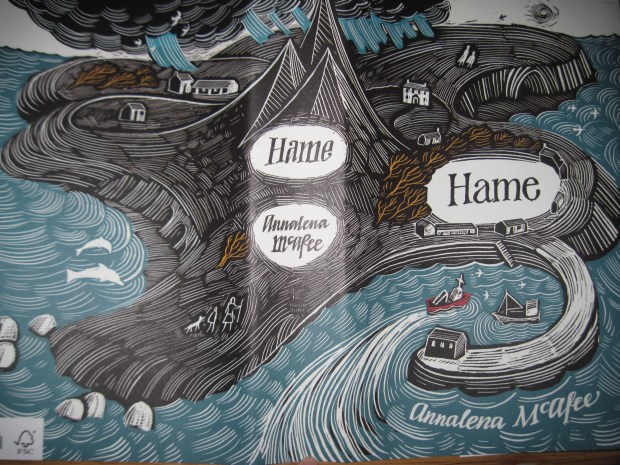
The balance between the alternating elements isn’t quite right – sections from Mhairi’s contemporary diary seem to get shorter as the novel goes along, such that it feels like there’s not enough narrative to anchor the book. Faced with yet more Scots poetry and vocabulary lists, or passages from Mhairi’s dry biography, it’s mighty tempting to skim.
That’s a shame, as the novel contains some truly lovely writing, particularly in McWatt’s nature observations:
In July and August, on rare days of startling and sustained heat, dragonflies as blue as the cloudless skies shimmer over cushions of moss by the burn while the midges, who abhor direct sunlight, are nowhere to be seen. Out to sea, somnolent groups of whales pass like cortèges of cruise ships and around them dolphins and porpoises joyously arc and dip as if stitching the ocean’s silken canopy of turquoise, gentian and cobalt.
For centuries male Fascaradians have sailed in the autumn, at the time of the ripe barley and the fruiting buckthorn, to hunt the plump young solan geese or gannets – the guga – near their nesting sites on the uninhabited rock pinnacles of Plodda and Grodda. No true Fascaradian can suffer vertigo since the scaling of these granite towers is done without the aid of mountaineers’ crampons or picks.
“Hame” means home in Scots – like in McWatt’s claim to fame, the folk-pop song “Hame tae Fascaray” – and themes of home and identity are strong here. The novel asks to what extent identity is bound up with a particular country and language, and whether we can craft our own selves. Must the place you come from always be the same as the home you choose? I could relate to Mhairi’s feeling that there’s nowhere she belongs, whether she’s in the bustle of New York or “marooned on a patch of damp peat floating in the North Sea.”
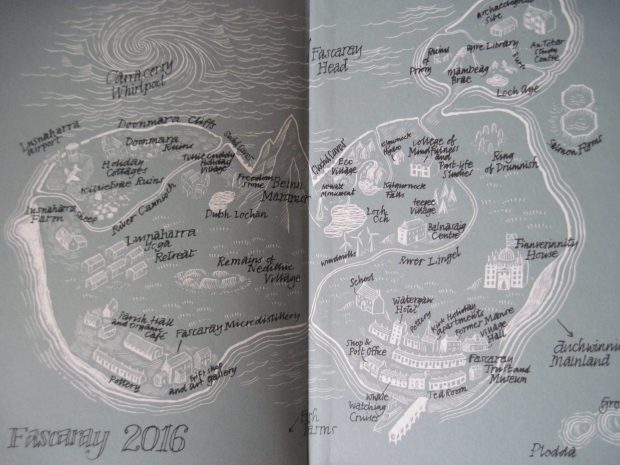
A map of the island from the inside of the back cover.
Although the blend of elements initially made me think that this would resemble A.S. Byatt’s Possession, it’s actually more like Rachel Cantor’s Good on Paper, which similarly stars a scholar who’s a single parent to a precocious daughter. In places I was also reminded of the work of Scarlett Thomas, Sara Maitland and Sarah Moss, and there’s even an echo of Robert Macfarlane’s Landmarks in the inventories of dialect words.
If you’ve done much traveling in Scotland, an added pleasure of the novel is trying to spot places you’ve been. (I thought I could see traces of Stromness, Orkney; indeed, McWatt reminded me most of Orcadian poet George Mackay Brown.) The comprehensive, archival approach didn’t completely win me over, but I was impressed by the book’s scope and its affectionate portrait of a beloved country. McAfee is of Scots-Irish parentage herself, and you can tell this is a true labor of love, and a cogent tribute.
Hame was published by Harvill Secker on February 9th. With thanks to Anna Redman for sending a free copy for review.
My rating: 
Giveaway Announcement!
I was accidentally sent two copies of Hame, so I am giving one away to a reader. Alas, this giveaway will have to be UK-only – the book is a hardback of nearly 600 pages, so would be prohibitively expensive to send abroad.
If you’re interested in winning a copy, simply leave a comment to that effect below. The competition will be open through the end of Friday the 17th and I will choose a winner at random on Saturday the 18th, to be announced via the comments and a personal e-mail.
Good luck!
All the Lonely People*
Last week I finished two books, one fiction and one nonfiction, that had loneliness as a central theme – although their treatment of the subject was vastly different.
First was Quartet in Autumn by Barbara Pym, which was recommended to me by various bloggers and certainly lived up to their praise. Originally published in 1977, this was Pym’s seventh novel out of nine; she died in 1980. It’s about four London office workers, all sixty-somethings who are partnerless and don’t have, or at least don’t live with, any immediate family members. We never learn what they do in this office; in fact, Edwin, Norman, Letty and Marcia don’t seem to be filling much of a need, especially given the fact that the two old girls aren’t replaced when they retire midway through the novel.
 For as long as they’ve been working together, the four haven’t given in to the usual human impulse to know and be known. At first there doesn’t seem to be much to know about them; with only one or two shorthand facts apiece it’s a minor challenge to tell them apart. Widower Edwin’s hobby is attending Anglican services; Norman lives off fried food and visits his brother-in-law in hospital; Letty lives in a boarding house and has a friend in the countryside; Marcia has had a mastectomy and hoards tinned food and empty milk bottles.
But for all of them a line applied to Letty holds true: “It was a comfortable enough life, if a little sterile, perhaps even deprived.” Especially after her retirement, Letty knows “she must never give the slightest hint of loneliness or boredom, the sense of time hanging heavy.”
From what I’d heard about Pym, I might have expected a lighthearted satire about country manners and Anglican vicars. Perhaps that’s a fair assessment of some of her earlier books? But this is much darker, and the humor always has a bitter edge:
- When Marcia finds a plastic bag labeled “To avoid danger of suffocation keep this wrapper away from babies and children,” the narrator adds, “They could have said from middle-aged and elderly persons too, who might well have an irresistible urge to suffocate themselves.”
- Offered the option of moving into a care home, Letty thinks “better to lie down in the wood under the beech leaves and bracken and wait quietly for death.”
Overall it’s quite a melancholy little book, a warning against letting your life become too small and private. Yet the last line, remarkably, is a sudden injection of optimism: “it made one realize that life still held infinite possibilities for change.” I’d recommend this to readers who have enjoyed Mrs. Palfrey at the Claremont by Elizabeth Taylor.
As an unwittingly positive counterpart, I was at the same time reading How to Be Alone by Sara Maitland. This is part of a School of Life series that turns the “how-to” concept on its head: instead of areas where we think we need instruction, the books are about areas where we feel like experts, topics so simple or automatic they don’t seem to need explanation (e.g. How to Be Bored, or How to Age).

I feel it’s important to point out that the author’s last name is spelled wrong on the cover!
But Maitland argues that although being alone is easy to achieve, there is an art to doing it properly, and solitude and loneliness are by no means the same thing. She knows whereof she speaks: though she grew up in a large Catholic family, after her divorce she moved to a remote area of Scotland and lives alone in a house a quarter mile from the nearest road.
Despite our modern obsession with self-confidence and fulfilling relationships, Maitland believes “the present paradigm is not really working.” More of us than ever are depressed and afraid to spend time alone lest it might make us appear selfish, pathetic or in some way unlovable.
Profiling everyone from the Desert Fathers of early Christianity to the Romantic poets, she counters by enumerating all the benefits that solitude confers: self-knowledge and a rest from constant relating (that goes for extroverts as well as introverts), a connection to nature and to the divine, and the freedom to create. She convinced me, and includes a great bibliography of further reading about solitude.
*I only found out the other week that Eleanor Rigby “picks up the rice” in a church. For my entire life I’d thought she “picks up her ice” (granted, that doesn’t make much sense, but the Beatles could be trippy lads). You learn something new every day!
 Bookish Beck = Rebecca Foster. American transplant to England. Freelance proofreader and book reviewer.
 Bookish Beck