Four Recent Review Books: Aidt, Brackenbury, Duclos & Zidrou
Four February–March releases: A shape-shifting bereavement memoir; a poet’s selected works, infused with nature and history; a novel set among expatriates in Shanghai; and a graphic novel about a romance at the watershed of age 60 – you can’t say I don’t read a variety of books! I’m particularly pleased that two of these four are in translation. All: 

When Death Takes Something from You Give It Back: Carl’s Book by Naja Marie Aidt
[Translated from the Danish by Denise Newman]
 In March 2015 Aidt got a call telling her that her second of four sons, Carl Emil, was dead. The 25-year-old experienced drug-induced psychosis after taking some mushrooms that he and his friend had grown in their flat and, naked, jumped out of his fifth-floor Copenhagen window. In italicized sections she cycles back to the moment she was notified, each time adding on a few more harrowing details about Carl’s accident and the condition she found him in. The rest of the text is a collage of fragments: memories, dreams, dictionary definitions, journal entries, and quotations from the patron saints of bereavement (C.S. Lewis and Joan Didion) and poets who lost children, such as Stéphane Mallarmé.
The playful disregard for chronology and the variety of fonts, typefaces and sizes are a way of circumventing the feeling that grief has made words lose their meaning forever. David Grossman, whose son died during his service in the Israeli army, does a similar thing in Falling Out of Time, which, although it is fiction, blends poetry and dialogue in an attempt to voice the unspeakable. Han Kang’s The White Book and Yiyun Li’s Where Reasons End are two other comparable precursors.

A representative passage:
“no language possible language died with my child could not be artistic could not be art did not want to be fucking art I vomit over art over syntax write like a child main clauses searching everything I write is a declaration I hate writing don’t want to write any more”
With thanks to Quercus Books for the free copy for review.
Gallop: Selected Poems by Alison Brackenbury
 I first encountered Alison Brackenbury’s poetry through her reading as part of the 2016 “Nature Matters” conference in Cambridge. From four generations of Lincolnshire shepherds, Brackenbury writes about history, nature, country life (especially horses, as you might guess from the title and cover) and everyday joys and regrets. A Collected/Selected Poems volume is often difficult to assess as a whole because there can be such a variety of style and content; while that is certainly true here in terms of the poems’ length and rhyme schemes, the tone and themes are broadly similar throughout. I connected most to her middle period. Her first and last lines are especially honed.
Highlights include “The Wood at Semmering” (“This is a dismal wood. We missed our train.”), “Half-day” (“Will she lift / Her face from cloth’s slow steam: will she find out / Ironing is duty; summer is a gift?”), “Hill Mist” (“I am too fond of mist, which is blind / without tenderness”), “On the Road” (the bravery of a roadkill squirrel), “Epigrams” (being in the sandwich generation), “The Card” (“Divorce comes close to death”), “Cycles” (“Would I go back?”), “The Jane Austen Reader” (“Welcome to the truth. Miss Bingley married Darcy”), “On the Aerial” (a starling’s many songs), and “Dickens: a daydream.”

A wee poem that’s perfect for this time of year. (I can see sparrows in a forsythia bush from my office window.)
Some favorite lines:
“we are love’s strange seabirds. We dive there, still.” (from “The Divers’ Death”)
“Ancestors are not in our blood, but our heads: / we make history.” (from “Robert Brackenbury”)
With thanks to Carcanet Press for the free copy for review.
Besotted by Melissa Duclos
 Sasha is soon to leave Shanghai, her departure hastened by the collapse of her relationship with Liz, whom she hired to work at her international school because she had no teaching experience or Chinese – and maybe because she signed her cover letter “Besottedly,” thinking it meant drunkenly. Even before Liz arrived, Sasha built romantic fantasies around her, thinking she’d show her the ropes and give her a spare room to live in. All went according to plan – the erstwhile straight Liz even ended up in Sasha’s bed – until it all fell apart.
The novel is set over one school year and shows the main characters exploring the expat community, which primarily involves going to happy hours. Liz starts language exchange sessions at Starbucks with a Chinese guy, Sam, and both women try to ignore the unwanted advances of their acquaintance Dorian, an architect. Little misunderstandings and betrayals go a long way towards rearranging these relationships, while delicate flashbacks fill in the women’s lives before China.
There were a couple of narrative decisions here that didn’t entirely work for me: Sasha narrates the whole book, even scenes she isn’t present for; and there is persistent personification of abstractions like Loneliness and Love. But the descriptions of the city and of expat life are terrific, and the wistful picture of a romance that starts off sweet but soon sours is convincing.
A favorite passage:
“Shanghai had found its own identity since then: a glittering capitalist heart, hardened into a diamond and barely hidden beneath its drab, brown communist cloak. … Constantly under construction, Shanghai was a place to reinvent yourself.”
Full disclosure: Melissa and I worked together on Bookkaholic web magazine, and are Facebook friends. She sent me a free proof copy for review.
Blossoms in Autumn by Zidrou and Aimée de Jongh
[Translated from the French by Matt Madden]
 The French-language title, translated literally, is The Programmed Obsolescence of Our Feelings. (Talk about highfalutin!) Both that and the English title defy the notion that we become less capable of true love and growth the older we are – as will be dramatized through the story of a later-life romance between the two main characters. Ulysses Varennes, a 59-year-old widower who retired early from his career as a mover, hates books (gasp!) because moving boxes of them ruined his back (he even refuses to read them!). Mediterranea Solenza, coming up on 62, was a nude model in her prime and is now a cheesemaker. At the book’s opening she has just laid her mother to rest, and her affair with Ulysses serves as a chance at a new life that somehow counterbalances the loss.


We come to understand these characters through the sadness of their past but also through their hopeful future, both encompassed by the metaphor of a Homeric journey (Ulysses, get it?). Indeed, the book takes an unusual turn I never would have expected; if it beggars belief, it is at least touching. Zidrou is a Belgian comics writer and Aimée de Jongh is a Dutch-born illustrator. She portrays these ageing bodies sensitively but realistically, retreating into an appropriately impressionistic style for the spreads that show their actual lovemaking. In a nice touch, the first two words and last two words of the book are exactly the same.
With thanks to SelfMadeHero for the free copy for review.
Would you be interested in reading one or more of these?
A Few Spooky Reads for Halloween
I’m not at all one for scary books; horror and even crime fiction rarely make it onto my reading agenda. But in advance of Halloween I did read a few books that would count as creepy. Maybe you’ll fancy picking one of them up today?
Ghost Stories of an Antiquary, Vol. II by M.R. James
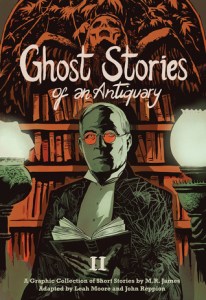 I’ve only ever read one M.R. James piece before, in an anthology of stories about libraries. This was perhaps not an ideal way to encounter his ghost stories for the first time. Though all four (“Number 13,” “Count Magnus,” “Oh, Whistle and I Will Come to You, My Lad” and “The Treasure of Abbot Thomas”) are adapted by the same pair, Leah Moore and John Reppion, each is illustrated by a different artist, so the drawing style ranges from rounded and minimalist to an angular, watercolor Marvel style. The stories have thematic links of research, travel, archaeological discovery and antiquities. Very often there are found documents that must be interpreted. Several narrators are scholars coming across unexplained phenomena: a hotel room that appears and disappears, a sarcophagus lid that opens on its own, a storm summoned by a whistle, and so on.
In a brief introduction, Jason Arnopp applauds the decision to “show readers the ghouls and ghosts,” but I disagree – to me a central problem with using the graphic form for these tales that center around nameless horror is that depicting the source of horror saps it of its power. Still, I appreciated the introduction to James’s ghost stories.
My rating:
With thanks to SelfMadeHero for the free copy for review.
Devil’s Day by Andrew Michael Hurley
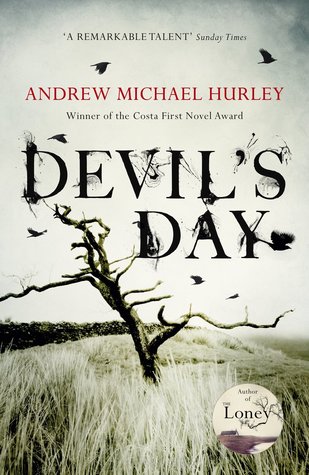 In Hurley’s Lancashire farmland setting, Devil’s Day is a regional Halloween-time ritual when the locals serve up the firstborn lamb of spring as a sacrifice to ward off the Devil’s shape-shifting appearance in the human or animal flock. Is it all a bit of fun, or necessary for surviving supernatural threat? We see the year’s turning through the eyes of John Pentecost, now settled back on his ancestral land with his wife, Kat, and their blind son, Adam. However, he focuses on two points from his past: his bullied childhood and a visit home early on in his marriage that coincided with the funeral of his grandfather, “the Gaffer”. The Endlands is a tight-knit community with a long history of being cut off from everywhere else, which makes it an awfully good place to keep secrets.
The first and last quarters of the book flew by for me, while the middle dragged a bit. The rural atmosphere and the subtle air of menace reminded me of Elmet and Bellman and Black. I’ll certainly seek out Hurley’s acclaimed debut, The Loney. [Read via NetGalley]
Favorite lines:
“Nothing changed in Underclough. Nothing happened. Not really. … elsewhere was always a place where the worst things happened. … The world outside the valley might well collapse but we wouldn’t necessarily feel the ripples here.”
My rating: 
Slade House by David Mitchell
“If I could just see a ghost, just once … Just one ghost, so I know that death’s not game over, but a door.”
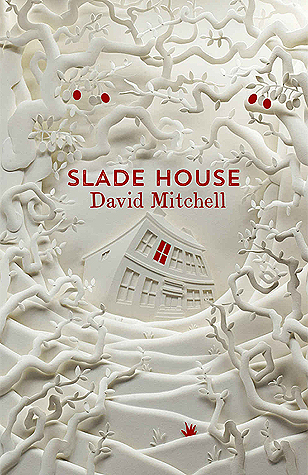 This was so cool! I feel like I’d never experienced a “real” Mitchell book before (having only read The Thousand Autumns of Jacob de Zoet, which is in some ways the odd one out), and I was impressed by how he brings everything together in this short novel. Every nine years between 1979 and 2015, a different visitor gets sucked into the treacherous world-within-a-world of the Grayer twins’ Slade House. This dilapidated mansion located off an unassuming alley morphs to fit each guest’s desires. To reveal more would spoil the fun, so I’ll just say that I love how Mitchell lulls you into a pretty horrific pattern before springing a couple of major surprises in later chapters. Each time period and narrator feels distinct and believable, and I’m told one character is from two other Mitchell novels (and the phrase “bone clock” even makes an appearance). I need to pick up Cloud Atlas soon for sure. [Public library copy]
My rating: 
Recommended spooky listening: The album That Ghost Belongs to Me by The Bookshop Band – all songs inspired by scary books.
Did you read anything scary this Halloween season?
Spinning by Tillie Walden (A Graphic Memoir)
I’m uncomfortable with the term “graphic memoir,” which to me connotes a memoir with graphically violent or sexual content. However, it seems to be accepted parlance nowadays for a graphic novel that’s autobiographical rather than fictional. Tillie Walden’s Spinning is in the same vein as Alison Bechdel’s Fun Home and Craig Thompson’s Blankets: a touching coming-of-age story delivered through the medium of comics.
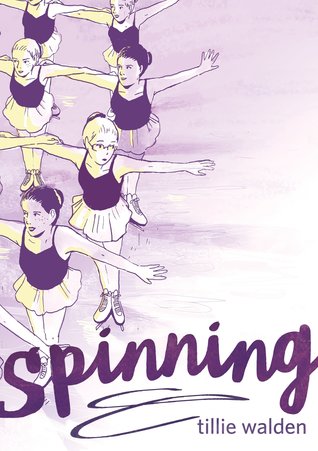 Specifically, this is about the 12 years Walden spent in the competitive figure skating world. She grew up in New Jersey, and when the family moved to Austin, Texas the bullying she’d experienced in her previous school continued. Mornings started at 4 a.m. when she got up for individual skating lessons; after school she had synchronized skating practice at another rink.
These years were full of cello lessons, unrequited crushes and skating competitions she rode to with her friend Lindsay and Lindsay’s mother. The femininity of the skating world – the slicked-back buns and thick make-up; the way every girl was made to look the same – chafed with Walden because she’d known since age five that she was gay. All told, she was disillusioned with what once seemed like her whole life:
Skating changed when I came to Texas. It wasn’t strict or beautiful or energizing any more. Now it just felt dull and exhausting. I couldn’t understand why I should keep skating after it lost all its shine.
Every chapter is named after a different skating move: waltz jump, axel, camel spin, etc. Walden’s drawing style initially reminded me most of This One Summer by Jillian and Mariko Tamaki, which is also about teens finding their way in the world and shares the same mostly purple and gray coloring. Walden’s work is more sketch-like, and also includes yellow on certain pages. The last third or so of the book is the most momentous: between when Walden comes out at 15 and when she gives up skating at 17.
Believe it or not, Walden was born in 1996 and this is her fourth book. She’s already won two Ignatz Awards. I felt this book would have benefited from more hindsight: time to mull over her skating experience and figure out what it all meant. The Author’s note at the end struck me as particularly shallow, like this project was about quick catharsis rather than considered reflection. However, the book’s scope (nearly 400 pages) is impressive, and Walden is adept at capturing the emotional milestones of her early life.
Published in the UK on September 12th. With thanks to Paul Smith of SelfMadeHero – celebrating its 10th anniversary this year – for the free copy for review.
My rating:
Gauguin Gets the Graphic Novel Treatment
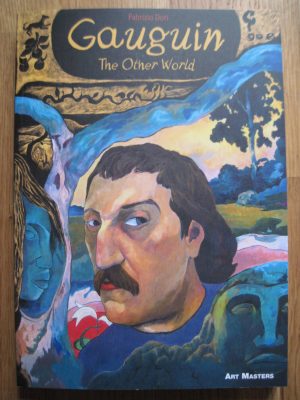 Fabrizio Dori’s Gauguin: The Other World is the third graphic novel I’ve reviewed from SelfMadeHero’s “Art Masters” series, after Munch and Vincent. Like those previous volumes, it delivers salient snippets of biography alongside drawings that cleverly echo the subject’s artistic style. Here the focus is on the last 12 years of Paul Gauguin’s life (1848–1903), which were largely spent in the South Pacific.
The book opens with a macro, cosmic view – the myth of the origin of Tahiti and a prophecy of fully clothed, soulless men arriving in a great canoe – before zeroing in on Gauguin’s arrival in June 1891. Although he returned to Europe in 1893–5, Tahiti and the Marquesas Islands would be his final homes. This is all covered in a whirlwind Chapter 1 that ends by, Christmas Carol-like, introducing a Spirit (as pictured in his 1892 painting Manaó Tupapaù (Spirit of the Dead Watching)) who will lead Gauguin – in a morphine haze on his deathbed in 1903 – and readers on a tour through his past.
Gauguin grew up in Peru and Paris, and at age 17 joined the crew of a merchant marine vessel to South America and the West Indies. Back in Paris, he tried to make a living as a stockbroker and salesman while developing as a self-taught artist. He married Mette, a Danish woman, but left her and their children behind in Copenhagen when he departed for Tahiti. The paintings he sent back were unprofitable, and she soon came to curse his career choice.
The locals called Gauguin “the man who makes men” for his skill in portraiture, but also “the woman man” because he wore his hair long. He moved from Papeete, Tahiti’s European-style colonial town, to a cabin in the woods to become more like a savage, and also explored the ghost-haunted island interior. Teura came to live with him as his muse and his lover.
The book is full of wonderful colors and spooky imagery. The palette shifts to suit the mood: dusky blue and purple for the nighttime visit of the Spirit, contrasting with lush greens, pinks and orange for other island scenes and simple ocher and black for the sequences where Gauguin is justifying his decisions. The black-robed, hollow-faced Spirit reminded me of similar figures imagined by Ingmar Bergman and Hayao Miyazaki – could these film directors have been inspired by Gauguin’s Polynesian emissary of death?
Overall this struck me as a very original and atmospheric way of delivering a life story. Although the font is a little bit difficult to read and I ultimately preferred the art to the narration, they still combine to build a portrait of a brazen genius who shunned conventional duties to pursue his art and cultivate the primitive tradition in new ways. Gauguin ends with a short sequence set in Paris in 1907, as Pablo Picasso, fired up by a Gauguin retrospective show, declares, “We must break with formal beauty. We must be savages.”
I appreciated this brief peek into the future, as well as the five-page appendix of critical and biographical information on Gauguin contributed by art critic Céline Delavaux. What I said about Vincent holds true here too: I’d recommend this to anyone with an interest in the lives of artists, whether you think you’re a fan of graphic novels or not. It will be particularly intriguing to see how Dori’s vision of Gauguin compares to that in W. Somerset Maugham’s The Moon and Sixpence, which I plan to start soon.
With thanks to Paul Smith of SelfMadeHero – celebrating its 10th anniversary this year – for the review copy. Translated from the French by Edward Gauvin.
My rating:
Vincent van Gogh’s Life as a Graphic Novel
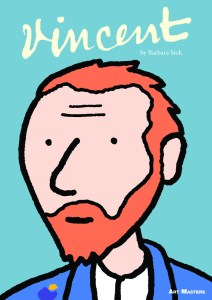 Dutch artist and writer Barbara Stok’s Vincent is the second graphic novel I’ve read from SelfMadeHero’s “Art Masters” series, after reviewing Munch last month. It’s another biographical study of an artist, in this case of Vincent van Gogh. Oddly, though, the drawing style and the subject’s vibrant shock of red hair reminded me most of Agatha.
The book focuses primarily on the time van Gogh spent in the South of France. He settled in Arles, staying first in a hotel and then in a large rental house he hoped to turn into an artists’ colony – he temporarily attracted Paul Gauguin before driving him away with his strict, workaholic ways and his temper.
In presumably authentic letters to his younger brother Theo (an art dealer who supported him financially) back in Paris, van Gogh details his progress and tells of his fondness for the Provence scenery. I particularly love the panels where you can spot the direct inspiration for some of van Gogh’s most famous paintings: wheat fields, cypress trees, sunflowers, irises, a starry night sky, and even his cluttered bedroom.
We also get insights into the philosophy behind van Gogh’s work: “An artist has to put character and emotion into his work, not just paint whatever sells,” he insists to an art dealer who expects him to pander to public taste. “I use lots of different techniques, all mixed together. I like to exaggerate the colors in order to capture the soul of the subject,” he explains to a couple of fellow painters who take an interest in him. He used thick, confident brush strokes and painted quickly, making him annoyingly prolific in others’ eyes.
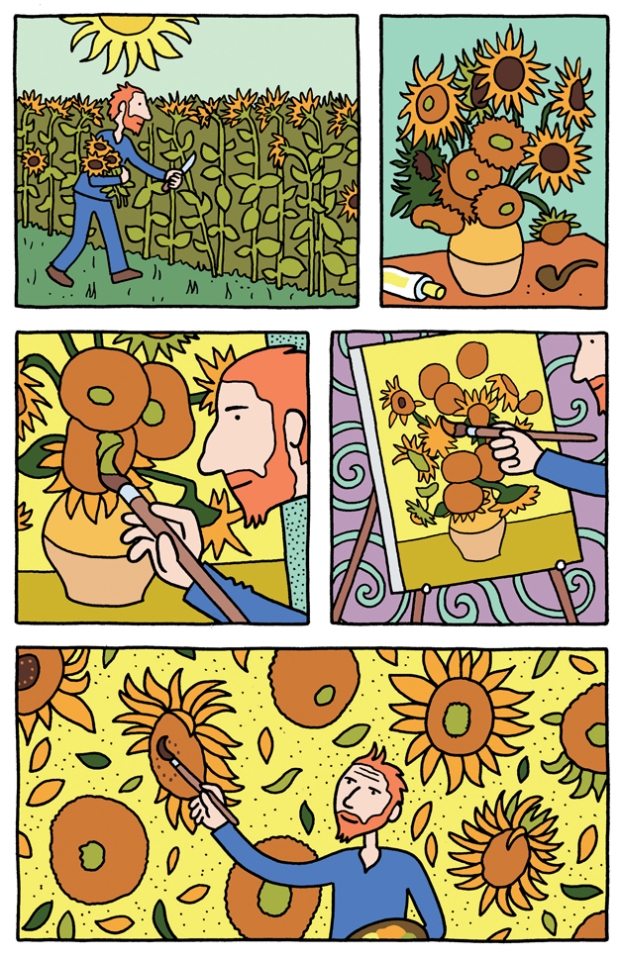
Stok does a wonderful job of depicting van Gogh as a misunderstood genius who drove people away with his lack of social skills, and sensitively introduces the breakdown during which he famously cut off his ear. He admitted himself to a mental hospital, where he could be treated for his epileptic attacks and continued to paint natural scenes under supervision.

Striking colors in the breakdown scene.
The book closes on what seems to be a fairly positive note: van Gogh voluntarily leaves the hospital and moves to Auvers-sur-Oise, near Paris, where he can be closer to Theo and his young family. “I foresee a future full of problems, but I’m not pessimistic,” he declares to his brother. And yet the final page shows a pair of gravestones: Vincent died in 1890 at age 37 and Theo just a year later, at 33.
Turn back one page and you see what might actually be a rather ominous scene: van Gogh has been painting in a wheat field; in one last two-page spread, he has disappeared from view and a flock of crows has taken off and filled the sky. Were they startled by the gunshot of his attempted suicide? While still true to the facts of van Gogh’s life, it’s a refreshingly subtle ending.
Stok perfectly captures van Gogh’s personality amid the warm colors of the French countryside, and whetted my appetite to read his letters for myself. I’d recommend this to anyone with an interest in the lives of artists, whether you think you’re a fan of graphic novels or not.
With thanks to the publisher, SelfMadeHero, for the free copy for review. Translated from the Dutch by Laura Watkinson.
My rating: 
Munch, Steffen Kverneland (graphic novel)
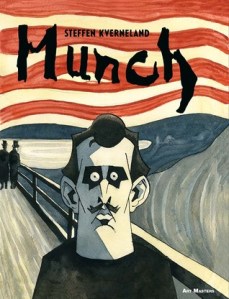 Munch is my second biography in graphic novel form from SelfMadeHero, following on from a life of Agatha Christie that I reviewed last month. Norwegian painter Edvard Munch (1863–1944) is, of course, best known for The Scream, but I learned a lot more about his work through this striking visual tour curated by illustrator Steffen Kverneland. Much of the text accompanying Kverneland’s images is from authentic primary sources: Munch’s diaries and letters, his contemporaries’ responses to his art, and so on.
Munch’s mother died early in his life, and sickroom and deathbed scenes were to permeate his work. “Disease and insanity and death were the black angels that stood by my cradle,” he wrote. “A mother who died early – gave me the seed of consumption – a distraught father – piously religious, verging on madness – gave me the seeds of insanity.” His first solo show opened in Kristiania (now Oslo) in 1889. Three and a half years later scandal erupted when his exhibition in Berlin was closed down. The establishment disapproved of the Impressionist influence in his work and thought he showed a lack of artistic technique. As it turned out, having his show shut down was the best publicity he ever could have asked for.
Kverneland shows different incarnations of Munch’s most famous pieces, such as Madonna, The Girls on the Bridge and The Scream. He also traces the painter’s important relationships, such as his friendship with playwright August Strindberg and his pursuit of the various women who inspired his nudes. In 1895, the writer Sigbjørn Obstfelder gave a lecture on Munch’s art. His appreciation included the following:
As no other Norwegian painter, Munch has focused on essential questions – has caused the deepest subjects to quiver. Before, one painted landscapes and everyday life – Munch paints human beings in all their shapes – even the beastly human. He finds his subjects where the emotions are strongest. Munch is one of the genuine artists who can shift boundaries.
This is a visually remarkable book, with various styles coexisting sometimes on the same page. Sometimes Munch is portrayed like a superhero in a comic (often with a hugely exaggerated chin); other times the images are more like photographs or nineteenth-century portraits. Pen sketches alternate with color spreads in which red, orange, sepia and flesh tones and black dominate. Some of my most admired individual panels have angular faces drawn in almost kaleidoscopic fragments. Strindberg’s is the most frighteningly fractured face, with triangles and trapezoids emphasizing his angry expression.
There’s also a meta aspect to this work: Kverneland depicts his travels with his friend Lars Fiske to sites associated with Munch, again using everything from black-and-white sketches to color photographs. These were, I’m afraid, my least favorite parts of the book: the friends’ raunchy, booze-filled banter has not translated well, and the style of some of their scenes is among the most cartoon-ish.
“Munch had become a monk whose life was devoted to art” is one of the last lines of the graphic novel. It’s a nice summation of what has gone before – with that wordplay especially remarkable given that this is a work in translation. I haven’t come away with a particularly clear sense of the trajectory of Munch’s life, but that’s probably not the point of a deliberately splintered biography like this one.
Kverneland worked on the book for seven years. First published in 2013, it won Norway’s Brage Prize for Literature. This is the fourth installment in SelfMadeHero’s “Art Masters” series, after Pablo, Vincent and Rembrandt. I can highly recommend it to you if you are already a fan of Munch’s work. However, if, like me, you look to graphic novels to also tell you a good story, you might come away slightly disappointed.
With thanks to the publisher, SelfMadeHero, for the free copy. Translated from the Norwegian by Francesca M. Nichols.
My rating:
Note: I’m traveling until the 24th so won’t be responding to comments right away, but will be sure to catch up soon after I’m back. I always welcome your thoughts!
Agatha Christie’s Life as a Graphic Novel
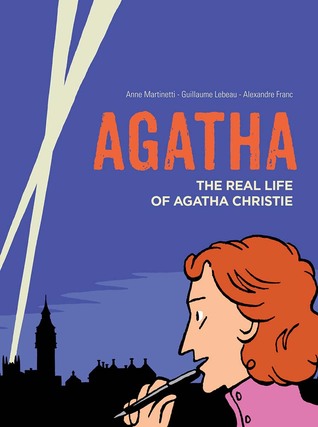 Agatha, a biography in graphic novel form written by Anne Martinetti and Guillaume Lebeau and illustrated by Alexandre Franc, opens – appropriately – with the real-life mystery at the heart of Agatha Christie’s story. In December 1926 the celebrated crime novelist disappeared, prompting a full-scale police investigation. She had abandoned her car by a lake in Surrey and traveled by train to Harrogate, where she checked into a hotel under a false name. Was it all an elaborate act of revenge for her husband’s philandering? Christie strikes up a conversation with Hercule Poirot, her most famous creation, in the hotel room, while back in London a clairvoyant is brought in to confirm she is alive. The medium’s look into Christie’s past sets up the novel’s first half as an extended flashback giving her history up until 1926.
Agatha Miller was raised in a wealthy household in Torquay, Devon. I never knew that she was a flaming redhead or that her father was American. His death when she was 11 was an early pall on an idyllic childhood of outdoor exploration and escape into books – even though her mother opined, “No child ought to be allowed to read until the age of 8. Better for the eyes and the brain.” She first turned her hand to writing while laid up in bed in 1908, completing her first story in two days. She and her mother took an exciting trip to Egypt, and in 1912 she met Lieutenant Archibald Christie at a ball. During the First World War she was a nurse at the town hospital in Torquay, where she came across a Belgian refugee who – at least in the authors’ theory – served as the inspiration for Poirot.
The Christies’ only daughter, Rosalind, was born in 1919. The following year The Mysterious Affair at Styles, the first Poirot mystery, was published. Christie’s career successes are intercut with her round-the-world travels (portrayed as sepia photographs), marriage difficulty and a new romance with archaeologist Max Mallowan, and the occasional intrusion of real-world events like World War II.
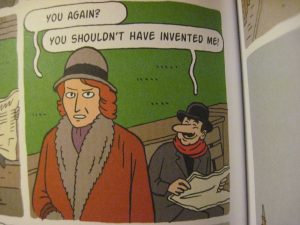 Meanwhile, her invented detectives jockey for her attention: not just Poirot, but Miss Marple and Tommy and Tuppence too. You have to suspend your disbelief during these scenes. I don’t think the authors are literally suggesting that Christie hallucinated conversations with her characters. Rather, it’s a whimsical way of imagining how her detectives took on lives of their own and became ‘real people’ she cared for yet found exasperating – she often threatens to do away with Poirot as Arthur Conan Doyle tried to do with Sherlock Holmes. There were only a couple of pages where I felt that a conversation with Poirot was a false way of conveying information. For the most part, this strategy works well; when coupled with the opening scene in 1926, it keeps the biography from being too much of a chronological slog.
With the exception of the sepia-tinged travel sections, this is a book packed with bright colors, particularly with Christie’s flash of red hair animating the first three quarters. It finishes with a timeline of Christie’s life and a complete bibliography of her works – no doubt invaluable references for diehard fans. I’ve only read one or two Christie books myself (my mother is the real devotee), but I enjoyed this quick peek into a legendary writer’s life. I was reminded of just how broad her reach was: from Hollywood studios to the West End, where The Mousetrap has been showing for a record-breaking 63 years. Her influence cannot be denied.
With thanks to the publisher, SelfMadeHero, for the free copy. Translated from the French by Edward Gauvin. (This one is in paperback!)
My rating: 
Are you an Agatha Christie fan? Does this tempt you to read more by or about her?
Irmina by Barbara Yelin (Graphic Novel)
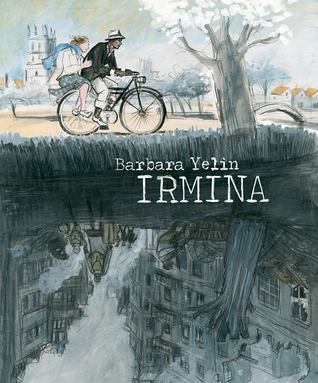 Barbara Yelin’s Irmina is one of the most visually stunning graphic novels I’ve ever come across. Not only that, but it’s based on a fascinating family story: after her grandmother’s death Yelin, a Munich-based artist, found a box of diaries and letters that told the story of a budding love affair that was not to be and charted a young woman’s gradual capitulation to Nazi ideology. How could her grandmother go from being a brave rule-breaker to a cowed regime supporter in just a few short years, she wondered? This fictionalized biography is her attempt to reconcile the ironies and hard facts of her ancestor’s life.
In 1934 Irmina von Behdinger arrives in London for a cultural exchange, attending a commercial school to train as a typist. One night she accompanies a friend to a fancy party and meets Howard, a young Barbados native she initially assumes to be a bartender. It turns out he actually has a scholarship to study law at Oxford. He’s learned, dignified and charming, and soon he and Irmina begin spending a lot of time together. Although she wishes she, too, could study at a proper university, women’s education is not valued in Germany.
Irmina and Howard’s carefree explorations of Oxford and London contrast with the increasingly bleak news coming from Germany about Hitler and his treatment of Jews. As her host family decries Nazism, Irmina tries to protest: “they are not MY Germans … this is politics! It doesn’t affect the average person.” She dreams of being an independent working woman and pursuing a relationship with Howard, but a change in her financial circumstances means she has to go back to Stuttgart instead. Promising to return to England as soon as she can raise some money, Irmina bids farewell to Howard at Portsmouth harbor in April 1935.
Back in Germany, she finds a translation job with the Ministry of War, hoping desperately to be transferred to the German consulate in London once she proves herself. But as the years pass and German relations with the rest of Europe grow strained, her dream seems increasingly unlikely. Having recently lost touch with Howard, she meets Gregor Meinrich, an architect for the SS, and gives up work when they marry and have a son. With the rare exception of a shocking event like Kristallnacht, it’s all too easy to ignore what’s happening to the nation’s Jews and absorb the propaganda that says they have earned their misfortune.
The novel is in three parts: London, Berlin and Barbados – Irmina gets a brief, late chance to see what her life might have been like with Howard. Yelin’s usual palette is muted and melancholy: grays, charcoal, slate blue, browns and flesh tones. However, in each section she chooses one signature color that adds symbolic flashes of life. For London it’s the bright blue of Irmina’s scarf, mirrored in Oxford’s sky and river, as well as in the occasional shopfront and lady’s dress.
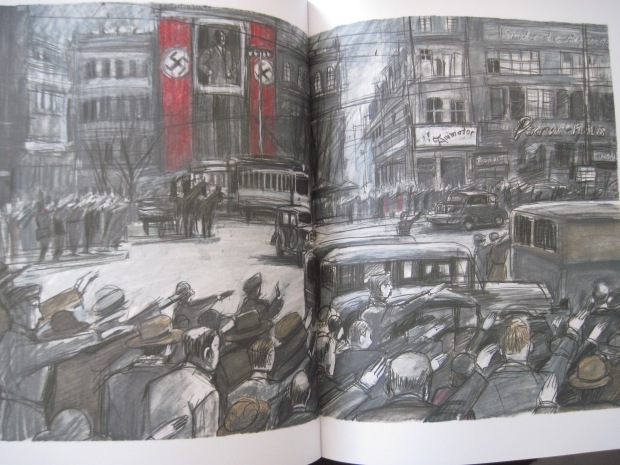
In Berlin the red of the Nazi flag crops up in lipstick, dress patterns, flowers, wine and the décor of a ballroom. In the most poignant scene of all, though, red is equated with the spilling of Jewish blood. As a friend discusses what she doesn’t want to hear – “they’re taking them all to the East now, where they kill them” – Irmina is getting a jar of berry preserves down from a high shelf and drops it, spattering scarlet everywhere. On the other hand, to evoke the calm and natural beauty of 1980s Barbados, the featured hue is a seafoam green.
I was particularly impressed with the two-page spreads showing city scenes. They range from Impressionist fog to Modernist detail, reminding me of everything from Monet to Modigliani. Although the artwork stands out a bit more than the story, this still strikes me as a fresh look at the lives of ordinary Germans who were kept in the dark (by themselves and others) about Hitler’s activities. In an afterword, Dr. Alexander Korb, Director of the University of Leicester’s Stanley Burton Centre for Holocaust and Genocide Studies, reflects on Irmina’s motivation:
Irmina had a full range of possibilities. Yet the fact that she chose the Nazi path from the wide variety in front of her, encompassing feminism, internationality and individuality, makes her story typical of this time. It was just as typical that she failed to find happiness in fascism, like millions of others.
For the out-of-the-ordinary window onto Third Reich history and the excellent illustrations, I highly recommend Irmina to graphic novel lovers and newbies alike.
With thanks to the publisher, SelfMadeHero, for the free copy. Translated from the German by Michael Waaler.
My rating: 
Review: Ruins by Peter Kuper
In the past few years I’ve made a conscious effort to get more into graphic novels. In that time I’ve discovered some real gems – highlighted in a previous post entitled “Graphic Novels for Newbies” – and Peter Kuper’s latest book, Ruins, is among my favorites. Kuper is a comics legend: he’s a long-time MAD Magazine illustrator and the author of more than 20 books, as well as a teacher at the School of Visual Arts in Manhattan.
 Ruins appealed to me because of its environmental theme, but I found so much more to love. I previewed it in my last post, “Books as Objects of Beauty,” because it’s a simply gorgeous physical book – what with the embossed title on the cover and spine, the red-edged pages, the built-in ribbon bookmark, and the entomological drawings on the endpapers. Luckily what’s inside is just as special as the packaging.
In essence, this is the bittersweet story of an American couple traveling from Manhattan to Oaxaca, Mexico for a sabbatical year. Samantha hopes to brush up on her Spanish, work on a book about Mexican history and legends, and finally get pregnant. George, recently laid off from his job as an entomologist at the Natural History Museum, is delighted with Oaxaca’s invertebrate life – leafcutter ants, edible grasshoppers, and a pesky scorpion – but not so convinced about having a baby; surely the world is too messed up to bring a new life into?
The novel’s small cast also includes Angelina, their housekeeper; another George, a British bookseller; and Al, a former photojournalist and heavy drinker who joins with our George to document the local teachers’ strike. We learn that Samantha has lived here before and has returned in part to exorcise tragic events from her past. The book’s title thus has many meanings in context: not only the ruined cities Samantha and George visit as tourists and the ruin corrupt Governor Ulises Ruiz Ortiz is currently making of the place, but also the decay of relationships old and new and the decline of the environment.
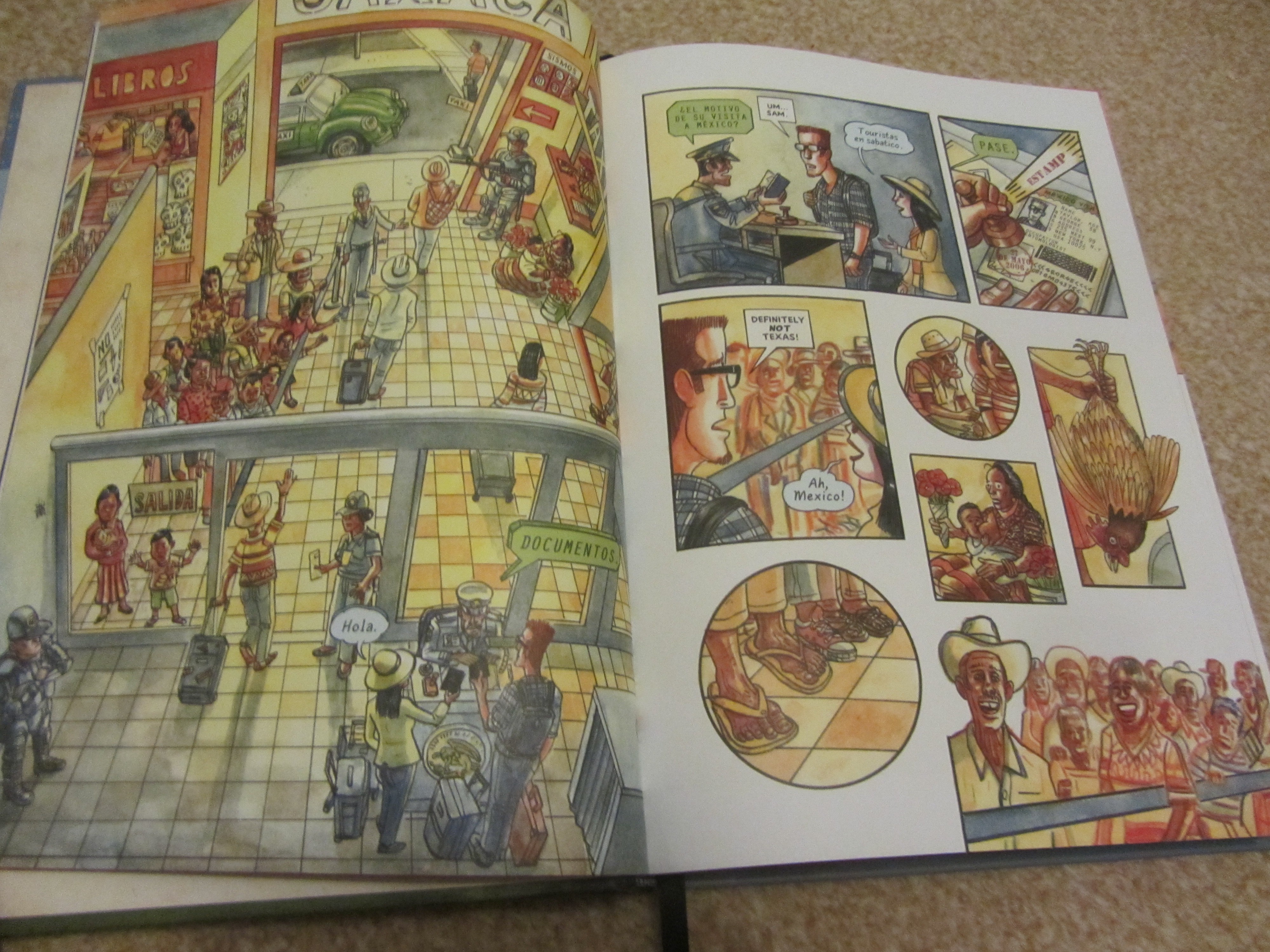
The colorful arrival at Oaxaca Airport.
The environmental agenda comes through in the parallel story of one monarch’s migration. Sections set in Mexico alternate with short interludes showing the butterfly’s journey south from America to Michoacan, Mexico, where monarchs gather en masse in a pine forest. The limited palette of these spreads, in contrast with the vibrant colors of the Oaxaca scenes, is particularly effective: the monarch is generally the only speck of color against a monochrome blue-gray background showing rather dreary American scenes. Tagged in Pennsylvania, the monarch flies over polluted rivers, a nuclear power plant, an abandoned West Virginian mine, the aftermath of Hurricane Katrina, Monsanto tomato pickers, a Texas border arrest, and a Mexican drug deal gone wrong – a symbol of precarious hope in spite of circumstance.
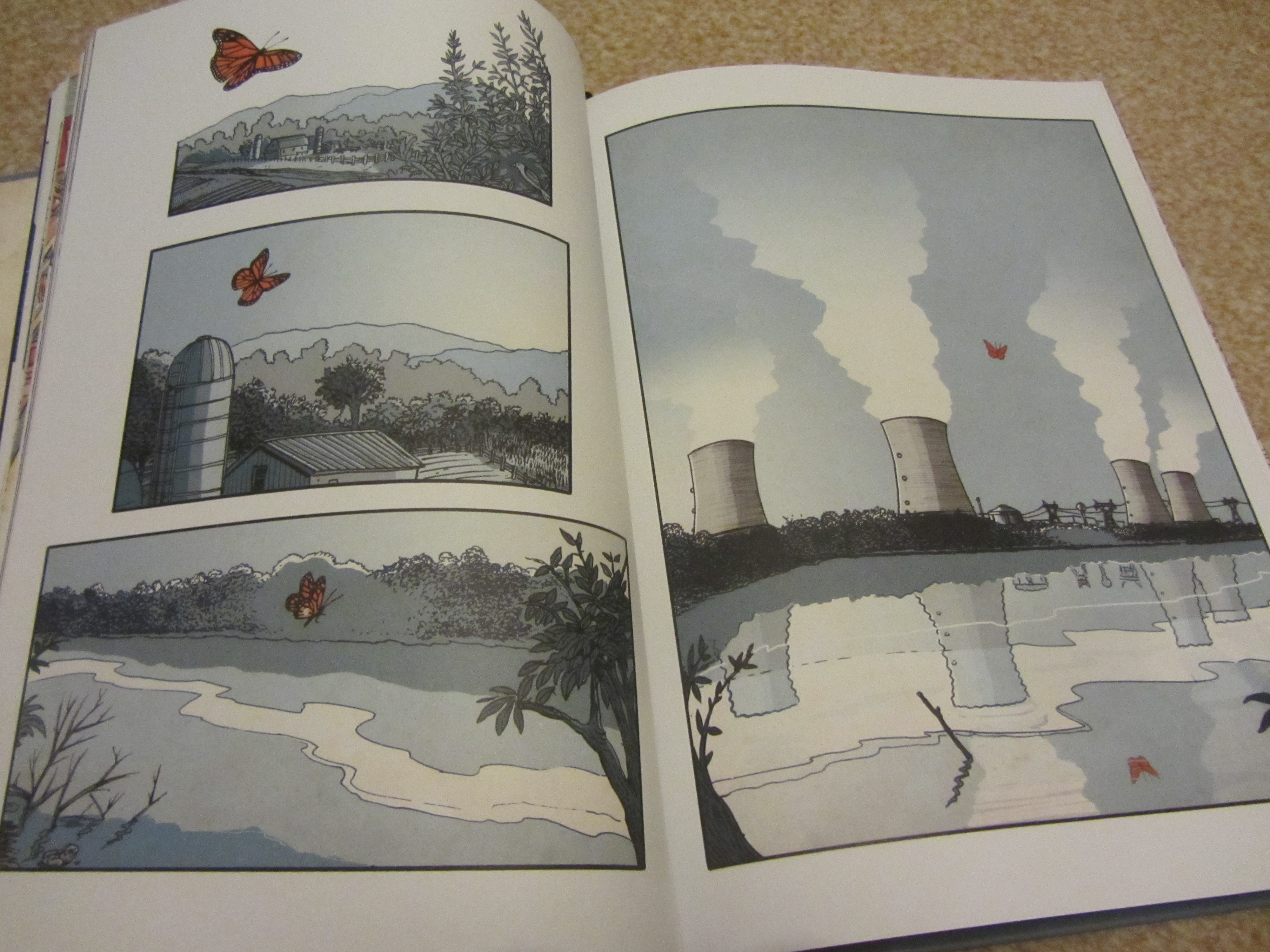
The tagged monarch flying over a polluted scene.
A Mexican folk belief has it that monarchs are the souls of dead children returning. At the end of the book a newly hatched butterfly starts its journey north – but what has become of our human heroes? That’s for readers lucky enough to get their hands on a copy of this wonderful book to find out.
Kuper and his family lived in Oaxaca from 2006 to 2008 and return annually for visits; you can see both familiarity and love in his terrific drawings of the city and its natural surroundings. Just as it tempers monochrome with color, Ruins carefully balances sadness and hope. If you think a graphic novel can’t sustain an involved and satisfying plot, think again. I’d especially recommend this to Barbara Kingsolver fans – the Mexican setting and monarch migration theme tie in with The Lacuna and Flight Behavior, respectively.
With thanks to the publisher, SelfMadeHero, for the free copy.
My rating: 
 Bookish Beck = Rebecca Foster. American transplant to England. Freelance proofreader and book reviewer.
 Bookish Beck