The Parent Trap by Erich Kästner for #1949Club
Simon and Karen’s classics reading weeks are always a good excuse to pick up an older book or two. The mistake I sometimes make is to have just one option lined up; if I don’t get on with it, I can’t participate. I read the first 20 pages of Yukio Mishima’s Confessions of a Mask, which promised to be a psychologically astute picture of awakening to homosexuality in a repressive culture (“in this house it was tacitly required that I act like a boy. The reluctant masquerade had begun”) but also had the makings of a queer tragedy, which I couldn’t bear just now. Then I found a nearly new copy of The Parent Trap in the Little Free Library a few days ago and spotted that the twins share my birthday! Of course, I could have reviewed it for German Literature Month and Novellas in November, as I did with Kästner’s Emil and the Detectives last year, but instead I treated myself to the delightfully cosy, if far-fetched, story.
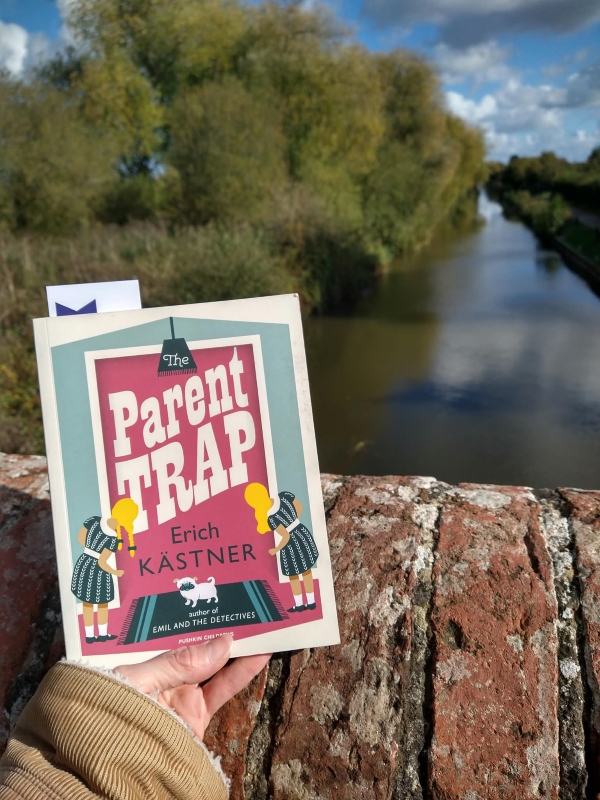
You likely know the story from a film adaptation starring Hayley Mills or Lindsay Lohan. I don’t think I’ve seen either, though they are culturally familiar to me. In Kästner’s original, separated twins are rejoined by chance at a summer camp in Bavaria. Luise Palfy has come here from Vienna, where she lives with her single father, a music director. One day an additional group of 20 little girls arrives from southern Germany, including Lottie Körner, who resides in Munich with her single mother, a journalist. It’s immediately evident that the two nine-year-olds are identical twins – same birthdate and -place – but with different hairstyles and their own personalities. They decide to switch places, partly as a trick to teach their parents a lesson, but partly to regain a long-lost and much-missed mother / father.
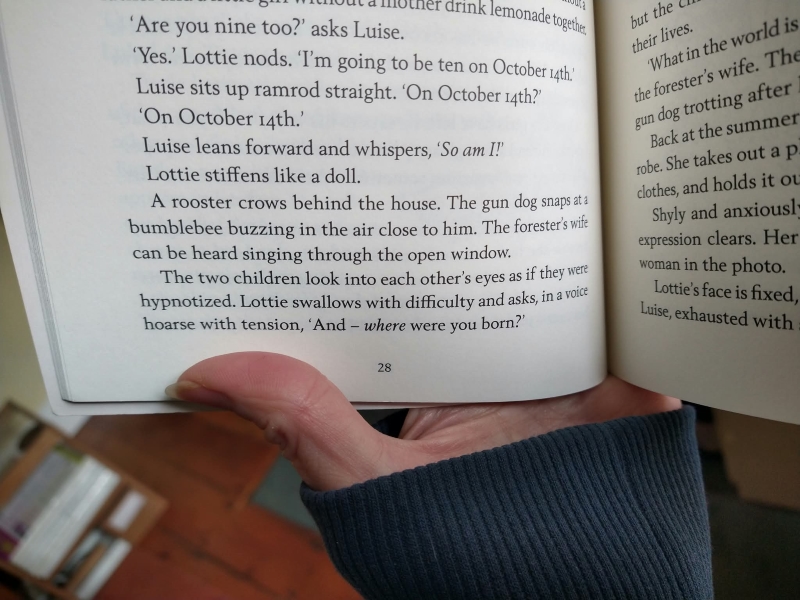
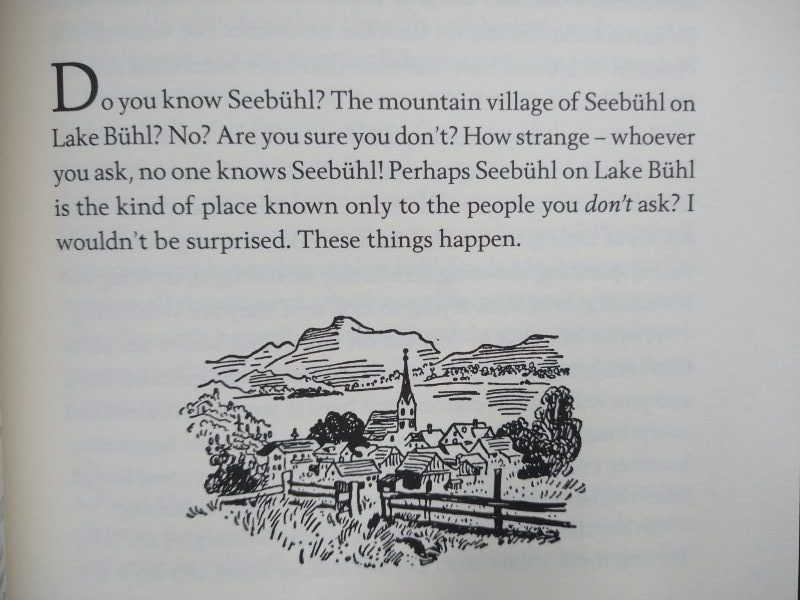
The girls have to be quick studies to cover up that ‘Lottie’ has ‘forgotten’ how to cook and that ‘Luise’ has suffered a horrendous decline in her handwriting and schoolwork. But there’s no fooling some, such as the doctor’s pug, Peperl, who is suspicious of a blonde stranger pretending to be an old friend. The girls are canny and stubborn, envisioning a new future and then doing whatever it takes to achieve it, but the emotional strain starts to show. I found myself upset with the parents’ Solomonic decision to split up their twins at their divorce. It’s just cruel; who would do such a thing?! In a sense, the whole premise of the novel is as hard to believe as the fantasy ending (“Catching up with lost happiness as if it were a missed lesson at school”), yet I gave myself over to it. Kästner’s tone is just right, shrewd and playful, and Walter Trier’s illustrations are charming. I recommend reading something middle grade every once in a while as an antidote to the awfulness of adulting and the occasionally depressing nature of modern literature. [Translated from German by Anthea Bell] (Little Free Library) 
(The whole Pushkin Children’s classics range is brilliant – see also From the Mixed-Up Files of Mrs. Basil E. Frankweiler by E.L. Konigsberg and The Murderer’s Ape by Jakob Wegelius.)
Here are other famous 1949 titles that I’ve read (just 3 of the top 20 on the Goodreads list of the most popular books published that year):
- The Hero with a Thousand Faces by Joseph Campbell
- A Sand County Almanac by Aldo Leopold
- 1984 by George Orwell
I’ve previously participated in the 1920 Club, 1956 Club, 1936 Club, 1976 Club, 1954 Club, 1929 Club, 1940 Club, 1937 Club, 1970 Club, 1952 Club, 1925 Club, and 1961 Club.
Margaret Atwood Reading Month: Wilderness Tips and CWWA Symposium
For this third annual Margaret Atwood Reading Month (#MARM), hosted by Canadian bloggers extraordinaires Marcie of Buried in Print and Naomi of Consumed by Ink, I picked up Wilderness Tips, a short story collection I’m not sure I’d even heard of before I liberated this battered paperback from the Hay-on-Wye Airbnb where we stayed in September (shhhhhh!).
I also listened in to one of the papers given at the Contemporary Women’s Writing Association’s mini online symposium held to mark her 81st birthday yesterday.

Wilderness Tips (1991)
 If pressed to give a one-line summary, I would say the overall theme of this collection is the power that women have (or do not have) in relationships – this is often a question of sex, but not always. Much of the collection falls neatly into pairs: “True Trash” and “Death by Landscape” are about summer camp and the effects that experiences had there still have decades later; “The Bog Man” and “The Age of Lead” both use the discovery of a preserved corpse (one a bog body, the other a member of the Franklin Expedition) as a metaphor for a frozen relationship; and “Hairball” and “Weight” are about a mistress’s power plays. I actually made myself a key on the table of contents page, assigning A, B, and C to those topics. The title story I labeled [A/C] because it’s set at a family’s lake house but the foreign spouse of one of the sisters has history with or designs on all three.
“Uncles,” a standout, didn’t fit into my framework. Susanna’s three uncles played a major role in her life, so when she got a job with a Toronto newspaper she welcomed her colleague Percy’s avuncular attentions. To her surprise, though, his tell-all autobiography reveals he wasn’t so happy about his protégée’s success after all. Two overall favorites were “Hairball,” about a mistress’s superbly executed act of revenge, and the final story, “Hack Wednesday,” in which Marcia takes stock of her life as she prepares for her children coming home for Christmas. Swap the Berlin Wall and Noriega for, I don’t know, Syria and Trump or suchlike, and it would be absolutely current, what with her partner Eric’s eco-warrior escapades (and hypocrisy) and her wish to situate herself in the context of history but also transcend it. I marked out the most passages in this one, and so many made me laugh:
Time is going faster and faster; the days of the week whisk by like panties. The panties she’s thinking about are the kind she had when was a little girl, in pastels, with ‘Monday,’ ‘Tuesday,’ ‘Wednesday’ embroidered on them. Ever since then the days of the week have had colours for her: Monday is blue, Tuesday is cream, Wednesday is lilac. You counted your way through each week by panty, fresh on each day, then dirtied and thrown into the bin. Marcia’s mother used to tell her that she should always wear clean panties in case a bus ran over her, because other people might see them as her corpse was being toted off to the morgue. It wasn’t Marcia’s potential death that loomed uppermost in her mind, it was the state of her panties.
“One of these days I’m going to kill that beast,” says Eric. … “You poor baby!” says Marcia, scooping up the cat, which is overweight. It’s on a diet, but mooches in secret from the neighbours. Marcia sympathizes. “I just let the damn thing out. In, out, in, out. It can’t make up its mind,” says Eric. “It’s confused,” says Marcia.
Marcia will get a little drunk on the eggnog, and later, after the dishes are done, she will cry silently to herself, shut into the bathroom and hugging in her festive arms the grumbling cat, which she will have dragged out from under a bed for this purpose. She will cry because the children are no longer children, or because she herself is not a child any more, or because there are children who have never been children, or because she can’t have a child any more, ever gone. Her body has gone past too quickly for her.
My rating: 
CWWA Symposium
 To open the afternoon program, Dr. Fiona Tolan of Liverpool John Moores University spoke on “21st-century Gileads: Feminist Dystopian Fiction after Atwood.” She noted that The Handmaid’s Tale casts a long shadow; it’s entered into our cultural lexicon and isn’t going anywhere. She showed covers of three fairly recent books that take up the Handmaid’s red: The Power, Vox, and Red Clocks. However, the two novels she chose to focus on do not have comparable covers: The Water Cure by Sophie Mackintosh (my review) and The Natural Way of Things by Charlotte Wood. I was unfamiliar with the premise of the Wood. Ten young women who have been involved in public sex scandals (e.g. with politicians) are kidnapped and imprisoned in a compound in the Outback; their heads are shaven and they are forced to undertake hard labor. Although it’s a female-dominated space, the patriarchy is perpetuated. Is sisterhood a possibility here?
Atwood has said, “Some books haunt the reader and some haunt the writer.” Tolan argued that Handmaid’s clearly does both, since Atwood chose to return to Gilead with The Testaments. While Tolan believes Atwood’s overall emphasis has always been on liberty, she notes that the author has been reluctant to be associated with feminism as a movement.
I feel like my #MARM participation has been somewhat half-hearted this year – I won’t be getting a Bingo on this chart! – but I always enjoy engaging with Atwood’s writing and thinking. With any luck, I’ll still get to read her new poetry collection, Dearly, for review in 2020, and before long I can start planning what I’ll read for this challenge next November.
 Bookish Beck = Rebecca Foster. American transplant to England. Freelance proofreader and book reviewer.

