A Patroness of the Arts
I recently sponsored my first book via Unbound, the UK’s crowdfunding publisher. You’re probably familiar with some Unbound titles even if that name doesn’t ring a bell. For instance, you might remember that The Wake by Paul Kingsnorth, an Unbound title from 2014, became the first crowdfunded novel longlisted for the Man Booker Prize. I’ve reviewed another previous Unbound title, Martine McDonagh’s Narcissism for Beginners, and will be participating in the blog tour for Lev Parikian’s Why Do Birds Suddenly Disappear? in May.

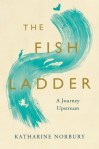 The forthcoming title I’ve chosen to support is Women on Nature by Katharine Norbury, which promises to be a wide-ranging and learned anthology celebrating the tradition of women’s writing about nature (both fiction and non-). I enjoyed Norbury’s first book, The Fish Ladder, which is a memoir in the vein of H Is for Hawk, and also saw her speak at the New Networks for Nature conference in 2016.

Albums that exist because I helped crowdfund them.
I’d only ever crowdfunded music before – albums by The Bookshop Band, Krista Detor, Duke Special and Marc Martel. Beaming internally at feeling like a patroness of the arts after funding my Women on Nature hardback, I kept the smug glow going by signing up to support The Bookshop Band via Patreon (where you can commit to a certain amount per creation, e.g. per music video, and have the option of setting a monthly cap) and to fund an album by their singer/cellist Beth Porter and her band The Availables via Indiegogo.
Have you ever gotten involved in a crowdfunding project? How about for the arts?
Christmas Gift Recommendations for 2017
Something tells me my readers are the sort of people who buy books for their family and friends at the holidays. Consider any rating of 3.5 or above on this blog a solid recommendation; 3 stars is still a qualified recommendation, and by my comments you should be able to tell whether the book would be right for you or a friend. I’ll make another plug for the books I’ve already mentioned here as gift ideas and highlight other books I think would be ideal for the right reader. I read all these books this year, and most were released in 2017, but I have a few backlist titles, too – in those cases I’ve specified the publication year. Since I recommend fiction all the time through my reviews, I’ve given significantly more space to nonfiction.
General suggestions:
 For the Shiny New Books Christmas special I chose two books I could see myself giving to lots of people. One was A Glorious Freedom: Older Women Leading Extraordinary Lives by Lisa Congdon, my overall top gift idea. It’s a celebration of women’s attainments after age 40, especially second careers and late-life changes of course. There’s a lively mixture of interviews, first-person essays, inspirational quotes, and profiles of figures like Vera Wang, Laura Ingalls Wilder and Grandma Moses, with Congdon’s whimsical drawings dotted all through. This would make a perfect gift for any woman who’s feeling her age, even if that’s younger than 40. (An essay on gray hair particularly hit home for me.) It’s a reminder that great things can be achieved at any age, and that with the right attitude, we will only grow in confidence and courage over the years. (See my full Nudge review.)
 One Year Wiser: An Illustrated Guide to Mindfulness by Mike Medaglia
Drawn like an adult coloring book, this mindfulness guide is divided into color-block sections according to the seasons and tackles themes like happiness, gratitude, fighting anxiety and developing a healthy thought life. The layout is varied and unexpected, with abstract ideas represented by bodies in everyday situations. It’s a fresh delivery of familiar concepts.


My thanks to SelfMadeHero for the free copy for review.
An Almost Perfect Christmas by Nina Stibbe
 With its short chapters and stocking stuffer dimensions, this is a perfect book to dip into over the holidays. The autobiographical pieces involve Stibbe begrudgingly coming round to things she’s resisted, from Slade’s “Merry Xmas Everybody” to a flaming Christmas pudding. The four short stories, whether nostalgic or macabre, share a wicked sense of humor. You’ll also find an acerbic shopping guide and – best of all – a tongue-in-cheek Christmas A-to-Z. Nearly as funny as Love, Nina. (I reviewed this for the Nov. 29th Stylist “Book Wars” column.)
For some reason book- and nature-themed books seem to particularly lend themselves to gifting. Do you find that too?
For the fellow book and word lovers in your life:
 The Diary of a Bookseller by Shaun Bythell
It’s a pleasure to spend a vicarious year running The Book Shop in Wigtown, Scotland with the curmudgeonly Bythell. I enjoyed the nitty-gritty details about acquiring and pricing books, and the unfailingly quirky customer encounters. This would make a great one-year bedside book. (See my full review.)
The Cabinet of Linguistic Curiosities: A Yearbook of Forgotten Words by Paul Anthony Jones
 Another perfect bedside book: this is composed of daily one-page entries that link etymology with events from history. I’ve been reading it a page a day since mid-October. A favorite word so far: “vandemonianism” (rowdy, unmannerly behavior), named after the penal colony of Van Diemen’s Land (Tasmania), first sighted by Europeans on 24 November 1642.
“The Gifts of Reading” by Robert Macfarlane (2016)
 This was my other Christmas recommendation for Shiny New Books. A love of literature shared with friends and the books he now gifts to students and a new generation of nature writers are the main themes of this perfect essay. First printed as a stand-alone pamphlet in aid of the Migrant Offshore Aid Station, this is just right for slipping in a stocking.
A Girl Walks into a Book: What the Brontës Taught Me about Life, Love, and Women’s Work by Miranda K. Pennington
 This charming bibliomemoir reflects on Pennington’s two-decade love affair with the work of the Brontë sisters, especially Charlotte. It cleverly gives side-by-side chronological tours through the Brontës’ biographies and careers and her own life, drawing parallels and noting where she might have been better off if she’d followed in Brontë heroines’ footsteps.
For the nature enthusiasts in your life:
 A Sand County Almanac and Sketches Here and There by Aldo Leopold
Few know how much of our current philosophy of wilderness and the human impact on the world is indebted to Aldo Leopold. This was first published in 1949, but it still rings true. A month-by-month account of life in Wisconsin gives way to pieces set everywhere from Mexico to Manitoba. Beautiful, incisive prose; wonderful illustrations by Charles W. Schwartz.
The History of Bees by Maja Lunde
 Blending historical, contemporary and future story lines, this inventive novel, originally published in Norway in 2015, is a hymn to the dying art of beekeeping and a wake-up call about the environmental disaster the disappearance of bees signals. The plot strands share the themes of troubled parenthood and the drive to fulfill one’s purpose. Like David Mitchell, Lunde juggles her divergent time periods and voices admirably. It’s also a beautifully produced book, with an embossed bee on the dust jacket and a black and gold honeycomb pattern across the spine and boards. (See my full Bookbag review.)
 Epitaph for a Peach: Four Seasons on My Family Farm by David Mas Masumoto (1995)
Masumoto is a third-generation Japanese-American peach and grape farmer in California. He takes readers on a quiet journey through the typical events of the farming calendar. It’s a lovely, meditative book about the challenges and joys of this way of life. I would highly recommend it to readers of Wendell Berry.
A Wood of One’s Own by Ruth Pavey
 This pleasantly meandering memoir, an account of two decades spent restoring land to orchard in Somerset, will appeal to readers of modern nature writers. Local history weaves through this story, too: everything from the English Civil War to Cecil Sharp’s collecting of folk songs. Bonus: Pavey’s lovely black-and-white line drawings. (See my full review.)
It’s not just books…
There are terrific ideas for other book-related gifts at Sarah’s Book Shelves and Parchment Girl.
 With this year’s Christmas money from my mother I bought the five-disc back catalogue of albums from The Bookshop Band. I crowdfunded their nine-disc, 100+-track recording project last year; it was money extremely well spent. So much quality music, and all the songs are based on books. I listen to these albums all the time while I’m working. I look forward to catching up on older songs I don’t know. Check out their Bandcamp site and see if there’s a physical or digital album you’d like to own or give to a fellow book and music lover. They played two commissioned songs at the launch event for The Book of Dust: La Belle Sauvage, so if you’re a Philip Pullman fan you might start by downloading those.
Would you like to give – or get – any of my recommendations for Christmas?
A Few Spooky Reads for Halloween
I’m not at all one for scary books; horror and even crime fiction rarely make it onto my reading agenda. But in advance of Halloween I did read a few books that would count as creepy. Maybe you’ll fancy picking one of them up today?
Ghost Stories of an Antiquary, Vol. II by M.R. James
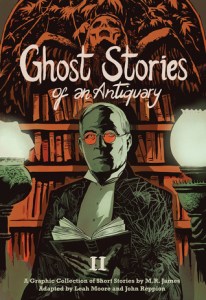 I’ve only ever read one M.R. James piece before, in an anthology of stories about libraries. This was perhaps not an ideal way to encounter his ghost stories for the first time. Though all four (“Number 13,” “Count Magnus,” “Oh, Whistle and I Will Come to You, My Lad” and “The Treasure of Abbot Thomas”) are adapted by the same pair, Leah Moore and John Reppion, each is illustrated by a different artist, so the drawing style ranges from rounded and minimalist to an angular, watercolor Marvel style. The stories have thematic links of research, travel, archaeological discovery and antiquities. Very often there are found documents that must be interpreted. Several narrators are scholars coming across unexplained phenomena: a hotel room that appears and disappears, a sarcophagus lid that opens on its own, a storm summoned by a whistle, and so on.
In a brief introduction, Jason Arnopp applauds the decision to “show readers the ghouls and ghosts,” but I disagree – to me a central problem with using the graphic form for these tales that center around nameless horror is that depicting the source of horror saps it of its power. Still, I appreciated the introduction to James’s ghost stories.
My rating:
With thanks to SelfMadeHero for the free copy for review.
Devil’s Day by Andrew Michael Hurley
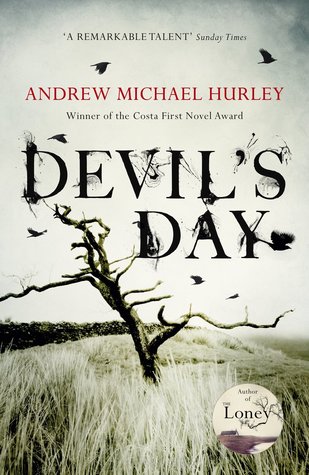 In Hurley’s Lancashire farmland setting, Devil’s Day is a regional Halloween-time ritual when the locals serve up the firstborn lamb of spring as a sacrifice to ward off the Devil’s shape-shifting appearance in the human or animal flock. Is it all a bit of fun, or necessary for surviving supernatural threat? We see the year’s turning through the eyes of John Pentecost, now settled back on his ancestral land with his wife, Kat, and their blind son, Adam. However, he focuses on two points from his past: his bullied childhood and a visit home early on in his marriage that coincided with the funeral of his grandfather, “the Gaffer”. The Endlands is a tight-knit community with a long history of being cut off from everywhere else, which makes it an awfully good place to keep secrets.
The first and last quarters of the book flew by for me, while the middle dragged a bit. The rural atmosphere and the subtle air of menace reminded me of Elmet and Bellman and Black. I’ll certainly seek out Hurley’s acclaimed debut, The Loney. [Read via NetGalley]
Favorite lines:
“Nothing changed in Underclough. Nothing happened. Not really. … elsewhere was always a place where the worst things happened. … The world outside the valley might well collapse but we wouldn’t necessarily feel the ripples here.”
My rating: 
Slade House by David Mitchell
“If I could just see a ghost, just once … Just one ghost, so I know that death’s not game over, but a door.”
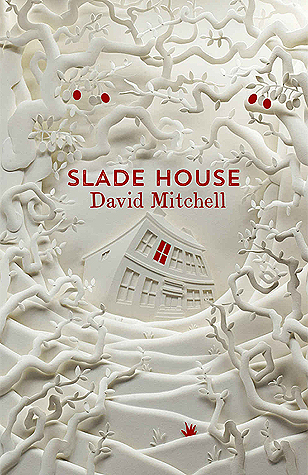 This was so cool! I feel like I’d never experienced a “real” Mitchell book before (having only read The Thousand Autumns of Jacob de Zoet, which is in some ways the odd one out), and I was impressed by how he brings everything together in this short novel. Every nine years between 1979 and 2015, a different visitor gets sucked into the treacherous world-within-a-world of the Grayer twins’ Slade House. This dilapidated mansion located off an unassuming alley morphs to fit each guest’s desires. To reveal more would spoil the fun, so I’ll just say that I love how Mitchell lulls you into a pretty horrific pattern before springing a couple of major surprises in later chapters. Each time period and narrator feels distinct and believable, and I’m told one character is from two other Mitchell novels (and the phrase “bone clock” even makes an appearance). I need to pick up Cloud Atlas soon for sure. [Public library copy]
My rating: 
Recommended spooky listening: The album That Ghost Belongs to Me by The Bookshop Band – all songs inspired by scary books.
Did you read anything scary this Halloween season?
Harvest Supper, Scrabble Tournament & Book Haul: A Great Trip to Bookbarn
I manage about an annual trip to Bookbarn International, one of my favorite secondhand bookshops in the UK. Apart from the stock in their newly opened Darwin Rare Books room and the 50-pence children’s books, everything in the shop is £1. I never fail to come out with a great stack of finds. Our trip on Thursday was extra special because we were going for the café’s Harvest Supper and Scrabble tournament, held as part of The Great Bath Feast.


We played one 45-minute game against another team of two, broke for an excellent vegetarian supper of squash, spinach and goat’s cheese pie with mashed potatoes and baby roast vegetables, then played a second match before dessert (vegan plum crumble with custard or gluten-free fig brownie with ice cream). Over the years my husband and I have become quite the Scrabble fiends, and together on one team I’m afraid we were unbeatable. Our bingo starting off Game #2 helped, but we worried we were at an overall advantage because the other boards each had three teams playing.


It was a special pleasure to meet William Pryor, the chairman of Bookbarn. Last year he spotted my blog posts about Bookbarn and offered me a copy of his memoir, The Survival of the Coolest. It’s a wonderful book about growing up a descendant of Charles Darwin but going off the rails and ending up addicted to heroin in his 20s:
This family of mine! On the one hand you have the royalty of science and Bloomsbury, on the other the fading world of the English landed gentry. … We had no religion but Darwin.
The months ran into each other as a blur of the chase for relief, the wheeling and dealing … One of the most striking aspects of hell is that it goes round and round; the same torments over and over again.
Mr. Pryor let me have a sneak peek at the Darwin room after the shop closed and kindly gave me a copy of his grandmother Gwen Raverat’s memoir, Period Piece. Over pudding we chatted about literary festivals, the Bookshop Band, his failed idea to return a portion of secondhand books’ resale value to the authors, and the latest Nobel Prize winner.
As to that book haul: I feel like I have fiction coming out of my ears, so with our hour of book browsing time I mainly focused on biographies and memoirs. Here are my finds:
Biographies and essays on writing biography:
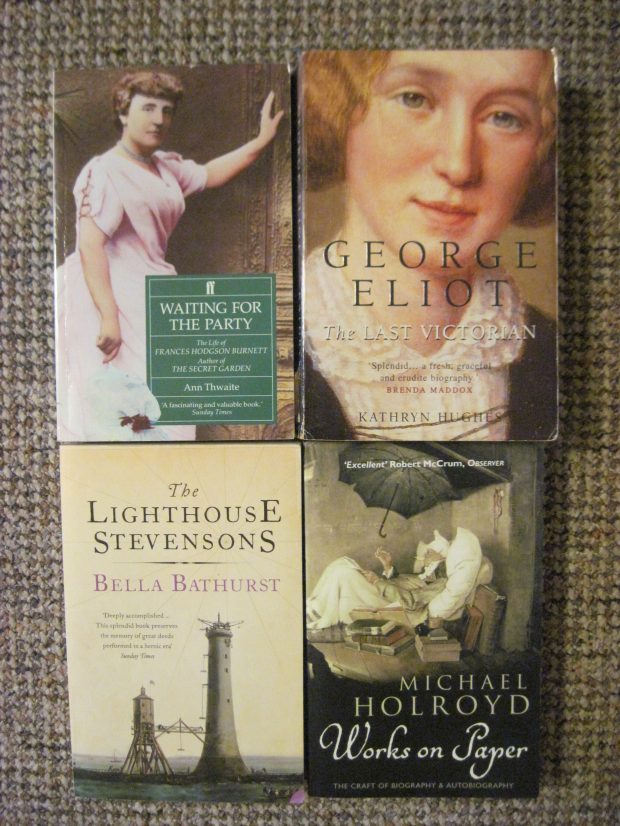
Bereavement memoirs:
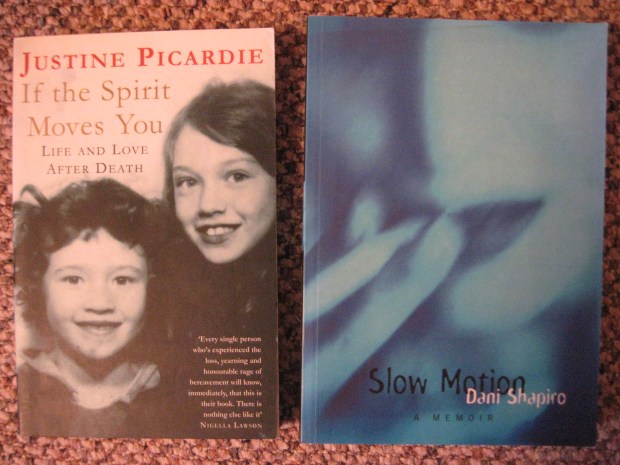
(Two of my purchases will go especially well as pairs with books I already own.)


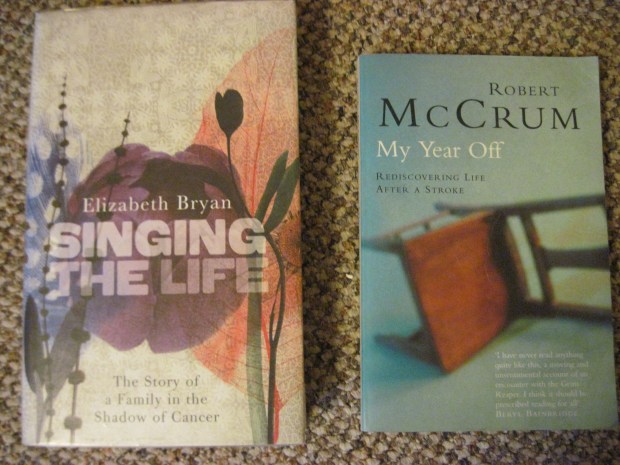
Medical memoirs:
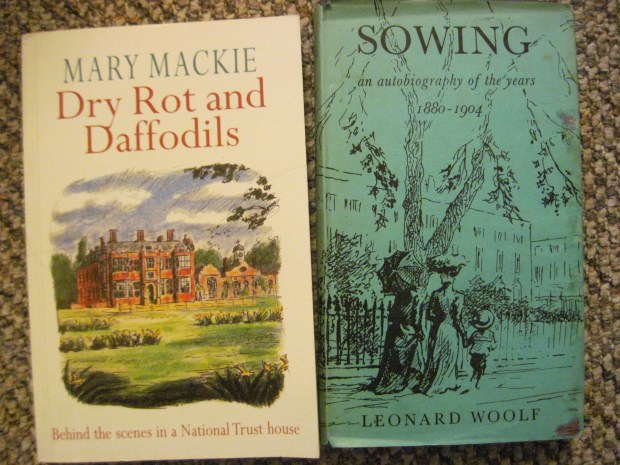
General memoirs (I was especially pleased to find the sequel to Cobwebs and Cream Teas, which I bought at Bookbarn last time and read early this year):
Plus two poetry books (one of them signed!):


And two novels I happened to grab on the way to the till:

My unexpected freebies. The Raverat is a lovely small-format hardback with gilt-edge pages and a maroon ribbon bookmark; on the right is our prize for winning the Scrabble tournament:


I’ve already had a peek inside a few of the books I bought and found some excellent passages. Leonard Woolf’s memoir opens with an extraordinary passage of almost biblical language about existence and non-existence; one of Marge Piercy’s poems struck me right away for its description of a Jewish holiday and the line “there is no justice we don’t make daily / like bread and love.”
My husband came away with three natural history books, and we also found a few children’s books to give to nieces and nephews.
Thanks to this book haul plus a trip to Book-Cycle in early September and some charity shopping last week, I’ve had to start a double stack on my biography/memoir shelves. There’s already a double stack on one of my unread fiction shelves. Next week is my birthday, so the book acquisitions are only likely to continue…
The Diary of a Bookseller by Shaun Bythell
So you think you’d like to run a bookshop? Here’s a book to tempt and deter you in equal measure. In 2001 Shaun Bythell acquired The Bookshop, the flagship bookstore in Wigtown, the Book Town in Galloway in the southwest of Scotland. Here he gives a one-year snapshot of life at the shop, from February 2014 to February 2015. At the start you can feel the winter chill in the old granite building, and as months pass you sense mounting excitement at preparations for the annual Book Festival (going on now) and the Scottish referendum. It’s a pleasure to spend a vicarious year at the shop. This would make a great bedside book for a bookish type to parcel out 5–10 pages at a time (another Christmas gift idea?).
 Bythell frequently ventures out to buy book collections in auctions and from estates, and occasionally goes fishing with his father or friends. But mostly we see what daily life is like for a bookshop owner. He can’t afford full-time staff, so gets sporadic help from university-age gals; his most “reliable” part-timer is Nicky, a ski suit-wearing, Dumpster-diving Jehovah’s Witness who blithely ignores much of what he asks her to do.
Every entry opens and closes with statistics on the day’s takings and online orders. Profits range from £5 to £500 a day, rising in the summer and peaking around £1200 during the festival. Also listed is the number of customers who make purchases, which represents only one-fifth of daily footfall. Nowadays most bookstores sell online too, and The Bookshop reluctantly partners with Amazon as a marketplace seller. There’s also ABE and eBay; as a last-ditch option, some outfits take books in bulk, even if just to recycle them. Alongside online sales, it’s essential for bookstores to have sidelines. Bythell does video production and sells furniture, antiques and walking sticks carved by “Sandy, the tattooed pagan.”
As with Wendy Welch’s The Little Bookstore of Big Stone Gap, I enjoyed the nitty-gritty details about acquiring and pricing books, especially the serendipitous moments of coming across real treasures, like a book signed by Sir Walter Scott and a 1679 edition of the Decameron with an interesting provenance. The book is also full of quirky customer behavior, the kind of stuff that fills The Bookshop’s Facebook feed. Bythell cultivates a curmudgeonly persona – he once shot a broken Kindle and mounted it on the bookshop wall – and maintains a tone that’s somewhere between George Orwell (excerpts from whose “Bookshop Memories” serve as monthly epigraphs) and Jen Campbell (Weird Things Customers Say in Bookshops et al.). Here’s a few of the best encounters:
a whistling customer with a ponytail and what I can only assume was a hat he’d borrowed from a clown bought a copy of Paolo Coelho’s The Alchemist, I suspect deliberately to undermine my faith in humanity and dampen my spirits further.
A man smelling of TCP [antiseptic] was the only customer in the shop for the first hour of opening, during which time I attempted to put out fresh stock. He had an uncanny ability to be standing in front of every shelf to which I needed access, regardless of the subject or where in the shop the relevant shelves were.
While I was repairing a broken shelf in the crime section, I overheard an elderly customer confusing E. L. James and M. R. James while discussing horror fiction with her friend. She is either going to be pleasantly surprised or deeply shocked when she gets home with the copy of Fifty Shades of Grey she bought.
I’ve been to Hay-on-Wye six times now but haven’t made it to Wigtown yet. It’s high on my bookish wish list. I had two additional reasons for wanting to read this particular book: I’d read Three Things You Need to Know about Rockets, a memoir by Bythell’s former partner, the American Jessica Fox (here known as “Anna”; in her book he’s “Ewan”), about coming to Scotland on a whim and falling in love with a bookshop owner; and I’m awfully fond of The Bookshop Band, a folky husband–wife musical duo who this year relocated from Bath to Wigtown. It was such fun to read about their first time playing in Wigtown and their stay as the inaugural guests/temporary store managers via The Open Book Airbnb project.

Colin Kinnear [CC BY-SA 2.0 (https://creativecommons.org/licenses/by-sa/2.0)%5D, via Wikimedia Commons.
The Book Shop trivia:
- December is by far the quietest month. (“The few people who give second-hand books as gifts for Christmas are usually eccentric” – count me as one of them!)
- Railway books sell best.
- Terry Pratchett, John Buchan, P.G. Wodehouse and E.F. Benson books are also perennial best sellers.
- You’ll be amazed at how many customers try to haggle over prices. It’s a shop, not a rummage sale, for goodness’ sake! I can’t imagine ever having the cheek to offer less than the advertised price.
My rating:
The Diary of a Bookseller was released in the UK on September 28th. My thanks to Profile Books for the free review copy.
A Saturday Jaunt to Bath
 We heard that The Bookshop Band would be playing at a free seasonal concert on Saturday night, so on something of a whim we planned a daytrip to Bath. Even though it wasn’t exactly on the way (my husband’s regular, feeble refrain), I take any opportunity of being in the Bath/Bristol area to make a pilgrimage to Bookbarn International. This was a delightful surprise since I’d been in late July and never thought I’d get to go again this year.
This turned out to be our best trip yet. We were unrushed for once, so had plenty of time for browsing. I had particularly good luck in the orange-spined all-Penguins section, and even found three books I wanted from the “Unsorted” shelves, which was something of a miracle. We finally tried out their newish café and got a darned good cup of coffee and a cake each.


All told, we came away with a better haul than on any previous visit: 13 books for me, 10 nature books plus a River Café cookbook for my husband, and eight books to give away as presents. And for all that (books + refreshments), less than £40. Add on a couple of books from a charity shop in Bath and I got some real steals – no book more than £1.
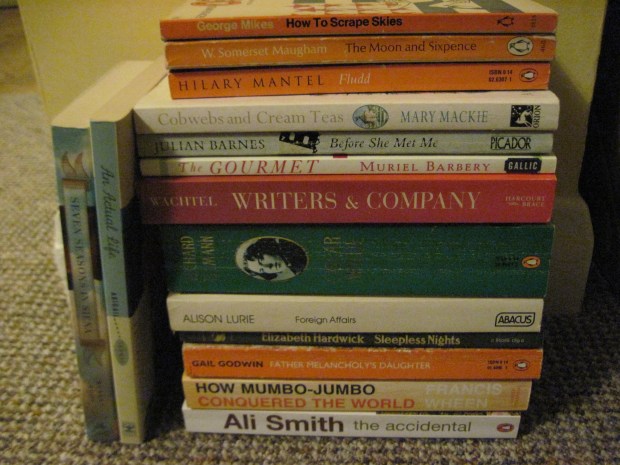
I’m particularly pleased with:
- Richard Ellmann’s biography of Oscar Wilde
- Writers & Company, a collection of Canadian radio interviews with authors
- A signed copy of Francis Wheen’s How Mumbo-Jumbo Conquered the World
- An Actual Life by Abigail Thomas – I love her memoirs so have been looking forward to trying her fiction.
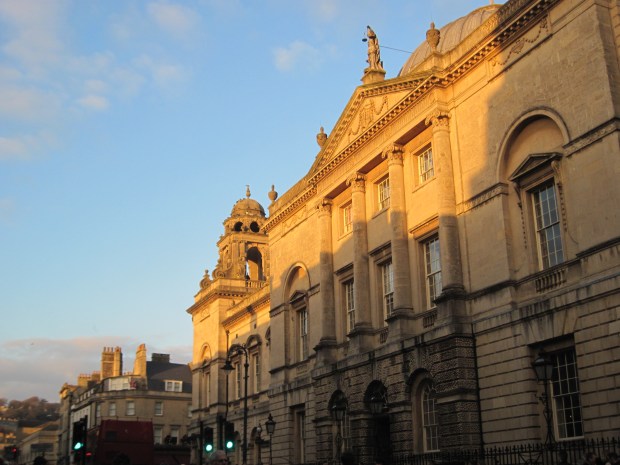
Bath Abbey
This was my fifth trip to Bath, which was looking lovely and golden in the wintry afternoon light but was certainly bustling, to put it politely. More accurately, you could barely move through the main streets, particularly around the Christmas market. At one point we weren’t sure we were going to get any hot food for dinner – it had never occurred to us to book ahead, and the brasserie and pub we tried were both full. Luckily the Real Italian Pizza Co. had a table for two, and I enjoyed a gloriously doughy calzone before we headed up to St Swithin’s Church for a holiday concert featuring Songways Choir and The Bookshop Band.
St Swithin’s has had a church on site since the tenth century, a sort of age we Americans can barely get our heads round. Jane Austen’s parents married here; so did William Wilberforce. It was something of a bittersweet occasion because the couple who make up The Bookshop Band are moving to Wigtown, Scotland’s town of books, in January and expecting their first booklet in May. So this was most likely my last chance to see them for quite a while. They only played a mini-set of five songs after the choir performance. Most of these I’d heard before, but “Wagons and Wheels,” based on Carol Birch’s Orphans of the Carnival (which I have on my Kindle and have been meaning to read), was new to me and a highlight.


Earlier in the evening we’d had a chance to stop by Mr B’s Emporium of Reading Delights, the independent bookshop in Bath where the band got their start. It’s such a cozy and welcoming shop, and I added a goodly number of books to my wish list while I was there. It’s something of a shame that we never got to see them perform in situ (though I don’t know how more than 20 people could fit in the upstairs space!), but I’ve managed to see them live three times and by funding their 2016 recording project have had excellent music streaming to my computer the whole year.
Thanks to last night’s holiday concert and the university carol service we’ll be attending tomorrow evening, I should certainly be feeling in the Christmas spirit. Look out for my two posts on seasonal reading coming up this week.
Picked up any secondhand bargains recently?
Are you feeling the Christmas spirit?
Music to Read and Write By
I usually can’t read while music is playing; the exception is if we’re on a long car journey – my husband needs to have peppy music playing to keep alert while he’s driving, so I have to find a Kindle book or two that I can zone out with. In day-to-day life, though, I tend to read in silence. If I find myself a little dozy and want to stay awake to get more pages read or edited, my music choices tend to be wordless: a classical compilation, or some instrumental folk. However, here’s another exception: I can read and work very well to Sigur Rós, an Icelandic indie/post-rock group who sing in Icelandic and/or Hopelandic, their invented language. For some reason Jónsi’s ethereal falsetto just washes over me and I can turn off the part of my brain that tries desperately to make English sense out of the words.

Writing is another matter. Unless I urgently need to concentrate – for instance, if I’m writing my first article for a new venue and feeling daunted and inadequate (cough, LARB, cough) – I almost always have music playing. I often turn to albums I know very well: they provide good cheer but aren’t distracting, so make for good background music. My most played tracks of all are from three playlists I made for my sister around the time of her husband’s death. I chose songs that would be meaningful and even uplifting without being in any way sappy. Examples: “The Drugs Don’t Work” (The Verve), “The Heart of Life” (John Mayer), “P.S. You Rock My World” (Eels) and “All Possibilities” (Badly Drawn Boy).
I recently discovered the play count feature on Windows Media Player and had great fun going through and seeing which individual songs and whole albums I’d played the most in the couple of years I’ve used my secondhand laptop. In some cases I was surprised, but most of these artists I could have predicted:
My 17 Most Played Albums:
Fading West, Switchfoot (32 plays)
Flat Earth Diary, Krista Detor (30 plays)
Memory Man, Aqualung (30 plays)
The Take-off and Landing of Everything, Elbow (25 plays)
You Knows It, Folk On (25 plays)
One Wild Life: Soul, Gungor (25 plays)
Barely, Krista Detor (24 plays)
Collapsible Lung, Relient K (24 plays)
Carrie & Lowell, Sufjan Stevens (23 plays)
Sparks, Imogen Heap (20 plays)
Havoc and Bright Lights, Alanis Morissette (17 plays)
Chocolate Paper Suites, Krista Detor (16 plays)
With Love, Rosie Thomas (16 plays)
Ghost Stories, Coldplay (15 plays)
Born and Raised, John Mayer (15 plays)
The Impersonator, Marc Martel (15 plays)
This Earthly Spell, Karine Polwart (15 plays)
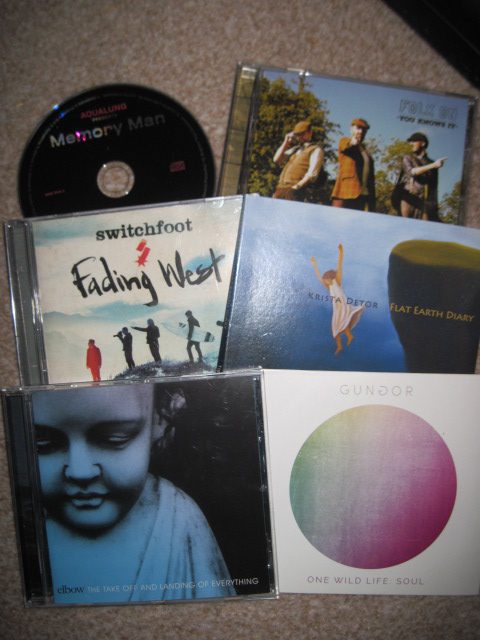
Of course, this mostly just tells you my listening tastes. But I’d like to think these artists hit a good balance of upbeat and mellow, catchy and contemplative. Or just plain daft, in the case of comedy folk trio Folk On. If I’m feeling particularly nostalgic, my inclination might be to play albums that defined the late 1990s or early 2000s for me, from artists like Matchbox 20, Snow Patrol, Coldplay, Sting and The Verve. (Not represented on this list, but I feel like I play them all the time: Bell X1, The Bookshop Band, Duke Special, and The Shins.)
Can you read or write to music? What are some of your favorite albums to work by?
We’re moving on Monday and may be without home Internet access for a week, so I’ll be scheduling a few posts ahead in case I can’t devote much time to blogging.
A Book-Themed Concert and Goody Bag
On Saturday my husband and I headed to Hungerford to see The Bookshop Band for the second time. A year and a half ago I first had the chance to see them live at the 2014 Hungerford Literary Festival, when they gave a performance tied in with Rachel Joyce’s release of The Love Song of Miss Queenie Hennessy.
The band formed about five years ago to provide music for author events at their local bookshop, Mr B’s Emporium of Reading Delights in Bath, England. Since then they’ve written somewhere between 120 and 150 songs inspired by books. Their basic genre is indie folk, with plenty of guitar, ukulele and cello as well as a bunch of improvised percussion and three intermingled voices. Depending on the book in question, though, the feel can vary widely, ranging from sweet to bizarre or haunting. Especially when I’ve read the book being sung about, it’s intriguing to see what the musicians have picked up on – often something very different from what I would as a reader and reviewer.
 This year the band (now down to two members) is making an effort to record and release all their songs in 10 albums. I participated in a crowdfunding project so am lucky enough to receive all their new releases in digital format before they’re available as printed CDs. The first album is Curious and Curiouser, the title track of which was inspired by Alice in Wonderland. Other sets of songs are based on A Midsummer Night’s Dream and the steampunk novel The Strange Affair of Spring Heeled Jack by Mark Hodder, while “Once Upon a Time,” a commission for radio, strings together famous first lines from fiction.
My favorite Bookshop Band song (so far) is “Bobo and the Cattle,” inspired by Alexandra Fuller’s Don’t Let’s Go to the Dogs Tonight. Two great ones new to me from Saturday’s performance were “Faith in Weather,” based on Central European fairy tales, and “You Make the Best Plans, Thomas,” about Hilary Mantel’s Bring Up the Bodies.
You can listen to lots of their songs on their Bandcamp page and dozens of videos of their performances are on YouTube and Vimeo (I’ve linked to several above). When performing events they often get the authors to play with them: Louis de Bernières pitched in with mandolin on a song about The Dust that Falls from Dreams, and Yann Martel played glockenspiel while promoting The High Mountains of Portugal.
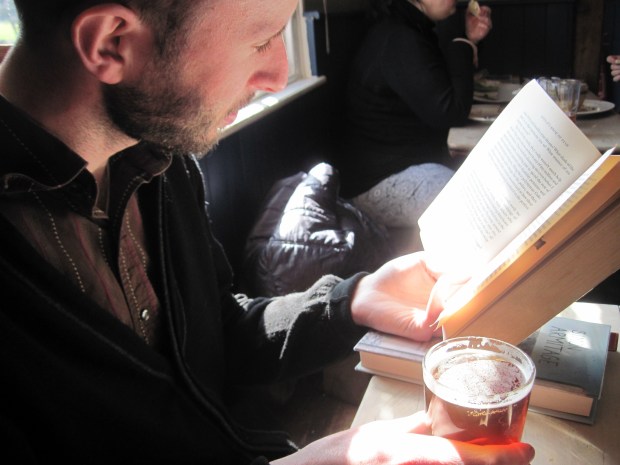
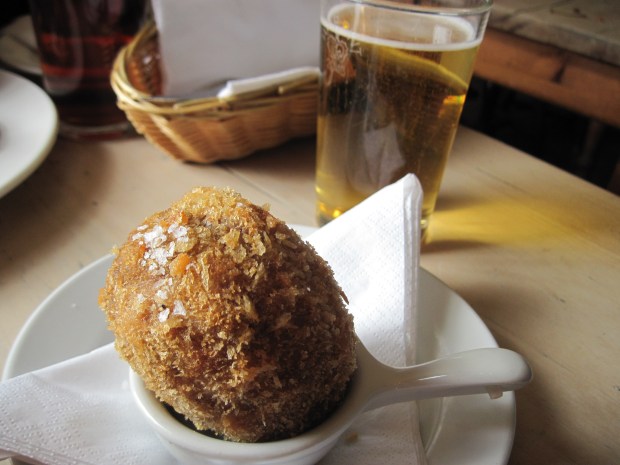
We had started off the day with lunch at a Berkshire country pub, The Pot Kiln, where we didn’t mind the 40-minute wait for food because we had books and half-pints of beer and cider to while away the time over as sunshine poured through the windows. The menu is mostly based around game shot by the chef himself in the fields opposite the pub, so we indulged in a venison and wild boar hot dog and venison Scotch eggs before setting off on a windy several-mile walk near Combe Gibbet and then continuing on to Hungerford.
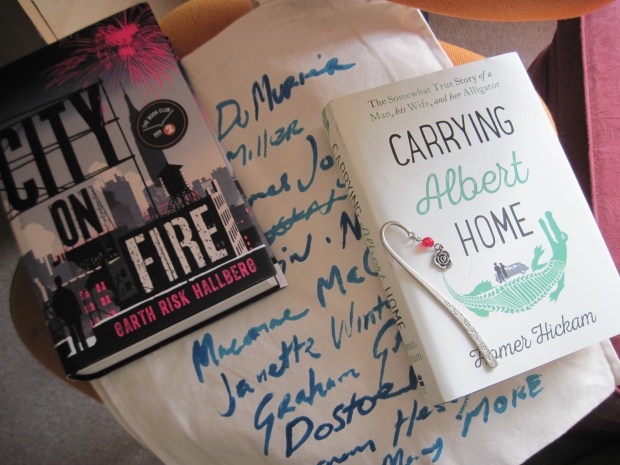
Now for the goody bag: on the venue tables the owner of Hungerford Bookshop had placed a ten-question literary quiz to work on and hand in during the intermission. I was fairly confident on some of my answers, had a guess at the others, and after literally about 45 minutes of wrestling with anagrams finally figured out that “Lobbing Slates” gives the name of novelist Stella Gibbons. We won with 7 out of 10 correct; an elderly lady joked that we’d Googled all the answers, but I pointed out that we don’t own a smartphone between us! Now, I suspect we were actually the only entry, but that doesn’t diminish our accomplishment, right?! I was delighted to win a couple of free books I hadn’t necessarily intended on reading but now certainly will, plus a metal bookmark and a notebook, all in a limited-edition “Books Are My Bag” tote designed by Tracey Emin.
All in all, a fantastic and mostly bookish day out!
If you live in the UK and get the chance, don’t hesitate to go see The Bookshop Band play; they’re touring widely this year.
 Bookish Beck = Rebecca Foster. American transplant to England. Freelance proofreader and book reviewer.
 Bookish Beck