Quick Reactions to the Wellcome Book Prize Shortlist
From 12, we are now down to six. The 2018 Wellcome Book Prize shortlist is here!

Some quick thoughts:
I sort-of predicted three out of the six in yesterday’s post: The Butchering Art by Lindsey Fitzharris, With the End in Mind by Kathryn Mannix, and To Be a Machine by Mark O’Connell.
I’m relieved that I’d already gotten to two of the shortlisted titles (Fitzharris and Mannix), so I can focus on reading the other four over the next 5+ weeks, and will briefly revisit those first two on my Kindle when it’s decision time.
I am pretty shocked that Maggie O’Farrell’s I Am, I Am, I Am did not advance to the shortlist. Mayhem will have to be a truly amazing memoir to outdo it; I wanted to read it anyway, but now I’m particularly keen – it would be a good one for me to feature on the official blog tour if that happens to work out.
I’m not feeling very cheerful about having to start Stay with Me again (I DNFed it last year), but I’ll try to approach it with an open mind.
To Be a Machine is currently on shelf at my local library (fingers crossed that it’s still there when I go on Friday) and I’ve reserved The Vaccine Race from another branch. I’ll start with one of those.
I’ve also been promised two review copies at random in the post – let’s hope it’s not the two I’ve already read!
(See also Laura’s initial thoughts.)
Feel like joining the shadow panel in reading one or more of these six books?
One More Wellcome Longlist Review & Shortlist Predictions
Tomorrow the six titles on the Wellcome Book Prize shortlist will be revealed. I’ve managed to read one more from the longlist since my last batch.
The Butchering Art: Joseph Lister’s Quest to Transform the Grisly World of Victorian Medicine by Lindsey Fitzharris
 Surgery was a gory business with a notably high fatality rate well into the nineteenth century. Surgeons had the fastest hands in the West, but their victims were still guaranteed at least a few minutes of utter agony as they had a limb amputated or a tumor removed, and the danger wasn’t over after they were sewn up either: most patients soon died from hospital infections. The development of anesthetics and antiseptic techniques helped to change all that.
Fitzharris opens with the vivid and rather gruesome scene of a mid-thigh amputation performed by Robert Liston at University College Hospital in London in 1846. This surgery was different, though: it only took 28 seconds, but the patient felt nothing thanks to the ether he had been administered. He woke up a few minutes later asking when the procedure would begin. In the audience that day was Joseph Lister, who would become one of Britain’s most admired surgeons.
Lister came from a Quaker family and, after being educated at University College London, started his career in Edinburgh. Different to many medical professionals of the time, he was fascinated by microscopy and determined to find out what caused deadly infections. Carbolic acid and catgut ligatures were two of Lister’s main innovations that helped to fight infection. In fact, whether we realize it or not, his legacy is forever associated with antiseptics: Listerine mouthwash (invented in 1879) is named after him, and the Johnson brothers of Johnson & Johnson fame started their business mass-producing sterile surgical dressings after attending one of Lister’s lectures.
My interest tailed off a bit after the first third, as the book starts going into more depth about Lister’s work and personal life: he married his boss’s daughter and moved from Edinburgh to Glasgow and then back to London. However, the best is yet to come: the accounts of the surgeries he performed on his sister (a mastectomy that bought her three more years of life) and Queen Victoria (removing an orange-sized abscess from under her arm) are terrific. The chapter on treating the queen in secret at Balmoral Castle in 1871 was my overall favorite.

It probably wasn’t the best idea to start this book over my lunch one day!
I was that kid who loved going to Civil War battlefields and medical museums and looking at all the different surgical saws and bullet fragments in museum cases, so I reveled in the gory details here but was not as interested in the biographical material. Do be sure you have a strong stomach before you try reading the prologue over a meal. This is a comparable read to The Remedy, about the search for a cure to tuberculosis.
My rating:
Shortlist Predictions
Now, I’ve still only read half of the longlisted titles so far, so it’s hard to make any solid guesses. However, the below fall somewhere between wishes and informed predictions:
- In Pursuit of Memory by Joseph Jebelli: A definitive treatment of an epidemic of our time, Alzheimer’s disease. The neuroscientist author achieves the right balance between history and research on the one hand and personal stories readers can relate to on the other.
- The White Book by Han Kang: The only fiction title from the longlist that I haven’t read at least part of. This is also on this year’s Man Booker International Prize longlist and has been well received. From what I can tell, the health theme seems stronger than that of Stay with Me or Midwinter Break, and it would also be nice for one title in translation to make the shortlist.
- With the End in Mind by Kathryn Mannix: As I said in my review last week, this is an excellent all-round guide to preparation for death, based around touching patient stories plus the author’s experience in palliative care and CBT. Practical, compassionate and helpful.
- I Am, I Am, I Am by Maggie O’Farrell: For me, this book stands out as the one that most clearly illuminates the effects of illness, medical treatment, and other threats to life and limb in the course of an ordinary existence. I’d be very happy to see it win the whole thing.
- EITHER The Butchering Art by Lindsey Fitzharris OR The Vaccine Race by Meredith Wadman: I reckon one history of science title deserves to be on there; I think Wadman might have the slight edge.
- EITHER To Be a Machine by Mark O’Connell OR Behave by Robert Sapolsky: The Wellcome Prize loves big books investigating human tendencies and possibilities. I find the thought of either of these daunting, but I know they would also be illuminating. I’d prefer to read the O’Connell, but I’d give the edge to Sapolsky.
Any predictions of your own to make?
Wellcome Book Prize Shadow Panel & Two Longlist Reviews
I’m delighted to announce the other book bloggers on my Wellcome Book Prize 2018 shadow panel: Paul Cheney of Halfman, Halfbook, Annabel Gaskell of Annabookbel, Clare Rowland of A Little Blog of Books, and Dr. Laura Tisdall. Once the shortlist is announced on Tuesday the 20th, we’ll be reading through the six nominees and sharing our thoughts. Before the official winner is announced at the end of April we will choose our own shadow winner.
I’ve been working my way through some of the longlisted titles I was able to access via the public library and NetGalley. Here’s my latest two (both  ):
):
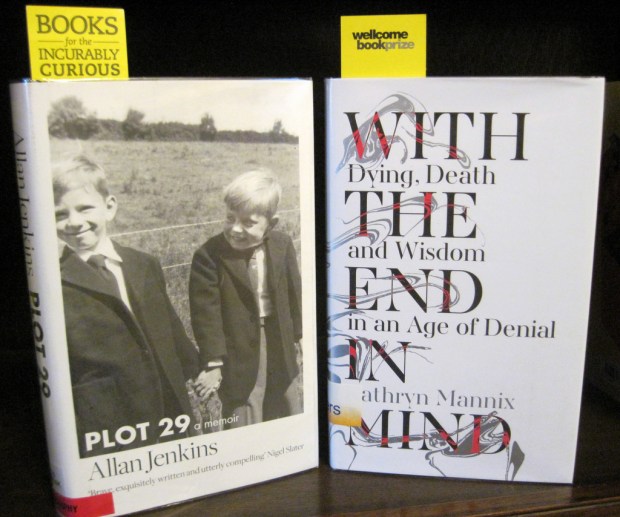
Plot 29: A Memoir by Allan Jenkins
This is an unusual hybrid memoir: it’s a meditative tour through the gardening year, on a plot in London and at his second home in his wife’s native Denmark. But it’s also the story of how Jenkins, editor of the Observer Food Monthly, investigated his early life. Handed over to a Barnardo’s home at a few months of age, he was passed between various family members and a stepfather (with some degree of neglect: his notes show scabies, rickets and TB) and then raised by strict foster parents in Devon with his beloved older half-brother, Christopher. It’s interesting to read that initially Jenkins intended to write a simple gardening diary, with a bit of personal stuff thrown in. But as he got further into the project, it started to morph.

This cover image is so sweet. It’s a photograph from Summer 1959 of Christopher and Allan (on the right, aged five), just after they were taken in by their foster parents in Devon.
The book has a complicated chronology: though arranged by month, within chapters its fragments jump around in time, a year or a date at the start helping the reader to orient herself between flashbacks and the contemporary story line. Sections are often just a paragraph long; sometimes up to a page or two. I suspect some will find the structure difficult and distancing. It certainly made me read the book slowly, which I think was the right way. You take your time adjusting to the gradual personal unveiling just as you do to the slow turn of the seasons. When major things do happen – meeting his mother in his 30s; learning who his father was in his 60s – they’re almost anticlimactic, perhaps because of the rather flat style. It’s the process that has mattered, and gardening has granted solace along the way.
I’m grateful to the longlist for making me aware of a book I otherwise might never have heard about. I don’t think the book’s mental health theme is strong enough for it to make the shortlist, but I enjoyed reading it and I’ll also take a look at Jenkins’s upcoming book, Morning, about the joys of being an early riser. (Ironic after my recent revelations about my own sleep patterns!)
Favorite lines:
“Solitude plus community, the constant I search for, the same as the allotment”
“The last element to be released from Pandora’s box, they say, was hope. So I will mourn the children we once were and I will sow chicory for bitterness. I will plant spring beans and alliums. I’ll look after them.”
“As a journalist, I have learned the five Ws – who, what, where, when, why. They are all needed to tell a story, we are taught, but too many are missing in my tale.”
With the End in Mind: Dying, Death and Wisdom in an Age of Denial by Kathryn Mannix
This is an excellent all-round guide to preparation for death. It’s based around relatable stories of the patients Mannix met in her decades working in the fields of cancer treatment and hospice care. She has a particular interest in combining CBT with palliative care to help the dying approach their remaining time with realism rather than pessimism. In many cases this involves talking patients and their loved ones through the steps of dying and explaining the patterns – decreased energy, increased time spent asleep, a change in breathing just before the end – as well as being clear about how suffering can be eased.
I read the first 20% on my Kindle and then skimmed the rest in a library copy. This was not because I wasn’t enjoying it, but because it was a two-week loan and I was conscious of needing to move on to other longlist books. It may also be because I have read quite a number of books with similar themes and scope – including Caitlin Doughty’s two books on death, Caring for the Dying by Henry Fersko-Weiss, Being Mortal by Atul Gawande, and Waiting for the Last Bus by Richard Holloway. Really this is the kind of book I would like to own a copy of and read steadily, just a chapter a week. Mannix’s introductions to each section and chapter, and the Pause for Thought pages at the end of each chapter, mean the book lends itself to being read as a handbook, perhaps in tandem with an ill relative.
 The book is unique in giving a doctor’s perspective but telling the stories of patients and their families, so we see a whole range of emotions and attitudes: denial, anger, regret, fear and so on. Tears were never far from my eyes as I read about a head teacher with motor neurone disease; a pair of women with metastatic breast cancer who broke their hips and ended up as hospice roommates; a beautiful young woman who didn’t want to stop wearing her skinny jeans even though they were exacerbating her nerve pain, as then she’d feel like she’d given up; and a husband and wife who each thought the other didn’t know she was dying of cancer.
Mannix believes there’s something special about people who are approaching the end of their life. There’s wisdom, dignity, even holiness surrounding them. It’s clear she feels she’s been honored to work with the dying, and she’s helped to propagate a healthy approach to death. As her children told her when they visited her dying godmother, “you and Dad [a pathologist] have spent a lifetime preparing us for this. No one else at school ever talked about death. It was just a Thing in our house. And now look – it’s OK. We know what to expect. We don’t feel frightened. We can do it. This is what you wanted for us, not to be afraid.”
I would be happy to see this advance to the shortlist.
Favorite lines:
“‘So, how long has she got?’ I hate this question. It’s almost impossible to answer, yet people ask as though it’s a calculation of change from a pound. It’s not a number – it’s a direction of travel, a movement over time, a tiptoe journey towards a tipping point. I give my most honest, most direct answer: I don’t know exactly. But I can tell you how I estimate, and then we can guesstimate together.”
“we are privileged to accompany people through moments of enormous meaning and power; moments to be remembered and retold as family legends and, if we get the care right, to reassure and encourage future generations as they face these great events themselves.”
Longlist strategy:
Currently reading: The Butchering Art by Lindsey Fitzharris: a history of early surgery and the fight against hospital infection, with a focus on the life and work of Joseph Lister.
Up next: I’ve requested review copies of The White Book by Han Kang and Mayhem by Sigrid Rausing, but if they don’t make it to the shortlist they’ll slip down the list of priorities.
Third Blog Anniversary
Hard to believe, but I’ve only been blogging for three years as of today. It feels like something I’ve been doing forever, but at the same time I still consider myself a newbie. This is my 382nd post, so I’ve been keeping up an average of 2.5 posts a week.

By Joey Gannon from Pittsburgh, PA (Candles) [CC BY-SA 2.0 (http://creativecommons.org/licenses/by-sa/2.0)%5D, via Wikimedia Commons.
I’ve particularly enjoyed doing author Q&As and highlighting seasonal reads, novellas, books about cats, and physical book traits. I especially like writing up bookshop visits and other literary travels, and discussing literary prizes. My supply of graphic novels seems to have dried up; for new releases I focus on literary fiction, historical fiction and memoirs.
Straightforward book reviews have always been less popular than book lists and other more tangentially book-related posts. Library Checkout posts are consistently well-liked, as were the “Books in Brief” sets of five mini-reviews I used to do. As I’ve noted before, my posts on abandoned books are always perversely popular.
Some of my favorite posts from the past year were on World Kidney Day, Mother–Daughter Author Pairs, and Book Hoarding, and my review in verse of Jonathan Eig’s Ali: A Life.
The numbers of likes seem to be less than informative as they simply reflect a growing number of followers – many of my recent posts have averaged 20–25 likes – so I prefer to look at comments, as it means people are truly reading and engaging. In terms of numbers of comments, my top posts of all time appeared in the last year and were:
- Bibliotherapy appointment
- Books in Brief, May 2017 (featuring books by Sebastian Barry, Tracy Chevalier, Thomas H. Cook, Nicole Gulotta and Elizabeth Hay)
- (Tied for 3rd) Booker Longlist 2017 & Jacob’s Room Is Full of Books review
Thanks to everyone who has supported me this past year, and/or all three years, by visiting the site, commenting, re-tweeting, and so on. You’re the best!
Filling One Last Bookcase
Earlier this week I inherited a beautiful antique bookcase from an online friend* who, we learned only recently, lived just 20 minutes away. She has to shed some furniture to move to London, and very kindly thought of me. This is the last major item we could possibly fit in our house, but I was happy to accept because it’s so much nicer than any of our Ikea shelving units. It has the kind of mahogany detail that looks like it could belong on a ship’s wheel.


My goals for the extra shelving space were to be able to keep genres together, to eliminate double stacking where possible, to put all books out on display instead of having some away in an overflow crate, and perhaps to free up the tops of a couple units for knick knacks, etc.


It was a multi-step process undertaken with military precision. Can you tell I used to work in a library?
- Reincorporate Short Stories into General Fiction
- Double-stack the already-read Fiction in the bedroom, leaving the more presentable books at the front; create a Signed Copies area
- Move Poetry in with Classics, double-stacking and putting some books on their sides to make more space; create a Classics priority area, with one book per month chosen for the rest of 2018
- Move oversize Science and Nature, Graphic Novels, Children’s Books, and Coffee Table Books (which, because they’re buried under magazines and newspapers on the coffee table shelf, we never look at) onto the bottom shelf of the new bookcase
- Move all Life Writing (biographies/memoirs), which had been split across a few rooms, onto one bookcase in my study
- Add a selection of Travel and Literary Reference to fill the built-in shelves of my desk, joining Reference and Humor
- Integrate Science and Nature, previously kept separate, into one bookcase


Unread fiction is mostly on the hall bookcase, with an area on the bottom shelf for upcoming projects so I can see what’s awaiting me. I’m keeping these in rough date order from left to right: bibliotherapy prescriptions, possibilities for Reading Ireland month, novellas for November, etc.
However, there are a handful of annoying hardback and trade paperback novels that are just that little bit too tall to fit here, so these have formed a partial shelf on the antique case. I’ve also set aside there the book(s) that I think might be included in my Best of 2018 list and a growing stash of Wellcome Book Prize 2019 hopefuls.
You would never believe it, but I think I need more books! Good thing we have a trip planned to Wigtown, Scotland’s Book Town, for the first week of April. In any case, it’s better to have room to grow into than to already be at capacity or overfull. I can always reshuffle as time goes on if I decide I don’t want any double stacking upstairs or if we ever manage to bring back more of my library from America.


From Book Riot I got the idea of making a personal “hold shelf” of books you own and have been meaning to read. So far I only have four books set aside, arranged as a sort of buffet atop the hall bookcase. Perhaps later I’ll replace this with a full shelf on the antique bookcase. Other ideas for the empty space there would be showcasing my most presentable fiction, or creating a favorites shelf. This was suggested by Paul and corroborated by The Novel Cure, which suggests pulling out the 10 books you love most and are likely to turn to for inspiration.
*If you’re on Instagram, you must check her out. She is a #bookstagram pro: @beth.bonini.
How do you organize your bookshelves?
Thoughts on the Wellcome Book Prize Longlist
The 2018 Wellcome Book Prize longlist is here! From the prize’s website, you can click on any of these 12 books’ covers, titles or authors to get more information about them.

Some initial thoughts:
I correctly predicted three of the entries (or 25%) in yesterday’s post: In Pursuit of Memory by Joseph Jebelli, With the End in Mind by Kathryn Mannix, and I Am, I Am, I Am by Maggie O’Farrell. I’m pretty shocked to not see Fragile Lives or Admissions on the list.
Of the remainder, I’ve already read one (Midwinter Break) and DNFed another (Stay with Me). Midwinter Break didn’t immediately suggest itself to me for this prize because its themes of ageing and alcoholism are the background to a story about the disintegration of a long marriage. Nonetheless, it’s a lovely book that hasn’t gotten as much attention as it deserves – it was on my runners-up list from last year – so I’m delighted to see it nominated. Stay with Me was also on the Women’s Prize shortlist; it appears here for its infertility theme, but I wouldn’t attempt it again unless it made the Wellcome shortlist.

As to the rest:
- I’m annoyed with myself for not remembering The Butchering Art, which I have on my Kindle. Sometimes I assume that books I’ve gotten from NetGalley are USA-only and don’t check for a UK publisher. I plan to read this and With the End in Mind (also on my Kindle) soon.
- I already knew about and was interested in Mayhem and The White Book.
- Of the ones I didn’t know about, Plot 29 appeals to me the most. I’m off to get it from the library this very afternoon, in fact. Its health theme seems quite subtle: it’s about a devoted gardener ‘digging’ into his past in an abusive family and foster care. The Guardian review describes it thus: “Like Helen Macdonald’s H Is for Hawk, this is a profoundly moving account of mental trauma told through the author’s encounters with nature. Jenkins sees his garden as a place where a person can try to escape from, and atone for, the darkness of human existence.” This is the great thing about prize lists: they can introduce you to fascinating books you might never have heard of otherwise. Even if it’s just one book that takes your fancy, who knows? It might end up being a favorite.
- While I’m not immediately drawn to the books on the history of vaccines, the evolution of human behavior, and transhumanism, I will certainly be glad to read them if they make the shortlist.
Some statistics on this year’s longlist, courtesy of the press release I was sent by e-mail:
- Three novels, three memoirs, and six nonfiction titles
- Five debut authors
- Three titles from independent publishers (Canongate and Granta/Portobello Books)
- The authors are from the UK, Ireland, USA, Nigeria, Canada, and – making their first appearance – Sweden (Sigrid Rausing) and South Korea (Han Kang)
Chair of judges Edmund de Waal writes: “The Wellcome Book Prize is unique in its reach across genres, and so the range of books that we have considered has been exhilarating in its extent and ambition. This is a remarkable time for readers, with a great flourishing of writing on ideas around science, medicine and health, lives and deaths, histories and futures. After passionate discussions we have arrived at our longlist for the Wellcome Book Prize 2018 and are proud to be part of this process of bringing to a wider public these 12 tremendous books that have moved, intrigued and inspired us. All of them bring something new to our understanding of what it is to be human.”
The shortlist is announced on Tuesday, March 20th, and the winner will be revealed on Monday, April 30th.
Are there any books on here that you’d like to read?
My 2018 Wellcome Book Prize Wish List
Tomorrow the longlist for the 2018 Wellcome Book Prize will be announced. This year’s judging panel is chaired by Edmund de Waal, author of The Hare with Amber Eyes. I hope to once again shadow the shortlist along with a few fellow book bloggers. I don’t feel like I’ve read all that many books that are eligible (i.e., released in the UK in 2017, and on a medical theme), but here are some that I would love to see make the list. I link to all those I’ve already featured here, and give review extracts for the books I haven’t already mentioned.

 I Found My Tribe by Ruth Fitzmaurice
- In Pursuit of Memory: The Fight against Alzheimer’s by Joseph Jebelli
- Goodbye, Vitamin by Rachel Khong
- In Every Moment We Are Still Alive by Tom Malmquist
- Admissions: A Life in Brain Surgery by Henry Marsh
 I Am, I Am, I Am: Seventeen Brushes with Death by Maggie O’Farrell: O’Farrell captures fragments of her life through essays on life-threatening illnesses and other narrow escapes she’s experienced. The pieces aren’t in chronological order and aren’t intended to be comprehensive. Instead, they crystallize the fear and pain of particular moments in time, and are rendered with the detail you’d expect from her novels. She’s been mugged at machete point, nearly drowned several times, had a risky first labor, and was almost the victim of a serial killer. (My life feels awfully uneventful by comparison!) But the best section of the book is its final quarter: an essay about her childhood encephalitis and its lasting effects, followed by another about her daughter’s extreme allergies.
- The Smell of Fresh Rain: A Journey into the Sense of Smell by Barney Shaw
- Fragile Lives: A Heart Surgeon’s Stories of Life and Death on the Operating Table by Stephen Westaby
It’s also possible that we could see these make the longlist:
 History of Wolves by Emily Fridlund: Fridlund’s Minnesota-set debut novel is haunted by a dead child. From the second page readers know four-year-old Paul is dead; a trial is also mentioned early on, but not until halfway does Madeline Furston divulge how her charge died. This becomes a familiar narrative pattern: careful withholding followed by tossed-off revelations that muddy the question of complicity. The novel’s simplicity is deceptive; it’s not merely a slow-building coming-of-age story with Paul’s untimely death at its climax. For after a first part entitled “Science”, there’s still half the book to go – a second section of equal length, somewhat ironically labeled “Health”. (Reviewed for the TLS.)
- Hair Everywhere by Tea Tulić
 Modern Death: How Medicine Changed the End of Life by Haider Warraich: A learned but engaging book that intersperses science, history, medicine and personal stories. The first half is about death as a medical reality, while the second focuses on social aspects of death: religious beliefs, the burden on families and other caregivers, the debate over euthanasia and physician-assisted suicide, and the pros and cons of using social media to share one’s journey towards death. (See my full Nudge review.)
Of 2017’s medical titles that I haven’t read, I would have especially liked to have gotten to:
- Sound: A Story of Hearing Lost and Found by Bella Bathurst
 This Is Going to Hurt: Secret Diaries of a Junior Doctor by Adam Kay
- With the End in Mind: Dying, Death, and Wisdom in an Age of Denial by Kathryn Mannix [I have this one on my Kindle from NetGalley]
- Into the Grey Zone: A Neuroscientist Explores the Border between Life and Death by Adrian Owen
- Patient H69: The Story of My Second Sight by Vanessa Potter
We are also likely to see a repeat appearance from the winner of the 2017 Royal Society Science Book Prize, Testosterone Rex: Myths of Sex, Science, and Society by Cordelia Fine.
Other relevant books I read last year that have not (yet?) been released in the UK:
 The Education of a Coroner: Lessons in Investigating Death by John Bateson
- The Family Gene: A Mission to Turn My Deadly Inheritance into a Hopeful Future by Joselin Linder
- Last Things: A Graphic Memoir of Loss and Love by Marissa Moss
- Love and Laughter in the Time of Chemotherapy by Manjusha Pawagi
 No Apparent Distress: A Doctor’s Coming-of-Age on the Front Lines of American Medicine by Rachel Pearson: Pearson describes her Texas upbringing and the many different hands-on stages involved in her training: a prison hospital, gynecology, general surgery, rural family medicine, neurology, dermatology. Each comes with memorable stories, but it’s her experience at St. Vincent’s Student-Run Free Clinic on Galveston Island that stands out most. Pearson speaks out boldly about the divide between rich and poor Americans (often mirrored by the racial gap) in terms of what medical care they can get. A clear-eyed insider’s glimpse into American health care.
- The Bright Hour: A Memoir of Living and Dying by Nina Riggs
 The Tincture of Time: A Memoir of (Medical) Uncertainty by Elizabeth L. Silver: At the age of six weeks, Silver’s daughter suffered a massive brain bleed for no reason that doctors could ever determine. Thanks to the brain’s plasticity, especially in infants, the bleed was reabsorbed and Abby has developed normally, although the worry never goes away. Alongside the narrative of Abby’s baffling medical crisis, Silver tells of other health experiences in her family. An interesting exploration of the things we can’t control and how we get beyond notions of guilt and blame to accept that time may be the only healer.
Do you follow the Wellcome Book Prize? Have you read any books that might be eligible?
A Journey through Chronic Pain: Heal Me by Julia Buckley
Julia Buckley can pinpoint the very moment when her battle with chronic pain began: it was a Tuesday morning in May 2012, and she was reaching across her desk for a cold cup of coffee. Although she had some underlying health issues, the “fire ants” down her arm and “carving knife” in her armpit? These were new. From there it just got worse: neck and back pain, swollen legs, and agonizing periods. Heal Me is a record of four years of chronic pain and the search for something, anything to take the pain away. “I couldn’t say no – that was a forbidden word on my journey. You never know who’s going to be your saviour.”
 Having exhausted the conventional therapies available privately and via the NHS, most of which focus on cognitive behavioral therapy and coping strategies, Buckley quit work and registered as disabled. Ultimately she had to acknowledge that forces beyond the physiological might be at work. Despite her skepticism, she began to seek out alternative practitioners in her worldwide quest for a cure. Potential saviors included a guru in Vienna, traditional healers in Bali and South Africa, a witch doctor in Haiti, an herbalist in China, and a miracle worker in Brazil. She went everywhere from Colorado Springs (for medical marijuana) to Lourdes (to be baptized in the famous grotto). You know she was truly desperate when you read about her bathing in the blood and viscera of a sacrificial chicken.
Now the travel editor of the Independent and Evening Standard, Buckley captures all these destinations and encounters in vivid detail, taking readers along on her rollercoaster ride of new treatment ideas and periodically dashed hopes. She is especially incisive in her accounting of doctors’ interactions with her. All too often she felt like a statistic or a diagnosis instead of a person, and sensed that her (usually male) doctors dismissed her as a stereotypically hysterical woman. Fat shaming came into the equation, too. Brief bursts of compassion, wherever they came from, made all the difference.
I was morbidly fascinated with this story, which is so bizarre and eventful that it reads like a great novel. I’ll be cheering it on in next year’s Wellcome Book Prize race.
My rating:
Heal Me: In Search of a Cure is published today, January 25th, by Weidenfeld & Nicolson. My thanks to the publisher for a free copy for review.
Julia graciously agreed to take part in a Q&A over e-mail. We talked about invisible disabilities, the gendered treatment of pain, and whether she believes in miracles.
“I spent a day at the Paralympic stadium with tens of thousands cheering on equality, but when it was time to go home, nobody wanted to give me a seat on the Central Line. I was, I swiftly realised, the wrong kind of disabled.”
Yours was largely an invisible disability. How can the general public be made more aware of these?
I feel like things are very, very gradually moving forward – speaking as a journalist, I know that stories about invisible disabilities do very well, and I think as we all try to be more “on” things and “woke” awareness is growing. But people are still cynical – Heathrow and Gatwick now have invisible disability lanyards for travellers and someone I was interviewing about it said “How do I know the person isn’t inventing it?” I think the media has a huge part to play in raising awareness, as do things like books (cough cough). And when trains have signs saying things like “be aware that not all disabilities are visible” on their priority seats, I think that’s a step forward. Openness helps, too, if people are comfortable about it – I’m a huge believer in oversharing.
“I wondered whether it was a peculiarly female trait to blame oneself when a treatment fails.”
You make a strong case for the treatment of chronic pain being gendered, and your chapter epigraphs, many from women writers who were chronic pain or mental health patients, back this up. There’s even a name for this phenomenon: Yentl Syndrome. Can you tell us a little more about that? What did you do to push back against it?
Yentl Syndrome is the studied phenomenon that male doctors are un/consciously sexist in their dealings with female patients – with regards to pain, they’re twice as likely to ascribe female pain to psychological reasons and half as likely to give them adequate painkillers. In the US, women have to cycle through 12 doctors, on average, before they find the one to treat their pain adequately. There are equally shocking stats if you look at race and class, too.
I did absolutely nothing to push back against it when I was being treated, to be honest, because I didn’t recognise what was going on, had never heard of Yentl Syndrome and thought it was my problem, not theirs. It was really only when I met Thabiso, my sangoma in South Africa, that I felt the scales lift from my eyes about what had been going on. I make up for it now, though – I recently explained to a GP what it was, and suggested he be tested for it (long story, but we were on the phone and he was being incredibly patronising and not letting me speak). He hung up on me.
“In my head I added, I don’t care what they do to me, as long as it helps the pain.”
Meatloaf sang, “I would do anything for love, but I won’t do that.” Can you think of anything you wouldn’t have done in the search for a cure?
Well, I refused a spiritual surgery from John of God – I would have had the medical clamp up my nose or happily been cut into, but I was phobic about having my eyeball scraped – I had visions of Un Chien Andalou. So I had said repeatedly I was up for the other stuff but wouldn’t do the eye-scraping, and was told that probably meant I’d get the eye-scraping so I should go for the “invisible” surgery instead. But I can’t think of anything else I wouldn’t have done. The whole point, for me, was that if I didn’t throw myself into something completely, if I didn’t get better I’d never know if that was the treatment not working or my fault. Equally, my life was worthless to me – I knew I would probably be dead if I didn’t find an answer, so I didn’t have anything to lose.
Having said that, I know I would have had major difficulties slaughtering a goat if I’d gone back to Thabiso – I’m not sure if I could even have asked anyone else to do that for me.
Looking back, do you see your life in terms of a clear before and after? Are you the same person as you were before you went through this chronic pain experience?
There’s definitely a clear before and after in terms of how I think of my life – before the accident and after it. The date is in my head and I measure everything in my life around that, whether that’s a work event, a holiday, anything else – it’s always XX months/years before or after the accident. I don’t have the same thing with the day I got better because I try not to think about what happened and why, so I still calculate everything around the accident even though I should probably try and move my life to revolve around that happier day.
Largely I’m the same person. I still have the same interests and the same job, so I haven’t changed in that way. But I’d say I’m more focused – I lost so much of my life that I’m trying to make up for it now. So I don’t watch TV, I don’t go out to anything I’m not really interested in, I didn’t go to the work Christmas party because I could think of better things to do than stand around sober shouting over music … so I’m more ruthless about how I spend my time.
I also think invisible illness – or people’s reaction to it – hardens you. You have to grow a shell, otherwise you wouldn’t get through it. So I’m probably more brusque. I’m also really fucking angry about how I was treated and how I see other people – especially other women – being treated and I know that low-level anger shows through a lot. But as I said to a friend (male, obviously) recently, when he read my book and was upset at my anger: once you start noticing what’s going on, when you see people’s lives ruined because of pain, when in extreme cases you see women dying because of their gender, how can you not be angry? I think we should all be more angry. Maybe we could get more done.
You got a book contract before you’d completed all the travel. At that point you didn’t know what the conclusion of your quest would be: a cure, or acceptance of chronic pain as your new normal. Given that uncertainty, how did you go about shaping this narrative?
For the proposal for the book I did a country-by-country, treatment-by-treatment chapter plan (it was wildly ambitious, but pain and finances put the dampeners on it) and suggested the last chapter would be at a meditation retreat in Dorset, learning acceptance. I put in some waggish comment like “assuming I don’t get cured first hahaha”, but secretly I knew there was no way I could write the book if I wasn’t cured, partly on a very literal level – I physically wouldn’t be able to do it – but more because I didn’t see how I would ever be able to accept it. I actually postponed the deadline twice for the same reasons, and when I realised deadline 3 was looming and I wasn’t better and I was going to have to suck it up and write it I was distraught. I genuinely thought that putting all that I had been through onto the page and having to admit that I had failed – and failed my fellow pain people I was doing it for – would kill me. So I don’t know what I would have done if it had come to the crunch; luckily I got my pot of white chrysanthemums and didn’t have to see what happened.
You are leery of words like “miracle” and “cure,” so what terms might you use to describe what ended your pain after four years?
Something happened, and it happened in Brazil. But I would never tell anyone to hop on a plane to Brazil. What happened to me happened after four years of soul-searching and introspection as well as all those treatments. If I’d gone to Brazil first, I don’t know what would have happened.
Who do you see being among the audience for your book?
I’d love people who need it to read it and take what they need from it, but I’d also love doctors to read it – as an insight into patient psychology if nothing else – and I’d love it to be seen as a continuation of the whole #MeToo debate. That sounds holier than thou, and obviously it’d be great for people to read it as a Jon-Ronson-meets-Elizabeth-Gilbert-style romp because I’d feel like I’d succeeded from a writing point of view, but to be honest the only reason I wanted to write it in the first place was to show what’s happening to people in pain, and once I got better, the only thing that mattered to me was getting it into the hands of people who need it. I know how much I needed something like this.
Brain vs. Heart Surgery: Admissions and Fragile Lives
It’s never too early to start thinking about which books might make it onto next year’s Wellcome Book Prize nominees list, open to any medical-themed books published in the UK in calendar year 2017. I’ve already read some cracking contenders, including these two memoirs from British surgeons.
Brain surgeon Henry Marsh’s first book, Do No Harm, was one of my favorite reads of 2015. In short, enthrallingly detailed chapters named after conditions he had treated or observed, he reflected on life as a surgeon, expressing sorrow over botched operations and marveling at the God-like power he wields over people’s quality of life. That first memoir saw him approaching retirement age and nearing the end of his tether with NHS bureaucracy.
Admissions: A Life in Brain Surgery serves as a sort of sequel, recording Marsh’s last few weeks at his London hospital and the projects that have driven him during his first years of retirement: woodworking, renovating a derelict lock-keeper’s cottage by the canal in Oxford, and yet more neurosurgery on medical missions to Nepal and the Ukraine. But he also ranges widely over his past, recalling cases from his early years in medicine as well as from recent memory, and describing his schooling and his parents. If I were being unkind, I might say that this feels like a collection of leftover incidents from the previous book project.
However, the life of a brain surgeon is so undeniably exciting that, even if these stories are the scraps, they are delicious ones. The title has a double meaning, of course, referring not only to the patients who are admitted to the hospital but also to a surgeon’s confessions. And there are certainly many cases Marsh regrets, including operating on the wrong side in a trapped nerve patient, failing to spot that a patient was on the verge of a diabetic coma before surgery, and a young woman going blind after an operation in the Ukraine. Often there is no clear right decision, though; operating or not operating could lead to equal damage.

Once again I was struck by Marsh’s trenchant humor: he recognizes the absurdities as well as the injustices of life. In Houston he taught on a neurosurgery workshop in which students created and then treated aneurysms in live pigs. When asked “Professor, can you give us some surgical pearls?” he “thought a little apologetically of the swine in the nearby bay undergoing surgery.” A year or so later, discussing the case of a twenty-two-year-old with a fractured spine, he bitterly says, “Christopher Reeve was a millionaire and lived in America and he eventually died from complications, so what chance a poor peasant in Nepal?”
Although some slightly odd structural decisions have gone into this book – the narrative keeps jumping back to Nepal and the Ukraine, and a late chapter called “Memory” is particularly scattered in focus – I still thoroughly enjoyed reading more of Marsh’s anecdotes. The final chapter is suitably melancholy, with its sense of winding down capturing not just the somewhat slower pace of his retired life but also his awareness of the inevitable approach of death. Recalling two particularly hideous deaths he observed in his first years as a doctor, he lends theoretical approval for euthanasia as a way of maintaining dignity until the end.
What I most admire about Marsh’s writing is how he blends realism and wonder. “When my brain dies, ‘I’ will die. ‘I’ am a transient electrochemical dance, made of myriad bits of information,” he recognizes. But that doesn’t deter him from producing lyrical passages like this one: “The white corpus callosum came into view at the floor of the chasm, like a white beach between two cliffs. Running along it, like two rivers, were the anterior cerebral arteries, one on other side, bright red, pulsing gently with the heartbeat.” I highly recommend his work to readers of Atul Gawande and Paul Kalanithi.
My rating:
Admissions: A Life in Brain Surgery was published in the UK by Weidenfeld & Nicolson on May 4th. My thanks to the publisher for sending a free copy for review. It will be published in the USA by Thomas Dunne Books on October 3rd.
What Marsh does for brain surgery in his pair of memoirs, Professor Stephen Westaby does for heart surgery in Fragile Lives, a vivid, compassionate set of stories culled from his long career. A working class lad from Scunthorpe who watched his grandfather die of heart failure, he made his way up from hospital porter to world-leading surgeon after training at Charing Cross Hospital Medical School.
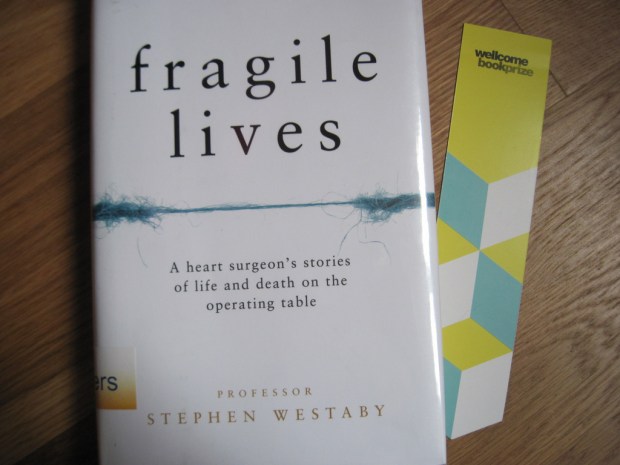
Each of these case studies, from a young African mother and her sick child whom he met while working in Saudi Arabia in the 1980s to a university student who collapses not far from his hospital in Oxford, is told in impressive depth. Although the surgery details are not for the squeamish, I found them riveting. Westaby conveys a keen sense of the adrenaline rush a surgeon gets while operating with the Grim Reaper looking on. I am not a little envious of all that he has achieved: not just saving the occasional life despite his high-mortality field – as if that weren’t enough – but also pioneering various artificial heart solutions and a tracheal bypass tube that’s named after him.
Like Marsh, he tries not to get emotionally attached to his patients, but often fails in this respect. “Surgeons are meant to be objective, not human,” he shrugs. But, also like Marsh, at his retirement he feels that NHS bureaucracy has tied his hands, denying necessary funds and equipment. Both authors come across as mavericks who don’t play by the rules, but save lives anyway. This is a fascinating read for anyone who enjoys books on a medical theme.
A few favorite lines:
“We stop life and start it again, making things better, taking calculated risks.”
“We were adrenaline junkies living on a continuous high, craving action. From bleeding patients to cardiac arrests. From theatre to intensive care. From pub to party.”
My rating: 
Fragile Lives: A Heart Surgeon’s Stories of Life and Death on the Operating Table was published in the UK by HarperCollins on February 9th. I read a public library copy. It will be published in the USA, by Basic Books, under the title Open Heart on June 20th.
And the Winner Is…
I’m just back from London, where I saw the Wellcome Book Prize 2017 announced in the course of an awards ceremony held at the Wellcome Collection. It was an enjoyable evening; I needn’t have been so nervous. And it was lovely to meet two fellow bloggers.
 I’ll post a full write-up tomorrow, but for now I will just convey the news, to those who may not have heard yet, that the winner of this year’s Wellcome Book Prize is Mend the Living by Maylis de Kerangal. This was quite a shock to many of us in attendance. I hope it won’t sound ungracious if I say it was the collective least favorite of the shadow panel. But keep in mind that that’s relative: it was a strong set of six very different books, each worth reading.
 Bookish Beck = Rebecca Foster. American transplant to England. Freelance proofreader and book reviewer.
 Bookish Beck