#WITMonth, Part I: Novellas by Eva Baltasar and Françoise Sagan
I’m starting off my Women in Translation month coverage with mini responses to two novellas: one Catalan and one French; both about disaffected women trying to work out what they want from life.
Mammoth by Eva Baltasar (2022; 2024)
[Translated from the Catalan by Julia Sanches]
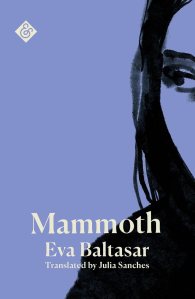 I’d been vaguely attracted by descriptions of the Spanish poet’s novels Permafrost and Boulder, which are also about lesbians in odd situations. Mammoth is the third book in a loose trilogy. Its 24-year-old narrator is so desperate for a baby that she’s decided to have unprotected sex with men until a pregnancy results. In the meantime, her sociology project at nursing homes comes to an end and she moves from Barcelona to a remote farm where she develops subsistence skills and forms an interdependent relationship with the gruff shepherd. “I’d been living in a drowning city, and I need this – the restorative silence of a decompression chamber. … my past is meaningless, and yet here, in this place, there is someone else’s past that I can set up and live in awhile.” For me this was a peculiar combination of distinguished writing (“The city pounces on the still-pale light emerging from the deep sea and seizes it with its lucrative forceps”) but absolutely repellent story, with a protagonist whose every decision makes you want to throttle her. An extended scene of exterminating feral cats certainly didn’t help matters. I’d be wary of trying Baltasar again.
With thanks to And Other Stories for the proof copy for review.
Aimez-vous Brahms… by Françoise Sagan (1959; 1960)
[Translated from the French by Peter Wiles]
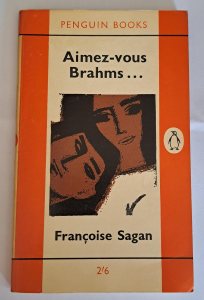 At age 39, divorced interior decorator Paule is “passionately concerned with her beauty and battling with the transition from young to youngish woman”. (Ouch. But true.) It’s an open secret that her partner Roger is always engaged in a liaison with a young woman; people pity her and scorn Roger for his infidelity. But when Paule has a dalliance with a client’s son, 25-year-old lawyer Simon, a double standard emerges: “they had never shown her the mixture of contempt and envy she was going to arouse this time.” Simon is an idealist, accusing her of “letting love go by, of neglecting your duty to be happy”, but he’s also indolent and too fond of drink. Paule wonders if she’s expected too much from an affair. “Everyone advised a change of air, and she thought sadly that all she was getting was a change of lovers: less bother, more Parisian, so common”.
I was by turns reminded of Chéri by Colette, In a Summer Season by Elizabeth Taylor, and even The Graduate (“Mrs. Robinson,” anyone?). Simon asks the title question to invite Paule to a concert; that she has to ponder it carefully tells her she’s “losing herself, losing track of herself”. But it’s all too easy for the status quo to be reinstated after a brave act. Middle-aged woman makes bid for freedom but ultimately nothing changes: same plot as The Funeral Cryer and any number of other books, but this was so much better. How did Sagan manage such insight at age 24 (and this was her fourth book)?! While not quite as memorable as Bonjour Tristesse, this is another incisive slice of fiction that has aged well apart from using “sodomite” and “Negress” as matter-of-fact terms for bit players. I’d read anything else I can find by Sagan. (Secondhand – Community Furniture Project, Newbury)
20 Books of Summer, 11–13: Campbell, Julavits, Lu
Two solid servings of women’s life writing plus a novel about a Chinese woman stuck in roles she’s not sure she wants anymore.
Thunderstone: A true story of losing one home and discovering another by Nancy Campbell (2022)
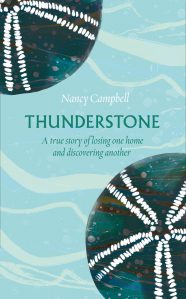 Just before Covid hit, Campbell’s partner Anna had a partially disabling stroke. They had to adjust to lockdown and the rigours of Anna’s at-home care at once. It was complicated in that Campbell was already halfway out the door: after 10 years, their relationship had run its course and she knew it was time to go, but guilt lingered about abandoning Anna at her most vulnerable (“How dare I leave someone who needed me”). That is the backdrop to a quiet book largely formed of a diary spanning June to September 2021. Campbell recounts settling into a caravan by the canal and railway line in Oxford, getting plenty of help from friends and neighbours but also finding her own inner resources and enjoying her natural setting.
The title refers to a fossil that has been considered a talisman in various cultures, and she needed the good luck during a period that involved accidental carbon monoxide poisoning and surgery for an ovarian abnormality (but it didn’t protect her books, which were all destroyed in a leaking shipping container – the horror!). I most enjoyed the longer entries where she muses on “All the potential lives I moved on from” during 20 years in Oxford and elsewhere, which makes me think that I would have preferred a more traditional memoir by her. Covid narratives feel really dated now, unfortunately. (New (bargain) purchase from Hungerford Bookshop with birthday voucher)
Directions to Myself: A Memoir by Heidi Julavits (2023)
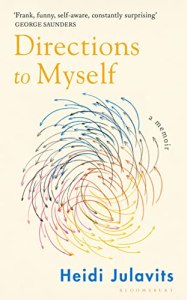 Julavits is a novelist and founding editor of The Believer. I loved her non-standard diary, The Folded Clock, back in 2017, so jumped at the chance to read her new memoir but then took more a year over reading it. The U.S. subtitle, “A Memoir of Four Years,” captures the focus: the change in her son from age five to age nine – from little boy to full-fledged individual. In later sections he sounds so like my American nephew with his Fortnite obsession and lawyerly levels of argumentation and self-justification. A famous author once told Julavits that writers should not have children because each one represents a book they will not write. This book is a rebuttal: something she could not have written without having had her son. Home is a New York City apartment near the Columbia University campus where she teaches – in fact, directly opposite a dorm at which rape allegations broke out – but more often the setting is their Maine vacations, where coastal navigation is a metaphor for traversing life.
Mostly the memoir takes readers through everyday conversations the author has with friends and family about situations of inequality or harassment. Through her words she tries to gently steer her son towards more open-minded ideas about gender roles. She also entrances him and his sleepover friends with a real-life horror story about being chased through the French countryside by a man in a car. The tenor of her musings appealed to me, but already the details are fading. I suspect this will mean much more to a parent.
With thanks to Bloomsbury for the free copy for review.
The Funeral Cryer by Wenyan Lu (2023)
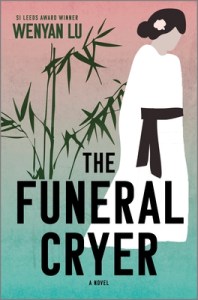 The title character holds a traditional position in her Chinese village, performing mourning at ceremonies for the dead. It’s a steady source of income for her and her husband, but her career choice has stigma attached: “Now that I brought bad luck and I smelt of the dead, nobody would step into our house to play mah-jong or chat.” Exotic as the setup might seem at first, it underpins a familiar story of a woman caught in frustrating relationships and situations. A very readable but plain style to this McKitterick Prize winner.
With thanks to the Society of Authors for the free copy.
The 2024 McKitterick Prize Shortlist and Winner
For the third year in a row, I was a first-round judge for the McKitterick Prize (for a first novel, published or unpublished, by a writer over 40), helping to assess the unpublished manuscripts. The McKitterick Prize is in memory of Tom McKitterick and sponsored by the Hawthornden Foundation. Thus far an unpublished manuscript has not advanced to the shortlist, but maybe one year it will!
On the 2024 McKitterick Prize shortlist (synopses adapted from Goodreads):
 Jacqueline Crooks for Fire Rush (Jonathan Cape, Vintage, Penguin Random House) – “Set amid the Jamaican diaspora in London at the dawn of 1980s, a mesmerizing story of love, loss, and self-discovery that vibrates with the liberating power of music. When Yamaye meets Moose, a soulful carpenter who shares her Jamaican heritage, a path toward a different kind of future seems to open. But then, Babylon rushes in.”
 Chidi Ebere for Now I Am Here (Pan Macmillan, Picador) – “We begin at the end. The armies of the National Defence Movement have been crushed and our unnamed narrator and his unit are surrounded. As he recounts the events leading to his disastrous finale, we learn how this gentle man is gradually transformed into a war criminal, committing acts he wouldn’t have thought himself capable.”
 Aoife Fitzpatrick for The Red Bird Sings (Virago) – “West Virginia, 1897. When young Zona Heaster Shue dies only a few months after her wedding, her mother, Mary Jane, becomes convinced Zona was murdered by her husband, Trout, the town blacksmith. As the trial rises to fever pitch, with the men of Greenbrier County aligned against them, Mary Jane and Zona’s best friend Lucy must decide whether to reveal Zona’s greatest secret in the service of justice.”
 Greg Jackson for The Dimensions of a Cave (Granta) – “When investigative reporter Quentin Jones’s story about covert military interrogation practices in the Desert War is buried, he is spurred to dig deeper, and he unravels a trail that leads to VIRTUE: cutting-edge technology that simulates reality during interrogation. As the shadowy labyrinths of governmental corruption unfurl and tighten around him, unnerving links to his protégé – who, like Joseph Conrad’s Kurtz, disappeared in the war several years earlier – keep emerging.”
 Wenyan Lu for The Funeral Cryer (Atlantic Books, Allen & Unwin) – “The Funeral Cryer long ago accepted the mundane realities of her life: avoided by fellow villagers because of the stigma attached to her job and under-appreciated by her husband, whose fecklessness has pushed the couple close to the brink of break-up. But just when things couldn’t be bleaker, she takes a leap of faith – and in so doing things start to take a surprising turn for the better.”
 Allan Radcliffe for The Old Haunts (Fairlight Books) – “Recently bereaved Jamie is staying at a rural steading in the heart of Scotland with his actor boyfriend Alex. The sudden loss of both of Jamie’s parents hangs like a shadow over the trip. In his grief, Jamie finds himself sifting through bittersweet memories, from his working-class upbringing in Edinburgh to his bohemian twenties in London, with a growing awareness of his sexuality threaded through.”
The Society of Authors kindly sent me free copies of the six shortlisted novels. I already had The Red Bird Sings and The Funeral Cryer on my TBR, so I’m particularly looking forward to reading them as part of my 20 Books of Summer – which I’ve decided might as well contain, as well as all hardbacks, only books by women.

I was familiar with Fire Rush from its shortlisting for last year’s Women’s Prize for Fiction. The other three titles are new to me but sound interesting, especially The Old Haunts – at 150 pages, it will be perfect for Novellas in November.
My fellow judge Rónán Hession, whom I got to meet very briefly on a Zoom call, wrote: “It is exciting to judge a prize and encounter such a depth of talent. Though [the books] hugely varied in subject matter and style, the writers on the shortlist all impressed me with the clarity of their creative vision and their narrative authority on the page.”
The winner and runner-up were announced in advance of the SoA Awards ceremony in London yesterday evening. As in other years, I watched the livestream, which this year included captivating speeches by the Very Revd Dr Mark Oakley, Dean of Southwark Cathedral (where the ceremony took place) and Kate Mosse. And what a thrill it was to see and hear my name on the livestream!

Winner: Wenyan Lu for The Funeral Cryer
Runner-up: Chidi Ebere for Now I Am Here

In the press release announcing the winners, Hession said, “Wenyan Lu has created an unforgettable debut, brimming with personality and written with a sense of consummate ease. The Funeral Cryer is such a funny, warm and original book. An absolute gem of a novel.” I can’t wait to get started!
Other notable winners announced yesterday included:
- Tom Crewe for The New Life (Betty Trask Prize for a first novel by a writer under 35)
- Jacqueline Crooks for Fire Rush (Paul Torday Memorial Prize for a first novel by a writer over 60 – how perfect for her to win this in place of the McKitterick!)
- Soula Emmanuel for Wild Geese (Gordon Bowker Volcano Prize for a novel focusing on travel)
- Cecile Pin for Wandering Souls (Runner-up for the Gordon Bowker Volcano Prize; and a Somerset Maugham Award travel bursary)
 Bookish Beck = Rebecca Foster. American transplant to England. Freelance proofreader and book reviewer.
 Bookish Beck