Three on a Theme: English Seasons and Flora (Brazier, Lamb and Parker)
These three books trace the turning of a typical year of the English seasons, especially as experienced through flora: produce for a veg stall, plants laid into a traditional hedge, and “weeds” celebrated for their wild beauty.
The Honesty Box: The diary of a broken marriage, a mental health crisis and a large marrow by Lucy Brazier (2025)
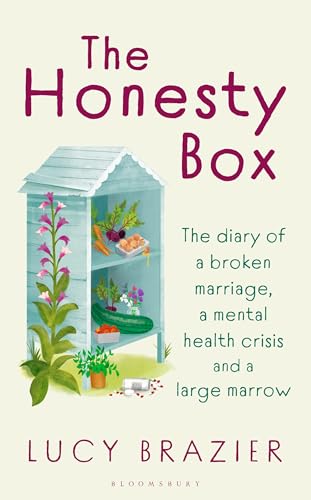 From one Christmas season to the next, Brazier highlights the delights and challenges of rural living (in the Bridport–Lyme Regis area of Dorset). She takes on a project of setting up and stocking her own honesty box – an unmanned roadside produce stall where visitors pay into a cashbox – with garden produce, preserves and baked goods, plus friends’ crafts. All along, her marriage is in an extended, low-level crisis: Steve’s bluntness, lack of social skills, and panicked inability to do his share of household tasks have long been issues. When he gets a combined ADHD and autism diagnosis, he has a roadmap but no easy solution. Going on medication and finding peers in a similar situation help somewhat, but he still struggles.
Brazier draws clever parallels between the turning of the seasons and the ebb and flow of a marriage. Wild swimming with friends and countryside walks with Margot the dog are ways of communing with nature. She incorporates all the daily concerns of her midlife existence, including home repairs, menopause and seeing Raff, the oldest of their three children, off to university. Brazier used to be a PFD talent agent in London, dealing with the likes of Anna Maxwell Martin, then worked for Hugh Fearnley-Whittingstall and his River Cottage cookery empire (she wrote their Christmas book); she’s now a freelance ghostwriter. She’s gently nostalgic for the days of balancing early motherhood and a stressful career, but also grateful for the slower pace of life she’s found in the countryside. There are also some amusingly ill-fated holidays (camping and boating), contrasted with a luxurious one in Italy.
It’s all very affable, the month-by-month present-tense write-ups offering an appealing blend of realism about life’s unpredictability and strategies for muddling through. While it may mean most to women of a certain age or those with neurodivergence in the family, anyone in a long-term relationship will find much to relate to. (Public library) 
Of Thorn and Briar: A Year with the West Country Hedgelayer by Paul Lamb (2025)
I picked this up after it was shortlisted (and highly commended) for the Wainwright Prize for Nature Writing. Lamb’s lifestyle could be from the 19th century: he lives in a sparse, cosy wagon, driving it from place to place and pausing for weeks-long projects laying traditional hedges across southwest England. Autumn through late winter is his key work period, to avoid the bird-nesting season. It’s gruelling physical labour. Sometimes he sees he’s made a difference; when he gets discouraged, he has to remind himself to take a longer view. “The hedger, like the forester, has to think of his work not as something completed in days or weeks or even months, but instead in years, decades and centuries.” Lamb can’t help but notice the daily shifts in weather adding up to changing seasons; it all affects his daily work.
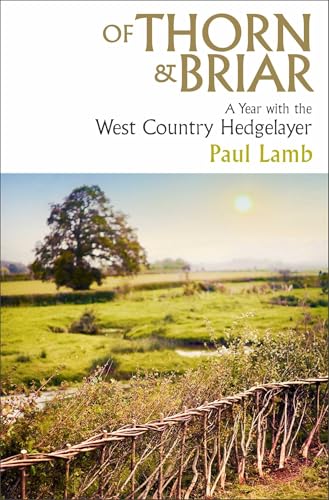 This gets reasonably technical about the different qualities of tree species and what they’re like to work with. I learned, or at least was reminded of, the vocabulary word “pleaching,” which means cutting a thin tree trunk vertically – almost but not all the way through – and laying horizontal branches into the crease. It takes skill to describe practical actions in a way that laypeople can picture. However, this account, which covers one August through the following July, is quite monotonous and repetitive. I blame the simple past-tense narration, which quickly becomes an ‘I did this, then I did that’ rundown and had me skimming more than half of the time. Literary techniques would have helped break up the format: extended flashbacks to his apprenticeship or family life, more scenes and dialogue, and some lyrical or imagined passages. (There is one particularly nicely done Hardy-esque vignette where he converses with Dorset locals in a pub.)
During the pandemic, Lamb’s daughters encouraged him to start an Instagram account, which now has 195,000 followers. No doubt it was his social media fame that led to this book deal. His writing, though serviceable, lacks sparkle. I enjoyed it as a window onto a rare profession and nearly forgotten way of life, but would hesitate to recommend unless you have patience and a greater-than-average interest in the subject matter. (Public library) 
Understorey: A Year Among Weeds by Anna Chapman Parker (2024)
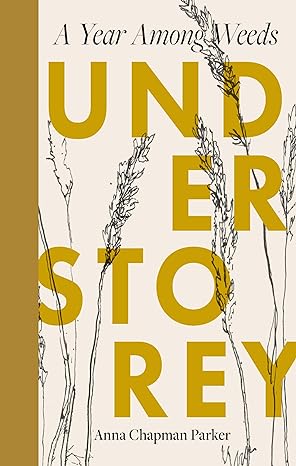 (One of my best backlist reads of last year.) Parker set out to study and sketch weeds as a way of cultivating attention and stillness as well as celebrating the everyday and overlooked. Her quick black-and-white drawings and written observations bear witness to the seasons changing but also to the minute alterations she observes in herself and her children. Here are a couple of examples of shorter entries:
25 April
Wild garlic flowers are explosive. As so often in drawing[,] there is a slippery negotiation between fidelity (getting the shape right) and spirit (capturing the feel of it). By the third drawing I’ve got my eye in and the balance between the two is nearer the mark. If I stayed here a week in the grass, drawing a single flower in a single stroke with my eyes closed, maybe eventually I’d hit it bang-on true.
10 December
On my way back from the shops, I find myself detouring to check in on the sowthistle again. Its leaves are drier now and the crisping at the edges is spreading inward. The leftward lean is more pronounced. A few more of the flowers have gone over. But there’s something else, as well – some impression of a former intimacy. A sensation not only of the past flower, but of my past self here, two days ago. Through the drawn encounter, the plant allows me to recognise myself, passing.
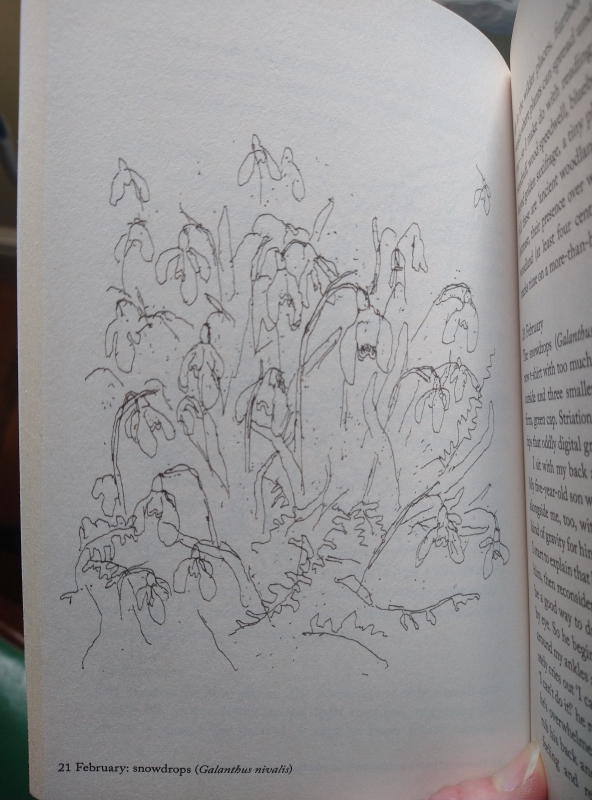
Taking a half-hour out of her day to find a subject feels transgressive in one sense, but dutiful – even holy – in another. Along with her frequent illustrations, there are reproductions of other artworks that depict wildflowers in situ, such as Albrecht Dürer’s Great Piece of Turf (1503). The tone is high-brow, meditative, introspective as she focuses on being present. This was just my kind of nature book, and all the more special because I’ve holidayed in her home of Berwick-on-Tweed so could picture some of the ‘overgrown’ spaces she honours. 
With thanks to Duckworth for the proof copy for review.
Book Serendipity, April to May 2024
I call it “Book Serendipity” when two or more books that I read at the same time or in quick succession have something in common – the more bizarre, the better. Of course, the truer term would be synchronicity, but the branding has stuck. In Liz Jensen’s Your Wild and Precious Life, she mentions that Carl Jung coined the term “synchronicity” for what he described as “a meaningful coincidence of two or more events where something other than the probability of chance is involved.” I like thinking that it’s not just a matter of luck.
This is a regular feature of mine every couple of months. I would normally have waited until the end of June, but I had way too many coincidences stored up! Because I usually have 20–30 books on the go at once, I suppose I’m more prone to finding them. People frequently ask how I remember all of these incidents. The answer is: I jot them down on scraps of paper or input them immediately into a file on my PC desktop; otherwise, they would flit away.
The following are in roughly chronological order.
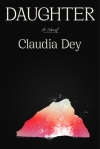
- Reading two King Lear updates at the same time: Private Rites by Julia Armfield and Daughter by Claudia Dey. The former has been specifically marketed as a “lesbian Lear,” but I had no idea that the latter also features two sisters plus a younger half-sister and their interactions with a larger-than-life father.

- Eating beans straight out of the tin in The Waterfall by Margaret Drabble and Of Mice and Men by John Steinbeck.
- Dead mice in Of Mice and Men by John Steinbeck and Stone Yard Devotional by Charlotte Wood.

-

- Screenshot
- Cloth holding the jaw of a corpse closed in one story from Barcelona by Mary Costello and A Woman’s Story by Annie Ernaux.
- Others see a character’s wife as a whore but the husband is oblivious in The Shipping News by E. Annie Proulx and Of Mice and Men by John Steinbeck.
 Setting up a game of solitaire in The Snow Hare by Paula Lichtarowicz and Of Mice and Men by John Steinbeck.
- Main character called Mona in Daughter by Claudia Dey and Mona of the Manor by Armistead Maupin.
- Being surprised at an older man still having his natural hair colour in one story of Barcelona by Mary Costello (where he’s aged 76) and Life in the Balance by Jim Down (where it’s Alan Bennett, at 84!).
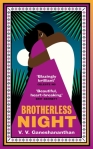
- A character named Anjali in Brotherless Night by V.V. Ganeshananthan and Moral Injuries by Christie Watson.

- A character named Cherry in Daughter by Claudia Dey and one story of This Is Why We Can’t Have Nice Things by Naomi Wood.
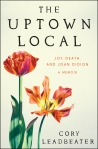
- My second memoir in two months in which a twentysomething son dies suddenly of a presumed heart problem: Fi by Alexandra Fuller, followed by Your Wild and Precious Life by Liz Jensen. (And a third in which his young friend died in the same way: The Uptown Local by Cory Leadbeater.) Also, Fuller and Jensen both see signs of their sons’ continued presence in bird sightings.
- Scratches on the inside of a coffin as proof of being buried alive in one story of Barcelona by Mary Costello and Life in the Balance by Jim Down.


- Surprise that one didn’t know the exact moment that a loved one died in one story of Barcelona by Mary Costello and Your Wild and Precious Life by Liz Jensen.
- Discussion of the meaning of brain stem death and a mention of meningococcal sepsis in Life in the Balance by Jim Down and Moral Injuries by Christie Watson.
- A scene set in a Denny’s diner in The Whole Staggering Mystery by Sylvia Brownrigg and After Dark by Haruki Murakami.


- A description of halal butchery in Barcelona by Mary Costello and Between Two Moons by Aisha Abdel Gawad.
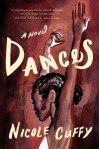
- A mention of ballet choreographer George Balanchine in Dances by Nicole Cuffy and The Uptown Local by Cory Leadbeater.
- A woman has an affair with a female postal worker in Mona of the Manor by Armistead Maupin and The Shipping News by Annie Proulx, both of which I DNFed.
- A character named Magdalena in Cloistered by Catherine Coldstream and The Snow Hare by Paula Lichtarowicz. The latter goes by Lena, which is also the name of the main character in Jungle House by Julianne Pachico. And there’s a character named Lina in Between Two Moons by Aisha Abdel Gawad.


- Being presented with powdered milk in Cloistered by Catherine Coldstream and Whale Fall by Elizabeth O’Connor.
- First I read a novel about a convent plagued by mice (Stone Yard Devotional by Charlotte Wood). Then I read a memoir about a convent plagued by feral cats (Cloistered by Catherine Coldstream).
- Buffalo, New York as a setting in Consent by Jill Ciment and The Age of Loneliness by Laura Marris. It’s also mentioned in Enter Ghost by Isabella Hammad.

- Watching pigeons on one’s balcony in Keep by Jenny Haysom, Your Wild and Precious Life by Liz Jensen, and The Uptown Local by Cory Leadbeater.
 The family’s pet chicken is cooked for dinner in Coleman Hill by Kim Coleman Foote and The Snow Hare by Paula Lichtarowicz.
- The mother is named Gloria in Consent by Jill Ciment and Cold Spring Harbor by Richard Yates (and The War for Gloria by Atticus Lish, a DNF).
- A character named Anton in The Snow Hare by Paula Lichtarowicz and Jungle House by Julianne Pachico.
- A cat named Dog in The Door-to-Door Bookstore by Carsten Henn and a dog named Tiger in Jungle House by Julianne Pachico.
- Two nature books that feature wild cold-water swimming (though don’t they all these days?!): In All Weathers by Matt Gaw and Your Wild and Precious Life by Liz Jensen.

- Two nature books that mention W.H. Hudson: In All Weathers by Matt Gaw and North with the Spring by Edwin Way Teale.
 A large anonymous donation to a church in Slammerkin by Emma Donoghue and Excellent Women by Barbara Pym (£10–11, which was much more in the 18th century of the former than in the 1950s of the latter).
- A mention of Poughkeepsie, New York in Birdeye by Judith Heneghan and Woman of Interest by Tracy O’Neill.
- A 1950s scene of perusing a lipstick display in Recipe for a Perfect Wife by Karma Brown and Excellent Women by Barbara Pym.

- A woman with a broken leg worries about how her garden will fare in Recipe for a Perfect Wife by Karma Brown and Remarkably Bright Creatures by Shelby Van Pelt.
- The same silent film image of a spaceship entering the moon’s eye (from Georges Méliès’s A Trip to the Moon) appears in Knife by Salman Rushdie and The Invention of Hugo Cabret by Brian Selznick. (I think this is the uncanniest coincidence of all this time!)

- A cleric who wears a biretta in Excellent Women by Barbara Pym and Daughters of the House by Michèle Roberts.
- A Black single mother who believes in the power of crystals in Company by Shannon Sanders and Another Word for Love by Carvell Wallace.


- An older woman really doesn’t want to leave her home but is moving into a retirement facility in Keep by Jenny Haysom and Remarkably Bright Creatures by Shelby Van Pelt. (There’s also a young woman who refuses to leave her house in Recipe for a Perfect Wife by Karma Brown.)
 A man throws his tie over his shoulder before eating in Recipe for a Perfect Wife by Karma Brown and Keep by Jenny Haysom.
- A mother writing a bad check becomes an important plot point in Remarkably Bright Creatures by Shelby Van Pelt and Another Word for Love by Carvell Wallace.
 A scene of self-induced abortion in Recipe for a Perfect Wife by Karma Brown and Sleeping with Cats by Marge Piercy.
- The Yiddish word feh (an expression of disappointment) appears in Feh by Shalom Auslander (no surprise there!) but also in A Reason to See You Again by Jami Attenberg, both of which are pre-release books I am reading for Shelf Awareness reviews.

What’s the weirdest reading coincidence you’ve had lately?
Review Catch-up: Matt Gaw, Sheila Heti, Liz Jensen (and a Pile of DNFs)
Today I have a travel book about appreciating nature in any weather, a sui generis memoir drawn from a decade of diaries, and an impassioned cry for the environment in the wake of a young adult son’s death.
I’m also bidding farewell to a whole slew of review books that have been hanging around, in some cases, for literal years – I think one is from 2021, and several others from 2022. Putting a book on my “set aside” shelf can be a kiss of death … or I can go back at a better time and end up loving it. It’s hard to predict which will occur. On these, alas, I have had to admit defeat and will pass the books on to other homes.
In All Weathers: A Journey through Rain, Fog, Wind, Ice and Everything in Between by Matt Gaw
Gaw’s two previous nature/travel memoirs, the enjoyable The Pull of the River and Under the Stars, involve gentle rambles through British landscapes, along with commentary on history, nature and science. The remit is much the same here. The book is split into four long sections: “Rain,” “Fog,” “Ice and Snow,” and “Wind.” The adventures always start from and end up at the author’s home in Suffolk, but he ranges as far as the Peak District, Cumbria and the Isle of Skye. Wild swimming is one way in which he experiences places. He notices a lot and describes it all in lovely and relatable prose.
 I was tickled by the definitions of, and statistics about, a “white Christmas”: in the UK, it counts if there’s even a single snowflake falling, whereas in the US there has to be 2.5 cm or more of standing snow. (Scotland is most likely to experience white Christmases; it has had 37 since 1960 vs. 26 in northern England. The English snow record is 43 cm, at Buxton and Malham Tarn in 1981 and 2009.) There’s underlying mild dread as he notes how weather patterns have changed and will likely continue changing, ever more dramatically, into his children’s future.
I find I don’t have much to say about this book because it is very nice but doesn’t do anything interesting or tackle anything that isn’t familiar from many other nature books (such as Rain by Melissa Harrison and Forecast by Joe Shute). It’s unfortunate for Gaw that his ideas often seem to have been done before – his book on night-walking, in particular, was eclipsed by several other works on that topic that came out at around the same time. I hope that the next time around he’ll get more editorial guidance to pursue original topics. It might take just a little push to get him to the next level where he could compete with top UK nature writers.
With thanks to Elliott & Thompson Books for the free copy for review.
Alphabetical Diaries by Sheila Heti
Heti put the contents of ten years of her diaries into a spreadsheet, alphabetizing each sentence (including articles), and then ruthlessly culled the results until she had a 25-chapter (no ‘X’) book. You could hardly call it a narrative, yet looking for one is so hardwired that every few sentences you are jolted out of what feels like a mini-story and into something new. Instead, you might think of it as an autobiographical mosaic. The recurring topics are familiar from the rest of Heti’s oeuvre, with obsessive cogitating about relationships, art and identity. But there are also the practicalities of trying to make a living as a woman in a creative profession. Tendrils of the everyday poke out here and there as she makes a meal, catches a plane, or buys clothes. Men loom large: explicit accounts of sex with Pavel and Lars (though also Fiona); advising her friend Lemons on his love life. There are also meta musings on what she is trying to achieve with her book projects and on what literature can be.
 Grammatically, the document is a lot more interesting than it could be – or than a similar experiment based on my diary would be, for instance – because Heti sometimes writes in incomplete sentences, dropping the initial pronoun; or intersperses rhetorical questions or notes to self in the imperative. So, yes, ‘I’ is a long chapter, but not only because of self-absorbed “I…” statements; there’s also plenty of “If…” and “It’s…” ‘H’ and ‘W’ are longer sections than might be expected because of the questioning mode. But it’s at the sentence level that the book makes the biggest impression: lines group together, complement or contradict each other, or flout coherence by being so merrily à propos of nothing. Here are a few passages to give a flavour:
Am I wasting my time? Am low on money. Am making noodles. Am reading Emma. Am tired and will go to sleep. Am tired today and I feel like I may be getting a cold. Ambivalence gives you something to do, something to think about.
Best not to live too emotionally in the future—it hardly ever comes to pass. Better to be on the outside, where you have always been, all your life, even in school, nothing changes. Better to look outward than inward. Blow jobs and tenderness. Books that fall in between the cracks of all aspects of the human endeavour.
It’s 2:34 every time I check the time these days. It’s 4 p.m. It’s 4:41 now. It’s a fantasy of being saved. It’s a stupid idea. It’s a yellow, cloudy sky. It’s amazing to me how life keeps going. It’s better to work, to go into the underground cave where there are books, than to fritter away time online. It’s crazy that I need all of these mental crutches in order to live. It’s fiction. It’s fine.
Scrambled eggs on toast at Yaddo. Second-guessing everything. Second, he said that no one is buying fiction. See the complexity. See the souls. See what kind of story the book can accommodate, if any. Seeing her for coffee was not so bad.
It’s surprising how much sense a text constructed so apparently haphazardly makes, perhaps because of the same subject and style throughout. Sometimes aphoristic, sometimes poetic (all that anaphora), the book is playful but overall serious about the capturing of a life on the page. Heti transcends the quotidian by exploding the one-thing-after-another tedium of chronology. Remarkably, the collage approach produces a more genuine, crystalline vision of the self than precise scenes and cause-and-effect chains ever could. A work of life writing like no other, it must be read in a manner all its own that it teaches you as you go along. I admire it enormously and hope I might write something even half as daring one day.
With thanks to Fitzcarraldo Editions for the free copy for review.
Your Wild and Precious Life: On grief, hope and rebellion by Liz Jensen
Jensen’s younger son, Raphaël Coleman, was just 25 when he collapsed while filming a documentary in South Africa and died of a previously undiagnosed heart condition. Raph had been involved in Extinction Rebellion and Jensen is a founding member of Writers Rebel. They both deemed activism “the best antidote to depression.” Her son had been obsessed with wildlife from a young age and was rewilding acres of their land in France, as well as making environmentalist films (he had achieved minor fame as a child actor in Nanny McPhee) and participating in direct action, such as at the Brazilian embassy in London.
 For Jensen, the challenge, especially after lockdown confined her to her Copenhagen flat, was to channel grief into further radicalism rather than retreating into herself or giving in to the lure of suicide. She tried to see personal grief as a reminder of ecogrief, and therefore as a spur. One way that she coped was turning towards the supernatural. She continued to hear and speak to Raph, in daily life as well as through a medium, and interpreted bird sightings as signs of his continued presence. An additional point of interest to me was that the author’s husband is Carsten Jensen, the writer of one of my favourite books, We, the Drowned.
This doesn’t particularly stand out among the dozens of bereavement memoirs I’ve read. (It was also remarkably similar to Alexandra Fuller’s Fi, which I’d read not long before.) Perhaps more years of reflection would have helped – Mary Karr advises seven – though I suspect Jensen felt, quite rightly, that given the current state of the environment we have no time to waste. And I have no doubt that the combination of a mother’s love and an ecological conscience will make this book meaningful to many readers.
With thanks to Canongate for the free copy for review.
And the DNFs…
there are more things, Yara Rodrigues Fowler – I loved Stubborn Archivist so much that I leapt at the chance to read her follow-up, but it was just too dull and involved about Brazilian versus UK politics. Nor did the stylistic tricks feel as novel this time around. I read 66 pages. (Fleet)
The Rabbit Hutch, Tess Gunty – Gunty dazzled critics and prize judges in the USA, winning a National Book Award. I was drawn to her debut novel for the composite picture of the residents of one Indiana apartment building and the strange connections that develop between them over one summer week, including perhaps a murder? Blandine, the central character, is a sort of modern-day mystic but hard to warm to (“She normally tries to avoid saying in which out loud, to minimize the number of people who find her insufferable”), as are all the characters. This felt like try-hard MFA writing. I read 85 pages. (Oneworld)
Eve: The Disobedient Future of Birth, Claire Horn – I usually get on well with Wellcome Collection books. I think the problem here was that there was too much material that was familiar to me from having read Womb by Leah Hazard – even the SF-geared stuff about artificial wombs. I read 45 pages. (Profile Books)
Blessings, Chukwuebuka Ibeh – This debut novel has a confident voice, buttressed by determination to reveal what life is like for queer people living in countries where homosexuality is criminalized. Obiefuna is cast out for having a crush on Aboy, his father’s apprentice, even though the two young men share nothing more physical than a significant gaze into each other’s eyes. The strict boarding school his father sends him to is a place of privation, hierarchy, hazing and, I suspect, same-sex experimentation. I found the writing capable but couldn’t get past a sense of dread about what was going to happen. Meanwhile, I didn’t think the alternating chapters from Obiefuna’s mother’s perspective added anything to the narrative. I read 62 pages. (Penguin Viking)
The War for Gloria, Atticus Lish – Lish’s debut novel, Preparation for the Next Life, was excellent, but I could never get stuck in to this follow-up, despite the appealing medical theme. When Gloria Goltz is diagnosed with ALS, her 15-year-old son Corey turns to his absent father and others for support. It was also unfortunate that Lish mentions the Ice Bucket Challenge: that was popularized in 2014, whereas the book is set in 2010. I read 75 pages. (Serpent’s Tail)
Snow Widows: Scott’s Fatal Antarctic Expedition through the Eyes of the Women They Left Behind, Katherine MacInnes – I seriously overestimated my interest in polar exploration narratives. MacInnes seems to have done quite a good job of creating novelistic scenes through research, though. I read 35 pages. (William Collins)
The Woodcock, Richard Smyth – I feel particularly bad about this one as I’ve read and enjoyed three of Smyth’s nature books and my husband and I are friendly with him on Twitter. Initially, I got Thomas Hardy, D.H. Lawrence and Sarah Perry (The Essex Serpent, anyway) vibes from this 1920s-set novel about the upheaval a naturalist and his wife experience when an American whaler and his daughters arrive in their small coastal English town. I read 90 pages. (Fairlight Books)
Better Broken than New: A Fragmented Memoir, Lisa St Aubin de Terán – I accepted this for review because I’d often seen the author’s name on spines in secondhand bookstores but didn’t know anything about her work. The précis of her globe-trotting life is stranger than fiction: marriage to a Venezuelan freedom fighter, managing a sugar plantation in the Andes, living in an Italian palace for 20 years, founding a charity in Mozambique. The vignettes in the early part of the book (e.g., skipping school and going on daytrips by train at age eight) are entertaining, if written with blithe disregard for a reader’s need for context or perspective. But the fragmented nature means it all feels as random as life, without the necessary authorial shaping. The publisher has done her a disservice as she seeks to relaunch her career by not proofreading properly: Many small errors slipped through the net, making this look like a sloppy manuscript. The worst happen to be other authors’ names: Jane ‘Austin’, ‘Kahil’ Gibran, Virginia ‘Wolfe’. Are you kidding me?! I read 53 pages. (Amaurea Press)
Review: The Tidal Year by Freya Bromley (2023)
The Nero Book Awards category winners will be announced on Tuesday. I haven’t had a chance to read as many of the nominees as I would like, but I’m catching up on one that I’ve wanted to read ever since I first heard about it early last year. Even though Stephen Collins sums up about my feelings about coldwater swimming well in this cartoon –

– I was drawn to The Tidal Year for several reasons. First off, I’ll read just about any bereavement memoir going. Second, I love following along on a year challenge. Third, even though I haven’t been much of a swimmer since childhood, I appreciate how outdoor swimming combines observation of nature and the seasons with achievable bodily exploits; you don’t have to be an exercise nut or undergo lots of training to get into it. There was a spate of swimming memoirs back in 2017, including Jessica J. Lee’s superb Turning and Ruth Fitzmaurice’s I Found My Tribe. Headlines often tout the physical benefits of coldwater swimming, but it’s the emotional benefits that Bromley emphasizes in this record of facing grief and opening up to love.
Bromley was the middle of five children but her boisterous family’s dynamic went out of kilter when her younger brother Tom was diagnosed with bone cancer and died at age 19. Suddenly she could hardly talk to her mother, let alone to Tom’s twin, Emma. Isolated in London, where she worked in music journalism, she roped her friend Miri into wild swimming excursions and threw herself into Internet dating. She and Miri concocted a plan to swim in all of Britain’s mainland tidal pools (saltwater enclosed by manmade elements) in a year; she started seeing Jem, a free-spirited documentary filmmaker – but also Flip, a Black actor she met when he came to buy her neighbour’s antique chairs; he nicknamed her “Poet” and encouraged her in her writing.
Each short chapter is identified by a place name and its geographical coordinates. Most often, these correspond to a swimming destination, but they can also be clues to interludes or flashbacks, whether set in London (“Jem’s Skylight”), on the last night she spent by Tom’s hospital bedside, or at the Brecon Beacons home her parents moved to after Tom’s death. A lot of the tidal pools are in Devon and Cornwall, but she and Miri also make expeditions to Scotland and Wales and elsewhere along the south coast.

At a certain point Bromley realizes that they aren’t going to hit every single pool before the year is over, but the goal starts to matter less than the slow internal transformation that’s taking place. “Swimming had been a way for me to rediscover my body as a place of power, play and movement.” We see the gradual shifts: she’s more able to talk about Tom, she commits to her writing through a Cambridge course, she’s a supportive big sister to Emma, and she breaks it off with one of the boyfriends.
I had to suppress my judgemental side here. I know monogamy is not a universal value, especially among a younger generation, and Bromley does acknowledge that she was behaving badly in stringing two partners along – grief leads people to make decisions they might not normally. The other niggle for this pedantic proofreader was the non-standard way of introducing dialogue. Bromley chose to put all dialogue in italics – fine with me – but doesn’t consistently bracket phrases with “I said” or “she asked.” Usually it’s clear enough, but sometimes the interruption of speech with gesture is downright maddening, e.g., “There’s this, I blew on the tea, well inside me” and “It’s magic isn’t it, Miri rolled down her window”.
But I was (mostly) able to excuse this stylistic quirk because Bromley writes so acutely about herself and others, giving a lucid sense of the passage of time and the particularities of place. She’s observant and funny, too. “I find what people often mean when they say ‘resilient’ is that they want people to be good at suffering in silence.” Youthful, playful, sexy: those are unusual characteristics for a book on the fringes of nature writing. The voice was distinctive enough that, though I’ve rarely met a 400+-page book that couldn’t stand to be closer to 300, I thoroughly enjoyed my time spent with it.
The Nero Awards judges chose an all-female inaugural shortlist made up of four works of opinionated nonfiction. I’ve read the first 42 pages of Undercurrent, Natasha Carthew’s memoir of growing up in poverty in Cornwall, and will probably leave it there; I didn’t care for the writing in Fern Brady’s Strong Female Character, her memoir of being a young autistic woman (it’s said to be funny but I didn’t get the humour). Hags, Victoria Smith’s book about the societal marginalizing of older women, is the sort of book I’d skim from the library but am unlikely to read in its entirety. I would have been very happy for Bromley to win. 
With thanks to Coronet (Hodder & Stoughton) for the free copy for review.
Salt & Skin by Eliza Henry-Jones (Blog Tour)
I was drawn to Eliza Henry-Jones’s fifth novel, Salt & Skin (2022), by the setting: the remote (fictional) island of Seannay in the Orkneys. It tells the dark, intriguing story of an Australian family lured in by magic and motivated by environmentalism. History overshadows the present as they come to realize that witch hunts are not just a thing of the past. This was exactly the right evocative reading for me to take on my trip to some other Scottish islands late last month. The setup reminded me of The Last Animal by Ramona Ausubel, while the novel as a whole is reminiscent of The Night Ship by Jess Kidd and Night Waking by Sarah Moss.
Only a week after the Managans – photographer Luda, son Darcy, 16, and daughter Min, 14 – arrive on the island, they witness a hideous accident. A sudden rockfall crushes a little girl, and Luda happens to have captured it all. The photos fulfill her task of documenting how climate change is affecting the islands, but she earns the locals’ opprobrium for allowing them to be published. It’s not the family’s first brush with disaster. The kids’ father died recently; whether in an accident or by suicide is unclear. Nor is it the first time Luda’s camera has gotten her into trouble. Darcy is still angry at her for selling a photograph she took of him in a dry dam years before, even though it raised a lot of money and awareness about drought.
The family live in what has long been known as “the ghost house,” and hints of magic soon seep in. Luda’s archaeologist colleague wants to study the “witch marks” at the house, and Darcy is among the traumatized individuals who can see others’ invisible scars. Their fate becomes tied to that of Theo, a young man who washed up on the shore ten years ago as a web-fingered foundling rumoured to be a selkie. Luda becomes obsessed with studying the history of the island’s witches, who were said to lure in whales. Min collects marine rubbish on her deep dives, learning to hold her breath for improbable periods. And Darcy fixates on Theo, who also attracts the interest of a researcher seeking to write a book about his origins.
It’s striking how Henry-Jones juxtaposes the current and realistic with the timeless and mystical. While the climate crisis is important to the framework, it fades into the background as the novel continues, with the focus shifting to the insularity of communities and outlooks. All of the characters are memorable, including the Managans’ elderly relative, Cassandra (calling to mind a prophetic figure from Greek mythology), though I found Father Lee, the meddlesome priest, aligned too readily with clichés. While the plot starts to become overwrought in later chapters, I appreciated the bold exploration of grief and discrimination, the sensitive attention to issues such as addiction and domestic violence, and the frank depictions of a gay relationship and an ace character. I wouldn’t call this a cheerful read by any means, but its brooding atmosphere will stick with me. I’d be keen to read more from Henry-Jones.
With thanks to Random Things Tours and September Publishing for the free copy for review.
Buy Salt & Skin from the Bookshop UK site. [affiliate link]
or
Pre-order Salt & Skin (U.S. release: September 5) from Bookshop.org. [affiliate link]
I was delighted to help kick off the blog tour for Salt & Skin on its UK publication day. See below for details of where other reviews have appeared or will be appearing soon.

Recommended March Releases by Jane Aldous, Danielle Evans, Katherine May & Genanne Walsh
Sonnets, short stories, nature-fuelled wonder, and an autobiographical essay about a father’s death … from postwar Edinburgh to modern-day San Francisco and from fiction about young African American women to pilgrimages along the English coast, I have a real variety to recommend this month. (And coming up in a separate post: Womb by Leah Hazard.)
More Patina than Gleam by Jane Aldous
 This was my second Arachne Press collection after Routes by Rhiya Pau. Intriguingly, it’s a story composed of 70 sonnets, untraditional in that they do not follow a particular rhyme scheme apart from the odd couplet. There is scant punctuation, with within-line spaces separating the phrases. Aldous, who has recently been featured in a Guardian article on debut authors over 60, imagines a sort of alternative future for her mother had she run away with her when she was a baby. Here, Linda escapes her abusive common-law husband, Vernon, and travels from England to Edinburgh with her 11-year-old daughter, Angie. They settle with an eccentric older woman named Elsie Datlow, who hires Linda as a lady’s companion and keeps her on as a housekeeper when financial struggles force her to accept paying guests. It’s impressive how much Aldous fits into comparatively little text, including Angie’s coming of age, the ups and downs of the Datlows’ picture restoring business, and transgressive romance as both Elsie and Linda fall in love across accepted gender or racial boundaries. This was a pleasant surprise that called to mind works by Muriel Spark and Sarah Waters.
With thanks to Arachne Press for the free copy for review.
Before You Suffocate Your Own Fool Self by Danielle Evans (2010)
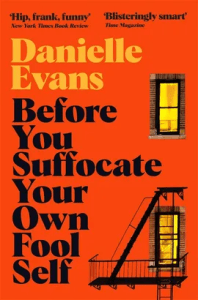 A couple of years ago I reviewed Evans’s second short story collection, The Office of Historical Corrections. This was her first book but has only just been published in the UK. Six of the eight stories are in the first person, the other two in third person. The protagonists tend to be young African American women in moments of transition or clinging to unhealthy relationships. In “Virgins,” 15-year-old Erica and Jasmine want to shed their innocence but can’t necessarily control how it happens. “Snakes” has Tara, a transracial adoptee, spending her ninth summer with her white cousin, Allison, down at their grandmother’s home in Florida. The response to a series of accidents makes it clear to her who is valued in this family. The college girls in “Harvest” consider a variety of reproductive experiences, from selling their eggs to abortion. In “The King of a Vast Empire,” a brother and sister decide to track down a survivor of a car accident their family had when they were children. “Jellyfish” sees a father and daughter meeting for lunch in Harlem and pondering their separate futures.
Many settings were familiar to me from the Delmarva area where I grew up. Here on the cusp of the South, Confederate sympathy still exists, as high schoolers Crystal and Geena discover in “Robert E. Lee Is Dead.” The best friends collaborate on pranks, but Crystal’s grades point to a promising future whereas everyone has given up on Geena, including herself. Along with that one, my two favourites were “Someone Ought to Tell Her There’s Nowhere to Go” and “Wherever You Go, There You Are.” In the former, military veteran Georgie tries to ingratiate himself with his ex-girlfriend by treating her daughter to a princess experience; in the latter, Carla takes her would-be-sexpot 14-year-old niece, Chrissie, on a road trip to North Carolina to meet her ex’s fiancée. Both are exemplary of the assets of the whole collection: strong characters, natural dialogue, and subtle treatment of themes of class and race. I’d proffer this for fans of Sidik Fofana, and as a better option than Dantiel Moniz’s stories.
With thanks to Picador for the proof copy for review.
Enchantment: Reawakening wonder in an exhausted age by Katherine May
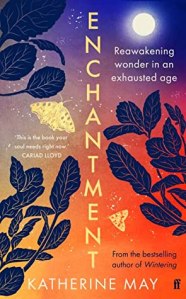 I was a big fan of Katherine May’s Wintering, which published just before the pandemic and, as if presciently, offers strategies for coping with seasons of depression. Coming after a few years of upheaval and disconnection, this follow-up voices May’s longing for rituals of the transcendent that will allow her to live in harmony and close attention to the world around her. Her usual way of communing with nature and other people was group swims in the sea, but that temporarily stopped with lockdown. She sought alternatives, such as visiting a sacred well with a friend, beekeeping, cultivating a wild garden, and chasing a meteor shower. The Earth – Water – Fire – Air structure is sometimes forced, and the content sparse; like Raynor Winn, May, I feel, was pressured to capitalize on the success of her previous work and quickly publish unfinished and rather nebulous material. It’s all surprisingly woo-woo from an English author. Yet May’s writing is unfailingly lovely and this went down easy a chapter at a time. It’s a comparable read to Wanderland by Jini Reddy.
With thanks to Faber for the proof copy for review.
Eggs in Purgatory by Genanne Walsh
I reviewed Genanne Walsh’s novel Twister as part of my summer reading in 2018. This autobiographical essay, recently published by WTAW Press and a finalist in their Alcove Chapbook Series Open, tells the story of the last few months of her father’s life. Aged 89, he lived downstairs from Walsh and her wife in San Francisco. He was quite the character: idealist, stubborn, outspoken; a former Catholic priest influenced by A Course in Miracles and convinced of the oneness of everything. Although he had no terminal conditions, he was sick of old age and its indignities and ready to exit. (“He wanted to be put on an ice floe and pushed offshore. The problem was, I lived above him on the iceberg and would be tasked with shoving him off.”) However, there was confusion about California state laws and whether doctors could help him with this, and at one point the police showed up at the door.
 The title refers to a Middle Eastern dish (see this Nigella Lawson recipe) I’ve known as shakshuka. It was the last proper meal her father ate, Christmas morning 2017 with her and her wife, before he went on his final hunger strike. Later Walsh writes, “Mourning is a kind of purgatory. You exist between worlds. For a long time I walked through, not fully feeling the world of the living or the world of the dead but aware of both.”
The task of a memoir is to fully mine the personal details of a situation but make of it something universal, and that’s just what she does here. Her father’s past with her mother (who died decades before, following a stroke) renders the family dynamic a backdrop to a final pyrrhic battle. Aware that she doesn’t come out of this a saint, Walsh admits to contradictory feelings, including “my life will be so much easier when he dies.” The prediction, no less than its reality, makes her feel guilty. Though she has no faith as such, she senses her father’s influence in her very desire to keep communing with him after his death.
This stunning little book met me at a deep place and I can highly recommend it, especially if you were a fan of In Love by Amy Bloom and All Things Consoled by Elizabeth Hay. (See also The Inevitable – one of its case studies reminded me of this.)
With thanks to the author for the free e-copy for review.
And one dud:
 Birnam Wood by Eleanor Catton – This year’s Klara and the Sun for me: I have trouble remembering why I was so excited about Catton’s third novel that I put it on my Most Anticipated list for 2023, especially given my decidedly mixed feelings about The Luminaries. I’d read a lot about Birnam Wood so its plot held no surprises for me. An American tech billionaire is up to no good on a New Zealand nature reserve; though the members of a guerrilla gardening group summon courage to fight back, his drones see all.
From early on I had little interest in the cast and their doings, especially the buzzword-filled dialogues, and skimmed the rest. Literary fiction usually distinguishes itself from commercial genre fiction by its focus on character depth (and prose quality), but in Catton’s case that was achieved through endless backstory. Her attempt at edginess entails adding at least one F-word to each spoken sentence. (The Bookshop Band, usually so mild-mannered, reflected this by dropping an F-bomb in their song based on the book – see the music video, which cleverly employs a derelict greenhouse and drones.) I’d heard that the ending was a knockout, so I skipped ahead and did find the last 40 pages gripping and the gruesome final tableau worthy of the Shakespearean allusions, but there’s a lot of blah to wade through before that.
With thanks to Granta for the free copy for review.
Would you be interested in reading one or more of these?
January Releases, Part III: Taylor Harris, Cathy Rentzenbrink & Tanya Shadrick
Rounding off my three-part look at some of the month’s new releases with two memoirs plus a memoir-writer’s self-help guide today. (Can you tell I’m a memoir junkie?) Topics range from medical mysteries and covert racism to a reclaiming of life after a near-death experience, but these three nonfiction works by women are linked by the determination to overcome self-doubt.
This Boy We Made: A Memoir of Motherhood, Genetics, and Facing the Unknown by Taylor Harris
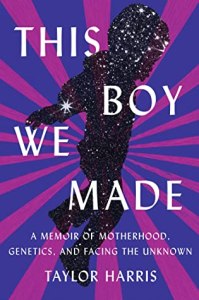 One morning, Taylor Harris and her husband (an African American family based in Charlottesville, Virginia) found their 22-month-old son Christopher, nicknamed “Tophs,” awake but unresponsive in his crib. In the years that followed, she and his doctors looked for answers as to why his body couldn’t regulate his blood sugar levels, sometimes leading to seizures, and to why his speech and mental processing remained delayed. All their tests and theories have never amounted to a conclusive diagnosis. This was a book that repeatedly surprised me. I’d assumed it would be exclusively about the medical mystery of Tophs’s physical and intellectual disability. But Harris elegantly weaves in a lot of other themes, too: mental illness, her own physical concerns (a BRCA2 mutation), racism, faith, and advocating for her children’s health and education. (Full review at BookBrowse.)
Write It All Down: How to put your life on the page by Cathy Rentzenbrink
Cathy Rentzenbrink is a lovely human being, and I’ve always appreciated her enthusiastic support of books. I’ve read all of her work even though I’ve been disappointed with her last few releases. There are so many writing guides out there – including several on memoir-writing specifically – that the first question to ask about one is, does it offer anything new? For me, this one doesn’t. In fact, it’s more of a therapy session than a practical writing guide.
 The undemanding prose slides right down, but 60 pages in (at the end of Part One, “Preparation”) I realized all we’d had thus far was enumerating and countering the hang-ups of unconfident, procrastinating would-be writers. The rest of the book does then get into the nitty-gritty of producing a first draft (“Excavation”) of a life story and editing it into a more polished form. Rentzenbrink peppers in little tricks to keep oneself at the desk, like setting a timer or micro-goals, writing a section in the form of a letter, and dredging up sensory details. Most of the mini chapters are just a couple of pages. Several end with a series of prompts. I’m notorious for skipping the application questions in self-help books, but I’d be interested to hear if other readers have actually gone through these exercises and found them helpful.
I’m so familiar with the author’s own story from her three autobiographical works that I was less than patient about encountering certain incidents again here – though I was intrigued to learn that she gave up alcohol in the recent past after realizing that she was a problem drinker. I’ve also read most of the material in her Further Reading list; all told, I didn’t feel this book offered me much, as a lay reader or a maybe-some-day memoirist. But it seems to have been enormously popular among critics and readers (its average Goodreads rating is 4.38), so clearly a lot of people have been finding Rentzenbrink’s down-to-earth approach reassuring.
With thanks to Emma Finnigan PR and Bluebird for the proof copy for review.
The Cure for Sleep: Memoir of a Late-Waking Life by Tanya Shadrick
From my Most Anticipated list. Shadrick hangs around the fringes of nature writing cliques on Twitter, so I expected this to have more of a nature/travel element. Instead, it bears a fairy tale ambience, of a little girl lost in the woods and craving freedom; of a sleepwalking woman deciding to live more deliberately. It opens with a near-death experience: Shadrick, new mother to a son conceived after infertility treatment, suffered a severe haemorrhage after the placenta tore an artery and was rushed to hospital for emergency surgery.
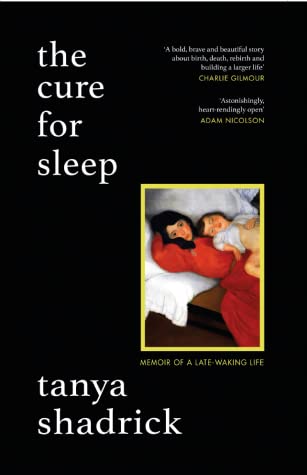 From this point she returns to the beginning of her life and proceeds chronologically, pausing at joyful or traumatic moments. Her childhood feels like the key to understanding everything else: her father left when she was a baby; her mother, all too aware of being of lower class, was driven to improve herself. Shadrick wanted her mother all to herself, at the same time as she felt trapped by her. She injured herself jumping off an outhouse roof in protest at her mother’s new boyfriend, who became her stepfather. At university she reacted against her upbringing in predictable ways, failing her first year and having an abortion. Even once happily married, she kept unconsciously searching for surrogate father (older male) figures.
After the postnatal operation, she felt a need to escape – by suicide if necessary – yet forced herself to stay, make connections in her town and be present for her children. But she remained a free spirit, swimming and writing a mile-long scroll as public performance art. Her work with hospice patients, recording their memories, qualified her to edit Lynne Roper’s wild swimming diaries into a Wainwright Prize-longlisted book.
Awakening versus sleep is the figurative framework for the memoir, with a feminist insistence on freedom and self-fulfilment at the same time as being a mother. This is an unusual book – at times overwritten and too deliberately moulded into tropes as a rebuttal to randomness, even though, looking back, I can’t decipher a coherent plot to the events – that reminded me most of Free Woman by Lara Feigel and I Am, I Am, I Am by Maggie O’Farrell.
With thanks to W&N for the free copy for review.
Does one of these books appeal to you?
A Spate of Swimming Memoirs
In the first four months of this year, I got my hands on no fewer than four swimming memoirs. For the upcoming July/August issue of Foreword Reviews magazine I’ve reviewed Floating: A Life Regained by Joe Minihane, in which the author recreates the late nature writer Roger Deakin’s wild swimming journeys from Waterlog (1999) in an attempt to overcome anxiety; I have Leap In by Alexandra Heminsley on my Kindle; and I read roughly the first 60 pages of a library copy of Al Álvarez’s 2013 Pondlife: A Swimmer’s Journal.
For now, I’m featuring Turning by Jessica J. Lee, which has strong similarities to these other memoirs – especially Minihane’s – but is its own beautifully reflective personal story. The book arose from Lee’s resolution, when she was 28 and in Berlin on a research placement for her dissertation in environmental history, to swim in 52 local lakes – a year’s worth – no matter the weather. At the time she blogged about her “52 Lakes Project” for Slow Travel Berlin, and kept friends and family up to date through social media as well. Her focus would be on the former East German region of Brandenburg, which has Berlin at its center and was first popularized by Theodor Fontane’s 1862 travel book.
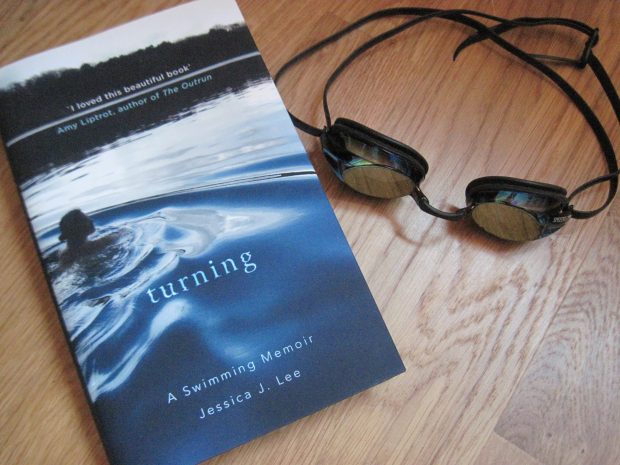
Lee traveled to the lakes under her own steam, using trains and her bicycle; occasionally she took friends with her, but most often she was alone, which became a chance to cultivate solitude – not the same as loneliness. The challenge entailed all kinds of practical difficulties like bike trouble, getting lost, and a dead phone battery, but gradually it became routine and held less fear for her. On summer days she could manage multiple lakes in a day, and even small encounters with Germans gave her a newfound sense of belonging.
Within chapters, the memoir gracefully alternates pieces of the author’s past with her lake travels. With a father from Wales and a mother from Taiwan, Lee grew up in Ontario and spent summers in Florida. She remembers taking YMCA swimming lessons alongside her mother, and swimming in Canadian lakes. Back then the water usually intimidated her, but over the years her feelings have changed:
Water feels different in each place. The water I grew up with was hard, cutting, and when I go back to visit it now, I feel it in my ears when I dive in. something different, more like rock. The lake a whetted blade. The water in Berlin has a softness to it. Maybe it’s the sand, buffing the edges off the water like splinters from a beam. It slips over you like a blanket. There’s a safety in this feeling. In the lakes here, there is a feeling of enclosure and security that Canada can’t replicate. And it shouldn’t – the pelagic vastness there is entirely its own, and I’ve learned to love that too.
Swimming fulfills many functions for Lee. It served variously as necessary discipline after going mildly off the rails in young adulthood (drinking, smoking pot and having an abortion during college; a short-lived marriage in her early twenties); as a way of bouncing back from depression when her planned life in London didn’t pan out and a budding relationship failed; and as a way of being in touch with the turning seasons and coming to know the German landscape intimately. Symbolically, of course, it’s also a baptism into a new life.
Yet I had to wonder if there was also something masochistic about this pursuit, especially in the winter months. On the back cover there’s a photograph of Lee using a hammer to chip out a path through the ice so she can do her minimum of 45 strokes. (No wetsuit!) As spring came, ironically, the water felt almost too warm to her. She had learned to master the timing of a winter swim: “Between pain and numbness there’s a brightness, a crisp, heightened sensation in the cold: that’s the place to swim through. When it ends, when numbness arrives, it’s time to get out.”
The end of Lee’s year-long project is bittersweet, but she’s consoled by the fact that she didn’t have to leave her ordinary life in order to complete it. It was a companion alongside the frantic last-minute work on her dissertation and it never got in the way of her relationships; on the contrary, it strengthened certain friendships. And with Berlin looking like her home for the foreseeable future, she’s committed to seeking out more lakes, too.
There are a lot of year quest books out there, but this one never feels formulaic because there’s such a fluid intermingling of past and present. As memoirs go, it is somewhat like Amy Liptrot’s The Outrun – but much better. It’s also comparable to Angela Palm’s Riverine, with a watery metaphor at the heart to reflect the author’s conception of life as a meandering route. Unlike the other swimming memoirs I’ve sampled, I can recommend this one to a general reader with no particular interest in wild swimming or any other sport. It’s for you if you enjoy reading about the ebb and flow of women’s lives.
In the stillness of the lakes, the border between nature and culture is thinned. Swimming takes place at this border, as if constantly searching for home. Water is a place in which I don’t belong, but where I find myself nonetheless. Out of my culture, out of my depth.
There is more space inside than I can imagine, more hope and possibility than I’d known. Feeling as clear as the day, as deep as the lake.
Turning: A Swimming Memoir was published in the UK by Virago on May 4th. My thanks to the publisher for sending a free copy for review.
My rating: 
 Bookish Beck = Rebecca Foster. American transplant to England. Freelance proofreader and book reviewer.
 Bookish Beck