Three on a Theme: Bog Body Novels by Balen, Holmes & North
I’ve been down something of a rabbit hole this year, reading four novels centred on the discovery of a bog body. I heard about Anna North’s first and, as a big fan of The Life and Death of Sophie Stark (and, to a lesser extent, Outlawed), had to read it. Who could resist the setup of scientists trying to solve a millennia-old murder mystery? When I learned that the theme of Katya Balen’s adult fiction debut was similar, there was no choice but to make it a trio. Through the library I located a teen novel that links the discovery of a bog body at the Irish border with a young man’s experience of The Troubles, Bog Child by Siobhan Dowd. I ended up reviewing that for Reading Ireland Month instead, but then spotted a backlist mystery – again, about a bog body discovery in Ireland – and couldn’t resist.
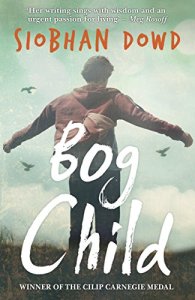
There are some common elements in all four of these novels. The authors briefly mention the special qualities of peat bog that preserve a corpse. In each case, the body is unearthed by accident and found to be that of a victim of violence – a kind of symbolic, corporate punishment. A female archaeologist is the lead researcher caught up in studying the body. In the Holmes and North, the archaeologist is the main character and has to deal with protesters; the other two feature a lay protagonist. The discovery becomes a matter of personal significance for all of them, though. (Discussed in the order in which I read them. The three below are also linked by an Anna!)
Bog Queen by Anna North (2025)
Dr. Agnes Linstrom is an American forensic scientist in Manchester for a postdoctoral fellowship. When a woman’s body is found in a patch of peat bog in Ludlow, she’s called down to give her expert opinion. Police think they’ve finally solved a 1960s spousal murder, but it soon becomes clear that the corpse is much, much older. Alternating chapters follow Agnes’s 2018 investigation, complicated by competing claims on the bog (a peat company vs. environmental protesters, who have occupied the site); and the story of the Iron Age druid who came to be buried in the bog.
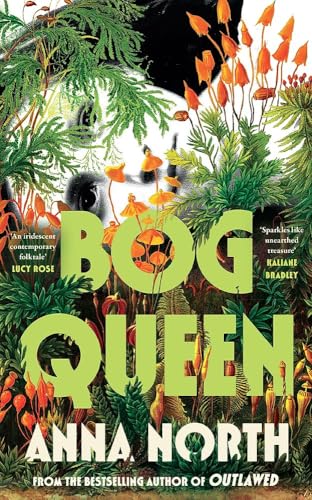 As per usual with a dual-narrative novel, I was more engaged with the contemporary storyline, so rather felt I had to push myself through the historical material so I could get back to the good stuff. Luckily, though, North doesn’t spoil the Celtic Britain segments with too much research or attempts at archaic speech. Occasional short sections from the point-of-view of a colony of moss were unnecessary but harmless. Subtle parallels emerge between Agnes and the druid, both young women who have to fight to be taken seriously, hope to live up to family expectations, and struggle to see the way forward.
Agnes works with other female scientists who seem to represent different ways of living: Sunita, who’s married to a woman and has a teenage daughter, Ruby; and Danielle, who’s easing back into work after a difficult childbirth. I thought the connections to Agnes’s past and potential future were a little heavy-handed in the party scene where she commiserates with Ruby over mental health and holds Danielle’s baby. If I were being unkind, I might also say that the characters are designed to tick boxes (Sunita = South Asian and queer; Nicholas, the lead protester = Black). Overall, though, this is illuminating about women’s lives then and now – not as different as one might hope – and kept me turning the pages to find out what happened to the not one, but two, bodies the bog disgorges. (Public library)
{SPOILERS IN THE NEXT TWO}
Our Numbered Bones by Katya Balen (2026)
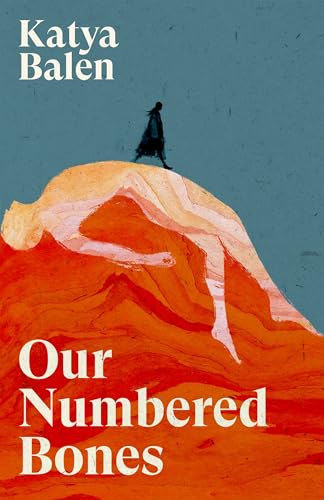 This was Balen’s adult debut after many works for children. Anna is stuck on her contracted novel when she gets a place on a retreat for writers who are struggling financially. Her struggle is more against despair, though: her mother is disappearing into dementia, and she recently had a stillborn daughter. The latter fact is not fully revealed until maybe halfway through, despite some heavy foreshadowing, so until then we are left to wonder why Anna left her husband, JP, who seems like a great guy (a considerate French chef, what’s not to like?), and why she is so inept and bent on sabotaging her own life.
When a bog body is found near the cottage where she’s staying, Anna becomes imaginatively and emotionally involved in the ensuing exhumation. As in Bog Child and Bog Queen, the corpse is that of a woman and it becomes clear that she was executed – punishment for a perceived social infraction, but also emblematic of the systemic misogyny of the time. Anna becomes enmeshed with the archaeologists, especially Jen, who wears a custom ring as a tribute to each woman she has found dead.
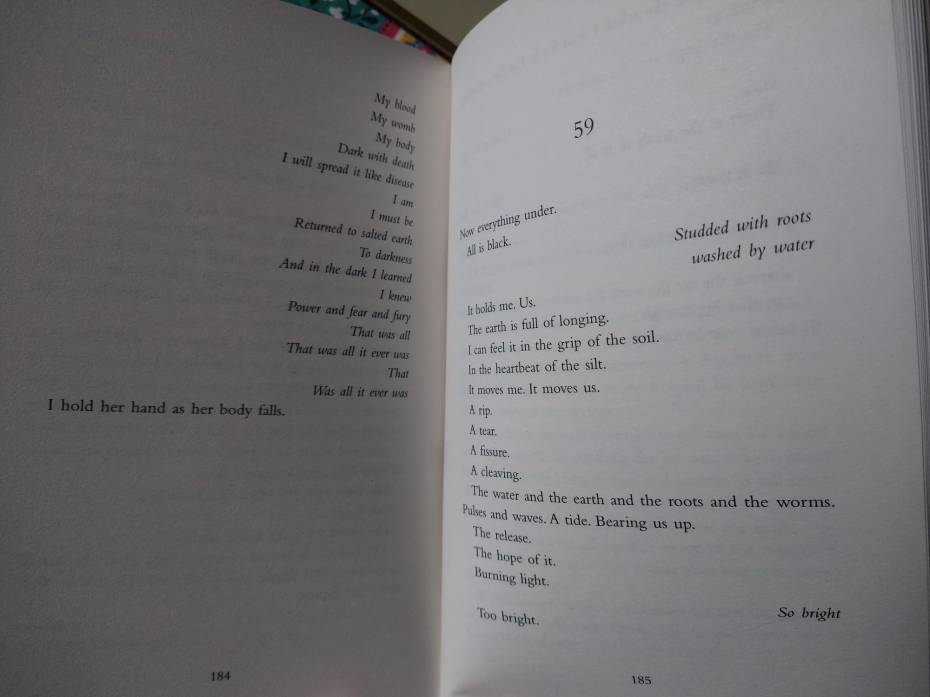
While the content of this novel ticked a lot of interest boxes for me, I didn’t particularly enjoy the style. The attempt to wring poetry out of a mental health crisis too often results in pretentious fragments – as in this sample two-page spread. (Read via Edelweiss / Public library)
The Find by Anna M Holmes (2022)
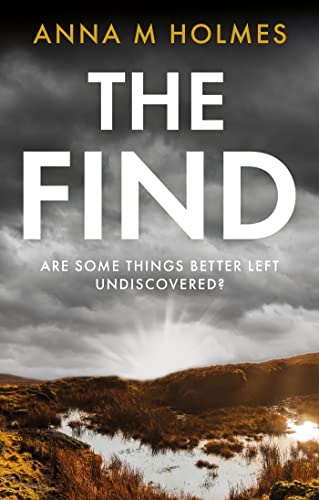 Construction on a retail park in Ireland stops abruptly when a digger encounters a body in the peat, and before long it’s clear that this is not a Troubles victim. Dr Carrie O’Neill, a young archaeologist from New Zealand, becomes “the Face of the Find” as media outlets become increasingly obsessed with the mystery of Ballybere Man. The furore only heightens when certain research conclusions are released about him: he was from Palestine, lived about two thousand years ago, had his body lovingly embalmed with pine needle stuffing and a coating of honey, and has wounds in his feet and hands consistent with crucifixion.
It’s such an interesting setup, pitting the scientists, who are determined to uncover the whole truth, against the religious powers that be – everyone from the Roman Catholic hierarchy to American fundamentalists – to whom the very idea of Jesus’s physical body being extant is an affront. Holmes makes Carrie a sympathetic character what with her homesickness, grief for her grandmother, relationship with Irish Times journalist Finn Durante, and harassment by extremists. But I was disappointed that a pretty standard thriller plot of abduction, blackmail, and violence ensues. From the cover you can tell that the author and publisher were hoping to attract readers of Peter May. The bog body itself is just a stand-in for an ideological impasse and so ends up feeling less important than in any of the other novels. (Read via BookSirens)
Another readalike: Meet Me at the Museum by Anne Youngson, a charming, bittersweet epistolary novel in which an English farmer’s wife writes to the curator at the Silkeborg Museum in Denmark about the Tollund Man.
“Peat might just save the world.”
~Victoria Gatehouse
 Last year a book I helped crowdfund, The Book of Bogs, edited by Anna Chilvers and Clare Shaw, was released by independent publisher Little Toller Books. The project began as a protest against a proposed wind farm that would obliterate Walshaw Moor in Yorkshire, which inspired the Brontë sisters and Ted Hughes. It’s astonishingly comprehensive and I’m only a third of the way through so far. I’ve been reading slowly, one or two pieces a week. There is art and poetry (I’ve been enjoying this the most so far) as well as environmentally minded essays. I’m looking forward to work by some greats of the nature writing world.
Earlier this year, I got to attend a special preview evening (put on for local charities – this was in my capacity as a Repair Café volunteer) of the Wildlife Photographer of the Year Award exhibition at The Base in Greenham. I was already working on this trio so was alert for photographs of bogs and moss.


#ReadIndies Review Catch-Up: Chevillard, Hopkins & Bateman, McGrath, Richardson
Quick thoughts on some more review catch-up books, most of them from 2025. It’s a miscellaneous selection today: absurdist flash fiction by a prolific French author, a self-help graphic novel about surviving heartbreak, a blend of bird photography and poetry, and a debut poetry collection about life and death as encountered by a parish priest.
Museum Visits by Éric Chevillard (2024)
[Trans. from French by David Levin Becker]
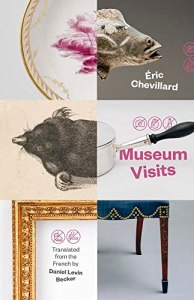 I’d not heard of Chevillard, even though he’s published 22 novels and then some. This appealed to me because it’s a collection of micro-essays and short stories, many of them witty etymological or historical riffs. “The Guide,” a tongue-in-cheek tour of places where things may have happened, reminded me of Julian Barnes: “So, right here is where Henri IV ran a hand through his beard, here’s where a raindrop landed on Dante’s forehead, this is where Buster Keaton bit into a pancake” and so on. It’s a clever way of questioning what history has commemorated and whether it matters. Some pieces elaborate on a particular object – Hegel’s cap, a chair, stones, a mass attendance certificate. A concertgoer makes too much of the fact that they were born in the same year as the featured harpsichordist. “Autofiction” had me snorting with laughter, though it’s such a simple conceit. All Chevillard had to do in this authorial rundown of a coming of age was replace “write” with “ejaculate.” This leads to such ridiculous statements as “It was around this time that I began to want to publicly share what I was ejaculating” and “I ejaculate in all the major papers.” There are some great pieces about animals. Others outstayed their welcome, however, such as “Faldoni.” Most feel like intellectual experiments, which isn’t what you want all the time but is interesting to try for a change, so you might read one or two mini-narratives between other things.
With thanks to the University of Yale Press for the free copy for review.
What to Do When You Get Dumped: A Guide to Unbreaking Your Heart by Suzy Hopkins; illus. Hallie Bateman (2025)
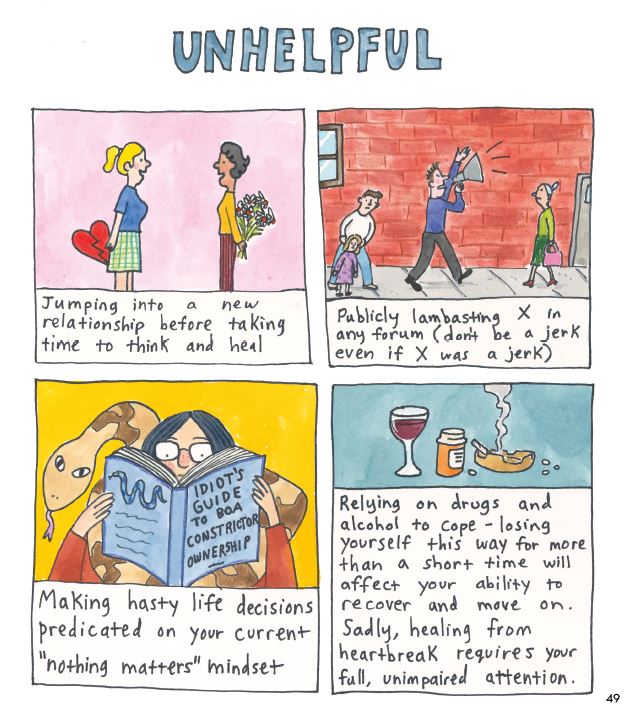
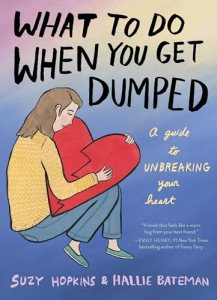 Discovered through Molly Wizenberg’s excellent author interview (she did a series on her Substack, “I’ve Got a Feeling”) with illustrator Hallie Bateman. It’s a mother–daughter collaboration – their second, after What to Do When I’m Gone, a funny advice guide that’s been likened to Roz Chast’s work (I’ve gotta get that one!). Hopkins’s husband of 30 years left her for an ex-girlfriend. (Ironic yet true: the girlfriend was a marriage counselor.) Composed while deep in grief, this is a frank look at the flood of emotions that accompany a breakup and gives wry but heartfelt suggestions for what might help: journaling, telling someone what happened, cleaning, making really easy to-do lists. Hopkins interviewed six others who had been dumped to get some extra perspective. Bateman describes her mother’s writing process: she made notes and stuck them in a shoebox with a hole in the lid, then went on a retreat to combine it all into a draft. At this point Bateman started illustrating. It was complicated for her, of course, because the dumper is her dad. She notes in the interview that she couldn’t just say “He’s an asshole” and dismiss him. But she could still position herself as a girlfriend to her mother, listening and commiserating. The vignettes are structured as a countdown starting with day 1,582 – it took over four years for Hopkins to come to terms with her loss and embrace a new life. This is a cute and gentle book that I wish had been around for my mom; it’s a heck of a lot cheaper than therapy.
With thanks to Bloomsbury for the free e-copy for review.
The Beauty of Vultures by Wendy McGrath; photos by Danny Miles (2025)
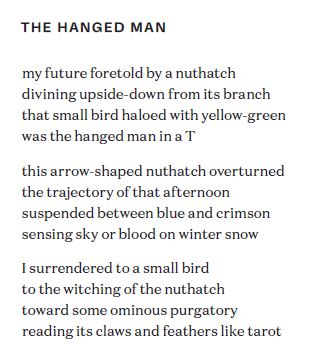
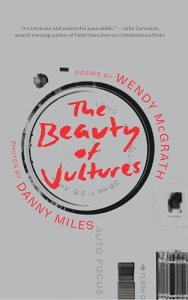 I enjoyed McGrath’s Santa Rosa trilogy and was keen to try her poetry, so I’m pleased that Marcie’s review pointed me here. McGrath came to collaborate with Miles, a musician, after her son told her of Miles’s newfound love of bird photography. She writes in her introduction that she wanted to go “beyond a simple call-and-response,” to instead use the photos as “portals” into art, history, memory, mythology, wordplay. The form varies to suit the topic: “sonnet, pantoum, acrostic, ghazal, concrete poem, … even a mini-play.” (I didn’t identify all of these on a first read, to be honest.) One poem imitates a matchbox cover and another is printed sideways. Most of the images are black-and-white close-ups, with a handful in colour. There are a few mammals as well as birds. One notable flash of colour is the recipient of the first poem, the sassy rebuttal “A Message from the Peahen to the Peacock.” The hen tells him to quit with the fancy displays and get real: “I’ve seen that gaudy display too often.”
Other poems describe birds, address them directly, or take on their perspectives. Birds are a reassuring presence (cf. Ted Hughes on swifts): “I counted on our robins to return every spring” as a balm, the anxious speaker reports in “Air raid siren.” A nest of gape-mouthed baby swallows in an outhouse is the prize at the end of a long countryside walk. With its alliteration and repetition, “The Goldfinch Charm” feels like an incantation. Birds model grace (or at least the appearance of grace):
Assume a buoyancy, lightness, as though you were about to fly.
That yellow rubber duck is my surreal mythology.
Head above water. Stay calm. Paddle like crazy.
They link the natural world and the human in these gorgeous poems that interact with the images in ways that both lead and illuminate.
A female swan is a pen and eyes open
I try to write this dream:
a moment stolen or given.
Published by NeWest Press. With thanks to the author for the free e-copy for review.
Dirt Rich by Graeme Richardson (2026)
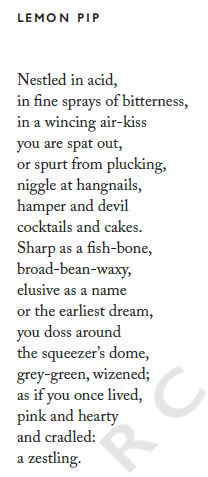
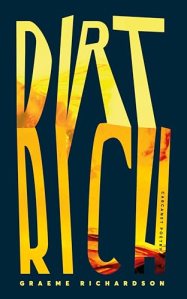 Dirt poor? Nah. Miners, gravediggers and archaeologists will tell you that dirt is precious. It’s where lots of our food and minerals come from; it’s what we’ll return to – our bodies as well as the material traces of what we loved and cared for. Richardson, the poetry critic for the Sunday Times, comes from Nottinghamshire mining country and has worked as a chaplain and parish priest. He writes of church interiors and cemeteries, funerals and crumbling faith. There’s a harsh reminder of life’s unpredictability in the juxtaposition of “For the Album,” about the photographic evidence of a wedding day; and, beginning on the facing page, “After the Death of a Child.” It opens with “A Pastoral Heckle”: “The dead live on in memory? Not true. / They lodge there dead, and yours not theirs the hell.” Richardson now lives in Germany, so there are continental scenes as well as ecclesial English ones. The elegiac tone of standouts such as “Last of the Coalmine Choirboys” (with its words drawn from scripture and hymns) is tempered by the chaotic joy of multiple poems about parenthood in the final section. Throughout, the imagery and language glisten. I loved the slant rhyme, assonance and sibilance in “Rewilding the Churchyard”: “Cedars and self-seeders link / with the storm-forked sycamore.” I highly recommend this debut collection.
With thanks to Carcanet Press for the advanced e-copy for review.
Which of these do you fancy reading?
Summer 2021 Reading, Part II & Transitioning into Autumn
In the past couple of weeks, we’ve taken advantage of the last gasp of summer with some rare chances at socializing, outdoors and in. Our closest friends came to visit us last weekend and accompanied us to a beer festival held in a local field, and this weekend we’ve celebrated birthdays with a formal-wear party at a local arts venue and a low-key family meal.


After my first installment of summer reads, I’ve also finished Klara and the Sun (a bust with me, alas) and the three below: a wildlife photographer’s memoir of lockdown summer spent filming in the New Forest, a record of searching for the summer’s remnants of snow in the Highlands, and an obscure 1950s novel about the psychological connections between four characters in one Irish summer. I close with a summer-into-autumn children’s book.
Goshawk Summer: A New Forest Season Unlike Any Other by James Aldred (2021)
My second nature book about the New Forest this year (after The Circling Sky by Neil Ansell) has only sharpened my hankering to get back there and have a good wander after many years away. In March 2020, Aldred had recently returned from filming cheetahs in Kenya when the UK went into its first national lockdown. He had the good fortune to obtain authorization from Forestry England that allowed him to travel regularly from his home in Somerset to the New Forest to gather footage for a documentary for the Smithsonian channel.
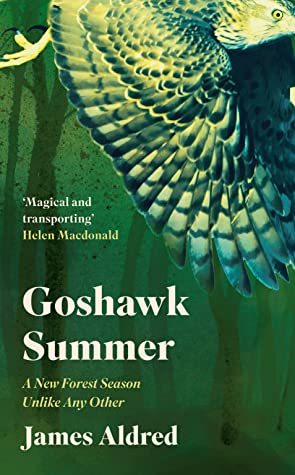 Zooming up on empty roads and staying in local cottages so he can start at 4 each morning, he marvels at the peace of a place when humans are taken out of the equation. His diary chronicles a few months of extraordinary wildlife encounters – not only with the goshawks across from whose nest he built a special treetop platform, but also with dragonflies, fox cubs, and rare birds like cuckoo and Dartford warbler. The descriptions of animal behaviour are superb, and the tone is well balanced: alongside the delight of nature watching is anger at human exploitation of the area after the reopening and despair at seemingly intractable declines – of 46 curlew pairs in the Forest, only three chicks survived that summer.
Despite the woe at nest failures and needless roadkill, Aldred is optimistic – in a similar way to Ansell – that sites like the New Forest can be a model of how light-handed management might allow animals to flourish. “I believe that a little space goes a long way and sometimes all we really need to do is take a step back to let nature do its thing. … It is nature’s ability to help itself, to survive in spite of us in fact, that gives me tentative hope”. (Unsolicited review copy) 
With thanks to Elliott & Thompson for the free copy.
Among the Summer Snows by Christopher Nicholson (2017)
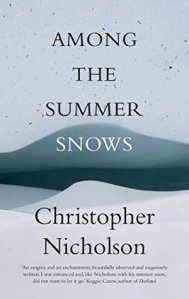 After the death from cancer of his wife Kitty, a botanical illustrator, Nicholson set off for Scotland’s Cairngorms and Ben Nevis in search of patches of snow that persist into summer. “Summer snow is a miracle, a piece of out-of-season magic: to see it is one thing, to make physical contact with it is another.” His account of his travels washed over me, leaving little impression. I appreciated the accompanying colour photographs, as the landscape is otherwise somewhat difficult to picture, but even in these it is often hard to get a sense of scale. I think I expected more philosophical reflection in the vein of The Snow Leopard, and, while Nicholson does express anxiety over what happens if one day the summer snows are no more, I found the books on snow by Charlie English and Marcus Sedgwick more varied and profound. (Secondhand, gifted)
A Shower of Summer Days by May Sarton (1952)
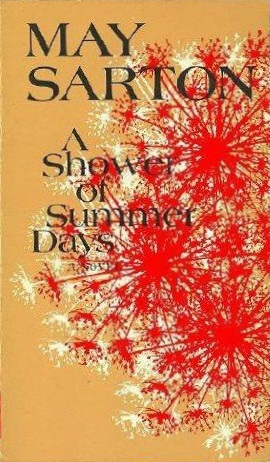 Although I’m more a fan of Sarton’s autobiographical material, especially her journals, I’ve also enjoyed exploring her fiction. This was my seventh of her novels. It’s set in Ireland at Dene’s Court, the grand house Violet inherited. She and her husband Charles have lived in Burma for two decades, but with the Empire on the wane they decide to settle in Violet’s childhood home. Gardening and dressing for dinner fill their languid days until word comes that Violet’s 20-year-old niece, Sally, is coming to stay.
The summer is meant to cure Sally of her infatuation with an actor named Ian. Violet reluctantly goes along with the plan because she feels so badly about the lasting rivalry with her sister, Barbara. Sally is a “bolt of life” shaking up Violet and Charles’s marriage, and when Ian, too, flies out from America, a curious love triangle is refashioned as a quadrilateral. The house remains the one constant as the characters wrestle with their emotional bonds (“the kaleidoscope of feelings was being rather violently shaken up”) and reflect on the transitory splendour of the season (“a kind of timelessness, the warm sun in the enclosed garden in the morning, the hum of bees, and the long slow twilights”). This isn’t one of my favourites from Sarton, but it has low-key charm. I saw it as being on a continuum from Virginia Woolf to Tessa Hadley (e.g. The Past) via Elizabeth Bowen. (Secondhand purchase from Awesomebooks.com) 
And finally, one for the seasons’ transition:
Goodbye Summer, Hello Autumn by Kenard Pak (2016)
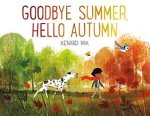 A child and dog pair set out from home, through the woods, by a river, and into town, greeting other creatures and marking the signs of the season. “Hello!” the beavers reply. “We have no time to play because we’re making cozy nests and dens. It will be cold soon, and we want to get ready.” The quaint Americana setting and papercut-style illustrations reminded me of Vermont college towns and Jon Klassen’s work. I liked the focus on nature. (Free from a neighbour)
 Bookish Beck = Rebecca Foster. American transplant to England. Freelance proofreader and book reviewer.
