I never believe people who say they read 300-page novels in a sitting. How is that possible?! I’m a pretty slow reader, I like to bounce between books rather than read one exclusively, and I often have a hot drink to hand beside my book stack, so I’d need a bathroom break or two. I also have a young cat who doesn’t give me much peace. But 100 pages or thereabouts? I at least have a fighting chance of finishing a novella in one go. Although I haven’t yet achieved a one-sitting read this month, it’s always the goal: to carve out the time and be engrossed such that you just can’t put a book down. I’ll see if I can manage it before November is over.
A couple of longish car rides last weekend gave me the time to read most of three of these, and the next day I popped the other in my purse for a visit to my favourite local coffee shop. I polished them all off later in the week. I have a mini memoir in pets, a surreal Japanese story with illustrations, an innovative modern classic about bereavement, and a set of short essays about money and commodification.
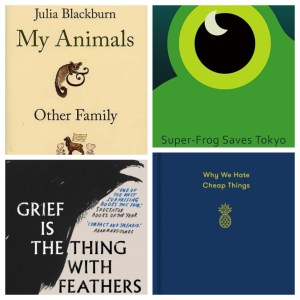
My Animals and Other Family by Julia Blackburn; illus. Herman Makkink (2007)
 In five short autobiographical essays, Blackburn traces her life with pets and other domestic animals. Guinea pigs taught her the facts of life when she was the pet monitor for her girls’ school – and taught her daughter the reality of death when they moved to the country and Galaxy sired a kingdom of outdoor guinea pigs. They also raised chickens, then adopted two orphaned fox cubs; this did not end well. There are intriguing hints of Blackburn’s childhood family dynamic, which she would later write about in the memoir The Three of Us: Her father was an alcoholic poet and her mother a painter. It was not a happy household and pets provided comfort as well as companionship. “I suppose tropical fish were my religion,” she remarks, remembering all the time she devoted to staring at the aquarium. Jason the spaniel was supposed to keep her safe on walks, but his presence didn’t deter a flasher (her parents’ and a policeman’s reactions to hearing the story are disturbingly blasé). My favourite piece was the first, “A Bushbaby from Harrods”: In the 1950s, the department store had a Zoo that sold exotic pets. Congo the bushbaby did his business all over her family’s flat but still was “the first great love of my life,” Blackburn insists. This was pleasant but won’t stay with me. (New purchase – remainder copy from Hay Cinema Bookshop, 2025) [86 pages]
Super-Frog Saves Tokyo by Haruki Murakami; illus. Seb Agresti and Suzanne Dean (2000, 2001; this edition 2025)
[Translated from Japanese by Jay Rubin]
 This short story first appeared in English in GQ magazine in 2001 and was then included in Murakami’s collection after the quake, a response to the Kobe earthquake of 1995. “Katigiri found a giant frog waiting for him in his apartment,” it opens. The six-foot amphibian knows that an earthquake will hit Tokyo in three days’ time and wants the middle-aged banker to help him avert disaster by descending into the realm below the bank and doing battle with Worm. Legend has it that the giant worm’s anger causes natural disasters. Katigiri understandably finds it difficult to believe what’s happening, so Frog earns his trust by helping him recover a troublesome loan. Whether Frog is real or not doesn’t seem to matter; either way, imagination saves the city – and Katigiri when he has a medical crisis. I couldn’t help but think of Rachel Ingalls’ Mrs. Caliban (one of my NovNov reads last year). While this has been put together as an appealing standalone volume and was significantly more readable than any of Murakami’s recent novels that I’ve tried, I felt a bit cheated by the it-was-all-just-a-dream motif. (Public library) [86 pages]
Grief Is the Thing with Feathers by Max Porter (2015)
 A reread – I reviewed this for Shiny New Books when it first came out and can’t better what I said then. “The novel is composed of three first-person voices: Dad, Boys (sometimes singular and sometimes plural) and Crow. The father and his two young sons are adrift in mourning; the boys’ mum died in an accident in their London flat. The three narratives resemble monologues in a play, with short lines often laid out on the page more like stanzas of a poem than prose paragraphs.” What impressed me most this time was the brilliant mash-up of allusions and genres. The title: Emily Dickinson. The central figure: Ted Hughes’s Crow. The setup: Edgar Allan Poe’s “The Raven” – while he’s grieving his lost love, a man is visited by a black bird that won’t leave until it’s delivered its message. (A raven cronked overhead as I was walking to get my cappuccino.) I was less dazzled by the actual writing, though, apart from a few very strong lines about the nature of loss, e.g. “Moving on, as a concept, is for stupid people, because any sensible person knows grief is a long-term project.” I have a feeling this would be better experienced in other media (such as audio, or the play version). I do still appreciate it as a picture of grief over time, however. Porter won the Sunday Times Young Writer of the Year Award as well as the Dylan Thomas Prize. (Secondhand – Gifted by a friend as part of a trip to Community Furniture Project, Newbury last year; I’d resold my original hardback copy – more fool me!) [114 pages]


My original rating (in 2015): 
My rating now: 
Why We Hate Cheap Things by The School of Life (2017)
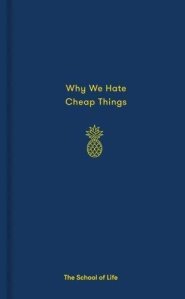 I’m generally a fan of the high-brow self-help books The School of Life produces, but these six micro-essays feel like cast-offs from a larger project. The title essay explores the link between the cost of an item or experience and how much we value it – with reference to pineapples and paintings. The other essays decry the fact that money doesn’t get fairly distributed, such that craftspeople and arts graduates often struggle financially when their work and minds are exactly what we should be valuing as a society. Fair enough … but any suggestions for how to fix the situation?! I’m finding Robin Wall Kimmerer’s The Serviceberry, which is also on a vaguely economic theme, much more engaging and profound. There’s no author listed for this volume, but as The School of Life is Alain de Botton’s brainchild, I’m guessing he had a hand. Perhaps he’s been cancelled? This raises a couple of interesting questions, but overall you’re probably better off spending the time with something more in depth. (Little Free Library) [78 pages]
 Bookish Beck = Rebecca Foster. American transplant to England. Freelance proofreader and book reviewer.

Thanks for the warning on Why We Hate Cheap Things–that title caught my eye.
LikeLiked by 1 person
I’ve enjoyed full-length books that they (or Alain de Botton) have issued.
LikeLiked by 1 person
I’ve read the Porter and agree that it probably works better in some form that incorporates orality, whether that’s an audiobook or the play (which looked brilliant). Of the rest, the Murakami is the most appealing – even though I, like you, tend not to like his novels – but that trope is the worst! Commit to the giant prophetic frog, I beg!
LikeLiked by 1 person
I’m not always convinced by this trend of publishing individual stories in stand-alone volumes, but it does mean that the Murakami was a super-quick read that counted as a whole book! Two giant frogs encountered in fiction in two years, who would believe it?
LikeLike
Now I have to know where the other giant frog was!
LikeLike
Oh – Mrs Caliban, of course.
LikeLiked by 1 person
I saw the play of Grief with Cillian Murphy a few years back and it was stunning. Better than the book, I blame Claire Keegan for this trend of publishing short stories as standalones, it smacks of cash grab if the story isn’t really strong.
LikeLiked by 2 people
I do fancy seeing the play. I reckon it would work better than the book or film.
True, I reckon Keegan is responsible. I DNFed the recent standalone Toibin story.
LikeLiked by 1 person
The Toibin has real ‘possible Christmas present for someone you don’t know very well’ vibes
LikeLiked by 1 person
I have read this one by Murakami. In the US it’s part of a collection of 4 stories
LikeLiked by 1 person
An interesting range here! I must read The Serviceberry, I keep being reminded of it.
LikeLiked by 1 person
It’s good! I was tempted to get the bite-size hardback, but I’m glad I got it on Kindle for 99p instead.
LikeLiked by 1 person
Gah, I have no time for that it-was-all-a-dream nonsense. A friend recently announced she was embarking on a classic network-TV series and it was all I could do to not scream my still-frustrated-after-all-these-years warning.
I used to have a tradition of reading for one whole day during the winter break around or between or on holidays and usually chose a book around 300 pages, and I still remember the books that I read that way…they stood out, in my usual stack of abundance (in a good way). Now, as you say, it’s only an occasional deal, with a novella.
LikeLiked by 1 person
Such a book would stand out to me for that reason. I still remember that I basically could not tear The Wind-Up Bird Chronicle out of my hands one day and read hundreds of pages in it (but then finished it another time).
LikeLike
[…] was reminded of the complications of keeping an exotic pet in My Animals and Other Family by Julia Blackburn, in which she buys Congo the bushbaby from Harrods (and there is also a family […]
LikeLike
[…] My Animals and Other Family by Julia Blackburn [passed on to a book club friend] […]
LikeLike