Thanks to Eleanor, Marcie, and Skai for posting about their library borrowing and reading!
This month marks six years that I’ve been volunteering in my local public library. I’m perversely nostalgic for those early days in summer 2020, when we were closed to the public and staff and volunteers socially distanced around an otherwise empty library.
In a normal year, I always forget just how busy the library gets during the school holidays. The children’s shelves, especially, look ransacked and the number of reservation requests shoots up as kids (and some adults) work towards the Summer Reading Challenge. I look forward to things quieting down again.
My library recently acquired the Wainwright Prize shortlists, so I’m taking advantage of the opportunity to read most of the Conservation titles (whereas the Nature writing titles mostly struck me as samey). I’m hoping it will also buy more from the Booker Prize longlist – besides the Harrison and Perry, which I’m waiting for. You can see I’ve also been stocking up on short story collections for Short Story September, which starts tomorrow!
My library use over the last month:
(links are to any book reviews not already featured on the blog)
READ
- Our Spoons Came from Woolworths by Barbara Comyns (for Classics book club)

- I Feel Bad about My Neck by Nora Ephron

- One Ukrainian Summer by Viv Groskop
- The Shock of the Light by Lori Inglis Hall
- Kakigori Summer by Emily Itami
- The New Carthaginians by Nick Makoha

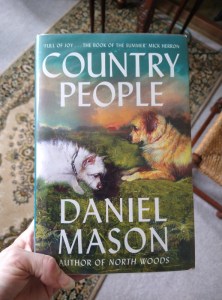
- Country People by Daniel Mason
- The Heartstopper Yearbook by Alice Oseman
- Heartstopper: Volume 6 by Alice Oseman
- The Land and Its People by David Sedaris
+
Women in Translation Month reads:
(All originally published in French, though Valckx is Dutch?)
 The Years by Annie Ernaux [transl. Alison L. Strayer]: This was a buddy read with Marcie of Buried in Print, though she quickly zoomed ahead! I preferred it to some of Ernaux’s other short memoirs (Happening, I Remain in Darkness, A Woman’s Story) precisely because it is not a memoir but a portrait of her life and times, mostly delivered in the first-person plural with some third person – in the late pages she herself calls it an “impersonal autobiography.” I was most wowed by the opening and closing litanies of the random memories lost whenever any individual ceases to exist. Elsewhere, when not used to depict her actual experiences (via scenes or photographs), the approach does tend toward the generic, yet it gives a good sense of social fads and political trends all the same. Education and consumerism seem like routes out of poverty, whereas novelty and technology offer false promise. Reading something like this would be a good way for younger generations to summon up some sympathy for Boomers.
Favourite lines: “Our parents and the middle-aged were from another time” / “She does not feel any particular age, though certainly feels a young woman’s arrogance vis-a-vis older women, a condescension towards the post-menopausal. It is unlikely she will ever be one of them herself.”
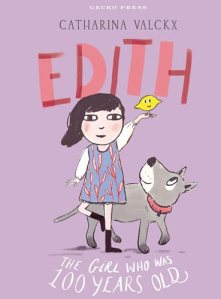 Edith: The Girl Who Was 100 Years Old by Catharina Valckx [transl. Antony Shugaar]: Speaking of never growing old… This is a charming middle-grade fantasy about a girl given two blessings by fairies: the ability to animate objects, and the gift of eternal childhood. The former is good fun, allowing her to have a sentient grandfather clock and a pet lemon named Squirt; the latter comes to seem like more of a curse, though. Edith has long outlived her parents and starts to think her condition is “eternal boredom.” She, Squirt and Bolster the dog set out to find the original fairy, now herself an old lady, and see if the spell can be reversed so Edith can experience life in all its stages. Somehow I can’t see this message catching on in the USA! I loved the illustrations and the whimsy but wanted it to go further, Moomins-like, into Edith’s losses and longing.
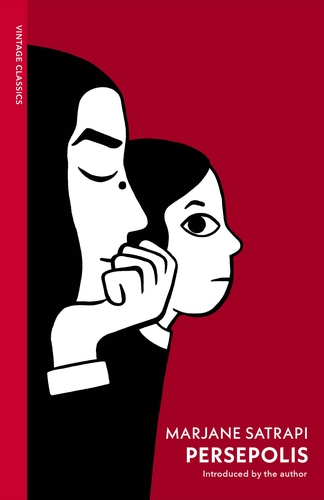 Persepolis by Marjane Satrapi [transl. L’Association / Anjali Singh]: This was one of the first graphic memoirs I ever read (along with Fun Home), a classic of the genre. I wanted to reread it because it has, unfortunately, taken on renewed relevance because of war in Iran and the author’s death earlier this year. Her memoir of growing up in the 1980s and 1990s illuminates what it’s like to live under an authoritarian religious regime in a time of war, and likely planted the seeds for novels such as Martyr! and The Persians.
Satrapi’s parents had secular values but, after the 1979 Islamic Revolution, everyone had to fall in line: she wore the veil whenever she left her house, and though her family made wine they were ready to dump it down the toilet at a minute’s notice. On the one hand, she and her friends were normal Westernized adolescents interested in pop music and trendy clothing; on the other, there were shortages, bombings, and rumours of relatives and neighbours being disappeared for voicing revolutionary ideas. A missile exploded in her neighbourhood, narrowly missing her building but killing their Jewish acquaintances.
Volume 2, “The Story of a Return,” has Satrapi attending school in Austria and encountering a whole new world of drugs and sex. “The harder I tried to assimilate, the more I had the feeling that I was distancing myself from my culture, betraying my parents and my origins”. She returned to Iran four years later to find a country that was still repressive but beginning to be rebuilt after war. Art school (with fully clothed life models) and a brief marriage in her early twenties followed, but she had to leave Iran for good to find a life of creative fulfilment.
Her father’s wise words: “As long as there is oil in the Middle East we will never have peace”; “We Iranians, we’re crushed not only by the government but by the weight of our traditions.”


CURRENTLY READING
- Taking Pictures by Anne Enright
- I Remember Nothing and Other Reflections by Nora Ephron
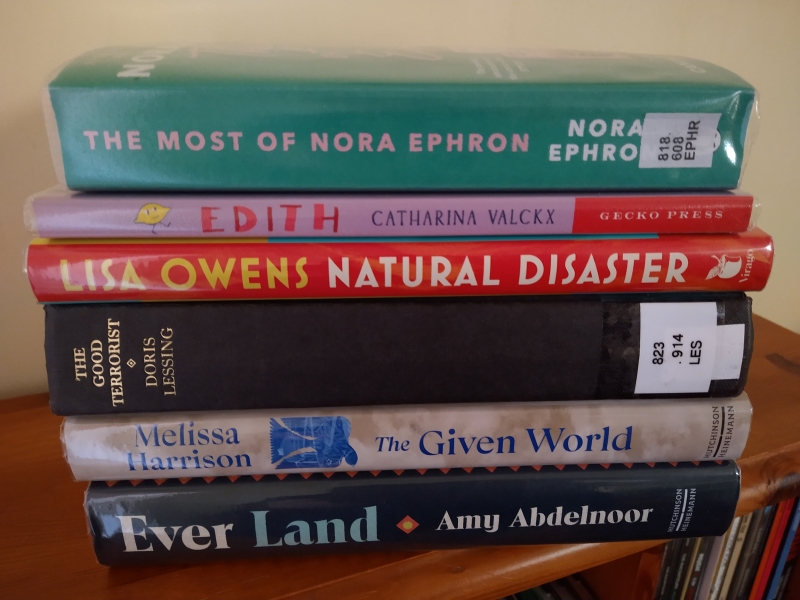
- The Given World by Melissa Harrison
- Night, Neon and Other Stories of Suspense by Joyce Carol Oates
- Natural Disaster by Lisa Owens
- Hum by Helen Phillips (a buddy read with Marcie of Buried in Print)
- Crossing the Water by Sylvia Plath (from university library)
- The Original by Nell Stevens
- The Queen’s Gambit by Walter S. Tevis
SKIMMED
- Come What May: Life-Changing Lessons for Coping with Crisis by Lucy Easthope
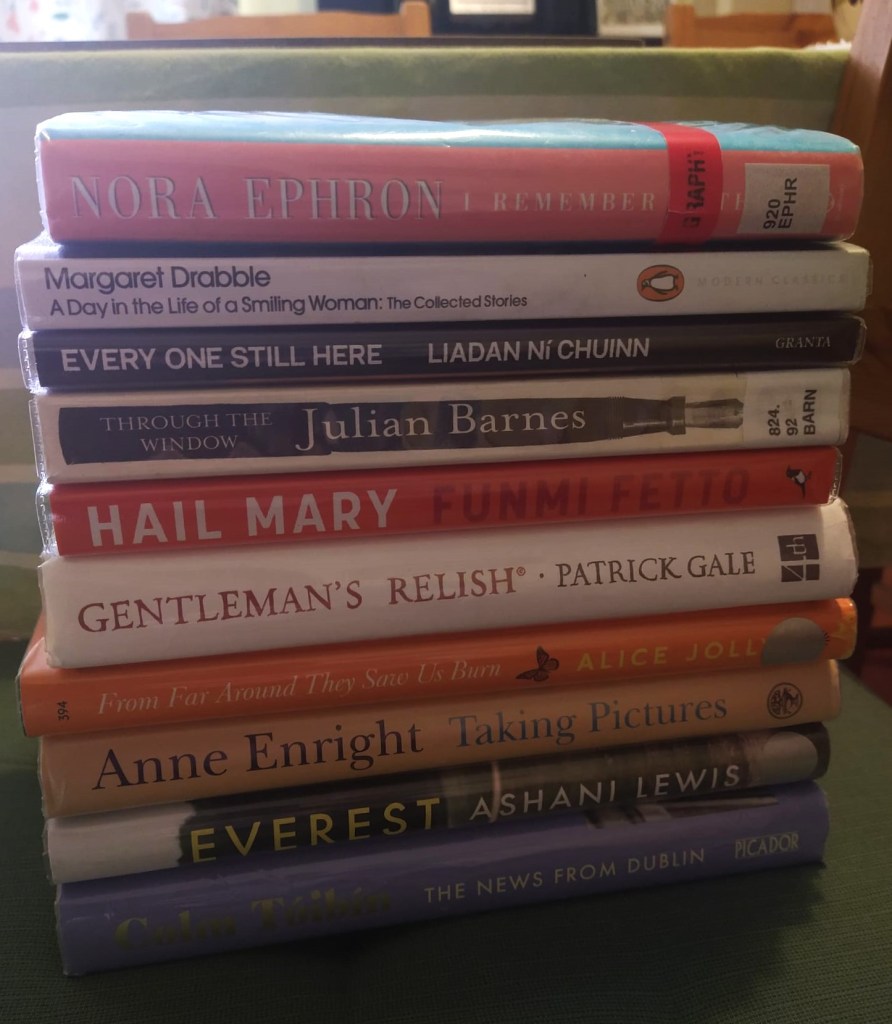
CHECKED OUT, TO BE READ
- Ever Land by Amy Abdelnoor
- Through the Window by Julian Barnes (to reread)
- A Day in the Life of a Smiling Woman: The Collected Stories by Margaret Drabble
- The Most of Nora Ephron – I’m on an Ephron kick at the moment!
- Hail Mary by Funmi Fetto
- Gentleman’s Relish by Patrick Gale
- From Far Around They Saw Us Burn by Alice Jolly
- The Good Terrorist by Doris Lessing (from university library, for Classics book club)
- Everest by Ashani Lewis
- The News from Dublin by Colm Tóibín
ON HOLD, TO BE COLLECTED
- In Meadowlight by Sussie Anie
- The Savage Landscape by Cal Flyn
- The Leveret by Anna Goldreich
- Eat the Planet Well: How to Fix Our Toxic Food System – One Meal at a Time by Dave Goulson
- The End of Everything by M. John Harrison
- When the Forest Breathes: Renewal and Resilience in the Natural World by Suzanne Simard
- Fiesta: A Journey through Festivity by Daniel Stables
IN THE RESERVATION QUEUE
- The Strangers by Naomi Alderman
- Stop All the Clocks: Poems of Love and Loss by W.H. Auden
- Dodge City by Patrick deWitt
- Honour & Other People’s Children by Helen Garner
- Every Last Fish by Rose George
- Neurodivergent by Nature by Joe Harkness
- Hag: Forgotten Folktales Retold by Daisy Johnson et al.
- How to Be Hopeful by Caitlin Moran
- The Winter Guest by Sarah Moss
- Autumn by Kate Mosse
- Sunrise by Téa Obreht
- May We Feed the King by Rebecca Perry
- Green Crime by Julia Shaw
- The Housekeeper by Rose Tremain
RETURNED UNREAD
- Every One Still Here by Liadan Ní Chuinn – It takes a lot for me to overcome my groundless antipathy to stories about The Troubles.
What have you been reading or reviewing from the library recently?

Share a link to your own post in the comments. Feel free to use the above image. The hashtag is #LoveYourLibrary.
 Bookish Beck = Rebecca Foster. American transplant to England. Freelance proofreader and book reviewer.

I think introverts had an easier pandemic than extroverts in some respects. Hope you’re enjoying The Given World. Expectations are high for that one.
LikeLiked by 1 person
True. My husband and I were quite happy with lockdown! But again, it feels perverse to say anything positive about Covid when so many lost family members or good health.
I’m about 50 pages into the Harrison. Enjoying it well enough, but less sure of her depictions of young men.
LikeLiked by 1 person
Some great stories here. I discovered ‘Persepolis’ many years ago when it was part of an exam for which I was invigilating. Excellent, and I used it in my own blog some time back. Thanks for sharing your thoughts on it and the other texts. 🙂
LikeLiked by 1 person
So interesting to hear that it was exam material. A great way to learn history, I think.
LikeLiked by 1 person
Persepolis is so brilliant. I hope you like Hum – I was impressed.
LikeLiked by 1 person
Hum is so easy to read! It’s just because there’s no firm deadline attached that I haven’t been reading it faster. (Marcie is racing ahead, as always.) I really like Phillips’s style and everything she says about tech is feeling either realistic or prescient.
LikeLiked by 1 person
Nooo, I’m not, really I’m not!! And I had to finish The Years quickly, because it couldn’t be renewed!! lol
I saw a book the other day that made me think of you, Laura: Spoiled Milk by Avery Curran. I don’t know very much about it, just read a short review in TNY (probably an old issue by now, I’m chronically behind with them), but it seemed to strike a lot of your favourite things. Thanks for linking to my library post, Rebecca. And now I’m looking forward to my November reread of Persepolis even more. It was one of my first graphic reads too.
LikeLiked by 1 person
Ha ha! Sorry to cast “nasturtiums” (as my FIL likes to joke). I finished Hum in a 100-page burst today and will e-mail you with final thoughts.
I checked Laura’s Goodreads and she already read it, in April, and enjoyed it 🙂 So, well chosen for her!
LikeLike
I’ve just started the Daniel Mason. I’m only 40 pages in, but so far, I’m hooked. So you volunteers volunteered in the pandemic? We weren’t used. The staff kept things going, delivering books ordered to key collection point and doubtless doig a lot of tidying up. I must be on about six years too, I think.
LikeLiked by 1 person
The Mason is quite likeable, though I didn’t enjoy the more generic (“the husband,” “the wife”) or, later, esoteric elements.
A handful of us came in while the library has closed to the public during the pandemic. It was blissful shelving in an empty, silent library. Reservations were handed out from a collection point on the ground floor next to the main door.
LikeLiked by 1 person
We weren’t allowed anywhere near the place during Lockdown! Now I’m further in, I’m only ‘quite enjoying’ the Mason too.
LikeLiked by 1 person
I very much agree that the Ernaux creates intergenerational sympathy. I’d had no idea that Marjane Satrapi had died, though – and having looked up the details, it all seems very mysterious and sad. Persepolis really was groundbreaking. It’s even taught in some schools now. Of your other stuff – I read Nora Ephron’s novel Heartburn early in August, and definitely found it funny, although a little shallower than I had hoped for; her nonfiction seems to be where she really shines. Amy Abdelnoor’s Ever Land got a DNF from me after only a few pages; I applaud the idea of it, but the writing just felt so mid and dull. The Good Terrorist is, in my memory at least, very good, very thought-provoking; it was one of the first books I read where the moral lines weren’t obvious. Of your reservation queue, I’ve got an eARC of The Winter Guest (am hopeful, but warily so, since Moss’s fiction has been hit or miss recently and I’m not sure this skimpy novella length that she’s been writing at is the one) and absolutely loved May We Feed the King, which I read as another eARC when it came out in January. I hope you do too!
LikeLiked by 1 person
Ephron does feel dated, I have to say, whether in fiction or non-, but I’ll let her off.
Thank you for that — I’m going to return Ever Land unread. Too many books, too little time!
I think this will be one of the more recent works I’ve read by Lessing. I know pretty much nothing about it and I think I’ll keep it that way and let it be a surprise.
I also have the Moss from NetGalley, but have felt no real rush to get to it. It will be cosier reading it in print in autumn-winter.
LikeLike
I think the Moss releases in October anyway so yes, definitely one for the cooler months!
LikeLiked by 1 person
Unfortunate timing that there’s a Karen Swan novel newly out in paperback also titled The Winter Guest — the Moss seems destined to be mistaken for it.
LikeLike
Congrats on six years of volunteering! Are you doing anything to celebrate? I volunteered for six years before getting a job at my local library. Here is my August reading! https://inspirationalskai.blogspot.com/2026/08/love-your-library-august-2026-july-28.html
LikeLiked by 1 person
Nothing in particular, no, just sharing the milestone with you all here 🙂 I think working at my local library would take all the fun out of it and make me resent customers and coworkers.
LikeLike
Boy, I understand your feelings about summer ending at the library. It’s crazy how different summer is here at mine. So busy all the time. We see people we don’t see other times in the year. It’s nice to get the breather of back-to-school.
LikeLiked by 1 person
Kids went back to school today, but the Summer Reading Challenge technically continues until the 15th.
LikeLiked by 1 person
I refuse to read about the Troubles and the Holocaust …
I liked Come What May and can remember some things from it, even, although I admit I don’t have a grab bag set up in the house in case I need to evacuate in a hurry!
LikeLiked by 1 person
We’ve started stockpiling tinned food for El Nino, as advised by the government…
LikeLiked by 1 person
I’ve always got a good supply of stuff in since I lived on my own in London!
LikeLike