Thanks for all the contributions to Short Story September thus far! I usually review whole collections, but today I’m highlighting individual stories I read either as stand-alones, in an unrelated volume, or as a taster from a book I might finish some other time. A few really surprised me for being so dissimilar to other work by the author. These six seem to illustrate different techniques or situations that short stories are good at exploring, thus my headings. (Beware mild spoilers in most of these brief responses.)

The Pastiche
“Homage to Hemingway” by Julian Barnes (2011)
[from Through the Window]
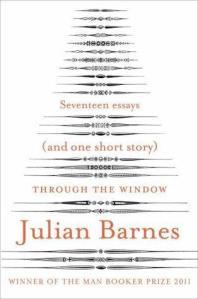 The protagonist is a literature instructor and failed novelist whom we see undertaking three different teaching gigs (in rural Wales, the Alps, and the American Midwest), like the triptych of expatriate Americans waiting for trains in Hemingway’s “Homage to Switzerland,” which is specifically referenced here. He believes fiction is “omnivorous and essentially amoral” and hopes to inspire his students to “reflect on life’s influence on art, and then art’s influence back on life.” This is, of course, a huge theme across Barnes’s oeuvre. Luckily, Barnes doesn’t attempt mimicry of Hemingway’s style, which really wouldn’t suit him at all, but I enjoyed the barbs his students throw. For example, Kate describes Hemingway as “the ultimate dead white male … celebration of machismo. Boys with toys.” This wasn’t very memorable but has me hankering to track down and reread Barnes’s full-length story collections. (Public library)
The Character Study
“Leaving the Yellow House” by Saul Bellow (1958)
[Penguin Modern: 36]
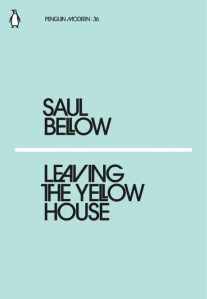 I wouldn’t have recognized this as Bellow’s writing were his name not on the cover. I think of him as a chronicle of Jewish city-dwellers; this is the story of a woman in a tiny town in the American West. Everyone in Sego Desert Lake knows that Hattie is an alcoholic. She’s now in her early seventies and pretty much has bourbon running through her veins. When she gets her car stuck on train tracks while driving drunk and breaks her arm in the ensuing kerfuffle, she and her acquaintances are forced to think seriously about what’s going to happen to her. She looks back on her two marriages and her relationship with India, who used to own her house – I never did work out who India was to her; a friend? an employer? – as she sets to the task of writing her will. Who deserves to have the house in turn? The title has a double meaning and also points to the final leave-taking of death. Hattie is not a very likeable character but has a certain admirable dignity, like Olive Kitteridge or Hagar in The Stone Angel. I liked her fancy that her whole life has been filmed and she’ll soon be able to revisit any moment she chooses. A melancholy slice of mid-century Americana. (Secondhand – Community Furniture Project, Newbury)
The Shock Ending
“Pillow” by Anne Enright (2008)
[from Taking Pictures]
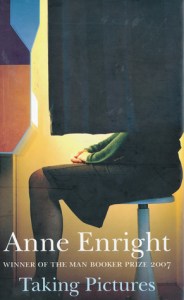 Alison, from Ireland, is part of a set of international roommates at her American college. Li is always asking her questions about what things mean or how they work. The first lines have her querying “What is a homosexual?” With this Enright sets us up to think that Li has a crush on Alison. First, the roommates find out that Li is her surname and really they should call her Ping. And then one morning Alison wakes up struggling to breathe because Ping is trying to smother her with the title object. I gasped aloud! The incident seems to come out of nowhere but I guess illustrates how easy it can be to hide mental illness. I kind of wish it wasn’t the Chinese girl who ended up being unstable, though. I’m not sure short stories are where Enright shines; I read the first two stories in this volume but won’t finish it. (Public library)
The Visual Pun
“The Axe” by Penelope Fitzgerald (1975)
[from The Means of Escape]
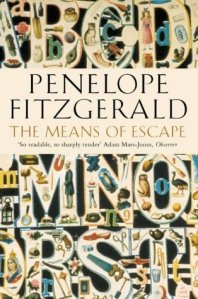 An office worker recalls having to make redundancies, including of his dignified clerical assistant, W. S. Singlebury. He feels even worse about it when the man invites him to visit his home. This faux report to the Company boss chronicles a growing sense of unease as he returns to work and finds the fired man still in the office, gruesomely injured and leaking blood all over. Fitzgerald has playfully imagined Singlebury getting the axe, literally, and then haunting the man responsible. I’ve never experienced such gleeful mischief from Fitzgerald – I only knew her austere historical novellas – but sure enough, this originally appeared in The Times Anthology of Ghost Stories. (Secondhand – Community Furniture Project, Newbury)
The Family Drama in Miniature
“The Worlds Smallest Unicorn” by Shena Mackay (1999)
[from The Worlds Smallest Unicorn and Other Stories]
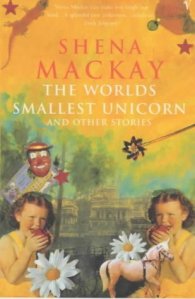 Fan’s brother-in-law, Teddy, has just returned from Hong Kong and she’s not happy about it: “now here was this succubus squatting in her kitchen, expecting to be fed.” She sees in the newspaper that an old flame of his, a singer, has died and he sets out for the funeral, passing a circus billet advertising the title act. (Since it reproduces what was on the tacky poster, I can let Mackay off for the grammatical gaffe, though it doth offend the eyes!) It seems to be a metaphor for anything that’s too good to be true, such as Fan’s affair with Teddy years ago. Her adolescent daughters’ banter and the South London environs are highlights in this one, but so far the book is not living up to the collection I read by Mackay last year, Dreams of Dead Women’s Handbags. (Secondhand – Slightly Foxed, Berwick)
The Relationship Study
“Kiss in the Hotel Joseph Conrad” by Howard Norman (1989)
[from Kiss in the Hotel Joseph Conrad]
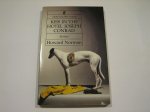 The narrator is dishonourably discharged from Canada’s air force for faking an emergency beach landing during a practice flight in 1943. “We’ve come up with a new, Asshole category,” the colonel declares as he dismisses him. Still, this amiable joker hopes his pluck will endear him to Imogene Linny, who has a kissing booth for would-be soldiers on the Halifax wharf. She recognizes him from his prank and says, “You can kiss something, but it ain’t, I guarantee you, my lips.” In the two decades that follow, he keeps tabs on Imogene as she marries into a hotel empire and he works on the greyhound tracks. After all, he paid his dollar at that booth but never got his kiss. This could have gone creepy but Norman keeps it quirky and sweet instead. His novels, too, often feature Atlantic Canada, oddballs, and hotels. (Secondhand – Hay Cinema Bookshop)
Are any of these authors, and their stories, familiar to you?
Which of these six story types do you prefer?
 Bookish Beck = Rebecca Foster. American transplant to England. Freelance proofreader and book reviewer.
 Bookish Beck
Hi, Rebecca
I would like to read Barnes’ and Howard Norman’s text.
Thanks for the reviews
Klausbernd 🙂
LikeLike