On Sunday morning I attended my first Marlborough Literature Fest event in four years (after the Patrick Gale keynote in 2022). It paired two debut authors whose recent novels incorporate multiple points-of-view to give a rounded picture of an English village. I already knew Helen Bain’s The Daffodil Days, one of my favourites from 2026, but was unfamiliar with Sara Bayat’s Hesket and looked forward to hearing more about it. The event took place in St Peter’s Church, at the bottom of the high street, and was chaired by Dr Nicola Presley of Bath Spa University – but mostly ran itself because the two authors had read each other’s books and asked each other their own insightful, leading questions along the way.
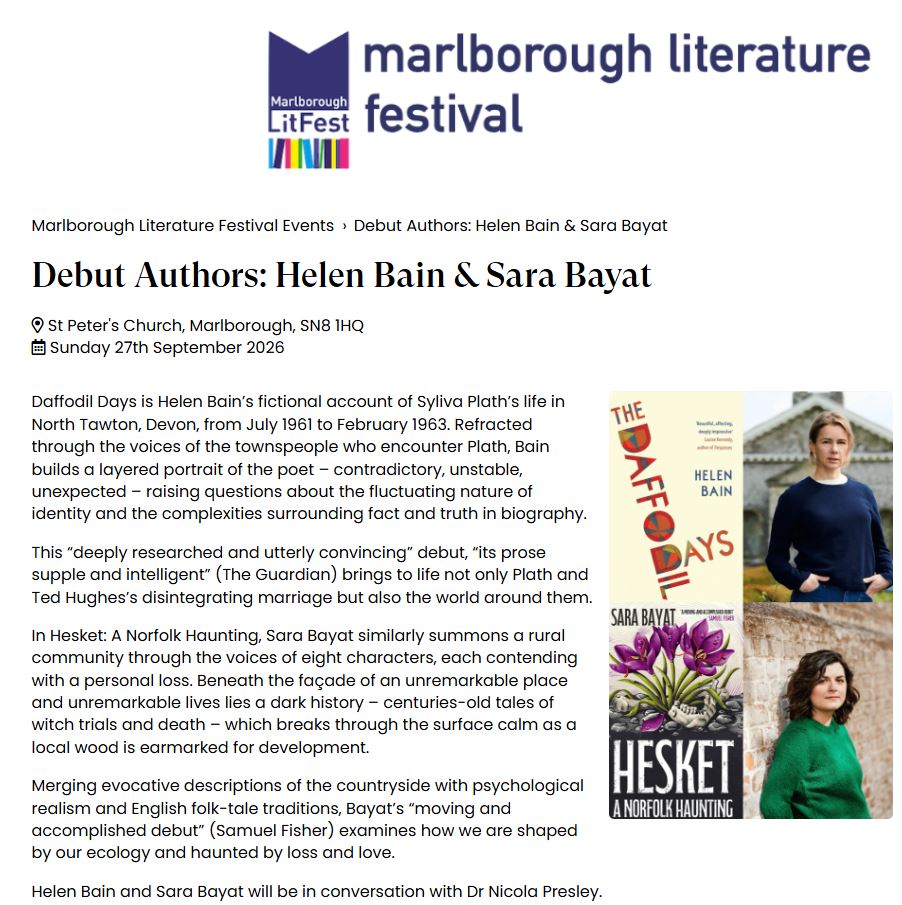
‘Syliva’ in the programme listing!
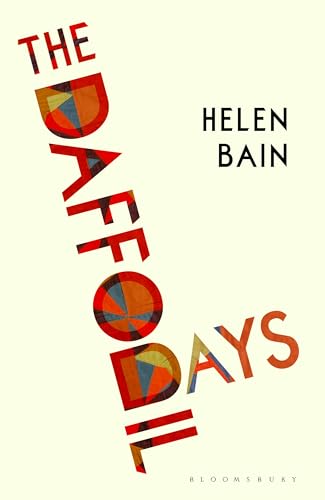 Bain’s focus on 16 ancillary characters was her way, she said, of countering the two-dimensional representation of Sylvia Plath that mostly relates to the nature of her death. It also allowed her to depict social change more broadly – David Kynaston’s history books covering 1962 were helpful, she said. Plath was a 28-year-old American dropped into the Devon village of North Tawton – an incomer, but she was gregarious and talked to anyone. Bain can see so much of Devon in her poems, and Dartmoor is visible from the house (which Ted Hughes kept for the rest of his life, though Plath only spent about 15 months there).
“Would it be possible to see her differently” from the poetry icon? Bain asked herself, and so “splintered her” into the 16 viewpoints. She opened the event by reading from the chapter in which the Bendix man visits to show Plath how to do a load of laundry; she gets agitated with him but he remains calm. Bain said she felt a heavy sense of historical responsibility. She spent a lot of time interviewing North Tawton residents about their childhood and let people review chapters that included their parents. All in all, she said, she approached the research as if she was writing a biography, but then looked for the gaps where only fiction can go.
Hesket is about a semi-rural village in Norfolk marked by the trauma of historical witch trials. A housing development disturbs the ground and strange things start happening. Bayat, who was heavily pregnant, read a passage from the early pages in which a swarm of bees lands in a baby’s crib. All of the major characters are othered in some way. The structure of multiple POVs was right for the novel because it encompassed the entirety of the village, Bayat said; she used the metaphors of mycorrhizal fungi and a beehive. “Uncanny” was the descriptor she employed most often, so I’m expecting the touches of horror to be subtle, but still plan on reading this next month for R.I.P. (I have a new copy on the way, bought with a voucher).
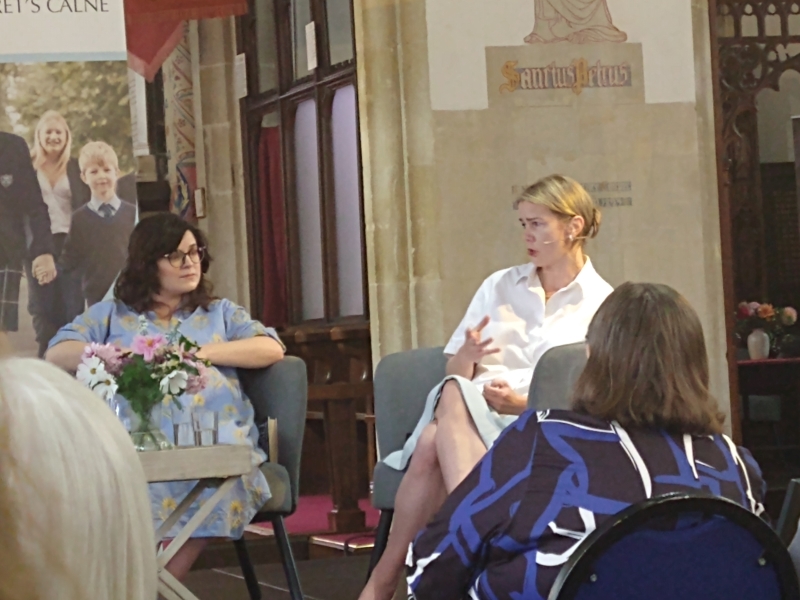
Bayat (L); Bain (R)
In terms of the connections between the two novels, Presley suggested that they are each haunted – The Daffodil Days by Plath’s death but also perhaps by Ted Hughes, who stays on the fringes – and that the landscape is of great importance. Bayat was influenced by local protests over the Western Link, her walks in the flatlands of Norfolk, and an inescapable awareness of drought and flooding. For both authors, maintaining a throughline while also revealing connections between the characters and across time was challenging (even more so for Bain due to her reverse chronology), but it was in the redrafting that everything came together. A question raised in one chapter might be answered in another, and so on.
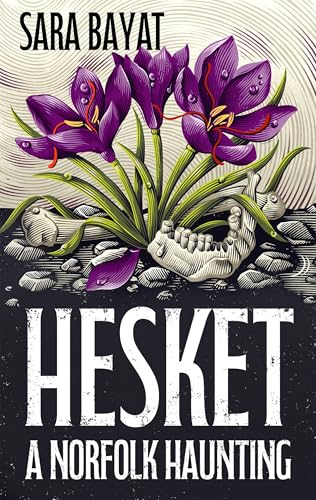 One of the audience questions was of the dreaded ‘where do you get your ideas?’ variety, but Bayat actually had a good answer. Roald Dahl’s The Witches was her favourite book growing up, and she was obsessed with Arthur C. Clarke’s Mysterious World and its tales of the uncanny in everyday life. She also remembers once, having a coffee in Norwich overlooking the polluted river through the centre, thinking that she saw movement under the surface. That, plus there’s a nearby bridge where the witches were led to their death. Bayat mentioned borrowing some details from her father-in-law’s allotment cronies, too. Bain chimed in: people-watching inspires her, and she sees writers as magpies pulling bits from here and there. The works were a long time in the making: Bayat started in 2019, while Bain’s took 4–5 years.
There were any number of events on the Festival programme that interested me, but given that a trip to Marlborough requires my husband to give me a ride 40 minutes away (there’s no train station in the town, alas), I felt I had to be selective. This was a great choice!
(Fun literary connections: Benjamin Wood was signing copies of Seascraper at the back of the church as I arrived – his was the previous event. And the owner of Hungerford Bookshop, my local indie, was in the audience and asked a question!)
 Bookish Beck = Rebecca Foster. American transplant to England. Freelance proofreader and book reviewer.

This does sound like a good choice of event. We were once on holiday near Wigtown when its literary festival was on and similarly chose a debut writer’s event. The author was so brilliant I bought the book and got it signed – not typical behaviour for me at all!
I like the sound of Hesket very much and will be sure to read your review. I don’t know if I could cope with 16 viewpoints on Sylvia Plath.
LikeLiked by 1 person
I would love to make it to Wigtown’s festival. I think it would be a lot less overwhelming than Hay, for instance. I’ve been to Wigtown twice and I really like it there.
I know it would have been more in the spirit of the thing for me to buy Hesket on the spot and get it signed, but I had money waiting for me on this website!
The Daffodil Days is really subtle. Plath plays more or less of a role in each chapter as you get glimpses of her via the village bell-ringers, a dress shop assistant, a young woman working for the BBC, and so on. Bain’s structure means that you move backwards in time and, while Plath’s mental distress is evident from time to time, we are moving further away from her death and she comes across as gregarious and full of life.
LikeLiked by 1 person
I’ve reserved the Bain from the library forthwith. I was faintly relieved when they turned out not to have the Bayat. I’m not a great accepter of strange things happening as a result of long-passed stranger things, and I may not try too hard to source this.
LikeLiked by 1 person
And I am usually very wary of books about witch trials! But I think I’m assured that this is not ‘about’ them as such.
LikeLike
I do like the sound of The Daffodil Days. A fresh perspective on Plath:)
LikeLiked by 1 person
For sure! I am relatively new to Plath, having only read The Bell Jar and a few of her poetry collections in the last year or two. I’d like to read a biography, and I’m currently reading Hughes’s collection about her.
LikeLike
You know, I’m retired now, I really should try to get to some of these festivals. They sound like fun!
LikeLiked by 1 person
Oh absolutely, literary festivals are marvellous. The challenge is usually limiting oneself to an event or two. If I lived closer, my wallet would have been feeling the strain!
Do I recall that you live in Israel, though? I don’t know about the scene there.
LikeLike