Marlborough Lit Fest Event: Debut Authors Helen Bain and Sara Bayat
On Sunday morning I attended my first Marlborough Literature Fest event in four years (after the Patrick Gale keynote in 2022). It paired two debut authors whose recent novels incorporate multiple points-of-view to give a rounded picture of an English village. I already knew Helen Bain’s The Daffodil Days, one of my favourites from 2026, but was unfamiliar with Sara Bayat’s Hesket and looked forward to hearing more about it. The event took place in St Peter’s Church, at the bottom of the high street, and was chaired by Dr Nicola Presley of Bath Spa University – but mostly ran itself because the two authors had read each other’s books and asked each other their own insightful, leading questions along the way.
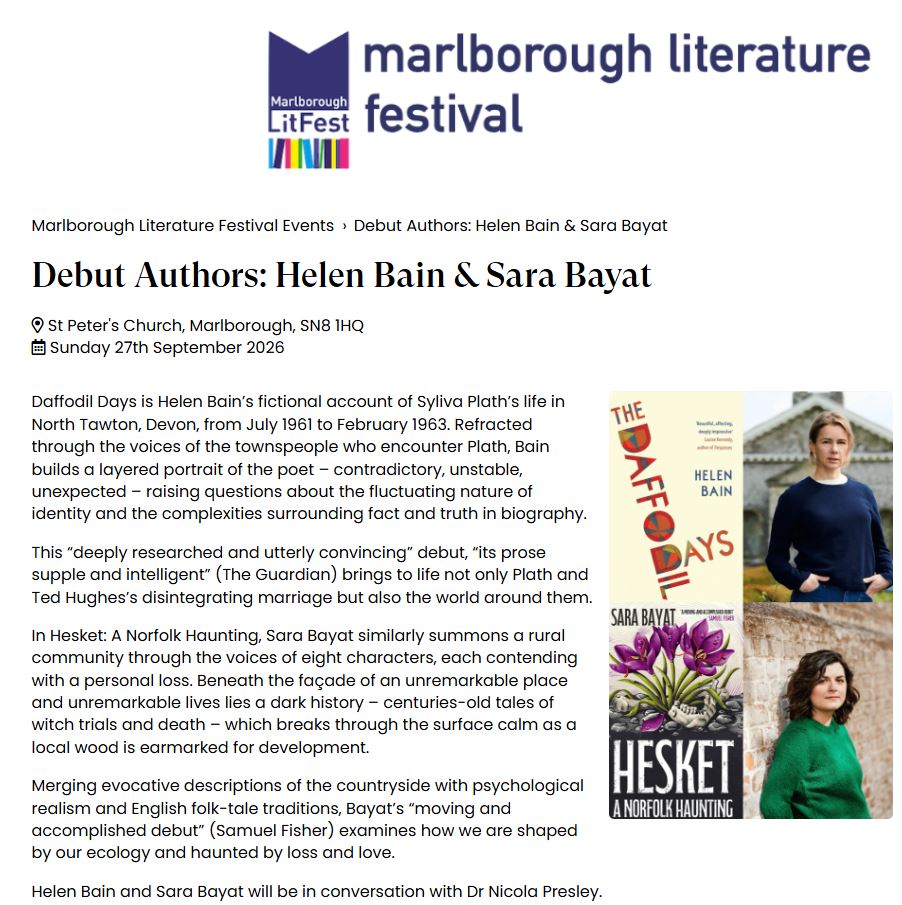
‘Syliva’ in the programme listing!
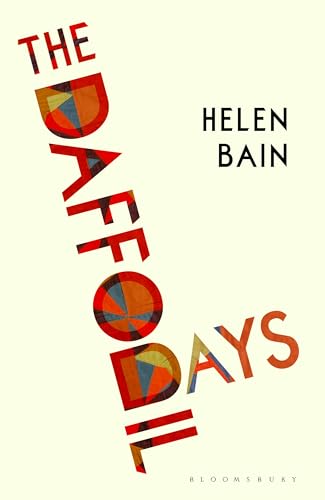 Bain’s focus on 16 ancillary characters was her way, she said, of countering the two-dimensional representation of Sylvia Plath that mostly relates to the nature of her death. It also allowed her to depict social change more broadly – David Kynaston’s history books covering 1962 were helpful, she said. Plath was a 28-year-old American dropped into the Devon village of North Tawton – an incomer, but she was gregarious and talked to anyone. Bain can see so much of Devon in her poems, and Dartmoor is visible from the house (which Ted Hughes kept for the rest of his life, though Plath only spent about 15 months there).
“Would it be possible to see her differently” from the poetry icon? Bain asked herself, and so “splintered her” into the 16 viewpoints. She opened the event by reading from the chapter in which the Bendix man visits to show Plath how to do a load of laundry; she gets agitated with him but he remains calm. Bain said she felt a heavy sense of historical responsibility. She spent a lot of time interviewing North Tawton residents about their childhood and let people review chapters that included their parents. All in all, she said, she approached the research as if she was writing a biography, but then looked for the gaps where only fiction can go.
Hesket is about a semi-rural village in Norfolk marked by the trauma of historical witch trials. A housing development disturbs the ground and strange things start happening. Bayat, who was heavily pregnant, read a passage from the early pages in which a swarm of bees lands in a baby’s crib. All of the major characters are othered in some way. The structure of multiple POVs was right for the novel because it encompassed the entirety of the village, Bayat said; she used the metaphors of mycorrhizal fungi and a beehive. “Uncanny” was the descriptor she employed most often, so I’m expecting the touches of horror to be subtle, but still plan on reading this next month for R.I.P. (I have a new copy on the way, bought with a voucher).
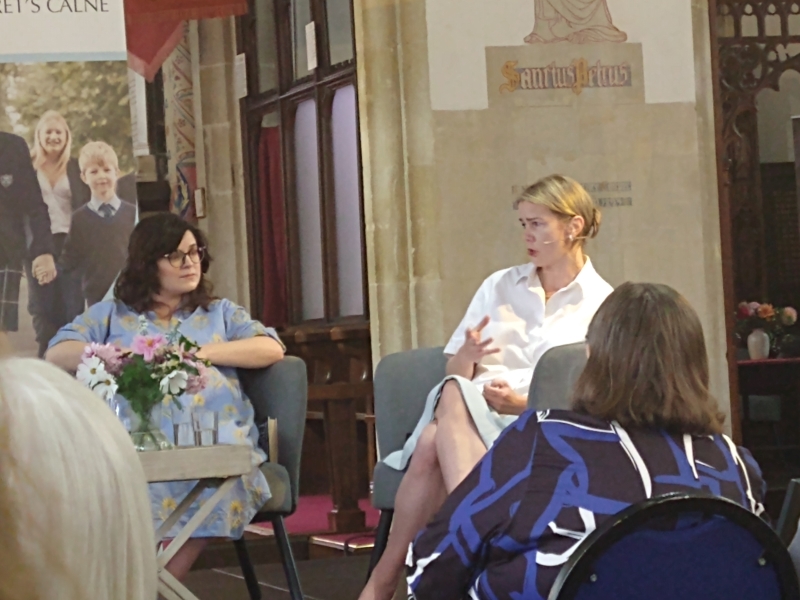
Bayat (L); Bain (R)
In terms of the connections between the two novels, Presley suggested that they are each haunted – The Daffodil Days by Plath’s death but also perhaps by Ted Hughes, who stays on the fringes – and that the landscape is of great importance. Bayat was influenced by local protests over the Western Link, her walks in the flatlands of Norfolk, and an inescapable awareness of drought and flooding. For both authors, maintaining a throughline while also revealing connections between the characters and across time was challenging (even more so for Bain due to her reverse chronology), but it was in the redrafting that everything came together. A question raised in one chapter might be answered in another, and so on.
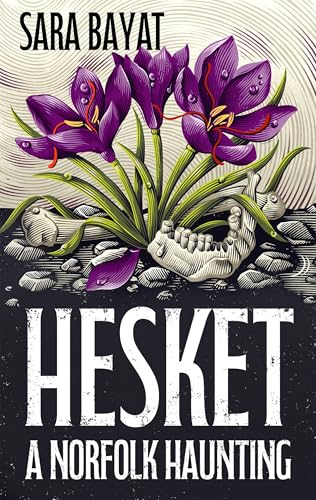 One of the audience questions was of the dreaded ‘where do you get your ideas?’ variety, but Bayat actually had a good answer. Roald Dahl’s The Witches was her favourite book growing up, and she was obsessed with Arthur C. Clarke’s Mysterious World and its tales of the uncanny in everyday life. She also remembers once, having a coffee in Norwich overlooking the polluted river through the centre, thinking that she saw movement under the surface. That, plus there’s a nearby bridge where the witches were led to their death. Bayat mentioned borrowing some details from her father-in-law’s allotment cronies, too. Bain chimed in: people-watching inspires her, and she sees writers as magpies pulling bits from here and there. The works were a long time in the making: Bayat started in 2019, while Bain’s took 4–5 years.
There were any number of events on the Festival programme that interested me, but given that a trip to Marlborough requires my husband to give me a ride 40 minutes away (there’s no train station in the town, alas), I felt I had to be selective. This was a great choice!
(Fun literary connections: Benjamin Wood was signing copies of Seascraper at the back of the church as I arrived – his was the previous event. And the owner of Hungerford Bookshop, my local indie, was in the audience and asked a question!)
Spring Reading 2021: Birdsong, Cherry Blossom & More
It’s been a gorgeously sunny spring here – how about where you are? Although there have still been some frosty nights troubling the gardeners among us, it’s been warm in the daytime and the flowers and blossom are coming on apace.
Recently I’ve read a couple of books reflecting on the spring of 2020, specifically the opportunities it offered to reconnect with local nature at a time when we were isolated and couldn’t travel.
I’ve also been feeling nostalgic for Washington, D.C. and the Maryland suburbs, where I grew up. It’s been two years since my last trip back, but I’m holding out hope that I can make it over in June for a family wedding.
Rounding out my selection of “Spring” titles is an offbeat Japanese novella.
Looking back to the coronavirus spring:
On Thursday evening I watched “The Act of Nature Watching,” a special Earth Day Zoom talk for West Berkshire Libraries by local nature writer Nicola Chester, whose memoir is coming out in the autumn. The UK is one of the most nature-depleted countries, she lamented. We are hardwired to watch and love nature, she noted, yet have never been more alienated from it. Reading from her columns and anthology contributions (as well as the Lovatt, below) and giving tips on recognizing birdsong and mammal signs, she spoke of nature-watching as a form of mindfulness – an approach that chimed with the first three books I feature here.
Birdsong in a Time of Silence: An Awakening by Steven Lovatt (2021)
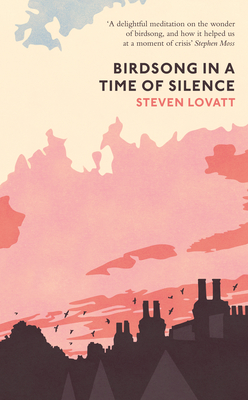 During the UK’s first lockdown, with planes grounded and cars stationary, many remarked on the quiet. All the better to hear birds going about their usual spring activities. For Lovatt, from Birmingham and now based in South Wales, it was the excuse he needed to return to his childhood birdwatching hobby. In between accounts of his spring walks, he tells lively stories of common birds’ anatomy, diet, lifecycle, migration routes, and vocalizations. (He even gives step-by-step instructions for sounding like a magpie.) Birdsong takes him back to childhood, but feels deeper than that: a cultural memory that enters into our poetry and will be lost forever if we allow our declining bird species to continue on the same trajectory.
Mentions of current events are sparse and subtle, so the spring feels timeless, as it should. I worried there might be too much overlap with A Sweet, Wild Note by Richard Smyth, but there’s room for both on your shelf. Lovatt’s writing is introspective and poetic, delighting in metaphors for sounds: “The song of a turtle dove is like the aural equivalent of a heat-haze, the gentlest corrugation of air, always just on the edge of your hearing.” 
Skylarks with Rosie: A Somerset Spring by Stephen Moss (2021)
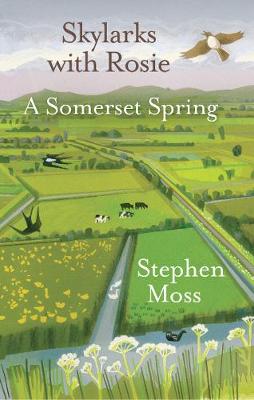 Lovatt must have been a pupil of Moss’s on the Bath Spa University MA degree in Travel and Nature Writing. The prolific Moss’s latest also reflects on the spring of 2020, but in a more overt diary format. Devoting one chapter to each of the 13 weeks of the first lockdown, he traces the season’s development alongside his family’s experiences and the national news. With four of his children at home, along with one of their partners and a convalescing friend, it’s a pleasingly full house. There are daily cycles or walks around “the loop,” a three-mile circuit from their front door, often with Rosie the Labrador; there are also jaunts to corners of the nearby Avalon Marshes. Nature also comes to him, with songbirds in the garden hedges and various birds of prey flying over during their 11:00 coffee breaks.
His speaking engagements and trips cancelled, Moss turns to online events instead. Twitter serves as a place for sharing outrage over UK politics and world events like George Floyd’s murder, but also as a welcoming community for sharing nature sightings. As the lockdown come to a close, he realizes that this time has had unexpected benefits: “Having to press the pause button … has made me rethink my life, in a good way.” He feels that, for once, he has truly appreciated the spring, “rediscovering the joys of wildlife-watching close to home”. This made for perfect reading in Somerset last week. 
Also recommended: The Consolation of Nature by Marren, McCarthy and Mynott
Remembering springs back home:
Spring in Washington by Louis J. Halle (1947)
“The discovery of spring each year, after the winter’s hibernation, is like a rediscovery of the universe … knowledge of spring gives me the freedom of the world.”
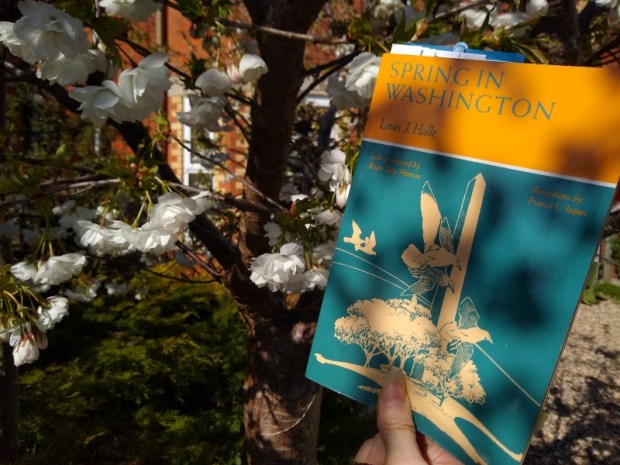 For Halle, who worked in the State Department, nature was an antidote to hours spent shuffling papers behind a desk. In this spring of 1945, there was plenty of wildfowl to see in central D.C. itself, but he also took long early morning bike rides along the Potomac or the C&O Canal, or in Rock Creek Park. From first migrant in February to last in June, he traces the spring mostly through the birds that he sees. More so than the specific observations of familiar places, though, I valued the philosophical outlook that makes Halle a forerunner of writers like Barry Lopez and Peter Matthiessen. He notes that those caught up in the rat race adapt the world to their comfort and convenience, prizing technology and manmade tidiness over natural wonders. By contrast, he feels he sees more clearly – literally as well as metaphorically – when he takes the long view of a landscape.
 I marked so many passages of beautiful description. Halle had mastered the art of noticing. But he also sounds a premonitory note, one that was ahead of its time in the 1940s and needs heeding now more than ever: “When I see men able to pass by such a shining and miraculous thing as this Cape May warbler, the very distillate of life, and then marvel at the internal-combustion engine, I think we had all better make ourselves ready for another Flood.”
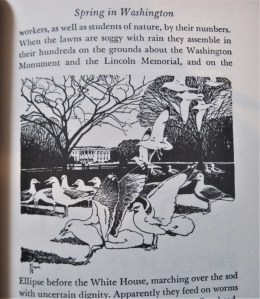
This was a lucky find at Hay Cinema Bookshop back in September. For me it was the ideal combination of thoughtful prose and vicarious travel, though I imagine it might not mean as much to those without a local connection. The black-and-white in-text illustrations by Francis L. Jaques are a particularly nice addition. 
Pussy cat, pussy cat, where have you been? I’ve been to Washington, and guess what I’ve seen… by Russell Punter and Dan Taylor (2019)
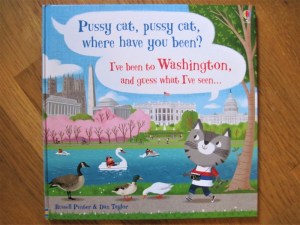 More cherry blossoms over tourist landmarks! This is part of a children’s series inspired by the 1805 English rhyme about London; other volumes visit New York City, Paris, and Rome. In rhyming couplets, he takes us from the White House to the Lincoln Memorial via all the other key sights of the Mall and further afield: museums and monuments, the Library of Congress, the National Cathedral, Arlington Cemetery, even somewhere I’ve never been – Theodore Roosevelt Island. Realism and whimsy (a kid-sized cat) together; lots of diversity in the crowd scenes. What’s not to like? (Titled Kitty cat, kitty cat… in the USA.)
And, as a bonus, some fiction in translation:
Spring Garden by Tomoka Shibasaki (2014; 2017)
[Translated from the Japanese by Polly Barton]
 Like a Murakami protagonist, Taro is a divorced man in his thirties, mildly interested in the sometimes peculiar goings-on in his vicinity. Rumor has it that his Tokyo apartment complex will be torn down soon, but for now the PR manager is happy enough here. “Avoiding bother was Taro’s governing principle.” But bother comes to find him in the form of a neighbor, Nishi, who is obsessed with a nearby house that was the backdrop for the art book Spring Garden, a collection of photographs of a married couple’s life. Her enthusiasm gradually draws Taro into the depicted existence of the TV commercial director and actress who lived there 25 years ago, as well as the young family who live there now. This Akutagawa Prize winner failed to hold my interest – like The Guest Cat, it’s oddly preoccupied with architectural detail, a Japanese fascination that doesn’t translate so well.
 Bookish Beck = Rebecca Foster. American transplant to England. Freelance proofreader and book reviewer.
