November Releases Including #NovNov24: Bennett, Pimlott, Rishøi, Shattuck
Two belated novellas: one a morbid farce set at an old folks’ home; the other a sweet Norwegian tale that offers sisterhood and magic as ways to survive a rough upbringing. Plus a lovely poetry pamphlet about the early days of widowhood and a linked short story collection spanning several centuries of art and relationships in New England.
Killing Time by Alan Bennett
I’d only previously read The Uncommon Reader by Alan Bennett; I perpetually have him confused with Arnold Bennett, by whom I know more. It could be debated whether this is a novella by word count, but even if more of a short story, for me it counts for #NovNov24 because it’s in a stand-alone volume, as publishing partner Faber produced for Claire Keegan’s So Late in the Day last year.
I polished this off in one sitting. Bennett’s black comedy is set at a posh home for the elderly, the Edwardian mansion Hill Topp House. (Residents know to be on their best behaviour lest they be demoted to an inferior neighbouring facility, Low Moor.) When a prospective client calls, Mrs McBryde enthusiastically lists the assets:
We have a choir and on special occasions a glass of dry sherry. It’s less of a home and more of a club and very much a community. We go on frequent trips out. Only last week we went to a local farm where they have a flamingo. … We don’t vegetate at Hill Topp. And the cuisine is not unadventurous. It’s not long since we had a Norwegian evening.
 The dialogue is sparkling, just like you’d expect from a playwright. As in the Hendrik Groen books and Elizabeth Taylor’s Mrs Palfrey at the Claremont, the situation invites cliques and infantilizing. The occasional death provides a bit more excitement than jigsaws and knitting. Ageing bodies may be pitiable (the incontinence!), but sex remains a powerful impulse.
Here is where readers might start to feel disconnected from Bennett’s dated humour. The window cleaner turned gigolo is somewhat amusing; the repeated gag of a flasher, not so much. “Has she seen the sights yet?” two ladies ask. And a jesting conversation about clerical sexual abuse scandals seems particularly ill considered given recent news.
The story is most interesting and fresh once Covid comes onto the scene. Some perish early on; the survivors, ungoverned, do their best. I loved the detail of a resident turning a velvet dress into 60 masks. Two objects, one of them depicted on the cover (it’s not a grenade as I thought at first!), come to have particular importance. I liked this but thought by favouring broad humour it sacrificed characterization or compassion. You’ll enjoy it if you’re fond of wicked comedy by the likes of Alan Ayckbourn. [112 pages]
With thanks to Profile Books for the free copy for review.
After the Rites and Sandwiches: Poems by Kathy Pimlott
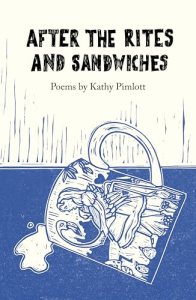 The 18 poems in this pamphlet (in America it would be called a chapbook) orbit the sudden death of Pimlott’s husband a few years ago. By the time she found Robert at the bottom of the stairs, there was nothing paramedics could do. What next? The callousness of bureaucracy: “Your demise constitutes a quarter off council tax; / the removal of a vote you seldom cast and then / only to be contrary; write-off of a modest overdraft; / the bill for an overpaid pension” (from “Death Admin I”). Attempts at healthy routines: “I’ve written my menu for the week. Today’s chowder. / I manage ten pieces of the 1000-piece jigsaw’s scenes / from Jane Austen. Tomorrow I’ll visit friends and say // it’s alright, it’s alright, seventy, eighty percent / alright” (from “How to be a widow”). Pimlott casts an eye over the possessions he left behind, remembering him in gardens and on Sunday walks of the sort they took together. Grief narratives can err towards bitter or mawkish, but this one never does. Everyday detail, enjambment and sprightly vocabulary lend the wry poems a matter-of-fact grace. I plan to pass on my copy to a new book club member who was widowed unexpectedly in May – no doubt she’ll recognise the practical challenges and emotional reality depicted.
With thanks to The Emma Press for the free copy for review.
Brightly Shining by Ingvild Rishøi (2021; 2024)
[Translated from the Norwegian by Caroline Waight]
 Ten-year-old Ronja and her teenage sister Melissa have to stick together – their single father may be jolly and imaginative, but more often than not he’s drunk and unemployed. They can’t rely on him to keep food in their Tøyen flat; they subsist on cereal. When Ronja hears about a Christmas tree seller vacancy, she hopes things might turn around. Their father lands the job but, after his crew at a local pub pull him back into bad habits, Melissa has to take over his hours. Ronja hangs out at the Christmas tree stand after school, even joining in enthusiastically with publicity. The supervisor, Tommy, doesn’t mind her being around, but it’s clear that Eriksen, the big boss, is uncomfortable with even a suggestion of child labour.
It’s touching to see Melissa take on a caring role and to meet the few indisputably good people who help the sisters, such as their elderly neighbour, Aronsen. Ronja’s innocent narration emphasizes her disbelief at their father’s repeated failings and also sets the story up for a late swerve into what seems like magic realism. I’m genuinely not sure what’s supposed to happen at the end, but the sisters find themselves alone in a wintry storm and the language of miracles is used. Rishøi’s debut will surely be compared to Small Things Like These and other classic holiday novellas. I found it a little obvious and saccharine, but if you find the right mood and moment it might just tug at your heart in the run-up to Christmas. [182 pages]
With thanks to Grove Press UK for the free copy for review.
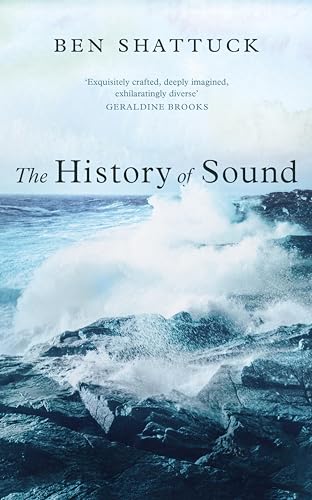
The History of Sound by Ben Shattuck
“history is personal, even when it isn’t”
The dozen stories of Shattuck’s fiction debut form a “hook-and-chain” structure of five couplets, bookended by a first and last story that are related to each other. The links are satisfyingly overt: A pair might take place in the same house in different centuries, or the second will fill in the history of the characters from the first. In “Edwin Chase of Nantucket,” the eponymous figure recognizes his bereaved mother’s loneliness and does her a kindness. “Silver Clip,” which follows, is separated by 200 years, but its accounts of a young painter living in his ancestral island home reprises the motifs of grief, compassion and memory. “Graft,” about a woman spurned in the 1880s, and “Tundra Swan,” in which a man concocts a swindle to pay for his son’s rehab in the present day, are connected by a Cape Cod orchard. Artefacts and documents also play important roles: a journal accounts for a mysterious mass death, a radio transcript and a photograph explain a well-meaning con, and an excerpt from a history textbook follows up on the story of the religious cult in “The Children of New Eden.”
 My favourite individual story was “August in the Forest,” about a poet whose artist’s fellowship isn’t all it cracked up to be – the primitive cabin being no match for a New Hampshire winter. His relationships with a hospital doctor, Chloe, and his childhood best friend, Elizabeth, seem entirely separate until Elizabeth returns from Laos and both women descend on him at the cabin. Their dialogues are funny and brilliantly awkward (“Sorry not all of us are quietly chiseling toward the beating heart of the human experience, August. One iamb at a time”) and it’s fascinating to watch how, years later, August turns life into prose. But the crowning achievement is the opening title story and its counterpart, “Origin Stories,” about folk music recordings made by two university friends during the First World War – and the afterlife of both the songs and the men.
From the start I was reminded strongly of North Woods by Daniel Mason, and particular sequences recall Shoot the Horses First by Leah Angstman and An Account of the Decline of the Great Auk, According to One Who Saw It by Jessie Greengrass. It’s a slight shame for Shattuck that what he was doing here didn’t seem as original to me because of my familiarity with these predecessors. Yet, to my surprise, I found that The History of Sound was more consistent than any of those. With the exception of a few phrases from “Graft” (“living room,” “had sex” and “boring” don’t strike me as 1880s lingo), all of the stories are historically convincing, and the very human themes of lust, parenthood, sorrow and frustrated ambition resonate across centuries and state lines. Really beautiful. (See Susan’s review too.)
[Some you-couldn’t-make-it-up trivia about Shattuck: he’s married to Jenny Slate (author of Little Weirds et al., as well as an actress known to me as Mona Lisa from Parks and Recreation); and he runs the oldest general store in America, built in 1793.]
With thanks to Swift Press for the free copy for review.
Which of these November releases catches your eye? What others can you recommend?
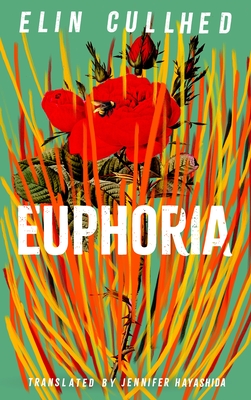
Literary Wives Club: Euphoria by Elin Cullhed (2021)
Swedish author Elin Cullhed won the August Prize and was a finalist for the Strega European Prize with this first novel for adults. Euphoria is a recreation of Sylvia Plath’s state of mind in the last year of her life. It opens on 7 December 1962 in Devon with a list headed “7 REASONS NOT TO DIE,” most of which centre on her children, Frieda and Nick. She enumerates the pleasures of being in a physical body and enjoying coastal scenery. But she also doesn’t want to give her husband, poet Ted Hughes, the satisfaction of having his prophecies about her mental illness come true.
 Flash back to the year before, when Plath is heavily pregnant with Nick during a cold winter and trying to steal moments to devote to writing. She feels gawky and out of place in encounters with the vicar and shopkeeper of their English village. “Who was I, who had let everything become a compromise between Ted’s Celtic chill and my grandiose American bluster?” She and Hughes have an intensely physical bond, but jealousy of each other’s talents and opportunities – as well as his serial adultery and mean and controlling nature – erodes their relationship. The book ends in possibility, with Plath just starting to glimpse success as The Bell Jar readies for publication and a collection of poems advances. Readers are left with that dramatic irony.
Cullhed seems to hew to biographical detail, though I’m not particularly familiar with the Hughes–Plath marriage. Scenes of their interactions with neighbours, Plath’s mother, and Ted’s lover Assia Wevill make their dynamic clear. The prose grows more nonstandard; run-on sentences and all-caps phrases indicate increasing mania. There are also lovely passages that seem apt for a poet: “Ted’s crystalline sly little mint lozenge eyes. Narrow foxish. Thin hard. His eyes, so embittered.” The use of language is effective at revealing Plath’s maternal ambivalence and shaky mental health. Somehow, though, I found this quite tedious by the end. Not among my favourite biographical novels, but surely a must-read for Plath fans. 
Translated from the Swedish by Jennifer Hayashida in 2022 – our first read in translation, I think? And what a brilliant cover.
With thanks to Canongate for the free copy for review.
The main question we ask about the books we read for Literary Wives is:
What does this book say about wives or about the experience of being a wife?
Marriage is claustrophobic here, as in so many of the books we read. Much as she loves her children, Plath finds the whole wifehood–motherhood complex to be oppressive and in direct conflict with her ambitions as an author. Sharing a vocation with her husband, far from helping him understand her, only makes her more bitter that he gets the time and exposure she so longs for. More than 60 years later, Plath’s death still echoes, a tragic loss to literature.
See Kate’s, Kay’s and Naomi’s reviews, too!
Coming up next, in March: Lessons in Chemistry by Bonnie Garmus – I’ve read this before but will plan to skim back through a copy from the library.
Thanks for Joining in with Novellas in November! #NovNov24 Statistics
Co-host Cathy and I are delighted that so many of you participated in Novellas in November again this year and helped us to celebrate the art of the short book. We had 46 participants and 173 posts covering more than 150 books.

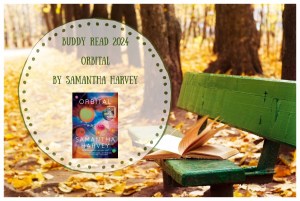
In total, 16 friends of #NovNov reviewed our buddy read, Orbital by Samantha Harvey, which won the Booker Prize partway through the month.

Other books with multiple reviews included John Boyne’s recent novella series, The Party by Tessa Hadley, various by Claire Keegan, Astraea by Kate Kruimink, and Baron Bagge by Alexander Lernet-Holenia.
The link-up will remain open through Saturday 7 December if you would like to add in any belated reviews (I will certainly be doing so).
See you next November – but keep reading novellas and sharing the love all through the year!
Novellas New to My TBR (#NovNov24)
I’m sure you don’t need me to tell you how busy November can be with blogger challenges, plus life-wise – lots of family birthdays cluster in the month, including my husband’s today. What with a book club social on Wednesday and a belated “Friendsgiving” meal with our next-door neighbour yesterday, it’s been a packed week. Today we had lunch out at a fine dining restaurant in the countryside and I’ve made him a maple and pecan cake. With Advent starting tomorrow, suddenly it feels like Christmas is just around the corner and there’s far too much to get done before the end of the year.
As usual, I come to the close of November still frantically trying to finish the many novellas I started at some point in the month, so although I will post an overall roundup with collective statistics tomorrow, my plan is to keep the final Inlinkz party open through 7 December and continue writing up novellas as I finish them, with next Saturday as my absolute deadline.
Here are some novellas I’ve added to my TBR this month:
 Blow Your House Down by Pat Barker, recommended by Margaret (From Pyrenees to Pennines) and seconded by Marcie (Buried in Print) in comments
 The Journey to the East by Hermann Hesse, recommended by Karen (reviewed at Kaggsy’s Bookish Ramblings)
Including some 2025 releases that are now on my radar…
through NetGalley:
Three Days in June by Anne Tyler (February 2025)
via the author’s Substack:
Breasts: A Relatively Brief Relationship by Jean Hannah Edelstein (April 2025)

and as Shelf Awareness review options:
The Cannibal Owl by Aaron Gwyn (January 2025)
The Unworthy by Agustina Bazterrica (March 2025)


Whew, six isn’t too overwhelming!
Interview with Neil Griffiths of Weatherglass Books (#NovNov24)
 Back in September, I attended a great “The Future of the Novella” event in London, hosted by Weatherglass. I wrote about it here, and earlier this month I reviewed the first of the two winners of the inaugural Weatherglass Novella Prize, Astraea by Kate Kruimink*. Weatherglass Books co-founder and novelist Neil Griffiths kindly sent review copies of both winning books, and agreed to answer some questions over e-mail.
Samantha Harvey’s 136-page Orbital won the Booker Prize, the film adaptation of Claire Keegan’s Small Things Like These is in cinemas: Is the novella having a moment? If so, how do you account for its fresh prominence? Or has it always been a powerful form and we’re realizing it anew?
 I do wonder whether Orbital is a novella, by which I mean, number of pages can be deceptive – there are a lot of words per page! I think it probably sneaks in under our Novella Prize max word count: under 40K. Also, I wonder whether Small Things like These would make it over our minimum 20K. I don’t think so. But what I think we can say is that there is something happening around length.
My co-founder of Weatherglass, Damian Lanigan, says this: “the novella is the form for our times: befitting our short attention spans, but also with its tight focus, with its singular atmosphere – it’s the ideal form for glimpsing something essential about the world and ourselves in an increasingly chaotic world.”
But then if we look over the history of the prose fiction over the last 200 hundred years, there are so many novellas that have defined an era: Turgenev’s Love, Conrad’s Heart of Darkness, Carr’s A Month in the Country, Orwell’s Animal Farm, Solzhenitsyn’s One Day in the Life of Ivan Denisovich.
Why did Weatherglass choose to focus on short books? Do economic and environmental factors come into it (short books = less paper = lower printing costs as well as fewer trees cut down)?
 Economic and environmental factors play a role, but there is also craft. Writers need to ask themselves the question: does this story need to be this length, and the answer is, more often than not: no. I think constraints bring the best out of writers. If a novel comes in at 70K words, our first thought is to cut 10K. (I should say, my last novel, very kindly reviewed by yourself, was a whooping 190K words. It should have been 150K! Since then I’ve written two pieces of fiction, both under 35K.)
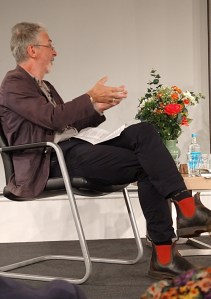
Neil Griffiths
We’ve heard about the bloating of films, that they’re something like 20% longer on average than they were 40 years ago; will books take the opposite trajectory? Can a one-sitting read compete with a film?
I don’t think I’ve ever read even the shortest novella in one sitting. I need time to reflect. I don’t think comparing the two forms is helpful because they require different things of us. Take music: Morton Feldman’s 2nd String Quartet is 5 hours long, without a break. I’d commit to that in the concert hall, but I couldn’t read for 5 hours without a break or sit through a film.
How did you bring Ali Smith on board as the judge for the first two years of the Weatherglass Novella Prize? There was a blind judging process and you ended up with an all-female shortlist in the inaugural year. Do you have a theory as to why?
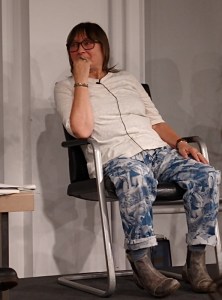
Ali Smith
Damian kept saying Ali Smith would be the best judge and I kept saying “but how do we get to her?” Then someone told me they had her email address. I didn’t expect to get an answer. A ‘Yes’ came an hour later. She’s been wonderful to work with. And she’s enjoyed it so much she’s agreed to do it ongoingly.
I do think the shortlist question is an important one. Certainly we don’t have to ask ourselves any questions when it’s an all-female short list, but we would if it was all-male. What does that say? I don’t know why the strongest were by women.
Do you have any personal favourite novellas?
 A Month in the Country might be the exemplar of the form for me. But there is a little-read novella by Tolstoy, Hadji Murat, which is also close to perfect. More contemporaneously, Gerald Murnane’s Border Districts. And I’m pleased to say: all three novellas we’re publishing from our inaugural prize are up there: Astraea, Aerth and We Hexed the Moon.
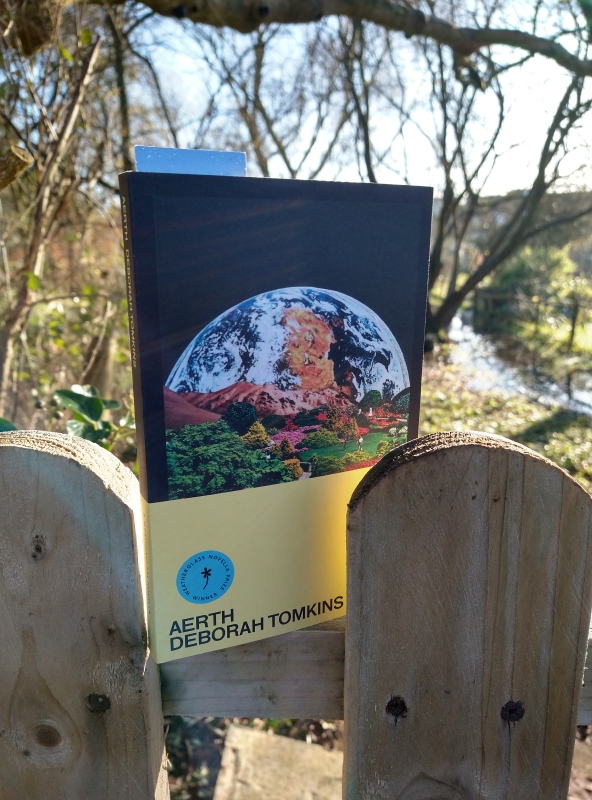
*Though it won’t be published until 25 January, I have a finished copy of the other winner, Aerth by Deborah Tomkins, a novella-in-flash set on alternative earths and incorporating second- and third-person narration and various formats. I’ve been enjoying it so far and hope to review it soon as my first recommendation for 2025.
Three Object Lessons Books for #NovNov24 & #NonfictionNovember (Frith, Hanna, Lobdell)
Bloomsbury’s Object Lessons series “is a series of concise, collectable, beautifully designed books about the hidden lives of ordinary things.” (I have previously reviewed Doctor, Dust, Grave, Pregnancy Test, and Recipe.) I love how interdisciplinary these short nonfiction works are, combining history and pop culture and often incorporating science or medicine, too. Here are my thoughts on three 2024 additions to the series.
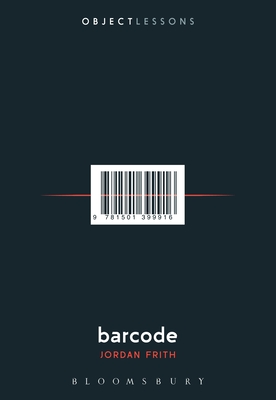 Barcode by Jordan Frith: The barcode was patented in 1952 but didn’t come into daily use until 1974. It was developed for use by supermarkets – the Universal Product Code or UPC. (These days a charity shop is the only place you might have a shopping experience that doesn’t rely on barcodes.) A grocery industry committee chose between seven designs, two of which were round. IBM’s design won and became the barcode as we know it. “Barcodes are a bit of a paradox,” Frith, a communications professor with previous books on RFID and smartphones to his name, writes. “They are ignored yet iconic. They are a prime example of the learned invisibility of infrastructure yet also a prominent symbol of cultural critique in everything from popular science fiction to tattoos.” In 1992, President Bush was considered to be out of touch when he expressed amazement at barcode scanning technology. I was most engaged with the chapter on the Bible – Evangelicals, famously, panicked that the Mark of the Beast heralded by the book of Revelation would be an obligatory barcode tattooed on every individual. While I’m not interested enough in technology to have read the whole thing, which does skew dry, I found interesting tidbits by skimming. (Public library) [152 pages]
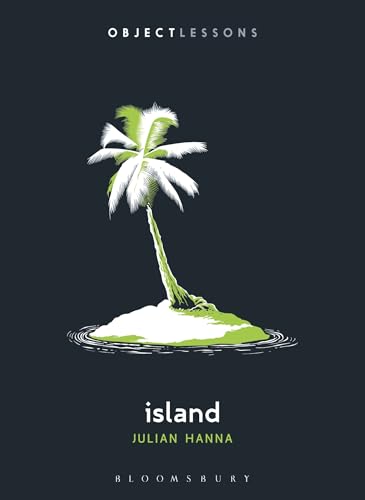 Island by Julian Hanna: The most autobiographical, loosest and least formulaic of these three, and perhaps my favourite in the series to date. Hanna grew up on Vancouver Island and has lived on Madeira; his genealogy stretches back to another island nation, Ireland. Through disparate travels he comments on islands that have long attracted expats: Hawaii, Ibiza, and Hong Kong. From sweltering Crete to the polar night, from family legend to Virginia Woolf’s To the Lighthouse, the topics are as various as the settings. Although Hanna is a humanities lecturer, he even gets involved in designing a gravity battery for Eday in the Orkneys (fully powered by renewables), having won funding through a sustainable energy prize, and is part of a team that builds one in situ there in three days. I admired the honest exploration of the positives and negatives of islands. An island can promise paradise, a time out of time, “a refuge for eccentrics.” Equally, it can be a site of isolation, of “domination and exploitation of fellow humans and of nature.” We may think that with the Internet the world has gotten smaller, but islands are still bastions of distinct culture. In an era of climate crisis, though, some will literally cease to exist. Written primarily during the Covid years, the book contrasts the often personal realities of death, grief and loneliness with idyllic desert-island visions. Whimsically, Hanna presents each chapter as a message in a bottle. What a different book this would have been if written by, say, a geographer. (Read via Edelweiss) [180 pages]
 X-Ray by Nicole Lobdell: X-ray technology has been with us since 1895, when it was developed by German physicist Wilhelm Roentgen. He received the first Nobel Prize in physics but never made any money off of his discovery and died in penury of a cancer that likely resulted from his work. From the start, X-rays provoked concerns about voyeurism. People were right to be wary of X-rays in those early days, but radiation was more of a danger than the invasion of privacy. Lobdell, an English professor, tends to draw slightly simplistic metaphorical messages about the secrets of the body. But X-rays make so many fascinating cultural appearances that I could forgive the occasional lack of subtlety. There’s an in-depth discussion of H.G. Wells’s The Invisible Man, and Superman was only one of the comic-book heroes to boast X-ray vision. The technology has been used to measure feet for shoes, reveal the hidden history of paintings, and keep air travellers safe. I went in for a hospital X-ray of my foot not long after reading this. It was such a quick and simple process, as you’ll find at the dentist’s office as well, and safe enough that my radiographer was pregnant. (Read via Edelweiss) [152 pages]

Nonfiction November: Two Memoirs of Biblical Living by Evans and Jacobs
I love a good year-challenge narrative and couldn’t resist considering these together because of the shared theme. Sure, there’s something gimmicky about a rigorously documented attempt to obey the Bible’s literal commandments as closely as possible in the modern day. But these memoirs arise from sincere motives, take cultural and theological matters seriously, and are a lot of fun to read.
The Year of Living Biblically: One Man’s Humble Quest to Follow the Bible as Literally as Possible by A.J. Jacobs (2007)
Jacobs came up with the idea, so I’ll start with him. His first book, The Know-It-All, was about absorbing as much knowledge as possible by reading the encyclopaedia. This starts in similarly intellectual fashion with a giant stack of Bible translations and commentaries. From one September to the next, Jacobs vows, he’ll do his best to understand and implement commandments from both the Old and New Testaments. It’s not a completely random choice of project in that he’s a secular Jew (“I’m Jewish in the same way the Olive Garden is an Italian restaurant. Which is to say: not very.”). Firstly, and most obviously, he stops shaving and getting haircuts. “As I write this, I have a beard that makes me resemble Moses. Or Abe Lincoln. Or [Unabomber] Ted Kaczynski. I’ve been called all three.” When he also takes to wearing all white, he really stands out on the New York subway system. Loving one’s neighbour isn’t easy in such an antisocial city, but he decides to try his best.
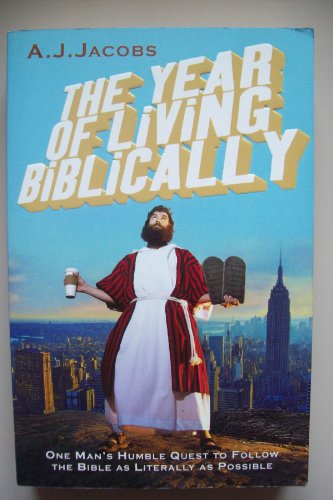 Jacobs is confused by the Bible’s combination of sensible moral guidelines and bizarre, arcane stuff. His conviction is that you can’t pick and choose – even if you don’t know why a law is important, you have to go with it. One of his “Top Five Most Perplexing Rules in the Bible” is a ban on clothing made of mixed fibers (shatnez). So he hires a shatnez tester, Mr. Berkowitz, who comes to investigate his entire wardrobe. To fulfil another obscure commandment, Berkowitz helps him ceremonially take an egg from a pigeon’s nest. Jacobs takes up prayer, hospitality, tithing, dietary restrictions, and avoiding women at the wrong time of the month. He gamely puts up a mezuzah, which displays a Bible passage above his doorframe. He even, I’m sorry to report, has a chicken sacrificed. Despite the proverb about not ‘sparing the rod’, he can’t truly bring himself to punish his son, so taps him gently with a Nerf bat; alas, Jasper thinks it’s a game. Stoning adulterers? Jacobs tosses pebbles at ankles.
The book is a near-daily journal, with a new rule or three grappled with each day. There are hundreds of strange and culturally specific guidelines, but the heart issues – covetousness, lust – pose more of a challenge. Alongside his work as a journalist for Esquire and this project, Jacobs has family stuff going on: IVF results in his wife’s pregnancy with twin boys. Before they become a family of five, he manages to meet some Amish people, visit the Creation Museum, take a trip to the Holy Land to see a long-lost uncle, and engage in conversation with Evangelicals across the political spectrum, from Jerry Falwell’s megachurch to Tony Campolo (who died just last week). Jacobs ends up a “reverent agnostic.” We needn’t go to such extremes to develop the gratitude he feels by the end, but it sure is a hoot to watch him. This has just the sort of amusing, breezy yet substantial writing that should engage readers of Bill Bryson, Dave Gorman and Jon Ronson. (Free mall bookshop) 
A Year of Biblical Womanhood: How a Liberated Woman Found Herself Sitting on Her Roof, Covering Her Head, and Calling Her Husband “Master” by Rachel Held Evans (2012)
 Evans’s book proposal must have referenced Jacobs’s project, but she comes at things from a different perspective as a progressive Christian, and likely had a separate audience in mind. Namely, the sort of people who worry about the concept of biblical womanhood and wrestle with Bible verses about women remaining silent in church and not holding positions of religious leadership over men. There are indeed factions of Christianity that take these passages literally. Given that she was a public speaker and popular theologian, Evans obviously didn’t. But in her native Alabama and her new home of Tennessee, many would. She decides to look more closely at some of the prescriptions for women in the scriptures, focusing on Proverbs 31, which describes the “woman of valor.” She looks at this idealized woman’s characteristics in turn and tries to adhere to them by dressing modestly, taking etiquette lessons, learning to cook and hosting dinners, and practicing for parenthood with a “Baby-Think-It-Over” doll. Like Jacobs, she stops cutting her hair and meets some Amish people. But she also sleeps outside in a tent while menstruating and undertakes silent meditation at an abbey and a mission trip to Bolivia. Each monthly chapter ends with a profile of a female character from the Bible and what might be learned from her story.
It’s a sweet, self-deprecating book. You can definitely tell that she was only 29 at the time she started her project. It’s okay with me that Evans turned all her literal intentions into more metaphorical applications by the end of the year. She concludes that the Church has misused Proverbs 31: “We abandoned the meaning of the poem by focusing on the specifics, and it became just another impossible standard by which to measure our failures. We turned an anthem into an assignment, a poem into a job description.” Her determination is not to obsess over rules but to continue with the habits that benefited her spiritual life, and to champion women whenever she can. I suspect this is a lesser entry from Evans’s oeuvre. She died too soon – suddenly in 2019, of brain swelling after a severe allergic reaction to an antibiotic – but remains a valued voice, and I’ll catch up on the rest of her books. Searching for Sunday, for instance, was great, and I’m keen to read Evolving in Monkey Town (about living in Dayton, Tennessee, where the famous Scopes Monkey Trial took place). (Birthday gift from my wish list, 2023)
#MARM2024: Life before Man and Interlunar by Margaret Atwood
Hard to believe, but it’s my seventh year participating in the annual Margaret Atwood Reading Month (#MARM) hosted by indomitable Canadian blogger Marcie of Buried in Print. In previous years, I’ve read Surfacing and The Edible Woman, The Robber Bride and Moral Disorder, Wilderness Tips, The Door, and Bodily Harm and Stone Mattress; and reread The Blind Assassin. I’m wishing a happy belated birthday to Atwood, who turned 85 earlier this month. Novembers are my excuse to catch up on her extensive back catalogue. In recent years, I’ve scoured the university library holdings to find works by her that I often had never heard of, as was the case with this early novel and mid-career poetry collection.
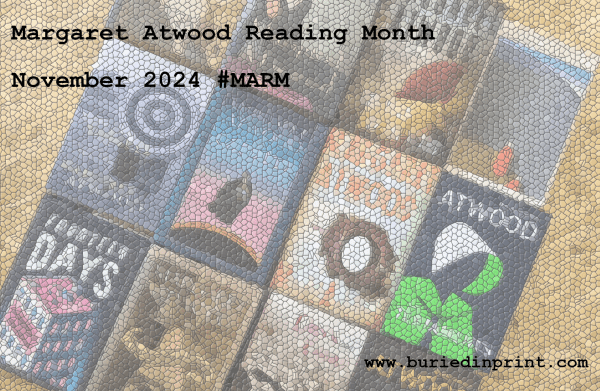
Life before Man (1979)
 Atwood’s fourth novel is from three rotating third-person POVs: Toronto museum curator Elizabeth, her toy-making husband Nate, and Lesje (pronounced “Lashia,” according to a note at the front), Elizabeth’s paleontologist colleague. The dated chapters span nearly two years, October 1976 to August 1978; often we visit with two or three protagonists on the same day. Elizabeth and Nate, parents to two daughters, have each had a string of lovers. Elizabeth’s most recent, Chris, has died by suicide. Nate disposes of his latest mistress, Martha, and replaces her with Lesje, who is initially confused by his interest in her. She’s more attracted to rocks and dinosaurs than to people, in a way that could be interpreted as consistent with neurodivergence.
It was neat to follow along seasonally with Halloween and Remembrance Day and so on, and see the Quebec independence movement simmering away in the background. To start with, I was engrossed in the characters’ perspectives and taken with Atwood’s witty descriptions and dialogue: “[Nate]’s heard Unitarianism called a featherbed for falling Christians” and (Lesje:) “Elizabeth needs support like a nun needs tits.” My favourite passage encapsulates a previous relationship of Lesje’s perfectly, in just the sort of no-nonsense language she would use:
The geologist had been fine; they could compromise on rock strata. They went on hikes with their little picks and kits, and chipped samples off cliffs; then they ate jelly sandwiches and copulated in a friendly way behind clumps of goldenrod and thistles. She found this pleasurable but not extremely so. She still has a collection of rock chips left over from this relationship; looking at it does not fill her with bitterness. He was a nice boy but she wasn’t in love with him.
Elizabeth’s formidable Auntie Muriel is a terrific secondary presence. But this really is just a novel about (repeated) adultery and its aftermath. The first line has Elizabeth thinking “I don’t know how I should live,” and after some complications, all three characters are trapped in a similar stasis by the end. By the halfway point I’d mostly lost interest and started skimming. The grief motif and museum setting weren’t the draws I’d expected them to be. Lesje is a promising character but, disappointingly, gets snared in clichéd circumstances. No doubt that is part of the point; “life before man” would have been better for her. (University library)
This prophetic passage from Life before Man leads nicely into the themes of Interlunar:
The real question is: Does [Lesje] care whether the human race survives or not? She doesn’t know. The dinosaurs didn’t survive and it wasn’t the end of the world. In her bleaker moments, … she feels the human race has it coming. Nature will think up something else. Or not, as the case may be.
The posthuman prospect is echoed in Interlunar in the lines: “Which is the sound / the earth will make for itself / without us. A stone echoing a stone.”
Interlunar (1984)
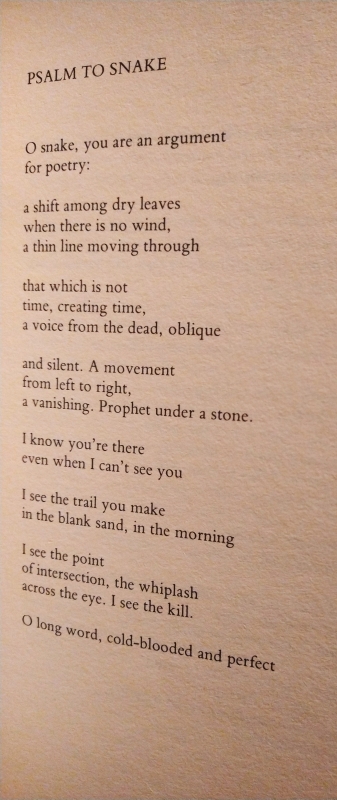
Some familiar Atwood elements in this volume, including death, mythology, nature, and stays at a lake house; you’ll even recognize a couple of her other works in poem titles “The Robber Bridegroom” and “The Burned House.” The opening set of “Snake Poems” got me the “green” and “scales” squares on Marcie’s Bingo card (in addition to various other scattered ones, I’m gonna say I’ve filled the whole right-hand column thanks to these two books).
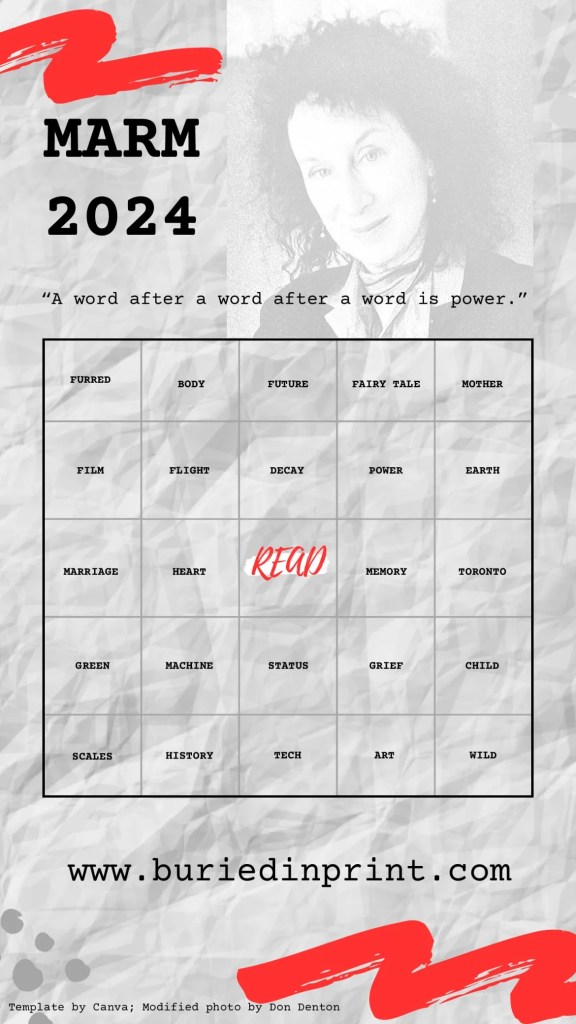
This one brilliantly likens the creature to the sinuous ways of language:
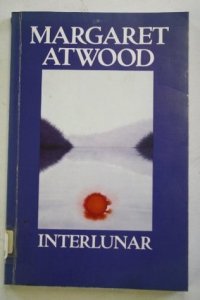 “A Holiday” imagines a mother–daughter camping vacation presaging a postapocalyptic struggle for survival: “This could be where we / end up, learning the minimal / with maybe no tree, no rain, / no shelter, no roast carcasses / of animals to renew us … So far we do it / for fun.” As in her later collection The Door, portals and thresholds are of key importance. “Doorway” intones, “November is the month of entrance, / month of descent. Which has passed easily, / which has been lenient with me this year. / Nobody’s blood on the floor.” There are menace and melancholy here. But as “Orpheus (2)” suggests at its close, art can be an ongoing act of resistance: “To sing is either praise / or defiance. Praise is defiance.” I do recommend Atwood’s poetry if you haven’t tried it before, even if you’re not typically a poetry reader. Her poems are concrete and forceful, driven by imagery and voice; not as abstract as you might fear. Alas, I wasn’t sent a review copy of her collected poems, Paper Boat, as I’d hoped, but I will continue to enjoy encountering them piecemeal. (University library)
Love Your Library, November 2024
Thanks to Eleanor (here and here) and Marcie for posting about their recent library reading!
New at my library this month: lacemakers sitting and working at their craft at two designated tables, with examples of finished work behind them. I was intrigued by their round wooden boards, almost like artists’ palettes, holding various pins and threads. Apparently if you can crochet you can tat lace. I didn’t know that we had a local lacemaking tradition in Newbury. On travels elsewhere, e.g. Nottingham, I have seen it more prominently mentioned as part of a city’s history. During my Tuesday volunteering the other week, a patron made a point of coming up to me and saying how nice it was to see them there.
The only thing that tarnished the experience for me, as with some other things I’m involved with (Repair Café especially), is that the participants are overwhelmingly over 50 – probably most of them over 70, in fact. Such skills and crafts are going to die out unless they’re being passed on to younger generations. This is not arcane knowledge to be admired but essential human culture to be preserved. Art is always of value for its own sake. We have never needed a ‘make do and mend’ mindset more, yet we are consuming and disposing as if there is no tomorrow. I need to bring up again with the Repair Café coordinators how we might get younger people apprenticed to skilled volunteer repairers to start this process.
Anyway, back to libraries. That day, one member of staff went over to a lacemaker and apologized that it was about to get noisy with Rhyme Time (a singing session for babies and toddlers with their parents and carers), which seemed like a great juxtaposition that shows the range of activities the library system supports.
My library use over the last month:
I’ve been catching up on the Booker Prize shortlist and reading loads of novella-length works.

READ
- The Wood at Midwinter by Susanna Clarke

- Without Ever Reaching the Summit: A Himalayan Journey by Paolo Cognetti
- James by Percival Everett
- A Haunting on the Hill by Elizabeth Hand

- Orbital by Samantha Harvey
- What Feasts at Night by T. Kingfisher
- Heartstopper: Volume 5 by Alice Oseman (a reread)
- Playground by Richard Powers
- Intermezzo by Sally Rooney

+ picture books Pete the Cat Saves Christmas and The Twelve Cats of Christmas
SKIMMED
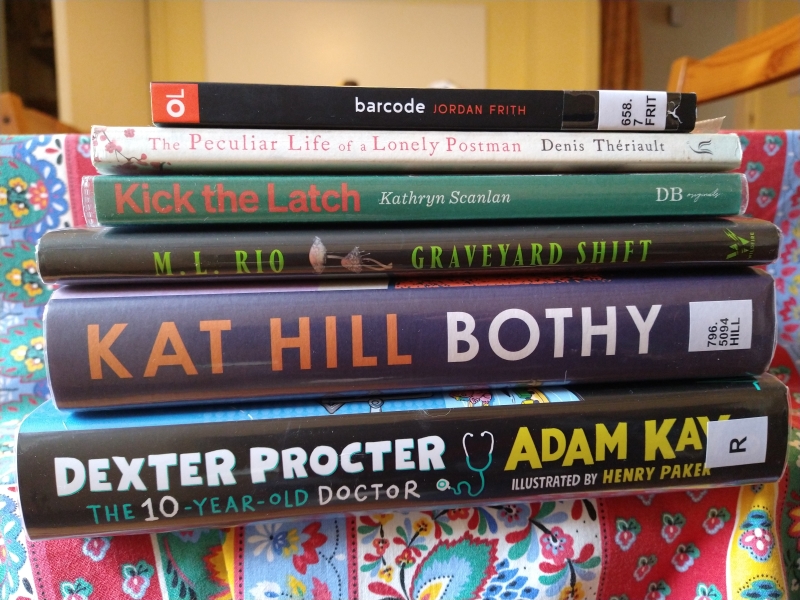
- Barcode by Jordan Frith
- A Nature Poem for Every Winter Evening by Jane McMorland Hunter
- A Thousand Feasts by Nigel Slater
- Dinner by Meera Sodha
CURRENTLY READING
- Interlunar by Margaret Atwood
- Life before Man by Margaret Atwood
- A Beginner’s Guide to Dying by Simon Boas
- Small Rain by Garth Greenwell
- Poetry Unbound: 50 Poems to Open Your World by Pádraig Ó Tuama
- The Place of Tides by James Rebanks
- Men Explain Things to Me by Rebecca Solnit
- The Peculiar Life of a Lonely Postman by Denis Thériault
- The Safekeep by Yael van der Wouden
CHECKED OUT, TO BE READ
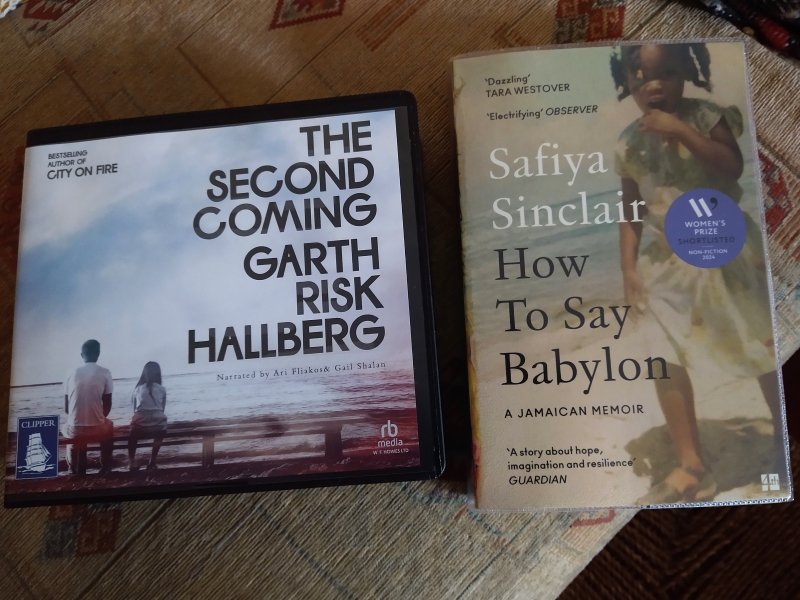
- The Second Coming by Garth Risk Hallberg (audiobook)
- Dexter Procter: The 10-Year-Old Doctor by Adam Kay
- Dispersals: On Plants, Borders and Belonging by Jessica J. Lee
RETURNED UNREAD
- Rosarita by Anita Desai
- Bellies by Nicola Dinan – Requested off me; will try another time.
- Bothy by Kat Hill – Have had it out twice and not managed to open it; maybe I should wait and take it away to a Scottish island.
- What Does It Feel Like? by Sophie Kinsella
- Kick the Latch by Kathryn Scanlan
The three not explained were borrowed for #NovNov24 with the best of intentions, but I don’t think they actually appeal to me (for very different reasons).
RETURNED UNFINISHED
- Graveyard Shift by M.L. Rio – Subpar.
- How to Say Babylon by Safiya Sinclair – Too long and involved (and such small print!) for a busy month. Will try another time.
What have you been reading or reviewing from the library recently?

Share a link to your own post in the comments. Feel free to use the above image. The hashtag is #LoveYourLibrary.
Short, Soul-Soothing Reads for #NovNov24 & #NonfictionNovember: Barnes, Cognetti, Lende, Mann, Nouwen and Winner
After the catastrophic U.S. election results (which we’ve all managed to ignore or normalize so as to keep going with our lives) and a medical crisis with our dear old cat, I’ve been craving literary soul food. These six short nonfiction books have been good companions, promising love, meaning and transcendence in the midst of bereavement and daily routines.
Levels of Life by Julian Barnes (2013)
 Barnes was a favourite author in my twenties and thirties, though I’ve had less success with his recent work. He wrote a few grief-soaked books in the wake of the death of his wife, celebrated literary agent Pat Kavanagh*. I had this mistaken for a different one (Through the Window, I think?) that I had enjoyed more. No matter; it was still interesting to reread this triptych of auto/biographical essays. The final, personal piece, “The Loss of Depth,” is a classic of bereavement literature on par with C.S. Lewis’s A Grief Observed; I would happily take it as a standalone pamphlet. Its every word rings true, especially the sense of duty as the lost one’s “principal rememberer.” But the overarching ballooning metaphor, and links with early French aerial photographer Nadar and Colonel Fred Burnaby, aeronaut and suitor of Sarah Bernhardt, don’t convince. The strategy feels like a rehearsal for Richard Flanagan’s Baillie Gifford Prize-winning Question 7, a similar hybrid work that pulls it off better. (Little Free Library) [118 pages]
*In spring 2008, I attended a talk by John Irving at King’s College, London, where I worked in library services for five years. Barnes and Kavanagh were in the front row and embraced Irving before the start. I was floored to hear of Kavanagh’s death later that year because she’d looked so well. It was a fast-acting brain tumour that felled her just 37 days after diagnosis.
Without Ever Reaching the Summit by Paolo Cognetti (2018; 2020)
[Translated from the Italian by Stash Luczkiw]
 Part pilgrimage and part 40th birthday treat, Cognetti’s October 2017 Himalayan trek through Dolpo (a Nepalese plateau at the Tibetan border) would also somewhat recreate Peter Matthiessen’s The Snow Leopard. Cognetti struggles with altitude sickness and the fare: “I tried salted yak butter tea for the first time—nauseating if you thought you were drinking tea, good and refreshing if you thought you were drinking broth.” He and his companions fancifully decide that Kanjiroba, the lovable stray dog who joins their party, is a reincarnation of Matthiessen. I have limited tolerance for travel books’ episodic combinations of nature descriptions, anthropological observations, and the rigours of the nomadic lifestyle. The same was true here, but the slight spiritual aspect and references to The Snow Leopard lifted it. (Public library) [135 pages]
Find the Good: Unexpected Life Lessons from a Small-Town Obituary Writer by Heather Lende (2015)
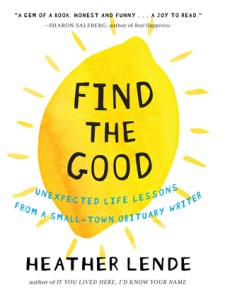 Lende is a journalist in isolated Haines, Alaska (population: 2,000). There’s a plucky motivational bent to these mini-essays about small-town life and death. In writing obituaries for normal, flawed people, she is reminded of what matters most: family (she’s a mother of five, one adopted, and a grandmother; she includes beloved pets in this category) and vocation. The title phrase is the motto she lives by. “I believe gratitude comes from a place in your soul that knows the story could have ended differently, and often does, and I also know that gratitude is at the heart of finding the good in this world—especially in our relationships with the ones we love.” The anecdotes and morals are sweet if not groundbreaking. The pocket-sized hardback might appeal to readers of Anne Lamott and Elizabeth Strout. (Birthday gift from my wish list, secondhand) [162 pages]
Do Not Be Afraid: The joy of waiting in a time of fear by Rachel Mann (2024)
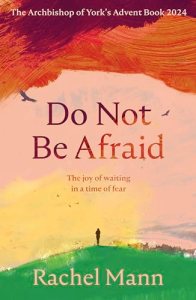 This is the Archbishop of York’s Advent Book 2024; I read it early because, pre-election, I yearned for its message of courage and patience. We need it all the more now. The bite-sized essays are designed to be read one per day from the first Sunday of Advent through to Christmas Day. Often they include a passage of scripture or poetry (including some of Mann’s own) for meditation, and each entry closes with a short prayer and a few questions for discussion or private contemplation. The topics are a real variety but mostly draw on the author’s own experiences of waiting and suffering: medical appointments and Covid isolation as well as the everyday loneliness of being single and the pain of coping with chronic illness. She writes about sitting with parishioners as they face death and bereavement. But there are also pieces inspired by popular culture – everything from Strictly to Quentin Tarantino.
Mann has written several previous Lent course books based on films. I’ve read her work in multiple genres (poetry: A Kingdom of Love and Eleanor Among the Saints; literary criticism: In the Bleak Midwinter; memoir: Dazzling Darkness; fiction: The Gospel of Eve); she is such a versatile writer, and with a fascinating story as a trans priest. Sombre yet hopeful, this is recommended seasonal reading. [114 pages]
With thanks to SPCK for the free copy for review.
The Inner Voice of Love: A Journey through Anguish to Freedom by Henri J. M. Nouwen (1997)
 Anguish is a strong word; I haven’t done any biographical digging to figure out what was going on in Nouwen’s life to prompt it, but apparently this secret journal came out of a lost relationship. (I wonder if it could have been a homosexual attachment. Nouwen was a Dutch Roman Catholic priest who became the pastor of a community for disabled adults in Canada.) He didn’t publish for another eight years but friends encouraged him to let his experience aid others. The one- or two-page reflections are written in the second person, so they feel like a self-help pep talk. The recurring themes are overcoming abandonment and rejection, relinquishing control, and trusting in God’s love and faithfulness. “You must stop being a pleaser and reclaim your identity as a free self.” The point about needing to integrate rather than sideline psychological pain is one I’m sure any therapist would affirm. Nouwen writes that a new spirituality of the body is necessary. This was a comforting bedside book with lots of passages that resonated. (Free – withdrawn from church theological library) [98 pages]
Mudhouse Sabbath: An Invitation to a Life of Spiritual Discipline by Lauren F. Winner (2003)
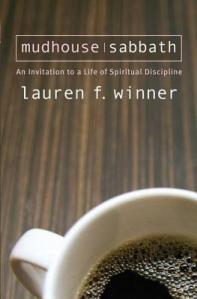 After Winner converted from Orthodox Judaism to Christianity, she found that she missed how Jewish rituals make routine events sacred. There are Christian sacraments, of course, but this book is about how the wisdom of another tradition might be applied in a new context. “Judaism offers opportunities for people to inhabit and sanctify bodies and bodily practices,” Winner writes. There are chapters on the concept of the Sabbath, wedding ceremonies, prayer and hospitality. Fasting is a particular sticking point for Winner, but her priest encourages her to see it as a way of demonstrating dependence on, and hunger for, God. I most appreciated the sections on mourning and ageing. “Perhaps the most essential insight of the Jewish approach to caring for one’s elderly is that this care is, indeed, an obligation. What Judaism understands is that obligations are good things. They are the very bedrock of the Jew’s relationship to God, and they govern some of the most fundamental human relationships”. By the way, Mudhouse is Winner’s local coffeehouse, so she believes these disciplines can be undertaken anywhere. (Secondhand – Awesomebooks.com) [142 pages]
 Bookish Beck = Rebecca Foster. American transplant to England. Freelance proofreader and book reviewer.
 Bookish Beck