My Year in Nonfiction (Thus Far)
If your household is anything like mine, stressful days and nights of lost sleep are ceding to relief after the U.S. election result was finally announced. We celebrated with whoopie pies (a Pennsylvania specialty) and Prosecco.


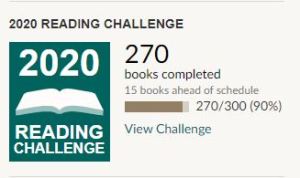
And look: I happened to pass 270 yesterday as well!
I’d taken part in the Six Degrees of Separation meme every month since February, but this time I had no inspiration. I was going to start with these two apple covers…
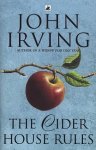
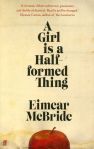
…but that’s as far as I got. Never mind! I’ll be back next month, when we all start with the YA classic Are You There God? It’s Me, Margaret by Judy Blume.
Instead, I’m catching up with this past week’s Nonfiction November prompt: Your Year in Nonfiction. It was hosted by Leann of Shelf Aware.

 What topics have been prominent in your year’s nonfiction reading?
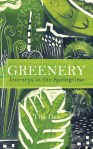
I’ve read a lot of nature and popular science, probably more than in an average year. Greenery by Tim Dee has been an overall highlight. I managed to read 12 books from the Wainwright Prize longlists, and I’m currently reading four books of nature-themed essays or journals. Thoughtful as well as consoling.

The popular science material has focused on environmentalism and current events, which has inevitably involved politics and long-term planning (Annabel called this category “The State We’re In”): e.g. Losing Eden, Footprints, The Good Ancestor, and Notes from an Apocalypse.


 Thanks to the food and drink theme I set for my 20 Books of Summer, I read a number of foodie memoirs. The best one was Heat by Bill Buford, but I also really enjoyed Kitchen Confidential by Anthony Bourdain and My Berlin Kitchen by Luisa Weiss.
 Since the Wellcome Book Prize didn’t run this year, I’ve read fewer health-related books, although I did specially read Not the Wellcome Prize shortlistee The Remarkable Life of the Skin by Monty Lyman, and Dear Life by Rachel Clarke, a palliative care doctor, has been one of my overall best nonfiction reads of the year.
Not very well represented in my nonfiction reading this year were biographies and travel books. I can struggle with the depth and dryness of some books from these genres, but I’d like to find some readable options to get stuck into next year.
What are your favorite nonfiction books you’ve read so far?
I’m a huge memoir junkie. Some of the most memorable ones this year have been Winter Journal by Paul Auster, Traveling Mercies by Anne Lamott (a reread), and A Three Dog Life by Abigail Thomas (another reread).


An incidental theme in the life writing I’ve read in 2020 is childhood (Childhood by Tove Ditlevsen, Cider with Rosie by Laurie Lee, Oleander, Jacaranda by Penelope Lively, Period Piece by Gwen Raverat); I hope to continue reading around this topic next year.
What books have you recommended the most to others?
I’ve mentioned the Clarke (above) in any discussions of books about illness and death.
I recommended the memoir Are You Somebody? by Nuala O’Faolain more than once following Reading Ireland Month.
Entangled Life, Merlin Sheldrake’s enthusiastic book about fungi, is one I can imagine suggesting to readers who don’t often pick up nonfiction.
And Signs of Life by Dr. Stephen Fabes has generated a fair bit of interest among my Goodreads friends.


Besides Annabel, Kate and Liz also wrote about their 2020 nonfiction reading habits.
How has your nonfiction reading been going this year?
Doorstopper of the Month: The Cider House Rules by John Irving (A Reread)
Next month will be all about the short books (#NovNov!), but first it was time to get this excessively long one out of the way. My husband’s and my reading tastes don’t overlap in many areas, but John Irving is our mutual favorite author. I first started The Cider House Rules (1985) on our second honeymoon – being from two different countries, we had two nuptial ceremonies and two honeymoons, one per continent – which was a road trip through New England. We drove from Maryland to Maine and back; I have a specific memory of reading the chunky Irving hardback at our B&B in Stowe, Vermont. I was a much less prolific reader in those days, so I had to return my American library copy partially read and then pay to reserve one from the Hampshire Libraries system once we were back in the UK.
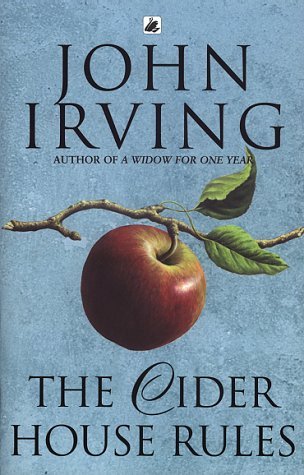
Thirteen years on, I remembered the orphanage and cider farm settings, the dynamic between Doctor Wilbur Larch and his protégé, Homer Wells, and Homer’s love for his best friend’s girl, Candy. I also remembered that this is a Trojan horse of a novel: it advocates, not very subtly, for abortion rights through pictures of women in desperate situations. Luckily, by the time I first read it I was no longer slavishly devoted to the American Religious Right. But this time I felt that even readers who consider themselves pro-choice might agree Irving over-eggs his argument. My memory of the 1999 film version is clearer. It severely condenses the book’s 40 years or so of action, cutting subplots and allowing Tobey Maguire and Charlize Theron to play the leads all the way through. A shorter timeframe also more neatly draws a line between Rose Rose’s experience and Homer’s change of heart about offering abortions.
I had a strong preference for the scenes set at St. Cloud’s orphanage in Maine. Dr. Larch is celibate and addicted to ether – all a result of his first sexual encounter with a prostitute. He has an ironclad conviction that he is doing the Lord’s work for the pregnant women who get off the train at St. Cloud’s, whether they come for an abortion or to leave a live baby behind. Homer Wells is the one orphan who never finds an adoptive home; he stays on and becomes Larch’s trainee in obstetrics, but vows that he won’t perform abortions. As a young adult, Homer is pulled away from the orphanage by his puppy love for Wally and Candy, a couple-in-trouble who come up from his family’s apple farm. Homer thinks he’ll go back with his new friends for a month or two, but instead he stays at Ocean View orchard for decades, his relationship with Candy changing when Wally goes off to war and comes back disabled.
I had forgotten the bizarre scenario Larch has to set up for the orphanage’s board of trustees to accept his chosen successor, and the far-fetched family situation Homer, Candy and Wally end up in. The orchard sections could feel endless, so I always thrilled to mentions of what was happening for Dr. Larch and the nurses back at St. Cloud’s.

Oktoberfest reading and snacking.
The Dickensian influence – lots of minor characters and threads tying up nicely by the end; quirks of speech and behavior – has generally been the aspect I like the most about Irving’s work, and while I loved the explicit references to David Copperfield here (a few kids get their names from it, it’s read aloud to the boy orphans every night, and its opening question about whether the protagonist will be the hero of his own life or not applies to Homer, too), I did find the novel awfully baggy this time. I even put in a slip of paper where I felt that things started to drift: page 450.
One further note to make about the film: it, rather unforgivably, eliminates Melony, a larger-than-life character and necessary counterpart to the book’s multiple passive females. She’s the de facto head of the girl orphans, as Homer is for the boys, and initiates Homer into sex. But her feelings for him are more of hero worship than of romantic love, and when he breaks his promise and leaves St. Cloud’s without her, she sets off to hunt him down. Her odyssey, delivered in parallel, is nearly as important as Homer’s (see what I/Irving did there?).
While I loved the medical history material and Dr. Larch’s moral fiber, this time I found Homer a little insipid and annoying (he answers nearly every question with “Right”), and the plot somewhat slack and obvious. In my memory this is probably #3 out of the Irving novels I’ve read, below A Prayer for Owen Meany and The World According to Garp – both of which I’d also like to reread to see if they’ve retained their power.
Page count: 731
My original rating (July–September 2007): 
My rating now: 
Done any rereading, or picked up any very long books, lately?
November Plans: Novellas, Margaret Atwood Reading Month & More
My big thing next month will, of course, be Novellas in November, which I’m co-hosting with Cathy of 746 Books as a month-long challenge with four weekly prompts. I’m taking the lead on two alternating weeks and will introduce them with mini-reviews of some of my favorite short books from these categories:
9–15 November: Nonfiction novellas
23–29 November: Short classics

I’m also using this as an excuse to get back into the nine books of under 200 pages that have ended up on my “Set Aside Temporarily” shelf. I swore after last year that I would break myself of the bad habit of letting books linger like this, but it has continued in 2020.
Other November reading plans…
Readalong of Derek Jarman’s Modern Nature
 I learned about this book through Losing Eden by Lucy Jones; she mentions it in the context of nature helping people come to terms with their mortality. Jarman found solace in his Dungeness, Kent garden while dying of AIDS. Shortly after I came across that reference, I learned that his home, Prospect Cottage, had just been rescued from private sale by a crowdfunding campaign. I hope to visit it someday. In the meantime, Creative Folkestone is hosting an Autumn Reads festival on his journal, Modern Nature, running from the 19th to 22nd. I’ve already begun reading it to get a headstart. Do you have a copy? If so, join in!
Margaret Atwood Reading Month
 This is the third year of #MARM, hosted by Canadian bloggers extraordinaires Marcie of Buried in Print and Naomi of Consumed by Ink. (Check out the neat bingo card they made this year!) I plan to read the short story volume Wilderness Tips and her new poetry collection, Dearly,on the way for me to review for Shiny New Books. If I fancy adding anything else in, there are tons of her books to choose from across the holdings of the public and university libraries.
Nonfiction November
I don’t usually participate in this challenge because nonfiction makes up at least 40% of my reading anyway, but the past couple of years I enjoyed putting together fiction and nonfiction pairings and “Being the Expert” on women’s religious memoirs. I might end up doing at least one post, especially as I have some “Three on a Theme” posts in mind to encompass a couple of nonfiction topics I happen to have read several books about. The full schedule is here.
Young Writer of the Year Award
 Being on the shadow panel for the Sunday Times Young Writer of the Year Award was a highlight of 2017 for me. I look forward to following along with the nominated books, as I did last year, and attending the virtual prize ceremony. With any luck I will already have read at least one or two books from the shortlist of four. Fingers crossed for Rowan Hisayo Buchanan, Naoise Dolan, Jessica J. Lee, Olivia Potts and Nina Mingya Powles; Niamh Campbell, Catherine Cho, Tiffany Francis and Emma Glass are a few other possibilities. (By chance, only young women are on my radar this year!)
November is such a busy month for book blogging: it’s also Australia Reading Month and German Literature Month. I don’t happen to have any books on the pile that will fit these prompts, but you might like to think about how you can combine one of them with some of the other challenges out there!
Any reading plans for November? Will you be joining in with novellas, Margaret Atwood’s books or Nonfiction November?
Library Checkout, October 2020
ALL of my reservations seemed to come in at once this month, so I’ve been busy reading the recent releases that are requested after me. Soon I’ll amass a pile of short books to consider reading for Novellas in November. While searching through shelves and boxes of children’s picture books for reserved titles, I often come across ones I can’t resist, especially if they feature animals. I borrow a few most weeks and enjoy reading them back at home over a cup of tea.

I would be delighted to have other bloggers – and not just book bloggers, either – join in this meme. Feel free to use the image above and leave a link to your blog in the comments if you’ve taken part in Library Checkout (which runs on the last Monday of every month), or tag me on Twitter and/or Instagram (@bookishbeck / #TheLibraryCheckout).
I rate most of the books I read or skim, and include links to reviews not already featured on the blog.
READ
- Sisters by Daisy Johnson
- Maid: Hard Work, Low Pay, and a Mother’s Will to Survive by Stephanie Land

- 666 Charing Cross Road by Paul Magrs
- An Event in Autumn by Henning Mankell
- The Pumpkin Eater by Penelope Mortimer
- English Pastoral: An Inheritance by James Rebanks
- Such a Fun Age by Kiley Reid – Success on the second try!
- How to Be Both by Ali Smith
- Adults by Emma Jane Unsworth
- Night by Elie Wiesel

+ Children’s picture books (don’t worry, these don’t count towards my year’s reading list!)
- Pumpkin Soup by Helen Cooper
- Moomin and the Golden Leaf by Richard Dungworth

- Little Owl’s Orange Scarf by Tatyana Feeney
- Christopher Pumpkin by Sue Hendra and Paul Linnet
- The Steves by Morag Hood
- Sloth Slept On by Frann Preston-Gannon
- Think of an Eel by Karen Wallace
SKIMMED
- 33 Meditations on Death: Notes from the Wrong End of Medicine by David Jarrett
- A Girl Is a Half-Formed Thing by Eimear McBride
- The Glorious Heresies by Lisa McInerney
- The Lonely Londoners by Sam Selvon
- The Wild Silence by Raynor Winn

CURRENTLY READING
- The Last Runaway by Tracy Chevalier (for book club)
- Piranesi by Susanna Clarke
- Just Like You by Nick Hornby
- Vesper Flights: New and Selected Essays by Helen Macdonald
- The Glass Hotel by Emily St. John Mandel
- First Time Ever: A Memoir by Peggy Seeger
- Real Life by Brandon Taylor
- Love and Other Thought Experiments by Sophie Ward
CURRENTLY SKIMMING
- The Book of Gutsy Women by Chelsea Clinton and Hillary Rodham Clinton
- What Have I Done? An Honest Memoir about Surviving Postnatal Mental Illness by Laura Dockrill
- Duty of Care by Dominic Pimenta
CHECKED OUT, TO BE READ
- Dependency by Tove Ditlevsen
- House of Glass: The Story and Secrets of a Twentieth-Century Jewish Family by Hadley Freeman
- A Registry of My Passage upon the Earth by Daniel Mason
- Something Special by Iris Murdoch
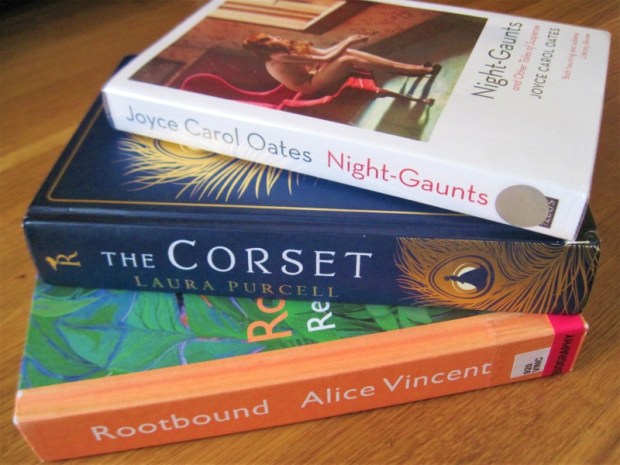
- Rootbound: Rewilding a Life by Alice Vincent
+ A few more picture books
+ This exciting university library book haul!

ON HOLD, TO BE PICKED UP
- As You Were by Elaine Feeney
- Dear Reader: The Comfort and Joy of Books by Cathy Rentzenbrink
- Jack by Marilynne Robinson
- The Courage to Care: A Call for Compassion by Christie Watson
And from the university library, for Novellas in November:
- Travels in the Scriptorium by Paul Auster
- Kill My Mother: A Graphic Novel by Jules Feiffer
- The Driver’s Seat by Muriel Spark
IN THE RESERVATION QUEUE
- Mr Wilder & Me by Jonathan Coe
- Here Is the Beehive by Sarah Crossan
- The Girl with the Louding Voice by Abi Daré
- Bringing Back the Beaver: The Story of One Man’s Quest to Rewild Britain’s Waterways by Derek Gow
- Tilly and the Map of Stories (Pages & Co. #3) by Anna James
- Kay’s Anatomy: A Complete (and Completely Disgusting) Guide to the Human Body by Adam Kay
- The Dickens Boy by Thomas Keneally
- To Be a Man by Nicole Krauss
- Mantel Pieces: Royal Bodies and Other Writing from the London Review of Books by Hilary Mantel
- Monogamy by Sue Miller
- My Last Supper: One Meal, a Lifetime in the Making by Jay Rayner
RETURNED UNFINISHED
- Night-Gaunts and Other Tales of Suspense by Joyce Carol Oates – I read and reviewed the first story for R.I.P. but didn’t continue.
- The Corset by Laura Purcell – My second DNF of a Purcell after last year and The Silent Companions. Her setups are appealing but she just doesn’t deliver the excitement. I made it to page 41. Really I should give up on her, but Bone China is still on my TBR…
RETURNED UNREAD
- The Magic Toyshop by Angela Carter – I decided it didn’t quite fit the bill for R.I.P. I will try it another time, though.
What appeals from my stacks?
Library Checkout, September 2020
On the 21st my library reopened to the public for limited browsing and computer use, so I no longer have blissfully solitary volunteering sessions and I have to wear a mask while I’m shelving. It’s only for a few hours a week, though, so it’s no great hardship – and it’s good that other people are getting to share the library love again.
This month my reading has focused on short stories and Women’s Prize winners, but I also picked up other recent releases, plus children’s books about cats and appealing memoirs.
I would be delighted to have other bloggers – and not just book bloggers, either – join in this meme. Feel free to use the image above and leave a link to your blog in the comments if you’ve taken part in Library Checkout (which runs on the last Monday of every month), or tag me on Twitter and/or Instagram (@bookishbeck / #TheLibraryCheckout).
READ
- Close to Where the Heart Gives Out: A Year in the Life of an Orkney Doctor by Malcolm Alexander
- A Traveller at the Gates of Wisdom by John Boyne

- Exciting Times by Naoise Dolan
- When I Lived in Modern Times by Linda Grant
- Tilly and the Lost Fairy Tales (Pages & Co. #2) by Anna James
- Learning to Talk by Hilary Mantel

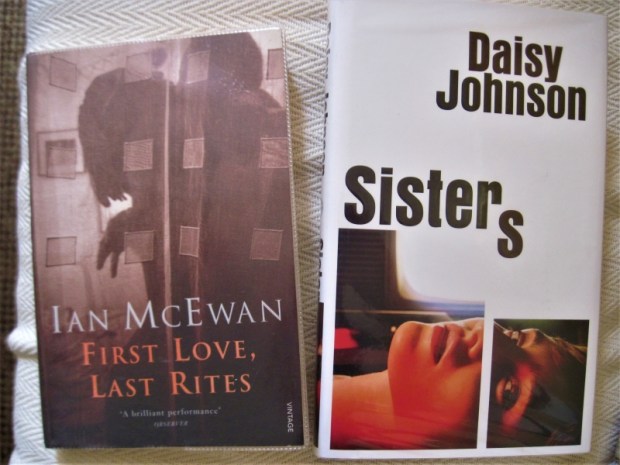
- First Love, Last Rites by Ian McEwan
- Six Dinner Sid by Inga Moore
- The Tabitha Stories by A.N. Wilson
SKIMMED
- A Spell of Winter by Helen Dunmore
- Dear NHS: 100 Stories to Say Thank You, edited by Adam Kay

- Norwegian Wood by Lars Mytting
CURRENTLY READING
- Owls Do Cry by Janet Frame
- Sisters by Daisy Johnson
- Maid: Hard Work, Low Pay, and a Mother’s Will to Survive by Stephanie Land
- Such a Fun Age by Kiley Reid
- First Time Ever: A Memoir by Peggy Seeger
- How to Be Both by Ali Smith
CURRENTLY SKIMMING
- 33 Meditations on Death: Notes from the Wrong End of Medicine by David Jarrett
CHECKED OUT, TO BE READ
- Dependency by Tove Ditlevsen
- What Have I Done? An Honest Memoir about Surviving Postnatal Mental Illness by Laura Dockrill
- House of Glass: The Story and Secrets of a Twentieth-Century Jewish Family by Hadley Freeman
- The Glorious Heresies by Lisa McInerney
- Adults by Emma Jane Unsworth

ON HOLD, TO BE PICKED UP
- English Pastoral: An Inheritance by James Rebanks
IN THE RESERVATION QUEUE
- Piranesi by Susanna Clarke
- Just Like You by Nick Hornby
- Tilly and the Map of Stories (Pages & Co. #3) by Anna James
- Vesper Flights: New and Selected Essays by Helen Macdonald
- The Glass Hotel by Emily St. John Mandel
- Mantel Pieces: Royal Bodies and Other Writing from the London Review of Books by Hilary Mantel
- Dear Reader: The Comfort and Joy of Books by Cathy Rentzenbrink
- Jack by Marilynne Robinson
- Real Life by Brandon Taylor
- Love and Other Thought Experiments by Sophie Ward
- The Courage to Care: A Call for Compassion by Christie Watson
- The Wild Silence by Raynor Winn
RETURNED UNFINISHED
- Persuasion by Jane Austen – This was for book club, but I completely failed to engage. I’m going to watch the 1995 film instead (and maybe skip the Zoom discussion this month).
- Golden Boy by Abigail Tarttelin – I was interested to compare this to Middlesex as it’s about an intersex teen named Max who has been raised as a boy. But I only made it 18 pages: Max’s voice is done well; his mum’s and little brother’s, not so much. Plus there was a pretty brutal scene that put me off reading further.
RETURNED UNREAD
- The Girl with the Louding Voice by Abi Daré – Requested after me. I’ll get it out another time.
- The Hungover Games by Sophie Heawood – I expected an addiction memoir, but this seems to be a breezy tell-all by a minor celebrity journalist I’d never heard of.
- The Interestings by Meg Wolitzer – I’ll save this novel about six friends who meet at summer camp for next summer.
What appeals from my stacks?
Women’s Prize Winners Reading Project: Grant, Martin, Shields et al.
In this 25th anniversary year of the Women’s Prize, readers are being encouraged to catch up on all the previous winners. I’d read 14 of them (including Hamnet) as of mid-April and have managed five more since then – plus a reread, a DNF and a skim. I recently reviewed Fugitive Pieces by Anne Michaels, and Half of a Yellow Sun by Chimamanda Ngozi Adichie and A Crime in the Neighborhood by Suzanne Berne as part of this summer reading post. This leaves just four more for me to read before voting for my all-time favorite in November.
When I Lived in Modern Times by Linda Grant (2000)
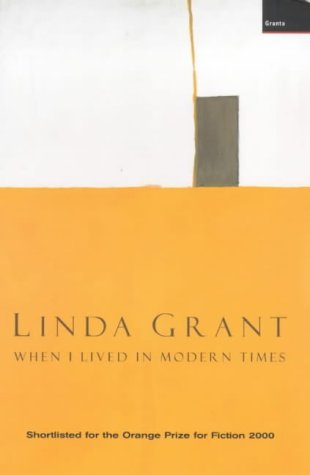 Some settings have been done to death, but here’s one I don’t think I’d ever encountered before: Israel in the final year before statehood. Grant dramatizes the contrast between Palestine, a doomed British colony, and the Jewish hope of a homeland. In 1946 twenty-year-old Evelyn Sert leaves her home in London, masquerading as a Gentile tourist (though she has Latvian Jewish ancestry) so as to jump ahead of thousands of displaced persons awaiting entry visas. With her mother recently dead of a stroke, she takes advice and money from her mother’s married boyfriend, “Uncle Joe,” a Polish Jew and Zionist, and heads to Palestine.
After six weeks on a kibbutz, Evelyn sets out to make her own life in Tel Aviv as a hairdresser and falls in with Johnny, a Jew who fought for the British. It’s safer to be part of the colonial structure here, so she once again passes as Gentile, dyeing her hair blonde and going by Priscilla Jones. In a land where all kinds of people have been thrown together by the accident of their ethnicity and the suffering it often entailed, one man’s terrorist is another’s freedom fighter. For Evelyn, who’s never known anywhere apart from suburban London and arrived in Palestine a virgin, the entire year is a journey of discovery. Will a place of ancient religious significance embrace modern architecture, technology and government? Grant really captures this period of transition for an individual and for a nascent nation of exiles. I loved the supporting characters and the nostalgic look back from half a century on.
Favorite passages:
In a country with its face turned towards the future, our stories sat on our shoulders like a second head, facing the way we had come from. We were the tribe of Janus, if there is such a thing.
With hindsight it always seems easy to do the right thing, but we were trying to decide something in those days that people don’t often get a chance to have a say in and it was this: would we be a free nation after two thousand years of wandering or would we always be a subject race? Would we be ghetto Jews or new Jews?
Property by Valerie Martin (2003)
 A compact study of slavery that unfolds through the relationship between a New Orleans plantation owner’s wife and her husband’s mistress. Manon Gaudet has never been happy in her marriage, but when their slave girl, Sarah, bears her husband a second child, she decides she has had enough of silently condoning his behavior. A slave uprising and cholera and yellow fever outbreaks provide some welcome drama, but the bulk of this short novel is an examination of the psyche of a woman tormented by hatred and jealousy. Ownership of another human being is, if not technically impossible, certainly not emotionally tenable. Manon’s situation is also intolerable because she has no rights as a woman in the early nineteenth century: any property she inherits will pass directly to her husband. Though thoroughly readable, for me this didn’t really add anything to the corpus of slavery fiction.
A reread (as well as a buddy read with Buried in Print):
Larry’s Party by Carol Shields (1997)
“The whole thing about mazes is that they make perfect sense only when you look down on them from above.”
 Larry Weller is an Everyman: sometimes hapless and sometimes purposeful; often bewildered with where life has led him, but happy enough nonetheless. From the start, Shields dwells on the role that “mistakes” have played in making Larry who he is, like a floral arts catalogue coming in the mail from the college instead of one on furnace repair and meeting Dorrie at a Halloween party he attended with a different girl. Before he knows it he and a pregnant Dorrie are getting married and he’s been at his flower shop job for 12 years. A honeymoon tour through England takes in the Hampton Court Palace maze and sparks an obsession that will change the course of Larry’s life, as he creates his first maze at their Winnipeg home and gradually becomes one of a handful of expert maze-makers.
The sweep of Larry’s life, from youth to middle age, is presented roughly chronologically through chapters that are more like linked short stories: they focus on themes (family, friends, career, sex, clothing, health) and loop back to events to add more detail and new insight. I found the repetition of basic information about Larry somewhat off-putting in that it’s as if we start over with this character with each chapter – the same might be said of Olive Kitteridge, but that book’s composition was drawn out and it involves a multiplicity of perspectives, which explains the slight detachment from Olive. Here the third-person narration sticks close to Larry but gives glimpses into other points of view, tiny hints of other stories – a man with AIDS, a woman trying to atone for lifelong selfishness, and so on.
From my first reading I remembered a climactic event involving the Winnipeg maze; a ribald chapter entitled “Larry’s Penis,” about his second marriage to a younger woman and more; and the closing dinner party, a masterful sequence composed almost entirely of overlapping dialogue (like the final wedding reception scene in her earlier novel, The Box Garden) as Larry hosts his two ex-wives, his current girlfriend, his sister and his partner, and a colleague and boss. What is it like to be a man today? someone asks, and through the responses Shields suggests a state of uneasiness, of walking on eggshells and trying not to be a chauvinist in a world whose boundaries are being redrawn by feminism. That process has continued in the decades since, though with predictable backlash from those who consider women a threat.
It seems slightly ironic that Shields won the Women’s Prize for this episodic fictional biography of a man, but I found so much to relate to in Larry’s story – the “how did I get here?” self-questioning, the search for life’s meaning, “the clutter of good luck and bad” – that I’d say Larry is really all of us.
One of Shields’s best, and quite possibly my winner of winners.
My original rating (2008?):
My rating now: 
Currently rereading: Gilead by Marilynne Robinson
A skim:
A Spell of Winter by Helen Dunmore (1995)
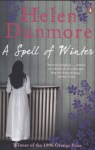 An annoying thing happened with this one: the back cover blurb gave away a central theme. It’s one I’m keen to avoid yet feel I have encountered disproportionately often in fiction, especially recently (I won’t name any titles as that would give it away instantly). Dunmore writes nicely – from my quick skim of this one it seemed very atmospheric – but I am not particularly drawn to her plots. I’ve read Exposure for book club and own two more of her novels, Talking to the Dead and Zennor in Darkness, so by the time I’ve read those I will have given her a solid try. So far I’ve preferred her poetry – I’ve read three of her collections.
A favorite passage:
“It is winter in the house. This morning the ice on my basin of water is so thick I can not break it. The windows stare back at me, blind with frost. … I can see nothing through the frost flowers on the glass. I wonder if it is snowing yet, but I think it is too cold. … I look at the house, still and breathless in the frost. I have got what I wanted. A spell of winter hangs over it, and everyone has gone.”
And a DNF:
The Song of Achilles by Madeline Miller (2011)
 Patroclus is a disappointment of a prince. He has no chance of winning Helen of Troy’s hand in marriage, and exile awaits him when he is responsible for an accidental death. As a foster child in the household of another king, he becomes obsessed with Achilles. The two young men take part in music lessons and military training, and Patroclus follows Achilles away from the palace to be taught by a centaur. That’s as far as I got before I couldn’t bear any more. The homoerotic hints are laughably unsubtle: (of a lyre) “‘You can hold it, if you like.’ The wood would be smooth and known as my own skin” & (fighting) “he rolled me beneath him, pinning me, his knees in my belly. I panted, angry but strangely satisfied.”
I got a free download from Emerald Street, the Stylist magazine e-newsletter. The ancient world, and Greek mythology in particular, do not draw me in the least, and I have had bad experiences with updates of Greek myths before (e.g. Bright Air Black by David Vann). I never thought this would be a book for me, but still wanted to attempt it so I could complete the set of Women’s Prize winners. I read 77 pages out of 278 in the e-book, but when I have to force myself to pick up a book, I know it’s a lost cause. As with the Dunmore, I think it’s safe to say this one never would have gotten my vote anyway.
The final four to complete my project:
(On the stack to read soon)
The Idea of Perfection by Kate Grenville – free from mall bookshop
The Glorious Heresies by Lisa McInerney – public library copy
How to Be Both by Ali Smith – public library copy; a planned buddy read with B.I.P.
(To get from the university library)
A Girl Is a Half-formed Thing by Eimear McBride
Read any Women’s Prize winners lately?
Book Serendipity in 2020: Part III
I call it Book Serendipity when two or more books that I read at the same time or in quick succession have something pretty bizarre in common. Because I have so many books on the go at once (usually around 20), I suppose I’m more prone to such incidents than some. I also list these occasional reading coincidences on a Twitter thread.
The following are in chronological order. (January to March’s incidents appeared in this post, and April to July’s here.)
- Reading two books whose covers feature Audubon bird paintings.
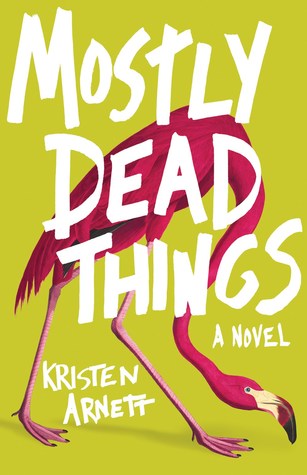
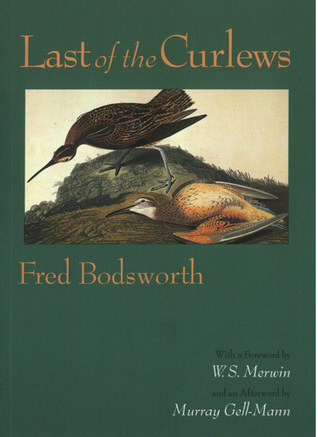
- A 19th-century female character inherits a house but knows it will pass instantly to her spouse in Property by Valerie Martin and Islands of Mercy by Rose Tremain.
- A bag/sack of potatoes as a metaphor in Other People’s Pets by R.L. Maizes and Redhead by the Side of the Road by Anne Tyler.
- Nipple rings get a mention in Addition by Toni Jordan and Other People’s Pets by R.L. Maizes.
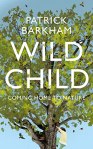
- Taxidermy is an element (most major in the first one) in Mostly Dead Things by Kristen Arnett, Wild Child by Patrick Barkham and Into the Tangled Bank by Lev Parikian.
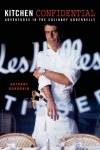
- A discussion of bartenders’ habit of giving out free drinks to get big tips (a canny way of ‘stealing’ from the employer) in Kitchen Confidential by Anthony Bourdain and Other People’s Pets by R.L. Maizes.
- Characters named Seamus in Addition by Toni Jordan and Mother’s Milk by Edward St. Aubyn.
- Wild boar mentioned in Mostly Dead Things by Kristen Arnett, Other People’s Pets by R.L. Maizes and My Berlin Kitchen by Luisa Weiss.
- A fastidious bachelor who’s always cleaning his living space in Other People’s Pets by R.L. Maizes and Redhead by the Side of the Road by Anne Tyler.
- A character is a blogger in Americanah by Chimamanda Ngozi Adichie, Other People’s Pets by R.L. Maizes and My Berlin Kitchen by Luisa Weiss.
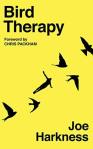
- Norfolk settings in Wild Child by Patrick Barkham and Bird Therapy by Joe Harkness (and both were on the Wainwright Prize longlist).
- A close aunt‒niece relationship in Mostly Dead Things by Kristen Arnett and Addition by Toni Jordan.
- A guy does dumb accents when talking about food, and specifically a French accent for “hamburger,” in Addition by Toni Jordan and Redhead by the Side of the Road by Anne Tyler.
- Recipes for a potato salad that is dressed with oil and vinegar rather than mayonnaise in Tender at the Bone by Ruth Reichl and My Berlin Kitchen by Luisa Weiss.
- Mentions of the Watergate hearings in A Crime in the Neighborhood by Suzanne Berne and Tender at the Bone by Ruth Reichl.
- Twins in Half of a Yellow Sun by Chimamanda Ngozi Adichie, A Crime in the Neighborhood by Suzanne Berne and The Yonahlossee Riding Camp for Girls by Anton DiSclafani.
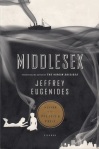
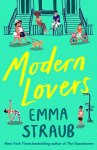
- Characters nicknamed “Lefty” in Middlesex by Jeffrey Eugenides and Modern Lovers by Emma Straub.
- Characters named Abir/Abeer in A Traveller at the Gates of Wisdom by John Boyne and Apeirogon by Colum McCann.
- Kayaking in Scotland in The Frayed Atlantic Edge by David Gange and Summerwater by Sarah Moss.
- The military coup in Nigeria features in Half of a Yellow Sun by Chimamanda Ngozi Adichie and The Shadow of the Sun by Ryszard Kapuściński.
- The song “White Christmas” is quoted in Mudbound by Hillary Jordan and Tales of the City by Armistead Maupin.
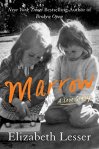
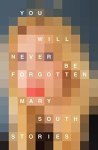
- The fact that fingerprints are formed by the fetus touching the uterine wall appears in Marrow by Elizabeth Lesser and You Will Never Be Forgotten by Mary South.
- Orkney as a setting in Close to Where the Heart Gives Out by Malcolm Alexander and The Frayed Atlantic Edge by David Gange. I’m hankering to go back!
- Teresa of Ávila is mentioned in Marrow by Elizabeth Lesser and You Will Never Be Forgotten by Mary South.
- A dog named Bingo in Half of a Yellow Sun by Chimamanda Ngozi Adichie and Modern Lovers by Emma Straub. (B-I-N-G-O!)
- Four sisters are given a joint name in A Crime in the Neighborhood by Suzanne Berne (Fran-Claire-Lois-Ada) and Marrow by Elizabeth Lesser (KaLiMaJo).
- The same Lilla Watson quote (“If you have come to help me, you are wasting your time. But if you have come because your liberation is bound up with mine, then let us work together”) appears in both The Gospel of Trees by Apricot Irving and Marrow by Elizabeth Lesser.
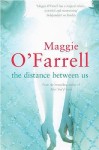
- An Irish author and Hong Kong setting for Exciting Times by Naoise Dolan and The Distance Between Us by Maggie O’Farrell.

- The Dorothy Parker quote “Men seldom make passes at girls who wear glasses” appears in both What Are You Going Through by Sigrid Nunez and First Time Ever by Peggy Seeger.
What’s the weirdest reading coincidence you’ve had lately?
Hay-on-Wye Trip & Sixpence House Reread
We found Hay-on-Wye fairly bustling on an early September weekend. Not all of the bookshops are operational or have reliable opening hours, so we missed our chance to go in a few of them this time. Still, nine was plenty to be getting on with. The castle currently has scaffolding up for necessary renovations, and many eateries were offering little or no indoor table service. Masks are not actually compulsory in Wales, but we wore ours inside shops anyway, and half or more of the other customers and booksellers were doing the same.


Day 1: Drive there; Clock Tower Books, Oxfam, a great haul from the honesty shelves by the Castle (everything’s £1); ice cream cones from Shepherds; dinner at The Globe.

Day 2: A walk up Hay Bluff; roast lunch at the Three Tuns pub; Broad Street Book Centre, Hay Cinema Bookshop.
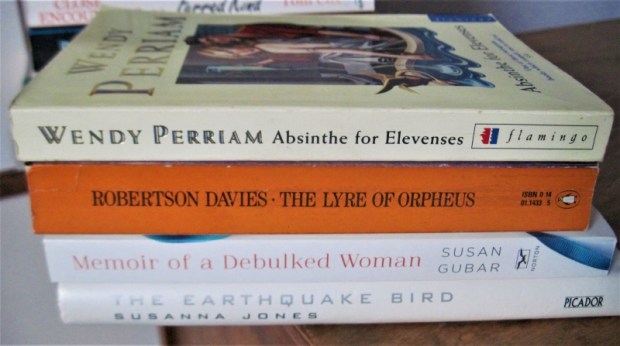
Day 3: Cinema outdoor area, Booth’s, British Red Cross shop, back to Oxfam, back to Clock Tower Books, Green Ink Booksellers; ice cream cones from Shepherds (again); drive home.
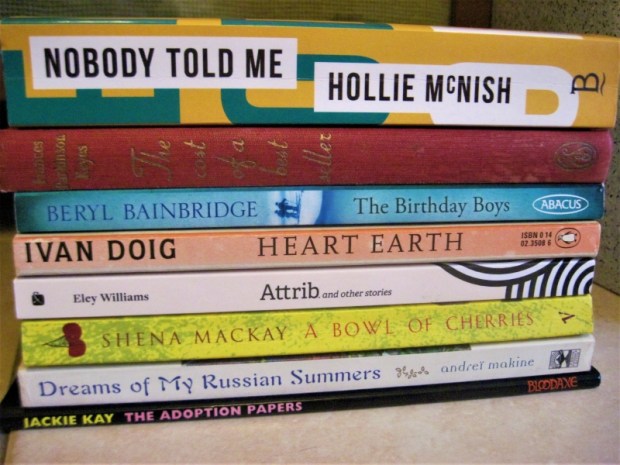
“To look for a specific book in Hay is a hopeless task; you can only find the books that are looking for you, the ones you didn’t even know to ask for in the first place. … What you mean to find matters less than what you do find.”
~Sixpence House: Lost in a Town of Books, Paul Collins (see below)


I bought 26 books in total (though one is an omnibus, so you could call it 28), at an average spend of £1.81 per volume. (My husband bought 10 nature books. We also found a gift for my father-in-law’s birthday next week – whew!) I’m particularly pleased with the Robertson Davies novels and the memoirs, some of which have been on my wish list for a long time. My interests in animals plus foodie and medical themes come through clearly. Some authors here I’ve never tried but have been meaning to; others are familiar names I was interested to read more by. I only noticed later on that Ghosts, the John Fuller poetry book, is a signed copy.
What I read
From last year’s book haul: The first 30 or so pages in Ingenious Pain by Andrew Miller and Jesus Land by Julia Scheeres. I’ll probably only skim the Spowers travel book (another one I only just noticed is signed). I have to read a different Dunmore first, towards my Women’s Prize reading project, as it’s requested after me at the library, but I’ll try to get to Talking to the Dead before too much longer.
I got through another 90 pages in Mike Parker’s On the Red Hill, about life in the house he and his partner inherited in the Welsh countryside from another gay couple. I also read about half of Tilly and the Lost Fairy Tales, Anna James’s second middle-grade novel about a girl who disappears into books and interacts with the characters, and the remainder of A.N. Wilson’s The Tabitha Stories, a cute chapter book with illustrations about a kitten learning how to be a cat.
Mostly, I focused on rereading the whole of Paul Collins’s memoir Sixpence House. I’ve listed this as one of the landmark books in my life because, as I was getting ready for my year abroad in England in the late summer of 2003, it was one of the books that whetted my appetite for traveling, and particularly for visiting Hay-on-Wye. (We first went in 2004; this was our seventh trip.)

In 2000 Collins moved from San Francisco to Hay with his wife and toddler son, hoping to make a life there. His parents were British and he’d enjoyed trips to the Book Town before, so it wasn’t a completely random choice. The place suited his interest in the oddities and obscure figures of literature and history. In fact, he’d just finished writing Banvard’s Folly, a fun book containing 13 profiles of thinkers and inventors whose great ideas flopped. (I should reread it, too.)
As he edits his manuscript and hunts for the perfect cover and title, he is also unexpectedly drawn into working for Richard Booth, the eccentric bookseller who was responsible for creating the world’s first book town and crowned himself King of Hay. Booth hired him to sort out the American Studies section – but if you ever went in the pre-2007 Booth’s you’ll know how impossible it would have been to make order out of its chaos. He comes across lots of interesting books time has forgotten, though (I first learned about W.N.P. Barbellion’s The Journal of a Disappointed Man from this book; why have I still not read it?!), and muses on counterfeiting, cover designs, bookbinding, and the sadness of the remainders bin.
Renting an apartment above Pembertons, which no longer exists but was at that time the town’s only new bookshop, Collins and his wife look at various properties and fall in love with a former pub. But when the survey comes back, they realize fixing all the damp and rot would nearly double its £125,000 price tag. (That sure looks good these days! The B&B next to the Airbnb flat where we stayed was for sale for over £700,000. Cusop Dingle is full of large, posh houses – Collins’s landlady referred to it as the “Beverly Hills of Hay.”) Buying one of the new-build houses on the edge of town just isn’t their dream.
In the end, after six months or so in Hay, they admit defeat and move back to the States. So in a sense this is – just like Banvard’s Folly, the book being shepherded into publication within it – a book about an experiment that turned out to be a noble failure. It’s warm, funny in a Bryson-esque way, and nostalgic for a place that still exists but a time that never will again. I loved spotting familiar landmarks, even if the shops have changed hands or are no longer there. This was probably my fourth read, but it all still felt fresh. An enduring favorite of mine. 
I’d be intrigued to know what Collins would make of Hay 20 years later. In 2000 it had 40 bookshops; now it’s only 12, with online sellers, book-related businesses, and shops further afield pushing the listings in the annual leaflet to 26. Whereas then Collins felt they were the only young family in town, it’s very much a hipster place now and we saw many groups of teens and twentysomethings. A tapas bar, boutique stores, turmeric chai lattes … it’s not just a musty antiquarian book lover’s paradise anymore, and that might sadden some like Collins. Yet gentrification and the Festival may be the only things that have kept the town alive. Richard Booth died last year, but the book town vision should live on.


I miss Hay already. I hate to think of all the time that might pass before I can get there again, and what will (or won’t) have changed by then. A few years can seem to go by in an instant these days. My vow is to go again before I turn 40.
Making Plans for a Return to Hay-on-Wye & A Book “Overhaul”
Somehow it’s been nearly 3.5 years since our last trip to Hay-on-Wye, the Book Town of Wales (I wrote about that April 2017 visit here). This coming weekend will be our seventh trip to Hay, one of our favorite places. We’ve booked an Airbnb in nearby English hamlet Cusop Dingle for two nights, so it’s a pretty short break, but longer than the weekend away we managed last month – reduced to only 36 hours by the cat’s poorly timed but ultimately minor one-day illness.
I’ve acquired many, many books from the free mall bookshop over the past year. (It’s now closed permanently, alas.) And I had no shortage of additional incomers during lockdown, via the unofficial Little Free Library I started and orders I placed with independent bookstores and publishers. So you could say I don’t need a book-buying trip to Hay. But 1) it’s never a question of need, is it? and 2) We want to continue to support the town, which will have been hit hard by temporary closures and by its annual literary festival being purely online this year.
I have no particular plans for what to buy this time, so will just see what takes my fancy. There are noticeably fewer bookshops than when we first started visiting Hay in 2004, but among the dozen or so remaining are some truly excellent shops like Addyman Books, the Hay Cinema Bookshop, and Booth’s Bookshop. Our best bargains last time were from the Oxfam charity shop and the honesty shelves around the castle, so those will likely be our first ports of call, and from there we’ll let whimsy be our guide. Saturday and Monday will be for wandering the town and book shopping, while Sunday will include countryside walks around Hay Bluff. We also hope to explore some eatery options we’ve not tried before.
An Overhaul of Last Trip’s Book Purchases
Simon of Stuck in a Book runs a regular blog feature he calls “The Overhaul,” where he revisits a book haul from some time ago and takes stock of what he’s read, what he still owns, etc. (here’s the most recent one). With his permission, I’m borrowing the title and format to look back at what I bought in Hay last time.
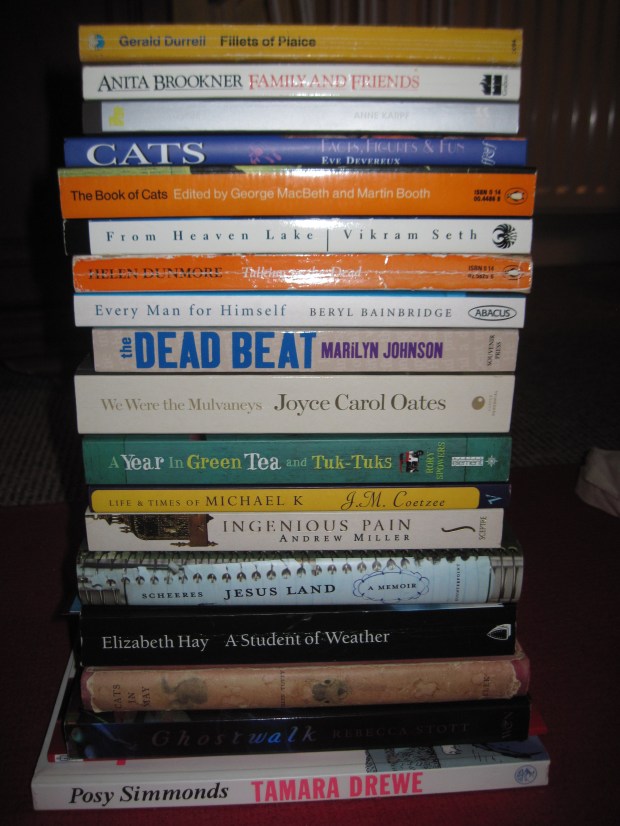
Date of haul: April 2017
Location: Hay-on-Wye
Number of books bought: 18
Had already read: (3/18)
- How to Age by Anne Karpf
- From Heaven Lake by Vikram Seth
- Tamara Drewe by Posy Simmonds – It’s on my shelf for rereading.
Have read since then: (5/18)
- Every Man for Himself by Beryl Bainbridge [resold]
- Fillets of Plaice by Gerald Durrell
- A Student of Weather by Elizabeth Hay (!)
- The Dead Beat by Marilyn Johnson
- Cats in May by Doreen Tovey
BUT also read from my hubby’s pile (not pictured):
- Sold for a Farthing by Clare Kipps
- All the Presidents’ Pastries by Roland Mesnier
- Second Nature by Michael Pollan
- A Shepherd’s Life by James Rebanks
DNFed: (3/18)
- Life & Times of Michael K by J.M. Coetzee [resold]
- We Were the Mulvaneys by Joyce Carol Oates – Might try this one again another time.
- Ghostwalk by Rebecca Stott [given away]
Resold unread: (1/18)
- Family and Friends by Anita Brookner – I’d added it to the Oxfam pile to make up a 5 for £1 stack, but then didn’t enjoy Booker winner Hotel du Lac enough to try another by Brookner.
Total still unread: 6
Total no longer owned: 4
This is not too bad a showing overall, though it does reveal my habit of buying books and letting them sit around for years unread. (Surely I’m not alone in this?!)
The six purchases still to read are two cat-themed anthologies for reading piecemeal, plus these four – two fiction and two non-:
- Talking to the Dead by Helen Dunmore
- Ingenious Pain by Andrew Miller
- Jesus Land by Julia Scheeres
- A Year in Green Tea and Tuk-Tuks by Rory Spowers
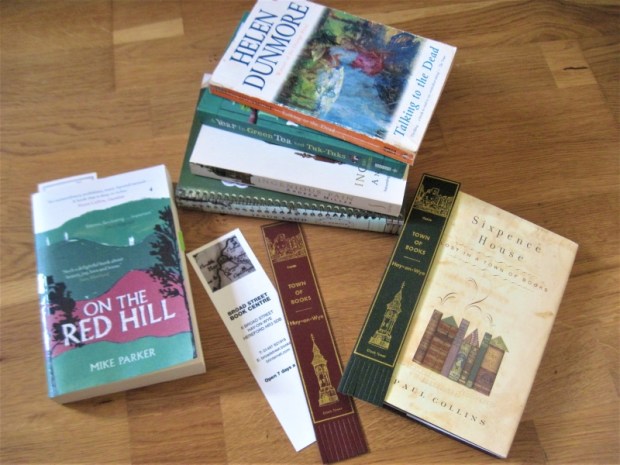
To force myself to get to them, these are the four I’ve packed for reading in the car and while in Hay. I’m also bringing, to read on location: 1) On the Red Hill by Mike Parker, a Wainwright Prize-shortlisted memoir about life in the Welsh countryside (I’m about 40 pages into it already); and 2) Sixpence House, which I’ve read several times before and consider among my absolute favorite books; it’s Paul Collins’s memoir about finding a temporary home and work among the bookshops of Hay.
I’ll be back on Tuesday with this year’s book haul plus photos and notes on how we found the town this time around. (But first, Six Degrees of Separation will post on Saturday while I’m away.)
Library Checkout, August 2020 & #WITMonth 2020, Part II
I’ve been volunteering at my local library twice a week since the start of the month, shelving and picking books off the shelves to fulfill reservations. Every time I’m there I spot more titles to add to my online wish list. It’s been a convenient excuse to return and pick up books, including book group sets. I was first in the queue for some brand-new releases this month.
Have you been able to borrow more books lately? Feel free to use the image above and leave a link to your blog in the comments if you’ve taken part in Library Checkout (which runs on the last Monday of every month), or tag me on Twitter and/or Instagram (@bookishbeck / #TheLibraryCheckout).
READ
- Queenie by Candice Carty-Williams
- Addition by Toni Jordan [book club choice]
- Kim Jiyoung, Born 1982 by Cho Nam-Joo (reviewed below)
SKIMMED
- Dark, Salt, Clear: Life in a Cornish Fishing Town by Lamorna Ash

- The Butterfly Isles: A Summer in Search of Our Emperors and Admirals by Patrick Barkham
- Water Ways: A Thousand Miles along Britain’s Canals by Jasper Winn
CURRENTLY READING
- Close to Where the Heart Gives Out: A Year in the Life of an Orkney Doctor by Malcolm Alexander
- A Traveller at the Gates of Wisdom by John Boyne
- Exciting Times by Naoise Dolan
- Maid: Hard Work, Low Pay, and a Mother’s Will to Survive by Stephanie Land

CURRENTLY SKIMMING
- Can You Hear Me? A Paramedic’s Encounters with Life and Death by Jake Jones
- Dear NHS: 100 Stories to Say Thank You, edited by Adam Kay
CHECKED OUT, TO BE READ
- The Girl with the Louding Voice by Abi Daré
- What Have I Done? An Honest Memoir about Surviving Postnatal Mental Illness by Laura Dockrill
- How to Be Both by Ali Smith
- Adults by Emma Jane Unsworth
- The Interestings by Meg Wolitzer
ON HOLD, TO BE PICKED UP
- Dependency by Tove Ditlevsen

IN THE RESERVATION QUEUE
- Persuasion by Jane Austen
- Piranesi by Susanna Clarke
- The Hungover Games by Sophie Heawood
- Just Like You by Nick Hornby
- 33 Meditations on Death: Notes from the Wrong End of Medicine by David Jarrett
- Sisters by Daisy Johnson
- Vesper Flights: New and Selected Essays by Helen Macdonald
- English Pastoral: An Inheritance by James Rebanks
- Such a Fun Age by Kiley Reid
- Dear Reader: The Comfort and Joy of Books by Cathy Rentzenbrink
- Jack by Marilynne Robinson
- Love and Other Thought Experiments by Sophie Ward
- The Courage to Care: A Call for Compassion by Christie Watson
- The Wild Silence by Raynor Winn
RETURNED UNFINISHED
- Apeirogon by Colum McCann – I only made it through the first 150 pages. A work that could have been very powerful if condensed instead sprawls into repetition and pretension. I still expect it to make the Booker shortlist, but not to win. I’ll add further thoughts closer to the time.
- That Reminds Me by Derek Owusu – I was expecting a memoir in verse about life in foster care; this is autofiction in dull fragments. I read the first 23 pages out of 113, waiting for it to get better.
RETURNED UNREAD
- Their Eyes Were Watching God by Zora Neale Hurston – I needed to make room for some new books on my account, so will request this at another time.
- Utopia Avenue by David Mitchell – I realized the subject matter didn’t draw me enough to read 500+ pages. So I passed it to my husband, a big Mitchell fan, and he read it happily, but mentioned that he didn’t find it compelling until about 2/3 through and he thought the combination of real-life and made-up figures (including from Mitchell’s previous oeuvre) was a bit silly.
- 1Q84 by Haruki Murakami – Again, I needed to make space on my card and was, unsurprisingly, daunted by the length of this 1,000+-page omnibus paperback. When I do try the novel, I’ll borrow it in its three separate volumes!
What appeals from my stacks?
My second choice for Women in Translation Month (after The Bitch by Pilar Quintana) was:
Kim Jiyoung, Born 1982 by Cho Nam-Joo (2016)
[Translated from the Korean by Jamie Chang]
 The title character is a sort of South Korean Everywoman whose experiences reveal the ways in which women’s lives are still constrained by that country’s patriarchal structures and traditions. She and her fellow female students and colleagues are subject to myriad microaggressions, from being served cafeteria lunches after the boys to being excluded from leadership of university clubs to having no recourse when security guards set up cameras in the female toilets at work. Jiyoung is wary of marriage and motherhood, afraid of derailing her budding marketing career, and despite her determination to do things differently she is disappointed at how much she has to give up when she has her daughter. “Her career potential and areas of interest were being limited just because she had a baby.”
The prose is flat, with statistics about women’s lives in Korea unnaturally inserted in the text. Late on we discover there’s a particular reason for the clinically detached writing, but it’s not enough to fully compensate for a dull style. I also found the translation shaky in places, e.g. “She cautiously mentioned shop sales … to the mother who’d dropped by at home to make dinner” and “Jiyoung made it home safely on her boyfriend’s back, but their relationship didn’t.” I most liked Jiyoung’s entrepreneurial mother, who occasionally shows her feisty spirit: “The porridge shop was my idea, and I bought the apartment. And the children raised themselves. Yes, you’ve made it, but you didn’t do it all by yourself,” she says to her husband. “Run wild!” she exhorts Jiyoung, but the system makes that vanishingly difficult.
 Bookish Beck = Rebecca Foster. American transplant to England. Freelance proofreader and book reviewer.
 Bookish Beck
