Love Your Library, June 2023
Thanks, as always, to Elle for her participation, and to Laura and Naomi for their reviews of books borrowed from libraries. Ever since she was our Sunday Times Young Writer of the Year Award shadow panel winner, I’ve followed Julianne Pachico’s blog. A recent post lists books she currently has from the library. I like her comment that borrowing books “is definitely scratching that dopamine itch for me”! On Instagram I spotted this post celebrating both libraries and Pride Month.

And so to my reading and borrowing since last time.
Most of my reservations seemed to come in all at once, right before we left for Scotland, so I’m taking a giant pile along with me (luckily, we’re traveling by car so I don’t have space or weight restrictions) and will see which I can get to, while also fitting in Scotland-themed reads, June review copies, e-books for paid review, and a few of my 20 Books of Summer!
READ
- Rainbow Rainbow: Stories by Lydia Conklin

- The Greengage Summer by Rumer Godden

- Under the Rainbow by Celia Laskey

- Scattered Showers: Stories by Rainbow Rowell
- A Cat in the Window by Derek Tangye

- Cats in Concord by Doreen Tovey

CURRENTLY READING
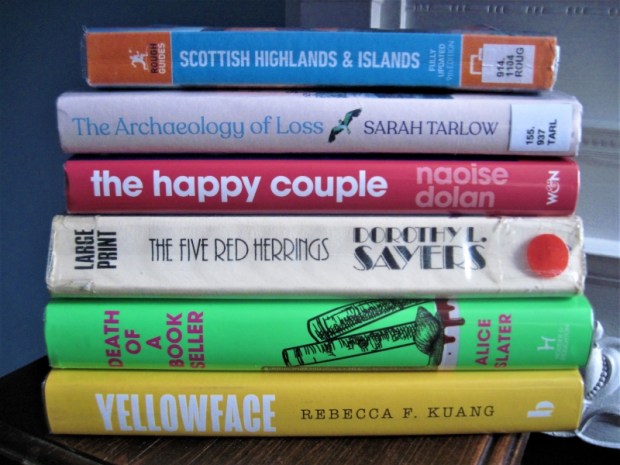
- The Happy Couple by Naoise Dolan
- The Gifts by Liz Hyder
- Milk by Alice Kinsella
- Yellowface by Rebecca F. Kuang
- Music in the Dark by Sally Magnusson
- Five Red Herrings by Dorothy L. Sayers
- Death of a Bookseller by Alice Slater
- The Archaeology of Loss by Sarah Turlow
- The Legacy of Elizabeth Pringle by Kirsty Wark
CHECKED OUT, TO BE READ


RETURNED UNREAD
- Pod by Laline Paull – I wanted to give this a try because it made the Women’s Prize shortlist, but I looked at the first few pages and skimmed through the rest and knew I just couldn’t take it seriously. I mean, look at lines like these: “The Rorqual wanted to laugh, but it was serious. The dolphin had been in some physical horror and had lost his mind. Google could not bear his mistake. The sound he raced toward was not Base, but this thing, this creature, he had never before encountered.”
What have you been reading or reviewing from the library recently?

Share a link to your own post in the comments. Feel free to use the above image. The hashtag is #LoveYourLibrary.
Book Serendipity, Mid-April through Early June
I call it “Book Serendipity” when two or more books that I read at the same time or in quick succession have something in common – the more bizarre, the better. This is a regular feature of mine every few months. Because I usually have 20–30 books on the go at once, I suppose I’m more prone to such incidents. The following are in roughly chronological order.
- Fishing with dynamite takes place in Glowing Still by Sara Wheeler and In Memoriam by Alice Winn.
- Egg collecting (illegal!) is observed and/or discussed in Sea Bean by Sally Huband and The Jay, the Beech and the Limpetshell by Richard Smyth.

- Deborah Levy’s Things I Don’t Want to Know is quoted in What I’d Rather Not Think About by Jente Posthuma and Glowing Still by Sara Wheeler. I then bought a secondhand copy of the Levy on my recent trip to the States.
- “Piss-en-lit” and other folk names for dandelions are mentioned in The House of the Interpreter by Lisa Kelly and The Furrows by Namwali Serpell.
- Buttercups and nettles are mentioned in The House of the Interpreter by Lisa Kelly and Springtime in Britain by Edwin Way Teale (and other members of the Ranunculus family, which includes buttercups, in These Envoys of Beauty by Anna Vaught).

- The speaker’s heart is metaphorically described as green in a poem in Lo by Melissa Crowe and The House of the Interpreter by Lisa Kelly.
- Discussion of how an algorithm can know everything about you in Tomb Sweeping by Alexandra Chang and I’m a Fan by Sheena Patel.
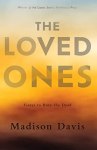
- A brother drowns in The Loved Ones: Essays to Bury the Dead by Madison Davis, What I’d Rather Not Think About by Jente Posthuma, and The Furrows by Namwali Serpell.


A few cases of a book recalling a specific detail from an earlier read:
- This metaphor in The Chosen by Elizabeth Lowry links it to The Marriage Portrait by Maggie O’Farrell, another work of historical fiction I’d read not long before: “He has further misgivings about the scalloped gilt bedside table, which wouldn’t look of place in the palazzo of an Italian poisoner.”
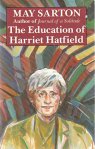
- This reference in The Education of Harriet Hatfield by May Sarton links it back to Chase of the Wild Goose by Mary Louisa Gordon (could it be the specific book she had in mind? I suspect it was out of print in 1989, so it’s more likely it was Elizabeth Mavor’s 1971 biography The Ladies of Llangollen): “Do you have a book about those ladies, the eighteenth-century ones, who lived together in some remote place, but everyone knew them?”
- This metaphor in Things My Mother Never Told Me by Blake Morrison links it to The Chosen by Elizabeth Lowry: “Moochingly revisiting old places, I felt like Thomas Hardy in mourning for his wife.”
- A Black family is hounded out of a majority-white area by harassment in The Education of Harriet Hatfield by May Sarton and Ordinary Notes by Christina Sharpe.
 Wartime escapees from prison camps are helped to freedom, including with the help of a German typist, in My Father’s House by Joseph O’Connor and In Memoriam by Alice Winn.
- A scene of eating a deceased relative’s ashes in 19 Claws and a Black Bird by Agustina Bazterrica and The Loved Ones by Madison Davis.
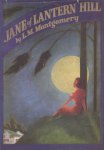
- A girl lives with her flibbertigibbet mother and stern grandmother in “Wife Days,” one story from How Strange a Season by Megan Mayhew Bergman, and Jane of Lantern Hill by L.M. Montgomery.
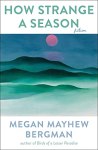
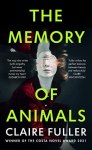
- Macramé is mentioned in How Strange a Season by Megan Mayhew Bergman, The Memory of Animals by Claire Fuller, Floppy by Alyssa Graybeal, and Sidle Creek by Jolene McIlwain.
- A fascination with fractals in Floppy by Alyssa Graybeal and one story in Sidle Creek by Jolene McIlwain. They are also mentioned in one essay in These Envoys of Beauty by Anna Vaught.
- I found disappointed mentions of the fact that characters wear blackface in Laura Ingalls Wilder’s Little Town on the Prairie in Monsters by Claire Dederer and, the very next day, Ordinary Notes by Christina Sharpe.


- Moon jellyfish are mentioned in the Blood and Cord anthology edited by Abi Curtis, Floppy by Alyssa Graybeal, and Sea Bean by Sally Huband.
- A Black author is grateful to their mother for preparing them for life in a white world in the memoirs-in-essays I Can’t Date Jesus by Michael Arceneaux and Ordinary Notes by Christina Sharpe.
- The children’s book The Owl Who Was Afraid of the Dark by Jill Tomlinson is mentioned in The Jay, the Beech and the Limpetshell by Richard Smyth and These Envoys of Beauty by Anna Vaught.
- The protagonist’s father brings home a tiger as a pet/object of display in The Marriage Portrait by Maggie O’Farrell and The Memory of Animals by Claire Fuller.

- Bloor Street, Toronto is mentioned in Jane of Lantern Hill by L.M. Montgomery and Ordinary Notes by Christina Sharpe.
- Ralph Waldo Emerson’s thinking about the stars is quoted in Jane of Lantern Hill by L.M. Montgomery and These Envoys of Beauty by Anna Vaught.
- Wondering whether a marine animal would be better off in captivity, where it could live much longer, in The Memory of Animals by Claire Fuller (an octopus) and Sea Bean by Sally Huband (porpoises).
 Martha Gellhorn is mentioned in The Collected Regrets of Clover by Mikki Brammer and Monsters by Claire Dederer.
- Characters named June in “Indigo Run,” the novella-length story in How Strange a Season by Megan Mayhew Bergman, and The Cats We Meet Along the Way by Nadia Mikail.
- “Explicate!” is a catchphrase uttered by a particular character in Girls They Write Songs About by Carlene Bauer and The Lake Shore Limited by Sue Miller.
- It’s mentioned that people used to get dressed up for going on airplanes in Fly Girl by Ann Hood and The Lights by Ben Lerner.

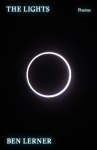
- Green-Wood Cemetery in Brooklyn is a setting in The Lights by Ben Lerner and Grave by Allison C. Meier.
- Last year I read Tomorrow, and Tomorrow, and Tomorrow by Gabrielle Zevin, in which Oregon Trail re-enactors (in a video game) die of dysentery; this is also a live-action plot point in “Pioneers,” one story in Lydia Conklin’s Rainbow Rainbow.
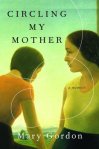
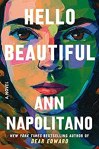
- A bunch (4 or 5) of Italian American sisters in Circling My Mother by Mary Gordon and Hello Beautiful by Ann Napolitano.
What’s the weirdest reading coincidence you’ve had lately?
20 Books of Summer 2023 Plan
It’s my sixth year participating in Cathy’s 20 Books of Summer challenge, which starts today and runs through the 1st of September. In previous years I’ve chosen a theme.
2018: Books by women
2019: Fauna
2020: Food
2021: Colours
2022: Flora
Only in 2018, I think, was I strict enough with myself to only read books that I own, but every year that’s been my main goal: to clear things from the print TBR.
So, that means: no library books, no review copies bar the long-neglected backlog or the set-aside ones, and Kindle books only if I purchased them. Though I won’t be prescriptive about it, I’d like to prioritize hardbacks, recent acquisitions or longtime shelf-sitters, and books by women.
I thought about having no theme, or multiple mini ones, this year. However, I’ve amassed so many foodie reads that I could easily fill my 20 just with that topic (fiction and nonfiction pictured below, with some supplementary summery reads at left), so I’ll see how I go.


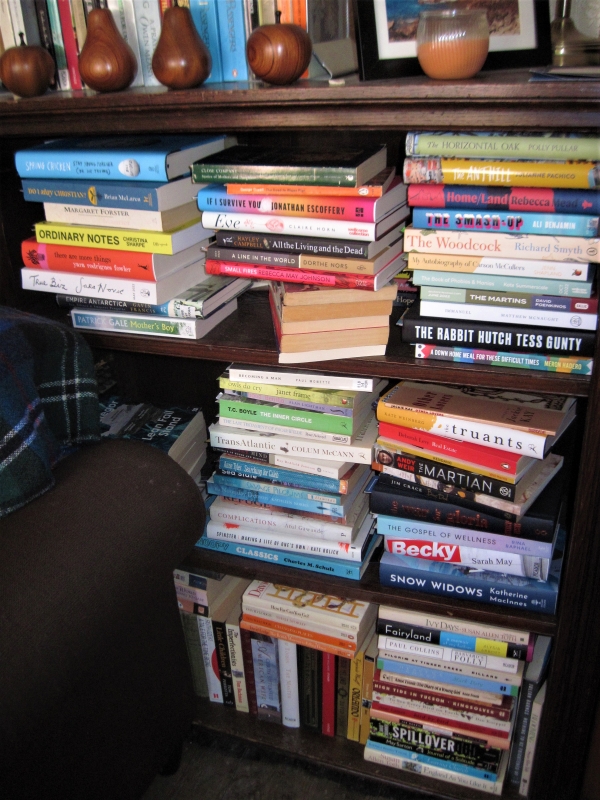
Below is my set-aside and review backlog area, which takes up much of the top two shelves. The bottom shelf is books I’m keen to reread. I could easily select some of my 20 from here.
I hoped to get ahead by reading one or two relevant books on the plane back from America, where I’ve been for the last 10 days for my sister’s nursing school graduation and some sadmin for my mom. Did I manage it? After I get over the jet lag, I’ll report back with my first read or two.
Are you joining in the summer reading challenge? What’s the first book on the docket?
Love Your Library, May 2023
Thanks to Elle for her monthly contribution, Laura for her great reviews of two high-profile novels, Birnam Wood and Pod, borrowed from her local library, and Naomi for the write-up of her recent audiobook loans, a fascinating selection of nonfiction and middle grade fiction. I forgot to link to Jana’s post last month, so here’s her April reading, another very interesting set.
My biggest news this month is that we now have a Little Free Library in my neighbourhood. This project was several years in the making as we waited for permissions and funding. The box (and a wooden bench next to it) were hand-crafted by my very talented neighbours, and the mayor of Newbury came to officially open it on the 7th. There are also a few planters of perennials and a small cherry tree. It really cheers up what used to be a patch of bare grass next to a parking area.
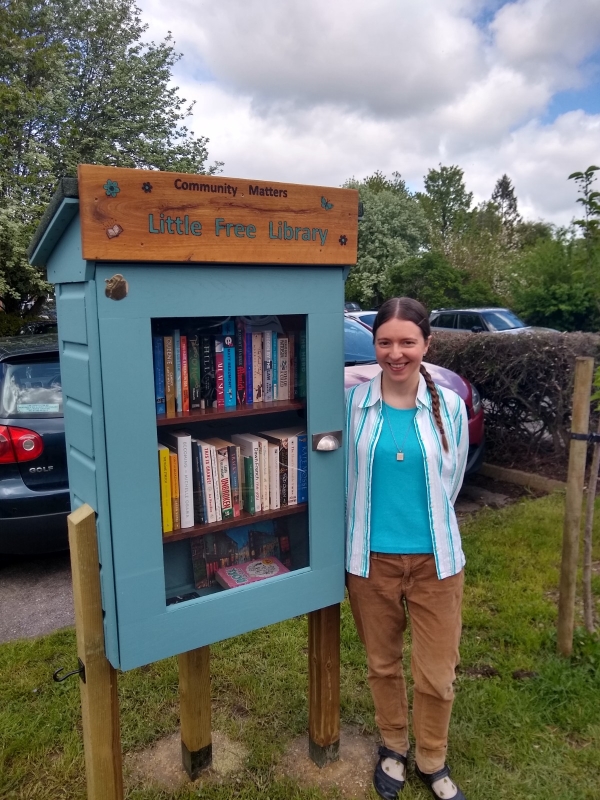
I’m the volunteer curator/librarian/steward so will ensure that the shelves are tidy and the stock keeps turning over. I try to stop by daily since it’s only around the corner from my house. We’ve ordered a charter sign to link us up with the organization and put us on the official map. Anyone visiting Newbury might decide to come find it. (I, for one, look out for LFLs wherever I go, from Pennsylvania to North Uist!)
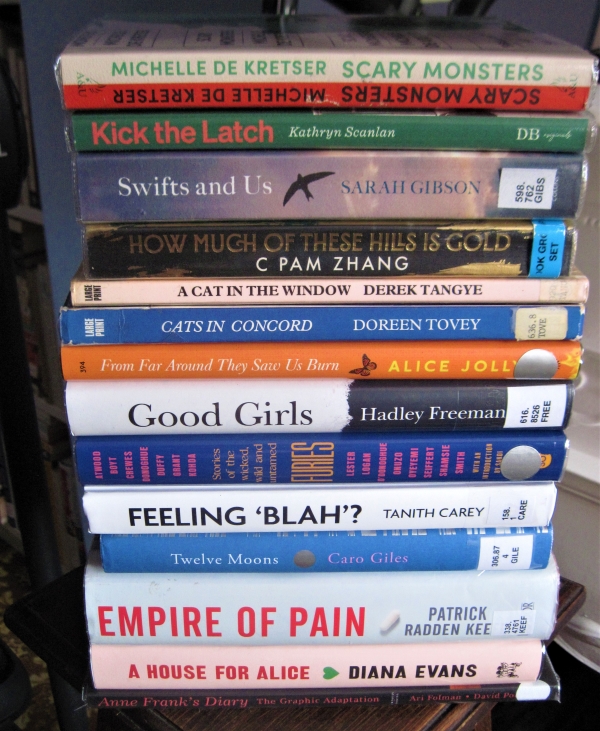
My library reading and borrowing since last month. I’m back in the States for a visit just now, so don’t currently have any library books on the go. It felt prudent to clear the decks, but I’ll have a big stack waiting for me when I come back!
READ
- I Can’t Date Jesus: Love, Sex, Family, Race, and Other Reasons I’ve Put My Faith in Beyoncé by Michael Arceneaux

- Shadow Girls by Carol Birch

- The Cats We Meet Along the Way by Nadia Mikail
- Jane of Lantern Hill by L.M. Montgomery

- My Father’s House by Joseph O’Connor
- The Boy Who Lost His Spark by Maggie O’Farrell
- Mrs. Palfrey at the Claremont by Elizabeth Taylor
- Glowing Still: A Woman’s Life on the Road by Sara Wheeler
- In Memoriam by Alice Winn

SKIMMED
- Fire Rush by Jacqueline Crooks

- You Are Not Alone by Cariad Lloyd

CHECKED OUT, TO BE READ
RETURNED UNFINISHED
- All the Men I Never Married by Kim Moore – I hadn’t heard of the poet and had never read anything from the publisher, but took a chance. I got to page 16. It’s fine: poems about former love interests, whether they be boyfriends or aggressors. There looks to be good variety of structure. I just didn’t sense adequate weight.
- The Furrows by Namwali Serpell – My apologies to Laura! (This started off as a buddy read.) I pushed myself through the first 78 pages, but once it didn’t advance in the Carol Shields Prize race there was no impetus to continue and it just wasn’t compelling enough to finish.
What have you been reading or reviewing from the library recently?

Share a link to your own post in the comments. Feel free to use the above image. The hashtag is #LoveYourLibrary.
Love Your Library, April 2023
Cheers to Elle and Laila for participating this month! Thanks also to Laura for her review of The Marriage Portrait and Naomi for a write-up of her recent Atlantic Canada reads, all from the library.
Last month Jana mentioned the non-media items that her library lends out. This reminded me of some interesting kits my library system offers: “wellbeing bags” (a joint venture with the local council) that contain an identical assortment of colouring sheets, card games, short self-help books and language learning tools; and “Reminiscence Collection” boxes specific to a particular decade or experience, geared towards the elderly. I wonder if they have been found to be helpful when working with people with dementia.


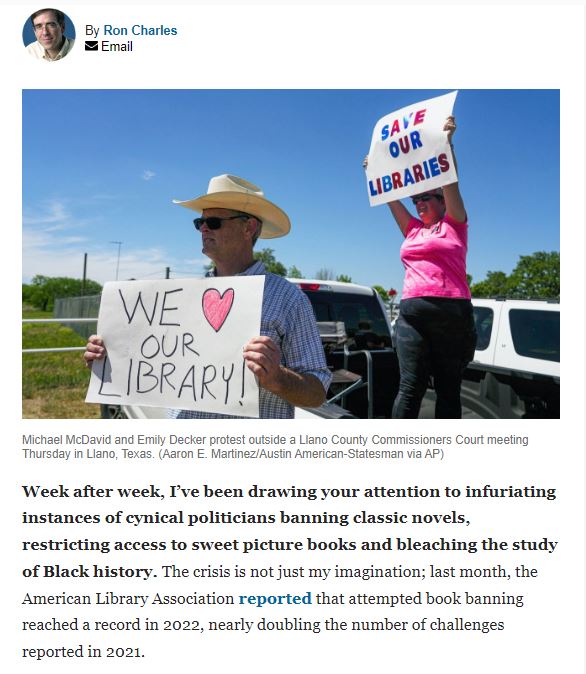
Yesterday was the start of National Library Week in the USA. Book banning and censorship are, alas, perennial news items in relation to libraries there. This week the Washington Post’s Ron Charles featured the Llano County, Texas counter-protests in his newsletter (so often my source of bookish news). The list of books banned is ridiculous. A federal judge in Austin paused the bans, prompting county commissioners to float the idea of closing down the library system entirely. Many turned out to support keeping the libraries open. You can read more about the case here.
As for my own library reading since last time (some great stuff this month!):
READ
- Old Babes in the Wood by Margaret Atwood

- Old God’s Time by Sebastian Barry
- Children of Paradise by Camilla Grudova*
- Two Sisters by Blake Morrison
- The Marriage Portrait by Maggie O’Farrell
- Rain by Don Paterson
- Of Mutability by Jo Shapcott (a re-read)
- Portrait of the Artist as a Young Dog by Dylan Thomas
*My first-ever e-book loan! I couldn’t figure out how to get the file to open on my e-reader, so I read it on my PC screen, 10 pages or so at a time, as a break between doing other things.
CURRENTLY READING
- I Can’t Date Jesus: Love, Sex, Family, Race, and Other Reasons I’ve Put My Faith in Beyoncé by Michael Arceneaux
- Shadow Girls by Carol Birch
- Fire Rush by Jacqueline Crooks
- The Cats We Meet Along the Way by Nadia Mikail
- All the Men I Never Married by Kim Moore
- The Boy Who Lost His Spark by Maggie O’Farrell
- The Furrows by Namwali Serpell
- Mrs. Palfrey at the Claremont by Elizabeth Taylor (a re-read for book club)
- Glowing Still: A Woman’s Life on the Road by Sara Wheeler
- In Memoriam by Alice Winn
SKIMMED
- This Is How Your Marriage Ends: A Hopeful Approach to Saving Relationships by Matthew Fray
- Cuddy by Benjamin Myers
- Between the Chalk and the Sea by Gail Simmons
- The Suspicions of Mr. Whicher by Kate Summerscale (a re-read for book club)
RETURNED UNFINISHED
- How Not to Drown in a Glass of Water by Angie Cruz – I read the first 40 pages. A voice-driven novel about a middle-aged immigrant re-entering the work force, it has a certain charm but also (the Spanglish!) a slightly irksome quality.
- Milk by Alice Kinsella – I was enjoying this a lot and had gotten to page 116 before it was requested on an interlibrary loan. I’ll pick it back up as soon as it returns to West Berkshire.
RETURNED UNREAD
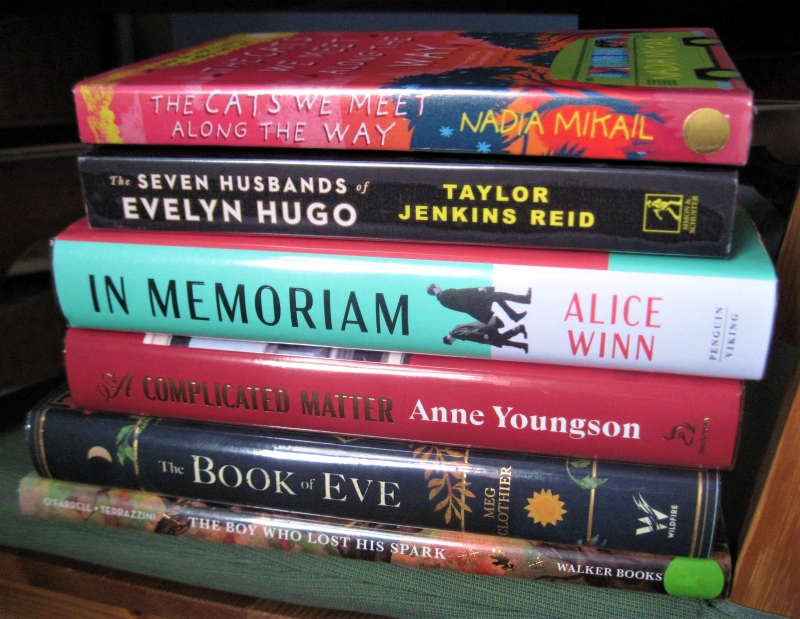
- The Book of Eve by Meg Clothier – The first few pages didn’t grab me, but maybe I’d try it another time.
- The Seven Husbands of Evelyn Hugo by Taylor Jenkins Reid – This seems like it would make a good holiday read, so I’ll wait until the demand for it dies down and try it later on.
- A Complicated Matter by Anne Youngson – This was requested; I was also doubtful that I felt like reading yet another WWII novel just now.
What have you been reading or reviewing from the library recently?
Share a link to your own post in the comments. Feel free to use the above image. The hashtag is #LoveYourLibrary.
Book Serendipity, Mid-February to Mid-April
I call it “Book Serendipity” when two or more books that I read at the same time or in quick succession have something in common – the more bizarre, the better. This is a regular feature of mine every couple of months. Because I usually have 20–30 books on the go at once, I suppose I’m more prone to such incidents. The following are in roughly chronological order.
Last time, my biggest set of coincidences was around books set in or about Korea or by Korean authors; this time it was Ghana and Ghanaian authors:
- Reading two books set in Ghana at the same time: Fledgling by Hannah Bourne-Taylor and His Only Wife by Peace Adzo Medie. I had also read a third book set in Ghana, What Napoleon Could Not Do by DK Nnuro, early in the year and then found its title phrase (i.e., “you have done what Napoleon could not do,” an expression of praise) quoted in the Medie! It must be a popular saying there.
- Reading two books by young Ghanaian British authors at the same time: Quiet by Victoria Adukwei Bulley and Maame by Jessica George.


And the rest:
- An overweight male character with gout in Where the God of Love Hangs Out by Amy Bloom and The Secret Diaries of Charles Ignatius Sancho by Paterson Joseph.
- I’d never heard of “shoegaze music” before I saw it in Michelle Zauner’s bio at the back of Crying in H Mart, but then I also saw it mentioned in Pulling the Chariot of the Sun by Shane McCrae.
- Sheila Heti’s writing on motherhood is quoted in Without Children by Peggy O’Donnell Heffington and In Vitro by Isabel Zapata. Before long I got back into her novel Pure Colour. A quote from another of her books (How Should a Person Be?) is one of the epigraphs to Lorrie Moore’s I Am Homeless If This Is Not My Home.


- Reading two Mexican books about motherhood at the same time: Still Born by Guadalupe Nettel and In Vitro by Isabel Zapata.
- Two coming-of-age novels set on the cusp of war in 1939: The Inner Circle by T.C. Boyle and Martha Quest by Doris Lessing.
- A scene of looking at peculiar human behaviour and imagining how David Attenborough would narrate it in a documentary in Notes from a Small Island by Bill Bryson and I Have Some Questions for You by Rebecca Makkai.
- The painter Caravaggio is mentioned in a novel (The Things We Do to Our Friends by Heather Darwent) plus two poetry books (The Fourth Sister by Laura Scott and Manorism by Yomi Sode) I was reading at the same time.


- Characters are plagued by mosquitoes in The Last Animal by Ramona Ausubel and Through the Groves by Anne Hull.
- Edinburgh’s history of grave robbing is mentioned in The Things We Do to Our Friends by Heather Darwent and Womb by Leah Hazard.
- I read a chapter about mayflies in Lev Parikian’s book Taking Flight and then a poem about mayflies later the same day in Ephemeron by Fiona Benson.
- Childhood reminiscences about playing the board game Operation and wetting the bed appear in Homesick by Jennifer Croft and Through the Groves by Anne Hull.

- Fiddler on the Roof songs are mentioned in Through the Groves by Anne Hull and We All Want Impossible Things by Catherine Newman.
- There’s a minor character named Frith in Shadow Girls by Carol Birch and Rebecca by Daphne du Maurier.
- Scenes of a female couple snogging in a bar bathroom in Through the Groves by Anne Hull and The Garnett Girls by Georgina Moore.

- The main character regrets not spending more time with her father before his sudden death in Maame by Jessica George and Pure Colour by Sheila Heti.
- The main character is called Mira in Birnam Wood by Eleanor Catton and Pure Colour by Sheila Heti, and a Mira is briefly mentioned in one of the stories in Before You Suffocate Your Own Fool Self by Danielle Evans.
- Macbeth references in Shadow Girls by Carol Birch and Birnam Wood by Eleanor Catton – my second Macbeth-sourced title in recent times, after Tomorrow and Tomorrow and Tomorrow by Gabrielle Zevin last year.


- A ‘Goldilocks scenario’ is referred to in Womb by Leah Hazard (the ideal contraction strength) and Taking Flight by Lev Parikian (the ideal body weight for a bird).
- Caribbean patois and mention of an ackee tree in the short story collection If I Survive You by Jonathan Escoffery and the poetry collection Cane, Corn & Gully by Safiya Kamaria Kinshasa.
- The Japanese folktale “The Boy Who Drew Cats” appeared in Our Missing Hearts by Celeste Ng, which I read last year, and then also in Enchantment by Katherine May.


- Chinese characters are mentioned to have taken part in the Tiananmen Square massacre/June 4th incident in Dear Chrysanthemums by Fiona Sze-Lorrain and Oh My Mother! by Connie Wang.
- Endometriosis comes up in What My Bones Know by Stephanie Foo and Womb by Leah Hazard.

What’s the weirdest reading coincidence you’ve had lately?
Checking Up on My 2023 Reading Goals
In January I set some specific reading goals to help me prioritize books from my own shelves. It’s time to assess my progress in the first quarter.
- Catch up on review copies, e.g., by coinciding with the paperback release dates. I’ve managed to review 9 so far, which works out to three per month. Four or more a month (so, at least weekly) would be preferable.
- Authors I own 2+ unread works by – I must read at least one book by each this year. I have crossed 3 off the list thus far: Amy Bloom, Helen Dunmore and Howard Norman. However, I have also started books by Peter Ackroyd, T.C. Boyle, Brian McLaren, Wendy Perriam and Edwin Way Teale. Considering there are 70 authors on my list, though, I need to pick up the pace. I do have plans to read quite a number in connection with future challenges, but this is a project that is probably going to extend into 2024. I will have to be strict with myself and not acquire more books by these authors in the meantime!
- I will participate in at least one reading challenge per month. Success! Nordic FINDS, Reading Indies and Reading Ireland Month down, and 1940 Club coming up soon.
- Reintroduce one set-aside book to my reading pile each week. I’ve reduced this (part physical and part digital) pile by 6 so far, so I’m only at half my quota. Sigh. Once I set a book aside it seems to be the kiss of death. Only some new deadline or thematic inclusion gets me picking these back up.
- ‘Overhauls’ of earlier book hauls to ensure no more than 3 unread remaining from any one haul. We’ve booked a last-minute overnight in Bridport later this month, so I looked up what I bought on our trip there in 2019. I promptly picked up the two unread books (by Lightman and Orwell) for before we go and/or while there. To tie in with the Dorset locale, I’ll also bring along The Chosen by Elizabeth Lowry, a novel about Thomas Hardy and his first wife. It comes out in paperback this month, so it counts toward the review catch-up, and is also on this year’s Walter Scott Prize for Historical Fiction shortlist.
- At least one “just because” book per fortnight. This means anything from my own shelves that isn’t a review copy. I’m smashing this goal with a whole 15 read so far! That’s more than one per week, a good rate to try to keep up.
- (A goal I added in later.) One reread per fortnight. I’m doing surprisingly well, mostly because everything we choose for book club this year seems to be a reread, but with 4 thus far I’m averaging monthly instead. Still, not a bad effort considering I hardly ever reread.
- Request fewer 2023 review books from publishers. I sent out a big batch of requests recently, but almost all have gone ignored (the story of my year), which is probably for the best. My latest coup was securing review copies of Claire Fuller and Curtis Sittenfeld’s new novels – but each did require 3+ request e-mails!
How are you doing on your (formal/informal, explicit/tacit) 2023 reading goals?
Love Your Library, March 2023
Thanks to Naomi for writing about her fascinating selection of recent library audiobook reads, all of them nonfiction; plus several Canadian novels read from the library. I appreciate Elle for being my most faithful participant; here’s her latest borrowings. And welcome to Jana, who has contributed for the first time with a post about what her library system has to offer: the different ways she can access audiobooks, the non-media items that can be borrowed (such as gardening tools from a Library of Things), and take-home activity kits.
Have you heard of the “Human Library”? The tagline is “Unjudge someone.” The idea is that you sign up to hear about someone else’s experiences that are quite different to your own. Events are online or in person and have involved ‘human books’ from 85 countries. “We host events where readers can borrow human beings serving as open books and have conversations they would not normally have access to. Every human book from our bookshelf, represent a group in our society that is often subjected to prejudice, stigmatization or discrimination because of their lifestyle, diagnosis, belief, disability, social status, ethnic origin etc.” I would be fascinated to hear from anyone who has taken part in this initiative.
As for my own library use since last month:
READ
- Ephemeron by Fiona Benson

- A Fortunate Man by John Berger
- Quiet by Victoria Adukwei Bulley
- The Things We Do to Our Friends by Heather Darwent
- Maame by Jessica George
- Pure Colour by Sheila Heti
- Cane, Corn & Gully by Safiya Kamaria Kinshasa
- England’s Green by Zaffar Kunial
- Martha Quest by Doris Lessing
- Nightwalking: Four Journeys into Britain after Dark by John Lewis-Stempel
- His Only Wife by Peace Adzo Medie
- The Garnett Girls by Georgina Moore
- We All Want Impossible Things by Catherine Newman
- Manorism by Yomi Sode
CURRENTLY READING
- Old God’s Time by Sebastian Barry
- Shadow Girls by Carol Birch
- How Not to Drown in a Glass of Water by Angie Cruz
- This Is How Your Marriage Ends: A Hopeful Approach to Saving Relationships by Matthew Fray
- Islamic Mystical Poetry, ed. Mahmood Jamal
- Two Sisters by Blake Morrison
- Rain by Don Paterson
I also have some lovely piles out from the public library and university library to read soon.


What have you been reading or reviewing from the library recently?
Share a link to your own post in the comments. Feel free to use the above image. The hashtag is #LoveYourLibrary.
Love Your Library, February 2023
Thanks to Cathy, Elle and Sarah for contributing with their recent library borrows!
While shelving in the large print area at the library I noticed something I’d never seen before: a “Dyslexic Edition” of a novel. I opened it up and saw that it has large type, but various other features: the font is a sans serif, in medium to dark blue, and there are lots of short sections rather than lengthy paragraphs. Instead of passages being in italics, they appear in bold face. The overall effect is fewer words on a page and maximized readability. We shelve these with large print, but there are plans to pull them out for a future display on disability awareness. There are also some children’s series geared towards dyslexic and reluctant readers, as well as the “Quick Reads” books put out by the Reading Agency for adult readers who may struggle with literacy.
This isn’t library-specific, but most of you will have heard about the new UK expurgated versions of Roald Dahl children’s books commissioned from the consultancy Inclusive Minds by his literary estate. Dahl’s work still flies off the shelves at my library. What’s more, it’s inspired countless other writers with his particular brand of snarky/edgy humour. Apparently the specific changes made are to, in hundreds of places, replace words like “fat,” “stupid” and “ugly.” In general, I’m leery of censorship, preferring that parents speak to their children about the appropriate use of words or, if that can’t be guaranteed, adding an introduction or afterword. (The unaltered “classic” Dahl collection will still be sold, too.)
Yet I am sympathetic in this case because I know how hurtful some stereotypes can be. For instance, we have Jen Campbell to thank for this addition to The Witches (who are portrayed as bald and wearing wigs): “There are plenty of other reasons why women might wear wigs and there is certainly nothing wrong with that.” She has various genetic conditions including alopecia and has long been opposed to casual associations of disfigurement with evil in popular culture.
What’s your take?
And my own library reading since last month:
READ
- The New Life by Tom Crewe
- Once Upon a Tome by Oliver Darkshire
- How to Be Sad by Helen Russell
- Lucy by the Sea by Elizabeth Strout

- City of Friends by Joanna Trollope
- Crying in H Mart by Michelle Zauner
Plus a load of picture books about winter and snow; I reviewed them here.


CURRENTLY READING
- A Fortunate Man by John Berger
- The Things We Do to Our Friends by Heather Darwent
- Martha Quest by Doris Lessing
- Nightwalking: Four Journeys into Britain after Dark by John Lewis-Stempel
- His Only Wife by Peace Adzo Medie
- Manorism by Yomi Sode
I also have the rest of the Folio Prize poetry shortlist out on loan to read soon. A lot of the other books pictured in this post have already gone back unread. I never consider that a problem, though, as it still helps libraries retain funding, and authors get royalties!
What have you been reading or reviewing from the library recently?
Share a link to your own post in the comments. Feel free to use the above image. The hashtag is #LoveYourLibrary.
Book Serendipity, Mid-December 2022 to Mid-February 2023
I call it “Book Serendipity” when two or more books that I read at the same time or in quick succession have something in common – the more bizarre, the better. This is a regular feature of mine every few months. Because I usually have 20–30 books on the go at once, I suppose I’m more prone to such incidents. The following are in roughly chronological order.
My biggest overall coincidence set this time was around Korean culture, especially food:
- A demanding Korean/American mother (“Umma”) in Sea Change by Gina Chung, Camp Zero by Michelle Min Sterling, and Crying in H Mart by Michelle Zauner.
- In the Chung and Zauner, she has eyebrows tattooed on.
- In the Chung and Sterling, there’s also a mall setting.
- Winter in Sokcho by Elisa Shua Dusapin was set in South Korea and mentioned a lot of the same cultural factors and foods. KIMCHI (which I’ve never had) was inescapable in these four books.


And the rest…
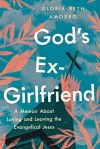
- The concept of Satan as “the enemy” in God’s Ex-Girlfriend by Gloria Beth Amodeo and All of Us Together in the End by Matthew Vollmer, two 2023 memoirs I reviewed for Foreword Reviews.
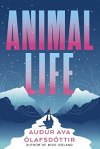
- A mention of the Newsboys (my favourite Christian rock band when I was a teenager) in God’s Ex-Girlfriend by Gloria Beth Amodeo and, of all places, Animal Life by Auður Ava Ólafsdóttir (the context: a list of songs with “Born” in the title; theirs is called – you guessed it! – “Born Again”).
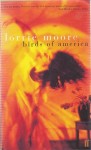
- Two Moores in my stack at once: Birds of America by Lorrie Moore and The Distance from Slaughter County by Steven Moore.
- A chapter in The Distance from Slaughter County by Steven Moore is called “Fight Night” and I was reading the early pages of Fight Night by Miriam Toews at the same time.
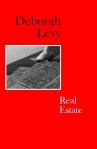
- A story in Birds of America by Lorrie Moore is called “Real Estate” and I was reading Real Estate by Deborah Levy at the same time.
- The Virgil quote “there are tears at the heart of things” and the theme of melancholy link Bittersweet by Susan Cain and The Heart of Things by Richard Holloway.
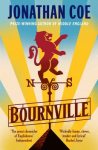
- A character who stutters in Bournville by Jonathan Coe and A Place Called Winter by Patrick Gale.

- (Werther’s) butterscotch candies are mentioned in Leila and the Blue Fox by Kiran Millwood Hargrave, Our Missing Hearts by Celeste Ng, What Napoleon Could Not Do by DK Nnuro, and How to Be Sad by Helen Russell.
- A mother who loves going to church in Bournville by Jonathan Coe and Born a Crime by Trevor Noah.
- The metaphor of a girl trapped in a block of marble ready to have her identity carved out in Sea Change by Gina Chung and Everything’s Changing by Chelsea Stickle.
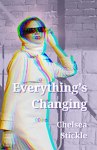
- When I read a short story about a landmine-detecting rat in Everything’s Changing by Chelsea Stickle, I knew it wasn’t the first time I’d encountered that very specific setup. It took some digging, but I found out the other was in Attrib. by Eley Williams.
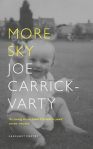
- Shane McCrae, whose forthcoming memoir Pulling the Chariot of the Sun I was also reading, is a named poetic influence/source in More Sky by Joe Varrick-Carty.

- I’m sure that after the one in Margaret Atwood’s The Door I encountered another poem about a frozen cat … but can’t now find it for the life of me.
- A character named Marnie in Martha Quest by Doris Lessing and City of Friends by Joanna Trollope.
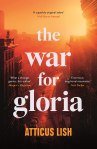
- Cape Verdean immigrants in the Boston area, then and now, in Daughters of Nantucket by Julie Gerstenblatt and The War for Gloria by Atticus Lish.

- Someone swaps green tea for coffee in Bittersweet by Susan Cain and City of Friends by Joanna Trollope.
- A half-French, half-Asian protagonist in a novella translated from the French: A Single Rose by Muriel Barbery and Winter in Sokcho by Elisa Shua Dusapin.
- A (semi-)historical lesbian couple as a subject of historical fiction in Daughters of Nantucket by Julie Gerstenblatt and Chase of the Wild Goose by Mary Gordon.
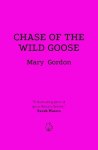
- A lesbian couple with a ten-year age gap breaks up because the one partner wants a baby and the other does not in My Mother Says by Stine Pilgaard and City of Friends by Joanna Trollope.
- After I specifically read three Frost Fairs books … 18th-century frolics on the frozen Thames were mentioned in The Secret Diaries of Charles Ignatius Sancho by Paterson Joseph.

- As I was reading The Secret Diaries of Charles Ignatius Sancho by Paterson Joseph, I saw him briefly mentioned in How to Be Sad by Helen Russell.
- From one 139-page book about a foreigner’s wanderings in Kyoto (often taking in temples) to another: I followed up A Single Rose by Muriel Barbery with How Kyoto Breaks Your Heart by Florentyna Leow.


- Persimmon jam is mentioned in Winter in Sokcho by Elisa Shua Dusapin and How Kyoto Breaks Your Heart by Florentyna Leow.
- A brave post-tragedy trip to a mothers and babies group ends abruptly when people are awkward or rude in All My Wild Mothers by Victoria Bennett and How to Be Sad by Helen Russell.


 As I was reading What We Talk about when We Talk about Love by Raymond Carver, I encountered a snippet from his poetry as a chapter epigraph in Bittersweet by Susan Cain.
- Sexologist Havelock Ellis inspired one of the main characters in The New Life by Tom Crewe and is mentioned in passing in Martha Quest by Doris Lessing.
What’s the weirdest reading coincidence you’ve had lately?
 Bookish Beck = Rebecca Foster. American transplant to England. Freelance proofreader and book reviewer.
 Bookish Beck