Readings for the 20th Anniversary of 9/11
Like the assassination of John F. Kennedy for a previous generation, September 11, 2001 was a landmark day in our shared history. I was two weeks into my freshman year of college and getting ready to head out to a 9:30 seminar when my roommate returned early from her first class. “All these planes flying into buildings – I’m freaking out!” she cried, and turned our tiny desktop TV set to a news station.
At that point it was unclear what was going on, so I dutifully trudged out across the quad linking the residence halls to the academic buildings, anticipating a normal day of classes. On the way I encountered small groups of somber students, and was alarmed to see my friend and “Big Sister” from the junior class weeping onto her boyfriend’s shoulder – her dad worked at the Pentagon, and she hadn’t yet heard that he was okay. When I entered the lecture hall it was clear no regular work was going to happen that day; I was one of only a handful of students who’d shown up, and our English professor, too, was engrossed by the rippling montage of rubble and smoke being projected onto a screen behind him.
 As the anniversary approached this year, I picked up a coffee table book of photos, Reuters’ September 11: A Testimony from the library and was struck by how dated everything appeared. For an event so fresh in my memory, it actually looks like something that happened a long time ago thanks to everything from the fashions and car designs to the photographic quality. You also get the sense that, even in the early Internet age, things like missing person posters and public tributes to the dead were primarily paper-based then. The photos barely capture the scope of the devastation. One image of firefighters among the wreckage looks like a film set or architect’s model, the human figures like ants among the dusty girders. This was published in late 2001, so it was put together quickly. Photographs tell the story, with extremely brief captions on facing pages. Nearly half of the length is devoted to documenting the three crash sites, with the rest chronicling memorial services, national and international commemorations, and New York City gradually returning to business as usual.


On the way back from our mother’s wedding this summer, my sister and brother-in-law and I passed the entrance to the Flight 93 Memorial in Shanksville, Pennsylvania so drove in for a look. The 1,000-acre site is administered by the National Park Service. On the airless June day we were there, the Tower of Voices was not making its eerie music, but it was still a peaceful spot for reflection. You can listen to a recording of the windchimes on the website. There is also a visitor center with a permanent exhibition that we will have to go back and see another time.
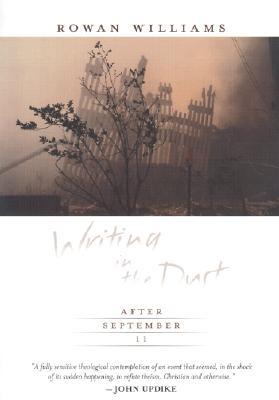
I also recently reread Rowan Williams’s superb book-length essay Writing in the Dust (2002), which I’d read twice before. Williams, then Archbishop of Wales and soon to become Archbishop of Canterbury, was in New York City on 9/11. He was, in fact, just a few blocks from the World Trade Center, at Trinity Church, Wall Street, where he was part of a group recording theological conversations to be used for educational purposes. When the planes hit and the air filled with dust and smoke, he did the same as everyone else: he quickly evacuated, ensured everyone was safe, and then watched, listened, and prayed. And in the months that followed he thought about what he’d seen that day, and what his experience had taught him about suffering, peacemaking, and the ways of God.
Writing well before military action against Iraq began, Williams cautioned against labeling the Other as Evil and responding in a simple spirit of retribution. Prophets’ words are never welcome, of course, and time has shown that Western policies have only made things worse. I must have read this from a university library; I then did a peculiar (and probably illegal, in copyright terms) thing and typed out every single word of it into a Word file so I could keep it forever.
Here are some of Williams’s words of wisdom:
“The hardest thing in the world is to know how to act so as to make the difference that can be made; to know how and why that differs from the act that only releases or expresses the basic impotence of resentment.”
My original rating (2013): 
My rating now:
Other 9/11-themed reading I have done:
The Second Plane by Martin Amis (2008)
 A famously bad-tempered English novelist who now lives in New York, Amis here presents a collection of 14 fictional and factual responses to 9/11. The essays are much stronger than the stories (a tale about Saddam Hussein’s son’s body double is downright weird), although it might be argued that Amis’s general understanding of Islam is fatally skewed. Opinionated, bold, and polarizing, these pieces ponder the symbolism and ideology of a day that changed the world.
The wonderful Annie Dillard’s post-9/11 essay “This is the Life,” available to read here, is another perceptive look at our response to tragedy, asking whether we are going to accept what “everyone” thinks about us vs. them and the value of human lives: “Everyone knows…the enemies are barbarians [but] our lives and our deaths count equally.”
Extremely Loud and Incredibly Close by Jonathan Safran Foer (2005)
 Oskar Schell is a tremendously precocious nine-year-old who’s trying to come to terms with his father’s death in the World Trade Center on 9/11. He sets off on a quest to find the lock that takes the key he found in his dad’s closet. This light-hearted search takes him all over New York’s five boroughs, but in the end Oskar is little closer to discovering who his dad really was or how exactly he died. All he has left of him is that same panicked message on the answering machine, left sometime during the morning of September 11th. By denying neat narrative closure, Foer avoids sentimentality at the same time as he affirms the tragedy’s effect on a nation and on individuals.
Small Wonder by Barbara Kingsolver (2002)
 On September 12th, 2001, Kingsolver sat down at her computer to write up some thoughts about the previous day’s tragedy. A newspaper had asked her for a short response, but as she sat and typed she found that the words kept coming, in essay after essay. The title piece in this collection, and several others like it, might make for occasionally uncomfortable reading, as Kingsolver questions automatic all-American responses like indiscriminate flag-waving and “we’ll hunt those terrorists down” vigilante justice. She asks how someone who loves her country can criticize its tenets and actions without being branded a traitor. “My country, right or wrong,” the saying goes – fair enough, but the truest patriot is one who loves her country enough to hold it to the highest moral standards, demanding it live up to its democratic ideals.
The Submission by Amy Waldman (2011)
 Waldman’s debut imagines what would have happened had New Yorkers chosen a 9/11 memorial design as soon as 2003 and – crucially – had the anonymous selection turned out to be by a Muslim architect named Mohammad Khan. His memorial garden is rich in possible meanings and influences. When a member of the memorial selection jury leaks the information about the designer’s name to the press, however, all hell breaks loose, and perfectly nice, reasonable people start to display some ugly bigotry. As the clever double meaning of the title suggests, Waldman has educated herself about Islam’s doctrines. She includes an impressive range of characters and opinions in this canny psychological exploration.
(Most of the above text is recycled from an article I wrote for Bookkaholic web magazine (now defunct) in 2013.)
I can think of at least six more novels I’ve read that would be appropriate for this list, yet even including them here would be a spoiler. Generally, if you’re reading a novel set in New York City in 2000 or so, you should be prepared…

This year I meant to read Mitchell Zuckoff’s comprehensive journalistic study, Fall and Rise: The Story of 9/11, but ran out of time. Eleanor highly recommends the audiobook of the oral history The Only Plane in the Sky by Garrett M. Graff. This Kirkus list has two additional nonfiction suggestions.
Where were you on 9/11?
Have you read anything related to it?
Finishing 20 Books of Summer: The Anthropocene Reviewed by John Green
The final choice for my colour-themed 20 Books of Summer, a terrific essay collection about the best and worst of the modern human experience, also happened to be the only one where the colour was part of the author’s name rather than the book’s title. I also have a bonus rainbow-covered read and a look back at the highlights of my summer reading.
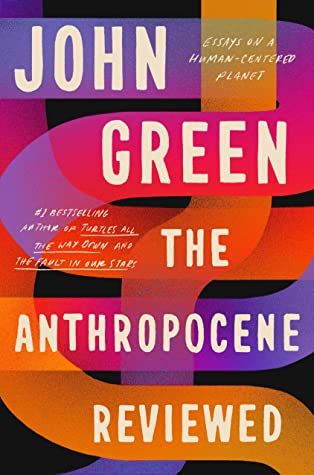
The Anthropocene Reviewed: Essays on a Human-Centered Planet by John Green (2021)
(20 Books of Summer, #20) How Have You Enjoyed the Anthropocene So Far? That’s the literal translation of the book’s German title, but also a tidy summary of its approach. John Green is not only a YA author but also a new media star – he and his brother Hank are popular vlogging co-hosts, and this book arose from a podcast of the same name. Some of the essays first appeared on his various video projects, too. In about 5–10 pages, he takes a phenomenon experienced in the modern age, whether miraculous (sunsets, the Lascaux cave paintings, favourite films or songs), regrettable (Staph infections, CNN, our obsession with grass lawns), or just plain weird, and riffs on it, exploring its backstory, cultural manifestations and personal resonance.
Indeed, the essays reveal a lot about Green himself. I didn’t know of his struggles with anxiety and depression. “Harvey,” one of the standout essays, is about a breakdown he had in his early twenties when living in Chicago and working for Booklist magazine. His boss told him to take as much time as he needed, and urged him to watch Harvey, the Jimmy Stewart film about a man with an imaginary friend that happens to be a six-foot rabbit. It was the perfect prescription. In “Auld Lang Syne,” Green toggles between the history of the song and a friendship from his own old times, with an author and mentor who has since died. “Googling Strangers” prides itself on a very 21st-century skill by which he discovers that a critically injured boy from his time as a student chaplain at a children’s hospital lived to adulthood.
Green is well aware of the state of things: “Humans are already an ecological catastrophe … for many forms of life, humanity is the apocalypse.” He plays up the contradictions in everyday objects: air-conditioning is an environmental disaster, yet makes everyday life tolerable in vast swathes of the USA; Canada geese are still, to many, a symbol of wildness, but are almost frighteningly ubiquitous – one of the winners in the species roulette we’ve initiated. And although he’s clued in, he knows that in many respects he’s still living as if the world isn’t falling apart. “In the daily grind of a human life, there’s a lawn to mow, soccer practices to drive to, a mortgage to pay. And so I go on living the way I feel like people always have.” A sentiment that rings true for many of us: despite the background dread about where everything is headed, we just have to get on with our day-to-day obligations, right?
Although he’s from Indianapolis, a not particularly well regarded city of the Midwest, Green is far from the conservative, insular stereotype of that region. There are pockets of liberal, hipster culture all across the Midwest, in fact, and while he does joke about Indy in the vein of “well, you’ve gotta live somewhere,” it’s clear that he’s come to love the place – enough to set climactic scenes from two of his novels there. However, he’s also cosmopolitan enough – he’s a Liverpool FC fan, and one essay is set on a trip to Iceland – to be able to see America’s faults (which, to an extent, are shared by many Western countries) of greed and militarism and gluttony and more.
In any book like this, one might quibble with the particular items selected. I mostly skipped over the handful of pieces on sports and video games, for instance. But even when the phenomena were completely unknown to me, I was still tickled by Green’s take. For example, here he is rhapsodizing on Diet Dr Pepper: “Look at what humans can do! They can make ice-cold, sugary-sweet, zero-calorie soda that tastes like everything and also like nothing.” He veers between the funny and the heartfelt: “I want to be earnest, even if it’s embarrassing.”
Each essay closes with a star rating. What value does a numerical assessment have when he’s making such apples-and-oranges comparisons (a sporting performance vs. sycamore trees vs. hot dog eating contests)? Not all that much. (Of course, some might make that very argument about rating books, but I persist!) At first I thought the setup was a silly gimmick, but since reviewing anything and everything on Amazon/TripAdvisor/wherever is as much a characteristic of our era as everything he’s writing about, why not? Calamities get 1–1.5 stars, things that seemed good but have turned out to be mixed blessings might get 2–3 stars, and whatever he unabashedly loves gets 4.5–5 stars.
As Green astutely remarks, “when people write reviews, they are really writing a kind of memoir—here’s what my experience was.” So, because I found a lot that resonated with me and a lot that made me laugh, and admired his openness on mental health à la Matt Haig, but also found the choices random such that a few essays didn’t interest me and the whole doesn’t necessarily build a cohesive argument, I give The Anthropocene Reviewed four stars. I’d only ever read The Fault in Our Stars, one of the first YA books I loved, so this was a good reminder to try more of Green’s fiction soon.
(Public library) 
Initially, I thought I might struggle to find 20 appealing colour-associated books, so I gave myself latitude to include books with different coloured covers. As it happens, I didn’t have to resort to choosing by cover, but I’ve thrown in this rainbow cover as an extra.
Songs in Ursa Major by Emma Brodie (2021)
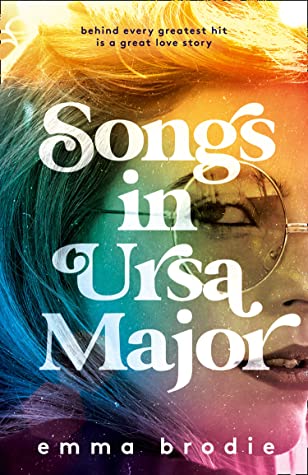 A Daisy Jones and the Six wannabe for sure, and a fun enough summer read even though the writing doesn’t nearly live up to Reid’s. Set largely between 1969 and 1971, the novel stars Jane Quinn, who lives on New England’s Bayleen Island with her aunt, grandmother and cousin – her aspiring singer mother having disappeared when Jane was nine. Nursing and bartending keep Jane going while she tries to make her name with her band, the Breakers. Aunt Grace, also a nurse, cares for local folk rocker Jesse Reid during his convalescence from a motorcycle accident. He then invites the Breakers to open for him on his tour and he and Jane embark on a turbulent affair. After Jane splits from both Jesse and the Breakers, she shrugs off her sexist producer and pours her soul into landmark album Songs in Ursa Major. (I got the Sufjan Stevens song “Ursa Major” in my head nearly every time I picked this up.)
There are some soap opera twists and turns to the plot, and I would say the novel is at least 100 pages too long, with an unnecessary interlude on a Greek island. Everyone loves a good sex, drugs and rock ’n roll tale, but here the sex scenes were kind of cringey, and the lyrics and descriptions of musical styles seemed laboured. Also, I thought from the beginning that the novel could use the intimacy of a first-person narrator, but late on realized it had to be in the third person to conceal a secret of Jane’s – which ended up feeling like a trick. There are also a few potential anachronisms (e.g. I found myself googling “how much did a pitcher of beer cost in 1969?”) that took me out of the period. Brodie is a debut novelist who has worked in book publishing in the USA for a decade. Her Instagram has a photo of her reading Daisy Jones and the Six in March 2019! That and the shout-out to Mandy Moore, of all the musical inspirations, in her acknowledgments, had me seriously doubting her bona fides to write this story. Maybe take it as a beach read if you aren’t too picky.
(Twitter giveaway win) 

Looking back, my favourite read from this project was Nothing but Blue Sky by Kathleen MacMahon, closely followed by the novels Under the Blue by Oana Aristide and Ruby by Ann Hood, the essay collection The Anthropocene Reviewed by John Green (above), the travel book The Glitter in the Green by Jon Dunn, and the memoirs Darkness Visible by William Styron and Direct Red by Gabriel Weston. A varied and mostly great selection, all told! I read six books from the library and the rest from my shelves. Maybe next year I’ll not pick a theme but allow myself completely free choice – so long as they’re all books I own.
What was the highlight of your summer reading?
Reading with the Seasons: Summer 2021, Part I
I’m more likely to choose lighter reads and dip into genre fiction in the summer than at other times of year. The past few weeks have felt more like autumn here in southern England, but summer doesn’t officially end until September 22nd. So, if I get a chance (there’s always a vague danger to labelling something “Part I”!), before then I’ll follow up with another batch of summery reads I have on the go: Goshawk Summer, Klara and the Sun, Among the Summer Snows, A Shower of Summer Days, and a few summer-into-autumn children’s books.
For this installment I have a quaint picture book, a mystery, a travel book featured for its title, and a very English classic. I’ve chosen a representative quote from each.
Summer Story by Jill Barklem (1980)
 One of a quartet of seasonal “Brambly Hedge” stories in small hardbacks. It wouldn’t be summer without weddings, and here one takes place between two mice, Poppy Eyebright and Dusty Dogwood (who work in the dairy and the flour mill, respectively), on Midsummer’s Day. I loved the little details about the mice preparing their outfits and the wedding feast: “Cool summer foods were being made. There was cold watercress soup, fresh dandelion salad, honey creams, syllabubs and meringues.” We’re given cutaway views of various tree stumps, like dollhouses, and the industrious activity going on within them. Like any wedding, this one has its mishaps, but all is ultimately well, like in a classical comedy. This reminded me of the Church Mice books or Beatrix Potter’s works: very sweet, quaint and English.
Source: Public library
My rating: 
These next two give a real sense of how heat affects people, physically and emotionally.
Heatstroke by Hazel Barkworth (2020)
“In the heat, just having a human body was a chore. Just keeping it suitable for public approval was a job”
 From the first word (“Languid”) on, this novel drips with hot summer atmosphere, with its opposing connotations of discomfort and sweaty sexuality. Rachel is a teacher of adolescents as well as the mother of a 15-year-old, Mia. When Lily, a pupil who also happens to be one of Mia’s best friends, goes missing, Rachel is put in a tough spot. I mostly noted how Barkworth chose to construct the plot, especially when to reveal what. By the one-quarter point, Rachel works out what’s happened to Lily; by halfway, we know why Rachel isn’t telling the police everything.
The dynamic between Rachel and Mia as they decide whether to divulge what they know is interesting. This is not the missing person mystery it at first appears to be, and I didn’t sense enough literary quality to keep me wanting to know what would happen next. I ended up skimming the last third. It would be suitable for readers of Rosamund Lupton, but novels about teenage consent are a dime a dozen these days and this paled in comparison to My Dark Vanessa. For a better sun-drenched novel, I recommend A Crime in the Neighborhood.
Source: Public library
My rating:
The Shadow of the Sun: My African Life by Ryszard Kapuściński (1998; 2001)
[Translated from the Polish by Klara Glowczewska]
“Dawn and dusk—these are the most pleasant hours in Africa. The sun is either not yet scorching, or it is no longer so—it lets you be, lets you live.”
 The Polish Kapuściński was a foreign correspondent in Africa for 40 years and lent his name to an international prize for literary reportage. This collection of essays spans decades and lots of countries, yet feels like a cohesive narrative. The author sees many places right on the cusp of independence or in the midst of coup d’états. Living among Africans rather than removed in a white enclave, he develops a voice that is surprisingly undated and non-colonialist. While his presence as the observer is undeniable – especially when he falls ill with malaria and then tuberculosis – he lets the situation on the ground take precedence over the memoir aspect. I read the first half last year and then picked the book back up again to finish this year. The last piece, “In the Shade of a Tree, in Africa” especially stood out. In murderously hot conditions, shade and water are two essentials. A large mango tree serves as an epicenter of activities: schooling, conversation, resting the herds, and so on. I appreciated how Kapuściński never resorts to stereotypes or flattens differences: “Africa is a thousand situations, varied, distinct, even contradictory … everything depends on where and when.”
Along with Patrick Leigh Fermor’s A Time of Gifts and the Jan Morris anthology A Writer’s World, this is one of the best few travel books I’ve ever read.
Source: Free bookshop
My rating:
August Folly by Angela Thirkell (1936)
“The sun was benignantly hot, the newly mown grass smelt sweet, bees were humming in a stupefying way, Gunnar was purring beside him, and Richard could hardly keep awake.”
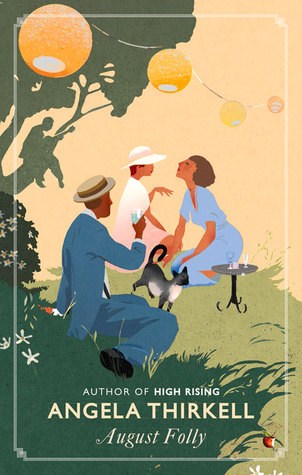 I’d been curious to try Thirkell, and this fourth Barsetshire novel seemed as good a place to start as any. Richard Tebben, not the best and brightest that Oxford has to offer, is back in his parents’ village of Worsted for the summer and dreading the boredom to come. That is, until he meets beautiful Rachel Dean and is smitten – even though she’s mother to a brood of nine, most of them here with her for the holidays. He sets out to impress her by offering their donkey, Modestine, for rides for the children, and rather accidentally saving her daughter from a raging bull. Meanwhile, Richard’s sister Margaret can’t decide if she likes being wooed, and the villagers are trying to avoid being roped into Mrs Palmer’s performance of a Greek play. The dialogue can be laughably absurd. There are also a few bizarre passages that seem to come out nowhere: when no humans are around, the cat and the donkey converse.
This was enjoyable enough, in the same vein as books I’ve read by Barbara Pym, Miss Read, and P.G. Wodehouse, though I don’t expect I’ll pick up more by Thirkell. (No judgment intended on anyone who enjoys these authors. I got so much flak and fansplaining when I gave Pym and Wodehouse 3 stars and dared to call them fluffy or forgettable, respectively! There are times when a lighter read is just what you want, and these would also serve as quintessential English books revealing a particular era and class.)
Source: Public library
My rating:
As a bonus, I have a book about how climate change is altering familiar signs of the seasons.
Forecast: A Diary of the Lost Seasons by Joe Shute (2021)
“So many records are these days being broken that perhaps it is time to rewrite the record books, and accept the aberration has become the norm.”
 Shute writes a weather column for the Telegraph, and in recent years has reported on alarming fires and flooding. He probes how the seasons are bound up with memories, conceding the danger of giving in to nostalgia for a gloried past that may never have existed. However, he provides hard evidence in the form of long-term observations (phenology) such as temperature data and photo archives that reveal that natural events like leaf fall and bud break are now occurring weeks later/earlier than they used to. He also meets farmers, hunts for cuckoos and wildflowers, and recalls journalistic assignments.
The book deftly recreates its many scenes and conversations, and inserts statistics naturally. It also delicately weaves in a storyline about infertility: he and his wife long for a child and have tried for years to conceive, but just as the seasons are out of kilter, there seems to be something off with their bodies such that something that comes so easily for others will not for them. A male perspective on infertility is rare – I can only remember encountering it before in Native by Patrick Laurie – and these passages are really touching. The tone is of a piece with the rest of the book: thoughtful and gently melancholy, but never hopeless (alas, I found The Eternal Season by Stephen Rutt, on a rather similar topic, depressing).
Forecast is wide-ranging and so relevant – the topics it covers kept coming up and I would say to my husband, “oh yes, that’s in Joe Shute’s book.” (For example, he writes about the Ladybird What to Look For series and then we happened on an exhibit of the artwork at Mottisfont Abbey.) I can see how some might say it crams in too much or veers too much between threads, but I thought Shute handled his material admirably.
Source: Public library
My rating: 
Have you been reading anything particularly fitting for summer this year?
Lana Bastašić for WIT Month 2021 & September Reading Plans
My literature in translation statistics for 2021 have been abysmal so far, but here’s my token contribution to Women in Translation Month: Catch the Rabbit by Lana Bastašić, originally published in 2018 and translated from the Serbo-Croatian by the author herself.
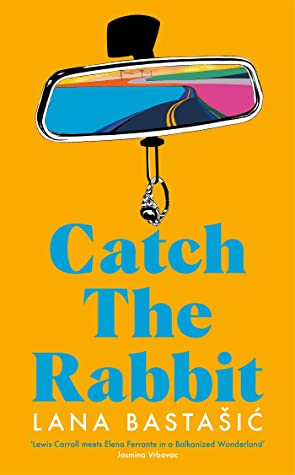 Sara has made a new life for herself in Dublin, with a boyfriend and an avocado tree. She rarely thinks about her past in Bosnia or hears her mother tongue. It’s a rude awakening, then, when she gets a phone call from her childhood best friend, Lejla Begić. Her bold, brassy pal says she needs Sara to pick her up in Mostar and drive her to Vienna to find her brother, Armin. No matter that Sara and Lejla haven’t been in contact in 12 years. But Lejla still has such a hold over Sara that she books a plane ticket right away.
Alternating chapters, with the text enclosed in brackets, dive into the friends’ past: school days, losing their virginity, and burying Lejla’s pet white rabbit, Bunny. Sara often writes as if to Lejla: “I can’t beautify those days, I can’t give them some special, big meaning. You would despise me for it. Besides, I don’t know how to write those two kids: you keep shrinking and growing in my memory, like illusive land to desperate sailors.”
In the road trip scenes, we have to shake our heads at how outrageous Lejla is: peeing in a cornfield, throwing her used tampons out the window, and orchestrating a farcical situation when she lies and tells their host that Sara only speaks English. A lovable rogue, she drives the book’s action. Indeed, Sara realizes, “both the car and I were nothing but an extension of Lejla’s will, she moved us with her words, and we followed obediently.”
This offbeat novel struck me, bizarrely, as a cross between Asylum Road and When God Was a Rabbit. I sometimes find that work in translation, particularly Eastern European, has too much quirkiness for the sake of it. That’s probably true here, and although the nostalgia element was appealing the emotional payoff wasn’t enough to satisfy me. However, I did love a late scene where Sara gazes at Albrecht Dürer’s famous Young Hare painting, and keep an eye out for how the ending connects back to the beginning.
(Simon appreciated this European Union Prize for Literature winner more than I did: his review compares the picture of asymmetrical female friendship favourably to that in Elena Ferrante’s Neapolitan Novels.)
With thanks to Picador for the free copy for review.

Did you do any special reading for Women in Translation month this year?
September Reading Plans
Each September I make a bit more of an effort to read short stories, which otherwise tend to sit on my shelves and Kindle unread. Last year I managed to read eight collections for this challenge. How many will I get to this year?! Here’s my shelf of potential reads:

I’ll reread selections from the Byatt anthology (I’ve read all of her published short story collections before and own two of them, one of which I reread last year) and will otherwise focus on books by women. I’ve had good success with Amy Bloom and Helen Simpson stories in previous years, so I’ll definitely plan to read those plus Bloodchild by Octavia E. Butler (from the university library).
Since I own THREE unread collections by Alice Munro, it’s time to tackle one, probably Dear Life since I’ve owned it the longest – it’s a review copy that arrived before her Nobel Prize win and I’ve (oops) never reviewed it. The World Does Not Require You is also a long-languishing review copy, so might be my one male-penned title.
What are your September reading plans? Any short story collections you’ve read recently and would recommend to me?
20 Books of Summer, #18–19: The Other’s Gold and Black Dogs
Today’s entries in my colour-themed summer reading are a novel about a quartet of college friends and the mistakes that mar their lives and a novella about the enduring impact of war set just after the fall of the Berlin Wall.
The Other’s Gold by Elizabeth Ames (2019)
Make new friends but keep the old,
One is silver and the other’s gold.
Do you know that little tune? We would sing it as a round at summer camp. It provides a clever title for this story of four college roommates whose lives are marked by the threat of sexual violence and ambivalent feelings about motherhood. Alice, Ji Sun, Lainey and Margaret first meet as freshmen in 2002 when they’re assigned to the same suite (with a window seat! how envious am I?) at Quincy-Hawthorn College.
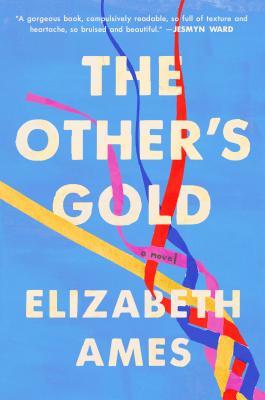 They live together for the whole four years – a highly unusual situation – and see each other through crises at college and in the years to come as they find partners and meander into motherhood. Iraq War protests and the Occupy movement form a turbulent background, but the friends’ overriding concerns are more personal. One girl was molested by her brother as a child and has kept secret her act of revenge; one has a crush on a professor until she learns he has sexual harassment charges being filed against him by multiple female students. Infertility later provokes jealousy between the young women, and mental health issues come to the fore.
As in Expectation by Anna Hope, the book starts to be all about babies at a certain point. That’s not a problem if you’re prepared for and interested in this theme, but I love campus novels so much that my engagement waned as the characters left university behind. Also, the characters seemed too artificially manufactured to inject diversity (Ji Sun is a wealthy Korean; adopted Lainey is of mixed Latina heritage, and bisexual; Margaret has Native American blood) and embody certain experiences. And, unfortunately, any #MeToo-themed read encountered in the wake of My Dark Vanessa is going to pale by comparison.
Part One held my interest, but after that I skimmed to the end. Ideally, I would have chosen replacements and not included skims like this and Green Mansions, but it’s not the first summer that I’ve had to count DNFs and skimmed books – my time and attention are always being diverted by paid review work, review copies and library books with imminent deadlines. I’ve read lots of fiction about groups of female friends this summer, partly by accident and partly by design, and will likely do a feature on it in an upcoming month. For now, I’d recommend Lara Feigel’s The Group instead of this. 
With thanks to Pushkin Press (ONE imprint) for the free e-copy for review.
Black Dogs by Ian McEwan (1992)
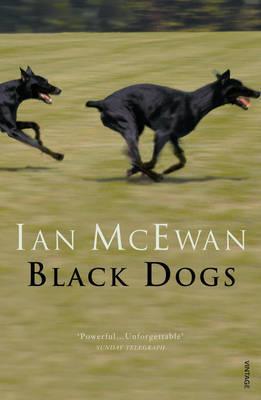 When I read the blurb, I worried I’d read this before and forgotten it: all it mentions is a young couple setting off on honeymoon and having an encounter with evil. Isn’t that the plot of The Comfort of Strangers? I thought. In fact, this only happens to have the vacation detail in common, and has a very different setup and theme overall.
Jeremy lost his parents in a car accident (my least favourite fictional trope – far too convenient a way of setting a character off on their own!) when he was eight years old, and is self-aware enough to realize that he has been seeking for parental figures ever after. He becomes deeply immersed in the story of his wife’s parents, Bernard and June, even embarking on writing a memoir based on what June, from her nursing home bed, tells him of their early life (Part One).
After June’s death, Jeremy takes Bernard to Berlin (Part Two) to soak up the atmosphere just after the Wall comes down, but the elderly man is kicked by a skinhead. The other key thing that happens on this trip is that he refutes June’s account of their honeymoon. At June’s old house in France (Part Three), Jeremy feels her presence and seems to hear the couple’s voices. Only in Part Four do we learn what happened on their 1946 honeymoon trip to France: an encounter with literal black dogs that also has a metaphorical dimension, bringing back the horrors of World War II.
I think the novel is also meant to contrast Communist ideals – Bernard and June were members of the Party in their youth – with how Communism has played out in history. It was shortlisted for the Booker, which made me feel that I must be missing something. A fairly interesting read, most similar in his oeuvre (at least of the 15 I’ve read so far) to The Child in Time. (Secondhand purchase from a now-defunct Newbury charity shop)
Coming up next: The latest book by John Green – it’s due back at the library on the 31st so I’ll aim to review it before then, possibly with a rainbow-covered novel as a bonus read.
20 Books of Summer, #16–17, GREEN: Jon Dunn and W.H. Hudson
Today’s entries in my colour-themed summer reading are a travelogue tracking the world’s endangered hummingbirds and a bizarre classic novel that blends nature writing and fantasy. Though very different books, they have in common lush South American forest settings.
The Glitter in the Green: In Search of Hummingbirds by Jon Dunn (2021)
As a wildlife writer and photographer, Jon Dunn has come to focus on small and secretive but indelible wonders. His previous book, which I still need to catch up on, was all about orchids, and in this new one he travels the length of the Americas, from Alaska to Tierra del Fuego, to see as many hummingbirds as he can. He provides a thorough survey of the history, science and cultural relevance (from a mini handgun to an indie pop band) of this most jewel-like of bird families. The ruby-throated hummingbirds I grew up seeing in suburban Maryland are gorgeous enough, but from there the names and corresponding colourful markings just get more magnificent: Glittering-throated Emeralds, Tourmaline Sunangels, Violet-capped woodnymphs, and so on. I’ll have to get a look at the photos in a finished copy of the book!
 Dunn is equally good at describing birds and their habitats and at constructing a charming travelogue out of his sometimes fraught journeys. He has only a narrow weather of fog-free weather to get from Chile to Isla Robinson Crusoe and the plane has to turn back once before it successfully lands; a planned excursion in Bolivia is a non-starter after political protestors block some main routes. There are moments when the thrill of the chase is rewarded – as when he sees 24 hummingbird species in a day in Costa Rica – and many instances of lavish hospitality from locals who serve as guides or open their gardens to birdwatchers.
Like so many creatures, hummingbirds are in dire straits due to human activity: deforestation, invasive species, pesticide use and climate change are reducing the areas where they can live to pockets here and there; some species number in the hundreds and are considered critically endangered. Dunn juxtaposes the exploitative practices of (white, male) 19th- and 20th-century bird artists, collectors and hunters with indigenous birdwatching and environmental initiatives that are rising up to combat ecological damage in Latin America. Although society has moved past the use of hummingbird feathers in crafts and fashion, he learns that the troubling practice of dead hummingbirds being sold as love charms (chuparosas) persists in Mexico.
Whether you’re familiar with hummingbirds or not, if you have even a passing interest in nature and travel writing, I recommend The Glitter in the Green for how it invites readers into a personal passion, recreates an adventurous odyssey, and reinforces our collective responsibility for threatened wildlife. (Proof copy passed on by Paul of Halfman, Halfbook)
A lovely folk tale I’ll quote in full:
A hummingbird as a symbol of hope, strength and endurance is a recurrent one in South American folklore. An Ecuadorian folk tale tells of a forest on fire – a hummingbird picks up single droplets of water in its beak and lets them fall on the fire. The other animals in the forest laugh, and ask the hummingbird what difference this can possibly make. They say, ‘Don’t bother, it is too much, you are too little, your wings will burn, your beak is too tiny, it’s only a drop, you can’t put out this fire. What do you think you are doing?’ To which the hummingbird is said to reply, ‘I’m just doing what I can.’
Links between the books: Hudson is quoted in Dunn’s introduction. In Chapter 7 of the below, Hudson describes a hummingbird as “a living prismatic gem that changes its colour with every change of position … it catches the sunshine on its burnished neck and gorget plumes—green and gold and flame-coloured, the beams changing to visible flakes as they fall”
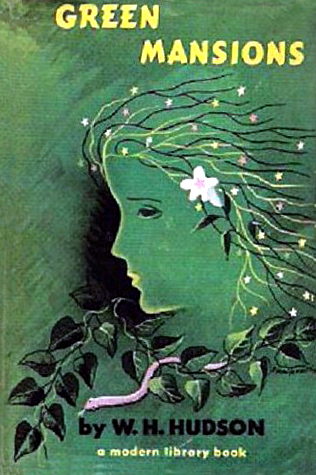
Green Mansions: A Romance of the Tropical Forest by W.H. Hudson (1904)
 Like Heart of Darkness, this is a long recounted tale about a journey among ‘savages’. After a prologue, the narrator soon cedes storytelling duties to Mr. Abel, whom he met in Georgetown, Guyana in 1887. Searching for gold and fighting off illness, the 23-year-old Abel took up the habit of wandering the Venezuelan forest. The indigenous people were superstitious and refused to hunt in that forest. Abel began to hear strange noises – magical bird calls or laughter – that, siren-like, drew him deeper in. His native friend warned him it was the daughter of an evil spirit.
One day, after being bitten by a snake, Abel woke up in the dwelling of an old man and his 17-year-old granddaughter, Rima – the very wood sprite he’d sensed all these times in the forest; she saved his life. Recovering in their home and helping Rima investigate her origins, he romanticizes this tree spirit in a way that struck me as smarmy. It’s possible this could be appreciated as a fable of connection with nature, but I found it vague and old-fashioned. (Not to mention Abel’s condescending attitude to the indigenous people and to women.) I ended up skimming the last three-quarters.
My husband has read nonfiction by Hudson; I think I was under the impression that this was a memoir, in fact. Perhaps I’d enjoy Hudson’s writing in another genre. But I was surprised to read high praise from John Galsworthy in the foreword (“For of all living authors—now that Tolstoi has gone—I could least dispense with W. H. Hudson”) and to note how many of my Goodreads friends have read this; I don’t see it as a classic that stands the test of time.
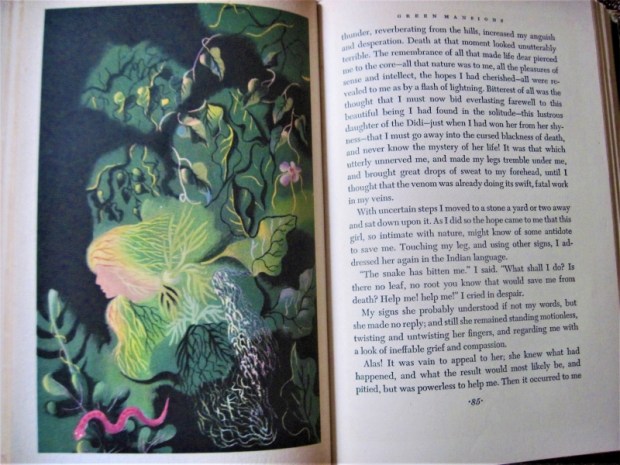
My 1944 hardback once belonged to one Mary Marcilliat of Louisville, Kentucky, and has strange abstract illustrations by E. McKnight Kauffer. (Free from the Book Thing of Baltimore) 
Coming up next: One black and one gold on Wednesday; a Green author and a rainbow bonus (probably on the very last day).
Would you be interested in reading one of these?
The Amateur Marriage by Anne Tyler (2004)
 This year I’ve been joining in Liz’s Anne Tyler readalong for most of the novels I own and hadn’t read yet. Just this summer, I’ve discovered two new favourites: Saint Maybe and now The Amateur Marriage – which surprised me because it was her sixteenth novel and not part of what I consider to be her golden mid-period of the 1980s-90s. Both Saint Maybe and The Amateur Marriage are, like Dinner at the Homesick Restaurant (my absolute favourite and, I was gratified to discover, Tyler’s favourite, too), effectively linked short story collections in which the chapters are self-contained narratives set at a particular point in a dysfunctional family’s life, with each one often focusing on a different character.
The Amateur Marriage feels unique in Tyler’s oeuvre for how it bridges historical fiction and her more typical contemporary commentary. Spanning 60 years precisely, it opens with the Pearl Harbor attack in 1941. In this Baltimore neighbourhood full of Polish immigrants, a spontaneous patriotic parade breaks out. In the excitement, Pauline jumps off a tram and hits her head on a lamppost. Her friends rush her to the Antons’ general store for a bandage and when Michael Anton meets her their fate is sealed. Pauline assumes Michael is bound for war and, so as not to disappoint her, he signs up. After his discharge, they marry – though Pauline had a near change of heart because they have so little in common and do nothing but fight.
{SPOILERS FOLLOW}
“Not quite forever”
The Antons’ marriage continues in the same volatile vein – until it doesn’t. I was taken aback that a story about marriage kept going even when Michael + Pauline ended, and even after one of them was no more. About two-thirds of the way through the book, on their 30th wedding anniversary, they find that their reminiscences are mostly of bitter arguments. Pauline wryly shakes her head over their antics, but Michael says to Pauline, “It has not been fun. It’s been hell.” She goads him into leaving, and he does.
I’ve jokingly heard women saying of their husbands, “I’m training him for his second wife,” and that seems to me to be the spirit of the title. These two characters had no idea that ‘opposites attract’ but don’t make for a stable marriage, and have muddled their way through for decades without figuring out how to change anything for the better. I sensed Tyler’s deep compassion for their foibles and how they affect the next generation.
A major thread of the novel is their eldest daughter Lindy’s teenage rebellion and eventual disappearance, reminding me a lot of Mary Lawson’s A Town Called Solace. Michael and Pauline retrieve her young son, Pagan, from San Francisco and raise him themselves, partly via shared custody. This theme of unexpected grandparent responsibility is a link to Saint Maybe and especially (along with the West as a setting) Clock Dance. There is no rapturous reunion to come, but the remnant of the family does eventually get back together.
Michael and Pauline are quintessential Tyler characters: the one easygoing if slightly useless (“He wished he had inhabited more of his life, used it better, filled it fuller”); the other highly strung and contrary, yet strong and efficient – “the ones who kept the planet spinning.” Michael never ceases to admire Pauline, even when he stops being married to her. In the penultimate chapter, the family swaps “Pauline stories” that exemplify how maddening but lovable she could be. You have someone in your family who’s just like that, right?
{END OF SPOILERS}
My U.S. paperback appends an interview with Tyler that I found illuminating. She knows that she doesn’t tend to break new ground with her fiction: “face it, I always write more or less the same sort of story,” she admits. During this reading project I’ve been debating whether this is a bad thing. Does it make her later work redundant? Does it mean she only had a limited store of good ideas? Are her characters types rather than three-dimensional creations? Marcie at Buried in Print loves the connections between the novels. I’m sure Liz does, too, but she’s also acknowledged that she finds individual plots strangely unmemorable.
I haven’t fully answered the above questions for myself. There are certainly Tyler books that I like more than others, but they have all been comforting and (mostly) compulsive reading. Her characters and situations feel so true to life that we don’t observe from the outside, but journey alongside and within them. (Secondhand purchase from 2nd & Charles, Hagerstown, MD, USA) See also Liz’s review.
Favourite lines:
“Was it possible to dislike your own wife? Well, no, of course not. This was just one of those ups-and-downs that every couple experienced.”
“so much about their parents had been embarrassing. Or did all children feel that way? But it seemed to George that the Antons’ lives were more extreme than other people’s. … People didn’t stay on an even keel in the Anton family. They did exaggerated things like throwing out their clothes or running away from home”
Another readalike: Larry’s Party by Carol Shields
My rating:
The 15 Tyler novels I’ve read, in order of preference (greatest to least), are:
Dinner at the Homesick Restaurant
Saint Maybe
The Amateur Marriage
Ladder of Years
The Accidental Tourist
Earthly Possessions
Breathing Lessons
Digging to America
Vinegar Girl
Back When We Were Grown-ups
Clock Dance
A Blue Spool of Thread
The Beginner’s Goodbye
Redhead by the Side of the Road
The Clock Winder
Next up for me will be Noah’s Compass later in September.
The Vixen by Francine Prose (Blog Tour)
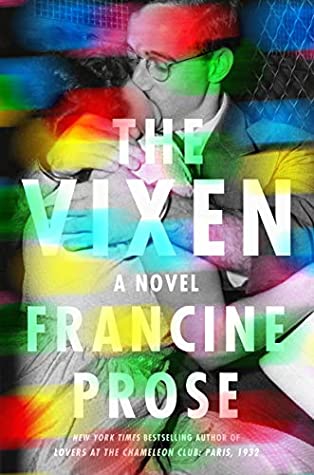 The New York City publishing world was an irresistible draw of this historical novel, my first fiction read from Francine Prose. In June 1953, Simon Putnam, newly graduated from Harvard with a degree in folklore studies, is living at home with his parents on Coney Island when the Rosenberg execution appears on television. The whole country has been caught up in this sordid real-life spy drama, but his family has an unusual connection that makes them feel they have more of a stake: Simon’s mother grew up in the same tenement building as Ethel Rosenberg and they attended high school together. The Putnams feel the execution was a disgrace, and Simon’s mother has even created a sort of shrine to Ethel in their apartment.
This puts Simon in a tricky situation when his uncle gets him an editorial job with a publisher whose next project – intended to keep the struggling firm afloat – is the potboiler The Vixen, the Patriot, and the Fanatic, a thinly veiled version of the Rosenberg story that relishes in their demise, turning them into “Soviet sex zombies.” Besides being in poor taste, it’s atrociously written. Can Simon turn it into something more in line with his values without displeasing his boss? Complicating matters is his crush on the book’s author, Anya Partridge, a vamp who wears a fox stole and happens to be confined to a mental asylum.
Nothing is what it seems in a suspenseful narrative inspired by the events of the Red Scare. Characters who initially embody stereotypes end up surpassing expectations. I have trouble putting my finger on why I found this novel underwhelming on the whole. Maybe it was something to do with the far-fetched turns and Simon’s impassive narration. Or one too many references to his sex fantasies about Anya. I don’t see myself seeking out more fiction by Prose. But if you’re a fan of Three-Martini Lunch by Suzanne Rindell and especially The Secrets We Kept by Lara Prescott, you may well find this a pleasant summer diversion.
My thanks to Harper360 UK and Anne Cater for arranging my proof copy for review.
I was delighted to be part of the blog tour for The Vixen. See below for details of where other reviews and features have appeared or will be appearing soon.
20 Books of Summer, #12–13, BLUE: Johnson & MacMahon
Blue has been the most common colour in my themed summer reading, showing up in six out of the 20 titles. In the two books I’m reviewing today, it’s used somewhat ironically, with a YA memoir subverting its association with conventional masculinity and a Women’s Prize-longlisted novel contrasting idyllic holiday weather with the persistence of grief.
All Boys Aren’t Blue: A Memoir-Manifesto by George M. Johnson (2020)
“you sometimes can’t see yourself if you can’t see other people like you existing, thriving”
Growing up in New Jersey in the late 1980s and early 1990s, Johnson knew he was different. He preferred Double-Dutch to football, called his classmates “Honeychild,” and begged for a pair of cowboy boots instead of the sneakers everyone else coveted. His effeminate ways earned the expected epithets. Even though he had plenty of LGBT precedents in his own family – a gay older half-brother, a lesbian aunt, a trans cousin – and his beloved Nanny assured him he was loved for who he was, he didn’t publicly confess his identity until he got to college and felt accepted as part of a fraternity. In fact, there are three instances in the book when, as a teenager, he’s asked directly if he’s gay and he denies it. (Do you hear a rooster?)
 Johnson is a warm, earnest storyteller and deftly chooses moments when he became aware of the social disadvantages inherent to his race and sexuality. His memoir is marketed to teens, who should find a lot to relate to here, such as dealing with bullies and realizing that what you’ve been taught is comforting myth. In the “‘Honest Abe’ Lied to Me” chapter, he discovers in middle school that Lincoln didn’t actually support racial equality and questions whether landmark achievements by Black people are just conciliatory tokens – “symbolism is a threat to actual change—it’s a chance for those in power to say, ‘Look how far you have come’ rather than admitting, ‘Look how long we’ve stopped you from getting here.’”
The manifesto element of the book lies in its investigation of the intersection of Blackness and queerness. Johnson is an activist and wants queer Black kids to have positive role models. He knows he was lucky to have family support and middle-class status; many have it harder, getting thrown out and ending up homeless. Multiple chapters are devoted to his family members, some in the form of letters. The structure didn’t always feel intuitive to me, with direct address to his cousin or grandmother coming seemingly out of nowhere. The language is informal, but that doesn’t excuse “me and so-and-so” constructions or referring to “people that” instead of “who”; young adult readers need to have good grammar reinforced.
I also questioned whether the author needed to be so sexually explicit in describing his molestation at the hands of an older male cousin (he has about a zillion cousins) and losing his virginity at age 20. Then again, today’s teens are probably a lot more sexually knowledgeable than I was 20+ years ago. All in all, I wondered if Johnson is more successful as a motivational speaker than a writer. I think his occasional bravado (he closes his introduction with “This is the story of George Matthew Johnson. This is a story for us all.”) would come across better in person than in print. Still, considering I couldn’t be much further from the target audience, I found this a sweet and engaging read. (Public library) 
Nothing but Blue Sky by Kathleen MacMahon (2020)
“Incongruous, the situations we found ourselves in. To be talking about such sorrow against the backdrop of a Mediterranean summer.”
SPOILERS in the following; otherwise it would be difficult to say anything other than that this novel is a deeply touching look at loss and what comes next. When I read a synopsis, I thought it would be Sue Miller’s Monogamy with the roles reversed, but that’s because the blurb makes it sound like there were secrets in David and Mary Rose’s marriage that only emerge after her death in a plane crash. I was on the alert for something sordid and earth-shattering, but in fact this is a quiet novel about what goes unsaid in any marriage.
 David, a foreign correspondent on Dublin’s television news, always put his career first, his sophistication and wicked humour masking the wounds of an emotionally chilly upbringing. Mary Rose, a hospital midwife, was the perfect foil, deflating his pomposity and calling him out on any unfeeling quips. Her loving nature was the soul of their relationship. Now that’s she gone, David regrets that he didn’t take more seriously her desperation to have children, a desire he didn’t share. His voice, even flattened and numbed by grief, is a delight. For instance, here’s how he describes Irish seaside holidays: “Summer to us was freezing your arse off on a windswept beach, with a trip to the ice-cream shop if you were lucky. Of course, they never had the ice-cream you wanted.”
The novel is set in Aiguaclara, a hidden gem on Spain’s Costa Brava where David and Mary Rose holidayed every summer for 20 years. Against his friends’ advice, he’s decided to come back alone this year. Although most of the book remembers their life together and their previous vacations here, there is also a present storyline running underneath. Initially subtle, it offers big surprises later on. These I won’t spoil; I’ll only say that David’s cynical belief that he’ll never experience happiness again is proven wrong. Grief, memory, fate: some of my favourite themes, elegantly treated. This reminded me of Three Junes and also, to a lesser extent, The Heart’s Invisible Furies. (Public library)
Coming up next: Pairs of green and red titles.
Would you be interested in reading one of these?
Review Book Catch-Up: Motherhood, Nature Essays, Pandemic, Poetry
July slipped away without me managing to review any current-month releases, as I am wont to do, so to those three I’m adding in a couple of other belated review books to make up today’s roundup. I have: a memoir-cum-sociological study of motherhood, poems of Afghan women’s experiences, a graphic novel about a fictional worst-case pandemic, seasonal nature essays from voices not often heard, and poetry about homosexual encounters.
(M)otherhood: On the choices of being a woman by Pragya Agarwal
“Mothering would be my biggest gesture of defiance.”
 Growing up in India, Agarwal, now a behavioural and data scientist, wished she could be a boy for her father’s sake. Being the third daughter was no place of honour in society’s eyes, but her parents ensured that she got a good education and expected her to achieve great things. Still, when she got her first period, it felt like being forced onto a fertility track she didn’t want. There was a dearth of helpful sex education, and Hinduism has prohibitions that appear to diminish women, e.g. menstruating females aren’t permitted to enter a temple.
Married and unexpectedly pregnant in 1996, Agarwal determined to raise her daughter differently. Her mother-in-law was deeply disappointed that the baby was a girl, which only increased her stubborn pride: “Giving birth to my daughter felt like first love, my only love. Not planned but wanted all along. … Me and her against the world.” No element of becoming a mother or of her later life lived up to her expectations, but each apparent failure gave a chance to explore the spectrum of women’s experiences: C-section birth, abortion, divorce, emigration, infertility treatment, and finally having further children via a surrogate.
While I enjoyed the surprising sweep of Agarwal’s life story, this is no straightforward memoir. It aims to be an exhaustive survey of women’s life choices and the cultural forces that guide or constrain them. The book is dense with history and statistics, veers between topics, and needed a better edit for vernacular English and smoothing out academic jargon. I also found that I wasn’t interested enough in the specifics of women’s lives in India.
With thanks to Canongate for the free copy for review.
Forty Names by Parwana Fayyaz
“History has ungraciously failed the women of my family”
 Have a look at this debut poet’s journey: Fayyaz was born in Kabul in 1990, grew up in Afghanistan and Pakistan, studied in Bangladesh and at Stanford, and is now, having completed her PhD, a research fellow at Cambridge. Many of her poems tell family stories that have taken on the air of legend due to the translated nicknames: “Patience Flower,” her grandmother, was seduced by the Khan and bore him two children; “Quietude,” her aunt, was a refugee in Iran. Her cousin, “Perfect Woman,” was due to be sent away from the family for infertility but gained revenge and independence in her own way.
Fayyaz is bold to speak out about the injustices women can suffer in Afghan culture. Domestic violence is rife; miscarriage is considered a disgrace. In “Roqeeya,” she remembers that her mother, even when busy managing a household, always took time for herself and encouraged Parwana, her eldest, to pursue an education and earn her own income. However, the poet also honours the wisdom and skills that her illiterate mother exhibited, as in the first three poems about the care she took over making dresses and dolls for her three daughters.
As in Agarwal’s book, there is a lot here about ideals of femininity and the different routes that women take – whether more or less conventional. “Reading Nadia with Eavan” was a favourite for how it brought together different aspects of Fayyaz’s experience. Nadia Anjuman, an Afghan poet, was killed by her husband in 2005; many years later, Fayyaz found herself studying Anjuman’s work at Cambridge with the late Eavan Boland. Important as its themes are, I thought the book slightly repetitive and unsubtle, and noted few lines or turns of phrase – always a must for me when assessing a poetry collection.
With thanks to Carcanet Press for the free copy for review.
Resistance by Val McDermid; illus. Kathryn Briggs
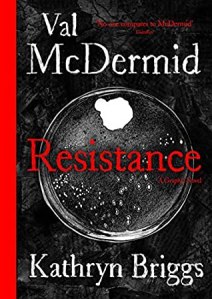 The second 2021 release I read in quick succession in which all but a small percentage of the human race (here, 2 million people) perishes in a pandemic – the other was Under the Blue. Like Aristide’s novel, this story had its origins in 2017 (in this case, on BBC Radio 4’s “Dangerous Visions”) but has, of course, taken on newfound significance in the time of Covid-19. McDermid imagines the sickness taking hold during a fictional version of Glastonbury: Solstice Festival in Northumberland. All the first patients, including a handful of rockstars, ate from Sam’s sausage sandwich van, so initially it looks like food poisoning. But vomiting and diarrhoea give way to a nasty rash, listlessness and, in many cases, death.
Zoe Beck, a Black freelance journalist who conducted interviews at Solstice, is friends with Sam and starts investigating the mutated swine disease, caused by an Erysipelas bacterium and thus nicknamed “the Sips.” She talks to the festival doctor and to a female Muslim researcher from the Life Sciences Centre in Newcastle, but her search for answers takes a backseat to survival when her husband and sons fall ill.
The drawing style and image quality – some panes are blurry, as if badly photocopied – let an otherwise reasonably gripping story down; the best spreads are collages or borrow a frame/backdrop (e.g. a medieval manuscript, NHS forms, or a 1910s title page).


SPOILER
{The ending, which has an immune remnant founding a new community, is VERY Parable of the Sower.}
With thanks to Profile Books/Wellcome Collection for the free copy for review.
Gifts of Gravity and Light: A Nature Almanac for the 21st Century, ed. Anita Roy and Pippa Marland
I hadn’t heard about this upcoming nature anthology when a surprise copy dropped through my letterbox. I’m delighted the publisher thought of me, as this ended up being just my sort of book: 12 autobiographical essays infused with musings on landscapes in Britain and elsewhere; structured by the seasons to create a gentle progression through the year, starting with the spring. Best of all, the contributors are mostly female, BIPOC (and Romany), working class and/or queer – all told, the sort of voices that are heard far too infrequently in UK nature writing. In momentous rites of passage, as in routine days, nature plays a big role.
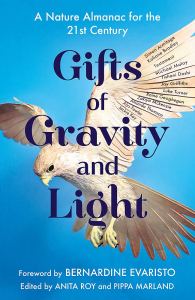 A few of my favourite pieces were by Kaliane Bradley, about her Cambodian heritage (the Wishing Dance associated with cherry blossom, her ancestors lost to genocide, the Buddhist belief that people can be reincarnated in other species); Testament, a rapper based in Leeds, about capturing moments through photography and poetry and about the seasons feeling awry both now and in March 2008, when snow was swirling outside the bus window as he received word of his uni friend’s untimely death; and Tishani Doshi, comparing childhood summers of freedom in Wales with growing up in India and 2020’s Covid restrictions.
Most of the authors hold two places in mind at the same time: for Michael Malay, it’s Indonesia, where he grew up, and the Severn estuary, where he now lives and ponders eels’ journeys; for Zakiya McKenzie, it’s Jamaica and England; for editor Anita Roy, it’s Delhi versus the Somerset field her friend let her wander during lockdown. Trees lend an awareness of time and animals a sense of movement and individuality. Alys Fowler thinks of how the wood she secretly coppices and lays on park paths to combat the mud will long outlive her, disintegrating until it forms the very soil under future generations’ feet.
A favourite passage (from Bradley): “When nature is the cuddly bunny and the friendly old hill, it becomes too easy to dismiss it as a faithful retainer who will never retire. But nature is the panic at the end of a talon, and it’s the tree with a heart of fire where lightning has struck. It is not our friend, and we do not want to make it our enemy.”
Also featured: Bernardine Evaristo (foreword), Raine Geoghegan, Jay Griffiths, Amanda Thomson, and Luke Turner.
With thanks to Hodder & Stoughton for the free copy for review.
Records of an Incitement to Silence by Gregory Woods
 Woods is an emeritus professor at Nottingham Trent University, where he was appointed the UK’s first professor of Gay & Lesbian Studies in 1998. Much of his sixth poetry collection is composed of unrhymed sonnets in two stanzas (eight lines, then six). The narrator is often a randy flâneur, wandering a city for homosexual encounters. One assumes this is Woods, except where the voice is identified otherwise, as in “[Walt] Whitman at Timber Creek” (“He gives me leave to roam / my idle way across / his prairies, peaks and canyons, my own America”) and “No Title Yet,” a long, ribald verse about a visitor to a stately home.
Other times the perspective is omniscient, painting a character study, like “Company” (“When he goes home to bed / he dare not go alone. … This need / of company defeats him.”), or of Frank O’Hara in “Up” (“‘What’s up?’ Frank answers with / his most unseemly grin, / ‘The sun, the Dow, my dick,’ / and saunters back to bed.”). Formalists are sure to enjoy Woods’ use of form, rhyme and meter. I enjoyed some of the book’s cheeky moments but had trouble connecting with its overall tone and content. That meant that it felt endless. I also found the end rhymes, when they did appear, over-the-top and silly (Demeter/teeter, etc.).
Two favourite poems: “An Immigrant” (“He turned away / to strip. His anecdotes / were innocent and his / erection smelled of soap.”) and “A Knot,” written for friends’ wedding in 2014 (“make this wedding supper all the sweeter / With choirs of LGBT cherubim”).
With thanks to Carcanet Press for the free copy for review.
 Bookish Beck = Rebecca Foster. American transplant to England. Freelance proofreader and book reviewer.
