Recommended May Releases
May and June are HUGE months for new releases. I’ve been doing enough early reading via NetGalley and Edelweiss that I’ve found plenty to recommend to you for next month. From a novel voiced by one of Hemingway’s wives to a physicist’s encouragement to waste more time, I hope there will be something here for everyone.
The Pisces by Melissa Broder
[Coming from Hogarth Press (USA) on the 1st and Bloomsbury (UK) on the 3rd]
 At first I thought this was one of those funny, quirky but somewhat insubstantial novels about a thirtysomething stuck with a life she isn’t sure she wants – something along the lines of Goodbye, Vitamin, The Portable Veblen, or All Grown Up. Then I thought it was just a crass sex comedy. But the further I read the deeper it all seemed to become: tropes from Greek myth and the fluidity of gender roles made me think of You Too Can Have a Body Like Mine, another debut novel that surprised me for its profundity. Lucy, a thirty-eight-year-old PhD student, agrees to spend a summer dog-sitting for her yoga entrepreneur sister in Venice Beach, California while she undertakes therapy for the twin problems of low self-esteem and love addiction. If you know one thing about this book, it’s that there’s sex with a merman. Ultimately, though, I’d say it’s about “the prison of the body” and choosing which of the different siren voices calling us to listen to. I found it outrageous but rewarding.
My rating:
How to Be a Perfect Christian by Adam Ford and Kyle Mann
[Coming from Multnomah (USA) on the 1st]
 The Babylon Bee is a Christian version of The Onion, so you know what you’re getting here: a very clever, pitch-perfect satire of evangelical Christianity today. If, like me, you grew up in a nondenominational church and bought into the subculture hook, line and sinker (Awana club, youth group, courtship, dc Talk albums, the whole shebang), you will find that so much of this rings true. The book is set up as a course for achieving superficial perfection through absolute “conformity to the status quo of the modern church.” Sample advice: find an enormous church that meets your needs, has a great coffee bar and puts on a laser-lit worship performance to rival “an amusement park for cats or a Def Leppard concert”; master the language of Christianese (“Keeping it in prayer” pretty much covers your bases); and bring as little as you can to the church potluck (a 25-pack of napkins) but consume as much as is anatomically possible. So, a lot of fun, just a little overlong because you get the joke early on.
My rating:
The Ensemble by Aja Gabel
[Coming from Riverhead (USA) on the 15th]
 In May 1994, the members of the Van Ness String Quartet are completing their final graduate recital at a San Francisco conservatory and preparing for the Esterhazy quartet competition in the Canadian Rockies. These four talented musicians – Jana, first violin; Brit, second violin; Henry, viola; and Daniel, cello – have no idea what the next 15 years will hold for them: a cross-country move, romances begun and lost, and career successes and failures. Drawing on her own history as a violinist and cellist, Aja Gabel infuses her debut novel with the simultaneous uncertainty and euphoria of both the artistic life and early adulthood in general. An alternating close third-person perspective gives glimpses into the main characters’ inner lives, and there are evocative descriptions of classical music. I think The Ensemble will mean even more to those readers who are involved in music, but anyone can relate to the slow fade from youth into middle age and the struggle to integrate art with the rest of life.
My rating:
Tropic of Squalor by Mary Karr
[Coming from Harper (USA) on the 8th]
 Mary Karr is mostly known as a memoirist, but this is actually her fifth poetry collection. Death is a major theme, with David Foster Wallace’s suicide and 9/11 getting multiple mentions. Karr also writes self-deprecatingly about her Texas childhood. Best of all is the multi-part “The Less Holy Bible”: a sort of Devil’s Dictionary based loosely around the books of the Bible, it bounces between Texas and New York City and twists biblical concepts into commonsense advice. Not one for those who are quick to cry heresy, perhaps, but I enjoyed it very much, especially “VI. Wisdom: The Voice of God”: “Ninety percent of what’s wrong with you could be cured with a hot bath, / says God through the manhole covers, but you want magic, to win / the lottery you never bought a ticket for. … Don’t look for initials in the geese honking / overhead or to see through the glass even darkly. It says the most obvious shit, / i.e. Put down that gun, you need a sandwich.”
My rating:
In Praise of Wasting Time by Alan Lightman
[Coming from Simon & Schuster / TED (USA and UK) on the 15th]
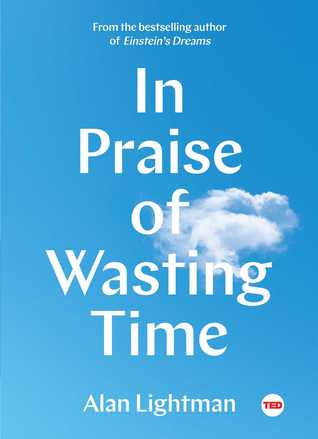 Lightman, a physicist and MIT professor, argues that only in unstructured time can we rediscover our true identity and recover our carefree childhood creativity. This work-as-play model goes against the modern idea that time is money and every minute must be devoted to a project. “For any unexpected opening of time that appears during the day, I rush to patch it, as if a tear in my trousers. … I feel compelled to find a project, to fill up the hole.” Yet there is another way of approaching time, as he discovered when doing research in a village in Cambodia. He realized that the women he talked to didn’t own watches and thus had no real sense of how long any task took them. This sharp, concise treatise ruminates on the cultural forces that have enslaved us in the West to productivity. (In short, he blames the Internet, but specifically smartphones.) Lightman insists on the spiritual benefits of free time and solitude. “With a little determination, each of us can find a half hour a day to waste time,” he asserts.
My rating:
Love and Ruin by Paula McLain
[Coming from Ballantine Books (USA) and Fleet (UK) on the 1st]
 This is the weakest of the three McLain novels I’ve read, but when we’re talking about a writer of this caliber that isn’t much of a criticism. It’s strange to me that, having written a novel from the perspective of Hadley Richardson, Ernest Hemingway’s first wife, McLain would choose to tell the story of another Hemingway wife – this time Martha Gellhorn, a war reporter and author in her own right. If I set aside this misgiving, though, and just assess the quality of the writing, there are definitely things to praise, such as the vivid scenes set during the Spanish Civil War, the dialogues between Martha and Hem, the way he perhaps fills in for her dead father, her fondness for his sons, and her jealousy over his growing success while her books sink like stones. I especially liked their first meeting in a bar in Key West, and the languid pace of their life in Cuba. I read such books because I’m intrigued about the appeal of a great man, but here I got a little bogged down with the many settings and events.
My rating:
What May books do you have on the docket? Have you already read any that you can recommend?
Wellcome Book Prize: Shortlist Recap
Tomorrow morning we will announce our Wellcome Book Prize 2018 shadow panel winner. Beforehand I wanted to do a quick recap of my reviews, especially for the two books that I read before the shortlist announcement. My full reviews are here:
Stay with Me by Ayobami Adebayo 
To Be a Machine by Mark O’Connell
Mayhem by Sigrid Rausing
The Vaccine Race by Meredith Wadman
I give some extra thoughts on and favorite quotes from the other two below:
The Butchering Art by Lindsey Fitzharris
 This is a great blend of medical history and popular science that should draw in readers who wouldn’t normally gravitate to either topic – provided they aren’t too squeamish. Fitzharris has recently returned to Oxford as a visiting academic, and this has also been nominated for the Wolfson History Prize. Follow her on Instagram (@drlindseyfitzharris) for a steady stream of gruesomely fascinating photos (I wish The Butchering Art had been illustrated!). Her next book will be much of a muchness, it seems, documenting the early years of plastic surgery after World War I through the story of pioneering surgeon Harold Gillies.
In the days before Joseph Lister…
“Operating theaters were gateways to death. It was safer to have an operation at home than in a hospital, where mortality rates were three to five times higher than they were in domestic settings.”
“The surgeon was very much viewed as a manual labourer who used his hands to make his living, much like a key cutter or plumber today.”
See what the rest of the shadow panel has to say about this book:
Annabel’s review: “[A]n extremely readable account of a ground-breaking career which led to real advances in hospital medicine. I enjoyed the whole, but particularly the grisly bits!”
Laura’s review: “It’s easy for me to feel a bit impatient with popular histories of periods or subjects that I know well, but Fitzharris strikes exactly the right note, writing clearly and accessibly with no dumbing down.”
Paul’s review: “It is one of the better books that I have read on medical history[;] Fitzharris writes in an engaging way on a subject that is not going to appeal to everyone, but in amongst all the blood is the fascinating story of Joseph Lister.”
With the End in Mind by Kathryn Mannix
 “It’s time to talk about dying. This is my way of promoting the conversation,” Mannix writes in her introduction to this accessible and reassuring book about death. She believes we are afraid of death because of our misconception that it is inevitably painful and undignified. In her decades of working in hospice care, this has rarely been the case. (Thank goodness that, compared to the earlier nineteenth-century situation Fitzharris surveys, we have reliable pain control options.) Mannix sees the role of the hospice worker as being like a midwife for the dying, a helpful idea I first encountered in Henry Fersko-Weiss’s Caring for the Dying: The Doula Approach to a Meaningful Death.
Many of the stories in this book are of peaceful deaths the patient and family had time to prepare for. Others are sad stories of denial. One, though, is quite gruesome, yet magnificently described. Alex, a young man with testicular teratoma, has a massive GI bleed:
“Alex’s head is thrown back, almost as though it is a voluntary movement. A huge, dark-red python slithers rapidly out of his mouth, pushing his head backwards as it coils itself onto the pillow beside him; the python is wet and gleaming and begins to stain the pillowcase and sheets with its red essence as Alex takes one snoring breath, and then stops breathing. His mother screams as he realises that the python is Alex’s blood. Probably all of his blood.”
See what the rest of the shadow panel has to say about this book:
Annabel’s review: “[I]t is helping patients, and their families and loved ones, to understand the process of dying, and dispelling the taboos around it that make this book such a valuable and compelling read. I wish I’d read something like this book before my mum died.”
Clare’s review: “For me, this enlightening book is a strong potential winner for the Wellcome Book Prize and I hope it brings comfort and guidance for those who need it.”
Laura’s review: “[The book is] written from her own experiences as a specialist in palliative care, and this proved, for me, both its strength and its downfall. … Mannix writes particularly well on the characteristic patterns of somebody who is entering a gradual decline.”
Paul’s review: “Can highly recommend this moving book and I think it should be essential reading for anyone who has any concerns about death.”
I wouldn’t be at all surprised to see either of these win the Wellcome Book Prize on Monday. Stay tuned for tomorrow’s shadow panel winner announcement, and Sunday’s write-up of a shortlist event I’m attending in London.
Final Wellcome Book Prize Shortlist Review: The Vaccine Race by Meredith Wadman
I had hoped this would be a comparable read to Rebecca Skloot’s The Immortal Life of Henrietta Lacks and Siddhartha Mukherjee’s The Emperor of All Maladies, which are two of my absolute favorite books and were also among the first to turn me on to medical-themed literature. Instead, I found myself skimming through the book’s dense scientific and historical information: like Mukherjee’s other book, The Gene, which made last year’s Wellcome shortlist, The Vaccine Race is overstuffed with a mixture of the familiar (for me, at least – genetics), the seemingly irrelevant (cell culture techniques and scientific nomenclature), and the truly interesting (questions of medical ethics).
The unlikely protagonist of this story is Leonard Hayflick, a single-minded and resourceful researcher who is still alive in his late eighties and assented to dozens of interviews and many more e-mails as Wadman put this book together. While in high school Hayflick made a chemistry lab in his basement, and in college he built his father a dental lab: that tells you how driven he was. After graduating from the University of Pennsylvania, he worked at the Wistar Institute on its campus. He chiefly investigated whether viruses cause cancer and whether a cell line will be immortal or subject to the normal rules of aging – the Hayflick limit, named after him, is the number of cell divisions possible before a cell line dies out.
 Hayflick experimented on his third child’s placenta, but also on aborted fetuses from the university hospital. Replacement fetal cell lines sourced from the Karolinska Institute in Stockholm, Sweden were used to produce the polio, rubella and rabies vaccines. In particular, he relied on the WI-38 line he developed from fetal cells taken from the Swedish “Mrs. X,” who – like Henrietta Lacks’s family – was never compensated; she did not want to be interviewed for or mentioned by name in this book. In the 1970s, with Roe v. Wade in the pipeline, the controversy over using aborted fetal tissue in research heated up*, and Hayflick was somewhat disgraced in the course of a 1976 lawsuit about his right to profit from WI-38.
But that’s not the only dubious ethical situation associated with the development of the twentieth century’s major vaccines: Hayflick’s bosses and associates had also tested early vaccines on intellectually disabled child “volunteers,” while a celebrated cancer researcher had injected cells into dying hospital patients and healthy prisoners in the name of science. Wadman writes, “by the mid-1960s, ordinary people were becoming less willing to give scientists carte blanche to tinker with human beings on a ‘Trust me, I know what’s best for you’ basis.” The question is whether these morally suspect strategies were worth it, given the alternative: rubella in pregnancy causes severe birth defects including blindness, while polio can be crippling and untreated rabies can lead to a slow and painful death.
These ethical questions are certainly worth thinking about, though the abortion history in particular is probably of much more interest to American readers. Here in Europe, abortion is a non-issue, so I don’t expect anyone to get fired up about the history of fetal tissue research. Wadman is certainly a thorough researcher and capable storyteller who doesn’t talk down when explaining science. That said, she might have scaled back on the science a bit to ensure that her work holds broader appeal for lay readers of popular science and medical history.
*More recently, Debi Vinnedge’s Children of God for Life nonprofit has opposed stem cell research despite a Vatican ruling that vaccines developed from fetal tissue are acceptable to use as long as there is no alternative.
My rating:
See what the rest of the shadow panel has to say about this book:
Annabel’s blog tour review: “The thrillerish feel to big pharma’s politics, and Hayflick’s continual battles for recognition and against anyone who wanted to take his cells away from him made for fascinating reading and added the much-needed human aspect.”
Clare’s review: “The Vaccine Race is a very dense read and some of the lengthier descriptions of things like the finer points of the biotechnology industry went a bit over my head in places. … However, the ethical debates are fascinating and clearly presented.”
Laura’s review: “Wadman writes clearly and compellingly, and given how much material she’s handling, managing to structure the book sensibly is a feat in itself. But I felt that The Vaccine Race was often not one thing or the other.”
Paul’s review: “It is a very important story that Wadman is telling … especially given that we may well be on the dawn of a new era in medicine with the rise of immunity against antibiotics.”
(Also, be sure to stop by Paul’s site today for an exclusive extract from The Vaccine Race as part of the ongoing blog tour.)
My gut feeling: This is the most science-y of the six books on the shortlist. For me that actually works against the broadness and public-facing nature of the prize, as expressed in its brief: “At some point, medicine touches all our lives. Books that find stories in those brushes with medicine are ones that add new meaning to what it means to be human. The subjects these books grapple with might include birth and beginnings, illness and loss, pain, memory, and identity. In keeping with its vision and goals, the Wellcome Book Prize aims to excite public interest and encourage debate around these topics.”
Shortlist strategy:
- Tomorrow I’ll quickly recap my thoughts about the two shortlisted books I read before the shortlist announcement, With the End in Mind and The Butchering Art.
- On Saturday morning I’ll announce our shadow panel winner. That day Clare and I are attending an event featuring five of the shortlisted authors in conversation at the Wellcome Collection in London. I’ll report back about it on Sunday.
- Monday is the awards ceremony, which I’ll be attending for the second year in a row. Expect my write-up of the experience on Tuesday. (In between you get a break from Wellcome Prize stuff with Library Checkout plus some recommendations for May!)
Wellcome Book Prize Blog Tour: Sigrid Rausing’s Mayhem
“Now that it’s all over I find myself thinking about family history and family memories; the stories that hold a family together and the acts that can split it apart.”
Sigrid Rausing’s brother, Hans, and his wife, Eva, were wealthy philanthropists – and drug addicts who kept it together long enough to marry and have children before relapsing. Hans survived that decade-long dive back into addiction, but Eva did not: in July 2012 the 48-year-old’s decomposed body was found in a sealed-off area of the couple’s £70 million Chelsea mansion. The postmortem revealed that she had been using cocaine, which threw her already damaged heart into a chaotic rhythm. She’d been dead in their drug den for over two months.
Those are the bare facts. Scandalous enough for you? But Mayhem is no true crime tell-all. It does incorporate the straightforward information that is in the public record – headlines, statements and appearances – but blends them into a fragmentary, dreamlike family memoir that proceeds through free association and obsessively deliberates about the nature and nurture aspects of addictive personalities. “We didn’t understand that every addiction case is the same dismal story,” she writes, in a reversal of Tolstoy’s maxim about unhappy families.

Rausing’s memories of idyllic childhood summers in Sweden reminded me of Tove Jansson stories, and the incessant self-questioning of a family member wracked by remorse is similar to what I’ve encountered in memoirs and novels about suicide in the family, such as Jill Bialosky’s History of a Suicide and Miriam Toews’ All My Puny Sorrows. Despite all the pleading letters and e-mails she sent Hans and Eva, and all the interventions and rehab spells she helped arrange, Rausing has a nagging “sense that when I tried I didn’t try hard enough.”
The book moves sinuously between past and present, before and after, fact and supposition. There are a lot of peculiar details and connections in this story, starting with the family history of dementia and alcoholism. Rausing’s grandfather founded the Tetra Pak packaging company, later run by her father. Eva had a pet conspiracy theory that her father-in-law murdered Swedish Prime Minister Olof Palme in 1986.
Rausing did anthropology fieldwork in Estonia and is now the publisher of Granta Books and Granta magazine. True to her career in editing, she’s treated this book project like a wild saga that had to be tamed, “all the sad and sordid details redacted,” but “I fear I have redacted too much,” she admits towards the end. She’s constantly pushing back against the more sensational aspects of this story, seeking instead to ground it in family experience. The book’s sketchy nature is in a sense necessary because information about her four nieces and nephews, of whom she took custody in 2007, cannot legally be revealed. But if she’d waited until they were all of age, might this have been a rather different memoir?
Mayhem effectively conveys the regret and guilt that plague families of addicts. It invites you to feel what it is really like to live through the “years of failed hope” that characterize this type of family tragedy. It doesn’t offer any easy lessons seen in hindsight. That makes it an uncomfortable read, but an honest one.
With thanks to Midas PR for the free copy for review.
My gut feeling: This book’s style could put off more readers than it attracts. I can think of two other memoirs from the longlist that I would have preferred to see in this spot. I suppose I see why the judges rate Mayhem so highly – Edmund de Waal, the chair of this year’s judging panel, describes the Wellcome shortlist as “books that start debates or deepen them, that move us profoundly, surprise and delight and perplex us” – but it’s not in my top tier.
See what the rest of the shadow panel has to say about this book:
Annabel’s review: “Rausing is clearly a perceptive writer. She is very hard on herself; she is brutally honest, knowing that others will be hurt by the book.”
Clare’s review: “Rausing writes thoughtfully about the nature of addiction and its many contradictions.”
Laura’s review: “One of the saddest bits of Mayhem is when Rausing simply lists some of the press headlines that deal with her family story in reverse order, illustrating the seemingly inescapable spiral of addiction.”
Paul’s review: “It is not an easy read subject wise, thankfully Rausing’s sparse but beautiful writing helps makes this an essential read.”
Also, be sure to visit Laura’s blog today for an exclusive extract from Mayhem.
Shortlist strategy: Tomorrow I’ll post a quick response to Meredith Wadman’s The Vaccine Race.
If you are within striking distance of London, please consider coming to one of the shortlist events being held this Saturday and Sunday.
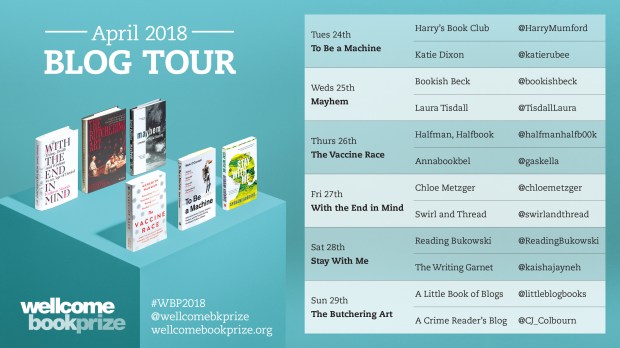
I was delighted to be asked to participate in the Wellcome Book Prize blog tour. See below for details of where other reviews and extracts have appeared or will be appearing soon.
Two Memoirs: Border Control and Breast Cancer
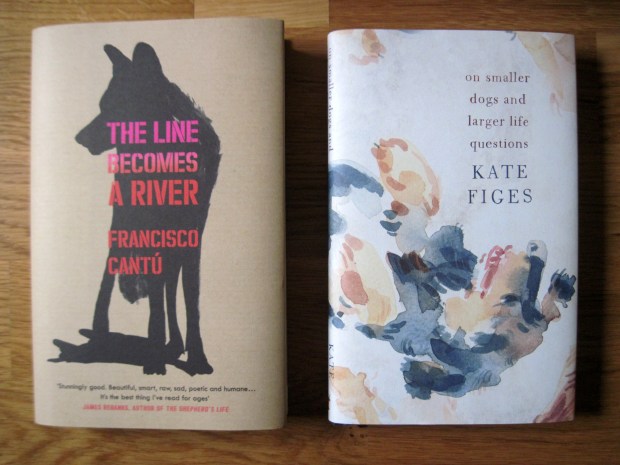
The Line Becomes a River
Francisco Cantú was a U.S. Border Patrol agent in Arizona and Texas for four years. Agents tracked illegals using the same skills with which hunters stalk their prey. Once captured, the would-be immigrants were detained, processed and deported. Days in the field were full of smuggled drugs, cached belongings and corpses of those who’d tried to cross in inhospitable conditions. Even when Cantú was transferred to a desk job, he couldn’t escape news of Mexican drug cartels and ritual mutilation of traitors’ corpses. Dreams of wolves and of his teeth breaking and falling out revealed that this was a more stressful career than he ever realized. Cantú worried that he was becoming inured to the violence he encountered daily – was he using his position “as a tool for destruction or as one of safekeeping”?
 Impressionistic rather than journalistic, the book is a loosely thematic scrapbook that uses no speech marks, so macho banter with colleagues blends into introspection, memories and stories. Cantú inserts snippets of U.S.–Mexico history, including the establishment of the border, and quotes from and discusses other primary and secondary texts. He also adds in fragments of his family’s history: His ancestors left Mexico during the Mexican Revolution of the 1910s, but there’s no doubt his Latino name and features made him a friendly face for illegal immigrants. He was often called upon to translate for those in custody. I felt that even if the overall policy was problematic, it was good to have someone compassionate in his job.
The final third of the book represents a change of gears: Cantú left law enforcement to be a Fulbright scholar and then embarked on an MFA in creative writing at the University of Arizona. During those years of study he worked as a barista at a food court and every day he chatted and shared food with another worker, José Martínez from Oaxaca. When José went back to Mexico to visit his dying mother and settle her estate, he was refused reentry to the United States for not having the proper papers. Cantú drew on his contacts in Border Patrol to find out when José’s hearing would be, helped his wife to gather character witness letters, and took José’s sons to visit him in the detention center during his continuance and civil trial. There’s a particularly wrenching recreated monologue from José himself.

I love these endpapers.
It is as if, for the first time, Cantú could see the human scale of U.S. immigration policy, what his mother, a former national park ranger, had described as “an institution with little regard for people.” No longer could he be blasé about the way things are. It was also, he recognized, an attempt to atone for the heartless deportations he had conducted as a Border agent. “All these years,” he said to his mother, “it’s like I’ve been circling beneath a giant, my gaze fixed upon its foot resting at the ground. But now, I said, it’s like I’m starting to crane my head upward, like I’m finally seeing the thing that crushes.” As he quotes from Holocaust historian Timothy Snyder, “It is for us as humanists to turn the numbers back into people.” That’s just what this remarkable memoir does. In giving faces to an abstract struggle, it passionately argues that people should not be divided by walls but united in common humanity.
My rating:
The Line Becomes a River was published in the UK by Bodley Head on March 1st. My thanks to the publisher for the free copy for review.
On Smaller Dogs and Larger Life Questions
It was hard to resist such a great title, especially with my penchant for cancer memoirs. In nine chapters that are almost like linked essays, Kate Figes reflects on the changes that a diagnosis of triple-negative, metastasized breast cancer has wrought in her life. However, like Vesna Goldsworthy’s Chernobyl Strawberries, the book sets the cancer experience within a wider life story of trauma and displacement. In the first essay, as Figes, a freelance nonfiction writer, approached age 60, she delighted in Zeus, their miniature wire-haired dachshund puppy, but also resented the sense of obligation. Cancer quickly changed her perspective.
 I appreciated the lack of bitterness; the book’s focus is generally on resilience and on the liberation of knowing that little is now expected of her: “when there is no need to rush just to be able to get through everything I had to achieve each day, there is a glorious sense of freedom, of empty space.” Two chapters go in-depth into Figes’s “arsenal” of cancer-fighting tools, everything from hyperbaric oxygen treatments to yoga. She gave up sugar and swears by cannabis oil, filtered water, supplements and fresh juices. Her embrace of complementary medicine and discussion of her limitations – it takes her an hour and a half to get dressed and have breakfast – will probably mean the most to others with a chronic illness.
As to the other essays, “Tennis” is an ode to a favorite hobby she had to give up; “Mediation” is about training as a family mediator. The psychological understanding she gained through this and through researching her books helped her work through childhood hurt over her parents’ divorce. “The Beach Hut” remembers recent ‘escapes’ to the seaside and contrasts them with her Jewish mother’s* escape from 1930s Germany. “Home,” my favorite essay, is about clearing out her mother’s flat and the memories and comfort a home retains, even decades later. “That’s the power I will leave behind too, the essence of having been really known. It will pervade every piece of crockery I have eaten off, … every chair I have sat on.”
Unfortunately, Figes frequently uses clichéd language – “Cancer can feel isolating” and “battle is the right word” – and seems to give credence to the damaging idea that unresolved emotional trauma caused her cancer. What with the typos and the slight repetition across the essays, this feels like a book that was put together in a hurry. A bit more time and editing could have made it more cohesive and fresh. But perhaps Figes does not have that time. Fellow cancer patients may well appreciate her dispatches from what she calls “Planet Cancer,” but it’s not a book that will particularly stand out for me in this crowded genre.
*Her mother was Eva Figes, an author in her own right.
My rating:
On Smaller Dogs and Larger Life Questions was published by Virago on February 28th. My thanks to the publisher for the free copy for review.
Wellcome Book Prize Shortlist: To Be a Machine by Mark O’Connell
The topic of this shortlisted book didn’t particularly appeal to me, so I was pleasantly surprised to enjoy it. Transhumanism is about using technology to help us overcome human limitations and radically extend our lifespan. Many of the strategies O’Connell, a Dublin-based freelance writer with a literature background, profiles are on the verge of science fiction. Are we looking at liberation from the rules of biology, or enslavement to technology? His travels take him to the heart of this very American, and very male, movement.
Cryogenic freezing: The first person was cryogenically frozen in 1966. Max More’s Alcor Life Extension Foundation in Scottsdale, Arizona offers whole-body or head-only (“neuro”) options for $200,000 or $80,000. More argues that the residents of Alcor are somewhere between living and dead. These entities are held in suspension in the belief that technology will one day allow us to upload the contents of the mind into a new vessel.
- This approach seems to conceive of the human mind/consciousness as pure information to be computed.
 Cyborgs: Grindhouse Wetware, near Pittsburgh, aims to turn people into literal cyborgs. Tim Cannon had a Circadia device the size of a deck of cards implanted in his arm for three months to take biometric measurements. Other colleagues have implanted RFID chips. He intends to have his arms amputated and replaced by superior prostheses as soon as the technology is available.
- That may seem extreme, but think how bound people already are to machines: O’Connell calls his smartphone a “mnemonic prosthesis” during his research travels.
Mortality as the enemy: Many transhumanists O’Connell meets speak of aging and death as an affront to human dignity. We mustn’t be complacent, they argue, but must oppose these processes with all we’re worth. One of the key people involved in that fight is Aubrey de Grey of SENS (“Strategies for Engineered Negligible Senescence”), and Google has also gotten in on it with their “Calico” project.
- O’Connell recounts explaining aging and death to his three-year-old son; his wife chipped in that – according to “Dada’s book” – perhaps by the time the boy is grown up death will no longer be a problem.
The Singularity: Posited by Ray Kurzweil, the Singularity is the future point at which artificial intelligence will surpass humanity. O’Connell likens it to the Christian idea of the Rapture, itself a moment of transcendence. At a conference on transhumanism and religion in Piedmont, California, he encounters Terasem, a religion founded recently by a transhumanist and transgender person.
- To my surprise, To Be a Machine makes frequent reference to religious ideas: O’Connell thinks of transhumanism as an attempt to reverse the Fall and become godlike, and he often describes the people he meets as zealots or saints, driven by the extremity of their beliefs. Both religion and transhumanism could be seen as a way of combating nihilism and insisting on the meaning of human life.
O’Connell’s outsider position helped me to engage with the science; he’s at least as interested, if not more so, in the deeper philosophical questions that transhumanism raises. I would caution that a grounding in religion and philosophy could be useful, as the points of reference used here range from the Gnostic gospels and St. Augustine to materialism and Nietzsche. But anyone who’s preoccupied with human nature should find the book intriguing.
You could also enjoy this purely as a zany travelogue along the lines of Elif Batuman’s The Possessed and Donovan Hohn’s Moby-Duck. The slapstick antics of the robots at the DARPA Robotics Challenge and the road trip in Zoltan Istvan’s presidential campaign Immortality Bus are particularly amusing. O’Connell’s Dickensian/Wildean delight in language is evident, and I also appreciated his passing references to William Butler Yeats.
It could be argued, however, that O’Connell was not the ideal author of this book. He is not naturally sympathetic to transhumanism; he’s pessimistic and skeptical, often wondering whether the proponents he meets are literally insane (e.g., to think that they are in imminent danger of being killed by robots). Most of the relevant research, even when conducted by Europeans, is going on in the USA, particularly in the Bay Area. So why would an Irish literary critic choose transhumanism as the subject for his debut? It’s a question I asked myself more than once, though it never stopped me from enjoying the book.
The title (from an Andy Warhol quote) may reference machines, but really this is about what it means to be human. O’Connell even ends with a few pages on his own cancer scare, a reminder that our bodies are flawed machines. I encourage you to give this a try even if you think you have no particular interest in technology or science fiction. It could also give a book club a lot to discuss.
Favorite lines:
“We exist, we humans, in the wreckage of an imagined splendor. It was not supposed to be this way: we weren’t supposed to be weak, to be ashamed, to suffer, to die. We have always had higher notions of ourselves. … The frailty is the thing, the vulnerability. This infirmity, this doubtful convalescence we refer to, for want of a better term, as the human condition.”
My rating:
See what the rest of the shadow panel has to say about this book:
Annabel’s review: “I loved this book from the front cover to the back, starting with its title. … He writes with empathy and a good deal of humour which makes the text always readable and entertaining, while provoking his readers to think deeply about their own beliefs.”
Clare’s review: “O’Connell’s prose style is wordy and ironic. He is pleasingly sceptical about many aspects of transhumanism. … It is an entertaining book which provides a lot of food for thought for a layperson like myself.”
Laura’s review: “Often, I found that his description of his own internal questions would mirror mine. This is a really fantastic book, and for me, a clear front runner for the Wellcome Book Prize.”
Paul’s review: “An interesting book that hopefully will provoke further discussion as we embrace technology and it envelops us.”
My gut feeling: Though they highlight opposite approaches to death – transcending it versus accepting it – this and Kathryn Mannix’s With the End in Mind seem to me the two shortlisted books of the most pressing importance. I’d be happy to see either of them win. To Be a Machine is an awful lot of fun to read, and it seems like a current favorite for our panel.
Shortlist strategy:
- I’m coming close to the end of my skim of The Vaccine Race by Meredith Wadman.
- I’m still awaiting a review copy of Mayhem by Sigrid Rausing, which I’ll be featuring as part of the official Wellcome Book Prize shortlist blog tour.
Just Okay for Me, Dawg
This was one of the catchphrases of long-time judge Randy Jackson on the reality TV show American Idol, which was my guilty pleasure viewing for a decade or more. The three recent books for which I provide short-ish reviews below have nothing much in common apart from the fact that I requested or accepted them from publishers and ended up feeling disappointed but like I still owed a review. You can consider them all  .
.
The Friendship Cure by Kate Leaver
(Duckworth, March 22nd)
 We’re in the middle of a loneliness epidemic, so friends are more important than ever. That’s the impetus for Kate Leaver’s jaunty, somewhat insubstantial book about modern friendship. She observes teen girls on the Tube and reflects on how we as primates still engage in social grooming – though language has replaced much of this more primitive bond-forming behavior. We experience a spike in our number of friends through adolescence and early adulthood, but friendships can fall by the wayside during our thirties as we enter long-term relationships and turn our attention to children and other responsibilities. Leaver argues that female friendships can amplify women’s voices and encourage us to embrace imperfection. She also surveys the bromance, mostly in its TV and film manifestations. There are plenty of pop culture references in the book; while I enjoy a Scrubs or Parks and Recreation scene or quotation as much as the next fan, the reliance on pop culture made the book feel lightweight.
Perhaps the most useful chapter was the one on online friendships (hi, book blogger friends!). We so often hear that these can’t replace IRL friendships, but Leaver sticks up for social media: it allows us to meet like-minded people, and is good for introverted and private people. Anything is better than isolation. The biggest problem I had with the book was the tone: Leaver is going for a Caitlin Moran vibe, and peppers in hip references to Taylor Swift, Lindsay Lohan and the like. But then she sometimes tries for more of a Mary Beard approach, yet doesn’t trust herself to competently talk about science, so renders it in matey, anti-intellectual language like “Robin [Dunbar, of Oxford University] did some fancy maths” (um, I think you mean “Dr. Dunbar”!) or “Let me hit you with a bit of research.”
Favorite lines:
“on some days, somewhere in our souls, we still count the number of social media connections as a measure of who we are”
“When you successfully recruit a new person into your friendship circle, you’re essentially confirming that you are a likable human being, worthy of someone’s time and emotional investment.”
You might choose to read instead: Kory Floyd’s The Loneliness Cure; Ann Patchett’s Truth and Beauty; Anna Quindlen’s essay “Girlfriends” from Lots of Candles, Plenty of Cake.
Writer’s Luck: A Memoir: 1976–1991 by David Lodge
(Harvill Secker, January 11th)
David Lodge has been one of my favorite authors for over a decade. His first memoir, Quite a Good Time to Be Born: A Memoir, 1935–1975 (see my Nudge review), is a good standalone read, even for non-fans, for its insight into the social changes of post-war Britain. However, this volume makes the mistake of covering much less ground, in much more detail – thanks to better record-keeping at the peak of his career – and the result is really rather tedious. The book opens with the publication of How Far Can You Go? and carries through to the reception of Paradise News, with a warning that he cannot promise a third volume; he is now 83. Conferences, lecture tours, and travels are described in exhaustive detail. There’s also a slightly bitter edge to Lodge’s attempts to figure out why ventures flopped or novels got negative reviews (Small World, though Booker-shortlisted, was better received in America), though he concludes that his career was characterized by more good luck than bad.
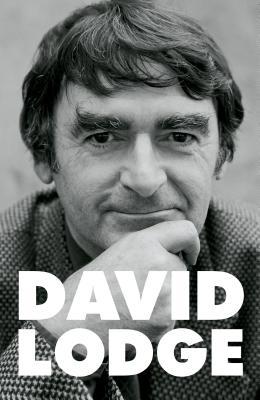 I liked the account of meeting Muriel Spark in Italy, and valued the behind-the-scenes look at the contentious task of judging the 1989 Booker Prize, which went to Kazuo Ishiguro for The Remains of the Days. Especially enjoyable is a passage about getting hooked on saunas via trips to Finland and to Center Parcs, a chain of all-inclusive holiday activity camps in England. Oh how I laughed at his description of nude sauna-going in midlife (whether I was supposed to or not, I’m not sure): “The difference in pleasure between swimming wearing a costume of any kind and the sensation of swimming without one, the water coursing unimpeded round your loins as you move through it, cannot be exaggerated, and I first discovered it in Center Parcs.” I also cringed at the Lodges placing “our Down’s son” Christopher in a residential care home – I do hope thinking about disability has moved on since the mid-1980s.
Ultimately, I’m not sure Lodge has had an interesting enough life to warrant a several-volume project. He’s an almost reassuringly dull chap; “The fact is that I am constitutionally monogamous,” he admits at one point. Although it was fun for me to see the genesis of novels like Paradise News, I don’t think I’d have the stomach for reading any more about why Lodge thinks his star faded starting in the 1990s. However, I’ll keep this on the shelf to go back to for some context when I finally get around to rereading Small World and Nice Work.
Favorite lines:
“there has been a downside to the Prize Culture which the Booker engendered. It has warped the evaluation of new fiction by measuring success as if it were a competitive sport.”
You might choose to read instead: Lodge’s Quite a Good Time to Be Born or John Carey’s The Unexpected Professor: An Oxford Life in Books – overall the better autobiography of a working-class, bookish lad.
The Parentations by Kate Mayfield
(Point Blank [Oneworld], March 29th)
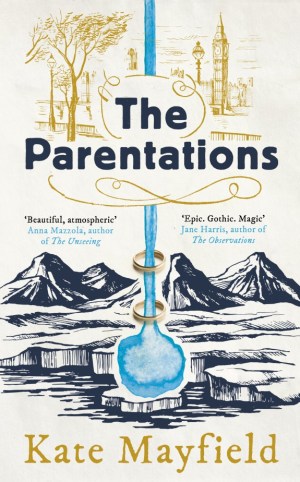 Sisters Constance and Verity Fitzgerald have been alive for over 200 years. A green pool in Iceland, first discovered in 1783, gives them “extended mortality” so long as they take the occasional two-week nap and only swallow two drops of the liquid at a time. In London in 2015, they eat a hearty stew by candlelight and wait for their boy to come. Then they try the churchyard: dead or alive, they are desperate to have him back. Meanwhile, Clovis Fowler is concealing extra phials of the elixir from her husband, their son and the maid. What’s going on here? We go back to Iceland in 1783 to see how the magic pool was first found, and then hop across to 1783 London to meet the sisters as children.
I read the first 67 pages, continued skimming to page 260, and then gave up. At well past the one-third point, the novel still hasn’t established basic connections. A book of nearly 500 pages has to hook the reader in sooner and more securely, not lull them with wordiness (case in point: on the first page of the first chapter, the adjective “macilent” – I looked it up and it means thin or lean, either of which would have been a far preferable word to use).
I could see faint echoes here of so many great books – Jonathan Strange and Mr. Norrell, A Discovery of Witches, Slade House, The Essex Serpent; works by Hannah Kent and Diane Setterfield, maybe even Matt Haig? I liked Mayfield’s memoir The Undertaker’s Daughter and had hoped for improvement with this debut novel. As it is, The Parentations has an interesting premise and lineage, but doesn’t deliver.
Favorite lines:
“His rage foments a decision. He will either take his place in the mounds of the dead, or he will find a good reason to stay alive.”
“Francis and Averil Lawless have impressed upon their daughters the concept of the consequences of a single moment, and there is no better teacher than the river’s majesty and its demand for respect for its waters, which can easily bring violence and ruin as well as wealth and peace.”
You might choose to read instead: Any of the literary fantasy novels listed above.
What books have disappointed or defeated you lately?
Dubiously Thematic Easter Reading
In 2015 and 2017 I came up with some appropriately theological reading recommendations for Easter. This year I’m going for a more tongue-in-cheek approach, as befits the unfortunate conjunction of Easter with April Fools’ Day.
Currently reading or reviewing:
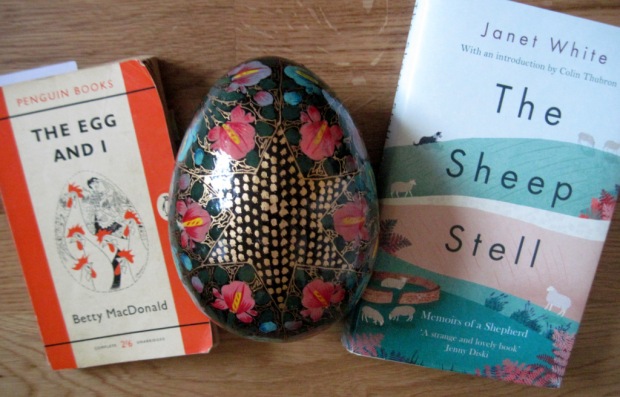
The Egg and I by Betty MacDonald
I bought this on a whim from a local charity shop, based on the title, cover and blurb. I’m about one-third of the way through so far. MacDonald and her husband started a chicken farm in a mountainous area of the Pacific Northwest in the 1940s. Her account of her failure to become the perfect farm wife is rather hilarious. My only hesitation is about her terrible snobbishness towards rednecks and “Indians.”


A representative passage: “Gathering eggs would be like one continual Easter morning if the hens would just be obliging and get off the nests. Co-operation, however, is not a chickenly characteristic and so at egg-gathering time every nest was overflowing with hen, feet planted, and a shoot-if-you-must-this-old-grey-head look in her eye.”
The Sheep Stell by Janet White
 I’m reviewing this reissued memoir for the TLS. It’s a delightful story of finding contentment in the countryside, whether on her own or with family. White, now in her eighties, has been a shepherd for six decades in the British Isles and in New Zealand. While there’s some darker material here about being stalked by a spurned suitor, the tone is mostly lighthearted. I’d recommend it to anyone who’s enjoyed books by Gerald Durrell, James Herriot and Doreen Tovey.
Representative passages: “Shepherding is a strange mixture of tremendous physical work alternating with periods of calm, quiet indolence.” & “A dare, a dream and a challenge. I could have hunted the whole world over and never in a lifetime found anywhere so right: warm, high, pastoral and severed by the sea.”
Read recently:
The Trouble with Goats and Sheep by Joanna Cannon
 Mrs. Creasy disappears one Monday in June 1976, and ten-year-old Grace Bennett and her friend Tilly are determined to figure out what happened. I have a weakness for precocious child detectives (from Harriet the Spy to Flavia de Luce), so I enjoyed Grace’s first-person sections, but it always feels like cheating to me when an author realizes they can’t reveal everything from a child’s perspective so add in third-person narration and flashbacks. These fill in the various neighbors’ sad stories and tell of a rather shocking act of vigilante justice they together undertook nine years ago.
Sheep are a metaphor here for herd behavior and a sense of belonging, but also for good versus evil. Grace and Tilly become obsessed with a Bible passage the vicar reads about Jesus separating the sheep from the goats. But how can he, or they, know who’s truly righteous? As Grace says, “I think that’s the trouble, it’s not always that easy to tell the difference.” It’s a simplistic message about acknowledging the complexity of other lives and situations rather than being judgmental, and matches the undemanding prose.
Reminiscent of Rachel Joyce, but not as good.
My rating:
Vita Nova by Louise Glück
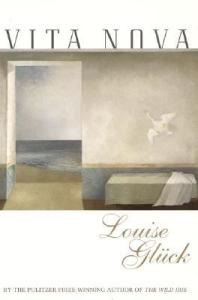 My first collection from the prolific Pulitzer winner. Some of the poems are built around self-interrogation, with a question and answer format; several reflect on the myth of Orpheus and Eurydice. The first and last poems are both entitled “Vita Nova,” while another in the middle is called “The New Life.” I enjoyed the language of spring in the first “Vita Nova” and in “The Nest,” but I was unconvinced by much of what Glück writes about love and self-knowledge, some of it very clichéd indeed, e.g. “I found the years of the climb upward / difficult, filled with anxiety” (from “Descent to the Valley”) and “My life took me many places, / many of them very dark” (from “The Mystery”).
Best lines about spring:
“The spring of the year; young men buying tickets for the ferryboats. / Laughter, because the air is full of apple blossoms.” (from “Vita Nova”)
“Spring / descended. Or should one say / rose? … yellow-green of forsythia, the Commons / planted with new grass— // the new / protected always” (from “Ellsworth Avenue”)
My rating:
Plucked off the shelf for their dubious thematic significance!

To Rise Again at a Decent Hour by Joshua Ferris
Animal, Vegetable, Miracle by Barbara Kingsolver
Wise Blood by Flannery O’Connor
So You’ve Been Publicly Shamed by Jon Ronson
The Resurrection of Joan Ashby by Cherise Wolas
Happy Easter to all those who mark it, and have a good week. I have a few review-based posts scheduled for while we’re in Wigtown, a trip I hope to report on next Monday, when I will also attempt to catch up on blogs and comments.
Reading Ireland Month 2018: Seamus Deane and Edna O’Brien
It’s my first time participating in Reading Ireland Month, run each March by Cathy of 746 Books and Niall of The Fluff is Raging. I enjoyed scouring my shelves for Irish reads – though in the end I only had time for two.

Reading in the Dark by Seamus Deane (1996)
I don’t recall how I first heard about this book, but its title was familiar to me when I picked it up for a matter of pence at a charity shop last year. When I saw it on Cathy’s recent list of her top five Irish books of all time, I knew I was in for something special. These vivid vignettes of childhood and young adulthood are so convincing that I could have been fooled into believing I was reading a memoir. Indeed, this debut novel has generally been interpreted as heavily autobiographical, with the anonymous narrator, the third of seven children born to Catholic parents in Derry, Northern Ireland, taken to be a stand-in for Deane.
 Ireland’s internecine violence is the sinister backdrop to this family’s everyday sorrows, including the death of a child and the mother’s shaky mental health. The narrator also learns a family secret from his dying maternal grandfather that at first thrills him – he knows something his father doesn’t! – but later serves to drive him away from his parents. The short chapters take place between 1945 and 1971: starting when the boy is five years old and encountering a household ghost on the stairs and ending as, in his early thirties, he lays his father to rest in the midst of the Troubles.
The Irish have such a knack for holding humor and tragedy up side by side – think John Boyne, James Joyce and Frank McCourt. The one force doesn’t negate the other, but the juxtaposition reminds you that life isn’t all gloom or laughs. There are some terrifically funny incidents in Reading in the Dark, like the individual sex ed. chat with Father Nugent (“And semen is the Latin for seed. Do you have to know Latin to do this?”) and going to investigate the rumor of a brothel by the football ground. But there is also perhaps the best ghost story I’ve ever read, an eerie tale of shape-shifting children he hears from his aunt.
This book captures all the magic, uncertainty and heartache of being a child, in crisp scenes I saw playing out in my mind. If I have one small, strange complaint, it’s that there’s too much plot – most of the chapters function perfectly well as stand-alone short stories, so, particularly in the last third, the growing obsession with the family secret feels like an unnecessary attempt to tie everything together. That plus the slight irrelevance of the title are the only reasons this misses out on 5 stars from me.
Still, I’d agree with Cathy: this is probably one of my favorite Irish reads, along with Boyne’s The Heart’s Invisible Furies, Mary Costello’s Academy Street, Anne Enright’s The Green Road, and Joyce’s A Portrait of the Artist as a Young Man. It’s no wonder Deane won so many prizes for this: the Irish Times International Fiction Prize, the Guardian Fiction Prize, and the Irish Literature Prize; he was also shortlisted for the 1996 Booker Prize.
Favorite lines:
“Child, she’d tell me, I think sometimes you’re possessed. Can’t you just let the past be the past?”
“He looked up at me, smiling, to say: ah well, it was all blood under the bridge now”
“Politics destroyed people’s lives in this place, he said. People were better not knowing some things”
My rating: 
Mother Ireland by Edna O’Brien (1976)
 This slim volume combines travel writing, history and memoir, with plentiful black and white photographs (by Fergus Bourke) along the way. Often, even where O’Brien is clearly drawing on autobiographical material, she resists saying “I”, instead opting for “one,” “you,” or “we.” I think she was aiming at the universalities of the Irish experience, but instead it ends up coming off as generic. That and a long opening chapter on Ireland’s history set me to skimming. (Also, the book is maddeningly underpunctuated, and the photos in particular seem very dated.) By far my favorite of the seven essays was the last, “Escape to England.” In just three pages, she explains what it’s like to start a new life in another country and how the experience allowed her to appreciate home all the more. Should I try O’Brien’s fiction?
Favorite lines:
“Irish people do not like to be contradicted. Foiled again and again[,] they have in them a rage that comes at you unawares like a briar jutting out of a hedge.”
“You are Irish[,] you say lightly, and allocated to you are the tendencies to be wild, wanton, drunk, superstitious, unreliable, backward, toadying and prone to fits, whereas you know that in fact a whole entourage of ghosts resides in you, ghosts with whom the inner rapport is as frequent, as perplexing, as defiant as with any of the living.”
My rating:
No time for these this year – maybe next year, if not sooner?

One More Wellcome Longlist Review & Shortlist Predictions
Tomorrow the six titles on the Wellcome Book Prize shortlist will be revealed. I’ve managed to read one more from the longlist since my last batch.
The Butchering Art: Joseph Lister’s Quest to Transform the Grisly World of Victorian Medicine by Lindsey Fitzharris
Surgery was a gory business with a notably high fatality rate well into the nineteenth century. Surgeons had the fastest hands in the West, but their victims were still guaranteed at least a few minutes of utter agony as they had a limb amputated or a tumor removed, and the danger wasn’t over after they were sewn up either: most patients soon died from hospital infections. The development of anesthetics and antiseptic techniques helped to change all that.
Fitzharris opens with the vivid and rather gruesome scene of a mid-thigh amputation performed by Robert Liston at University College Hospital in London in 1846. This surgery was different, though: it only took 28 seconds, but the patient felt nothing thanks to the ether he had been administered. He woke up a few minutes later asking when the procedure would begin. In the audience that day was Joseph Lister, who would become one of Britain’s most admired surgeons.
Lister came from a Quaker family and, after being educated at University College London, started his career in Edinburgh. Different to many medical professionals of the time, he was fascinated by microscopy and determined to find out what caused deadly infections. Carbolic acid and catgut ligatures were two of Lister’s main innovations that helped to fight infection. In fact, whether we realize it or not, his legacy is forever associated with antiseptics: Listerine mouthwash (invented in 1879) is named after him, and the Johnson brothers of Johnson & Johnson fame started their business mass-producing sterile surgical dressings after attending one of Lister’s lectures.
My interest tailed off a bit after the first third, as the book starts going into more depth about Lister’s work and personal life: he married his boss’s daughter and moved from Edinburgh to Glasgow and then back to London. However, the best is yet to come: the accounts of the surgeries he performed on his sister (a mastectomy that bought her three more years of life) and Queen Victoria (removing an orange-sized abscess from under her arm) are terrific. The chapter on treating the queen in secret at Balmoral Castle in 1871 was my overall favorite.

It probably wasn’t the best idea to start this book over my lunch one day!
I was that kid who loved going to Civil War battlefields and medical museums and looking at all the different surgical saws and bullet fragments in museum cases, so I reveled in the gory details here but was not as interested in the biographical material. Do be sure you have a strong stomach before you try reading the prologue over a meal. This is a comparable read to The Remedy, about the search for a cure to tuberculosis.
My rating:
Shortlist Predictions
Now, I’ve still only read half of the longlisted titles so far, so it’s hard to make any solid guesses. However, the below fall somewhere between wishes and informed predictions:
- In Pursuit of Memory by Joseph Jebelli: A definitive treatment of an epidemic of our time, Alzheimer’s disease. The neuroscientist author achieves the right balance between history and research on the one hand and personal stories readers can relate to on the other.
- The White Book by Han Kang: The only fiction title from the longlist that I haven’t read at least part of. This is also on this year’s Man Booker International Prize longlist and has been well received. From what I can tell, the health theme seems stronger than that of Stay with Me or Midwinter Break, and it would also be nice for one title in translation to make the shortlist.
- With the End in Mind by Kathryn Mannix: As I said in my review last week, this is an excellent all-round guide to preparation for death, based around touching patient stories plus the author’s experience in palliative care and CBT. Practical, compassionate and helpful.
- I Am, I Am, I Am by Maggie O’Farrell: For me, this book stands out as the one that most clearly illuminates the effects of illness, medical treatment, and other threats to life and limb in the course of an ordinary existence. I’d be very happy to see it win the whole thing.
- EITHER The Butchering Art by Lindsey Fitzharris OR The Vaccine Race by Meredith Wadman: I reckon one history of science title deserves to be on there; I think Wadman might have the slight edge.
- EITHER To Be a Machine by Mark O’Connell OR Behave by Robert Sapolsky: The Wellcome Prize loves big books investigating human tendencies and possibilities. I find the thought of either of these daunting, but I know they would also be illuminating. I’d prefer to read the O’Connell, but I’d give the edge to Sapolsky.
 Bookish Beck = Rebecca Foster. American transplant to England. Freelance proofreader and book reviewer.
 Bookish Beck