Midwinter Cedes to Spring
I’ve marked the turn of the seasons by following a ‘Midwinter’ book with a ‘Spring’ one.
Moominland Midwinter by Tove Jansson
 My third and favorite Moomins book (so far).
Moomins are supposed to sleep through the winter, but this year young Moomintroll awakens and finds himself in a “strange and dangerous” world transformed by snowdrifts. He can’t get his parents to wake up so is effectively a temporary orphan, surrounded by peculiar creatures from Jansson’s menagerie, this time including a dim-witted squirrel, invisible shrews, a glum little dog who wishes he could run with wolves, and the Dweller Under the Sink (with its exceptionally bushy eyebrows).
While Moomintroll searches for totems of familiarity—
He looked at the cupboard in the corner and thought of how nice it was to know that his own old bath-gown was hanging inside it. That something certain and cosy still remained in the middle of all the new and worrying things.
—Too-ticky has the opposite mindset: “All things are so very uncertain, and that’s exactly what makes me feel reassured.” She goes fishing under the ice, builds a life-size horse out of snow, and assembles tree trunks and old furniture for the midwinter ritual of a huge bonfire.
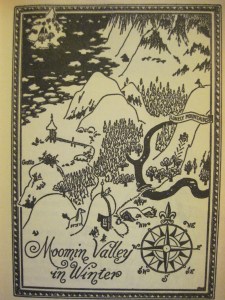 When they receive a visit from the Hemulen, who’s keen on skiing and declares the indoors too stuffy in winter, the creatures quickly tire of his energetic optimism. The truth is that they like sitting around being miserable. “I’m cold! I’m lonely! I want the sun back again!” Moomintroll pouts, but even he is too affable to make the Hemulen leave.
Of course the spring finally arrives, as it does every year, but it’s depressingly long in coming and for Moomintroll becomes a matter of faith. I love the strangeness of Jansson’s imagination, the balance of melancholy and comedy, and the little philosophical nuggets buried along the way – children and adult readers alike will get a lot out of this. It doesn’t talk down to children with a rosy message about everything being alright.
My rating: 
Spring: An anthology for the changing seasons, edited by Melissa Harrison
Although this was the first of the Wildlife Trusts anthologies published in 2016, I got a late start last year so am reading this as the final of four. In common with the other volumes, it’s a terrific mix of contemporary and historical writing, big names and newcomers, observation and reflection. Compared with the other books, it seems to have more about WT sites in particular, with a few pieces from current volunteers or former employees. I also noticed that there’s a bit more of a focus on birds – with essays on the chiffchaff, the birds encountered on the Cley Marshes, cuckoo festivals, young dippers, and a tawny owl chick.
 That said, there’s still plenty of variety here, with everything from spring flora* to adders fueling the generally two- to three-page essays. I especially liked Kate Long’s piece on filming hedgehogs at night and Vijay Medtia’s on how people of color living in cities have little access to nature; he recalls spotting a magpie with a twig in its beak at a train station and having to ask someone what it was called. Of the previously published authors, I enjoyed hearing more from Rob Cowen and Miriam Darlington and laughed at Will Cohu’s ice cream and underwear metaphors applied to varieties of cherry trees.
You can’t beat George Orwell on toad sex, and it’s fun to encounter excerpts from classic novels in the context of a nature book: The Wind in the Willows, Lorna Doone, and Jane Eyre (which, shamefully, I didn’t recognize until Lowood was mentioned in the last paragraph). I think my favorite piece of all, though, was Jo Sinclair’s about watching spring’s arrival after a major operation and noting nature’s inscrutable jumble of beauty and brutality.
And my favorite passage:
Year after year all this loveliness for eye and ear recurs: in early days, in youth, it was anticipated with confidence; in later years, as the season approaches, experience and age qualify the confidence with apprehension lest clouds of war or civil strife, or some emergency of work, or declining health, or some other form of human ill may destroy the pleasure or even the sight of it: and when once again it has been enjoyed we have a sense of gratitude greater than in the days of confident and thoughtless youth. Perhaps the memory of those days, having become part of our being, helps us in later life to enjoy each passing season.
(from Sir Edward Grey’s The Charm of Birds, 1927)
This passage from Reverend Francis Kilvert’s diary (April 14, 1871) makes me look forward to our trip to nearby Hay-on-Wye next month: “The village is in a blaze of fruit blossom. Clyro is at its loveliest. What more can be said?” Simply that these anthologies are an essential companion to the seasons.
*Like my husband’s piece, positioned right before the R.D. Blackmore extract.
(See also my reviews of Summer, Autumn and Winter.)
My rating:
Yet More Books about Cats
I reviewed two sets of cat books last year, one in April and another in October. When you start looking, you realize there are endless pet books out there, with cat books seemingly second only to dog books in popularity. In the past few months I’ve encountered five more books about cats: a Christmas classic, a scientist’s introduction to cat behavior, an anthology of church-themed fiction, an installment of a charming children’s series, and a very funny memoir.
The Cat Who Came for Christmas by Cleveland Amory
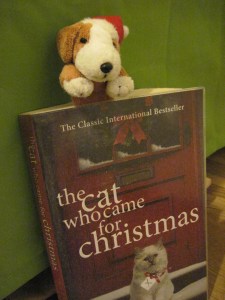 In the late 1970s Amory was a bona fide animal lover (he’d founded the NYC-based Fund for Animals, after all) but didn’t have a pet of his own until he was involved in the rescue of an unprepossessing stray one Christmas: Polar Bear, the cat who would introduce his fussy habits to a bachelor’s household and complicate his life in all kinds of ways. Cat owners will recognize so many things – the 3 a.m. bowl-emptying snack, testy relations with various other species – but I found the book strangely belabored and irrelevant as it goes into the history of the domestic cat, the business of naming cats, and Amory’s travels on behalf of the Fund. [Public library]
Favorite lines:
- “For an animal person, an animal-less home is no home at all.”
- “The fact is that most cats, most of the time, have already met everybody they care to meet.”
Cat Sense: The Feline Enigma Revealed by John Bradshaw
 Bradshaw is the founder and director of the Anthrozoology Institute at the University of Bristol. He writes as both an expert in animal behavior and a cat lover. I only skimmed this one rather than reading it in full because I expected it would repeat a lot of the information in Abigail Tucker’s The Lion in the Living Room. There is indeed a fair amount of overlap in the discussion of domestic cat evolution and the environmental effects of cats’ hunting instinct, but Bradshaw’s book is unique for the amount of time it gives to cat genetics and behavior, especially things like breeding and how cats interact with other cats and with people. This would be a good halfway house if you want a readable but quite scientific book about cats. The Lion in the Living Room is the better all-round introduction, though. [Public library]
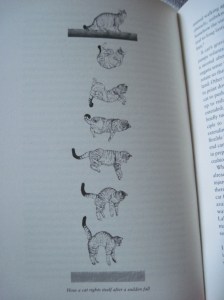
Bradshaw’s diagram of a cat landing on its feet.
Favorite lines:
- “Part of the pleasure of owning a pet comes from projecting our thoughts and feelings on to the animal, treating it as if it were almost human. We talk to our cats as if they could understand our every word, while knowing full well that they certainly can’t.”
- “Purring therefore seems to convey a general request: ‘Please settle down next to me.’ In the gentlest way, the purring cat is asking someone else, whether cat or human, to do something for it.”
The Church Cat: Clerical Cats in Stories and Verse, edited by Mark Bryant
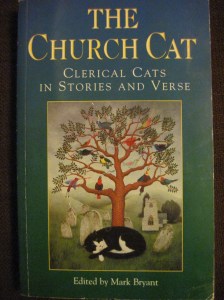 This seems like an impossibly narrow category: stories and poems that combine cats with a church setting. But Bryant has found some real gems that fulfill just that criterion. A few of the short stories, by Ellis Peters, M.R. James and Ernest Dudley, are compact murder mysteries. I most enjoyed Arnold Bennett’s “The Cat and Cupid,” about spinster sisters and “notorious cat-idolaters” who squabble over the handsome new organist; W.L. Alden’s “The Yellow Terror,” about a ship’s cat who insists that his owner hold church services onboard; and Christopher Park’s “The Case of the Cross-eyed Sphinx and the Holy Ghost” (my overall favorite) in which a newly married man meets his wife’s family, including a defrocked chaplain in a wheelchair and his barking mad wife, all of whom have “had an overdose of cat worship.” Of the 21 pieces, only five or six stood out for me (and none of the poetry, really). [Charity shop]
The Church Mice Adrift by Graham Oakley
This 1976 picture book was my introduction to the 14-strong “Church Mice” series. The town of Wortlethorpe is looking to modernize: tearing down all its heritage buildings in favor of glass-fronted monstrosities. This leaves a troop of rats without a home, but they spy an opportunity when they sneak through Sampson’s catflap in the church door. The wily creatures displace the church mice and even Sampson the ginger wonder cat can’t take back his territory. So the cat and his mice are forced to get creative, and come up with a plan that involves a doll’s house turned into a floating café for rats…
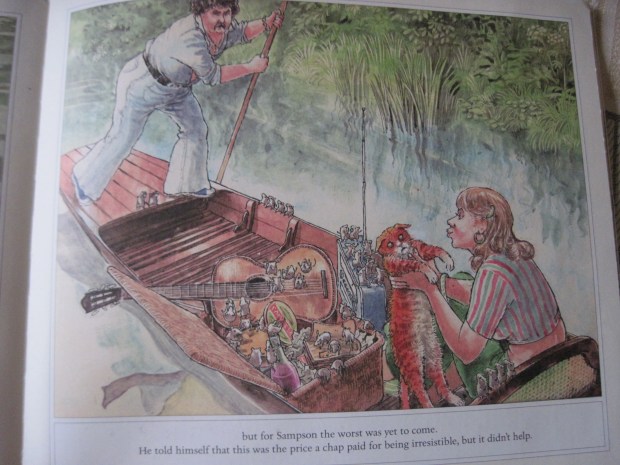
I loved the illustrations (the 1970s clothing on the few human characters cracked me up!) and the plot, a good mixture of humor and mild peril. There’s a fair number of words on each page, yet not too many. I can see this being ideal to read aloud with young children before having them take over the reading at age 5 or 6. I look forward to experiencing more of the church mice’s adventures. My thanks to Margaret of From Pyrenees to Pennines for recommending this charming series. [Public library]
Cats in the Belfry by Doreen Tovey
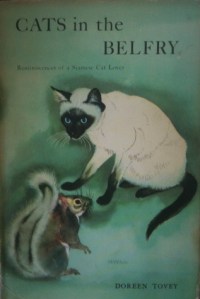
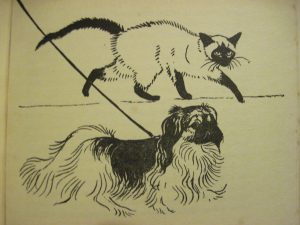
Solomon stalking a neighbor dog.
Do you think your cat is noisy and troublesome? Be thankful you don’t have Doreen Tovey’s Siamese cats! This 1957 book was the first of her many cat-themed memoirs and is perfectly delightful for any animal lover. Their first Siamese was Sugieh, who loved nothing more than to jump into a full bath and frighten the life out of the bather. They bred her and kept two of the littermates, Solomon and Sheba, a mischievous pair whose first three years of antics fill much of the book: terrorizing dogs, pulling down the curtains, following horses, and developing, er, ‘refined’ tastes – “What with spiders, string, and the occasional butterfly caught napping on a cabbage which he ate wings and all, Solomon was, of course, frequently sick. But never, ever, was he so gloriously sick as the day he ate the cream cakes.” [Charity shop]
Up next:
 I have Thomas McNamee’s The Inner Life of Cats (coming out on March 28th) and Jason Hazeley’s The Fireside Grown-Up Guide to the Cat (coming out on April 4th) on my e-readers.
- I’m sure to borrow more books from the public library by Tovey and Bradshaw, who has a book about training your cat (ha!).
- I covet I Could Pee on This, Too: And More Poems by More Cats by Francesco Marciuliano.
Whether you consider yourself a cat lover or not, do any of these books appeal?
Six “Love” Books for Valentine’s Day
Starting in mid-January I began surveying my shelves, library stack and Kindle for books with “love” in the title. Here are the six I had time to try; I didn’t get to Alain de Botton’s The Course of Love on my Kindle, nor my paperback copies of Iris Murdoch’s The Sacred and Profane Love Machine and Nancy Horan’s Loving Frank.
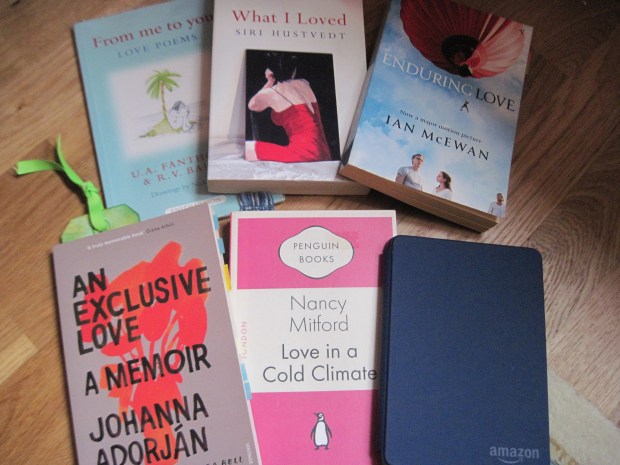
You’ll notice that a number of the books I’ve read aren’t that optimistic about love; in several cases the use of the word in the title even seems to be ironic. As Lady Montdore exclaims in Love in a Cold Climate, “Love indeed – whoever invented love ought to be shot.” So I can’t offer them as particularly romantic choices. But let’s start positively, with some pleasantly out-of-the-ordinary love poems.
From Me to You: Love Poems, U.A. Fanthorpe and R.V. Bailey
 Ursula Fanthorpe and Rosie Bailey met as English teachers at the same Cheltenham school in their late twenties and were partners for nearly 40 years. None of the poems in this short volume are attributed, though I recognized a few from Fanthorpe’s Collected Poems. They’re not particularly distinguished as poetry, but I appreciated the simple, unsentimental examples of what makes up everyday life with a partner: “There is a kind of love called maintenance, / Which stores the WD40 and knows when to use it; // Which checks the insurance, and doesn’t forget / The milkman” (“Atlas”) and “I’m working on a meal you haven’t had to imagine, / A house cleaned to the rafters” (“Dear Valentine”). [Public library]
What I Loved, Siri Hustvedt
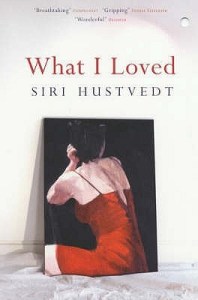 This 2003 novel could just as well have been titled “What I Lost,” which might be truer to its elegiac tone. Narrated by Professor Leo Hertzberg and set between the 1970s and 1990s, it’s about two New York City couples – academics and artists – and the losses they suffer over the years. With themes of modern art, perspective, memory, separation and varieties of mental illness, it asks to what extent we can ever know other people or use replacements to fill the gaps left by who and what is missing. Read it if you’ve enjoyed The Suicide of Claire Bishop by Carmiel Banasky, other books by Siri Hustvedt, or anything by Howard Norman. My favorite lines about love were “I often thought of our marriage as one long conversation” and “love thrives on a certain kind of distance … it requires an awed separateness to continue.” [Charity shop]
Love in a Cold Climate, Nancy Mitford
 I didn’t realize this 1949 novel is a sequel to The Pursuit of Love, so it took a while to figure out who all the characters were. Fanny Logan is a cousin orbiting around Lord and Lady Montdore and their daughter Polly Hampton, all recently returned from some years in India. Fanny marries an Oxford don, while Polly shocks everyone by eloping with her uncle by marriage, “Boy” Dougdale, a recent widower once known as the “Lecherous Lecturer” for interfering with little girls. (This hint of pedophilia is carelessly tossed off in a way no writer would get away with today.) Meanwhile, the heir to the Hampton estate, an effeminate chap named Cedric, comes over from Canada for a visit and wins Lady Montdore over. This amusing picture of aristocratic life in the 1930s marvels at who we love and why. [Bookbarn International]
Enduring Love, Ian McEwan
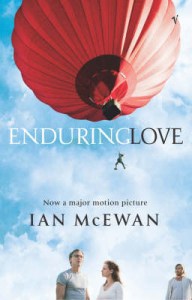 Interesting to consider this as a precursor to Saturday: both have a scientist as the protagonist and get progressively darker through a slightly contrived stalker plot. Enduring Love opens, famously, with a ballooning accident that leaves its witnesses questioning whether they couldn’t have done more to prevent it. Freelance science journalist Joe Rose – on a picnic with his partner, Keats scholar Clarissa, at the time – was one of those who rushed to help, as was Jed Parry, a young Christian zealot who fixates on Joe. He seems to think that by loving Joe, a committed atheist, he can bring him to God. In turn, Joe’s obsession with Jed’s harassment campaign drives Clarissa away. It’s a deliciously creepy read that contrasts rationality with religion and inquires into what types of love are built to last. [Charity shop]
An Exclusive Love: A Memoir, Johanna Adorján
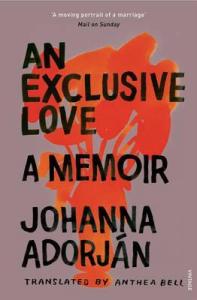 The author’s grandparents, Hungarian Holocaust survivors who moved to Denmark as refugees, committed suicide together on October 13, 1991. Her grandfather, an orthopedic surgeon who had been in an Austrian concentration camp, was terminally ill and his wife was determined not to live a day without him. This short, elegant memoir alternates Adorján’s imagined reconstruction of her grandparents’ last day with an account of their life together, drawn from family memories and interviews with those who knew them. She wonders whether, like Primo Levi and Arthur Koestler, theirs was a typically Jewish failure to fit in wherever they went, and/or a particularly Hungarian melancholy. “The answer is their great love,” the newspaper report of their death insisted. [Waterstones clearance]
Note: That striking cover is by Leanne Shapton.
And another nonfiction selection that I didn’t make it all the way through:
A Book about Love, Jonah Lehrer
 (Abandoned at 31%.) Although I can see why he starts where he does, Lehrer’s early focus on attachment and attunement – two psychological theories of how babies learn to relate affectionately to others – means the book gets bogged down in studies performed on mice and/or children and feels more like a parenting book than anything else. (If that’s what you’re after, read All Joy and No Fun.) A glance at the table of contents suggests the rest of the book will go into marriage, divorce and how love changes over time, but I couldn’t be bothered to stick around. That said, Lehrer’s popular science writing is clear and engaging, and with the heartfelt mea culpa at the start of this book I couldn’t hold a grudge about his earlier plagiarism scandal. [Kindle book from NetGalley.]
No overtly heartwarming love stories in that selection, then, but are there any you fancy reading anyway? Have you read any “love” titles recently?
See also: The Guardian’s list of Top 10 Authentic Romances.
All the Lonely People*
Last week I finished two books, one fiction and one nonfiction, that had loneliness as a central theme – although their treatment of the subject was vastly different.
First was Quartet in Autumn by Barbara Pym, which was recommended to me by various bloggers and certainly lived up to their praise. Originally published in 1977, this was Pym’s seventh novel out of nine; she died in 1980. It’s about four London office workers, all sixty-somethings who are partnerless and don’t have, or at least don’t live with, any immediate family members. We never learn what they do in this office; in fact, Edwin, Norman, Letty and Marcia don’t seem to be filling much of a need, especially given the fact that the two old girls aren’t replaced when they retire midway through the novel.
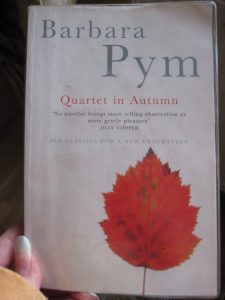 For as long as they’ve been working together, the four haven’t given in to the usual human impulse to know and be known. At first there doesn’t seem to be much to know about them; with only one or two shorthand facts apiece it’s a minor challenge to tell them apart. Widower Edwin’s hobby is attending Anglican services; Norman lives off fried food and visits his brother-in-law in hospital; Letty lives in a boarding house and has a friend in the countryside; Marcia has had a mastectomy and hoards tinned food and empty milk bottles.
But for all of them a line applied to Letty holds true: “It was a comfortable enough life, if a little sterile, perhaps even deprived.” Especially after her retirement, Letty knows “she must never give the slightest hint of loneliness or boredom, the sense of time hanging heavy.”
From what I’d heard about Pym, I might have expected a lighthearted satire about country manners and Anglican vicars. Perhaps that’s a fair assessment of some of her earlier books? But this is much darker, and the humor always has a bitter edge:
- When Marcia finds a plastic bag labeled “To avoid danger of suffocation keep this wrapper away from babies and children,” the narrator adds, “They could have said from middle-aged and elderly persons too, who might well have an irresistible urge to suffocate themselves.”
- Offered the option of moving into a care home, Letty thinks “better to lie down in the wood under the beech leaves and bracken and wait quietly for death.”
Overall it’s quite a melancholy little book, a warning against letting your life become too small and private. Yet the last line, remarkably, is a sudden injection of optimism: “it made one realize that life still held infinite possibilities for change.” I’d recommend this to readers who have enjoyed Mrs. Palfrey at the Claremont by Elizabeth Taylor.
As an unwittingly positive counterpart, I was at the same time reading How to Be Alone by Sara Maitland. This is part of a School of Life series that turns the “how-to” concept on its head: instead of areas where we think we need instruction, the books are about areas where we feel like experts, topics so simple or automatic they don’t seem to need explanation (e.g. How to Be Bored, or How to Age).

I feel it’s important to point out that the author’s last name is spelled wrong on the cover!
But Maitland argues that although being alone is easy to achieve, there is an art to doing it properly, and solitude and loneliness are by no means the same thing. She knows whereof she speaks: though she grew up in a large Catholic family, after her divorce she moved to a remote area of Scotland and lives alone in a house a quarter mile from the nearest road.
Despite our modern obsession with self-confidence and fulfilling relationships, Maitland believes “the present paradigm is not really working.” More of us than ever are depressed and afraid to spend time alone lest it might make us appear selfish, pathetic or in some way unlovable.
Profiling everyone from the Desert Fathers of early Christianity to the Romantic poets, she counters by enumerating all the benefits that solitude confers: self-knowledge and a rest from constant relating (that goes for extroverts as well as introverts), a connection to nature and to the divine, and the freedom to create. She convinced me, and includes a great bibliography of further reading about solitude.
*I only found out the other week that Eleanor Rigby “picks up the rice” in a church. For my entire life I’d thought she “picks up her ice” (granted, that doesn’t make much sense, but the Beatles could be trippy lads). You learn something new every day!
Books that (Should Have) Literally Changed My Life
(Following on from my posts Landmark Books from My Early Life and Landmark Books in My Life, Part II.)
Every once in a while you’ll hear someone claim that a certain book will change your life. I think of a scene in Garden State, still one of my favorite movies of all time, where Natalie Portman’s character tells Zach Braff’s character “this song will change your life” and puts The Shins’ “New Slang” on his headphones. (Ok, it’s a good song, but not that great.)
Are there any books that have literally changed my life? I can think of a handful that have been extremely influential on my worldview and, in a couple of cases, also changed my behavior. As it happens, they’re all nonfiction.
Religion
 After I got back to the States from my year abroad, I spent a few years doing some intensive reading about progressive Christianity (it was sometimes also called the emergent church) and other religions, trying to decide if it was worth sticking with the faith I’d grown up in. Although I still haven’t definitively answered this for myself, and have drifted in and out of lots of churches over the last 12 years, two authors were key to me never ditching Christianity entirely: Brian McLaren and Marcus Borg.
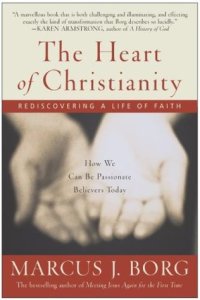 McLaren founded the church we attend whenever we’re back in Maryland and is the author of over a dozen theology titles, including the New Kind of Christian trilogy of allegorical novels. For me his best book is A New Kind of Christianity, which pulls together all his recurrent themes. Borg, who died in 2015, wrote several books that made a big impression on me, but none more so than The Heart of Christianity, which is the best single book I’ve found about what Christianity can and should be, going back to Jesus’ way of peace and social justice and siphoning off the unhelpful doctrines that have accumulated over the centuries.
 Any number of other Christian books and authors have been helpful to me over the years (Secrets in the Dark by Frederick Buechner, How (Not) to Speak of God by Peter Rollins, Falling Upward by Richard Rohr, An Altar in the World by Barbara Brown Taylor, Without Buddha I Could Not be a Christian by Paul Knitter, Unapologetic by Francis Spufford, and various by Kathleen Norris, Rowan Williams, Richard Holloway and Anne Lamott), reassuring me that it’s not all hellfire/pie in the sky mumbo-jumbo for anti-gay Republicans, but Borg and McLaren were there at the start of my journey.
Sexuality
 Reading is my primary means of examining society as well as my own life, so it’s no wonder that I have turned to books to learn from some gender pioneers. Hanne Blank’s accessible social history Straight (2012) is particularly valuable for its revelation of the surprisingly short history of heterosexuality as a concept – the term has only existed since the 1860s. But the book that most helped me adjust my definitions of gender and broaden my tolerance was Conundrum by Jan Morris (1974).
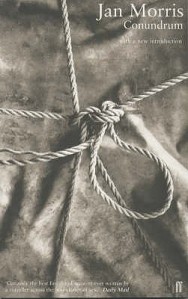 James Morris, born in 1926, was a successful reporter, travel writer, husband and father. Yet all along he knew he was meant to be female; it was something he had sensed for the first time as a young child sitting under the family piano: “I was three or perhaps four years old when I realized that I had been born into the wrong body, and should really be a girl … the conviction was unfaltering from the start.” In 1954 he began taking hormones to start his transition to womanhood, completed by a sex reassignment surgery in Morocco in 1972. This exceptional memoir of sex change evokes the swirl of determination and doubt, as well as the almost magical process of metamorphosing from one thing to another. Morris has been instrumental in helping me see sexuality as a continuum rather than a fixed entity.
Food
Apart from Michael Pollan, can you guess who’s had the greatest influence on my eating habits? You might be surprised to learn it’s American novelist Jonathan Safran Foer. In 2009 he published a provocative book called Eating Animals. I’m still surprised by how powerful and challenging I found it, considering that I knew pretty much what to expect: anti-meat rhetoric from a trendy vegetarian, with plenty of arresting statistics and horrifying behind-the-scenes accounts of factory farming and slaughter. But I set aside my jaded approach to potential propaganda and let it all saturate me, and it was devastating.
 The fact that I still haven’t completely given up meat is proof of how difficult it is to change, even once you’ve been convicted. We’ve gone from eating meat occasionally to almost never, and then mostly when we’re guests at other people’s houses. But if I really reminded myself to think about where my food was coming from, I’m sure we’d be even more hardline. Foer didn’t answer all my questions – what about offal and wild game, and why not go all the way to veganism? – but I appreciated that he never characterizes the decision to be vegetarian as an easy one. He recognizes the ways food is bound up with cultural traditions and family memories, but still thinks being true to one’s principles outweighs all. (He’s brave enough to suggest to middle America that it’s time to consider a turkey-free Thanksgiving!)
Daily Life
 There’s nothing more routine than brushing your teeth, and I never thought I would learn a new way to do it at age 32! But that’s just what Ignore Your Teeth and They’ll Go Away by Sheldon Dov Sydney gave me. He advises these steps: (1) brushing with a dry brush to remove bits of food and plaque, (2) flossing, and (3) brushing with toothpaste as a polish and to freshen breath. It takes a little bit longer than your usual quick brush and thus I can’t often be bothered to do it, but it does always leave my mouth feeling super-clean.
 I frequently succumb to negative self-talk, thinking “I can’t cope” or “There’s no way I could…” Feel the Fear and Do It Anyway by Susan Jeffers helped me see that I need to be more positive in my thought life. Originally published in 1987, the self-help classic says that at the base of every fear is a belief that “I can’t handle it.” Our fears are either of things that can happen to us (aging and natural disasters) or actions we might take (going back to school or changing jobs). You can choose to hold fear with either pain (leading to paralysis) or power (leading to action). This is still a struggle for me, but whenever I start to think “I can’t” I try to replace it with Jeffers’ mantra, “Whatever it is, I’ll handle it.”
Can you think of any books that have literally changed your life?
Starting the Year as I Mean to Go On?
The houseguests have gone home, the Christmas tree is coming down tomorrow, and it’s darned cold. I’m feeling stuck in a rut in my career, the blog, and so many other areas of life. It’s hard not to think of 2017 as a huge stretch of emptiness with very few bright spots. All I want to do is sit around in my new fuzzy bathrobe and read under the cat. Luckily, I’ve had some great books to accompany me through the Christmas period and have finished five so far this year.
I thought I’d continue the habit of writing two-sentence reviews (or maybe no more than three), except when I’m writing proper full-length reviews on assignment or for blog tours or other websites. Granted, they’re usually long and multi-part sentences, and this isn’t actually a time-saving trick – as Blaise Pascal once said, “I’m sorry I wrote you such a long letter; I didn’t have time to write a short one” – but it feels like good discipline.
So here’s some mini-reviews of what I’ve been reading in late December and early January:
The Dark Flood Rises, Margaret Drabble
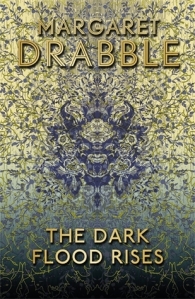 The “dark flood” is D.H. Lawrence’s metaphor for death, and here it corresponds to busy seventy-something Fran’s obsession with last words, obituaries and the search for the good death as many of her friends and acquaintances succumb – but also to literal flooding in the west of England and (dubious, this) to mass immigration of Asians and Africans into Europe. This is my favorite of the five Drabble books that I’ve read – it’s closest in style and tone to her sister A.S. Byatt as well as to Tessa Hadley, and the themes of old age and life’s randomness are strong – even though there seem to be too many characters and the Canary Islands subplot mostly feels like an unnecessary distraction. (Public library)
Hogfather, Terry Pratchett
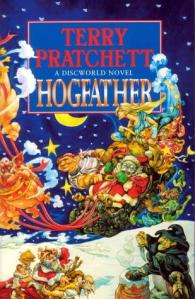 In Discworld belief causes imagined beings to exist, so when a devious plot to control children’s minds results in a dearth of belief in the Hogfather, the Fat Man temporarily disappears and Death has to fill in for him on this Hogswatch night. I laughed aloud a few times while reading this clever Christmas parody, but I had a bit of trouble following the plot and grasping who all the characters were given that this was my first Discworld book; in general I’d say that Pratchett is another example of British humor that I don’t entirely appreciate (along with Monty Python and Douglas Adams) – he’s my husband’s favorite, but I doubt I’ll try another of his books. (Own copy)
Love of Country: A Hebridean Journey, Madeleine Bunting
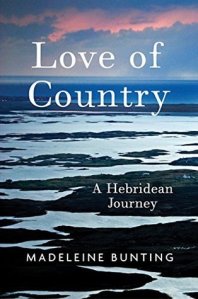 In a reprise of childhood holidays that inevitably headed northwest, Bunting takes a series of journeys around the Hebrides and weaves together her contemporary travels with the religion, folklore and history of this Scottish island chain, an often sad litany of the Gaels’ poverty and displacement that culminated with the brutal Clearances. Rather than giving an exhaustive survey, she chooses seven islands to focus on and tells stories of unexpected connections – Orwell’s stay on Jura, Lord Leverhulme’s (he of Port Sunlight and Unilever) purchase of Lewis, and Bonnie Prince Charlie’s landing on Eriskay – as she asks how geography influences history and what it truly means to belong to a place. (Public library)
Cobwebs and Cream Teas: A Year in the Life of a National Trust House, Mary Mackie
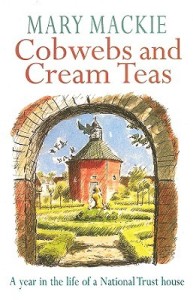 Mackie’s husband was Houseman and then Administrator at Felbrigg Hall in Norfolk in the 1980s – live-in roles that demanded a wide range of skills and much more commitment than the usual 9 to 5 (when he borrowed a pedometer he learned that he walked 15 miles in the average day, without leaving the house!). Her memoir of their first year at Felbrigg proceeds chronologically, from the intense cleaning and renovations of the winter closed season through to the following Christmas’ festivities, and takes in along the way plenty of mishaps and visitor oddities. It will delight anyone who’d like a behind-the-scenes look at the life of a historic home. (Own copy)
The Bridge Ladies: A Memoir, Betsy Lerner
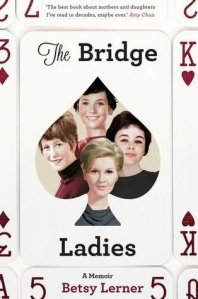 When life unexpectedly took the middle-aged Lerner back to her hometown of New Haven, Connecticut, she spent several years sitting in on her mother’s weekly bridge games to learn more about these five Jewish octogenarians who have been friends for 50 years and despite their old-fashioned reserve have seen each other through the loss of careers, health, husbands and children. Although Lerner also took bridge lessons herself, this is less about the game and more about her ever-testy relationship with her mother (starting with her rebellious teenage years), the ageing process, and the ways that women of different generations relate to their family and friends. It wouldn’t be exaggerating to say that every mother and daughter should read this; I plan to shove it in my mother’s and sister’s hands the next time I’m in the States. (Own copy)
Waiting on the Word, Malcolm Guite
 Guite chooses well-known poems (by Christina Rossetti, John Donne, Alfred Lord Tennyson, Samuel Taylor Coleridge et al.) as well as more obscure contemporary ones as daily devotional reading between the start of Advent and Epiphany; I especially liked his sonnet sequence in response to the seven “O Antiphons.” His commentary is learned and insightful, and even if at times I thought he goes into too much in-depth analysis rather than letting the poems speak for themselves, this remains a very good companion to the Christmas season for any poetry lover. (E-book from NetGalley)
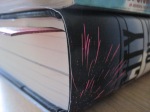 I started too many books over Christmas and have sort of put six of them on hold – including Titus Groan, which I’m thinking of quitting (it takes over 50 pages for one servant to tell another that the master has had a son?!), and City on Fire, which is wonderful but dispiritingly long: even after two good sessions with it in the days after Christmas, I’ve barely made a dent.
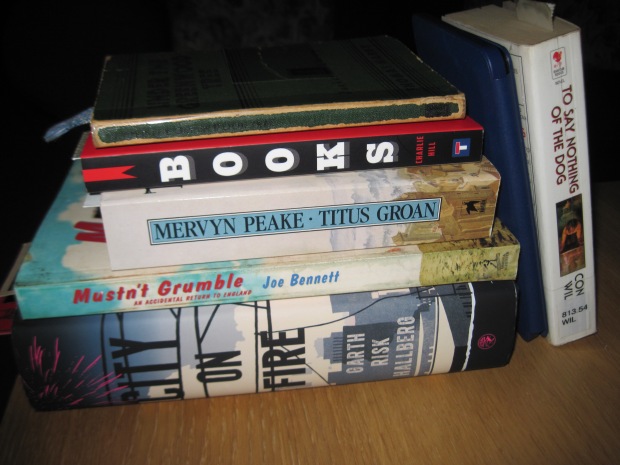
Stack on left = on hold (the book on top is Under the Greenwood Tree); standing up at right = books I’m actually reading.
However, the three books that I am actively reading I’m loving: To Say Nothing of the Dog by Connie Willis is an uproarious blend of time travel science fiction and Victorian pastiche (university library), Pachinko by Min Jin Lee is a compulsive historical saga set in Korea (ARC from NetGalley), and the memoir Birds Art Life by Kyo Maclear has been compared to H Is for Hawk in the way she turns to birdwatching to deal with depression (e-book from Edelweiss). I also will be unlikely to resist my e-galley of the latest Anne Lamott book, Hallelujah Anyway (forthcoming in April, ARC from Edelweiss), for much longer.



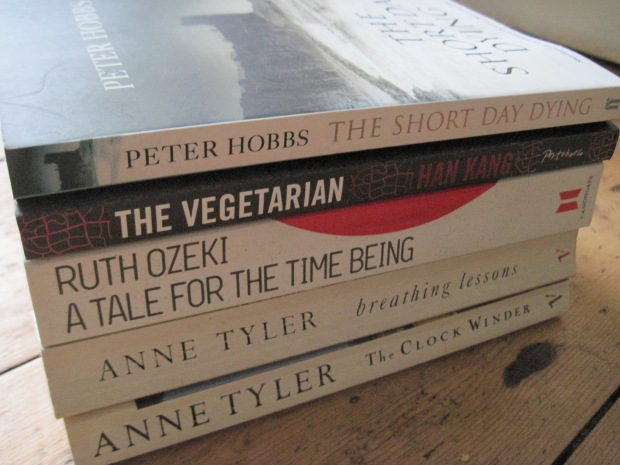
Meanwhile, in post-holiday charity shopping I scored six books for £1.90: one’s been tucked away as a present for later in the year; the Ozeki I’ve already read, but it’s a favorite so I’m glad to own it; and the rest are new to me. I look forward to trying Han Kang; Anne Tyler is a reliable choice for a cozy read; and the Hobbs sounds like a wonderful Victorian-set novel.
All in all, I seem to be starting my year in books as I mean to go on: reading a ton; making sure I review most or all of the books, even if I write just a few sentences; maintaining a balance between my own books, library books, and recent or advance NetGalley/Edelweiss reads; and failing to restrain myself from buying more.
Now if I could just work on my general attitude…
How’s the reading year starting off for you?
Favorite Nonfiction Reads of 2016
Below I’ve chosen my 10 favorite nonfiction books published in 2016, followed by five older nonfiction reads that I only discovered this year. I find it nigh on impossible to compare different genres of nonfiction, so I’m not ranking these but simply listing them alphabetically by author (interestingly, all but one of the 2016 books are by women).
As with yesterday’s fiction choices, many of these books have already featured on the blog in some way over the course of the year. To keep it simple for myself as well as for all of you who are figuring out whether you’re interested in these books or not, I’m limiting myself to two sentences per title: the first is a potted summary; the second tells you why you should read it. I also link to any full reviews.
The Best of 2016
 This Is Cancer by Laura Holmes Haddad: A stage IV inflammatory breast cancer survivor, the author wrote the “What to Expect” guide she wishes she could have found at the time of her diagnosis in 2012. Throughout this comprehensive, well-structured book, she uses her own experience to set out practical advice for dealing with the everyday medical and emotional realities of cancer.
 Lab Girl by Hope Jahren: With witty anecdotes and recreated dialogue, Jahren tells about her Minnesota upbringing, her long years in education, her ultimate specialization in geobiology/botany, crossing the country to take up academic posts in Atlanta, Baltimore and Hawaii, her long-time platonic relationship with eccentric lab partner Bill, and zany road trips across America for conferences and field work. What I think she does best is convey what it’s like to have true passion for your work, a rare thing.
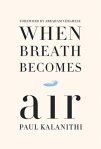 When Breath Becomes Air by Paul Kalanithi: Kalanithi was 36 and just completing his neurosurgery residency in Stanford, California when he was diagnosed with advanced lung cancer that did not respond well to treatment; he devoted his last year to writing this. I would recommend this cancer memoir to anyone for the beauty of its prose – a fine blend of literature and medicine – and the simple yet wholehearted picture of a life cut short.
 The Lonely City by Olivia Laing: A remarkable piece of work fusing social history, commentary on modern art, biographical observation and self-knowledge. It’s a testament to Laing’s skill when I say that I knew next to nothing about any of these artists to start with and have little fondness for modern art but still found her book completely absorbing.
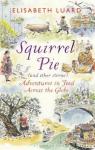 Squirrel Pie (and Other Stories): Adventures in Food across the Globe by Elisabeth Luard: Broadly speaking, this is about indigenous and peasant cooking traditions, a remit that allows Luard to include and adapt travel pieces she’s written over the past 20 years. It’s a cozy and conversational book for anyone who enjoys cooking or eating food from different cuisines (from Maui and Romania to Gujarat and Ethiopia); Luard’s own sketches and line drawings provide a lovely accompaniment.
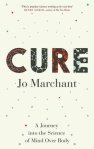 Cure: A Journey into the Science of Mind over Body by Jo Marchant: Marchant, a journalist with a PhD in genetics and medical microbiology, investigates instances where the mind seems to contribute to medical improvement: the use of placebos in transplant recipients, hypnosis for IBS patients, virtual reality to help burn victims manage pain, and the remarkable differences that social connection, a sense of purpose, meditation and empathic conversation all make. I finished the book feeling intrigued and hopeful about what this might all mean for the future of medicine.
 Poor Your Soul by Mira Ptacin: Ptacin’s wonderful memoir is based around two losses: her brother in a collision with a drunk driver, and a pregnancy in 2008; she skips back and forth in time to examine the numb aftermath of trauma as well as the fresh pain of actually going through it. I loved so much about this book, especially her memories of growing up in the cereal capital of America in Michigan and the account of her mother coming to America from Poland and setting up a fine-dining restaurant.
 The Violet Hour: Great Writers at the End by Katie Roiphe: An erudite, elegiac work of literary biography that takes in Susan Sontag, Sigmund Freud, John Updike, Dylan Thomas, Maurice Sendak and James Salter. What Roiphe observes of Sendak’s habit of drawing the dead and dying could equally be applied to The Violet Hour: it’s about seeing the beauty in what terrifies you.
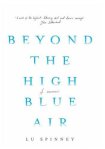 Beyond the High Blue Air: A Memoir by Lu Spinney: In March 2006 Lu Spinney’s twenty-nine-year-old son, Miles King, was on a snowboarding holiday in Austria; on the final morning of the trip he took a fall that would leave this athlete, intellectual, and entrepreneur with a traumatic brain injury. Spinney tells her sad tale remarkably well, in a consciously literary style: with no speech marks and present-tense narration, thought and action flow lucidly into dialogue and daydream; she always chooses just the right metaphors, too.
 The Lion in the Living Room: How House Cats Tamed Us and Took Over the World by Abigail Tucker: From the earliest domestication of animals to the cat meme-dominated Internet, Tucker marvels at how cats have succeeded by endearing themselves to humans and adapting as if effortlessly to any habitat in which they find themselves. This is the amazing cat book I’d been looking for, but I don’t think you even have to be a pet person to find this wide-ranging book enthralling.
If I had to list an overall favorite nonfiction book of the year, it would be The Violet Hour.
The Best of the Rest
Stir: My Broken Brain and the Meals That Brought Me Home by Jessica Fechtor (2015): At age 28 Fechtor, then a graduate student in history and Yiddish, collapsed on a treadmill with a brain bleed; a subsequent surgery to clip the aneurysm left her blind in one eye. She gives a glimpse into an ordinary existence turned upside down and the foods that helped her regain a zest for life by reconnecting her with her family and her Jewish heritage.
A Time of Gifts by Patrick Leigh Fermor (1977): Over the course of three years in the 1930s, starting when he was just 18, Fermor walked from Holland to Constantinople; this first of three volumes covers up until his entry into Hungary. His descriptions of the landscape and the people he interacted with are as fresh as if they happened yesterday; the precious glimpse of pre-war history and the damn fine writing make this a true masterwork of travel writing.
The Cloister Walk by Kathleen Norris (1996): Norris draws lessons from the time she spent as a lay Benedictine oblate but also simply reflects on her own life: the blessings and challenges of being a freelance poet and theologian; the daily discipline involved in marriage, keeping a house and gardening; and childhood memories from Virginia, Illinois and Hawaii. This is an impressively all-encompassing and eloquent set of essays on how faith intersects with everyday life.
One of Us : The Story of a Massacre and Its Aftermath by Åsne Seierstad (2015): An utterly engrossing account of Anders Behring Breivik’s July 22, 2011 attacks on an Oslo government building (8 dead) and the political youth camp on the island of Utøya (69 killed). This is a book about love and empathy – what they can achieve and what happens when they are absent; it shows how wide the ripples of one person’s actions can be, and how deep individual motivation goes.
 The Complete Maus by Art Spiegelman (1986): Spiegelman drew these allegorical tableaux to illustrate what, from a distance of decades, his Polish father Vladek told him about his almost unbelievable series of escapes, including time in Auschwitz. The only graphic novel to win the Pulitzer Prize, this brings the Holocaust home in a fresh way and paved the way for comic artists like Roz Chast and Alison Bechdel.
What were some of your top nonfiction reads of the year?
Tomorrow I’ll list some runners-up for the year, and award a few more superlatives.
Two Books about Mind–Body Medicine
Two of my library reads from this month were about different aspects of mind–body medicine. I expected them to overlap more than they did, actually, and hoped that the second might serve as a sort of well-written rebuttal to the first, but in the end they stayed in different camps: the first is about psychosomatic illness and psychiatric treatment, while the second is about the placebo effect and how alternative and holistic treatment strategies might be complementary to orthodox medical approaches. Both gave me a lot to think about.
It’s All in Your Head: Stories from the Frontline of Psychosomatic Illness
By Suzanne O’Sullivan
 O’Sullivan is a UK-based neurology consultant. I picked this up on a whim because I knew it had won the Wellcome Book Prize, as well as the Royal Society of Biology General Book Prize. The conditions she writes about go by many names: psychosomatic illnesses, conversion disorders, or functional conditions. In every case the patients have normal neurological test results – they do not have epilepsy or nerve damage, for instance – but still suffer from seizures or lose the use of limb(s). Their symptoms have an emotional origin instead. Many of her patients are outraged by referral to a psychiatrist, as if they’re being told they’re making it all up, but it’s actually a holistic approach: acknowledging the influence the mind has on how we feel.
Along with cases from her own career, the author writes about early doctors who developed the science of conversion disorders, including Jean-Martin Charcot and Sigmund Freud. I read the book very quickly, almost compulsively; these are fascinating stories for anyone who’s interested in medical mysteries. That’s in spite of the fact that O’Sullivan does not strike me as a natural storyteller: her accounts of patients’ cases are often no more than just one thing after another, and in reports of her own conversations with patients she comes across as robotic and not always very compassionate. Ultimately I believe she does empathize with those with psychosomatic illnesses – otherwise she wouldn’t have written a whole book to illuminate their plight – but it would have taken the writing skill of someone like Atul Gawande for this to be a better book. I’m somewhat surprised it won a major prize.
Note: Chapter 7 tackles CFS/ME/fibromyalgia. These are controversial fatigue disorders, and O’Sullivan is aware that even mentioning them in a book about psychosomatic illnesses is “foolhardy to say the least.” I don’t think what she actually has to say about these conditions is offensive, though (and I say that as someone whose mother struggled with fibromyalgia for years). She allows that there may be physical triggers, but that emotional wellbeing and traumatic experiences or regular stress cannot be overlooked.
Chew on this: “More than seventy per cent of patients with dissociative seizures and chronic fatigue syndrome are women.” The author’s best guess as to why this is? “On the face of it, women turn their distress inward and men turn it outward.”
My rating: 
Cure: A Journey into the Science of Mind over Body
By Jo Marchant
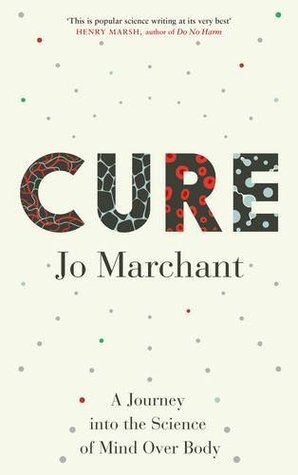 In this absorbing and well-written work of popular science, Marchant, a journalist with a PhD in genetics and medical microbiology, investigates instances where the mind seems to contribute to medical improvement: the use of placebos in transplant recipients, hypnosis for IBS patients, virtual reality to help burn victims manage pain, and the remarkable differences that social connection, a sense of purpose, meditation and empathic conversation all make. On the other hand, she shows how stress and trauma in early life can set (usually poor) people up for ill health in later years. She also travels everywhere from Boston to Lourdes to meet patients and medical practitioners, and even occasionally proffers herself as a guinea pig.
A relentless scientist, Marchant is skeptical of any claims for which there is no hard evidence, so when she acknowledges that there’s something to these unusual treatments, you know you can believe her. As Jeremy Howick of the Centre for Evidence-Based Medicine, Oxford puts it, “I think it’s more important to know that something works, than how it works.” I finished the book feeling intrigued and hopeful about what this might all mean for the future of medicine. The problem, though, is that most medical trials are funded by big pharmaceutical companies, which won’t be supportive of non-traditional methods or holistic approaches.
My rating: 
Do these books appeal to you? Do you have any experience of psychosomatic illness or mind–body medicine?
Books in Brief: Five I Loved Recently
Novels about Patricia Highsmith and a prison production of The Tempest; a true-life account of opening a secondhand bookstore; a faux memoir setting ancestors’ memories in the context of twentieth-century history; and an exposé of the happiness movement in America: these five very different books are all 4-star reads I can highly recommend.
The Crime Writer
By Jill Dawson
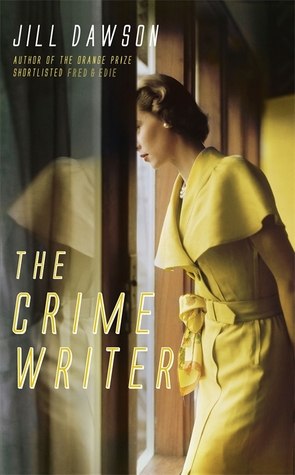 Patricia Highsmith hated the term “crime writer”; she preferred to speak of her work as “suspense novels,” animated by the threat of danger. Dawson’s terrific pastiche is set in the early 1960s, when the nomadic Highsmith was living in a remote cottage in Suffolk, England. Beyond the barest biographical facts, though, Dawson has imagined the plot based on Highsmith’s own preoccupations: fear of a stalker, irksome poison-pen letters, imagining what it would be like to commit murder … and snails. In a combination of third- and first-person narration, she shows “Pat” succumbing to alcoholism and paranoia as she carries on affairs with Sam, a married woman, and Ginny, a young journalist who’s obsessed with her. You’re never quite sure as you’re reading what is actually happening in the world of the novel and what only occurs in Highsmith’s imagination; I’m sure that’s deliberate. This counts as one of the most gripping, compulsive books I’ve encountered this year.
The Little Bookstore of Big Stone Gap
By Wendy Welch
 Everyone told Wendy Welch and her husband that they were crazy when they decided to open a used bookstore in a small Appalachian Coalfields town in the middle of a recession. They lived above the shop and initially stocked it with their own library plus books picked up cheap at yard sales – though Welch later learned to be much more choosy about what they added to their inventory and to tailor their selections to the tastes of country readers. Essentially, they were making it all up as they went along, but eight years later they’re still a community fixture in Big Stone Gap, Virginia. (I’d love to visit someday.) For the most part that’s because they branched out to fill other roles: hosting cultural events, murder mystery evenings, a writing group, a crafting circle, and regular Quaker meetings. I appreciated the details about the nitty-gritty of running a bookstore (like a chapter on pricing) more than the customer interactions. A warm and fuzzy book-lover’s delight.
Hag-Seed: The Tempest Retold
By Margaret Atwood
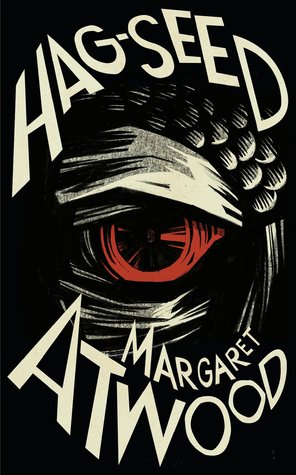 Margaret Atwood looks more like a good witch every year, and here she works her magic on The Tempest to produce the most satisfying volume of the Hogarth Shakespeare series yet. There’s a really clever play-within-the-play-within-the-play thing going on, and themes of imprisonment and performance resonate in multiple ways. It’s fun to see the disgraced Felix’s second act as a director of inmate plays at Fletcher Correctional – “I don’t care why you’re in here or what they say you’ve done: for this course the past is prologue.” Part V gets a little tedious/didactic as the cast hash out the characters’ afterlives, and at times (mainly the raps) you’re painfully aware that this is an old white lady trying to approximate how seasoned criminals might speak, but in general I thoroughly enjoyed this. Even though you see behind the scenes (e.g. my favorite chapter was about Felix wandering the streets of Toronto to buy props and costumes), you still get caught up in the magic. (See also Carolyn’s wonderful review at Rosemary and Reading Glasses.)
The Pursuit of Happiness: Why are we driving ourselves crazy and how can we stop?
By Ruth Whippman
 I call this niche genre anti-self-help. (Two other great examples are Smile or Die by Barbara Ehrenreich and Promise Land by Jessica Lamb-Shapiro.) Whippman has a particularly interesting perspective as a British Jew who moved to California for her husband’s work. With sharp humor and natural British cynicism, she investigates various manifestations of the American obsession with happiness, including the cult-like Landmark Forum, Zappos shoes HQ, Facebook’s encouragement of shallow social interaction, and the positive psychology movement. I especially liked her visit to Mormons in Salt Lake City (the nation’s happiest group, it seems, but also the most highly medicated against depression), but the funniest chapter is on happiness-focused parenting. The basic message is that the happiness movement went wrong by making it a matter of personal responsibility, of mental and spiritual triumph over circumstances. It gives no easy answers, but it’s a very enjoyable book.
Moonglow
By Michael Chabon
 Chabon’s seventh novel was inspired by his maternal grandfather’s deathbed confessions in 1989—or was it? A tongue-in-cheek author’s note refers to this as a “memoir,” and it’s narrated by “Mike Chabon,” but he and “Grandfather” (never named) are characters here in the same way that Jonathan Safran Foer and his ancestors are in Everything Is Illuminated. Space travel and explosives are Grandfather’s lifelong obsessions, but the chronology moves back and forth seemingly haphazardly, as if we are hearing this story exactly as it emerged. Chabon offers a rich meditation on how Jewishness and family secrets influence the creation of identity. With a seam of dark humor that brings to mind Jonas Jonasson’s The Hundred-Year-Old Man…, Moonglow inventively fuses family history and fiction but leaves cracks for happiness and meaning to shine through. (See my full review on the Pittsburgh Post-Gazette website.)
Have you read any of these? Which one takes your fancy?
Some Advanced 2017 Reads
I haven’t had much chance to explore 2017’s offerings yet. Although I technically have access to loads of pre-release titles through NetGalley and Edelweiss, the books in front of me and, of course, the ones I’m reading on assignment tend to take priority. Much as I’d like to be ahead of the trend, I’ve only read five 2017 titles, three of which I can recommend. Two of these happen to be poetry books; the third is a wonderful bereavement-themed memoir.
Whereas by Stephen Dunn
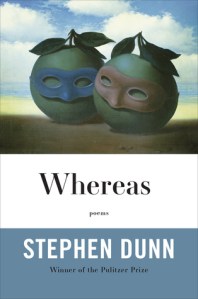 “A Card from Me to Me,” the prefatory poem, sets the tone, as the poet wishes himself a happy 75th birthday and marvels at “the strangeness, the immensity, of what I have / and have had and every small thing that against the odds continues to be.” Much of what follows is about life and death, success and failure, and what we learn from it all. For example, writing about a funeral: “at such moments / everyone is an amateur of feelings.”
I especially liked “Unnatural,” with its meditation on nature vs. artifice, “Let’s Say,” and “Nothing Personal,” about an author killing off a character (or is that God killing off the narrator?). These are very lucid poems, reading like complete sentences and thorough trains of thought, with memorable alliteration and vocabulary. I’d read more from Dunn.
Releases February 21st.
My rating: 
The Analyst by Molly Peacock
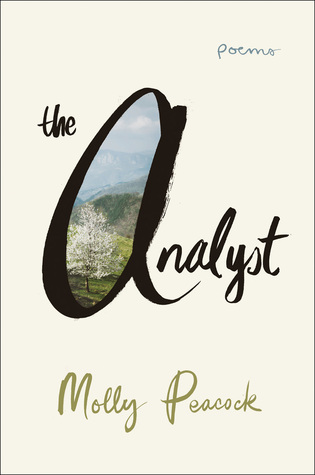 Peacock wrote this in tribute to her longtime psychoanalyst, Joan Workman Stein, who practiced in New York City until she suffered a stroke in 2012. This collection contains a rich mixture of autobiographical reflection and translations. The form and style vary from poem to poem, but I was always struck by the imagery, often drawn from the culinary and art worlds – everything from marinara sauce and a skinned rabbit to paper dolls and methods of expressing gratitude in French. I presumed the entire book would be about Stein, but instead the poems about her pre- and post-stroke life share space with ones about Peacock’s own life, from childhood onward. Having enjoyed The Paper Garden, the author’s biography of eighteenth-century artist Mary Delany, I was especially tickled to see several poems that mention collage and other paper arts, such as “Authors.”
“Mandala in the Making,” the final poem, meditates on the contrast between the drive to make art and the essential impermanence of life: “When they’re done, // they’ll brush it all away. You can’t believe it. / Nothing stays (including the memory you’ve lost). / What lasts?”
I was really impressed with this collection and will be searching out Peacock’s previous poetry books as well.
Releases January 3rd.
My rating:
Traveling with Ghosts: A Memoir by Shannon Leone Fowler
“This is a story about finding love and learning to live with loss. But mostly, it’s a story about all the places in between.” In August 2002, Fowler was traveling in Thailand with her fiancé Sean. They were embracing in shallow water outside their cabana when Fowler felt something brush past her thigh. The highly toxic box jellyfish stung Sean on his leg, and by the time she brought help he was already dead, though clinic staff went through the motions of trying to resuscitate him.
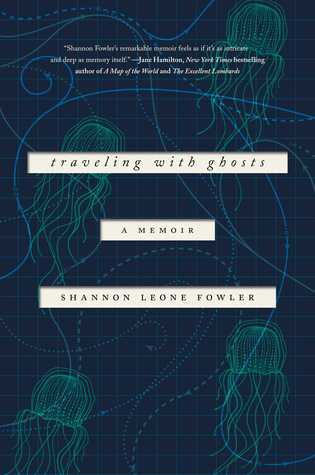 This memoir concentrates on the four and a half months that followed Sean’s death, a time that Fowler filled with constant travel through Eastern Europe – “a place where the endings [in folk tales as well as in real life] were rarely happy, but the stories were told just the same.” She had a compulsion to keep moving, as if Sean’s death was something she could outrun; she sought out risky places, going to Bosnia and then to Tel Aviv to visit the Israeli girls who helped her deal with the practicalities of Sean’s death.
Fowler toggles between her blithe trips with Sean in the few years they had together, her somber travels after his death, and the immediate aftermath of his death. Each short section is headed by the date and place, but the constant time shifts are meant to be disorienting and reflect how traumatic memories linger. Your average memoir might have brought things up to the present day by showing how the author learned and grew from the experience. This is not your average memoir. It delves into the thick of the grief and stays there. It doesn’t give easy answers about how to get over things or suggest life will later be perfect, just in a different way. It’s honest and unusual and has stayed with me. Highly recommended.
(Note: The author is the daughter of novelist Karen Joy Fowler.)
Releases February 21st.
My rating:
Two more 2017 books are on my reading stack:
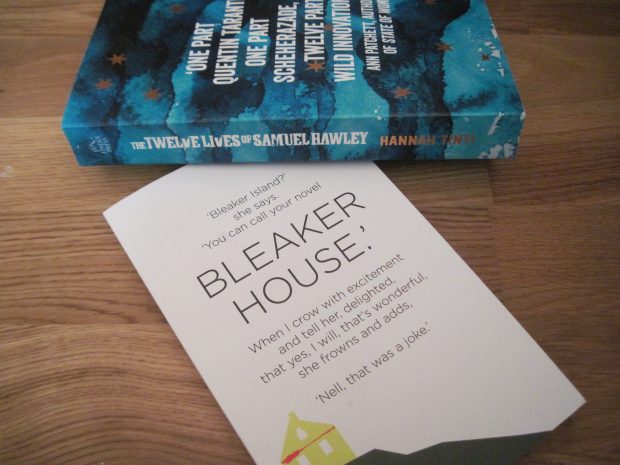
- I’m halfway through Bleaker House by Nell Stevens, a memoir about her failed attempt to write her debut novel during several months of isolation on Bleaker Island in the Falklands. It’s weird but funny, and I think any writer will relate to the feelings of loneliness and a lack of confidence. I’ll be reviewing it for Nudge. (Releases March 14th.)
- I’ll be reviewing The Twelve Lives of Samuel Hawley by Hannah Tinti for The Bookbag sometime before its March 28th release.
 Bookish Beck = Rebecca Foster. American transplant to England. Freelance proofreader and book reviewer.
