Recommended June Releases
I have an all-female line-up for you this time, with selections ranging from a YA romance in verse to a memoir by a spiritual recording artist. There’s a very random detail that connects two of these books – look out for it!

In Paris with You by Clémentine Beauvais
[Faber & Faber, 7th]
 I don’t know the source material Beauvais was working with (Eugene Onegin, 1837), but still enjoyed this YA romance in verse. Eugene and Tatiana meet by chance in Paris in 2016 and the attraction between them is as strong as ever, but a possible relationship is threatened by memories of a tragic event from 10 years ago involving Lensky, Eugene’s friend and the boyfriend of Tatiana’s older sister Olga. I’m in awe at how translator Sam Taylor has taken the French of her Songe à la douceur and turned it into English poetry with the occasional rhyme. This is a sweet book that would appeal to John Green’s readers, but it’s more sexually explicit than a lot of American YA, so is probably only suitable for older teens. (Proof copy from Faber Spring Party)
Favorite lines:
“Her heart takes the lift / up to her larynx, / where it gets stuck / hammering against the walls of her neck.”
“an adult with a miniature attention span, / like everyone else, refreshing, updating, / nibbling at time like a ham baguette.”
“helium balloons in the shape of spermatozoa straining towards the dark sky.”
My rating: 
Implosion: A Memoir of an Architect’s Daughter by Elizabeth W. Garber
[She Writes Press, 12th]
 The author grew up in a glass house designed by her father, Modernist architect Woodie Garber, outside Cincinnati in the 1960s–70s. This and his other most notable design, Sander Hall, a controversial tower-style dorm at the University of Cincinnati that was later destroyed in a controlled explosion, serve as powerful metaphors for her dysfunctional family life. Woodie is such a fascinating, flawed figure. Manic depression meant he had periods of great productivity but also weeks when he couldn’t get out of bed. He and Elizabeth connected over architecture, like when he helped her make a scale model of Le Corbusier’s Villa Savoye for a school project, but it was hard for a man born in the 1910s to understand his daughter’s generation or his wife’s desire to go back to school and have her own career.
Mixed feelings towards a charismatic creative genius who made home life a torment and the way their fractured family kept going are reasons enough to read this book. But another is just that Garber’s life has been so interesting: she witnessed the 1968 race riots and had a black boyfriend when interracial relationships were frowned upon; she was briefly the librarian for the Oceanics School, whose boat was taken hostage in Panama; and she dropped out of mythology studies at Harvard to become an acupuncturist. Don’t assume this will be a boring tome only for architecture buffs. It’s a masterful memoir for everyone. (Read via NetGalley on Nook)
My rating: 
Florida by Lauren Groff
[William Heinemann (UK), 7th / Riverhead (USA), 5th]
 My review is in today’s “Book Wars” column in Stylist magazine. Two major, connected threads in this superb story collection are ambivalence about Florida, and ambivalence about motherhood. The narrator of “The Midnight Zone,” staying with her sons in a hunting camp 20 miles from civilization, ponders the cruelty of time and her failure to be sufficiently maternal, while the woman in “Flower Hunters” is so lost in an eighteenth-century naturalist’s book that she forgets to get Halloween costumes for her kids. A few favorites of mine were “Ghosts and Empties,” in which the narrator goes for long walks at twilight and watches time passing through the unwitting tableaux of the neighbors’ windows; “Eyewall,” a matter-of-fact ghost story; and “Above and Below,” in which a woman slips into homelessness – it’s terrifying how precarious her life is at every step. (Proof copy)
Favorite lines:
“What had been built to seem so solid was fragile in the face of time because time is impassive, more animal than human. Time would not care if you fell out of it. It would continue on without you.” (from “The Midnight Zone”)
“The wind played the chimney until the whole place wheezed like a bagpipe.” (from “Eyewall”)
“How lonely it would be, the mother thinks, looking at her children, to live in this dark world without them.” (from “Yport”)
My rating:
The Most Beautiful Thing I’ve Seen: Opening Your Eyes to Wonder by Lisa Gungor
[Zondervan, 26th]
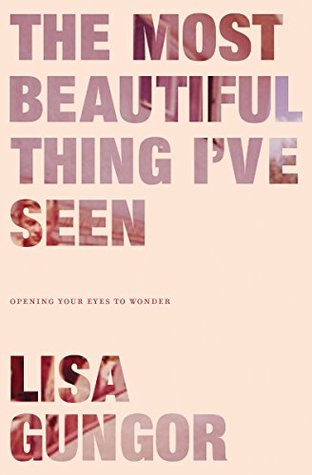 You’re most likely to pick this up if you enjoy Gungor’s music, but it’s by no means a band tell-all. The big theme of this memoir is moving beyond the strictures of religion to find an all-encompassing spirituality. Like many Gungor listeners, Lisa grew up in, and soon outgrew, a fundamentalist Christian setting. She bases the book around a key set of metaphors: the dot, the line, and the circle. The dot was the confining theology she was raised with; the line was the pilgrimage she and Michael Gungor embarked on after they married at 19; the circle was the more inclusive spirituality she developed after their second daughter, Lucie, was born with Down syndrome and required urgent heart surgery. Being mothered, becoming a mother and accepting God as Mother: together these experiences bring the book full circle. Barring the too-frequent nerdy-cool posturing (seven mentions of “dance parties,” and so on), this is a likable memoir for readers of spiritual writing by the likes of Sue Monk Kidd, Mary Oliver and Terry Tempest Williams. (Read via NetGalley on Kindle)
My rating:
 Orchid & the Wasp by Caoilinn Hughes
[Oneworld, 7th] – see my full review. 
Ok, Mr Field by Katharine Kilalea
[Faber & Faber, 7th]
 Mr. Field is a concert pianist whose wrist was shattered in a train crash. With his career temporarily derailed, there’s little for him to do apart from wander his Cape Town house, a replica of Le Corbusier’s Villa Savoye, and the nearby coastal path. He also drives over to spy on his architect’s widow, with whom he’s obsessed. He’s an aimless voyeur who’s more engaged with other people’s lives than with his own – until a dog follows him home from a graveyard. This is a strangely detached little novel in which little seems to happen. Like Asunder by Chloe Aridjis and Leaving the Atocha Station by Ben Lerner, it’s about someone who’s been coasting unfeelingly through life and has to stop to ask what’s gone wrong and what’s worth pursuing. It’s so brilliantly written, with the pages flowing effortlessly on, that I admired Kilalea’s skill. Her descriptions of scenery and music are particularly good. In terms of the style, I was reminded of books I’ve read by Katie Kitamura and Henrietta Rose-Innes. (Proof copy from Faber Spring Party)
My rating:
This came out in the States (from Riverhead) back in early April, but releases here in the UK soon, so I’ve added it in as a bonus.
The Female Persuasion by Meg Wolitzer
[Chatto & Windus, 7th]
 An enjoyable story of twentysomethings looking for purpose and trying to be good feminists. To start with it’s a fairly familiar campus novel in the vein of The Art of Fielding and The Marriage Plot, but we follow Greer, her high school sweetheart Cory and her new friend Zee for the next 10+ years to see the compromises they make as ideals bend to reality. Faith Frank is Greer’s feminist idol, but she’s only human in the end, and there are different ways of being a feminist: not just speaking out from a stage, but also quietly living every day in a way that shows you value people equally. I have a feeling this would have meant much more to me a decade ago, and the #MeToo-ready message isn’t exactly groundbreaking, but I very much enjoyed my first taste of Wolitzer’s sharp, witty writing and will be sure to read more from her. This seems custom-made for next year’s Women’s Prize shortlist. (Free from publisher, for comparison with Florida in Stylist “Book Wars” column.)
My rating:
What June books do you have on the docket? Have you already read any that you can recommend?
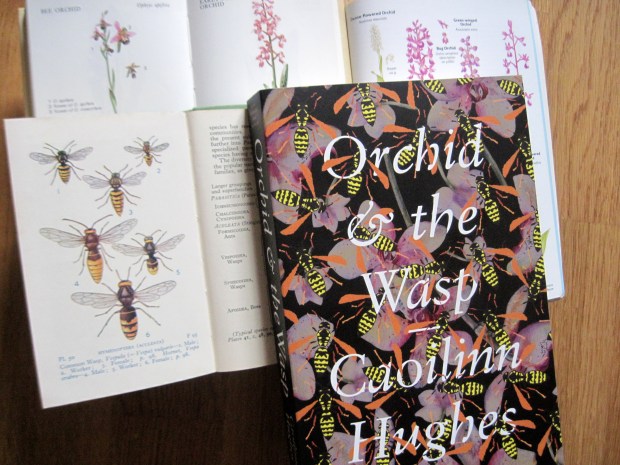
Orchid & the Wasp by Caoilinn Hughes
Gael Foess, the antiheroine of Caoilinn Hughes’ debut novel, is a trickster. When we first meet her in Dublin in 2002, the 11-year-old is promptly kicked out of school for trying to sell other girls “virginity pills.” As the years pass we see her con her way into a London Business School interview, self-assuredly teach a literature class when her professor doesn’t show up, pretend to be a journalist to get an exclusive interview, and use deception to try to boost the careers of both her mother, Sive (a conductor), and her younger brother, Guthrie (a painter and single dad). In the title metaphor, which refers to an orchid species that lures pollinating wasps, Gael is the seductive flower that gets what it wants. We’re also invited to think of her, with that typically Gael-ic name, as an incarnation of mythological Irish hero Cúchulainn.
The novel spans about nine years: a politically turbulent decade that opens with Iraq War protests and closes with the Occupy movement in New York City. The financial crisis temporarily jolts Gael and Guthrie’s father, Jarleth, a high-flying Barclays banker who leaves the family in 2008. The biblical parable of the talents, which he recounted to Gael when she was a little girl, comes back to resonate: It’s a potent reminder that money and skills don’t get distributed fairly in this life. When Gael gets to New York in 2011, she plans to redress the balance in two paradoxical ways: living in the Occupy camp and taking part in protests; and secretly earning her brother a fortune on his modern art. For even while decrying her father’s privilege, she indulges her own love of fine things; even if ironically, she says that she aspires to be in the 1%, too.
With all her contradictions, Gael is an unforgettable character. I also found Guthrie fascinating. It was serendipitous that I read this novel alongside Suzanne O’Sullivan’s new book, Brainstorm. Guthrie was a mystically religious child and suffered from seizures, which doctors determined weren’t due to epilepsy but to somatic delusions – psychological rather than physiological. The seizures, ironically, became a boon because they inspire his art: “they’re hallowed and each aura is an absolution – a benison – and not just a synaptic blip.”

The U.S. cover
Hughes is wonderfully adept at voices, bringing secondary characters to life largely through how they speak. I especially warmed to Art, Sive’s boyfriend, who’s a Yorkshireman; and Harper, Gael’s OCD-plagued flatmate from Las Vegas. Even a brief run-in with American officialdom gets the perfect deadpan rendering: “United States Customs has no interest in surprises. Matter of fact, we hate surprises.” The novel often has a frenetic pace – an energy that’s well matched by the virtuosic use of language, with wordplay, neologisms, and metaphors drawn from art, music and nature. An orchestra is compared to a flock of starlings; a despondent Sive “began to resemble a bass clef.” The Irish are like radishes: “Pink on the outside, white underneath. Speck of mud on their cheeks.” Harper’s entire upbringing is pithily reduced to an “only-childhood of sprinkler weather, window glare and doughnut glazing.” I also loved this tiny poem of a phrase: “sobbing hampers syntax.”
My only real misgiving about the novel is the ending: After Gael comes back from New York, things sort of fizzle out. I even wondered if the story line could have stopped a chapter earlier. But in a way it makes sense to get no tidy closure for our protagonist. Gael is still only 20 years old at the book’s end, so it’s no surprise that she remains a restless wanderer. I certainly wouldn’t object to hearing about her further adventures in a sequel. Hughes is an exciting writer who has rightfully attracted a lot of buzz for her debut, and this is sure to be one of my novels of the year. It’s a perfect follow-on read from Tom Rachman’s The Italian Teacher, and I’d also recommend it highly to fans of Sweetbitter, The Art of Fielding, The Nix, and The Life and Death of Sophie Stark. Watch out for it in two weeks’ time.
My rating: 
Orchid & the Wasp will be published by Oneworld in the UK on June 7th. It’s not out in the USA until July 10th (Hogarth). My thanks to Margot Weale for a proof copy for review.
Natural Causes by Barbara Ehrenreich & Human Errors by Nathan Lents
Two recent books about our flawed bodies and the ultimate pointlessness of trying to control them…
Natural Causes: Life, Death and the Illusion of Control by Barbara Ehrenreich
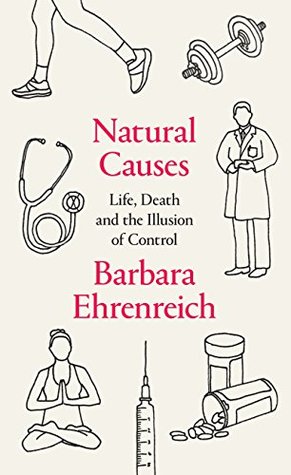 A decade ago, Barbara Ehrenreich discovered a startling paradox through a Scientific American article: the immune system assists the growth and spread of tumors, including in breast cancer, which she had in 2000. It was an epiphany for her, confirming that no matter how hard we try with diet, exercise and early diagnosis, there’s only so much we can do to preserve our health; “not everything is potentially within our control, not even our own bodies and minds.” I love Ehrenreich’s Smile or Die (alternate title: Bright-Sided), which is what I call an anti-self-help book refuting the supposed health benefits of positive thinking. In that book I felt like her skeptical approach was fully warranted, and I could sympathize with her frustration – nay, outrage – when people tried to suggest she’d attracted her cancer and limited her chances of survival through her pessimism.
However, Natural Causes is so relentlessly negative and so selective in the evidence it provides that, even though it’s sure to be considered for next year’s Wellcome Book Prize longlist, I would be unlikely to recommend it. In the first chapter, “Midlife Revolt,” which has been excerpted at Literary Hub and is worth reading, Ehrenreich writes of her decision to give up routine medical screening after a false positive mammogram caused undue stress. She decided once she passed 70 she was old enough to die without accepting a “medicalized life.” Moreover, she believes there’s an epidemic of “overdiagnosis,” especially in the USA, where there can be a profit motive behind testing. (This is certainly not the case in the UK, where the NHS doesn’t pester me about getting cervical smear tests to line any pockets; no, it’s about saving taxpayers money by catching cancer early and thus minimizing treatment costs.)
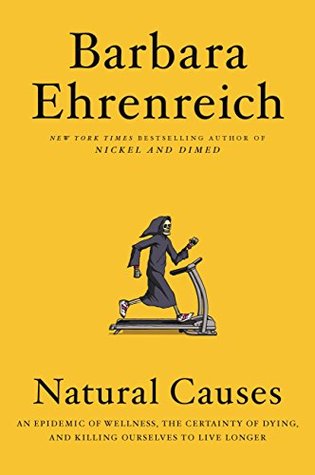
I love the U.S. cover. (Note the different subtitle.)
Ehrenreich goes on to argue that many medical procedures are simply rituals to establish patient trust, that cancer screening is invasive and ineffective, that there is little evidence that meditation does any good, and that fitness has become a collective obsession that probably doesn’t help us live any longer. It’s uncomfortable to hear her dismiss early detection techniques as worthless; no one whose doctor found cancer in the early stages would agree. The author also seems unwilling to confront her own personal prejudices (e.g. against yoga).
Although she uses plenty of statistics to back up her points, these usually come from newspapers and websites rather than peer-reviewed journals; only in two chapters about how macrophages ‘betray’ the body by abetting cancer does she consult the scientific literature, in keeping with her PhD in cellular immunology. Her most bizarre example of how our bodies aren’t evolutionarily fit for purpose is copious menstruation. Overall, the book is a strange mixture of hard science, social science, and, in later chapters, philosophy, as Ehrenreich asks about the nature of the self and the soul and what survives of us after death. As usual, her work is very readable, but this doesn’t match up to many other mind/body books I’ve read.
Favorite lines:
“The only cure for bad science is more science, which has to include both statistical analysis and some recognition that the patient is not ‘just a statistic,’ but a conscious, intelligent agent, just as the doctor is.”
“The objection raised over and over to any proposed expansion of health insurance was, in so many words: Why should I contribute to the care of those degenerates who choose to smoke and eat cheeseburgers? … we persist in subjecting anyone who dies at a seemingly untimely age to a kind of bio-moral autopsy: Did she smoke? Drink excessively? Eat too much fat and not enough fiber? Can she, in other words, be blamed for her own death?”
My rating: 
Natural Causes was published in the UK by Granta on April 12th. My thanks to the publisher for the free copy for review.
Human Errors: A Panorama of Our Glitches, from Pointless Bones to Broken Genes by Nathan H. Lents
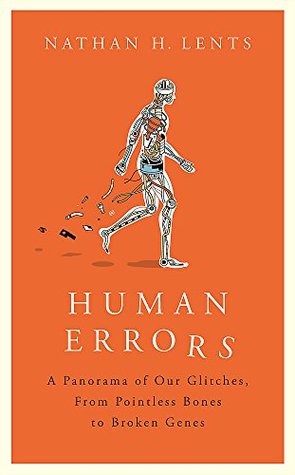 Lents is a biology professor at John Jay College, City University of New York, and in this, his second book, he explores the ways in which the human body is flawed. These errors come in three categories: adaptations to the way the world was for early humans (to take advantage of once-scarce nutrients, we gain weight quickly – but lose it only with difficulty); incomplete adaptations (our knees are still not fit for upright walking); and the basic limitations of our evolution (inefficient systems such as the throat handling both breath and food, and the recurrent laryngeal nerve being three times longer than necessary because it loops around the aorta). Consider that myopia rates are 30% or higher, the retina faces backward, sinuses drain upwards, there are 100+ autoimmune diseases, we have redundant bones in our wrist and ankle, and we can’t produce most of the vitamins we need. Put simply, we’re not a designer’s ideal. And yet this all makes a lot of sense for an evolved species.
My favorite chapter was on the inefficiencies of human reproduction compared to that of other mammals. Infertility and miscarriage rates are notably high, and gestation is shorter than it really needs to be: because otherwise their heads would get too big to pass through the birth canal, all babies are effectively born premature, so are helpless for much longer than other newborn mammals. I also especially liked the short section on cancer, which would eventually get us all if we only lived long enough. As it is, “evolution has struck an uneasy balance with cancer. Mutations cause cancer, which kills individuals, but it also brings diversity and innovation, which is good for the population.”
Lents writes in a good conversational style and usually avoids oversimplifying the science. In places his book reminded me of Kathryn Schulz’s Being Wrong and Mark O’Connell’s To Be a Machine. It’s a wry and gentle treatment of human weakness; the content never turns depressing or bitter. Recommended for all curious readers of popular science.
Favorite lines:
“While lithopedions [“stone babies”] and abdominal pregnancies are quite rare, they are also 100 percent the result of poor design. Any reasonable plumber would have attached the fallopian tube to the ovary, thereby preventing tragic and often fatal mishaps like these.”
“to call our immune system perfectly designed would be equally inaccurate. There are millions of people who once happily walked this planet only to meet their demise because their bodies simply self-sabotaged. When bodies fight themselves, there can be no winner.”
My rating:
Human Errors was published in the UK by Weidenfeld & Nicolson on May 3rd. My thanks to the publisher for the free copy for review.
Blog Tour Review: Why Do Birds Suddenly Disappear? by Lev Parikian
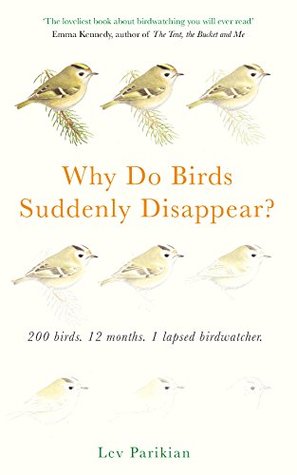 Lev Parikian was a keen birdwatcher when he was 11, but as an adult he barely remembered most of what he used to know about birds. He’d confidently declare that he’d seen a nightingale and then be too embarrassed to later admit it was actually a skylark. Also, he had to acknowledge that he hadn’t been completely honest as a preteen birder: No way had he seen a black redstart, for instance. Probably about 30% of his childhood sightings could be dismissed as cheats or downright lies. As the birdwatching bug bit again at the start of 2016, he decided it was time to set the record straight. His aim? To see 200 birds in a year, with no twitching (driving many miles to see a reported rarity) and no cheating.
Most of the book is a chronological tour through 2016, with each month’s new sightings totaled up at the end of the chapter. Being based in London isn’t the handicap one might expect – there’s a huge population of parakeets there nowadays, and the London Wetland Centre in Barnes is great for water birds – but Parikian also fills in his list through various trips around the country. He picks up red kites while in Windsor for a family wedding, and his list balloons in April thanks to trips to Minsmere and Rainham Marshes, where he finds additions like bittern and marsh harrier. The Isle of Wight, Scotland, Lindsifarne, North Norfolk… The months pass and the numbers mount until it’s the middle of December and his total is hovering at 196. Will he make it? I wouldn’t dare spoil the result for you!
I’ve always enjoyed ‘year-challenge’ books, everything from Julie Powell’s Julie and Julia to Nina Sankovitch’s Tolstoy and the Purple Chair, so I liked this memoir’s air of self-imposed competition, and its sense of humor. Having accompanied my husband on plenty of birdwatching trips, I could relate to the alternating feelings of elation and frustration. I also enjoyed the mentions of Parikian’s family history and career as a freelance conductor – I’d like to read more about this in his first book, Waving, Not Drowning (2013). This is one for fans of Alexandra Heminsley’s Leap In and Kyo Maclear’s Birds Art Life, or for anyone who needs reassurance that it’s never too late to pick up a new skill or return to a beloved hobby.
Lastly, I must mention what a beautiful physical object this book is. The good folk of Unbound have done it again. The cover image and endpapers reproduce Alan Harris’s lovely sketch of a gradually disappearing goldcrest, and if you lift the dustjacket you’re rewarded with the sight of some cheeky bird footprints traipsing across the cover.


Some favorite passages:
“Birders love a list. Day lists, week lists, month lists, year lists, life lists, garden lists, county lists, walk-to-work lists, seen-from-the-train lists, glimpsed-out-of-the-bathroom-window-while-doing-a-poo lists.”
“It’s one thing sitting in your favourite armchair, musing on the plumage differences between first- and second-winter black-headed gulls, but that doesn’t help identify the scrubby little blighter that’s just jigged into that bush, never to be seen again. And it’s no use asking them politely to damn well sit still blast you while I jot down the distinguishing features of your plumage in this notebook dammit which pocket is it in now where did I put the pencil ah here it is oh bugger it’s gone. They just won’t. Most disobliging.”
“There is a word in Swedish, gökotta, for the act of getting up early to listen to birdsong, but the knowledge that this word exists, while heartwarming, doesn’t make it any easier. It’s a bitter pill, this early rising, but my enthusiasm propels me to acts of previously unimagined heroism, and I set the alarm for an optimistic 5 a.m., before reality prompts me to change it to 5.15, no 5.30, OK then 5.45.”
My rating:
Why Do Birds Suddenly Disappear? was published by Unbound on May 17th. My thanks to the publisher for the free copy for review.
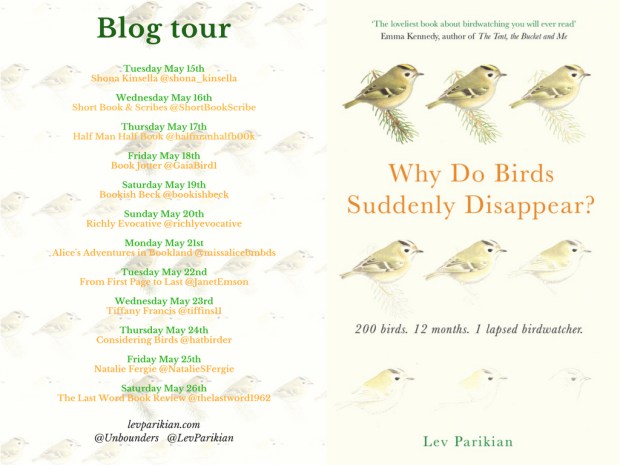
I was delighted to be invited to participate in the blog tour for Why Do Birds Suddenly Disappear? See below for details of where other reviews and features have appeared or will be appearing soon (including on my hubby’s blog on Thursday!).
Blog Tour: Mr Peacock’s Possessions by Lydia Syson
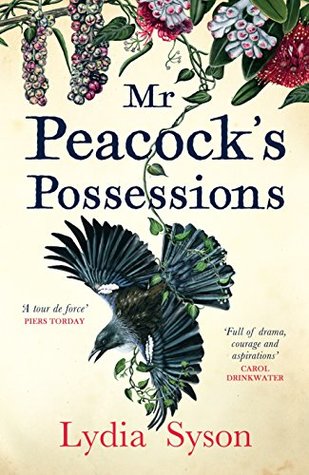 Mr Peacock’s Possessions, Lydia Syson’s first novel for adults, will be published in the UK by Zaffre on May 17th. You might think of it as a cross between Lloyd Jones’s Mister Pip and Lucy Treloar’s Salt Creek. Set in the late 1870s in New Zealand and Oceania, it’s the story of the Peacock family, who settled on Monday Island two years ago, believing it would be their own “piece of paradise.” Mr Peacock is a self-assured man of many schemes. One day fifteen-year-old Lizzie spots a ship, and a Pacific Islander jumps off it and swims ashore. This is Kalala, who learned English and gentlemanly manners from “Mr Reverend” and narrates his chapters in a charming patois. He’s here to help with manual labour, but Mr Peacock unsettles him: “he goes from light to dark like a forest walk,” as his family knows all too well. The novel is based loosely on Syson’s husband’s family history.
Today as part of the blog tour I have an extract from Kalala’s narration as he approaches the island.
In water once more, all my limbs are joyful, and my ears too, joyful with bubbling whoosh, all sluice and surge and flow, a dulled and busy quietness which is never silence. Eyes open in infinite blue. A slow-winging turtle rises. I rise myself, for air, and sink again. The sea argues: back and forth, it tests me sorely – but I know these tricks and tumbles, and I have power enough in mind and body to work these waves to my delight.
Head up and out.
The shore approaches.
I am down and under, and now give way and let the water roller me in – the rocks cry out a warning – I swim sideways with all my ebbing strength – so fast so fast – and then a mighty power throws me down, hard, in whiteness. Yet I claw for life with so much longing that nothing can pull me back. Fiercely I fight – my enemy, my friend – the suck of it, guzzling and gulping at my legs. Ploughing and pushing, now in air, gasping, now under foam, I launch my body and dive for land.
My bellowing back ups and downs, unasked. My chest is first fast and roaring, then slower and slower still. Smallest of stones print my face, embed their heat in all my body. Ears whine and sing. Foam flicks and waves reach, rush, drag at my feet, trying to lure me back into water, over and again, but I resist the sea’s entreaties, crawl from its hungry reach. My head hammers and hums and stars whirl brightly in my closed eyes. I wait for all to slow, for glow to dim, for land to cease its tipping.
And then I raise my head and look up and down the beach. Nobody. Spume slides slowly on flat wet sand where sky and clouds lie spread and wrinkled. Some scattered rocks. So much sand. On and on and on all along the shore. Out of the sea’s reach, the land dries and lightens, stretches up to a wall of rock, grass at bottom and green bushes tipping from on top. Not so high you could not climb it. There will be holes for fingers and toes in the red-brown lumps and chunks. Or I will find another way to reach the houses and the children. When I can breathe. I hardly can hold my head up yet.
Thud. Thud. Thud. As this thumping lulls in head and heart, I gather strength. Here I am, Monday Island. I have come as commanded. Now it is for you to make good your promise.
Two Memoirs of Women’s Freedom: Lara Feigel and Rebecca Loncraine
I have read some truly phenomenal memoirs this year, most of them by women. These two have rather different starting points – frustration with the constraints of marriage and motherhood, and breast cancer treatment – but I’ve paired them because both are journeys of self-discovery in which the author commits to determining how to live a free and true life.
Free Woman: Life, Liberation and Doris Lessing by Lara Feigel
 It started with a spate of weddings one summer. Lara Feigel, a literature lecturer at King’s College London, found herself strangely irked at all this capitulation to marital convention, even though she herself had married in her twenties and had a young son. What did her mild outrage signify? At the same time, she was rereading the works of Doris Lessing, whom she found simultaneously admirable and vexing: Lessing lived by her ideals of free love and Communism, but it came at the price of abandoning her children. Feigel could identify with Lessing in some ways but not in others, and as she entered a rocky time in her mid-thirties – a miscarriage followed by IVF, which was a strain on her marriage; the death of a close friend; and ongoing worry over how motherhood might affect her academic career – she set out to find what Lessing could teach her about how to be free.
Throughout, Feigel holds up her own experiences of marriage and motherhood in parallel to Lessing’s. She maintains a delicate balance between biographical and autobiographical information and brings in references to other writers – everyone from Rachel Cusk to D.H. Lawrence – to explore various opinions on maternal ambivalence and sexual fulfillment. I could relate to the bookworm’s impulse to turn to literature for comfort and direction – “the most enduring novelists … illuminate our lives,” and “we live differently as a result of reading them,” Feigel insists. Lessing seemed to her the perfect “writer to discover in your thirties; a writer who wrote about the lives of grown-up women with an honesty and fullness I had not found in any novelist before or since.”
And yet a familiarity with or fondness of the works of Doris Lessing is not a prerequisite to enjoying this book. I’ve only ever read The Golden Notebook (1962) and Alfred and Emily (2008), a fictionalized biography of Lessing’s parents, both during my mid-twenties. The former I almost certainly read before I could fully appreciate it. It’s about the ways in which women compartmentalize their lives and the struggle to bring various strands into harmony; that’s what Free Woman is all about as well. Feigel often looks for clues in Lessing’s heavily autobiographical Martha Quest novels, which I’d like to read, and also travels to California to meet one of Lessing’s lovers and to Zimbabwe to see the farm where Lessing grew up.
Like Samantha Ellis’s How to Be a Heroine and Rebecca Mead’s My Life in Middlemarch, this is a richly satisfying hybrid of biography, literary criticism and memoir. I would also recommend it to readers of Alexandra Fuller’s Don’t Let’s Go to the Dogs Tonight, Nancy Horan’s Loving Frank, and Adrienne Rich’s Of Woman Born. Feigel’s is a particularly brave and forthright book. I feel proud of her in an oddly personal way: during my years as a library assistant at King’s, I saw her chair countless literature and life writing events. She seemed impossibly young for a professor type, and wore her navy blue shift dress and string of pearls like it was her grown-up’s uniform. I can tell that the years since, including the difficult experiences she recounts here, have both softened and toughened her, sandpapering away what she calls her “diffident angularity” and replacing it with womanly wisdom.
My rating:
Free Woman was published by Bloomsbury UK on March 8th. My thanks to the publisher for the free copy for review.
Skybound: A Journey in Flight by Rebecca Loncraine
 In 2016 it was When Breath Becomes Air by Paul Kalanithi; in 2017 it was The Bright Hour by Nina Riggs. And now Skybound. Each year seems to bring one exquisite posthumous memoir about facing a death from cancer with dignity. For Rebecca Loncraine, after treatment for breast cancer in her early thirties, taking flying lessons in an unpowered glider was her way of rediscovering joy and experiencing freedom by facing her fears in the sky.
She was a freelance writer based on her parents’ farm in the Black Mountains of Wales, an area that’s familiar to me from trips to Hay-on-Wye and from my reading of Bruce Chatwin’s On the Black Hill. The history and geography of the region, as revealed from the air, weave through the book, as do childhood memories and recollections of chemotherapy. Loncraine discovered a particular love for flying alongside birds: the red kites in Wales, and later vultures in Nepal. The most remarkable passages of the book are the exhilarating descriptions of being thousands of feet up in the air and the reflections on why humans are drawn to flight and what it does for our bodies and spirits. She learned from a British Airways pilot that 500,000 people are airborne at any one moment! We take for granted what should still be acknowledged as a miraculous feat.
“There’s no road in the sky. Each individual glider pilot finds a new pathless way through the air, a unique scribble. We locate a bit of ridge lift, here; fly out to a thermal, there; we wind and manoeuvre over the curving land. We never take the same route twice, so flight offers me a new perspective each time I fly.”
“Influenced by the ancient seam of human thought that associates the sky with the imagination, weaving and circling in the sky begins to feel like sailing through the realm of the subconscious itself.”
This hobby-turned-obsession was not without its inconveniences and dangers. Even when it’s warm at ground level it’s frigid at 13,000 feet, so you have to bundle up. Meanwhile, the strength of the sun means you keep guzzling water and have to wear either a urine-collecting device or adult diapers. The earliest attempts at unpowered flight were generally fatal, and when Loncraine went to New Zealand for a bonus season of flying to replace the Welsh winter, one of her fellow flyers died in a crash. Her instructor told her she’d become fearless, even reckless. But when she met one of the pioneers of gliding, then in his nineties, in New Zealand he spoke an aphorism that perfectly captures the role flying played for Loncraine: “The antidote to fear is fascination.”
There’s a brief afterword by Loncraine’s mother, Trisha. Her daughter had virtually finished this manuscript when the cancer returned, and underwent another 14 grueling months of treatment before her death in September 2016. This is a simply wonderful book; what a shame that we won’t get another.
My rating: 
Skybound was published by Picador on April 19th. My thanks to the publisher for a proof copy for review.
Mini-Reviews of Three Recent Releases: Chariandy, Dean & Tallack
Brother by David Chariandy
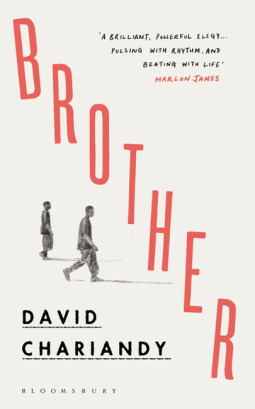 Canadian author David Chariandy’s second novel was longlisted for the Giller Prize and won the Rogers Writers’ Trust Fiction Prize. Narrator Michael and his older brother Francis grew up in the early 1980s in The Park, a slightly dodgy area of Toronto. Their single mother, Ruth, is a Trinidadian immigrant who worked long shifts as a cleaner to support the family after their father left early on. From the first pages we know that Francis is an absence, but don’t find out why until nearly the end of the book. The short novel is split between the present, as Michael and Ruth try to proceed with normal life, and vignettes from the past, culminating in the incident that took Francis from them 10 years ago.
The title is literal, of course, but also street slang for friends or comrades. Michael looked up to street-smart Francis, who fell in with a gang of “losers and neighbourhood schemers” and got expelled from school at age 18. Francis tried to teach his little brother how to carry himself: “You’ve got to be cooler about things, and not put everything out on your face all the time.” Yet the more we hear about Francis staying with friends at a barber shop and getting involved with preparations for a local rap DJ competition, the more his ideal of aloof masculinity starts to sound ironic, if not downright false.
I came into the book with pretty much no idea of what it was about. It didn’t fit my narrow expectations of Canadian fiction (sweeping prairie stories or hip city ones); instead, it reminded me of The Corner by David Simon, We, the Animals by Justin Torres, and Another Day in the Death of America by Gary Younge. It undoubtedly gives a powerful picture of immigrant poverty and complicated grief. Yet the measured prose somehow left me cold.
My rating: 
Brother was published in the UK by Bloomsbury on March 8th. My thanks to the publisher for the free copy for review.
Sharp by Michelle Dean
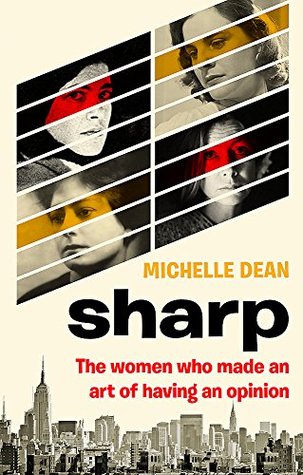 “People have trouble with women who aren’t ‘nice,’ … who have the courage to sometimes be wrong in public.” In compiling 10 mini-biographies of twentieth-century women writers and cultural critics who weren’t afraid to be unpopular, Dean (herself a literary critic) celebrates their feminist achievements and insists “even now … we still need more women like this.” Her subjects include Rebecca West, Mary McCarthy, Susan Sontag, Joan Didion, Nora Ephron and Renata Adler. She draws on the women’s correspondence and published works as well as biographies to craft concise portraits of their personal and professional lives.
You’ll get the most out of this book if a) you know nothing about these women and experience this as a taster session; or b) you’re already interested in at least a few of them and are keen to learn more. I found the Dorothy Parker and Hannah Arendt chapters most interesting because, though I was familiar with their names, I knew very little about their lives or works. Parker’s writing was pulled from a slush pile in 1914 and she soon replaced P.G. Wodehouse as Vanity Fair’s drama critic. Her famous zingers masked her sadness over her dead parents and addict husband. “This was her gift,” Dean writes: “to shave complex emotions down to a witticism that hints at bitterness without wearing it on the surface.”
Unfortunately, such perceptive lines are few and far between, and the book as a whole lacks a thesis. Chance meetings between figures sometimes provide transitions, but the short linking chapters are oddly disruptive. In one, by arguing that Zora Neale Hurston would have done a better job covering a lynching than Rebecca West, Dean only draws attention to the homogeneity of her subjects: all white and middle-class; mostly Jewish New Yorkers. I knew too much about Sontag and Didion to find their chapters interesting, but enjoyed reading more about Ephron. I’ll keep the book to refer back to when I finally get around to reading Mary McCarthy. It has a terrific premise, but I found myself asking what the point was.
My rating:
Sharp was published in the UK by Fleet on May 3rd. My thanks to the publisher for a proof copy for review.
The Valley at the Centre of the World by Malachy Tallack
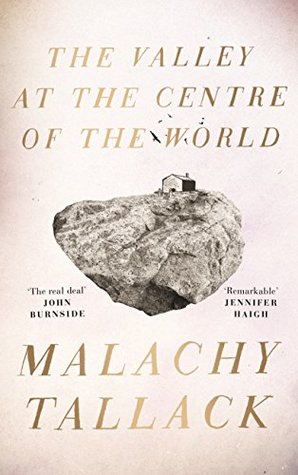 I’d previously enjoyed Malachy Tallack’s two nonfiction books, Sixty Degrees North and The Undiscovered Islands. In his debut novel he returns to Shetland, where he spent some of his growing-up and early adult years, to sketch out a small community and the changes it undergoes over about ten months. Sandy has lived in this valley for three years with Emma, but she left him the day before the action opens. Unsure what to do now, he sticks around to help her father, David, butcher the lambs. After their 90-year-old neighbor, Maggie, dies, Sandy takes over her croft. Other valley residents include Ryan and Jo, a troubled young couple; Terry, a single dad; and Alice, who moved here after her husband’s death and is writing a human and natural history of the place, The Valley at the Centre of the World. (This strand reminded me of Annalena McAfee’s Hame.)
The prose is reminiscent of the American plain-speaking style of books set in the South or Appalachia – Richard Ford, Walker Percy, Ron Rash and the like. We dive deep into this tight-knit community and its secrets. It’s an offbeat blend of primitive and modern: the minimalism of the crofting life contrasts with the global reach of Facebook, for instance. When Ryan and Jo host a housewarming party, all the characters are brought together at about the halfway point, and some relationships start to shift. Overall, though, this is a slow and meandering story. Don’t expect any huge happenings, just some touching reunions and terrific scenes of manual labor. David is my favorite character, an almost biblical patriarch who seems “to live in a kind of eternal present, looking neither forward nor backward but always, somehow, towards the land.”
Tallack has taken a risk by writing in phonetic Shetland dialect. David’s speech is particularly impenetrable. The dialect does rather intrude; the expository passages are a relief. I’ve been to Shetland once, in 2006. This quiet story of belonging versus being an outsider is one to reread there some years down the line: I reckon I’d appreciate it more on location.
My rating: 
The Valley at the Centre of the World was published by Canongate on May 3rd. My thanks to the publisher for the free copy for review.
The Language of Kindness: A Nurse’s Story by Christie Watson
After all that Wellcome Book Prize reading, I’ve given myself a break from the medical reads, right? No way! I’m already eagerly looking out for hopefuls for next year’s prize – I’ve amassed quite a nice little pile – and this is a particularly strong candidate, based on the 20 years that Watson spent as a nurse in England’s health system before leaving to write full-time. (Her debut, Tiny Sunbirds Far Away, won the Costa First Novel Award in 2011; she followed it up with Where Women Are Kings in 2013.) It taps into the widespread feeling that medicine is in desperate need of a good dose of compassion, and will ring true for anyone who spends time in hospitals, whether as a patient or a carer.
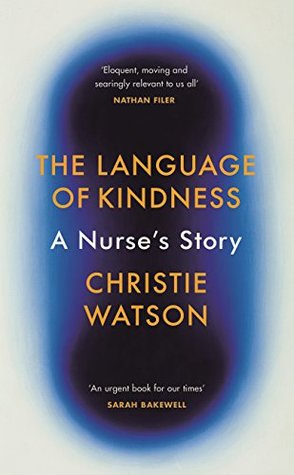 Watson presents her book as a roughly chronological tour through the stages of nursing – from pediatrics through to elderly care and the tending to dead bodies – but also through her own career, as she grows from a seventeen-year-old trainee who’s squeamish about blood to a broadly experienced nurse who can hardly be fazed by anything. The first chapter is set up like a tour of the hospital, describing everything she sees and hears as she makes her way up to her office, and the final chapter takes place on her very last day as a nurse, when, faced with a laboring mother in a taxi, she has to deliver the baby right there in the carpark.
In between we hear a series of vivid stories that veer between heartwarming and desperately sad. Watson sees children given a second shot at life. Aaron gets a heart–lung transplant to treat his cystic fibrosis and two-year-old Charlotte bounces back from sepsis – though with prosthetic limbs. But she also sees the ones who won’t get better: Tia, a little girl with a brain tumor; Mahesh, who has muscular dystrophy and relies on a breathing tube; and Jasmin, who is brought to the hospital after a house fire but doesn’t survive for long. She dies in the nurses’ arms as they’re washing the smoke smell out of her hair.
Although Watson specialized in children’s intensive care nursing, she trained in all branches of nursing, so we follow her into the delivery room, mental health ward, and operating theatre. As in Maggie O’Farrell’s I Am, I Am, I Am, we learn about her links to hospitals over the years, starting with her memories of being nursed as a child. She met her former partner, a consultant, at the hospital; they had a child together and adopted another before splitting 12 years later. And as her father was dying of lung cancer, she developed a new appreciation for what nurses do as she observed the dedicated care he received from his hospice nurse. She characterizes nursing as a career that requires great energy, skill and emotional intelligence, “that demands a chunk of your soul on a daily basis,” yet is all too often undervalued.

(The superior American cover.)
For me the weakest sections of Watson’s book are the snippets of history about hospitals and the development of the theory and philosophy of nursing. These insertions feel a little awkward and break up the flow of personal disclosure. The same applies to the occasional parenthetical phrase that seems to talk down to the reader, such as “women now receive medical help (IVF) to have their babies” and “obstetricians (doctors) run the show.” Footnotes or endnotes connected to a short glossary might have been a less obtrusive way of adding such explanatory information.
I would particularly recommend this memoir to readers of Kathryn Mannix’s With the End in Mind and Henry Marsh’s Admissions. But with its message of empathy for suffering and vulnerable humanity, it’s a book that anyone and everyone should read. I have it on good authority that there has recently been a copy on the desk of Jeremy Hunt, Health Secretary of the UK, which seems like an awfully good start.
A few favorite passages:
“I wanted to live many lives, to experience different ways of living. I didn’t know then that I would find exactly what I searched for: that both nursing and writing are about stepping into other shoes all the time.”
“What I thought nursing involved when I started: chemistry, biology, physics, pharmacology and anatomy. And what I now know to be the truth of nursing: philosophy, psychology, art, ethics and politics.”
“You get used to all sorts of smells, as a nurse. [An amazingly graphic passage!] But for all that I’ve seen and touched and smelled, and as difficult as it is at the time, there is a patient at the centre of it, afraid and embarrassed. … The horror of our bodies – our humanity, our flesh and blood – is something nurses must bear, lest the patient think too deeply, remember the lack of dignity that makes us all vulnerable. It is our vulnerability that unites us. Promoting dignity in the face of illness is one of the best gifts a nurse can give.”
My rating:
The Language of Kindness was published in the UK on May 3rd by Chatto & Windus. My thanks to the publisher for the free review copy. It is released today, May 8th, by Doubleday Canada and Tim Duggan Books in the States.
You Think It, I’ll Say It: Stories by Curtis Sittenfeld
“Oh, our private habits, our private selves—how strange we all are, how full of feelings and essentially alone.”
You could say that Curtis Sittenfeld is the reason I’m a book reviewer. Back when I worked as a library assistant in London, I filled the hours of tedium by writing one- or two-paragraph responses to every book I read, but these just sat in a Word file and never saw the light of day. I had so little confidence in my writing that I didn’t show these proto-reviews to anyone, not even on Goodreads. One day in 2011, though, I saw that Stylist magazine was looking for a temporary books columnist; to be considered you had to submit a 100-word review of your favorite book by a woman. I chose Sittenfeld’s American Wife, her masterfully introspective 2008 novel from the perspective of a fictionalized Laura Bush. It was great practice in being concise, that’s for sure, and Stylist chose me as a finalist. (You can see my 100-word review here.) From there it went to public voting on the website. Alas, I didn’t win, but it was the first time I got recognition for a book review, and I was hooked. When I left my job in 2013 to go freelance, I was determined that reviewing would be part of my work.
Sittenfeld is still one of my favorite authors, and I’ve read everything she’s written. Like Maggie O’Farrell and Carolyn Parkhurst, her work is perfectly balanced between women’s fiction and literary fiction and she describes families and romantic relationships expertly, in prose so deliciously smooth it slides right down. If you’re a fan of her novels, I would certainly recommend these 11 short stories to you. They’re about marriage, parenting, authenticity, celebrity and social media in Trump’s America, with the two key recurring elements of role reversal and retrospect.
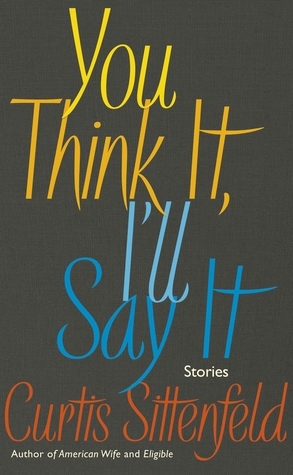 The opening story, “The Nominee,” which only appears in the U.K. edition, feels like a natural follow-up to American Wife. Though never named, the narrator is clearly Hillary Clinton, and in a voice that’s consistent with her memoirs she ponders her struggle to earn popular appeal: “The typical American voter doesn’t wish to share a beer with me.” It’s 2016 and she’s about to be interviewed by a younger female journalist who has written about her dozens of times. Back in 2002 she was compassionate when this journalist fell apart during an interview, but she knows not to expect the same courtesy in return. No, she fully expects to be burned. But still the nominee truly believes she’ll win, as the opposite outcome would be catastrophic.
Yet that’s the reality in the final story, “Do-Over,” which was shortlisted for this year’s Sunday Times EFG Short Story Award. In the wake of Trump’s election, Clay hears from Sylvia, a high school classmate, out of the blue and meets up with her for dinner in Chicago. She’s still sore about the sexist nature of the election at Bishop Academy in which, despite having tied, she was given the patronizing, made-up role of “assistant prefect” while Clay was named senior prefect. Sylvia has engineered this fake date as a gift to herself, to see what could happen, and she’s going to behave as badly as she wants.
The role reversal is clearest in “Gender Studies” and “A Regular Couple.” In the former, Nell, a gender studies professor, accidentally uses a taxi driver for sex. In the latter, Maggie is on her honeymoon with Jason; though they’re both lawyers, she recently handled a sportsman’s rape trial and earns 20 times what Jason does in nonprofit immigration law. There’s another flipping of positions in this one: among the other honeymooners at their ski resort is Ashley Frye, who was one of the popular girls at Maggie’s high school and made her feel awkward and inferior. But Maggie’s TV appearances have given her an aura of celebrity: now she’s the popular one, and she has an idea for how to get revenge on Ashley.
The most similar to Sittenfeld’s early fare is “Vox Clamantis in Deserto,” in which a college student loses her virginity under bizarre circumstances in 1994. Several stories involve a dual time setting: a decade or more later, characters reflect on the strange turns their lives have taken to get them where they are now and have a chance to rethink the decisions they made.
My favorite single story is “Plausible Deniability,” the only time I can think of that Sittenfeld has used a male point-of-view. The narrator is William, a 41-year-old lawyer in St. Louis who has distinctly different relationships with his brother and his sister-in-law. There’s a clever surprise in this one, as there is later on in “The Prairie Wife,” and it makes you ask about the various ways there are of being close with another person.
Other stories concern new mothers’ guilt and compromises, the temptation of adultery, and the danger of jealousy and making up your mind about someone too soon. I was less sure about “Volunteers Are Shining Stars,” voiced by a character with OCD and set among African-Americans at a family shelter in Washington, D.C., and I thought “Off the Record” was a bit too similar to “The Nominee.” Overall, though, this is a whip-smart, current and relatable book, ideal for readers who don’t think they like short stories.
My rating:
You Think It, I’ll Say It is published in the UK today, May 3rd, by Doubleday. My thanks to the publisher for the free review copy.
Recommended May Releases
May and June are HUGE months for new releases. I’ve been doing enough early reading via NetGalley and Edelweiss that I’ve found plenty to recommend to you for next month. From a novel voiced by one of Hemingway’s wives to a physicist’s encouragement to waste more time, I hope there will be something here for everyone.
The Pisces by Melissa Broder
[Coming from Hogarth Press (USA) on the 1st and Bloomsbury (UK) on the 3rd]
 At first I thought this was one of those funny, quirky but somewhat insubstantial novels about a thirtysomething stuck with a life she isn’t sure she wants – something along the lines of Goodbye, Vitamin, The Portable Veblen, or All Grown Up. Then I thought it was just a crass sex comedy. But the further I read the deeper it all seemed to become: tropes from Greek myth and the fluidity of gender roles made me think of You Too Can Have a Body Like Mine, another debut novel that surprised me for its profundity. Lucy, a thirty-eight-year-old PhD student, agrees to spend a summer dog-sitting for her yoga entrepreneur sister in Venice Beach, California while she undertakes therapy for the twin problems of low self-esteem and love addiction. If you know one thing about this book, it’s that there’s sex with a merman. Ultimately, though, I’d say it’s about “the prison of the body” and choosing which of the different siren voices calling us to listen to. I found it outrageous but rewarding.
My rating:
How to Be a Perfect Christian by Adam Ford and Kyle Mann
[Coming from Multnomah (USA) on the 1st]
 The Babylon Bee is a Christian version of The Onion, so you know what you’re getting here: a very clever, pitch-perfect satire of evangelical Christianity today. If, like me, you grew up in a nondenominational church and bought into the subculture hook, line and sinker (Awana club, youth group, courtship, dc Talk albums, the whole shebang), you will find that so much of this rings true. The book is set up as a course for achieving superficial perfection through absolute “conformity to the status quo of the modern church.” Sample advice: find an enormous church that meets your needs, has a great coffee bar and puts on a laser-lit worship performance to rival “an amusement park for cats or a Def Leppard concert”; master the language of Christianese (“Keeping it in prayer” pretty much covers your bases); and bring as little as you can to the church potluck (a 25-pack of napkins) but consume as much as is anatomically possible. So, a lot of fun, just a little overlong because you get the joke early on.
My rating:
The Ensemble by Aja Gabel
[Coming from Riverhead (USA) on the 15th]
 In May 1994, the members of the Van Ness String Quartet are completing their final graduate recital at a San Francisco conservatory and preparing for the Esterhazy quartet competition in the Canadian Rockies. These four talented musicians – Jana, first violin; Brit, second violin; Henry, viola; and Daniel, cello – have no idea what the next 15 years will hold for them: a cross-country move, romances begun and lost, and career successes and failures. Drawing on her own history as a violinist and cellist, Aja Gabel infuses her debut novel with the simultaneous uncertainty and euphoria of both the artistic life and early adulthood in general. An alternating close third-person perspective gives glimpses into the main characters’ inner lives, and there are evocative descriptions of classical music. I think The Ensemble will mean even more to those readers who are involved in music, but anyone can relate to the slow fade from youth into middle age and the struggle to integrate art with the rest of life.
My rating:
Tropic of Squalor by Mary Karr
[Coming from Harper (USA) on the 8th]
 Mary Karr is mostly known as a memoirist, but this is actually her fifth poetry collection. Death is a major theme, with David Foster Wallace’s suicide and 9/11 getting multiple mentions. Karr also writes self-deprecatingly about her Texas childhood. Best of all is the multi-part “The Less Holy Bible”: a sort of Devil’s Dictionary based loosely around the books of the Bible, it bounces between Texas and New York City and twists biblical concepts into commonsense advice. Not one for those who are quick to cry heresy, perhaps, but I enjoyed it very much, especially “VI. Wisdom: The Voice of God”: “Ninety percent of what’s wrong with you could be cured with a hot bath, / says God through the manhole covers, but you want magic, to win / the lottery you never bought a ticket for. … Don’t look for initials in the geese honking / overhead or to see through the glass even darkly. It says the most obvious shit, / i.e. Put down that gun, you need a sandwich.”
My rating:
In Praise of Wasting Time by Alan Lightman
[Coming from Simon & Schuster / TED (USA and UK) on the 15th]
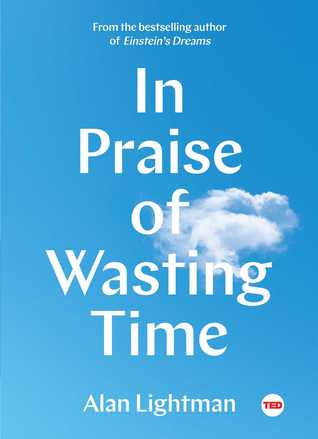 Lightman, a physicist and MIT professor, argues that only in unstructured time can we rediscover our true identity and recover our carefree childhood creativity. This work-as-play model goes against the modern idea that time is money and every minute must be devoted to a project. “For any unexpected opening of time that appears during the day, I rush to patch it, as if a tear in my trousers. … I feel compelled to find a project, to fill up the hole.” Yet there is another way of approaching time, as he discovered when doing research in a village in Cambodia. He realized that the women he talked to didn’t own watches and thus had no real sense of how long any task took them. This sharp, concise treatise ruminates on the cultural forces that have enslaved us in the West to productivity. (In short, he blames the Internet, but specifically smartphones.) Lightman insists on the spiritual benefits of free time and solitude. “With a little determination, each of us can find a half hour a day to waste time,” he asserts.
My rating:
Love and Ruin by Paula McLain
[Coming from Ballantine Books (USA) and Fleet (UK) on the 1st]
 This is the weakest of the three McLain novels I’ve read, but when we’re talking about a writer of this caliber that isn’t much of a criticism. It’s strange to me that, having written a novel from the perspective of Hadley Richardson, Ernest Hemingway’s first wife, McLain would choose to tell the story of another Hemingway wife – this time Martha Gellhorn, a war reporter and author in her own right. If I set aside this misgiving, though, and just assess the quality of the writing, there are definitely things to praise, such as the vivid scenes set during the Spanish Civil War, the dialogues between Martha and Hem, the way he perhaps fills in for her dead father, her fondness for his sons, and her jealousy over his growing success while her books sink like stones. I especially liked their first meeting in a bar in Key West, and the languid pace of their life in Cuba. I read such books because I’m intrigued about the appeal of a great man, but here I got a little bogged down with the many settings and events.
My rating:
 Bookish Beck = Rebecca Foster. American transplant to England. Freelance proofreader and book reviewer.
