Blog Tour: Extract from The Power of Dog by Andrew G. Marshall
 Last April I participated in the blog tour for Andrew G. Marshall’s previous book, My Mourning Year, a memoir about the death of his partner Thom and his journey through grief.
The Power of Dog is like a sequel; it tells what happened when Andrew acquired a collie cross puppy named Flash.
Alas, a copy didn’t arrive in time for me to read it before I left for America, but to open up the blog tour today I have an extract for you, and I look forward to reading the book when I get back.
Prologue
What I wanted most and what frightened me most, when I was a child, turned out to be the same thing. Every year as I blew out my birthday cake candles, I’d wish for a puppy ‒ with my eyes tightly closed to maximise the magic. But while my daydreams were full of adoring Labradors fetching sticks, my nightmares were stalked by their distant relatives: wolves.
My parents belonged to the ‘comfortably off’ middle classes and were only too happy to pay for tennis lessons, new bikes and summer camp – indeed they were particularly keen to send me to these. My birthday cake was always home baked, a fruit cake decorated with teddy bears sitting in a spiky snow scene. Despite the growing number of candles and my entreaties, the gods of birthday wishes were unmoved. Although my mother agreed first to guinea pigs and later mice, she remained firm about getting a dog: ‘I’ll be the one who ends up walking it.’
I can pinpoint the exact moment the nightmares started. Our next-door neighbours, whom I’d christened H’auntie and H’uncle, had retired to Bournemouth and one summer we stayed overnight at their house. I must have been four or five and already possessed a vivid imagination. In the middle of the night, I had to tiptoe across an unfamiliar landing to the lavatory ‒ never toilet because my mother considered the term vulgar. Returning, I closed the bedroom door as quietly as possible and revealed a large hairy wolf ready to pounce. I can’t remember if I screamed or whether anybody came. Maybe my mother pointed out that the wolf was really a man’s woollen winter dressing gown hanging on a hook; all of those details have been forgotten but I can still remember the nightmares.
Back home in Northampton, I slept in a tall wooden bed which had originally belonged to my father. The mattress and the springs were so old that they had sunk to form a hollow which fitted exactly around my small body. I felt safe nestling between the two hills on either side. However, the old-fashioned design left a large amount of space under the bed. By day, this space housed a box of favourite toys, but at night I never had the nerve to lift the white candlewick counterpane. I instinctively knew the wolves had set up camp there. The rules of engagement were simple: I was safe in bed, but they could pounce and catch me if I didn’t run fast enough back from the loo ‒ an acceptable abbreviation. On particularly dark nights, the wolves would emerge from their lair and dance round the room with their teeth glinting in the moonlight. I’d scream out and Mummy would come and reassure me:
‘The wolves will not get you.’
She would lift the counterpane and show me.
‘There’s nothing there.’
It was easy for her to say – the wolves would disappear as soon as she’d open my bedroom door. But after she’d told me to ‘sleep tight’ and gone back to bed, they would rematerialise, slink back into the lair and an uneasy truce would be established.
Wolves did not have a monopoly on my fears. For a while in the sixties a ‘cop killer’ called Harry Roberts evaded the police by haunting my nightmares. If there was a strange-looking man drinking alone at the rugby club bar ‒ where my father was treasurer ‒ I would sidle up to one of my parents and whisper: ‘THERE’S HARRY ROBERTS.’ It must have been embarrassing for my parents, but in defence of my seven-year-old self, the rugby club did attract an odd crowd.
Fortunately, my fear of Harry Roberts was easy to cure. One night in 1966, I was allowed to stay up late to watch his capture on the news. I can still picture the small makeshift camp in the woods ‒ the blanket strung between three trees and the discarded tin cans ‒ but not where (except it was many miles from my home). I slept soundly that night.
Flushed by her success with Harry Roberts, my mother took me to London Zoo. I was softened up with lions, monkeys and possibly even a ride on an elephant. Next, she casually mentioned that they had wolves too. I can’t remember what I was wearing but I can picture myself in an anorak so large it came down past my knees ‒ ‘you’ll grow into it’ – being taken to an enclosure hidden in some back alley of the Zoo. Did I actually look at the wolves? Perhaps I refused. Perhaps they were asleep in their den. Whatever happened next, the pack under my bed would not be exorcised so easily.
At that age it was impossible to believe I would ever reach ten; but I did. I even turned eighteen and left home for university where I studied Politics and Sociology. After graduating, I got a job first at BRMB Radio in Birmingham (in the newsroom) and then Essex Radio in Southend (as a presenter and producer) and Radio Mercury in Crawley (where I rose to become Deputy Programme Controller). My nightmares about wolves had long since ended, but if they appeared on TV they would still make me feel uneasy and I would switch channels. I still wanted a dog, but I was far too practical. I had a career to pursue. Who would walk the dog? Would it be fair to leave it alone while I worked? I couldn’t be tied down by such responsibilities.
At thirty, I fell in love with Thom and we talked about getting a dog together. However, for the first four and a half years, he lived in Germany and I lived in Hurstpierpoint (a small Sussex village). In the spring of 1995, Thom finally moved over to England with plans to set up an interior design company. However, six months later, he fell ill. All our plans for dog-owning were put on hold, while we concentrated on getting him better. He spent months in hospital first in England and then in Germany and I spent a lot of time flying backwards and forwards between the two countries. I loved Thom with a passion that sometimes terrified me, so when he died, on 9 March 1997, I was completely inconsolable.
I moved into the office he’d created in our spare room, but I couldn’t stop the computer from still sending faxes from Andrew Marshall and Thom Hartwig. As far as Microsoft Word was concerned, he was immortal. I tried various strategies to cope with my bereavement but three different counsellors did not shift it. Two short-term relationships made me feel worse not better. I had just turned forty. My regular sources of income – being Agony Uncle for Live TV and writing a column for the Independent newspaper – were both terminated. My grief was further isolating me and many of Thom’s and my couple friendships had just withered away.
Approaching the Millennium, something had to change, but what?
The Power of Dog will be released by RedDoor Publishing on Thursday, July 12th. My thanks to the publisher for a review copy.
Calypso by David Sedaris
“Why Aren’t You Laughing?” is one of the essay titles in Calypso, David Sedaris’s tenth book; it’s an ironically appropriate question you might ask of the whole book. It’s not that this isn’t funny – it is, very much so, in places – but that there’s a melancholy aura I hadn’t sensed in his work before. “Now We Are Five,” the second piece, sets the tone, explaining that Tiffany, Sedaris’s youngest sister, committed suicide in 2013, aged 49. He hadn’t spoken to her for the eight years prior to that. The siblings learn that she did it with pills plus a plastic bag over her head. These facts are just thrown out there for us: there’s no getting around how horrific it all was, but Sedaris doesn’t do much obvious hand-wringing or soul-searching.

Tiffany’s suicide is an occasional point of reference in these 21 short essays, as is their mother’s alcoholism and death from cancer. The remaining middle-aged family members – and their 90-something dad – make an effort to stay close, chiefly through meet-ups at the beach cottage Sedaris and his partner, Hugh Hamrick, buy in Emerald Isle, North Carolina. They name the place Sea Section, and it’s the setting for about a third of the book. Two-thirds of these essays were published previously, which entails some repetition, especially in the setup of each piece. I wondered if an adjustment to the sequencing and some editing out of repeated details could have made the Emerald Isle material flow together a bit better.
Sedaris’s trouble communicating with his father, a thrift-conscious hoarder, is one major theme of the book. “We’re like a pair of bad trapeze artists, reaching for each other’s hands and missing every time,” he writes. Their relationship mostly consists of trying to avoid talk of politics lest his father spout pro-Trump propaganda, and his father nagging him about his health. Despite advancing age, Sedaris’s medical crises are trivial and turned to humorous effect: broken ribs from falling off a ladder, an awful stomach virus that provides scatological background to a reading tour, and a fatty tumor he decides to freeze and feed to the snapping turtles the next time he’s on Emerald Isle.* O-kaaaay.
There are echoes of Me Talk Pretty One Day and When You Are Engulfed in Flames in the delight in languages and travel. “Your English Is So Good” skewers the annoyances of small talk and jargon, especially as used by waitstaff and shop assistants. Another essay is about what people in various countries shout when they get cut off in traffic – unsurprisingly, this one is rather foul-mouthed. Sedaris gets addicted to clothes shopping in Tokyo and obsesses over achieving his daily Fitbit steps goal while litter picking near his home in West Sussex. Some of my favorite essays were “A Modest Proposal,” reflecting on the Supreme Court’s legalization of gay marriage; “Untamed,” about feeding a local fox; and “Boo-Hooey,” in which he scoffs at ghost stories yet wonders if his dead mother visits him in dreams.
This collection doesn’t quite live up to the two I’ve already mentioned, and there were moments when I was put off by the author’s unthinking adherence to a luxurious lifestyle, but this is a solid book you wouldn’t have to be an existing fan to enjoy.
Favorite lines:
“The battle for gay marriage was, in essence, the fight to be as square as straight people, to say things like ‘My husband tells me that the new Spicy Chipotle Burger they’ve got at Bennigan’s is awesome!’”
“We’re not pessimists, exactly, but in late middle age, when you envision your life ten years down the line, you’re more likely to see a bedpan than a Tony Award.”
My rating: 
*The topic of the title essay. He’s affronted when he learns that the local kids know about ‘his’ snapping turtle and even have a name for it – he likens this to finding out that your cat is being secretly fed by the neighbors, who call it “Calypso.” It’s an obscure reference, definitely; then again, this is the same man who titled books Dress Your Family in Corduroy and Denim and Let’s Explore Diabetes with Owls. The cover design even has some slight relevance within the book: “Calypso” mentions an old friend he meets up with on an American book tour, Janet, and her woodgrain art.
Calypso comes out today, July 5th, in the UK from Little, Brown. It was released in the USA on May 29th. My thanks to the publisher for sending a free copy for review.
20 Books of Summer #4 + Substitutes & Plane Reading
You’ll have to excuse me posting twice in one day. I’ve just finished packing the last few things for my three weeks in America, and want to get my latest #20BooksofSummer review out there before I fly early tomorrow. What with a layover in Toronto, it will be a very long day of travel, so I think the volume of reading material I’m taking is justified! (See the last photo of the post.)
Four Wings and a Prayer: Caught in the Mystery of the Monarch Butterfly by Sue Halpern (2001)
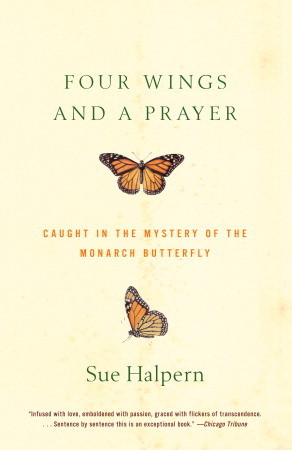 I admire nonfiction books that successfully combine lots of genres into a dynamic narrative. This one incorporates travel, science, memoir, history, and even politics. Halpern spent a year tracking monarch butterflies on their biannual continent-wide migrations, which were still not well understood at that point. She rides through Texas into Mexico with Bill Calvert, field researcher extraordinaire; goes gliding with David Gibo, a university biologist, in fields near Toronto; and hears from scientists and laymen alike about the monarchs’ habits and outlook. It happened to be a worryingly poor year for the butterflies, yet citizen science initiatives provided valuable information that could be used to predict their future.
The book is especially insightful about clashes between environmentalist initiatives and local livelihoods in Mexico (tree huggers versus subsistence loggers) and the joy of doing practical science with simple tools you make yourself. It’s also about how focused attention becomes passion. “Science, like belief, starts with wonder, and wonder starts with a question,” Halpern writes.
The style is engaging, though at nearly 20 years old the book feels a bit dated, and I might have liked more personal reflections than interviews with (middle-aged, white, male) scientists. I only realized on the very last page, through the acknowledgments, that the author is married to Bill McKibben, a respected environment writer. [She frequently mentions Fred Urquhart, a Toronto zoology professor; I wondered if he could be related to Jane Urquhart, a Canadian novelist whose novel Sanctuary Line features monarchs. (Turns out: no relation. Oh well!)]
Readalikes: Farther Away by Jonathan Franzen & Ruins by Peter Kuper
My rating:
I’ve already done some substituting on my 20 Books of Summer. I decided against reading Vendela Vida’s Girls on the Verge after perusing the table of contents and the first few pages and gauging reader opinions on Goodreads. I have a couple of review books, Twister by Genanne Walsh and The Life and Loves of Lena Gaunt by Tracy Farr, that I’m enjoying but will have to leave behind while I’m in the States, so I may need that little extra push to finish them once I get back. I’ve also been rereading a favorite, Paulette Bates Alden’s memoir Crossing the Moon, which has proved an excellent follow-up to Sheila Heti’s Motherhood.
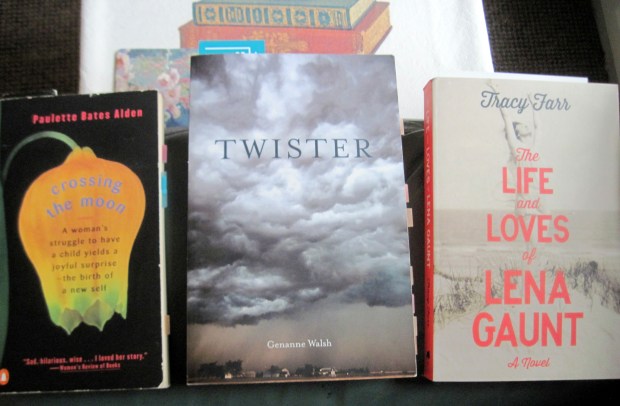
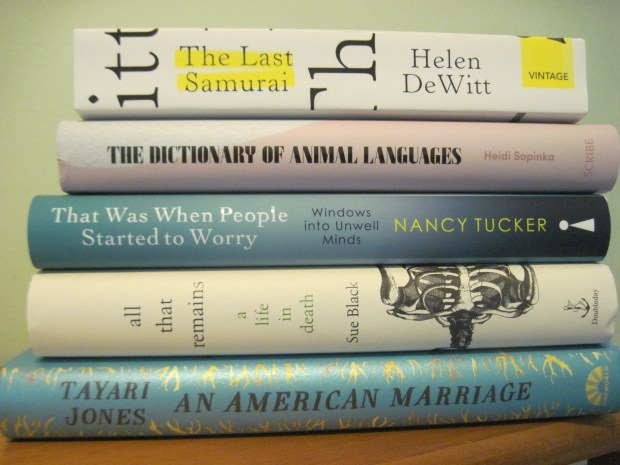
(What I haven’t determined yet is which books these will be standing in for.) Waiting in the wings in case further substitutions are needed is this stack of review books:
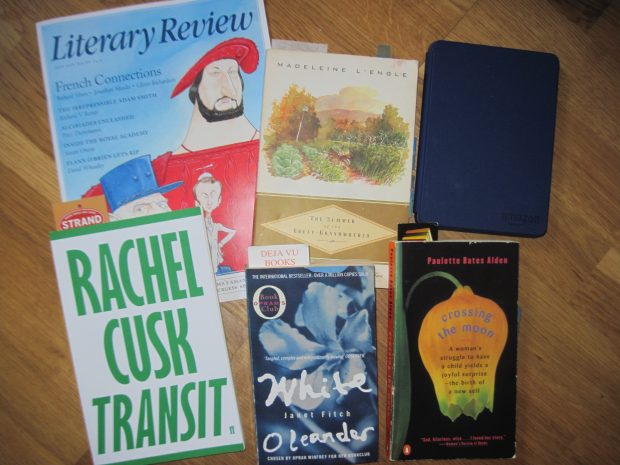
Also from the #20Books list and coming with me on the flight are Madeleine L’Engle’s The Summer of the Great-Grandmother and Janet Fitch’s White Oleander, which are both terrific thus far. The final print book joining me for the journey is Transit by Rachel Cusk. I have attempted to read her twice before and failed to get through a whole book, so we’ll see if it’s third time lucky. It seems like the perfect book to read in transit to Canada, after all.
Finally, in progress on the Kindle are Summer by Karl Ove Knausgaard, the last in his set of four seasonal essay collections, and The Late Bloomers’ Club by Louise Miller, another cozy novel set in fictional Guthrie, Vermont, which she introduced in her previous book, The City Baker’s Guide to Country Living.
It’ll be a busy few weeks helping my parents pack up their house and moving my mom into her new place, plus doing a reduced freelance work load for the final two weeks. It’s also going to be a strange time because I have to say goodbye to a house that’s been a part of my life for 13 years, and sort through box after box of mementoes before putting everything into medium-term storage.
I won’t be online all that much, and can’t promise to keep up with everyone else’s blogs, but I’ll try to pop in with a few reviews.
Happy July reading!
Blog Tour: Extract from Song by Michelle Jana Chan
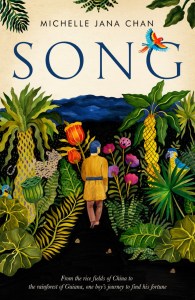 Song escapes the poverty and natural disasters of his hometown in China by sailing to Guiana. The village medicine man describes Guiana as a kind of paradise, and tells him he can earn free passage if he presents himself to the Englishmen in Guangzhou. What he doesn’t realize is that he will effectively be an indentured servant, working in the sugarcane fields for years just to pay for the voyage. From Singapore to India to Guiana, it’s a long and fraught journey, and though his new home does dazzle with its colors and wildlife, it’s not the idyll he expected. Still, Song is determined to make something of himself. “He would yet live a life that was a story worth telling.”
I have an extract from Chapter 1, about the flooding in China, to whet your appetite:
Lishui Village, China, 1878
At first they were glad the rains came early. They had already finished their planting and the seedlings were beginning to push through. The men and women of Lishui straightened their backs, buckled from years of labouring, led the buffalo away and waited for the fields to turn green. With such early rains there might be three rice harvests if the weather continued to be clement. But they quickly lost hope of that. The sun did not emerge to bronze the crop. Instead the clouds hung heavy. More rain beat down upon an already sodden earth and lakes were born where even the old people said they could not remember seeing standing water.
The Li rose higher and higher. Every morning the men of the village walked to the river to watch the water lap at its banks like flames. Sometimes they stood there for hours, their faces as grey as the flat slate light. Still the rain fell, yet no one cared about their clothes becoming wet or the nagging coughs the chill brought on. Occasionally a man lifted his arm to wipe his face. But mostly they stood still like figures in a painting, staring upstream, watching the water barrel down, bulging under its own mass.
Before the end of the week the Li had spilled over its banks. A few days later the water had covered the footpaths and cart tracks, spreading like a tide across the land and sweeping away all the fine shoots of newly planted rice. Further upstream the river broke up carts, bamboo bridges and outbuildings; it knocked over vats of clean water and seeped beneath the doors of homes. Carried on its swirling currents were splintered planks of wood, rotting food, and shreds of sacking and rattan.
Song awoke to feel the straw mat wet beneath him. He reached out his hand. The water was gently rising and ebbing as if it was breathing. His brother Xiao Bo was crying in his sleep. The little boy had rolled off his mat and was lying curled up in the water. He was hugging his knees as if to stop himself from floating away.
Song’s father was not home yet. He and the other men had been working through the night trying to raise walls of mud and rein back the river’s strength. But the earthen barriers washed away even as they built them; they could only watch, hunched over their shovels.
The men did not return that day. As the hours passed the women grew anxious. They stopped by each other’s homes, asking for news, but nobody had anything to say. Song’s mother Zhang Je was short with the children. The little ones whimpered, sensing something was wrong.
Song huddled low with his sisters and brothers around the smoking fire which sizzled and spat but gave off no heat. They had wedged among the firewood an iron bowl but the rice inside was not warming. That was all they had left to eat now. Xiao Wan curled up closer to Song. His little brother followed him everywhere nowadays. His sisters Xiao Mei and San San sat opposite him, adding wet wood to the fire and poking at the ash with a stick. His mother stood in the doorway, the silhouette of Xiao Bo strapped to her back and her large rounded stomach tight with child.
The children dipped their hands into the bowl, squeezing grains of rice together, careful not to take more than their share. Song was trying to feed Xiao Wan but he was too weak even to swallow. The little boy closed his eyes and rested his head in Song’s lap, wheezing with each breath. Their mother continued to look out towards the fields, waiting, with Xiao Bo’s head slumped unnaturally to the side as he slept.
‘I don’t think they’re coming back.’
Song could barely hear what his mother was saying.
‘They’re too late,’ she muttered.
Song wasn’t sure if she was talking to him. ‘Mama?’
Her voice was more brisk. ‘They’re not coming back, I said.’
Hurled into Gettysburg: Poems by Theresa Wyatt
 Today marks the start of the 155th anniversary of the Battle of Gettysburg, which took place on July 1–3, 1863. Theresa Wyatt was so kind as to send her terrific book of commemorative poems all the way to England for me. She pays tribute to forgotten and fringe players of the Civil War, such as Elizabeth C. Thorn, who served as the gatekeeper of Gettysburg’s Evergreen Cemetery from 1862 to 1865 while her husband was off fighting, and Jennie Wade, the only civilian killed by a war sniper. “Jennie & Jack” includes fragments of letters written by Jennie and her childhood friend and sweetheart Johnston Skelly, who died of an infection just nine days after her; neither was aware of the other’s demise. Another great story is that of poet and abolitionist John Greenleaf Whittier, whose colorblindness may have been a disadvantage growing up on a farm but was a metaphorical boon in the days of slavery.
The poems are also peopled by immigrant settlers, Underground Railroad passengers (“divinity squeezing / into dark tight spaces”) on the run from slave hunters, and brothers fighting on opposite sides. On a recent visit to Gettysburg Wyatt imagines herself into the position of General Buford, “descending these stairs in flawless summer light, / uplifted by a cyclorama of clear view, fortified” – a clever reference to the famous Gettysburg Cyclorama.
In “Visiting Gettysburg” she captures the sense of overwhelmed helplessness one experiences in relation to great historical tragedies: “trying to take it all in as if I knew anything at all / about horses, cannons or bloodshed.” The imagery ranges from grisly through innocuous to lovely, so that “buckets full of gangrene – a country’s highest price” contrast with “drops of ruby blood / invisible to sight or touch / [that] have mingled into blooms” on a farm that once comprised part of the battlefield. Especially if you’ve visited Gettysburg or another military site recently, you’ll find these poems truly resonate. It’s hard not to devour them within one sitting.
Another favorite passage: “Some people like their heroes loud / and let them talk, but sometimes history / picks off the scabs of arrogance / when setting records straight.” (from “At the Jennie Wade Monument”)
Readalikes:
March by Geraldine Brooks
Into the Cyclorama by Annie Kim
The Underground Railroad by Colson Whitehead
My Most Anticipated Releases of the Second Half of 2018
Here are 30 books that are on my radar for the months of July through November (I haven’t heard about any December titles yet), plus one bonus book that I’ve already read. This is by no means a full inventory of what’s coming out, or even of what I have available through NetGalley and Edelweiss; instead, think of it as a preview of the books I actually intend to read, in release date order. The quoted descriptions are from the publisher blurbs on Goodreads. If I already have access to the book in some way, I’ve noted that.
The first half of the year seemed to be all about plants. This time around I have plenty of memoirs, some medical and some bookish; birds and watery imagery; and some religious and philosophical themes.
[By the way, here’s how I did with my most anticipated releases of the first half of the year:
- 17 out of 30 read; of those 8 were at least somewhat disappointing (d’oh!)
- 5 unfinished
- 1 currently reading
- 1 lost interest in
- 1 I still intend to read
- 5 I didn’t manage to find]
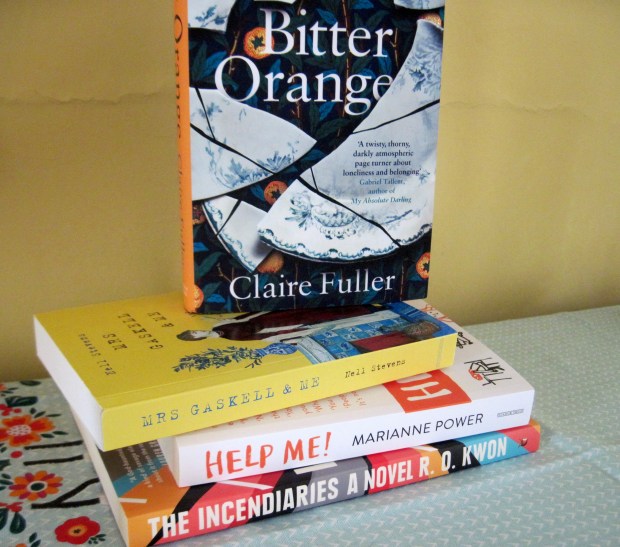
The upcoming titles I happen to own in print.
July
 No One Tells You This: A Memoir by Glynnis MacNicol [July 10, Simon & Schuster]: “If the story doesn’t end with marriage or a child, what then? This question plagued Glynnis MacNicol on the eve of her 40th birthday. … Over the course of her fortieth year, which this memoir chronicles, Glynnis embarks on a revealing journey of self-discovery that continually contradicts everything she’d been led to expect.” (NetGalley download)
 The Lost Chapters: Finding Recovery and Renewal One Book at a Time by Leslie Schwartz [July 10, Blue Rider Press]: “Leslie Schwartz’s powerful, skillfully woven memoir of redemption and reading, as told through the list of books she read as she served a 90-day jail sentence. … Incarceration might have ruined her, if not for the stories that comforted her while she was locked up.”
 The Bumblebee Flies Anyway: Gardening and Surviving Against the Odds by Kate Bradbury [July 17, Bloomsbury Wildlife]: “Finding herself in a new home in Brighton, Kate Bradbury sets about transforming her decked, barren backyard into a beautiful wildlife garden. She documents the unbuttoning of the earth and the rebirth of the garden, the rewilding of a tiny urban space.”
 Crux: A Cross-Border Memoir by Jean Guerrero [July 17, One World]: “A daughter’s quest to find, understand, and save her charismatic, troubled, and elusive father, a self-mythologizing Mexican immigrant who travels across continents—and across the borders between imagination and reality; and spirituality and insanity—fleeing real and invented persecutors.”
 The Incendiaries by R.O. Kwon [July 31, Riverhead]: “A shocking novel of violence, love, faith, and loss, as a young woman at an elite American university is drawn into acts of domestic terrorism by a cult tied to North Korea. … The Incendiaries is a fractured love story and a brilliant examination of the minds of extremist terrorists, and of what can happen to people who lose what they love most.” (Print ARC for blog review at UK release on Sept. 6 [Virago])
August
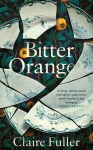 Bitter Orange by Claire Fuller [Aug. 2, Penguin Fig Tree]: I’ve loved Fuller’s two previous novels. This one is described as “a suspenseful story about deception, sexual obsession and atonement” set in 1969 in a run-down English country house. I don’t need to know any more than that; I have no doubt it’ll be brilliant in an Iris Murdoch/Gothic way. (Print ARC for blog review on release date)
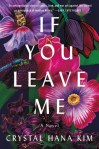 If You Leave Me by Crystal Hana Kim [Aug. 7, William Morrow]: “An emotionally riveting debut novel about war, family, and forbidden love—the unforgettable saga of two ill-fated lovers in Korea and the heartbreaking choices they’re forced to make in the years surrounding the civil war that continues to haunt us today.” This year’s answer to Pachinko? And another botanical cover to boot! (Edelweiss download)
 A River of Stars by Vanessa Hua [Aug. 14, Ballantine Books]: “In a powerful debut novel about motherhood, immigration, and identity, a pregnant Chinese woman makes her way to California and stakes a claim to the American dream. … an entertaining, wildly unpredictable adventure, told with empathy and wit” Sounds like The Leavers, which is a Very Good Thing.
 The Shakespeare Requirement by Julie Schumacher [Aug. 14, Doubleday]: A sequel to the very funny epistolary novel Dear Committee Members! “Now is the fall of his discontent, as Jason Fitger, newly appointed chair of the English Department of Payne University, takes aim against a sea of troubles, personal and institutional.” (Edelweiss download)
 Gross Anatomy: Dispatches from the Front (and Back) by Mara Altman [Aug. 21, G.P. Putnam’s Sons]: “By using a combination of personal anecdotes and fascinating research, Gross Anatomy holds up a magnifying glass to our beliefs, practices, biases, and body parts and shows us the naked truth—that there is greatness in our grossness.” (PDF from publisher; to review for GLAMOUR online)
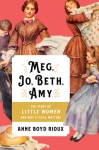 Meg, Jo, Beth, Amy: The Story of Little Women and Why It Still Matters by Anne Boyd Rioux [Aug. 21, W. W. Norton Company]: This is the bonus one I’ve already read, as part of my research for my Literary Hub article on rereading Little Women at its 150th anniversary. (That’s also the occasion for this charming book.) Rioux unearths Little Women’s origins in Alcott family history, but also traces its influence through to the present day. She also makes a strong feminist case for it. My short Goodreads review is here. (Edelweiss download)
September
 Lake Success by Gary Shteyngart [Sept. 4, Random House]: I read his memoir but am yet to try his fiction. “When his dream of the perfect marriage, the perfect son, and the perfect life implodes, a Wall Street millionaire takes a cross-country bus trip in search of his college sweetheart and ideals of youth. … [a] biting, brilliant, emotionally resonant novel very much of our times.” (Edelweiss download; for Pittsburgh Post-Gazette review)
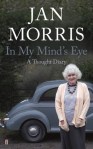 In My Mind’s Eye: A Thought Diary by Jan Morris [Sept. 6, Faber & Faber]: One of my most admired writers. “A collection of diary pieces that Jan Morris wrote for the Financial Times over the course of 2017.” I have never before in my life kept a diary of my thoughts, and here at the start of my ninth decade, having for the moment nothing much else to write, I am having a go at it. Good luck to me.
 Help Me!: One Woman’s Quest to Find Out if Self-Help Really Can Change Her Life by Marianne Power [Sept. 6, Picador]: “[F]or a year she vowed to test a book a month, following its advice to the letter, taking the surest road she knew to a perfect Marianne. As her year-long plan turned into a demented roller coaster where everything she knew was turned upside down, she found herself confronted with a different question: Self-help can change your life, but is it for the better?” (Print ARC)
 Normal People by Sally Rooney [Sept. 6, Faber & Faber]: Much anticipated follow-up to Conversations with Friends. “Connell and Marianne both grow up in the same town in rural Ireland. The similarities end there; they are from very different worlds. But they both get places to study at university in Dublin, and a connection that has grown between them despite the social tangle of school lasts long into the following years.”
 Mrs. Gaskell & Me by Nell Stevens [Sept. 6, Picador]: “In 2013, Nell Stevens is embarking on her PhD … and falling drastically in love with a man who lives in another city. As Nell chases her heart around the world, and as Mrs. Gaskell forms the greatest connection of her life, these two women, though centuries apart, are drawn together.” I was lukewarm on her previous book, Bleaker House, but I couldn’t resist the Victorian theme of this one! (Print ARC to review for Shiny New Books)
 Heart: A History by Sandeep Jauhar [Sept. 18, Farrar, Straus and Giroux]: “Deftly alternating between key historical episodes and his own work, Jauhar tells the colorful and little-known story of the doctors who risked their careers and the patients who risked their lives to know and heal our most vital organ. … Affecting, engaging, and beautifully written.” (Edelweiss download)
 To the Moon and Back: A Childhood under the Influence by Lisa Kohn [Sept. 18, Heliotrope Books]: “Lisa was raised as a ‘Moonie’—a member of the Unification Church, founded by self-appointed Messiah, Reverend Sun Myung Moon. … Told with spirited candor, [this] reveals how one can leave behind such absurdity and horror and create a life of intention and joy.”
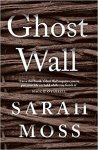 Ghost Wall by Sarah Moss [Sept. 20, Granta]: I’ve read Moss’s complete (non-academic) oeuvre; I’d read her on any topic. This novella sounds rather similar to her first book, Cold Earth, which I read recently. “Teenage Silvie is living in a remote Northumberland camp as an exercise in experimental archaeology. … Behind and ahead of Silvie’s narrative is the story of a bog girl, a sacrifice, a woman killed by those closest to her, and as the hot summer builds to a terrifying climax, Silvie and the Bog girl are in ever more terrifying proximity.” (NetGalley download)
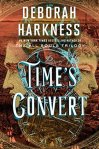 Time’s Convert (All Souls Universe #1) by Deborah Harkness [Sept. 25, Viking]: I was a sucker for Harkness’s A Discovery of Witches and its sequels, much to my surprise. (The thinking girl’s Twilight, you see. I don’t otherwise read fantasy.) Set between the American Revolution and contemporary London, this fills in the backstory for some of the vampire characters.
October
 All You Can Ever Know: A Memoir by Nicole Chung [Oct. 2, Catapult]: “Nicole Chung was born severely premature, placed for adoption by her Korean parents, and raised by a white family in a sheltered Oregon town. … With warmth, candor, and startling insight, Chung tells of her search for the people who gave her up, which coincided with the birth of her own child.” (Edelweiss download)
 Melmoth by Sarah Perry [Oct. 2, Serpent’s Tail]: Gothic fantasy / historical thriller? Not entirely sure. I just know that it’s the follow-up by the author of The Essex Serpent. (I choose to forget that her first novel exists.) Comes recommended by Eleanor Franzen and Simon Savidge, among others. (Edelweiss download)
 The Ravenmaster: Life with the Ravens at the Tower of London by Christopher Skaife [Oct. 2, 4th Estate]: More suitably Gothic pre-Halloween fare! “Legend has it that if the Tower of London’s ravens should perish or be lost, the Crown and kingdom will fall. … [A]fter decades of serving the Queen, Yeoman Warder Christopher Skaife took on the added responsibility of caring for these infamous birds.” I briefly met the author when he accompanied Lindsey Fitzharris to the Wellcome Book Prize ceremony.
 I Am Dynamite!: A Life of Friedrich Nietzsche by Sue Prideaux [Oct. 4, Faber & Faber]: “Friedrich Nietzsche’s work forms the bedrock of our contemporary thought, and yet a shroud of misunderstanding surrounds the philosopher behind these proclamations. The time is right for a new take on Nietzsche’s extraordinary life, whose importance as a thinker rivals that of Freud or Marx.” (For a possible TLS review?)
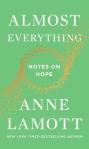 Almost Everything: Notes on Hope by Anne Lamott [Oct. 16, Riverhead]: I haven’t been too impressed with Lamott’s recent stuff, but I’ll still read anything she publishes. “In this profound and funny book, Lamott calls for each of us to rediscover the nuggets of hope and wisdom that are buried within us that can make life sweeter than we ever imagined. … Almost Everything pinpoints these moments of insight as it shines an encouraging light forward.”
 The Library Book by Susan Orlean [Oct. 16, Simon & Schuster]: The story of a devastating fire at Los Angeles Public Library in April 1986. “Investigators descended on the scene, but over 30 years later, the mystery remains: Did someone purposefully set fire to the library—and if so, who? Weaving her life-long love of books and reading with the fascinating history of libraries and the sometimes-eccentric characters who run them, … Orlean presents a mesmerizing and uniquely compelling story as only she can.” (Edelweiss download)
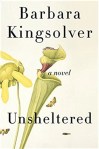 Unsheltered by Barbara Kingsolver [Oct. 18, Faber & Faber]: Kingsolver is another author I’d read anything by. “[T]he story of two families, in two centuries, who live at the corner of Sixth and Plum, as they navigate the challenges of surviving a world in the throes of major cultural shifts.” 1880s vs. today, with themes of science and utopianism – I’m excited! (Edelweiss download)
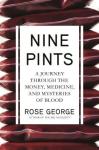 Nine Pints: A Journey through the Money, Medicine, and Mysteries of Blood by Rose George [Oct. 23, Metropolitan Books]: “Rose George, author of The Big Necessity [on human waste], is renowned for her intrepid work on topics that are invisible but vitally important. In Nine Pints, she takes us from ancient practices of bloodletting to modern ‘hemovigilance’ teams that track blood-borne diseases.”
November
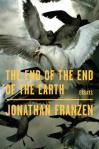 The End of the End of the Earth: Essays by Jonathan Franzen [Nov. 13, Farrar, Straus and Giroux]: “[G]athers essays and speeches written mostly in the past five years … Whether exploring his complex relationship with his uncle, recounting his young adulthood in New York, or offering an illuminating look at the global seabird crisis, these pieces contain all the wit and disabused realism that we’ve come to expect from Franzen.”
 A River Could Be a Tree by Angela Himsel [Nov. 13, Fig Tree Books]: “How does a woman who grew up in rural Indiana as a fundamentalist Christian end up a practicing Jew in New York? … Ultimately, the connection to God she so relentlessly pursued was found in the most unexpected place: a mikvah on Manhattan’s Upper West Side. This devout Christian Midwesterner found her own form of salvation—as a practicing Jewish woman.”
 Becoming by Michelle Obama [Nov. 13, Crown]: “In her memoir, a work of deep reflection and mesmerizing storytelling, Michelle Obama invites readers into her world, chronicling the experiences that have shaped her—from her childhood on the South Side of Chicago to her years as an executive balancing the demands of motherhood and work, to her time spent at the world’s most famous address.”
Which of these do you want to read, too? What other upcoming 2018 titles are you looking forward to?
The Best Books from the First Half of 2018
Here’s a quick look back at a baker’s dozen of 2018 releases that have stood out most for me so far. I’ve linked to books that I’ve already reviewed in full on the blog or elsewhere.
Fiction:
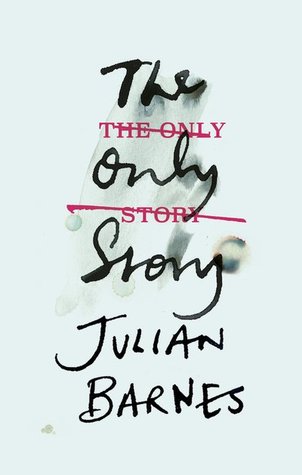 The Only Story by Julian Barnes: A familiar story: a May–December romance fizzles out. A sad story: an idealistic young man who swears he’ll never be old and boring has to face that this romance isn’t all he wanted it to be. A love story nonetheless. Paul met 48-year-old Susan, a married mother of two, at the local tennis club when he was 19. The narrative is partly the older Paul’s way of salvaging what happy memories he can, but also partly an extended self-defense. Barnes takes what could have been a dreary and repetitive story line and makes it an exquisitely plangent progression: first-person into second-person into third-person. The picture of romantic youth shading into cynical but still hopeful middle age really resonates, as do the themes of unconventionality, memory, addiction and pity.
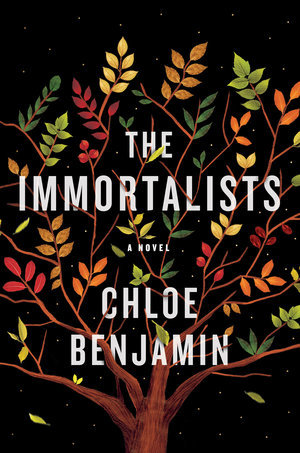 The Immortalists by Chloe Benjamin: Summer 1969: four young siblings escape a sweltering New York City morning by visiting a fortune teller who can tell you the day you’ll die. In the decades that follow, they have to decide what to do with this advance knowledge: will it spur them to live courageous lives, or drive them to desperation? This compelling family story lives up to the hype. Imagine the fun Benjamin had researching four distinct worlds: Daniel, a military doctor, examines Iraq War recruits; Klara becomes a magician in Las Vegas; Varya researches aging via primate studies; and Simon is a dancer in San Francisco. The settings, time periods, and career paths are so diverse that you get four novels’ worth of interesting background.
 Florida by Lauren Groff: Two major, connected threads in this superb story collection are ambivalence about Florida, and ambivalence about motherhood. There’s an oppressive atmosphere throughout, with environmental catastrophe an underlying threat. Set-ups vary in scope from almost the whole span of a life to one scene. A dearth of named characters emphasizes just how universal the scenarios and emotions are. Groff’s style is like a cross between Karen Russell’s Swamplandia! and Cormac McCarthy’s The Road, and her unexpected turns of phrase jump off the page. A favorite was “Above and Below,” in which a woman slips into homelessness. Florida feels innovative and terrifyingly relevant. Any one of its stories is a bracing read; together they form a masterpiece.
 Motherhood by Sheila Heti: Should one have children? Should I have children? No matter who’s asking the questions or in what context, you’re going to get the whole gamut of replies. Heti’s unnamed heroine consults a fortune teller and psychics, tosses coins and interprets her dreams as The Decision looms. Chance, inheritance, and choice vie for pride of place in this relentless, audacious inquiry into the purpose of a woman’s life. I marked out dozens of quotes that could have been downloaded directly from my head or copied from my e-mails and journal pages. The book encapsulates nearly every thought that has gone through my mind over the last decade as I’ve faced the intractable question of whether to have children. Heti has captured brilliantly what it’s like to be in this situation in this moment in time.
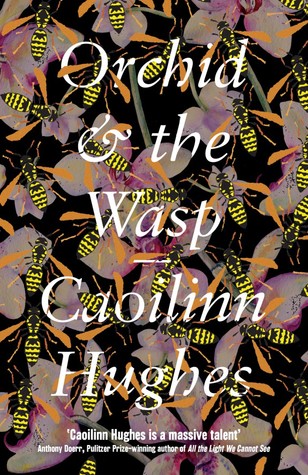 Orchid & the Wasp by Caoilinn Hughes: The action spans about nine years: a politically turbulent decade that opens with the Iraq War protests and closes with the Occupy movement in New York City. Gael Foess, our lovable antiheroine, is a trickster. She’s learned well her banker father’s lesson that money and skills don’t get distributed fairly in this life, so she’s going to do what she can to ensure that her loved ones succeed. Art, music, religion and health are major interlocking themes. The author is wonderfully adept at voices, and the book’s frenetic pace is well matched by the virtuosic use of language – wordplay, neologisms, and metaphors drawn from the arts and nature. Hughes is an exciting writer who has rightfully attracted a lot of buzz for her debut.
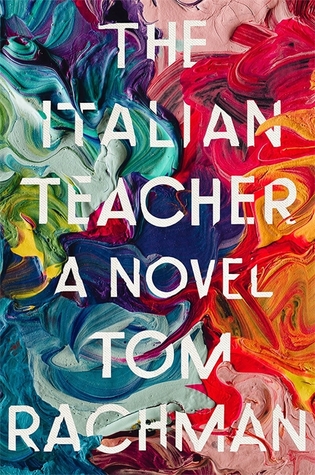 The Italian Teacher by Tom Rachman: Charles “Pinch” Bavinsky is just an Italian teacher, though as a boy in Rome in the 1950s–60s he believed he would follow in the footsteps of his sculptor mother and his moderately famous father, Bear Bavinsky, who paints close-ups of body parts. We follow Pinch through the rest of his life, a sad one of estrangement, loss and misunderstandings – but ultimately there’s a sly triumph in store for the boy who was told that he’d never make it as an artist. Rachman jets between lots of different places – Rome, New York City, Toronto, rural France, London – and ropes in quirky characters in the search for an identity and a place to belong. This is a rewarding story about the desperation to please, or perhaps exceed, one’s parents, and the legacy of artists in a fickle market.

The ‘bests’ that I happen to own in print.
Nonfiction:
 The Line Becomes a River by Francisco Cantú: Francisco Cantú was a U.S. Border Patrol agent for four years in Arizona and Texas. Impressionistic rather than journalistic, his book is a loosely thematic scrapbook. He inserts snippets of U.S.–Mexico history, including the establishment of the border, and quotes from other primary and secondary texts. He also adds in fragments of his family’s history: His ancestors left Mexico during the Mexican Revolution of the 1910s, but there’s no doubt his Latino name and features made him a friendly face for illegal immigrants. The final third of the book makes things personal when his friend is detained in Mexico. Giving faces to an abstract struggle, this work passionately argues that people should not be divided by walls but united in common humanity.
 The Unmapped Mind by Christian Donlan: Some of the best medical writing from a layman’s perspective I’ve ever read. Donlan, a Brighton-area video games journalist, was diagnosed with (relapsing, remitting) multiple sclerosis in 2014. “I think sometimes that early MS is a sort of tasting menu of neurological disease,” Donlan wryly offers. He approaches his disease with good humor and curiosity, using metaphors of maps to depict himself as an explorer into uncharted territory. The accounts of going in for an MRI and a round of chemotherapy are excellent. Short interludes also give snippets from the history of MS and the science of neurology in general. What’s especially nice is how he sets up parallels with his daughter’s early years. My frontrunner for next year’s Wellcome Book Prize so far.
 Free Woman by Lara Feigel: Doris Lessing lived by ideals of free love and Communism, but it came at the price of abandoning her children. Lara Feigel could identify with Lessing in some ways, and as she entered a rocky time in her mid-thirties – a miscarriage followed by IVF, which was a strain on her marriage; the death of a close friend; ongoing worry over how motherhood might affect her academic career – she set out to find what Lessing could teach her about how to be free. A familiarity with the works of Doris Lessing is not a prerequisite to enjoying this richly satisfying hybrid of biography, literary criticism and memoir. The Golden Notebook is about the ways in which women compartmentalize their lives and the struggle to bring various strands into harmony; that’s what Free Woman is all about as well.
 Implosion by Elizabeth W. Garber: The author grew up in a glass house designed by her father, Modernist architect Woodie Garber, outside Cincinnati in the 1960s to 70s. This and Woodie’s other most notable design, Sander Hall, a controversial tower-style dorm at the University of Cincinnati that was later destroyed in a controlled explosion, serve as powerful metaphors for her dysfunctional family life. Woodie is such a fascinating, flawed figure. Garber endured sexual and psychological abuse yet likens him to Odysseus, the tragic hero of his own life. She connected with him over Le Corbusier’s designs, but it was impossible for a man born in the 1910s to understand his daughter’s generation. This definitely is not a boring tome just for architecture buffs. It’s a masterful memoir for everyone.
 Skybound by Rebecca Loncraine: Each year seems to bring one exquisite posthumous memoir about facing death with dignity. For Rebecca Loncraine, after treatment for breast cancer in her early thirties, taking flying lessons in an unpowered glider was her way of rediscovering joy and experiencing freedom by facing her fears in the sky. She discovered a particular love for flying alongside birds: red kites in Wales, and vultures in Nepal. The most remarkable passages of the book are the exhilarating descriptions of being thousands of feet up in the air and the reflections on why humans are drawn to flight and what it does for our bodies and spirits. Loncraine had virtually finished this manuscript when her cancer returned; she underwent another 14 grueling months of treatment before her death in September 2016.
 Bookworm by Lucy Mangan: Mangan takes us along on a nostalgic chronological tour through the books she loved most as a child and adolescent. No matter how much or how little of your early reading overlaps with hers, you’ll appreciate her picture of the intensity of children’s relationship with books – they can completely shut out the world and devour their favorite stories over and over, almost living inside them, they love and believe in them so much – and her tongue-in-cheek responses to them upon rereading them decades later. There are so many witty lines that it doesn’t really matter whether you give a fig about the particular titles she discusses or not. A delightful paean to the joys of being a lifelong reader; recommended to bibliophiles and parents trying to make bookworms out of their children.
 Educated by Tara Westover: This is one of the most powerful and well-written memoirs I’ve ever read. It tells of a young woman’s off-grid upbringing in Idaho and the hard work that took her from almost complete ignorance to a Cambridge PhD. Westover’s is an incredible story about testing the limits of perseverance and sanity. Her father may have been a survivalist, but her psychic survival is the most impressive outcome here. What takes this astonishing life story to the next level, making it a classic to sit alongside memoirs by Alexandra Fuller, Mary Karr and Jeannette Walls, is the writing. Westover writes with calm authority, channeling the style of the scriptures and history books that were formative in her upbringing and education.
What are some of the best books you’ve read so far this year?
What 2018 releases do I need to catch up on right away?
Where My Books Came from in the First Half of 2018
I find it interesting to look back at where my books come from, and how this changes from year to year. So far this year, it seems like I’m reading fewer e-books and more from various libraries. I’m also doing a bit better about reading the secondhand books I already own, but – like last year – the largest proportion of my reading is still review copies of new books.
Here are the statistics for the year so far, in both real numbers and percentages (not including the books I’m currently reading, DNFs and books I only skimmed BUT including picture books, which I don’t count towards my yearly total):
- Free print or e-copy from the publisher or author: 45 (28%)
- Public library: 42 (26%)
- Secondhand purchase: 29 (18%)
- Downloaded from NetGalley or Edelweiss: 27 (17%)
- University library: 8 (5%)
- Gifts: 5 (3%)
- Twitter giveaway win: 3 (2%)
- New (bargain) book purchase: 1 (0.5%)
- Kindle purchase: 1 (0.5%)
Where do you get most of your books from?
All the Books I’ve Abandoned So Far This Year
I abandon about 15% of the books I start. I try not to go on too much about the books I don’t finish, partially because a DNF still feels like something of a failure on my part (to choose the right book; to stick with what I’ve started) and partially because a book blog would ideally be a place where you just wax lyrical on the books that you love. But every time I have written abandoned books posts they have been absurdly popular, so if you need encouragement to ditch the books that aren’t working out for you right now, do take this as my blessing!
If there are books on my list that you have finished and loved, I’d be glad to hear from you. Equally, if there are some here that you also abandoned, do reassure me that I’m not totally off base. I know I can be inconsistent in how I deal with DNFs: how many pages I give them, how much I write about them, and whether I choose to rate them. If I feel I gave a book enough of a try to know what I would have thought of it overall, I go ahead and rate it. Others will almost certainly think that this is unfair to the author and their hard work. Thoughts?
These are in chronological order of my attempted reads, with the pages or percentages read in parentheses. I’ve omitted any books I’ve already written about on the blog.
The Light of Amsterdam by David Park: This is the second time I’ve been seduced by Park’s amazing-sounding plots – the blurb for this one and The Poets’ Wives are ever so appealing – but ended up unable to engage with them. Here, not one of the characters interested me. Park’s writing is noteworthy, but a bit belabored: there are more words and images there than you really need to make the point (“The solace he tried to take in his intellectual superiority was thinning in spiteful synchronicity with the thinning of his hair”; “in this game, intensity or passion were the illegitimate children of commitment”). (32 pp.)
Census by Jesse Ball: I’d enjoyed Ball’s previous novel, How to Start a Fire and Why. This one is very different, though – probably closer to his usual style, based on accounts I’ve read from others. It’s strange, dreamy, and philosophical. With its flat, simple, repetitive language; short sentences and paragraphs; and no speech marks, it is fable-like and oblique, and altogether hard to latch onto. The author opens by saying this is a tribute to his brother, who had Down’s syndrome and died 20 years ago. But in the portion that I read, the character with Down’s syndrome has no apparent presence or personality. People who like dystopian allegories (Saramago and the like?) may well enjoy this, but it wasn’t for me. (10%) 
Exodus: A Memoir by Deborah Feldman: A memoir about a woman’s loss of faith – here, that involved leaving her marriage and her Hasidic Jewish community – should be right up my alley, but I had trouble connecting with Feldman’s voice. I didn’t sense honest wrestling, just hipster angst. Should I bother trying her previous memoir, Unorthodox? (20 pp.)
Tender by Belinda McKeon: I could relate to Catherine, an awkward and initially unconfident university student who doesn’t know what she’s good at. Perhaps because I’ve never had close male friends, though, I found it harder to understand her intimate friendship with James. I liked their snappy conversations, but the run-on nature of the narration was slightly off-putting. I would try other work by McKeon, or possibly even give this one another go some years in the future. (140 pp.) 
The Man on the Middle Floor by Elizabeth S. Moore: Initially I enjoyed the first-person voice of Nick, who is on the autism spectrum and relies on careful weekly schedules and lists of rules of how the world works to fit in. However, the second section featuring him is ill-advised and damaging, branding ASD people as violent and horny. All really rather unpleasant, with two of the main characters walking stereotypes and undistinguished writing. (16 pp. plus some further skimming)
Life in the Garden by Penelope Lively: This is a gorgeous physical book, but inside it’s writing by numbers: It feels so stiff you can see how Lively filled in an outline. One chapter even ends with “This has been a discussion of the written garden”. Early chapters are on the history of gardens, gardens as metaphors, and gardens in literature (Vita Sackville-West, Elizabeth von Arnim, the Sitwells, et al.). I think you’d have to be much more of a gardening enthusiast than I am – I’m a lazy, frustrated amateur at best – to get a lot out of this. (79 pp.) 
The Mermaid and Mrs. Hancock by Imogen Hermes Gowar: Gowar has an accomplished and knowing narrative voice, and the historical setting is totally convincing. But I didn’t get drawn into the story. A merchant unwittingly acquires a hideous fish-like creature and decides to make as much money from displaying it as he can. Meanwhile, a high-class madam decides she needs a new gentleman protector for one of her best whores. Given the title, I think I know what we can expect. The scenes set in the brothel particularly bored me, and the thought of another 350+ pages appalled me. (70 pp. plus some further skimming)
Things Bright and Beautiful by Anbara Salam: I had been looking forward to this historical novel about a missionary marriage in the South Pacific. Unfortunately, I did not find it compelling in the least. Even the twist in the last line of the prologue was not enough to keep me reading. You might try Euphoria by Lily King instead. (6%)
Leap In: A Woman, Some Waves and the Will to Swim by Alexandra Heminsley: I really enjoyed Part 1, which is about leaping into life, whatever that means for you. For her it was learning to swim, undertaking outdoor swimming challenges everywhere from her hometown of Brighton to Ithaca, Greece, but also getting married and undergoing IVF. I especially appreciated her words on acquiring a new skill as an adult and overcoming body issues. But then it seems like her publishers said, “Meh, too short; add in more stuff!” and so we get the history of swimming, what gear you should buy, FAQs, etc. – boring! (Part 1) 
The Lost Girls of Camp Forevermore by Kim Fu: We get a brief introduction to a set of nine- to eleven-year-old campers from the early 1990s on an isolated overnight adventure – they’re pretty hard to keep straight – before diving deep into one’s life for the next 20+ years. The long interlude means Fu doesn’t sustain suspense about whatever bad thing happened when the girls were campers. A disappointment after For Today I Am a Boy. (86 pp.)
The Underneath by Melanie Finn: I requested this on the strength of Finn’s previous novel. Jumping between italicized passages set in Africa and Kay and Michael’s troubled marriage playing out its end in Vermont 10 years later, the narrative feels fragmented. Another strand is about Ben of Comeau Logging and his drug-addicted friend Shevaunne. It’s clear these subplots will meet up at some point, but I didn’t have the patience to hang around. There is a lot of gritty violence towards animals, too. (15 pp. plus some further skimming)
Carry On, Warrior: The real truth about being a woman by Glennon Melton: Melton was an alcoholic and bulimic for nearly 20 years until she found herself pregnant and cleaned up her act, fast. Her approach here is like a cross between Brené Brown, Elizabeth Gilbert and Anne Lamott: generically Christian encouragement to be your authentic self, do your best work, and choose love. But something about the voice grated, and the short essays felt repetitive. (37 pp.)
Life & Times of Michael K by J.M. Coetzee: I should know by now that this is just the sort of book I hate: a spare, almost dystopian allegory that’s not rooted in time or place and whose characters are symbols you hardly care about. The Childhood of Jesus was similar. This starts off as Michael K’s quest to get his ailing mother to Prince Albert, but that’s very soon derailed, and with it my interest. (20 pp. plus some further skimming)
The Conservationist by Nadine Gordimer: Alas, I was 0 for 2 on South African Booker Prize winners. Nice landscape descriptions, but despite the discovery of a body there’s no narrative momentum, and one doesn’t warm to Mehring. My favorite passage, with ironically apt adjectives in bold, was “The upland serenity of high altitude, the openness of grassland without indigenous bush or trees … A landscape without theatricals except when it became an arena for summer storms … – a typical Transvaal landscape, that you either find dull and low-keyed or prefer to all others (they said).” (44 pp.)
The Trick to Time by Kit de Waal: There’s nothing wrong with the book per se; I just wasn’t compelled to read more. Mona is a lonely 60-year-old who runs a toy shop in a seaside town and makes custom-designed dolls. There are some major losses in her past, at first just hints and then whole stories. In memory Mona can relive the limited moments she had with her loved ones. I could recommend this to fans of Rachel Joyce – the story line is particularly reminiscent of The Unlikely Pilgrimage of Harold Fry and The Snow Garden – but wonder if de Waal’s previous book would feel more original. (70 pp.)
The Best of Everything by Rona Jaffe: I had a weird reverse case of déjà vu: this is awfully similar to Mad Men, Suzanne Rindell’s Three-Martini Lunch, and A.J. Pearce’s Dear Mrs Bird, though of course they would have been based on Jaffe’s novel rather than the other way round. Caroline Bender, fresh out of a broken engagement, arrives for her first day as a typist at a New York City publishing house and has to adjust to catty office politics. I think I’ll enjoy this, but need to find another time when I can give it my full attention. (Ch. 1)
The Day that Went Missing: A Family Tragedy by Richard Beard: In August 1978, when the Beard family was on holiday at the beach in Cornwall, nine-year-old Nicholas was taken by the undertow and drowned. Eleven-year-old Richard was the last person to see him alive. He digs up evidence and stories of who Nicky was in his brief life and what exactly happened on that fateful day. The matter-of-fact, even cavalier, tone detracts from any potential emotional power. The other problem is there’s simply not very much to say about a nine-year-old and his rather average English family. (28 pp. plus some further skimming)
The Lido by Libby Page: The kindest word I could apply to the prose is “undemanding.” I’d hoped the charm of a story about a lonely twentysomething journalist and an octogenarian who band together to rescue their local swimming pool would outweigh the dull writing, but not so. Comparisons with Eleanor Oliphant didn’t fill me with confidence, either. (25 pp.)
The Great Believers by Rebecca Makkai: There’s a near-contemporary story line that’s not very compelling; while I enjoyed the 1980s strand about a group of gay friends in Chicago, there are a lot of secondary characters we don’t get to know very well, plus the details of Yale’s art deal slow down the narrative. I really wanted to appreciate the book more because I loved Makkai’s two previous novels so much, but I didn’t feel the impetus to continue. (50 pp. plus some further skimming)
A Long Island Story by Rick Gekoski: I loved Darke, so jumped at the chance to read Gekoski’s second novel. I liked our introduction to mother Addie and father Ben, who works for the Department of Justice but has ambitions as a writer so stays up until all hours typing. They drive out with kids Becca and Jake one summer morning to Long Island to stay with Addie’s parents, Maurice and Perle, at their bungalow. I didn’t sense a lot of promise. It’s interesting to see in the acknowledgements that Gekoski originally tried writing this as a memoir of his 1950s childhood. I think that could have been much more interesting. (35 pp.)
An Actual Life by Abigail Thomas: Thomas writes terrific memoirs-in-essays, so I was intrigued to try her fiction. Nineteen-year-old Virginia got pregnant the first time she slept with Buddy; now she’s married to him and a stay-at-home mother to Madeline. This reads like a cheap knockoff of Anne Tyler, and the shortage of punctuation is maddening. (46 pp.)
The Book of Salt by Monique Truong: I never warmed to the voice of Bình, the Vietnamese cook for Gertrude Stein and Alice B. Toklas in 1930s Paris, nor was I interested enough in what I read about the “Mesdames” to continue getting to know them. I found the narration overwritten: “This language that I dip into like a dry inkwell has failed me. It has made me take flight with weak wings and watched me plummet into silence.” I couldn’t resist the terrific setup, but the delivery was ever so slightly dull. (31 pp.)
Iris Murdoch Readalong: The Italian Girl
A short Gothic drama about hedonism versus the ethical life, this was my seventh Murdoch novel, and, alas, one of the less memorable ones (along with An Unofficial Rose and The Black Prince). Narrator Edmund Narraway, an engraver in his forties, arrives at the family home, a Victorian rectory in the North, one moonlit night shortly after his mother’s death. He’s locked out, but fortunately there’s another night prowler about who can let him in: David Levkin, the apprentice to Edmund’s drunken stonemason brother, Otto.
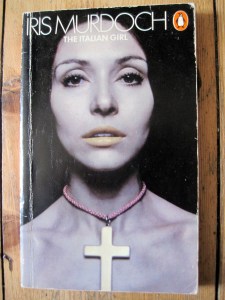 Edmund finds his mother Lydia’s body laid out on her bed and recalls the almost Oedipal relationships she had with him and his brother. Hints of incest are also there in Edmund’s infatuation with his niece, Flora, while various characters are in love (or lust) with David and his peculiar sister, Elsa, who both live in the property’s summer house. As in A Severed Head, the language of possession marks these shifting bonds as unhealthy and obsessive.
Murdoch often sets up stark dichotomies between characters and situations, and here Otto and Edmund serve as the two poles: “Otto’s Gothic, you know,” his wife Isabel says to Edmund. “He is the north. He’s primitive, gross.” In contrast, Edmund clings to the narrow way (as his surname suggests) of morality, taking a hard line on his niece’s ethical dilemma and largely avoiding the sexual temptations that come his way. “You are a good man,” Isabel tells him. “You are the assessor, the judge, the inspector, the liberator. You will clear us all up.”
I found this setup a little too simplistic (the brothers are also referred to by the shorthand of “wet-lipped” and “dry-lipped”), and the generalizing about Jews that bothered me in A Severed Head is worse here: there’s a whole chapter entitled “Two Kinds of Jew.” Given the title, I was unsure what role Maggie, the latest in Lydia’s series of Italian servants, is meant to play. She’s virtually speechless until the final chapter, and seems most like a nun.
A surprise will, a fire, and an interlude in an “enchanted wood” keep things moving along quickly, and it’s Murdoch’s shortest novel, almost what you’d call novella length. But this mostly felt to me like an unnecessary reprise of A Severed Head (and perhaps The Unicorn, which I haven’t read but know has a very Gothic atmosphere).
My rating:
I’m participating on and off in Liz Dexter’s two-year Iris Murdoch readalong project to get through some of the paperbacks I own. See also her interesting introductory post on The Italian Girl. I have two more readalong books lined up for later in the year: The Nice and the Good in September and An Accidental Man in December. Join us for one or more!
 Bookish Beck = Rebecca Foster. American transplant to England. Freelance proofreader and book reviewer.
