Snow-y Reads
It’s been a frigid start to March here in Europe. Even though it only amounted to a few inches in total, this is still the most snow we’ve seen in years. We were without heating for 46 hours during the coldest couple of days due to an inaccessible frozen pipe, so I’m grateful that things have now thawed and spring is looking more likely. During winter’s last gasp, though, I’ve been dipping into a few appropriately snow-themed books. I had more success with some than with others. I’ll start with the one that stood out.


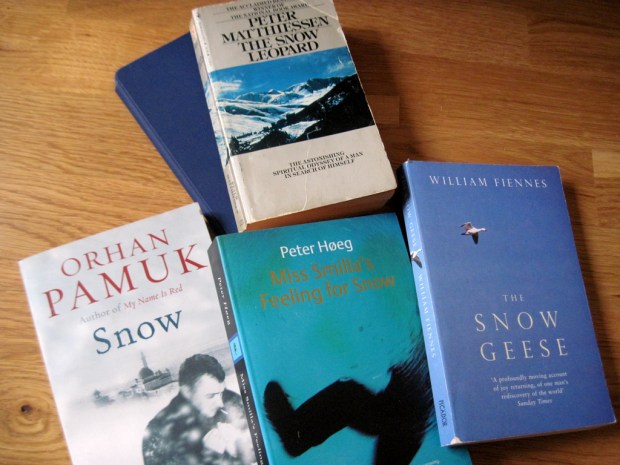
Miss Smilla’s Feeling for Snow by Peter Høeg (1992)
[trans. from the Danish by Felicity David]
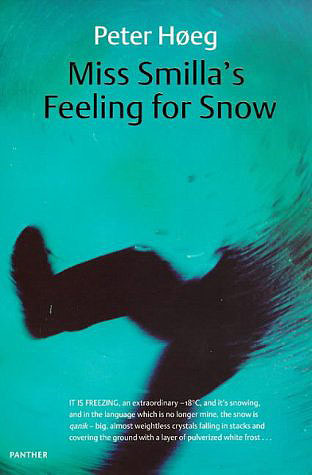 Nordic noir avant la lettre? I bought this rather by accident; had I realized it was a murder mystery, I never would have taken a chance on this international bestseller. That would have been too bad, as it’s much more interesting than your average crime thriller. The narrator/detective is Smilla Jaspersen: a 37-year-old mathematician and former Arctic navigator with a Danish father and Greenlander mother, she’s a stylish dresser and a shrewd, bold questioner who makes herself unpopular by nosing about where she doesn’t belong.
Isaiah, a little Greenlander boy, has fallen to his death from the roof of the Copenhagen apartment complex where Smilla also lives, and she’s convinced foul play was involved. In Part I she enlists the help of a mechanic neighbor (and love interest), a translator, an Arctic medicine specialist, and a mining corporation secretary to investigate Isaiah’s father’s death on a 1991 Arctic expedition and how it might be connected to Isaiah’s murder. In Part II she tests her theories by setting sail on the Greenland-bound Kronos as a stewardess. At every turn her snooping puts her in danger – there are some pretty violent scenes.
I read this fairly slowly, over the course of a month (alongside lots of other books); it’s absorbing but in a literary style, so not as pacey or full of cliffhangers as you’d expect from a suspense novel. I got myself confused over all the minor characters and the revelations about the expeditions, so made pencil notes inside the front cover to keep things straight. Setting aside the plot, which gets a bit silly towards the end, I valued this most for Smilla’s self-knowledge and insights into what it’s like to be a Greenlander in Denmark. I read this straight after Gretel Ehrlich’s travel book about Greenland, This Cold Heaven – an excellent pairing I’d recommend to anyone who wants to spend time vicariously traveling in the far north.
Favorite wintry passage:
“I’m not perfect. I think more highly of snow and ice than of love. It’s easier for me to be interested in mathematics than to have affection for my fellow human beings.”
My rating:
One that I left unfinished:
Snow by Orhan Pamuk (2002)
[trans. from the Turkish by Maureen Freely]
 This novel seems to be based around an elaborate play on words: it’s set in Kars, a Turkish town where the protagonist, a poet known by the initials Ka, becomes stranded by the snow (Kar in Turkish). After 12 years in political exile in Germany, Ka is back in Turkey for his mother’s funeral. While he’s here, he decides to investigate a recent spate of female suicides, keep tabs on the upcoming election, and see if he can win the love of divorcée Ipek, daughter of the owner of the Snow Palace Hotel, where he’s staying. There’s a hint of magic realism to the novel: the newspaper covers Ka’s reading of a poem called “Snow” before he’s even written it. He and Ipek witness the shooting of the director of the Institute of Education. The attempted assassination is revenge for him banning girls who wear headscarves from schools.
As in Elif Shafak’s Three Daughters of Eve, the emphasis is on Turkey’s split personality: a choice between fundamentalism (= East, poverty) and secularism (= West, wealth). Pamuk is pretty heavy-handed with these rival ideologies and with the symbolism of the snow. By the time I reached page 165, having skimmed maybe two chapters’ worth along the way, I couldn’t bear to keep going. However, if I get a recommendation of a shorter and subtler Pamuk novel I would give him another try. I did enjoy the various nice quotes about snow (reminiscent of Joyce’s “The Dead”) – it really was atmospheric for this time of year.
Favorite wintry passage:
“That’s why snow drew people together. It was as if snow cast a veil over hatreds, greed and wrath and made everyone feel close to one another.”
My rating:
One that I only skimmed:
The Snow Geese by William Fiennes (2002)
 Having recovered from an illness that hit at age 25 while he was studying for a doctorate, Fiennes set off to track the migration route of the snow goose, which starts in the Gulf of Mexico and goes to the Arctic territories of Canada. He was inspired by his father’s love of birdwatching and Paul Gallico’s The Snow Goose (which I haven’t read). I thought this couldn’t fail to be great, what with its themes of travel, birds, illness and identity. However, Fiennes gets bogged down in details. When he stays with friendly Americans in Texas he gives you every detail of their home décor, meals and way of speaking; when he takes a Greyhound bus ride he recounts every conversation he had with his random seatmates. This is too much about the grind of travel and not enough about the natural spectacles he was searching for. And then when he gets up to the far north he eats snow goose. So I ended up just skimming this one for the birdwatching bits. I did like Fiennes’s writing, just not what he chose to focus on, so I’ll read his other memoir, The Music Room.
My rating:
 Considered but quickly abandoned: In the Midst of Winter by Isabel Allende
Would like to read soon: The Snow Leopard by Peter Matthiessen – my husband recently rated this 5 stars and calls it a spiritual quest memoir, with elements of nature and travel writing.
What’s been your snowbound reading this year?
A Patroness of the Arts
I recently sponsored my first book via Unbound, the UK’s crowdfunding publisher. You’re probably familiar with some Unbound titles even if that name doesn’t ring a bell. For instance, you might remember that The Wake by Paul Kingsnorth, an Unbound title from 2014, became the first crowdfunded novel longlisted for the Man Booker Prize. I’ve reviewed another previous Unbound title, Martine McDonagh’s Narcissism for Beginners, and will be participating in the blog tour for Lev Parikian’s Why Do Birds Suddenly Disappear? in May.

 The forthcoming title I’ve chosen to support is Women on Nature by Katharine Norbury, which promises to be a wide-ranging and learned anthology celebrating the tradition of women’s writing about nature (both fiction and non-). I enjoyed Norbury’s first book, The Fish Ladder, which is a memoir in the vein of H Is for Hawk, and also saw her speak at the New Networks for Nature conference in 2016.

Albums that exist because I helped crowdfund them.
I’d only ever crowdfunded music before – albums by The Bookshop Band, Krista Detor, Duke Special and Marc Martel. Beaming internally at feeling like a patroness of the arts after funding my Women on Nature hardback, I kept the smug glow going by signing up to support The Bookshop Band via Patreon (where you can commit to a certain amount per creation, e.g. per music video, and have the option of setting a monthly cap) and to fund an album by their singer/cellist Beth Porter and her band The Availables via Indiegogo.
Have you ever gotten involved in a crowdfunding project? How about for the arts?
Filling One Last Bookcase
Earlier this week I inherited a beautiful antique bookcase from an online friend* who, we learned only recently, lived just 20 minutes away. She has to shed some furniture to move to London, and very kindly thought of me. This is the last major item we could possibly fit in our house, but I was happy to accept because it’s so much nicer than any of our Ikea shelving units. It has the kind of mahogany detail that looks like it could belong on a ship’s wheel.


My goals for the extra shelving space were to be able to keep genres together, to eliminate double stacking where possible, to put all books out on display instead of having some away in an overflow crate, and perhaps to free up the tops of a couple units for knick knacks, etc.


It was a multi-step process undertaken with military precision. Can you tell I used to work in a library?
- Reincorporate Short Stories into General Fiction
- Double-stack the already-read Fiction in the bedroom, leaving the more presentable books at the front; create a Signed Copies area
- Move Poetry in with Classics, double-stacking and putting some books on their sides to make more space; create a Classics priority area, with one book per month chosen for the rest of 2018
- Move oversize Science and Nature, Graphic Novels, Children’s Books, and Coffee Table Books (which, because they’re buried under magazines and newspapers on the coffee table shelf, we never look at) onto the bottom shelf of the new bookcase
- Move all Life Writing (biographies/memoirs), which had been split across a few rooms, onto one bookcase in my study
- Add a selection of Travel and Literary Reference to fill the built-in shelves of my desk, joining Reference and Humor
- Integrate Science and Nature, previously kept separate, into one bookcase


Unread fiction is mostly on the hall bookcase, with an area on the bottom shelf for upcoming projects so I can see what’s awaiting me. I’m keeping these in rough date order from left to right: bibliotherapy prescriptions, possibilities for Reading Ireland month, novellas for November, etc.
However, there are a handful of annoying hardback and trade paperback novels that are just that little bit too tall to fit here, so these have formed a partial shelf on the antique case. I’ve also set aside there the book(s) that I think might be included in my Best of 2018 list and a growing stash of Wellcome Book Prize 2019 hopefuls.
You would never believe it, but I think I need more books! Good thing we have a trip planned to Wigtown, Scotland’s Book Town, for the first week of April. In any case, it’s better to have room to grow into than to already be at capacity or overfull. I can always reshuffle as time goes on if I decide I don’t want any double stacking upstairs or if we ever manage to bring back more of my library from America.


From Book Riot I got the idea of making a personal “hold shelf” of books you own and have been meaning to read. So far I only have four books set aside, arranged as a sort of buffet atop the hall bookcase. Perhaps later I’ll replace this with a full shelf on the antique bookcase. Other ideas for the empty space there would be showcasing my most presentable fiction, or creating a favorites shelf. This was suggested by Paul and corroborated by The Novel Cure, which suggests pulling out the 10 books you love most and are likely to turn to for inspiration.
*If you’re on Instagram, you must check her out. She is a #bookstagram pro: @beth.bonini.
How do you organize your bookshelves?
Waiting for the Last Bus by Richard Holloway
Theology rarely appears on this blog, though I have a dual degree in English and Religion and read a fair number of books with religious themes. Never fear: it’s not your average pie-in-the-sky Christian talk in Waiting for the Last Bus, Richard Holloway’s brand-new book about old age and death. Holloway was a career priest and has written nearly 30 theological works, but he comes at things from a refreshingly different angle. In Leaving Alexandria (2012), one of my all-time favorite memoirs, he recorded his drift away from orthodoxy – even as he rose through the ranks of the Church of Scotland to become Bishop of Edinburgh. He recognizes morality as provisional (like in another of his books I’ve read, Godless Morality (1999)) – the Church has changed its mind about women and gay people, for instance – and doesn’t waste time pondering the supernatural or the chance of eternal life, but he still thinks religion has lessons to teach us about how we can approach death with dignity.

The thematic scaffolding of this short book, which grew out of a Radio 4 series that aired in 2016, is acceptance versus denial. For Holloway, going prematurely bald was like a preview of ageing, and the futility of the quack hair restoration pills he ordered from a magazine was his first lesson in accepting what you cannot change about yourself. Seeing ourselves as we really are is a lifelong struggle, Holloway acknowledges; some only grasp their identity right at the end, as death approaches. Predestination is a doctrine common to Christianity and Islam, but he is more inclined to mix free will and fate. His recurring metaphor is of a deck of cards: life is a hand that you are dealt, but you get to choose exactly how to play it.
This is a richly allusive book, full of snatches of literature (especially poetry), as well as excerpts from obituaries and from funeral addresses Holloway has given. He also discusses the fear of death, the dystopian possibilities of cryogenic freezing, countering regrets with forgiveness, and how the way we face death could redeem a disappointing life. Holloway’s is a voice of wisdom worth heeding, and he is honest and humble instead of giving pat answers to life’s enormous questions. I would be particularly likely to recommend this to readers of Julian Barnes’s Nothing to Be Frightened Of who want a contrasting perspective.
A couple of favorite passages:
“I have ministered [Last Rites] myself and seen the peace they can bring at the end. I have sent good friends into the arms of a merciful God I was no longer sure I believed in. And I was convinced not only of the efficacy but of the honesty of what I was doing. I was not there to ventilate my doubts but to help the dying find the strength to cast off and take the tide that was pulling them out.”
“Religion is at its most compelling when it restrains the urge to explain death away and contents itself with voicing our sorrow and defiance that [death] keeps beating us into the ground. It feels most authentic when it stops preaching and becomes, instead, our song, our protest, the handkerchief waved against the immense tank looming at the corner of the street.”
My rating:
Waiting for the Last Bus is published in the UK today, March 1st. With thanks to Canongate for the free copy for review.
Two Recommended March Releases
The Little Book of Feminist Saints by Julia Pierpont
[Coming from Random House (USA) and Virago (UK) on the 6th]
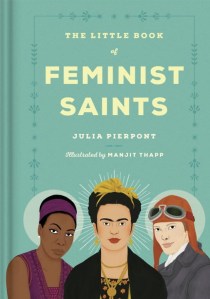 Like A Glorious Freedom, this is a celebration of women’s achievements, especially those that have been overlooked. Each “matron saint,” presented in chronological order by birthday, gets a two-page spread, with a full-color portrait on the left (by Manjitt Thapp, a young British artist), often featuring a halo, and a very short biographical essay on the right that highlights the person’s background and contributions towards greater opportunities for women. The first two subjects give you a sense of the range covered: Artemisia Gentileschi and Michelle Obama. There are about 90 profiles here, and while I recognized many of the figures, a lot of the mathematical/scientific pioneers and civil rights activists were new to me. This is the perfect little coffee table book to gift to the women in your life this year.
My rating:
E-ARC from Edelweiss.
The Italian Teacher by Tom Rachman
[Coming from Viking on the 20th]
 Charles “Pinch” Bavinsky is just an Italian teacher, though as a boy in Rome in the 1950s–60s he believed he would follow in the footsteps of his sculptor mother and his moderately famous father, Bear Bavinsky, who paints close-ups of body parts. When his father shattered his dream, though, he turned to criticism, getting art history degrees and planning to preserve his father’s reputation by writing his authorized biography. But along the way something went wrong. We follow Pinch through the rest of his life, a sad one of estrangement, loss and misunderstandings – but ultimately there’s a sly triumph in store for the boy who was told that he’d never make it as an artist.
Like his previous book, The Rise and Fall of Great Powers, Rachman’s new one jets between lots of different places – Rome, New York City, Toronto, rural France, London – and ropes in quirky characters in the search for an identity and a place to belong. Although I preferred the early chapters when Pinch is a child – these have some of the free-wheeling energy of The Imperfectionists, Rachman’s first novel – this is a rewarding story about the desperation to please, or perhaps exceed, one’s parents, and the legacy of artists in a fickle market. Existing Rachman fans will certainly want to read this, but for those who are new to his work I’d particularly recommend it to fans of Daniel Kehlmann’s F and Dominic Smith’s The Last Painting of Sara de Vos.
My rating:
E-ARC from Edelweiss.
Plus one I’m a bit less enthusiastic in recommending, alas.
Anatomy of a Miracle by Jonathan Miles
[Coming from Hogarth on the 13th]
 On August 23, 2014, wheelchair-bound veteran Cameron Harris stands up and walks outside the Biz-E-Bee convenience store in Biloxi, Mississippi. In the rest of the novel we find out how he got to this point and what others – ranging from his doctor to representatives of the Roman Catholic Church – will make of his recovery. Was it a miracle, or an explainable medical phenomenon? Miles has been rather sly in how he’s packaged this. On the title page he calls it a “True Story,” but an asterisk qualifies that with the phrase “a novel.” The style, reminiscent of journalistic reportage, is like what Dave Eggers uses in Zeitoun. He keeps up the pretense of the whole thing being based on interviews with the key players, all the way through to the acknowledgements. But early on I searched for information on a war veteran named Cameron Harris and found nothing. Miles made it all up.
It’s hard to reconcile the style with the fictional contents. That’s a shame, because there are interesting questions here that would be rewarding for a book club to discuss. What is the relationship between science and storytelling? How can we determine what “God’s will” is? Miles’s previous novel, Want Not, is one of the books I most wish I’d written, so it was perhaps inevitable this one would suffer in comparison. (Full review at The Bookbag.)
My rating:
Other March releases I’m planning to read:
- Happiness by Aminatta Forna (Grove Atlantic, 16th)
- The Friendship Cure, by Kate Leaver (Duckworth, 22nd) – for blog review
- The Long Forgotten by David Whitehouse (Picador, 22nd) – for blog tour
- The Parentations by Kate Mayfield (Oneworld, 29th) – for Shiny New Books review
What March books do you have on the docket?
Have you already read any that you can recommend?
Library Checkout: February 2018 – A Bumper Edition!
I found a plethora of interesting books, many of them pretty recent, on my last few trips to the public library. I had somehow convinced myself that my library system doesn’t have many interesting new books in stock, but I was proven wrong.
Plus, excellent news: As of March 1st, reservations will be free again. Eleven months ago, the library system brought in a 50-pence charge for every reservation and I stopped placing holds altogether. I can only presume that this was an experiment that didn’t bring in enough revenue, or that, now that the council has reduced hours and staffed its branch libraries with volunteers only, they can afford to offer reservations for free again. It’s a sad state of affairs in general, but a boon for me: from next month I’ll be able to place holds on any Wellcome-shortlisted titles I haven’t read, and lots of other recent books I’m interested in.
For once I’ve done a good job of plowing through a bunch of my library books, including the four books that made up the Costa Prize for Poetry shortlist. As usual, I’ve added in star ratings and links to reviews of books I haven’t already featured on the blog in some way.
LIBRARY BOOKS READ
- The Travelling Cat Chronicles by Hiro Arikawa

- Women and Power: A Manifesto by Mary Beard
- Kumukanda by Kayo Chingonyi [poetry – shortlisted for Costa Prize]
- Inside the Wave by Helen Dunmore [poetry – winner of Costa Prize]
- This Cold Heaven: Seven Seasons in Greenland by Gretel Ehrlich

- Family Matters by Rohinton Mistry
- On Balance by Sinéad Morrissey [poetry – shortlisted for Costa Prize]
- Useful Verses by Richard Osmond [poetry – shortlisted for Costa Prize]
- The Man Who Mistook His Wife for a Hat by Oliver Sacks
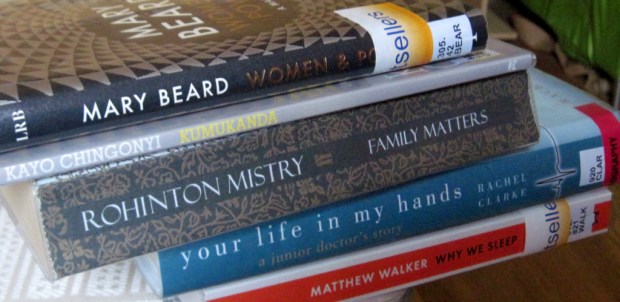
A selection of the library books I read and skimmed this past month (the others have since been returned).
SKIMMED ONLY
- Your Life in My Hands: A Junior Doctor’s Story by Rachel Clarke
- Why We Sleep: The New Science of Sleep and Dreams by Matthew Walker
CURRENTLY READING
- Little Women by Louisa May Alcott (a re-read)
- Herzog by Saul Bellow
- Harmless Like You by Rowan Hisayo Buchanan
- The Book of Forgotten Authors by Christopher Fowler
- To the Is-Land: An Autobiography by Janet Frame
- Plot 29: A Memoir by Allan Jenkins
- There Is an Anger that Moves by Kei Miller [poetry]
- And When Did You Last See Your Father? by Blake Morrison
- Spirals in Time: The Secret Life and Curious Afterlife of Seashells by Helen Scales
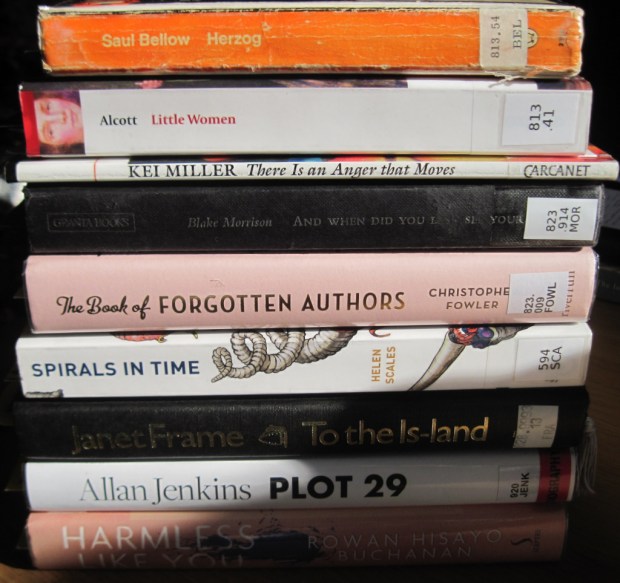
The currently reading stack.
CHECKED OUT, TO BE READ
Public library:
- The Most Perfect Thing: Inside (and Outside) a Bird’s Egg by Tim Birkhead
- Mean Time by Carol Ann Duffy [poetry]
- Testosterone Rex: Myths of Sex, Science, and Society by Cordelia Fine
- Somebody I Used to Know by Wendy Mitchell with Anna Wharton
- In the Days of Rain by Rebecca Stott
- Island Home: A Landscape Memoir by Tim Winton
- The Secret Life of Cows by Rosamund Young
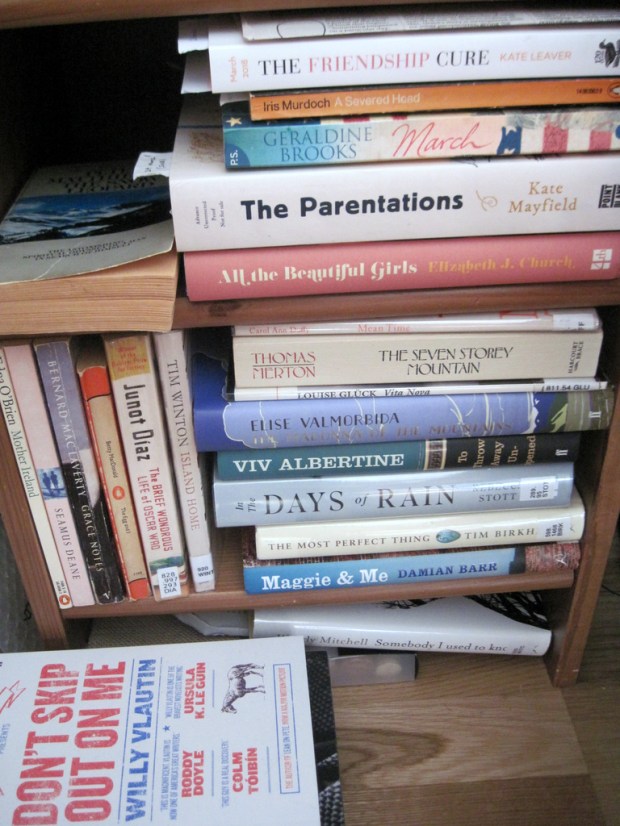
My bedside table (and environs) with its usual overwhelming selection of review books, library books, and backlist books from my own collection. And yes, it’s double-stacked!
University library:
- The Amazing Adventures of Kavalier & Clay by Michael Chabon
- The Brief Wondrous Life of Oscar Wao by Junot Díaz
- Vita Nova by Louise Glück [poetry]
- On the Road by Jack Kerouac
- The Cabaret of Plants: Botany and the Imagination by Richard Mabey
- The Sparrow by Mary Doria Russell
- The Catcher in the Rye by J.D. Salinger
- The Magnificent Spinster by May Sarton
RETURNED UNREAD
- Take Courage: Anne Brontë and the Art of Life by Samantha Ellis – This was requested by another user before I had a chance to read it. Maybe I’ll put a hold on it next month and try again.
What have you been reading from your local libraries? Does anything appeal from my stacks?
The Reading Cure: How Books Restored My Appetite by Laura Freeman
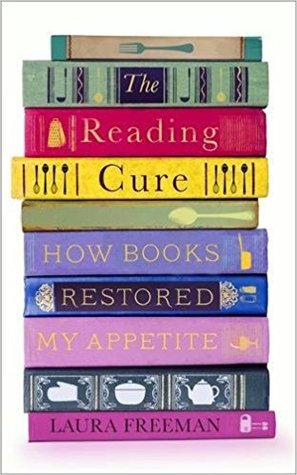 A debut memoir with food, medical and literary themes and a bibliotherapy-affirming title – this book ticks a whole lot of boxes for me. The very day I saw it mentioned on Twitter I requested a copy, and it was a warming, cozy read for the dark days of late December. As a teenager, freelance journalist Laura Freeman suffered from anorexia, and ever since she has struggled to regain a healthy relationship with food. This is decidedly not an anorexia memoir; if that’s what you’re looking for, you’ll want to pick up Nancy Tucker’s grueling but inventive The Time in Between. Instead, it’s about the lifelong joy of reading and how books have helped Freeman in the years that she has been haltingly recovering a joy of eating.
If asked to name a favorite food, Freeman writes that it would be porridge – or, if she was really pressed, perhaps her mother’s roast chicken dinner. But it’s been so long since she’s thought of food in terms of pleasure that written accounts of feasting from the likes of M.F.K. Fisher or Parson Woodforde might as well be written in a foreign language. When in 2012 she decided to read the whole of Charles Dickens’s oeuvre in his bicentenary year, she was struck afresh by the delight his characters take in meals.
While I was reading Dickens something changed. I didn’t want to be on the outside, looking at pictures, tasting recipes at one remove, seeing the last muffin go to someone else. I began to want to want food. To share it, savour it, to have it without guilt.
This nascent desire for a broader and more sumptuous food repertoire fuels the author through her voracious reading: of war writers like Siegfried Sassoon and Robert Graves with their boiled eggs and cocoa; of travel writers Laurie Lee and Patrick Leigh Fermor and their enthusiastic acceptance of whatever food came their way on treks; and of rediscovered favorite children’s books from The Secret Garden through the Harry Potter series with the characters’ greedy appetite for sweets. Other chapters are devoted to Virginia Woolf, whose depression and food issues especially resonate for Freeman; food writers; famous gluttons; and the specific challenge of chocolate, which she can’t yet bring herself to sample because it’s “so tangled up in my mind with ideas of sin, greed and loss of control.”
It’s these psychological and emotional aspects of food that Freeman is so good at capturing. She recognizes a tendency to all-or-nothing thinking that makes her prey to clean eating fads and exclusion diets. Today she still works to stifle the voices that tell her she’ll never be well and she doesn’t deserve to eat; she also tries to block out society’s contradictory messages about fat versus thin, healthy versus unhealthy, this diet versus that one. Channeling Dickens, she advises, “Don’t make a Marshalsea prison of rules for yourself – no biscuits at tea, no meat in the week, no pudding, not ever. Don’t trap yourself in lonely habits.”
Freeman’s taste in both food and literature seems a trifle old-fashioned, leaning towards jolly ol’ English stuff, but that’s because this is about comfort reading as much as it is about rediscovering comfort eating. Her memoir delicately balances optimism with reality, and encourages us to take another look at the books we love and really notice all those food scenes. Maybe our favorite writers have been teaching us how to eat well all along.
My rating:
The Reading Cure: How Books Restored My Appetite is published in the UK by Weidenfeld & Nicolson. My thanks to Virginia Woolstencroft for the review copy.
A President’s Day Reading Special
Today is President’s Day in the States, which was instituted to jointly celebrate the February birthdays of George Washington and Abraham Lincoln and is more about feting historical presidents than the current one (thank goodness). I’ve recently read four books that shed light on some American presidents: a brand-new novel, two memoirs, and a zany travel book.
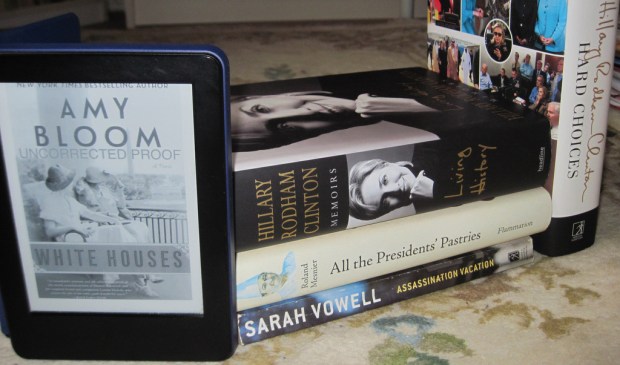
White Houses by Amy Bloom (2018)
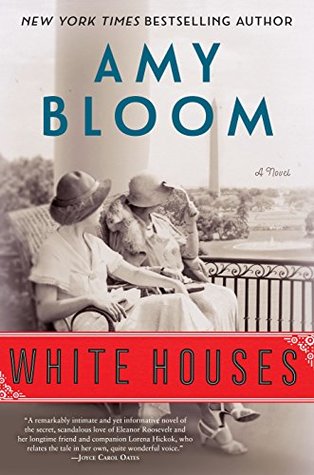 April 1945: Franklin D. Roosevelt is dead. His widow Eleanor goes to New York City to spend a long weekend with her lover, former White House reporter Lorena Hickok. Lorena, our feisty narrator, recalls her abusive upbringing in South Dakota, her early days as a reporter, and the flirtation that arose when she interviewed Eleanor about her governor husband’s presidential campaign. The open secret of FDR’s affair with his secretary, Missy LeHand, is contrasted with Eleanor and Lorena’s relationship – and with the situation of Eleanor’s cousin Parker Fiske, a closeted homosexual. Lorena’s voice is enjoyable, but I felt I gained no particular insight into Eleanor or Franklin Roosevelt. Bloom aims to reconcile Eleanor’s frumpy image with her passionate secret self, but for me that never fully happened. The most interesting scenes are from Lorena’s time working for a circus freak show on her way to Chicago (presumably completely made up). While Bloom had access to letters that passed between Lorena and Eleanor, she emphasizes that this is a work of fiction.
My rating:
[Neat little connection: As First Lady, Hillary Clinton felt a kinship with Eleanor Roosevelt, and visited her portrait in the Oval Office to have imaginary chats and buck up her courage. These are described in a chapter of Living History entitled “Conversations with Eleanor.”]
Living History: Memoirs by Hillary Rodham Clinton (2003)
 I may be showing my political colors with this choice. However, in my defense, I have also read memoirs by Laura Bush and Sarah Palin, both of which, like this, are rumored to have been ghostwritten. (In her acknowledgments Clinton mentions Lissa Muscatine as “Responsible for many of the words in my speeches as First Lady and in this book”.) The first few chapters, about Clinton’s early years and college days, are rather plodding, but once she meets Bill at Yale Law School in 1971 things pick up, and I found the whole informative and diverting. I hadn’t realized that Clinton was an accomplished lawyer in her own right, focusing on women’s and children’s rights and family law. She was also a researcher on the Nixon impeachment case – an experience that, ironically, came in handy three decades later.
Clinton is honest and self-deprecating about her image issues. She was a whole new breed of First Lady, chairing the committee for Bill’s health care bill and making state visits. Her Beijing speech is still a touchstone for international feminism. Inevitably, a good chunk of the book is devoted to the investigations that plagued the Clinton administration. The eight years of Bill’s presidency are very much the focus; the book ends with them saying a final farewell to the White House. By this point, though, Clinton had been elected a New York senator, so she left for a new mission. I picked up a secondhand copy of Hard Choices the other week and look forward to learning more about her time as a senator and then Secretary of State.
My rating:
[Neat little connection: Roland Mesnier and his sweet creations get two mentions in Living History: the giant carrot cake he made for Chelsea’s sixteenth birthday; and the book-shaped cake for her graduation.]
All the Presidents’ Pastries: Twenty-Five Years in the White House, A Memoir by Roland Mesnier with Christian Malard [trans. from French by Louise Rogers Lalaurie] (2007)
 Roland Mesnier was the White House pastry chef for 25 years. After training in France and Germany, he worked at the Savoy in London and then as head pastry chef at the Princess Hotel, Bermuda – all by age 20. His specialty was intricate sugar sculptures, for which he won international competitions. He also worked in Paris and Virginia before hearing that Rosalynn Carter was looking for a White House pastry chef. Fast-tracked to U.S. citizenship, he made elaborate desserts for presidential family occasions and state dinners. The latter were always based on research into a particular country’s culture, products, taste and traditions. These impressive constructions included molded sorbets, petits fours and marzipan figures, and were often feats of logistics and timing. The memoir is undoubtedly more interesting for what it tells about the First Families (Nancy Reagan was a hard taskmistress; Barbara Bush was his personal #1) than for its author’s life. An appendix includes 15 fairly simple (i.e., replicable at home!) recipes from his 2004 cookbook Dessert University, such as pecan bourbon pie and baked apple soufflé.
 (I must also marvel at the journey that this particular book has been on. It is signed by the English translator and inscribed to her mother: “Mum, with all love, Louise – 8 May 2007”. This hardback copy somehow made it all the way to the £1 bargain shelves outside the upper level of the castle in Hay-on-Wye, Wales, where my husband snatched it up last spring.)
My rating:
Assassination Vacation by Sarah Vowell (2005)
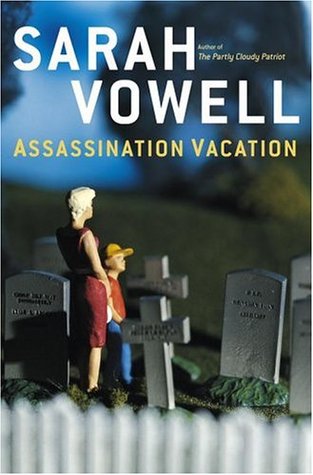 U.S. history has never been so much fun! There’s nothing Sarah Vowell loves more than a presidential plaque, monument, home or grave, and her enthusiasm is infectious. Over half of this book is about Abraham Lincoln’s assassination; the rest goes to those of James Garfield and William McKinley (attempts on T. Roosevelt and Reagan get a brief mention, but she pretty much avoids JFK – presumably because that would fill a book of its own). If all you remember about these last two assassins is that one was a disgruntled civil servant and the other was an anarchist with a funny name, let Vowell enlighten you with her mixture of travel and trivia. She follows John Wilkes Booth’s escape route from the nation’s capital, traces Charles Guiteau back to upstate New York’s Oneida community, and sympathizes with Leon Czolgosz’s hard early life. The book came out in 2005, and what with Vowell’s outrage over the Dubya administration, it does feel a little dated. But if the rest of her books are this nerdy-cool, I’ll be reading them all.
My rating:
What’s on your presidential reading list?
Review: Salt Creek by Lucy Treloar
Salt Creek is one of the very best works of historical fiction I’ve read. All the harder, then, to believe that it’s Lucy Treloar’s debut novel. Since its initial release in Australia in 2015, it has gone on to be shortlisted for the Walter Scott Prize for historical fiction and the Miles Franklin Award for Australian novels. We have Claire McAlpine of Word by Word to thank for helping this book find a publisher in the UK. I can particularly recommend it to fans of The Essex Serpent and English Passengers, and there are also resonances with Rebecca Winterer’s Australia-set The Singing Ship.
 Hester Finch is looking back from the 1870s – when she is a widowed teacher settled in England – to the eight ill-fated years her family spent at Salt Creek, a small (fictional) outpost in South Australia, in the 1850s–60s. Her luckless father tried whaling in Adelaide before turning to cheese-making as his next far-fetched money-making venture. From Quaker stock, Papa believed the natives should be well treated and even all but adopted an aboriginal boy named Tully, getting him to bathe and wear clothes and educating him alongside his seven children. However, as Hester hints starting early on in the novel, having a white family monopolizing resources put an impossible strain on relations with the natives.
It seems an inevitable irony of reviewing – or maybe it’s just me? – that the books you love the most are the hardest to write about. However can I do this book justice? I wonder about lots of 5-star books. It’s easier to put together a review when you have some mixture of positive and negative things to say, but I have no faults to find with Salt Creek. It flawlessly evokes its time period and somewhat bleak setting. Hester’s narration is as lyrical as it is nostalgic and matter-of-fact, and I sympathized with her desperation not to be drawn into a Victorian housewife’s cycle of endless pregnancies. The characterization is spot on, especially for figures like Papa or Tully who could have easily been reduced to stereotypes.
Most of all, this is the piercing story of a clash of cultures and the secret prejudices that underpin our beliefs. You might think notions of dominion and looking after ‘poor natives’ are outdated, but just listen in to what particular groups have to say about the environment and intervention abroad and you’ll realize that this is as relevant as ever. Salt Creek comes with my highest recommendation.
Some favorite lines:
“Poor Papa. He pitted himself against the land, yet it was impervious to all his learning and effort and incantatory prayers. The land had its own drives and they ran against Papa’s, blunting all his purposes.”
“I would not have a baby or that would be my life. There would be another and another and nothing left of my self; my life being decided for me.”
“Memories are just the survivors of complete events and are not easy to interpret; in the recalling they can be used to create a story that is only partially true or not true at all.”
“It seemed as if every part of the lagoon had a name and a story and a meaning. The stories were all around us wherever we went. There was scarcely a place without one and it felt as if we were nothing but one more story inside this world and the stories were without number.”
“The longer I looked the more that impression of civilization seemed an illusion.”
With thanks to Gallic Books for the free copy for review.
My rating:
Love and Lust: Four Books for Valentine’s Day
Got any romantic plans for the morrow? I’ll be having my first of six evening yoga classes at our local Waitrose (was a more middle-class phrase ever written?!), but I’ve been promised a nice dinner with dessert on my return.
Like last year, I’ve been reading a few books with “love” in the title – plus one featuring “lust” this time – in advance of the day and can report back on what I’ve gleaned. Nothing particularly optimistic about marriage or true love, I’m afraid.

Lust in Translation: Infidelity from Tokyo to Tennessee by Pamela Druckerman (2007)
 Druckerman travels from France (where she lives) to the United States, Russia, Japan, South Africa, Indonesia and China, interviewing professionals and anonymous adulterers and pondering what makes people cheat and what difference country of origin makes. Boiling it down, people in poor countries, even in parts of Africa where AIDS is a huge threat, are more likely to have multiple sexual partners than those in wealthy countries. Statistically speaking, there’s also a slight bias towards adultery in warmer countries. However, some factors that you might expect to have a big effect on the adultery rate, like religiosity (e.g. America vs. France), actually hardly do. What does differ is the level of guilt experienced over infidelity and its concomitant offense, lying. In places like France and Japan she discovers more of a don’t-ask-don’t-tell attitude: as long as the straying partner is discreet enough not to be caught, the other turns a blind eye.
Travel-based quest narratives like this usually have a personal element that helps to anchor a book. The other direction Druckerman might have taken would be a straightforward academic study, which her journalistic tone wouldn’t suit. Because this book hovers between genres/levels of discourse, it didn’t quite work for me, but if you think you might find the subject matter interesting it’s at least worth skimming.
A representative line:
“The pursuit of happiness, or true love, is one of the most salient stories that Americans use to justify affairs and overcome their moral qualms about cheating.”
My rating:
Loving Frank by Nancy Horan (2007)
 Even if you don’t have any particular interest in architect Frank Lloyd Wright, this carefully crafted and lovingly written historical novel is well worth reading. Mamah (“May-muh”) Borthwick Cheney and her husband Edwin hired Wright to design their suburban Chicago home in 1903, and in 1907 she and Wright embarked on an affair. The novel covers roughly the next seven years of their lives, and is particularly illuminating about relationships, the rights of women and the morality code of the time. Through Mamah’s eyes Horan shows just why this affair was irresistible: “Frank Lloyd Wright was a life force. He seemed to fill whatever space he occupied with a pulsing energy that was spiritual, sexual, and intellectual all at once.” But in the eyes of the public, and of their families, it was a selfish choice that left her two children adrift. Beside Mamah, Catherine Wright was held up as a paragon of fidelity, waiting patiently for Frank to come back to her and their seven children.
If you think you are at all likely to read this book, DO NOT GOOGLE Mamah Borthwick Cheney, or Frank Lloyd Wright’s life in these years. I’m now keen to compare this with T.C. Boyle’s The Women, which is about Catherine, Mamah and two other important female figures in Frank Lloyd Wright’s life.
A representative passage:
“Does that mean I have to play this hand to the bitter end, full of regret? Knowing I might have had the happiest life imaginable with the one man I love more than any other I have ever known?”
My rating:
I Love Dick by Chris Kraus (1997)
 This is one of the stranger novels I’ve ever read. It’s December 1994 and failed filmmaker Chris Kraus, 39, and her husband, 56-year-old professor Sylvère Lotringer, spend a night at the home of Dick, one of his California colleagues, to mark the end of Sylvère’s sabbatical. When they wake up the next morning Dick is gone, but he’s made a huge impression on Chris. She decides she and Dick have had something like D.H. Lawrence’s ‘sex in the head’, and becomes obsessed with him. Chris and Sylvère address reams of letters and journal entries to Dick. Some they send and some they don’t; Dick is a total blank, which allows the couple to build fantasies around him. It’s a chance for Chris to reimagine a life that’s gotten away from her and regain her voice.
I preferred Part 1, which I found quite funny. Kraus lost me a bit in Part 2, with a trip to Guatemala plus random exhibits and performance art. I think the whole thing would have been more effective at novella length. But it’s intriguing how it blends fact and fiction (Dick Hebdige is a real person, and apparently not happy about the invasion of his privacy) and adapts the epistolary form. An afterword by Joan Hawkins notes the similarity to Dangerous Liaisons, in which a couple exchange letters about a seduction plot.
A representative passage:
“Dear Dick,
No woman is an island-ess. We fall in love in hope of anchoring ourselves to someone else, to keep from falling,
Love,
Chris”
My rating:
The Pursuit of Love by Nancy Mitford (1945)
 Last year I unwittingly read the 1949 sequel, Love in a Cold Climate, first. I rather enjoyed that one, but somehow wasn’t in the mood for Mitford this time around, and ended up just skimming this one. Once again Fanny traces the love life of one of her posh cousins. This time it’s Linda Radlett, whose two marriages – to a Conservative and a Communist – are doomed to failure. Then she finds her true love, too late. I liked the ball scene, and the image of Uncle Matthew using his bloodhounds to hunt down his children. Mitford mixes the lighthearted and the caustic in an amusing way. The last two pages of this novel turn particularly nasty, though, which made me wonder how people can call this a comfort read.
A representative passage:
“What we would never admit was the possibility of lovers after marriage. We were looking for real love, and that could only come once in a lifetime; it hurried to consecration, and thereafter never wavered. Husbands, we knew, were not always faithful, this we must be prepared for, we must understand and forgive.”
My rating:
 Bookish Beck = Rebecca Foster. American transplant to England. Freelance proofreader and book reviewer.
