Six Degrees of Separation: From Wintering to The Summer of the Bear
This month we begin with Wintering by Katherine May. I reviewed this for the Times Literary Supplement back in early 2020 and enjoyed the blend of memoir, nature and travel writing. (See also Kate’s opening post.)

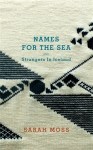 #1 May travels to Iceland, which is the location of Sarah Moss’s memoir Names for the Sea. I’ve read nine of Moss’s books and consider her one of my favourite contemporary authors. (I’m currently rereading Night Waking.)
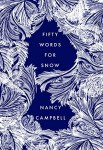 #2 Nancy Campbell’s Fifty Words for Snow shares an interest in languages and naming. I noted that the Icelandic “hundslappadrifa” refers to snowflakes as large as a dog’s paw.
 #3 In 2018–19, Campbell was the poet laureate for the Canal & River Trust. As part of her tour of the country’s waterways, she came to Newbury and wrote a poem on commission about the community gardening project I volunteer with. (Here’s her blog post about the experience.) Three Women and a Boat by Anne Youngson is about a canalboat journey.
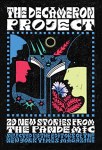 #4 Youngson’s novel was inspired by the setup of Jerome K. Jerome’s Three Men in a Boat. Another book loosely based on a classic is The Decameron Project, a set of 29 short stories ranging from realist to dystopian in their response to pandemic times.
 #5 Another project updating the classics was the Hogarth Shakespeare series. One of these books (though not my favourite) was The Gap of Time by Jeanette Winterson, her take on The Winter’s Tale.
 #6 Even if you’ve not read it (it happened to be on my undergraduate curriculum), you probably know that The Winter’s Tale famously includes the stage direction “Exit, pursued by a bear.” I’m finishing with The Summer of the Bear by Bella Pollen, one of the novels I read on my trip to the Outer Hebrides because it’s set on North Uist. I’ll review it in full soon, but for now will say that it does actually have a bear in it, and is based on a true story.
I’m pleased with myself for going from Wintering (via various other ice, snow and winter references) to a “Summer” title. We’ve crossed the hemispheres from Kate’s Australian winter to summertime here.
Where will your chain take you? Join us for #6Degrees of Separation! (Hosted on the first Saturday of each month by Kate W. of Books Are My Favourite and Best.) Next month’s starting point will be the recent winner of the Women’s Prize, The Book of Form and Emptiness by Ruth Ozeki.
Have you read any of my selections? Tempted by any you didn’t know before?
The Best Books from the First Half of 2022
Yes, it’s that time of year already! At first I thought I wouldn’t have enough 2022-released standouts to fill a post, but the more I looked through my list the more I realized that, actually, it has been a pretty good reading year. It remains to be seen, of course, how many of these will make it onto my overall best-of year list, but for now, these are my highlights. I made it up to an even 20 by including one that doesn’t release until July. Fiction is winning thus far! I give review excerpts below and link to the full text here or elsewhere.
Fiction
 Our Wives under the Sea by Julia Armfield: Miri is relieved to have her wife back when Leah returns from an extended deep-sea expedition. Something went wrong with the craft when it was too late to evacuate, though. Chapters alternate between Miri describing their new abnormal and Leah recalling the voyage. As Miri tries to tackle life admin for both of them, she feels increasingly alone. This is a sensitive study of love, grief and dependency. Armfield gives an increasingly eerie story line a solid emotional foundation.
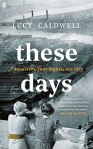 These Days by Lucy Caldwell: A beautiful novel set in Belfast in April 1941. We see the Second World War mostly through the eyes of the Bell family – especially daughters Audrey, engaged to be married to a young doctor, and Emma, in love with a fellow female first aider. The evocation of a time of crisis is excellent. The lack of speech marks, fluid shifting between perspectives, and alternation between past and present tense keep the story from seeming too familiar or generic. All of the female characters have hidden depths.
 Groundskeeping by Lee Cole: In Cole’s debut novel, two aspiring writers meet on a Kentucky college campus and form a romantic connection despite very different backgrounds. There are stereotypes to be overcome as Owen introduces Alma to Kentucky culture and slang. Trump’s election divides families and colleagues. The gentle satire on the pretensions of writing programs is another enjoyable element. Three-dimensional characters, vivid scenes ripe for the Netflix treatment, timely themes and touching relationships: alright!
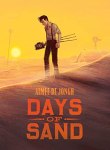 Days of Sand by Aimée de Jongh: This Great Depression-era story was inspired by the work of photographers such as Dorothea Lange. John Clark is following in his father’s footsteps as a photographer, leaving NYC for the Oklahoma panhandle. Locals are suspicious of John as an outsider, especially when they learn he is working to a checklist. Whether a cityscape or the midst of a dust storm, de Jongh’s scenes are stark and evocative. It’s rare for me to find the story and images equally powerful in a graphic novel, but that’s definitely the case here.
 Dance Move by Wendy Erskine: The 11 stories in Erskine’s second collection do just what short fiction needs to: dramatize an encounter, or a moment, that changes life forever. Her characters are ordinary, moving through the dead-end work and family friction that constitute daily existence, until something happens, or rises up in the memory, that disrupts the tedium. Erskine being from Belfast, evidence of the Troubles is never far away. Her writing is blunt and edgy, with no speech marks plus flat dialogue and slang.
 Antipodes by Holly Goddard Jones: Riveting stories of contemporary life in the American South and Midwest. Some have pandemic settings; others are gently magical. All are true to the anxieties of modern careers, marriage and parenthood. Endings elicit a gasp, particularly the audacious inconclusiveness of “Exhaust,” a tense tale of a quarreling couple driving through a blizzard. Worry over environmental crises fuels “Ark,” about a pyramid scheme for doomsday preppers. Nickolas Butler and Lorrie Moore fans will find much to admire.
 Sea of Tranquility by Emily St. John Mandel: This dazzlingly intricate novel blends historical fiction, up-to-the-minute commentary and science-fiction predictions. In 2401, the Time Institute hires Gaspery-Jacques Roberts to investigate a recurring blip in time. Fans of The Glass Hotel will recognize some characters, and those familiar with Station Eleven will find similarities in a pandemic plot that resonates with the Covid-19 experience. How does Mandel do it? One compulsively readable hit after another.
 Very Cold People by Sarah Manguso: The aphoristic style of some of Manguso’s previous books continues here as discrete paragraphs and brief vignettes build to a gloomy portrait of Ruthie’s archetypical affection-starved childhood in the fictional Massachusetts town of Waitsfield in the 1980s and 90s. The depiction of Ruthie’s narcissistic mother is especially acute. So much resonated with me. This is the stuff of girlhood – if not universally, then certainly for the (largely pre-tech) American 1990s as I experienced them.
 How High We Go in the Dark by Sequoia Nagamatsu: Just the right blend of literary fiction and science fiction. Opening in 2031 and stretching another 70 years into the future, this linked short story collection imagines how a pandemic reshapes the world and how communication and connection might continue after death. All but one story are in the first person, so they feel like personal testimonies. The whole is greater than the sum of the parts. The focus on illness and bereavement, but also on the love that survives, made this a winner.
 The Swimmers by Julie Otsuka: Otsuka’s third novel of the Japanese American experience again employs the first-person plural, as well as the second person – rarer perspectives that provide stylistic novelty. The first two chapters are set at a pool that, for the title swimmers, serves as a locus of escape and safety. On the first page we’re introduced to Alice, whose struggle with dementia becomes central. I admired Otsuka’s techniques for moving readers through the minds of the characters, alternating range with profundity and irony with sadness.
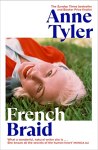 French Braid by Anne Tyler: My 17th from Tyler, and easily her best new work in 18 years. It joins my other favourites such as Dinner at the Homesick Restaurant which reveal a dysfunctional family’s quirks through a close look, in turn, at the various members. Mercy is a painter and essentially moves into her studio, but without announcing it, and her husband Robin spends the next 25+ years pretending they still share a home. Other surprises from Tyler this time: a mild sex scene and a gay character. A return to form. Brava!
Nonfiction
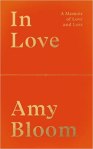 In Love by Amy Bloom: Bloom’s husband, Brian Ameche, was diagnosed with early-onset Alzheimer’s in his mid-60s, having exhibited mild cognitive impairment for several years. Brian quickly resolved to make a dignified exit while he still, mostly, had his faculties. This achieves the perfect tone, mixing black humour with teeth-gritted practicality as Bloom chronicles their relationship, the final preparations, his assisted suicide at Dignitas in Switzerland, and the aftermath. An essential, compelling read.
 Everything Is True by Roopa Farooki: Second-person, present-tense narration drops readers right into the life of a junior doctor. In February 2020, Farooki’s sister Kiron died of breast cancer. During the first 40 days of the initial UK lockdown, she continues to talk to Kiron. Grief opens the door for magic realism. There is also wry humour, wordplay, slang and cursing. A hybrid work that reads as fluidly as a novel while dramatizing real events, this is sure to appeal to people who wouldn’t normally pick up a bereavement or medical memoir.
 Body Work by Melissa Febos: A boldly feminist essay collection that explores how autobiographical writing can help one face regrets and trauma and extract meaning from the “pliable material” of memory. “In Praise of Navel Gazing” affirms the importance of women airing their stories of abuse and thereby challenging the power structures that aim to keep victims silent. “A Big Shitty Party” warns of the dangers of writing about real people. “The Return” employs religious language for the transformation writing can achieve.
 All Down Darkness Wide by Seán Hewitt: This poetic memoir about love and loss in the shadow of mental illness blends biography, queer history and raw personal experience. The book opens, unforgettably, in a Liverpool graveyard where Hewitt has assignations with anonymous men. His secret self, suppressed during teenage years in the closet, flies out to meet other ghosts: of his college boyfriend; of men lost to AIDS during his 1990s childhood; of English poet George Manley Hopkins; and of a former partner who was suicidal. (Coming out on July 12th from Penguin/Vintage (USA) and July 14th from Jonathan Cape (UK). My full review is forthcoming for Shelf Awareness.)
Poetry
 Thorpeness by Alison Brackenbury: This tenth collection features abundant imagery of animals and the seasons. Alliteration is prominent, but there is also a handful of rhymes. Family history and the perhaps-idyllic rural underpin the verse set in Lincolnshire and Gloucestershire as Brackenbury searches for ancestral graves and delivers elegies. I especially loved “Aunt Margaret’s Pudding,” a multipart poem about her grandmother’s life. There are also playful meetings between historical figures.
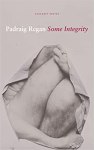 Some Integrity by Padraig Regan: The sensual poems in this debut collection are driven by curiosity, hunger and queer desire. Flora and foods are described as teasing mystery, with cheeky detail. An unusual devotion to ampersands; an erotic response to statuary; alternating between bold sexuality and masochism to the point of not even wanting to exist; a central essay on the Orlando nightclub shooting and videogames – the book kept surprising me. I loved the fertile imagery, and appreciated Regan’s exploration of a nonbinary identity.
 Love Poems in Quarantine by Sarah Ruhl: Having read Ruhl’s memoir Smile, I recognized the contours of her life and the members of her family. Cooking and laundry recur: everyday duties mark time as she tries to write and supervises virtual learning for three children. “Let this all be poetry,” she incants. Part 2 contains poems written after George Floyd’s murder, the structure mimicking the abrupt change in focus for a nation. Part 3’s haiku and tanka culminate in a series on the seasons. A welcome addition to the body of Covid-19 literature.
 Rise and Float by Brian Tierney: Although it tackles heavy subjects like grief and mental health, the collection’s candor and stunning images transform the melancholy into the sublime. Much of the verse is in the first person, building an intimate portrait of the poet and his relationships. A family history of mental illness and electroshock treatment occasions a visit to a derelict psychiatric hospital. Recurring metaphors of holes dramatize a struggle against the void. Tierney’s close attention lends beauty to bleak scenes.
 Vinegar Hill by Colm Tóibín: I didn’t realize when I started that this was Tóibín’s debut collection; so confident is his verse, I assumed he’d been publishing poetry for decades. There’s a wide range of tone, structures and topics. Bereavements and chemotherapy are part of a relatable current events background. Irish-Catholic nostalgia animates a witty sequence from “The Nun” to “Vatican II.” Come along on armchair travels. Poems are based around anecdotes or painterly observations. The line breaks are unfailingly fascinating.
What are some of the best books you’ve read so far this year?
What 2022 releases do I need to catch up on right away?
The Wainwright Prize 2022 Longlists
The Wainwright Prize is my favourite nonfiction prize and one I follow closely because I tend to read many of the nature books released in the UK in any given year, as well as some popular science. I was honoured to be part of an “academy” of bloggers, booksellers, previous year judges and previously shortlisted authors asked to comment on a very long list of publisher submissions. These votes were used to help arrive at the longlists. This year, the categories have been subtly adjusted to avoid the problem there has been the past two years of certain books falling between the cracks because they are set between the UK and overseas. Now there is a clearer thematic division between narrative nature writing and conservation, without the UK/global dichotomy. For the first year, there is also a prize for children’s books on nature (fiction and non-). Several of my picks made it through to each longlist.
I’m snatching a few moments between a bistro dinner and seal watching out our B&B window on the tiny island of Berneray to put this together. Below I give brief comments based on what I’ve read so far and would like to read.
The 2022 James Cropper Wainwright Prize for Nature Writing longlist:
- Otherlands: A World in the Making, Dr Thomas Halliday (Allen Lane)
- 12 Birds to Save Your Life: Nature’s Lessons in Happiness, Charlie Corbett (Penguin)
- Goshawk Summer: A New Forest Season Unlike Any Other, James Aldred (Elliott & Thompson)
- Much Ado About Mothing: A year intoxicated by Britain’s rare and remarkable moths, James Lowen (Bloomsbury Wildlife)
- On Gallows Down: Place, Protest and Belonging, Nicola Chester (Chelsea Green Publishing)
- Shadowlands: A Journey through Lost Britain, Matthew Green (Faber & Faber)
- The Heeding, Rob Cowen, illustrated by Nick Hayes (Elliott & Thompson)
- The Instant, Amy Liptrot (Canongate)
- The Sea Is Not Made of Water: Life Between the Tides, Adam Nicolson (William Collins)
- The Trespasser’s Companion, Nick Hayes (Bloomsbury)
- Time on Rock: A Climber’s Route into the Mountains, Anna Fleming (Canongate)
- Wild Green Wonders: A Life in Nature, Patrick Barkham (Guardian Faber Publishing)
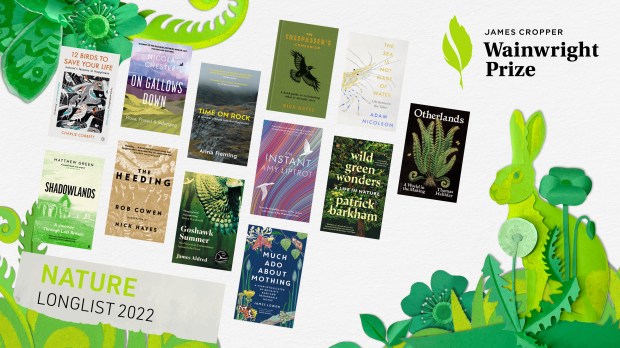
My thoughts: I have read and loved Goshawk Summer and On Gallows Down—the latter would be my overall top recommendation for the prize for how it fuses place-based memoir and passion for protecting wildlife and landscapes. I’ve also read The Heeding and The Instant but had mixed feelings about both. I’ve had the Barkham, Halliday and Nicolson out from the library but realized I only wanted to skim them – they were too dense (or, in the case of Barkham’s collected columns, too disparate) to read right through. I have a review copy of Much Ado about Mothing and have been finding it a delightful nature quest. I don’t know much about the four other titles, but would gladly read them if I found copies.
The 2022 James Cropper Wainwright Prize for Writing on Conservation:
- Abundance: Nature in Recovery, Karen Lloyd (Bloomsbury Wildlife)
- Aurochs and Auks, John Burnside (Little Toller Books)
- Climate Change Is Racist, Jeremy Williams and Dr Shola Mos-Shogbamimu (Icon Books)
- Divide: The relationship crisis between town and country, Anna Jones (Kyle Books)
- Eating to Extinction: The World’s Rarest Foods and Why We Need to Save Them, Dan Saladino (Jonathan Cape)
- Our Biggest Experiment: A History of the Climate Crisis, Alice Bell (Bloomsbury Sigma)
- Regenesis: Feeding the World Without Devouring the Planet, George Monbiot (Allen Lane)
- Silent Earth: Averting the Insect Apocalypse, Dave Goulson (Vintage)
- Soundings: Journeys in the Company of Whales, Doreen Cunningham (Virago)
- The Insect Crisis: The Fall of the Tiny Empires that Run the World, Oliver Milman (Atlantic Books)
- The Treeline: The Last Forest and the Future of Life on Earth, Ben Rawlence (Jonathan Cape)
- The Women Who Saved the English Countryside, Matthew Kelly (Yale University Press)
- Wild Fell: Fighting for nature on a Lake District hill farm, Lee Schofield (Doubleday)
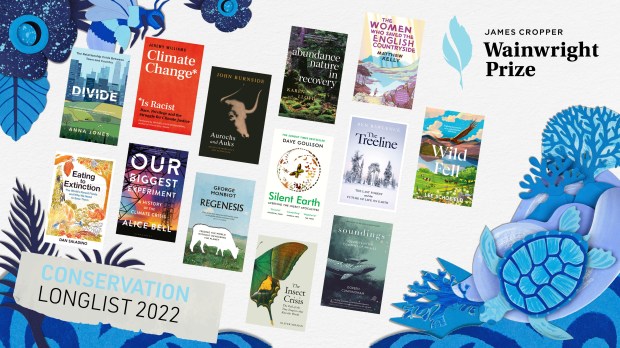
My thoughts: I’ve only read Aurochs and Auks and Silent Earth (which I reviewed for Shelf Awareness and would gladly see win the prize for shedding light on an aspect of the biodiversity crisis that’s not talked about enough; curious to longlist a second book, the Milman, on the same topic, though). I’d happily read any of the others. I’m particularly interested in Soundings, which I already have on my e-reader from a review opportunity I passed up.
The 2022 James Cropper Wainwright Prize for Children’s Writing on Nature and Conservation longlist:
- A Bug’s World, Dr Erica McAlister, illustrated by Stephanie Fizer Coleman (Wren & Rook)
- Around the World in 80 Trees, Ben Lerwill, illustrated by Kaja Kajfež (Welbeck)
- By Rowan and Yew, Melissa Harrison (Chicken House)
- Julia and the Shark, Kiran Millwood Hargrave, illustrated by Tom de Freston (Orion Children’s Books)
- Nests, Susan Ogilvy (Particular Books)
- October, October, Katya Balen, illustrated by Angela Harding (Bloomsbury Children’s Books)
- One World: 24 Hours on Planet Earth, Nicola Davies, illustrated by Jenni Desmond (Walker Books)
- Spark, Mitch Johnson (Orion Children’s Books)
- The Biggest Footprint: Eight billion humans. One clumsy giant, Rob Sears, illustrated by Tom Sears (Canongate)
- The Summer We Turned Green, William Sutcliffe (Bloomsbury YA)
- Twitch, M.G. Leonard (Walker Books)
- Wild Child: A Journey Through Nature, Dara McAnulty, illustrated by Barry Falls (Macmillan Children’s Books)

My thoughts: To my surprise, I’d read two of these: October, October and Wild Child. I’ve also read the Harrison novel that preceded this one. I’ve read other novels by Hargrave so would read this one, too. I’m unlikely to seek out any of the rest, but I’m pleased this new prize exists. If children are our only hope for surviving the climate crisis as a species, then we have to get them on-side as early as possible.
Overall thoughts: Pretty good representation of women on the lists! Just one person of colour this year, I think. A good mix of subjects; not too much repetition. (My husband (an entomologist) was pleased to see four books about insects.) And a decent balance of veteran versus new writers. I look forward to following the process and seeing who makes it through to the shortlist (on 28 July, with the winners to be announced on 7 September).
Have you read anything from the Wainwright Prize longlists?
Which of these books take your fancy?
Love Your Library, June 2022
In the past month we’ve had visits to libraries in Canada and Catalonia – thanks to Marcie and Margaret for sharing about these.
It’s been good to see more activities resuming at my local library, where I volunteer twice a week. In recent months I’ve noticed the upstairs meeting room being used for Lego building and flower arranging, as well as for reading group discussions.
When it comes to library material, I’ve been borrowing much more than I’ve been reading. I stocked up in advance of our Scotland holiday – even though we’re travelling by train, bus and ferry, so I haven’t been able to take very many books with me.


This is what I’ve gotten to since last month:
READ
- The Dance Tree by Kiran Millwood Hargrave

- The Feast by Margaret Kennedy
- A Parrot in the Pepper Tree by Chris Stewart

- The Murderer’s Ape by Jakob Wegelius

(I reviewed the above four across my Spain trip and 20 Books of Summer posts.)
- By Ash, Oak and Thorn by Melissa Harrison
- Stormy Petrel by Mary Stewart (review to come)

- The Schoolhouse by Sophie Ward

CURRENTLY READING
- Orchid Summer by Jon Dunn
- Secrets of the Sea House by Elisabeth Gifford
- Black Narcissus by Rumer Godden
- This Is Not a Pity Memoir by Abi Morgan
- The Summer of the Bear by Bella Pollen
What have you been reading or reviewing from the library recently?
Share a link to your own post in the comments. Feel free to use the above image. The hashtag is #LoveYourLibrary.
20 Books of Summer, 6–7: Melissa Harrison & Oliver Rackham
After two days in Inverness, our Western Isles adventure is ready to begin. I’m writing on the ferry from Ullapool to Stornoway (the main population centre on the island of Lewis in the Outer Hebrides of Scotland), where we’ll pick up a rental car and head to our Airbnb before exploring standing stones and bird reserves well into the long evening.
On the bus this morning I started Black Narcissus by Rumer Godden, the next in my flora-themed reading. For today, I have brief responses to two books I finished before we left: a genial children’s fantasy novel and an in-depth guide to a tree. Ash is today’s linking word.
By Ash, Oak and Thorn by Melissa Harrison (2021)
 Burnet, Cumulus and Moss are “Hidden Folk” (like Iceland’s elves), ancient, tiny beings who hibernate for winter in an ash tree. When they lose their home and Cumulus, the oldest, starts fading away, they set off on a journey to look for more of their kind and figure out what is happening. This eventually takes them to “the Hive” (London, presumably); they are helped along the way by creatures they might have been wary of: they hitch rides on deer and pigeons, and a starling, fox and rat are their allies in the city.
This reminded me of Watership Down with the classic quest feel, the many perils faced, and the way the species communicate with each other and are rendered as having different accents. The feasts and creative use of miniature objects recalled what I most love about the Brambly Hedge books. There is an important message about overcoming fear and prejudice, and a warning that Mortals have lost their connection to the Wild World. The hint is that the trio might play a role in helping humans reclaim it – perhaps in the sequel, recently longlisted for the Wainwright Prize (more on which anon).
Although there is a didactic element, with Harrison also commenting on emotions and pointing out natural phenomena for children to notice through the seasons, this didn’t bother me, and – in the Tove Jansson tradition – there are plenty of asides for grown-ups to appreciate, too. I’m unfamiliar with the series that inspired this, the 1930s The Little Grey Men books by “B.B.” (Denys Watkins-Pitchford), so can’t comment on it in comparison to the source material. I’ve read four other Harrison books, nonfiction and adult fiction, but this outstripped them all. (Public library)
A favourite passage:
“Going on an adventure might be exciting, but if you’re a home-loving person, it’s not long until you start wanting to feel safe and indoorsy again.”
The Ash Tree by Oliver Rackham (2014)
 A single-species monograph, this was more academic than I expected from Little Toller – it has statistics, tables and figures. So, it contains everything you ever wanted to know about ash trees, and then some. I actually bought it for my husband, who has found the late Rackham’s research on British landscapes useful, but thought I’d take a look as well. (The rental house we recently left had a self-seeded ash in the front garden that sprang up to almost the height of the house within the five years we lived there. Every time our landlords came round, we held our breath waiting for them to notice that the roots had started to push up the pavement and tell us it had to be cut down, but until now it has survived.)
Topics include the birds and insects the trees shelter, the lichen that grows on them, coppicing and pollarding techniques (“plashing” into hedges, the creation of horizontal seats), and the designation of ancient and veteran trees. Ash dieback disease, a major global issue, is another point for discussion. I found myself skimming through a lot of the detail, especially in later chapters. My favourite bits of trivia were that Yeats mentions the ash the most out of a handful of notable UK/Ireland poets, and that baseball bats are generally made out of ash wood. There are loads of colour photographs to help visualize tree features and locations. (New purchase)
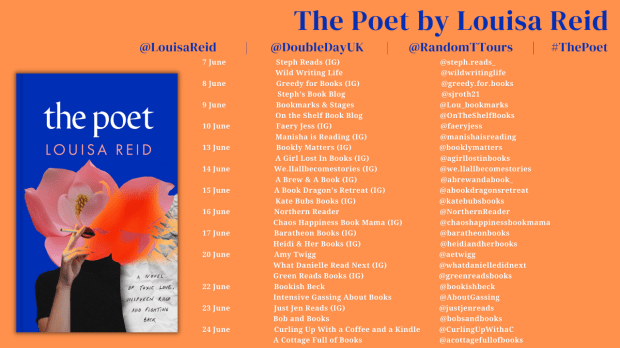
The Poet by Louisa Reid (Blog Tour Review)
The Poet lured me with the prospect of a novel in verse (Girl, Woman, Other and Mary Ann Sate, Imbecile are two others I would recommend) and the theme of a female poet caught up in a destructive relationship with her former professor. Emma Eliot published a poetry collection at age 21 before embarking on an abandoned PhD on Charlotte Mew. Tom Abbot, a charming Oxford don in his early forties, left his wife and daughters for her, but Emma has found that the housewife existence doesn’t suit her and longs to return to academia. Tom relies on Emma to boost his ego, play stepmum and help him with his publications, but scorns her working-class upbringing and can’t conceive of her having her own life and desires.

Tom’s students and ex-wife commiserate with Emma over his arrogance, but in the end it’s up to her whether she’ll break free. She tells her story of betrayal, gaslighting and the search for revenge in free verse that flows effortlessly. Sometimes her words are addressed to Tom:
Miles of misunderstanding waver
between us
Anything would be better than the stink
of your
superiority.
– and other times to the reader.
Give me the confidence of a mediocre white man
who thinks he has the right to
a woman’s work –
her words
and womb –
and everything else.
if the bed seems too big
then perhaps that is because I have shrunk
to fit the space,
or am lost in the wasteland of what was.
There are a few poetry in-jokes like that one, with Emma quoting Emily Dickinson and Tom likening her early work to Sylvia Plath’s. Usually this feels like reading fiction rather than poetry, though the occasional passage where alliteration and internal rhymes bloom remind you that Emma is meant to be an accomplished poet.
I wanted to sit in a book-lined room
wombed in words.
I didn’t see the tomb that waited
for the woman
who underrated herself.
That said, I didn’t particularly rate this qua poetry, and the storytelling style wasn’t really enough to make a rather thin story stand out. Still, I’d recommend it to poetry-phobes, as well as to readers of The Wife by Meg Wolitzer and especially Here Is the Beehive by Sarah Crossan (who, like Reid, wrote YA fiction before producing an adult novel in verse).
My thanks to Doubleday and Anne Cater of Random Things Tours for my proof copy for review.
I was delighted to be part of the blog tour for The Poet. See below for details of where other reviews have appeared or will be appearing soon.
20 Books of Summer, 4–5: Roy Dennis & Sophie Pavelle
The next two entries in my flora-themed summer reading are books I read for paid reviews, so I only give extracts from my thoughts below. These are both UK-based environmentalist travel memoirs and counted because of their titles, but do also feature plants in the text. I have various relevant books of my own and from the library on the go toward this challenge. Despite the complications of a rail strike and two cancelled trains, we have persisted in finding workarounds and making new bookings, so our trip to the Outer Hebrides is going ahead – whew! I’ll schedule a few posts for while I’m away and hope to share all that was seen and done (and read) when I’m back in early July.
Mistletoe Winter: Essays of a Naturalist throughout the Year by Roy Dennis (2021)
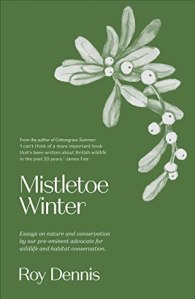 Dennis is among the UK’s wildlife conservation pioneers, particularly active in reintroducing birds of prey such as ospreys and white-tailed eagles (see also my response to his Restoring the Wild). In this essay collection, his excitement about everyday encounters with the natural world matches his zeal for momentous rewilding projects. The book entices with the wonders that can be experienced through close attention, like the dozen species’ worth of tracks identified on a snowy morning’s walk. Dennis is sober about wildlife declines witnessed in his lifetime. Practical and plain-speaking, he does not shy away from bold proposals. However, some of the pieces feel slight or dated, and it’s unclear how relevant the specific case studies will prove elsewhere. (Full review forthcoming for Foreword Reviews.)
Forget Me Not: Finding the forgotten species of climate-change Britain by Sophie Pavelle (2022)
 A late-twenties science communicator for Beaver Trust, Pavelle is enthusiastic and self-deprecating. Her nature quest takes in insects like the marsh fritillary and bilberry bumblebee and marine species such as seagrass and the Atlantic salmon. Travelling between lockdowns in 2020–1, she takes low-carbon transport wherever possible and bolsters her trip accounts with context, much of it gleaned from Zoom calls and e-mail correspondence with experts from museums and universities. Refreshingly, half the interviewees are women, and her animal subjects are never obvious choices. The snappy writing – full of extended sartorial or food-related metaphors, puns and cheeky humour (the dung beetle chapter is a scatological highlight) – is a delight. (Full review forthcoming for the Times Literary Supplement.)
With thanks to Bloomsbury Wildlife for the free copy for review.
Women’s Prize Shadowing & Men Reading Books by Women
Back in April I announced that my book club was one of six selected to shadow this year’s Women’s Prize shortlist by reading and discussing one of the finalists. Our assigned title was one I’d already read, but I skimmed back through it before our meet-up and enjoyed getting reacquainted with Martha Friel. Here’s our group’s review:

Sorrow and Bliss by Meg Mason
Readability: 5/5
Characters: 5/5
Storyline: 4/5
Can’t Put It Down: 4.5/5
Total = 18.5/20
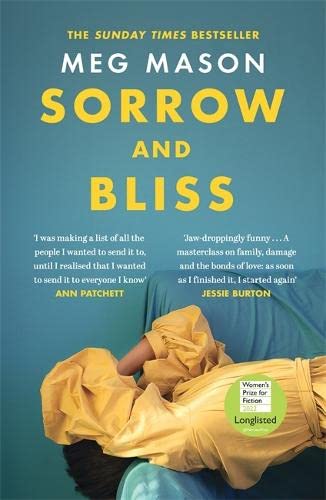 Our joint highest rating, and one of our best discussions – taking in mental illness and its diagnosis and treatment, marriage, childlessness, alcoholism, sisterhood, creativity, neglect, unreliable narrators and loneliness. For several of us, these issues hit close to home due to personal or family experience. We particularly noted the way that Mason sets up parallels between pairs of characters, accurately reflecting how family dynamics can be replicated in later generations.
Even the minor characters are fully rounded, and although Martha is not always pleasant to spend time with, her voice is impressively rendered. The picture of mental illness from the inside feels authentic, including the fact that Martha uses it as an excuse for her bad behaviour, becoming self-absorbed and not seeing how she is affecting others around her. Our main point of disagreement was about Mason’s decision not to name the mental illness Martha is suffering from. It seemed clear to several of us that it was meant to be bipolar disorder, so we wondered if it was a copout not to identify it as such.
We also thought about the meaning of the term “literary fiction”, and whether this has the qualities of a prize winner and will stand the test of time.
We had to fill out a feedback questionnaire about our experience of shadowing, and most of us sent in individual blurbs in response to the book. Some ended up in the final Reading Agency article. Here was mine:
“This deceptively light novel was a perfect book club selection, eliciting deep discussion about mental illness, family relationships and parenthood. Martha’s (unreliable) narration is a delight, wry and deadpan but also with moments of wrenching emotion. Mason masterfully controls the tone to create something that is witty and poignant all at once.”
Probably the main reason we were chosen for this opportunity is that we have a man – my husband, that is! – who attends regularly. This year the prize has been particularly keen to get more men reading books by women (see more below). So, he was responsible for giving The Male Response to the novel. No pressure, right? Luckily, he enjoyed it just as much as the rest of us. From the cover and blurb, it didn’t necessarily seem like the sort of book that he would pick up to read for himself, but he was fully engaged with the themes of mental illness, family relationships, and the question of whether or not to have children, and was so compelled that he read over half of it in a day.
I’m not sure who I expect to be awarded the Women’s Prize tomorrow. We of West Fields Readers would be delighted if it went to Meg Mason for Sorrow and Bliss, but I’d also be happy with a win for Louise Erdrich or Ruth Ozeki – though I wasn’t taken with their latest works compared with earlier ones I’ve read, they are excellent authors who deserve recognition. I don’t think The Bread the Devil Knead has a chance; I’d be disappointed in a win by Elif Shafak in that I would feel obligated to try her novel – the kind that gives magic realism a bad name – again; and, while I’m a Maggie Shipstead fan in general and admire the ambition of Great Circle, it would be galling for a book I DNFed twice to take the title!
Who are you rooting for/predicting?
I’d like to mock you with that thought,
jeer at the man
who won’t read novels
written by women –
at least not if they’re still alive
~from The Poet by Louisa Reid
Maybe you’ve seen on social media that the Women’s Prize has been canvassing opinion on the books by women that all men should read. This was prompted by some shocking statistics suggesting that even bestselling female authors can only attract a 20% male readership, whereas the best-known male authors are almost equally popular with men and women. They solicited 60 nominations from big names and ran a public poll. I voted for these 10:
Half of a Yellow Sun (Chimamanda Ngozi Adichie)
Possession (A.S. Byatt)
Homegoing (Yaa Gyasi)
The Poisonwood Bible (Barbara Kingsolver)
The Sea, The Sea (Iris Murdoch)
The Stone Diaries (Carol Shields)
We Need to Talk about Kevin (Lionel Shriver)
Olive Kitteridge (Elizabeth Strout)
The Goldfinch (Donna Tartt)
Orlando (Virginia Woolf)
*If I could have added to that list, though, my top recommendations for all men to read would be Station Eleven by Emily St. John Mandel and Bring Up the Bodies by Hilary Mantel (and probably a different Octavia E. Butler novel from the one nominated).


Three of my selections were among the 10 essential reads announced on the WP website. Their list was headed by Margaret Atwood’s The Handmaid’s Tale, though of her works I’d be more likely to direct men to Oryx and Crake.
I’ve seen discussions on Twitter about why men don’t read novels (at all, prioritizing nonfiction), or specifically not ones by women. Do you have any theories?
What one book by a woman do you think all men should read?
20 Books of Summer, 1–3: Hargrave, Powles & Stewart
Plants mirror minds,
Healing, harming powers
Growing green thoughts.
(First stanza of “Plants Mirror Minds” from The Facebook of the Dead by Valerie Laws)
Here are my first three selections for my flora-themed summer reading. I hope to get through more of my own books, as opposed to library books and review copies, as the months go on. Today I have one of each from fiction, nonfiction and poetry, with the settings ranging from 16th-century Alsace to late-20th-century Spain.
The Dance Tree by Kiran Millwood Hargrave (2022)
 Kiran Millwood Hargrave is one of my favourite new voices in historical fiction (she had written fiction for children and young adults before 2020’s The Mercies). Both novels hit the absolute sweet spot between the literary and women’s fiction camps, choosing a lesser-known time period and incident and filling in the background with sumptuous detail and language. Both also consider situations in which women, queer people and other cultural minorities were oppressed, and imagine characters pushing against those boundaries in affirming but authentic-feeling ways.
The setting is Strasbourg in the sweltering summer of 1518, when a dancing plague (choreomania) hit and hundreds of women engaged in frenzied public dancing, often until their feet bled or even, allegedly, until 15 per day dropped dead. Lisbet observes this all at close hand through her sister-in-law and best friend, who get caught up in the dancing. In the final trimester of pregnancy at last after the loss of many pregnancies and babies, Lisbet tends to the family beekeeping enterprise while her husband is away, but gets distracted when two musicians (brought in to accompany the dancers; an early strategy before the council cracked down), one a Turk, lodge with her and her mother-in-law. The dance tree, where she commemorates her lost children, is her refuge away from the chaos enveloping the city. She’s a naive point-of-view character who quickly has her eyes opened about different ways of living. “It takes courage, to love beyond what others deem the right boundaries.”
This is likely to attract readers of Hamnet; I was also reminded of The Sleeping Beauties, in that the author’s note discusses the possibility that the dancing plagues were an example of a mass hysteria that arose in response to religious restrictions. (Public library)
Magnolia by Nina Mingya Powles (2020)
 (Powles also kicked off my 2020 food-themed summer reading.) This came out from Nine Arches Press and a small New Zealand press two years ago but is being published in the USA by Tin House in August. I’ve reviewed it for Shelf Awareness in advance of that release. Those who are new to Powles’s work should enjoy her trademark blend of themes in this poetry collection. She’s mixed race and writes about crossing cultural and language boundaries – especially trying to express herself in Chinese and Hakka. Often, food is her way of embodying split loyalties and love for her heritage. I noted the alliteration in “Layers of silken tofu float in the shape of a lotus slowly opening under swirls of soy sauce.” Magnolia is the literal translation of “Mulan,” and that Disney movie and a few other films play a major role here, as do writers Eileen Chang and Robin Hyde. My issue with the book is that it doesn’t feel sufficiently different from her essay collections that I’ve read – the other is Small Bodies of Water – especially given that many of the poems are in prose paragraphs. [Update: I dug out my copy of Small Bodies of Water from a box and found that, indeed, one piece had felt awfully familiar for a reason: that book contains a revised version of “Falling City” (about Eileen Chang’s Shanghai apartment), which first appeared here.] (Read via Edelweiss)
A Parrot in the Pepper Tree by Chris Stewart (2002)
 It’s at least 10 years ago, probably nearer 15, that I read Driving over Lemons, the first in Stewart’s eventual trilogy about buying a remote farm in Andalusia. His books are in the Peter Mayle vein, low-key and humorous: an Englishman finds the good life abroad and tells amusing anecdotes about the locals and his own mishaps.
This sequel stood out for me a little more than the previous book, if only because I mostly read it in Spain. It’s in discrete essays, some of which look back on his earlier life. He was a founding member of Genesis and very briefly the band’s drummer; and to make some cash for the farm he used to rent himself out as a sheep shearer, including during winters in Sweden.
To start with, they were really very isolated, such that getting a telephone line put in revolutionized their lives. By this time, his first book had become something of a literary sensation, so he reflects on its composition and early reception, remembering when the Mail sent a clueless reporter out to find him. Spanish bureaucracy becomes a key element, especially when it looks like their land might be flooded by the building of a dam. Despite that vague sense of dread, this was good fun. (Public library)

10 Days in Spain (or at Sea) and What I Read
(Susan is the queen of the holiday travel and reading post – see her latest here.)
We spent the end of May in Northern Spain, with 20+-hour ferry rides across the English Channel either way. Thank you for your good thoughts – we were lucky to have completely flat crossings, and the acupressure bracelets that I wore seemed to do the job, such that not only did I not feel sick, but I even had an appetite for a meal in the ship’s café each day.

Not a bad day to be at sea. (All photos in this post are by Chris Foster.)
With no preconceived ideas of what the area would be like and zero time to plan, we went with the flow and decided on hikes each morning based on the weather. After a chilly, rainy start, we had warm but not uncomfortable temperatures by the end of the week. My mental picture of Spain was of hot beaches, but the Atlantic climate of the north is more like that of Britain’s. Green gorse-covered, livestock-grazed hills reminded us of parts of Wales. Where we stayed near Potes (reached by a narrow road through a gorge) was on the edge of Picos de Europa national park. The mountain villages and wildflower-rich meadows we passed on walks were reminiscent of places we’ve been in Italy or the Swiss and Austrian Alps.


The flora and fauna were an intriguing mix of the familiar (like blackbirds and blue tits) and the exotic (black kites, Egyptian vultures; some different butterflies; evidence of brown bears, wolves and wild boar, though no actual sightings, of course). One special thing we did was visit Wild Finca, a regenerative farming project by a young English couple; we’d learned about it from their short film shown at New Networks for Nature last year. We’d noted that the towns have a lot of derelicts and properties for sale, which is rather sad to see. They told us farm abandonment is common: those who inherit a family farm and livestock might just leave the animals on the hills and move to a city apartment to have modern conveniences.


I was especially taken by this graffiti-covered derelict restaurant and accommodation complex. As I explored it I was reminded of Cal Flyn’s Islands of Abandonment. It’s a wonder no one has tried to make this a roadside eatery again; it has a fantastic view!


It so happens that we were there for the traditional weekend when cattle are moved to new pastures. A cacophony of cowbells alerted us to herds going past our cottage window a couple of times, and once we were stopped on the road to let a small group through. We enjoyed trying local cheese and cider and had two restaurant meals, one at a trendy place in Potes and one at a roadside diner where we tried the regional speciality fabada, a creamy bean stew with sausage chunks.
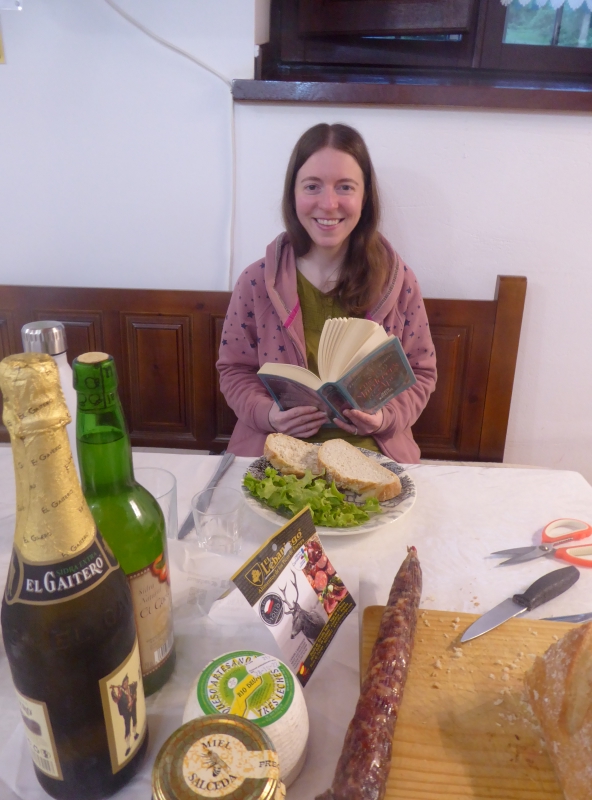
Sampling local products and reading The Murderer’s Ape.
With our meager Spanish we just about got by. I used a phrase book so old it still referred to pesetas to figure out how to ask for roundtrip tickets, while my husband had learned a few useful restaurant-going phrases from the Duolingo language-learning app. For communicating with the cottage owner, though, we had to resort to Google Translate.
A highlight of our trip was the Fuente Dé cable car to 1900 meters / ~6200 feet above sea level, where we found snowbanks, Alpine choughs, and trumpet gentians. That was a popular spot, but on most of our other walks we didn’t see another human soul. We felt we’d found the real, hidden Spain, with a new and fascinating landscape around every corner. We didn’t make it to any prehistoric caves, alas – we would probably have had to book that well in advance – but otherwise experienced a lot of the highlights of the area.


On our way back to Santander for the ferry, we stopped in two famous towns: Comillas, known for its modernist architecture and a palace designed by Gaudí; and Santillana del Mar, which Jean-Paul Sartre once called the most beautiful town in Spain. We did not manage any city visits – Barcelona was too far and there was no train service; that will have to be for another trip. It was a very low-key, wildlife-filled and relaxing time, just what we needed before plunging back into work and DIY.
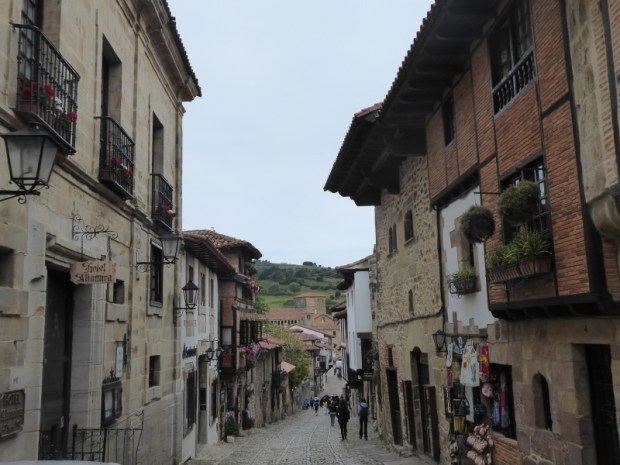
Santillana del Mar
What I Read
On the journey there and in the early part of the trip:
 The Murderer’s Ape by Jakob Wegelius (translated from the Swedish by Peter Graves): Sally Jones is a ship’s engineer who journeys from Portugal to India to clear her captain’s name when he is accused of murder. She’s also a gorilla. Though she can’t speak, she understands human language and communicates via gestures and simple written words. This was the perfect rip-roaring adventure story to read at sea; the twisty plot and larger-than-life characters who aid or betray Sally Jones kept the nearly 600 pages turning quickly. I especially loved her time repairing accordions with an instrument maker. This is set in the 1920s or 30s, I suppose, with early airplanes and maharajahs, but still long-distance sea voyages. Published by Pushkin Children’s, it’s technically a teen novel and the middle book in a trilogy, but neither fact bothered me at all.
& to see me through the rest of the week:
The Feast by Margaret Kennedy: Originally published in 1950, this was reissued by Faber in 2021 with a foreword by Cathy Rentzenbrink – had she not made much of it, I’m not sure how well I would have recognized the allegorical framework of the Seven Deadly Sins. In August 1947, we learn, a Cornish hotel was buried under a fallen cliff, and with it seven people. Kennedy rewinds a month to let us watch the guests arriving, and to plumb their interactions and private thoughts. We have everyone from a Lady to a lady’s maid; I particularly liked the neglected Cove children. It took me until the very end to work out precisely who died and which sin each one represented. The characters and dialogue glisten. This is intelligent, literary yet light, and so makes great vacation/beach reading.

 Book of Days by Phoebe Power: A set of autobiographical poems about walking the Camino pilgrimage route. Power writes about the rigours of the road – what she carried in her pack; finding places to stay and food to eat – but also gives tender pen portraits of her fellow walkers, who have come from many countries and for a variety of reasons: to escape an empty nest, to make amends, to remember a departed lover. Whether the pilgrim is religious or not, the Camino seems like a compulsion. Often the text feels more like narrative prose, though there are some sections laid out in stanzas or forming shapes on the page to remind you it is verse. I think what I mean to say is, it doesn’t feel that it was essential for this to be poetry. Short vignettes in a diary may have been more to my taste.
Two favourite passages:
into cobbled elegance; it’s opening time for shops
selling vegetables and pan and gratefully I present my
Spanish and warmth so far collected, and receive in return
smiles, interest, tomatoes, cheese.
We are resolute, though unknowing
if we will succeed at this.
We are still children here –
arriving, not yet grown
up.
With thanks to Carcanet Press for the free copy for review.
 I’d also downloaded from Edelweiss the recent travel memoir The Way of the Wild Goose by Beebe Bahrami, in which she walks sections of the Camino in France and Spain and reflects on why the path keeps drawing her back. It’s been a probing, beautiful read so far – I think this is the mild, generically spiritual quest feel Jini Reddy was trying to achieve with Wanderland.
Plus, I read a few e-books for paid reviews and parts of other library books, including a trio of Spain-appropriate memoirs: As I Walked Out One Midsummer Morning by Laurie Lee, Homage to Catalonia by George Orwell, and A Parrot in the Pepper Tree by Chris Stewart – more about this last one in my first 20 Books of Summer post, coming up on Sunday.
Our next holiday, to the Outer Hebrides of Scotland, is just two weeks away! It’ll be very different, but no doubt equally welcome and book-stuffed.
 Bookish Beck = Rebecca Foster. American transplant to England. Freelance proofreader and book reviewer.
 Bookish Beck