The 2024 McKitterick Prize Shortlist and Winner
For the third year in a row, I was a first-round judge for the McKitterick Prize (for a first novel, published or unpublished, by a writer over 40), helping to assess the unpublished manuscripts. The McKitterick Prize is in memory of Tom McKitterick and sponsored by the Hawthornden Foundation. Thus far an unpublished manuscript has not advanced to the shortlist, but maybe one year it will!
On the 2024 McKitterick Prize shortlist (synopses adapted from Goodreads):
 Jacqueline Crooks for Fire Rush (Jonathan Cape, Vintage, Penguin Random House) – “Set amid the Jamaican diaspora in London at the dawn of 1980s, a mesmerizing story of love, loss, and self-discovery that vibrates with the liberating power of music. When Yamaye meets Moose, a soulful carpenter who shares her Jamaican heritage, a path toward a different kind of future seems to open. But then, Babylon rushes in.”
 Chidi Ebere for Now I Am Here (Pan Macmillan, Picador) – “We begin at the end. The armies of the National Defence Movement have been crushed and our unnamed narrator and his unit are surrounded. As he recounts the events leading to his disastrous finale, we learn how this gentle man is gradually transformed into a war criminal, committing acts he wouldn’t have thought himself capable.”
 Aoife Fitzpatrick for The Red Bird Sings (Virago) – “West Virginia, 1897. When young Zona Heaster Shue dies only a few months after her wedding, her mother, Mary Jane, becomes convinced Zona was murdered by her husband, Trout, the town blacksmith. As the trial rises to fever pitch, with the men of Greenbrier County aligned against them, Mary Jane and Zona’s best friend Lucy must decide whether to reveal Zona’s greatest secret in the service of justice.”
 Greg Jackson for The Dimensions of a Cave (Granta) – “When investigative reporter Quentin Jones’s story about covert military interrogation practices in the Desert War is buried, he is spurred to dig deeper, and he unravels a trail that leads to VIRTUE: cutting-edge technology that simulates reality during interrogation. As the shadowy labyrinths of governmental corruption unfurl and tighten around him, unnerving links to his protégé – who, like Joseph Conrad’s Kurtz, disappeared in the war several years earlier – keep emerging.”
 Wenyan Lu for The Funeral Cryer (Atlantic Books, Allen & Unwin) – “The Funeral Cryer long ago accepted the mundane realities of her life: avoided by fellow villagers because of the stigma attached to her job and under-appreciated by her husband, whose fecklessness has pushed the couple close to the brink of break-up. But just when things couldn’t be bleaker, she takes a leap of faith – and in so doing things start to take a surprising turn for the better.”
 Allan Radcliffe for The Old Haunts (Fairlight Books) – “Recently bereaved Jamie is staying at a rural steading in the heart of Scotland with his actor boyfriend Alex. The sudden loss of both of Jamie’s parents hangs like a shadow over the trip. In his grief, Jamie finds himself sifting through bittersweet memories, from his working-class upbringing in Edinburgh to his bohemian twenties in London, with a growing awareness of his sexuality threaded through.”
The Society of Authors kindly sent me free copies of the six shortlisted novels. I already had The Red Bird Sings and The Funeral Cryer on my TBR, so I’m particularly looking forward to reading them as part of my 20 Books of Summer – which I’ve decided might as well contain, as well as all hardbacks, only books by women.

I was familiar with Fire Rush from its shortlisting for last year’s Women’s Prize for Fiction. The other three titles are new to me but sound interesting, especially The Old Haunts – at 150 pages, it will be perfect for Novellas in November.
My fellow judge Rónán Hession, whom I got to meet very briefly on a Zoom call, wrote: “It is exciting to judge a prize and encounter such a depth of talent. Though [the books] hugely varied in subject matter and style, the writers on the shortlist all impressed me with the clarity of their creative vision and their narrative authority on the page.”
The winner and runner-up were announced in advance of the SoA Awards ceremony in London yesterday evening. As in other years, I watched the livestream, which this year included captivating speeches by the Very Revd Dr Mark Oakley, Dean of Southwark Cathedral (where the ceremony took place) and Kate Mosse. And what a thrill it was to see and hear my name on the livestream!

Winner: Wenyan Lu for The Funeral Cryer
Runner-up: Chidi Ebere for Now I Am Here

In the press release announcing the winners, Hession said, “Wenyan Lu has created an unforgettable debut, brimming with personality and written with a sense of consummate ease. The Funeral Cryer is such a funny, warm and original book. An absolute gem of a novel.” I can’t wait to get started!
Other notable winners announced yesterday included:
- Tom Crewe for The New Life (Betty Trask Prize for a first novel by a writer under 35)
- Jacqueline Crooks for Fire Rush (Paul Torday Memorial Prize for a first novel by a writer over 60 – how perfect for her to win this in place of the McKitterick!)
- Soula Emmanuel for Wild Geese (Gordon Bowker Volcano Prize for a novel focusing on travel)
- Cecile Pin for Wandering Souls (Runner-up for the Gordon Bowker Volcano Prize; and a Somerset Maugham Award travel bursary)
March Releases by Akbar, Bosker, García Márquez, and Wrenn
I’m catching up after a busy end to last month. Today I have an uneven debut novel from a poet whose work I’ve enjoyed before, a journalist’s jaunty submersion in the world of modern art, a posthumous novella from a famous Colombian author I’d not previously read, and a (literally) trippy memoir about C-PTSD, coral, climate breakdown, queerness and more. I can pinpoint a couple of elements that some or all of them have in common: beauty (whether in art or in nature) and dead mothers.
Martyr! by Kaveh Akbar
I’d read the Iranian American poet’s two full-length collections and particularly admired Pilgrim Bell, one of my favourite books of 2021. That was enough for me to put this on my Most Anticipated list for 2024, even though based on the synopsis I wrote: “His debut novel sounds kind of unhinged, but I figure it’s worth a try.” Here’s an excerpt from the publisher’s blurb: “When Cyrus’s obsession with the lives of the martyrs – Bobby Sands, Joan of Arc – leads him to a chance encounter with a dying artist, he finds himself drawn towards the mysteries of an uncle who rode through Iranian battlefields dressed as the Angel of Death; and toward his [late] mother, who may not have been who or what she seemed.”
 Cyrus Shams is an Iranian American aspiring poet who grew up in Indiana with a single father, his mother Roya having died in a passenger aircraft mistakenly shot down by a U.S. Navy missile cruiser (this really happened: Iran Air Flight 655, on 3 July 1988). He continues to lurk around the Keady University campus, working as a medical actor at the hospital, but his ambition is to write. During his shaky recovery from drug and alcohol abuse, he undertakes a project that seems divinely inspired: “Tired of interventionist pyrotechnics like burning bushes and locust plagues, maybe God now worked through the tired eyes of drunk Iranians in the American Midwest”. By seeking the meaning in others’ deaths, he hopes his modern “Book of Martyrs” will teach him how to cherish his own life.
This document, which we see in fragments, sets up hypothetical dialogues between figures real and imaginary, dead and living, and intersperses them with poems and short musings. But when a friend tells Cyrus about the Brooklyn Museum installation “DEATH-SPEAK,” which has terminally ill Iranian artist Orkideh living out her last days in public, he spies an opportunity to move the work beyond theory and into the physical realm. So he flies to New York City with his best friend (and occasional f**kbuddy), bartender Zee Novak, and visits Orkideh every day until the installation’s/artist’s end.
This is a wildly original but unruly novel with a few problems. One: Akbar has clung too obviously to his own story and manner of speaking with Cyrus (e.g., “I honestly actually do worry about that, no joke. Being a young Iranian man making a book about martyrdom, going around talking to people about becoming a martyr. It’s not inert, you know?”). Another is that the poems, and poetic descriptions, are much the best material. The only exception might be a zany scene where Zee and Cyrus chop wood while high. But the main issue I had is that the plot turns on a twist 50 pages from the end, a huge coincidence that feels unearned. I admire the ambition Akbar had for this – a seething, open-hearted enquiry into addiction, love, suicide and queerness – but look forward to him getting back to poetry. 
With thanks to Picador for the proof copy for review.
Get the Picture: A Mind-Bending Journey among the Inspired Artists and Obsessive Art Fiends Who Taught Me How to See by Bianca Bosker
I was a big fan of Bosker’s Cork Dork (2017), her deep dive into the world of fine wine. Her second book is similarly constructed and equally fun: more personal than authoritative, light yet substantial, and accessible to the uninitiated as well as those with an existing interest in the subject. She begins as a complete novice, wondering if she’ll ever know what art is, let alone what it means and whether it’s any good (“the familiar feeling that everyone got the punch line except me”). By the end, she has discovered that, like the love of wine, art appreciation can be a way of expanding and savouring one’s life.
The aim was to get the broadest experience possible, generally through voluntary placements. She started out as an assistant at Jack Barrett’s 315 Gallery, where one of her tasks was to paint a wall white; she failed miserably to meet his expectations even for this simple task. He never lost his fundamental distrust of her, a writer and outsider, as one of “the enemy.” It was expected that she would attend as many art shows and openings as possible per week. “Talking shit was essentially a job requirement.” Bosker might not have known what to make of the art, but others were gossipy, snobbish and opinionated enough to make up for it. When she was tasked with writing a press release for an exhibit, a gallerist taught her the clichéd shorthand: “Every f**king artist allegedly transforms the familiar into the unfamiliar, or vice versa.”

In the course of the book, the New York City-based author also:
- attends the Art Basel Miami Beach contemporary art fair and sells photographs on behalf of Denny Dimin Gallery;
- befriends performance artist and “ass influencer” Mandy AllFIRE, who – ahem – sits on Bosker’s face as part of a temporary installment;
- serves as a studio assistant for French painter Julie Curtiss, whose work is selling for alarmingly high amounts at auction (not actually what a painter wants, as it tends to signal bad things for a career);
- meets a pair of North Dakota collectors known as “the Icy Gays”; and
- works as a Guggenheim Museum guard.
This last was my favourite episode. Forty-minute placements on particular ramps gave her time to focus on one chosen artwork – for instance, an abstract sculpture. She challenged herself to stay with it for that whole time, doing as one artist advised and simply noticing five things about the work. Before, her “default approach to art had just been to plant myself in front of a piece and wait for the epiphany to wash over me.” Now, she worked at it. In fact, she counsels newcomers to not read a caption because many people take a title at face value and an interpretation as gospel, and so don’t experience the art for themselves.
At times I found the book slightly scattered in the way that it zigzags from one challenge to another. There’s differing attention to various experiences; a week-long art school merits just one paragraph. And there’s no getting past the fact that some art she encounters sounds outlandish or just plain silly. (Is it any surprise that she mistakes part of a wall, and a mousetrap, for art pieces?) Ultimately, I think it’s best if you have at least a modicum of appreciation for modern art, which I don’t; whereas I do enjoy drinking wine even if I don’t have a trained palate.
Even so, Bosker’s writing has such verve (“artists were coyly evasive about their work and treated my questions like I was a cactus running after their balloon”; “a hazy daydream of an idea solidified into a yappy, un-shut-uppable chihuahua of want”) that you’ll be glad you went along for the ride. She concludes that taste is subjective, but “Beauty … pulls you close.” Art is valuable because it “knocks us off our well-worn pathways” into something uncharted, a tantalizing prospect. 
With thanks to Allen & Unwin (Grove Press) for the free copy for review.
{SPOILERS IN THIS NEXT ONE}
Until August by Gabriel García Márquez
[Translated from the Spanish by Anne McLean]
A posthumous ‘lost’ novella was not a good place for me to have started with this celebrated author. García Márquez okayed the fifth draft of the text in 2004, 10 years before his death. By this time he was already suffering with memory loss that interfered with his creativity. His sons got the message that he didn’t think the book worked and should be destroyed. But they didn’t do his bidding and, revisiting the book nearly a decade on from his death, decided it wasn’t that bad, if not up to the standard of his best work, and that it should see the light of day after all.
Every August 16th, Ana Magdalena Bach travels to the island where her mother is buried to visit the grave and lay gladioli on it. (My review book came with a bag of three gladioli bulbs and a mini Colombian chocolate bar.) Each year she takes a different lover for the one night at a hotel. The first time, the man leaves her a $20 bill and she feels ashamed, but it doesn’t stop her doing the same thing again for the next four years in a row. Once it’s a long-ago school friend whom she runs into on the ferry. Another time, by golly, it’s a bishop.

It’s refreshing to have a woman in middle age as protagonist and for her to claim sexual freedom. However, the setup is formulaic and repetitive, the sex scenes are somewhat excruciating, and the hypocrisy of her gleefully having one-night stands while fretting over her husband’s potential infidelity is grating. I did like the ending – Ana hears that an anonymous elderly gentleman has been paying to have gladioli laid on her mother’s grave year-round and she wonders if she is in a sense following in her mother’s footsteps all along without knowing it; and decides she’s had enough and exhumes her mother’s remains, returning to her husband with a bag of bones (gruesome!).
But nothing about the plot or the writing – fluid enough bar one awkward sentence (“She listened to him worried that he meant it, but she had the strength not to appear as easy a woman as he might think”) – suggested to me a master at work. At best, this might be reminiscent of the late work of misogynist-leaning authors like Coetzee or Updike.
In my mind García Márquez is linked with magic realism, so I’d be better off trying one of his more representative works. I have several of his earlier novellas on the shelf (received as review copies as part of the same recent marketing push), and if I get on better with those then I’ll be sure to try one of the most famous full-length novels. 
With thanks to Viking (Penguin) for the free copy for review.
Mothership: A Memoir of Wonder and Crisis by Greg Wrenn
Wrenn is an associate English professor teaching environmental literature at James Madison University. He has also been exploring coral reefs for 25 years, with a love of marine wildlife sparked by growing up in Florida. But all along, he’s been trying (much like Cyrus Shams) to come to terms with addiction, queerness, suicidal inclinations, and especially his mother’s place in his life. She made him feel dirty, that he would never be good enough; she hit him with a wooden spoon and bathed him until he was 17. Though he never found out for sure, he suspects his mother was sexually abused by her father and repeated the cycle of molestation.
 This is the third C-PTSD memoir I’ve read (after What My Bones Know and A Flat Place), and has a lot in common with I’m Glad My Mom Died, which features a co-dependent relationship with an abusive mother. After Wrenn’s parents’ divorce, he and his mother remained close. “I had been her therapist, confessor, girlfriend, and punching bag.” He helped care for her after a stroke but eventually had to throw up his hands at her stubborn refusal to follow doctors’ orders. Drawing on the Greek etymology of ecology (oikos means house or family), Wrenn insists on a parallel between the personal and the environmental here: “What we’re facing amounts to global C-PTSD” as “Mother” Earth turns against us. On each trip to Raja Ampat, he knows the coral reef is dying, his carbon footprint only accelerating it.
There’s a lot in this short memoir. Even the summary had me shaking my head in disbelief. For me, though, the tone and style were too erratic. Wrenn can be wry, sorrowful, or campy; he includes scientific data, letters to Adrienne Rich and an imagined descendent, a chapter riffing on “Otters” (the animal and the gay stereotype), flashbacks, and E.T. metaphors. The final third of the book then takes a left turn as he experiments with therapeutic psychedelics via ayahuasca ceremonies in South America, and ditches dating apps and casual sex to try to find a long-term relationship. The drug literally alters his brain, allowing him to feel trust and love. Add on nature and a husband and that’s why he’s still here rather than dead by suicide.
Like Akbar, Wrenn published poetry before switching genre. Their books are both amazing in premise but wobbly in execution. Still, I’d say both authors are laudable for their effort to depict lives wrenched back from extremity. 
With thanks to Regalo Press (USA) for the proof copy for review.
March Paperback Releases: Fledgling, Theatre of Marvels, What My Bones Know
I’m catching up on three 2022 books I was sent for review and didn’t read at their initial publication. Today I have a memoir of living between Ghana and England and hand-raising two birds, a Victorian pastiche starring a mixed-race actress in London, and an account of being diagnosed with complex PTSD and working towards healing of childhood trauma.
Fledgling by Hannah Bourne-Taylor
Nature-lover Hannah Bourne-Taylor lived in Ghana for eight years for her husband’s job. As a dependent spouse, she was not permitted to work and, in their rural setting, she felt cut off from any expatriate community. From childhood she’d been an obsessive animal rescuer – fishing ants out of swimming pools, for instance – and when she found a swift that had been displaced from its nest, her protective instincts went into overdrive. Collecting hundreds of termites, she fed the bird to a demanding schedule for two weeks before releasing it. This went as disastrously as it could, but she soon got another chance when she found a grounded bronze-winged mannikin finch fledgling after a storm. Their bond was even closer: the bird climbed her body and nested in her hair (she wrote a Guardian article about the experience), and they developed a mutual language of chirps. The care routine sounds like it was not so different from having an infant. She even calls the finch her daemon.
 There is something very insular about this narrative, such that I had trouble gauging the passage of time. Raising the two birds, adopting street dogs, going on a pangolin patrol with a conservation charity – was this a matter of a couple of months, or were events separated by years? Ghana is an intriguing setting, yet because there is no attempt to integrate, she can only give a white outsider’s perspective on the culture, and indigenous people barely feature. I was sympathetic to the author’s feelings of loneliness and being trapped between countries, not belonging in either, but she overstates the lessons of compassion and freedom the finch taught. The writing, while informed and passionate about nature, needs a good polish (many misplaced modifiers, wrong prepositions, errors in epigraph quotes, homonym slips – “sight” instead of “site”; “balled” in place of “bawled”; “base” where it should be “bass,” twice – and so on). Still, it’s a promising debut from a valuable nature advocate, and I share her annual delight in welcoming England’s swifts, as in the scenes that open and close the book.
With thanks to Aurum for the free copy for review. Fledgling came out in paperback on 9 March.
Theatre of Marvels by Lianne Dillsworth
Lianne Dillsworth is a Black British author with MAs in creative writing and Victorian studies, interests she combines in this debut novel set in Victorian London. Zillah’s mother, a slave from Barbados, was forced to abandon her seven-year-old daughter. Zillah is mixed-race and grew up in St Giles slum. Too light-skinned to convince as a “savage” when she headlines Crillick’s Variety Theatre show as “Amazonia,” she has to coat herself with greasepaint and soot. As mistress to a viscount, she has access to a life of luxury, but instead chooses to try to free her fellow Black performers, including the “Leopard Lady,” who is exhibited for her skin condition and confined in conditions little better than slavery.
 Through secondary characters, we glimpse other options for people of colour: one, Lucien Winters, is a shopkeeper (reminding me of the title character of The Secret Diaries of Charles Ignatius Sancho, a historical figure) but intends to move to Sierra Leone via a colonisation project; another passes as white to have a higher position in the theatre world. It felt odd, though, how different heritages were conflated, such that Zillah, of Caribbean descent, learns a few words of “Zulu” to speak to the Leopard Lady, and Lucien explains Africanness to her as if it is one culture. Perhaps this was an attempt to demonstrate solidarity among oppressed peoples.
There are rivalries with fellow actresses, and well-meaning Quakers who work toward a better society. Much of the characterisation is tissue-thin, however, and a few turns of phrase felt not of the time period (describing someone as being in a “pissy mood”; “If he was in this much of a funk there’d be no getting through to him. I might as well go to bed before he killed my mood completely.”). All told, this never lived up to its first paragraph –
Go to the theatre much? No, nor me. At least not before I became an actress. I know what you’re thinking. Actress, eh? But you can keep your dirty-minded thoughts to yourself. I trod the boards and no more. Doesn’t mean I don’t have a story or two to tell, mind. Would you be kind enough to indulge me if I talked about the old days? Hard as it was back then, I can’t say that if I had my time again I’d change it.
– which promised a much more original voice than we ever get from Zillah. It’s only worth writing in the first person if the narration is remarkable in some way, so this could easily have been in third person limited instead. This was a nicely undemanding selection to start on the ferry ride back from Spain last year, but took much effort to finish because of the 400+ page count and despite the jejune prose (some have labelled this YA for that reason). Fans of Stacey Halls may enjoy it. It’s certainly what I’d call an easy read. 
Hutchinson Heinemann sent a proof copy. Theatre of Marvels came out in paperback on 2 March.
What My Bones Know: A Memoir of Healing from Complex Trauma by Stephanie Foo
It’s okay to have some things you never get over.
Radio producer Stephanie Foo was diagnosed with complex PTSD at age 30. Although she briefly delves into the parental abuse that accounts for her trauma, this is – thankfully – mostly about the four years she spent trying to get better. The Malaysian Chinese Foo family moved to San Francisco when she was two years old. Her mother nagged and beat her, and both parents made credible threats to kill her and/or themselves, such as by driving off the road. It’s hard to read this material, but by proportion it doesn’t take up much of the book. Foo’s mother left when she was 13; she later gave her father an ultimatum one day (while wielding an axe!) that also saw him move out. This left her, then a high school student, living alone and in squalor. Unsurprisingly, she engaged in disordered eating and self-harm.
 A love of journalism kept Foo from committing suicide, got her into college and landed her podcast roles followed by her dream job with public radio programme This American Life in New York City. However, she struggled with a horrible, exacting boss and, when her therapist issued the diagnosis, she left to commit to the healing process, aided by her new partner, Joey. C-PTSD was named in the 1990s but is not recognised in the DSM; The Body Keeps the Score by Bessel van der Kolk is its alternative bible. Repeated childhood trauma, as opposed to a single event, rewires the brain to identify threats that might not seem rational, leading to self-destructive behaviour and difficulty maintaining healthy relationships.
All that Foo discovers in her research into C-PTSD feels damning, but she focuses on what she can control: sleep, diet, exercise, yoga, meditation, acupuncture, and seeing various therapists. She tries everything from hallucinogenic mushrooms and a gratitude journal to EMDR (like hypnosis but based on eye movement). Working with a therapist from the Center for Child Trauma and Resilience helped her to address the root cause rather than the symptoms. There came a point where I would have been okay with a condensed version of events instead of a blow-by-blow of every therapy attempted, but Foo writes with bravery and clarity, adroitly recreating scenes and dialogue and displaying impressive memory and self-knowledge. The detail and overall optimism should make this helpful to many. 
With thanks to Allen & Unwin for the free copy for review. What My Bones Know came out in paperback on 3 March.
Reading Ireland Month 2019: Nonfiction – Lynn Enright and Emilie Pine
It’s my second time participating in Reading Ireland Month, run each March by Cathy of 746 Books and Niall of Raging Fluff. For this week’s nonfiction theme, I’ve put together reviews of two hard-hitting feminist books I happen to have read recently.

Vagina: A Re-education by Lynn Enright (2019)
 Sex education is poor and lacking in many parts of the world, Enright argues, including the Ireland she grew up in in the 1980s. We need better knowledge about gender, anatomy (including the range of what’s ‘normal’) and issues of consent, she insists. To that end, she sets out to bust myths about the hymen, clitoris, female orgasm, menstruation, gynecological problems, infertility, pregnancy and menopause. Her just-the-facts approach is especially helpful in her rundown of the female anatomy. She also encourages women not to take no for an answer from doctors who try to deny or minimize their pain.
This is a confident book sometimes marred by TMI (all in the name of openness and honesty, but still…) and repetitive writing. For me, there was too much overlap with other books I’ve read over the last five years or so: Vagina: A New Biography by Naomi Wolf, The Wonder Down Under: A user’s guide to the vagina by two female Norwegian medical students, Gross Anatomy by Mara Altman (waxing), Notes to Self by Emilie Pine (see below! rape, menstruation and infertility) and the upcoming Constellations by Sinéad Gleeson (women’s pain). Thus, after about page 50 I just skimmed this one. If you haven’t read anything like Vagina before, though, it would serve as a wonderfully comprehensive introduction.
Some favorite lines:
“With vaginas, it seems, we doubt what we know. With vaginas, we listen to the lies, more than we listen to the truth. … We perpetuate the unsureness with our silences – and with our acceptance of lies.”
“Pregnancy, abortion, miscarriage and birth are common but extraordinary – each story is unique. Women benefit when those stories are told – and listened to.”
My rating:
With thanks to Allen & Unwin for the free copy for review.
Notes to Self: Essays by Emilie Pine (2018)
 Originally released by Ireland’s Tramp Press, this won the An Post Irish Book Award and has now been re-released by Penguin and other major publishers. You expect the average essay collection to contain 10 or 12 pieces, so the fact that there are only six here accounts for why they drag at a certain point. While I think most could be made snappier, they remain bold, accessible feminist takes on the body and expectations for women’s lives.
I especially liked “Notes on Intemperance,” the first essay, about her alcoholic father’s health crisis and the poor chances of him getting adequate treatment on Corfu, where he lived. She had to beg his nurses to wear gloves. When she learned that staff had to buy such disposables out of their own salaries, she understood – but was still appalled. Just being there was a miracle given there was no love lost between father and daughter.
Other essays are about infertility, the early breakdown of their parents’ marriage, menstruation and body hair, her wild teenage years and being raped, and the working woman’s constant struggle to be ambitious yet vulnerable without coming across as bitchy or oversensitive. The writing style is not flashy, but it doesn’t need to be. This is relatable straight talk, like you might get if you were to sit down with girlfriends of various backgrounds and experiences and actually discuss things that matter.
A favorite passage:
“It is hard to love an addict. Not only practically difficult, in the picking up after them and the handling of those aspects of life they’re not able [to] for themselves, but metaphysically hard. It feels like bashing yourself against a wall, not just your head, but your whole self. It makes your heart hard. … It took years of refusing him empathy before I realised that the only person I was hurting was myself.”
My rating: 
I read an e-copy via NetGalley.
 I’ve also started a travel classic by Dervla Murphy, Full Tilt: Ireland to India with a Bicycle (1965), but travel books are such slow reads for me that I’ll likely be working on this one for months. Where I’ve got to now, she’s between Tehran and Afghanistan and nursing a bad sunburn. Already she’s eternally grateful that she brought a gun with her: she’s used it once to fend off wolves, once to deter a would-be rapist, and once to prevent bike thieves. Exciting stuff!
Late in the Day by Tessa Hadley & Improvement by Joan Silber
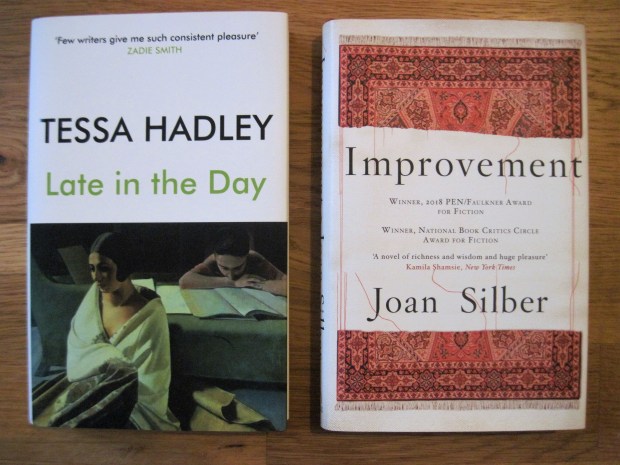
Late in the Day by Tessa Hadley (2019)
Two London couples: Christine and Alex, and Lydia and Zachary. They’ve known each other for decades, and their affiliations have changed in major, even ironic ways. It was Lydia who was initially infatuated with Alex when he taught both her and Christine, and Christine and Zachary who dated for a time. But this is how things ultimately fell out, each marriage resulting in one daughter. Christine with Alex; Lydia with Zachary.

The cover image is Raja (1925) by Felice Casorati.
Except now Zachary is dead. The phone call comes in the novel’s very first sentence. How Lydia and her friends – not to mention her daughter, Grace, who’s studying art in Glasgow – will cope with the loss, and rearrange what was once such a comfortable quadrilateral, is the ostensible subject of the rest of the book. There’s a funeral to plan and a future for Lydia to construct. But the problem, for me, is that every other chapter hosts a seemingly endless flashback to the couples’ backstory. Apart from an odd, titillating moment when the four nearly let down their guard together, these sections don’t reveal an awful lot.
This is my sixth book by Tessa Hadley. Her eye is always sharp on how families work, how relationships fall apart, and how memories form and linger as we age. She’s also a master of third-person omniscience, moving effortlessly between characters’ perspectives. The writing here is exquisite; there’s no question about that. I especially love the descriptive passages, full of so much sensual detail that you can imagine yourself right into a scene:
A breeze fanned the newspaper on the table, the smells of a city summer were wafted through the open window: tar and car exhaust, the bitter-green of the flowering privet hedge. Police horses went past in the broad street, their hooves clip-clopping conversationally alongside the voices of the women who rode them; the stables were nearby.
Her perception was a skin stretched taut, prickling with response to each change in the light outside as it ran through the drama of its sunset performance at the end of the street, in a mass of gilded pink cloud. When eventually the copper beech was only a silhouette cut out against the blue of the last light, Christine pulled down the blinds, put on all the lamps, turned her awareness inwards.
Despite the fine prose, I found the past strand of this novel tedious. If you’re new to Hadley, I’d recommend starting with Clever Girl and/or Bad Dreams and Other Stories.
Late in the Day was published in the UK by Jonathan Cape on February 14th, and in the USA by Harper on January 15th. My thanks to the publisher for the free copy for review.
Improvement by Joan Silber (2017)
I’ve been thinking a lot about linked short story collections, having written a brief article about them for BookBrowse to accompany my review of Carrianne Leung’s That Time I Loved You (those who contributed ideas on Twitter, thank you!). I find them easier to read than the average short story volume because there are fewer characters and settings to keep track of, and you get the fun of tracing unexpected connections between characters. Improvement didn’t quite work for me in that way, mostly because you can tell that it started as one short story, “About My Aunt”: now the untitled first chapter, it is, as you might guess, a solid stand-alone narrative about Reyna and her aunt Kiki. It was originally published in Tin House and collected in The Best American Short Stories 2015.
 I was most interested in Kiki, a terrific character with a completely unsuitable name. Her marriage to a Turk failed – but hey, at least she got a great rug out of it, as well as the fun but temporary challenge of third-world life. (“For a hardheaded person, she had let herself be flung about by the winds of love, and she wasn’t sorry either.”) Back in New York City she directs a house-cleaning agency and babysits for Reyna’s four-year-old son, Oliver. Tattooed Reyna’s African-American boyfriend, Boyd, is in prison for three months for selling pot; when he gets out he comes up with the bright idea of smuggling cigarettes between Virginia and New York to profit from the tax difference. He asks Reyna to make one of the pick-ups, but she chickens out at the last minute. Boyd’s friend Claude drives instead, and is killed instantly in a crash.
Part II reaches into the lives of some of the minor characters on the fringes: Claude; Teddy, the truck driver who was the other party in the car accident; Osman, Kiki’s ex-husband; a trio of Germans who passed through their Turkish town in the summer of 1977 with smuggled antiquities in their possession; and so on. For me, these narratives were too diffuse and didn’t hang together as a novel. I had hoped to enjoy this more since it won the National Book Critics Circle Award for Fiction and Silber is one of those writer’s writers you always hear about but never get to read. I found her voice similar to Anne Tyler’s or perhaps Julia Glass’s, but I’m not sure I’d try another book by her.
Improvement was published by Allen & Unwin on February 7th. It came out in the USA from Counterpoint Press in 2017. My thanks to the publisher for the free copy for review.
Bottom line for both:
Subtle, sophisticated but underwhelming. 
 Bookish Beck = Rebecca Foster. American transplant to England. Freelance proofreader and book reviewer.
 Bookish Beck