Three on a Theme for Father’s Day: Holt Poetry, Filgate & Virago Anthologies
A rare second post in a day for me; I got behind with my planned cat book reviews. I happen to have had a couple of fatherhood-themed books come my way earlier this year, an essay anthology and a debut poetry collection. To make it a trio, I finished an anthology of autobiographical essays about father–daughter relationships that I’d started last year.
What My Father and I Don’t Talk About: Sixteen Writers Break the Silence, ed. Michele Filgate (2025)
This follow-up to Michele Filgate’s What My Mother and I Don’t Talk About is an anthology of 16 compassionate, nuanced essays probing the intricacies of family relationships.
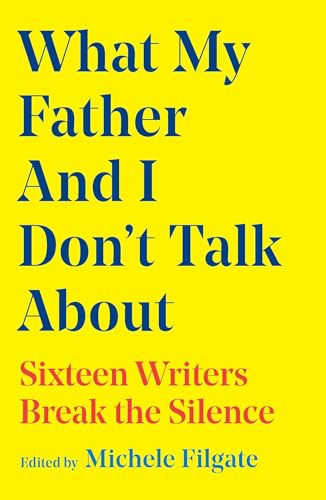 Understanding a father’s background can be the key to interpreting his later behavior. Isle McElroy had to fight for scraps of attention from their electrician father, who grew up in foster care; Susan Muaddi Darraj’s Palestinian father was sent to America to make money to send home. Such experiences might explain why the men were unreliable or demanding as adults. Patterns threaten to repeat across the generations: Andrew Altschul realizes his father’s hands-off parenting (he joked he’d changed a diaper “once”) was an outmoded convention he rejects in raising his own son; Jaquira Díaz learns that the depression she and her father battle stemmed from his tragic loss of his first family.
Some take the title brief literally: Heather Sellers dares to ask her father about his cross-dressing when she visits him in a nursing home; Nayomi Munaweera is pleased her 82-year-old father can escape his arranged marriage, but the domestic violence that went on in it remains unspoken. Tomás Q. Morín’s “Operation” has the most original structure, with the board game’s body parts serving as headings. All the essays display psychological insight, but Alex Marzano-Lesnevich’s—contrasting their father’s once-controlling nature with his elderly vulnerability—is the pinnacle.
Despite the heavy topics—estrangement, illness, emotional detachment—these candid pieces thrill with their variety and their resonant themes. (Read via Edelweiss)
Reprinted with permission from Shelf Awareness. (The above is my unedited version.)
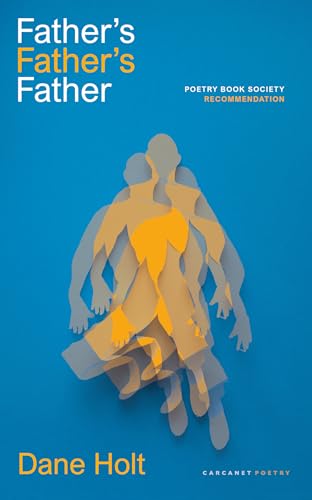
Father’s Father’s Father by Dane Holt (2025)
Holt’s debut collection interrogates masculinity through poems about bodybuilders and professional wrestlers, teenage risk-taking and family misdemeanours.
Your father’s father’s father
poisoned a beautiful horse,
that’s the story. Now you know this
you’ve opened the door marked
‘Family History’.
(from “‘The Granaries are Bursting with Meal’”)
The only records found in my grandmother’s attic
were by scorned women for scorned women
written by men.
(from “Tammy Wynette”)
He writes in the wake of the deaths of his parents, which, as W.S. Merwin observed, makes one feel, “I could do anything,” – though here the poet concludes, “The answer can be nothing.” Stylistically, the collection is more various than cohesive, with some of the late poetry as absurdist as you find in Caroline Bird’s. My favourite poem is “Humphrey Bogart,” with its vision of male toughness reinforced by previous generations’ emotional repression:
My grandfather
never told his son that he loved him.
I said this to a group of strangers
and then said, Consider this:
his son never asked to be told.
They both loved
the men Humphrey Bogart played.
…
There was
one thing my grandfather could
not forgive his son for.
Eventually it was his son’s dying, yes.
With thanks to Carcanet Press for the free e-copy for review.
Fathers: Reflections by Daughters, ed. Ursula Owen (1983; 1994)
“I doubt if my father will ever lose his power to wound me, and yet…”
~Eileen Fairweather
I read the introduction and first seven pieces (one of them a retelling of a fairy tale) last year and reviewed that first batch here. Some common elements I noted in those were service in a world war, Freudian interpretation, and the alignment of the father with God. The writers often depicted their fathers as unknown, aloof, or as disciplinarians. In the remainder of the book, I particularly noted differences in generations and class. Father and daughter are often separated by 40–55 years. The men work in industry; their daughters turn to academia. Her embrace of radicalism or feminism can alienate a man of conservative mores.
 Sometimes a father is defined by his emotional or literal absence. Dinah Brooke addresses her late father directly: “Obsessed with you for years, but blind – seeing only the huge holes you had left in my life, and not you at all. … I did so want someone to be a father to me. You did the best you could. It wasn’t a lot. The desire was there, but the execution was feeble.” Had Mary Gordon been tempted to romanticize her father, who died when she was seven, that aim was shattered when she learned how much he’d lied about and read his reactionary and ironically antisemitic writings (given that he was a Jew who converted to Catholicism).
I mostly skipped over the quotes from novels and academic works printed between the essays. There are solid pieces by Adrienne Rich, Michèle Roberts, Sheila Rowbotham, and Alice Walker, but Alice Munro knocks all the other contributors into a cocked hat with “Working for a Living,” which is as detailed and psychologically incisive as one of her stories (cf. The Beggar Maid with its urban/rural class divide). Her parents owned a fox farm but, as it failed, her father took a job as night watchman at a factory. She didn’t realize, until one day when she went in person to deliver a message, that he was a janitor there as well.
This was a rewarding collection to read and I will keep it around for models of autobiographical writing, but it now feels like a period piece: the fact that so many of the fathers had lived through the world wars, I think, might account for their cold and withdrawn nature – they were damaged, times were tough, and they believed they had to be an authority figure. Things have changed, somewhat, as the Filgate anthology reflects, though father issues will no doubt always be with us. (Secondhand – National Trust bookshop)
20 Books of Summer, 7–9: Furies, The Earthquake Bird, and Greta & Valdin
It might seem that I’m very behind on 20 Books of Summer, and I am, but that’s mostly because I’ve done my usual trick of starting loads of books at once so that I’m currently in the middle of another nine with no prospect of finishing any particularly soon. I will eventually review more, but probably all in a rush and on the later side. It doesn’t help that quite a few happen to be lacklustre reads, such that I have to push myself through them instead of enjoying spending time with the stack. For today, though, I have a pretty readable trio made up of feminist short stories, a mild Japan-set mystery, and a highly random queer dysfunctional family novel that rose from indie obscurity in New Zealand. (Also a DNF.)
Furies: Stories of the Wicked, Wild and Untamed (2023)
It was my second attempt at this Virago anthology; I borrowed it from the library last year but never opened it, as far as I can remember. Each story is named after a synonym for “virago,” so the focus is on strong and unconventional women, but given that brief there is huge variety, including memoir (Ali Smith’s “Spitfire,” about her late mother’s WAAF service), historical research (CN Lester on sexology and early trans figures, Emma Donoghue on early-twentieth-century activist and lesbian Kathlyn Oliver, Stella Duffy on menopause) and even one graphic short, the mother–daughter horror story “She-Devil” by comics artist Eleanor Crewes.
 As with any anthology, some pieces stand out more than others. Caroline O’Donoghue, Helen Oyeyemi and Kamila Shamsie’s contributions were unlikely to convert me into a fan. Margaret Atwood is ever sly and accessible, with “Siren” opening with the line “Today’s Liminal Beings Knitting Circle will now be called to order.” I was surprised to get on really well with Kirsty Logan’s “Wench,” about girls ostracized by their religious community because of their desire for each other – I’ll have to read Now She Is Witch, as it’s set in the same fictional world – and Chibundu Onuzo’s “Warrior,” about Deborah, an Israelite leader in the book of Judges. And while I doubt I need to read a whole novel by Rachel Seiffert, I did enjoy “Fury,” about a group of Polish women who fended off Nazi invaders.
A few of my favourites were “Harridan” by Linda Grant, about an older woman who frightens the young couple who share her flat’s garden during lockdown (“this old lady, this hag she sees, this bitter travesty of her celestial youth and beauty is not her. Inside she’s a flame, she’s a pistol”); “Muckraker” by Susie Boyt, in which a woman makes conquests of breast cancer widowers; and “Tygress” by Claire Kohda, where the stereotype of the Asian ‘tiger mother’ turns literal. Duffy’s “Dragon” closes the collection with a very interesting blend of autofiction, interviews and medical reportage about different experiences of objectification in youth and invisibility in ageing. It brings the whole together nicely: “Tell me your tale and, in the telling, feel it all drop away. You are, and you are not, your story. Keep what serves you now, make space for new maybes.” (Free from a neighbour) 
The Earthquake Bird: A Novel of Mystery by Susanna Jones (2001)
 Susanna Jones’s When Nights Are Cold is one of my favourite novels that no one else has ever heard of, so I jumped at the chance to buy a bargain copy of her debut back in 2020. Lucy Fly has lived in Tokyo for ten years, working as a translator of machinery manuals. She wanted to get as far away as possible from her conventional family of six brothers, so she’s less than thrilled to meet fellow Yorkshire lass Lily Bridges, a nurse new to the country and looking for someone to help her find an apartment and learn some basic Japanese. Lucy is a prickly loner with only a few friends – and a lover, photographer Teiji – but she reluctantly agrees to be Lily’s guide.
We know from the start that Lucy is in custody being questioned about events leading up to Lily’s murder. She refuses to tell the police anything, but what we are reading is her confession, in which she does eventually tell all. We learn that there have already been three accidental deaths among her family and acquaintances – she seems cursed to attract them – and that her feelings about Lily changed over the months she showed the woman around. This short and reasonably compelling book gives glimpses of mountain scenery, noodle bars, and spartan apartments. Perhaps inevitably, it reminded me a bit of Murakami. It’s hard to resist an unreliable narrator. However, I felt Jones’s habit of having Lucy speak of herself in the third person was overdone. (Secondhand – Broad Street Book Centre, Hay-on-Wye) 
Greta & Valdin by Rebecca K Reilly (2021; 2024)
 The title characters are a brother and sister in their late twenties who share a flat and a tendency to sabotage romantic relationships. Both are matter-of-factly queer and biracial (Māori/Russian). The novel flips back and forth between their present-tense first-person narration with each short chapter. It takes quite a while to pick up on who is who in the extended Vladisavljevic clan and their New Zealand university milieu (their father is a science professor and Greta an English department PhD and tutor), so I was glad of the character list at the start.
I was expecting a breezy, snarky read and to an extent that’s what I got. Not a whole lot happens; situations advance infinitesimally through quirky dialogue thick with pop culture references. There are some quite funny one-liners, but the plot is so meandering and the voices so deadpan that I struggled to remain engaged. (On her website, Reilly, who is Māori, ascribes the book’s randomness to her neurodivergence.)
The protagonists seem so affectedly cynical that when they exhibit strong feelings for new partners, you’re a bit taken aback. Really, Reilly can do serious? One of the siblings is reunited with a former partner and starts to think about settling down and even adopting a child. This is the last novel I would have expected to end with a wedding, but so it does. If you’re a big fan of Elif Batuman and Naoise Dolan, this might be up your street. Below are some sample lines that should help you make up your mind (quotes unattributed to minimize spoilers).
I don’t really feel like anything these days, just a beautiful husk filled with opinions about globalism and a strong desire to go out for dinner.
I don’t think you’re the weirdest person I’ve ever met even though you do sometimes talk like a philosophical narrator in an independent film.
I’m trying to write my wedding speech, so I don’t go off on a tangent and start listing my favourite Arnold Schwarzenegger movies. I was thinking I could write an acrostic poem, but I’ve made the foolish decision of marrying someone whose name begins with X.
With thanks to Hutchinson Heinemann (Penguin Random House) for the free copy for review.
And a DNF:
 The Lost Love Songs of Boysie Singh by Ingrid Persaud – I thought Persaud’s debut novel, Love after Love, was fantastic, but I was right to be daunted by the length of this follow-up. The strategy is similar to that in Mrs. Hemingway by Naomi Wood: giving sideways looks at a famous man through the women he collected around him. John Boysie Singh was a real-life Trinidadian gangster who was hanged for his crimes in 1957 (as the article reprinted on the first page reveals). The major problem here is that all four of the dialect voices sound much the same, so I couldn’t tell them apart. Each time I opened the book, I had to look back at the blurb to be reminded that Popo was his prostitute mistress while Mana Lala was the mother of his son Chunksee. In the 103 pages I read (less than one-fifth of the total), there were so few chapters by Doris and Rosie that I never got a handle on who they were. Nor did I come to understand, or care about, Boysie. The editor needed to make drastic changes to this to ensure widespread readability. (Signed copy won in a Faber Instagram giveaway)
20 Books of Summer, 14–16: Barba, Bersweden and Solnit
I’m all about flowers today: American wildflowers in poetry and prose, a year of hunting down the flora of the British Isles, and a discursive account of a famous English author’s life and times through the prism of his rose garden.
American Wildflowers: A Literary Field Guide, ed. Susan Barba; illus. Leanne Shapton (2022)
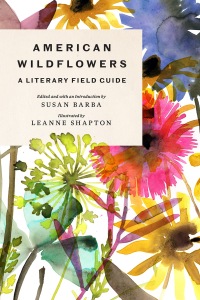 This comes out from Abrams Press in the USA on 8 November and I’ll be reviewing it for Shelf Awareness, so I’ll just give a few brief thoughts for now. Barba is a poet and senior editor for New York Review Books. She has collected pieces from a wide range of American literature, including essays, letters and early travel writings as well as poetry, which dominates.
Apart from a closing section on various/anonymous wildflowers, where particular species are named they are grouped into families, which are arranged alphabetically. The Asteraceae section is particularly strong, with poems on dandelions and sunflowers, a typically prophetic Aldo Leopold fragment about the decline of native flora, and “Asters and Goldenrod,” an extract from Robin Wall Kimmerer’s Braiding Sweetgrass (itself one of my 20 Books of Summer – review to come in the week) that I think was also excerpted in This Book Is a Plant.
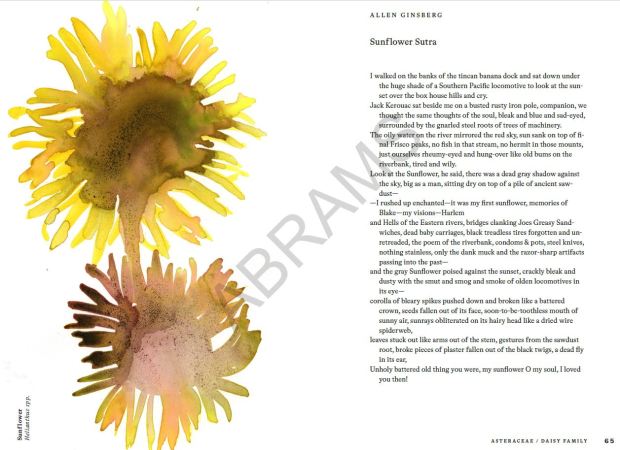
Sample two-page spread with a Leanne Shapton watercolor and part of an Allen Ginsberg poem.
In general, I engaged more with the poetry than with the prose. Barba has ensured a real variety of styles, with good representation for BIPOC. What draws it all together into a beautiful whole I wish I could see as a physical object is Leanne Shapton’s watercolor illustrations, painted from pressed flowers. “What a gift to stare at flowers—these ephemeral miracles of color and synthesis and botany,” she writes in an opening note. This would be a perfect coffee table book for any gardener or nature lover. (E-review copy)
Where the Wildflowers Grow: My Botanical Journey through Britain and Ireland by Leif Bersweden (2022)
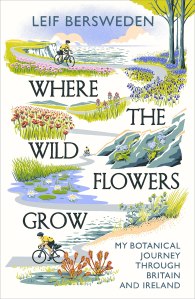 A good case of nominative determinism – the author’s name is pronounced “leaf” – and fun connections abound: during the course of his year-long odyssey, he spends time plant-hunting with Jon Dunn and Sophie Pavelle, whose books featured earlier in my flora-themed summer reading: Orchid Summer and Forget Me Not. With Dunn on Unst, Shetland, he sees not only rare flowers but close-up orcas. Like Pavelle, who he meets up with in Cornwall, he has an eye to how species will be affected by climate change and commits to doing his hunting by train and bike; there’s only so much you can see when zooming by in a car. Bersweden makes a case for spending time with plants – after all, they don’t move, so once you’ve found them you can commune in a way you can’t during, say, a fleeting mammal encounter.
He starts 2021 with a New Year Plant Hunt in central London with his mother – more is in bloom in January than ever before, at least in part due to climate warming. Even when the weather is foul on his travels, there is plenty to be seen. Everywhere he goes, he meets up with fellow experts and plant enthusiasts to marvel at bluebell woodlands or ancient pine forests, alpine or bog species. The floral circuit (documented in full on the book’s website through chapter-by-chapter photographs; there are two small sections of colour plates in the hardback) is also a chance to tour the British Isles, from Kent to Cork, coast to mountaintop.
Bersweden has been in love with plants ever since childhood; he believes they have nostalgia value for many people, and can be an easy way into appreciation of nature. “A wildflower growing from a crack in the wall is an everyday miracle.” His casual writing style and clear zeal for his subject – his author photo is of him hugging a tree, and another has such a cute caption: “Being given the opportunity to hold a Greater Bladderwort (Utricularia vulgaris) was one of the best things that’s ever happened to me!” – make this a pleasure even though it’s a bit overlong at points. (Public library)
Orwell’s Roses by Rebecca Solnit (2021)
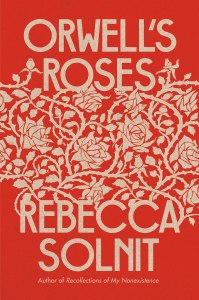 I was fascinated by the concept behind this one. “In the spring of 1936 a writer planted roses” is Solnit’s refrain; from there sprawls a book that’s somehow about everything: botany, geology, history, politics and war – as well as, of course, George Orwell’s life and works (with significant overlap with the graphic novel biography of him that I read last year). On a trip to England with a friend who is a documentary filmmaker, Solnit had the impulse to go find what might be left of Orwell’s garden. When she arrived in the Hertfordshire village of Wallington, the current owners of his home kindly showed her round. His fruit trees had long since been cut down, but the rosebushes were still going strong some 80 years later.
This goes down as a skim for me: though I read the first 30%, after that I just browsed to the end. Some side tracks lost me, e.g. Tina Modotti’s presentation of roses in her photographs; Orwell’s interest in mining, which leads Solnit to investigate how coal is formed; much history; and a week spent observing the rose-growing industry in Colombia. I most enjoyed the book when it stayed close to Orwell’s biography and writings, positing gardening as his way of grounding his ideas in the domestic and practical. “Pursuits like that can bring you back to earth from the ether and the abstractions.” I also liked – briefly, at least – thinking about the metaphorical associations of roses, and flowers in general.
If you’ve read Solnit before, you’ll know that her prose is exquisite, but I think this was the stuff of a long article rather than a full book. As it is, it’s a pretty indulgent project. (Kaggsy reviewed this recently and came to somewhat similar conclusions.) (NetGalley)
Review Catch-Up: Brackenbury, McLaren, Wellcome Collection
As usual, I have a big backlog of 2021–22 releases I’m working my way through. I’ll get there eventually! Today I’m reporting on a poetry collection about English ancestry and wildlife, a vision of post-doubt Christian faith, and a set of essays on connection to nature, specifically flora. (I also take a brief look at some autofiction that didn’t work for me.)
Thorpeness by Alison Brackenbury (2022)
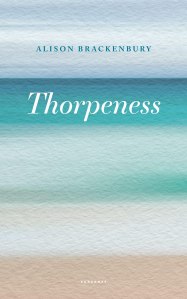 I’m familiar with Brackenbury from her appearance at New Networks for Nature in 2016 and her latest selected poems volume, Gallop. This, her tenth stand-alone collection, features abundant imagery of animals and the seasons, as in “Cucu” and “Postcard,” which marks the return of swifts. Alliteration is prominent, but there is also a handful of rhymes, like in “Fern.” Family history and the perhaps-idyllic rural underpin the verse set in Lincolnshire and Gloucestershire as Brackenbury searches for ancestral graves and delivers elegies.
I especially loved “Aunt Margaret’s Pudding,” a multipart poem about her grandmother’s life as a professional cook and then a mother of four, and “My Grandmother Waits for Christmas,” about a simple link between multiple generations’ Christmases: a sugar mouse. Caring for horses is another recurring theme; a 31-year-old blind pony receives a fond farewell.
There are also playful meetings between historical figures (“Purple Haze,” a dialogue between George Frideric Handel and Jimi Hendrix, who saw the composer’s ghost in their shared London home) and between past and contemporary, like “Thomas Hardy sends an email” (it opens “I need slide no confessions under doors”). “Charles Dickens at Home” was another favourite of mine. The title is the never-to-be-reached destination in the final poem, “Shingle.” A number of these poems were first broadcast on BBC Radio. 
With thanks to Carcanet Press for the e-copy for review.
Faith after Doubt: Why Your Beliefs Stopped Working and What to Do about It by Brian McLaren (2021)
I’ve explained before how McLaren’s books were pivotal to my spiritual journey, even before I attended the church he founded in Maryland. (I’ve also reviewed his previous book, God Unbound). His progressive, environmentalist theology is perfect for continuing searchers like me. At one of last year’s online Church Times Festival events, I saw him introduce the schema that underpins this book. He proposes that the spiritual life (not just Christian) has four stages that may overlap or repeat: simplicity, complexity, perplexity and harmony. The first stage is for new zealots who draw us–them divisions and are most concerned with orthodoxy. In the second, practitioners are more concerned with practicalities: what works, what makes life better. Perplexity is provoked by cynicism about injustice and hypocrisy, while harmony moves beyond dualism and into connection with other people and with nature.
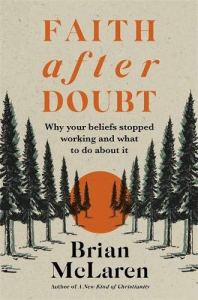 McLaren suggest that honest doubting, far from being a problem, might present an opportunity for changing in the right direction, getting us closer to the “revolutionary love” at the heart of the gospel. He shares stories from his own life, in and out of ministry, and from readers who have contacted him remotely or come up to him after events, caught in dilemmas about what they believe and whether they want to raise their children into religion. Though he’s fully aware of the environmental crisis and doesn’t offer false hope that we as a species will survive it, he isn’t ready to give up on religion; he believes that a faith seasoned by doubt and matured into an understanding of the harmony of all things can be part of a solution.
It’s possible some would find McLaren’s ideas formulaic and his prose repetitive. His point of view always draws me in and gives me much to think about. I’ve been stuck in perplexity for, ooh, 20 years? I frequently ask myself why I persist in going to church when it’s so boring and so often feels like a social club for stick-in-the-mud white people instead of a force for change. But books like this and Robin Wall Kimmerer’s Braiding Sweetgrass, my current soul food, encourage me to keep pursuing spiritual connection as a worthwhile path. I’ll be seeking out his forthcoming book (due out in May), Do I Stay Christian?, too.
Some favourite lines:
“only doubt can save the world. Only doubt will open a doorway out of hostile orthodoxies – whether religious, cultural, economic or political. Only through the difficult passage of doubt can we emerge into a new stage of faith and a new regenerative way of life. Everything depends on making this passage.”
“Among all the other things doubt is – loss, loneliness, crisis, doorway, descent, dissent [these are each the subject of individual chapters early on in the book] – it is also this: a crossroads. At the crossroads of doubt, we either become better or bitter. We either break down or break through. We become cynics or sages, hollow or holy. We choose love or despair.”
“Blessed are the wonderers, for they shall find what is wonderful. … Blessed are the doubters, for they shall see through false gods. Blessed are the lovers, for they shall see God everywhere.”
With thanks to Hodder & Stoughton for the free copy for review.
This Book Is a Plant: How to Grow, Learn and Radically Engage with the Natural World (2022)
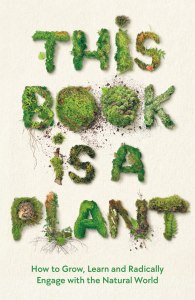 This collection of new essays and excerpts from previously published volumes accompanies the upcoming Wellcome Collection exhibition Rooted Beings (a collaboration with La Casa Encendida, Madrid, it’s curated by Bárbara Rodríguez Muñoz and Emily Sargent and will run from 24 March to 29 August). The overarching theme is our connection with plants and fungi, and the ways in which they communicate. Some of the authors are known for their nature writing – there’s an excerpt from Merlin Sheldrake’s Entangled Life, Jessica J. Lee (author of Turning and Two Trees Make a Forest) contributes an essay on studying mosses, and a short section from Kimmerer’s Braiding Sweetgrass closes the book – while others are better known in other fields, like Susie Orbach and Abi Palmer (author of Sanatorium).
I especially enjoyed novelist Rowan Hisayo Buchanan’s “Wilder Flowers,” which is about landscape painting, balcony gardening in pots, and what’s pretty versus what’s actually good for nature. (Wildflowers aren’t the panacea we are sometimes sold.) I was also interested to learn about quinine, which comes from the fever tree, in Kim Walker and Nataly Allasi Canales’ “Bitter Barks.” Sheila Watt-Cloutier’s essay on the Western influence on Inuit communities in northern Canada, reprinted from Granta, is one of the best individual pieces – forceful and with a unique voice, it advocates reframing the climate change debate in terms of human rights as opposed to the economy – but has nothing to do with plants specifically. There are also a couple of pieces that go strangely mystical, such as one on plant metaphors in the Kama Sutra. So, a mixed bag that jumbles science, paganism and postcolonial thought, but if you haven’t already encountered the Kimmerer and Sheldrake (or, e.g., Rooted by Lyanda Lynn Haupt and Losing Eden by Lucy Jones) you might find this a good primer. 
With thanks to Profile Books / Wellcome Collection for the free copy for review.
And one that really didn’t work for me; my apologies to the author and publisher.
I Love You but I’ve Chosen Darkness by Claire Vaye Watkins (2021)
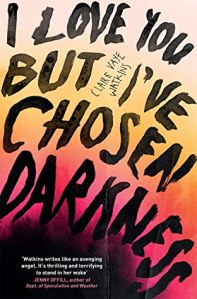 What a letdown after Gold Fame Citrus, one of my favourite novels of 2015. I’d also read Watkins’s debut short story collection, Battleborn, which won the Dylan Thomas Prize. Despite the amazing title and promising setup – autofiction that reflects on postpartum depression and her Mojave Desert upbringing as a daughter of one of the Manson Family cult members – this is indulgent, misguided, and largely unreadable.
A writer named Claire Vaye Watkins flies to Nevada to give a lecture and leaves her husband and baby daughter behind – for good? To commemorate her mother Martha, who died of an opiate overdose, she reprints Martha’s 1970s letters, which are unspeakably boring. I feel like Watkins wanted to write a memoir but didn’t give herself permission to choose nonfiction, so tried to turn her character Claire’s bad behaviour into a feminist odyssey of sexual freedom and ended up writing such atrocious lines as the below:
“I mostly boinked millennial preparers of beverages and schlepped to book festivals to hook up with whatever adequate rando lurked at the end of my signing line. This was what our open marriage looked like”
“‘Psychedelics tend to find me when I need them,’ she said, sending a rush of my blood to my vulva.”
Her vagina dentata (a myth, or a real condition?!) becomes a bizarre symbol of female power and rage. I could only bear to skim this. 
Some lines I liked:
Listen: I am a messenger from the future. I am you in ten years. Pay attention! Don’t fetishize marriage and babies. Don’t succumb to the axial tilt of monogamy! I don’t pretend to know the details of your…situation, but I guarantee you, you’re as free as you’ll ever be. Have sex with anyone you want. Enjoy the fact that it might happen any minute. You could have sex with a man, a woman, both—tonight!
I went from being raised by a pack of coyotes to a fellowship at Princeton where I sat next to John McPhee at a dinner and we talked about rocks and he wasn’t at all afraid of me.
With thanks to riverrun for the proof copy for review.
Would you be interested in reading one or more of these?
New Networks for Nature 2019
This past weekend was my fifth time attending Nature Matters, the annual New Networks for Nature conference. I’ve written about it on the blog a few times before: last year’s 10th anniversary meeting in Stamford, plus once when there was a particular focus on nature poetry and another time when it was held in Cambridge. This year the theme was “Time for Nature” and the conference was held at the very posh St Peter’s School in York, which dates back to 627 and resembles an Oxford college. We have close friends in York, but our timing was off in that they were in Italy this week. However, they sent us a key to their house and let us stay there while they were away, which saved us having to book an Airbnb or guest house.

York street scene. Photo by Chris Foster.
What makes Nature Matters so special is its interdisciplinary nature: visual artists, poets, musicians, writers, activists, academics and conservationists alike attend and speak. So although the event might seem geared more towards my ecologist husband, there’s always plenty to interest me, too. In particular, I enjoyed the panel discussions on nature in children’s books and new directions for nature writing. This year the organizers were determined to make the speakers’ roster more diverse, so some panels were three-quarters or wholly female, and four people of color appeared on the stage. (That might not seem like a great record, but in a field so dominated by white males it’s at least a start.)
 The Friday was a particularly brilliant day, the best day of sessions I can remember in any year. After a presentation by wildlife photographer and painter Robert Fuller, the first session was “Nature in Deep Time,” featuring three archaeologists from northern universities who talked about cave art, woodcraft, and evidence of rapid climate change. “Taking a long view, we get a very different perspective,” Professor Terry O’Connor of the University of York observed. The topic felt timely and tied in with a number of books that have come out this year, including Time Song by Julia Blackburn, Surfacing by Kathleen Jamie and Underland by Robert Macfarlane.
Next up was “Now or Never – Fighting for Nature,” featuring three female activists: Ruth Peacey, a filmmaker for BBC Wildlife whose subjects have included bird persecution in the Mediterranean; Sally Goldsmith, a campaigner who deployed poems and songs against the mass street tree-cutting campaign in Sheffield and helped save some 10,000 trees; and Hatti Owens, an environmental lawyer with ClientEarth who has partnered with Extinction Rebellion. The panel chair and one of this year’s organizers, writer Amy-Jane Beer, noted that activism is no longer radical, but an obligation.
Either side of lunch, Dr. Sara Goodacre of the University of Nottingham SpiderLab demonstrated how money spiders walk on water and “sail” using two raised legs to cope with wind; and Dr. Geoff Oxford of the University of York told the successful conservation story of the tansy beetle, which has recently been celebrated with a crowdfunded wall mural on the corner of York’s Queen Street and the Tansy Beetle Bar at the Rattle Owl restaurant on Micklegate. After the day’s proceedings, we joined a general movement over to see the mural and toast the bar’s grand opening.

Tansy beetle mural. Photo by Chris Foster.
The children’s books session featured Anneliese Emmans Dean, who gave very entertaining performances of her poems on insects and birds; Gill Lewis, who writes middle grade novels that introduce children to environmental issues; and Yuval Zommer, who writes and illustrates nonfiction guides with titles like The Big Book of Bugs and The Big Book of Blooms. Panel chair Ben Hoare, another of this year’s organizers and a former editor of BBC Wildlife magazine, concluded that children’s books should be joyous and not preachy.
There was still more to come on this jam-packed Friday! “The Funny Thing about Nature…” was essentially three stand-up comedy routines by Simon Watt, creator of the Ugly Animal Appreciation Society; Helen Pilcher, who has written a speculative book about the science of de-extinction; and Hugh Warwick, an author and hedgehog enthusiast. The language got a little crass in this session, but all three speakers were genuinely funny. As Watt put it, “Sincerity should not be our only weapon” in the fight for nature; he’s trying to reach the people who aren’t “already on our side.”
 After free gin and tonics provided by local producers SloeMotion, we had the absolute treat of a performance by Kitty Macfarlane, whose folk songs are inspired by the natural world. The title track of her 2018 album Namer of Clouds is about Luke Howard, who created the naming system for clouds (cumulus, stratus, and so on) in 1802. Other songs are about eels, a starling murmuration and the Sardinian tradition of weaving sea silk. She often incorporates field recordings of birdsong, and writes about her native Somerset Levels. Her voice is gorgeously clear, reminding me of Emily Smith’s. We bought her album and EP at once.
Saturday was a slightly less memorable day, with sessions on insects and the uplands, an interview with clean rivers campaigner (and former pop star) Feargal Sharkey, and the short film Raising the Hare by Bevis Bowden. Most engaging for me was a four-person discussion on new directions for nature writing, chaired by author and academic Richard Kerridge. Katharine Norbury is editing the Women on Nature anthology, which I have supported via Unbound; it’s due out next year. She went all the way back to Julian of Norwich and has included novelists, poets, gardeners and farmers – lots of women who wouldn’t have called themselves ‘nature writers’.

L to R: Kerridge, Norbury, Sethi, McKenzie and Smyth. Photo by Chris Foster.
Anita Sethi, a journalist from Manchester, speaks out about inequality of access to nature due to race, gender and class. She read part of her essay “On Class and the Countryside” from the Common People anthology edited by Kit de Waal. Zakiya McKenzie, a London-born Jamaican, was a Forest England writer in residence and founded the Green & Black project to give underprivileged children trips to the countryside. Richard Smyth, the author of A Sweet, Wild Note, spoke of the need for robust nature writing – and criticism. He stressed that it’s not good enough for nature writing to be “charming” or “lyrical”; it’s too important to be merely pleasant. I would have liked to hear him explore this more and for it to turn into more of a debate, but the discussion drifted into praise for experimental and speculative forms.

Peregrine on York Minster. Photo by Chris Foster.

Finishing off a Bettys lunch with cake and a mocha. Photo by Chris Foster.
There’s something for everyone at this conference; some of the elements that I didn’t get on with or found pretentious were others’ highlights, so it’s all a matter of taste. Spending time in York, one of my favorite cities, was an added bonus. We managed to fit in a trip to the National Railway Museum and lunch at Bettys on the Sunday before our train back.
Next year’s conference will be at the University of East Anglia in Norwich, 10–12 July. I’ve never been to Norwich so look forward to visiting it and attending the full conference once again. It’s always a fascinating, inspiring weekend with a wide range of speakers and ideas.
 Bookish Beck = Rebecca Foster. American transplant to England. Freelance proofreader and book reviewer.
 Bookish Beck