January Releases II: Nick Blackburn, Wendy Mitchell & Padraig Regan
The January new releases continue! I’ll have a final batch of three tomorrow. For today, I have an all-over-the-place meditation masquerading as a bereavement memoir, an insider’s look at what daily life with dementia is like, and a nonbinary poet’s debut.
The Reactor: A Book about Grief and Repair by Nick Blackburn
I’ll read any bereavement memoir going, and the cover commendations from Olivia Laing and Helen Macdonald made this seem like a sure bet. Unfortunately, this is not a bereavement memoir but an exercise in self-pity and free association. The book opens two weeks after Blackburn’s father’s death – “You have died but it’s fine, Dad.” – and proceeds in titled fragments of one line to a few paragraphs. Blackburn sometimes addresses his late father directly, but more often the “you” is himself. He becomes obsessed with the Chernobyl disaster (even travelling to Belarus), which provides the overriding, and overstretched, title metaphor – “the workings of grief are unconscious, invisible. Like radiation.”
 From here the author indulges in pop culture references and word association: Alexander McQueen’s fashion shows, Joni Mitchell’s music, Ingmar Bergman’s films, Salvador Dalí’s paintings and so on. These I at least recognized; there were plenty of other random allusions that meant nothing to me. All of this feels obfuscating, as if Blackburn is just keeping busy: moving physically and mentally to distract from his own feelings. A therapist focusing on LGBT issues, he surely recognizes his own strategy here. This seems like a diary you’d keep in a bedside drawer (there’s also the annoyance of no proper italicization or quotation marks for works of art), not something you’d try to get published as a bereavement memoir.
The bigger problem is there is no real attempt to convey a sense of his father. It would be instructive to go back and count how many pages actually mention his father. One page on his death; a couple fleeting mentions of his mental illness being treated with ECT and lithium. Most revealing of all, ironically, is the text of a postcard he wrote to his mother on a 1963 school trip to Austria. “I want to tell you more about my father, but honestly I feel like I hardly knew him. There was always his body and that was enough,” Blackburn writes. Weaselling out of his one task – to recreate his father for readers – made this an affected dud.
With thanks to Faber for the free copy for review.
What I Wish People Knew About Dementia: From Someone Who Knows by Wendy Mitchell
I loved Mitchell’s first book, Somebody I Used to Know. She was diagnosed with early-onset Alzheimer’s at age 58 in 2014. This follow-up, too, was co-written with Anna Wharton (they have each written interesting articles on their collaboration process, here and here). Whereas her previous work was a straightforward memoir, this has more of a teaching focus, going point by point through the major changes dementia causes to the senses, relationships, communication, one’s reaction to one’s environment, emotions, and attitudes.
 I kept shaking my head at all these effects that would never have occurred to me. You tend not to think beyond memory. Food is a major issue for Mitchell: she has to set iPad reminders to eat, and chooses the same simple meals every time. Pasta bowls work best for people with dementia as they can get confused trying to push food around a plate. She is extra sensitive to noises and may have visual and olfactory hallucinations. Sometimes she is asked to comment on dementia-friendly building design. For instance, a marble floor in a lobby looks like water and scares her, whereas clear signage and bright colours cheer up a hospital trip.
The text also includes anonymous input from her friends with dementia, and excerpts from recent academic research on what can help. Mitchell and others with Alzheimer’s often feel written off by their doctors – her diagnosis appointment was especially pessimistic – but her position is that the focus should be on what people can still do and adaptations that will improve their everyday lives. Mitchell lives alone in a small Yorkshire village and loves documenting the turning of the seasons through photographs she shares on social media. She notes that it’s important for people to live in the moment and continue finding activities that promote a flow state, a contrast to some days that pass in a brain haze.
This achieves just what it sets out to: give a picture of dementia from the inside. As it’s not a narrative, it’s probably best read in small doses, but there are some great stories along the way, like the epilogue’s account of her skydive to raise money for Young Dementia UK.
With thanks to Bloomsbury for the proof copy for review.
Some Integrity by Padraig Regan
The sensual poems in this debut collection are driven by curiosity, hunger and queer desire. Flora and foods are described as teasing mystery, with cheeky detail:
I’m thinking of how mushrooms will haunt a wet log like bulbous ghosts
The chicken is spatchcocked & nothing
like a book, but it lies open & creases
where its spine once was.
For as long as it take a single drop of condensation to roll its path
down the curve of a mojito glass before it’s lost in the bare wood of the table,
everything is held // in its hall of mirrors

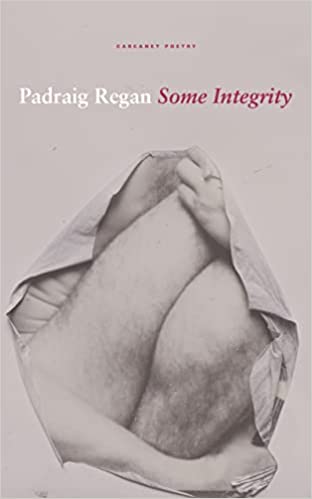 An unusual devotion to ampersands; an erotic response to statuary, reminiscent of Richard Scott; alternating between bold sexuality and masochism to the point of not even wanting to exist; a central essay on the Orlando nightclub shooting and videogames – the book kept surprising me. I loved the fertile imagery, and appreciated Regan’s exploration of a nonbinary identity:
Often I envy the Scandinavians for their months of sun,
unpunctuated. I think I want some kind of salad. I want to feel like a real boy, sometimes.
Thank you
for this chain of daisies to wear around my neck — it makes me look so pretty.
Highly recommended, especially to readers of Séan Hewitt and Stephen Sexton.
With thanks to Carcanet Press for the free copy for review.
Does one of these books appeal to you?
January 2022 Releases, Part I: Jami Attenberg and Roopa Farooki
It’s been a big month for new releases! I’m still working on a handful and will report back on two batches of three, tomorrow and Sunday; more will likely turn up in review roundups in future months. For today, I have a memoir in essays about a peripatetic writer’s life and an excerpt from my review of a junior doctor’s chronicle of the early days of the pandemic.
I Came All This Way to Meet You: Writing Myself Home by Jami Attenberg
 I’ve enjoyed Attenberg’s four most recent novels (reviewed here: The Middlesteins and All This Could Be Yours) so was intrigued to hear that she was trying out nonfiction. She self-describes as a “moderately successful author,” now in her early fifties – a single, independent feminist based in New Orleans after years in Manhattan and then Brooklyn. (Name-dropping of author friends: “Lauren” (Groff), “Kristen” (Arnett) and “Viola” (di Grado), with whom she stays in Italy.) Leaving places abruptly had become a habit; travelling from literary festival to holiday to writing residency was her way of counterbalancing a safe, quiet writing life at home. She tells of visiting a friend in Hong Kong and teaching fiction for two weeks in Vilnius – where she learned that, despite her Jewish heritage, Holocaust tourism is not her thing. Anxiety starts to interfere with travel, though, and she takes six months off flying. Owning a New Orleans home where she can host guests is the most rooted she’s ever been.
Along with nomadism, creativity and being a woman are key themes. Attenberg notices how she’s treated differently from male writers at literary events, and sometimes has to counter antifeminist perspectives even from women – as in a bizarre debate she ended up taking part in at a festival in Portugal. She takes risks and gets hurt, physically and emotionally. Break-ups sting, but she moves on and tries to be a better person. There are a lot of hard-hitting one-liners about the writing life and learning to be comfortable in one’s (middle-aged) body:
I believe that one must arrive at an intersection of hunger and fear to make great art.
Who was I hiding from? I was only ever going to be me. I was only ever going to have this body forever. Life was too short not to have radical acceptance of my body.
Whenever my life turns into any kind of cliché, I am furious. Not me, I want to scream. Not me, I am special and unusual. But none of us are special and unusual. Our stories are all the same. It is just how you tell them that makes them worth hearing again.
I did not know yet how books would save me over and over again. I did not know that a book was a reason to live. I did not know that being alive was a reason to live.
Late on comes her #MeToo story, which in some ways feels like the core of the book. When she was in college, a creative writing classmate assaulted her on campus while drunk. She reported it but nothing was ever done; it only led to rumours and meanness towards her, and a year later she attempted suicide. You know how people will walk into a doctor’s appointment and discuss three random things, then casually drop in a fourth that is actually their overriding concern? I felt that way about this episode: that really the assault was what Attenberg wanted to talk about, and could have devoted much more of the book to.
The chapters are more like mini essays, flitting between locations and experiences in the same way she has done, and sometimes repeating incidents. I think the intent was to mimic, and embrace, the random shape that a life takes. Each vignette is like a competently crafted magazine piece, but the whole is no more than the sum of the parts.
With thanks to Serpent’s Tail for the proof copy for review.
Everything Is True: A Junior Doctor’s Story of Life, Death and Grief in a Time of Pandemic by Roopa Farooki
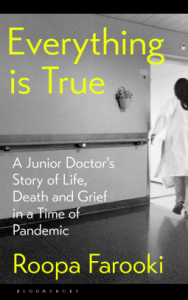 Farooki is a novelist, lecturer, mum of four, and junior doctor. Her storytelling choices owe more to literary fiction than to impassive reportage. The second-person, present-tense narration drops readers right into her position. Frequent line breaks and repetition almost give the prose the rhythm of performance poetry. There is also wry humour, wordplay, slang and cursing. In February 2020, her sister Kiron had died of breast cancer. During the first 40 days of the initial UK lockdown – the book’s limited timeframe – she continues to talk to Kiron, and imagines she can hear her sister’s chiding replies. Grief opens the door for magic realism, despite the title – which comes from a Balzac quote. A hybrid work that reads as fluidly as a novel while dramatizing real events, this is sure to appeal to people who wouldn’t normally pick up a bereavement or medical memoir. (Full review coming soon at Shiny New Books.)
A great addition to my Covid chronicles repertoire!
With thanks to Bloomsbury for the proof copy for review.
Would one of these books interest you?
Some of My Most Anticipated Releases of 2022
Ninety-nine 2022 releases have made it onto my Goodreads shelves so far. I’ve read about 10 already and will preview some of them tomorrow.
 This year we can expect new fiction from Julian Barnes, Carol Birch, Jessie Burton, Jennifer Egan, Karen Joy Fowler, David Guterson, Sheila Heti, John Irving (perhaps? at last), Liza Klaussman, Benjamin Myers, Julie Otsuka, Alex Preston and Anne Tyler; a debut novel from Emilie Pine; second memoirs from Amy Liptrot and Wendy Mitchell; another wide-ranging cultural history/self-help book from Susan Cain; another medical history from Lindsey Fitzharris; a biography of the late Jan Morris; and much more. (Already I feel swamped, and this in a year when I’ve said I want to prioritize backlist reads! Ah well, it is always thus.)
I’ve limited myself here to the 20 upcoming releases I’m most excited about. The low figure is a bit of a cheat: with a few exceptions, I’ve not included books I have / have been promised. I’ll be scurrying around requesting copies of most of the others soon. The following are due out between January and August and are in (UK) release date order, within sections by genre. (U.S. details given too/instead if USA-only. Quotes are extracted from publisher blurbs on Goodreads.)
U.S. covers – included where different – rule!
N.B. Fiction is winning this year!
Fiction
 To Paradise by Hanya Yanagihara [Jan. 11, Picador / Doubleday] You’ll see this on just about every list; her fans are legion after the wonder that was A Little Life. Another doorstopper, but this time with the epic reach to justify the length: sections are set in an alternative 1893, 1993, and 2093 – “joined in an enthralling and ingenious symphony, as recurring notes and themes deepen and enrich one another.” [Proof copy]

UK cover
 How High We Go in the Dark by Sequoia Nagamatsu [Jan. 18, Bloomsbury / William Morrow] Amazing author name! Similar to the Yanagihara what with the century-hopping and future scenario, a feature common in 2020s literature – a throwback to Cloud Atlas? I’m also reminded of the premise of Under the Blue, one of my favourites from last year. “Once unleashed, the Arctic Plague will reshape life on Earth for generations to come.”
Heartstopper, Volume 5 by Alice Oseman [Feb. ?, Hodder Children’s] I devoured the first four volumes of this teen comic last year. In 2020, Oseman tweeted that the fifth and final installment was slated for February 2022, but I don’t have any more information than that. Nick will be getting ready to go off to university, so I guess we’ll see how he leaves things with Charlie and whether their relationship will survive a separation. (No cover art yet.)
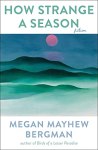 How Strange a Season by Megan Mayhew Bergman [March 29, Scribner] I enjoyed her earlier story collection, Almost Famous Women. “Bergman portrays women who wrestle with problematic inheritances: a modern glass house on a treacherous California cliff, a water-starved ranch, an abandoned plantation on a river near Charleston … provocative prose asks what are we leaving behind for our ancestors … what price will they pay for our mistakes?”
A Violent Woman by Ayana Mathis [April 7, Hutchinson] Her Oprah-approved 2013 debut, The Twelve Tribes of Hattie, got a rare 5-star review from me. About “an estranged mother and her daughter. Dutchess lives in Bonaparte, Alabama, a once thriving black town now in its death throes. Lena lives in Philadelphia in the 1980s. Her involvement with the radical separatist group STEP leads to transcendence and tragedy.” (No cover art yet.)
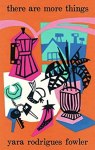 there are more things by Yara Rodrigues Fowler [April 28, Fleet] I so wanted her 2019 debut novel, Stubborn Archivist, to win the Young Writer of the Year Award. I love the cover and Hamlet-sourced title, and I’m here for novels of female friendship. “In January 2016, Melissa [South London native] and Catarina [born to well-known political family in Brazil] meet for the first time, and as political turmoil unfolds … their friendship takes flight.”


UK cover
Sea of Tranquility by Emily St. John Mandel [April 28, Picador / April 5, Knopf] This is the other title you’ll find on everyone else’s list. That’s because The Glass Hotel, even more so than Station Eleven, was amazing. Another history-to-future-hopper: “a novel of art, time, love, and plague that takes the reader from Vancouver Island in 1912 to a dark colony on the moon three hundred years later, unfurling a story of humanity across centuries and space.” [Edelweiss download]
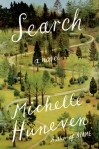 Search by Michelle Huneven [April 28, Penguin] A late addition to my list thanks to the Kirkus review. Sounds like one for readers of Katherine Heiny! “Dana Potowski is a restaurant critic and food writer … asked to join [her California Unitarian Universalist] church search committee for a new minister. Under pressure to find her next book idea, she agrees, and resolves to secretly pen a memoir, with recipes, about the experience.”


UK cover
Very Cold People by Sarah Manguso [April 28, Picador / Feb. 8, Hogarth] The debut novel from an author by whom I’ve read four nonfiction works. “For Ruthie, the frozen town of Waitsfield, Massachusetts, is all she has ever known. Once home to the country’s oldest and most illustrious families[,] … it is an unforgiving place awash with secrets. … Ruthie slowly learns how the town’s prim facade conceals a deeper, darker history…”
UK cover
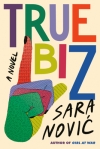
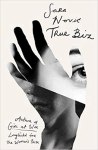
True Biz by Sara Nović [May 5, Little, Brown / April 5, Random House] Her 2015 Girl at War is one of my most-admired debuts of all time, and who can resist a campus novel?! “The students at the River Valley School for the Deaf just want to hook up, pass their history final, and have doctors, politicians, and their parents stop telling them what to do with their bodies. This revelatory novel plunges readers into the halls of a residential school for the deaf.”
 You Have a Friend in 10a: Stories by Maggie Shipstead [May 19, Transworld / May 17, Knopf] Shipstead’s Booker-shortlisted doorstopper, Great Circle, ironically, never took off for me; I’m hoping her short-form storytelling will work out better. “Diving into eclectic and vivid settings, from an Olympic village to a deathbed in Paris to a Pacific atoll, … Shipstead traverses ordinary and unusual realities with cunning, compassion, and wit.”

UK cover
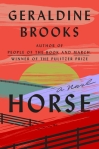 Horse by Geraldine Brooks [June 2, Little, Brown / June 14, Viking] You guessed it, another tripartite 1800s–1900s–2000s narrative! With themes of slavery, art and general African American history. I’m not big on horses, at least not these days, but Brooks’s March and Year of Wonders are among my recent favourites. “Based on the remarkable true story of the record-breaking thoroughbred, Lexington, who became America’s greatest stud sire.”

UK cover
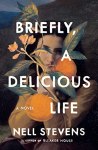
Briefly, a Delicious Life by Nell Stevens [June 23, Picador / June 21, Scribner] I’ve read her two previous autofiction-y memoirs and loved Mrs Gaskell & Me. The title, cover and Victorian setting of her debut novel beckon. “In 1473, fourteen-year-old Blanca dies in a hilltop monastery in Mallorca. Nearly four hundred years later, when George Sand, her two children, and her lover Frederic Chopin arrive in the village, Blanca is still there: a spirited, funny, righteous ghost.”
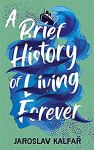 A Brief History of Living Forever by Jaroslav Kalfar [Aug. 4, Sceptre / Little, Brown] His Spaceman of Bohemia (2017) was terrific. “When Adela discovers she has a terminal illness, her thoughts turn to Tereza, the American-raised daughter she gave up at birth. … In NYC, Tereza is … the star researcher for two suspicious biotech moguls hellbent on developing a ‘god pill’ to extend human life indefinitely. … Narrated from the beyond by Adela.”
Nonfiction
 The Cure for Sleep by Tanya Shadrick [Jan. 20, Weidenfeld & Nicolson] Nature memoir / self-help. “On return from near-death, Shadrick vows to stop sleepwalking through life. … Around the care of young children, she starts to play with the shape and scale of her days: to stray from the path, get lost in the woods, make bargains with strangers … she moves beyond her respectable roles as worker, wife and mother in a small town.” [Review copy]
 The Invisible Kingdom: Reimagining Chronic Illness by Meghan O’Rourke [March 1, Riverhead] O’Rourke wrote one of the best bereavement memoirs ever. This ties in with my medical interests. “O’Rourke delivers a revelatory investigation into this elusive category of ‘invisible’ illness that encompasses autoimmune diseases, post-treatment Lyme disease syndrome, and now long COVID, synthesizing the personal and the universal.”

UK cover
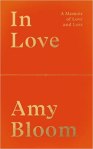
In Love: A Memoir of Love and Loss by Amy Bloom [April 7, Granta / March 8, Random House] The true story of how Bloom accompanied her husband Brian, who had Alzheimer’s, to Dignitas in Switzerland to end his life. I’ve read quite a lot around assisted dying. “Written in Bloom’s captivating, insightful voice and with her trademark wit and candor, In Love is an unforgettable portrait of a beautiful marriage, and a boundary-defying love.”
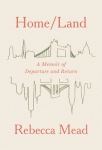 Home/Land: A Memoir of Departure and Return by Rebecca Mead [April 21, Grove Press UK / Feb. 8, Knopf] I enjoyed Mead’s bibliomemoir on Middlemarch. The Anglo-American theme is perfect for me: “drawing on literature and art, recent and ancient history, and the experience of encounters with individuals, environments, and landscapes in New York City and in England, Mead artfully explores themes of identity, nationality, and inheritance.”

UK cover
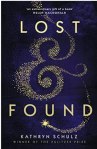
Lost & Found: A Memoir by Kathryn Schulz [April 28, Picador / Jan. 20, Random House] I loved her 2010 book Being Wrong, and bereavement memoirs are my jam. “Eighteen months before Kathryn Schulz’s father died, she met the woman she would marry. In Lost & Found, she weaves the story of those relationships into a brilliant exploration of the role that loss and discovery play in all of our lives … an enduring account of love in all its many forms.”
Poetry
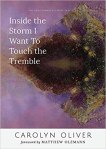 Inside the Storm I Want to Touch the Tremble by Carolyn Oliver [Aug. 19, Univ. of Utah Press] Carolyn used to blog at Rosemary and Reading Glasses. The poems she’s shared on social media are beautiful, and I’m proud of her for winning the Agha Shahid Ali Prize. “Inside this debut collection, girlhood’s dangers echo, transmuted, in the poet’s fears for her son. A body … is humbled by chronic illness. Stumbling toward joy across time and space, these poems hum with fear and desire, bewildering loss, and love’s lush possibilities.”
Themes arising: crossing three centuries; H & I titles, the word “brief”; moons and stars on covers. Mostly female authors (only two men here).
Do check out these other lists for more ideas!
Plus you can seek out all the usual lists (e.g. on Lit Hub and virtually every other book or newspaper site) … if you want to be overwhelmed!
What catches your eye here?
What other 2022 titles do I need to know about?
Six Degrees: Ethan Frome to A Mother’s Reckoning
This month we began with Ethan Frome by Edith Wharton, which was our buddy read for the short classics week of Novellas in November. I reread and reviewed it recently. (See Kate’s opening post.)
 #1 When I posted an excerpt of my Ethan Frome review on Instagram, I got a comment from the publicist who was involved with the recent UK release of The Smash-Up by Ali Benjamin, a modern update of Wharton’s plot. Here’s part of the blurb: “Life for Ethan and Zo used to be simple. Ethan co-founded a lucrative media start-up, and Zo was well on her way to becoming a successful filmmaker. Then they moved to a rural community for a little more tranquility—or so they thought. … Enter a houseguest who is young, fun, and not at all concerned with the real world, and Ethan is abruptly forced to question everything: his past, his future, his marriage, and what he values most.” I’m going to try to get hold of a review copy when the paperback comes out in February.
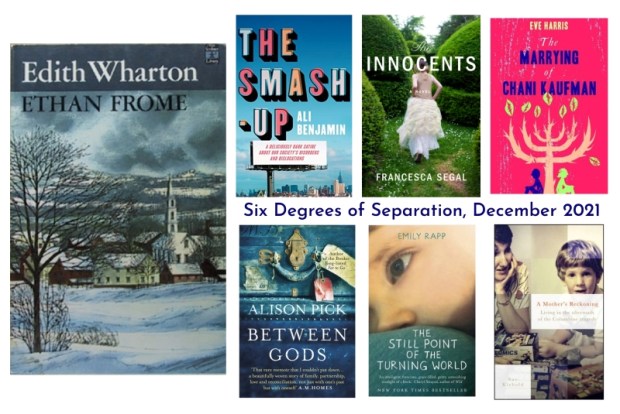
 #2 One of my all-time favourite debut novels is The Innocents by Francesca Segal, which won the Costa First Novel Award in 2012. It is also a contemporary reworking of an Edith Wharton novel, this time The Age of Innocence. Segal’s love triangle, set in a world I know very little about (the tight-knit Jewish community of northwest London), stays true to the emotional content of the original: the interplay of love and desire, jealousy and frustration. Adam Newman has been happily paired with Rachel Gilbert for nearly 12 years. Now engaged, Adam and Rachel seem set to become pillars of the community. Suddenly, their future is threatened by the return of Rachel’s bad-girl American cousin, Ellie Schneider.
 #3 Also set in north London’s Jewish community is The Marrying of Chani Kaufman by Eve Harris, which was longlisted for the Booker Prize in 2013. Chani is the fifth of eight daughters in an ultra-Orthodox Jewish family in Golders Green. The story begins and closes with Chani and Baruch’s wedding ceremony, and in between it loops back to detail their six-month courtship and highlight a few events from their family past. It’s a light-hearted, gossipy tale of interclass matchmaking in the Jane Austen vein.
 #4 I learned more about Jewish beliefs and rituals via several memoirs, including Between Gods by Alison Pick. Her paternal grandparents escaped Czechoslovakia just before the Holocaust; she only found out that her father was Jewish through eavesdropping. In 2008 the author (a Toronto-based novelist and poet) decided to convert to Judaism. The book vividly depicts a time of tremendous change, covering a lot of other issues Pick was dealing with simultaneously, such as depression, preparation for marriage, pregnancy, and so on.
 #5 One small element of Pick’s story was her decision to be tested for the BRCA gene because it’s common among Ashkenazi Jews. Tay-Sachs disease is usually found among Ashkenazi Jews, but because only her husband was Jewish, Emily Rapp never thought to be tested before she became pregnant with her son Ronan. Had she known she was also a carrier, things might have gone differently. The Still Point of the Turning World was written while her young son was still alive, but terminally ill.
 #6 Another wrenching memoir of losing a son: A Mother’s Reckoning by Sue Klebold, whose son Dylan was one of the Columbine school shooters. I was in high school myself at the time, and the event made a deep impression on me. Perhaps the most striking thing about this book is Klebold’s determination to reclaim Columbine as a murder–suicide and encourage mental health awareness; all author proceeds were donated to suicide prevention and mental health charities. There’s no real redemptive arc, though, no easy answers; just regrets. If something similar could happen to any family, no one is immune. And Columbine was only one of many major shootings. I finished this feeling spent, even desolate. Yet this is a vital book everyone should read.
So, I’ve gone from one unremittingly bleak book to another, via sex, religion and death. Nothing for cheerful holiday reading – or a polite dinner party conversation – here! All my selections were by women this month.
Where will your chain take you? Join us for #6Degrees of Separation! (Hosted on the first Saturday of each month by Kate W. of Books Are My Favourite and Best.)
Next month’s starting point is Rules of Civility by Amor Towles; I have a copy on the shelf and this would be a good excuse to read it!
Have you read any of my selections? Are you tempted by any you didn’t know before?
#NonFicNov Review Book Catch-Up: Cohen, Gilbert, Hodge, Piesse, Royle
I have a big backlog of review books piled beside my composition station (a corner of the lounge by the front window; an ancient PC inherited from my mother-in-law and not connected to the Internet; a wooden chair with leather seat that had been left behind in a previous rental house’s garage). Nonfiction November is the excuse I need to finally get around to writing about lots of them; at least one more catch-up will be coming later this month. My apologies to the publishers for the brief reviews.
Today I have a therapist’s take on classic literature, an optimist’s research on data use, a journalist’s response to her sister’s and father’s deaths, a professor’s search for the remnants of Charles Darwin at his family home, and a bibliophile’s tales of book-collecting exploits.
How to Live. What to Do.: In Search of Ourselves in Life and Literature by Josh Cohen
“Literature and psychoanalysis are both efforts to make sense of the world through stories, to discover the recurring problems and patterns and themes of life. Read and listen enough, and we soon come to notice how insistently the same struggles, anxieties and hopes repeat themselves down the ages and across the world.”
 This is the premise for Cohen’s work life, and for this book. Moving through the human experience from youth to old age, he examines anonymous case studies and works of literature that speak to the sorts of situations encountered in that stage. For instance, he recommends Alice in Wonderland as a tonic for the feeling of being stuck – Lewis Carroll’s “let’s pretend” attitude can help someone return to the playfulness and openness of childhood. William Maxwell’s They Came Like Swallows, set during the Spanish flu, takes on new significance for Cohen in the days of Covid as his appointments all move online; he also takes from it the importance of a mother for providing emotional security. A bibliotherapy theme would normally be catnip for me, but I often found the examples too obvious and the discussion too detailed (and thus involving spoilers). Not a patch on The Novel Cure.
(Ebury Press, February 2021.) With thanks to the publicist for the free copy for review.
Good Data: An Optimist’s Guide to Our Digital Future by Sam Gilbert
 Gilbert worked for Experian before going back to university to study politics; he is now a researcher at the Bennett Institute for Public Policy at the University of Cambridge. At a time of much anxiety about “surveillance capitalism,” he seeks to provide reassurance. He explains that Facebook and the like, with their ad-based business models, use profile data and behavioural data to make inferences about you. This is not the same as “listening in,” he is careful to assert. Gilbert contrasts broad targeting and micro-targeting, and runs through trends in search data. He highlights instances where social media and data mining have been beneficial, such as in creating jobs, increasing knowledge, or aiding communication during democratic protests. I have to confess that a lot of this went over my head; I’d overestimated my interest in a full book on technology, having reviewed Born Digital earlier in the year.
(Welbeck, April 2021.) With thanks to the publisher for the proof copy for review.
The Consequences of Love by Gavanndra Hodge (2020)
 In 1989, Hodge’s younger sister Candy died on a family holiday in Tunisia when a rare virus brought on rapid organ failure. The rest of the family exhibited three very different responses to grief: her father retreated into existing addictions, her mother found religion, and she went numb and forgot her sister as much as possible – despite having a photographic memory in general. After her father’s death, Hodge finally found the courage to look back to her early life and the effect of Candy’s death. Hers was no ordinary upbringing; her father was a drug dealer who constantly disappointed her and from her teens on roped her into his substance abuse evenings. Often she was the closest thing to a sober and rational adult in the drug den their home had become. This is a very fluidly written bereavement memoir and a powerful exploration of memory and trauma. It was unfortunate that it felt that little bit too similar to a couple of other books I’ve read in recent years: When I Had a Little Sister by Catherine Simpson and especially Featherhood by Charlie Gilmour.
(Paperback: Penguin, July 2021.) With thanks to the publicist for the free copy for review.
The Ghost in the Garden: In Search of Darwin’s Lost Garden by Jude Piesse
 When Piesse’s academic career took her back to her home county of Shropshire, she became fascinated by the Darwin family home in Shrewsbury, The Mount. A Victorian specialist, she threw herself into research on the family and particularly on the traces of the garden. Her thesis is that here, and on long walks through the surrounding countryside, Darwin developed the field methods and careful attention that would serve him well as the naturalist on board the Beagle. Piesse believes the habit of looking closely was shared by Darwin and his mother, Susannah. The author contrasts Susannah’s experience of childrearing with her own – she has two young daughters when she returns to Shropshire, and has to work out a balance between work and motherhood. I noted that Darwin lost his mother early – early parent loss is considered a predictor of high achievement (it links one-third of U.S. presidents, for instance).
I think what Piesse was attempting here was something like Rebecca Mead’s wonderful My Life in Middlemarch, but the links just aren’t strong enough: There aren’t that many remnants of the garden or the Darwins here (all the family artefacts are at Down House in Kent), and Piesse doesn’t even step foot into The Mount itself until page 217. I enjoyed her writing about her domestic life and her desire to create a green space, however small, for her daughters, but this doesn’t connect to the Darwin material. Despite my fondness for Victoriana, I was left asking myself what the point of this project was.
(Scribe, May 2021.) With thanks to the publisher for the free copy for review.
White Spines: Confessions of a Book Collector by Nicholas Royle
 From the 1970s to 1990s, Picador released over 1,000 paperback volumes with the same clean white-spined design. Royle has acquired most of them – no matter the author, genre or topic; no worries if he has duplicate copies. To build this impressive collection, he has spent years haunting charity shops and secondhand bookshops in between his teaching and writing commitments. He knows where you can get a good bargain, but he’s also willing to pay a little more for a rarer find. In this meandering memoir-of-sorts, he ponders the art of cover design, delights in ephemera and inscriptions found in his purchases (he groups these together as “inclusions”), investigates some previous owners and the provenance of his signed copies, interviews Picador staff and authors, and muses on the few most ubiquitous titles to be found in charity shops (Once in a House on Fire by Andrea Ashworth, Bridget Jones’s Diary by Helen Fielding, anything by Kathy Lette, and Last Orders by Graham Swift). And he does actually read some of what he buys, though of course not all, and finds some hidden gems.
In 2013 I read Royle’s First Novel, which also features Picador spines on its cover and a protagonist obsessed with them. I’d read enthusiastic reviews by fellow bibliophiles – Paul, Simon, Susan – so couldn’t resist requesting White Spines. While I enjoyed the conversational writing, ultimately I thought it quite an indulgent undertaking (especially the records of his dreams!), not dissimilar to a series of book haul posts. The details of shopping trips aren’t of much interest because he’s solely focused on his own quest, not on giving any insight into the wider offerings of a shop or town, e.g., Hay-on-Wye and Barter Books. But if you’re a fan of Shaun Bythell’s books you may well want to read this too. It’s also a window into the collector’s mindset: You know Royle is an extremist when you read that he once collected bread labels!
(Salt Publishing, July 2021.) With thanks to the publicist for the free copy for review.
Are you interested in reading one or more of these?
September Poetry & Nonfiction: Antrobus, Benning, Carey; Bowler, Lister
September is a major month for new releases. I’ve already reviewed two fiction titles that came out this month: Blank Pages and Other Stories by Bernard MacLaverty and Bewilderment by Richard Powers. I’m still working through the 500+ pages of Ruth Ozeki’s new novel, The Book of Form and Emptiness, and hope to report back on it before too long.
Today I have poetry volumes reckoning with race and disability and with modern farming on the Canadian prairie, as well as a centuries-spanning anthology; and, in nonfiction, memoirs of living with advanced cancer and adjusting to widowhood in one’s thirties.
All the Names Given by Raymond Antrobus
 Antrobus, a British-Jamaican poet, won the Rathbones Folio Prize, the Ted Hughes Award, and the Sunday Times Young Writer of the Year Award for his first collection, The Perseverance. I reviewed it for the Folio Prize blog tour in 2019 and was in attendance at the Young Writer ceremony when he won. Its themes carry over into this second full-length work: again, he reflects on biracial identity, deafness, family divisions, and the loss of his father. Specifically, he is compelled to dive into the history of his English mother’s ancient surname, Antrobus: associated with baronets, owners of Stonehenge, painters – and slavers.
Tell me if I’m closer
to the white painter
with my name than I am
to the black preacher,
his hands wide to the sky,
the mahogany rot
of heaven. Sorry,
but you know by now
that I can’t mention trees
without every shade
of my family
appearing and disappearing. (from “Plantation Paint”)
Other poems explore police and prison violence against Black and deaf people, and arise from his experiences teaching poetry to students and inmates. Captions in square brackets are peppered throughout, inspired by the work of Deaf sound artist Christine Sun Kim. These serve as counterparts to the sign language illustrations in The Perseverance. There are also unsentimental love poems written for his wife, Tabitha. This didn’t captivate me in the same way as his first book, but I always enjoy experiencing the work of contemporary poets and would recommend this to readers of Jason Allen-Paisant, Caleb Femi and Kei Miller.
With thanks to Picador for the free copy for review.
Field Requiem by Sheri Benning
Benning employs religious language to give structure to her solemn meditations on the degraded landscape of Saskatchewan, a place where the old ways have been replaced by impersonal, industrial-scale farming. Poems are titled “Plainsong,” “Minor Doxology,” “Intercession” and “Compline.” You can hear the rhythms of psalms and the echoes of the requiem mass in her verse.
 There’s a prophetic tone behind poems about animal casualties due to pesticides, with “We were warned” used as a refrain in “1 Zephaniah”:
Everything swept away.
Everything consumed. Sky bled dry
of midges. Locusts, bees, neurons frayed.
Antiseptic silence of canola
fields at dusk, muted
grasshopper thrum.
Alliteration pops out from the lists of crops and the prairie species their cultivation has pushed to the edge of extinction. This is deeply place based writing, with the headings of multipart poems giving coordinates. Elegies tell the stories behind the names in a local graveyard, including Ukrainian immigrants. Many of these are tragic tales of failure: “neck in the noose of profit margins and farm credit” (from “NE 10 36 22 W2ND”). Benning and her sister, Heather, who took the Ansel Adams-like black-and-white photographs that illustrate the book, toured derelict farms and abandoned homes:
pull yourself through the kitchen window,
glass shot out decades ago. Breathe the charnel reek,
the cracked-open casket of the nation’s turn-of-the-century bullshit-
promises, adipose gleam of barley and wheat. (from “SW 26 36 22 W2ND”)
I attended the online launch event last night and enjoyed hearing Benning read from the book and converse with Karen Solie about its origins. Benning’s parents were farmers up until the late 1990s, then returned to diversified farming in the late 2000s. Solie aptly referred to the book as “incantatory.” With its ecological conscience, personal engagement and liturgical sound, this is just my kind of poetry. If you’ve been thinking about the issues with land use and food production raised by the likes of Wendell Berry and James Rebanks, you shouldn’t miss it.
With thanks to Carcanet Press for the free copy for review.
100 Poets: A Little Anthology by John Carey
John Carey is among the UK’s most respected literary critics. I’ve read several of his books over the years, including his outstanding memoir, The Unexpected Professor. This anthology, a sort of follow-up to his A Little History of Poetry (2020), chooses 100 top poets and then opines on what he considers their best work. The book is organized chronologically, proceeding from Homer to Maya Angelou. Sticking mostly to English-language and American, British or Commonwealth poets (with just a handful of Continental selections, like Charles Baudelaire and Rainer Maria Rilke, in translation), Carey delivers mini-essays with biographical information and historical background.
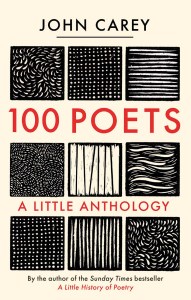 There is some inconsistency in terms of the amount of context and interpretation given, however. For some poets, there may be just a line or two of text, followed by a reprinted poem (Richard Wilbur, Les Murray); for others, there are paragraphs’ worth of explanations, interspersed with excerpts (Andrew Marvell, Thomas Gray). Some choices are obvious; others are deliberately obscure (e.g., eschewing Robert Frost’s and Philip Larkin’s better-known poems in favour of “Out, Out” and “The Explosion”). The diversity is fairly low, and you can see Carey’s age in some of his introductions: “Edward Lear was gay, and felt a little sad when friends got married”; “Alfred Edward Housman was gay, and he thought it unjust that he should be made to feel guilty about something that was part of his nature.” There’s way too much First and Second World War poetry here. And can a poet really be one of the 100 greatest ever when I’ve never heard of them? (May Wedderburn Cannan, anyone?)
Unsurprisingly, I was most engaged with the pieces on Victorian and Modernist poets since those are the periods I studied at university and still love the most, but there were a few individual poems I was glad to discover, such as Ben Jonson’s “On My First Sonne,” written upon his death from bubonic plague, and Edward Thomas’s “Old Man,” as well as many I was happy to encounter again. This would be a good introduction for literature students as well as laypeople wanting to brush up on their poetry.
With thanks to Yale University Press, London for the proof copy for review.
Nonfiction
No Cure for Being Human (And Other Truths I Need to Hear) by Kate Bowler
(Below is my Shelf Awareness review, reprinted with permission.)
 In her bittersweet second memoir, a religion professor finds the joys and ironies in a life overshadowed by advanced cancer.
When Kate Bowler, an associate professor at Duke Divinity School, was diagnosed with advanced colon cancer at age 35, her chances of surviving two years were just 14%. In No Cure for Being Human, her wry, touching follow-up to her 2018 memoir Everything Happens for a Reason (And Other Lies I’ve Loved) and its associated podcast, she continues to combat unhelpful religious/self-help mantras as she ponders what to do with the extra time medical breakthroughs have given her.
After multiple surgeries, a promising immunotherapy drug trial gave Bowler hope that she would live to see her 40th birthday and her young son starting kindergarten. Working on her bucket list, she found that small moments outshined large events: on a trip to the Grand Canyon, what stood out was a chapel in the ponderosa pinewoods where she added a prayer to those plastering the walls. In the Church calendar, “Ordinary Time” is where most of life plays out, so she encourages readers to live in an “eternal present.”
The chapters function like stand-alone essays, some titled after particular truisms (like “You Only Live Once”). The book’s bittersweet tone finds the humor as well as the tragedy in a cancer diagnosis. Witty recreated dialogue and poignant scenes show the type-A author learning to let go: “I am probably replaceable,” she acknowledges, but here in the shadow of death “the mundane has begun to sparkle.” These dispatches from the “lumpy middle” of life and faith are especially recommended to fans of Anne Lamott.
(If you’ve read her previous book, Everything Happens for a Reason, you may find, as I did, that there is a little too much repetition about her diagnosis and early treatment. The essays could also probably be structured more successfully. But it’s still well worth reading.)
With thanks to Rider Books for the free copy for review.
The Elements: A Widowhood by Kat Lister
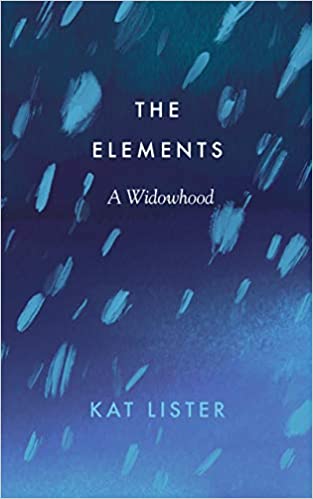 This story hit all too close to home to me: like Kat Lister, my sister was widowed in her thirties, her husband having endured gruelling years of treatment for brain cancer that caused seizures and memory loss. Lister’s husband, Pat Long, was a fellow journalist. Cancer was with them for the entire span of their short marriage, and infertility treatment didn’t succeed in giving them the children they longed for.
Although it moves back and forth in time, the memoir skims over the happy before and the torturous middle, mostly shining a light on the years after Pat died in 2018. Lister probes her emotional state and the ways in which she met or defied people’s expectations of a young widow. Even when mired in grief, she was able to pass as normal: to go to work, to attend social functions wearing leopard print. She writes of a return trip to Mexico, where she’d gone with Pat, and in some detail of the sexual reawakening she experienced after his death. But everyday demands could threaten to sink her even when life-or-death moments hadn’t.
Writing helped her process her feelings, and the Wellcome Library was a refuge where she met her predecessors in bereavement literature. While some of the literary points of reference are familiar (Joan Didion, Elisabeth Kübler-Ross, C.S. Lewis), others are unexpected, and the overall Fire–Water–Earth–Air structure creates thematic unity in a similar way as the constellations do in Molly Wizenberg’s The Fixed Stars. Giving shape and dignity to grief, this is a lovely, comforting read.
A favourite passage:
When I talk of my husband, I often speak of disparate worlds. Mine is inside time, his is supertemporal. I continue to age whilst my husband stays fixed in a past I am drifting further away from with every sentence that I type. And yet, like those luminous balls of plasma in the sky, we are still connected together, for all time is cyclical. I hold the elements within me.
With thanks to Icon Books for the free copy for review.
What recent releases can you recommend?
Three June Releases: Allen-Paisant, Cowen and Mosse
Two poetry offerings and a short memoir this month. A similar strategy is at work in both verse volumes: Jason Allen-Paisant contrasts Jamaica and England via the medium of trees, and Rob Cowen comments on current events through the prism of the natural world. In Kate Mosse’s first nonfiction book, she reflects on bereavement and caregiving.
Thinking with Trees by Jason Allen-Paisant
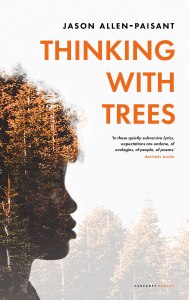 Allen-Paisant, from Jamaica and now based in Leeds, describes walking in the forest as an act of “reclamation.” For people of colour whose ancestors were perhaps sent on forced marches, hiking may seem strange, purposeless (the subject of “Black Walking”). Back in Jamaica, the forest was a place of utility rather than recreation:
In Porus life was un-
pastoral
The woodland was there
not for living in going for walks
or thinking
Trees were answers to our needs
not objects of desire
woodfire
But “I give myself permission / to go outside,” he writes, to notice the turning of the seasons, to commune with trees and birds, even if “there is nobody else like me / around here”. Explicitly calling into question Wordsworth’s model of privileged wandering, he injects a hint of threat into his interactions with nature. Most often this is symbolized by the presence of dogs. Even the most idyllic of scenes harbours the possibility of danger.
beware of spring
believe you are
a sprout of grass
and love all you see
but come out of the woods
before the white boys
with pitbulls
come
The poet cites George Floyd and Christian Cooper, the Central Park birder a white woman called the police on, as proof that being Black outdoors is inherently risky. There’s no denying this is an important topic, but I found the poems repetitive, especially the references to dogs. These felt like overkill. While there is some interesting enjambment, as in the first extended quote above, as well as internal and half-rhymes, I tend to prefer more formal poetry that uses more sonic techniques and punctuation. Still, I would be likely to direct fans of Kei Miller’s work to this collection.
With thanks to Carcanet Press for the free copy for review.
The Heeding by Rob Cowen
This poetry and art collaboration arose out of a “pact to pay attention” during a year of lockdown in the UK and record observations of nature, current events, and everyday life. Cowen is drawn to the moors near his home in Yorkshire, but also yearns to spend time with his friends again. He watches hawks and blue tits, notices the insects that fill his garden, and celebrates the way that allotment gardening brings together all sorts of people.
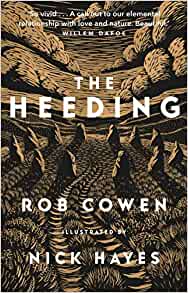 The emotional scope of the poems is broad: the author fondly remembers his brick-making ancestors and his honeymoon; he sombrely imagines the last moments of an old man dying in a hospital; he expresses guilt over accidentally dismembering an ant, yet divulges that he then destroyed the ants’ nest deliberately. There are even a couple of cheeky, carnal poems, one about a couple of teenagers he caught copulating in the street and one, “The Hottest Day of the Year,” about a longing for touch. “Matter,” in ABAB stanzas, is on the theme of racial justice by way of the Black Lives Matter movement.
My two favourites were “Sunday School,” about the rules for life he’s lived by since leaving religion behind, and “The End of This (Drinking Poem),” which serves as a good-riddance farewell to 2020: “Let me shake off / this year the way the otter / slips out of fast, rising water / and makes the holt just in time … / Let me rid my days of caution and fear, / these protocols and tiers / and Zoom funerals for people I love / and will never see again.” The book is worth the price of admission for the latter alone, and Nick Hayes’s black-and-white woodcut-style engravings are a plus.
However, in general I felt that the balance of current events and nature was off, especially compared to books like The Consolation of Nature, and ultimately I was not convinced that this needed to be in verse at all. “Starling,” especially, feels like a straight knockoff of Robert Macfarlane’s The Lost Words (“We forget that you once shimmered through frozen air, ripple bird. / Shape-shifter, dusk-dancer. Murmurer, sky-writer”). Judging from Cowen’s Common Ground, this would have been more successful as a book of short prose diary entries with a few poems dotted through.
With thanks to Elliott & Thompson for the proof copy for review.
An Extra Pair of Hands: A Story of Caring, Ageing and Everyday Acts of Love by Kate Mosse
Mosse’s parents and mother-in-law all moved in to live with her and her husband in their Chichester home when they reached old age. Her father had Parkinson’s and died in 2011, her mother survived him by a few years, and Granny Rosie is still going (reasonably) strong at the age of 90. This is a compact and relatable account of a daughter’s experiences of caregiving and grief, especially with the recent added complications of a pandemic.
 What came through particularly clearly for me was the older generation’s determination to not be a burden: living through the Second World War gave them a sense of perspective, such that they mostly did not complain about their physical ailments and did not expect heroic measures to be made to help them. (Her father knew his condition was “becoming too much” to deal with, and Granny Rosie would sometimes say, “I’ve had enough of me.”) In her father’s case, this was because he held out hope of an afterlife. Although Mosse does not share his religious beliefs, she is glad that he had them as a comfort.
The author recognizes the ways in which she has been lucky: as a full-time writer, she works from home and has the time and energy to devote to caring for elderly parents, whereas for many – generally middle-aged women, who may still have children at home – it is a huge struggle to balance caregiving with the rest of life. What is more, money is no issue for her. Repeating some of the statistics from Madeleine Bunting’s Labours of Love, she acknowledges that the situation is much more challenging for the average person.
I can see how this could serve as a great introduction for someone who hasn’t previously read much about bereavement, caregiving or old age, and I imagine it will especially appeal to existing fans of Mosse’s writing, whereas I was new to her work. I’ve read so much around these topics, including most of the works included in the bibliography, that the book did not offer me anything new, though it was a perfectly pleasant read.
Readalikes I have reviewed:
Notes on Grief by Chimamanda Ngozi Adichie
Be With by Mike Barnes
All Things Consoled by Elizabeth Hay
The Fragments of My Father by Sam Mills
With thanks to Profile Books/Wellcome Collection for the free copy for review.
What recent releases can you recommend?
Recommended May Releases: Adichie, Pavey and Unsworth
Three very different works of women’s life writing: heartfelt remarks on bereavement, a seasonal diary of stewarding four wooded acres in Somerset, and a look back at postnatal depression.
Notes on Grief by Chimamanda Ngozi Adichie
This slim hardback is an expanded version of an essay Adichie published in the New Yorker in the wake of her father’s death in June 2020. With her large family split across three continents and coronavirus lockdown precluding in-person get-togethers, they had a habit of frequent video calls. She had seen her father the day before on Zoom and knew he was feeling unwell and in need of rest, but the news of his death still came as a complete shock.
 Adichie anticipates all the unhelpful platitudes people could and did send her way: he lived to a ripe old age (he was 88), he had a full life and was well respected (he was Nigeria’s first statistics professor), he had a mercifully swift end (kidney failure). Her logical mind knows all of these facts, and her writer’s imagination has depicted grief many times. Still, this loss blindsided her.
She’d always been a daddy’s girl, but the anecdotes she tells confirm how special he was: wise and unassuming; a liberal Catholic suspicious of materialism and with a dry humour. I marvelled at one such story: in 2015 he was kidnapped and held in the boot of a car for three days, his captors demanding a ransom from his famous daughter. What did he do? Correct their pronunciation of her name, and contradict them when they said that clearly his children didn’t love him. “Grief has, as one of its many egregious components, the onset of doubt. No, I am not imagining it. Yes, my father truly was lovely.” With her love of fashion, one way she dealt with her grief was by designing T-shirts with her father’s initials and the Igbo words for “her father’s daughter” on them.
I’ve read many a full-length bereavement memoir, and one might think there’s nothing new to say, but Adichie writes with a novelist’s eye for telling details and individual personalities. She has rapidly become one of my favourite authors: I binged on most of her oeuvre last year and now have just one more to read, Purple Hibiscus, which will be one of my 20 Books of Summer. I love her richly evocative prose and compassionate outlook, no matter the subject. At £10, this 85-pager is pricey, but I was lucky to get it free with Waterstones loyalty points.
Favourite lines:
“In the face of this inferno that is sorrow, I am callow and unformed.”
“How is it that the world keeps going, breathing in and out unchanged, while in my soul there is a permanent scattering?”
Deeper Into the Wood by Ruth Pavey
 In 1999 Ruth Pavey bought four acres of scrubland at auction, happy to be returning to her family’s roots in the Somerset Levels and hoping to work alongside nature to restore some of her land to orchard and maintain the rest in good health. Her account of the first two decades of this ongoing project, A Wood of One’s Own, was published in 2017.
In this sequel, she gives peaceful snapshots of the wood throughout 2019, from first snowdrops to final apple pressing, but also faces up to the environmental degradation that is visible even in this pocket of the countryside. “I am sure there has been a falling off in numbers of insects, smaller birds and rabbits on my patch,” she insists. Without baseline data, it is hard to support this intuition, but she has botanical and bird surveys done, and invites an expert in to do a moth-trapping evening. The resulting species lists are included as appendices. In addition, Pavey weaves a backstory for her land. She meets a daffodil breeder, investigates the source of her groundwater, and visits the head gardener at the Bishop’s Palace in Wells, where her American black walnut sapling came from. She also researches the Sugg family, associated with the land (“Sugg’s Orchard” on the deed) from the 1720s.
 Pavey aims to treat this landscape holistically: using sheep to retain open areas instead of mowing the grass, and weighing up the benefits of the non-native species she has planted. She knows her efforts can only achieve so much; the pesticides standard to industrial-scale farming may still be reaching her trees on the wind, though she doesn’t apply them herself. “One sad aspect of worrying about the state of the natural world is that everything starts to look wrong,” she admits. Starting in that year’s abnormally warm January, it was easy for her to assume that the seasons can no longer be relied on.
Compared with her first memoir, this one is marked by its intellectual engagement with the principles and practicalities of rewilding. Clearly, her inner struggle is motivated less by the sense of ownership than by the call of stewardship. While this book is likely be of most interest to those with a local connection or a similar project underway, it offers a universal model of how to mitigate our environmental impact. Pavey’s black-and-white sketches of the flora and fauna on her patch, reminiscent of Quentin Blake, are a highlight.
With thanks to Duckworth for the proof copy for review. The book will be published tomorrow, the 27th of May.
After the Storm: Postnatal Depression and the Utter Weirdness of New Motherhood by Emma Jane Unsworth
The author’s son was born on the day Donald Trump won the U.S. presidential election. Six months later, she realized that she was deep into postnatal depression and finally agreed to get help. The breaking point came when, with her husband* away at a conference, she got frustrated with her son’s constant fussing and pushed him over on the bed. He was absolutely fine, but the guilty what-ifs proliferated, making this a wake-up call for her.
 In this succinct, wry and hard-hitting memoir, Unsworth exposes the conspiracies of silence that lead new mothers to lie and pretend that everything is fine. Since her son’s traumatic birth (which I first read about in Dodo Ink’s Trauma anthology), she hadn’t been able to write and was losing her sense of self. To add insult to injury, her baby had teeth at 16 weeks and bit her as he breastfed. She couldn’t even admit her struggles to her fellow mum friends. But “if a woman is in pain for long enough, and denied sleep for long enough, and at the same time feels as though she has to keep going and put a ‘brave’ face on, she’s going to crack.”
The book’s titled mini-essays give snapshots into the before and after, but particularly the agonizing middle of things. I especially liked the chapter “The Weirdest Thing I’ve Ever Done in a Hotel Room,” in which she writes about borrowing her American editor’s room to pump breastmilk. Therapy, antidepressants and hiring a baby nurse helped her to ease back into her old life and regain some part of the party girl persona she once exuded – enough so that she was willing to give it all another go (her daughter was born late last year).
While Unsworth mostly writes from experience, she also incorporates recent research and makes bold statements of how cultural norms need to change. “You are not monsters,” she writes to depressed mums. “You need more support. … Motherhood is seismic. It cracks open your life, your relationship, your identity, your body. It features the loss, grief and hardship of any big life change.” I can imagine this being hugely helpful to anyone going through PND (see also my Three on a Theme post on the topic), but I’m not a mother and still found plenty to appreciate (especially “We have to smash the dichotomy of mums/non-mums … being maternal has nothing to do with actually physically being a mother”).
I’m attending a Wellcome Collection online event with Unsworth and midwife Leah Hazard (author of Hard Pushed) this evening and look forward to hearing more from both authors.
*It took me no time at all to identify him from the bare facts: Brighton + doctor + graphic novelist = Ian Williams (author of The Lady Doctor)! I had no idea. What a fun connection.
With thanks to Profile Books/Wellcome Collection for the free copy for review.
What recent releases can you recommend?
The Still Point (of the Turning World & Sanctuary)
Amy Sackville’s debut novel, The Still Point, had been on my radar ever since I read her follow-up, Orkney. I finally put it on my wish list and got a copy for Christmas. In the meantime, I’d also acquired a copy of Emily Rapp’s memoir The Still Point of the Turning World as part of a big secondhand book haul at the start of the first lockdown.
Both books take their title from the eminently quotable T.S. Eliot*, specifically his poem “Burnt Norton.” I couldn’t resist the urge to review them together (along with Rapp’s recent sequel) – although, unlike with my dual review of two books titled Ex Libris, I won’t pit them against each other because they’re such different books.
That said, they do share a dreamlike quality and the search for people and places that might serve as refuges in a shattered life. All: 
The Still Point by Amy Sackville (2010)
no
I am not heroic, I prefer
not to conquer
polar regions, my
gardens in July
serve for me.
~from “emperor’s walk” by G.F. Dutton
 A sweltering summer versus an encasing of ice; an ordinary day versus decades of futile waiting. Sackville explores these contradictions only to deflate them, collapsing time such that a polar explorer’s wife and her great-great-niece can inhabit the same literal and emotional space despite being separated by more than a century. When Edward Mackley went off on his expedition in the early 1900s, he left behind Emily, his devoted, hopeful new bride. She was to live out the rest of her days in the Mackley family home with her brother-in-law and his growing family; Edward never returned. Now Julia and her husband Simon reside in that same Victorian house, serving as custodians of memories and artifacts from her ancestors’ travels and naturalist observations. From one early morning until the next, we peer into this average marriage with its sadness and silences. On this day, Julia discovers a family secret, and late on reveals another of her own, that subtly change how we see her and Emily.
This is a highly fluid and sensual novel, but somehow so sinuous as to be hard to grasp. I took in its interlocking story lines just a few pages at a time; floating on the gorgeous prose, basking in the alternating heat and chill. Sackville’s greatest stylistic debt must be to Virginia Woolf, but I was also reminded of Lucy Wood’s Weathering and Evie Wyld’s The Bass Rock – two similarly beautiful books in which a house and its ghosts are major characters – and of how some of Sarah Moss’s work braids the past into the everyday. I suspect this won’t be for every reader, but if you can find the right moment and mood, you might just be entranced.
One of Sackville’s research sources was Arctic Dreams by Barry Lopez, a work I recently skimmed for a winter post. Two passages that stood out to me apply equally well to Rapp’s books:
 “The literature of nineteenth-century arctic exploration is full of coincidence and drama—last-minute rescues, a desperate rifle shot to secure food for starving men, secret letters written to painfully missed loved ones. There are moments of surreal stillness, as in Parry’s journal when he writes of the sound of the human voice in the land. And of tender ministration and quiet forbearance in the face of inevitable death.”
“The continuous work of the imagination, I thought, to bring what is actual together with what is dreamed is an expression of human evolution. The conscious desire is to achieve a state, even momentarily, that like light is unbounded, nurturing, suffused with wisdom and creation, a state in which one has absorbed that very darkness which before was the perpetual sign of defeat.”
The Still Point of the Turning World by Emily Rapp (2013)
 In 2011 Rapp’s baby son Ronan was diagnosed with Tay-Sachs disease, a degenerative nerve condition that causes blindness, deafness, seizures, paralysis and, ultimately, death. Tay-Sachs is usually seen in Ashkenazi Jews, so it came as a surprise: Rapp and her husband Rick both had to be carriers, whereas only he was Jewish; they never thought to get tested.
This memoir was written while Ronan was still alive, and the rapid, in-the-thick-of-it composition is evident: it rides the same rollercoaster of feelings over and over again, even repeating some of the same facts. I put this down to the brain fog of anticipatory grief. “The constant push-pull: here but not for long. What will come next?” Rapp quotes extensively from other writers who have grappled with bereavement, especially poets, as if building an inner library to bolster herself against what is to come (“it wasn’t consolation I needed or desired, but the tools to walk through this fire without being consumed by it”).
Rapp puts her son’s life into context through memories of growing up disabled (she had a rare condition that necessitated the amputation of a leg as a child, and wore a prosthesis) in the conservative Midwest, contrasting the Christian theology she grew up in and studied at college with the Eastern and New Age spiritualities that prevail in Santa Fe, where she and Rick then lived with Ronan. She ponders the worth of a life that will be marked by no traditional achievements.
In The Art of Memoir, Mary Karr advises seven years between the events and the writing about them, but Rapp explains her strategy of instant reaction thus:
grief, this extreme experience, forces a writer to draw on her deepest resources, and such a dive demands so much work that what comes up must be heaved onto the page almost immediately; otherwise it might eat the thinker alive, drown them … Or at least that’s how I felt. You can eat fire for only so long, and then you’ve got to spit it out in another form or risk the burn.
She felt that “rendering loss was a way of honoring life,” which even with this death sentence hanging over the family had its times of pure joy: “there existed inside this helpless, frantic sadness exquisite moments of pristine happiness and an almost-perfect peace.” The title perfectly captures the necessity of finding this calmness of soul amidst a tumultuous life.
Sanctuary by Emily Rapp Black (2021)
 Things got worse before they got better. As is common for couples who lose a child, Rapp and her first husband separated, soon after she completed her book. In the six months leading up to Ronan’s death in February 2013, his condition deteriorated rapidly and he needed hospice caretakers. Rapp came close to suicide. But in those desperate months, she also threw herself into a new relationship with Kent, a 20-years-older man who was there for her as Ronan was dying and would become her second husband and the father of her daughter, Charlotte (“Charlie”). The acrimonious split from Rick and the astonishment of a new life with Kent – starting in the literal sanctuary of his converted New Mexico chapel, and then moving to California – were two sides of a coin. So were missing Ronan and loving Charlie.
Sanctuary is a similarly allusive text, with each chapter prefaced by a poem, and it is again full of flashbacks, threading all the seemingly disparate parts of a life into a chaotic tapestry. Rapp Black questions the sorts of words that she and her experience got branded with: “brave,” “tragic,” “resilient” – “I unwittingly became the poster child,” she wryly reports. In the same way that she’d been praised for “overcoming disability,” she saw that she was now being trotted out as an example of coping with unimaginable loss. But she didn’t want to be someone’s model; she just wanted the chance to live her life and be happy again. Her wisdom isn’t what makes it onto inspirational stickers, but it’s genuine and hard-won:
“It has little or nothing to do with bravery. Nobody is charging into warfare here. No gold stars are given because none are earned. I am no warrior of love or anything else.”
“Time doesn’t heal anything; it just changes things—reshapes and reorients them.”
“resilience is not always a function of the desire to survive. Either you survive, or you don’t. There’s no fault, no moral judgment, assigned to either outcome.”
“Isn’t it true that what doesn’t kill you makes you stronger? No. What doesn’t kill you changes you, and those who chose to love you. That is what it means to bear witness, a unique and salvific form of resilience.”
Although I was glad to have read both, to have experienced both the in-the-moment and the after-the-fact, I think Sanctuary could easily function as a standalone memoir because of how much of Ronan’s illness it relives. For being that bit more measured and wrought, I think it’s the better book by a hair’s breadth. It tames the fire and just radiates the light and warmth.
I read an advanced e-copy via NetGalley. Thanks to John Murray Press for the approval.
*Other Eliot-sourced titles I have reviewed: Teach Us to Sit Still by Tim Parks and The Stillness The Dancing by Wendy Perriam.
Six Degrees of Separation: From Hamnet to Paula
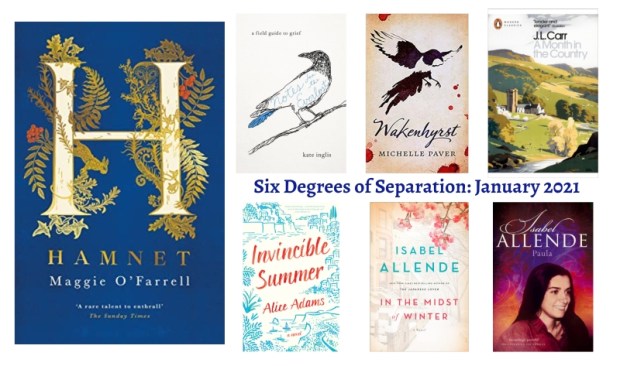
 I was slow off the mark this month, but here we go with everyone’s favorite book blogging meme! This time we start with Hamnet, Maggie O’Farrell’s Women’s Prize-winning novel about the death of William Shakespeare’s son. (See Kate’s opening post.) Although I didn’t love this as much as others have (my review is here), I was delighted for O’Farrell to get the well-deserved attention – Hamnet was also named the Waterstones Book of the Year 2020.
 #1 I’ve read many nonfiction accounts of bereavement. One that stands out is Notes from the Everlost by Kate Inglis, which is also about the death of a child. The author’s twin sons were born premature; one survived while the other died. Her book is about what happened next, and how bereaved parents help each other to cope. An excerpt from my TLS review is here.
 #2 Also featuring a magpie on the cover, at least in its original hardback form, is Wakenhyrst by Michelle Paver (reviewed for R.I.P. this past October). I loved that Maud has a pet magpie named Chatterpie, and the fen setting was appealing, but I’ve been pretty underwhelmed by all three of Paver’s historical suspense novels for adults.
 #3 One of the strands in Wakenhyrst is Maud’s father’s research into a painting of the Judgment Day discovered at the local church. In A Month in the Country by J. L. Carr (reviewed last summer), a WWI veteran is commissioned to uncover a wall painting of the Judgment Day, assumed to be the work of a medieval monk and long ago whitewashed over.
 #4 A Month in the Country spans one summer month. Invincible Summer by Alice Adams, about four Bristol University friends who navigate the highs and lows of life in the 20 years following their graduation, checks in on the characters nearly every summer. I found it clichéd; not one of the better group-of-friends novels. (My review for The Bookbag is here.)
 #5 The title of Invincible Summer comes from an Albert Camus quote: “In the midst of winter, I found there was, within me, an invincible summer. And that makes me happy.” Inspired by the same quotation, then, is In the Midst of Winter by Isabel Allende, a recent novel of hers that I was drawn to for the seasonal link but couldn’t get through.
 #6 However, I’ve enjoyed a number of Allende books over the last 12 years or so, both fiction and non-. One of these was Paula, a memoir sparked by her twentysomething daughter’s untimely death in the early 1990s from complications due to the genetic condition porphyria. Allende told her life story in the form of a letter composed at Paula’s bedside while she was in a coma.
So, I’ve come full circle with another story of the death of a child, but there’s a welcome glimpse of the summer somewhere there in the middle. May you find your own inner summer to get you through this lockdown winter.
Join us for #6Degrees of Separation! (Hosted on the first Saturday of each month by Kate W. of Books Are My Favourite and Best.) Next month’s starting point is Redhead at the Side of the Road by Anne Tyler.
 Bookish Beck = Rebecca Foster. American transplant to England. Freelance proofreader and book reviewer.
