Announcing the NOT the Wellcome Prize and Blog Tour
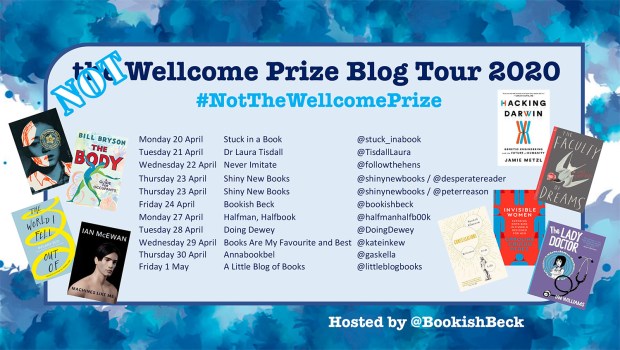
Soon after I heard that the Wellcome Book Prize would be on hiatus this year, I had the idea to host a “Not the Wellcome Prize” blog tour to showcase some of the best health-themed literature published in 2019. I was finalizing the participants and schedule just before as well as during the coronavirus crisis, which has reinforced the importance of celebrating books that disseminate crucial information about medicine and/or tell stories about how health affects our daily lives. I got the go-ahead for this unofficial tour from the Wellcome Trust’s Simon Chaplin (Director of Culture & Society) and Jeremy Farrar (overall Director).
Starting on Monday and running for the next two weeks (weekdays only), the tour will be featuring 19 books across 10 blogs. One of the unique things about the Wellcome Prize is that both fiction and nonfiction are eligible, so we’ve tried to represent a real variety here: on the longlist we have everything from autobiographical essays to science fiction, including a graphic novel and a couple of works in translation.

Based on the blog tour reviews and the Prize’s aims*, the shadow panel (Annabel of Annabookbel, Clare of A Little Blog of Books, Laura of Dr. Laura Tisdall, Paul of Halfman, Halfbook and I) will choose a shortlist of six titles, to be announced on the 4th of May. We will then vote to choose a winner, with the results of a Twitter poll serving as one additional vote (be sure to have your say!). The overall winner of the Not the Wellcome Prize will be announced on the 11th of May.
I hope you’ll follow along with the reviews and voting. I would like to express my deep thanks to all the blog tour participants, especially the shadow panel for helping with ideas and planning – plus Annabel designed the graphics.
*Here is how the website describes the Prize’s purpose: “At some point, medicine touches all our lives. Books that find stories in those brushes with medicine are ones that add new meaning to what it means to be human. The subjects these books grapple with might include birth and beginnings, illness and loss, pain, memory, and identity. In keeping with its vision and goals, the Wellcome Book Prize aims to excite public interest and encourage debate around these topics.”
Below I’ve appended our preliminary list of eligible books that were considered but didn’t quite make the cut to be featured on the tour, noting major themes and positive blog review coverage I’ve come across. (The official Prize excludes poetry entries, but we were more flexible.)
Nonfiction:
- When Death Takes Something from You Give It Back by Naja Marie Aidt (memoir of child’s sudden death)
- The Man in the Red Coat by Julian Barnes (biography of 19th-century gynecologist)
- Let Me Not Be Mad by A.K. Benjamin (neuropsychologist’s memoir)
- The Story of Sex: From Apes to Robots by Philippe Brenot (medical history/graphic novel, in translation)
- The Prison Doctor by Amanda Brown (doctor’s memoir)
- The Undying by Anne Boyer (essays – cancer)
- Breaking & Mending by Joanna Cannon (doctor’s memoir)
- How to Treat People by Molly Case (nurse’s memoir)
- Will My Cat Eat My Eyeballs? by Caitlin Doughty (popular science – death)
- Happening by Annie Ernaux (memoir, in translation – abortion)
- I Remain in Darkness by Annie Ernaux (memoir, in translation – mother’s dementia)
- Out of Our Minds by Felipe Fernández-Armesto (popular science – evolutionary biology)
- The Heartland by Nathan Filer (medical history/memoir – schizophrenia)
- Childless Voices by Lorna Gibb (cultural history – infertility, etc.)
- Maybe You Should Talk to Someone by Lori Gottlieb (memoir/self-help – therapy)
Books Are My Favourite and Best review
- Once More We Saw Stars by Jayson Greene (memoir – child’s sudden death)
- A Short History of Falling by Joe Hammond (memoir – disability, dying)
- All Things Consoled by Elizabeth Hay (memoir – geriatrics, dementia)
- Hard Pushed by Leah Hazard (midwife’s memoir)
- Life Lessons from a Brain Surgeon by Rahul Jandial (memoir/self-help)
- Twas the Nightshift before Christmas by Adam Kay (doctor’s memoir)
- Why Can’t We Sleep? by Darian Leader (popular science – insomnia)
- Incandescent: We Need to Talk about Light by Anna Levin (light’s effects on health and body rhythms)
- A Puff of Smoke by Sarah Lippett (memoir – growing up with rare disease)
- Hormonal by Eleanor Morgan (popular science – women’s health)
- Critical by Matt Morgan (ICU doctor’s memoir)
- A Short History of Medicine by Steve Parker (medical history, illustrated)
- Notes to Self by Emilie Pine (essays – infertility, rape, etc.)
- That Good Night by Sunita Puri (doctor’s memoir – palliative care)
- An Elegant Defense: The Extraordinary New Science of the Immune System: A Tale in Four Lives by Matt Richtel (popular science)
- The Gendered Brain by Gina Ripon (popular science – neuroscience, gender)
- The Five by Hallie Rubenhold (alcoholism, sex work)
- When I Had a Little Sister by Catherine Simpson (memoir – mental health, suicide)
- Flash Count Diary: Menopause and the Vindication of Natural Life by Darcey Steinke (memoir, female anatomy)
- Skeleton Keys: The Secret Life of Bone by Brian Switek (popular science – anatomy)
- Out of the Woods by Luke Turner (memoir – masculinity, bisexuality)
- The Making of You by Katharina Vestre (popular science, in translation – embryology)
- Transcendence: How Humans Evolved through Fire, Language, Beauty, and Time by Gaia Vince (popular science – human evolution)
- The Knife’s Edge by Stephen Westaby (surgeon’s memoir)
Fiction:
- Starling Days by Rowan Hisayo Buchanan (literary fiction – mental illness, bisexuality)
- Recursion by Blake Crouch (science fiction – memory)
- Expectation by Anna Hope (women’s fiction – infertility, cancer)
- Stillicide by Cynan Jones (speculative fiction – water crisis)
- Things in Jars by Jess Kidd (historical fiction – Victorian medicine)
- Patience by Toby Litt (disability)
- The Migration by Helen Marshall (speculative fiction – immune disorder)
- The Warlow Experiment by Alix Nathan (historical fiction – medical experimentation)
- Night Theatre by Vikram Paralkar (magic realism – surgeon to the dead)
- The Art of Dying by Ambrose Parry (historical mystery – Victorian medicine)
- The Dutch House by Ann Patchett (doctor narrator, diabetes)
- Body Tourists by Jane Rogers (science fiction – body rental technology)
- Children of Ruin by Adrian Tchaikovsky (science fiction – evolutionary biology)
- Oligarchy by Scarlett Thomas (eating disorders)
- Wanderers by Chuck Wendig (science fiction – sleepwalking disorder)
Poetry:
- O Positive by Joe Dunthorne (death, therapy)
- The Carrying by Ada Limon (ageing parents, infertility)
A Theatre for Dreamers by Polly Samson (Blog Tour Review)
In the 1950s the Greek island of Hydra became a magnet for artists and writers, including Lawrence Durrell, Patrick Leigh Fermor and Henry Miller. Polly Samson’s fifth work of fiction, set in this makeshift artists’ colony in 1960, zeroes in on the married Australian authors Charmian Clift and George Johnston, Norwegian novelist Axel Jensen, his wife Marianne Ihlen, and an unknown young poet from Canada named Leonard Cohen.
We see all of these real-life characters from the perspective of our starry-eyed narrator, Erica, a seventeen-year-old outsider. In a framing story set c. late 2016, after she hears of Leonard’s death, Erica has returned to Hydra as an old woman. Yet that first gold summer is still intensely alive in her memory. She decided to decamp to Hydra just before Easter in 1960, with her boyfriend Jimmy and her brother Bobby, because Charmian was once their late mother’s closest friend back in London. Erica’s inheritance would go far here: “people like us … can live for a year in the sun on what it’d cost us for a month in a dingy bedsit at home.”

Love triangles abound and emotions run high on Hydra. Gradually Erica learns that just about everyone has slept with, or is currently sneaking around with, someone they aren’t married to. Meanwhile, Bobby and friends sleep late and paint, then party well into the night. While Erica is the responsible mother hen at their villa, seeing that everyone gets fed, she indulges her hedonistic side, too – going to every bash and spending half the day in bed with Jimmy.
Charmian becomes a kind of surrogate mother to Erica, but remains spiky due to her jealousy over George’s greater literary success while she has to care for the children and act as his amanuensis. “They’re the closest thing I have to a family,” Erica writes of Charmian and George and the wider expatriate circle. “I love them all: their banter and moods and tears and wild laughter, all of it, every chaotic bit of it.” But there’s a sense that the idyll can’t last.
This is a novel simply dripping with atmosphere. You can feel the Mediterranean heat soaking up through your sandals; see the piercing sunlight reflecting off white-washed buildings; smell the ripening fruit and herbs and fresh-caught fish. There are dozens of evocative passages I could quote from, but here is part of one of my favourites:
The port throbs with tourists and the street cats grow fat. The cicadas are busy breaking a hundred hearts with their songs. We pull our mattresses out to the terrace and sleep beneath the stars, wake with the sun … We pick over platters of fish at taverna tables, or drift from courtyard to courtyard with our records and poems, or take bottles of beer and eat bread and meatballs beneath the tumbling vines of the outdoor cinema … We have all become leaner, our legs muscled from the steps, Bobby and Jimmy’s shoulders almost amphibian from swimming. Sometimes we take a bag of peaches and a flask of coffee to the cave and grab a dip before the port is fully awake, other times we swim late at night and lie naked between the moon and the tide on the still-warm rocks.
If you’re getting cabin fever and are hankering for some armchair travelling, I can’t recommend a trip to 1960 Hydra enough. There are two prizes that specifically recognize literature with a strong sense of place: The Royal Society of Literature’s Ondaatje Prize is “for a distinguished work of fiction, non-fiction or poetry, evoking the spirit of a place,” as is the Cicerone (fiction) prize, part of the Edward Stanford Travel Writing Awards. I’d be willing to bet that A Theatre for Dreamers will be shortlisted for one or both of those next year.
My thanks to Bloomsbury Circus for the free copy for review.
Hamnet by Maggie O’Farrell (Blog Tour Review)

I’ve been a huge admirer of Maggie O’Farrell’s work ever since I read The Hand that First Held Mine, which won the Costa Novel Award, in 2011. I was intrigued by the premise of her new book, in which she delves further back into history than she has before to imagine the context of the death of William Shakespeare’s son Hamnet and the effect it had on the playwright’s work – including, four years later, Hamlet.
Curiously, O’Farrell has decided never to mention Shakespeare by name in her novel, so he remains a passive, shadowy figure seen only in relation to his wife and children – he’s referred to as “the father,” “the Latin tutor” or “her husband.” Instead, the key characters are his wife Agnes (most will know her as Anne, but Agnes was the name her father, Richard Hathaway, used for her in his will) and Hamnet himself.

As the novel opens, 11-year-old Hamnet is alone in his grandfather’s glove workshop. His twin sister Judith has a fever and lumps at her neck and he is frantically trying to find an adult. But with his father in London, his mother off tending her bees and his grandfather’s indifference all too ready to shade into violence, there is no one to help. Although it’s Judith who appears to be ill with the Plague, readers know from the scant historical record that it is Hamnet who dies. Somehow, even though we see this coming, it’s still a heavy blow. Hamnet is a story of the moments that change everything, of regrets that last forever: Agnes will ever after be afflicted with a sense of having neglected her children just when they needed her.
Short chapters set in that summer of 1596 alternate with longer ones from 15 years before, when WS was engaged as a Latin tutor to the sons of a sheep farmer to pay off his father’s debts. Soon he became captivated by a young woman with a kestrel whom he assumed to be the family’s maid but learned was actually the unconventional daughter of the household, Agnes. She had a reputation as a herbal healer and was known to have second sight – just by holding someone’s hand, she could see into their past or predict their future.
There are some wonderfully vivid scenes in this earlier story line, including a tryst in the apple shed and Agnes going off alone into the forest to give birth to their first child, Susanna. My favourite chapter of all, though, is the central one that traces the journey of the pestilence from a glassmaker’s studio in Italy to the small Warwickshire village. The medical subplot of Hamnet has taken on a new significance that O’Farrell surely never predicted when she was immersing herself in the time period by undertaking falconry and mudlarking.
Although I remain a big fan, Hamnet is the least successful of the six books of O’Farrell’s that I’ve read. Her trademark third person omniscient voice and present tense narration, which elsewhere exude confidence and immediacy, here create detachment and even vagueness (“A boy is coming down a flight of stairs”; “Look. Agnes is pouring water into a pan”). The strategy for evoking the 16th century seems to be to throw in the occasional period prop, but the dialogue and vocabulary can feel anachronistic, as in “Boys! Stop that this instant! Or I’ll come up there and give you something to wail about”.
In comparison with historical fiction I’ve read recently by Geraldine Brooks and Hilary Mantel, this fell short. Overall, I found the prose flat and repetitive, which diluted the portrait of grief. My reaction was lukewarm, but this should not deter readers from trying this wonderful writer – if not this book, then any one of her previous five.
My thanks to Midas PR and Tinder Press for the free copy for review.
If All the World and Love Were Young by Stephen Sexton: The Dylan Thomas Prize Blog Tour
 For my second spot on the official Dylan Thomas Prize blog tour, I’m featuring the debut poetry collection If All the World and Love Were Young (2019) by Stephen Sexton, which was awarded the Forward Prize for Best First Collection. Sexton lives in Belfast (so this is also an incidental contribution to Reading Ireland Month) and was the winner of the 2016 National Poetry Competition and a 2018 Eric Gregory Award.
The book is a highly original hybrid of video game imagery and a narrative about the final illness of his mother, who died in 2012. As a child the poet was obsessed with Super Mario World. He overlays the game’s landscapes onto his life to create an almost hallucinogenic fairy tale. Into this virtual world, which blends idyll and threat, comes the news of his mother’s cancer:
One summer’s day I’m summoned home to hear of cells which split and glitch
so haphazardly someone is called to intervene with poisons
drawn from strange and peregrine trees flourishing in distant kingdoms.
Her doctors are likened to wizards attempting magic –
In blue scrubs the Merlins apply various elixirs potions
panaceas to her body
– until they give up and acknowledge the limitations of medicine:
So we wait in the private room turn the egg timer of ourselves.
Hippocrates in his white coat brings with him a shake of the head …
where we cannot do some good
at least we must refrain from harm.
Super Mario settings provide the headings: Yoshi’s Island, Donut Plains, Forest of Illusion, Chocolate Island and so on. There are also references to bridges, Venetian canals, mines and labyrinths, as if to give illness the gravity of a mythological hero’s journey. Meanwhile, the title repeats the first line of “The Nymph’s Reply to the Shepherd” by Sir Walter Raleigh, which, as a rebuttal to Christopher Marlowe’s “The Passionate Shepherd to His Love,” eschews romanticism in favor of realism about change and mortality. Sexton wanted to include both views. (He discusses his inspirations in detail in this Irish Times article.)
Apart from one rough pantoum (“Choco-Ghost House”), I didn’t notice any other forms being used. This is free verse; internally unpunctuated, it has a run-on feel. While I do think readers are likely to get more out of the poems if they have some familiarity with Super Mario World and/or are gamers themselves, this is a striking book that examines bereavement in a new way.
Note: Be sure to stick around past “The End” for the Credits, which summarize all the book’s bizarrely diverse elements, and a lovely final poem that’s rather like a benediction.
My thanks to Midas PR for the free copy for review.
The Swansea University International Dylan Thomas Prize recognizes the best published work in the English language written by an author aged 39 or under. All literary genres are eligible, so there are poetry collections nominated as well as novels and short stories.
To recap, the 12 books on this year’s longlist are:
- Surge, Jay Bernard
- Flèche, Mary Jean Chan (my review)
- Exquisite Cadavers, Meena Kandasamy
- Things We Say in the Dark by Kirsty Logan (my preview & an excerpt)
- Black Car Burning, Helen Mort
- Virtuoso, Yelena Moskovich
- Inland, Téa Obreht
- Stubborn Archivist, Yara Rodrigues Fowler (my review)
- If All the World and Love Were Young, Stephen Sexton
- The Far Field, Madhuri Vijay
- On Earth We’re Briefly Gorgeous, Ocean Vuong
- Lot, Bryan Washington
The shortlist will be announced on Tuesday, April 7th.
Dylan Thomas Prize Blog Tour: Things We Say in the Dark by Kirsty Logan
It’s an honour to be kicking off the official Swansea University International Dylan Thomas Prize 2020* blog tour with a post introducing and giving an excerpt from one of this year’s longlisted titles, the short story collection Things We Say in the Dark by Kirsty Logan.

Many of these 20 stories twist fairy tale imagery into nightmarish scenarios, enumerating fears of bodies and pregnancies going wrong. Body parts are offered as tokens of love or left behind as the sole evidence of an abduction. Ghosts and corpses are frequent presences. I also recognized some of the same sorts of Celtic sea legends that infuse Logan’s debut novel, The Gracekeepers.
Some stories are divided into multiple parts by headings or point-of-view changes. Others are in unusual formats like footnotes, a questionnaire, bullet-pointed lists, or a couple’s contrasting notes on house viewings. The titles can be like mini-tales in their own right, e.g. “Girls Are Always Hungry when All the Men Are Bite-Size” and “The Only Thing I Can’t Tell You Is Why.”
In between the stories are italicized passages that seem to give context on Logan’s composition process, including her writing retreat in Iceland – but it turns out that this is a story, too, split into pieces and shading from autobiography into fiction.
Full of magic realism and gentle horror, this is a book for fans of Salt Slow and The Doll’s Alphabet.
My favourite story was “Things My Wife and I Found Hidden in Our House,” about a series of objects Rain and her wife Alice find in the derelict house Alice’s granny has left them. Here’s an excerpt from the story to whet your appetite:
- A KNIFE
I wasn’t surprised when Alice and I found the long thin silver knife wrapped in blackened grot beneath the floorboards. It wasn’t easy: to find it we’d had to pull up just about every rotting, stinking board in the house, our hands slick with blood and filth. Alice had told me that a silver knife through the heart is the only way to kill a kelpie, so if Alice’s gran really had killed it, the knife was likely to be there somewhere. Her mistake, her haunting, was in keeping the thing. As proof? A memento? We’d never know. Then again, we knew that her bathtub drowning was due to a stroke. So I guess you can never really know anything.
Alice and I gathered up the ring and the paper and the horse and the pearls and the hair and the glass jar and the knife, and we put them all in a box. We drove for hours until we got to the coast, to the town where Alice’s gran and her grandad and the first wife had all lived, and we climbed to the highest cliff and we threw all the things into the sea.
Together we drove back to the house, holding hands between the front seats. A steady calm grew in our hearts; we knew that it was over, that we had cleansed the house and ourselves, that we had proven women’s love was stronger than women’s hate.
- MORE
Approaching the front door, key outstretched, hands still held, hearts grown sweet, Alice and I stopped. Our hands unlinked. The doorknob was wrapped all around with layers of long black hair.
My thanks to Midas PR for the free copy for review, and to Harvill Secker for permission to reprint an excerpt.
*The Swansea University International Dylan Thomas Prize recognizes the best published work in the English language written by an author aged 39 or under. All literary genres are eligible, so there are poetry collections nominated as well as novels and short stories. The other 11 books on this year’s longlist are:
- Surge, Jay Bernard
- Flèche, Mary Jean Chan (my review)
- Exquisite Cadavers, Meena Kandasamy
- Black Car Burning, Helen Mort
- Virtuoso, Yelena Moskovich
- Inland, Téa Obreht
- Stubborn Archivist, Yara Rodrigues Fowler (my review)
- If All the World and Love Were Young, Stephen Sexton
- The Far Field, Madhuri Vijay
- On Earth We’re Briefly Gorgeous, Ocean Vuong
- Lot, Bryan Washington
The official blog tour runs this month and into April, with multiple bloggers covering each book. At the end of March, I’ll also be reviewing the poetry collection by Stephen Sexton.
Three Hours by Rosamund Lupton (Blog Tour Review)
It can’t happen here. Or can it? That’s a question Rosamund Lupton asks with her novel about a siege at a progressive school in rural England. When out in public with my copy of the book, I was asked a few times what I was reading. I would explain that it was about a school shooting in Somerset, and the reply was always “In the UK?!” Guns are difficult to come by in this country thanks to firearms legislation that was passed following a couple of high-profile massacres in the 1980s and 90s. So, to an extent, you’ll have to suspend your disbelief about the perpetrators getting access to automatic weapons and bombs. And you should, because the story that unfolds is suspenseful and timely.
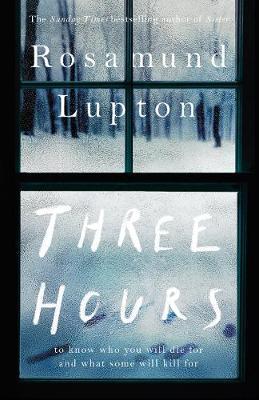 Cliff Heights School is in the midst of a surprise November blizzard. It’s also under attack. At 9:16 the headmaster, Matthew Marr, is shot twice. Students bundle him into the library, barricade the doors and tend to his head and foot injuries as best they can. He recognized the shooter, but the damage to his brain means he’s incapable of telling anyone who it was.
At 8:15 Rafi Bukhari, a Syrian refugee pupil, had seen an IED explode on the school grounds and alerted Marr, who promptly evacuated the junior school. But the institution is based across several buildings, with some students in the theatre for a dress rehearsal, more in the pottery hut for art class – and now a few trapped in the library.
Lupton toggles between these different locations, focusing on a handful of staff and students and the relationships between them. Hannah, who’s doing her best to help Mr. Marr, is Rafi’s girlfriend. Rafi is concerned for his little brother, Basi, who’s still traumatized after their escape from Syria. Mr. Marr sponsored the boys’ move to England. Could it be that anti-Muslim sentiment has made the Bukhari boys – and thus the school they attend – a target?
We also spend time behind the scenes with police investigators as they pursue leads and worried parents as they await news of their children. I found the book most gripping when the situation was still a complete unknown; as the options narrow down and it becomes clear who’s responsible, things feel a bit more predictable. However, there are still unexpected turns to come.
A few elements that stood out for me were the use of technology (FaceTime, WhatsApp and drones weren’t available at the time of Columbine), the Syrian boys’ history, and the student production of Macbeth, whose violence ironically comments on the school’s crisis. While not my usual fare, I found this well worth reading and will look into Lupton’s back catalogue, too.
Readalikes: Bloomland by John Englehardt and A Mother’s Reckoning by Sue Klebold
My rating: 
Three Hours will be published by Penguin Viking on the 9th. My thanks to the publisher for the free copy for review.
My pal Annabel has also reviewed the book today.
Five Nonfiction Review Books: Hammond, Iorio, Rault, Riley & Rutt
A diagnosis of motor neurone disease; a father’s dispiriting experience of censorship trials. An illustrated history of fonts; an essay on grief; a cold weather-appropriate record of geese-watching. I gear up for Nonfiction November by catching up on five nonfiction review books I’ve been sent over the last couple of months. You can’t say that I don’t read a variety, even within nonfiction! See if one or more of these tempts you.
A Short History of Falling: Everything I Observed about Love whilst Dying by Joe Hammond
 Hammond, a playwright, takes a wry, clear-eyed approach to his diagnosis of motor neurone disease (ALS) and the knowledge that his physical capacities will only deteriorate from here on out. “New items arrive almost daily and I am unexpectedly becoming the curator of the Museum of my own Decline.” Yet he also freezes funnier moments, like blowing his nose on a slice of bread because he couldn’t reach a tissue box, or spending “six hours of my fiftieth birthday sat on this hospice toilet, with a bottle of good Scotch wedged between my knees.”
Still, Hammond regrets that he’s become like a third small child for his wife Gill to look after, joining his sons Tom and Jimmy, and that he won’t see his boys grow up. (This book arose from an article he wrote for the Guardian in 2018 about making 33 birthday cards for his sons to open in the years after his death.) Although I wasn’t as interested in the details of Hammond’s earlier life, or his relationship with his narcissistic father, I appreciated his quiet acceptance of disability, help and impending death.
Favorite lines:
“I’ve waited all my life to know this peace. To know that I am nothing more than this body.”
“my place in all of this is becoming smaller, historic and just the right size of important.”
With thanks to 4th Estate for the free copy for review.
An Author on Trial: The Story of a Forgotten Writer by Luciano Iorio
 The author’s father, Giuseppe Jorio, was a journalist and schoolteacher who wrote an infamous novel based on an affair he had in the 1930s. Using italicized passages from his father’s diary and letters to Tina, who was 19 when their affair started, Iorio reconstructs the sordid events and unexpected aftermath in fairly vivid detail. Tina fell pregnant and decided to abort the baby. Meanwhile, Giuseppe’s wife, Bruna, got the truth out of him and responded with more grace than might be expected. Giuseppe was devastated at the loss of his potential offspring, and realized he wanted to have a child with Bruna. He bid Tina farewell and the family moved to Rome, where the author was born in 1937.
Giuseppe’s novel inspired by the affair, Il Fuoco del Mondo (The Fire of the World) was rejected by all major publishers and accused of obscenity in a series of five trials that threatened his reputation and morale. It’s a less familiar echo of the Lady Chatterley’s Lover trial, and a poignant portrait of a man who felt he never lived up to his potential because of bad luck and societal disapproval. I enjoyed learning a bit about Italian literature. However, inconsistent use of tenses and shaky colloquial English (preposition issues, etc.) suggest that a co-writer or translator was needed to bring this self-published work up to scratch. 
With thanks to the publicist for the free copy to review as part of a blog tour.
ABC of Typography by David Rault
[Translated from the French by Edward Gauvin]
 From cuneiform to Gutenberg to Comic Sans, this history of typography is delightful. Graphic designer David Rault wrote the whole thing, but each chapter has a different illustrator, so the resulting book is like a taster course in comics styles. As such, I would highly recommend it to those who are fairly new to graphic novels and want to see whose work appeals to them, as well as to anyone who enjoyed Simon Garfield’s book about fonts, Just My Type.
I found it fascinating to explore the technical characteristics (serif vs. sans serif, etc.) and aesthetic associations of various fonts. For instance, I didn’t realize that my mainstay – Times New Roman – is now seen as a staid choice: “Highly readable, but overexposed in the early days of the Internet, it took on a reputation for drabness that it hasn’t shed since the ’90s.” Nowadays, some newspapers and brands pay typeface creators to make a font for their exclusive use. Can you name the typeface that is used on German road signs, or in Barack Obama’s campaign materials? (You’ll be able to after you read this.) 


With thanks to SelfMadeHero for the free copy for review.
Time Lived, Without Its Flow by Denise Riley
 What Virginia Woolf’s essay “On Being Ill” does for sickness, this does for bereavement. Specifically, Riley, whose son Jake died suddenly of a heart condition, examines how the experience of time changes during grief. “I’ll not be writing about death, but about an altered condition of life,” she opens. In short vignettes written from two weeks to three years after her son’s death, she reflects on how her thinking and feelings have morphed over time. She never rests with an easy answer when a mystery will do instead. “What if” questions and “as if” imaginings proliferate. Poetry – she has also written an exquisite book of poems, Say Something Back, responding to the loss of Jake – has a role to play in the acceptance of this new reality: “rhyme may do its minute work of holding time together.”
Max Porter provides a fulsome introduction to this expanded version of Riley’s essay, which first appeared in 2012. This small volume meant a lot more to him than it did to me; I preferred Riley’s poetic take on the same events. Still, this is sure to be a comfort for the bereaved.
Favorite passages:
“I’ll try to incorporate J’s best qualities of easy friendliness, warmth, and stoicism, and I shall carry him on in that way. Which is the only kind of resurrection of the dead that I know about.”
“I don’t experience him as in the least dead, but simply as ‘away’. Even if he’ll be away for my remaining lifetime. My best hope’s to have a hallucination of his presence when I’m dying myself.”
With thanks to Picador for the free copy for review.
Wintering: A Season with Geese by Stephen Rutt
 Rutt’s The Seafarers: A Journey among Birds, one of my favorite recent nature/travel books, came out in May. What have we done to deserve another publication from this talented young author just four months later?! I didn’t enjoy this as much as The Seafarers, yet it does a lot of the same things well: it provides stunning word portraits of individual bird species, explores the interaction between nature and one’s mental state, and gathers evidence of the cultural importance of birds through legends and classical writings.
Here the focus is on geese, which the author had mostly overlooked until the year he moved to southern Scotland. Suddenly they were impossible to ignore, and as he became accustomed to his new home these geese sightings were a way of marking the seasons’ turn. Ethical issues like hunting, foie gras and down production come into play, and, perhaps ironically, the author eats goose for Christmas dinner!
Rutt’s points of reference include Paul Gallico (beware plot spoilers!), Aldo Leopold, Mary Oliver and Peter Scott. The writing in this short book reminded me most of Horatio Clare (especially The Light in the Dark) and Jim Crumley (who’s written many short seasonal and single-species nature books) this time around.
A favorite passage (I sympathize with the feelings of nomadism and dislocation):
“I envy the geese their certainty, their habits of home. I am forever torn between multiple places that feel like home. Scotland where I live or Suffolk, Essex, Norfolk: the flatlands of golden evenings and reeds, mud and water and sand. The distant horizon and all the space in between I grew up with, which seems to lurk somewhere, subconsciously calling me back.”
[Neat aside: My husband and I both got quotes (about The Seafarers) on the press release for this book!]

With thanks to Elliott & Thompson for the free copy.
Would you be interested in reading one or more of these?
Ake Book Festival: An Extract from Manchester Happened
Africa’s leading literary festival, Ake Book Festival in Lagos, Nigeria, is in its seventh year. Appearing this year are 100 authors including Ayobami Adebayo, Oyinkan Braithwaite, Reni Eddo-Lodge, Bernadine Evaristo, Jennifer Nansubuga Makumbi and Nnedi Okarafor. I was asked to take part in a blog tour celebrating the festival and the authors involved – specifically, to host an extract of Makumbi’s Manchester Happened, which I’ve been especially keen to read since hearing her in conversation with Evaristo last week.
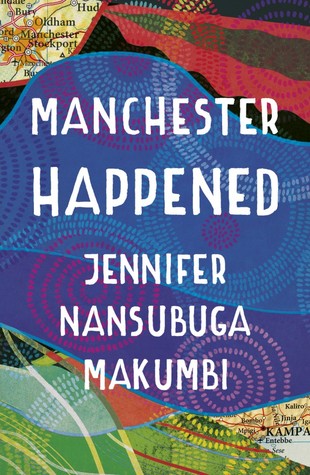
This is the opening few pages of “Our Allies the Colonies,” the first story following the Prologue. I hope it whets your appetite to read the whole thing.
First he felt a rush of dizziness like life was leaving his body, then the world wobbled. Abbey stopped and held onto a bollard outside the Palace Theatre. He had not eaten all day. He considered nipping down to Maama Rose’s for fried dumplings and kidney beans, but the thought of eating brought nausea to his throat. He steered his mind away from food. He gave himself some time then let go of the bollard to test his steadiness. His head felt right, and his vision was back. He started to walk tentatively at first then steadily, down Oxford Road, past the Palace Hotel, under the train bridge, upwards, towards the Grosvenor Picture Palace.
Abbey was set to return to Uganda. He had already paid for the first leg of the journey – the passage from Southampton to Mombasa – and was due to travel within six months. For the second and third legs of the journey – Mombasa to Nairobi, then Nairobi to Kampala – he would pay at the ticket offices on arrival. He had saved enough to start a business either dealing in kitenge textiles from the Belgian Congo or importing manufactured goods from Mombasa. Compete with the Indians even. As a starter, he had bought rolls of fabric prints from Summer Mist Textiles for women’s dresses and for men’s suits, to take with him. All that commercial development in Uganda he had read about – increased use of commercial vehicles; the anticipated opening of the Owen Falls Dam, which would provide electricity for everyone; he had even heard that Entebbe had opened an airport back in 1951 – was beckoning.
But his plan was in jeopardy. It was his one-month-old baby, Moses. Abbey had just returned from Macclesfield Children’s Home, where the baby’s mother, Heather Newton, had given him up for adoption, but he had not seen his son. In fact, he did not know what the baby looked like: he never saw him in hospital when he was born. Abbey suspected that Heather feared that one day she might bump into him and Moses. But Heather was fearful for nothing. Abbey was taking Moses home, never to return.
Suppose the children’s home gave you the child, what then, hmm? the other side of his mind asked. What do you know about babies? The journey from Southampton to Mombasa is at least two weeks long on a cheap vessel. The bus ride from Mombasa to Nairobi would last up to two days. Then the following night you would catch the mail train from Nairobi to Kampala: who knows if it is still running? All those journeys with luggage and a six-month-old ankle-biter on your own. Yet Abbey knew that if he left Britain without his boy, that would be it. Moses would be adopted, given a new name and there would be no way of finding him. Then his son would be like those rootless Baitale children you heard of in Toro, whose Italian fathers left them behind.
He was now outside Manchester Museum, by the university. He was on his way to his second job, at the Princess Road bus depot, where he cleaned Manchester Corporation buses. His shift began at 9 p.m. It was almost 8 p.m., but the day was bright. He could not wait to get home and tell people how in Britain the sun had moods. It barely retired in summer yet in winter it could not be bothered to rise. He could not wait to tell them things about Britain. It was a shame he had stayed this long. But having a job and saving money made him feel like he was not wasting his youth away in a foreign land. His day job paid the bills while the evening job put savings away in his Post Office account. His mind turned on him again: Maybe Heather had a point – you don’t have a wife to look after Moses while you work. You still have five months before you set off; if the home gives him to you, how will you look after him? But then shame rose and reason was banished. Blood is blood, a child is better off with his father no matter what.
He reached Whitworth Park. It was packed with people sunning themselves, young men throwing and catching Frisbees, families picnicking. At the upper end, close to Whitworth Art Gallery, he caught sight of a group of Teddy boys who, despite the warm evening, wore suits, crêpe-soled shoes and sunglasses, their greased hair slicked back. They looked like malnourished dandies. Even though Teddy Boys tended to hunt blacks in the night, Abbey decided against crossing the park. Instead, he walked its width to Moss Lane East. The way the sun had defrosted British smiles. ‘Enjoy it while it lasts,’ strangers will tell you now.
The Secrets We Kept by Lara Prescott Blog Tour
“this was not just a book, but a weapon”
 It’s the latest Reese Witherspoon book club selection and film rights have been sold to the producers of La La Land; if you haven’t already heard about The Secrets We Kept, you’ll be hearing a lot more soon. Prescott’s debut novel is an offbeat spy thriller set mostly in the 1950s and based on the international reception of Boris Pasternak’s Doctor Zhivago. Considered to express anti-Soviet opinions, Pasternak’s love story is suppressed in his native country but published widely in Western Europe and further afield. The Central Intelligence Agency, in the belief that books are one way to change ideologies in the long term (“They had their satellites, but we had their books”), decides it is important to make Doctor Zhivago available in its original Russian in the motherland, and duly enrolls two female spies – who have been masquerading as a typist and a receptionist – in the scheme.
First-person narration duties are shared by Olga Vsevolodovna, Pasternak’s lover and the inspiration for Lara in Doctor Zhivago; Irina Drozdova, a new secretary at the Agency; Sally Forrester, the more experienced spy who takes Irina under her wing; Teddy Helms, Irina’s first trainer and would-be romantic interest; and the typist pool as a whole. I have a special love for the first-person plural voice, used as a kind of observant chorus. Here it doesn’t work perfectly: Chapter 17 unnecessarily recaps information readers had already gleaned, while Chapter 20 is a clunky way of revealing more. But the ‘we’ of the title is not just these all-seeing typists (who reminded me of the secretaries in Mad Men), but also Sally and Irina, as well as Olga and her family, who often suffer for their connection with Pasternak. The epilogue carries things through to the present in a hopeful, almost whimsical way.
There’s a lot to appreciate about The Secrets We Kept, including the prominent roles played by women, the surprising place given to a same-sex relationship, and the glimpses into publishing and literary history. Prescott might have included more about Doctor Zhivago itself, though. The plot will most likely be unfamiliar to today’s readers. (I saw the film nearly 20 years ago and remember nothing.) Including more passages and some careful plot summary might have tempted more readers to try Pasternak’s work as we approach the 60th anniversary of his death in 2020. Still, this is in a very easy-reading style that lends itself to binges, and it nicely bridges the gap between literary fiction and spy stories.
Recommended to: Readers of Jessie Burton and Whitney Scharer; viewers of The Americans.
My rating:
The Secrets We Kept was published by Hutchinson on September 3rd. My thanks to the publisher for the proof copy for review.
Blog Tour Review: Ask Again, Yes by Mary Beth Keane
Ask Again, Yes is about the inextricable links that form between two Irish-American policemen’s families in New York. Francis Gleeson and Brian Stanhope meet as cops on the same South Bronx beat in July 1973 and soon move upstate, settling in as close neighbors in the suburb of Gillam. After a stillbirth and a miscarriage, Brian and his wife Anne, who’s from Dublin, finally have a son, Peter. Six months later, Francis and Lena’s third daughter, Kate, is born; from the start it’s as if Peter and Kate are destined for each other. They’re childhood best friends, but then, like Romeo and Juliet, have to skirt around the animosity that grows between their families to be together as adults.

Anne’s mental health issues and the Stanhope family history of alcoholism will lead to explosive situations that require heroic acts of forgiveness. I ached for many characters in turn, especially Lena and Kate. The title sets up a hypothetical question: if you had your life to live again, knowing what the future held, would you have it the same way? Keane suggests that for her characters the answer would be yes, even if they knew about all the bad that was to come alongside the good. Impossible to write any more about the plot without giving too much away, so suffice it to say that this is a wrenching story of the ways in which we repeat our family’s mistakes or find the grace to move on and change for the better.
As strong as the novel’s characterization is, and as intricately as the storyline is constructed around vivid scenes, I found this a challenging read and had to force myself to pick it up for 20 pages a day to finish it in time for my blog tour slot. Simply put, it is relentless. And I say that even though I was reading a novel about a school shooting at the same time. There aren’t many light moments to temper the sadness. (Also, one of my pet peeves in fiction is here: skipping over 15 years within a handful of pages.) Still, I expect Keane’s writing will appeal to fans of Celeste Ng and Ann Patchett – the latter’s Commonwealth, in particular, came to mind right away.
My rating:
Ask Again, Yes was published by Michael Joseph (Penguin) on August 8th. My thanks to the publisher for the proof copy for review.
 Bookish Beck = Rebecca Foster. American transplant to England. Freelance proofreader and book reviewer.
 Bookish Beck