Hay-on-Wye Trip & Book Haul (Plus a Little Life Complication)
Last week was our ninth time visiting Hay-on-Wye. Our previous trip was in October 2023 for my 40th birthday. Prompted by my overhaul post last month, I managed to finish a couple more of the 16 books I’d bought that time, taking me to 4 read and 1 skimmed; I’ve also read the first quarter of So Happy for You by Celia Laskey. Considering it was less than 18 months between visits, I’m going to call that an adequate showing. However, I will endeavour to be better about reading this latest book haul (below) in a timely fashion!
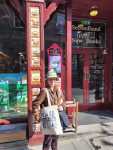 Because we were staying four nights, there was no need to rush through all the bookshops in a day or two, though that would be possible; instead, we parcelled them out and mixed up our shopping with walks, short outings in the car, and relaxing in the comfy cottage just over the English border in Cusop. I had work deadlines to meet within the first few days, but on another evening we took advantage of the place having Netflix to watch My Neighbor Totoro.
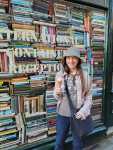 I’ve gotten secondhand book shopping in Hay down to a science over the years. Check on opening days and hours carefully or you can miss out. Thursday to Saturday is the best window to go: the Thursday market is excellent for local produce and crafts, and it’s nice to see the town bustling. (Though I’ve never seen it at Festival time, and wouldn’t want to!)


Start with the bargain options: the Little Free Library shelves by the river, where I scored Electricity by Victoria Glendinning; the sale area outside Hay Cinema Bookshop, the dedicated honesty shop beside Richard Booth’s Bookshop (new this trip), and the Book Passage beside Addyman Books – all £1/book; and the honesty shelves on the castle grounds, where it’s £2/book. Most of my purchases came from these areas. Just call me thrifty!

Next, the mid-priced options: Cinema, Broad Street Book Centre, Hay-on-Wye Booksellers, Clock Tower Books, and the new British Red Cross bookshop, which is not cheap for a charity shop but has a good selection of relatively recent stuff. (Oxfam, however, has moved away from books and primarily sells clothes, new products and bric-a-brac.) Cap it off with Addymans + Addyman Annexe, Cinema, Booth’s, the Poetry Bookshop and Green Ink Booksellers.
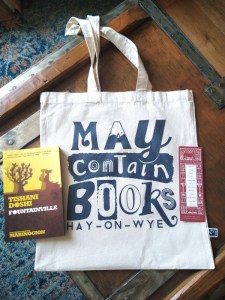 I had the best luck in Cinema this time, where I found two remainder books, three bargain books (one not pictured because it will be a gift) and the Howard Norman short stories – a particular thrill as his work is not often seen in the UK. Cinema and Booth’s are the greatest pleasure to browse. At Booth’s I bought my priciest book of the trip – Fountainville by Tishani Doshi, a retelling of stories from the Mabinogion – and indulged in a bookish tote bag (as if I needed another!). It was especially pleasing to find the Doshi and the Lewis in Hay as they are Welsh authors so will cover me for Reading Wales Month next year.
I wasn’t in the market for new books this time, not having any vouchers at my disposal, but those who are will also enjoy perusing Gay on Wye, North Books, and the large selection of new stock mixed in thematically at Booth’s. All told, that’s 15 places to shop for books.
Alas, The Bean Box, where you could get the best coffee in town, has now closed. We returned to Hay Distillery for delicious gin drinks and had Shepherd’s ice cream (a must) twice. New to us on this trip were nearby Talgarth and its excellent Mill café, the Burger Me (oh dear) restaurant at The Globe, a drink at Kilverts Inn, and an evening walk down the river to a nice shingle spit.


The weather was improbably warm and sunny – as in, I packed an umbrella and raincoat but never used them. I did need my woolly hat, scarf and gloves, but only on the first morning when we climbed up a hill. The rest of the time, it was blue skies and blossom, lambs in the fields, and 20 degrees C, for which, in early April, we could only be grateful – but also, as the lady on the till at Cinema rightly observed, it’s mildly disturbing.
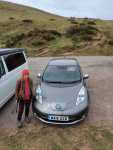
This was our first major trip with our secondhand electric car, which needs rather frequent charging. En route we broke the journey at Gloucester and toured its cathedral; on the way back, we plumped for usefulness over aesthetics by stopping at carparks in Ross-on-Wye and Cirencester. We now choose routes that avoid motorways, which makes for more leisurely and scenic touring.
-
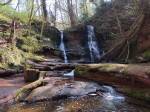
- Pwll y grach waterfall
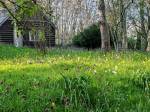
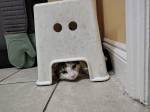
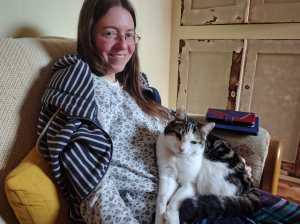
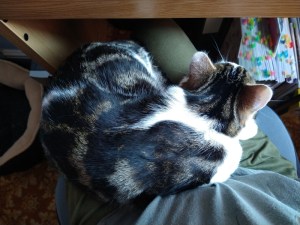
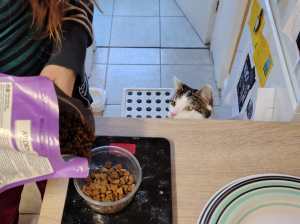
Two days after we bought the car from a local acquaintance, this creature entered our lives. I certainly didn’t intend to adopt another cat a shade under six weeks after Alfie’s death. (I haven’t even finished reading Grieving the Death of a Pet on my Kindle; I still haven’t brought myself to read your kind comments on my post about losing Alfie.) But we were deeply lonely in a way we hadn’t been expecting. I would object to the use of the word “replace” – there is no replacing Alfie; we still miss him for his predictability and dignity as well as all his own funny ways. I’ve come to realize that grief is ongoing, and all of a piece: mourning Alfie took me back to the same place of grief I inhabit for my mother, and missing them and others lost in recent years is tied into my helpless sadness over natural disasters, humanitarian crises, the state of affairs in my home country, the trajectory of the planet, and on and on.
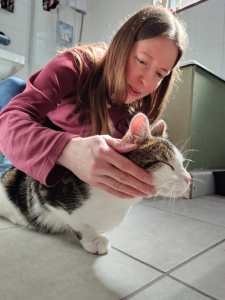
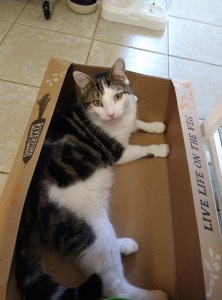
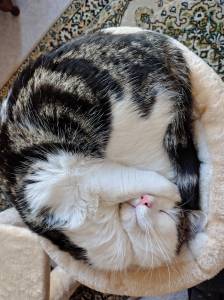
Any road, the adoption moved very quickly: from expressing interest on a Thursday to getting a call back on a Saturday to meeting and taking him home on a Sunday afternoon. Benny (“Tubbs” as was) is only a year old and full of energy. He came home with a tapeworm but got over it within a week after a targeted worming treatment. It’s been a big adjustment for us to have a cat who doesn’t sleep most of the day and can jump up onto any counter or piece of furniture. Benny considers every waking moment a chance for playtime and mischief. But he is also so sweet and affectionate. And we haven’t laughed this much in a long, long time.
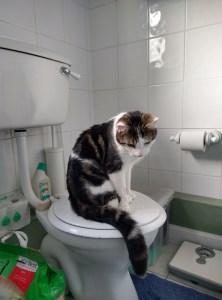
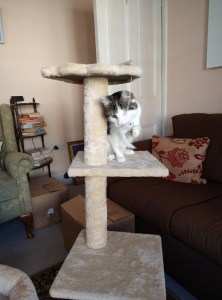
We had booked the Hay trip long before we knew about Benny and were concerned it would be too soon to leave him. But we needn’t have worried; he was settled in here from Day One. Our regular cat sitter visited twice a day and he was absolutely fine. She sent us WhatsApp updates on him and cute photos, in most of which he is a blur chasing his toy snake!

So that’s what’s been going on with me. And of course, I’ve been frantically reading there in the background (36 books on the go at the moment): pre-release e-books for paid reviews, review copies I’ve been sent for the blog, new releases from the library, and the rest of the McKitterick Prize longlist – my shortlist choices are due on the 23rd, eek! I still hope to read a couple of novels from the Carol Shields Prize longlist before the winner is announced, too.
Hope everyone is having a happy spring!
Making Plans for a Return to Hay-on-Wye & A Book “Overhaul”
I was last in Hay-on-Wye for my 40th birthday (write-up here). We’ve decided 18 months is a decent length between visits such that we can go back and find enough turnover in the bookshops and changes around the town. The plan is to spend four nights there in early April, in a holiday cottage we’ve not stayed in before. It’s in Cusop, just back over the border into England, which means a pleasant (if not pouring with rain) walk over the fields into the town. Normally we go for just a night or two, so this longer ninth trip to Hay will allow us time to do more local exploring besides thoroughly trawling all the bookshops and rediscovering the best eateries on offer.
An Overhaul of Last Trip’s Book Purchases
Simon of Stuck in a Book has a regular blog feature he calls “The Overhaul,” where he revisits a book haul from some time ago and takes stock of what he’s read, what he still owns, etc. (here’s the most recent one). With his permission, I occasionally borrow the title and format to look back at what I’ve bought. Previous overhaul posts have covered pre-2020 Hay-on-Wye purchases, birthdays, the much-lamented Bookbarn International, and Northumberland. It’s been a good way of holding myself accountable for what I’ve purchased and reminding myself to read more from my shelves.
So, earlier this week I took a look back at the 16 new and secondhand books I acquired in Hay in October 2023. I was quickly dismayed: 18 months might seem like a long time, but as far as my shelves go it is more like the blink of an eye.
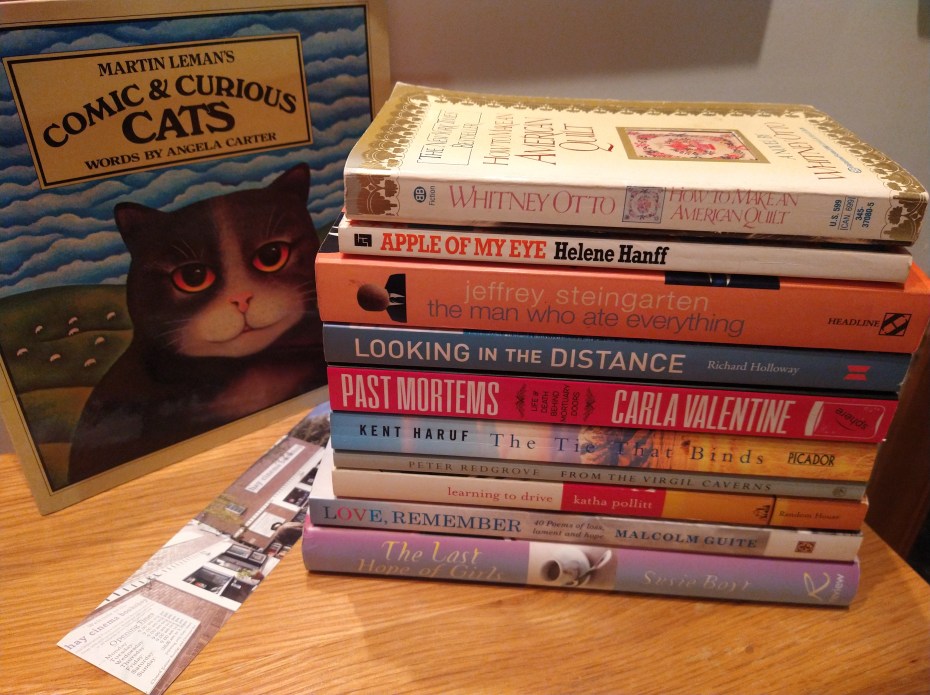
Read: Only 1 – Uh oh…
- Learning to Drive by Katha Pollitt

But also:
Partially read: 4
- A God at the Door by Tishani Doshi – Doshi is awesome. This is only my second of her poetry collections. I’ll finish it this month for Dewithon.
- Looking in the Distance by Richard Holloway – The problem with Holloway is that all of his books of recent decades are about the same – a mixture of mediations and long quotations from poetry – and I have one from last year on the review catch-up pile already. But I’m sure I’ll finish this at some point.
- The Ghost Orchid by Michael Longley – No idea why I set this one aside, but I’ve put it back on a current stack.
- The Enduring Melody by Michael Mayne – I have this journal of his approaching death as one of my bedside books and read a tiny bit of it at a time. (Memento mori?)
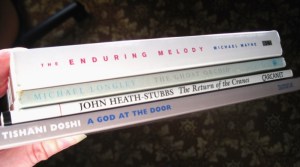
Skimmed: 1
- Love, Remember: 40 Poems of Loss, Lament and Hope by Malcolm Guite – I enjoyed the poetry selection well enough but didn’t find that the author’s essays added value, so I’m donating this to my church’s theological library.
That left 10 still to read. Eager to make some progress, I picked up a quick win, Comic & Curious Cats, illustrated in an instantly recognizable blocky folk art style by Martin Leman (I also have his Twelve Cats for Christmas, a stocking present I gave my husband this past year) and with words by Angela Carter. Yes, that Angela Carter! It’s picture book size but not really, or not just, for children. Each spread of this modified abecedarian includes a nonsense poem that uses the letter as much as possible: the cat’s name, where they live, what they eat, and a few choice adjectives. I had to laugh at the E cat being labelled “Elephantine.” Who knows, there might be some good future cat names in here: Basil and Clarissa? Francesca and Gordon? Wilberforce? “I love my cat with an XYZ [zed] … There is really nothing more to be said.” Charming. (Secondhand purchase – Hay-on-Wye Booksellers)


Total still unread: 9
Luckily, I’m still keen to read all of them. I’ll start with the two I purchased new, So Happy for You by Celia Laskey, a light LGBTQ thriller about a wedding (from Gay on Wye with birthday money from friends, a sweet older lesbian couple – so it felt appropriate to use their voucher there!), and Past Mortems by Carla Valentine, a memoir set at a mortuary (remainder copy from Addymans); as well as a secondhand novel, The Tie that Binds by Kent Haruf (Hay-on-Wye Booksellers) and the foodie essays of The Man Who Ate Everything by Jeffrey Steingarten (Cinema).
Then, if I still haven’t read them before the trip (who am I kidding…), I’ll pack for the car a few small volumes that will fit neatly into my handbag: Apple of My Eye by Helene Hanff, How to Make an American Quilt by Whitney Otto, and one of the poetry collections.
Hay-on-Wye Trip & Book Haul
Our previous trip to Hay was in September 2020, when Covid restrictions meant some shops were closed and most eateries only offered takeaway or outdoor dining. At the end of my write-up, I vowed to go back before I turned 40. I stayed true to my word and we arrived in town the day before my 40th birthday. (Not only that, but I’ve completed the Triple Crown of British Book Towns in a year, what with visits to Wigtown in June and Sedbergh in August. My hauls were comparable in all three and my spending in Hay (£37.95 for 15 books) was somewhere between Sedbergh’s low (£24.50 for 13) and Wigtown’s high (£44 for 16).)
Every time we visit, we find some businesses have closed but others have opened. There’s still a core of 12 bookshops, but as in Sedbergh, there are other establishments with a few shelves of books, so there are 15–20 places in town where you can browse books. That’s plenty for anyone to be getting on with in a long weekend.
I had an action plan for our three days that moved from cheapest (honesty shelves below the castle, £1 area outside Cinema; Oxfam and British Red Cross charity shops; Hay-on-Wye Booksellers; Clock Tower Books) through mid-price (Addyman Books, Cinema) to the more expensive options (Green Ink, Booths). The town’s newest shop, as pictured in my birthday post, is Gay on Wye, which, with North Books, replaced Pembertons as sellers of new stock. (Booth’s, the Castle and the Old Electric Shop also sell curated selections of new books.)
New to us on this trip:
- The Bean Box, a terrific and reasonably priced mini coffee bar run out of a horse box by the river. They have a nice garden and a secondhand book selection, and you can sit on their patio or at tables and chairs closer to the river view.
 Felin Fach Griffin, a country pub about a 20-minute drive from Hay, where we booked a table for my birthday lunch. Excellent food and a cosy atmosphere, with hill views from the windows.
- Hay Castle, which has had scaffolding up and been half-derelict ever since our first visit in 2004. At various points it has had books for sale. In 2022, it opened to the public as a visitor attraction. A projected animation gives a jaunty historical overview from the Middle Ages to the present day. We especially liked the room of Richard Booth and Book Town memorabilia and the viewing platform at the top. Booth himself was the last to live in the castle. On our earliest trips we would occasionally see him around town – a loud, shuffling (after his stroke) eccentric.

- Hay Distillery, where I had a delicious gin cocktail on my birthday evening.
“It is obviously impossible to catalogue over one million books and these listings therefore represent only a very small selection of the books that we have in stock in Hay. We would point out that one of the chief services of the secondhand bookshop is to provide the customer the opportunity to find the book he did not know existed.”
~Richard Booth, “Books for Sale” periodical (1981?)
“The new book is for the ego; the second-hand book is for the intellect.”
~Richard Booth, quoted on the castle exhibit wall
When we arrived at our Airbnb, we found it had not been cleaned; no linen, etc. A cleaner belatedly came to sort it out, but the owner gave us a full refund, so a minor inconvenience got us back more than enough to pay for the rest of the weekend.
After the final day’s shopping, this was my final book haul. We had particularly good luck in the Addyman’s alleyway, where all books are £1 – we got a bunch for presents (not pictured).


I also opened a first set of birthday books. (My husband and I are having a joint birthday party later this month; I daresay there may be more book parcels to open after.)
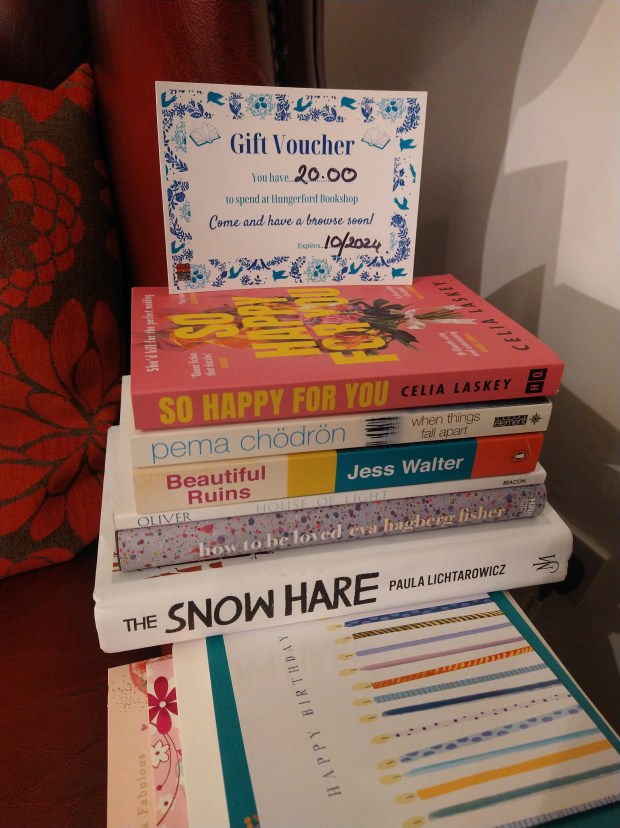
Hay is gentrified and hipster now in ways that would probably have Booth turning in his grave. While we slightly miss its dusty, ramshackle past, it’s the new businesses and the Festival that have helped it survive.
If you’ve never been to Hay, I’d certainly recommend it. I possibly slightly prefer Wigtown for its community atmosphere, but it’s more than twice as far away and has fewer book shopping opportunities, which for many of us is the main draw, as well as measly food options. Depending on where you live or are traveling in from, Hay is also likely to be the easiest of the three UK book towns to get to, including by public transport.
Cumbria Sights and Reading & A Return to Sedbergh
We returned on Friday from a one-week reunion with university friends – some we see very often and some less so; we hadn’t all been together since February 2020. After a protracted winter selection process pitting locations and cottages against each other, the nine of us had managed to agree on a converted inn in Appleby-in-Westmorland, Cumbria, and it ended up being the perfect base for us: roomy, with lots of communal space plus en suite rooms for each family unit, and well located.
This was my first time in the Lake District in 17 years, and I particularly enjoyed the outings to Haweswater, Acorn Bank, Keswick and Derwentwater, and Carlisle (that one by train), as well as some low-key walking closer to the cottage.


As apposite reading, I took along:
- Some of Us Just Fall by Polly Atkin: A memoir of chronic illness by a writer based in Grasmere.
- Haweswater by Sarah Hall: Purchased in Sedbergh last year. Hall’s debut novel is set in the run-up to the lake being dammed to provide water for the city of Manchester in 1936, flooding the village of Mardale. I’m finding it rather dry and the local accent over-the-top, but I’ll push through and call it one of my 20 Books of Summer.
- The Farmer’s Wife by Helen Rebanks: A recipe-studded memoir of daily life as the spouse of famous Lake District sheep farmer James Rebanks.
- Wild Fell by Lee Schofield: As featured in my Six Degrees post, a plant-loving and conservation-oriented memoir by the manager of the RSPB Haweswater site.

I also packed, but didn’t get time to read from, books by Margaret Forster and Dorothy Wordsworth. A good showing by women from the northwest!
Though we hadn’t planned on going back so soon, having been for the first time in September, when I learned that Sedbergh was only 40 minutes from where we were staying, I suggested it for a daytrip along with a scenic walk to a waterfall and cake and soft drinks at the Cross Keys Temperance Inn, and even the less book-obsessed of us seemed to enjoy.

My final haul – including, from Carlisle, one book each from a charity shop and Bookcase (above), which I learned about from Simon but actually found kind of overwhelmingly huge and mazelike – cost £9.50 after subtracting the sellback of a partial box of books at Westwood. A good selection of poetry and novellas, plus a favourite I couldn’t resist buying two copies of and might reread as a buddy read with my husband (the Orlean).

Any vacation reading or book hauls for you this August?
Tricking Myself into Reading My Own Books
I suspect many of us have this bibliophile problem: we get tremendously excited about a particular book and just have to have it, whether as a proof from the publisher, pre-ordering it new, or (for an older book) snapping it up secondhand the minute we hear about it. Then months or even years pass and we realize that the novel or memoir we were once so desperate to read has simply joined the ranks of hundreds of other half-forgotten books we still plan to get to on that legendary ‘one day’ but always pass by in favour of newer acquisitions.
I’ve long strived to read more backlist books from my own collection, as well as to catch up on the dozens of books I’ve been foolish enough to pause partway through and group together on two “set-aside” shelves in the lounge. (Many of these I obtained as review copies from publishers, so I do feel a sense of obligation to write at least a mini review for each.) As Marcie (Buried in Print) noted in her recent reading goals post, vague intentions go by the wayside, so it’s time to get specific about how to incorporate these into my reading stacks.


- For my review backlog of 2022 releases, I get a second chance. I’ve noted the paperback release dates for around 20 books and will aim to have catch-up review posts (here or for Shiny New Books) ready for that date, or at least within that month. Having a deadline to work towards is essential for a last-minute worker like me.
- There are some authors I own 3 or more unread works by. Usually this means I enjoyed a book of theirs so much I went on a secondhand binge … then got distracted and didn’t explore their back catalogue as I meant to. Via Margaret, I just found out about What Cathy Read Next’s Backlist Burrow challenge, where she’s picked six authors who piqued her interest and two books by each to read this year. I’m unlikely to manage two each, but I fancy doing this adjacent/modified challenge: where I own 2 or more unread books by an author, I must read at least 1 this year. I have these authors to choose from, but also others in my sights, e.g. Sarah Hall, whose Haweswater I’ll take on holiday to the Lake District in July.
- Challenges like that one are the best way to get me rifling through my own shelves. I started a few low-key, long-term projects of my own back in 2020 (Journey through the Day and 4 in a Row) and am still ostensibly working on them, as well as on thematic pairs and trios (my Three on a Theme series) as they arise, along with regular tie-ins to seasons, holidays, etc. Hosted challenges are somehow better, though, perhaps due to the built-in companionship and accountability. Nordic FINDS this month, Reading Indies in February, Reading Ireland in March, the 1940 Club in April, and so on. Because they’re so useful for getting me reading from my shelves, I will participate in at least 1 reading challenge per month.
- How to tackle the dreaded set-aside shelves? One book at a time. So, in addition to the ones I’ll review to coincide with the paperback release, I’ll also reintroduce 1 set-aside book to my reading pile each week.
- How to ensure that book hauls from shopping excursions and gift-receiving occasions don’t get neglected? By undertaking regular “overhauls” such as this and this, and checking there are no more than 3 unread books remaining from any 1 haul. If there are, start reading the stragglers right away. This will be particularly important because it looks like this year I might complete the triple crown of UK book towns, with trips planned to Wigtown in June and the Sedbergh area in July/August and Hay-on-Wye a perpetual temptation.
- How to make time for all those lovely random books (such as this stack) that I keep meaning to read but somehow never do? I’m going to allow myself to start at least 1 “just because” book per fortnight.
- Connected to all of these will be requesting fewer 2023 review books from publishers. Almost all my recent requests have gone completely ignored, in fact, which is probably for the best. Unless I’m reviewing something for pay, I’ll just plan to read it from the library or, if I can’t find it that way, will add it to my wish list in advance of my birthday and Christmas.


How do you trick yourself into reading your own books?
A Short Trip to Sedbergh, England’s Book Town
We’ve finally completed the ‘Triple Crown’ of British book towns: Hay-on-Wye in Wales is one of our favourite places and we’ve visited seven or more times over the years (the latest); inspired by Shaun Bythell’s memoirs, we then made the pilgrimage to Wigtown in Scotland in 2018. But we hadn’t made it to Sedbergh, England’s book town, until this past week. A short conference my husband was due to attend in the northwest of the country was the excuse we needed – though a medical emergency with our cat (fine now; just had to have an infected tooth out) shortened our trip and kept him from participating in the symposium at Lancaster.
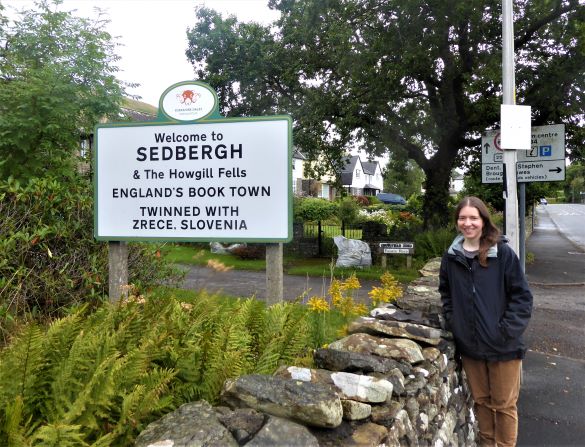
Sedbergh is technically in Cumbria but falls within the Yorkshire Dales National Park. The book town initiative was part of a drive to re-invigorate the local economy after the 2001 foot and mouth disease outbreak. It’s a very sleepy town, more so than Hay or Wigtown, and only has two dedicated bookshops. The flagship store is Westwood Books, which was based in Hay until 2006 and occupies a former cinema / factory building. It is indeed reminiscent of Hay’s Cinema Bookshop, and is similar in size and stock to the largest of the Hay shops.
The only other shop in town that only sells books is Clutterbooks charity bookshop, where we started our book hunting after we left the car at our Airbnb flat on the Wednesday. With everything priced at £1 or £1.50, it tempted me into my first six purchases. Next up was Westwood, which opens until 5, an hour later than some other places. I bought a couple more books (delighted with the pristine secondhand copy of Julian Hoffman’s first nature book) but also resold them a small box of antiquarian and signed books for more than I could ever have hoped for – covering all my book purchases for the trip, as well as our meals and snacks out. On the Thursday we had a quiet drink in a cosy local pub to toast Her Majesty’s memory.


Various main street eateries and shops have a shelf or two of books for sale. We perused these, and the Little Free Library in the old bus shelter, on the Wednesday afternoon and first thing Friday morning. I added one more purchase to my stack – a paperback copy of Fire on the Mountain by Jean McNeil for £1 – just before we left town. In general, there weren’t as many bookshops as expected, and lots of places opened later or closed earlier than advertised, presumably because it was off season and rather rainy. So, it was a little underwhelming as book town experiences go, and I can’t imagine Sedbergh ever drawing us back.
However, we enjoyed exploring the area in general, with stops at Little Moreton Hall, and Sizergh Castle and Chester, respectively, on the way up and back. As part of the conference, we joined in a walk from Grange to Cartmel that took in an interesting limestone pavement landscape. It was my first time in the Dales or Lake District in many a year, and a good chance to get back to that pocket of the world.


Hay-on-Wye Trip & Sixpence House Reread
We found Hay-on-Wye fairly bustling on an early September weekend. Not all of the bookshops are operational or have reliable opening hours, so we missed our chance to go in a few of them this time. Still, nine was plenty to be getting on with. The castle currently has scaffolding up for necessary renovations, and many eateries were offering little or no indoor table service. Masks are not actually compulsory in Wales, but we wore ours inside shops anyway, and half or more of the other customers and booksellers were doing the same.


Day 1: Drive there; Clock Tower Books, Oxfam, a great haul from the honesty shelves by the Castle (everything’s £1); ice cream cones from Shepherds; dinner at The Globe.

Day 2: A walk up Hay Bluff; roast lunch at the Three Tuns pub; Broad Street Book Centre, Hay Cinema Bookshop.
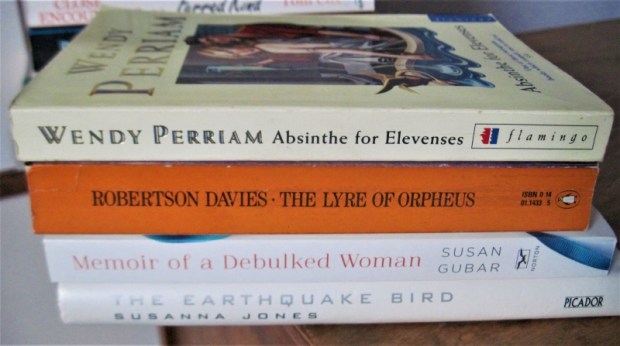
Day 3: Cinema outdoor area, Booth’s, British Red Cross shop, back to Oxfam, back to Clock Tower Books, Green Ink Booksellers; ice cream cones from Shepherds (again); drive home.
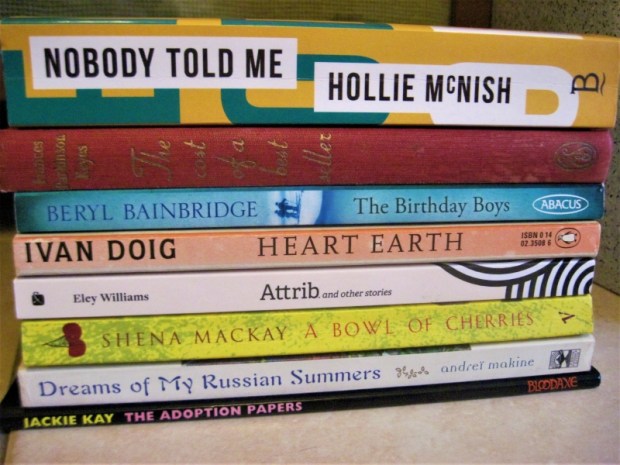
“To look for a specific book in Hay is a hopeless task; you can only find the books that are looking for you, the ones you didn’t even know to ask for in the first place. … What you mean to find matters less than what you do find.”
~Sixpence House: Lost in a Town of Books, Paul Collins (see below)


I bought 26 books in total (though one is an omnibus, so you could call it 28), at an average spend of £1.81 per volume. (My husband bought 10 nature books. We also found a gift for my father-in-law’s birthday next week – whew!) I’m particularly pleased with the Robertson Davies novels and the memoirs, some of which have been on my wish list for a long time. My interests in animals plus foodie and medical themes come through clearly. Some authors here I’ve never tried but have been meaning to; others are familiar names I was interested to read more by. I only noticed later on that Ghosts, the John Fuller poetry book, is a signed copy.
What I read
From last year’s book haul: The first 30 or so pages in Ingenious Pain by Andrew Miller and Jesus Land by Julia Scheeres. I’ll probably only skim the Spowers travel book (another one I only just noticed is signed). I have to read a different Dunmore first, towards my Women’s Prize reading project, as it’s requested after me at the library, but I’ll try to get to Talking to the Dead before too much longer.
I got through another 90 pages in Mike Parker’s On the Red Hill, about life in the house he and his partner inherited in the Welsh countryside from another gay couple. I also read about half of Tilly and the Lost Fairy Tales, Anna James’s second middle-grade novel about a girl who disappears into books and interacts with the characters, and the remainder of A.N. Wilson’s The Tabitha Stories, a cute chapter book with illustrations about a kitten learning how to be a cat.
Mostly, I focused on rereading the whole of Paul Collins’s memoir Sixpence House. I’ve listed this as one of the landmark books in my life because, as I was getting ready for my year abroad in England in the late summer of 2003, it was one of the books that whetted my appetite for traveling, and particularly for visiting Hay-on-Wye. (We first went in 2004; this was our seventh trip.)

In 2000 Collins moved from San Francisco to Hay with his wife and toddler son, hoping to make a life there. His parents were British and he’d enjoyed trips to the Book Town before, so it wasn’t a completely random choice. The place suited his interest in the oddities and obscure figures of literature and history. In fact, he’d just finished writing Banvard’s Folly, a fun book containing 13 profiles of thinkers and inventors whose great ideas flopped. (I should reread it, too.)
As he edits his manuscript and hunts for the perfect cover and title, he is also unexpectedly drawn into working for Richard Booth, the eccentric bookseller who was responsible for creating the world’s first book town and crowned himself King of Hay. Booth hired him to sort out the American Studies section – but if you ever went in the pre-2007 Booth’s you’ll know how impossible it would have been to make order out of its chaos. He comes across lots of interesting books time has forgotten, though (I first learned about W.N.P. Barbellion’s The Journal of a Disappointed Man from this book; why have I still not read it?!), and muses on counterfeiting, cover designs, bookbinding, and the sadness of the remainders bin.
Renting an apartment above Pembertons, which no longer exists but was at that time the town’s only new bookshop, Collins and his wife look at various properties and fall in love with a former pub. But when the survey comes back, they realize fixing all the damp and rot would nearly double its £125,000 price tag. (That sure looks good these days! The B&B next to the Airbnb flat where we stayed was for sale for over £700,000. Cusop Dingle is full of large, posh houses – Collins’s landlady referred to it as the “Beverly Hills of Hay.”) Buying one of the new-build houses on the edge of town just isn’t their dream.
In the end, after six months or so in Hay, they admit defeat and move back to the States. So in a sense this is – just like Banvard’s Folly, the book being shepherded into publication within it – a book about an experiment that turned out to be a noble failure. It’s warm, funny in a Bryson-esque way, and nostalgic for a place that still exists but a time that never will again. I loved spotting familiar landmarks, even if the shops have changed hands or are no longer there. This was probably my fourth read, but it all still felt fresh. An enduring favorite of mine. 
I’d be intrigued to know what Collins would make of Hay 20 years later. In 2000 it had 40 bookshops; now it’s only 12, with online sellers, book-related businesses, and shops further afield pushing the listings in the annual leaflet to 26. Whereas then Collins felt they were the only young family in town, it’s very much a hipster place now and we saw many groups of teens and twentysomethings. A tapas bar, boutique stores, turmeric chai lattes … it’s not just a musty antiquarian book lover’s paradise anymore, and that might sadden some like Collins. Yet gentrification and the Festival may be the only things that have kept the town alive. Richard Booth died last year, but the book town vision should live on.


I miss Hay already. I hate to think of all the time that might pass before I can get there again, and what will (or won’t) have changed by then. A few years can seem to go by in an instant these days. My vow is to go again before I turn 40.
Making Plans for a Return to Hay-on-Wye & A Book “Overhaul”
Somehow it’s been nearly 3.5 years since our last trip to Hay-on-Wye, the Book Town of Wales (I wrote about that April 2017 visit here). This coming weekend will be our seventh trip to Hay, one of our favorite places. We’ve booked an Airbnb in nearby English hamlet Cusop Dingle for two nights, so it’s a pretty short break, but longer than the weekend away we managed last month – reduced to only 36 hours by the cat’s poorly timed but ultimately minor one-day illness.
I’ve acquired many, many books from the free mall bookshop over the past year. (It’s now closed permanently, alas.) And I had no shortage of additional incomers during lockdown, via the unofficial Little Free Library I started and orders I placed with independent bookstores and publishers. So you could say I don’t need a book-buying trip to Hay. But 1) it’s never a question of need, is it? and 2) We want to continue to support the town, which will have been hit hard by temporary closures and by its annual literary festival being purely online this year.
I have no particular plans for what to buy this time, so will just see what takes my fancy. There are noticeably fewer bookshops than when we first started visiting Hay in 2004, but among the dozen or so remaining are some truly excellent shops like Addyman Books, the Hay Cinema Bookshop, and Booth’s Bookshop. Our best bargains last time were from the Oxfam charity shop and the honesty shelves around the castle, so those will likely be our first ports of call, and from there we’ll let whimsy be our guide. Saturday and Monday will be for wandering the town and book shopping, while Sunday will include countryside walks around Hay Bluff. We also hope to explore some eatery options we’ve not tried before.
An Overhaul of Last Trip’s Book Purchases
Simon of Stuck in a Book runs a regular blog feature he calls “The Overhaul,” where he revisits a book haul from some time ago and takes stock of what he’s read, what he still owns, etc. (here’s the most recent one). With his permission, I’m borrowing the title and format to look back at what I bought in Hay last time.
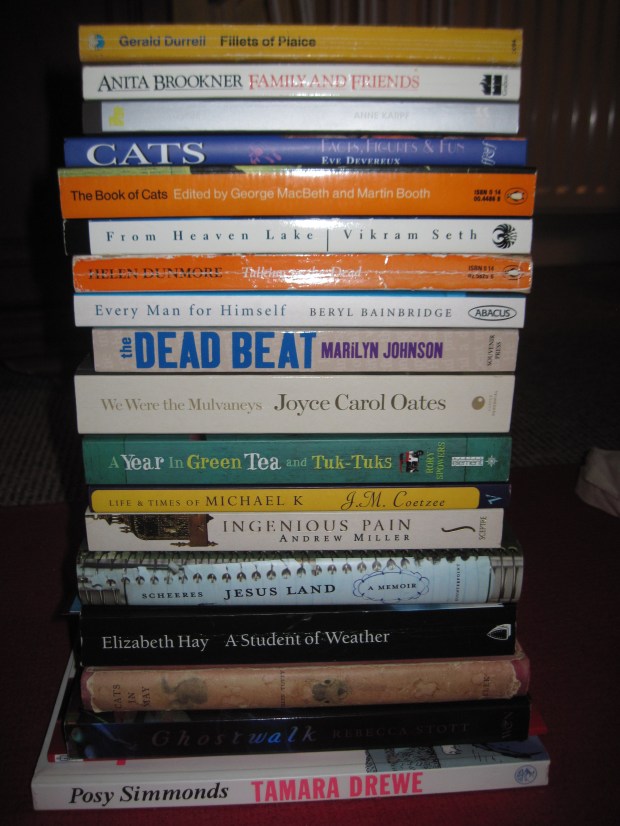
Date of haul: April 2017
Location: Hay-on-Wye
Number of books bought: 18
Had already read: (3/18)
- How to Age by Anne Karpf
- From Heaven Lake by Vikram Seth
- Tamara Drewe by Posy Simmonds – It’s on my shelf for rereading.
Have read since then: (5/18)
- Every Man for Himself by Beryl Bainbridge [resold]
- Fillets of Plaice by Gerald Durrell
- A Student of Weather by Elizabeth Hay (!)
- The Dead Beat by Marilyn Johnson
- Cats in May by Doreen Tovey
BUT also read from my hubby’s pile (not pictured):
- Sold for a Farthing by Clare Kipps
- All the Presidents’ Pastries by Roland Mesnier
- Second Nature by Michael Pollan
- A Shepherd’s Life by James Rebanks
DNFed: (3/18)
- Life & Times of Michael K by J.M. Coetzee [resold]
- We Were the Mulvaneys by Joyce Carol Oates – Might try this one again another time.
- Ghostwalk by Rebecca Stott [given away]
Resold unread: (1/18)
- Family and Friends by Anita Brookner – I’d added it to the Oxfam pile to make up a 5 for £1 stack, but then didn’t enjoy Booker winner Hotel du Lac enough to try another by Brookner.
Total still unread: 6
Total no longer owned: 4
This is not too bad a showing overall, though it does reveal my habit of buying books and letting them sit around for years unread. (Surely I’m not alone in this?!)
The six purchases still to read are two cat-themed anthologies for reading piecemeal, plus these four – two fiction and two non-:
- Talking to the Dead by Helen Dunmore
- Ingenious Pain by Andrew Miller
- Jesus Land by Julia Scheeres
- A Year in Green Tea and Tuk-Tuks by Rory Spowers
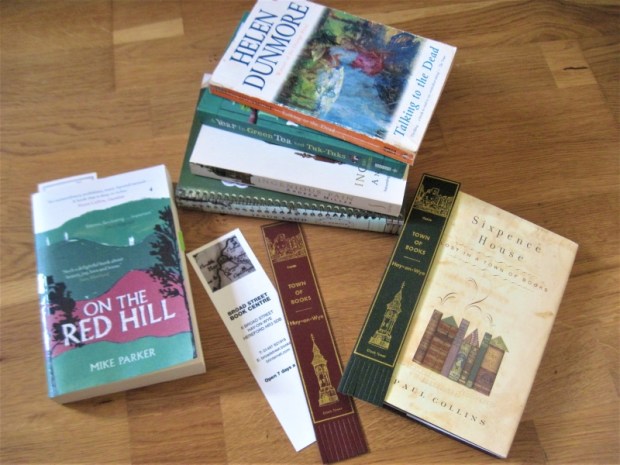
To force myself to get to them, these are the four I’ve packed for reading in the car and while in Hay. I’m also bringing, to read on location: 1) On the Red Hill by Mike Parker, a Wainwright Prize-shortlisted memoir about life in the Welsh countryside (I’m about 40 pages into it already); and 2) Sixpence House, which I’ve read several times before and consider among my absolute favorite books; it’s Paul Collins’s memoir about finding a temporary home and work among the bookshops of Hay.
I’ll be back on Tuesday with this year’s book haul plus photos and notes on how we found the town this time around. (But first, Six Degrees of Separation will post on Saturday while I’m away.)
A Trip to Wigtown, Scotland’s Book Town
Wigtown is tucked away in the southwest corner of Scotland in Galloway, a region that doesn’t draw too many tourists. It did remind us a lot of Hay-on-Wye, the Book Town in Wales, what with the dry-stone walls, rolling green hills with more imposing mountains behind, sheep in the fields, and goodly number of bookshops. Wigtown is a sleepier place – it’s really just one main street and square – and has fewer bookshops and eateries overall, but the shops it does have are mainly large and inviting, and several are lovely bookshops-cum-cafés where you can pause for tea/coffee and cake before continuing with your book browsing. It rained for much of our trip and even snowed on a couple of brief occasions, but we got one day of very good weather and made the best of all the rest.


Day 1, Monday the 2nd: Six-plus hours of driving, partially in the sleet and snow, saw us arriving to our spacious and comfortable B&B by 6 p.m., giving us an hour to freshen up before dinner in the dining room. Cullen skink (leek and potato soup with chunks of smoked haddock); pork chops in a mustard cream sauce with roast parsnips, boiled potatoes and carrots, and mashed swede (aka rutabaga); and chocolate cake with gingerbread sauce. All delicious!
Day 2, Tuesday the 3rd: Smoked salmon and scrambled eggs for breakfast, accompanied by plenteous tea and toast. Off in the drizzle to see some local sites: Torhouse stone circle and Crook of Baldoon RSPB bird reserve. Nice sightings of whooper swans, pink-footed geese and lapwings, and a panoramic view of Wigtown across the way. Back to the car in the steady rain to find that we had a flat tire. Thanks to our foot pump, we got back to the W. Barclay garage in town, where they ordered a new tire and fitted the spare wheel. In the afternoon we drove to the Isle of Whithorn to see the 13th-century St. Ninian’s Chapel ruins and St. Ninian’s Cave. In the evening we went to Craft for beer/cider and the weekly acoustic music night, which, alas, just ended up being two old guys playing Americana songs on guitars.


Today’s book shopping: Glaisnock Café, where we also stopped for coffee and a tasty slice of courgette and avocado cake; The Open Book (run by Airbnb customers – this week it was Maureen from Pennsylvania and her niece Rebecca from Switzerland; they’d booked the experience two years ago, and the wait is now up to three years); the Wigtown Community shop (a charity shop); and browsing at Old Bank Books and Byre Books.


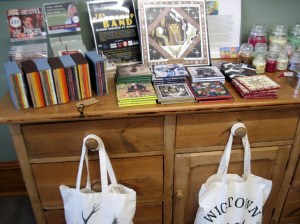
I loved seeing lots of Bookshop Band merchandise around. This was in the Festival Shop.
Day 3, Wednesday the 4th: Vegetarian ‘full Scottish’ cooked breakfast to fuel us for a rainy day of bookshops and explorations further afield. 12 p.m.: return trip to the garage to have our tire fitted. All the staff were so friendly and pleasant. They seemed delighted to see tourists around, and were interested in where we came from and what we were finding to do in the area. Mr. Barclay himself had one of the thickest Scottish accents I’ve ever heard, but I managed to decipher that he thinks of Galloway as “the next best place to heaven,” despite the weather. We spotted a local ‘celebrity’, Ben of the Bookshop Band, in the Co-op, but didn’t say hello as he was trying to pay for his shopping and had the baby in tow.
In the afternoon we ventured to Newton Stewart, the nearest big town, to buy petrol, picnic supper food, and another secondhand book at the community shop there. We retreated from the sudden snow for a scrumptious dinner of smoked salmon, black pudding and haggis (all of them battered and fried, with chips!) at a diner-like smokehouse. Back in Wigtown, we got a mainly dry evening to do the Martyrs’ Walk. In 1685 two Covenanters (Scottish reformers who broke from Charles I’s Anglican Church), Margaret McLachlan, 63, and Margaret Wilson, 18, were tied to stakes on the mud flats and allowed to drown in the rising tide.


Today’s book shopping: THE BOOKSHOP. I’ve meant to visit ever since I read Jessica Fox’s memoir, Three Things You Need to Know about Rockets, in February 2013. Previously based in California, Fox decided on a whim to visit a bookshop in Scotland and ended up here at the country’s largest. She promptly fell in love with the bookshop owner and with Wigtown itself; though she and Shaun Bythell are no longer an item, she has been a major mover and shaker in the town, playing a role in the annual festival and establishing The Open Book.


The Bookshop is a wonderfully rambling place with lots of nooks and crannies housing all sorts of categories. Look out for the shot and mounted Kindle, the Festival bed, the stuffed badger, a scroll of bookseller’s rules, Captain the cat, and a display of Bythell’s The Diary of a Bookseller. Together we found £35 worth of books we wanted to buy – whew! – thanks to my husband’s niche nature books, and had a nice chat with the man himself at the till. He signed my book, commiserated with us about the weather and our trip to see “Willie” (Barclay), and gave us tips for what to see locally. You’d hardly believe he’s the same curmudgeon who wrote the book. Now that I’ve been to the town and the shop, it’s time for me to start rereading it.


We also perused the smallish but very nice selection at Beltie Books, where we made a welcome stop for a cappuccino and some cookies, and I bought a cut-price new book at the Festival Shop. (They stock books by festival speakers plus a curated selection of new releases.)
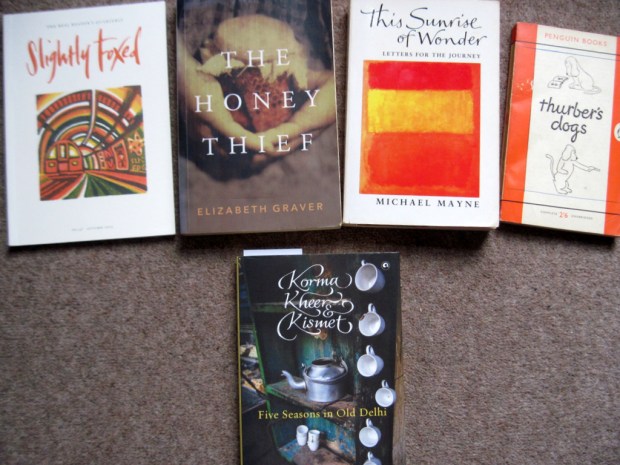
Day 4, Thursday the 5th: SUNSHINE, at last! After hearty omelettes, we headed to the hill that overlooks the town to get the best views of the week. On to Monreith for a charming coastal walk up to the Gavin Maxwell monument of a bronze otter. (He wrote Ring of Bright Water, which my husband brought along to read on our trip.) After a lunch stop back in town, it was out to the red kite feeding station about 40 minutes away – I came for the books; my husband came for the red kites. Though they’re common enough in our part of Berkshire, he was keen to see the site of another recent reintroduction. Wales also has a feeding station we visited some years ago, and on both occasions seeing dozens of birds swoop down for meat was quite the spectacle – though here you sit on an open porch, even closer to the action. We did a few other short walks in the area, finishing off with a sunset sit in Wigtown’s bird hide.


Today’s book shopping: ReadingLasses calls itself Britain’s only women’s bookshop. They stock Persephone Books direct from Bloomsbury, and they also have a large selection of secondhand books. This is the best place to go in town for a light meal and a snack. We had delicious homemade soup with soda bread for an early lunch, followed by coffee and tiffin. I bought a novel by Candia McWilliam, a Scottish author I’ve only read nonfiction by before.


At Curly Tale Books, the children’s bookshop next-door to The Bookshop, we bought a picture book about the local ‘belted’ Galloway cows for our niece. We didn’t realize the shop owner is also the author! She offered to sign the book for us, but we decided that a five-year-old wouldn’t appreciate it enough.
Day 5, Friday the 6th: Full Scottish breakfast to see us on our way, and a farewell to the two B&B cats, including the fluffiest cat on earth. To break up the rather arduous journey, we stopped early on at the Cairn Holy stone circle/tomb and the Cream o’ Galloway farm shop for cheese and ice cream. Home at 7:30 p.m. to find something from the freezer for dinner, unpack and shelve all these new books.
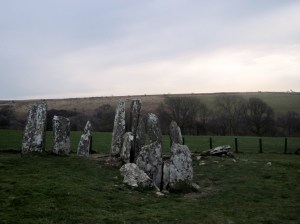
Cairn Holy
Total acquisitions: 13 books for me, 7 books for my husband, 3 books for gifts
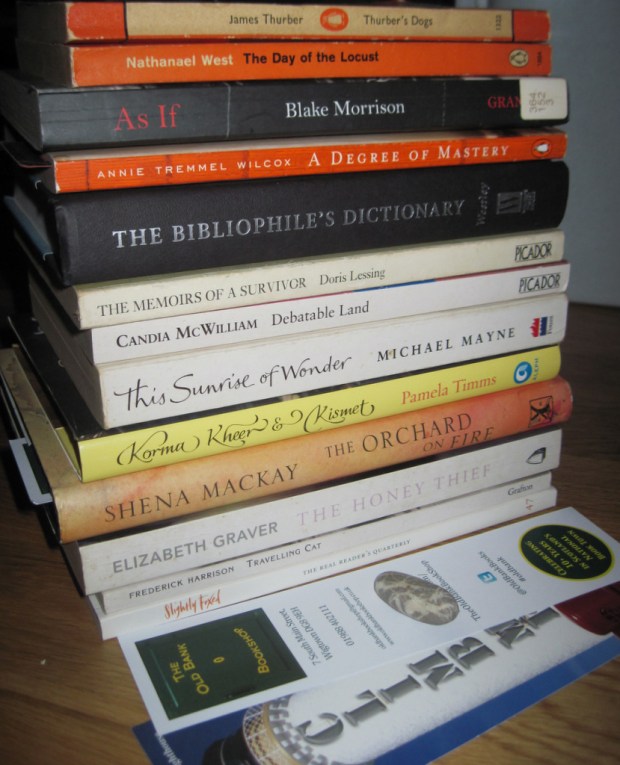
Wigtown is more than twice as far away as Hay is for us, so we’re less likely to go back. (It’s also a tough place to find a decent evening meal.) However, I’d like to think that life will take me back to Wigtown someday, perhaps for the Festival, or for a stay at The Open Book – though I’d have to start planning ahead to 2021!
What I read:
Bits of lots of books I had on the go, but mostly a few vaguely appropriate titles:
Under the Skin by Michel Faber was the perfect book for reading on rainy Scottish highways. I’m so glad I decided at the last minute to bring it. Isserley drives along Highland roads picking up hitchhikers – but only the hunky males – to take back to her farm near the Moray Firth. It’s likely that you already know the setup of this even if you haven’t read it, perhaps from the buzz around the 2013 film version starring Scarlett Johansson. It must have been so difficult for the first reviewers and interviewers to discuss the book without spoilers back in 2000. David Mitchell, in his introduction to my Canons series reprint, does an admirable job of suggesting the eeriness of the contents without giving anything significant away.
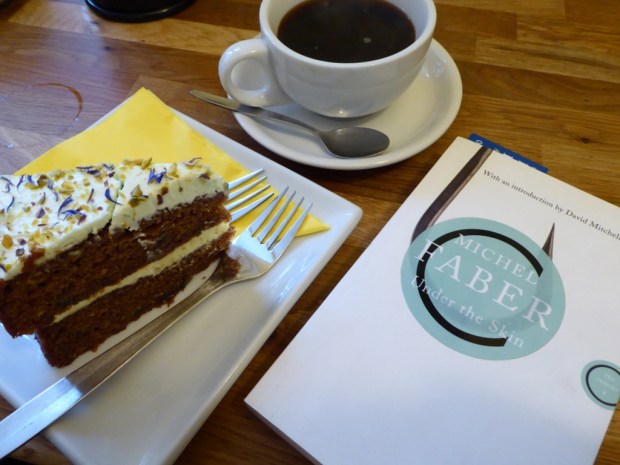
Shelve this under science fiction, though it veers towards horror and then becomes a telling allegory. I knew the basic plot beforehand, but there were still some surprises awaiting me, and I was impressed with how Faber pulled it all off. Keep an eye open for how he uses the word “human.” This has a lot to say about compassion and dignity, and how despite our differences we are fundamentally the same “under the skin.” 
An atmospheric line: “The fields all around her house were shrouded in snow, with patches of dark earth poking through here and there as if the world were a rich fruit cake under cream.”
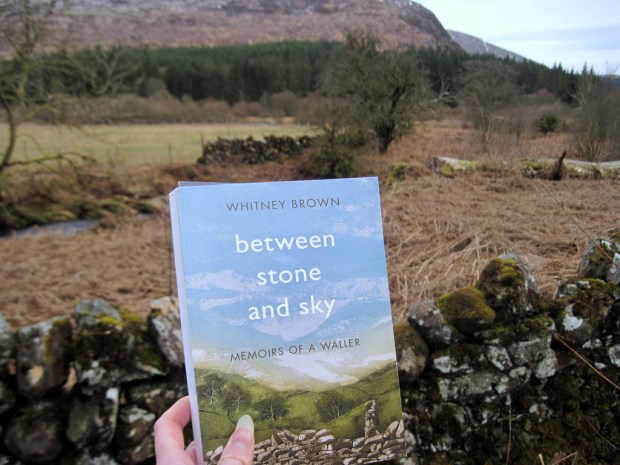
Between Stone and Sky: Memoirs of a Waller by Whitney Brown: For a TLS review. Brown, from South Carolina, trained as a dry-stone waller in Wales (where she fell in love with a man who wouldn’t marry her), but we saw plenty such walls in Scotland too. As an expat I could relate to her feeling of being split between two countries.  (Releases May 17th.)
I n the Days of Rain: A daughter. A father. A cult. by Rebecca Stott: I read the first two-fifths or so, mostly in the car and over our leisurely B&B breakfasts. One branch of Stott’s Exclusive Brethren family came from Eyemouth, a Scottish fishing village. A family memoir, a bereavement memoir, a theological theme: this brings together a lot of my favorite things. And it won last year’s Costa Biography Award, so you know it’s got to be good.
I also started two books by Scottish novelists, The Orchard on Fire by Shena Mackay and The Accidental by Ali Smith – though I don’t know if I’ll make it through the latter.
The Diary of a Bookseller by Shaun Bythell
So you think you’d like to run a bookshop? Here’s a book to tempt and deter you in equal measure. In 2001 Shaun Bythell acquired The Bookshop, the flagship bookstore in Wigtown, the Book Town in Galloway in the southwest of Scotland. Here he gives a one-year snapshot of life at the shop, from February 2014 to February 2015. At the start you can feel the winter chill in the old granite building, and as months pass you sense mounting excitement at preparations for the annual Book Festival (going on now) and the Scottish referendum. It’s a pleasure to spend a vicarious year at the shop. This would make a great bedside book for a bookish type to parcel out 5–10 pages at a time (another Christmas gift idea?).
 Bythell frequently ventures out to buy book collections in auctions and from estates, and occasionally goes fishing with his father or friends. But mostly we see what daily life is like for a bookshop owner. He can’t afford full-time staff, so gets sporadic help from university-age gals; his most “reliable” part-timer is Nicky, a ski suit-wearing, Dumpster-diving Jehovah’s Witness who blithely ignores much of what he asks her to do.
Every entry opens and closes with statistics on the day’s takings and online orders. Profits range from £5 to £500 a day, rising in the summer and peaking around £1200 during the festival. Also listed is the number of customers who make purchases, which represents only one-fifth of daily footfall. Nowadays most bookstores sell online too, and The Bookshop reluctantly partners with Amazon as a marketplace seller. There’s also ABE and eBay; as a last-ditch option, some outfits take books in bulk, even if just to recycle them. Alongside online sales, it’s essential for bookstores to have sidelines. Bythell does video production and sells furniture, antiques and walking sticks carved by “Sandy, the tattooed pagan.”
As with Wendy Welch’s The Little Bookstore of Big Stone Gap, I enjoyed the nitty-gritty details about acquiring and pricing books, especially the serendipitous moments of coming across real treasures, like a book signed by Sir Walter Scott and a 1679 edition of the Decameron with an interesting provenance. The book is also full of quirky customer behavior, the kind of stuff that fills The Bookshop’s Facebook feed. Bythell cultivates a curmudgeonly persona – he once shot a broken Kindle and mounted it on the bookshop wall – and maintains a tone that’s somewhere between George Orwell (excerpts from whose “Bookshop Memories” serve as monthly epigraphs) and Jen Campbell (Weird Things Customers Say in Bookshops et al.). Here’s a few of the best encounters:
a whistling customer with a ponytail and what I can only assume was a hat he’d borrowed from a clown bought a copy of Paolo Coelho’s The Alchemist, I suspect deliberately to undermine my faith in humanity and dampen my spirits further.
A man smelling of TCP [antiseptic] was the only customer in the shop for the first hour of opening, during which time I attempted to put out fresh stock. He had an uncanny ability to be standing in front of every shelf to which I needed access, regardless of the subject or where in the shop the relevant shelves were.
While I was repairing a broken shelf in the crime section, I overheard an elderly customer confusing E. L. James and M. R. James while discussing horror fiction with her friend. She is either going to be pleasantly surprised or deeply shocked when she gets home with the copy of Fifty Shades of Grey she bought.
I’ve been to Hay-on-Wye six times now but haven’t made it to Wigtown yet. It’s high on my bookish wish list. I had two additional reasons for wanting to read this particular book: I’d read Three Things You Need to Know about Rockets, a memoir by Bythell’s former partner, the American Jessica Fox (here known as “Anna”; in her book he’s “Ewan”), about coming to Scotland on a whim and falling in love with a bookshop owner; and I’m awfully fond of The Bookshop Band, a folky husband–wife musical duo who this year relocated from Bath to Wigtown. It was such fun to read about their first time playing in Wigtown and their stay as the inaugural guests/temporary store managers via The Open Book Airbnb project.

Colin Kinnear [CC BY-SA 2.0 (https://creativecommons.org/licenses/by-sa/2.0)%5D, via Wikimedia Commons.
The Book Shop trivia:
- December is by far the quietest month. (“The few people who give second-hand books as gifts for Christmas are usually eccentric” – count me as one of them!)
- Railway books sell best.
- Terry Pratchett, John Buchan, P.G. Wodehouse and E.F. Benson books are also perennial best sellers.
- You’ll be amazed at how many customers try to haggle over prices. It’s a shop, not a rummage sale, for goodness’ sake! I can’t imagine ever having the cheek to offer less than the advertised price.
My rating:
The Diary of a Bookseller was released in the UK on September 28th. My thanks to Profile Books for the free review copy.
 Bookish Beck = Rebecca Foster. American transplant to England. Freelance proofreader and book reviewer.
 Bookish Beck