March Releases by Akbar, Bosker, García Márquez, and Wrenn
I’m catching up after a busy end to last month. Today I have an uneven debut novel from a poet whose work I’ve enjoyed before, a journalist’s jaunty submersion in the world of modern art, a posthumous novella from a famous Colombian author I’d not previously read, and a (literally) trippy memoir about C-PTSD, coral, climate breakdown, queerness and more. I can pinpoint a couple of elements that some or all of them have in common: beauty (whether in art or in nature) and dead mothers.
Martyr! by Kaveh Akbar
I’d read the Iranian American poet’s two full-length collections and particularly admired Pilgrim Bell, one of my favourite books of 2021. That was enough for me to put this on my Most Anticipated list for 2024, even though based on the synopsis I wrote: “His debut novel sounds kind of unhinged, but I figure it’s worth a try.” Here’s an excerpt from the publisher’s blurb: “When Cyrus’s obsession with the lives of the martyrs – Bobby Sands, Joan of Arc – leads him to a chance encounter with a dying artist, he finds himself drawn towards the mysteries of an uncle who rode through Iranian battlefields dressed as the Angel of Death; and toward his [late] mother, who may not have been who or what she seemed.”
 Cyrus Shams is an Iranian American aspiring poet who grew up in Indiana with a single father, his mother Roya having died in a passenger aircraft mistakenly shot down by a U.S. Navy missile cruiser (this really happened: Iran Air Flight 655, on 3 July 1988). He continues to lurk around the Keady University campus, working as a medical actor at the hospital, but his ambition is to write. During his shaky recovery from drug and alcohol abuse, he undertakes a project that seems divinely inspired: “Tired of interventionist pyrotechnics like burning bushes and locust plagues, maybe God now worked through the tired eyes of drunk Iranians in the American Midwest”. By seeking the meaning in others’ deaths, he hopes his modern “Book of Martyrs” will teach him how to cherish his own life.
This document, which we see in fragments, sets up hypothetical dialogues between figures real and imaginary, dead and living, and intersperses them with poems and short musings. But when a friend tells Cyrus about the Brooklyn Museum installation “DEATH-SPEAK,” which has terminally ill Iranian artist Orkideh living out her last days in public, he spies an opportunity to move the work beyond theory and into the physical realm. So he flies to New York City with his best friend (and occasional f**kbuddy), bartender Zee Novak, and visits Orkideh every day until the installation’s/artist’s end.
This is a wildly original but unruly novel with a few problems. One: Akbar has clung too obviously to his own story and manner of speaking with Cyrus (e.g., “I honestly actually do worry about that, no joke. Being a young Iranian man making a book about martyrdom, going around talking to people about becoming a martyr. It’s not inert, you know?”). Another is that the poems, and poetic descriptions, are much the best material. The only exception might be a zany scene where Zee and Cyrus chop wood while high. But the main issue I had is that the plot turns on a twist 50 pages from the end, a huge coincidence that feels unearned. I admire the ambition Akbar had for this – a seething, open-hearted enquiry into addiction, love, suicide and queerness – but look forward to him getting back to poetry. 
With thanks to Picador for the proof copy for review.
Get the Picture: A Mind-Bending Journey among the Inspired Artists and Obsessive Art Fiends Who Taught Me How to See by Bianca Bosker
I was a big fan of Bosker’s Cork Dork (2017), her deep dive into the world of fine wine. Her second book is similarly constructed and equally fun: more personal than authoritative, light yet substantial, and accessible to the uninitiated as well as those with an existing interest in the subject. She begins as a complete novice, wondering if she’ll ever know what art is, let alone what it means and whether it’s any good (“the familiar feeling that everyone got the punch line except me”). By the end, she has discovered that, like the love of wine, art appreciation can be a way of expanding and savouring one’s life.
The aim was to get the broadest experience possible, generally through voluntary placements. She started out as an assistant at Jack Barrett’s 315 Gallery, where one of her tasks was to paint a wall white; she failed miserably to meet his expectations even for this simple task. He never lost his fundamental distrust of her, a writer and outsider, as one of “the enemy.” It was expected that she would attend as many art shows and openings as possible per week. “Talking shit was essentially a job requirement.” Bosker might not have known what to make of the art, but others were gossipy, snobbish and opinionated enough to make up for it. When she was tasked with writing a press release for an exhibit, a gallerist taught her the clichéd shorthand: “Every f**king artist allegedly transforms the familiar into the unfamiliar, or vice versa.”

In the course of the book, the New York City-based author also:
- attends the Art Basel Miami Beach contemporary art fair and sells photographs on behalf of Denny Dimin Gallery;
- befriends performance artist and “ass influencer” Mandy AllFIRE, who – ahem – sits on Bosker’s face as part of a temporary installment;
- serves as a studio assistant for French painter Julie Curtiss, whose work is selling for alarmingly high amounts at auction (not actually what a painter wants, as it tends to signal bad things for a career);
- meets a pair of North Dakota collectors known as “the Icy Gays”; and
- works as a Guggenheim Museum guard.
This last was my favourite episode. Forty-minute placements on particular ramps gave her time to focus on one chosen artwork – for instance, an abstract sculpture. She challenged herself to stay with it for that whole time, doing as one artist advised and simply noticing five things about the work. Before, her “default approach to art had just been to plant myself in front of a piece and wait for the epiphany to wash over me.” Now, she worked at it. In fact, she counsels newcomers to not read a caption because many people take a title at face value and an interpretation as gospel, and so don’t experience the art for themselves.
At times I found the book slightly scattered in the way that it zigzags from one challenge to another. There’s differing attention to various experiences; a week-long art school merits just one paragraph. And there’s no getting past the fact that some art she encounters sounds outlandish or just plain silly. (Is it any surprise that she mistakes part of a wall, and a mousetrap, for art pieces?) Ultimately, I think it’s best if you have at least a modicum of appreciation for modern art, which I don’t; whereas I do enjoy drinking wine even if I don’t have a trained palate.
Even so, Bosker’s writing has such verve (“artists were coyly evasive about their work and treated my questions like I was a cactus running after their balloon”; “a hazy daydream of an idea solidified into a yappy, un-shut-uppable chihuahua of want”) that you’ll be glad you went along for the ride. She concludes that taste is subjective, but “Beauty … pulls you close.” Art is valuable because it “knocks us off our well-worn pathways” into something uncharted, a tantalizing prospect. 
With thanks to Allen & Unwin (Grove Press) for the free copy for review.
{SPOILERS IN THIS NEXT ONE}
Until August by Gabriel García Márquez
[Translated from the Spanish by Anne McLean]
A posthumous ‘lost’ novella was not a good place for me to have started with this celebrated author. García Márquez okayed the fifth draft of the text in 2004, 10 years before his death. By this time he was already suffering with memory loss that interfered with his creativity. His sons got the message that he didn’t think the book worked and should be destroyed. But they didn’t do his bidding and, revisiting the book nearly a decade on from his death, decided it wasn’t that bad, if not up to the standard of his best work, and that it should see the light of day after all.
Every August 16th, Ana Magdalena Bach travels to the island where her mother is buried to visit the grave and lay gladioli on it. (My review book came with a bag of three gladioli bulbs and a mini Colombian chocolate bar.) Each year she takes a different lover for the one night at a hotel. The first time, the man leaves her a $20 bill and she feels ashamed, but it doesn’t stop her doing the same thing again for the next four years in a row. Once it’s a long-ago school friend whom she runs into on the ferry. Another time, by golly, it’s a bishop.

It’s refreshing to have a woman in middle age as protagonist and for her to claim sexual freedom. However, the setup is formulaic and repetitive, the sex scenes are somewhat excruciating, and the hypocrisy of her gleefully having one-night stands while fretting over her husband’s potential infidelity is grating. I did like the ending – Ana hears that an anonymous elderly gentleman has been paying to have gladioli laid on her mother’s grave year-round and she wonders if she is in a sense following in her mother’s footsteps all along without knowing it; and decides she’s had enough and exhumes her mother’s remains, returning to her husband with a bag of bones (gruesome!).
But nothing about the plot or the writing – fluid enough bar one awkward sentence (“She listened to him worried that he meant it, but she had the strength not to appear as easy a woman as he might think”) – suggested to me a master at work. At best, this might be reminiscent of the late work of misogynist-leaning authors like Coetzee or Updike.
In my mind García Márquez is linked with magic realism, so I’d be better off trying one of his more representative works. I have several of his earlier novellas on the shelf (received as review copies as part of the same recent marketing push), and if I get on better with those then I’ll be sure to try one of the most famous full-length novels. 
With thanks to Viking (Penguin) for the free copy for review.
Mothership: A Memoir of Wonder and Crisis by Greg Wrenn
Wrenn is an associate English professor teaching environmental literature at James Madison University. He has also been exploring coral reefs for 25 years, with a love of marine wildlife sparked by growing up in Florida. But all along, he’s been trying (much like Cyrus Shams) to come to terms with addiction, queerness, suicidal inclinations, and especially his mother’s place in his life. She made him feel dirty, that he would never be good enough; she hit him with a wooden spoon and bathed him until he was 17. Though he never found out for sure, he suspects his mother was sexually abused by her father and repeated the cycle of molestation.
 This is the third C-PTSD memoir I’ve read (after What My Bones Know and A Flat Place), and has a lot in common with I’m Glad My Mom Died, which features a co-dependent relationship with an abusive mother. After Wrenn’s parents’ divorce, he and his mother remained close. “I had been her therapist, confessor, girlfriend, and punching bag.” He helped care for her after a stroke but eventually had to throw up his hands at her stubborn refusal to follow doctors’ orders. Drawing on the Greek etymology of ecology (oikos means house or family), Wrenn insists on a parallel between the personal and the environmental here: “What we’re facing amounts to global C-PTSD” as “Mother” Earth turns against us. On each trip to Raja Ampat, he knows the coral reef is dying, his carbon footprint only accelerating it.
There’s a lot in this short memoir. Even the summary had me shaking my head in disbelief. For me, though, the tone and style were too erratic. Wrenn can be wry, sorrowful, or campy; he includes scientific data, letters to Adrienne Rich and an imagined descendent, a chapter riffing on “Otters” (the animal and the gay stereotype), flashbacks, and E.T. metaphors. The final third of the book then takes a left turn as he experiments with therapeutic psychedelics via ayahuasca ceremonies in South America, and ditches dating apps and casual sex to try to find a long-term relationship. The drug literally alters his brain, allowing him to feel trust and love. Add on nature and a husband and that’s why he’s still here rather than dead by suicide.
Like Akbar, Wrenn published poetry before switching genre. Their books are both amazing in premise but wobbly in execution. Still, I’d say both authors are laudable for their effort to depict lives wrenched back from extremity. 
With thanks to Regalo Press (USA) for the proof copy for review.
Thinking about the Future with David Farrier & Roman Krznaric (Hay Festival)
My last of three digital Hay Festival* talks this year was by Roman Krznaric, a School of Life philosopher with a background in politics and gardening. I discovered him through Greenbelt Festival eight years ago and have since enjoyed several of his books on the topics of empathy, finding purposeful work, and models for living well. His talk on his upcoming book, The Good Ancestor: How to Think Long Term in a Short Term World, was an ideal follow-up to one of the top three 2020 nonfiction works I’ve read so far:
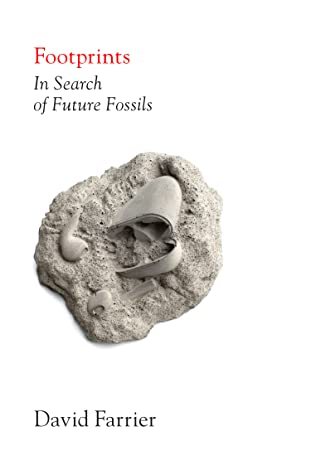
Footprints: In Search of Future Fossils by David Farrier
Look on my Works, ye Mighty, and despair!
Nothing beside remains. Round the decay
Of that colossal Wreck, boundless and bare
The lone and level sands stretch far away.
~from “Ozymandias” by Percy Bysshe Shelley
In May 2013 a set of fossil human footprints was found at Happisburgh in Norfolk. At 850,000 years old, they were the oldest outside of Africa. In the same month, atmospheric CO2 passed 400 ppm for the first time. It’s via such juxtapositions of past and future, and longevity versus precariousness, that Farrier’s book – a sophisticated lattice of human and planetary history, environmental realism and literary echoes – tells the story of the human impact on the Earth.
Unusually, Farrier is not a historian or a climate scientist, but a senior lecturer in English literature at the University of Edinburgh specializing in nature and place writing, especially in relation to the Anthropocene. That humanities focus allowed him to craft a truly unique, interdisciplinary work in which the canon both foreshadows and responds to environmental collapse. On a sabbatical in Australia, he also gets to hold an ice core taken by an icebreaker, swim above coral reefs and visit a uranium mine exempted from protection in a national park.
 He travels not just through space, but also through time, tracing a plastic bottle from algal bloom to oil to factory to river/landfill to ocean; he thinks about how cultural memory can preserve vanished landscapes; he imagines propitiatory rites arising around radioactive waste to explain poisoned lakes and zinc-lined coffins; and he wonders how to issue appropriate warnings to the future when we don’t even know if English, or language in general, will persist (a nuclear waste storage site in Carlsbad uses a combination of multilingual signs, symbols, monoliths and planned oral tradition, while one in Finland is unmarked).
Each chapter is an intricate blend of fact, experience and story. For example, “The Insatiable Road” is about cars and the concrete landscapes they zip through – all made possible by oil. Farrier wins a chance to be among the first to cross the new Forth Bridge on foot and finds himself awed by the human achievement. Yet he knows that, in a car, the bridge will be crossed in seconds and soon taken for granted. Whether as a driver or a passenger, we have become detached from the journey and from the places we are travelling through. The road trip, a standard element of twentieth-century art and literature, has lost its lustre. “Really, we have conceded so much,” he writes. “Most of us live and wander only where road networks permit us to, creeping along their edges and lulled into deafness by their constant roar.” Ben Okri’s legend provides the metaphor of a famished road that swallows all in its path.
What will the human species leave behind? “The entire atmosphere now bears the marks of our passage … Perhaps no one will be around to read our traces, but nonetheless we are, everywhere, constantly, and with the most astonishing profligacy, leaving a legacy that will endure for hundreds of thousands or even hundreds of millions of years to come.” That legacy includes the concrete foundations of massive road networks, the remnants of megacities on coastal plains, plastics that will endure for many centuries, carbon and methane locked up in permafrost, the 2300-km fossil of the dead Great Barrier Reef, nuclear waste in isolation plants, jellyfish-dominated oceans and decimated microbial life.
Thinking long term doesn’t come naturally. In the same way that multiple books of 2019 (Time Song, Surfacing, Underland) helped us think about the place of humanity in reference to deep time, Footprints offers an invaluable window onto the deep future. Its dichotomies of hubris and atonement, and culpability versus indifference, are essential to ponder. It was always going to be sobering to read about how we have damaged our only home, but I never found this to be a needlessly depressing book; it is clear-eyed and forthright, but also meditative and beautifully constructed. Life on the planet continues in spite of our alterations, but all the diminishment was unavoidable, and perhaps some of it is remediable still.
My rating: 
 Related reading: Notes from an Apocalypse by Mark O’Connell. I’m only up to page 36 and at the moment it’s just him watching loads of crackpot preppers’ videos on YouTube, but already I think that Footprints should have had this book’s spot on the Wainwright Prize for Writing on Global Conservation longlist (a new prize run in addition to the standard UK nature writing one) for being more directly engaged with conservation issues rather than just humorously commenting on the end-of-the-world mindset.
Roman Krznaric at Hay Festival
 Krznaric’s discussion of being a “good ancestor” resonated in connection with the long-term thinking of Farrier’s book. “This is the age of the tyranny of the now,” he began, but “humankind has colonized the future” as well, treating it as a tempus nullius where we can dump our ecological waste and tech failures. Yet long-termism is needed more than ever as a way of planning for environmental challenges (and pandemics and the like). Future generations have no say in the decisions we make now that will affect them. To put this in perspective, he showed an image of three spheres, proportionally sized: one represented the 100 billion dead, one was the 7.7 billion currently living, and one was the 6.75 trillion in unborn generations (if the current birth rate continues).
It was Jonas Salk, creator of the polio vaccine, who asked, “Are we being good ancestors?” Krznaric invited the audience to come up with examples (in the chat window on the sidebar) of long-term projects through which people are trying to help future generations, such as the Svalbard Seed Depository, the Green New Deal, the 10,000-Year Clock (inside a mountain in the Texas desert), the Long Play piece of music to last 1,000 years, rewilding, archives and libraries, and tree planting. He had also opened the talk with his own modest contribution: he and his partner ‘gave’ their 11-year-old twins their votes in the latest election.
Krznaric elaborated on four of his book’s six ways of thinking about the future: 1) Rethink human nature by using the “acorn brain” (long-term thinking) rather than the “marshmallow brain” (instant gratification). 2) Embark on projects with long time horizons (“cathedral thinking”). 3) Think in terms of legacies, whether familial or transcendent – leaving a gift to the citizens of the future (e.g. The Future Library of 100 books not published or read until 2114). 4) Create a politics for the future, e.g. the citizen assembly movement.
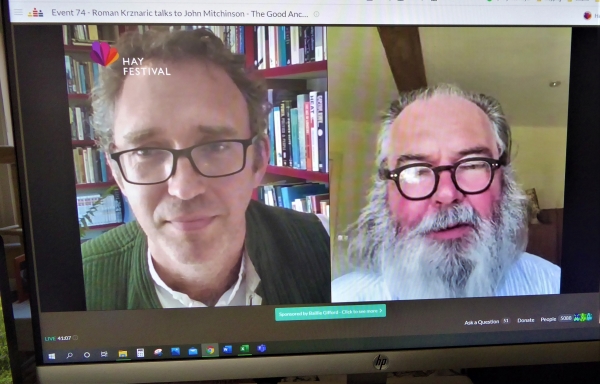
Roman Krznaric at the digital Hay Festival. Q&A led by John Mitchinson (right).
In the case of the UK, Krznaric advocates abolishing the House of Lords, replacing it with a citizens’ assembly and a Minister for the Future, and establishing legal rights for future generations. He noted that globally we’re at a “devil’s fork” where there’s a danger of authoritarian regulations continuing around the world after quarantine ends, endangering the future of social democracy. Instead, we need grassroots activism and “doughnut economics.” He pictures devolution of power away from central governments, with progressive cities becoming new loci of power. Individual actions like vowing not to fly and installing solar panels can inspire peers, but only collective action can tackle environmental breakdown.
 Related reading: I’ll be reviewing Eric Holthaus’s forthcoming book The Future Earth: A Radical Vision for What’s Possible in the Age of Warming for BookBrowse later this month. The meteorologist and science journalist fleshes out some of Krznaric’s ideas, such as a citizen assembly and the cyclical economy, in his proposal for the drastic changes needed over the next three decades.
*You can access the recorded Hay Festival talks by paying a £10 annual subscription here.
 Bookish Beck = Rebecca Foster. American transplant to England. Freelance proofreader and book reviewer.
 Bookish Beck