American Book Acquisitions and 2019 Reading Goals
We arrived in the UK on January 1, after an overnight flight from Baltimore. There was no midnight announcement, no complimentary champagne; nothing. Clearly I had my hopes too high. So we’re feeling a bit cheated out of our New Year’s Eve experience and will be doing a recreated countdown and toast when we have houseguests over for this Epiphany weekend.
It was a low-key, relaxing couple of weeks back in the States, the majority of it spent seeing family and friends. We also made it into D.C. to see the new Obama portraits. Mostly I enjoyed doing not a lick of work. And I acquired books, of course: a secondhand and remainder stack that, after my trade-in of some cast-off books, cost just $4; and a few ARCs I’m excited about.


2019 Goals
I’m feeling restless in my career, like if someone gave me permission to quit all my gigs I would do it tomorrow. But, of course, only a fool would do so with no plan to replace them with other remunerative work. The year is likely to involve a lot of rethinking for me as I evaluate which of my proofreading and writing jobs feel worthwhile, and what’s taking me in the direction I want to go (not that I currently know what that is).
Life is awfully hard to plan out. Reading is much easier! So here are my fairly modest reading goals for the year, some of them overlapping:
- I plan to reinstate the Classic and Doorstopper of the month features I ran in 2017, since otherwise I hardly ever read them. I’m starting with Annabel’s readalong of The Name of the Rose by Umberto Eco, which is just over 500 pages but also conveniently falls into one of the below categories.

The doorstoppers I have around to choose from.
- I’ll make a second attempt at getting through some of the travel books and biographies I own, though I won’t hold myself to any particular target. At least five of each would be nice.


- I’m determined to up my literature in translation ratio. These are all the books I own that were originally published in other languages – pitiful! – but I will get hold of more through the library and publishers.

- Re-reading is something I undertake very reluctantly. I have friends who swear by it, but to me it can feel like a waste of time. Last year I re-read just four books: Little Women, Give Me Everything You Have, Crossing the Moon, and Diary of a Bookseller. In each case, on the second reading I rated the book a star lower. That suggests that, far from appreciating books more on a second reading, I have less patience with them and find more flaws! All the same, I’ve chosen four books to re-read in 2019. The Collins is a longtime favorite about moving to Hay-on-Wye; the Thomas is one of the books that first got me into reading memoirs. I’ve been let down by Lamott’s latest three books so wanted to go back to one of her spiritual classics; I’ve gotten into L’Engle’s writing for adults and want to revisit her most famous children’s book (which I don’t think I comprehended at age nine or whatever I was).
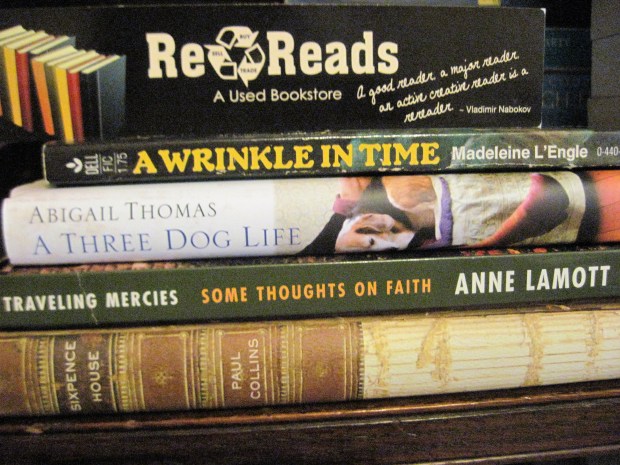
- I have a bad habit of racing through self-help and theology books rather than taking my time mulling over them and fully exploring how I might apply them in my life. This was especially true of The Artist’s Way, one of my bibliotherapy prescriptions. I started out with the aim of completing the daily “morning pages” of free writing (though for me they were ‘evening pages’; I’m not a morning person) and each chapter’s self-knowledge exercises. But soon I’d given up on the writing and contemplation and begun just reading the book straight through, which is not the point of it at all. So this year I mean to go back through the Cameron and Rubin books more mindfully, and use the McLaren devotional as it is intended, reading the recommended Bible passages alongside the weekly reflections.

What are some of your goals (reading-related or otherwise) for 2019?
#16–17: The Life and Loves of Lena Gaunt & The Invisible Bridge
I’m coming towards the close of my 20 Books of Summer challenge. Now, I’ve done plenty of substituting – some of my choices from early in the summer will have to spill over into the autumn (for instance, I’m reading the May Sarton biography slowly and carefully so am unlikely to finish it before early September) or simply wait for another time – but in the end I will have read 20+ books I own in print by women authors. (Ongoing/still to come are a few buddy reads: Half of a Yellow Sun by Chimamanda Ngozi Adichie with Anna Caig; Late Nights on Air by Elizabeth Hay with Naomi of Consumed by Ink and Penny of Literary Hoarders; and West with the Night by Beryl Markham with Laila of Big Reading Life.)
The two #20Booksof Summer I finished most recently have been the best so far. I’d heard great things about these debut novels but let years go by before getting hold of them, and then months more before picking them up. Though one is more than twice the length of the other, they are both examples of large-scale storytelling at its best: we as readers are privy to the sweep of a whole life, and get to know the protagonists so well that we ache for their sorrow. What might have helped the authors tap into the emotional power of their stories is that both drew on family history, to different extents, when creating the characters and incidents.
The Life and Loves of Lena Gaunt by Tracy Farr (2013)
 Lena Gaunt: early theremin player, grande dame of electronic music, and opium addict. When we meet our 81-year-old narrator, she’s just performed at the 1991 Transformer Festival and has caught the attention of a younger acolyte who wants to come interview her at home near Perth, Australia for a documentary film – a setup that reminded me a bit of May Sarton’s Mrs. Stevens Hears the Mermaids Singing. It’s pretty jolting the first time we see Lena smoke, but as her life story unfolds it becomes clear that it’s been full of major losses, some nearly unbearable in their cruelty, so it’s no surprise that she would wish to forget.
Though Lena bridles at Mo’s many probing questions, she realizes this may be her last chance to have her say and starts typing up a record of her later years to add to a sheaf of autobiographical stories she wrote earlier in life. These are interspersed with the present action to create a vivid collage of Lena’s life: growing up with a pet monkey in Singapore, moving to New Zealand with her lover, frequenting jazz clubs in Paris, and splitting her time between teaching music in England and performing in New York City.
With perfect pitch and recall, young Lena moved easily from the piano to the cello to the theremin. I loved how Farr evokes the strangeness and energy of theremin music, and how sound waves find a metaphorical echo in the ocean’s waves – swimming is Lena’s other great passion. Life has been an overwhelming force from which she’s only wrested fleeting happiness, and there’s a quiet, melancholic dignity to her voice. This was nominated for several prizes in Australia, where Farr is from, but has been unfairly overlooked elsewhere.
Favorite lines:
“I once again wring magic from the wires by simply plucking and stroking my fingers in the aether.”
“I felt the rush of the electrical field through my body. I felt like a god. I felt like a queen. I felt like a conqueror. And I wanted to play it forever.”
“All of the stories of my life have begun and ended with the ocean.”
My rating: 
The Life and Loves of Lena Gaunt was published in the UK by Aardvark Bureau in 2016. My thanks to the publisher for a free copy for review.
The Invisible Bridge by Julie Orringer (2010)
 It’s all too easy to burn out on World War II narratives these days, but this is among the very best I’ve read. It bears similarities to other war sagas such as Birdsong and All the Light We Cannot See, but the focus on the Hungarian Jewish experience was new for me. Although there are brief glimpses backwards and forwards, most of the 750-page book is set during the years 1937–45, as Andras Lévi travels from Budapest to Paris to study architecture, falls in love with an older woman who runs a ballet school, and – along with his parents, brothers, and friends – has to adjust to the increasingly strict constraints on Jews across Europe.
A story of survival against all the odds, this doesn’t get especially dark until the last sixth or so, and doesn’t stay really dark for long. So if you think you can’t handle another Holocaust story, I’d encourage you to make an exception for Orringer’s impeccably researched and plotted novel. Even in labor camps, there are flashes of levity, like the satirical newspapers that Andras and a friend distribute among their fellow conscripts, while the knowledge that the family line continues into the present day provides a hopeful ending.
This is a flawless blend of family legend, wider history, and a good old-fashioned love story. I read the first 70 pages on the plane back from America but would have liked to find more excuses to read great big chunks of it at once. Sinking deep into an armchair with a doorstopper is a perfect summer activity (though also winter … any time, really). [First recommended to me by Andrea Borod (aka the Book Dumpling) over five years ago.]
Favorite lines:
“He felt the stirring of a new ache, something like homesickness but located deeper in his mind; it was an ache for the time when his heart had been a simple and satisfied thing, small as the green apples that grew in his father’s orchard.”
“[It] seemed to be one of the central truths of his life: that in any moment of happiness there was a reminder of bitterness or tragedy, like the ten plague drops spilled from the Passover cup, or the taste of wormwood in absinthe that no amount of sugar could disguise.”
“For years now, he understood at last, he’d had to cultivate the habit of blind hope. It had become as natural to him as breathing.”
My rating: 
December’s Doorstopper: The Heart’s Invisible Furies by John Boyne
The more I examined the architecture of my life, the more I realized how fraudulent were its foundations.
This is a book that wasn’t even on my radar until fairly late on in the year, when I noticed just how many of my Goodreads friends had read it and rated it – almost without fail – 5 stars. I knew John Boyne’s name only through the movie version of his Holocaust-set novel for younger readers, The Boy in the Striped Pajamas, and didn’t think I’d be interested in his work. But the fact that The Heart’s Invisible Furies was written in homage to John Irving (Boyne’s dedicatee) piqued my interest, and I’m so glad I gave it a try. It distills all the best of Irving’s tendencies while eschewing some of his more off-putting ones. Of the Irving novels I’ve read, this is most like The World According to Garp and In One Person, with which it shares, respectively, a strong mother–son relationship and a fairly explicit sexual theme.
 A wonderful seam of humor tempers the awfulness of much of what befalls Cyril Avery, starting with his indifferent adoptive parents, Charles and Maude. Charles is a wealthy banker and incorrigible philanderer occasionally imprisoned for tax evasion, while Maude is a chain-smoking author whose novels, to her great disgust, are earning her a taste of celebrity. Both are cold and preoccupied, always quick to remind Cyril that since he’s adopted he’s “not a real Avery”. The first bright spot in Cyril’s life comes when, at age seven, he meets Julian Woodbead, the son of his father’s lawyer. They become lifelong friends, though Cyril’s feelings are complicated by an unrequited crush. Julian is as ardent a heterosexual as Cyril is a homosexual, and sex drives them apart in unexpected and ironic ways in the years to come.
For Cyril, born in Dublin in 1945, homosexuality seems a terrible curse. It was illegal in Ireland until 1993, so assignations had to be kept top-secret to avoid police persecution and general prejudice. Only when he leaves for Amsterdam and the USA is Cyril able to live the life he wants. The structure of the novel works very well: Boyne checks in on Cyril every seven years, starting with the year of his birth and ending in the year of his death. In every chapter we quickly adjust to a new time period, deftly and subtly marked out by a few details, and catch up on Cyril’s life. Sometimes we don’t see the most climactic moments; instead, we see what happened just before and then Cyril remembers the aftermath for us years later. It’s an effective tour through much of the twentieth century and beyond, punctuated by the AIDS crisis and focusing on the status of homosexuals in Ireland – in 2015 same-sex marriage was legalized, which would have seemed unimaginable a few short decades before.
Boyne also sustains a dramatic irony that kept me reading eagerly: the book opens with the story Cyril’s birth mother told him of her predicament in 1945, and in later chapters Cyril keeps running into this wonderfully indomitable woman in Dublin – but neither of them realizes how intimately they’re connected. Thanks to the first chapter we know they eventually meet and all will be revealed, but exactly when and how is a delicious mystery.
Along with Irving, Dickens must have been a major influence on Boyne. I spotted traces of David Copperfield and Great Expectations in minor characters’ quirks as well as in Cyril’s orphan status, excessive admiration of a romantic interest, and frequent maddening failures to do the right thing. But there are several other recent novels – all doorstoppers – that are remarkably similar in their central themes and questions. In Donna Tartt’s The Goldfinch, Hanya Yanagihara’s A Little Life and Nathan Hill’s The Nix we also have absent or estranged mothers; friends, lovers and adoptive family who help cut through a life of sadness and pain; and the struggle against a fate that seems to force one to live a lie. Given a span of 500 pages or more, it’s easy to become thoroughly engrossed in the life of a flawed character.
The Heart’s Invisible Furies – a phrase Hannah Arendt used to describe the way W.H. Auden wore his experiences on his face – is an alternately heartbreaking and heartening portrait of a life lived in defiance of intolerance and tragedy. A very Irish sense of humor runs all through the dialogue and especially Maude’s stubborn objection to fame. I loved Boyne’s little in-jokes about the writer’s life (“It’s a hideous profession. Entered into by narcissists who think their pathetic little imaginations will be of interest to people they’ve never met”) and thanks to my recent travels I was able to picture a lot of the Dublin and Amsterdam settings. Although it’s been well reviewed on both sides of the Atlantic, I’m baffled that this novel doesn’t have the high profile it deserves. I am especially grateful to Sarah of Sarah’s Book Shelves for naming this her book of the year: knowing her discriminating tastes, I could tell I’d be in for something special. Look out for it on my Best Fiction of 2017 list tomorrow.
My rating:
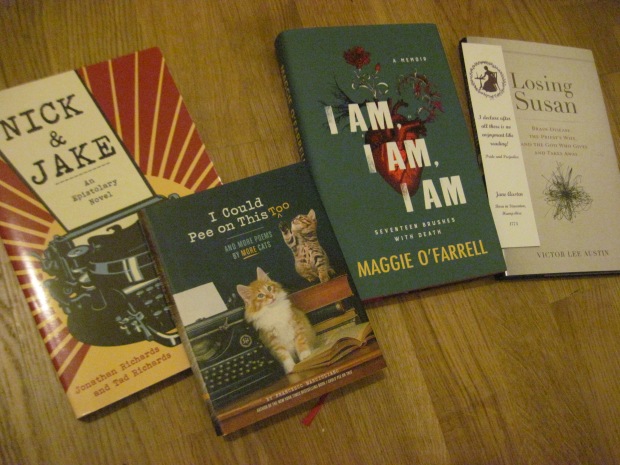
I got just four books for Christmas this year, but they’re all ones I’m very excited to read. I looked back at last year’s Christmas book haul photo and am impressed that I’ve actually read seven out of eight of them now – and the eighth is a cocktail cookbook one wouldn’t read all the way through anyway. All too often I let books sit around for years unread, but I will try to keep up this trend of reading books fairly soon after they enter my collection.
December Reading Plans & Year-End Goals
Somehow the end of the year is less than four weeks away, so it’s time to start getting realistic about what I can read before 2018 begins. I wish I was the sort of person who was always reading books 4+ months before the release date and setting trends, but I’ve only read three 2018 releases so far, and it’s doubtful I’ll get to more than another handful before the end of the year. Any that I do read and can recommend I will round up briefly in a couple weeks or so.
I’m at least feeling pleased with myself for resuming and/or finishing all but two of the 14 books I had on hold as of last month; one I finally DNFed (The Unseen by Roy Jacobsen) and another I’m happy to put off until the new year (Paradise Road: Jack Kerouac’s Lost Highway and My Search for America by Jay Atkinson – since he’s recreating the journey taken for On the Road, I should look over a copy of that first). Ideally, the plan is to finish all the books I’m currently reading to clear the decks for a new year.
Some other vague reading plans for the month:
I might do a Classic of the Month (I’m currently reading The Awakening by Kate Chopin) … but a Doorstopper isn’t looking likely unless I pick up Hillary Clinton’s Living History. However, there are a few books of doorstopper length pictured in the piles below.
Christmas-themed books. The title-less book with the ribbon is Seven Days of Us by Francesca Hornak, a Goodreads giveaway win. I think I’ll start that plus the Amory today since I’m going to a carol service this evening. On Kindle: A Very Russian Christmas, a story anthology I read about half of last year and might finish this year.
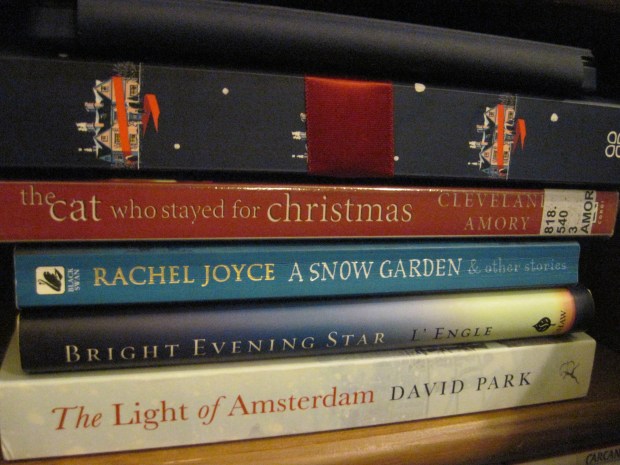
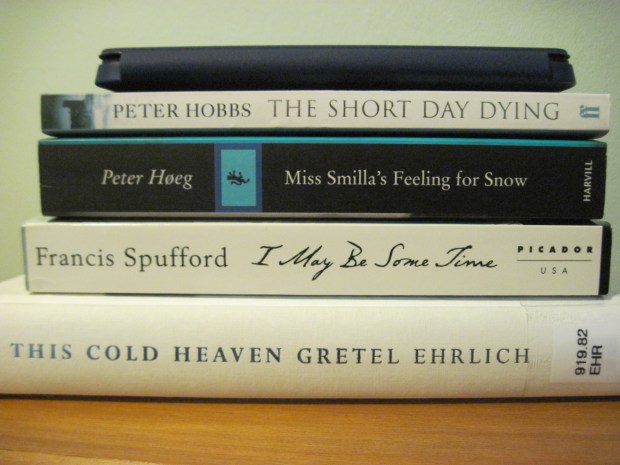
Winter-themed books. On Kindle: currently reading When the Professor Got Stuck in the Snow by Dan Rhodes; Winter by Karl Ove Knausgaard is to be read. (The subtitle of Spufford’s book is “Ice and the English Imagination”.)
As the holidays approach, I start to daydream about what books I might indulge in during the time off. (I’m giving myself 11 whole days off of editing, though I may still have a few paid reviews to squeeze in.) The kinds of books I would like to prioritize are:
Absorbing reads. Books that promise to be thrilling (says the person who doesn’t generally read crime thrillers); books I can get lost in (often long ones). On Kindle: The Bear and the Nightingale by Katherine Arden.
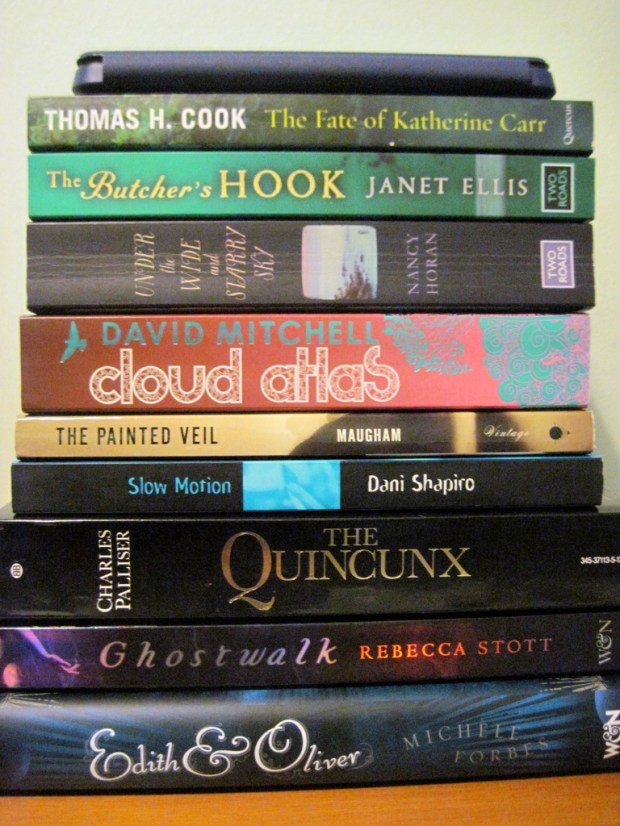
Cozy reads. Animal books, especially cat books, generally fall into this category, as do funny books and children’s books. My mother and I love Braun’s cat mysteries; I read them all starting when I was about 11. I’ve never reread any, so I’d like to see how they stand up years later. Goodreads has been trying to recommend me Duncton Wood for ages, which is funny as I’ve had my eye on it anyway. My husband read the series when he was a kid and we still own some well-worn copies. Given how much I loved Watership Down and Brian Jacques’ novels as a child, I’m hoping it’s a pretty safe bet.

Books I’ve been meaning to read for ages. ’Nuff said. On Kindle: far too many.

And, as always, I’m in the position of wishing I’d gotten to many more of this year’s releases. In fact, there are at least 22 books from 2017 on my e-readers that I still intend to read:
- A Precautionary Tale: How One Small Town Banned Pesticides, Preserved Its Food Heritage, and Inspired a Movement by Philip Ackerman-Leist
- In the Midst of Winter by Isabel Allende
 The Floating World by C. Morgan Babst
- The Day that Went Missing by Richard Beard
- The Best American Series taster volume (skim only?)
- The Heart’s Invisible Furies by John Boyne*
- Guesswork: A Memoir in Essays by Martha Cooley
- The Night Brother by Rosie Garland
- Difficult Women by Roxane Gay
- The Twelve-Mile Straight by Eleanor Henderson
- Eco-Dementia by Janet Kauffman [poetry]
- The Rules Do Not Apply by Ariel Levy
- A Stitch of Time: The Year a Brain Injury Changed My Language and Life by Lauren Marks
- Hug Everyone You Know: A Year of Community, Courage, and Cancer by Antoinette Truglio Martin
 Homing Instinct: Early Motherhood on a Midwestern Farm by Sarah Menkedick
- One Station Away by Olaf Olafsson
- Ghosts of the Tsunami: Death and Life in Japan’s Disaster Zone by Richard Lloyd Parry
- Memory’s Last Breath: Field Notes on My Dementia by Gerda Saunders
- See What I Have Done by Sarah Schmidt
- What She Ate: Six Remarkable Women and the Food That Tells Their Stories by Laura Shapiro
- Midnight at the Bright Ideas Bookstore by Matthew J. Sullivan
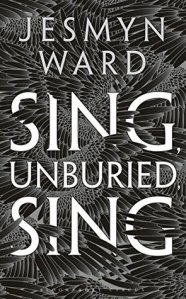
- Sing, Unburied, Sing by Jesmyn Ward*
* = The two I most want to read, and thus will try hardest to get to before the end of the year. But the Boyne sure is long.
[The 2017 book I most wanted to read but never got hold of in any form was The Resurrection of Joan Ashby by Cherise Wolas.]
Are there any books from my stacks or lists that you want to put in a good word for?
How does December’s reading look for you?
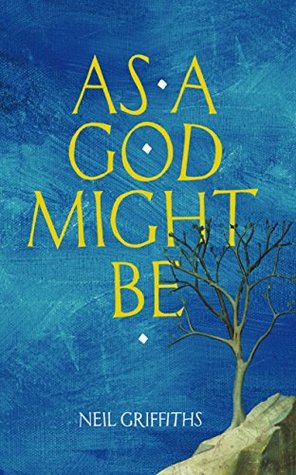
As a God Might Be by Neil Griffiths
[Note: A shortened, edited version of this review appeared in the June 15th, 2018 issue of the Church Times.]
Proctor McCullough isn’t a churchgoer. He’s not even particularly religious. Yet somehow he senses that God is calling him to build a chapel, with a little house beside it, on a cliff in the southwest of England. It’s a source of bewilderment for his partner, Holly, and their London friends. Is Mac mentally ill, or having a particularly acute midlife crisis? He’s handed off from a minister to a therapist to a neurologist, but no one knows what to make of him. This forty-four-year-old father of two, an otherwise entirely rational-seeming advisor to the government on disaster situations, won’t be deterred from his mission.
It’s important to get a sense of the way this character speaks:
I want a structure that will move people to contemplate something other than all the obvious stuff … to be confronted with a sense of something and only be able to define it as Other.
God is the transcendent Other for whom creation, what we know as life, is a gratuitous act of love, a dispossession of a portion of His infinite creativity given over to our thriving. It is a gift from His infinite excess. That we can know Him at all is because of the possibility of this excess within us, which we experience as love, art, great feats of the mind. Our bounty is Him.
Down at the project site, Mac acquires four young workers/disciples: Rebecca, Nathaniel, Terry and Rich. Rebecca is a sarcastic, voluptuous teenager who will be off to Cambridge in a few months. She perhaps represents vanity, temptation and judgment, while the other three are more difficult to slot into symbolic roles. Terry is a dreadlocked lager lout who takes care of a mother with early dementia; contrary to appearances, he’s also a thinker, and takes to carrying around a Bible along with a collection of other theological works. Nat and Rich are more sketch-like figures, just ciphers really, which became problematic for me later on.
 With Mac we shuttle between the building site and his home in London for weeks at a time. The idea of incorporating Pascal’s mystical hexagon into the church design captivates him, and the costs – initially set at £100,000 – balloon. Meanwhile, his relationship with Holly is strained almost to the breaking point as they each turn to alternative confidants, and there’s a renegotiation process as they decide whether their actions have torn them apart for good.
Like Sarah Moss, Neil Griffiths realistically blends serious concepts with everyday domestic tasks: sure, there may be a God-ordained chapel to build, but Mac also has to do the shopping and get his six-year-old twins fed and in bed at a decent hour. If Mac is meant to be a Messiah figure here, he’s a deeply flawed one; he can even be insufferable, especially when delivering his monologues on religion. If you’re like me, you’ll occasionally get incensed with him – particularly when, at the midpoint, he concocts a Clintonian justification for his behavior.
All the same, the themes and central characters were strong enough to keep me powering through this 600-page novel of ideas. Mac’s violent encounters with God and with the nature of evil are compelling, and although some of the events of the last third push the boundaries of credibility, it’s worth sticking with it to see where Griffiths takes the plot. There’s no getting past the fact that this is a dense theological treatise, but overlaid on it is a very human story of incidental families and how love sustains us through the unbearable.
If I had to point to the novel’s forebears, I’d mention Hamlet, A.S. Byatt’s The Virgin in the Garden, Michael Arditti’s Easter, and even Ayn Rand’s The Fountainhead. If you’ve read any Dostoevsky (I haven’t, yet) or Iris Murdoch, you’ll likely spot philosophical echoes. The title itself is from Wallace Stevens. It’s all unabashedly highbrow, and a greater than average familiarity with the Christian tradition is probably key. For the wary, I’d suggest not trying too hard to read metaphorical significance into character names or chapter and section titles – I’m sure those meanings are in there, but better to let the story carry you along rather than waste time trying to work it all out.
While reading this novel I was bitterly regretting the demise of Third Way magazine; it would have been a perfect place for me to engage with Griffiths’ envelope-pushing theology. I was also wishing I was still involved with Greenbelt Festival’s literature programming, as this would make a perfect Big Read. (Though however would we get people to read 600 pages?! In my experience of book clubs, it’s hard enough to get them to read 200.)
I’m grateful to Dodo Ink (“an independent UK publisher publishing daring and difficult fiction”) for stepping into the breach and taking a chance on a book that will divide Christians and the nonreligious alike, and to publicist Nicci Praça for the surprise copy that turned up on my doorstep. This turned out to be just my sort of book: big and brazen, a deep well of thought that will only give up its deeper meanings upon discussion and repeat readings.
My rating:
As a God Might Be was published in the UK by Dodo Ink on October 26th. This is Neil Griffiths’ third novel, after Betrayal in Naples (2004) and Saving Caravaggio (2006). He says that this most recent book took him seven years to write.
Better Late than Never: The Nix by Nathan Hill
I was wary of Nathan Hill’s debut novel, The Nix, as I always am of big ol’ books. Six hundred and twenty pages of small print: was it going to be worth it? Luckily, the answer was a resounding yes. If you’ve loved The World According to Garp, City on Fire, The Goldfinch, and/or Your Heart Is a Muscle the Size of a Fist, you should pick this one up right away. From the first few pages onwards, I was impressed by Hill’s carefully honed sentences. He mixes up the paragraph arrangement in a particularly effective way, such that long thoughts are punctuated by a killer one-liner given a paragraph of its own. Here’s one: “How easily a simple façade can become your life, can become the truth of your life.”
In 2011 Samuel Anderson and his estranged mother, Faye, find themselves in strange situations. Samuel is an assistant English professor at a small suburban Chicago college. Once the Next Big Thing, feted by Granta for a brilliant short story, he has never delivered his contracted novel and spends more time in the World of Elfscape online game than he does engaging in real life. Now Laura Pottsdam, a student he caught plagiarizing a Hamlet essay, is on a mission to take Samuel down. Meanwhile Faye is awaiting trial for throwing rocks at Governor Packer, a conservative presidential hopeful from Wyoming. It’s been 23 years since Faye walked out on Samuel and his father, but her lawyer still hopes Samuel will be willing to write a character reference to be used in her defense, prompting their awkward reunion.
 This is a rich, multi-layered story about family curses and failure, and how to make amends for a life full of mistakes. Along with 2011, the two main time periods are 1968, when Faye was a would-be radical caught up in student violence; and 1988, the summer before Faye left, when Samuel met twins Bishop and Bethany Fall, two friends who would still be having an impact on his life decades later even though they moved away after a few months. Although most of the action takes place in Iowa and Chicago, there’s also a brief interlude set in Norway when Faye tries to track down the ghosts of her father’s homeland. He’d told her stories of the nisse and the Nix, a house spirit and a water spirit in the form of a giant horse: both lead greedy children to their doom, a terrifying prospect for an anxious girl like Faye.
Political protest is a thread running all through the novel, though it never drowns out the centrality of the mother–son relationship: the 1968 Grant Park protest Faye attends in Chicago, the anti-Iraq War march Samuel and Bethany go on in 2004, the Occupy demonstrations taking place in 2011, and Faye’s odd transformation into the Packer Attacker. Hill makes cogent comments on contemporary America, where the “pastime is no longer baseball. Now it’s sanctimony.” Young people parcel emotions into easy categories for social media, which also markets ready-made heroes (pop singer Molly Miller) and villains (Faye).
Hill is a funny and inventive writer; a few of his more virtuosic moments include an argument with headings indicating its logical fallacies, a relationship presented as a Choose Your Own Adventure story, and a nearly-eleven-page sentence in which a character has a health crisis. These sections are almost too long – Come now, you’re just showing off, I thought. But changing up the structure like that does mean that the novel is never boring, and its reflections on self-knowledge and how we get lost, stuck in patterns of our own creating, made me think deeply. This is one debut that really does live up to the hype; look out for it, and for the upcoming television adaptation directed by J.J. Abrams and starring Meryl Streep.
My rating:
First published in August 2016, The Nix was released in the UK in paperback on September 21st. My thanks to Picador for the free copy for review.
Doorstopper of the Month: By Gaslight by Steven Price
My 2017 goal of reading one book of 500+ pages per month has been a mixed success. With the best doorstoppers the pages fly by and you enjoy every minute spent in a fictional world. From this past year Murakami’s The Wind-Up Bird Chronicle fits that bill, and a couple of novels I read years ago on holidays also come to mind: Susanna Clarke’s Jonathan Strange and Mr. Norrell and Michel Faber’s The Crimson Petal and the White. But then there are the books that feel like they’ll never end and you have to drag yourself through page by page.
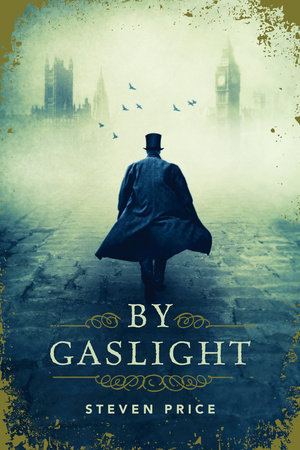 Unfortunately, Steven Price’s second novel, By Gaslight, a Victorian cat-and-mouse mystery, tended more towards the latter group for me. Like Eleanor Catton’s The Luminaries, it has the kernel of a fascinating story but piles up the words unnecessarily. Between July and August I read the first 300 pages and then skimmed the rest (in total the paperback has 731 small-type pages). This is the story of William Pinkerton, a 39-year-old Civil War veteran and private investigator from Chicago who comes to London in 1885 to chase up a name from his father’s files: Edward Shade. His best lead comes to nothing when Charlotte Reckitt evades him and turns up as a set of dismembered remains in the Thames. Keeping in mind the rudimentary state of forensics, though, there’s some uncertainty about the corpse’s identity.
The other central character in this drama is Adam Foole, a master thief. Half Indian and half English, he has violet eyes and travels in the company of Molly, a young pickpocket he passes off as his daughter, and Japheth Fludd, a vegetarian giant just out of prison. Foole was Charlotte’s lover ten years ago in South Africa, where they together pulled off a legendary diamond heist. Now he’s traveling back to England: she’s requested his help with a job as she knows she’s being tailed by a detective. The remaining cast is large and Dickensian: a medium and her lawyer brother, Charlotte’s imprisoned uncle, sewer dwellers, an opium dealer, and so on. Settings include a rare goods emporium, a Miss Havisham-type lonely manor house, the Record Office at Chancery Lane, and plenty of shabby garrets.
What I most enjoyed about the book was the restless, outlaw spirit of both main characters, but particularly Pinkerton. His troubled relationship with his father, in whose footsteps he’s following as a detective, is especially poignant: “William feared him and loved him and loathed him every day of his life yet too not a day passed that he did not want to be him.”
Price’s style is not what you’d generally expect of a Victorian pastiche. He uses no speech marks and his punctuation is non-standard, with lots of incomplete or run-in sentences like the one above. The critics’ blurbs liken By Gaslight to William Faulkner or Cormac McCarthy, apt comparisons that tell you just how unusual a hybrid it is.
I liked Price’s writing and starting around page 150 found the book truly gripping for a time, but extended flashbacks to Pinkerton and Foole’s earlier years really drag the story down, taking away from the suspense of the hunt. Meanwhile, the two major twists aren’t confirmed until over halfway through, but are hinted at so early that the watchful reader will know what’s going on long before the supposedly shrewd Pinkerton does. The salient facts about both characters’ past might have been conveyed in one short chapter each and the 1885 plot streamlined to make a taut novel of less than half the length.
There are many reasons to admire this Canadian novelist’s achievement, but whether it’s a reading experience you’d enjoy is something you’ll have to decide for yourself.
A favorite passage:
There is in every life a shadow of the possible, she said to him. The almost and the might have been. There are the histories that never were. We imagine we are keeping our accounts but what we are really saying is, I was here, I was real, this did happen once. It happened.
My rating: 
By Gaslight was first published in the UK by Oneworld in September 2016. My thanks to Margot Weale for sending a free paperback for review.
Fun trivia: Steven Price is married to Esi Edugyan, author of the Booker Prize-shortlisted novel Half Blood Blues.
Better Late than Never: City on Fire
I aim to read one book of 500+ pages in each month of 2017. My first Doorstopper of the Month is City on Fire, the 2015 debut novel from Garth Risk Hallberg. It’s common knowledge that Hallberg earned a six-figure advance for this 911-page evocation of a revolutionary time in New York City. When it was first published I didn’t think I had the fortitude to tackle it and had in mind to wait for the inevitable miniseries instead, but when I won a copy in a goodie bag from Hungerford Bookshop I decided to go for it. I started the novel just after Christmas and finished it a few days ago, so like Donna Tartt’s The Goldfinch it took me roughly a month to read because I had many other books on the go at the same time.
 Opening on Christmas Eve 1976 and peaking with the July 1977 blackout, the novel brings its diverse cast together through a shooting in Central Park. Insider traders, the aimless second generation of some of the city’s wealthiest aristocrats, anarchist punk rockers, an African-American schoolteacher, a journalist and his Vietnamese neighbor, a fireworks manufacturer, a policeman crippled by childhood polio – the characters fill in the broad canvas of the city, everywhere from Wall Street boardrooms to drug dens.
The real achievement is not how Hallberg draws each character but how he fits them all together. The closest comparison I can make is with one of Dickens’s long novels, say David Copperfield, where, especially as you approach the conclusion, you get surprising meet-ups of figures from different realms of life. The relaxed chronology reaches back to the 1950s and forward to 2003 to give hints of where these people came from and what fate holds for them.
City on Fire might sound like a crime drama – I can see a miniseries working in a manner comparable to The Wire – and the mystery of who shot Samantha Cicciaro does indeed last from about page 80 to page 800-something. But finding out who shot her and why (or why investment bankers would be funding a posse of anarchists, or who pushed a journalist into the river) is something of an anticlimax. The journey is the point, and the city is the real star, even though it’s described with a kind of affectionate disdain in the passages that follow:
The stench of the basement level reached him even here, like hot-dog water mixed with roofing tar and left in an alley to rot
The park on New Year’s Day had been a blasted whiteness, or a series of them, hemmed in by black trees like sheets snagged on barbed wire.
It seemed impossible that he’d chosen to live here, at a latitude where spring was a semantic variation on winter, in a grid whose rigid geometry only a Greek or a builder of prisons could love, in a city that made its own gravy when it rained. Taxis continued to stream toward the tunnel, like the damned toward a Boschian hellmouth. Screaming people staggered past below. Impossible, that he now footed the rent entire, two hundred bucks monthly for the privilege of pressing his cheek to the window and still not being able to see spectacular Midtown views. Impossible, that the cinderblock planter on the fire escape could ever have produced flowers.
Or wasn’t this city really the sum of every little selfishness, every ignorance, every act of laziness and mistrust and unkindness ever committed by anybody who lived there, as well as of everything she personally had loved?
Mercer Goodman, Jenny Nguyen and Richard Groskoph were my three favorite characters, and I might have liked to see more of each of them. I also felt that the book as a whole was quite baggy, and the six Interludes that separate the seven large sections, remarkable as they are (especially an entire fanzine, complete with photographs, comics and handwritten articles), weren’t strictly necessary.

It’s definitely a chunkster. For the longest while it felt like I wasn’t making a dent.
Still, I couldn’t help but be impressed by Hallberg’s ambition, and on the sentence level the novel is always well wrought and surprising, with especially lovely last lines that are like a benediction. Though it’s mostly set in the 1970s, this never feels dated; in fact, I thought it thoroughly relevant for our time: “even now they’re writing over history, finding ways to tell you what you just saw doesn’t exist. The big, bad anarchic city, people looting, ooga-booga. Better to trust the developers and the cops.”
I won’t pretend that a 900+-page book isn’t a massive undertaking, and I have some trusted bloggers and Goodreads friends who gave up on this after 250 or 450 pages. So I can’t promise you that you’ll think it’s worth the effort, though for me it was. A modern twist on the Dickensian state-of-society novel, it’s one I’d recommend to fans of Jonathan Franzen, Bill Clegg and Jennifer Egan.
My rating:
Starting the Year as I Mean to Go On?
The houseguests have gone home, the Christmas tree is coming down tomorrow, and it’s darned cold. I’m feeling stuck in a rut in my career, the blog, and so many other areas of life. It’s hard not to think of 2017 as a huge stretch of emptiness with very few bright spots. All I want to do is sit around in my new fuzzy bathrobe and read under the cat. Luckily, I’ve had some great books to accompany me through the Christmas period and have finished five so far this year.
I thought I’d continue the habit of writing two-sentence reviews (or maybe no more than three), except when I’m writing proper full-length reviews on assignment or for blog tours or other websites. Granted, they’re usually long and multi-part sentences, and this isn’t actually a time-saving trick – as Blaise Pascal once said, “I’m sorry I wrote you such a long letter; I didn’t have time to write a short one” – but it feels like good discipline.
So here’s some mini-reviews of what I’ve been reading in late December and early January:
The Dark Flood Rises, Margaret Drabble
 The “dark flood” is D.H. Lawrence’s metaphor for death, and here it corresponds to busy seventy-something Fran’s obsession with last words, obituaries and the search for the good death as many of her friends and acquaintances succumb – but also to literal flooding in the west of England and (dubious, this) to mass immigration of Asians and Africans into Europe. This is my favorite of the five Drabble books that I’ve read – it’s closest in style and tone to her sister A.S. Byatt as well as to Tessa Hadley, and the themes of old age and life’s randomness are strong – even though there seem to be too many characters and the Canary Islands subplot mostly feels like an unnecessary distraction. (Public library)
Hogfather, Terry Pratchett
 In Discworld belief causes imagined beings to exist, so when a devious plot to control children’s minds results in a dearth of belief in the Hogfather, the Fat Man temporarily disappears and Death has to fill in for him on this Hogswatch night. I laughed aloud a few times while reading this clever Christmas parody, but I had a bit of trouble following the plot and grasping who all the characters were given that this was my first Discworld book; in general I’d say that Pratchett is another example of British humor that I don’t entirely appreciate (along with Monty Python and Douglas Adams) – he’s my husband’s favorite, but I doubt I’ll try another of his books. (Own copy)
Love of Country: A Hebridean Journey, Madeleine Bunting
 In a reprise of childhood holidays that inevitably headed northwest, Bunting takes a series of journeys around the Hebrides and weaves together her contemporary travels with the religion, folklore and history of this Scottish island chain, an often sad litany of the Gaels’ poverty and displacement that culminated with the brutal Clearances. Rather than giving an exhaustive survey, she chooses seven islands to focus on and tells stories of unexpected connections – Orwell’s stay on Jura, Lord Leverhulme’s (he of Port Sunlight and Unilever) purchase of Lewis, and Bonnie Prince Charlie’s landing on Eriskay – as she asks how geography influences history and what it truly means to belong to a place. (Public library)
Cobwebs and Cream Teas: A Year in the Life of a National Trust House, Mary Mackie
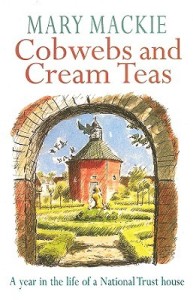 Mackie’s husband was Houseman and then Administrator at Felbrigg Hall in Norfolk in the 1980s – live-in roles that demanded a wide range of skills and much more commitment than the usual 9 to 5 (when he borrowed a pedometer he learned that he walked 15 miles in the average day, without leaving the house!). Her memoir of their first year at Felbrigg proceeds chronologically, from the intense cleaning and renovations of the winter closed season through to the following Christmas’ festivities, and takes in along the way plenty of mishaps and visitor oddities. It will delight anyone who’d like a behind-the-scenes look at the life of a historic home. (Own copy)
The Bridge Ladies: A Memoir, Betsy Lerner
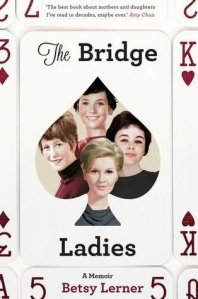 When life unexpectedly took the middle-aged Lerner back to her hometown of New Haven, Connecticut, she spent several years sitting in on her mother’s weekly bridge games to learn more about these five Jewish octogenarians who have been friends for 50 years and despite their old-fashioned reserve have seen each other through the loss of careers, health, husbands and children. Although Lerner also took bridge lessons herself, this is less about the game and more about her ever-testy relationship with her mother (starting with her rebellious teenage years), the ageing process, and the ways that women of different generations relate to their family and friends. It wouldn’t be exaggerating to say that every mother and daughter should read this; I plan to shove it in my mother’s and sister’s hands the next time I’m in the States. (Own copy)
Waiting on the Word, Malcolm Guite
 Guite chooses well-known poems (by Christina Rossetti, John Donne, Alfred Lord Tennyson, Samuel Taylor Coleridge et al.) as well as more obscure contemporary ones as daily devotional reading between the start of Advent and Epiphany; I especially liked his sonnet sequence in response to the seven “O Antiphons.” His commentary is learned and insightful, and even if at times I thought he goes into too much in-depth analysis rather than letting the poems speak for themselves, this remains a very good companion to the Christmas season for any poetry lover. (E-book from NetGalley)
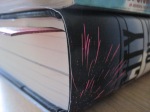 I started too many books over Christmas and have sort of put six of them on hold – including Titus Groan, which I’m thinking of quitting (it takes over 50 pages for one servant to tell another that the master has had a son?!), and City on Fire, which is wonderful but dispiritingly long: even after two good sessions with it in the days after Christmas, I’ve barely made a dent.
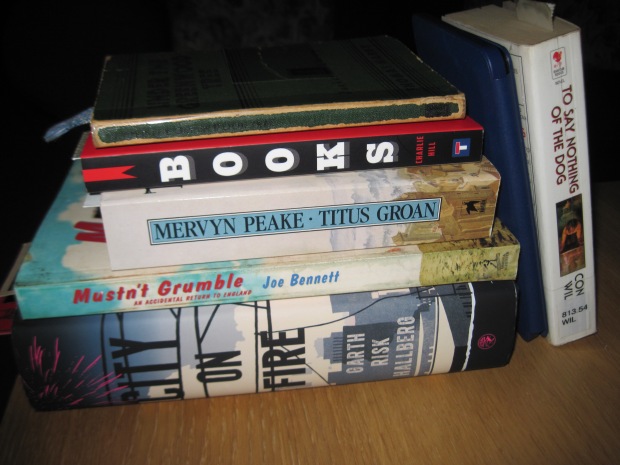
Stack on left = on hold (the book on top is Under the Greenwood Tree); standing up at right = books I’m actually reading.
However, the three books that I am actively reading I’m loving: To Say Nothing of the Dog by Connie Willis is an uproarious blend of time travel science fiction and Victorian pastiche (university library), Pachinko by Min Jin Lee is a compulsive historical saga set in Korea (ARC from NetGalley), and the memoir Birds Art Life by Kyo Maclear has been compared to H Is for Hawk in the way she turns to birdwatching to deal with depression (e-book from Edelweiss). I also will be unlikely to resist my e-galley of the latest Anne Lamott book, Hallelujah Anyway (forthcoming in April, ARC from Edelweiss), for much longer.



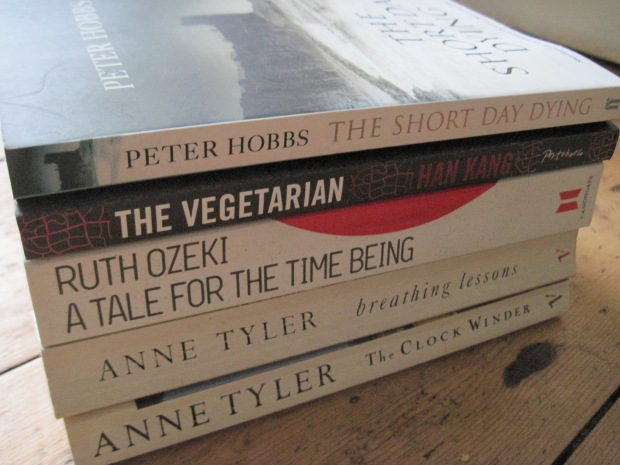
Meanwhile, in post-holiday charity shopping I scored six books for £1.90: one’s been tucked away as a present for later in the year; the Ozeki I’ve already read, but it’s a favorite so I’m glad to own it; and the rest are new to me. I look forward to trying Han Kang; Anne Tyler is a reliable choice for a cozy read; and the Hobbs sounds like a wonderful Victorian-set novel.
All in all, I seem to be starting my year in books as I mean to go on: reading a ton; making sure I review most or all of the books, even if I write just a few sentences; maintaining a balance between my own books, library books, and recent or advance NetGalley/Edelweiss reads; and failing to restrain myself from buying more.
Now if I could just work on my general attitude…
How’s the reading year starting off for you?
Better Late than Never: The Signature of All Things
 Who knew Elizabeth Gilbert had it in her? I’ve read and loved all of her nonfiction (e.g. Big Magic), but my experience of her fiction was a different matter: Stern Men is simply atrocious. I’m so glad I took a chance on this 2013 novel anyway. Many friends had lauded it, and for good reason. It’s a warm, playful doorstopper of a book, telling the long and eventful story of Alma Whittaker, a fictional nineteenth-century botanist whose staid life in her father’s Philadelphia home unexpectedly opens outward through marriage, an adventure in Tahiti, and a brush with the theories of Charles Darwin and Alfred Russel Wallace.
The novel’s voice feels utterly natural, and though Gilbert must have done huge amounts of research about everything from bryophytes to Tahitian customs, nowhere does the level of historical detail feel overwhelming. There are truly terrific characters, including mystical orchid illustrator Ambrose Pike, perky missionary Reverend Welles, and a charismatic Polynesian leader named Tomorrow Morning.
We see multiple sides of Alma herself, like her enthusiasm for mosses and her sexual yearning. For a short time in her girlhood she’s part of a charming female trio with her adopted sister Prudence and their flighty friend Retta. I loved how Gilbert pins down these three very different characters through pithy (and sometimes appropriately botanical) descriptions: “Prudence’s nose was a little blossom; Alma’s was a growing yam,” while Retta is “a perfect little basin of foolishness and distraction.”
Gilbert also captures the delight of scientific discovery and the fecundity of nature in a couple of lush passages that are worth quoting in full:
(Looking at mosses on boulders) Alma put the magnifying lens to her eye and looked again. Now the miniature forest below her gaze sprang into majestic detail. She felt her breath catch. This was a stupefying kingdom. This was the Amazon jungle as seen from the back of a harpy eagle. She rode her eye above the surprising landscape, following its paths in every direction. Here were rich, abundant valleys filled with tiny trees of braided mermaid hair and minuscule, tangled vines. Here were barely visible tributaries running through that jungle, and here was a miniature ocean in a depression in the center of the boulder where all the water pooled.
The cave was not merely mossy; it throbbed with moss. It was not merely green; it was frantically green. It was so bright in its verdure that the color nearly spoke, as though—smashing through the world of sight—it wanted to migrate into the world of sound. The moss was a thick, living pelt, transforming every rock surface into a mythical, sleeping beast.
Best of all, the novel kept surprising me. Every chapter and part took a new direction I never would have predicted. Like The Goldfinch, this is a big, rich novel I can imagine rereading.
My rating: 
One of my favorite parts of reviewing (e.g. for Kirkus and BookBrowse) is choosing “readalikes” that pick up on the themes or tone of the book in question. I’ve picked four for The Signature of All Things:
 Lab Girl, Hope Jahren: An enthusiastic, wide-ranging memoir of being a woman in science. There’s even some moss! This was a really interesting one for me to be reading at the same time as the Gilbert novel. (See Naomi’s review at Consumed by Ink.)
Euphoria, Lily King: Based on Margaret Mead’s anthropological research among the tribes of Papua New Guinea in the 1930s, this also has a wonderfully plucky female protagonist.
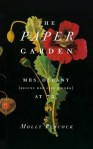 The Paper Garden, Molly Peacock: This biography of Mary Delany, an eighteenth-century botanical illustrator, examines the options for women’s lives at that time and celebrates the way Delany beat the odds by seeking a career of her own in her seventies.
The Seed Collectors, Scarlett Thomas: A quirky novel full of plants and sex.
 Bookish Beck = Rebecca Foster. American transplant to England. Freelance proofreader and book reviewer.
