Four for #NonfictionNovember and #NovNov25: Hanff, Humphrey, Kimmerer & Steinbeck
I’ll be doubling up posts most days for the rest of this month to cram everything in!


Today I have a cosy companion story to a beloved bibliophiles’ classic, a comprehensive account of my favourite beverage, a refreshing Indigenous approach to economics, and a journalistic exposé that feels nearly as relevant now as it did 90 years ago.
Q’s Legacy by Helene Hanff (1985)
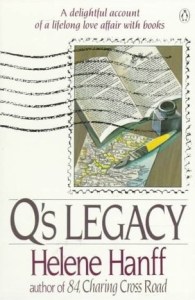 Of course we all know and love 84, Charing Cross Road, about Hanff’s epistolary friendship with the staff of Marks & Co. Antiquarian Booksellers in London in the 1950s. This gives a bit of background to the writing and publication of that book, responds to its unexpected success, and follows up on a couple of later trips to England for the TV and stage adaptations. Hanff lived in a tiny New York City apartment and worked behind the scenes in theatre and television. Even authoring a cult classic didn’t change the facts of being a creative in one of the world’s most expensive cities: paying the bills between royalty checks was a scramble. The title is a little odd and refers to Hanff’s self-directed education after she had to leave Temple University after a year. When she stumbled on Cambridge professor Sir Arthur Quiller-Couch’s books of lectures at the library, she decided to make them the basis of her classical education. I most liked the diary from a 1970s trip to London on which she stayed in her UK publisher André Deutsch’s mother’s apartment! This is pleasant and I appreciated Hanff’s humble delight in her unexpected later-life accomplishments, but it does feel rather like a collection of scraps. I also have to wonder to what extent this repeats content from the 84 sequel, The Duchess of Bloomsbury Street. But if you’ve liked her other books, you may as well read this one, too. (Free – The Book Thing of Baltimore) [177 pages]
Gin by Shonna Milliken Humphrey (2020)
 Picking up something from the Bloomsbury Object Lessons series (or any of these other series of nonfiction books) is a splendid way to combine two challenges. Humphrey was introduced to gin at 16 when the manager of the movie theater where she worked gave her Pepsi cups of gin and grapefruit juice. Luckily, that didn’t precede any kind of misconduct and she’s been fond of gin ever since. She takes readers through the etymology of gin (from the Dutch genever; I startled the bartender by ordering a glass of neat vieux ginèvre at a bar in Brussels in September), the single necessary ingredient (juniper), the distillation process, the varieties (single- or double-distilled; Old Tom with sugar added), the different neutral spirits or grain bases that can be used (at a recent tasting I had gins made from apples and potatoes), and appearances in popular culture from William Hogarth’s preachy prints through The African Queen and James Bond to rap music. I found plenty of interesting tidbits – Samuel Pepys mentions gin (well, “strong water made of juniper,” anyway) in his diary as a constipation cure – but the writing is nothing special, I knew a lot of technical details from distillery tours, and I would have liked more exploration of the modern gin craze. “Gin is, in many ways, how I see myself: comfortable, but evolving,” Humphrey writes. “Gin has always interested a younger generation of drinker, as well as commitment from the older crowd, while maintaining a reputation among the middle aged. It is unique that way.” That checks out from my experience of tastings and the fact that it’s my mother-in-law’s tipple of choice as well. (Birthday gift from my Bookshop wish list) [134 pages]
The Serviceberry: An Economy of Gifts and Abundance by Robin Wall Kimmerer (2024)
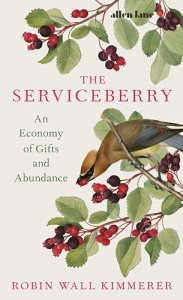 Serviceberries (aka saskatoons or juneberries) are Kimmerer’s chosen example of nature’s bounty, freely offered and reliable. When her farmer neighbours invite people to come and pick pails of them for nothing, they’re straying from the prevailing economic reasoning that commodifies food. Instead of focusing on the “transactional,” they’re “banking goodwill, so-called social capital.” Kimmerer would disdain the term “ecosystem services,” arguing that turning nature into a commodity has diminished people’s sense of responsibility and made them feel more justified in taking whatever they want and hoarding it. Capitalism’s reliance on scarcity (sometimes false or forced) is anathema to her; in an Indigenous gift-based economy, there is sufficient for all to share: “You can store meat in your own pantry or in the belly of your brother.” I love that she refers to Little Free Libraries and other community initiatives such as farm stands of free produce, swap shops, and online giveaway forums. I volunteer with our local Repair Café, I curate my neighbourhood Little Free Library, and I’m lucky to live in a community where people are always giving away quality items. These are all win-win situations where unwanted or broken items get a new lease on life. Save landfill space, resources, and money at the same time! Compared to Braiding Sweetgrass, this is thin (but targeted) and sometimes feels overly optimistic about human nature. I was glad I didn’t buy the bite-sized hardback with gift money last year, but I was happy to have a chance to read the book anyway. (New purchase – Kindle 99p deal) [124 pages]
The Harvest Gypsies: On the Road to The Grapes of Wrath by John Steinbeck (1936; 1988)
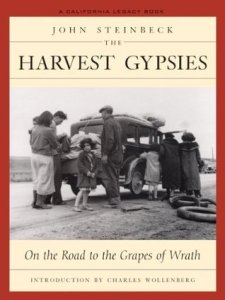 This lucky find is part of the “California Legacy” collection published by Heyday and Santa Clara University. In October 1936, Steinbeck produced a series of seven articles for The San Francisco News about the plight of Dust Bowl-era migrant workers. His star was just starting to rise but he wouldn’t achieve true fame until 1939 with the Pulitzer Prize-winning The Grapes of Wrath, which was borne out of his travels as a journalist. Some 150,000 transient workers traveled the length of California looking for temporary employment in the orchards and vegetable fields. Squatters’ camps were places of poor food and hygiene where young children often died of disease or malnutrition. Women in their thirties were worn out by annual childbirth and frequent miscarriage and baby loss. Dignity was hard to maintain without proper toilet facilities. Because workers moved around, they could not establish state residency and so had no access to healthcare or unemployment benefits. This distressing material is captured through dispassionate case studies. Steinbeck gives particular attention to the state’s poor track record for the treatment of foreign workers – Chinese, Japanese and Filipino as well as Mexican. He recounts disproportionate police brutality in response to workers’ attempts to organize. (Has anything really changed?!) In the final article, he offers solutions: the right to unionize, and blocks of subsistence farms on federal land. Charles Wollenberg’s introduction about Steinbeck and his tour guide, camp manager Tom Collins, is illuminating and Dorothea Lange’s photographs are the perfect accompaniment. Now I’m hankering to reread The Grapes of Wrath. (Secondhand – Gifted by a friend as part of a trip to Community Furniture Project, Newbury last year) [62 pages]
Check out Kris Drever’s folk song “Harvest Gypsies” (written by Boo Hewerdine) here.
Four (Almost) One-Sitting Novellas by Blackburn, Murakami, Porter & School of Life (#NovNov25)
I never believe people who say they read 300-page novels in a sitting. How is that possible?! I’m a pretty slow reader, I like to bounce between books rather than read one exclusively, and I often have a hot drink to hand beside my book stack, so I’d need a bathroom break or two. I also have a young cat who doesn’t give me much peace. But 100 pages or thereabouts? I at least have a fighting chance of finishing a novella in one go. Although I haven’t yet achieved a one-sitting read this month, it’s always the goal: to carve out the time and be engrossed such that you just can’t put a book down. I’ll see if I can manage it before November is over.
A couple of longish car rides last weekend gave me the time to read most of three of these, and the next day I popped the other in my purse for a visit to my favourite local coffee shop. I polished them all off later in the week. I have a mini memoir in pets, a surreal Japanese story with illustrations, an innovative modern classic about bereavement, and a set of short essays about money and commodification.
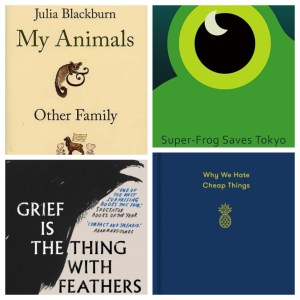
My Animals and Other Family by Julia Blackburn; illus. Herman Makkink (2007)
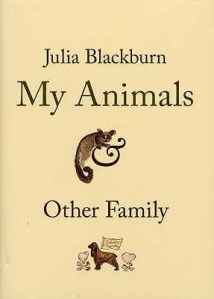 In five short autobiographical essays, Blackburn traces her life with pets and other domestic animals. Guinea pigs taught her the facts of life when she was the pet monitor for her girls’ school – and taught her daughter the reality of death when they moved to the country and Galaxy sired a kingdom of outdoor guinea pigs. They also raised chickens, then adopted two orphaned fox cubs; this did not end well. There are intriguing hints of Blackburn’s childhood family dynamic, which she would later write about in the memoir The Three of Us: Her father was an alcoholic poet and her mother a painter. It was not a happy household and pets provided comfort as well as companionship. “I suppose tropical fish were my religion,” she remarks, remembering all the time she devoted to staring at the aquarium. Jason the spaniel was supposed to keep her safe on walks, but his presence didn’t deter a flasher (her parents’ and a policeman’s reactions to hearing the story are disturbingly blasé). My favourite piece was the first, “A Bushbaby from Harrods”: In the 1950s, the department store had a Zoo that sold exotic pets. Congo the bushbaby did his business all over her family’s flat but still was “the first great love of my life,” Blackburn insists. This was pleasant but won’t stay with me. (New purchase – remainder copy from Hay Cinema Bookshop, 2025) [86 pages]
Super-Frog Saves Tokyo by Haruki Murakami; illus. Seb Agresti and Suzanne Dean (2000, 2001; this edition 2025)
[Translated from Japanese by Jay Rubin]
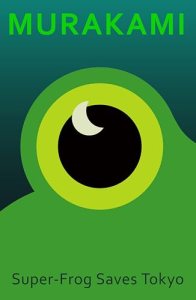 This short story first appeared in English in GQ magazine in 2001 and was then included in Murakami’s collection after the quake, a response to the Kobe earthquake of 1995. “Katigiri found a giant frog waiting for him in his apartment,” it opens. The six-foot amphibian knows that an earthquake will hit Tokyo in three days’ time and wants the middle-aged banker to help him avert disaster by descending into the realm below the bank and doing battle with Worm. Legend has it that the giant worm’s anger causes natural disasters. Katigiri understandably finds it difficult to believe what’s happening, so Frog earns his trust by helping him recover a troublesome loan. Whether Frog is real or not doesn’t seem to matter; either way, imagination saves the city – and Katigiri when he has a medical crisis. I couldn’t help but think of Rachel Ingalls’ Mrs. Caliban (one of my NovNov reads last year). While this has been put together as an appealing standalone volume and was significantly more readable than any of Murakami’s recent novels that I’ve tried, I felt a bit cheated by the it-was-all-just-a-dream motif. (Public library) [86 pages]
Grief Is the Thing with Feathers by Max Porter (2015)
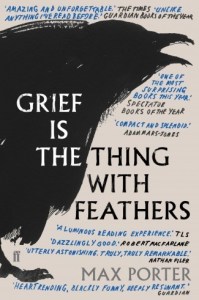 A reread – I reviewed this for Shiny New Books when it first came out and can’t better what I said then. “The novel is composed of three first-person voices: Dad, Boys (sometimes singular and sometimes plural) and Crow. The father and his two young sons are adrift in mourning; the boys’ mum died in an accident in their London flat. The three narratives resemble monologues in a play, with short lines often laid out on the page more like stanzas of a poem than prose paragraphs.” What impressed me most this time was the brilliant mash-up of allusions and genres. The title: Emily Dickinson. The central figure: Ted Hughes’s Crow. The setup: Edgar Allan Poe’s “The Raven” – while he’s grieving his lost love, a man is visited by a black bird that won’t leave until it’s delivered its message. (A raven cronked overhead as I was walking to get my cappuccino.) I was less dazzled by the actual writing, though, apart from a few very strong lines about the nature of loss, e.g. “Moving on, as a concept, is for stupid people, because any sensible person knows grief is a long-term project.” I have a feeling this would be better experienced in other media (such as audio, or the play version). I do still appreciate it as a picture of grief over time, however. Porter won the Sunday Times Young Writer of the Year Award as well as the Dylan Thomas Prize. (Secondhand – Gifted by a friend as part of a trip to Community Furniture Project, Newbury last year; I’d resold my original hardback copy – more fool me!) [114 pages]


My original rating (in 2015):
My rating now:
Why We Hate Cheap Things by The School of Life (2017)
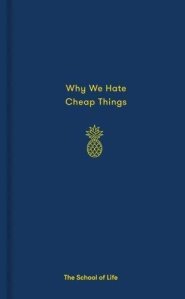 I’m generally a fan of the high-brow self-help books The School of Life produces, but these six micro-essays feel like cast-offs from a larger project. The title essay explores the link between the cost of an item or experience and how much we value it – with reference to pineapples and paintings. The other essays decry the fact that money doesn’t get fairly distributed, such that craftspeople and arts graduates often struggle financially when their work and minds are exactly what we should be valuing as a society. Fair enough … but any suggestions for how to fix the situation?! I’m finding Robin Wall Kimmerer’s The Serviceberry, which is also on a vaguely economic theme, much more engaging and profound. There’s no author listed for this volume, but as The School of Life is Alain de Botton’s brainchild, I’m guessing he had a hand. Perhaps he’s been cancelled? This raises a couple of interesting questions, but overall you’re probably better off spending the time with something more in depth. (Little Free Library) [78 pages]
20 Books of Summer, 17–20: Bennett, Davidson, Diffenbaugh, Kimmerer
As per usual, I’m squeezing in my final 20 Books of Summer reviews late on the very last day of the challenge. I’ll call it a throwback to the all-star procrastination of my high school and college years. This was a strong quartet to finish on: two novels, the one about (felling) trees and the other about communicating via flowers; and two nonfiction books about identifying trees and finding harmony with nature.
Tree-Spotting: A Simple Guide to Britain’s Trees by Ros Bennett; illus. Nell Bennett (2022)
Botanist Ros Bennett has designed this as a user-friendly guide that can be taken into the field to identify 52 of Britain’s most common trees. Most of these are native species, plus a few naturalized ones. “Walks in the countryside … take on a new dimension when you find yourself on familiar, first-name terms with the trees around you,” she encourages. She introduces tree families, basics of plant anatomy and chemistry, and the history of the country’s forests before moving into identification. Summer leaves make ID relatively easy with a three-step set of keys, explained in words as well as with impressively detailed black-and-white illustrations of representative species’ leaves (by her daughter, Nell Bennett).

Seasonality makes things trickier: “Identifying plants is not rocket science, though occasionally it does require lots of patience and a good hand lens. Identifying trees in winter is one of those occasions.” This involves a close look at details of the twigs and buds – a challenge I’ll be excited to take up on canalside walks later this year. The third section of the book gives individual profiles of each featured species, with additional drawings. I learned things I never realized I didn’t know (like how to pronounce family names, e.g., Rosaceae is “Rose-A-C”), and formalized other knowledge. For instance, I can recognize an ash tree by sight, but now I know you identify an ash by its 9–13 compound, opposite, serrated leaflets.

Some of the information was more academic than I needed (as with one of my earlier summer reads, The Ash Tree by Oliver Rackham), but it’s easy to skip any sections that don’t feel vital and come back to them another time. I most valued the approachable keys and their accompanying text, and will enjoy taking this compact naked hardback on autumn excursions. Bennett never dumbs anything down, and invites readers to delight in discovery. “So – go out, introduce yourself to your neighbouring trees and wonder at their beauty, ingenuity and variety.” 
With thanks to publicist Claire Morrison and Welbeck for the free copy for review.
Damnation Spring by Ash Davidson (2021)
When this would-be Great American Novel* arrived unsolicited through my letterbox last summer, I was surprised I’d not encountered the pre-publication buzz. The cover blurb is from Nickolas Butler, which gives you a pretty good sense of what you’re getting into: a gritty, working-class story set in what threatens to be an overwhelmingly male milieu. For generations, Rich Gundersen’s family has been involved in logging California’s redwoods. Davidson is from Arcata, California, and clearly did a lot of research to recreate an insider perspective and a late 1970s setting. There is some specialist vocabulary and slang (the loggers call the largest trees “big pumpkins”), but it’s easy enough to understand in context.
 What saves the novel from going too niche is the double billing of Rich and his wife, Colleen, who is an informal community midwife and has been trying to get pregnant again almost ever since their son Chub’s birth. She’s had multiple miscarriages, and their family and acquaintances have experienced alarming rates of infant loss and severe birth defects. Conservationists, including an old high school friend of Colleen’s, are attempting to stop the felling of redwoods and the spraying of toxic herbicides.
A major element, then, is people gradually waking up to the damage chemicals are doing to their waterways and, thereby, their bodies. The problem, for me, was that I realized this much earlier than any of the characters, and it felt like Davidson laid it on too thick with the many examples of human and animal deaths and deformities. This made the book feel longer and less subtle than, e.g., The Overstory. I started it as a buddy read with Marcie (Buried in Print) 11 months ago and quickly bailed, trying several more times to get back into the book before finally resorting to skimming to the end. Still, especially for a debut author, Davidson’s writing chops are impressive; I’ll look out for what she does next. 
*I just spotted that it’s been shortlisted for the $25,000 Mark Twain American Voice in Literature Award.
With thanks to Tinder Press for the proof copy for review.
The Language of Flowers by Vanessa Diffenbaugh (2011)
The cycle would continue. Promises and failures, mothers and daughters, indefinitely.
 The various covers make this look more like chick lit than it is. Basically, it’s solidly readable issues- and character-driven literary fiction, on the lighter side but of the caliber of any Oprah’s Book Club selection. It reminded me most of White Oleander by Janet Fitch, one of my 20 Books selections in 2018, because of the focus on the foster care system and a rebellious girl’s development in California, and the floral metaphors.
In Diffenbaugh’s debut, Victoria Jones ages out of foster care at 18 and leaves her group home for an uncertain future. She spends time homeless in San Francisco but her love of flowers, and particularly the Victorian meanings assigned to them, lands her work in a florist’s shop and reconnects her with figures from her past. Chapters alternate between her present day and the time she came closest to being adopted – by Elizabeth, who owned a vineyard and loved flowers, when she was nine. We see how estrangements and worries over adequate mothering recur, with Victoria almost a proto-‘Disaster Woman’ who keeps sabotaging herself. Throughout, flowers broker reconciliations.
I won’t say more about a plot that would be easy to spoil, but this was a delight and reminded me of a mini flower dictionary with a lilac cover and elaborate cursive script that I owned when I was a child. I loved the thought that flowers might have secret messages, as they do for the characters here. Whatever happened to that book?! (Charity shop)
Braiding Sweetgrass: Indigenous Wisdom, Scientific Knowledge and the Teachings of Plants by Robin Wall Kimmerer (2013)
I’d heard Kimmerer recommended by just about every nature writer around, North American or British, and knew I needed this on my shelf. Before I ever managed to read it, I saw her interviewed over Zoom by Lucy Jones in July 2021 about her other popular science book, Gathering Moss, which was first published 18 years ago but only made it to the UK last year. So I knew what a kind and peaceful person she is: she just emanates warmth and wisdom, even over a computer screen.
And I did love Braiding Sweetgrass nearly as much as I expected to, with the caveat that the tiny-print 400 pages of my paperback edition make the essays feel very dense. I could only read a handful of pages in a sitting. Also, after about halfway, it started to feel a bit much, like maybe she had given enough examples from her life, Native American legend and botany. The same points about gratitude for the gifts of the Earth, kinship with other creatures, responsibility and reciprocity are made over and over.
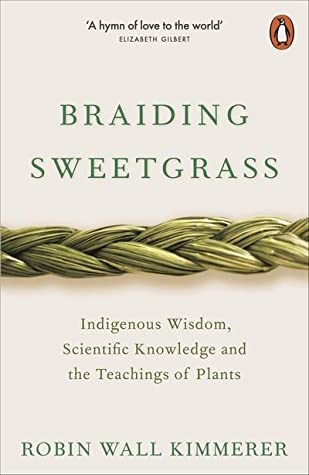 However, I feel like this is the spirituality the planet needs now, so I’ll excuse any repetition (and the basket-weaving essay I thought would never end). “In a world of scarcity, interconnection and mutual aid become critical for survival. So say the lichens.” (She’s funny, too, so you don’t have to worry about the contents getting worthy.) She effectively wields the myth of the Windigo as a metaphor for human greed, essential to a capitalist economy based on “emptiness” and “unmet desires.”
I most enjoyed the shorter essays that draw on her fieldwork or her experience of motherhood. “The Gift of Strawberries” – “An Offering” – “Asters and Goldenrod” make a stellar three-in-a-row, and “Collateral Damage” is an excellent later one about rescuing salamanders from the road, i.e. doing the small thing that we can do rather than being overwhelmed by the big picture of nature in crisis. “The Sound of Silverbells” is one of the most well-crafted individual pieces, about taking a group of students camping when she lived in the South. At first their religiosity (creationism and so on) grated, but when she heard them sing “Amazing Grace” she knew that they sensed the holiness of the Great Smoky Mountains.
But the pair I’d recommend most highly, the essays that made me weep, are “A Mother’s Work,” about her time restoring an algae-choked pond at her home in upstate New York, and its follow-up, “The Consolation of Water Lilies,” about finding herself with an empty nest. Her loving attention to the time-consuming task of bringing the pond back to life is in parallel to the challenges of single parenting, with a vision of the passing of time being something good rather than something to resist.
Here are just a few of the many profound lines:
For all of us, becoming indigenous to a place means living as if your children’s future mattered, to take care of the land as if our lives, both material and spiritual, depended on it.
I’m a plant scientist and I want to be clear, but I am also a poet and the world speaks to me in metaphor.
Ponds grow old, and though I will too, I like the ecological idea of aging as progressive enrichment, rather than progressive loss.
This will be a book to return to time and again. (Gift from my wish list several years ago)
I also had one DNF from this summer’s list:
Human Croquet by Kate Atkinson: This reminded me of a cross between The Crow Road by Iain Banks and The Heavens by Sandra Newman, what with the teenage narrator and a vague time travel plot with some Shakespearean references. I put it on the pile for this challenge because I’d read it had a forest setting. I haven’t had much luck with Atkinson in the past and this didn’t keep me reading past page 60. (Little Free Library)
A Look Back at My 20 Books of Summer 2022
Half of my reads are pictured here. The rest were e-books (represented by the Kindle) or have already had to go back to the library.

My fiction standout was The Language of Flowers, reviewed above. Nonfiction highlights included Forget Me Not and Braiding Sweetgrass, with Tree-Spotting the single most useful book overall. I also enjoyed reading a couple of my selections on location in the Outer Hebrides. The hands-down loser (my only 1-star rating of the year so far, I think?) was Bonsai. As always, there are many books I could have included and wished I’d found the time for, like (on my Kindle) A House among the Trees by Julia Glass, This Is Your Mind on Plants by Michael Pollan and Finding the Mother Tree by Suzanne Simard.
At the start, I was really excited about my flora theme and had lots of tempting options lined up, some of them literally about trees/flowers and others more tangentially related. As the summer went on, though, I wasn’t seeing enough progress so scrambled to substitute in other things I was reading from the library or for paid reviews. This isn’t a problem, per se, but my aim with this challenge has generally been to clear TBR reads from my own shelves. Maybe I didn’t come up with enough short and light options (just two novella-length works and a poetry collection; only the Diffenbaugh was what I’d call a page-turner); also, even with the variety I’d built in, having a few plant quest memoirs got a bit samey.

Next year…
I’m going to skip having a theme and set myself just one simple rule: any 20 print books from my shelves (NOT review copies). There will then be plenty of freedom to choose and substitute as I go along.
Nonfiction Catch-Up: Long-Term Thinking, Finding a Home in Wales, Eels
Not long now until Nonfiction November. I’m highlighting three nonfiction books I’ve read over the last few months; any of them would be well worth your time if you’re still looking for some new books to add to the pile. I’ve got a practical introduction to the philosophy and politics of long-term/intergenerational planning, a group biography about the two gay couples who inhabited a house in the Welsh hills in turn, and a wide-ranging work on eels.
The Good Ancestor: How to Think Long Term in a Short-Term World by Roman Krznaric
 I saw Krznaric introduce this via a digital Hay Festival session back in May. He is an excellent speaker and did an admirable job of conveying all the major ideas from his recent work within a half-hour presentation. Unfortunately, this meant that reading the book itself didn’t add much for me, although it goes deeper into his propositions and is illustrated with unique, helpful figures.
Without repeating from my write-up of the Festival talk, then, I’ll add in points and quotes that struck me:
- “some of the fundamental ways we organise society, from nation states and representative democracy to consumer culture and capitalism itself, are no longer appropriate for the age we live in.”
- 100 years as the minimum timeframe to think about (i.e., a long human life) – “taking us beyond the ego boundary of our own mortality so we begin to imagine futures that we can influence yet not participate in ourselves.”
- “The phones in our pockets have become the new factory clocks, capturing time that was once our own and offering in exchange a continuous electronic now full of infotainment, advertising and fake news. The distraction industry works by cleverly tapping into our ancient mammalian brains: our ears prick up at the ping of an arriving message … Facebook is Pavlov, and we’re the dogs.”
- The Intergenerational Solidarity Index as a way of assessing governments’ future preparation: long-term democracies tend to perform better, though they aren’t perfect; Iceland scores the highest of all, followed by Sweden.
- Further discussion of Doughnut Economics (a model developed by Krznaric’s wife, Kate Raworth), which pictures the sweet spot humans need to live in between a social foundation and the ecological ceiling; failures lead to overshoot or shortfall.
- Four fundamental barriers to change: outdated institutional designs (our basic political systems), the power of vested interests (fossil fuel companies, Amazon, et al.), current insecurity (refugees), and “insufficient sense of crisis” – we’re like frogs in a gradually boiling pot, he says, and need to be jolted out of our complacency.
This is geared more towards economics and politics than much of what I usually read, yet fits in well with other radical visions of the future I’ve engaged with this year (some of them more environmentalist in approach), including Footprints by David Farrier, The Future Earth by Eric Holthaus, and Notes from an Apocalypse by Mark O’Connell.
With thanks to WH Allen for the free copy for review.
On the Red Hill: Where Four Lives Fell into Place by Mike Parker (2019)
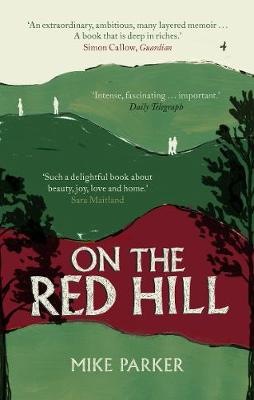 I ordered a copy from Blackwell’s after this made it through to the Wainwright Prize shortlist – it went on to be named the runner-up in the UK nature writing category. It’s primarily a memoir/group biography about Parker, his partner Peredur, and George and Reg, the couple who previously inhabited their home of Rhiw Goch in the Welsh Hills and left it to the younger pair in their wills. In structuring the book into four parts, each associated with an element, a season, a direction of the compass and a main character, Parker focuses on the rhythms of the natural year. The subtitle emphasizes the role Rhiw Goch played, providing all four with a sense of belonging in a rural setting not traditionally welcoming to homosexuals.
Were George and Reg the ‘only gays in the village,’ as the Little Britain sketch has it? Impossible to say, but when they had Powys’ first same-sex civil partnership ceremony in February 2006, they’d been together nearly 60 years. By the time Parker and his partner took over the former guesthouse, gay partnerships were more accepted. In delving back into his friends’ past, then, he conjures up another time: George fought in the Second World War, and for the first 18 years he was with Reg their relationship was technically illegal. But they never rubbed it in any faces, preferring to live quietly, traveling on the Continent and hosting guests at their series of Welsh B&Bs; their politics was conservative, and they were admired locally for their cooking and hospitality (Reg) and endurance cycling (George).
There are lots of in-text black-and-white photographs of Reg and George over the years and of Rhiw Goch through the seasons. Using captioned photos, journal entries, letters and other documents, Parker gives a clear impression of his late friends’ characters. There is something pitiable about both: George resisting ageing with nude weightlifting well into his sixties; Reg still essentially ashamed of his sexuality as well as his dyslexia. I felt I got to know the younger protagonists less well, but that may simply be because their stories are ongoing. It’s remarkable how Welsh Parker now seems: though he grew up in the English Midlands, he now speaks decent Welsh and has even stood for election for the Plaid Cymru party.
It’s rare to come across something in the life writing field that feels genuinely sui generis. There were moments when my attention waned (e.g., George’s feuds with the neighbors), but so strong is the overall sense of time, place and personality that this is a book to prize.
The Gospel of the Eels: A Father, a Son and the World’s Most Enigmatic Fish by Patrik Svensson
[Translated from the Swedish by Agnes Broomé]
“When it comes to eels, an otherwise knowledgeable humanity has always been forced to rely on faith to some extent.”
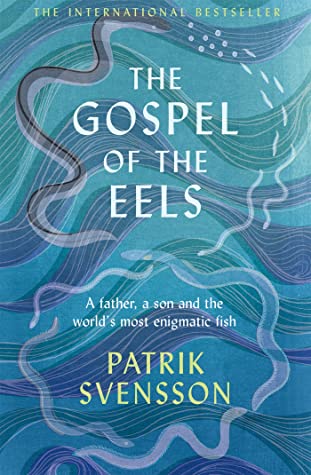 We know the basic facts of the European eel’s life cycle: born in the Sargasso Sea, it starts off as a larva and then passes through three stages that are almost like separate identities: glass eel, yellow eel, silver eel. After decades underwater, it makes its way back to the Sargasso to spawn and die. Yet so much about the eel remains a mystery: why the Sargasso? What do the creatures do for all the time in between? Eel reproduction still has not been observed, despite scientists’ best efforts. Among the famous names who have researched eels are Aristotle, Sigmund Freud and Rachel Carson, all of whom Svensson discusses at some length. He even suggests that, for Freud, the eel was a suitable early metaphor for the unconscious – “an initial insight into how deeply some truths are hidden.”
But there is a more personal reason for Svensson’s fascination with eels. As a boy he joined his father in eel fishing on Swedish summer nights. It was their only shared hobby; the only thing they ever talked about. His father was as much a mystery to him as eels are to science. And it was only as his father was dying of a cancer caused by his long road-paving career that Svensson came to understand secrets he’d kept hidden for decades.
Chapters alternate between this family story and the story of the eels. The book explores eels’ place in culture (e.g., Günter Grass’ The Tin Drum) and their critically endangered status due to factors such as a herpes virus, nematode infection, pollution, overfishing and climate change. A prior curiosity about marine life would be helpful to keep you going through this, but the prose is lovely enough to draw in even those with a milder interest in nature writing.
With thanks to Picador for the free copy for review.
One of my recent borrows from the public library’s children’s section was the picture book Think of an Eel by Karen Wallace. Her unrhymed, alliterative poetry and the paintings by Mike Bostock beautifully illustrate the eel’s life cycle and journey.

You simply must hear folk singer Kitty Macfarlane’s gorgeous song “Glass Eel” – literally about eels, it’s also concerned with migration, borders and mystery.
Would you be interested in reading one or more of these?
This Is Not a Drill: An Extinction Rebellion Handbook
“There is no planet B. This is where we will live, or go extinct as a species.”
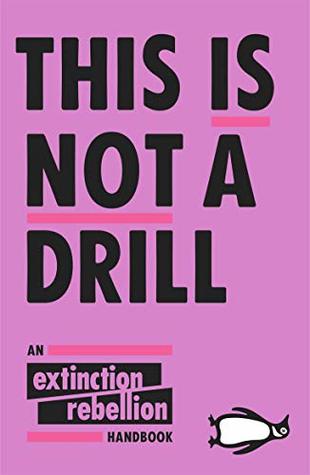 I’m periodically prone to melancholy musings on the impending end of the world (like here). Reading this punchy collection of 35 essays was a way of taking those feelings seriously and putting them to constructive use. You’ve likely heard of Extinction Rebellion: a peaceful environmental activism movement that began in the UK and has now spread worldwide, it demands that governments face the facts about the climate crisis and do something about it, now. Fittingly, the book is divided into two sections: “Tell the Truth” plainly sets out the basics of climate breakdown and the effects we expect to see, including the disproportionate toll it will have on the poor and marginalized, and on island nations like the Maldives; “Act Now” is a practical call to arms with pieces by politicians, economists and protest organizers.
Not surprisingly, experts are calling for radical societal change: we must move away from the car culture; we cannot continue to equate success with economic growth; we must reorganize how cities function. “We are not looking at adjustments any more. It’s a complete overhaul,” Leeds University’s Professor of Urban Futures, Paul Chatterton, writes. But what did surprise me about reading This Is Not a Drill is that it’s not depressing. It’s actually rather exciting to see how many great minds and ordinary folk are aware of the climate crisis and working to mitigate it. We might not have political will at the highest levels, but grassroots movements involving just 3% of the citizenry have been shown to effect social change. I want to be part of that 3%. After I finished reading I signed up to ER’s mailing list, and though it’s not at all in my comfort zone, I’m going to consider taking part in their next public disruption.
 I came away from this book with a feeling of camaraderie: we’re all in this together, and so we can only tackle it together. Post-apocalyptic fiction envisions violent, everyone-for-themselves scenarios, but it doesn’t have to be that way. ER demonstrations are said to be characterized by energy, music, laughter and good food. One word keeps appearing throughout the essays: “love.” There is righteous anger here, yes, but that’s outweighed by love – love of our planet, our only home, and the creatures it nurtures; love of the human race, the family that encompasses us all. While the authors are not unanimously optimistic, there is a sense that there is dignity in working towards positive change, whether or not we ultimately succeed. Plus, “It might just work,” former Archbishop of Canterbury Rowan Williams concludes in his afterword.
If you feel hopeless when you think about the state of the environment, I encourage you to pick this up, even if you only skim through and read a handful of the essays. The handbook achieves a fine balance between academics and laypeople; forthright assertions and creative ideas; grief and enthusiasm. It’s also strikingly designed, with the pink cover matching the ER boat and heavy use of the sorts of recurring icons and slogans you might recognize from their banners: skulls and hourglasses share space with bees, birds, butterflies and a Tree of Life. My only real quibble is that I would have liked a short bio of each contributor, either at the close of each essay or in an appendix, because while a few of these authors are household names, many are not, and it would be useful to know their bona fides.
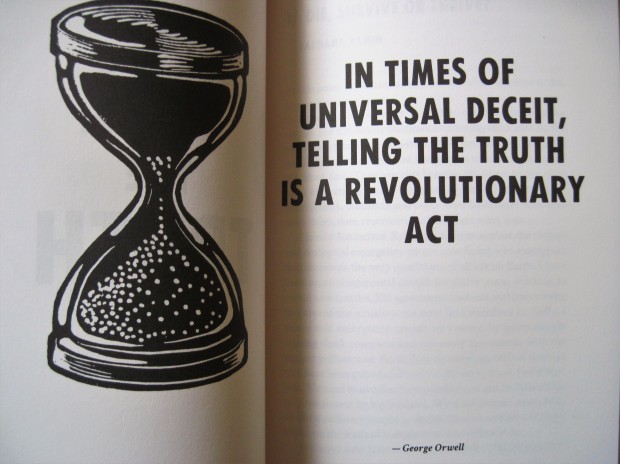
Don’t miss these pieces: “Climate Sorrow” by psychotherapist Susie Orbach, “A Political View” by Green Party MP Caroline Lucas, “A New Economics” by Oxbridge economist Kate Raworth, and “The Civil Resistance Model” by Roger Hallam of Extinction Rebellion.
Some favorite lines:
“Being human is not about individual survival or escape. It’s a team sport. Whatever future humans have, it will be together.” (from “Survival of the Fittest,” by American media theorist Douglas Rushkoff)
“It’s interesting and important to note that the people who are most effective are often the least attached to the effectiveness of their actions. Being detached from the outcome, and in love with the principles and the process, can help mitigate against burn-out.” (from “The Civil Resistance Model” by Roger Hallam)
“We may or may not escape a breakdown. But we can escape the toxicity of the mindset that has brought us here. And in so doing we can recover a humanity that is capable of real resilience.” (from the Afterword by Rowan Williams)
“if you are alive at this moment in history, it is because you are here to do a job. So what is your place in these times?” (from “What Is Your Place in These Times?” by Gail Bradbrook, co-founder of Extinction Rebellion)
My rating:
This Is Not a Drill was published on June 13th. My thanks to Penguin Random House for the free copy for review.
 Bookish Beck = Rebecca Foster. American transplant to England. Freelance proofreader and book reviewer.
 Bookish Beck