New Reading Projects! (Join Me?)
It’s only one week since we announced the Not the Wellcome Prize winner, the culmination of a month-long project that was months more in the planning. I don’t think I’ll be coordinating another blog tour anytime soon, as it was a lot of work finding participants, working out a schedule and keeping on top of the publicizing via social media. Still, it was a lot of fun, and already I’m missing the buzz and ready to get stuck into more projects.
I’d love it if you joined me for one or more of these. Some could be combined with your 20 Books of Summer or other challenges, too.
Ongoing buddy reads
 It would have been Richard Adams’s 100th birthday on the 9th. That night I started rereading his classic tale of rabbits in peril, Watership Down, which was my favorite book from childhood even though I only read it the once at age nine. I’m 80 pages in and enjoying all the local place names. Who would ever have predicted that that mousy tomboy from Silver Spring, Maryland would one day live just 6.5 miles from the real Watership Down?!
 My husband is joining me for the Watership Down read (he’s not sure he ever read it before), and we’re also doing a buddy read of Arctic Dreams by Barry Lopez. In that case, we ended up with two free copies, one from the bookshop where I volunteer and the other from The Book Thing of Baltimore, so we each have a copy on the go. Lopez’s style, like Peter Matthiessen’s, lends itself to slower, reflective reading, so I’m only two chapters in. It’s novel to journey to the Arctic, especially as we approach the summer.
I plan to take my time over these two, so tell me if you have a copy of either and feel like picking it up at any point over the next few months.
Bibliotherapy self-prescriptions
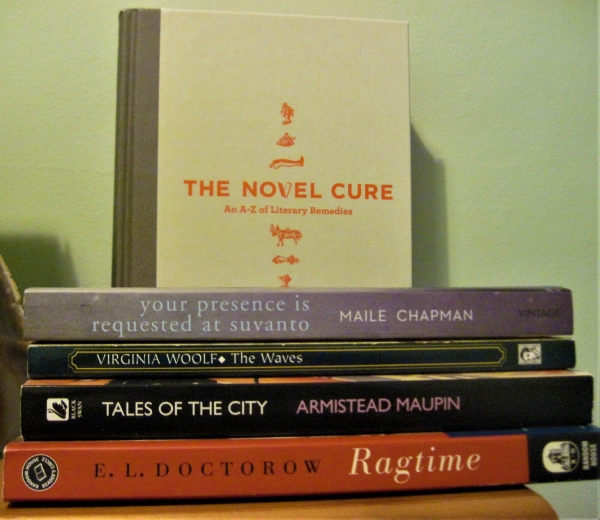
The other day I got out my copy of The Novel Cure by School of Life bibliotherapists Ella Berthoud and Susan Elderkin and browsed through the categories for some prescriptions that might feel relevant to the current situation. I found four books I own that fit the bill:
From the list of “The Ten Best Novels to Lower Your Blood Pressure”: Your Presence Is Requested at Suvanto by Maile Chapman & The Waves by Virginia Woolf (and I’ve read another three of them, including, recently, Crossing to Safety).
One of several prescriptions for Loneliness: Tales of the City by Armistead Maupin.
The cure for Zestlessness: Ragtime by E. L. Doctorow.
If you have access to one of these, or have a copy of The Novel Cure and are keen on following up on another of the prescriptions, let me know.
And now for two memes that I (think I) have created. Although I’m sure something similar has been done in the past, I couldn’t find any specific blogs about them. I don’t know about you, but I always need encouragement to pick up books from my own shelves – even though libraries are currently closed, I’m still working my way through a library stack, and I’m tempted to make another order of new books from Hungerford Bookshop. It’s great to support libraries and independent bookstores, of course, but there could be no better time to mine your own bookshelves for treasures you bought ages ago but still have never read.
Journey through the Day with Books
I enjoyed picking out 18 books from my shelves that refer to particular times of day or meals or activities associated therewith. Four of these are books I’ve already read and four are ones I’m currently reading. You can piggyback on my selections if you wish, or find your own set.
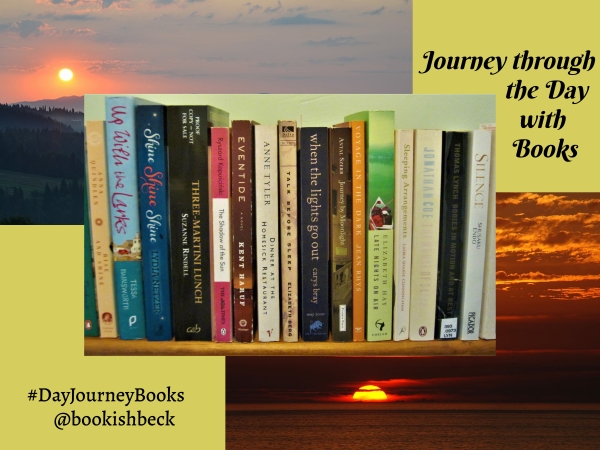
Here’s my full list:
Zennor in Darkness by Helen Dunmore
Rise and Shine by Anna Quindlen
Up with the Larks by Tessa Hainsworth
Shine Shine Shine by Lydia Netzer
Three-Martini Lunch by Suzanne Rindell
The Shadow of the Sun by Ryszard Kapuściński
Eventide by Kent Haruf
Dinner at the Homesick Restaurant by Anne Tyler
Talk before Sleep by Elizabeth Berg
When the Lights Go Out by Carys Bray
Journey by Moonlight by Antal Szerb
Voyage in the Dark by Jean Rhys
Late Nights on Air by Elizabeth Hay
Sleeping Arrangements by Laura Shaine Cunningham
The House of Sleep by Jonathan Coe
Bodies in Motion and at Rest by Thomas Lynch
Silence by Shūsaku Endō
Arctic Dreams by Barry Lopez
The Four in a Row Challenge
I’ve been contemplating this one for quite a while. It’s inspired by Phyllis Rose’s The Shelf –from LEQ to LES: Adventures in Extreme Reading (one of Simon’s favourite books – see his review), for which she picked a shelf of the New York Society Library, eliminated duplicates and repeat entries from the same author, and read the remainder – whether she’d heard of them or not; whether they were awful or not. (“Hands down the worst book on the shelf is Le Queux’s Three Knots, a mystery that reads as if it were written by an eight-year-old on Percocet.”)

This is a variation in that you’re looking at your own TBR shelves and picking a set of four books in a row. For many, that will be four novels whose authors’ surnames all start with the same letter. But if you organize your books differently (especially within nonfiction), you may find that the set of four is more arbitrary. You never know what they might have in common, though (book serendipity!).
I’m no strict challenge host, so if you want to engineer your shelf order, or if you decide to swap a book in later on, that is no problem at all. My one firm rule is only one book per author.
I’ve picked out a few appealing sets, all from my fiction shelves. F, G, L and M had particularly rich pickings. I’ll report back as I finish each set, while the “Journey through a Day” may well take me the whole rest of the year.
Still ongoing (more here): Projects to read as many Bellwether Prize, Wellcome Book Prize and Women’s Prize winners as possible, as well as Wellcome long- and shortlistees.
Can I tempt you to take part in any of these reading projects?
[Journey through the Day: Sunrise in Pieniny, Poland (Pudelek / CC BY-SA (https://creativecommons.org/licenses/by-sa/4.0)) / Sunset (Alvesgaspar / CC BY-SA (https://creativecommons.org/licenses/by-sa/3.0))
Four in a Row: Four pelicans in a row (Sheba_Also 43,000 photos / CC BY-SA (https://creativecommons.org/licenses/by-sa/2.0)) / Phone boxes, Market Place, Ripon (Tim Green from Bradford / CC BY (https://creativecommons.org/licenses/by/2.0))]
April Releases: Motherhood, Medicine, Wine … And an Aardvark
I’m averaging four new releases a month: a nicely manageable number. In April I read a memoir about a mother’s dementia, a bizarre little novel about a stuffed aardvark linking two centuries, a history of medicine in graphic novel form, and a sommelier’s memoir.
My top recommendation for the month is:
What We Carry by Maya Shanbhag Lang
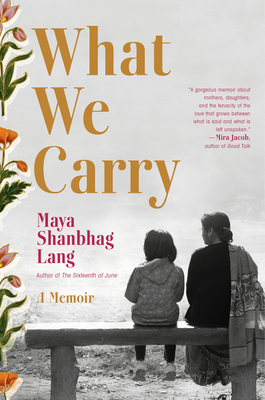 Maya Lang’s novel The Sixteenth of June* was one of my top three novels of 2014, so I was eager to read her next book, a forthright memoir of finding herself in the uncomfortable middle (the “sandwich generation”) of three generations of a female family line. Her parents had traveled from India to the USA for her mother’s medical training and ended up staying on permanently after she became a psychiatrist. Lang had always thought of her mother as a superwoman who managed a career alongside parenthood, never asked for help, and reinvented herself through a divorce and a career change.
When Lang gave birth to her own daughter, Zoe, this model of self-sufficiency mocked her when she had postpartum depression and needed to hire a baby nurse. It was in her daughter’s early days, just when she needed her mother’s support the most, that her mother started being unreliable: fearful and forgetful. Gradually it became clear that she had early-onset Alzheimer’s. Lang cared for her mother at home for a year before making the difficult decision to see her settled into a nearby nursing home.
Like Elizabeth Hay’s All Things Consoled, this is an engaging, bittersweet account of obligation, choices and the secrets that sometimes come out when a parent enters a mental decline. I especially liked how Lang frames her experiences around an Indian folktale of a woman who enters a rising river, her child in her arms. She must decide between saving her child or herself. Her mother first told this story soon after Zoe’s birth to acknowledge life’s ambiguity: “Until we are in the river, up to our shoulders—until we are in that position ourselves, we cannot say what the woman will do. We must not judge. That is the lesson of the story. Whatever a woman decides, it is not easy.” The book is a journey of learning not to judge her mother (or herself), of learning to love despite mistakes and personality changes. 
*One for me to reread in mid-June!
Published by Dial Press on the 28th. I read an e-copy via NetGalley.
Full disclosure: Maya and I are Facebook friends.
Other April releases to look out for:
(All:  )
)
Enter the Aardvark by Jessica Anthony
 On a scoreboard of the most off-the-wall, zany and fun novels I’ve read, this one would be right up there with Ned Beauman’s Boxer, Beetle and Alex Christofi’s Glass. The two story lines, one contemporary and one set in the 1870s, are linked by a taxidermied aardvark that makes its way from Namibia to the Washington, D.C. suburbs by way of Victorian England.
The aardvark was collected by naturalist Sir Richard Ostlet and stuffed by Titus Downing, his secret lover. Ostlet committed suicide in Africa, but his wife could still sense him walking up and down outside her London home. In the present day, Republican congressman Alexander Paine Wilson, who emulates Ronald Reagan in all things, gets a FedEx delivery of a taxidermied aardvark – an apparent parting gift from Greg Tampico before the latter committed suicide. To keep his gay affair from becoming public knowledge, Wilson decides it’s high time he found himself a trophy wife. But the damned aardvark keeps complicating things in unexpected ways.
A scene where a police officer stops Wilson for texting and driving and finds the stuffed aardvark in the back of his SUV had me laughing out loud (“Enter the aardvark, alight on its mount. Enter the aardvark, claw raised, head covered with a goddamned gourmet $22 dish towel that suddenly looks incredibly suspicious hanging over the head of an aardvark, like it’s an infidel”). History repeats itself amusingly and the aardvark is an entertaining prop, but Wilson is too obviously odious, and having his narrative in the second person doesn’t add anything. This is not a debut novel but reads like one: full of bright ideas, but falling a bit short in the execution.
Published by Doubleday on the 23rd. I won a proof copy in a Twitter giveaway.
Medicine: A Graphic History by Jean-Noël Fabiani
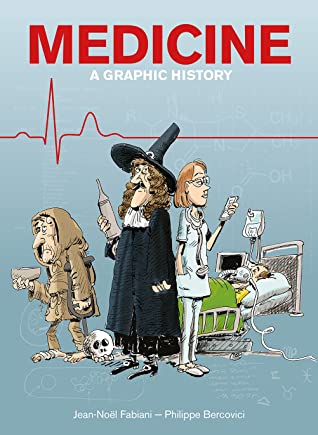 [Illustrated by Philippe Bercovici; translated from the French by Edward Gauvin]
From prehistory to nanotechnology, this is a thorough yet breezy survey of what people have learned about the body and how to treat it. (In approach it reminded me most of another SelfMadeHero graphic novel I reviewed last year, ABC of Typography.) Some specific topics are the discovery of blood circulation, the development of anesthesia, and the history of mental health treatment.
Fabiani, a professor as well as the head of cardiac surgery at Georges Pompidou European Hospital in Paris, focuses on the key moments when ideas became testable theories and when experiments gave groundbreaking results. While he provided the one-page introduction to each chapter and the expository writing at the head of each comic pane, I suspect it was illustrator Philippe Bercovici who added most of the content in the speech bubbles, including plenty of jokes (especially since Fabiani thanks Bercovici for bringing his talent and humor to the project).
This makes for a lighthearted book that contains enough detail so that you feel like you are still getting the full story. Unsurprisingly, I took the most interest in chapters entitled The Great Epidemics and A Few Modern Plagues. I would especially recommend this to teenagers with an interest in medicine.
Published by SelfMadeHero on the 9th. My thanks to the publisher for the free copy for review.
Wine Girl by Victoria James
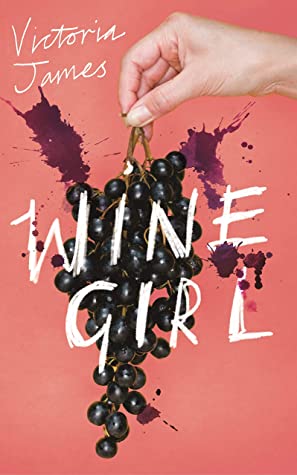 In 2012, at age 21, Victoria James became America’s youngest certified sommelier. Still in her twenties, she has since worked in multiple Michelin-starred restaurants in New York City and became the only American female to win the Sud de France Sommelier Challenge. But behind all the competition wins, celebrity sightings, and international travel for wine festivals and conferences is a darker story.
This is a tell-all about a toxic restaurant culture of overworked employees and casual sexism. James regularly worked 80-hour weeks in addition to her wine school studies, and suffered multiple sexual assaults. In addition, sexual harassment was common – even something as seemingly harmless as the title epithet a dismissive diner launched at her when he ordered a $650 bottle of wine for his all-male table and then told her it was corked and had to be replaced. “Wine girl” was a slur against her for her age, her gender and her presumed lack of experience, even though by that point she had an encyclopedic knowledge of wine varieties and service.
That incident from the prologue was my favorite part of the book; unfortunately, nothing that came afterwards really lived up to it. The memoir goes deep into James’s dysfunctional upbringing (her parents’ bitter divorce, her mother’s depression, her father’s alcoholism and gambling, her own battle with addictions), which I found I had little interest in. It’s like Educated lite, but with a whiney tone: “I grew up in a household of manipulation and neglect, left to fend for myself.”
For those interested in reading about wine and restaurant culture, I’d recommend Cork Dork by Bianca Bosker and Sweetbitter by Stephanie Danler (one of my pairings here) instead.
A favorite line: “Like music, the wonders of art, food, and beverage can transcend all boundaries. … I wanted to capture that feeling, the exhilaration of familiarity, and bring people together through wine.”
Published by Fleet on the 16th. My thanks to the publisher for the free copy for review.
What recent releases can you recommend?
Announcing the NOT the Wellcome Prize and Blog Tour
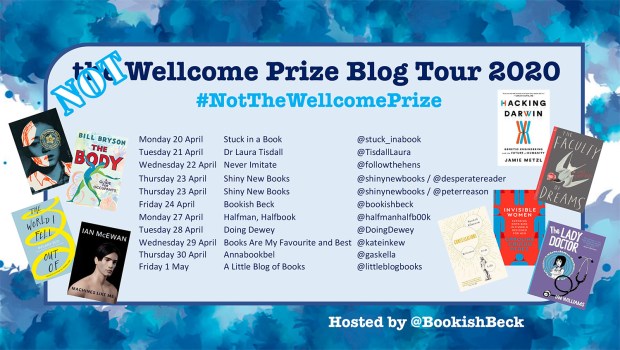
Soon after I heard that the Wellcome Book Prize would be on hiatus this year, I had the idea to host a “Not the Wellcome Prize” blog tour to showcase some of the best health-themed literature published in 2019. I was finalizing the participants and schedule just before as well as during the coronavirus crisis, which has reinforced the importance of celebrating books that disseminate crucial information about medicine and/or tell stories about how health affects our daily lives. I got the go-ahead for this unofficial tour from the Wellcome Trust’s Simon Chaplin (Director of Culture & Society) and Jeremy Farrar (overall Director).
Starting on Monday and running for the next two weeks (weekdays only), the tour will be featuring 19 books across 10 blogs. One of the unique things about the Wellcome Prize is that both fiction and nonfiction are eligible, so we’ve tried to represent a real variety here: on the longlist we have everything from autobiographical essays to science fiction, including a graphic novel and a couple of works in translation.

Based on the blog tour reviews and the Prize’s aims*, the shadow panel (Annabel of Annabookbel, Clare of A Little Blog of Books, Laura of Dr. Laura Tisdall, Paul of Halfman, Halfbook and I) will choose a shortlist of six titles, to be announced on the 4th of May. We will then vote to choose a winner, with the results of a Twitter poll serving as one additional vote (be sure to have your say!). The overall winner of the Not the Wellcome Prize will be announced on the 11th of May.
I hope you’ll follow along with the reviews and voting. I would like to express my deep thanks to all the blog tour participants, especially the shadow panel for helping with ideas and planning – plus Annabel designed the graphics.
*Here is how the website describes the Prize’s purpose: “At some point, medicine touches all our lives. Books that find stories in those brushes with medicine are ones that add new meaning to what it means to be human. The subjects these books grapple with might include birth and beginnings, illness and loss, pain, memory, and identity. In keeping with its vision and goals, the Wellcome Book Prize aims to excite public interest and encourage debate around these topics.”
Below I’ve appended our preliminary list of eligible books that were considered but didn’t quite make the cut to be featured on the tour, noting major themes and positive blog review coverage I’ve come across. (The official Prize excludes poetry entries, but we were more flexible.)
Nonfiction:
- When Death Takes Something from You Give It Back by Naja Marie Aidt (memoir of child’s sudden death)
- The Man in the Red Coat by Julian Barnes (biography of 19th-century gynecologist)
- Let Me Not Be Mad by A.K. Benjamin (neuropsychologist’s memoir)
- The Story of Sex: From Apes to Robots by Philippe Brenot (medical history/graphic novel, in translation)
- The Prison Doctor by Amanda Brown (doctor’s memoir)
- The Undying by Anne Boyer (essays – cancer)
- Breaking & Mending by Joanna Cannon (doctor’s memoir)
- How to Treat People by Molly Case (nurse’s memoir)
- Will My Cat Eat My Eyeballs? by Caitlin Doughty (popular science – death)
- Happening by Annie Ernaux (memoir, in translation – abortion)
- I Remain in Darkness by Annie Ernaux (memoir, in translation – mother’s dementia)
- Out of Our Minds by Felipe Fernández-Armesto (popular science – evolutionary biology)
- The Heartland by Nathan Filer (medical history/memoir – schizophrenia)
- Childless Voices by Lorna Gibb (cultural history – infertility, etc.)
- Maybe You Should Talk to Someone by Lori Gottlieb (memoir/self-help – therapy)
Books Are My Favourite and Best review
- Once More We Saw Stars by Jayson Greene (memoir – child’s sudden death)
- A Short History of Falling by Joe Hammond (memoir – disability, dying)
- All Things Consoled by Elizabeth Hay (memoir – geriatrics, dementia)
- Hard Pushed by Leah Hazard (midwife’s memoir)
- Life Lessons from a Brain Surgeon by Rahul Jandial (memoir/self-help)
- Twas the Nightshift before Christmas by Adam Kay (doctor’s memoir)
- Why Can’t We Sleep? by Darian Leader (popular science – insomnia)
- Incandescent: We Need to Talk about Light by Anna Levin (light’s effects on health and body rhythms)
- A Puff of Smoke by Sarah Lippett (memoir – growing up with rare disease)
- Hormonal by Eleanor Morgan (popular science – women’s health)
- Critical by Matt Morgan (ICU doctor’s memoir)
- A Short History of Medicine by Steve Parker (medical history, illustrated)
- Notes to Self by Emilie Pine (essays – infertility, rape, etc.)
- That Good Night by Sunita Puri (doctor’s memoir – palliative care)
- An Elegant Defense: The Extraordinary New Science of the Immune System: A Tale in Four Lives by Matt Richtel (popular science)
- The Gendered Brain by Gina Ripon (popular science – neuroscience, gender)
- The Five by Hallie Rubenhold (alcoholism, sex work)
- When I Had a Little Sister by Catherine Simpson (memoir – mental health, suicide)
- Flash Count Diary: Menopause and the Vindication of Natural Life by Darcey Steinke (memoir, female anatomy)
- Skeleton Keys: The Secret Life of Bone by Brian Switek (popular science – anatomy)
- Out of the Woods by Luke Turner (memoir – masculinity, bisexuality)
- The Making of You by Katharina Vestre (popular science, in translation – embryology)
- Transcendence: How Humans Evolved through Fire, Language, Beauty, and Time by Gaia Vince (popular science – human evolution)
- The Knife’s Edge by Stephen Westaby (surgeon’s memoir)
Fiction:
- Starling Days by Rowan Hisayo Buchanan (literary fiction – mental illness, bisexuality)
- Recursion by Blake Crouch (science fiction – memory)
- Expectation by Anna Hope (women’s fiction – infertility, cancer)
- Stillicide by Cynan Jones (speculative fiction – water crisis)
- Things in Jars by Jess Kidd (historical fiction – Victorian medicine)
- Patience by Toby Litt (disability)
- The Migration by Helen Marshall (speculative fiction – immune disorder)
- The Warlow Experiment by Alix Nathan (historical fiction – medical experimentation)
- Night Theatre by Vikram Paralkar (magic realism – surgeon to the dead)
- The Art of Dying by Ambrose Parry (historical mystery – Victorian medicine)
- The Dutch House by Ann Patchett (doctor narrator, diabetes)
- Body Tourists by Jane Rogers (science fiction – body rental technology)
- Children of Ruin by Adrian Tchaikovsky (science fiction – evolutionary biology)
- Oligarchy by Scarlett Thomas (eating disorders)
- Wanderers by Chuck Wendig (science fiction – sleepwalking disorder)
Poetry:
- O Positive by Joe Dunthorne (death, therapy)
- The Carrying by Ada Limon (ageing parents, infertility)
Classics of the Month: Cold Comfort Farm and Crossing to Safety
These were terrific reads. A comic novel set on a Sussex farm and a look back at banner years in the friendship of two couples. Both:
Cold Comfort Farm by Stella Gibbons (1932)
 I’d heard so much about this over the years. It was one I had to be in just the right mood for, though – I’d picked up my secondhand copy and read the first few pages on four different occasions before it finally took. If you recognize the phrase “something nasty in the woodshed” or know of a fictional plant called sukebind, you’ll appreciate the extent to which the story has entered into popular culture.
When Flora Poste’s parents die of the “influenza or Spanish Plague” (oh dear), she’s left an orphan at age 20. Her best option seems to be moving in with relatives she’s never met: Aunt Ada Doom and the Starkadder cousins of Cold Comfort Farm in Howling, Sussex. They’re a delightful collection of eccentrics: mad Aunt Ada shut away in her room; her son Amos, a fire-and-brimstone preacher; cousin Seth, with his movie star looks and multiple children by the servant girl; cousin Elfine, a fey innocent in a secret relationship with the local landowner’s son, who’s dumb but rich; and so on.
Relying on her London sophistication and indomitable optimism, Flora sets out to improve everything and everyone at the crumbling farm. The blurb calls this a “parody of the melodramatic rural novels of the time,” but I thought of it more as a skewering of Victorian stereotypes, not least in that the farming folk speak like Thomas Hardy’s rustics (Reuben: “‘I ha’ scranleted two hundred furrows come five o’clock down i’ the bute.’ It was a difficult remark, Flora felt, to which to reply. Was it a complaint?”). Meanwhile, Mr. Mybug, with his obsession with sex, is a caricature of a D.H. Lawrence protagonist.
It may take a little while to adjust to the book’s sense of humor, which struck me as surprisingly edgy for its time. Gibbons expresses no great outrage about Seth’s illegitimate offspring, for instance; instead, the babies’ grandmother has the enterprising idea of training them up to be a jazz band. There is also plenty of pure silliness, like the cows being named Graceless, Pointless, Feckless and Aimless and one of them spontaneously losing legs. I especially liked that Flora’s London friend Mrs. Smiling collects brassieres and that Flora always samples novels to make sure they don’t contain a childbirth scene. This non sequitur also amused me at the same time as it puzzled me: Flora “liked Victorian novels. They were the only kind of novel you could read while you were eating an apple.”
Crossing to Safety by Wallace Stegner (1987)
 (A buddy read with Laila of Big Reading Life for her Classics Club challenge.) Right from the start, I was thoroughly invested in this lovely, bittersweet story of two faculty couples, Larry and Sally Morgan and Sid and Charity Lang. Much of the action is split between Wisconsin in the 1930s and Vermont in the 1970s, the novel’s present day. Larry, the narrator, had a brief academic career in Madison but moved on to write novels. Sid longed to be a poet but didn’t have the skill, so remained in academia despite a tiny publication record.
Charity is the quartet’s stubborn mother hen, organizing everyone and tailoring everything to her own plans (don’t we all have a friend like that?). The Langs have wealth and class on their side, whereas the Morgans are described as having the intellect and talent. I found it odd that Stegner gave Charity such an obviously metaphorical name – starting with a big dinner party, the Langs lavish gifts and money on the Morgans in the name of friendship.
The novel sets up various counterparts and doubles, so Sally’s polio in the 1930s finds a parallel in the 1970s story line, when a terminally ill Charity is orchestrating her grand farewell. For all its challenges, Larry describes that first year in Madison as an idyllic time with “Two Adams and two Eves, an improvement on God’s plan.” Later on they all take a glorious sabbatical year together in Florence, too. New England, the Midwest and Italy make for an attractive trio of settings. There are also some great sequences that happen to reveal a lot about the friends’ dynamic, including an ill-fated sailboat outing and a hiking trip.
Nostalgic and psychologically rich, this is a quiet, beautifully written character study that would suit fans of Elizabeth Hay and May Sarton (though she was writing a decade and more earlier, this reminded me a lot of her small-town novel Kinds of Love and, eventually, A Reckoning). I’ll try more by Stegner.
Favorite lines:
“a chilly Octoberish smell of cured leaves rose from the ground, the indescribable smell of fall and football weather and the new term that is the same almost everywhere in America.”
Sid and Charity as “the people who above any other two on earth made us feel good, wanted, loved, important, and happy.”
“she was the same old Charity. She saw objectives, not obstacles, and she did not let her uncomplicated confidence get clouded by other people’s doubts, or other people’s facts, or even other people’s feelings.”
See also Susan’s review.
Adventures in Rereading: A. S. Byatt and Abigail Thomas
At the end of last year, I picked out a whole shelf’s worth of books I’ve been meaning to reread. I know that others of you are devoted re-readers, returning to childhood favorites for comfort or poring over admired novels two or three times to figure out how they work. Alas, I’m usually resistant to rereading because I feel like it takes away time that I could be spending reading new or at least new-to-me books. Yet along with the nostalgia there is also a certain relief to returning to a favorite: here’s a book that is guaranteed not to disappoint.
So far this year I’ve finished two rereads, and I’m partway through a third. I’m not managing the one-every-other-week pace I would need to keep up to get through the whole shelf this year, but for me this is still good progress. I’ll report regularly on my experience of rereading.
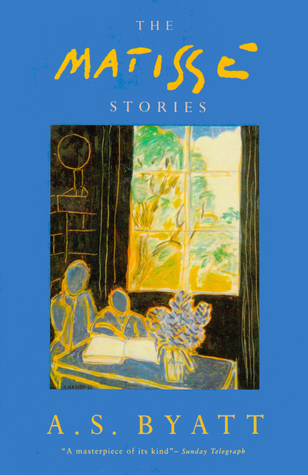
The Matisse Stories by A. S. Byatt (1993)
Byatt is my favorite author. My memory for individual short stories is pitiful, yet I have never forgotten the first of three stories in this volume, so I focus on it here with a close rereading. In “Medusa’s Ankles,” a middle-aged woman goes berserk in a hair salon but it all turns out fine. I remember imagining what that would be like: to let go, to behave badly with no thought for others’ opinions, to act purely on instinct – and for there to be no consequences.
I’d forgotten all the particulars of the event. Susannah, a linguist, is drawn to the salon by the Rosy Nude reproduction she sees through the window. She becomes a reluctant receptacle for her stylist Lucian’s stories, including tales of his wife’s fat ankles and his mistress’ greater appeal. He confides in her his plan to run away. “I don’t want to put the best years of my life into making suburban old dears presentable. I want something more.”
 Susannah holds in all her contempt for Lucian and his hip shop redesign until the day he fobs her off on another stylist – even though she’s said she needs an especially careful job this time because she is to appear on TV to accept the Translator’s Medal. When Deirdre is done, Susannah forgets about English politeness and says just what she thinks: “It’s horrible. I look like a middle-aged woman with a hair-do.” (Never mind that that’s exactly what she is.)
In a whirlwind of fury, she trashes the salon. Byatt describes the aftermath, indulging her trademark love of colors: “It was a strange empty battlefield, full of glittering fragments and sweet-smelling rivulets and puddles of venous-blue and fuchsia-red unguents, patches of crimson-streaked foam and odd intense spills of orange henna or cobalt and copper.”
You can just imagine the atmosphere in the salon: everyone exchanging horrified looks and cautiously approaching Susannah as if she’s a dangerous dog. Lucian steps in to reassure her: “We all feel like that, sometimes. Most of us don’t dare. … The insurance’ll pay. Don’t worry. … You’ve done me a good turn in a way.” Maybe he’ll go off with his girlfriend and start a new business, after all. Predictably, the man has made it all about him.
The ironic kicker to this perfect story about middle age and female rage comes after Susannah goes home to a husband we hadn’t heard about yet. “He saw her. (Usually he did not.) ‘You look different. You’ve had your hair done. I like it. You look lovely. It takes twenty years off you. You should have it done more often.’”
“Art Work” briefly, unnecessarily, uses a Matisse painting as a jumping-off point. A bourgeois couple, a painter and magazine design editor, hire Mrs. Brown, a black woman, to clean their house and are flabbergasted when she turns out to be an artist in her own right. “The Chinese Lobster,” the final story, is the only one explicitly about Matisse. An academic dean invites her colleague out to lunch at a Chinese restaurant to discuss a troubled student he’s supervising. This young woman has eating disorders and is doing a portfolio of artwork plus a dissertation on Matisse’s treatment of female bodies. Her work isn’t up to scratch, and now she’s accused her elderly supervisor of sexual harassment. The racial and sexual politics of these two stories don’t quite hold up, though both are well constructed.
I reread the book in one morning sitting last week.
My original rating (c. 2005):
My rating now: 
A Three Dog Life by Abigail Thomas (2006)
In April 2000 Thomas’s husband Rich was hit by a car and incurred a traumatic brain injury when their dog Harry got off the leash and Rich ran out into the road near their New York City home to save him. It was a miracle that Rich lived, but his disability was severe enough that he had to be moved to an upstate nursing home. This is one of the first memoirs I ever remember reading, and it made a big impression. I don’t think I realized at the time that it was written in discrete essays, many of which were first published in magazines and anthologies. It represents an advance on the highly fragmentary nature of her first memoir, Safekeeping.
 Thomas maintains a delicate balance of emotions: between guilt every time she bids Rich goodbye in the nursing home and relief that she doesn’t have to care for him 24/7; between missing the life they had and loving the cozy one she’s built on her own with her three dogs. (The title is how Aborigines refer to the coldest nights.) As in One Hundred Names for Love and All Things Consoled, Rich’s aphasia produces moments of unexpectedly poetic insight.
Before rereading I remembered one phrase and one incident (though I’d thought the latter was from Safekeeping): doctors described Rich’s skull as “shattered like an eggshell,” and Thomas remembers a time she was driving and saw the car ahead hit a raccoon; she automatically swerved to avoid the animal, but saw in her rearview mirror that it was still alive and realized the compassionate thing would have been to run it over again. I’ve never forgotten these disturbing images.
Unassuming and heart on sleeve, Thomas wrote one of the most beautiful books out there about loss and memory. I’d recommend this to fans of Anne Lamott and readers of bereavement memoirs in general. This is what I wanted from the rereading experience: to find a book that was even better the second time around.
My original rating (c. 2006):
My rating now: 
Currently rereading: Flaubert’s Parrot by Julian Barnes
Considering rereading next: On Beauty by Zadie Smith
Done any rereading lately?
My Best Backlist Reads of 2019
Like many book bloggers, I’m irresistibly drawn to the shiny new books released each year. However, I consistently find that many of my most memorable reads were published years or even decades ago.
These selections, in alphabetical order by author name, account for the rest of my 5-star ratings of the year, plus a handful of 4.5 and high 4 ones.
Fiction
 Faces in the Water by Janet Frame: The best inside picture of mental illness I’ve read. Istina Mavet, in and out of New Zealand mental hospitals between ages 20 and 28, undergoes regular shock treatments. Occasional use of unpunctuated, stream-of-consciousness prose is an effective way of conveying the protagonist’s terror. Simply stunning writing.
 The Monsters of Templeton by Lauren Groff: Groff wrote this in homage to Cooperstown, New York, where she grew up. We hear from leading lights in the town’s history and Willie’s family tree through a convincing series of first-person narratives, letters and other documents. A charming way to celebrate where you come from with all its magic and mundanity.
 The Poisonwood Bible by Barbara Kingsolver: What an amazing novel about the ways that right and wrong, truth and pain get muddied together. Some characters are able to acknowledge their mistakes and move on, while others never can. Christianity and colonialism have a lot to answer for. A masterpiece.
 The Grass Is Singing by Doris Lessing: Begins with the words “MURDER MYSTERY”: a newspaper headline announcing that Mary, wife of Rhodesian farmer Dick Turner, has been found murdered by their houseboy. The breakdown of a marriage and the failure of a farm form a dual tragedy that Lessing explores in searing psychological detail.
 Moon Tiger by Penelope Lively: Seventy-six-year-old Claudia Hampton, on her deathbed in a nursing home, determines to write a history of the world as she’s known it. More impressive than the plot surprises is how Lively packs the whole sweep of a life into just 200 pages, all with such rich, wry commentary on how what we remember constructs our reality.
 The Friend by Sigrid Nunez: The narrator is a writer and academic who has stepped up to care for her late friend’s aging Great Dane, Apollo. It feels like Nunez has encapsulated everything she’s ever known or thought about, all in just over 200 pages, and alongside a heartwarming little plot. (Animal lovers need not fear.)
 There There by Tommy Orange: Orange’s dozen main characters are urban Native Americans converging on the annual Oakland Powwow. Their lives have been difficult, to say the least. The novel cycles through most of the characters multiple times, so gradually we work out the links between everyone. Hugely impressive.
 In the Driver’s Seat by Helen Simpson: The best story collection I read this year. Themes include motherhood, death versus new beginnings, and how to be optimistic in a world in turmoil. Gentle humor and magic tempers the sadness. I especially liked “The Green Room,” a Christmas Carol riff, and “Constitutional,” set on a woman’s one-hour lunch break walk.
 East of Eden by John Steinbeck: Look no further for the Great American Novel. Spanning from the Civil War to World War I and crossing the country from New England to California, this is just as wide-ranging in its subject matter, with an overarching theme of good and evil as it plays out in families and in individual souls.
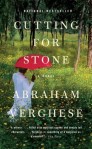 Cutting for Stone by Abraham Verghese: The saga of conjoined twins born of a union between an Indian nun and an English surgeon in 1954. Ethiopia’s postcolonial history is a colorful background. I thrilled to the accounts of medical procedures. I can’t get enough of sprawling Dickensian stories full of coincidences, minor characters, and humor and tragedy.
 Extinctions by Josephine Wilson: The curmudgeonly antihero is widower Frederick Lothian, at age 69 a reluctant resident of St Sylvan’s Estate retirement village. It’s the middle of a blistering Australian summer and he has plenty of time to drift back over his life. He’s a retired engineering expert, but he’s been much less successful in his personal life.
Poetry
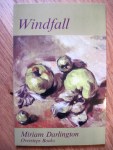 Windfall by Miriam Darlington: I’d had no idea that Darlington had written poetry before she turned to nature writing. The verse is rooted in the everyday. Multiple poems link food and erotic pleasure; others make nature the source of exaltation. Lots of allusions and delicious alliteration. Pick this up if you’re still mourning Mary Oliver.
 Girls Are Coming Out of the Woods by Tishani Doshi: The third collection by the Welsh–Gujarati poet and dancer is vibrant and boldly feminist. The tone is simultaneously playful and visionary, toying with readers’ expectations. Several of the most arresting poems respond to the #MeToo movement. She also excels at crafting breath-taking few-word phrases.
 Where the Road Runs Out by Gaia Holmes: A major thread of the book is caring for her father at home and in the hospital as he was dying on the Orkney Islands – a time of both wonder and horror. Other themes include pre-smartphone life and a marriage falling apart. There are no rhymes, just alliteration and plays on words, with a lot of seaside imagery.
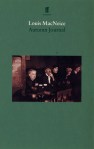 Autumn Journal by Louis MacNeice: MacNeice wrote this long verse narrative between August 1938 and the turn of the following year. Everyday life for the common worker muffles political rumblings that suggest all is not right in the world. He reflects on his disconnection from Ireland; on fear, apathy and the longing for purpose. Still utterly relevant.
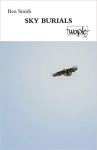 Sky Burials by Ben Smith: I discovered Smith through the 2018 New Networks for Nature conference. He was part of a panel discussion on the role poetry might play in environmental activism. This collection shares that environmentalist focus. Many of the poems are about birds. There’s a sense of history but also of the future.
Nonfiction
 Crow Planet: Essential Wisdom from the Urban Wilderness by Lyanda Lynn Haupt: During a bout of depression, Haupt decided to start paying more attention to the natural world right outside her suburban Seattle window. Crows were a natural place to start. A charming record of bird behavior and one woman’s reawakening, but also a bold statement of human responsibility to the environment.
 All Things Consoled: A Daughter’s Memoir by Elizabeth Hay: Hay’s parents, Gordon and Jean, stumbled into their early nineties in an Ottawa retirement home. There are many harsh moments in this memoir, but almost as many wry ones, with Hay picking just the right anecdotes to illustrate her parents’ behavior and the shifting family dynamic.
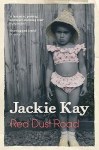 Red Dust Road by Jackie Kay: Jackie Kay was born out of the brief relationship between a Nigerian student and a Scottish nurse in Aberdeen in the early 1960s. This memoir of her search for her birth parents is a sensitive treatment of belonging and (racial) identity. Kay writes with warmth and a quiet wit. The nonlinear structure is like a family photo album.
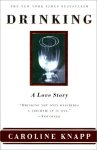 Drinking: A Love Story by Caroline Knapp: An excellent addiction memoir that stands out for its smooth and candid writing. For nearly 20 years, Knapp was a high-functioning alcoholic who maintained jobs in Boston-area journalism. The rehab part is often least exciting, but I appreciated how Knapp characterized it as the tortured end of a love affair.
 The Trauma Cleaner: One Woman’s Extraordinary Life in Death, Decay and Disaster by Sarah Krasnostein: I guarantee you’ve never read a biography quite like this one. It’s part journalistic exposé and part “love letter”; it’s part true crime and part ordinary life story. It considers gender, mental health, addiction, trauma and death. Simply a terrific read.
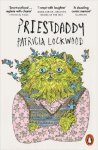 Priestdaddy by Patricia Lockwood: A memoir of growing up in a highly conservative religious setting, but not Evangelical Christianity as you or I have known it. Her father, a married Catholic priest, is an unforgettable character. This is a poet’s mind sparking at high voltage and taking an ironically innocent delight in dirty and iconoclastic talk.
 The Snow Leopard by Peter Matthiessen: For two months in 1973, Matthiessen joined a zoologist on a journey from the Nepalese Himalayas to the Tibetan Plateau in hopes of spotting the elusive snow leopard. Recently widowed, Matthiessen put his Buddhist training to work as he pondered impermanence and acceptance. The writing is remarkable.

This Sunrise of Wonder: Letters for the Journey by Michael Mayne: Mayne’s thesis is that experiencing wonder is what makes us human. He believes poets, musicians and painters, in particular, reawaken us to awe by encouraging us to pay close attention. Especially with the frequent quotations and epigraphs, this is like a rich compendium of wisdom from the ages.
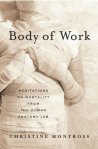 Body of Work: Meditations on Mortality from the Human Anatomy Lab by Christine Montross: When she was training to become a doctor, Montross was assigned an older female cadaver, Eve, who taught her everything she knows about the human body. Montross is also a poet, as evident in this lyrical, compassionate exploration of working with the dead.
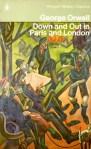 Down and Out in Paris and London by George Orwell: An excellent first-hand account of the working and living conditions of the poor in two world cities. Orwell works as a dishwasher and waiter in Paris hotel restaurants for up to 80 hours a week. The matter-of-fact words about poverty and hunger are incisive, while the pen portraits are glistening.
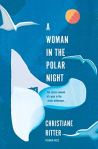 A Woman in the Polar Night by Christiane Ritter: In 1934, Ritter, an Austrian painter, joined her husband Hermann for a year in Spitsbergen. I was fascinated by the details of Ritter’s daily tasks, but also by how her perspective on the landscape changed. No longer a bleak wilderness, it became a tableau of grandeur. A travel classic worth rediscovering.
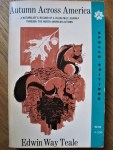 Autumn Across America by Edwin Way Teale: In the late 1940s Teale and his wife set out on a 20,000-mile road trip from Cape Cod on the Atlantic coast to Point Reyes on the Pacific to track the autumn. Teale was an early conservationist. His descriptions of nature are gorgeous, and the scientific explanations are at just the right level for the average reader.
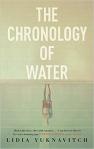 The Chronology of Water by Lidia Yuknavitch: This blew me away. Reading this nonlinear memoir of trauma and addiction, you’re amazed the author is still alive, let alone a thriving writer. The writing is truly dazzling, veering between lyrical stream-of-consciousness and in-your-face informality. The watery metaphors are only part of what make it unforgettable.

(Books not pictured were read from the library or on Kindle.)
And if I really had to limit myself to just two favorites – my very best fiction and nonfiction reads of the year – they would be Moon Tiger by Penelope Lively and Priestdaddy by Patricia Lockwood.
What were your best backlist reads this year?
Nonfiction Review Books Roundup: Hay, Hope et al., Lee, Long, McLaren, Zuckerman
I’m continuing with the Nonfiction November focus by catching up on six nonfiction review books I’ve been sent over the last half a year. We’ve got a record of elderly parents’ decline, letters and poems written about the climate crisis, a family memoir set between Taiwan and Canada, a widow’s mushroom-hunting quest, a work of ecotheology that reflects on travels in the Galápagos Islands, and a defense of an entirely secular basis for morality. You can’t say I don’t read a variety, even within nonfiction! See if one or more of these tempts you.
All Things Consoled: A Daughter’s Memoir by Elizabeth Hay
 Gordon and Jean Hay stumbled into their early nineties in an Ottawa retirement home starting in 2009. Elizabeth Hay is one of four children, but caregiving fell to her for one reason and another, and it was a fraught task because of her parents’ prickly personalities: Jean was critical and thrifty to the point of absurdity, spooning thick mold off apple sauce before serving it and needling Elizabeth for dumping perfectly good chicken juice a year before; Gordon had a terrible temper and a history of corporal punishment of his children and of his students when he was a school principal. Jean’s knee surgery and subsequent infection finally put paid to their independence; her mind was never the same and she could no longer paint.
There are many harsh moments in this memoir, but almost as many wry ones, with Hay picking just the right anecdotes to illustrate her parents’ behavior and the shifting family dynamic. She never looks away, no matter how hard it all gets. Her father’s rage against the dying of the light contrasts with her mother’s fade into confusion – lightened by the surprisingly poetic turns of phrase she came out with despite her dementia and aphasia. The title phrase, for instance, was her attempt at “all things considered.” I would wholeheartedly recommend this to readers of Hay’s novels, but anyone can appreciate the picture of complicated love and grief. (See also Susan’s review.)
With thanks to MacLehose Press for the free copy for review.
Letters to the Earth: Writing to a Planet in Crisis, edited by Anna Hope et al.
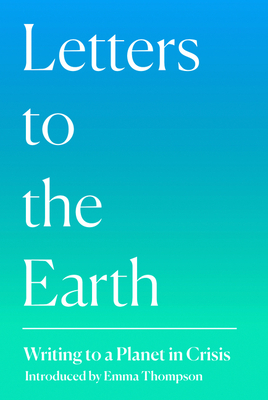 Culture Declares Emergency launched in April to bring the arts into the conversation about the climate emergency. Letters to the Earth compiles 100 short pieces by known and unknown names alike. Alongside published authors, songwriters, professors and politicians are lots of ordinary folk, including children as young as seven. The brief was broad: to write a letter in response to environmental crisis, whether to or from the Earth, to future generations (there are wrenching pieces written to children: “What can I say, now that it’s too late? … that I’m sorry, that I tried,” writes Stuart Capstick), to the government or to other species.
There are certainly relatable emotions here, especially the feeling of helplessness. “We take the train, go vegan, refuse plastic, buy less and less. But that is tiny. We are tiny,” novelist Jo Baker writes. I loved retired bishop Richard Holloway’s wry letter calling the author of Genesis to account for unhelpful language of dominion, Rob Cowen’s poem to a starling, and Anna Hope’s essay about parenting in a time of uncertainty. Unfortunately, much of the rest is twee or haranguing, e.g. “Forest fires are scorching INNOCENT wildlife. Plastic is strangling INNOCENT turtles and dolphins,” a 12-year-old writes. This was put together in a matter of months, and it shows. There is not enough tonal variety, a lot of overwriting has crept through, and errors, especially in the kids’ work, remain uncorrected. Perhaps six to 10 pieces stood out to me overall. I’d recommend the Extinction Rebellion handbook instead.
With thanks to Alison Menzies / William Collins for the free copy for review.
Two Trees Make a Forest: On Memory, Migration and Taiwan by Jessica J. Lee
 I loved Turning, Lee’s 2017 memoir about swimming in one of Berlin’s lakes per week for a year, so I jumped at the chance to read her follow-up, which delves into her maternal line’s history in Taiwan. She travels to Taipei for three months to brush up on her Chinese, write and hike. Interspersed with the lush descriptions of her walks are reflections on Taiwan’s history and on the hidden aspects of her grandfather Gong’s past that only came to light after Lee’s grandmother, Po, died and she and her mother discovered an autobiographical letter he’d written before he drifted into dementia. Nature, language, history and memory flow together in a delicate blend of genres – “I moved from the human timescale of my family’s story through green and unfurling dendrological time,” she writes.
This has got to be one of the most striking title and cover combinations of the year. Along with Chinese characters, the book includes some looping text and Nico Taylor’s maps and illustrations of Taiwanese flora and fauna. While you will likely get more out of this if you have a particular interest in Asian history, languages and culture, it’s impressive how Lee brings the different strands of her story together to form a hybrid nature memoir that I hope will be recognized by next year’s Wainwright Prize and Young Writer of the Year Award shortlists. She’d also be a perfect New Networks for Nature speaker.
With thanks to Virago for the free copy for review.
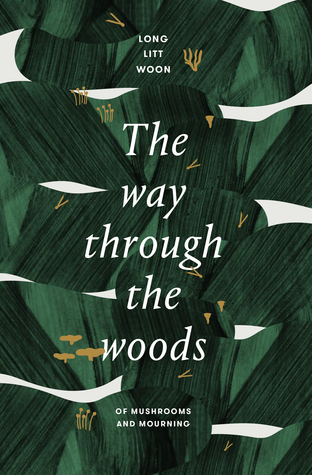
The Way through the Woods: Of Mushrooms and Mourning by Long Lit Woon
 [Trans. from the Norwegian by Barbara J. Haveland]
I couldn’t resist the sound of a bereavement memoir crossed with a mushroom hunting guide. When Long met her husband, Eiolf Olsen, she was an 18-year-old Malaysian exchange student in Stavanger, Norway. Meeting Eiolf changed the whole course of her life, keeping her in Europe for good; decades later, her life changed forever once again when Eiolf dropped dead at work one morning. “If anyone had told me that mushrooms would be my lifeline, the thing that would help me back onto my feet and quite literally back onto life’s track, I would have rolled my eyes. What had mushrooms to do with mourning?” she writes.
 The answer to that rhetorical question is nothing much, at least not inherently, so this ends up becoming a book of two parts, with the bereavement strand (printed in green and in a different font – green is for grief? I suppose) engaging me much more than the mushroom-hunting one, which takes her to Central Park and the annual Telluride, Colorado mushroom festival as well as to Norway’s woods again and again – “In Norway, outdoor life is tantamount to a religion.” But the quest for wonder and for meaning is a universal one. In addition, if you’re a mushroom fan you’ll find gathering advice, tasting notes, and even recipes. I fancy trying the “mushroom bacon” made out of oven-dried shiitakes.
With thanks to Scribe for the free copy for review.
God Unbound: Theology in the Wild by Brian McLaren
 McLaren was commissioned to launch a series that was part travel guide, part spiritual memoir and part theological reflection. Specifically, he was asked to write about the Galápagos Islands because he’d been before and they were important to him. He joins a six-day eco-cruise that tours around the island chain off Ecuador, with little to do except observe the birds, tortoises and iguanas, and swim with fish and sea turtles. For him this is a peaceful, even sacred place that reminds him of the beauty that still exists in the world despite so much human desecration. Although he avoids using his phone except to quickly check in with his wife, modernity encroaches unhelpfully through a potential disaster with his laptop.
I was surprised to see that McLaren leaves the Galápagos at the midpoint – whatever could fill the rest of the book, I wondered? He starts by reassessing Darwin, so often painted as a villain by Evangelical Christianity but actually a model of close, loving attention to nature. He also recalls how some of his most intense spiritual experiences have arisen from time in nature. McLaren’s books have been pivotal to my spiritual journey as we’ve both gradually become more liberal and environmentalist. His definition of God might horrify traditionalists, but holds appeal for me: “a centering singularity whose gravity holds me in insistent orbit, pulling me deeper into mystery, pondering who I am and what my life means.” This is an unusual but gently entrancing book full of photos and quotes from other thinkers including John Muir, Pope Francis and Richard Rohr. It’s an ideal introduction to ecotheology.
With thanks to Canterbury Press for the free copy for review.
What It Means to Be Moral: Why Religion Is Not Necessary for Living an Ethical Life by Phil Zuckerman
 From one end of the spectrum (progressive Christianity) to the other (atheism). Here’s a different perspective from a sociology professor at California’s Pitzer College. Zuckerman’s central argument is that humanism and free choice can fuel ethical behavior; since there’s no proof of God’s existence and theists have such a wide range of beliefs, it’s absurd to slap a “because God says so” label on our subjective judgments. Morals maintain the small communities our primate ancestors evolved into, with specific views (such as on homosexuality) a result of our socialization. Alas, the in-group/out-group thinking from our evolutionary heritage is what can lead to genocide. Instead of thinking in terms of ‘evil’, though, Zuckerman prefers Dr. Simon Baron-Cohen’s term, “empathy erosion.”
To tackle violent crime, Zuckerman contends, we need a more equal society, with the Scandinavian countries a model of how to achieve that through higher taxes, social services and the rehabilitation of prisoners. He uses a lot of relatable examples from history and from his own experience, as well as theoretical situations, to think through practical morality. I found his indictment of American Christianity accurate – how does it make sense for people who say they follow the way of Jesus to fight against equality, tolerance and scientific advances and instead advocate guns, the death penalty and Trump? Well, indeed.
It might seem odd for me to recommend this alongside the McLaren, but there is much to be gained from both viewpoints. Zuckerman’s work overlaps a fair bit with another I’ve read on the topic, Richard Holloway’s Godless Morality – even a bishop agrees we needn’t take our societal ethics straight from the Bible! I can’t go along fully with Zuckerman because I think progressive religion has been and can continue to be a force for good, but I would agree that atheists can be just as moral as people of faith – and often more so.
With thanks to Counterpoint Press for sending a proof copy for review.
Would you be interested in reading one or more of these?
Book Serendipity, 2019 Second Half
I call it serendipitous when two or more books that I’m reading at the same time or in quick succession have something pretty bizarre in common. Because I have so many books on the go at once – usually between 10 and 20 – I guess I’m more prone to such incidents. I post these occasional reading coincidences on Twitter. What’s the weirdest one you’ve had lately? (The following are in rough chronological order.)
[Previous 2019 Book Serendipity posts from April and July.]
- Two novels in which a character attempts to glimpse famous mountains out of a train window but it’s so rainy they can barely be seen: The Unchangeable Spots of Leopards by Kristopher Jansma and The Pine Islands by Marion Poschmann.


- Ex-husbands move from England to California and remarry younger women in The Stillness The Dancing by Wendy Perriam and Heat Wave by Penelope Lively.
 References to Edgar Allan Poe in both Timbuktu by Paul Auster and The Unchangeable Spots of Leopards by Kristopher Jansma.
- An account of Percy Shelley’s funeral pyre in both The Unchangeable Spots of Leopards by Kristopher Jansma and Frankissstein by Jeanette Winterson.
- Mentions of barn owls being killed by eating poisoned rats in Owl Sense by Miriam Darlington and Homesick by Catrina Davies.


- Miriam Rothschild is mentioned in Irreplaceable by Julian Hoffman and An Obsession with Butterflies by Sharman Apt Russell.
- Gorse is thrown on bonfires in Homesick by Catrina Davies and The Stillness The Dancing by Wendy Perriam.
 A character has a nice cup of Ovaltine in Some Tame Gazelle by Barbara Pym and The Stillness The Dancing by Wendy Perriam.
- I started two books with “Bloom” in the title on the same day.

 Two books I finished about the same time conclude by quoting or referring to the T. S. Eliot lines about coming back to the place where you started and knowing it for the first time (Owl Sense by Miriam Darlington and This Is Not a Drill, the Extinction Rebellion handbook).
- Three books in which the narrator wonders whether to tell the truth slant (quoting Emily Dickinson, consciously or not): The Unchangeable Spots of Leopards by Kristopher Jansma, The Poisonwood Bible by Barbara Kingsolver and The Hiding Game by Naomi Wood.
- On the same day, I saw mentions of crullers in both On Chapel Sands by Laura Cumming and The Dutch House by Ann Patchett.


- There are descriptions of starling murmurations over Brighton Pier in both Irreplaceable by Julian Hoffman and Expectation by Anna Hope. (Always brings this wonderful Bell X1 song to mind!)
- I was reading The Outermost House by Henry Beston and soon after found an excerpt from it in Irreplaceable by Julian Hoffman; later I started The Easternmost House by Juliet Blaxland, whose title is a deliberate tip of the hat to Beston.
 At a fertility clinic, the author describes a pair of transferred embryos as “two sequins of light” (in On Chapel Sands by Laura Cumming) and “two points of light” (in Expectation by Anna Hope).
- Mentions of azolla ferns in Time Song by Julia Blackburn and Bloom (aka Slime) by Ruth Kassinger.
 Incorporation of a mother’s brief memoir in the author’s own memoir in On Chapel Sands by Laura Cumming and All Things Consoled by Elizabeth Hay.
- Artist mothers in On Chapel Sands by Laura Cumming, All Things Consoled by Elizabeth Hay, and Expectation by Anna Hope.
- Missionary fathers in The Poisonwood Bible by Barbara Kingsolver and The Wind that Lays Waste by Selva Almada.


- Twins, one who’s disabled from a birth defect and doesn’t speak much, in Golden Child by Claire Adam and The Poisonwood Bible by Barbara Kingsolver.
 An Irish-American family in a major East Coast city where the teenage boy does construction work during the summers in Ask Again, Yes by Mary Beth Keane and The Dutch House by Ann Patchett.
- SPOILERS: A woman with terminal cancer refuses treatment so she can die on her own terms and is carried out into her garden in Expectation by Anna Hope and A Reckoning by May Sarton.
- A 27-year-old professor has a student tearfully confide in her in Crow Lake by Mary Lawson and The Small Room by May Sarton.


- Reading The Yellow House by Sarah M. Broom at the same time as The Dutch House by Ann Patchett.
 “I was nineteen years old and an idiot” (City of Girls, Elizabeth Gilbert); “I was fifteen and generally an idiot” (The Dutch House, Ann Patchett).
- Mentions of a conjuring tricks book in Time Song by Julia Blackburn and Fifth Business by Robertson Davies.
- A teen fleeces their place of employment in Sweet Sorrow by David Nicholls and Who Will Run the Frog Hospital? by Lorrie Moore.


- A talking parrot with a religious owner in The Poisonwood Bible by Barbara Kingsolver and Olive Kitteridge by Elizabeth Strout.
- Pictorial book serendipity: three books I was reading, and another waiting in the wings, had a red, black and white color scheme.

 Kripalu (a Massachusetts retreat center) is mentioned in Fleishman Is in Trouble by Taffy Brodesser-Akner and Once More We Saw Stars by Jayson Greene.
- The character of Netty Quelch in Robertson Davies’s The Manticore reminds me of Fluffy in Ann Patchett’s The Dutch House.
- The artist Chardin is mentioned in How Proust Can Change Your Life by Alain de Botton and Varying Degrees of Hopelessness by Lucy Ellmann.
- A Czech grand/father who works in a plant nursery in the opening story of Andrea Barrett’s Ship Fever and Patricia Hampl’s The Florist’s Daughter.


- The author was in Eva Le Gallienne’s NYC theatre company (Madeleine L’Engle’s Two-Part Invention and various works by May Sarton, also including a biography of her).
 Gillian Rose’s book Love’s Work is mentioned in both Notes Made while Falling by Jenn Ashworth and My Year Off by Robert McCrum. (I will clearly have to read the Rose!)
- Sarah Baartman (displayed in Europe as the “Hottentot Venus”) is mentioned in Shame on Me by Tessa McWatt and Hull by Xandria Phillips.
20 Books of Summer, #14–15: Mary Lawson and Stephen Moss
Approaching the home straight with these two: another novel that happens to have an animal in the title, and a pleasant work of modern nature writing set in an English village. My rating for both:
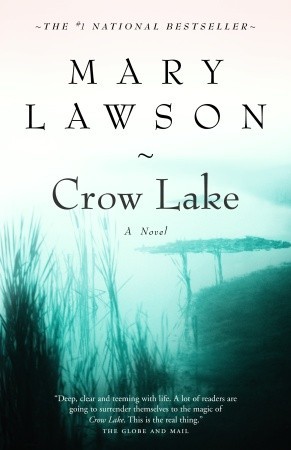
Crow Lake by Mary Lawson (2002)
I’ve meant to read more by Lawson ever since I reviewed her latest book, Road Ends, for Nudge in May 2015. All three of her novels draw on the same fictional setting: Struan, Ontario. Lawson grew up in a similar Canadian farming community before moving to England in the late 1960s. After an invitation arrives for her nephew’s birthday party, narrator Kate Morrison looks 20 years into the past to remember the climactic events of the year that she was seven. When she and her siblings were suddenly orphaned, her teenage brothers, Luke and Matt, had to cobble together local employment that allowed them to look after their little sisters at home. With the help of relatives and neighbors, they kept their family of four together. All along, though, their lives were becoming increasingly entwined with those of the Pyes, a troubled local farming family.
 Matt inspired Kate’s love of pond life – she’s now an assistant professor of invertebrate ecology – but never got to go to college himself. Theirs was a family that prized schooling above all else (legend has it that Great-Grandmother installed a book rest on her spinning wheel so she could read while her hands were busy*) and eschewed emotion. “It was the Eleventh Commandment,” Kate recalls: “Thou Shalt Not Emote.”
This is a slow burner for sure, but it’s a winning picture of a family that stuck together despite the odds, as well as an appeal to recognize that emotional intelligence is just as important as book learning. The novel reminded me a lot of Surfacing by Margaret Atwood and The Girls by Lori Lansens, and I’d also recommend it to readers of Elizabeth Hay and Jane Urquhart.
*Delightfully, this detail was autobiographical for Lawson.
Wild Hares and Hummingbirds: The Natural History of an English Village by Stephen Moss (2011)
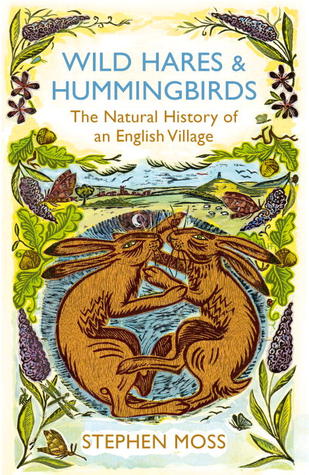 England doesn’t have any hummingbirds, but it does have hummingbird hawkmoths, which explains the title. In the tradition of Gilbert White, Moss writes a month-by-month tribute to what he regularly sees on his home turf of Mark, Somerset. As I did with Mark Cocker’s Claxton, I picked up the book partway – at the month in which I started reading it – and when I reached the end, returned to the beginning and read up to my starting point. Controversial, I know, but that July to June timeline worked fine: it gave me familiar glimpses of what’s going on with English nature now, followed by an accelerated preview of what I have to look forward to in the coming months.
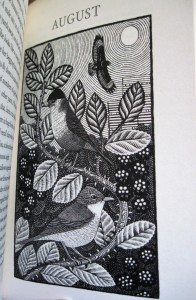 Moss is primarily a birder, so he focuses on bird life, but also notes what’s happening with weather, trees, fungi, and so on. In the central and probably best chapter, on June, he maximizes wildlife-watching opportunities: going eel fishing, running a moth trap, listening for bats, and looking out for unfamiliar plants. My minor annoyances with the book were the too-frequent references to “the parish,” which makes the book’s concerns seem parochial rather than microcosmic, and the common use of semicolons where commas and dashes would be preferable. But if you’re fond of modern nature writing, and have some familiarity with (or at least interest in) the English countryside, I highly recommend this as a peaceful, observant read. Plus, Harry Brockway’s black-and-white engravings heading each chapter are exquisite.
Favorite lines:
“Being in one place is also the best way to understand the passing of the seasons: not the great shifts between winter and spring, summer and autumn, which we all notice; but the tiny, subtle changes that occur almost imperceptibly, from week to week, and day to day, throughout the year.”
“For me, one of the greatest pleasures of living in the English countryside is the way we ourselves become part of the natural cycle of the seasons.”
Best Backlist Reads of 2018
Like a lot of book bloggers, I’m irresistibly drawn to the shiny new books released each year. However, I’ve noticed recently that many of my most memorable reads were published years or even decades ago. In 2018 I even came across a handful of books that are for me among the very best representatives of their genre, whether that’s nature, travel, family memoir, historical fiction or science fiction. The below selections are in alphabetical order by author name, and account for all the rest of my 4.5- and 5-star ratings of the year (another 27!).

My best backlist reads of the year (most of the ones I own in print, anyway).
Fiction
 March by Geraldine Brooks (2005): The best Civil War novel I’ve read. The best slavery novel I’ve read. One of the best historical novels I’ve ever read, period. Brooks’s second novel uses Little Women as its jumping-off point but is very much its own story. The whole is a perfect mixture of what’s familiar from history and literature and what Brooks has imagined.
 Marlena by Julie Buntin (2017): The northern Michigan setting pairs perfectly with the novel’s tone of foreboding: you have a sense of these troubled teens being isolated in their clearing in the woods, and from one frigid winter through a steamy summer and into the chill of the impending autumn, they have to figure out what in the world they are going to do with their terrifying freedom. It’s basically a flawless debut, one I can’t recommend too highly.
 Reading in the Dark by Seamus Deane (1996): Ireland’s internecine violence is the sinister backdrop to this family’s everyday sorrows, including the death of a child and the mother’s shaky mental health. The book captures all the magic, uncertainty and heartache of being a child, in crisp scenes I saw playing out in my mind.
 The Life and Loves of Lena Gaunt by Tracy Farr (2013): Lena Gaunt: early theremin player, grande dame of electronic music, and opium addict. I loved how Farr evokes the strangeness and energy of theremin music, and how sound waves find a metaphorical echo in the ocean’s waves – swimming is Lena’s other great passion.
 Late Nights on Air by Elizabeth Hay (2007): A tight-knit cast gathers around the local radio station in Yellowknife, a small city in Canada’s Northwest Territories: Harry and Gwen, refugees from Ontario starting new lives; Dido, an alluring Dutch newsreader; Ralph, the freelance book reviewer; menacing Eddie; and pious Eleanor. This is a marvellous story of quiet striving and dislocation; I saw bits of myself in each of the characters, and I loved the extreme setting, both mosquito-ridden summer and bitter winter.
 The Leavers by Lisa Ko (2017): An ambitious and satisfying novel set in New York and China, with major themes of illegal immigration, searching for a mother and a sense of belonging, and deciding what to take with you from your past. This was hand-picked by Barbara Kingsolver for the 2016 PEN/Bellwether Prize for Socially Engaged Fiction.
 The Invisible Bridge by Julie Orringer (2010): Hungarian Jew Andras Lévi travels from Budapest to Paris to study architecture, falls in love with an older woman who runs a ballet school, and – along with his parents, brothers, and friends – has to adjust to the increasingly strict constraints on Jews across Europe in 1937–45. It’s all too easy to burn out on World War II narratives these days, but this is among the very best I’ve read.
 The Sparrow by Mary Doria Russell (1996): For someone like me who struggles with sci-fi at the best of times, this is just right: the alien beings are just different enough from humans for Russell to make fascinating points about gender roles, commerce and art, but not so peculiar that you have trouble believing in their existence. All of the crew members are wonderful, distinctive characters, and the novel leaves you with so much to think about: unrequited love, destiny, faith, despair, and the meaning to be found in life.
 Salt Creek by Lucy Treloar (2015): Hester Finch is looking back from the 1870s – when she is a widowed teacher settled in England – to the eight ill-fated years her family spent at Salt Creek, a small (fictional) outpost in South Australia, in the 1850s–60s. This is one of the very best works of historical fiction I’ve read; it’s hard to believe it’s Treloar’s debut novel.
 Christmas Days: 12 Stories and 12 Feasts for 12 Days by Jeanette Winterson (2016): I treated myself to this new paperback edition with part of my birthday book token and it was a perfect read for the week leading up to Christmas. The stories are often fable-like, some spooky and some funny. Most have fantastical elements and meaningful rhetorical questions. Winterson takes the theology of Christmas seriously. A gorgeous book I’ll return to year after year.
Poetry
 Available Light by Marge Piercy (1988): The subjects are diverse: travels in Europe, menstruation, identifying as a Jew as well as a feminist, scattering her father’s ashes, the stresses of daily life, and being in love. Some of my favorites were about selectively adhering to the lessons her mother taught her, how difficult it is for a workaholic to be idle, and wrestling the deity for words.
Nonfiction
 Deep Country: Five Years in the Welsh Hills by Neil Ansell (2011): One of the most memorable nature/travel books I’ve ever read; a modern-day Walden. Ansell’s memoir is packed with beautiful lines as well as philosophical reflections on the nature of the self and the difference between isolation and loneliness.
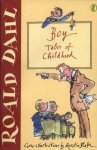 Boy by Roald Dahl (1984): Pranks and larks and holidays: these are all here; so is crushing homesickness and a bitter sense of injustice at being at the mercy of sadistic adults. Nearly 60 years later, Dahl could use memory and imagination to fully inhabit his childhood self and give a charming survey of the notable events of his life up to age 20.
 This Cold Heaven: Seven Seasons in Greenland by Gretel Ehrlich (2001): I thoroughly enjoyed my armchair trek across a frigid island nation in the company of Gretel Ehrlich, who traveled here repeatedly between 1995 and 2001 and intersperses her journeys with those of her historical model, Inuit–Danish explorer Knud Rasmussen, whose seven Arctic expeditions took in the west coast of Greenland and the far north of the North American continent. Every time she finds a fresh way to write about ice and sun glare and frigid temperatures.
 Ali: A Life by Jonathan Eig (2017): It’s a riveting account of outliving segregation and developing a personal style and world-beating confidence; it’s a sobering tale of facing consequences and having your own body fail you. I’m the furthest thing from a sports fan you could imagine, but I approached this as a book about a cultural icon and read it with a spirit of curiosity about how Eig would shape this life story and separate the facts from the legend. I loved it.
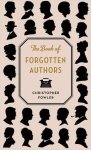 The Book of Forgotten Authors by Christopher Fowler (2017): A charming introduction to 99 more or less obscure writers. Each profile is a perfectly formed mini-biography with a survey of the author’s major work: in just two or three pages, Fowler is able to convey all a writer’s eccentricities and why their output is still worth remembering.
 To the Is-Land: An Autobiography by Janet Frame (1982): This is some of the best writing about childhood and memory that I’ve ever read, infused with music, magic and mystery. The prose alternates between dreamy and matter-of-fact as Frame describes growing up in New Zealand one of five children in the Depression and interwar years.
 Leaving Before the Rains Come by Alexandra Fuller (2015): This poignant sequel to Don’t Let’s Go to the Dogs Tonight is a portrait of Fuller’s two-decade marriage, from its hopeful beginnings to its acrimonious end. What I most appreciated about the book was Fuller’s sense of being displaced: she no longer feels African, but nor does she feel American.
 West With the Night by Beryl Markham (1942): Markham writes so vividly about the many adventures of her life in Africa: hunting lions, training race horses, and becoming one of the continent’s first freelance pilots, delivering mail and locating elephant herds. Whether she’s reflecting on the many faces of Africa or the peculiar solitude of night flights, the prose is just stellar.
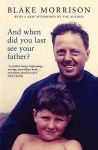 And When Did You Last See Your Father? by Blake Morrison (1993): An extraordinary memoir based around the author’s relationship with his father. Alternating chapters give glimpses into earlier family life and narrate Morrison’s father’s decline and death from cancer. This is simply marvelously written, not a bad line in the whole thing.
 The Seabird’s Cry: The Lives and Loves of Puffins, Gannets and Other Ocean Voyagers by Adam Nicolson (2017): This is an extraordinarily well-written and -researched book (a worthy Wainwright Prize winner) about the behavior, cultural importance, and current plight of the world’s seabirds. Each chapter takes up a different species and dives deep into everything from its anatomy to the legends surrounding it, simultaneously conveying the playful, intimate real lives of the birds and their complete otherness.
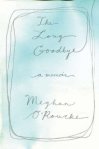 The Long Goodbye: A Memoir of Grief by Meghan O’Rourke (2011): I read a whole lot of bereavement memoirs; this has been one of the very best. O’Rourke tells her story with absolute clarity – a robust, plain-speaking style that matches her emotional transparency. The heart of the book is her mother’s death from colorectal cancer on Christmas Day 2008, but we also get a full picture of the family life that preceded it and the first couple of years of aftermath.
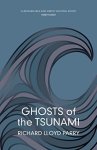 Ghosts of the Tsunami: Death and Life in Japan’s Disaster Zone by Richard Lloyd Parry (2017): Eighteen and a half thousand people died in the earthquake and tsunami that hit Japan in March 2011. It’s not really possible to get your head around a tragedy on that scale so, wisely, Parry focuses on a smaller story within the story: 74 died at Okawa primary school because the administration didn’t have a sufficient disaster plan in place. This is a stunning portrait of a resilient people, but also a universal story of the human spirit facing the worst.
 Lots of Candles, Plenty of Cake by Anna Quindlen (2012): A splendid memoir-in-essays that dwells on aging, parenting and female friendship. Some of its specific themes are marriage, solitude, the randomness of life, the process of growing into your own identity, and the special challenges her generation (roughly my mother’s) faced in seeking a work–life balance. Her words are witty and reassuring, and cut right to the heart of the matter in every case.
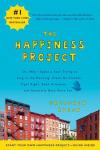 The Happiness Project: Or, Why I Spent a Year Trying to Sing in the Morning, Clean My Closets, Fight Right, Read Aristotle, and Generally Have More Fun by Gretchen Rubin (2009): Probably the best self-help book I’ve read; dense (in the best possible way) with philosophy, experience and advice. What I appreciated most is that her approach is not about undertaking extreme actions to try to achieve happiness, but about finding contentment in the life you already have by adding or tweaking small habits – especially useful for pessimists like me.
 In the Days of Rain: A daughter. A father. A cult by Rebecca Stott (2017): This was a perfect book for my interests, and just the kind of thing I would love to write someday. It’s a bereavement memoir that opens with Stott’s father succumbing to pancreatic cancer and eliciting her promise to help finish his languishing memoir; it’s a family memoir that tracks generations through England, Scotland and Australia; and it’s a story of faith and doubt, of the absolute certainty experienced inside the Exclusive Brethren (a Christian sect that numbers 45,000 worldwide) and how that cracked until there was no choice but to leave.
 Writers & Company by Eleanor Wachtel (1993): Erudite and fascinating author interviews from Wachtel’s weekly Canadian Broadcasting Corporation radio program. Whether I’d read anything by these authors (or even heard of them) or not, I found each Q&A chock-full of priceless nuggets of wisdom about creativity, mothers and daughters, drawing on autobiographical material, the writing process, and much more.
And if I really had to limit myself to just two books – my very best fiction and nonfiction reads of the year – they would be March by Geraldine Brooks and And When Did You Last See Your Father? by Blake Morrison.

 Bookish Beck = Rebecca Foster. American transplant to England. Freelance proofreader and book reviewer.
 Bookish Beck


.jpg)
.jpg)