Reading Wales Month: Tishani Doshi & Ruth Janette Ruck (#ReadingWales25)
It’s my first time participating in Reading Wales Month, hosted this year by Karen of BookerTalk. I happened to be reading a collection by a Welsh-Gujarati poet, and added a Welsh hill farming memoir to my stack so I could review two books towards this challenge.

A God at the Door by Tishani Doshi (2021)
 I discovered Doshi through the phenomenal Girls Are Coming out of the Woods, which I reviewed for Wasafiri literary magazine. This fourth collection is just as rich in long, forthright feminist and political poems. Violence against women is a theme that crops up again and again in her work, as in “Every Unbearable Thing”: “this is not / a poem against longing / but against the kind of one-way / desire that herds you into a / dead-end alley”. The arresting title of the sestina “We Will Not Kill You. We’ll Just Shoot You in the Vagina” is something the former Philippines president Rodrigo Duterte said in 2018 in reference to female communist rebels. Doshi links femicide and ecocide with “A Possible Explanation as to Why We Mutilate Women & Trees, which Tries to End on a Note of Hope”. Her poem titles are often striking and tell stories in and of themselves. Several made me laugh, such as “Advice for Pliny the Elder, Big Daddy of Mansplainers,” which is shaped like a menstrual cup.
In defiance of those who would destroy it, Doshi affirms the primacy of the body. The joyfully absurd “In a Dream I Give Birth to a Sumo Wrestler” ends with the lines “How easy to forget / that all we have are these bodies. That all of this, all of this is holy.” Poems are inspired by Emily Dickinson and Frida Kahlo as well as by real events that provoke outrage. The clever folktale-like pair “Microeconomics” and “Macroeconomics” contrasts a woman dutifully growing peas and trying to get ahead with exploitative situations: “One man sits on another if he can. … One man goes / into the mines for another man to sparkle.” I also found many wise words on grief. Doshi is a treasure. (Secondhand – Green Ink Booksellers, Hay-on-Wye) 
Place of Stones by Ruth Janette Ruck (1961)
“Farming is rather like the theatre—whatever happens the show must go on.”
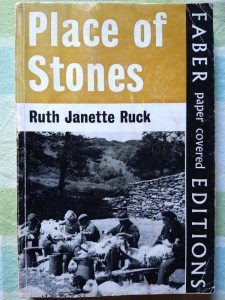 I reviewed Ruck’s Along Came a Llama several years ago when it was re-released by Faber. This was the first of her three memoirs about life at Carneddi (which means “place of stones”), the hill farm in North Wales that she and her family took over in the 1950s. After college, Ruck trained at a farm on the Isle of Wight and later completed an apprenticeship at Oathill Farm, Oxfordshire under George Henderson, who seems to have been something of a celebrity farmer back then (he contributes a brief but complimentary foreword). By age 20 she was in full charge of Carneddi, where they kept sheep, cattle and fowl. Many of their neighbours had Welsh as a first or only language. At that time, farmers were eligible for government grants. Ruck put in an intensive hen-rearing barn and started growing strawberries and rearing turkeys for Christmas.
Even when things were going well, it was a hand-to-mouth existence and storms or illness could set everything back. The Rucks renovated a nearby cottage to serve as a holiday let. Another windfall came in the bizarre form of a nearby film shoot by Twentieth Century Fox (The Inn of the Sixth Happiness, starring Ingrid Bergman). Mountainous North Wales stood in for China, and the film crew hired Ruck as a driver and, like many locals, as an occasional extra. This book was light and mildly entertaining, though probably more detailed about everyday farm work and projects than I needed. I was reminded again of Doreen Tovey, especially in the passage about Topsy the pet black sheep, but also this time of Betty Macdonald (The Egg and I) and Janet White (The Sheep Stell). (Secondhand – Lions bookshop, Alnwick) 
April Releases: Frida Kahlo, Games and Rituals, Romantic Comedy
It’s been a big month for new releases and I have loads more April books on the go or waiting in the wings to be reviewed in catch-up posts in the future. For now, I have a biographical graphic novel about a celebrated painter whose medical struggles coloured her art, a set of witty short stories about modern preoccupations and relationships, and a guilty pleasure of a novel from one of my favourite contemporary authors.
Frida Kahlo: Her Life, Her Work, Her Home by Francisco de la Mora
[Translated from the Spanish by Lawrence Schimel]
 The latest in SelfMadeHero’s Art Masters series (I’ve also reviewed their books on Munch, Van Gogh, Gauguin and O’Keeffe). De la Mora imagines Kahlo (1907–1954) hosting a party at her famous blue house in Coyoacán, Mexico in her final summer – unknown to everyone there, it’s exactly one week before her death. “Hola, come in, welcome. I’m so glad you’re all here. Today is my birthday, and I want to tell all of you the story of my life…” she invites her guests, and thereby the reader. It’s a handy conceit that justifies a chronological approach.
I was reminded of traumatic events from Kahlo’s life that I’d already encountered in various places (such as Constellations by Sinéad Gleeson and Frida Kahlo and My Left Leg by Emily Rapp Black): childhood polio and the Mexican Revolution, the hideous bus accident that reshaped her body, and two miscarriages. Periods of confinement alternate with travels. We see her devotion to traditional dress and the development of her frank self-portraiture style. I’d forgotten, or never knew, that she married Diego Rivera twice and divorced in between. They hosted many cultural giants of the time (e.g., Trotsky’s stay with them forms part of Barbara Kingsolver’s The Lacuna), and both had their infidelities. I loved the use of vibrant colours, but learned little. This is really only an introduction for those new to her.

With thanks to Paul Smith and SelfMadeHero for the free copy for review.
Games and Rituals by Katherine Heiny
Early Morning Riser was one of my favourite books of 2021, and I caught up earlier this year with Heiny’s only previous novel, Standard Deviation. Both are hilarious takes on the quirks of relationships, exploring a specific dynamic that recurs in a couple of these stories: the uncomfortable triangle between a man, his second (invariably younger) wife, and the very different, generally formidable, woman he was formerly married to and who continues to play a role in his life. One of the strongest stories is “561,” which was first published as a stand-alone e-book in 2018. Charlie stole Forrest away from Barbara and now the two women have a frosty relationship. It might seem like poetic justice that Charlie later has to load all of Barbara’s possessions into a moving van, but the notion of penance gets murkier when we learn what happened when they worked together on a suicide prevention hotline.
 Eight of the 11 stories are in the third person and most protagonists are young or middle-aged women navigating marriage/divorce and motherhood. A driving examiner finds herself in the same situation as her teenage test-taker; a wife finds evidence of her actor husband’s adultery. In “Damascus,” Mia worries her son might be on drugs, but doesn’t question her own self-destructive habits. Inspired by Marie Kondo, Rachel tries to pare her life back to the basics in “CobRa.” In “King Midas,” Oscar learns that all is not golden with his mistress. “Sky Bar” has Fawn stuck in her hometown airport during a blizzard. I particularly liked the ridiculous situations Florida housemates get themselves into in “Pandemic Behavior,” and the second-person “Twist and Shout,” about loving an elderly father even though he’s infuriating.
Heiny mixes humour with bitter truths in engaging stories about characters whose mistakes and futile attempts to escape the past only make them the more relatable. Her first and last lines are particularly strong; who could resist a piece that opens with “Your elderly father has mistaken his four-thousand-dollar hearing aid for a cashew and eaten it”?
With thanks to 4th Estate for the proof copy for review.
Romantic Comedy by Curtis Sittenfeld
Curtis Sittenfeld is one of my favourite contemporary authors (I’ve also reviewed You Think It, I’ll Say It and Rodham) and I’ve read everything she’s published. Her work might seem lighter than my usual fare, but I’ve always maintained that she, like Maggie O’Farrell, perfectly treads the line between literary fiction and women’s fiction. This was one of my most anticipated releases of the year and it met my expectations.
Sally Milz is a mid-thirties writer for The Night Owls, a long-running sketch comedy show modelled on Saturday Night Live. Sittenfeld clearly did a lot of research into women in comedy, and Chapter 1 is a convincing blow-by-blow of a typical TNO schedule of pitches, edits, rehearsals, all-nighters and afterparties. This particular week in 2018, the host and musical guest are the same person: Noah Brewster, a pop star with surfer-boy good looks who rose to fame in the early 2000s with radio singles like “Making Love in July” and has maintained steady popularity since then. (I imagined him as a cross between Robbie Williams and Chris Hemsworth.) Sally had been expecting a self-absorbed ignoramus so, when she helps Noah edit a sketch he’s written, is pleasantly surprised to discover he’s actually smart, funny and humble. Sparks seem to fly between them, too, though the week ends all too soon.
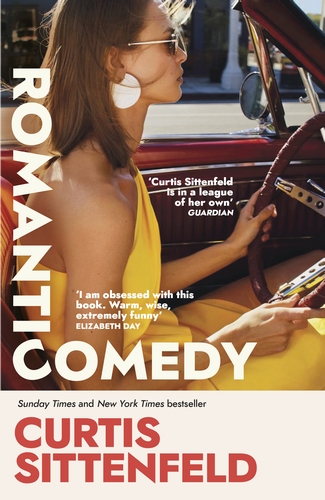 Plain Jane getting the hot guy … that never happens, right? In fact, Sally has a theory about this very dilemma, named after her schlubby TNO office-mate: The Danny Horst Rule states that ordinary men may date and even marry actresses or supermodels, but reverse the genders and it never works. A fundamental lack of confidence means that, whenever she feels too vulnerable, Sally resorts to snarky comedy and sabotages her chances at happiness. But when, midway through the summer of 2020, she gets an out-of-the-blue e-mail from Noah, she wonders if this relationship has potential in the real world. (This, for me, is the peak: when you find out that interest is requited; that the person you’ve been thinking about for years has also been thinking about you. Whatever comes next pales in comparison to this moment.)
The correspondence section was my favourite element. “I do still wonder whether a person’s writing self is their realest self, their fakest self, or just a different self than their in-the-world self?” Sally writes to Noah. As always, Sittenfeld’s inhabiting of a first-person narrator is flawless, and Sally’s backstory and Covid-lockdown, Kansas City existence with her octogenarian stepfather and his beagle endeared her to me. I also appreciated that a woman in her mid- to late thirties could be a romantic lead, and that the question of whether she wants children simply never comes up. Of Sittenfeld’s books, I’d call this closest in tone and content to Eligible, and some familiarity with SNL would probably be of benefit.
Could this be called a predictable story? Well, what does one expect or want from a romcom (watching or reading)? There may be a feminist leaning in places, but this is conventional wish fulfilment, which, I assume, is what keeps romance readers hooked. I enjoyed every sentence and, when it was over, wished I could stay in Sally’s world. (See also Susan’s review.)
With thanks to Doubleday for the proof copy for review.
Would you be interested in reading one or more of these?
Seven Final Novellas: Crumley, Morris, Rapp Black; Hunter, Johnson, Josipovici, Otsuka (#NovNov)
We’ll be wrapping up Novellas in November and giving final statistics on Tuesday. Today, I have mini reviews of another seven novellas I’ve been working on, some of them for the whole month. I’ll start with some short nonfiction and then move on to the fiction.
Nonfiction:
Barn Owl by Jim Crumley (2014)
[63 pages]
 I reviewed Kingfisher and Otter, two other titles from Crumley’s “Encounters in the Wild” series for the publisher Saraband, earlier in the month. Barn Owl follows the same pattern, traveling the Scottish islands in search of close encounters (with badgers and ospreys, too) but also stretching back to a childhood memory from 1950s Dundee, when there was an owl-occupied derelict farmstead a quarter-mile from his home. This is a lovely little full-circle narrative in that the book closes with “the barn owl, unlike all other night-flying owls, is the one that we can see in the dark … its inarguable beauty is layered with mystery, and …all of us have a place in our hearts and minds for mysterious beauty. I have known that to be an essential truth since I was about eight years old.” (Public library)
Conundrum by Jan Morris (1974)
[148 pages]
 A reread of a book that transformed my understanding of gender back in 2006. Morris (d. 2020) was a trans pioneer. Her concise memoir opens “I was three or perhaps four years old when I realized that I had been born into the wrong body, and should really be a girl.” Sitting under the family piano, little James knew it, but it took many years – a journalist’s career, including the scoop of the first summiting of Mount Everest in 1953; marriage and five children; and nearly two decades of hormone therapy – before a sex reassignment surgery in Morocco in 1972 physically confirmed it. I was struck this time by Morris’s feeling of having been a spy in all-male circles and taking advantage of that privilege while she could. She speculates that her travel books arose from “incessant wandering as an outer expression of my inner journey.” The focus is more on her unchanging soul than on her body, so this is not a sexual tell-all. She paints hers as a spiritual quest toward true identity and there is only joy at new life rather than regret at time wasted in the ‘wrong’ one. (Public library)
Frida Kahlo and My Left Leg by Emily Rapp Black (2021)
[145 pages]
 This was my third memoir by the author; I reviewed The Still Point of the Turning World and Sanctuary earlier in the year. Like Sinéad Gleeson does in Constellations, Rapp Black turns to Frida Kahlo as a role model for “translating … pain into art.” Polio, a streetcar accident, 32 operations, failed pregnancies and an amputated leg – Kahlo endured much suffering. It was this last particular that especially drew Rapp Black (who has had a prosthetic leg since early childhood) to her. On a visit to Kahlo’s Mexico City home, she can hardly bear the intimacy of seeing Kahlo’s prostheses and corsets. They plunge her back into her own memories: of passing as normal despite a disability, having an eating disorder, losing her son Ronan to Tay-Sachs disease, and starting over with a new marriage and baby. Rapp Black weaves this all together artfully as well as effectively, but for someone like me who is already conversant with her story, there wasn’t quite enough in the way of new material.
With thanks to Notting Hill Editions for the free e-copy for review.
Fiction:
These first two ended up having a major arc in common: desperate preservation of key family relationships against the backdrop of a believably falling-apart near-future world.
The End We Start From by Megan Hunter (2017)
[127 pages]
 A woman, her partner (R), and their baby son flee a flooded London in search of a place of safety, traveling by car and boat and camping with friends and fellow refugees. “How easily we have got used to it all, as though we knew what was coming all along,” she says. Her baby, Z, tethers her to the corporeal world. What actually happens? Well, on the one hand it’s very familiar if you’ve read any dystopian fiction; on the other hand it is vague because characters only designated by initials are hard to keep straight and the text is in one- or two-sentence or -paragraph chunks punctuated by asterisks (and dull observations): “Often, I am unsure whether something is a bird or a leaf. *** Z likes to eat butter in chunks. *** We are overrun by mice.” etc. It’s touching how Z’s early milestones structure the book, but for the most part the style meant this wasn’t my cup of tea. (Secondhand purchase)
My Monticello by Jocelyn Nicole Johnson (2021)
[For novella only: 182 pages?]
 Pick this up right away if you loved Danielle Evans’s The Office of Historical Corrections. After “the unraveling,” Da’Naisha and fellow escapees from racial violence in Charlottesville – including her former and current boyfriends, the one Black and the other white; and her ailing grandmother, MaViolet – shelter at Thomas Jefferson’s famous Virginia estate. At first they stay by the visitor’s center, but as weeks pass and they fear a siege, they retreat to the mansion itself. Da’Naisha, our narrator, becomes the de facto leader of the motley crew, spearheading a trip out for supplies. She harbors two major secrets, one about her heritage and one about her future. Although this is a bit too similar to Parable of the Sower, against which I judge just about any dystopian fiction, the setting and timeliness can’t be beat. I read the U.S. ebook edition, which includes five short stories that also explore race issues and employ the first person plural and second person to good effect; “Buying a House Ahead of the Apocalypse” encapsulated my whole autumn mood. (Read via Edelweiss)
The Cemetery in Barnes by Gabriel Josipovici (2018)
[101 pages]
 After reviewing Josipovici’s 100 Days earlier in the month, I wanted to get a taste of his fiction. The protagonist is a translator who has lived in London, Paris and now rural Wales. He’s been married twice but, whatever his living situation, he’s always prized the solitude and routine he needs for his work. Passages from Monteverdi’s opera L’Orfeo and Joachim du Bellay’s poetry – in the original language, sometimes but not always translated for us – drift through the novella, which also prioritizes the sort of repeated phrases that constitute a long-cohabitating couple’s domestic vocabulary. References to cemeteries and to du Bellay’s Regrets are hints of something hasn’t isn’t being revealed to us up front. I think I worked out what it was. Clever and interesting, but I’d like a bit more grounding detail. A favorite line: “for one’s life not living up to expectation there is no excuse, except for the paltry one that this is true of everybody’s life.” (University library)
When the Emperor Was Divine by Julie Otsuka (2002)
[145 pages]
 Otsuka’s The Buddha in the Attic, about Japanese mail order brides in early 1900s San Francisco, was one of my first encounters with the first person plural, which I’ve come to love. It also serves as a prequel to this, her debut novel. In Berkeley, California in 1942, a Japanese man is arrested as a potential enemy combatant. His wife, son and daughter are given just a matter of days to pack their things and evacuate to an internment camp in the desert. Otsuka takes us along on the train journey and to the camp, where small moments rather than climactic ones reveal the children’s sadness and the injustice of what they’re missing out on. I most enjoyed the last section, when they all return to their home after over three years away and start to piece life back together. I’d already read a few novels featuring Japanese internment (e.g. The Japanese Lover and Snow Falling on Cedars) but, more than that, Otsuka’s writing is a tad too subtle for me. (Secondhand purchase)
In total, I read 29 novellas this November – a new record for me! I didn’t set out to read the equivalent of nearly one per day, but it happened to pan out like that. Some of my selections were very short indeed, at under 100 pages; multiple volumes of Garfield comics also helped. Three were 5-star reads: The Cost of Living by Deborah Levy plus two rereads, Conundrum by Jan Morris (above) and our classics buddy read, Ethan Frome by Edith Wharton.
I also had a couple of DNFs:
Gone by Michael Blencowe: (45 pages) I made a second attempt on this essay collection about extinct species this month. Maybe I’ve just read too much around the topic recently. (Review copy)
Inside the Bone Box by Anthony Ferner: (50 pages) I loved the idea of a novella about a neurosurgeon, but mostly this concerns Nick’s fatness and his family members’ various dysfunctions. (New purchase)
Barbellion Prize Shortlist: Golem Girl by Riva Lehrer
Three memoirs remain on the shortlist; three windows onto living with disability or caring for a relative with an incapacitating mental illness.
First up is a visual artist’s account of growing up with spina bifida, entering Disabled culture, and forming a collaborative style all her own.
Golem Girl: A Memoir by Riva Lehrer (2020)
“My first monster story was Frankenstein,” Lehrer writes. Like Dr. Frankenstein’s creation or the Golem of medieval Jewish legend, she felt like a physical monstrosity in search of an animating purpose. Born with spina bifida, she spent much of her first two years in Cincinnati Children’s Hospital and would endure dozens of surgeries in years to come to repair her spine and urinary tract and attempt to make her legs the same length. In 1958, when she was born, 90% of children with her condition died before age two. Lehrer’s mother, Carole, who grew up in a family pharmacy business and had worked as a medical researcher, was her daughter’s dogged health advocate. Carole fought for Riva even though she was caught up in her own chronic pain after a botched back surgery that left her addicted to painkillers.
Lehrer went to a special school for the disabled in Ohio. It was racially integrated (rare at that time) and offered children physical therapy and normal experiences like Girl Scouts and day camp. But it was clear the teachers didn’t expect these children to achieve anything or have a family life; home ec classes just taught how to wash up from a wheelchair and make meals for one. One horrible day, a substitute teacher locked a classroom door and hectored the children, saying their parents must have drunk and fornicated and they were the wages of sin.
Between the routine or emergency surgeries and family heartaches, Lehrer grew up to attend art school at the University of Cincinnati and Art Institute of Chicago. Professors (most of them male) found her work grotesque and self-indulgent, and she struggled with how to depict her body. There were boyfriends and girlfriends, even a wife (though in the late 1980s, before same-sex marriage was legally recognized). In 1996 she joined the Chicago Disabled Artists Collective and it was a revelation. She learned that Disabled (like Deaf) is a cultural identity as much as a physical reality, adopted vocabulary like crip (a reclaimed term, like queer) and ableism, and began painting fellow artists with dwarfism, prostheses, or wheelchairs.

Becoming a member of the Medical Humanities faculty as well as a visiting artist at two Chicago universities, the School of the Art Institute and Northwestern, gave Lehrer access to Gross Anatomy Labs, where she found in the historical collections – just as she had at the Mütter Museum of medical curiosities in Philadelphia – a fetus in a jar with her very condition. Knowing that she might be the first Disabled person her budding doctors met, she was determined to give them an “inclusive vision” of “the reality of human divergence.” She would have the medical students draw one of the jarred specimens, not as an oddity but as an individual, and give a 15-minute presentation about someone who lives with that disability.
Golem Girl is a touching family memoir delivered in short, essay-like chapters, most of them named after books or films. It is also a primer in Disability theory and – what truly lifts it above the pack – a miniature art gallery, with reproductions of paintings from various of Lehrer’s series as well as self-portraits, family portraits, and photographs. “I fiercely wanted to see a gallery filled with portraits of luminous crips,” she writes; “I suspected I was going to have to make them myself.” And that is just what she has done. The “Circle Stories” featured the Chicago Disabled Artists Collective and “Mirror Shards” included animal daimons, while “The Risk Pictures” of some of her personal heroes were daringly collaborative: she would give the subject an hour alone in her studio with their portrait in progress and allow them to amend it as they wished. Much of her work has bright colors and involves anatomical realism and symbols personal to herself and/or the subject – with Frida Kahlo an acknowledged influence.
I’ve now (just about) read the whole Barbellion Prize shortlist. For how it illuminates a life of being different – through queerness in addition to disability, engages with the academic fields of anatomy and Disability studies, and showcases the achievements of Disabled artists, this would be my clear winner of the inaugural award, with Sanatorium my backup choice. It is also a finalist for the National Book Critics Circle Award for Autobiography.
Readalikes I have also reviewed:
- Constellations by Sinéad Gleeson
- I Am, I Am, I Am by Maggie O’Farrell
Favorite lines:
“The hospital demands surrender. You accept the piercing, the cutting, the swallowing of noxious chemicals. You roll over and stand up even when it’s as impossible as flying around the ceiling. Whoever has authority can remove your clothes and display your stitched-up monster body to crowds of young white-coated men. You’re an assemblage of parts that lack gender and those elusive things called feelings.”
“‘Normal’ beauty is unmarked, smooth, shiny, upright; but my gaze began to slip past normal beauty as if it was coated in baby oil. I wanted crip beauty—variant, iconoclastic, unpredictable. Bodies that were lived in with intentionality and self-knowledge. Crip bodies were fresh.”
With thanks to Virago for the free copy for review.
See my introductory post for more about the Barbellion Prize, which is in its first year and will be awarded on Friday “to an author whose work has best represented the experience of chronic illness and/or disability.”
I will review the final two on the shortlist, The Fragments of My Father by Sam Mills and Kika & Me by Amit Patel, tomorrow.
Six Degrees of Separation: From Normal People to The Bass Rock
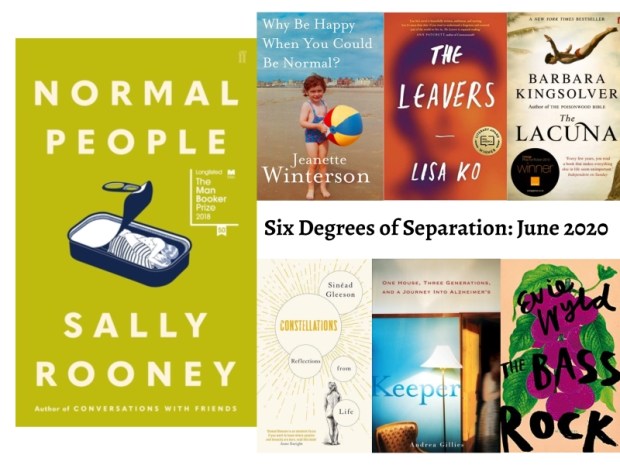
I’m a #6Degrees regular now: this is my fifth time participating. This month (see Kate’s introductory post) we start with Sally Rooney’s Normal People (2018). I loved Conversations with Friends but wasn’t so enamored with Rooney’s second novel (see my review), so I haven’t been tempted to watch the television adaptation; I don’t have a TV anyway.
#1 Picking out one of the words from the book title, and echoing the question that Rooney’s characters seem to be asking themselves, I’ll hop over to a memoir I enjoyed a lot in late 2011, Why Be Happy When You Could Be Normal? by Jeanette Winterson. Adopted into a strict religious household, Winterson had to hide her sexuality. Here you get the full story behind her autobiographical debut novel, Oranges Are Not the Only Fruit.

#2 Adoption is my link to The Leavers by Lisa Ko. When he’s abandoned by his mother, an undocumented Chinese immigrant in the USA, Daniel is adopted by a pair of white professors. This is an achingly beautiful story of searching for a mother and a sense of belonging. It won the 2016 PEN/Bellwether Prize for Socially Engaged Fiction.
#3 Barbara Kingsolver created and funds the biennial Bellwether Prize for unpublished fiction that addresses issues of social justice. I have vague ambitions to read as many Bellwether and Women’s Prize winners as I can. While it’s not one of my favorites by Kingsolver, The Lacuna (2009) won her the (then) Orange Prize. A historical novel, it’s largely set in the household of Diego Rivera and Frida Kahlo.
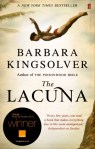
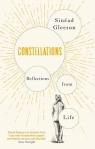
#4 Frida Kahlo is my link to Constellations by Sinéad Gleeson, autobiographical essays about the female body in pain. Kahlo is one of Gleeson’s gurus in that she turned her chronic pain and pregnancy loss into art – “making wounds the source of inspiration.” Constellations was our Not the Wellcome Prize winner during this hiatus year for the official prize.
#5 The first winner of the Wellcome Book Prize, in 2009, was Keeper by Andrea Gillies, a memoir of her mother-in-law Nancy’s struggle with Alzheimer’s disease. I also intend to read as many WBP winners and nominees as possible, so I recently ordered a secondhand copy of this and read the introduction before setting it aside for another time. Already I can tell it will be an engaging if harrowing book; Gillies pulls no punches in her depiction of the misery of the years when Nancy lived with her family and then in an institution.


[#5.5 Another book called Keeper, this one by Jessica Moor, provides my cheaty half-step. I found this debut novel to be a gripping and grimly fascinating story of why women stay with their abusers and what finally drives them to leave.]
 #6 Violence against women is also the theme of The Bass Rock by Evie Wyld, my novel of 2020 so far. While it ranges across the centuries, it always sticks close to the title location, an uninhabited island off the east coast of Scotland. It cycles through its three strands in an ebb and flow pattern that is appropriate to the coastal setting and creates a sense of time’s fluidity. This is not a puzzle book where everything fits together. Instead, it is a haunting echo chamber where elements keep coming back, stinging a little more each time. A must-read, especially for fans of Claire Fuller, Sarah Moss and Lucy Wood. (See my full Shiny New Books review.)
I’ve featured only books by women this month, and there have been quite a number of prize winners in here, too.
Join us for Six Degrees of Separation if you haven’t already!
Have you read any of my selections? Are you tempted by any you didn’t know before?
Childless Voices by Lorna Gibb
People end up not having children for any number of reasons: medical issues, bereavement, a lack of finances, not having a partner at the right time, or the simple decision not to become a parent. The subtitle of Lorna Gibb’s Childless Voices acknowledges these various routes: “Stories of Longing, Loss, Resistance and Choice.”
 For Gibb, a university lecturer, biographer and novelist, the childless state was involuntary, a result of severe endometriosis that led to infertility and early menopause. Although this has been a source of sadness for her and her husband, she knows that she has it easy compared to women in other parts of the world. Through her research and Skype interviews, she hears horrific stories about infertile women who meet with domestic violence and social ostracism and are sometimes driven to suicide. In Ghana childless women can be branded as witches and exiled. Meanwhile, some are never given the chance to have the children they might long for: Gibb cites China’s one-child policy, female genital mutilation, and enforced sterilization programs like those of the Roma in Yugoslavia and the Quechua in Peru.
Gibb is admirably comprehensive here, considering every possible aspect of childlessness. Particularly interesting are the different cultural adaptations childless women make. Certain countries allow polygamy, giving a second wife a chance to bear children on behalf of an infertile one; Kenya and other parts of sub-Saharan Africa recognize ‘marriages’ between childless women so they can create a family and support system. In Albania being a “sworn virgin” is an old and venerable custom. And, of course, there are any number of support groups and online communities. The situation of those who were once parents but are no longer is especially wrenching. Stillbirth only started to be talked about in the 1980s, Gibb notes, but even today is seen as a lesser loss than that of a child who dies later in life.
The author believes there is societal injustice in terms of who has access to fertility treatment and how the state deals with childless people. In the UK, she characterizes IVF as a “postcode lottery”: where you live often determines how many free cycles you’re entitled to on the NHS. In the USA, meanwhile, fertility treatment is so expensive that only those with a certain level of wealth can consider it. The childless may also feel ‘punished’ by tax breaks that favor parents and workplaces that expect non-parents to work unsociable hours. In a sense, then, the childless contribute more but benefit less.
Chosen childlessness is perhaps given short shrift at just 32 pages out of 239. However, it’s still a very thorough treatment of the reasons why couples decide not to become parents, including cultural norms, career goals, self-knowledge and environmental concerns. No surprise that this was the chapter that resonated with me the most. I also especially enjoyed the personal interludes (all titled “A Short Note on…”) in which Gibb celebrates her feminist, childless heroes like Frida Kahlo and Anaïs Nin and writes about how much becoming a godmother meant to her but also of the sadness of seeing a good friend’s teenage son die of a brain tumor.
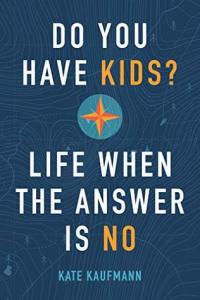 By coincidence, I’ve recently read another book on the same topic: Do You Have Kids? Life when the Answer Is No, by Kate Kaufmann (coming out in America next month). Gibb primarily traces the many different reasons for childlessness; Kaufmann mostly addresses the question of “now what?” – how women without children approach careers, wider family life, housing options, spirituality and the notion of leaving a legacy. Gibb’s approach is international and comparative, while Kaufmann’s is largely specific to the USA. Though the two authors are childless due to endometriosis and infertility, they feel sisterhood with women who never became mothers for whatever reason. I’d say these two books are complementary rather than rivals, and reveal valuable perspectives that can sometimes be overlooked.
My rating:
Childless Voices was published by Granta on February 7th. My thanks to the publisher for the free copy for review.
A Publisher Party and a One-Man Play
I was a veritable social butterfly this past week: I went out two evenings in a row! (Believe me, that’s rare.) On Tuesday I met up with bloggers Annabel, Eric and Kim at the Faber Spring Party held at Crypt on the Green in London, and on Wednesday my husband and I attended a performance at the University of Reading of Michael Mears’s one-man play on the plight of Britain’s conscientious objectors during World War I, This Evil Thing.
Faber Spring Party
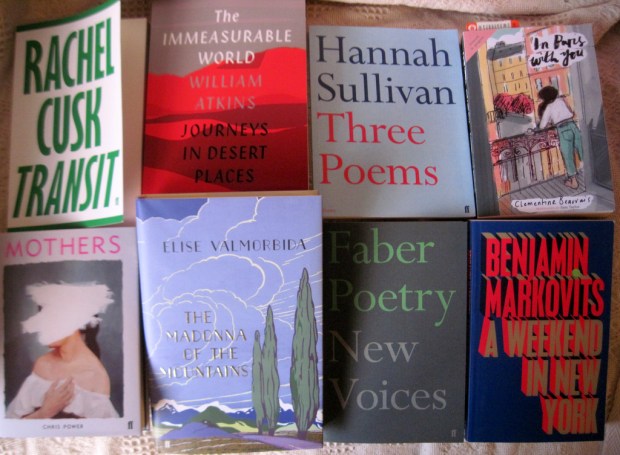
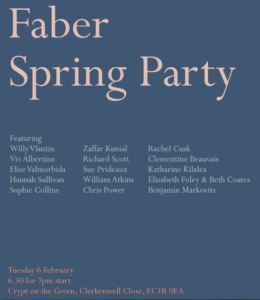 I’ve never been to an event quite like this. Publisher Faber & Faber, which will be celebrating its 90th birthday in 2019, previewed its major releases through to September. Most of the attendees seemed to be booksellers and publishing insiders. Drinks were on a buffet table at the back; books were on a buffet table along the side. Glass of champagne in hand, it was time to plunder the free books on offer. I ended up taking one of everything, with the exception of Rachel Cusk’s trilogy: I couldn’t make it through Outline and am not keen enough on her writing to get an advanced copy of Kudos, but figured I might give her another try with the middle book, Transit.

For the evening’s presentation, each featured author had a few minutes to introduce their new book and/or give a short reading.
Rachel Cusk opened the evening with a reading from Kudos. If you’re familiar with her recent work, you won’t be surprised at this synopsis: a man on a plane recounts having his dog put to sleep. (Out on May 3rd.)
William Atkins’s book on deserts, The Immeasurable World, is based on three years of travel and is, he is not ashamed to say, in the old-fashioned travel writing tradition. (Out on June 7th.)
Hannah Sullivan’s Three Poems is a hybrid work of poem-essays. #2 is more philosophical, she said; #3 is about her father’s death and her son’s birth. She read sonnet 3.21. (Out now.)
Clémentine Beauvais’s In Paris with You is a YA romance in free verse, loosely based on Eugene Onegin. I don’t know the source text but started this on the train ride home and it’s enjoyable thus far. I’m in awe at how translator Sam Taylor has taken the French of her Songe à la douceur and turned it into English poetry. (Out on June 7th.)
Chris Power’s Mothers is a book of linked short stories, three of which are about a character named Eva. He read a portion of a story about her having an encounter with an unpleasant man in Innsbruck. (Out on March 1st.)
Elise Valmorbida’s The Madonna of the Mountains, set in 1923–50, is a saga that resembles “an Italian Mother Courage,” she says. She read a scene in which a character comes across a madwoman. (Out on April 5th.)
Zaffar Kunial read the poem “Spark Hill” from his forthcoming collection Us. It’s about a childhood fight in the area of Birmingham where he grew up. He had a folder open in front of him but, impressively, recited the long poem completely from memory. (Out on July 5th.)
American novelist Benjamin Markovits was a professional basketball player in Germany for six months. Like the tennis-playing protagonist of his upcoming book, A Weekend in New York, he got tired of being measured. After 15 years, his hero is eager to escape a life of being constantly ranked. This is the first in a quartet of novels that inevitably invites comparison with John Updike’s “Rabbit” books. (Out on June 7th.)
I confess I didn’t previously know the name Viv Albertine; she was the guitarist for the female punk band The Slits, and To Throw Away Unopened is her second memoir. Albertine realized that it was her mother who had made her an angry rebel; the title is the label on a bag she found in her mother’s room after her death. (Out on April 5th.)
Sophie Collins incorporates hybrid forms in her poetry – what she calls “lyric essays.” The theme of her book Who Is Mary Sue? is perceptions of women’s writing (with “Mary Sue” as a metonym for the stereotypical good girl). She read from “Engine.” (Out now.)
Katharine Kilalea’s debut novel Ok, Mr Field is about an injured concert pianist who becomes obsessed with a house he buys in South Africa. (Out on June 7th.)
Elizabeth Foley and Beth Coates are the authors of two Homework for Grown-Ups books. Their new book, What Would Boudicca Do?, is about lessons we can draw from the women of history. For instance, the sampler booklet has pieces called “Dorothy Parker and Handling Jerks” and “Frida Kahlo and Finding Your Style.” There’s a heck of a lot of books like this out this year, though, and I’m not so sure this one will stand out. (Out on September 6th.)
Richard Scott read two amazingly intimate poems from his upcoming collection, Soho. One, “cover-boys,” was about top-shelf gay porn; the other was about mutilated sculptures of male bodies in the Athens archaeological museum. If you appreciated Andrew McMillan’s Physical, you need to get hold of this the second it comes out. I went back and read “cover-boys” in the sampler booklet and it wasn’t nearly as powerful as it was aloud; Scott’s reading really brought it to life, in contrast to some other authors’ dull delivery. (Out on April 5th.)
Sue Prideaux’s forthcoming biography of Friedrich Nietzsche is entitled I Am Dynamite! She encountered her subject when she wrote her first biography, of Edvard Munch. Although Nietzsche has been embraced by far-right groups in America, he was in fact against racism, nationalism, and anti-semitism, so he has important messages for us today. I’ll be keen to get hold of this one. (Out on September 6th.)
Guitar in hand, Willy Vlautin closed the evening with a performance of the title track from the soundtrack album to his fifth novel, Don’t Skip Out on Me – he was the singer in Portland, Oregon alt-country band Richmond Fontaine, which has recently stopped touring. He said the novel asks, “can you make the scars of broken people bearable?” (Out now.)

Now that I’ve got this terrific stack of books, wherever do I start?! I’m currently reading the Beauvais; from there I’ll focus on ones that have already been released, starting with Vlautin and the two poetry collections. The titles that aren’t out until June can probably wait – though it’s tempting to be one of the privileged few who get to read them nearly four months early. One Faber book per week should see me getting through all these by the final release date.
This Evil Thing
Michael Mears plays about 50 different characters in this one-man production. He’s an actor and pacifist who has written a number of solo pieces over 20 years. In this commemorative year of the end of the First World War, he knew we would hear a lot about battles, soldiers, and their families back home. But conscientious objectors weren’t likely to be remembered: theirs is a “story that’s rarely told,” he realized. This Evil Thing sets out to correct that omission. The title phrase refers not to war in general but specifically to conscription.
 The two main characters Mears keeps coming back to in the course of the play are Bert Brocklesby, a Yorkshire preacher, and philosopher Bertrand Russell. Brocklesby refused to fight and, when he and other COs were shipped off to France anyway, resisted doing any work that supported the war effort, even peeling the potatoes that would be fed to soldiers. He and his fellow COs were beaten, placed in solitary confinement, and threatened with execution. Meanwhile, Russell and others in the No-Conscription Fellowship fought for their rights back in London. There’s a wonderful scene in the play where Russell, clad in nothing but a towel after a skinny dip, pleads with Prime Minister Asquith.
As in solo shows I’ve seen before (e.g. A Christmas Carol with Patrick Stewart), Mears had to find subtle ways to distinguish between characters: he used a myriad different voices, including regional accents; he quickly donned a jacket, hat, or pair of glasses. Russell was identified by his ever-present pipe. The most challenging scene, Mears said in the Q&A at the end, was one with four characters in a French street café.
Mears reveals during the play that his grandfather fought in WWI and his father in WWII, but he has never had to put his own pacifist views to the test. What about Hitler? people always ask. Mears is honest and humble enough to admit that he doesn’t know what he would have done had he been called on to fight Hitler, or had he faced persecution as a CO in WWI. Ultimately, what Mears hopes audiences take from his play, which won acclaim at the Edinburgh Festival Fringe, is that “this is not an irrelevant piece of history.” Standing up for what you believe in, especially if it goes against the spirit of the times, is always valuable.
 Bookish Beck = Rebecca Foster. American transplant to England. Freelance proofreader and book reviewer.
 Bookish Beck