Short, Soul-Soothing Reads for #NovNov24 & #NonfictionNovember: Barnes, Cognetti, Lende, Mann, Nouwen and Winner
After the catastrophic U.S. election results (which we’ve all managed to ignore or normalize so as to keep going with our lives) and a medical crisis with our dear old cat, I’ve been craving literary soul food. These six short nonfiction books have been good companions, promising love, meaning and transcendence in the midst of bereavement and daily routines.
Levels of Life by Julian Barnes (2013)
 Barnes was a favourite author in my twenties and thirties, though I’ve had less success with his recent work. He wrote a few grief-soaked books in the wake of the death of his wife, celebrated literary agent Pat Kavanagh*. I had this mistaken for a different one (Through the Window, I think?) that I had enjoyed more. No matter; it was still interesting to reread this triptych of auto/biographical essays. The final, personal piece, “The Loss of Depth,” is a classic of bereavement literature on par with C.S. Lewis’s A Grief Observed; I would happily take it as a standalone pamphlet. Its every word rings true, especially the sense of duty as the lost one’s “principal rememberer.” But the overarching ballooning metaphor, and links with early French aerial photographer Nadar and Colonel Fred Burnaby, aeronaut and suitor of Sarah Bernhardt, don’t convince. The strategy feels like a rehearsal for Richard Flanagan’s Baillie Gifford Prize-winning Question 7, a similar hybrid work that pulls it off better. (Little Free Library) [118 pages]
*In spring 2008, I attended a talk by John Irving at King’s College, London, where I worked in library services for five years. Barnes and Kavanagh were in the front row and embraced Irving before the start. I was floored to hear of Kavanagh’s death later that year because she’d looked so well. It was a fast-acting brain tumour that felled her just 37 days after diagnosis.
Without Ever Reaching the Summit by Paolo Cognetti (2018; 2020)
[Translated from the Italian by Stash Luczkiw]
 Part pilgrimage and part 40th birthday treat, Cognetti’s October 2017 Himalayan trek through Dolpo (a Nepalese plateau at the Tibetan border) would also somewhat recreate Peter Matthiessen’s The Snow Leopard. Cognetti struggles with altitude sickness and the fare: “I tried salted yak butter tea for the first time—nauseating if you thought you were drinking tea, good and refreshing if you thought you were drinking broth.” He and his companions fancifully decide that Kanjiroba, the lovable stray dog who joins their party, is a reincarnation of Matthiessen. I have limited tolerance for travel books’ episodic combinations of nature descriptions, anthropological observations, and the rigours of the nomadic lifestyle. The same was true here, but the slight spiritual aspect and references to The Snow Leopard lifted it. (Public library) [135 pages]
Find the Good: Unexpected Life Lessons from a Small-Town Obituary Writer by Heather Lende (2015)
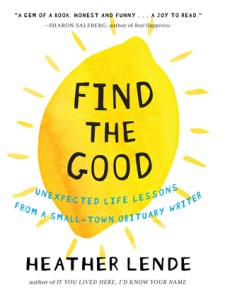 Lende is a journalist in isolated Haines, Alaska (population: 2,000). There’s a plucky motivational bent to these mini-essays about small-town life and death. In writing obituaries for normal, flawed people, she is reminded of what matters most: family (she’s a mother of five, one adopted, and a grandmother; she includes beloved pets in this category) and vocation. The title phrase is the motto she lives by. “I believe gratitude comes from a place in your soul that knows the story could have ended differently, and often does, and I also know that gratitude is at the heart of finding the good in this world—especially in our relationships with the ones we love.” The anecdotes and morals are sweet if not groundbreaking. The pocket-sized hardback might appeal to readers of Anne Lamott and Elizabeth Strout. (Birthday gift from my wish list, secondhand) [162 pages]
Do Not Be Afraid: The joy of waiting in a time of fear by Rachel Mann (2024)
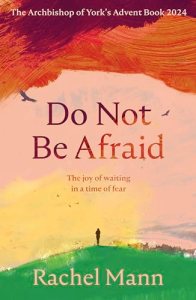 This is the Archbishop of York’s Advent Book 2024; I read it early because, pre-election, I yearned for its message of courage and patience. We need it all the more now. The bite-sized essays are designed to be read one per day from the first Sunday of Advent through to Christmas Day. Often they include a passage of scripture or poetry (including some of Mann’s own) for meditation, and each entry closes with a short prayer and a few questions for discussion or private contemplation. The topics are a real variety but mostly draw on the author’s own experiences of waiting and suffering: medical appointments and Covid isolation as well as the everyday loneliness of being single and the pain of coping with chronic illness. She writes about sitting with parishioners as they face death and bereavement. But there are also pieces inspired by popular culture – everything from Strictly to Quentin Tarantino.
Mann has written several previous Lent course books based on films. I’ve read her work in multiple genres (poetry: A Kingdom of Love and Eleanor Among the Saints; literary criticism: In the Bleak Midwinter; memoir: Dazzling Darkness; fiction: The Gospel of Eve); she is such a versatile writer, and with a fascinating story as a trans priest. Sombre yet hopeful, this is recommended seasonal reading. [114 pages]
With thanks to SPCK for the free copy for review.
The Inner Voice of Love: A Journey through Anguish to Freedom by Henri J. M. Nouwen (1997)
 Anguish is a strong word; I haven’t done any biographical digging to figure out what was going on in Nouwen’s life to prompt it, but apparently this secret journal came out of a lost relationship. (I wonder if it could have been a homosexual attachment. Nouwen was a Dutch Roman Catholic priest who became the pastor of a community for disabled adults in Canada.) He didn’t publish for another eight years but friends encouraged him to let his experience aid others. The one- or two-page reflections are written in the second person, so they feel like a self-help pep talk. The recurring themes are overcoming abandonment and rejection, relinquishing control, and trusting in God’s love and faithfulness. “You must stop being a pleaser and reclaim your identity as a free self.” The point about needing to integrate rather than sideline psychological pain is one I’m sure any therapist would affirm. Nouwen writes that a new spirituality of the body is necessary. This was a comforting bedside book with lots of passages that resonated. (Free – withdrawn from church theological library) [98 pages]
Mudhouse Sabbath: An Invitation to a Life of Spiritual Discipline by Lauren F. Winner (2003)
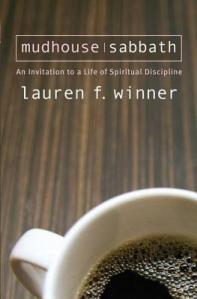 After Winner converted from Orthodox Judaism to Christianity, she found that she missed how Jewish rituals make routine events sacred. There are Christian sacraments, of course, but this book is about how the wisdom of another tradition might be applied in a new context. “Judaism offers opportunities for people to inhabit and sanctify bodies and bodily practices,” Winner writes. There are chapters on the concept of the Sabbath, wedding ceremonies, prayer and hospitality. Fasting is a particular sticking point for Winner, but her priest encourages her to see it as a way of demonstrating dependence on, and hunger for, God. I most appreciated the sections on mourning and ageing. “Perhaps the most essential insight of the Jewish approach to caring for one’s elderly is that this care is, indeed, an obligation. What Judaism understands is that obligations are good things. They are the very bedrock of the Jew’s relationship to God, and they govern some of the most fundamental human relationships”. By the way, Mudhouse is Winner’s local coffeehouse, so she believes these disciplines can be undertaken anywhere. (Secondhand – Awesomebooks.com) [142 pages]

Books of Summer #18–20: Alan Garner, Peter Matthiessen, Lorrie Moore
I’m sneaking in just in time here, on the very last day of the #20BooksofSummer challenge, with my final three reviews: two novellas, one of them a work of children’s fantasy; and a nature/travel classic that turns into something more like a spiritual memoir.
The Owl Service by Alan Garner (1967)
 I’d heard of Garner, a British writer of classic children’s fantasy novels, but never read any of his work until I picked this up from the free bookshop where I volunteer on a Friday. My husband remembers reading Elidor (also a 1990s TV series) as a boy, but I’m not sure Garner was ever well known in America. Perhaps if I’d discovered this right after the Narnia series when I was a young child, I would have been captivated. I did enjoy the rural Welsh setting, and to start with I was intrigued by the setup: curious about knocking and scratching overhead, Alison and her stepbrother Roger find a complete dinner service up in the attic of this house Alison inherited from her late father. Alison becomes obsessed with tracing out the plates’ owl pattern – which disappears when anyone else, like Nancy the cook, looks at them.
I gather that Garner frequently draws on ancient legend for his plots. Here he takes inspiration from Welsh myths, but the background was so complex and unfamiliar that I could barely follow along. This meant that the climactic ‘spooky’ scenes failed to move me. Instead, I mostly noted the period slang and the class difference between the English children and Gwyn, Nancy’s son, who’s forbidden from speaking Welsh (Nancy says, “I’ve not struggled all these years in Aber to have you talk like a labourer”) and secretly takes elocution lessons to sound less ‘common’.
Can someone recommend a Garner book I might get on with better?
My rating: 
The Snow Leopard by Peter Matthiessen (1978)
 For two months of 1973, from late September to late November, Matthiessen joined zoologist George Schaller on a journey from the Nepalese Himalayas to the Tibetan Plateau to study Himalayan blue sheep. Both also harbored a hope of spotting the elusive snow leopard.
Matthiessen had recently lost his partner, Deborah Love, to cancer, and left their children behind – at residential schools or with family friends – to go on this spirit-healing quest. Though he occasionally feels guilty, especially about the eight-year-old, his thoughts are usually on the practicalities of the mountain trek. They have sherpas to carry their gear, and they stop in at monasteries but also meet ordinary people. More memorable than the human encounters, though, are those with the natural world. Matthiessen watches foxes hunting and griffons soaring overhead; he marvels at alpine birds and flora.
The writing is stunning. No wonder this won a 1979 National Book Award (in the short-lived “Contemporary Thought” category, which has since been replaced by a general nonfiction award). It’s a nature and travel writing classic. However, it took me nearly EIGHTEEN MONTHS to read, in all kinds of fits and starts (see below), because I could rarely read more than part of one daily entry at a time. I struggle with travel narratives in general – perhaps I think it’s unfair to read them faster than the author lived through them? – but there’s also an aphoristic density to the book that requires unhurried, meditative engagement.

The mountains in their monolithic permanence remind the author that he will die. The question of whether he will ever see a snow leopard comes to matter less and less as he uses his Buddhist training to remind himself of tenets of acceptance (“not fatalism but a deep trust in life”) and transience: “In worrying about the future, I despoil the present”; what is this “forever getting-ready-for-life instead of living it each day”? I’m fascinated by Buddhism, but anyone who ponders life’s deep questions should get something out of this.
My rating: 
Who Will Run the Frog Hospital? by Lorrie Moore (1994)
Thanks to Cathy for reminding me about this one – I had intended to make it one of my novellas for November, but as I was scrambling around to find a last couple of short books to make up my 20 I thought, “Frog! hey, that fits”* and picked it up.
 Oddly, given that Moore is so well known for short stories, I’ve only ever read two of her novels (the other was A Gate at the Stairs). Berie Carr lives just over the border from Quebec in Horsehearts, a fictional town in upstate New York. She and her best friend Sils are teenagers at the tail end of the Vietnam War, and work at Storyland amusement park on the weekends and during the summer. When Sils gets into trouble, Berie starts pocketing money from the cash register to help her out, but it will only be so long until she gets caught and the course of her life changes.
Berie is recounting these pivotal events from adulthood, when she’s traveling in Paris with her husband, Daniel. There are some troubling aspects to their relationship that don’t get fully explored, but that seems to be part of the point: we are always works in progress, and never as psychologically well as we try to appear. I most enjoyed the book’s tone of gentle nostalgia: “Despite all my curatorial impulses and training, my priestly harborings and professional, courtly suit of the past, I never knew what to do with all those years of one’s life: trot around in them forever like old boots – or sever them, let them fly free?”
Moore’s voice here reminds me of Amy Bloom’s and Elizabeth McCracken’s, though I’ve generally enjoyed those writers more.
*There are a few literal references to frogs (as well as the understood slang for French people). The title phrase comes from a drawing Sils makes about their mission to find and mend all the swamp frogs that boys shoot with BB guns. Berie also remarks on the sound of a frog chorus, and notes that two decades later frogs seem to be disappearing from the earth. In both these cases frogs are metaphors for a lost innocence. “She has eaten the frog” is also, in French, a slang term for taking from the cash box.
(I can’t resist mentioning Berie and Sils’ usual snack: raw, peeled potatoes cut into quarters and spread with margarine and salt!)
My rating: 
A recap of my 20 Books of Summer:
- I enjoyed my animal theme, which was broad enough to encompass straightforward nature books but also a wide variety of memoirs and fiction. In most cases there was a literal connection between the animal in the title and the book’s subject.
- I read just nine of my original choices, plus two of the back-ups. The rest were a mixture of: books I brought back from America, review copies, books I’d started last year and set aside for ages, and ones I had lying around and had forgotten were relevant.
- I accidentally split the total evenly between fiction and nonfiction: 10 of each.
- I happened to read three novels by Canadian authors. The remainder were your usual British and American suspects.
- The clear stand-out of the 20 was Crow Planet by Lyanda Lynn Haupt, followed closely by The Snow Leopard (see above) and The Seafarers by Stephen Rutt – all nonfiction!
- In my second tier of favorites were three novels: Fifteen Dogs, The Unchangeable Spots of Leopards, and Crow Lake.

I also had three DNFs that I managed to replace in time.
Hollow Kingdom by Kira Jane Buxton [a review copy – and one of my Most Anticipated titles]
(I managed the first 36 pages.) Do you have a friend who’s intimidatingly sharp, whose every spoken or written line leaps from wordplay to a joke to an allusion to a pun? That’s how I felt about Hollow Kingdom. It’s so clever it’s exhausting.
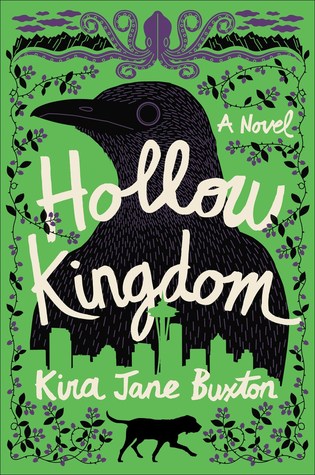 I wanted to read this because I’d heard it’s narrated by a crow. S.T. (Shit Turd) is an American Crow who lives with an electrician, Big Jim, in Seattle, along with Dennis the dumb bloodhound. One day Jim’s eyeball pops out and he starts acting crazy and spending all his time in the basement. On reconnaissance flights through the neighborhood, S.T. realizes that all the humans (aka “MoFos” or “Hollows”) are similarly deranged. He runs into a gang of zombies when he goes to the Walgreens pharmacy to loot medications. Some are even starting to eat their pets. (Uh oh.)
We get brief introductions to other animal narrators, including Winnie the Poodle and Genghis Cat. An Internet-like “Aura” allows animals of various species to communicate with each other about the crisis. I struggle with dystopian and zombie stuff, but I think I could make an exception for this. Although I do think it’s overwritten (one adverb and four adjectives in one sentence: “We left slowly to the gentle song of lugubrious paw pads and the viscous beat of crestfallen wings”), I’ll try it again someday.
 Gould’s Book of Fish: A Novel in Twelve Fish by Richard Flanagan: I read the first 164 pages last year before stalling; alas, I could make no more headway this summer. It’s an amusing historical pastiche in the voice of a notorious forger and counterfeiter who’s sentenced to 14 years in Van Diemen’s Land. I could bear only so much of this wordy brilliance, and no more.
 Tisala by Richard Seward Newton: I guess I read the blurb and thought this was unmissable, but I should have tried to read a sample or some more reviews of it. I got to page 6 and found it so undistinguished and overblown that I couldn’t imagine reading another 560+ pages about a whale.
For next year, I’m toying with the idea of a food and drink theme. Once again, this would include fiction and nonfiction that is specifically about food but also slightly more cheaty selections that happen to have the word “eats” or “ate” or a potential foodstuff in the title, or have an author whose name brings food to mind. I perused my shelf and found exactly 20 suitable books, so that seems like a sign! (The eagle-eyed among you may note that two of these were on my piles of potential reads for this summer, and two others on last summer’s. When will they ever actually get read?!)
Alternatively, I could just let myself have completely free choice from my shelves. My only non-negotiable criterion is that all 20 books must be ones that I own, to force me to get through more from my shelves (even if that includes review copies).


How did you fare with your summer reading?
R.I.P. Reads, Part II: Cox, Gaiman, Paver
Happy Halloween! I enjoyed taking part in R.I.P. for the first time this year. My top two choices out of the six fantastical and/or spooky books I managed to read would be The Loney and The Graveyard Book (see below). For this second installment I’ve been reading eerie short stories that take place in the English countryside, a young adult fantasy novel set mostly in a graveyard, and a ghost story that unfolds in the Himalayas of the 1930s.

Help the Witch by Tom Cox (2018)
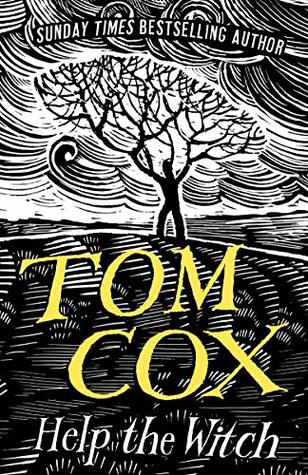 I knew Tom Cox for his witty books about his many cats, including The Good, the Bad and the Furry. His first foray into fiction was published by Unbound earlier this month; I pre-ordered it on a Kindle deal for £1. The settings are dilapidated cottages, moorland and villages, mostly in the North of England. Even in the spookier stories, there’s always a welcome touch of humor. “Seance” raises the ghost of a cyclist who was killed on his bike and now is destined to cycle evermore. He doesn’t, at first, realize that he’s dead. “‘Morning!’ he called to a middle-aged couple with a labradoodle, cheerfully, as he cycled past Whiddon Scrubs. They ignored him. ‘Shitbags,’ he said under his breath.”
The three sets of flash fictions, “Listings,” “Nine Tiny Stories about Houses,” and “Folk Tales of the Twenty-third Century,” particularly made me laugh, though each perhaps overstays its welcome a bit. My two favorites were proper ghost stories: “Speed Awareness,” about a peculiar mix-up with the course teacher, and “Just Good Friends,” in which a woman’s Internet dating experiences turn strange when she meets someone with inside knowledge about her past. I could see the latter being anthologized. These are enjoyable enough stories to flip through around Halloween.
My rating: 
The Graveyard Book by Neil Gaiman (2008)
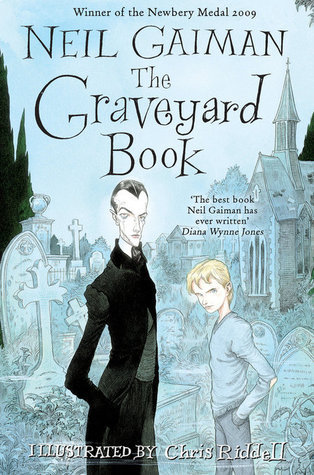 Nobody “Bod” Owens has lived in a graveyard ever since the night he climbed out of his cot and toddled there – the same night that a man named Jack murdered his parents and older sister. He was the only member of his family to survive the slaughter. Although he passes a happy childhood among the graveyard’s witches, ghouls and ghosts from many centuries, he knows he’s different. He’s alive; he has to eat and craves human friendship. As valuable as his lessons in Fading and Dreamwalking prove to be, he longs to attend school and discover more of the world outside – provided he can keep his head down and avoid notice; previous trips beyond the cemetery walls, such as to a pawnshop, have bordered on the disastrous.
Bod’s japes with his returning friend Scarlett turn more serious when he learns that Jack is still after him. This is quite a dark book for its young teen audience, but as I remember from the only other Gaiman book I’ve read, The Ocean at the End of the Lane, he’s a master at balancing sadness with humor and magic. The illustrations by Chris Riddell are terrific, too.
Favorite lines:
Silas, Bod’s guardian: “You’re alive, Bod. That means you have infinite potential. You can do anything, make anything, dream anything. If you change the world, the world will change.”
“Mother Slaughter’s headstone [was] so cracked and worn and weathered that all it said now was:
LAUGH
which had puzzled the local historians for over a hundred years.”
My rating: 
Thin Air: A Ghost Story by Michelle Paver (2016)
 In 1935 Dr. Stephen Pearce and his brother Kits are part of a five-man mission to climb the most dangerous mountain in the Himalayas, Kangchenjunga. Thirty years before, Sir Edmund Lyell led an ill-fated expedition up the same mountain: more than one man did not return, and the rest lost limbs to frostbite. “I don’t want to know what happened to them. It’s in the past. It has nothing to do with us,” Dr. Pearce tells himself, but from the start it feels like a bad omen that they, like Lyell’s party, are attempting the southwest approach; even the native porters are nervous. And as they climb, they fall prey to various medical and mental crises; hallucinations of ghostly figures on the crags are just as much of a danger as snow blindness.
This is pacey, readable historical fiction with a good sense of period and atmosphere. I enjoyed Pearce’s narration, and the one-upmanship type of relationship with his brother adds an interesting dimension to the expedition dynamics. However, I never submitted sufficiently to Paver’s spell to find anything particularly scary. I’ll try again with her other ghost story, Dark Matter, about an Arctic expedition from the same time period.
Favorite passage:
“The Sherpas are wrong. This mountain has no spirit, no sentience and no intent. It’s not trying to kill us. It simply is.” [famous last words…]
My rating:
 Bookish Beck = Rebecca Foster. American transplant to England. Freelance proofreader and book reviewer.
 Bookish Beck