20 Books of Summer, 13–16: Tony Chan, Jen Hadfield, Kenward Anthology, Catherine Taylor
Three from my initial list (all nonfiction) and one substitute picked up at random (poetry). These are strongly place-based selections, ranging from Sheffield to Shetland and drawing on travels while also commenting on how gender and dis/ability affect daily life as well as the experience of nature.
Four Points Fourteen Lines by Tony Chan (2016)
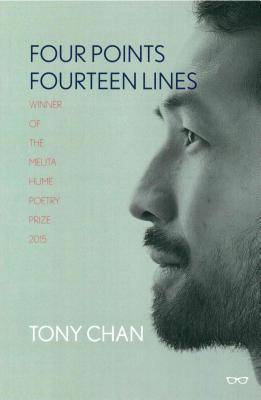 Chan is a schoolteacher who, in 2015, left his day job to undertake a 78-day solo walk between “the four extreme cardinal points of the British mainland”: Dunnet Head (North) to Ardnamurchan Point (West) in Scotland, down to Lowestoft Ness (East) in Suffolk and across to Lizard Point, Cornwall (South). It was a solo trek of 1,400 miles. He wrote one sonnet per day, not always adhering to the same rhyme scheme but fitting his sentiments into 14 lines of standard length. He doesn’t document much practical information, but does admit he stayed in decent hotels, ate hot meals, etc. Each poem is named for the starting point and destination, but the topic might be what he sees, an experience on the road, a memory, or whatever. “Evanton to Inverness” decries a gloomy city; “Inverness to Foyers” gives thanks for his shoes and lycra undershorts. He compares Highlanders to heroic Trojans: “Something sincere in their browned, moss-green tweeds, / In their greeting voice of gentle tenor. / From ancient Hector or from ancient clans, / Here live men most earnest in words and deeds.” None of the poems are laudable in their own right, but it’s a pleasant enough project. Too often, though, Chan resorts to outmoded vocabulary to fit the form or try to prove a poetic pedigree (“Suddenly comes an Old Testament of deluge and / Tempest, deluding the sense wholly”; “I know these streets, whence they come and whither / They run”; “I learnt well some verses of Tennyson / Years ago when noble dreams were begat”) when he might have been better off varying the form and/or using free verse. (Signed copy from Little Free Library)
Storm Pegs: A Life Made in Shetland by Jen Hadfield (2024)
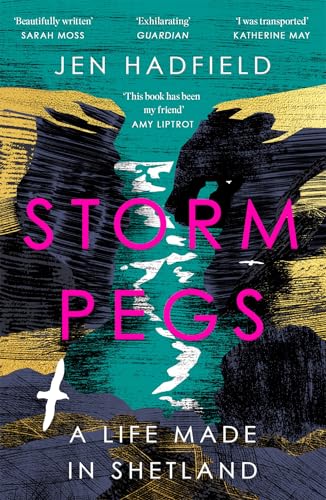 This is not so much a straightforward memoir as a set of atmospheric vignettes, each headed by a relevant word or phrase in the Shaetlan dialect. Hadfield, who is British Canadian, moved to the islands in her late twenties in 2006 and soon found her niche. “My new life quickly debunked those Edge-of-the-World myths – Shetland was too busy to feel remote, and had too strong a sense of its own identity to feel frontier-like.” It’s gently ironic, she notes, that she’s a terrible sailor and gets vertigo at height yet lives somewhere with perilous cliff edges that is often reachable only by sea. Living in a trailer waiting for her home to be built on West Burra, she feels the line between indoors and out is especially thin. It’s a life of wild swimming, beachcombing, fresh fish, folk music, seabirds, kind neighbours, and good cheer that warms long winter nights. After the isolation of the pandemic period comes the unexpected joy of a partner and a pregnancy in her mid-forties. Hadfield is a Windham-Campbell Prize-winning poet, and her lyrical prose is full of lovely observations that made me hanker to return to Shetland – it’s been 19 years since my only visit, after all. This was a slow read I savoured for its language and sense of place.
With thanks to Picador for the free paperback copy for review.
From Shetland authors, I have also reviewed:
Orchid Summer by Jon Dunn (Hadfield mentions him)
Sea Bean by Sally Huband (Hadfield meets her)
The Valley at the Centre of the World by Malachy Tallack
Moving Mountains: Writing Nature through Illness and Disability, ed. Louise Kenward (2023)
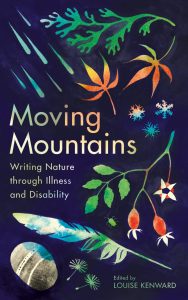 I often read memoirs about chronic illness and disability – the sort of narratives recognized by the Barbellion and ACDI Literary Prizes – and the idea of nature essays that reckon with health limitations was an irresistible draw. The quality in this anthology varies widely, from excellent to barely readable (for poor prose or pretentiousness). I’ll be kind and not name names in the latter category; I’ll only say the book has been poorly served by the editing process. The best material is generally from authors with published books: Polly Atkin (Some of Us Just Fall; see also her recent response to the Raynor Winn fiasco), Victoria Bennett (All My Wild Mothers), Sally Huband (as above!), and Abi Palmer (Sanatorium). For the first three, the essay feels like an extension of their memoir, while Palmer’s inventive piece is about recreating seasons for her indoor cats. My three favourite entries, however, were Louisa Adjoa Parker’s poem “This Is Not Just Tired,” Nic Wilson’s “A Quince in the Hand” (she’s an acquaintance through New Networks for Nature and has a memoir out this summer, Land Beneath the Waves), and Eli Clare’s “Moving Close to the Ground,” about being willing to scoot and crawl to get into nature. A number of the other pieces are repetitive, overlong or poorly shaped and don’t integrate information about illness in a natural way. Kudos to Kenward for including BIPOC and trans/queer voices, though. (Christmas gift from my wish list)
The Stirrings: Coming of Age in Northern Time by Catherine Taylor (2023)
“A typical family and an ordinary story, although neither the family nor the story seems commonplace when it is your family and your story.”
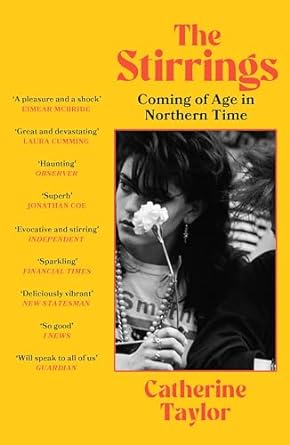 Taylor, who was born in New Zealand and grew up in Sheffield, won the Ackerley Prize for this memoir. (After Dunmore and King, this is the third in my intended four-in-a-row on the 20 Books of Summer Bingo card, fulfilling the “Book published in summer” category – August 2023.) It is bookended by two pivotal summers: 1976, the last normal season in her household before her father left; and 1989, the “Second Summer of Love,” when she had an abortion (the subject of “Milk Teeth,” the best individual chapter and a strong stand-alone essay). In between, fear and outrage overshadow her life: the Yorkshire Ripper is at large, nuclear war looms, mines are closing and protesters meet with harsh reprisals, and her own health falters until she gets a diagnosis of Graves’ disease. Then, in her final year at Cardiff, one of their housemates is found dead. Taylor draws reasonably subtle links to the present day, when fascism, global threats, and femicide are, unfortunately, as timely as ever. She’s the sort of personality I see at every London literary event I attend: Wellcome Book Prize ceremonies, Weatherglass’s Future of the Novella event, and so on. I got the feeling this book is more about bearing witness to history than revealing herself, and so I never warmed to it or to her on the page. But if you’d like to get a feel for the mood of the times, or you have experience of the settings and period, you may well enjoy it more than I did. (New purchase from Bookshop.org with a Christmas book token)
May Graphic Novels by Alison Bechdel, Peter Kuper & Craig Thompson
May has been chock-full of new releases for me! For this first batch of reviews, I’m featuring three fantastic graphic novels that have made it onto my Best of 2025 (so far) list. I don’t read graphic books as often as I’d like to – my library tends to major on superhero comics and manga, which aren’t my cup of tea – but I sometimes get a chance to access them for paid review purposes. (The first two below are ones I was sent for potential Shelf Awareness reviews, but I missed the deadlines.) Reading these took me back to the early 2010s when I worked for a university library in South London and would walk to Lambeth Library on my lunch breaks to borrow huge piles of books, mostly taking advantage of their excellent graphic novel selection. That was where my education and fascination began.
Spent: A Comic Novel by Alison Bechdel
 I’ve read all but one of Bechdel’s works now. Fun Home was among the first graphic books I read and is a great choice if you’re new to this form of storytelling. It’s a family memoir about her father’s funeral home business and closeted lifestyle, which emerged shortly after her own coming-out – and shortly before his accidental death. In Spent, Alison and her handy wife Holly live on a Vermont pygmy goat farm. Alison has writer’s block and is struggling financially despite her famous memoir about her taxidermist father having been made into a successful TV series, Death & Taxidermy. Mostly, she’s consumed with anxiety about the state of the world, what with the ongoing pandemic, her sister’s right-wing opinions, and the litany of awful headlines. “Who can draw when the world is burning?” she exclaims.
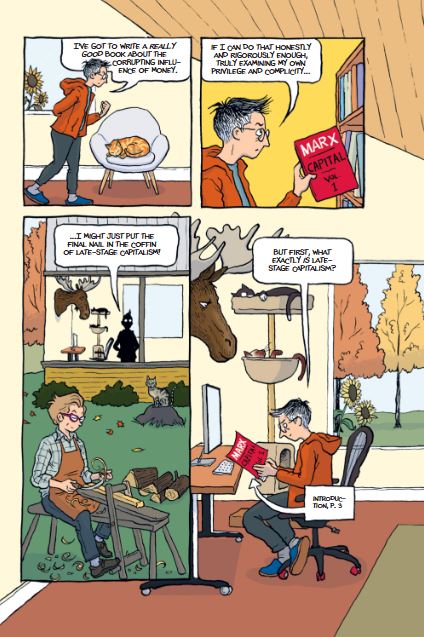
Then Alison has an idea for a book – or maybe a reality TV series – called $UM that will wean people off of capitalism. That creative journey is mirrored in Spent, which is composed of 12 “episodes” titled after Marxist terminology. Through Alison’s ageing hippie friends and their kids, Bechdel showcases alternative ways of living: a commune, a throuple, nonbinary identity, unpaid internships, Just Stop Oil demos, and the influencer lifestyle versus rejection of technology. It’s (auto)fiction exaggerated to the brink of absurdity, with details changed enough to mock but not enough to hide (e.g., she’s published by “Megalopub,” the hardware store is “Home Despot,” her show airs on “Schmamazon”).

Tiny details in the drawings reward close attention, such as Alison and Holly’s five cats’ antics during their morning routine, and a stuffed moose head rolling its eyes. It’s the funniest I can remember Bechdel being, with much broad humour derived from the outrageous screen mangling of her book – cannibalism, volcanoes and dragons come out of nowhere – and her middle-class friends’ hand-wringing over their liberal credentials. Even the throwaway phrases are hilarious. It’s a gleeful and zeitgeist-y satire, yet draws to a touching close as Alison has the epiphany that she can’t fix everything herself so must simply do what she can, “with a little help from her annoying, tender-hearted, and utterly luminous friends.”
Accessed as an e-book from Mariner Books. Published in the UK by Jonathan Cape (Penguin).
Insectopolis: A Natural History by Peter Kuper
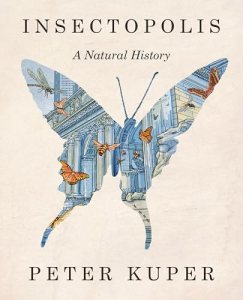 Nearly a decade ago, I reviewed Peter Kuper’s Ruins, which features monarch migration and has as protagonist a laid-off Natural History Museum entomologist. Here insects have even more of a starring role. The E. O. Wilson epigraph sets the stage: “If all mankind were to disappear, the world would regenerate back to the rich state of equilibrium that existed ten thousand years ago. If insects were to vanish, the environment would collapse into chaos.” We follow an African American brother-and-sister pair, the one dubious and the other eager, as they walk downtown to the New York Public Library. The sister, who holds a PhD in entomology, promises that its exhibition on insects is going to be amazing. But just before they reach the building, a red alert flashes up on every smartphone and sirens start blaring. A week later, the city is a ruin of overturned cabs and debris. Only insects remain and, group by group, they guide readers through the empty exhibit, interacting within and across species.


It’s a sly blend of science, history, stories and silliness. I loved the scenes of mosquitoes and ants railing against how they’ve been depicted as villainous, and dignified dung beetles resisting scatological jokes and standing up for their importance in ecosystems. There are interesting interludes about insects in literature (not just Kafka and Nabokov, but the Japanese graphic novel The Book of Human Insects by Osamu Tezuka), and unsung heroines of entomology get their moment in the sun. The pages in which Margaret Collins, an African American termite researcher in the 1950s, and Rachel Carson appear to a dragonfly as ghosts and tell their stories of being dismissed by male researchers were among my favourites. Informative and entertaining at once; what could be better? Welcome our insect overlords!
Accessed as an e-book from W. W. Norton & Company.
Ginseng Roots by Craig Thompson
 I’d read several of Thompson’s works and especially enjoyed his previous graphic memoir, Blankets, about his first love and loss of faith. When I read this blurb, I worried the niche subject couldn’t possibly sustain my attention for nearly 450 pages. But I was wrong; this is a vital book about everything, by way of ginseng. It begins with childhood summers working on American ginseng farms with his siblings in Marathon, Wisconsin. Theirs was a blue collar and highly religious family, but Thompson and his little brother Phil were allowed to spend their earnings from the back-breaking labour of weeding and picking rocks as they pleased. Each hour, each dollar, meant a new comic from the pharmacy. “Comics helped me survive my childhood. But what will help me survive my adulthood?” Thompson asks.

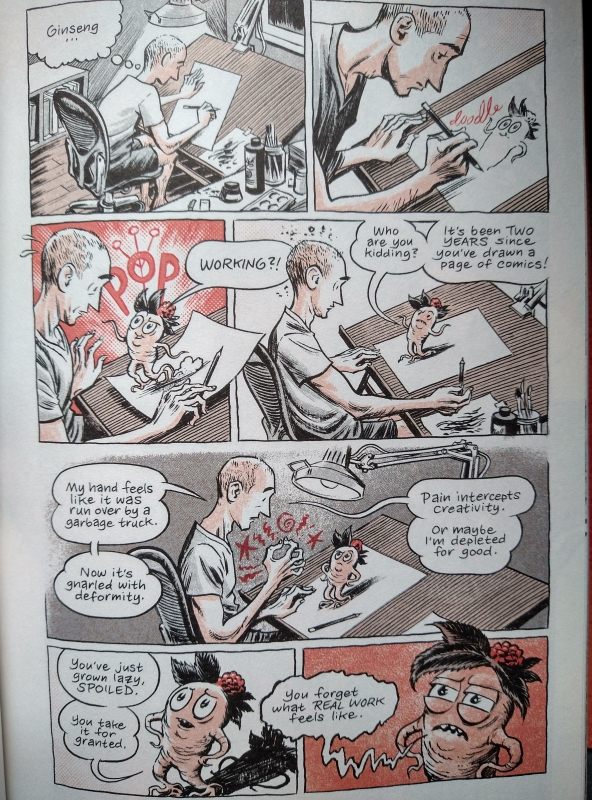
Together with Phil, he travels first to Midwest ginseng farms and festivals and then through China and Korea to learn about the plant’s history, cultivation practices, lore, and medicinal uses. As he meets producers – including a Hmong man whose early life mirrors his own – he feels sheepish about how he makes a living: “I carry this working-class guilt – what I do isn’t real work.” When his livelihood is threatened by worsening autoimmune conditions, he tries everything from acupuncture to psychotherapy to save his hands and his creativity.
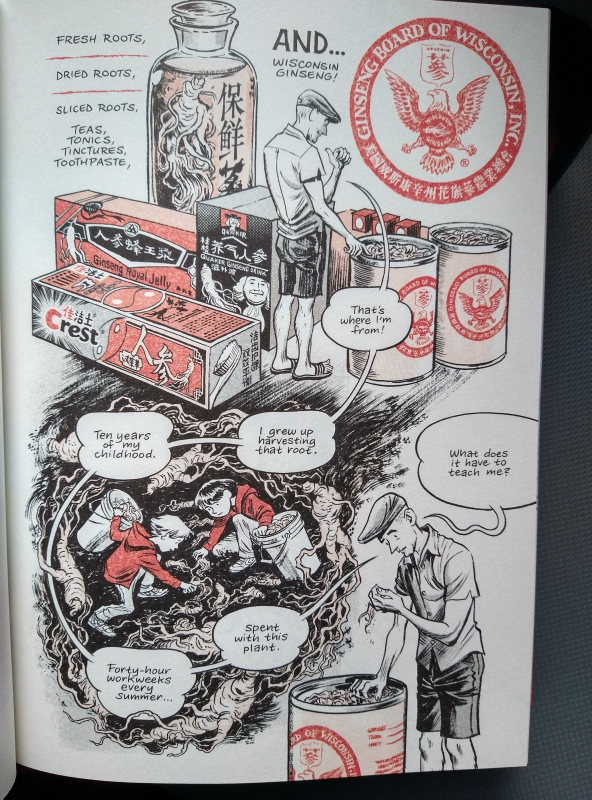
This chunky book has an appealing earth-tones palette and shifts smoothly between locations and styles, memories and research. When interviewing growers and Chinese medicine practitioners, the depictions are almost photorealistic, but there are also superhero pastiche panels and a cute ginseng mascot who pops up throughout the book. Like Spent, this pulls in class and economic issues in a lighthearted way and also explores its own composition process.
The story of ginseng is often sobering, involving the exploitation of immigrants (in the Notes, Thompson regrets that he was unable to speak with any of the Mexican migrant workers on whom the American ginseng harvest now depends), soil degradation, and pesticide pollution. The roots of the title are both literal and symbolic of the family story that unfolds in parallel. Both strands are captivating, but especially the autobiographical material: Thompson’s relationship with Phil, his new understanding but ongoing frustration with his parents, and the way all three siblings exhibit the damage of their upbringing – Phil’s marriage is crumbling; their sister Sarah, who has moved 26 times as an adult, wonders what she’s running from. A conversation with a Chinese herbal pharmacist gets to the heart of the matter: “I learned home is not WHERE I am. Home is HOW I am.”
Both expansive and intimate, this is a surprising gem from one of the best long-form graphic storytellers out there.
With thanks to Faber for the free copy for review. Published in the USA by Pantheon (Penguin).
Nonfiction November “Stranger than Fiction”: The Boys in the Boat
I’m taking a quick break from novellas coverage but keeping up the nonfiction focus with this week’s Nonfiction November prompt, “Stranger than Fiction,” hosted by Christopher at Plucked from the Stacks: “This week we’re focusing on all the great nonfiction books that almost don’t seem real. A sports biography involving overcoming massive obstacles, a profile on a bizarre scam, a look into the natural wonders in our world—basically, if it makes your jaw drop, you can highlight it for this week’s topic.” I would also interpret this brief to refer to nonfiction that reads as fluently as a novel, and on both counts this book stands out.
The Boys in the Boat: Nine Americans and Their Epic Quest for Gold at the 1936 Berlin Olympics by Daniel James Brown (2013)
We read this for my book club a couple of months ago, on the recommendation of one of our members’ spouses. I was dubious because I don’t read history books, and don’t enjoy playing or watching sports, so a sport + history book sounded like a real snoozefest, but that couldn’t have been further from the truth.

Brown focuses on one of the University of Washington rowers, Joe Rantz, in effect making him the protagonist of a classic underdog story. The college team in general, and Rantz in particular, were unlikely champions. Rantz lost his mother young and, abandoned by his father multiple times, had to make a living by his wits in the Seattle area, sometimes resorting to illegal schemes like poaching and selling liquor during Prohibition, but also logging and working in dam construction. Even among the teammates who became his de facto family, he was bullied for coming from poverty and for his enthusiasm for folksy music. That we come to know and care deeply for Rantz testifies to how well Brown recreates his life story – largely via Rantz’s daughter’s reminiscences, though Brown did meet Rantz before his death.
Another central character is world-renowned boat designer George Pocock, an Englishman who set up shop on the Washington campus. Boatbuilding and rowing both come across as admirable skills involving hard physical labour, scientific precision and an artist’s mind. I was surprised by how much I enjoyed reading about the technical details of woodworking and rowing. Brown emphasizes the psychological as well as the physical challenges of rowing – “mind in boat” is a catchphrase reminding rowers to give their total attention for there to be harmony between teammates. Individual talent is only useful insomuch as it boosts collective performance, and there has to be a perfect balance between speed, power and technique. Often, it means going past the pain barrier: “Competitive rowing is an undertaking of extraordinary beauty preceded by brutal punishment,” as the author sums it up.
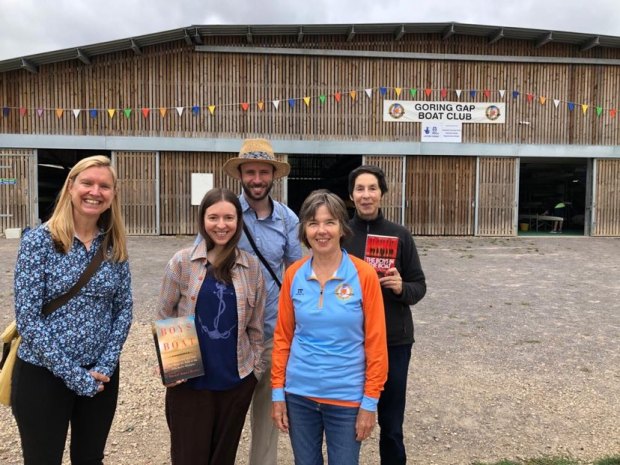
(After reading the book, some of us went on a fieldtrip to see the boating club where the woman who recommended the book rows as an amateur. It wasn’t until I saw the rowers out on the Thames that I realized that only the coxswain – the one who sits at the back of the boat and calls out the orders – faces forward, while all the other rowers are facing backwards. That feels metaphorically significant, like you have to trust where the journey is taking you all together rather than relying on your own sight.)
All along, Brown subtly weaves in the historical background: Depression-era Seattle with its shantytowns, and the rise of Hitler in Germany. Joseph Goebbels and Leni Riefenstahl were key propagandists, whitewashing the city in advance of the Olympics to make a good impression on foreign visitors. Some atrocities had already been committed, and purification policies were in place, yet the Nazis fooled many with a façade of efficiency and cleanliness.
I have deep admiration for books, fiction or non-, that can maintain suspense even though you know the outcome. The pacing really works here. Most of the action is pre-Berlin, which keeps the tension high. (The only times when my attention waned was in the blow-by-blow accounts of preliminary races.) There were so many mishaps associated with the Olympic race that it truly is amazing that the U.S. team pulled through to win – I’ll leave the specifics for future readers to discover. But there are a couple ‘stranger than fiction’ details of the book that I do want to pull out: Joe’s father and brother each married one sister from a set of twins; and actor Hugh Laurie’s father was on the Great Britain rowing team at the 1936 Olympics.
The fires and heatwave of 1936 felt familiar, as did the hairstyles and fashions in the black-and-white photos (but the ‘boys’ themselves look more like 35-year-olds than modern college students). In some ways it seemed that little has changed, but then other facts feel impossibly outdated – e.g., sperm whale oil was used to oil the boats.
This might seem like a ‘dad book’ – indeed, several of us passed the book on to our fathers/-in-law after reading – but in fact it has very broad appeal and is one I’d be likely to recommend to any big readers, even if they’re not keen on nonfiction. It’s one of my most memorable reads of the year so far. And whether you fancy reading the book or not, you may want to look out for the George Clooney-directed film, coming out next year. (Secondhand purchase) 
Three on a Theme: Raven Books for Halloween
It’s been a while since I’ve done a Three on a Theme post (over eight months, in fact). I thought it would be fun to round up a few nonfiction books about ravens that I’ve read over the last year or so – I just finished the Skaife last night.
I tend to associate ravens with Halloween because of Edgar Allan Poe’s eerie poem “The Raven.” In eighth grade English class we had the challenge of memorizing as much of this multi-stanza poem as possible. A friend and I took this very seriously and recited the whole thing, I think (or at least enough to be obnoxious), in front of the class. I can still conjure up big chunks of it in my memory: “Once upon a midnight dreary / while I pondered, weak and weary / over many a quaint and curious volume of forgotten lore…” The rhymes and alliteration make it a real earworm.
The Book of the Raven: Corvids in Art and Legend by Angus Hyland and Caroline Roberts (2021)
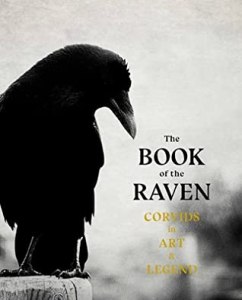 I loved the art, which ranges from the well-known (Van Gogh) to the recent and obscure and includes etchings, paintings and photographs, and wood carvings. The text was less illuminating, relying on some very familiar points of reference like Aesop’s fables, Norse myths, Poe’s “The Raven,” and so on. It’s slightly confusing that the authors decided to lump all corvids together as it suits them, so they include legends and poems associated with crows and magpies as well as ravens.
Most pieces are only one page and have an image facing, as well as at least two pages of wordless spreads between them. There are also shorter quotations embedded in some of the illustrations. Gothic font abounds and there is an overall black, white and red colour scheme. I was glad to be reminded that Charles Dickens’s pet raven, Grip III, was stuffed and is now in display in the Free Library of Philadelphia – that will be a sight to seek out on my next trip there. I also enjoyed learning about Jimmy, a Hollywood raven who appeared in over 1,000 films between 1938 and 1954, including It’s a Wonderful Life. This was a surprise Christmas gift, and a fun enough coffee table read. 
A Shadow Above: The Fall and Rise of the Raven by Joe Shute (2018)
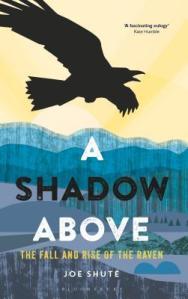 Ravens are freighted with such symbolism that people attribute special significance to their presence or absence. In parts of Britain, they were persecuted to the point of extirpation, but in recent years they have been finding new strongholds everywhere from sea cliffs and abandoned quarries to the New Forest and city centres. Travelling around the country, Shute learns how mythology reflects humans’ historical relationships with the birds and meets with those who hate and shoot ravens (farmers whose lambs and piglets they gang up to kill) as well as those who rehabilitate them or live with them as companions. It’s a balanced and well informed book, if a little by-the-numbers in its approach.
A terrific final paragraph: “Watching the birds dive under the fizzing pylon wires, I also realise just how much we need them close by. To provide us with a glimpse of wildness in a world hell-bent on civilising its furthest reaches, while at the same time inching closer towards the abyss. The raven will always continue to represent our own projections. This modern omen remains as yet ill-defined; our shared futures unresolved.” (Public library) 
The Ravenmaster by Christopher Skaife (2018)
A newspaper/magazine feature I enjoy is when a journalist interviews someone with a really random job – you know, like a cat food taste tester or the guy who cleans the Tube tunnels in London or empties the loos after Glastonbury Festival. This memoir was moderately interesting in the same sort of way.
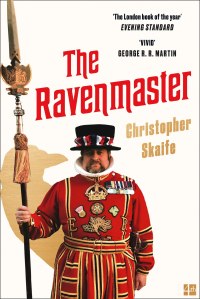 How does one get to be raven keeper at the Tower of London? In Skaife’s case, via the military. He was an indifferent student so joined the Army young and served for 24 years, including as a Drum Major and in Northern Ireland, before becoming a Yeoman Warder. He’s the sixth Ravenmaster (a new title after 1946), in post since 2011. He was always interested in history and as a mature student took a degree in archaeology, so he’s well suited to introducing the Tower to visitors. I appreciated his description of the challenge of making the experience fresh each time even though for him it’s become daily drudgery: “Doing a really great tour is like being a jazz musician: a moment’s improvisation based on a lifetime’s experience.”
Seeing to seven resident ravens’ needs is also repetitive and has to be done in the same way, on time, every day if he doesn’t want revolt – when he once tried to put them to bed in their cages in a different order, Merlina (who also plays dead and engages in hide-and-seek) led him a merry dance and he ended up falling into the moat. He’s sometimes learned the hard way, as when a raven died when it hid in scaffolding and then plunged to the ground – he realized he’d clipped its wings too severely. Other birds have been lost to foxes, so he’s gotten in the habit of feeding foxes in one spot so they’ll stay away from the raven enclosure.
It’s a good-natured, anecdotal book, but didn’t teach me anything I didn’t already know about ravens from various other books; it reports pretty entry-level information on bird intelligence, communication, and representations in popular culture. I most liked hearing about the ravens’ individual personalities and the little mishaps and surprises he’s experienced in dealing with them. But many chapters feel thrown together in an arbitrary order, and Skaife’s writing about his life before the Tower doesn’t add anything. So while I envy him living in such a history-saturated place and would probably like to tour the Tower one day, the book wasn’t the intriguing insider’s account I was looking for. A ghostwriter or extra helping editorial hand wouldn’t have gone amiss, honestly. (A gift from my wish list a couple of Christmases ago)
If you read just one … A Shadow Above by Joe Shute was the stand-out for me.
My next raven-themed read will be: Ravens in Winter by Bernd Heinrich.
What Lies Hidden: Secrets of the Sea House & Night Waking
When I read Kay’s review of Sarah Maine’s The House Between Tides, the book seemed so familiar I did a double take. A Scottish island in the Outer Hebrides … dual contemporary and historical story lines … the discovery of a skeleton. It sounded just like Night Waking by Sarah Moss (another Sarah M.!), which I was already planning on rereading on our trip to the Outer Hebrides. Kay then suggested a readalike that ended up being even more similar, Elisabeth Gifford’s The Sea House (U.S. title), one of whose plots was Victorian and the skeleton in which was a baby’s. I passed on the Maine but couldn’t resist finding a copy of the Gifford from the library so I could compare it with the Moss. Both: 
Secrets of the Sea House by Elisabeth Gifford (2013)
 Although nearly 130 years separate the two protagonists, they are linked by the specific setting – a manse on the island of Harris – and a belief that they are descended from selkies. In 1992, Ruth and her husband are converting the Sea House into a B&B and hoping to start a family. When they find the remains of a baby with skeletal deformities reminiscent of a mermaid under the floorboards, Ruth plunges into a search for the truth of what happened in their home. In 1860, Reverend Alexander Ferguson lived here and indulged his amateur naturalist curiosity about cetaceans and the dubious creatures announced as “mermaids” (often poor taxidermy crosses between a monkey and a fish, as in The Mermaid and Mrs. Hancock).
Ruth and Alexander trade off as narrators, but we get a more rounded view of mid-19th-century life through additional chapters voiced by the reverend’s feisty maid, Moira, a Gaelic speaker whose backstory reveals the cruelty of the Clearances – she won’t forgive the laird for what happened to her family. Gifford’s rendering of period prose wasn’t altogether convincing and there are some melodramatic moments: this could be categorized under romance, and I was surprised by the focus on Ruth’s traumatic upbringing in a children’s home after her mother’s death by drowning. Still, this was an absorbing novel and I actually learned a lot, including the currently accepted explanation for where selkie myths come from.
I also was relieved that Gifford uses real place names instead of disguising them (as Bella Pollen and Sarah Moss did). We passed through the tiny town of Scarista, where the manse is meant to be, on our drive. If I’d known ahead of time that it was a real place, I would have been sure to stop for a photo op (it must be this B&B!). We also stopped in Tarbert, a frequent point of reference, to visit the Harris Gin distillery. (Public library)
Night Waking by Sarah Moss (2011)
This was my first of Moss’s books and I have always felt guilty that I didn’t appreciate it more. I found the voice more enjoyable this time, but was still frustrated by a couple of things. Dr Anna Bennet is a harried mum of two and an Oxford research fellow trying to finish her book (on Romantic visions of childhood versus the reality of residential institutions – a further link to the Gifford) while spending a summer with her family on the remote island of Colsay, which is similar to St. Kilda. Her husband, Giles Cassingham, inherited the island but is also there to monitor the puffin numbers and track the effects of climate change. Anna finds a baby’s skeleton in the garden while trying to plant some fruit trees. From now on, she’ll snatch every spare moment (and trace of Internet connection) away from her sons Raph and Moth – and the builders and the police – to write her book and research what might have happened on Colsay.
 Each chapter opens with an epigraph from a classic work on childhood (e.g. by John Bowlby or Anna Freud). Anna also inserts excerpts from her manuscript in progress and fragments of texts she reads online. Adding to the epistolary setup is a series of letters dated 1878: May Moberley reports to her sister Allie and others on the conditions on Colsay, where she arrives to act as a nurse and address the island’s alarming infant mortality statistics. It took me the entire book to realize that Allie and May are the sisters from Moss’s 2014 novel Bodies of Light; I’m glad I didn’t remember, as there was a shock awaiting me.
According to Goodreads, I first read this over just four days in early 2012. (This was back in the days where I read only one book at a time, or at most two, one fiction and one nonfiction.) I remember feeling like I should have enjoyed its combination of topics – puffin fieldwork, a small island, historical research – much more, but I was irked by the constant intrusions of the precocious children. That is, of course, the point: they interrupt Anna’s life, sleep and research, and she longs for a ‘room of her own’ where she can be a person of intellect again instead of wiping bottoms and assembling sometimes disgusting meals. She loves her children, but hates the daily drudgery of motherhood. Thankfully, there’s hope at the end that she’ll get what she desires.
I had completely forgotten the subplot about the first family they rent out the new holiday cottage to (yet another tie-in to the Gifford, in which they’re preparing to open a guest house): a hot mess of alcoholic mother, workaholic father, and university-age daughter with an eating disorder. Zoe’s interactions with the boys, and Anna’s role as makeshift counsellor to her, are sweet, but honestly? I would have cut this story line entirely. Really, I longed for the novella length and precision of a later work like Ghost Wall. Still, I was happy to reread this, with Anna’s wry wit a particular highlight, and to discover for the first time (silly me!) that thread of connection with Bodies of Light / Signs for Lost Children. (Free from a neighbour)
Original rating: 
My rating now:
I enjoyed the Gifford enough to immediately request the library’s copy of one of her newer novels, The Lost Lights of St. Kilda, so my connection to the Western Isles can at least continue through my reading. I also found a pair of children’s novels plus a mystery novel set on St. Kilda, and I was sent an upcoming novel set on an island off the west coast of Scotland, so I’ll be on this Scotland reading kick for a while!
Three on a Theme: “Heart”
From a vibrant novel about trauma and second chances to a cultural history of our knowledge of the organ and its symbols, via a true story of the effects of being struck by lightning, what might these three disparate books have to tell us about the human heart on Valentine’s Day?
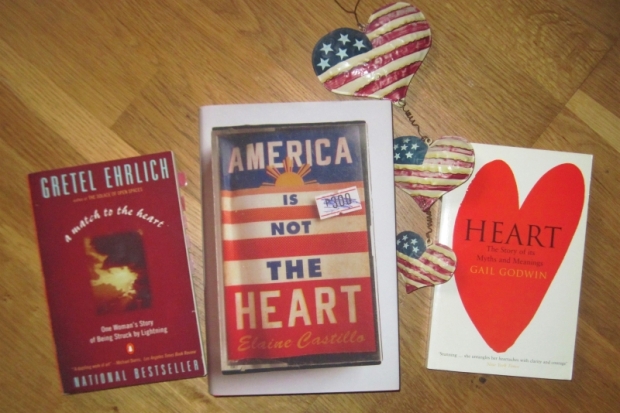
America Is Not the Heart by Elaine Castillo (2018)
This was criminally overlooked a few years ago, though I do remember Naomi F. featuring it on The Writes of Womxn. Set in the early 1990s in the Filipino immigrant neighborhoods of the Bay Area in California, it throws you into an unfamiliar culture at the deep end. There are lots of different ethnicities mentioned, and snippets of various languages (not just Tagalog, the one I knew of previously) run through the text, sometimes translated but often not. It’s a complex, confident debut novel that references episodes from the history of the Philippines of which I was mostly ignorant – genocide and reforms, dictatorship and a Marxist resistance.
 Geronima is a family name for the De Veras; not many realize that Hero, in her mid-thirties and newly arrived in the USA as an undocumented immigrant, and her cousin Roni, her uncle Pol’s seven-year-old daughter, share the same first name. Hero is estranged from her wealthy parents: they were friendly with the Marcos clan, while she ran away to serve as a doctor in the New People’s Army for 10 years. We gradually learn that she was held in a prison camp for two years and subjected to painful interrogations. Still psychologically as well as physically marked by the torture, she is reluctant to trust anyone. She stays under the radar, just taking Roni to and from school and looking after her while her parents are at work.
When Roni’s mother Paz, a medical professional, turns to traditional practices for help with Roni’s extreme eczema, Hero takes Roni to the Boy’s BBQ & Grill / Mai’s Hair and Beauty complex to see Adela Cabugao, a Filipina faith healer. The restaurant becomes a refuge for Hero and Roni – a place where they hang out with Adela’s granddaughter, Rosalyn, and her friends in the long hours Paz is away at her hospital jobs, eating and watching videos or reading Asian comics. Over the next few years Rosalyn introduces Hero to American holidays and customs. Castillo is matter-of-fact about Hero’s hook-ups with guys and girls but never strident about a bisexuality label. Hero pursues sex but remains wary of romance.
The everydayness of life here – car rides, cassette tapes, job applications, foil trays of food – contrasts with too-climactic memories. Though the plot can meander, there’s forward motion in that Hero shifts from a survival mindset into an assurance of safety that allows her to start rebuilding her life. I loved the 1990s as a setting. The characters shine and the dialogue (not in speech marks) feels utterly authentic in this fresh immigration story. My only minor disappointment was that second-person narration does not recur beyond a chapter about Paz and one about Rosalyn. The title riffs on a classic of Filipino American literature, America Is in the Heart (1946) by Carlos Bulosan, though I didn’t explore that comparison; it’s a novel that opens up real Google wormholes, should you take up the challenge. Castillo’s vibrant, distinctive voice reminded me of authors from Chimamanda Ngozi Adichie to Viet Thanh Nguyen. Please tell me she has another book in the works.
Favorite line: “Baggage means no matter how far you go, no matter how many times you immigrate, there are countries in you you’ll never leave.”
Words about the heart:
“Hero had no truck with people for whom the heart was a dreamt-up thing, held together by divine saliva, a place where gods of love still made their beds. A heart was something you could buy on the street, six to a skewer … served with garlicky rice and atsuete oil.”
“Hero had never even felt ambivalence toward Pol … She’d only ever known what it felt like to love him, to keep the minor altar of admiration for him in her heart well cleaned, its flowers rotless and blooming. What she hadn’t known was that her love was a room, cavernous, and hate could enter there, too; curl up in the same bed, blanketed and sleep-warm.”
“May tinik sa puso. You know what that means? Like she has a fishbone in the heart. She’s angry about something.”
Source: Free from a neighbor
My rating: 
A Match to the Heart by Gretel Ehrlich (1994)
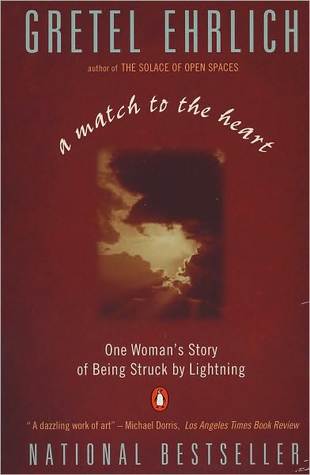 In August 1991, as a summer thunderstorm approached her Wyoming ranch, Ehrlich was struck by lightning. Although she woke up in a pool of blood, her dogs stayed by her side and she was able to haul herself the quarter-mile home and call 911 before she collapsed completely. Being hit by so much electricity (10–30 million volts) had lasting effects on her health. Her heart rhythms were off and she struggled with fatigue for years to come. In a sense, she had died and come back to a subtly different life.
After relocating to the California coast, she shadows her cardiologist and observes open-heart surgery, attends the annual Lightning Strike and Electric Shock Conference, and explores a new liminal land of beaches and islands. Again and again, she uses metaphors of the bardo and the phoenix to make sense of the in-between state she perhaps still inhabits. Full-on medical but also intriguingly mystical, this is another solid memoir from a phenomenal author. I know of her more as a nature/travel writer (This Cold Heaven is fantastic) and have another of her books on the shelf, The Solace of Open Spaces.
Words about the heart:
“Above and beyond the drama of cardiac arrest, or the threat of it, is the metaphorical territory of the heart: if love desists, if passion arrests, if compassion stops circulating through the arteries of society, then civilization, such as it is, will stop.”
“The thoracic cavity must have been the place where human music began, the first rhythm was the beat of the heart, and after that initial thump, waltzes and nocturnes, preludes and tangos rang out, straight up through flesh and capillary, nerve ganglion and epidermal layer, resonating in sternum bone: it wasn’t light that created the world but sound.”
Source: Birthday gift (secondhand) a couple years ago
My rating:
Heart: The Story of Its Myths and Meanings by Gail Godwin (2001)
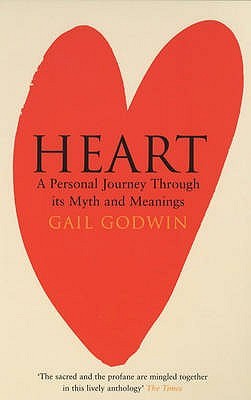 I’d read one novel and one memoir by Godwin and was excited to learn that she had once written a wide-ranging study of the religious and literary meanings overlaid on the heart. While there are some interesting pinpricks here, the delivery is shaky: she starts off with a dull, quotation-stuffed, chronological timeline, all too thorough in its plod from the Epic of Gilgamesh to the Industrial Revolution. I quickly resorted to skimming and my eye alighted on Chinese philosophy (“True knowledge, Confucius taught, lies in the heart. He created and taught an ethical system that emphasized ‘human-heartedness,’ stressing balance in the heart”) and Dickens’s juxtaposition of facts and emotion in Hard Times.
Part Two, “Heart Themes in Life and Art,” initially seemed more promising in that it opens with the personal stories of her half-brother’s death in a murder–suicide and her mother’s fatal heart attack while driving a car, but I didn’t glean much from her close readings of, e.g. Joseph Conrad and Elizabeth Bowen. Still, I’ll keep this on the shelf as a reference book for any specific research I might do in the future.
Source: Bookbarn International on February 2020 visit (my last time there)
My rating: 
If you read just one … It’s got to be America Is Not the Heart. (Though, if you’re also interested in first-person medical accounts, add on A Match to the Heart.)
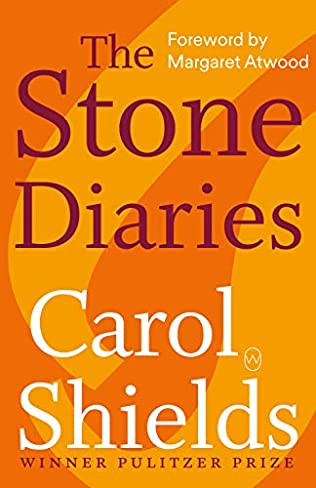
The Stone Diaries by Carol Shields (Blog Tour Review)
Is it possible to capture the complete course of a life, whether looking from the outside or telling it from the inside? What is set in stone and what is fleeting? These are questions Carol Shields addresses in her 1995 Pulitzer Prize winner, which plays with perspective and forms of storytelling as it conveys the extra/ordinary life of Daisy Stone Goodwill Flett. What with the family tree and section of black-and-white photographs, you might expect this to be a family saga; with the chronological chapters proceeding from “Birth” in 1905 to “Death” in the 1990s, you might expect an objective faux-biography. But The Stone Diaries is neither.
 The facts are these. Daisy’s mother, Mercy, dies giving birth to her in rural Manitoba. Raised by a neighbor, Daisy later moves to Indiana with her stonecutter father, Cuyler. After a disastrously short first marriage, Daisy returns to Canada to marry Barker Flett. Their three children and Ottawa garden become her life. She temporarily finds purpose in her empty-nest years by writing a “Mrs. Green Thumb” column for a local newspaper, but her retirement in Florida is plagued by illness and the feeling that she has missed out on what matters most.
What makes this surprising life story so remarkable is its unpicking of (auto)biographical authenticity: Shields switches between the first and third person, between Daisy’s point of view and a feigned omniscience. Some sections foreground others’ opinions: Chapter 6 is composed entirely of letters Daisy receives, while Chapter 7 collects short first-person narratives from her children and friends as they speculate on why she has fallen into a depression.
As in Shields’s Happenstance and Larry’s Party, which I’ve also reread this year, I was struck by the role that chance plays in any life:
History indeed! As though this paltry slice of time deserves such a name. Accident, not history, has called us together, and what an assembly we make. What confusion, what a clamor of inadequacy and portent.
Talk of bias, gaps and unreliability undermines the narrative:
Well, a childhood is what anyone wants to remember of it. It leaves behind no fossils, except perhaps in fiction. Which is why you want to take Daisy’s representation of events with a grain of salt, a bushel of salt.
Daisy herself almost disappears from the parts of the book where she is voiceless, consumed by her roles – by the end she is universally known as “Grandma Flett.” This meant that other characters stood out as more memorable to me: Cuyler for his obsessive building of stone monuments and streams of words, Barker for his love of plants and long-deferred sexual fulfillment, Daisy’s friend Fraidy Hoyt for her careful chronicling of fast living, and Magnus, Barker’s father, who lives long past his 100th birthday after his return to the Orkney Islands.
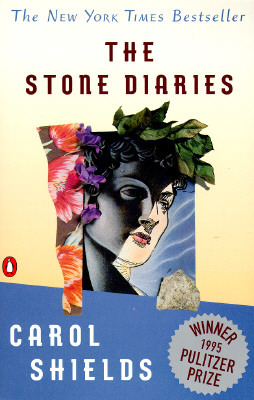 As in Moon Tiger, one of my absolute favorites, the author explores how events and memories turn into artifacts. The meta approach also, I suspect, tips the hat to other works of Canadian literature: in her introduction, Margaret Atwood mentions that the poet whose story inspired Shields’s Mary Swann had a collection entitled A Stone Diary, and surely the title’s similarity to Margaret Laurence’s The Stone Angel (1964) can’t be pure coincidence.
Experiencing the novel again after 14 years, I was impressed by the experimentation but ultimately somewhat detached from the story. It was admiration rather than love; I enjoyed earlier chapters more than the last few. But isn’t that just like life, to keep going past the point where it’s fun? And isn’t that the point, that the meaning you long for may not be there at all?
Marcie (Buried in Print) and I have reread – or, in my case for half of them, read for the first time – six Shields novels together in 2020. I hope I’ll find time to respond to the rest of them in the next few weeks. It has been so rewarding to observe how her themes recur and interlock. How heartening to see that, 17 years after her death, Shields is still being read and remembered, through the World Editions reissues (three more are coming in 2021) and through the Carol Shields Prize for Fiction, a new $100,000 annual award for North American women’s writing.
The Stone Diaries was reissued in the UK by World Editions on December 3rd. My thanks to the publisher for the free copy for review.
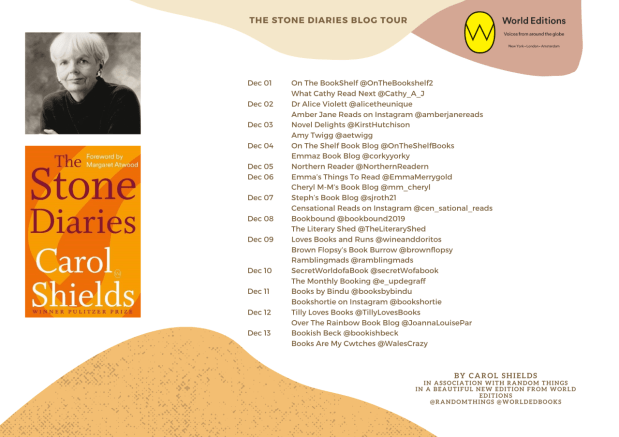
I was delighted to be invited to help close out the blog tour for The Stone Diaries. See below for details of where other reviews have appeared.
Review Book Catch-Up: Gange, Mann, O’Donoghue
The end of the year is fast approaching, and one of my main reading goals is to follow through on all the rest of the review books I’ve received from publishers. I have another handful on the go, including a few holiday- and snow-themed ones I’ll review together.
Today, I have a history-rich travelogue that explores the Atlantic coast of Britain and Ireland, a memoir by an Anglican priest who has transitioned and experienced chronic illness, and a humorous, offbeat novel about finding the real Ireland.
The Frayed Atlantic Edge: A Historian’s Journey from Shetland to the Channel by David Gange (2019)
 This was one of the 2020 Wainwright Prize finalists. Having now experienced the entire nature writing shortlist, I stick with my early September pronouncement that it should have won. I was consistently impressed with the intricacy of the interdisciplinary approach. While kayaking down the western coast of the British Isles and Ireland, Gange delved into the folklore, geology, history, local language and wildlife of each region and island group. From the extreme north of Scotland at Muckle Flugga to the southwest tip of Cornwall, he devoted a month to each Atlantic-facing area, often squeezing in expeditions between commitments as a history lecturer at Birmingham.
Gange’s thesis is that the sea has done more to shape Britain and Ireland than we generally recognize, and that to be truly representative history books must ascribe the same importance to coastal communities that they do to major inland cities. Everywhere he goes he meets locals, trawls regional archives and museums, and surveys the art and literature (especially poetry) that a place has produced. Though dense with information, the book is a rollicking travelogue that – in words no less than in the two sections of stunning colour photographs – captures the elation and fear of an intrepid solo journey. He hunkers on snowy cliffs in his sleeping bag and comes face to face with otters, seals and seabirds in his kayak; at the mercy of the weather, he has deep respect for the Atlantic waves’ power.
I enjoyed revisiting places I’ve seen in person (Shetland, the Orkney Islands, Skomer) and getting a taste of others I’ve not been to but would like to go (like the Western Isles and the west coast of Ireland). Gange’s allusive writing reminds me of Tim Dee’s and Adam Nicolson’s, and Madeleine Bunting’s Love of Country is a similar read I also loved.
With thanks to William Collins for the free copy for review.
Dazzling Darkness: Gender, sexuality, illness and God by Rachel Mann (2012; 2020)
 I’ve so enjoyed discovering Rev. Rachel Mann’s work: poetry collection A Kingdom of Love, Advent devotional In the Bleak Midwinter, and novel The Gospel of Eve. This is a revised edition of her memoir, which is less an autobiographical blow-by-blow of becoming a trans priest in the Church of England than it is a vibrant theological meditation based around keywords like loneliness, reconciliation and vocation. She reflects on the apparent contradictions of her life: she was a typical boy who loved nothing more than toy guns, and then a young man obsessed with drugs and guitars; as ‘Nick’, she was married to a woman at the time of coming out, but continued to have relationships with women after transitioning and undergoing reassignment surgery, so considers herself a lesbian.
Ambiguities like this make us uncomfortable, Mann notes, but change and loss, and making the best of impossible situations, are all a part of the human condition. I appreciated how she characterizes herself as a perennial beginner: having to face the world anew after the second adolescence of becoming a woman as well as after the end of a long-term relationship and the last in a series of hospitalizations for severe Crohn’s disease.
While I’ve read other trans memoirs (Amateur by Thomas Page McBee and Conundrum by Jan Morris), this is my first from a Christian perspective, apart from the essays in The Book of Queer Prophets. Mann describes her early faith as intense but shallow, like falling in love; later it became deeper but darker as she followed Jesus’s path of suffering. Ministry has been a gift but is not without challenges: At synod meetings she is unsure whether to speak out or remain silent, but at least she bears witness to the presence of trans people in the Church.
With thanks to Wild Goose Publications for the free copy for review.
Scenes of a Graphic Nature by Caroline O’Donoghue (2020)
 Charlotte “Charlie” Regan is a 29-year-old filmmaker based in London. Her father has had cancer on and off for four years, but he got his ‘survivor’ label in a different way: when he was a child on an island off the western coast of Ireland, his teacher and 18 classmates died of carbon monoxide poisoning from the faulty secondhand oil burner in the schoolhouse; he was the only one left alive. Although her film commemorates this story, Charlie has never actually been to Ireland, so an invitation to Cork Film Festival is the perfect opportunity to see the place before her father dies. Travelling with her is her former best friend and roommate, Laura Shingle. There’s sexual tension between these two: Charlie is a lesbian, but Laura is determined to think of herself as straight even though she and Charlie would occasionally share a bed. To prove herself, Laura goes too far the other way, making homophobic comments about strangers.
If initially Charlie thinks this trip to Ireland will be about shamrock-green nostalgia, she soon snaps out of her idealism as she has to face some tough truths about the film and her family’s history. Charlie is a companionable narrator, but, while I enjoyed the pub scenes and found some of the one-liners very funny (“Everything in our room is a faint brown, as though it were daubed very gently by a child with a teabag” and “He had an X-ray and there’s legumes all over it.” / “Legumes? Do you mean lesions?”), I was underwhelmed overall. My interest peaked at the halfway point and waned thereafter. This is one I might recommend to fans of Caoilinn Hughes.
With thanks to Virago for the free copy for review.
Would you be interested in reading one or more of these?
The Feather Thief by Kirk Wallace Johnson
 The Feather Thief is a delightful read that successfully combines many genres – biography, true crime, ornithology, history, travel and memoir – to tell the story of an audacious heist of rare bird skins from the Natural History Museum at Tring in 2009. Somehow I managed not to hear about it at the time, but it was huge news in terms of museum collections and endangered species crime. The tendrils of this thorny case wind around Victorian explorers, tycoons, and fashionistas through to modern obsessions with music, fly-fishing and refugees.
Author Kirk Wallace Johnson worked for USAID in Iraq, heading up the reconstruction of Fallujah, then founded a non-profit organization rehoming refugees in America. Plagued by PTSD, he turned to fly-fishing as therapy, and this was how he heard about the curious case of Edwin Rist, who stole the bird specimens from Tring to sell the bright feathers to fellow hobbyists who tie elaborate Victorian-style fishing flies.
Rist, from upstate New York, was a 20-year-old flautist studying at the Royal Academy of Music in London. Since age 11 he’d been fixated on fly-tying, especially old-fashioned salmon ties, which use exotic feathers or ordinary ones dyed to look like them. An online friend told him he should check out Tring – the museum Walter Rothschild’s financier father built for him as a twenty-first birthday present – when he got to London. In 2008 Rist scoped out the collection, pretending to be photographing the birds of paradise for a friend’s book.
A year later he took the train to Tring one summer night with an empty suitcase and a glass cutter, broke in through a window, stole 300 bird skins, and made it back to his flat without incident. The museum only discovered the crime a month later, by accident. Rist sold many feathers and whole birds via a fly-tying forum and on eBay. It was nearly another year and a half before the police knocked on his door, having been alerted by a former law enforcement officer who encountered a museum-grade bird skin at the Dutch Fly Fair and asked where it came from.

An interior shot showing some plates of fishing flies.
Here is where things get really interesting, at least for me. Rist confessed immediately, but a psychological evaluation diagnosed him with Asperger’s; on the strength of that mental health defense he was given a suspension and a large fine, but no jail time, so he graduated from the Royal Academy as normal and auditioned for jobs. The precedent was a case from 2000 in which a young man with Asperger’s who stole human remains from a Bristol graveyard was exonerated.
The book is in three parts: the first gives historical context about specimen collection and the early feather trade; the second is a blow-by-blow of Rist’s crime and the aftermath, including the trial; and the third goes into Wallace’s own investigation process. He started by attending a fly-tying symposium, where he felt like an outsider and even received vague threats: Rist was now a no-go subject for this community. But Wallace wasn’t going to be deterred. Sixty-four bird skins were still missing, and his quest was to track them down. He started by contacting Rist’s confirmed customers, then interviewed Rist himself in Germany and traveled to Norway to meet someone who might have been Rist’s accomplice – or fall guy.

From the back cover.
I happened to be a bit too familiar with the related history – I’ve read a lot of books that touch on Alfred Russel Wallace, whose specimens formed the core of the Tring collection, as well as a whole book on the feather trade for women’s hats and the movement against the extermination, which led to the formation of the Audubon Society (Kris Radish’s The Year of Necessary Lies). This meant that I was a little impatient with the first few chapters, but if you are new to these subjects you shouldn’t have that problem. For me the highlights were the reconstruction of the crime itself and Wallace’s inquiry into whether the Asperger’s diagnosis was accurate and a fair excuse for Rist’s behavior.
This whole story is stranger than fiction, which would make it a great selection for readers who don’t often pick up nonfiction, perhaps expecting it to be dry or taxing. Far from it. This is the very best sort of nonfiction: wide-ranging, intelligent and gripping.
My rating:
The Feather Thief was published in the UK by Hutchinson on April 26th. My thanks to Najma Finlay for the free copy for review.
 Bookish Beck = Rebecca Foster. American transplant to England. Freelance proofreader and book reviewer.
 Bookish Beck