20 Books of Summer, 1–3: Paul Auster, David Baker, Helen Ellis
I took the three of these on the plane to the States with me — I’ve been away for just over a week for my nephew’s high school graduation and a family party — and they proved to be undemanding and reasonably diverting company. All: 
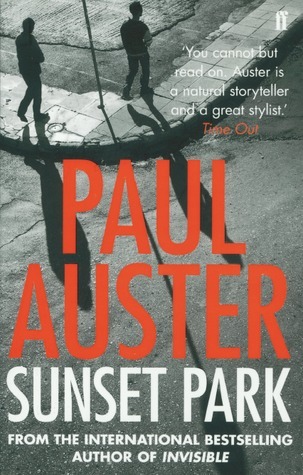
Sunset Park by Paul Auster (2010)
After reading Siri Hustvedt’s Ghost Stories, I found myself hankering to try more by her late husband. This is a fairly good novel about sexual boundaries and the ongoing impact of secrets on families. Miles Heller is living in Florida, clearing out abandoned houses. He’s 29 and has been estranged from his parents — actress mother Mary-Lee, publisher father Morris — for seven years, moving from place to place and doing odd jobs but never letting anyone know where he’s living. He’s never told anyone that he believes his stepbrother Bobby’s death was his fault. When he falls in love with a Cuban American high school student named Pilar Sanchez, one of the girl’s older sisters threatens to call the police on him for sleeping with someone underage unless he steals them stuff from the foreclosed houses. To escape potential consequences, he joins his old friend Bing Nathan at a squat in Sunset Park, Brooklyn, right across from Green-Wood cemetery. What he doesn’t know is that Bing has been reporting on his movements to his parents all along.
 The omniscient narration moves between Miles, his parents, and the three other residents of the squat, with no speech marks throughout and one section in the second person. The prose is so fluid that the pages turn incredibly quickly, but even when he’s inhabiting women’s perspectives you feel a male presence in Auster’s work. There can be something a little distasteful in his writing about sex. If being charitable, I would say that all these examples (the underage girlfriend, having anal sex to avoid pregnancy, infidelity, housemate Ellen’s pornographic drawings, a man being in love with his male best friend) are a way of exploring the lines we draw around sex and whether they are fundamental or arbitrary. But when you’re reading it, it just feels prurient.
Auster’s pet loves of baseball (Hustvedt in Ghost Stories: “Year-round, Paul yakked to me about the Mets”) and film are here through Miles’s and Morris’s shared passion for baseball and housemate Alice’s dissertation work on The Best Years of Our Lives, a charming (or should that be sentimental?) postwar movie I watched back when I was working my way through the American Film Institute’s top 100 list in my high school and college years. Between that, the glimpse of the publishing industry through Morris and Alice’s work for PEN trying to get justice for an exiled Chinese writer, there are a number of appealing elements, but they don’t all come together in any particularly meaningful way. Definitely second-tier work from him. I know I have a lot of better ones still to come. (Secondhand — Community Furniture Project, Newbury)
Whale Fall by David Baker (2022)
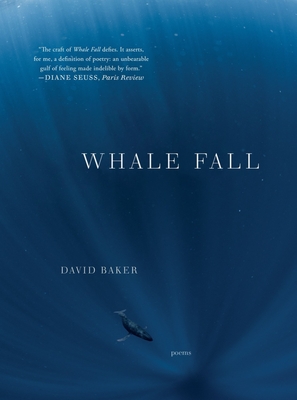 I’d never heard of Baker, even though he’s a prolific and well-respected American practitioner of eco-poetry. Nature poetry is usually right up my street, so I was keen to give this a try. The long title sequence intersperses statistics about whale journeys and ocean plastics with the poet’s memories of Cold War alarmism and current chronic health issues. There are descriptions of riverside and forest scenes, worries about an ageing father, references to Turner’s paintings of clouds, concerns about wildfires, and so on. I quite liked “Storm Psalm” and “Middle Devonian,” but there are not many other standouts overall. The stanza and line arrangements vary a good bit, with most poems ranging across several pages in numbered sections or parts separated by asterisks. Apart from a bit of alliteration, I didn’t notice a lot in the way of technique. I feel almost churlish for not appreciating this more, but it didn’t speak to me, and there were some sentimental tics, as in the brief poem below. (Secondhand — hospital book sale)
“Extinction”
When you are gone they will read your footprints,
if they still read, as they might a poem about love—
wandering in circles, here and there obscured,
washed out in places by weather, sudden landslide.
Keep walking, pilgrim. This is your great tale.
Southern Lady Code by Helen Ellis (2012)
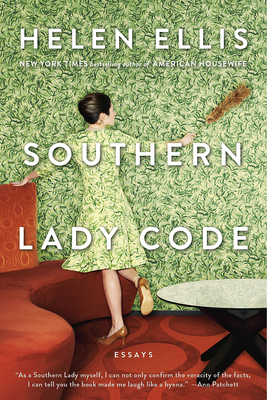 That I read the whole thing on the flight tells you that this collection of 23 micro-essays was addictive in a popcorn sort of way. Ellis is more sassy than introspective when writing about her Alabama upbringing versus her married, childfree adulthood in New York City and the etiquette that she espouses. She quotes her mother’s dictums and gives translations of phrases one might use when trying to be polite: “I’m put together. ‘Put together’ is Southern Lady Code for you can take me to church or Red Lobster and I’ll fit in fine.” She writes about reality TV, reporting pornography on Twitter (but not before enjoying it privately), her belief in ghosts, and her beauty routines for an ageing body — her debt to Nora Ephron is clearest in “Seven Things I’m Doing Instead of a Neck Lift.” I especially enjoyed one essay about her affinity for gay men (I was reminded of Beard by Kelly Foster Lundquist). The best sequence of three pieces covers making kitschy 1970s finger food for her annual holiday party, tips for how to be a good guest, and the art of the thank-you note.
But, often, I found the book quite shallow, and mentions of how much she spends on outfits rubbed me the wrong way. (I’d somehow encountered the essay on accidentally switching another woman’s Burberry coat for her own before.) “Serious Women” is the least fluffy with its account of a sordid murder trial she attended because her friend was the assistant district attorney. There were other little mentions of incidents I wished she’d had the courage to take on in full, such as her rape and her and her husband’s collective loss of parents and a brother. Still, I liked Ellis’s writing enough that I’d definitely read her short story collection, American Housewife. (Secondhand — Community Furniture Project, Newbury)
So none of these were stellar books, but I’m pleased to have read them because they were all “just-because” books from my shelves. No challenge or deadline drove me to them; I picked them up simply because I felt like reading them. Which is what I think summer reading is supposed to be about.
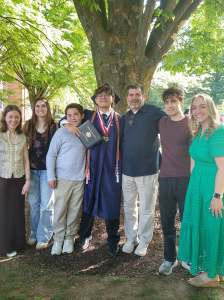
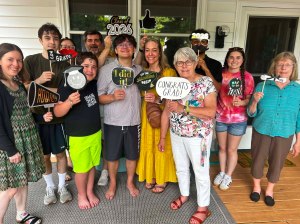
Graduation and party pics:
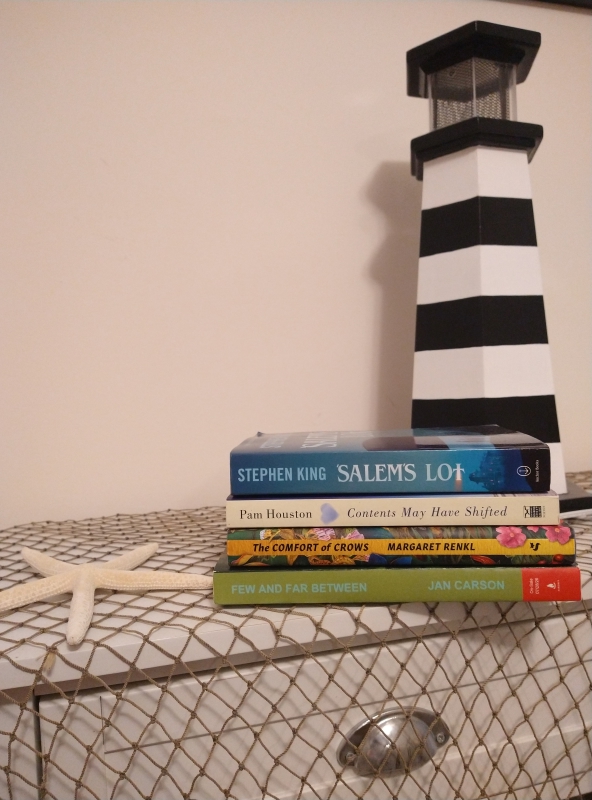
My U.S. book haul (the Houston is signed; the Carson is a review copy, out at the end of July):
I couldn’t figure out how to log in to WordPress from the laptop I borrowed from my sister while I was away, so I’ll be catching up on blogs and comments the rest of this week. I read most of two other books during my trip and will write those up soon.
The Three Best Books I’ve Read So Far This Year
I’m very stingy with my 5-star ratings, so when I give one out you can be assured that a book is truly special. These three are all backlist reads – look out for my Classic of the Month post next week for a fourth that merits 5 stars – that are well worth seeking out. Out of the 50 books I’ve read so far this year, these are far and away the best.
This Sunrise of Wonder: Letters for the Journey by Michael Mayne (1995)

The cover image is Mark Rothko’s Orange, Red, Yellow (1956).
I plucked this Wigtown purchase at random from my shelves and it ended up being just what I needed to lift me out of January’s funk. Mayne’s thesis is that experiencing wonder, “rare, life-changing moments of seeing or hearing things with heightened perception,” is what makes us human. Call it an epiphany (as Joyce did), call it a moment of vision (as Woolf did), call it a feeling of communion with the universe; whatever you call it, you know what he is talking about. It’s that fleeting sense that you are right where you should be, that you have tapped into some universal secret of how to be in the world.
Mayne believes poets, musicians and painters, in particular, reawaken us to wonder by encouraging us to pay close attention. His frame of reference is wide, with lots of quotations and poetry extracts; he has a special love for Turner, Monet and Van Gogh and for Rilke, Blake and Hopkins. Mayne was an Anglican priest and Dean of Westminster, so he comes at things from a Christian perspective, but most of his advice is generically spiritual and not limited to a particular religion. There are about 50 pages towards the end that are specifically about Jesus; one could skip those if desired.
The book is a series of letters written to his grandchildren from a chalet in the Swiss Alps one May to June. Especially with the frequent quotations and epigraphs, the effect is of a rich compendium of wisdom from the ages. I don’t often feel awake to life’s wonder – I get lost in its tedium and unfairness instead – but this book gave me something to aspire to.
A few of the many wonderful quotes:
“The mystery is that the created world exists. It is: I am. The mystery is life itself, together with the fact that however much we seek to explore and to penetrate them, the impenetrable shadows remain.”
“Once wonder goes; once mystery is dismissed; once the holy and the numinous count for nothing; then human life becomes cheap and it is possible with a single bullet to shatter that most miraculous thing, a human skull, with scarcely a second thought. Wonder and compassion go hand-in-hand.”
“this recognition of my true worth is something entirely different from selfishness, that turned-in-upon-myselfness of the egocentric. … It is a kind of blasphemy to view ourselves with so little compassion when God views us with so much.”
Body of Work: Meditations on Mortality from the Human Anatomy Lab by Christine Montross (2007)
 When she was training to become a doctor in Rhode Island, Montross and her anatomy lab classmates were assigned an older female cadaver they named Eve. Eve taught her everything she knows about the human body. Montross is also a published poet, as evident in her lyrical exploration of the attraction and strangeness of working with the remnants of someone who was once alive. She sees the contrasts, the danger, the theatre, the wonder of it all:
“Stacked beside me on my sage green couch: this spinal column that wraps into a coil without muscle to hold it upright, hands and feet tied together with floss, this skull hinged and empty. A man’s teeth.”
“When I look at the tissues and organs responsible for keeping me alive, I am not reassured. The wall of the atrium is the thickness of an old T-shirt, and yet a tear in it means instant death. The aorta is something I have never thought about before, but if mine were punctured, I would exsanguinate, a deceptively beautiful word”
All through her training, Montross has to remind herself to preserve her empathy despite a junior doctor’s fatigue and the brutality of the work (“The force necessary in the dissections feels barbarous”), especially as the personal intrudes on her career through her grandparents’ decline and her plans to start a family with her wife – which I gather is more of a theme in her next book, Falling into the Fire, about her work as a psychiatrist. I get through a whole lot of medical reads, as any of my regular readers will know, but this one is an absolute stand-out for its lyrical language, clarity of vision, honesty and compassion.
There There by Tommy Orange (2018)
Had I finished this late last year instead of in the second week of January, it would have been vying with Lauren Groff’s Florida for the #1 spot on my Best Fiction of 2018 list.
 The title – presumably inspired by both Gertrude Stein’s remark about Oakland, California (“There is no there there”) and the Radiohead song – is no soft pat of reassurance. It’s falsely lulling; if anything, it’s a warning that there is no consolation to be found here. Orange’s dozen main characters are urban Native Americans converging on the annual Oakland Powwow. Their lives have been difficult, to say the least, with alcoholism, teen pregnancy, and gang violence as recurring sources of trauma. They have ongoing struggles with grief, mental illness and the far-reaching effects of fetal alcohol syndrome.
The novel cycles through most of the characters multiple times, alternating between the first and third person (plus one second person chapter). As we see them preparing for the powwow, whether to dance and drum, meet estranged relatives, or get up to no good, we start to work out the links between everyone. I especially liked how Orange unobtrusively weaves in examples of modern technology like 3D printing and drones.
The writing in the action sequences is noticeably weaker, and I wasn’t fully convinced by the sentimentality-within-tragedy of the ending, but I was awfully impressed with this novel overall. I’d recommend it to readers of David Chariandy’s Brother and especially Sunil Yapa’s Your Heart Is a Muscle the Size of a Fist. It was my vote for the National Book Critics Circle’s John Leonard Prize (for the best first book, of any genre, published in 2018), and I was pleased that it went on to win.
 Bookish Beck = Rebecca Foster. American transplant to England. Freelance proofreader and book reviewer.
