20 Books of Summer, 14–16: Polly Atkin, Nan Shepherd and Susan Allen Toth
I’m still plugging away at the challenge. It’ll be down to the wire, but I should finish and review all 20 books by the 31st! Today I have a chronic illness memoir, a collection of poetry and prose pieces, and a reread of a cosy travel guide.
Some of Us Just Fall: On Nature and Not Getting Better by Polly Atkin (2023)
I was heartened to see this longlisted for the Wainwright Prize. It was a perfect opportunity to recognize the disabled/chronically ill experience of nature and the book achieves just what the award has recognised in recent years: the braiding together of life writing and place-based observation. (Wainwright has also done a great job on diversity this year: there are three books by BIPOC and five by women on the nature writing shortlist alone.)
 Polly Atkin knew something was different about her body from a young age. She broke bones all the time, her first at 18 months when her older brother ran into her on his bicycle. But it wasn’t until her thirties that she knew what was wrong – Ehlers-Danlos syndrome and haemochromatosis – and developed strategies to mitigate the daily pain and the drains on her energy and mobility. “Correct diagnosis makes lives bearable,” she writes. “It gives you access to the right treatment. It gives you agency.”
The book assembles long-ish fragments, snippets from different points of her past alternating with what she sees on rambles near her home in Grasmere. She writes in some depth about Lake District literature: Thomas De Quincey as well as the Wordsworths – Atkin’s previous book is a biography of Dorothy Wordsworth that spotlights her experience with illness. In describing the desperately polluted state of Windermere, Atkin draws parallels with her condition (“Now I recognise my body as a precarious ecosystem”). Although she spurns the notion of the “Nature Cure,” swimming is a valuable therapy for her.
Theme justifies form here: “This is the chronic life, lived as repetition and variance, as sedimentation of broken moments, not as a linear progression.” For me, there was a bit too much particularity; if you don’t connect to the points of reference, there’s no way in and the danger arises of it all feeling indulgent. Besides, by the time I opened this I’d already read two Ehlers-Danlos memoirs (All My Wild Mothers by Victoria Bennett and Floppy by Alyssa Graybeal) and another reference soon came my way in The Invisible Kingdom by Meghan O’Rourke. So overfamiliarity was a problem. And by the time I forced myself to pick this off of my set-aside shelf and finish it, I’d read Nina Lohman’s stellar The Body Alone. For those newer to reading about chronic illness, though, especially if you also have an interest in the Lakes, it could be an eye-opener.
With thanks to Sceptre (Hodder) for the free copy for review.
Selected Prose & Poetry by Nan Shepherd (2023)
 I’d read and enjoyed Shepherd’s The Living Mountain, which has surged in popularity as an early modern nature writing classic thanks to Robert Macfarlane et al. I’m not sure I’d go as far as the executor of the Nan Shepherd Estate, though, who describes her in the Preface as “Taylor Swift in hiking boots.” The pieces reprinted here are from her one published book of poems, In the Cairngorms, and the mixed-genre collection Wild Geese. There is also a 28-page “novella,” Descent from the Cross. After World War I, Elizabeth, a workers’ rights organiser for a paper mill, marries a shell-shocked veteran who wants to write a book but isn’t sure he has either the genius or the dedication. It’s interesting that Shepherd would write about a situation where the wife has the economic upper hand, but the tragedy of the sickly failed author put me in mind of George Gissing or D.H. Lawrence, so didn’t feel fresh. Going by length alone, I would have called this a short story, but I understand why it would be designated a novella, for the scope.
None of the miniature essays – field observations and character studies – stood out to me. About half of the book is given over to poetry. As with the nature writing, there is a feeling of mountain desolation. There are a lot of religious references and hints of the mystical, as in “The Bush,” which opens “In that pure ecstasy of light / The bush is burning bright. / Its substance is consumed away / And only form doth stay”. It’s a mixed bag: some feels very old-fashioned and sentimental, with every other line or, worse, every line rhyming, and some archaic wording and rather impenetrable Scots dialect. It could have been written 100 years before, by Robert Burns if not William Blake. But every so often there is a flash of brilliance. “Blackbird in Snow” is quite a nice one, and reminiscent of Thomas Hardy’s “The Darkling Thrush.” I even found the cryptic lines from “Real Presence” that inspired a song on David Gray’s Skellig. My favourite poem by far was:
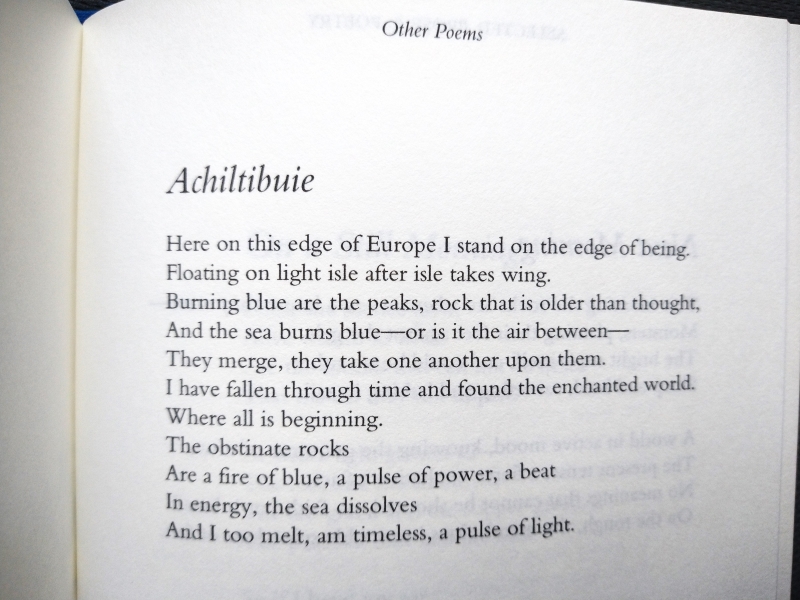
Overall, this didn’t engage me; it’s only for Shepherd fanatics and completists. (Won from Galileo Publishers in a Twitter giveaway)
England As You Like It: An Independent Traveler’s Companion by Susan Allen Toth (1995)
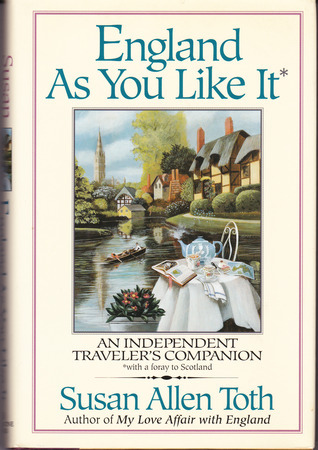 A reread. As I was getting ready to go overseas for the first time in the summer of 2003, Toth’s trilogy of memoirs whetted my appetite for travel in Britain. (They’re on my Landmark Books in My Life, Part II list.) This is the middle book and probably the least interesting in that it mostly recounts stays in particular favourite locations, such as Dorset, the Highlands, and various sites in Cornwall. However, I’ve never forgotten her “thumbprint theory,” which means staying a week or more in an area no larger than her thumb covers on a large-scale map, driving an hour or less for day trips. Not for her those cram-it-all-in trips where you race through multiple countries in a week (I have American friends who did Paris, London and Rome within six days, or five countries in eight days; blame it on stingy vacation policies, I guess). Instead, she wants to really bed into one place and have the time to make serendipitous discoveries such as an obscure museum or a rare opening of a private garden.
I most liked the early general chapters about how to make air travel bearable, her obsession with maps, her preference for self-catering, and her tendency to take home edible souvenirs. Of course, all the “Floating Facts” are hopelessly out-of-date. This being the early to mid-1990s, she had to order paper catalogues to browse cottage options (I still did this for honeymoon prep in 2006–7) and make international phone calls to book accommodation. She recommends renting somewhere from the National Trust or Landmark Trust. Ordnance Survey maps could be special ordered from the British Travel Bookshop in New York City. Entry fees averaged a few pounds. It’s all so quaint! An Anglo-American time capsule of sorts. I’ve always sensed a kindred spirit in Toth, and those whose taste runs toward the old-fashioned will probably also find her a charming tour guide. I’ve also reviewed the third book, England for All Seasons. (Free from The Book Thing of Baltimore)
August Releases: Bright Fear, Uprooting, The Farmer’s Wife, Windswept
This month I have three memoirs by women, all based on a connection to land – whether gardening, farming or crofting – and a sophomore poetry collection that engages with themes of pandemic anxiety as well as crossing cultural and gender boundaries.
My August highlight:
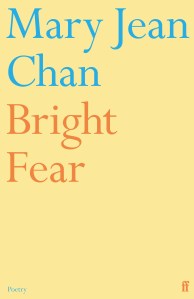
Bright Fear by Mary Jean Chan
Chan’s Flèche was my favourite poetry collection of 2019. Their follow-up returns to many of the same foundational subjects: race, family, language and sexuality. But this time, the pandemic is a lens through which all is filtered. This is particularly evident in Part I, “Grief Lessons.” “London, 2020” and “Hong Kong, 2003,” on facing pages, contrast Covid-19 with SARS, the major threat when they were a teenager. People have always made assumptions about them based on their appearance or speech. At a time when Asian heritage merited extra suspicion, English was both a means of frank expression and a source of ambivalence:
“At times, English feels like the best kind of evening light. On other days, English becomes something harder, like a white shield.” (from “In the Beginning Was the Word”)
“my Chinese / face struck like the glow of a torch on a white question: / why is your English so good, the compliment uncertain / of itself.” (from “Sestina”)
 At the centre of the book, “Ars Poetica,” a multi-part collage incorporating lines from other poets, forms a kind of autobiography in verse. Chan also questions the lines between genres, wondering whether to label their work poetry, nonfiction or fiction (“The novel feels like a springer spaniel running off-/leash the poem a warm basket it returns to always”).
The poems’ structure varies, with paragraphs and stanzas of different lengths and placement on the page (including, in one instance, a goblet shape). The enjambment, as you can see in lines I’ve quoted above and below, is noteworthy. Part III, “Field Notes on a Family,” reflects on the pressures of being an only child whose mother would prefer to pretend lives alone rather than with a female partner. The book ends with hope that Chan might be able to be open about their identity. The title references the paradoxical nature of the sublime, beautifully captured via the alliteration that closes “Circles”: “a commotion of coots convincing / me to withstand the quotidian tug-/of-war between terror and love.”
Although Flèche still has the edge for me, this is another excellent work I would recommend even to those wary of poetry. 
Some more favourite lines, from “Ars Poetica”:
“What my mother taught me was how
to revere the light language emitted.”
“Home, my therapist suggests, is where
you don’t have to explain yourself.”
With thanks to Faber for the free copy for review.
Three land-based memoirs:
(All:  )
)
Uprooting: From the Caribbean to the Countryside – Finding Home in an English Country Garden by Marchelle Farrell
 This Nan Shepherd Prize-winning memoir shares Chan’s attention to pandemic-era restrictions and how they prompt ruminations about identity and belonging. Farrell is from Trinidad but came to the UK as a student and has stayed, working as a psychiatrist and then becoming a wife and mother. Just before Covid hit, she moved to the outskirts of Bath and started rejuvenating her home’s large and neglected garden. Under thematic headings that also correspond to the four seasons, chapters are named after different plants she discovered or deliberately cultivated. The peace she finds in her garden helps her to preserve her mental health even though, with the deaths of George Floyd and so many other Black people, she is always painfully aware of her fragile status as a woman of colour, and sometimes feels trapped in the confining routines of homeschooling. I enjoyed the exploration of postcolonial family history and the descriptions of landscapes large and small but often found Farrell’s metaphors and psychological connections obvious or strained.
With thanks to Canongate for the free copy for review.
The Farmer’s Wife: My Life in Days by Helen Rebanks
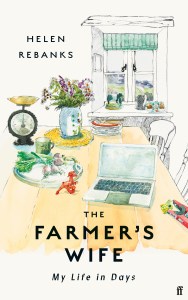 I fancied a sideways look at James Rebanks (The Shepherd’s Life and Wainwright Prize winner English Pastoral) and his regenerative farming project in the Lake District. (My husband spotted their dale from a mountaintop on holiday earlier in the month.) Helen Rebanks is a third-generation farmer’s wife and food and family are the most important things to her. One gets the sense that she has felt looked down on for only ever wanting to be a wife and mother. Her memoir, its recollections structured to metaphorically fall into a typical day, is primarily a defence of the life she has chosen, and secondarily a recipe-stuffed manifesto for eating simple, quality home cooking. (She paints processed food as the enemy.)
Growing up, Rebanks started cooking for her family early on, and got a job in a café as a teenager; her mother ran their farm home as a B&B but was forgetful to the point of being neglectful. She met James at 17 and accompanied him to Oxford, where they must have been the only student couple cooking and eating proper food. This period, when she was working an office job, baking cakes for a café, and mourning the devastating foot-and-mouth disease epidemic from a distance, is most memorable. Stories from travels, her wedding, and the births of her four children are pleasant enough, yet there’s nothing to make these experiences, or the telling of them, stand out. I wouldn’t make any of the dishes; most you could find a recipe for anywhere. Eleanor Crow’s black-and-white illustrations are lovely, though.
With thanks to Faber for the free copy for review.
Windswept: Life, Nature and Deep Time in the Scottish Highlands by Annie Worsley
 I’d come across Worsley in the Wildlife Trusts’ Seasons anthologies. For a decade she has lived on Red River Croft, in a little-known pocket of northwest Scotland. In word pictures as much as in the colour photographs that illustrate this volume, she depicts it as a wild land shaped mostly by natural forces – also, sometimes, manmade. From one September to the next, she documents wildlife spectacles and the influence of weather patterns. Chronic illness sometimes limited her daily walks to the fence at the cliff-top. (But what a view from there!) There is more here about local history and ecology than any but the keenest Scotland-phile may be interested to read. Worsley also touches on her upbringing in polluted Lancashire, and her former academic career and fieldwork in Papua New Guinea. Her descriptions are full of colours and alliteration, though perhaps a little wordy: “Pale-gold autumnal days are spliced by fickle and feisty bouts of turbulent weather. … Sunrises and sunsets may pour with cinnabar and henna; dawn and dusk can ripple with crimson and purple.” The kind of writing I could appreciate for the length of an essay but not a whole book.
With thanks to William Collins for the free copy for review.
Would you read one or more of these?
Cumbria Sights and Reading & A Return to Sedbergh
We returned on Friday from a one-week reunion with university friends – some we see very often and some less so; we hadn’t all been together since February 2020. After a protracted winter selection process pitting locations and cottages against each other, the nine of us had managed to agree on a converted inn in Appleby-in-Westmorland, Cumbria, and it ended up being the perfect base for us: roomy, with lots of communal space plus en suite rooms for each family unit, and well located.
This was my first time in the Lake District in 17 years, and I particularly enjoyed the outings to Haweswater, Acorn Bank, Keswick and Derwentwater, and Carlisle (that one by train), as well as some low-key walking closer to the cottage.


As apposite reading, I took along:
- Some of Us Just Fall by Polly Atkin: A memoir of chronic illness by a writer based in Grasmere.
- Haweswater by Sarah Hall: Purchased in Sedbergh last year. Hall’s debut novel is set in the run-up to the lake being dammed to provide water for the city of Manchester in 1936, flooding the village of Mardale. I’m finding it rather dry and the local accent over-the-top, but I’ll push through and call it one of my 20 Books of Summer.
- The Farmer’s Wife by Helen Rebanks: A recipe-studded memoir of daily life as the spouse of famous Lake District sheep farmer James Rebanks.
- Wild Fell by Lee Schofield: As featured in my Six Degrees post, a plant-loving and conservation-oriented memoir by the manager of the RSPB Haweswater site.

I also packed, but didn’t get time to read from, books by Margaret Forster and Dorothy Wordsworth. A good showing by women from the northwest!
Though we hadn’t planned on going back so soon, having been for the first time in September, when I learned that Sedbergh was only 40 minutes from where we were staying, I suggested it for a daytrip along with a scenic walk to a waterfall and cake and soft drinks at the Cross Keys Temperance Inn, and even the less book-obsessed of us seemed to enjoy.

My final haul – including, from Carlisle, one book each from a charity shop and Bookcase (above), which I learned about from Simon but actually found kind of overwhelmingly huge and mazelike – cost £9.50 after subtracting the sellback of a partial box of books at Westwood. A good selection of poetry and novellas, plus a favourite I couldn’t resist buying two copies of and might reread as a buddy read with my husband (the Orlean).

Any vacation reading or book hauls for you this August?
Six Degrees of Separation: Romantic Comedy to Wild Fell
This is a fun meme I take part in every few months.
For August we begin with Romantic Comedy by Curtis Sittenfeld, one of my top 2023 releases so far. (See Kate’s opening post.)
 #1 Sittenfeld’s protagonist, Sally Milz, writes TV comedy, as does Kristin Newman (That ’70s Show, How I Met Your Mother, etc.), author of What I Was Doing While You Were Breeding, a lighthearted record of her travels and romantic conquests. (She even has a passage that reminds me of Sally’s Danny Horst Rule: “I looked like a thirty-year-old writer. Not like a twenty-year-old model or actress or epically legged songstress, which is a category into which an alarmingly high percentage of Angelenas fall. And, because the city is so lousy with these leggy aliens, regular- to below-average-looking guys with reasonable employment levels can actually get one, another maddening aspect of being a woman in this city.”)
 #2 I didn’t realize when I picked it up in a charity shop that my copy smelled strongly of cigarette smoke. I aired it in kitty litter, then by scented candles, and it still reeks. I reckon I can tolerate the smell long enough to finish it and put it in the Little Free Library, which gets good ventilation. A novel I acquired from the free bookshop we used to have in the mall in town was the only book I can remember having to get rid of before reading because it just smelled too bad (also of cigarettes in that case): My Sister’s Keeper by Jodi Picoult.
 #3 So I didn’t read that, but I have read another Picoult novel, Sing You Home. The author is known for picking a central issue to address in each work, and in that one it was sexuality. Zoe, a music therapist, is married to Max but leaves him for Vanessa – and then decides to sue him for the use of the embryos they created together via IVF. It was the first book I’d read with that dynamic (a previously straight woman enters into a lesbian partnership), but by no means the last. Later came Untamed by Glennon Doyle, Hidden Nature by Alys Fowler, The Fixed Stars by Molly Wizenberg … and one you maybe weren’t expecting: the fantastic memoir First Time Ever by Peggy Seeger. The authors vary in how they account for it. They were gay all along but didn’t realize it? Their orientation changed? Or they just happened to fall in love with someone of the same gender? Seeger doesn’t explain at all, simply records how head-over-heels she was for Ewan MacColl … and then for Irene Pyper Scott.
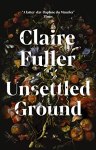 #4 Peggy Seeger is one of my heroes these days. I first got into her music through the lockdown livestreams put together by Folk on Foot and have since seen her live and acquired several of her albums, including a Smithsonian Folkways collection of her best-loved folk standards. One of these is, of course, “I’m Gonna Be an Engineer,” which was one of the inspirations for Claire Fuller’s Unsettled Ground.
 #5 Unsettled Ground, an unusual story of rural poverty and illiteracy, is set in a fictional village modelled on Inkpen, where Nicola Chester lives. Her memoir On Gallows Down, which held particular local interest for me, was shortlisted for the Wainwright Prize last year.
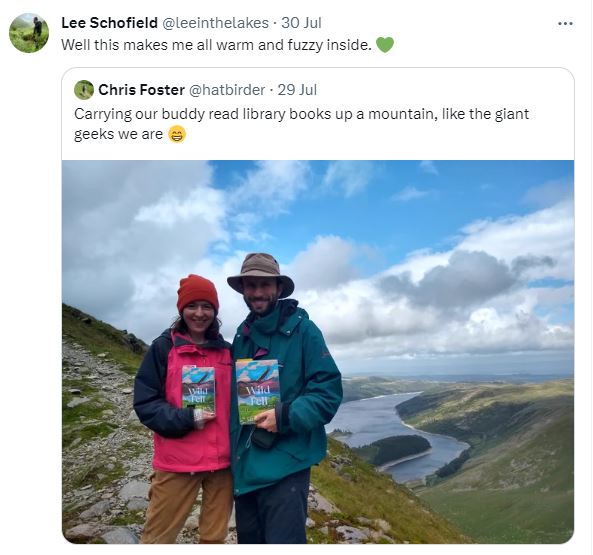
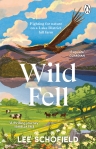 #6 Also shortlisted that year was Wild Fell by Lee Schofield, about his work at RSPB Haweswater. Like Chester, he’s been mired in the struggle to balance sustainable farming with conservation at a beloved place. And like a fellow Lakeland farmer (and previous Wainwright Prize winner for English Pastoral), James Rebanks, he’s trying to be respectful of tradition while also restoring valuable habitats. My husband and I each took a library copy of Wild Fell along to Cumbria last week (about which more anon) and packed it in a backpack for an on-location photo during our wild walk at the very atmospheric Haweswater.
Where will your chain take you? Join us for #6Degrees of Separation! (Hosted on the first Saturday of each month by Kate W. of Books Are My Favourite and Best.) Next month’s starting book is Wifedom by Anna Funder.
Have you read any of my selections? Tempted by any you didn’t know before?
A Short Trip to Sedbergh, England’s Book Town
We’ve finally completed the ‘Triple Crown’ of British book towns: Hay-on-Wye in Wales is one of our favourite places and we’ve visited seven or more times over the years (the latest); inspired by Shaun Bythell’s memoirs, we then made the pilgrimage to Wigtown in Scotland in 2018. But we hadn’t made it to Sedbergh, England’s book town, until this past week. A short conference my husband was due to attend in the northwest of the country was the excuse we needed – though a medical emergency with our cat (fine now; just had to have an infected tooth out) shortened our trip and kept him from participating in the symposium at Lancaster.
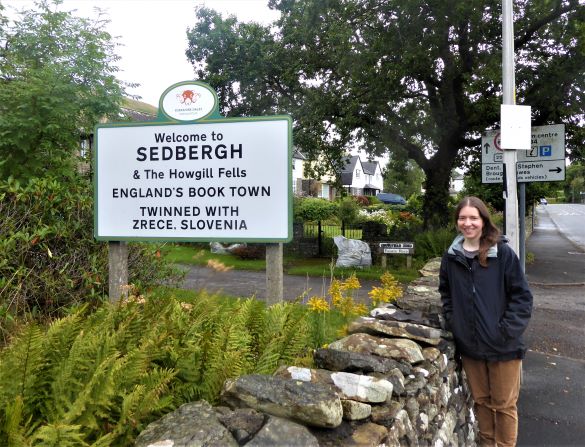
Sedbergh is technically in Cumbria but falls within the Yorkshire Dales National Park. The book town initiative was part of a drive to re-invigorate the local economy after the 2001 foot and mouth disease outbreak. It’s a very sleepy town, more so than Hay or Wigtown, and only has two dedicated bookshops. The flagship store is Westwood Books, which was based in Hay until 2006 and occupies a former cinema / factory building. It is indeed reminiscent of Hay’s Cinema Bookshop, and is similar in size and stock to the largest of the Hay shops.
The only other shop in town that only sells books is Clutterbooks charity bookshop, where we started our book hunting after we left the car at our Airbnb flat on the Wednesday. With everything priced at £1 or £1.50, it tempted me into my first six purchases. Next up was Westwood, which opens until 5, an hour later than some other places. I bought a couple more books (delighted with the pristine secondhand copy of Julian Hoffman’s first nature book) but also resold them a small box of antiquarian and signed books for more than I could ever have hoped for – covering all my book purchases for the trip, as well as our meals and snacks out. On the Thursday we had a quiet drink in a cosy local pub to toast Her Majesty’s memory.


Various main street eateries and shops have a shelf or two of books for sale. We perused these, and the Little Free Library in the old bus shelter, on the Wednesday afternoon and first thing Friday morning. I added one more purchase to my stack – a paperback copy of Fire on the Mountain by Jean McNeil for £1 – just before we left town. In general, there weren’t as many bookshops as expected, and lots of places opened later or closed earlier than advertised, presumably because it was off season and rather rainy. So, it was a little underwhelming as book town experiences go, and I can’t imagine Sedbergh ever drawing us back.
However, we enjoyed exploring the area in general, with stops at Little Moreton Hall, and Sizergh Castle and Chester, respectively, on the way up and back. As part of the conference, we joined in a walk from Grange to Cartmel that took in an interesting limestone pavement landscape. It was my first time in the Dales or Lake District in many a year, and a good chance to get back to that pocket of the world.


Young Writer of the Year Award: Shortlist Reviews and Predictions
Being on the shadow panel for the Sunday Times Young Writer of the Year Award was a bookish highlight of 2017 for me. I’m pleased for this year’s shadow panelists, a couple of whom are blogging friends (one I’ve met IRL), to have had the same opportunity, and I look forward to attending the prize ceremony at the London Library on December 5th.
I happened to have already read two of the shortlisted titles, the poetry collection The Perseverance by Raymond Antrobus and the debut novel Stubborn Archivist by Yara Rodrigues Fowler, which was one of my specific wishes/predictions. The kind folk of FMcM Associates sent me the other two shortlisted books, a short story collection and another debut novel, for blog reviews so that I could follow along with the shadow panel’s deliberations.
Salt Slow by Julia Armfield (2019)
These nine short stories are steeped in myth and magic, but often have a realistic shell. Only gradually do the fantastical or dystopian elements emerge, with the final paragraph delivering a delicious surprise. For instance, the narrator of “Mantis” attends a Catholic girls’ school and is caught up in a typical cycle of self-loathing and obsessing over boys. It’s only at the very end that we realize her extreme skin condition is actually a metamorphosis that enables her to protect herself. The settings are split between the city and the seaside; the perspective is divided almost perfectly down the middle between the first and third person. The body is a site of transformation, or a source of grotesque relics, as in “The Collectables,” in which a PhD student starts amassing body parts she could only have acquired via grave-robbing.
 Two favorites for me were “Formerly Feral,” in which a 13-year-old girl acquires a wolf as a stepsister and increasingly starts to resemble her; and the final, title story, a post-apocalyptic one in which a man and a pregnant woman are alone in a fishing boat, floating above a drowned world and living as if outside of time. This one is really rather terrifying. I also liked “Cassandra After,” in which a dead girlfriend comes back – it reminded me of Margaret Atwood’s The Robber Bride, which I’m currently reading for #MARM. “Stop Your Women’s Ears with Wax,” about a girl group experiencing Beatles-level fandom on a tour of the UK, felt like the odd one out to me in this collection.
Armfield’s prose is punchy, with invented verbs and condensed descriptions that just plain work: “Jenny had taken to poltergeisting round the house”; “skin like fork-clawed cottage cheese,” “the lobster shells gleam a slick vermilion” and “The sky is gory with stars.” There’s no shortage of feminist fantasy stories out there nowadays – Aimee Bender, Kelly Link, Carmen Maria Machado and Karen Russell are just a few others working in this vein – but the writing in Salt Slow really grabbed me even when the plots didn’t. I’ll be following Armfield’s career with interest.
Testament by Kim Sherwood (2018)
Eva Butler is a 24-year-old MA student specializing in documentary filmmaking. She is a live-in carer for her grandfather, the painter Joseph Silk (real name: József Zyyad), in his Fitzroy Park home. When Silk dies early on in the book, she realizes that she knows next to nothing about his past in Hungary. Learning that he wrote a testament about his Second World War experiences for the Jewish Museum in Berlin, she goes at once to read it and is distressed at what she finds. With the help of Felix, the museum’s curator, who did his PhD on Silk’s work, she travels to Budapest to track down the truth about her family.
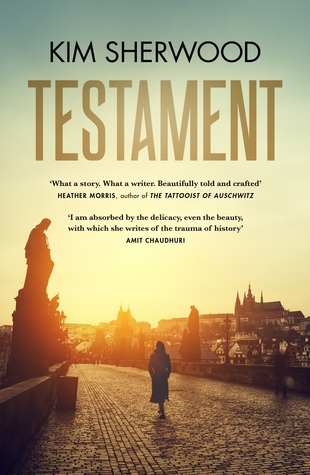 Sherwood alternates between Eva’s quest and a recreation of József’s time in wartorn Europe. Cleverly, she renders the past sections more immediate by writing them in the present tense, whereas Eva’s first-person narrative is in the past tense. Although József escaped the worst of the Holocaust by being sentenced to forced labor instead of going to a concentration camp, his brother László and their friend Zuzka were in Theresienstadt, so readers get a more complete picture of the Jewish experience at the time. All three wind up in the Lake District after the war, rebuilding their lives and making decisions that will affect future generations.
It’s almost impossible to write anything new about the Holocaust these days, and overfamiliarity was certainly a roadblock for me here. I was especially reminded of Julie Orringer’s The Invisible Bridge, what with its focus on the Hungarian Jewish experience. However, I did appreciate the way Sherwood draws on her family history – her grandmother is a Hungarian Holocaust survivor – to consider how trauma still affects the second and third generation. This certainly doesn’t feel like a debut novel. It’s highly readable, and the emotional power of the story cannot be denied. The Young Writer of the Year Award is great for highlighting books that risk being overlooked: in a year dominated by The Testaments, poor Testament was otherwise likely to sink without notice.
Note: “Testament” is also the title of the poem written by Sherwood’s great-grandfather that she recited at her grandfather’s funeral – just as Eva does in the novel. It opens this Telegraph essay (paywalled, but reprinted in the paperback of Testament) that Sherwood wrote about her family history.
General thoughts and predictions:
Any of these books would be a worthy winner. However, as Raymond Antrobus has already won this year’s £30,000 Rathbones Folio Prize as well as the 2018 Geoffrey Dearmer Award from the Poetry Society, The Perseverance has had sufficient recognition – plus it’s a woman’s turn. Testament is accomplished, and likely to hold the widest appeal, but it strikes me as the safe choice. Salt Slow would be an edgier selection, and feels quite timely and fresh. But Stubborn Archivist has stuck with me since I reviewed it in March. I called it “Knausgaard for the Sally Rooney generation” and wrote that “the last book to have struck me as truly ‘novel’ in the same way was Lincoln in the Bardo.” From a glance at the shadow panel’s reviews thus far, I fear it may prove too divisive for them, though.
Based on my gut instincts and a bit of canny thinking about the shadow panelists and judges, here are my predictions:
Shadow Panel:
- What they will pick: Testament [but they might surprise me and go with Salt Slow or Stubborn Archivist]
- What they should pick: Salt Slow
Official Judging Panel:
- What they will pick: Stubborn Archivist [but they might surprise me and go with Salt Slow]
- What they should pick: Stubborn Archivist
I understand that the shadow panel is meeting today for their in-person deliberations. I wish them luck! Their pick will be announced on the 28th. I’ll be intrigued to see which book they select, and how it compares with the official winner on December 5th.
Have you read anything from this year’s shortlist?
Narcissism for Beginners by Martine McDonagh
Don’t talk like we were stuck in a lift.
Why would I be missing you so violently?
We’re all the hero when directing the scene,
But therapy for liars is a giant ice cream.
(from “Montparnasse” by Elbow)
I broke one of my cardinal reviewing rules—write about the book while it’s still fresh in your mind—and waited two weeks after finishing Martine McDonagh’s Narcissism for Beginners before writing it up. Luckily the Elbow stanza above (Guy Garvey’s lyrics are like poetry, after all) brought back to me some of the themes I want to explore: how you can miss someone you barely know, the way that ties ebb and shift such that your blood kin are strangers and the unrelated become like family, and how a narcissistic personality can use coercion and deception to get his or her way. Plus there’s the ice cream metaphor of the last line, a link to the terrific cover on finished copies of the novel—not on my proof, alas.
 The novel is presented as Sonny Anderson’s extended letter to the mother he doesn’t remember. He’s lived with his guardian, a Brit named Thomas Hardiker, in Redondo Beach, California for 11 years; before that they were in Brazil with Sonny’s father. A month ago, on his twenty-first birthday, Sonny received the astounding news that he’s a millionaire thanks to a trust fund from his late father, Robin Agelaste-Bim, better known as Guru Bim. His mother is Sarah Anderson: once a Scottish housewife, now untraceable. Despite his youth, Sonny has been a meth addict and kicked the habit through NA. This kid’s done a lot of living already, but sets out on a new adventure to learn about his parents from those who knew them. And while he’s in Britain, he’ll squeeze in some tourism related to his favorite movie, Shaun of the Dead.
Starting with Sonny’s plane ride to Heathrow, the book is in the present tense, which makes you feel you’re taking the journey right along with him. Although this isn’t being marketed as young adult fiction, it has the same vibe as some YA quest narratives I’ve read: John Green’s The Fault in Our Stars, both of David Arnold’s books, and Nicola Yoon’s The Sun is Also a Star. Sonny is more bitter and world-weary than those teen protagonists, but you still get the slang and the pop culture references along with the heartfelt emotions.
Sonny’s first visit is to Torquay octogenarian Doris Henry, who was the Agelaste-Bims’ servant and Robin’s wet nurse circa 1970. Next up: London and Ruth Williams, whom Sonny’s mother, then going by Suki, recruited into a LifeForce meditation group. Ruth remembers taking against Guru Bim immediately: “He was faking it to get in with Suki. I understood the attraction, though; those narcissistic types are always charming.” Bim and Suki formed a splinter group, Trembling Leaves and soon announced Suki’s pregnancy, but things went awry and Suki fled to Scotland with her ex-boyfriend, Andrew.
This slightly madcap biographical trip around Britain also takes in Brighton, Scotland and Keswick in the Lake District. At each stop Sonny’s able to fill in more about his past, but it’s the letters Thomas sent along for him that contain the real shockers. It’s an epistolary within an epistolary, really, with Thomas’s series of long, explanatory letters daubing in the details and anchoring Sonny’s sometimes-earnest, sometimes-angry missive to his mother.
I loved tagging along on this kooky hero’s quest. My one small criticism about an otherwise zippy novel is that there is a lot of backstory to absorb, from Sonny’s former drug use onwards. For an American expat, though, it was especially fun to watch Sonny trying to get used to some peculiarities of Britain: “apparently it’s compulsory to eat potato chips and on Brit trains” and “We argue about which floor she lives on. I say second and Ruth says first, until we realise we mean the same thing.”
In a year that opened with a narcissist being installed in the White House and will soon see the publication of a new book about cult leader Jim Jones (The Road to Jonestown by Jeff Guinn, April 11th), McDonagh’s picture of Guru Bim is sure to strike a chord. As Ruth tells Sonny, in Ancient Greek an agelast was someone with no sense of humor; and she accused Bim of being “a manipulative charlatan.”
For Sonny, whose very name places him in relationship to others, coming to grips with who he came from means deciding to live differently and be content with his own piecemeal family, including Thomas, the Great Dudini (their dog), and maybe even a cool old lady like Ruth. You’ll love spending time with them all, and I imagine you’ll get a particular kick out of this if you like Shaun of the Dead. (Whisper it: I’ve never seen it.)
Narcissism for Beginners was published in the UK on March 9th. With thanks to Unbound for the review copy.
My rating: 
Martine McDonagh was an artist manager in the music industry for 30 years and now leads the Creative Writing & Publishing MA at West Dean College, Sussex. This is her third novel, following I Have Waited, and You Have Come and After Phoenix.
Reviews Roundup, May–June
One of my goals with this blog is to have one convenient place where I can gather together all my writing that has appeared in disparate online locations. To that end, once a month – or maybe more often – I’ll provide links to all the book reviews I’ve published elsewhere, with a rating and a short taster so you can decide whether to click to read more. (A couple of exceptions: I won’t point out my Kirkus Indie or BlueInk reviews since I don’t get a byline.)
BookBrowse
Girl at War by Sara Nović [subscription service; excerpt available to non-subscribers]: This pitch-perfect debut novel is an inside look at the Yugoslavian Civil War and its aftermath, from the perspective of a young girl caught up in the fighting. The careful structure is what keeps it from becoming just another ordinary, chronological war story. The recreation of a child’s perspective on the horrors of war is stunning. In fact, I can barely think of a negative thing to say about this concise novel. It strikes a perfect balance between past and present, tragic and hopeful.

 Church of Marvels by Leslie Parry [subscription service; excerpt available to non-subscribers]: With settings ranging from a Coney Island theater to an opium den and a mental asylum, this is a gritty look at late-nineteenth-century outsiders. Circus and sideshow themes have been very popular in fiction in recent years, and this is a great example of a novel that uses those elements as background but goes beyond the incidentals of the carnival lifestyle to examine sexuality and societal outcasts. A very atmospheric and accomplished debut novel.

The Bookbag
Secrets of the Pomegranate by Barbara Lamplugh (& interview): In the aftermath of the 2004 Madrid train bombings, the secrets harbored by two English sisters, one of them settled in Granada, will come out into the open and affect the entire family. Lamplugh does a great job of unveiling a little at a time – but still maintaining tension until the surprise of the final revelation. The novel shifts easily between the central narrative and Deb’s diary entries, and between Alice’s and Mark’s perspectives. A strong debut novel.
An Account of the Decline of the Great Auk, According to One Who Saw It by Jessie Greengrass: An unusual mixture of historical, contemporary and dystopian short stories. A number of the first-person narratives feel like vague interior monologues, though there are some universal sentiments. When Greengrass picks one genre (but which will it be?) and sticks with it for the length of a whole book, she should have the time and space for the deep characterizations I thought were missing here. (But you can’t beat this book’s title, can you?)

 From the Mixed-Up Files of Mrs. Basil E. Frankweiler by E.L. Konigsburg: This was one of the key books of my American childhood. All these years later, phrases were still familiar to me, such as Jamie’s frequent exclamation of “Oh, boloney!” I clearly remembered the delicious overall sense of adventure and secrecy. Konigsburg captures school group chatter and brother/sister banter perfectly. The museum and archive settings are a great way to get children interested in art, history and library research. This was the original Night at the Museum before that franchise was ever dreamed up.
The Hunt for the Golden Mole by Richard Girling: From Victorian animal collecting to present-day poaching, Girling surveys the contradictory human instincts toward exploitation and preservation of mammals. The book is rather scattered, with too little about the actual quest for the mole, but the message about species extinction is powerful. (The Somali golden mole has never been seen in the wild, except as a few bones in an owl pellet found by an Italian zoologist in 1964. For some reason, it captured Girling’s imagination, becoming a symbol of rarity and fragility.)

Nudge
Road Ends by Mary Lawson: Contrasting rural Canada and London in the 1960s, Lawson’s third novel is a powerful story about how people deal with a way of life ending. She creates a perfect balance between her two plot strands, and the evocation of both locations is flawless, perhaps because they have autobiographical worth for her – she grew up on a farm in Ontario but moved to England in 1968. One remarkable thing about the novel is how she traces every decision back to a traumatic event in a character’s past.
 The Wolf Border by Sarah Hall: Rachel Caine has run Idaho’s Chief Joseph wolf preserve for nearly a decade, but her roots are in England’s Lake District. Her two worlds unexpectedly collide when an earl asks for her help reintroducing wolves near the Scottish border. Alongside the story of the wolves’ release runs Rachel’s decision to become a mother. The twin plot strands – one environmental and the other personal – ask what can be salvaged from the past.
Italian Ways by Tim Parks: Parks, an Englishman, has lived and worked in northern Italy for over 30 years. To start with he saw his train travel as an everyday source of woes about ticket queues, late running, officious staff, and so on, but as years passed he decided to interrogate Italy’s rail system as a metaphor for the country itself. He structures this book around seven train journeys. It’s better suited to train spotters than to armchair travelers: there is quite a lot about train schedules and not enough about the countryside itself.
 Landmarks by Robert Macfarlane: This new classic of nature writing zeroes in on the language we use to talk about our environment, both individual words – which Macfarlane celebrates in nine mini-glossaries alternating with the prose chapters – and the narratives we build around places, via discussions of the work of nature writers he admires. Whether poetic (“heavengravel,” Gerard Manley Hopkins’s term for hailstones), local and folksy (“wonty-tump,” a Herefordshire word for a molehill), or onomatopoeic (on Exmoor, “zwer” is the sound of partridges taking off), his vocabulary words are a treasure trove.
Penelope Fitzgerald: A Life by Hermione Lee: A thorough and sympathetic appreciation of an underrated author, and another marvelously detailed biography from Lee. Fitzgerald is, like Diana Athill, a reassuring examples of an author who did not find success until well into middle age. Although she always guarded literary ambitions, she was not able to pursue her work wholeheartedly until she had reared three children and nursed her hapless husband through his last illness. The approach is largely chronological, though Lee pauses at key moments to investigate the biographical origins of each of Fitzgerald’s books.
Saint Mazie by Jami Attenberg: Mazie Phillips-Gordon, a real ticket-taker at The Venice movie theatre, barely gets a footnote in history. Here we see all sides of this bold, brassy broad through Attenberg’s fragmented, epistolary narrative. The novel intersperses Mazie’s fictional diary entries (1907 to 1939) with excerpts from her unpublished autobiography and interviews with people who knew her. This is historical fiction – but not as we’re accustomed to it. Attenberg shows how fragile and incomplete the documentary record can be. A hard-nosed heroine with a heart of gold, Mazie will leave her mark on you.
 A Buzz in the Meadow by Dave Goulson: As Goulson did in his book about bees, A Sting in the Tale, he treats readers like friends he is taking on a gentle tour to have everyday encounters with nature. The low-key, humorous anecdotes are reminiscent of the writings of Gerald Durrell, but – like Durrell – Goulson has a serious environmental agenda. Some of the most amusing chapters are about the sexual habits of insects and plants. This is less focused than his previous book, though, and repeats some of the material. The main draw, as always, is Goulson’s infectious enthusiasm and excellent explanations of science.
We Love This Book
War of the Encyclopaedists by Christopher Robinson and Gavin Kovite: In this postmodern satire, two Seattle hipsters must face reality when one of them leaves to fight in the Iraq War. From now on they keep in touch by updating their pretentious Wikipedia article. While Hal applies literary criticism to Star Wars and tries to make amends to his ex-girlfriend, Mickey is in life-and-death situations, looking for car bombs and overseeing local elections. Robinson and Kovite (an Iraq War veteran) alternate their settings in a fairly seamless whole.
The Edible Atlas by Mina Holland: Food lovers and armchair travelers alike will savor this tour through the world’s regional cuisines and trademark dishes. In her first book, the editor of the Guardian’s Cook supplement introduces 39 cuisines with larder lists, a rundown of crucial flavors, and one to four recipes. Maps show which spices and chilies are used in different areas, while sidebars present key ingredients. The book strives for a balance of common imports and unknown dishes, prioritizing authenticity and reproducibility at home.
 Hollow Heart by Viola di Grado: Twenty-five-year-old Dorotea Giglio slit her wrists in the bathtub in July 2011 and expired in “a grim mojito of mint bubble bath and blood.” Over the next four years she chronicles her physical decomposition as well as her spirit’s enduring search for love. In alternately clinical and whimsical language, with fresh metaphors that have survived translation from Italian admirably, di Grado’s second novel examines the secret sadness passed down through families.
Foreword Reviews
Auschwitz #34207: The Joe Rubinstein Story by Nancy Sprowell Geise: This eye-opening account of a Polish Jew’s life before, during, and after Auschwitz deposits readers right into concentration camp horrors. Instead of presenting this as a third-person biography, Geise writes as Rubinstein, using extensive interviews and documentary research to recreate his perspective. While the story is necessarily a bit less dramatic after the chapters on the Holocaust, the fact that Rubinstein survived and later became a successful shoe designer in New York is inspiring.
The Contaminants by Devin K. Smyth: Two teens aboard a spacecraft hold out hope for new life on post-apocalyptic Earth in this believable YA science fiction novel. Composed of two solid first-person narratives and based around two father-child relationships, this is a novel that prizes emotions as much as it does technology. The novel is on the thin side; it could have done with another subplot or two to add some complexity. However, the subtle eugenics theme will give teen readers plenty to think about while they follow the fast-paced story.
 The Loneliness Cure by Kory Floyd: A professor of communication tackles the loneliness epidemic with stories and science. Floyd explains the problems associated with chronic affection deprivation and suggests practical strategies for getting more of the human contact we naturally crave. Two-thirds of the text goes to preliminaries, but the subtitle’s six strategies are worth waiting for. Like the best self-help books, this convinces readers that “it pays to reach out for help when you need it” and gives the confidence and tactics to do so.
BookTrib
In this article I give a more in-depth preview of Circling the Sun by Paula McLain, her fictionalized biography of Beryl Markham.
I also post reviews of most of my casual reading and skimming on Goodreads.
Insomnia by Linda Pastan: Excellent free verse poems infused with images of weather, heavenly bodies, the night sky, art history, and travels. No rhymes to speak of, but plenty of alliteration and repetition – like in “Necklace,” where nearly every line ends with “pearl” or “pearls.” Historical and mythological references are frequent and highbrow. Especially in Part 3, the main theme is facing old age and illness. Linda Pastan has been writing poetry for nearly half a century; I’ll be sure to seek out more of her collections. Releases October 26th.
The Kindness by Polly Samson: This very subtle novel reminds me of works by Tessa Hadley and Lucy Caldwell. It takes one seemingly perfect couple – Julia and Julian – and parses out what went wrong between them and the aftermath. The book is so elegantly structured; characters drift in and out of flashbacks with none of the customary warnings. Instead Samson leaves it to readers to piece together the jigsaw puzzle of how they met and raised their daughter, Mira, and then how everything fell apart.
 The Versions of Us by Laura Barnett: In this impressive debut, Barnett chronicles the romantic lives of two Cambridge graduates through three-quarters of a century, giving three options for how their connection might play out. She juggles her storylines and moves through decades with ease. Less mawkish than One Day; less gimmicky than Life After Life – though there are shades of both. The message seems to be: there is no one perfect person, no one perfect story. Unsentimental this may be, but it feels true to how life works. (My full review will appear in the July 2015 issue of Third Way magazine.)
Eating Appalachia: Rediscovering Regional American Flavors by Darrin Nordahl: Nordahl travels through Ohio, West Virginia, Kentucky and North Carolina in search of truly indigenous local ingredients. He highlights ramsons, pawpaw, elk (leaner and richer than beef), squirrel, hickory nuts and black walnuts, sumac, spicebush berry, sassafras, and persimmons. There are a few recipes and photographs in each chapter, although this is more of a narrative than a cookbook. I loved how he brought it all together with an imagined Appalachian Thanksgiving feast.
Eating Rome: Living the Good Life in the Eternal City by Elizabeth Minchilli: Minchilli’s parents moved the family from America to Rome when she was 12. Over the years she kept going back to Italy: to Florence as a graduate student, and then to stay when she married Domenico. Here, through recipes and personal stories, she shares her enthusiasm for Italian food and for Rome in particular. She finishes each chapter with a list of favorite eateries, so this is a practical guide anyone would benefit from taking along on a trip to Rome.
Some Churches by Tasha Cotter: I loved the first two poems but felt a number of the rest were lacking in artistry. Almost all are written in complete sentences, some in paragraph blocks, and alliteration isn’t always enough to differentiate them from prose. Favorite lines (from “Blood Orange”): “People think that either the red or the orange should go, because to blend the two / alienates some readers. / … I, too, am having an identity crisis, / just like the blood orange. Now that we’ve peeled back / the artifice, you’re inviting me in anyway”.
South Toward Home: Travels in Southern Literature by Margaret Eby: This tour through Southern literature is a great introduction for someone whose familiarity with Southern authors is minimal. Starting off in her home state of Mississippi, Eby travels through Georgia, Alabama, Louisiana, and back to Mississippi in a roughly circular road trip. My favorite chapter was on Flannery O’Connor, but I was also interested to learn about Harry Crews, who I’d never heard of before – it certainly sounds like he was a character. Releases September 8th.
 Post-Traumatic Church Syndrome: A Memoir of Humor and Healing by Reba Riley: I could relate to much of Riley’s story. She was a Pentecostal-leaning fundamentalist through high school, but now even setting foot in a church made her feel nauseous. Yet she retained a strong spiritual compass that helped her tap into the energy of the “Godiverse.” Aged 29, Riley had the idea of experiencing 30 different religious traditions before 30. She writes in a chatty, girlfriend-to-girlfriend style, as if you’ve joined her book club for a glass of pinot grigio.
 Bookish Beck = Rebecca Foster. American transplant to England. Freelance proofreader and book reviewer.
 Bookish Beck