Literary Wives Club: Mrs. Bridge by Evan S. Connell (1959)
This is the best thing we’ve read in my time with the Literary Wives online book club (out of 16 books so far). In the early pages it reminded me of Richard Yates’s work, but by the end I was thinking of it as on par with Stoner by John Williams, a masterpiece I reread last year. Is Mrs. Bridge a female Stoner? In that she is an Everywoman, representative of a certain comfortable, conventional interwar life but also of common longings to be purposeful, experience novelty, and connect with others – I’d say yes. From the first line onwards, we see her as at odds with the facts of her life, which at least appear to her to be unalterable: “Her first name was India – she was never able to get used to it.” She’s never lived up to her exotic name, she feels; her parents must have expected something of her that she couldn’t be.
Connell (1924–2013) sets this portrait of a marriage in his native Kansas City, Missouri. The story is not contemporaneous to its publication but begins in the 1930s; this doesn’t become clear until two-thirds of the way through when, on a European tour that workaholic lawyer Walter Bridge arranged as a belated birthday gift to his wife, news comes that the Nazis have invaded Poland and they have to hurry home. Bear in mind that this is the man who refused to move when a tornado threatened their country club and every single other person had moved to the basement. He insisted on staying at the table and finishing his steak. (So … he expects the weather to bow to his will, if not world leaders?) It’s an astonishing scene, and occasions an astute summation of their relationship dynamic:
It did not occur to Mrs Bridge to leave her husband and run to the basement. She had been brought up to believe without question that when a woman married she was married for the rest of her life and was meant to remain with her husband wherever he was, and under all circumstances, unless he directed her otherwise. She wished he would not be so obstinate; she wished he would behave like everyone else, but she was not particularly frightened. For nearly a quarter of a century she had done as he told her, and what he had said would happen had indeed come to pass, and what he had said would not occur had not occurred. Why, then, should she not believe him now?
(That attitude of blind faith seems more appropriate in a father–daughter or God–mortal relationship than husband–wife, does it not?)
The structure of the book must have been groundbreaking for its time: it’s in 117 short, titled vignettes – a fragmentary style later popularized by writers such as Elizabeth Hardwick, Sarah Manguso and Jenny Offill – that build a picture of the protagonist and her milieu. Even though many of them seem to concern minor incidents from the Bridges’ social life (parties, gossip, the bores they’re forced to have lunch with every time they’re in town), they also reveal a lot about India’s outlook. She wears stockings even on the hottest summer days because “it was the way things were, it was the way things had always been, and so she complied.” Like many of her time and place, she is a casual racist, evidenced by comments on her children’s Black and “gypsy” friends. It pains her that she doesn’t understand her three children. To her it seems they do strange, shocking things (okay, Douglas building a tower of junk is pretty weird) when really they’re just experimenting with fashion and sexuality as any teenager would.
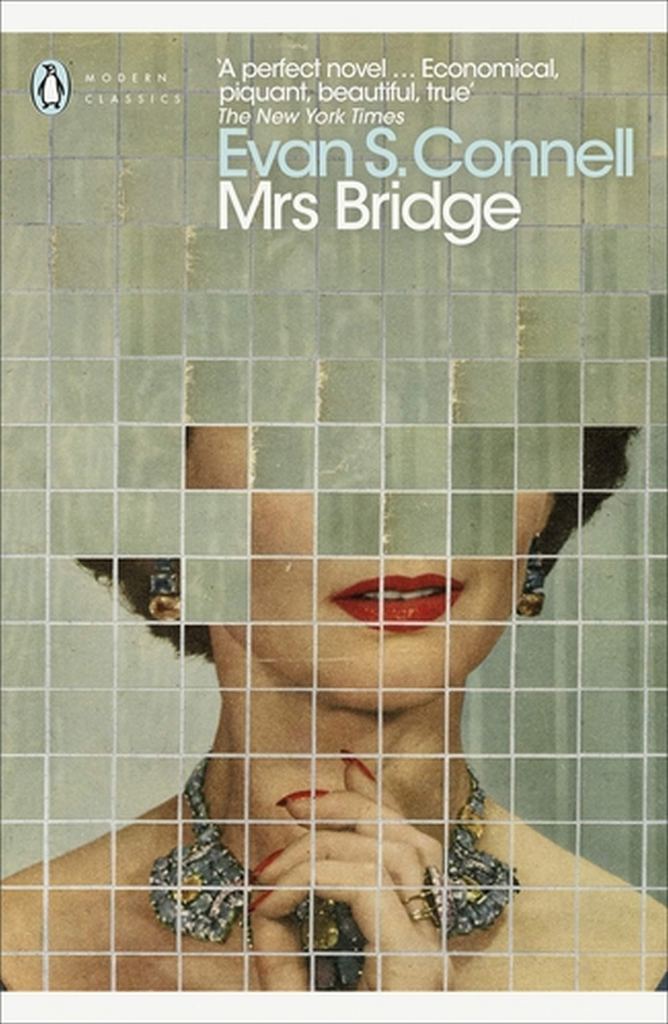
India is in awe of the women of her acquaintance who step out of line, like Grace Barron and Mabel Ong. Grace, in particular, is well informed and confident arguing with men. India seriously considers breaking away from Walter and voting liberal at the next election, but loses her nerve at the last minute; her viewpoint is fundamentally conservative. The novel justifies this by showing how those who flout social rules are shamed or punished in some way.
Mostly, India feels pointless. With a housekeeper around, there’s nothing for her to do. She has nothing but leisure time she doesn’t know how to fill. And yet the years fly past, propelling her into middle age. Occasionally, she’ll summon the motivation to sign up for painting classes or start learning Spanish via records, but she never follows through. So it’s just unnecessary shopping trips in a massive Lincoln she never figures out how to park properly.
She spent a great deal of time staring into space, oppressed by the sense that she was waiting. But waiting for what? She did not know. Surely someone would call, someone must be needing her. Yet each day proceeded like the one before. … Time did not move. The home, the city, the nation, and life itself were eternal; still she had a foreboding that one day, without warning and without pity, all the dear, important things would be destroyed.
It may be fashionable to scorn the existential despair of the privileged, but this is a potent picture of a universal condition. It’s all too easy to get stuck in the status quo and feel helpless to change life for the better. I came across a Slightly Foxed article (Spring 2016) by William Palmer, “The Sadness of Mrs Bridge.” Palmer suggests that Connell was an oddity to his publishers because he wrote in so many genres, and never the same kind of book twice. He dubs this Connell’s finest work. I marked out a couple of passages from his appreciation:
The genius of Connell is to show that this is how most people live: first in their own minds, then in their families, then in their limited social circles; most historical novels fail to realize that most people simply do not notice whatever great moments of history are being enacted around them unless they actually impinge upon their lives.
What is truly compelling about Mrs Bridge is her very ordinariness, notwithstanding all her petty snobbery, conformism and timidity. The list is easy to make and appears to be a fairly damning indictment, but Connell is not writing a satirical portrait. His intention is to show us the utter uniqueness of this one human life, irreplaceability of body and soul that is India Bridge. Connell portrays her so tenderly that we come to sympathize with her and, more, to care for her.
{SOME SPOILERS IN THE REMAINDER}
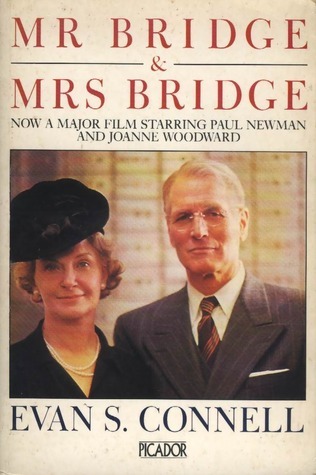
The way Mrs. Bridge ends indicates that Mr. Bridge, which was published 10 years later, will be not a sequel but a companion piece. I’m somewhat wary of reading it, but it will be intriguing to see how events overlap and to what extent Connell is able to make Walter a more sympathetic character. (Palmer remarks, “It is terrifying how little the two portraits have in common – they might be describing two entirely different worlds.”) Connell’s work remains influential: Claire Fuller has featured the pair of novels in one of her year-end reading roundups, and the husband’s surname in Manguso’s Liars is Bridges.
I’ve written much more than I intended to about Mrs. Bridge, but wanted to do justice to what will no doubt be one of my stand-out reads of the year.
(My omnibus edition came from the free bookshop we used to have in the local mall.) 
The main question we ask about the books we read for Literary Wives is:
What does this book say about wives or about the experience of being a wife?
Based on Mrs. Bridge’s experience, one would be excused for thinking that being a wife involves the complete suppression of one’s own personality, ambitions and desires – including sexual, as dealt with very succinctly in the first chapter: Walter usually initiates; the one time she tries to do so, he gives her a patronizing hug and falls asleep. “This was the night Mrs Bridge concluded that while marriage might be an equitable affair, love itself was not.” A wry statement from Connell as marriage is certainly not equitable in this novel.
Granted, this was the 1910s–1930s. By the 1940s, when her daughters are young women, they’re determined to live differently, the one by becoming a New York City career girl, single and promiscuous. The other also vows to do things differently – “Listen, Mother, no man is ever going to push me around the way Daddy pushes you around” – yet ends up pregnant and battered. When India tries to encourage her to placate her husband through sex, she replies, “Oh no, don’t tell me that! I don’t want any part of that myth.”
So we see attitudes starting to change, but it would be another couple of decades before there were more options for both of these generations of women.
A common observation in many of the novels we’ve considered is that, even in a marriage, it is possible for the partners to be a complete mystery to each other. I’ll be interested to see whether Walter’s side of the story illuminates anything or portrays him as clueless. And a main moral I draw from most of our reads is that defining oneself by any relationship – mostly marriage, but also parenthood – sets one up for disappointment, or worse.
See the reviews by Becky, Kate, Kay and Naomi, too!
We recently welcomed a new member, Marianne, and will soon be choosing our books for the next two-plus years. Here’s the club page on Kay’s blog with the current members’ profiles plus all the books covered since 2013.
Our next selection will be Interpreter of Maladies by Jhumpa Lahiri in June. I’ve not read Lahiri before but have always meant to, so I’m particularly looking forward to this one.
Literary Wives Club: The Soul of Kindness by Elizabeth Taylor (1964)
(With apologies for today’s multiple posts!)
 This was my fifth time reading Elizabeth Taylor. It’s a later novel of hers: the ninth of 12. As per usual, there’s an ensemble cast, but this time I had some trouble keeping the characters straight and finding enough sympathy for all of them. There are a dozen main players if you count housekeepers and neighbours. The opening scene is Flora’s wedding to Richard. She’s the title character: beautiful and well-meaning yet sometimes thoughtless. As she grows into the roles of wife and mother, Flora believes everyone should follow her into marriage.
Although as good as gold, she had inconvenient plans for other people’s pleasure, and ideas differing from her own she was unable to imagine.
Her interfering can be comical – she doesn’t realize Patrick is homosexual, so her attempt to match-make between him and her friend Meg is futile.
If she could get Meg settled, Flora had decided, she herself would be quite happy, but her friend thought she went about it in strange ways and wondered what, if anything, Flora knew about people.
When she convinces her father-in-law, Percy, to marry his mistress, Barbara, it’s the wrong thing for them. (“I think we are very well as we are, Percy,” Ba had said.) By ignoring Meg’s little brother Kit’s crush on her and encouraging his hopeless dream of acting, Flora nearly precipitates a tragedy – and Kit’s lover decides to let her know about her misstep.
I got hints of Emma so was pleased to see that comparison made in Philip Hensher’s introduction, in which he considers The Soul of Kindness in the context of the English “novel of community.” Flora herself somewhat fades into the background as we spend time rotating through the other characters in pairs. I found Flora silly and stubborn but not deserving of others’ ire. I felt most for Richard and for her mother, Mrs Secretan, both of whom she unfairly underestimates and sidelines.
This wasn’t one of my favourite Taylors – those are Mrs. Palfrey at the Claremont, which I’ve read twice, and In a Summer Season – but she always writes with grace and psychological acuity. Here I loved a description of the fog – “It’s disorganising, like snow. It makes a different world” – and the fact that the book starts and ends with throwing crumbs to birds. Flora’s pet doves must be a symbol of something: the peace she tries to keep but unwittingly disturbs? In any case, the next time you find a book a slog, here’s her diplomatic strategy for talking about it:
she said that she was taking the books in tiny sips, à petites doses, as Henry James wrote when he was up to the same trick – as if it were the most precious wine. That meant that she was bogged down in it.
(Secondhand – Community Furniture Project, Newbury?)
The main question we ask about the books we read for Literary Wives is:
What does this book say about wives or about the experience of being a wife?
Marriage is not a solution to a problem. (Especially if that problem is loneliness.) Some people aren’t the marrying kind, for whatever reason. Being a spouse can be one aspect of a person’s identity, but it’s dangerous when it becomes defining – this is probably the single common moral I’d draw from all that we’ve read for the club.
See Becky’s, Kate’s and Kay’s reviews, too! (Naomi is taking a break.)
Coming up next, in March: Mrs. Bridge by Evan S. Connell.
Literary Wives Club: Novel About My Wife by Emily Perkins (2008)
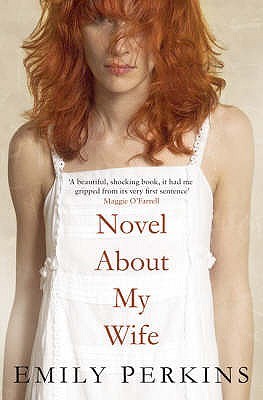 Although Emily Perkins was a new name to me, the New Zealand author has published five novels and a short story collection. Unfortunately, I never engaged with her London-set Novel About My Wife. On the one hand, it must have been an intriguing challenge for Perkins to inhabit a man’s perspective and examine how a widower might recreate his marriage and his late wife’s mental state. “I can’t speak for Ann[,] obviously, only about her,” screenwriter Tom Stone admits. On the other hand, Tom is so egotistical and self-absorbed that his portrait of Ann is more obfuscating than illuminating.
“If I could build her again using words, I would,” he opens, but that promising start just leads into paragraphs of physical description. Bare facts, such as that Ann was from Sydney and created radiation masks for cancer patients in a hospital, are hardly revealing. We mostly know Ann through her delusions. In her late thirties, when she was three months pregnant with their son Arlo, she was caught in an underground train derailment. Thereafter, she increasingly fell victim to paranoia, believing that she was being stalked and that their house was infested. We’re invited to speculate that pregnancy exacerbated her mental health issues and that postpartum psychosis may have had something to do with her death.
I mostly skimmed the novel, so I may have missed some plot points, but what stood out to me were Tom’s unpleasant depictions of women and complaints about his faltering career. (He’s envious of a new acquaintance, Simon, who’s back and forth to Hollywood all the time for successful screenwriting projects.) Interspersed are seemingly pointless excerpts from Tom’s screenplay about a trip he and Ann took to Fiji. I longed for the balance of another perspective. This had a bit of the flavour of early Maggie O’Farrell, but none of the warmth. (Secondhand – Awesomebooks.com) 
The main question we ask about the books we read for Literary Wives is:
What does this book say about wives or about the experience of being a wife?
Being generous to Perkins, perhaps the very point she was trying to make is that it’s impossible to get outside of one’s own perspective and understand what’s going on with a spouse, especially one who has mental health struggles. Had Tom been more attentive and supportive, might things have ended differently?
See Becky’s, Kate’s and Kay’s reviews, too! (Naomi is on a break this month.)
Coming up next, in December: The Soul of Kindness by Elizabeth Taylor.
Literary Wives Club: The Constant Wife by W. Somerset Maugham (1927)
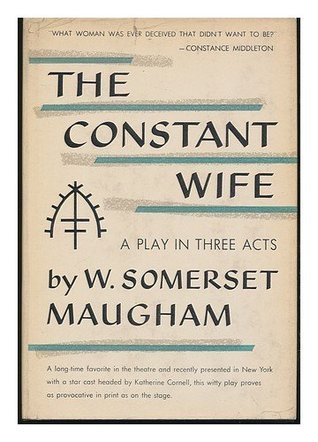
As far as I know, this is the first play we’ve chosen for the club. While I’m a Maugham fan, I haven’t read him in a while and I’ve never explored his work for the theatre. The Constant Wife is a straightforward three-act play with one setting: a large parlour in the Middletons’ home in Harley Street, London. A true drawing room comedy, then, with very simple staging.
{SPOILERS IN THE REMAINDER}
Rumours are circulating that surgeon John Middleton has been having an affair with his wife Constance’s best friend, Marie-Louise. It’s news to Mrs. Culver and Martha, Constance’s mother and sister – but not to Constance herself. Mrs. Culver, the traditional voice of a previous generation, opines that men are wont to stray and so long as the wife doesn’t find out, what harm can it do? Women, on the other hand, are “naturally faithful creatures and we’re faithful because we have no particular inclination to be anything else,” she says.
Other characters enter in twos and threes for gossip and repartee and the occasional confrontation. Marie-Louise’s husband, Mortimer Durham, shows up fuming because he’s found John’s cigarette-case under her pillow and assumes it can only mean one thing. Constance is in the odd position of defending her husband’s and best friend’s honour, even though she knows full well that they’re guilty. With her white lies, she does them the kindness of keeping their indiscretion quiet – and gives herself the moral upper hand.
Constance is matter of fact about the fading of romance. She is grateful to have had a blissful first five years of marriage; how convenient that both she and John then fell out of love with each other at the same time. The decade since has been about practicalities. Thanks to John, she has a home, respectability, and fine belongings (also a child, only mentioned in passing); why give all that up? She’s still fond of John, anyway, and his infidelity has only bruised her vanity. However, she wants more from life, and a sheepish John is inclined to give her whatever she asks. So she agrees to join an acquaintance’s interior decorating business.
The early reappearance of her old flame Bernard Kersal, who is clearly still smitten with her, seeds her even more daring decision in the final act, set one year after the main events. Having earned £1400 of her own money, she has more than enough to cover a six-week holiday in Italy. She announces to John that she’s deposited the remainder in his account “for my year’s keep,” and slyly adds that she’ll be travelling with Bernard. This part turns out to be a bluff, but it’s her way of testing their new balance of power. “I’m not dependent on John. I’m economically independent, and therefore I claim my sexual independence,” she declares in her mother’s company.
There are some very funny moments in the play, such as when Constance tells her mother she’ll place a handkerchief on the piano as a secret sign during a conversation. Her mother then forgets what it signifies and Constance ends up pulling three hankies in a row from her handbag. I had to laugh at Mrs. Culver’s test for knowing whether you’re in love with someone: “Could you use his toothbrush?” It’s also amusing that Constance ends up being the one to break up with John for Marie-Louise, and with Marie-Louise for John.
However, there are also hidden depths of feeling meant to be brought out by the actors. At least three times in scenes between John and Constance, I noted the stage direction “Breaking down” in parentheses. The audience, therefore, is sometimes privy to the emotion that these characters can’t express to each other because of their sardonic wit and stiff upper lips.
I hardly ever experience plays, so this was interesting for a change. At only 70-some pages, it’s a quick read even if a bit old-fashioned or tedious in places. It does seem ahead of its time in questioning just what being true to a spouse might mean. A clever and iconoclastic comedy of manners, it’s a pleasant waystation between Oscar Wilde and Alan Ayckbourn.
(Free download from Internet Archive – is this legit or a copyright scam??) 
The main question we ask about the books we read for Literary Wives is:
What does this book say about wives or about the experience of being a wife?
Answered by means of quotes from Constance.
- Partnership is important, yes, but so is independence. (Money matters often crop up in the books we read for the club.)
“there is only one freedom that is really important, and that is economic freedom”
- Marriage often outlasts the initial spark of lust, and can survive one or both partners’ sexual peccadilloes. (Maugham, of course, was a closeted homosexual married to a woman.)
“I am tired of being the modern wife.” When her mother asks for clarification, she adds rather bluntly, “A prostitute who doesn’t deliver the goods.”
“I may be unfaithful, but I am constant. I always think that’s my most endearing quality.”
We have a new member joining us this month: Becky, from Australia, who blogs at Aidanvale. Welcome! Here’s the group’s page on Kay’s website.
See Becky’s, Kate’s, Kay’s and Naomi’s reviews, too!
Coming up next, in September: Novel about My Wife by Emily Perkins
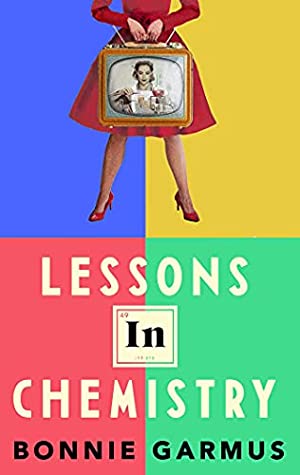
Literary Wives Club: Lessons in Chemistry by Bonnie Garmus (2022)
Like pretty much every other woman over 30 on the planet, I read Lessons in Chemistry when it first came out. I was happy for my book club to select it for a later month when I was away; it made a decent selection but I had no need to revisit it, then or now. I think it still holds the record for the longest reservation queue in my library system. I enjoyed this feel-good feminist story well enough but found certain elements hokey, such as Six-Thirty the dog’s preternatural intelligence and Elizabeth Zott’s neurodivergent-like bluntness and lack of sentimentality.
My original review: Elizabeth Zott is a scientist through and through, applying a chemist’s mindset to her every venture, including cooking, rowing and single motherhood in the 1950s. When she is fired from her job in a chemistry lab and gets a gig as a TV cooking show host instead, she sees it as her mission to treat housewives as men’s intellectual equals, but there are plenty of people who don’t care for her unusual methods and free thinking. I was reminded strongly of The Atomic Weight of Love and The Rosie Project, as well as novels by Katherine Heiny and especially John Irving with the deep dive into backstory and particular pet subjects, and the orphan history for Zott’s love interest. This was an enjoyable tragicomedy. You have to cheer for the triumphs she and other female characters win against the system of the time. However, the very precocious child (and dog) stretch belief, and the ending was too pat for me. (Public library)
The main question we ask about the books we read for Literary Wives is:
What does this book say about wives or about the experience of being a wife?
Elizabeth is deeply in love with Calvin Evans yet refuses to be his wife. She spurns marriage because she correctly intuits that it will limit her prospects, this being the 1960s. “I’m going to be a scientist. Successful women scientists don’t marry,” she tells her mother. Forasmuch as she assumes her television audience to be traditional housewives, she rejects their situation for herself. A single mother, a minor celebrity, a scientific researcher: none of these roles would be compatible with marriage. (Though there’s another ultimate reason why she stays unmarried.)
A supporting character, her neighbour Harriet, offers a counterpoint or cautionary tale. She’s trapped in a marriage to an odious man she despises. “Because while she was stuck forever being Mrs. Sloane—she was a Catholic—she never wanted to turn into a Mr. Sloane.”
Almost all of the books we read for the club, whether contemporary or historical, present marriage in at least a somewhat negative light, or warn that there are many things that can go wrong…
See Kate’s, Kay’s and Naomi’s reviews, too!
Coming up next, in June: The Constant Wife by W. Somerset Maugham. This is the first play we’ve done and my first Maugham in a while, so I’m looking forward to it.
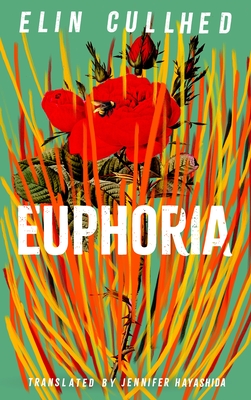
Literary Wives Club: Euphoria by Elin Cullhed (2021)
Swedish author Elin Cullhed won the August Prize and was a finalist for the Strega European Prize with this first novel for adults. Euphoria is a recreation of Sylvia Plath’s state of mind in the last year of her life. It opens on 7 December 1962 in Devon with a list headed “7 REASONS NOT TO DIE,” most of which centre on her children, Frieda and Nick. She enumerates the pleasures of being in a physical body and enjoying coastal scenery. But she also doesn’t want to give her husband, poet Ted Hughes, the satisfaction of having his prophecies about her mental illness come true.
 Flash back to the year before, when Plath is heavily pregnant with Nick during a cold winter and trying to steal moments to devote to writing. She feels gawky and out of place in encounters with the vicar and shopkeeper of their English village. “Who was I, who had let everything become a compromise between Ted’s Celtic chill and my grandiose American bluster?” She and Hughes have an intensely physical bond, but jealousy of each other’s talents and opportunities – as well as his serial adultery and mean and controlling nature – erodes their relationship. The book ends in possibility, with Plath just starting to glimpse success as The Bell Jar readies for publication and a collection of poems advances. Readers are left with that dramatic irony.
Cullhed seems to hew to biographical detail, though I’m not particularly familiar with the Hughes–Plath marriage. Scenes of their interactions with neighbours, Plath’s mother, and Ted’s lover Assia Wevill make their dynamic clear. The prose grows more nonstandard; run-on sentences and all-caps phrases indicate increasing mania. There are also lovely passages that seem apt for a poet: “Ted’s crystalline sly little mint lozenge eyes. Narrow foxish. Thin hard. His eyes, so embittered.” The use of language is effective at revealing Plath’s maternal ambivalence and shaky mental health. Somehow, though, I found this quite tedious by the end. Not among my favourite biographical novels, but surely a must-read for Plath fans. 
Translated from the Swedish by Jennifer Hayashida in 2022 – our first read in translation, I think? And what a brilliant cover.
With thanks to Canongate for the free copy for review.
The main question we ask about the books we read for Literary Wives is:
What does this book say about wives or about the experience of being a wife?
Marriage is claustrophobic here, as in so many of the books we read. Much as she loves her children, Plath finds the whole wifehood–motherhood complex to be oppressive and in direct conflict with her ambitions as an author. Sharing a vocation with her husband, far from helping him understand her, only makes her more bitter that he gets the time and exposure she so longs for. More than 60 years later, Plath’s death still echoes, a tragic loss to literature.
See Kate’s, Kay’s and Naomi’s reviews, too!
Coming up next, in March: Lessons in Chemistry by Bonnie Garmus – I’ve read this before but will plan to skim back through a copy from the library.
Literary Wives Club: Their Eyes Were Watching God by Zora Neale Hurston (1937)
This is one of those classics I’ve been hearing about for decades and somehow never read – until now. Right from the start, I could spot its influence on African American writers such as Toni Morrison. Hurston deftly reproduces the all-Black milieu of Eatonville, Florida, bringing characters to life through folksy speech and tying into a venerable tradition through her lyrical prose. As the novel opens, Janie Crawford, forty years old but still a looker, sets tongues wagging when she returns to town “from burying the dead.” Her friend Pheoby asks what happened and the narrative that unfolds is Janie’s account of her three marriages.
{SPOILERS IN THE REMAINDER!}
- To protect Janie’s reputation and prospects, her grandmother, who grew up in the time of slavery, marries Janie off to an old farmer, Logan Killicks, at age 16. He works her hard and treats her no better than one of his animals.
- She then runs off with handsome, ambitious Joe Starks. [A comprehension question here: was Janie technically a bigamist? I don’t recall there being any explanation of her getting an annulment or divorce.] He opens a general store and becomes the town mayor. Janie is, again, a worker, but also a trophy wife. While the townspeople gather on the porch steps to shoot the breeze, he expects her to stay behind the counter. The few times we hear her converse at length, it’s clear she’s wise and well-spoken, but in the 20 years they are together Joe never allows her to come into her own. He also hits her. “The years took all the fight out of Janie’s face.” When Joe dies of kidney failure, she is freer than before: a widow with plenty of money in the bank.
- Nine months after Joe’s death, Janie is courted by Vergible Woods, known to all as “Tea Cake.” He is about a decade younger than her (Joe was a decade older, but nobody made a big deal out of that), but there is genuine affection and attraction between them. Tea Cake is a lovable scoundrel, not to be trusted around money or other women. They move down to the Everglades and she joins him as an agricultural labourer. The difference between this and being Killicks’ wife is that Janie takes on the work voluntarily, and they are equals there in the field and at home.
In my favourite chapter, a hurricane hits. The title comes from this scene and gives a name to Fate. Things get really melodramatic from this point, though: during their escape from the floodwaters, Tea Cake has to fend off a rabid dog to save Janie. He is bitten and contracts rabies which, untreated, leads to madness. When he comes at Janie with a pistol, she has to shoot him with a rifle. A jury rules it an accidental death and finds Janie not guilty.
I must admit that I quailed at pages full of dialogue – dialect is just hard to read in large chunks. Maybe an audiobook or film would be a better way to experience the story? But in between, Hurston’s exposition really impressed me. It has scriptural, aphoristic weight to it. Get a load of her opening and closing paragraphs:
Ships at a distance have every man’s wish on board. For some they come in with the tide. For others they sail forever on the horizon, never out of sight, never landing until the Watcher turns his eyes away in resignation, his dreams mocked to death by Time. That is the life of men.
Here was peace. [Janie] pulled in her horizon like a great fish-net. Pulled it from around the waist of the world and draped it over her shoulder. So much of life in its meshes! She called in her soul to come and see.
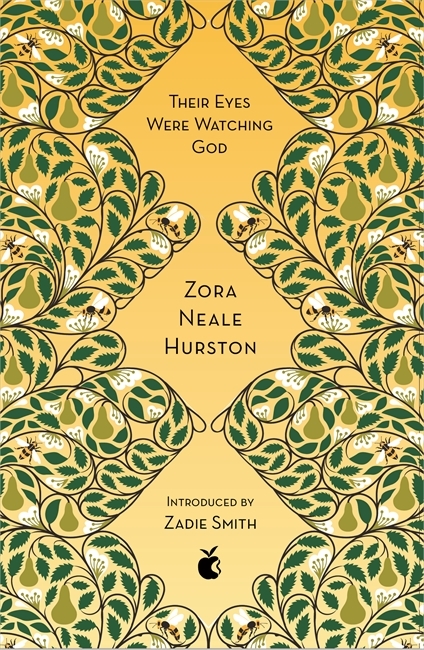
There are also beautiful descriptions of Janie’s state of mind and what she desires versus what she feels she has to settle for. “Janie saw her life like a great tree in leaf with the things suffered, things enjoyed, things done and undone. Dawn and doom was in the branches.” She envisions happiness as sitting under a pear tree; bees buzzing in the blossom above and all the time in the world for contemplation. (It was so pleasing when I realized this is depicted on the Virago Modern Classics cover.)
I was delighted that the question of having babies simply never arises. No one around Janie brings up motherhood, though it must have been expected of her in that time and community. Her first marriage was short and, we can assume, unconsummated; her second gradually became sexless; her third was joyously carnal. However, given that both she and her mother were born of rape, she may have had traumatic associations with pregnancy and taken pains to prevent it. Hurston doesn’t make this explicit, yet grants Janie freedom to take less common paths.
What with the symbolism, the contrasts, the high stakes and the theatrical tragedy, I felt this would be a good book to assign to high school students instead of or in parallel with something by John Steinbeck. I didn’t fall in love with it in the way Zadie Smith relates in her introduction, but I did admire it and was glad to finally experience this classic of African American literature. (Secondhand purchase – Community Furniture Project, Newbury) 
The main question we ask about the books we read for Literary Wives is:
What does this book say about wives or about the experience of being a wife?
- A marriage without love is miserable. Marriage is not a cure for loneliness.
There are years that ask questions and years that answer. Janie had had no chance to know things, so she had to ask. Did marriage end the cosmic loneliness of the unmated? Did marriage compel love like the sun the day?
(These are rhetorical questions, but the answer is NO.)
- Every marriage is different. But it works best when there is equality of labour, status and finances. Marriage can change people.
Pheoby says to Janie when she confesses that she’s thinking about marrying Tea Cake, “you’se takin’ uh awful chance.” Janie replies, “No mo’ than Ah took befo’ and no mo’ than anybody else takes when dey gits married. It always changes folks, and sometimes it brings out dirt and meanness dat even de person didn’t know they had in ’em theyselves.”
Later Janie says, “love ain’t somethin’ lak uh grindstone dat’s de same thing everywhere and do de same thing tuh everything it touch. Love is lak de sea. It’s uh movin’ thing, but still and all, it takes its shape from de shore it meets, and it’s different with every shore.”
This was a perfect book to illustrate the sorts of themes we usually discuss!
See Kate’s, Kay’s and Naomi’s reviews, too!
Coming up next, in December: Euphoria by Elin Cullhed (about Sylvia Plath)
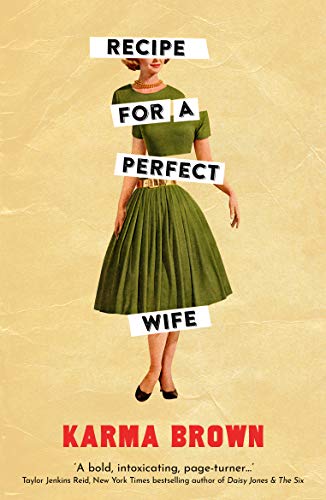
Literary Wives Club: Recipe for a Perfect Wife by Karma Brown (2019)
{SPOILERS IN THIS REVIEW!}
Canadian author Karma Brown’s fifth novel features two female protagonists who lived in the same house in different decades. The dual timeline, which plays out in alternating chapters, contrasts the mid-1950s and late 2010s to ask 1) whether the situation of women has really improved and 2) if marriage is always and inevitably an oppressive force.
Nellie Murdoch loves cooking and gardening – great skills for a mid-twentieth-century housewife – but can’t stay pregnant, which provokes the anger of her abusive husband, Richard. To start with, Alice Hale can’t cook or garden for toffee and isn’t sure she wants a baby at all, but as she reads through Nellie’s unsent letters and recipes, interspersed with Ladies’ Home Journal issues in the boxes in the basement, she starts to not just admire Nellie but emulate her. She’s keeping several things from her husband Nate: she was fired from her publicist job after a pre-#MeToo scandal involving a handsy male author, she’s had an IUD fitted, and she’s made zero progress on the novel she’s supposed to be writing. But Nellie’s correspondence reveals secrets that inspire Alice to compose Recipe for a Perfect Wife.
The chapter epigraphs, mostly from period etiquette and relationship guides for young wives, provide ironic commentary on this pair of not-so-perfect marriages. Brown has us wondering how closely Alice will mirror Nellie’s trajectory (aborting her pregnancy? poisoning her husband?). There were clichéd elements, such as Richard’s adultery, glitzy New York City publishing events, Alice’s quirky-funny friend, and each woman having a kindly elderly (maternal) neighbour who looks out for her and gives her valuable advice. I felt uncomfortable with how Nellie’s mother’s suicide makes it seem like Nellie’s radical acts are borne out of inherited mental illness rather than a determination to make her own path.
Often, I felt Brown was “phoning it in,” if that phrase means anything to you. In other words, playing it safe and taking an easy and previously well-trodden path. Parallel stories like this can be clever, or can seem too simple and coincidental. However, I can affirm that the novel is highly readable and has vintage charm. I always enjoy epistolary inclusions like letters and recipes, and it was intriguing to see how Nellie uses her garden herbs and flowers for pharmaceutical uses. Our first foxglove just came into flower – eek! (Kindle purchase)
The main question we ask about the books we read for Literary Wives is:
What does this book say about wives or about the experience of being a wife?
- Being a wife does not have to mean being a housewife. (It also doesn’t have to mean being a mother, if you don’t want to be one.)
- Secrets can be lethal to a marriage. Even if they aren’t literally so, they’re a really bad idea.
This was, overall, a very bleak picture of marriage. In the 1950s strand there is a scene of marital rape – one of two I’ve read recently, and I find these particularly difficult to take. Alice’s marriage might not have blown up as dramatically, but still doesn’t appear healthy. She forced Nate to choose between her and the baby, and his job promotion in California. The fallout from that ultimatum is not going to make for a happy relationship. I almost thought that Nellie wields more power. However, both women get ahead through deception and manipulation. I think we are meant to cheer for what they achieve, and I did for Nellie’s revenge at Richard’s vileness, but Alice I found brattish and calculating.
See Kate’s, Kay’s and Naomi’s reviews, too!
Coming up next, in September: Their Eyes Were Watching God by Zora Neale Hurston.
Literary Wives Club: Mrs. March by Virginia Feito (2021)
{SPOILERS IN THIS REVIEW!}
What a deliciously odd debut novel, reminiscent of Patricia Highsmith’s work for how it places a neurotic outsider at the heart of an unlikely murder investigation. George March is a popular author whose latest novel stars Johanna, a prostitute so ugly that men feel sorry for her and can’t bear to sleep with her. Meanwhile, the news cycle is consumed with the strangling of a young woman named Sylvia Gibbler in Gentry, Maine, where George goes on hunting trips with his editor. Mrs. March takes two misconceptions – that George modeled Johanna on her, and that he was somehow involved in Sylvia’s death because he kept newspaper clippings about it on his desk – and runs with them, to catastrophic effect.
Mrs. March’s usual milieu is the New York City apartment she shares with George and their son, Jonathan. Martha, the housekeeper, keeps the daily details under control, leaving Mrs. March with little to do. She doesn’t seem very interested in her son, and resents George. Each morning she walks to the bakery to buy olive bread. Every so often she’ll host an extravagant dinner party. But there is plenty of time in between to fill with flashbacks to shameful memories (having an imaginary friend, wetting the bed, her mother’s favoritism towards her sister, being raped in Cádiz) and hallucinations (a dead pigeon in the bathtub, cockroaches scuttling around the apartment). She decides to travel to Maine herself to investigate Sylvia’s death; it’s not what she finds there but what she returns to that changes things forever.

There are so many intriguing factors. One is the nebulous time period: what with Mrs. March’s fur coat and head scarf, the train cars and payphone calls, it could be the 1950s; but then there are more modern references (a washing machine, holiday flights) that made me inclined to point to the 1980s. It couldn’t be the present day unless Feito is deliberately setting the story in an alternative world without much tech. As in Highsmith, we get mistaken identity and disguises. Feito really ramps up the psychological elements, interrogating how trauma, paranoia and extreme body issues may have led to dissociation in her protagonist. Mrs. March is both obsessed with and repulsed by bodily realities. It’s only through other characters’ reactions, though, that we see just how mentally disturbed she is. Worryingly, patterns seem to be repeating with her son, who is suspended for ‘doing something’ to a girl.
I can see how this would be a divisive read: the characters are thoroughly unlikable and it can be difficult to decide what is real and what is not. Incidents I took at face value may well be symbolic, or psychological manifestations of trauma. But I found it morbidly fascinating. I never knew what was going to happen next. (Public library/NetGalley) 
The main question we ask about the books we read for Literary Wives is:
What does this book say about wives or about the experience of being a wife?
In terms of Literary Wives reads, this reminded me most of The Harpy by Megan Hunter because of its eventual focus on adultery and revenge. Notably, until the very last sentence, we only know Mrs. March’s identity through her relationship to her husband. (Her first name is finally revealed to be Agatha, which of course made me think of Agatha Christie and detection, but its meaning is “good” or “honorable” – there was a martyred saint by the name.) What I took from that is that defining oneself primarily through marriage is dangerous because personality and control can be lost. This character was in need of a wider purpose to take her outside of her home and family – though those would always be her refuge to return to. Even setting Mrs. March’s mental problems aside, it is frighteningly easy to indulge in delusions about oneself or one’s spouse, so getting a reality check via communication is key.
See Kay’s and Naomi’s reviews, too!
We’ve recently acquired a new member – welcome to Kate of Books Are My Favourite and Best! – and chosen our books for the next two and a bit years. Anyone is welcome to join us in reading them. Here’s the club page on Kay’s blog, and our schedule through the end of 2026:
June 2024 Recipe for a Perfect Marriage by Karma Brown
Sept. 2024 Their Eyes Were Watching God by Zora Neale Hurston
Dec. 2024 Euphoria by Elin Culhed
March 2025 Lessons in Chemistry by Bonnie Garmus
June 2025 The Constant Wife by W. Somerset Maugham
Sept. 2025 Novel about My Wife by Emily Perkins
Dec. 2025 The Soul of Kindness by Elizabeth Taylor
March 2026 Mrs. Bridge by Evan S. Connell
June 2025 Interpreter of Maladies by Jhumpa Lahiri
Sept. 2026 Family Family by Laurie Frankel
Dec. 2026 The Eden Test by Adam Sternbergh
A Quick Look Back at Hamnet by Maggie O’Farrell for #LiteraryWives
I read Maggie O’Farrell’s Women’s Prize winner, Hamnet, at its release in 2020. Unfortunately, it has been my least favourite of her novels (I’ve read all but My Lover’s Lover now), and it turns out 3.5 years is too soon to reread and appreciate anew. But I had a quick skim back through, this time focusing on the central marriage and the question we ask for the Literary Wives online book club:
What does this book say about wives or about the experience of being a wife?

From my original review: O’Farrell imagines the context of the death of William Shakespeare’s son Hamnet and the effect it had on the playwright’s work – including, four years later, Hamlet. Curiously, she has decided never to mention Shakespeare by name in her novel, so he remains a passive, shadowy figure seen only in relation to his wife and children – he’s referred to as “the father,” “the Latin tutor” or “her husband.” Instead, the key characters are his wife, Agnes (most will know her as Anne, but Agnes was the name her father, Richard Hathaway, used for her in his will), and Hamnet himself.
It is refreshing, especially for the time period, to have the wife’s experience and perspective be primary, and the husband in the background to the extent of being unnamed. Both, however, blame themselves for not being there when 11-year-old Hamnet fell ill with what O’Farrell posits was the Plague. Shakespeare was away in London with his theatre company; Agnes was off tending her bees. Shakespeare is only present in flashbacks – in which he morphs from eager tutor to melancholy drinker – until three-quarters of the way through the novel, when he returns to Stratford, too late. All he can do then is carry his son’s corpse.
I have heard it said many times that few marriages survive the death of a child. And for a while that looks like it will be the case here, too:
Her husband takes her arm as they reach the gate; she turns to look at him and it is as if she has never seen him before, so odd and distorted and old do his features seem. Is it their long separation, is it grief, is it all the tears? she wonders, as she regards him. Who is this person next to her, claiming her arm, holding it to him?
How were they to know that Hamnet was the pin holding them together? That without him they would all fragment and fall apart, like a cup shattered on the floor?
With his earnings, Shakespeare buys the family a new house, but never moves them to London as he once intended. He continues to stay away for long periods at a time, leaving Agnes to her grief. When, four years after Hamnet’s death, Agnes and their daughters learn that he has written a play about a character called Hamlet, they feel betrayed, but Agnes goes to a performance and her anger melts as she recognizes her son. “It is him. It is not him. … grown into a near-man, as he would be now, had he lived, on the stage, walking with her son’s gait, talking in her son’s voice, speaking words written for him by her son’s father.”
Although O’Farrell leaves it there, creating uncertainty about the couple’s future, she implies that the play has been the saving of both of them. For Shakespeare, it was the outlet for his grief. For Agnes, it was the proof she needed that he loved their son, grieved him as bitterly as she did, and still remembers him. That seems to be enough to hold them together.
While her next novel, The Marriage Portrait, which I liked a lot more as historical fiction goes, might seem on the surface better suited for this club, Hamnet was in fact perfect for the prompt, revealing an aspect I don’t recall looking at before: the strain that a child’s illness and death can place on a marriage. At my first reading I found the prose flat and detached, to the point of vagueness, and thought there was anachronistic language and unsubtle insertion of research. This time, I was more aware of how the deliberate evenness softens the emotion, making it more bearable – though, still, I have a friend who gave up reading this partway because she found it too raw.
See also Kay’s and Naomi’s responses!
The next book, for March 2024, will be Mrs. March by Virginia Feito.
 Bookish Beck = Rebecca Foster. American transplant to England. Freelance proofreader and book reviewer.
 Bookish Beck