Three Days in June vs. Three Weeks in July
Two very good 2025 releases that I read from the library. While they could hardly be more different in tone and particulars, I couldn’t resist linking them via their titles.
Three Days in June by Anne Tyler
(From my Most Anticipated list.) A delightful little book that I loved more than I expected to, for several reasons: the effective use of a wedding weekend as a way of examining what goes wrong in marriages and what we choose to live with versus what we can’t forgive; Gail’s first-person narration, a rarity for Tyler* and a decision that adds depth to what might otherwise have been a two-dimensional depiction of a woman whose people skills leave something to be desired; and the unexpected presence of a cat who brings warmth and caprice back into her home. (I read this soon after losing my old cat, and it was comforting to be reminded that cats and their funny ways are the same the world over.)
From Tyler’s oeuvre, this reminded me most of The Amateur Marriage and has a surprise Larry’s Party-esque ending. The discussion of the outmoded practice of tapping one’s watch is a neat tie-in to her recurring theme of the nature of time. And through the lunch out at a chic crab restaurant, she succeeds at making the Baltimore setting essential rather than incidental, more so than in much of her other work.
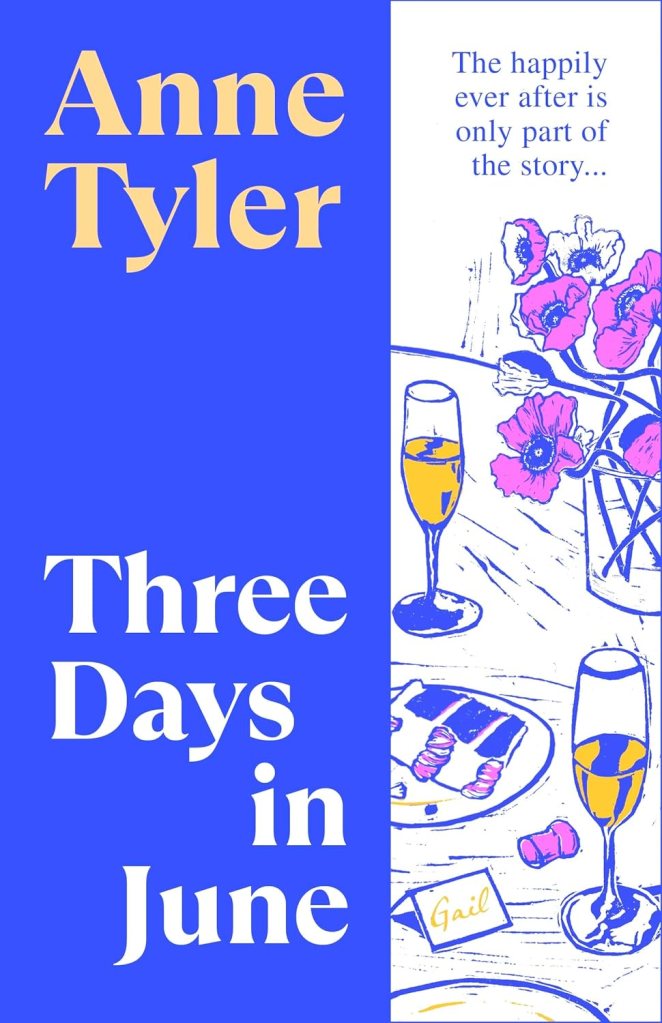
Gail is in the sandwich generation with a daughter just married and an old mother who’s just about independent. I appreciated that she’s 61 and contemplating retirement, but still feels as if she hasn’t a clue: “What was I supposed to do with the rest of my life? I’m too young for this, I thought. Not too old, as you might expect, but too young, too inept, too uninformed. How come there weren’t any grownups around? Why did everyone just assume I knew what I was doing?”
My only misgiving is that Tyler doesn’t quite get it right about the younger generation: women who are in their early thirties in 2023 (so born about 1990) wouldn’t be called Debbie and Bitsy. To some degree, Tyler’s still stuck back in the 1970s, but her observations about married couples and family dynamics are as shrewd as ever. Especially because of the novella length, I can recommend this to readers wanting to try Tyler for the first time. 
*I’ve noted it in Earthly Possessions. Anywhere else?
Three Weeks in July: 7/7, The Aftermath, and the Deadly Manhunt by Adam Wishart and James Nally
July 7th is my wedding anniversary but before that, and ever since, it’s been known as the date of the UK’s worst terrorist attack, a sort of lesser 9/11 – and while reading this I felt the same way that I’ve felt reading books about 9/11: a sort of awed horror. Suicide bombers who were born in the UK but radicalized on trips to Islamic training camps in Pakistan set off explosions on three Underground trains and one London bus. I didn’t think my memories of 7/7 were strong, yet some names were incredibly familiar to me (chiefly Mohammad Sidique Khan, the leader of the attacks; Jean Charles de Menezes, the innocent Brazilian electrician shot dead on a Tube train when confused with a suspect in the 21/7 copycat plot – police were operating under a new shoot-to-kill policy and this was the tragic result).
 Fifty-two people were killed that day, ranging in age from 20 to 60; 20 were not UK citizens, hailing from everywhere from Grenada to Mauritius. But a total of 770 people were injured. I found the authors’ recreation of events very gripping, though do be warned that there is a lot of gruesome medical and forensic detail about fatalities and injuries. They humanize the scale of events and make things personal by focusing on four individuals who were injured, even losing multiple limbs in some cases, but survived and now work in motivational speaking, disability services or survivor advocacy.
What really got to me was thinking about all the hundreds of people who, 20 years on, still live with permanent pain, disability or grief because of the randomness of them or their loved ones getting caught up in a few misguided zealots’ plot. One detail that particularly struck me: with the Tube tunnels closed off at both ends while searchers recovered bodies, the temperature rose to 50 degrees C (122 degrees F), only exacerbating the stench. The book mostly avoids cliches and overwriting, though I did find myself skimming in places. It is based on the research done for a BBC documentary series and synthesizes a lot of material in an engaging way that does justice to the victims. 
Have you read one or both of these?
Could you see yourself picking one of them up?
The 2025 McKitterick Prize Winner & SoA Awards Ceremony
Yesterday the Society of Authors’ awards were announced and the prizes handed out at a ceremony in London. As a McKitterick Prize judge, I was asked last month to give a 50-word blurb on the shortlist as a whole—
Each of these six novels has a fully realized style. So confident and inviting are they that it’s hard to believe they are debuts. With nuanced characters and authentic settings and dilemmas, they engage the mind and delight the emotions. I will be following these authors’ careers with keen interest.
—and on each individual shortlisted title:
 Etymology and Shakespeare studies are the keys to solving a cold case in Susie Dent’s clever, engrossing mystery, Guilty by Definition.
 Psychoanalysis, motherhood, and violence against women are resounding themes in Lauren Elkin’s Scaffolding. As history repeats itself one sweltering Paris summer, the personal and political structures undergirding the protagonists’ parallel lives come into question. This fearless, sophisticated work ponders what to salvage from the past—and what to tear down.
 Clinical Intimacy’s mysterious antihero comes to life through interviews with his family, friends and clients. The brilliant oral history format builds a picture of isolation among vulnerable populations, only alleviated by care and touch—especially during Covid-19. Ewan Gass’s intricate story reminds us of the ultimate unknowability of other people.
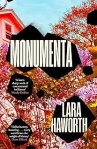
In Monumenta, Lara Haworth braids satire, magic realism, and metafiction into a compact and surprising meditation on how we seek to memorialise the tragedies of history.
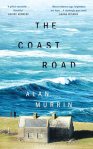
Set in small-town Ireland, The Coast Road is a subtle, compassionate novel in which the characters learn to write their own stories rather than bow to convention and fate. Alan Murrin is a must-read author for fans of Claire Keegan, Louise Kennedy, and Colm Tóibín.
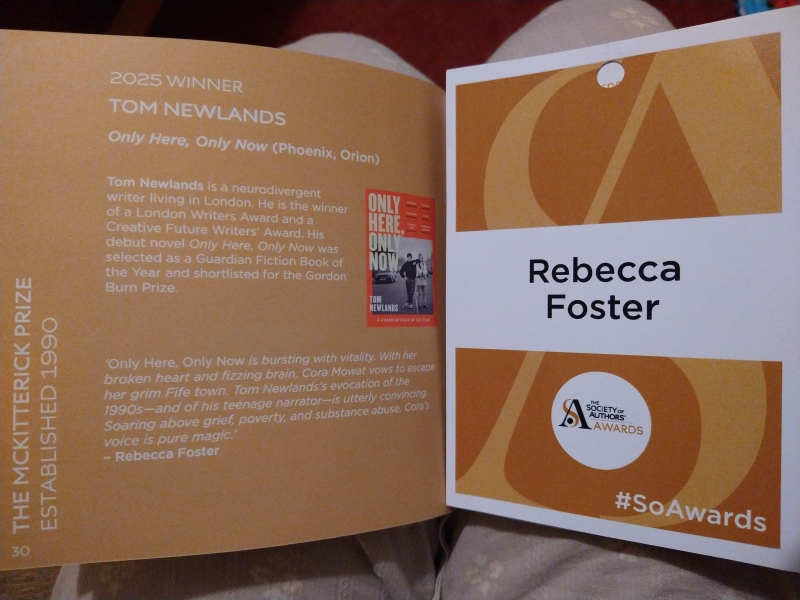
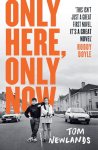 Only Here, Only Now is bursting with vitality. With her broken heart and fizzing brain, Cora Mowat vows to escape her grim Fife town. Tom Newlands’s evocation of the 1990s—and of his teenage narrator—is utterly convincing. Soaring above grief, poverty, and substance abuse, Cora’s voice is pure magic.
Our winner was Tom Newlands for Only Here, Only Now and our runner-up was Lauren Elkin for Scaffolding. (What an honour to have my blurb for the former used in the winners press release, the ceremony programme, and social media publicity.)


Newlands was also a runner-up for the ADCI Literary Prize “for a disabled or chronically ill writer, for an outstanding novel containing a disabled or chronically ill character or characters.” Here’s an excerpt from his statement for the press release:
To have my debut novel recognised in these two categories is particularly meaningful for me because they are linked by my experience. I didn’t start writing until the age of 40, in large part because growing up neurodivergent I didn’t feel my thought processes or methods of working were compatible with the production of a novel. There were no role models out there publishing stories like mine, and in the end, I wrote Only Here, Only Now because I couldn’t find the novel I wanted to read – a warm, vivid and funny story that examined poverty, disability and belonging, and that featured characters rarely found in British fiction.
Looking back to early on in this prize journey (which started back in November) … here was some of my early reading:
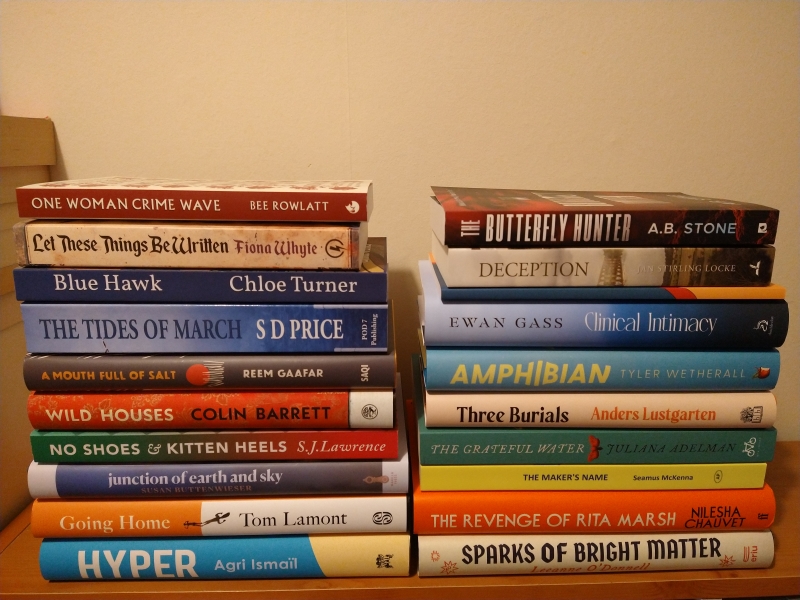
And our longlist:
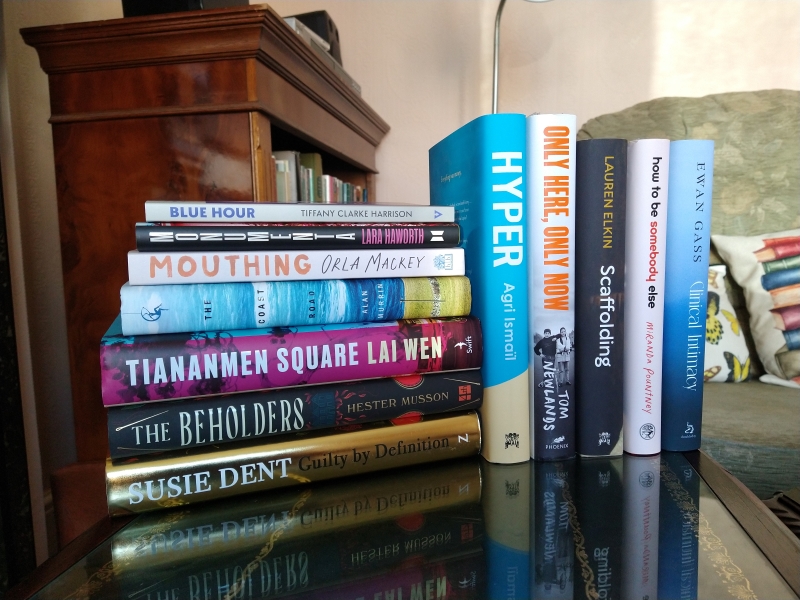
A couple of my favourite books from my reading that didn’t make the shortlist were:
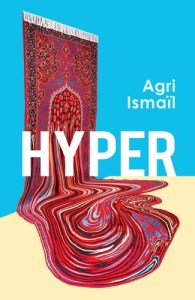 Hyper by Agri Ismaïl [I longlisted it – and then shortlisted it – but was outvoted]
Following a Kurdish family across several decades, this is a zeitgeist-y story that examines questions of national and personal autonomy. With its Dubai, Baghdad, London, and New York settings, it sets the second generation’s luxury, high finance, and fully online worlds against their parents’ bitter experience of exile after a failed independence movement. With its themes of dysfunction and failures and the long view of how we got here from there, it reminded me of Jonathan Franzen’s body of work.
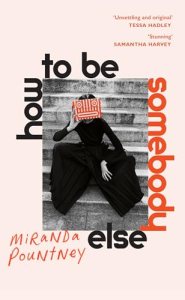 How to Be Somebody Else by Miranda Pountney [It had two votes to make the shortlist, but because it was so similar to Scaffolding in its basics (a thirtysomething woman in a big city, the question of motherhood, and pregnancy loss) we decided to cut it.]
This is the addictively readable story of Dylan, a late-thirties English woman who gives up her New York City advertising job and ponders authorship and motherhood while house-sitting an acquaintance’s apartment—and carrying on an affair with the married downstairs neighbour. As we see her interact with family and friends, we come to appreciate her not as some stereotypical ‘sad girl’ or ‘disaster woman’, but as an Everywoman seeking the time and space to become herself. It’s a sharp and witty novel for fans of Sally Rooney.
For the first time, I got to attend the SoA Awards ceremony in person yesterday. It was a hot day to be travelling in London, and after the oven of the Bakerloo line I was grateful to escape into the cool of Southwark Cathedral and its grounds. It was such a juxtaposition between the sleek City architecture and the ancient refuge of a church.
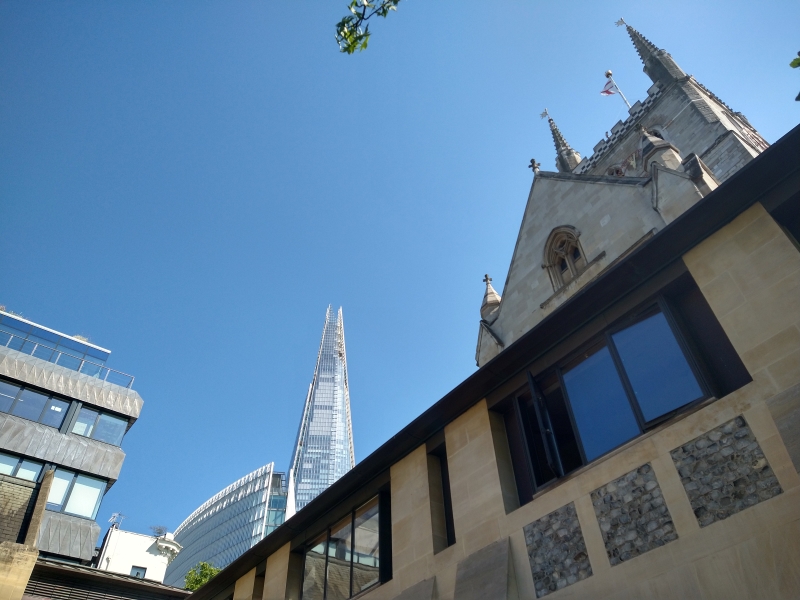
I worried that on such a warm and then busy day Hodge the cathedral cat wouldn’t show himself, but as I picked up my name badge he was asking to be let inside from the courtyard. He didn’t seem interested in strokes so I followed him at a respectful distance and let him settle in for a watchful rest.


Nominated authors and judges were treated to an exceptional afternoon tea, followed by the ceremony and drinks reception. It was lovely to meet my fellow judges Anietie Isong and Kathy O’Shaughnessy (author of the fantastic In Love with George Eliot, which won the SoA’s Paul Torday Memorial Prize) in the flesh as I’d only met them on Zoom before. We chatted a good bit with Lara Haworth, one of our shortlistees, and with Anne Booth, one of the Queen’s Knickers Award (children’s books) nominees, and also got to briefly meet Tom Newlands when he arrived for the ceremony. I always look out for literary ‘celebrities’ at such events and yesterday spotted Naomi Alderman, Caroline Bird, Joanne Harris and Alice Jolly.
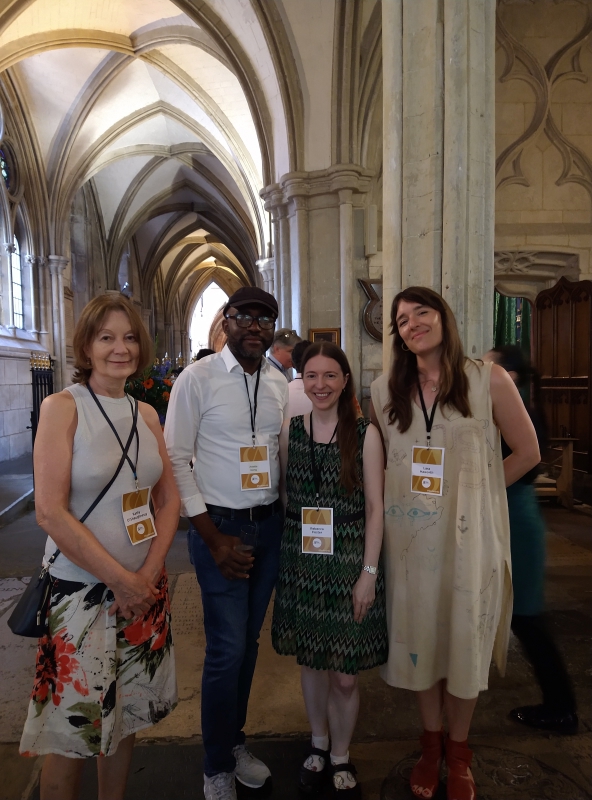


Dean Rev. Mark Oakley gave a welcome address via video, praising authors for bringing “resonance” rather than just “relevance.” He exhorted us, in the words of David Copperfield, to “read as if for life.” Joseph Coelho then gave a terrific keynote speech celebrating words written by humans (as opposed to an inaccurate AI-written bio of himself that he once encountered) and encouraging shortlistees, especially, to take time to bask in their achievement. Rejection is an ongoing, annual thing for him even at this stage of his career – he still remembers the £50 poetry gigs, changing in library toilets and school staff rooms; and the 12 years he spent trying to get published – even after he became the youngest-ever children’s laureate in 2022. “Wait for no one,” he challenged us: no one is going to give you permission or come save you, so go out there and do what you’re meant to do.
What an all-round fantastic experience this was! I’m so grateful to the Society of Authors for the opportunity.
Other notable winners announced yesterday included:
- Ashani Lewis (the only double winner): the Betty Trask Prize and Somerset Maugham award for Winter Animals
- Hisham Matar & Elif Shafak: the Gordon Bowker Volcano Prize (for a novel focusing on the experience of travel away from home), joint winners for My Friends and There Are Rivers in the Sky
Finishing Off the Barbellion Prize Shortlist: Sam Mills and Dr Amit Patel
The Barbellion Prize 2020 will be awarded tomorrow “to an author whose work has best represented the experience of chronic illness and/or disability.” (See also my reviews of Golem Girl by Riva Lehrer and Sanatorium by Abi Palmer.)
These two memoirs, though very different outwardly, both draw attention to the practical and emotional challenges of life with disability or a mental illness, and call for compassion from individuals and a commitment to help from governing bodies.
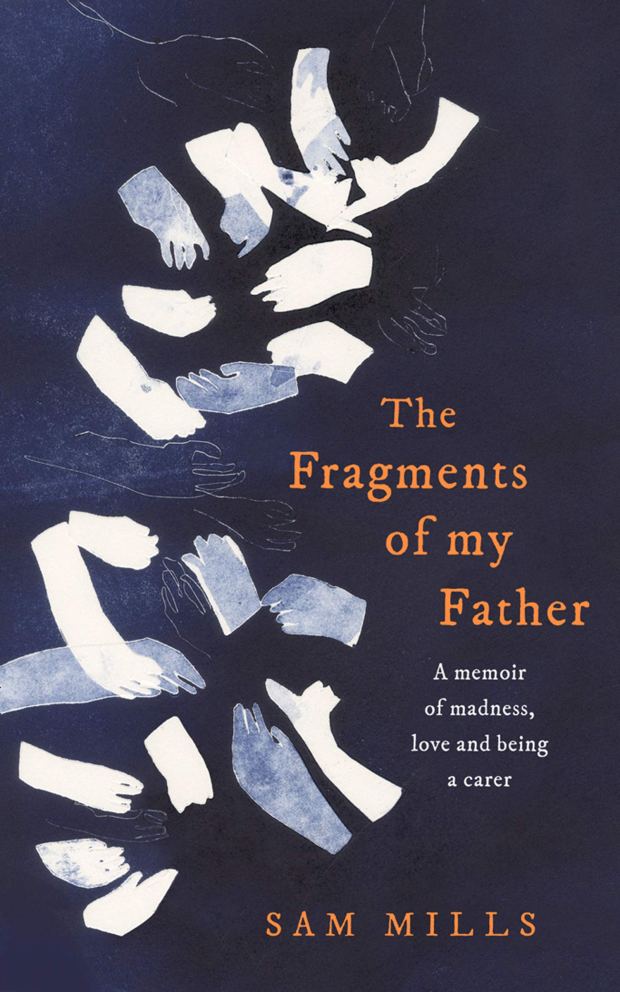
The Fragments of My Father: A memoir of madness, love and being a carer by Sam Mills
One in eight people in the UK cares for an ill or disabled relative. Sam Mills has been a carer for a parent – not once, but twice. The first time was for her mother, who had kidney cancer that spread to her lungs and died one Christmas. A few years later, Mills’s father, Edward, who has paranoid schizophrenia, started having catatonic episodes, as with the incident she opens her memoir on. In 2016, on what would have been her mother’s 70th birthday, Edward locked himself in the toilet of the family home in Surrey. Her brother had to break in with a screwdriver and ambulance staff took him away to a hospital. It wasn’t the first time he’d been institutionalized for a mental health crisis, nor would it be the last. It was always excruciating to decide whether he was better off at home or sectioned on a ward.
Mills darts between past and present as she contrasts her father’s recent condition with earlier points in their family life. She only learned about his diagnosis from her mother when, at age 14, she saw him walk down the stairs naked and then cry when he burned the chips. While schizophrenia can have a genetic element, relatives of a schizophrenic are also more likely to be high achievers. So, although Mills went through a time of suicidal depression as a teenager, meditation got her through and she exhibits more of the positive traits: An author of six books and founder of the small press Dodo Ink, she is creative and driven. Still, being her father’s full-time carer with few breaks often leaves her exhausted and overwhelmed.
The book’s two main points of reference are Leonard Woolf and F. Scott Fitzgerald, who cared for mentally ill wives and had to make difficult choices about their treatment and housing. In a nutshell, Mills concludes that Woolf was a good carer while Fitzgerald was a terrible one. Leonard was excused World War I service due to his nervous exhaustion from being a carer, and he gave up on the idea of children when doctors said that motherhood would be disastrous for Virginia. Virginia herself absolved Leonard in her suicide note, reassuring him that no couple could have been happier and that no one could have looked after her better. Scott, on the other hand, couldn’t cope with Zelda’s unpredictable behaviour – not least because of his own alcoholism – so had her locked up in expensive yet neglectful institutions and censored her work when it came too close to overlapping with his own plots.
The Fragments of My Father brings together a lot of my favourite topics to read about: grief, physical and mental illness, and literary biography. It had already been on my wish list since I first heard about it last year, but I’m glad the Barbellion Prize shortlisting gave me a chance to read it. It helps to have an interest in the Fitzgeralds and Woolfs – though in my case I had read a bit too extensively about them for this strand to feel fully fresh. (I also had a ‘TMI’ response to some revelations about the author’s relationships and sex life.)
Ultimately, I most appreciated the information on being a carer, including the mental burden and the financial and social resources available. (Although there is a government allowance for carers, Mills wasn’t eligible because of her freelance earnings, so she had to apply for Society of Authors grants instead.) With caring so common, especially for women, we need a safety net in place for all whose earnings and relationships will be affected by family duties. I read this with an eye to the future, knowing there’s every possibility that one day I’ll be a carer for a parent(-in-law) or spouse.
Readalikes I have also reviewed:
- Labours of Love: The Crisis of Care by Madeleine Bunting
- All the Lives We Ever Lived: Seeking Solace in Virginia Woolf by Katharine Smyth
Favorite lines:
“had I ever made a conscious choice? Caring felt like something that was happening to me, as though my father’s illness had been an eruption that had flowed like lava over my life. … I can’t think of any other job where someone defines your role by conferring its title on you, as though they are holding out a mould that you must fill.”
“caring is rarely simple because its nature is not static. It creates routines, crafts the days into set shapes, lulls you into states of false security, and then mutates, slaps you with fresh challenges, leaves you lost just when you feel you have gained wisdom.”
With thanks to Fourth Estate for the free copy for review.
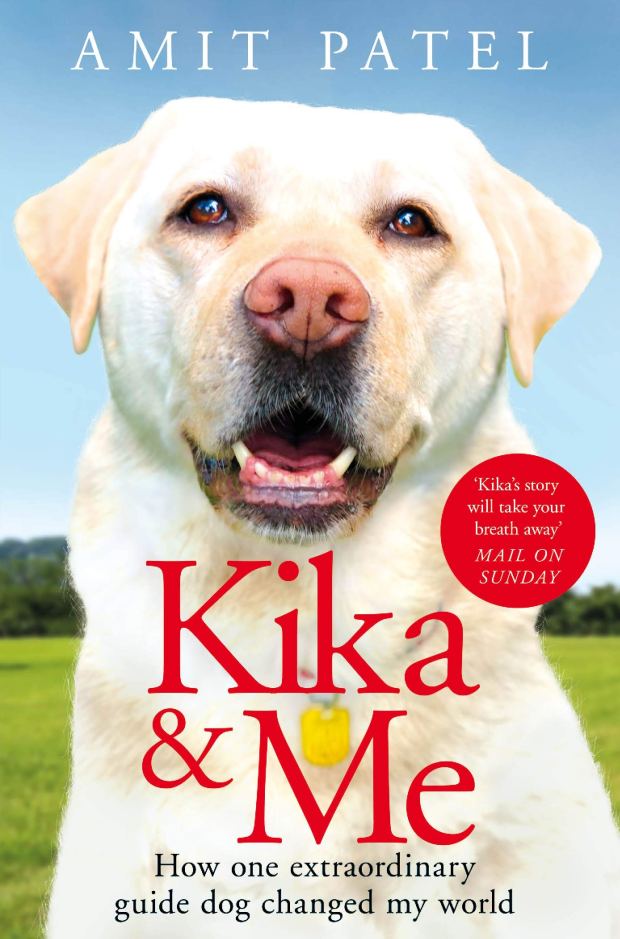
Kika & Me: How one extraordinary guide dog changed my world by Dr Amit Patel with Chris Manby
Dr Patel grew up in Guildford, studied medicine at Cambridge, and specialised in trauma medicine as a junior doctor in London. Diagnosed with keratocornus, which changes the shape of the cornea (it affects 1 in 450), he required first special contact lenses and then a series of cornea transplants. By the time of his eighth transplant, he’d remortgaged his house to pay an American specialist. Meeting and marrying Seema was a time of brightness before, in November 2013, he completely lost his vision within 36 hours. Blindness meant that he could no longer do his job, and constant eye pain and inactivity exacerbated his depression. While white cane and Braille training, plus the Royal National Institute of Blind People’s “Living with Sight Loss” course, started to boost his independence, it was being paired with his guide dog, Kika the Labrador, in 2015 that truly gave Patel his life back.
Trying out guide dogs sounds a little bit like speed dating. The Guide Dogs for the Blind Association (founded in the UK in 1931) warned that Kika was a “Marmite dog,” moody and likely to push boundaries; there was no guarantee she and Patel would get along. But from the start Kika was just right for him. More than once, what seemed like her pure stubbornness – lying on his feet and refusing to move – kept him from dangerous situations, like getting trapped between a busy road and a building site on an unfamiliar route. After a 10-day core skills training course, during which man and dog stayed at a hotel together, Kika was ready to join them at home. In the days to come, she would learn all Patel’s usual routes around their neighbourhood and into the City – with the help of smears of mackerel pâté.
If you’re like me, you’ll be most curious to learn about the nitty-gritty of life for a visually impaired person. I loved hearing about how Patel practiced his Braille letters with an egg container and ping pong balls. Since he went blind, he and his wife have had two children, and with Kika’s help manoeuvring a baby buggy is no problem. Guide dogs are trained to be predictable, e.g., doing their business in the same spot at the same times so it’s much easier to find and clean up. Some dog training tricks also worked for children, like putting a bell on a Labrador or a toddler to know when they wandered off!
Patel has had some unfortunate experiences since he went blind, particularly on the London Underground: teenagers picking him up and spinning him around on a train platform, busy commuters barging past him and Kika on an escalator, and an impatient woman hitting Kika with her handbag. While Patel doesn’t like being negative on social media, he finds that posting video clips of these incidents raises awareness of the challenges VIPs face. Every time he hits a setback, he uses it as an opportunity. For instance, one Diwali he was excited to visit Neasden Temple, only to be dismayed that they wouldn’t allow Kika inside. Since then, he has worked with temples around the world to improve disability services. He is also involved in London’s “Transport for All” work, and advises companies on access issues.
More so than the rest of the shortlist, Kika & Me is illuminating about daily life with a disability and has a campaigning focus. It’s an easy read, and not just for animal lovers. Judging the book by the cover, I might not have picked it up otherwise, so I’m grateful that the Barbellion put it on my radar. I’m deeply impressed by what Patel has achieved and the positive attitude he maintains. (Kika has her own Twitter account! @Kika_GuideDog)
With thanks to Pan Macmillan for the free copy for review.
(Fellow bloggers John Fish and Jackie Law have also been reading along with the Barbellion Prize shortlist. See their reviews thus far: John—Mills and Palmer; Jackie—Mills and Palmer.)
Next year the Barbellion Prize hopes to award more money, including to all nominated authors. They are accepting submissions for 2021, and are grateful for any Paypal donations via their website (see the page footer). I’ve donated to the cause. Can you help, too?
 Bookish Beck = Rebecca Foster. American transplant to England. Freelance proofreader and book reviewer.
 Bookish Beck