Book Serendipity, Mid-February to Mid-April
I call it “Book Serendipity” when two or more books that I read at the same time or in quick succession have something in common – the more bizarre, the better. This is a regular feature of mine every couple of months. Because I usually have 20–30 books on the go at once, I suppose I’m more prone to such incidents. The following are in roughly chronological order.
Last time, my biggest set of coincidences was around books set in or about Korea or by Korean authors; this time it was Ghana and Ghanaian authors:
- Reading two books set in Ghana at the same time: Fledgling by Hannah Bourne-Taylor and His Only Wife by Peace Adzo Medie. I had also read a third book set in Ghana, What Napoleon Could Not Do by DK Nnuro, early in the year and then found its title phrase (i.e., “you have done what Napoleon could not do,” an expression of praise) quoted in the Medie! It must be a popular saying there.
- Reading two books by young Ghanaian British authors at the same time: Quiet by Victoria Adukwei Bulley and Maame by Jessica George.


And the rest:
- An overweight male character with gout in Where the God of Love Hangs Out by Amy Bloom and The Secret Diaries of Charles Ignatius Sancho by Paterson Joseph.
- I’d never heard of “shoegaze music” before I saw it in Michelle Zauner’s bio at the back of Crying in H Mart, but then I also saw it mentioned in Pulling the Chariot of the Sun by Shane McCrae.
- Sheila Heti’s writing on motherhood is quoted in Without Children by Peggy O’Donnell Heffington and In Vitro by Isabel Zapata. Before long I got back into her novel Pure Colour. A quote from another of her books (How Should a Person Be?) is one of the epigraphs to Lorrie Moore’s I Am Homeless If This Is Not My Home.


- Reading two Mexican books about motherhood at the same time: Still Born by Guadalupe Nettel and In Vitro by Isabel Zapata.
- Two coming-of-age novels set on the cusp of war in 1939: The Inner Circle by T.C. Boyle and Martha Quest by Doris Lessing.
- A scene of looking at peculiar human behaviour and imagining how David Attenborough would narrate it in a documentary in Notes from a Small Island by Bill Bryson and I Have Some Questions for You by Rebecca Makkai.
- The painter Caravaggio is mentioned in a novel (The Things We Do to Our Friends by Heather Darwent) plus two poetry books (The Fourth Sister by Laura Scott and Manorism by Yomi Sode) I was reading at the same time.


- Characters are plagued by mosquitoes in The Last Animal by Ramona Ausubel and Through the Groves by Anne Hull.
- Edinburgh’s history of grave robbing is mentioned in The Things We Do to Our Friends by Heather Darwent and Womb by Leah Hazard.
- I read a chapter about mayflies in Lev Parikian’s book Taking Flight and then a poem about mayflies later the same day in Ephemeron by Fiona Benson.
- Childhood reminiscences about playing the board game Operation and wetting the bed appear in Homesick by Jennifer Croft and Through the Groves by Anne Hull.

- Fiddler on the Roof songs are mentioned in Through the Groves by Anne Hull and We All Want Impossible Things by Catherine Newman.
- There’s a minor character named Frith in Shadow Girls by Carol Birch and Rebecca by Daphne du Maurier.
- Scenes of a female couple snogging in a bar bathroom in Through the Groves by Anne Hull and The Garnett Girls by Georgina Moore.

- The main character regrets not spending more time with her father before his sudden death in Maame by Jessica George and Pure Colour by Sheila Heti.
- The main character is called Mira in Birnam Wood by Eleanor Catton and Pure Colour by Sheila Heti, and a Mira is briefly mentioned in one of the stories in Before You Suffocate Your Own Fool Self by Danielle Evans.
- Macbeth references in Shadow Girls by Carol Birch and Birnam Wood by Eleanor Catton – my second Macbeth-sourced title in recent times, after Tomorrow and Tomorrow and Tomorrow by Gabrielle Zevin last year.


- A ‘Goldilocks scenario’ is referred to in Womb by Leah Hazard (the ideal contraction strength) and Taking Flight by Lev Parikian (the ideal body weight for a bird).
- Caribbean patois and mention of an ackee tree in the short story collection If I Survive You by Jonathan Escoffery and the poetry collection Cane, Corn & Gully by Safiya Kamaria Kinshasa.
- The Japanese folktale “The Boy Who Drew Cats” appeared in Our Missing Hearts by Celeste Ng, which I read last year, and then also in Enchantment by Katherine May.


- Chinese characters are mentioned to have taken part in the Tiananmen Square massacre/June 4th incident in Dear Chrysanthemums by Fiona Sze-Lorrain and Oh My Mother! by Connie Wang.
- Endometriosis comes up in What My Bones Know by Stephanie Foo and Womb by Leah Hazard.

What’s the weirdest reading coincidence you’ve had lately?
Until the Future: “Tomorrow” Novels by Emma Straub & Gabrielle Zevin
These two 2022 novels I read from the library recently were such fun, but also had me fighting back tears – they’re lovely, bittersweet reads that think seriously about time and failure and loss (and prompted me to ask myself, “Was everything better in 1995–6?” The answer to which is an emphatic YES). If you’re a city-goer, you’ll appreciate the loving depictions of New York City and Los Angeles. They’re also perfect literary/ commercial crossovers that I can imagine recommending to just about any of my readers. Both: 
This Time Tomorrow by Emma Straub
Emma Straub is one of the most reliable authors I know for highly readable literary fiction (see also: Jami Attenberg, Maggie O’Farrell and Ann Patchett): while there’s always a lot going on in terms of family dysfunction and character dynamics, her plots are juicy and the prose slides right down (especially Modern Lovers, as well as The Vacationers). Here Alice Stern is a frustrated 40-year-old who feels stuck career- and relationship-wise, working in admissions in the same NYC private school she once attended and living with an okay boyfriend she secretly hopes won’t propose. She devotes much of her emotional energy to her seriously ill father, Leonard, who it seems may never be released from the hospital.
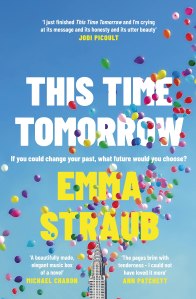 Leonard is the one-hit sci-fi author of a cult classic about time travel, and when an inebriated Alice falls asleep near her childhood home on the night of her 40th birthday, she has her own time-travel adventure, waking up on her 16th birthday in 1996. This is her chance, she thinks: to make sure things go right with her high school crush, and to encourage her father to write more and adopt healthier habits so he won’t be dying in a hospital 24 years down the line. As she figures out the rules of this personal portal and attempts the same transition again and again, she starts to get the hang of what works; what she can change and what is inexorable. And she tries to be a better person, both then and now.
True sci-fi aficionados would probably pick holes in the reasoning, but I would say so long as you pick this up expecting a smart commentary on relationships, ageing, loss and regret rather than a straight-up time-travel novel, you’ll be just fine. Straub is closer to my older sister’s age than mine, but I still loved the 1990s nostalgia, and looking back at your childhood/teen years from a parent’s perspective can only ever be an instructive thing to do.
It’s clever how Straub starts cycling through the time changes faster and faster so they don’t get repetitive. The supporting characters like Sam (Alice’s African American best friend), Kenji and even Ursula the cat are great, and there are little nods throughout to other pop culture representations of time travel. This was entertaining and relatable, but also left me with a lump in the throat. And it was all the more poignant to have been reading it just as news hit of author Peter Straub’s death; it’s a daughter’s tribute.
Some favourite lines:
(Alice thinking about Leonard) “She would feel immeasurably older when he was gone.”
“Maybe, she thought, … her mistake had been assuming that somewhere along the line, everything would fall into place and her life would look just like everyone else’s.”
(in 1996) “Everyone was gorgeous and gangly and slightly undercooked, like they’d been taken out of the oven a little bit too early”
“Any story could be a comedy or a tragedy, depending on where you ended it. That was the magic, how the same story could be told an infinite number of ways.”
Tomorrow, and Tomorrow, and Tomorrow by Gabrielle Zevin
I didn’t think I’d ever read another novel by Zevin after the dud that was The Storied Life of A.J. Fikry (by far my most popular negative review on Goodreads), but Laura’s fantastic review changed my mind.
Here’s the summary I wrote for Bookmarks magazine:
Sadie Green and Sam Masur met in unlikely circumstances. In 1986, Sam’s serious foot injury had him in a children’s hospital, where Sadie was visiting her sister, who had cancer. They hit it off talking video games, but Sam was hurt to learn Sadie kept up the visits to earn community service hours for her bat mitzvah. When they meet again during college in Boston, they decide to co-design a game. Helped by his roommate and her boyfriend, they create a bestseller, Ichigo, based on The Tempest. Over the decades, these gaming friends collaborate multiple times, but life throws some curveballs. A heartwarming story for gamers and the uninitiated alike.
 The novel was more complicated than I expected, mostly because it spans nearly 30 years – and my main critique would probably be that a shorter timeline would have been more intense. It also goes to some dark places as it probes the two central characters’ traumas and tendency to depression. But their friendship, which over the years becomes a business partnership that also incorporates Sam’s college roommate, Marx Watanabe, is a joy. The creative energy and banter are enviable. Marx is the uncomplicated, optimistic go-between when Sam and Sadie butt heads and take offense at perceived betrayals. Underneath Sam and Sadie’s conflicts is a love different from, and maybe superior to, romantic love (I think Sam might best be described as ace).
Gaming comes across as better than reality in that it offers infinite possibilities for do-overs. Life, on the other hand, only goes in one direction and is constrained by choices, your own and others’. Part VII, “The NPC” (for non-player character), is in second person narration and is beautiful as well as heartbreaking – I’ll say no more for fear of spoilers.
Apart from playing Super Mario with older cousins at 1990s family reunions and a couple of educational computer games with my childhood best friend, I don’t have any history with gaming at all, yet Zevin really drew me in to the fictional worlds Sadie and Sam created with their games. What with the vivid imagery and literary allusions, EmilyBlaster, Ichigo and Master of the Revels are real works of art, bridging high and low culture and proving that Dickinson’s poetry and Shakespeare’s plays are truly timeless. I was also interested to see how games might be ahead of their time socio-politically.
This reminded me most of The Animators and The Art of Fielding, similarly immersive stories of friendship and obsessive commitment to work and/or play. In the same way that you don’t have to know anything about cartooning or baseball to enjoy those novels, you don’t have to be a gamer to find this a nostalgic, even cathartic, read.
Some favourite lines:
“for Marx, the world was like a breakfast at a five-star hotel in an Asian country—the abundance of it was almost overwhelming. Who wouldn’t want a pineapple smoothie, a roast pork bun, an omelet, pickled vegetables, sushi, and a green-tea-flavoured croissant? They were all there for the taking and delicious, in their own way.”
Sam to Sadie: “We work through our pain. That’s what we do. We put the pain into the work, and the work becomes better.”
Marx (who was a college actor) in the early years, citing Macbeth: “What is a game? It’s tomorrow, and tomorrow, and tomorrow. It’s the possibility of infinite rebirth, infinite redemption. The idea that if you keep playing, you could win. No loss is permanent, because nothing is permanent, ever.”
Three Hours by Rosamund Lupton (Blog Tour Review)
It can’t happen here. Or can it? That’s a question Rosamund Lupton asks with her novel about a siege at a progressive school in rural England. When out in public with my copy of the book, I was asked a few times what I was reading. I would explain that it was about a school shooting in Somerset, and the reply was always “In the UK?!” Guns are difficult to come by in this country thanks to firearms legislation that was passed following a couple of high-profile massacres in the 1980s and 90s. So, to an extent, you’ll have to suspend your disbelief about the perpetrators getting access to automatic weapons and bombs. And you should, because the story that unfolds is suspenseful and timely.
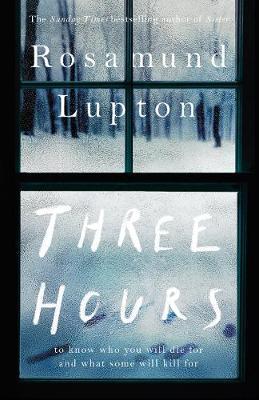 Cliff Heights School is in the midst of a surprise November blizzard. It’s also under attack. At 9:16 the headmaster, Matthew Marr, is shot twice. Students bundle him into the library, barricade the doors and tend to his head and foot injuries as best they can. He recognized the shooter, but the damage to his brain means he’s incapable of telling anyone who it was.
At 8:15 Rafi Bukhari, a Syrian refugee pupil, had seen an IED explode on the school grounds and alerted Marr, who promptly evacuated the junior school. But the institution is based across several buildings, with some students in the theatre for a dress rehearsal, more in the pottery hut for art class – and now a few trapped in the library.
Lupton toggles between these different locations, focusing on a handful of staff and students and the relationships between them. Hannah, who’s doing her best to help Mr. Marr, is Rafi’s girlfriend. Rafi is concerned for his little brother, Basi, who’s still traumatized after their escape from Syria. Mr. Marr sponsored the boys’ move to England. Could it be that anti-Muslim sentiment has made the Bukhari boys – and thus the school they attend – a target?
We also spend time behind the scenes with police investigators as they pursue leads and worried parents as they await news of their children. I found the book most gripping when the situation was still a complete unknown; as the options narrow down and it becomes clear who’s responsible, things feel a bit more predictable. However, there are still unexpected turns to come.
A few elements that stood out for me were the use of technology (FaceTime, WhatsApp and drones weren’t available at the time of Columbine), the Syrian boys’ history, and the student production of Macbeth, whose violence ironically comments on the school’s crisis. While not my usual fare, I found this well worth reading and will look into Lupton’s back catalogue, too.
Readalikes: Bloomland by John Englehardt and A Mother’s Reckoning by Sue Klebold
My rating: 
Three Hours will be published by Penguin Viking on the 9th. My thanks to the publisher for the free copy for review.
My pal Annabel has also reviewed the book today.
 Bookish Beck = Rebecca Foster. American transplant to England. Freelance proofreader and book reviewer.
 Bookish Beck