20 Books of Summer, 11–13: Campbell, Julavits, Lu
Two solid servings of women’s life writing plus a novel about a Chinese woman stuck in roles she’s not sure she wants anymore.
Thunderstone: A true story of losing one home and discovering another by Nancy Campbell (2022)
 Just before Covid hit, Campbell’s partner Anna had a partially disabling stroke. They had to adjust to lockdown and the rigours of Anna’s at-home care at once. It was complicated in that Campbell was already halfway out the door: after 10 years, their relationship had run its course and she knew it was time to go, but guilt lingered about abandoning Anna at her most vulnerable (“How dare I leave someone who needed me”). That is the backdrop to a quiet book largely formed of a diary spanning June to September 2021. Campbell recounts settling into a caravan by the canal and railway line in Oxford, getting plenty of help from friends and neighbours but also finding her own inner resources and enjoying her natural setting.
The title refers to a fossil that has been considered a talisman in various cultures, and she needed the good luck during a period that involved accidental carbon monoxide poisoning and surgery for an ovarian abnormality (but it didn’t protect her books, which were all destroyed in a leaking shipping container – the horror!). I most enjoyed the longer entries where she muses on “All the potential lives I moved on from” during 20 years in Oxford and elsewhere, which makes me think that I would have preferred a more traditional memoir by her. Covid narratives feel really dated now, unfortunately. (New (bargain) purchase from Hungerford Bookshop with birthday voucher)
Directions to Myself: A Memoir by Heidi Julavits (2023)
 Julavits is a novelist and founding editor of The Believer. I loved her non-standard diary, The Folded Clock, back in 2017, so jumped at the chance to read her new memoir but then took more a year over reading it. The U.S. subtitle, “A Memoir of Four Years,” captures the focus: the change in her son from age five to age nine – from little boy to full-fledged individual. In later sections he sounds so like my American nephew with his Fortnite obsession and lawyerly levels of argumentation and self-justification. A famous author once told Julavits that writers should not have children because each one represents a book they will not write. This book is a rebuttal: something she could not have written without having had her son. Home is a New York City apartment near the Columbia University campus where she teaches – in fact, directly opposite a dorm at which rape allegations broke out – but more often the setting is their Maine vacations, where coastal navigation is a metaphor for traversing life.
Mostly the memoir takes readers through everyday conversations the author has with friends and family about situations of inequality or harassment. Through her words she tries to gently steer her son towards more open-minded ideas about gender roles. She also entrances him and his sleepover friends with a real-life horror story about being chased through the French countryside by a man in a car. The tenor of her musings appealed to me, but already the details are fading. I suspect this will mean much more to a parent.
With thanks to Bloomsbury for the free copy for review.
The Funeral Cryer by Wenyan Lu (2023)
 The title character holds a traditional position in her Chinese village, performing mourning at ceremonies for the dead. It’s a steady source of income for her and her husband, but her career choice has stigma attached: “Now that I brought bad luck and I smelt of the dead, nobody would step into our house to play mah-jong or chat.” Exotic as the setup might seem at first, it underpins a familiar story of a woman caught in frustrating relationships and situations. A very readable but plain style to this McKitterick Prize winner.
With thanks to the Society of Authors for the free copy.
Review Book Catch-Up: Ante, Evans, Foster and White
Today I have a book of poems about the Filipinx experience in the UK, a collection of short stories reflecting on racial injustice, a monograph on a bird that spells summer for many of us, and a biographical investigation into a little-understood medical condition.
Antiemetic for Homesickness by Romalyn Ante
I was drawn to this debut collection by the terrific title and cover, but also by the accolades it received: it was on the Dylan Thomas Prize longlist and the Jhalak Prize shortlist. I hope we’ll see it on the Sunday Times Young Writer of the Year Award shortlist, too. Ante grew up in the Philippines but at age 16 joined her mother in the UK, where she had moved years before to work as a nurse in the NHS. She has since followed in her mother’s footsteps as a nurse – indeed, overseas Filipinx workers (Jamaicans, too) are a mainstay of the NHS.
 Ante remembers the years when her mother was absent but promised to send for the rest of the family soon: “You said all I needed to do was to sleep and before I knew it, / you’d be back. But I woke to the rice that needed rinsing, / my siblings’ school uniforms that needed ironing.” The medical profession as a family legacy and noble calling is a strong element of these poems, especially in “Invisible Women,” an ode to the “goddesses of caring and tending” who walk the halls of any hospital. Hard work is a matter of survival, and family – whether physically present or not – bolsters weary souls. A series of short, untitled poems are presented as tape recordings made for her mother.
Food is inextricably entwined with memory (reminding me of Nina Mingya Powles’s approach in Tiny Moons) and provides some of the standout metaphors, especially in “Patis” and “Ode to a Pot Noodle.” Ante uses a lot of alliteration and adapts various forms. I especially liked “Tagay!”, a traditional drinking song, and “Mateo,” printed in the shape of a pound sign. The nuanced look at the immigrant experience reminded me of Jenny Xie’s Eye Level. Movement entails losses as well as benefits. The focus on the Filipinx experience also made me think of America Is Not the Heart. My favourite single poem was “The Making of a Smuggler,” which opens “Wherever we travel, we carry / the whole country with us – // our rice terraces are folded garments, / we have pillars of trees, a rainforest // on a hairbrush.”
Favourite lines:
“Gone are the nights he steals / the moon with a mango picker / and swaps it for her pocket mirror”
“The yellow admission papers in my hands escaped / flustering at my face into a flight of orioles.”
“I am halved in order to be whole – / I rebuild by leaving / everything I love.”
With thanks to Chatto & Windus for the free copy for review.
The Office of Historical Corrections by Danielle Evans
To boil these six stories and a novella down to the topic of race in America risks painting them as solemn or strident – more concerned with meaning than with art – when the truth is that they are playful and propulsive even though they keep cycling back to bereavement and injustice. Several of the protagonists are young Black women coming to terms with a loss.
 In “Happily Ever After,” Lyssa works in the gift shop of a Titanic replica and is cast as an extra in a pop star’s music video. Mythical sea monsters are contrasted with the real dangers of her life, like cancer and racism. “Anything Could Disappear” was a favourite of mine, though it begins with that unlikely scenario of a single woman acquiring a baby as if by magic. What starts off as a burden becomes a bond she can’t bear to let go. A family is determined to clear the name of their falsely imprisoned ancestor in “Alcatraz.” In “Richard of York Gave Battle in Vain” (a mnemonic for the colours of the rainbow), photojournalist Rena is wary about attending the wedding of a friend she met when their plane was detained in Africa some years ago. The only wedding she’s been in is her sister’s, which ended badly.
Mistakes and deceit seem to follow these characters. In the title novella that closes the book, Cassie and her colleagues combat fake news, going around putting correction labels on plaques that whitewash history. When she and her former colleague meet up in Wisconsin to find the truth behind a complex correction case, a clash with a white supremacist group quickly turns pedantry into a matter of life and death. The story I’d heard the most about beforehand was “Boys Go to Jupiter,” about a college girl who dons a Confederate flag bikini, not caring what message it sends to others in her dorm. It turns out she has history with a Black family, but has chosen to airbrush this experience out of her life.
There was only one story I didn’t care for, “Why Won’t Women Just Say What They Want,” about a celebrity who turns apologizing into performance art. Overall, this is a very strong collection I would recommend to readers of Brit Bennett and Raven Leilani, with some stories also reminding me of recent work by Curtis Sittenfeld and Mary South. I’ll be sure to seek out Evans’s previous book (also short stories), too.
With thanks to Picador for the proof copy for review.
The Screaming Sky by Charles Foster
The other week I was volunteering at our local community garden and looked up to see a dozen common swifts wheeling over the Kennet & Avon canal and picking off insects among the treetops. I hope this fellow Foster (for whom my husband was once confused on a nature conference attendee list) would be proud of me for pausing to gaze at the birds for a while. My impression of the author is as a misanthropic eccentric. A Renaissance man as well versed in law and theology as he is in natural history, he’s obsessed with swifts and ashamed of his own species: for looking down at their feet when they could be watching the skies; for the “pathological tidiness” that leaves swifts and so many other creatures no place to live.
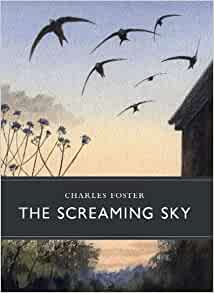 The obsession began when he was eight years old and someone brought him a dead swift fledgling for his taxidermy hobby. Ever since, he’s dated the summer by their arrival. “It is always summer for them,” though, as his opening line has it. This monograph is structured chronologically. Much like Tim Dee does in Greenery, Foster follows the birds for a year: from their winter territory in Africa to the edges of Europe in spring and then to his very own Oxford street in high summer. When they leave, he’s bereft and ready to book a flight back to Africa.
Along the way, Foster delivers heaps of information: the fossil evidence of swifts, how they know where to migrate (we have various theories but don’t really know), their nesting habits and lifespan, and the typical fates of those individuals that don’t survive. But, thumbing his nose at his “ex-friend” (a closed-minded biologist he repeatedly, and delightfully, rails against), he refuses to stick to a just-the-facts approach. Acknowledging the risks of anthropomorphizing, he speaks of swifts as symbols of aspiration, of life lived with intensity. He believes that we can understand animal emotions analogously through our own, so that, inappropriate as such words might seem, we can talk about what birds hope and plan for. He scorns reductive ecosystem services lingo that defines creatures by what we get out of them.
Also like Dee, Foster quotes frequently from poetry. His prose is full of sharp turns of phrase and moments of whimsy and made me eager to try more of his work (I know the most about but have not yet read Being a Beast).
Swifts know the roar of lions better than the roar of the M25, the piping of hornbills better than the Nunc Dimittis of parish Evensong … Are memories of our eaves spiralling high above the Gulf of Guinea? … They don’t seem to prevaricate. One moment they’re there, the next they’re off, diving straight into the journey. It’s the way we should run into cold water.
 As I’ve found with a number of Little Toller releases now (On Silbury Hill, Snow, Landfill), knowledge meets passion to create a book that could make an aficionado of the most casual of readers. Towards the close I was also reminded of Richard Smyth’s An Indifference of Birds: “When Homo sapiens has gone there will be lots of ideal swift holes in the decaying buildings we’ll leave behind.” It’s comforting to think of natural cycles continuing after we’re gone … but let’s start making the space for them now. Jonathan Pomroy’s black-and-white illustrations of swift behaviour only add to this short book’s charms.
With thanks to Little Toller Books for the free copy for review.
Waiting for Superman: One Family’s Struggle to Survive – and Cure – Chronic Fatigue Syndrome by Tracie White
Like Suzanne O’Sullivan’s books (most recently, The Sleeping Beauties), this is presented as an investigation into a medical mystery. White, a Stanford Medicine journalist, focuses on one family that has been indelibly changed by chronic fatigue syndrome – now linked with myalgic encephalomyelitis and termed ME/CFS for short. Whitney Dafoe was a world traveller and promising photographer before, in 2010, a diagnosis of ME/CFS explained his exhaustion and gastrointestinal problems. By the time White first met the family in 2016, the thirtysomething was bedbound in his parents’ home with a feeding tube, only able to communicate via gestures and rearranging Scrabble tiles. He couldn’t bear loud noises, or to be touched. At times he was nearly comatose.
 Whitney’s father, Ron Davis, is a Stanford geneticist whose research has contributed to the Human Genome Project. He has devoted himself to studying ME/CFS, which affects 20 million people worldwide yet receives little research funding; he calls it “the last major disease we know nothing about.” Testing his son’s blood, he found a problem with the citric acid cycle that produces ATP, essential fuel for the body’s cells – proof that there was a physiological reason for Whitney’s condition. Frustratingly, though, a Stanford colleague who examined Whitney prescribed a psychological intervention. This is in line with the current standard of care for ME/CFS: a graded exercise regime (nigh on impossible for someone who can’t get out of bed) and cognitive behavioural therapy.
White delves into Whitney’s past, looking for clues to what could have triggered his illness (having mono in high school? a parasite he picked up in India?). She also goes back to the mid-1980s to consider the Lake Tahoe outbreak of ME/CFS, whose victims “looked too healthy to be sick and were repeatedly disbelieved.” The media called it “yuppie flu,” downplaying the extreme fatigue involved. White also meets Laura Hillenbrand, author of Seabiscuit, who suffers from ME/CFS and managed to write her bestselling books from bed. Like Whitney, she only has a certain allotment of energy and mustn’t use it up too fast.
- A neat connection: Stephanie Land, author of Maid, was Whitney’s ex-girlfriend when he was 19 and living in Alaska; she wrote a Longreads article about their relationship.
- The title is from a Flaming Lips lyric and expresses Whitney’s trust in his dad’s ability to cure him; the U.S. title is The Puzzle Solver and the working title was The Invisible Patient.
With thanks to Atlantic Books for the free copy for review.
Would you be interested in reading one or more of these?
Introducing the Barbellion Prize & A Review of Sanatorium by Abi Palmer
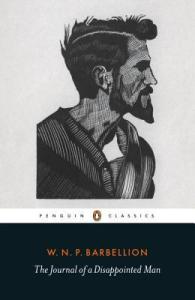
New this year, the Barbellion Prize will be awarded annually “to an author whose work has best represented the experience of chronic illness and/or disability.” It’s named after W.N.P. Barbellion (the pen name of Bruce Frederick Cummings), the English author of The Journal of a Disappointed Man, which he started writing at 13. A self-taught naturalist, he specialized in lice when he worked for the British Museum’s department of natural history in London. He was rejected for war service in 1915 after a doctor found him to have multiple sclerosis. At that time, the diagnosis was like a death sentence; indeed, Cummings died at age 30 in 1919, though by then he had managed to produce two volumes of memoirs as well as a daughter.
Here’s some more information on the prize criteria from the website: “Eligibility for the prize is predicated on the author’s presentation of life with a long-term chronic illness or disability, whether that be in the form of blindness, MS, cystic fibrosis, dwarfism, or another comparable condition that may substantially define one’s life. Authors – such as those in a carer’s capacity – who themselves are not ill may be considered for the prize if their work is truly exceptional as an articulation of life with illness, but authors who themselves deal personally with illness or disability will take priority in any selection for the prize.”


Especially in the absence of the Wellcome Book Prize, which has been on hiatus since the announcement of the 2019 winner, I’m delighted that there is a new prize with a health slant, particularly one that will lead to greater visibility for disabled writers and their stories. From a longlist of eight, in January the Barbellion Prize judges chose a shortlist of four titles: three memoirs and a work of autofiction. The publishers kindly agreed to send me the shortlist for review. Two have arrived so far (there have been postal delays in the UK, as in many places).

I have already read one of the nominees and will do my best to review the rest before the £1000 prize is awarded on the 12th. The others are:
- Golem Girl by Riva Lehrer – An illustrated memoir by a visual artist born with spina bifida.
- The Fragments of My Father by Sam Mills – A memoir of being a carer for her father, who has paranoid schizophrenia; also includes musings on Leonard Woolf and F. Scott Fitzgerald, who cared for mentally ill wives. I’m currently reading this one.
 Kika & Me by Amit Patel – Patel was a trauma doctor and lost his sight within 36 hours due to a rare condition. He was paired with his guide dog, Kika, in 2015.
Sanatorium by Abi Palmer (2020)
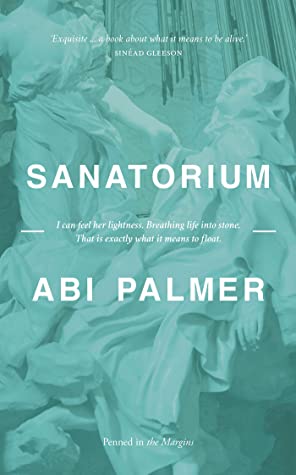 Water is a source of comfort and delight for Abi, the narrator of Sanatorium (whose experiences may or may not be those of the author; always tricky to tell with autofiction). Floating is like dreaming for her – an intermediate state between the solid world where she’s in pain and the prospect of vanishing into the air. In 2017 she spends a few weeks at a sanatorium in Budapest for water therapy; when she returns to London she buys a big inflatable plastic bathtub to keep up the exercises as she tries to wean herself off of opiates.
Abi feels fragile due to a whole host of body issues, some in her past but most continuing into the present: an autoimmune connective tissue disorder, psoriatic arthritis, Crohn’s disease, and sexual assaults. Her knee is most immediately problematic, leading her to use a mobility scooter. As her health waxes and wanes, other people – unable to appreciate any internal or incremental changes – judge her by whether or not she is able to walk well.
 The book is in snippets, often of just a paragraph or even one sentence, and cycles through its several strands: Abi’s time in Budapest and how she captures it in an audio diary; ongoing therapy at her London flat, custom-designed for disabled tenants (except “I was the only cripple who could afford it”); the haunted house she grew up in in Surrey; and notes on plus prayers to St. Teresa of Ávila, accompanied by diagrams of a female figure in yoga poses.
Locations are given in small letters in the top corner of the page, apart from for the more dreamlike segments that can’t be pinned down to any one place. For instance, I was reminded of a George Saunders story by the surreal interlude in which Abi imagines Van Gogh’s Starry Night reproduced in the hair on a detached pair of legs mounted on a wall as a work of art.
The different formats and short chunks of prose generally keep the voice from becoming monotonous, though I did wonder if occasional use of the third person (and some more second person) could have been effective, too. Far from a straightforward memoir, the book incorporates passages that are closer to fantasy and poetry, and the visual elements and fertile imagery attest to Palmer’s background as a mixed-media artist.
Sanatorium is a fascinating work – matter-of-fact, playful and sensual – that vividly conveys the reality of life with a chronic illness. It was already on my wish list, but I’m so glad that this shortlisting gave me a chance to read it. Though I haven’t read the other nominees yet, the passages below are proof that this would be a deserving Barbellion Prize winner.
You go through life as a chronically ill person with so many different people who have so many different opinions about how your treatment should be. They’re not always useful or right. You have to build your own narrative and your own sense of what feels appropriate. You have to learn to trust your body to tell you what’s working. But that’s hard too, when your body keeps changing the rules.
I am one of the more privileged ones and still I’m screaming. God, it would be so nice just to dissolve into nothing and wash up onto a lonely beach.
I wonder if what I’ve learned about chronic illness, more than anything, is that it’s a constant cycle. You fall apart, then you try your best to rebuild again. I wonder what would happen if I stopped trying.
Readalikes I have also reviewed:
- Heal Me by Julia Buckley
- Bodies of Water by V. H. Leslie
- My Year of Rest and Relaxation by Ottessa Moshfegh
With thanks to Penned in the Margins for the free copy for review.
Book Spine Poetry Strikes Again
Great minds think alike in the blogging world: last week, on the very day that Annabel posted a book spine poem, it was on my to-do list to assemble my current reading stack into a poem or two. I’d spotted some evocative and provocative titles, as well as some useful prepositions. The poems below, then, serve as a snapshot of what I’m reading at the moment, with some others from my set aside and occasional reading shelves filling in. You get a glimpse of the variety I read. (For one title in the second pile, a poetry book I’m reading on my e-reader, I had to improvise!)
My previous book spine poetry efforts are here and here (2016); and here (March 2020).
A dark one, imagining an older woman in serious condition and passing a night in a hospital bed:

Intensive Care
Complications,
Pain.
As I Lay Dying,
Owls Do Cry.
I Miss You When I Blink.
This Thing of Darkness,
Spinster Keeper,
Wrestling with the Angel.
And a more general reflection on recent times and what might keep us going:

Embers
How Should a Person Be
In These Days of Prohibition?
The Light Years
Outlawed,
The Noonday Demon.
Some Body to Love
The Still Point,
The Still Point of the Turning World.
Color and Line
A Match to the Heart.
The Bare Abundance
Love’s Work.
Unsettled Ground
The Magician’s Assistant.
Braiding Sweetgrass
Revelations of Divine Love.
Have a go at some book spine poems if you haven’t already! They’re such fun.
My Year in Nonfiction (Thus Far)
If your household is anything like mine, stressful days and nights of lost sleep are ceding to relief after the U.S. election result was finally announced. We celebrated with whoopie pies (a Pennsylvania specialty) and Prosecco.


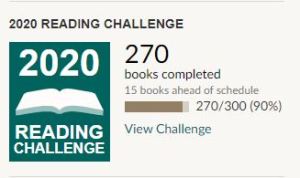
And look: I happened to pass 270 yesterday as well!
I’d taken part in the Six Degrees of Separation meme every month since February, but this time I had no inspiration. I was going to start with these two apple covers…
…but that’s as far as I got. Never mind! I’ll be back next month, when we all start with the YA classic Are You There God? It’s Me, Margaret by Judy Blume.
Instead, I’m catching up with this past week’s Nonfiction November prompt: Your Year in Nonfiction. It was hosted by Leann of Shelf Aware.

 What topics have been prominent in your year’s nonfiction reading?
I’ve read a lot of nature and popular science, probably more than in an average year. Greenery by Tim Dee has been an overall highlight. I managed to read 12 books from the Wainwright Prize longlists, and I’m currently reading four books of nature-themed essays or journals. Thoughtful as well as consoling.

The popular science material has focused on environmentalism and current events, which has inevitably involved politics and long-term planning (Annabel called this category “The State We’re In”): e.g. Losing Eden, Footprints, The Good Ancestor, and Notes from an Apocalypse.


 Thanks to the food and drink theme I set for my 20 Books of Summer, I read a number of foodie memoirs. The best one was Heat by Bill Buford, but I also really enjoyed Kitchen Confidential by Anthony Bourdain and My Berlin Kitchen by Luisa Weiss.
 Since the Wellcome Book Prize didn’t run this year, I’ve read fewer health-related books, although I did specially read Not the Wellcome Prize shortlistee The Remarkable Life of the Skin by Monty Lyman, and Dear Life by Rachel Clarke, a palliative care doctor, has been one of my overall best nonfiction reads of the year.
Not very well represented in my nonfiction reading this year were biographies and travel books. I can struggle with the depth and dryness of some books from these genres, but I’d like to find some readable options to get stuck into next year.
What are your favorite nonfiction books you’ve read so far?
I’m a huge memoir junkie. Some of the most memorable ones this year have been Winter Journal by Paul Auster, Traveling Mercies by Anne Lamott (a reread), and A Three Dog Life by Abigail Thomas (another reread).


An incidental theme in the life writing I’ve read in 2020 is childhood (Childhood by Tove Ditlevsen, Cider with Rosie by Laurie Lee, Oleander, Jacaranda by Penelope Lively, Period Piece by Gwen Raverat); I hope to continue reading around this topic next year.
What books have you recommended the most to others?
I’ve mentioned the Clarke (above) in any discussions of books about illness and death.
I recommended the memoir Are You Somebody? by Nuala O’Faolain more than once following Reading Ireland Month.
Entangled Life, Merlin Sheldrake’s enthusiastic book about fungi, is one I can imagine suggesting to readers who don’t often pick up nonfiction.
And Signs of Life by Dr. Stephen Fabes has generated a fair bit of interest among my Goodreads friends.


Besides Annabel, Kate and Liz also wrote about their 2020 nonfiction reading habits.
How has your nonfiction reading been going this year?
The Not the Wellcome Prize Blog Tour: Francesca Segal and Ian Williams
It’s my stop on the “Not the Wellcome Prize” blog tour. With two dozen reviews of health-themed 2019 books to choose from, I decided to nominate these two for the longlist because they’re under the radar compared to some other medical releases, plus they showcase the breadth of the books that the Prize recognizes: from a heartfelt memoir of a mother welcoming premature babies to a laugh-out-loud graphic novel about a doctor practicing in a small town in Wales. (The Prize website says “picture-led books are not eligible,” so in fact it is likely that graphic novels have never been considered, but we’ve been flexible with the rules for this unofficial blog tour.)
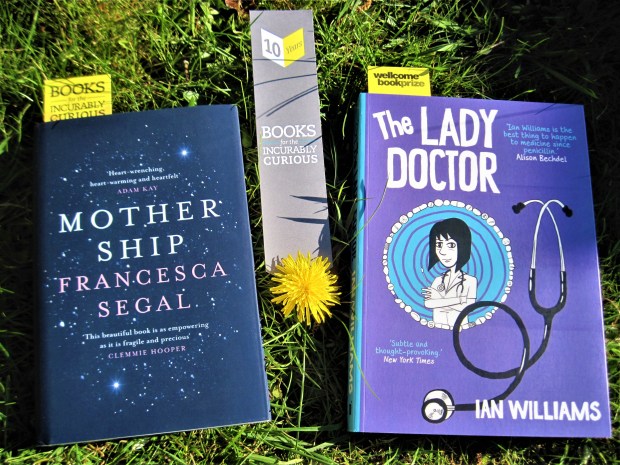
Mother Ship by Francesca Segal
 This first work of nonfiction from the author of the exquisite The Innocents is a visceral diary of the first eight weeks in the lives of her twin daughters, who were born by Caesarean section at 29 weeks in October 2015 and spent the next two months in the NICU, “an extremely well-funded prison or perhaps more accurately a high-tech zoo.” In Mother Ship, she strives to come to terms with this unnatural start to motherhood. “Taking my unready daughters from within me felt not like a birth but an evisceration,” she writes. “My children do not appear to require mothering. Instead they need sophisticated medical intervention.”
Segal describes with tender precision the feeling of being torn: between the second novel she’d been in the middle of writing and the all-consuming nature of early parenthood; and between her two girls (known for much of the book as “A-lette” and “B-lette”), who are at one point separated in different hospitals. Her attitude towards the NHS is pure gratitude.
As well as portraying her own state of mind, she crafts twinkly pen portraits of the others she encountered in the NICU, including the staff but especially her fellow preemie mums, who met in a “milking shed” where they pumped breast milk for the babies they were so afraid of losing that they resisted naming. (Though it was touch and go for a while, A-lette and B-lette finally earned the names Raffaella and Celeste and came home safely.) Female friendship is thus a subsidiary theme in this exploration of desperate love and helplessness.
The Lady Doctor by Ian Williams
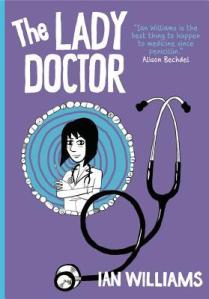 This sequel to 2014’s The Bad Doctor returns to a medical practice in small-town Wales. This time, though, the focus is on Iwan James’s colleague, Dr. Lois Pritchard, who also puts in two days a week treating embarrassing ailments at the local hospital’s genitourinary medicine clinic. At nearly 40, Lois is a divorcee with no children; just a dog. She enjoys her nights out drinking with her best friend, Geeta, but her carefree life is soon beset by various complications: she has to decide whether she wants to join the health centre as a full partner, a tryst with her new fella goes horribly wrong, and her estranged mother suddenly reappears in her life, hoping that Lois will give her a liver transplant. And that’s not to mention all the drug addicts and VD-ridden lotharios hanging about.
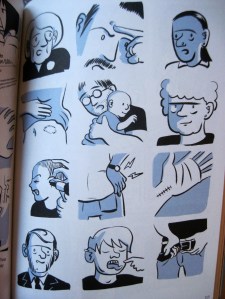 Williams was a GP in North Wales for 20 years, and no doubt his experiences have inspired his comics. His tone is wonderfully balanced: there are plenty of hilarious, somewhat raunchy scenes, but also touching moments where Lois learns that a doctor is never completely off duty and has no idea what medical or personal challenge will crop up next. The drawing style reminded me most of Alison Bechdel’s or Posy Simmonds’, with single shades from rose to olive alternating as the background. I especially loved the pages where each panel depicts a different patient to show the range of people and complaints a doctor might see in a day. Myriad Editions have a whole “Graphic Medicine” series that I’m keen to explore.
See below for details of the blogs where other reviews have appeared or will be appearing soon.
The shadow panel will choose a shortlist of six titles to be announced on 4 May. We will then vote to choose a winner, with the results of a Twitter poll serving as one additional vote. The Not the Wellcome Prize winner will be announced on 11 May.
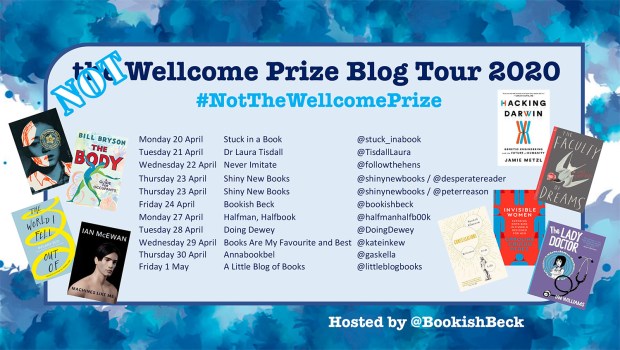
Announcing the NOT the Wellcome Prize and Blog Tour
Soon after I heard that the Wellcome Book Prize would be on hiatus this year, I had the idea to host a “Not the Wellcome Prize” blog tour to showcase some of the best health-themed literature published in 2019. I was finalizing the participants and schedule just before as well as during the coronavirus crisis, which has reinforced the importance of celebrating books that disseminate crucial information about medicine and/or tell stories about how health affects our daily lives. I got the go-ahead for this unofficial tour from the Wellcome Trust’s Simon Chaplin (Director of Culture & Society) and Jeremy Farrar (overall Director).
Starting on Monday and running for the next two weeks (weekdays only), the tour will be featuring 19 books across 10 blogs. One of the unique things about the Wellcome Prize is that both fiction and nonfiction are eligible, so we’ve tried to represent a real variety here: on the longlist we have everything from autobiographical essays to science fiction, including a graphic novel and a couple of works in translation.

Based on the blog tour reviews and the Prize’s aims*, the shadow panel (Annabel of Annabookbel, Clare of A Little Blog of Books, Laura of Dr. Laura Tisdall, Paul of Halfman, Halfbook and I) will choose a shortlist of six titles, to be announced on the 4th of May. We will then vote to choose a winner, with the results of a Twitter poll serving as one additional vote (be sure to have your say!). The overall winner of the Not the Wellcome Prize will be announced on the 11th of May.
I hope you’ll follow along with the reviews and voting. I would like to express my deep thanks to all the blog tour participants, especially the shadow panel for helping with ideas and planning – plus Annabel designed the graphics.
*Here is how the website describes the Prize’s purpose: “At some point, medicine touches all our lives. Books that find stories in those brushes with medicine are ones that add new meaning to what it means to be human. The subjects these books grapple with might include birth and beginnings, illness and loss, pain, memory, and identity. In keeping with its vision and goals, the Wellcome Book Prize aims to excite public interest and encourage debate around these topics.”
Below I’ve appended our preliminary list of eligible books that were considered but didn’t quite make the cut to be featured on the tour, noting major themes and positive blog review coverage I’ve come across. (The official Prize excludes poetry entries, but we were more flexible.)
Nonfiction:
- When Death Takes Something from You Give It Back by Naja Marie Aidt (memoir of child’s sudden death)
- The Man in the Red Coat by Julian Barnes (biography of 19th-century gynecologist)
- Let Me Not Be Mad by A.K. Benjamin (neuropsychologist’s memoir)
- The Story of Sex: From Apes to Robots by Philippe Brenot (medical history/graphic novel, in translation)
- The Prison Doctor by Amanda Brown (doctor’s memoir)
- The Undying by Anne Boyer (essays – cancer)
- Breaking & Mending by Joanna Cannon (doctor’s memoir)
- How to Treat People by Molly Case (nurse’s memoir)
- Will My Cat Eat My Eyeballs? by Caitlin Doughty (popular science – death)
- Happening by Annie Ernaux (memoir, in translation – abortion)
- I Remain in Darkness by Annie Ernaux (memoir, in translation – mother’s dementia)
- Out of Our Minds by Felipe Fernández-Armesto (popular science – evolutionary biology)
- The Heartland by Nathan Filer (medical history/memoir – schizophrenia)
- Childless Voices by Lorna Gibb (cultural history – infertility, etc.)
- Maybe You Should Talk to Someone by Lori Gottlieb (memoir/self-help – therapy)
Books Are My Favourite and Best review
- Once More We Saw Stars by Jayson Greene (memoir – child’s sudden death)
- A Short History of Falling by Joe Hammond (memoir – disability, dying)
- All Things Consoled by Elizabeth Hay (memoir – geriatrics, dementia)
- Hard Pushed by Leah Hazard (midwife’s memoir)
- Life Lessons from a Brain Surgeon by Rahul Jandial (memoir/self-help)
- Twas the Nightshift before Christmas by Adam Kay (doctor’s memoir)
- Why Can’t We Sleep? by Darian Leader (popular science – insomnia)
- Incandescent: We Need to Talk about Light by Anna Levin (light’s effects on health and body rhythms)
- A Puff of Smoke by Sarah Lippett (memoir – growing up with rare disease)
- Hormonal by Eleanor Morgan (popular science – women’s health)
- Critical by Matt Morgan (ICU doctor’s memoir)
- A Short History of Medicine by Steve Parker (medical history, illustrated)
- Notes to Self by Emilie Pine (essays – infertility, rape, etc.)
- That Good Night by Sunita Puri (doctor’s memoir – palliative care)
- An Elegant Defense: The Extraordinary New Science of the Immune System: A Tale in Four Lives by Matt Richtel (popular science)
- The Gendered Brain by Gina Ripon (popular science – neuroscience, gender)
- The Five by Hallie Rubenhold (alcoholism, sex work)
- When I Had a Little Sister by Catherine Simpson (memoir – mental health, suicide)
- Flash Count Diary: Menopause and the Vindication of Natural Life by Darcey Steinke (memoir, female anatomy)
- Skeleton Keys: The Secret Life of Bone by Brian Switek (popular science – anatomy)
- Out of the Woods by Luke Turner (memoir – masculinity, bisexuality)
- The Making of You by Katharina Vestre (popular science, in translation – embryology)
- Transcendence: How Humans Evolved through Fire, Language, Beauty, and Time by Gaia Vince (popular science – human evolution)
- The Knife’s Edge by Stephen Westaby (surgeon’s memoir)
Fiction:
- Starling Days by Rowan Hisayo Buchanan (literary fiction – mental illness, bisexuality)
- Recursion by Blake Crouch (science fiction – memory)
- Expectation by Anna Hope (women’s fiction – infertility, cancer)
- Stillicide by Cynan Jones (speculative fiction – water crisis)
- Things in Jars by Jess Kidd (historical fiction – Victorian medicine)
- Patience by Toby Litt (disability)
- The Migration by Helen Marshall (speculative fiction – immune disorder)
- The Warlow Experiment by Alix Nathan (historical fiction – medical experimentation)
- Night Theatre by Vikram Paralkar (magic realism – surgeon to the dead)
- The Art of Dying by Ambrose Parry (historical mystery – Victorian medicine)
- The Dutch House by Ann Patchett (doctor narrator, diabetes)
- Body Tourists by Jane Rogers (science fiction – body rental technology)
- Children of Ruin by Adrian Tchaikovsky (science fiction – evolutionary biology)
- Oligarchy by Scarlett Thomas (eating disorders)
- Wanderers by Chuck Wendig (science fiction – sleepwalking disorder)
Poetry:
- O Positive by Joe Dunthorne (death, therapy)
- The Carrying by Ada Limon (ageing parents, infertility)
Polio and the Plague: Epidemics in Fiction
Back in January I had the idea to catch up as much as I can on previous Wellcome Book Prize long- and shortlists while the Prize is on hiatus. I decided to start with a pair of novels about polio from my public library system: The Golden Age by Joan London and Nemesis by Philip Roth. The latter, especially, has taken on new significance due to its evocation of a time of panic over a public health crisis (see this article, but beware spoilers). On a fellow book reviewer’s recommendation, I also took Year of Wonders by Geraldine Brooks off the shelf and read it at the same time as the Roth.
The Golden Age by Joan London (2014)
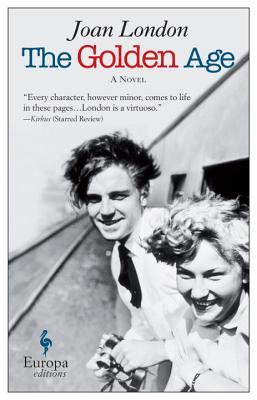 [First published in the UK in 2016; on the Wellcome Book Prize 2017 longlist]
The Golden Age was a real children’s polio hospital in Western Australia, but London has peopled it with her own fictional cast. In 1953–4, Frank Gold and Elsa Briggs, polio patients aged 12 going on 13, fall in love in the most improbable of circumstances: “The backs of their hands brushed as they walked side by side on their crutches. Their bloodstreams recharged by exercise and fresh air, they experienced a fiery burst of pleasure.”
Frank is much the more vibrant character thanks to his family’s wartime past in Hungary and his budding vocation as a poet, which was spurred on by his friendship with Sullivan, a fellow inmate at his previous rehabilitation center. The narrative spends time with the nurses, parents and other patients but keeps coming back to Frank and Elsa. However, Chapter 7, with Frank and his mother Ida still back in Budapest, was my favorite.
I was reminded of Tracy Farr’s work (The Life and Loves of Lena Gaunt), especially the look back from decades later. This has a strong premise and some great lines, but for me there was something slightly lacking in the execution.
Favorite lines:
There was beauty everywhere, strange beauty, even—especially?—in a children’s polio hospital.
Polio is like love, Frank says … Years later, when you think you have recovered, it comes back.
My rating: 
Nemesis by Philip Roth (2010)
[On the Wellcome Book Prize 2011 shortlist]
 In the summer of 1944 Newark, New Jersey is hit hard by polio. As a local playground director, 23-year-old Bucky Cantor is distressed when several of his charges become ill; a couple of them even die within a matter of days.
At first Bucky, whose poor eyesight kept him out of the War, sees his job as his own field of duty, but gradually fear and helplessness drive him away. He escapes to the Pocono Mountains to join his fiancée, Marcia, as a summer camp counselor, but soon realizes the futility of trying to outrun a virus. Unable to accept the randomness of bad luck, he blames God – and himself – for the epidemic’s spread.
Despite our better general understanding of epidemiology today, there were still many passages in this novel that rang true for me as they picture life proceeding as normal until paranoia starts to take hold:
Despite polio’s striking in the neighborhood, the store-lined main street was full of people out doing their Saturday grocery shopping…
(Bucky) Look, you mustn’t be eaten up with worry … What’s important is not to infect the children with the germ of fear. We’ll come through this, believe me. We’ll all do our bit and stay calm and do everything we can to protect the children, and we’ll all come through this together.
The important thing, he said, was always to wash your hands after you handled paper money or coins. What about the mail, someone else said … What are you going to do, somebody retorted, suspend delivering the mail? The whole city would come to a halt. Six or seven weeks ago they would have been talking about the war news.
Roth really captures the atmosphere of alarm and confusion, but doesn’t always convey historical and medical information naturally, sometimes resorting to paragraphs of context and representative conversations like in the last quote above. I also wasn’t sure about the use of a minor character (revealed on page 108 to be one of Bucky’s playground kids and a polio patient) as the narrator. This seemed to me to make Bucky more of a symbolic hero than a genuine character. Still, this was a timely and riveting read.
My rating:

A period warning about polio reprinted at the back of Paul Auster’s Report from the Interior.
Year of Wonders by Geraldine Brooks (2001)
 In 1665, with the Derbyshire village of Eyam in the grip of the Plague, the drastic decision was made to quarantine it. A benevolent landowner arranged for regular deliveries of food and other supplies to just outside the parish boundaries. The villagers made an oath that no one would leave until the pestilence was eradicated. One year later, two-thirds of its residents were dead. Brooks imagines that the “plague seeds” came to the village in a bolt of cloth that was delivered from London to the tailor George Viccars, who lodged with widow Anna Frith. Viccars is the first victim and the disease quickly spreads outward from Anna’s home.
Anna barely has time to grieve her own losses before she’s called into service: along with the minister’s wife, Elinor Mompellion, she steps in as a midwife, herbal healer and even a miner. The village succumbs to several sobering trajectories. Suspicion of women’s traditional wisdom leads some to take vigilante action against presumed witches. Unscrupulous characters like Anna’s father, who sets up as a gravedigger, try to make a profit out of others’ suffering. Frustration with the minister’s apparent ineffectuality attracts others to forms of religious extremism. Like Bucky, people cannot help but see the hand of God here.
Perhaps what I was most missing in the London and Roth novels (and in Hamnet, which bears such striking thematic similarities to Year of Wonders) was intimate first-person narration, which is just what you get here from Anna. The voice and the historical recreation are flawless, and again there were so many passages that felt apt:
Stay here, in the place that you know, and in the place where you are known. … Stay here, and here we will be for one another.
the current times did seem to ask us all for every kind of sacrifice
(once they start meeting for church in a meadow) We placed ourselves so that some three yards separated each family group, believing this to be sufficient distance to avoid the passing of infection.
Yet it is a good day, for the simple fact that no one died upon it. We are brought to a sorry state, that we measure what is good by such a shortened yardstick.
I’ve docked a half-star only because of a far-fetched ending that reminded me of that to The Wonder by Emma Donoghue. Apart from that, this is just what I want from my historical fiction.
My rating: 
Are you doing any reading about epidemics?
The Best Books from the First Half of 2019
My top 10 releases of 2019 thus far, in no particular order, are:

Not pictured: one more book read from the library; the Kindle represents two NetGalley reads.
General / Historical Fiction
 Stubborn Archivist by Yara Rodrigues Fowler: What a hip, fresh approach to fiction. Broadly speaking, this is autofiction: like the author, the protagonist was born in London to a Brazilian mother and an English father. The book opens with fragmentary, titled pieces that look almost like poems in stanzas. The text feel artless, like a pure stream of memory and experience. Navigating two cultures (and languages), being young and adrift, and sometimes seeing her mother in herself: there’s a lot to sympathize with in the main character.
 The Flight Portfolio by Julie Orringer: Every day the Emergency Rescue Committee in Marseille interviews 60 refugees and chooses 10 to recommend to the command center in New York City. Varian and his staff arrange bribes, fake passports, and exit visas to get celebrated Jewish artists and writers out of the country via the Pyrenees or various sea routes. The story of an accidental hero torn between impossible choices is utterly compelling. This is richly detailed historical fiction at its best. My top book of 2019 so far.
 Daisy Jones and The Six by Taylor Jenkins Reid: This story of the rise and fall of a Fleetwood Mac-esque band is full of verve and heart, and it’s so clever how Reid delivers it all as an oral history of pieced-together interview fragments, creating authentic voices and requiring almost no footnotes or authorial interventions. It’s pure California sex, drugs, and rock ’n roll, but there’s nothing clichéd about it. Instead, you get timeless rivalry, resentment, and unrequited or forbidden love; the clash of personalities and the fleeting nature of fame.
Victorian Pastiche
 Things in Jars by Jess Kidd: In the autumn of 1863 Bridie Devine, female detective extraordinaire, is tasked with finding the six-year-old daughter of a baronet. Kidd paints a convincingly stark picture of Dickensian London, focusing on an underworld of criminals and circus freaks. Surgery before and after anesthesia and mythology (mermaids and selkies) are intriguing subplots woven through. Kidd’s prose is spry and amusing, particularly in her compact descriptions of people but also in more expansive musings on the dirty, bustling city.
 The Doll Factory by Elizabeth Macneal: Iris Whittle dreams of escaping Mrs Salter’s Doll Emporium and becoming a real painter. Set in the early 1850s and focusing on the Great Exhibition and Pre-Raphaelite Brotherhood, this also reveals the everyday world of poor Londoners. It’s a sumptuous and believable fictional world, with touches of gritty realism. If some characters seem to fit neatly into stereotypes (fallen woman, rake, etc.), be assured that Macneal is interested in nuances. A terrific debut full of panache and promise.
Graphic Novel
 The Lady Doctor by Ian Williams: Dr. Lois Pritchard works at a medical practice in small-town Wales and puts in two days a week treating embarrassing ailments at the local hospital’s genitourinary medicine clinic. The tone is wonderfully balanced: there are plenty of hilarious, somewhat raunchy scenes, but also a lot of heartfelt moments as Lois learns that a doctor is never completely off duty and you have no idea what medical or personal challenge will crop up next. The drawing style reminds me of Alison Bechdel’s.
Medical Nonfiction
 Constellations by Sinéad Gleeson: Perfect for fans of I Am, I Am, I Am by Maggie O’Farrell, this is a set of trenchant autobiographical essays about being in a female body, especially one wracked by pain. Gleeson ranges from the seemingly trivial to life-and-death matters as she writes about hairstyles, blood types, pregnancy, the abortion debate in Ireland and having a rare type of leukemia. The book feels timely and is inventive in how it brings together disparate topics to explore the possibilities and limitations of women’s bodies.
 Hard Pushed: A Midwife’s Story by Leah Hazard: An empathetic picture of patients’ plights and medical professionals’ burnout. Visceral details of sights, smells and feelings put you right there in the delivery room. Excerpts from a midwife’s official notes – in italics and full of shorthand and jargon – are a neat window into the science and reality of the work. This is a heartfelt read as well as a vivid and pacey one, and it’s alternately funny and sobering. If you like books that follow doctors and nurses down hospital hallways, you’ll love it.
 Mother Ship by Francesca Segal: A visceral diary of the first eight weeks in the lives of her daughters, who were born by Caesarean section at 29 weeks in October 2015 and spent the next two months in the NICU. As well as portraying her own state of mind, Segal crafts twinkly pen portraits of the others she encountered in the NICU, including the staff but especially her fellow preemie mums. Female friendship is thus a subsidiary theme in this exploration of desperate love and helplessness.
Poetry
 Thousandfold by Nina Bogin: This is a lovely collection whose poems devote equal time to interactions with nature and encounters with friends and family. Birds – along with their eggs and feathers – are a frequent presence. Often a particular object will serve as a totem as the poet remembers the most important people in her life. Elsewhere Bogin greets a new granddaughter and gives thanks for the comforting presence of her cat. Gentle rhymes and half-rhymes lend a playful or incantatory nature. I recommend it to fans of Linda Pastan.
The three 4.5- or 5-star books that I read this year (and haven’t yet written about on here) that were not published in 2019 are:
 Girls Are Coming Out of the Woods by Tishani Doshi [poetry]
Faces in the Water by Janet Frame
Priestdaddy: A Memoir by Patricia Lockwood
What are some of the best books you’ve read so far this year?
What 2019 releases do I need to catch up on right away?
Recent Writing for BookBrowse, Shiny New Books and the TLS
Here are excerpts from (and links to, where available) some of my recent reviews for other places. A few of these books will undoubtedly be showing up on my end-of-year best lists in a couple weeks’ time.
BookBrowse
I was pleased to have three of the books I reviewed show up on BookBrowse’s list of the top 20 books of the year, as voted for by the site’s readers. What’s more, Educated was voted their top nonfiction book of the year and Where the Crawdads Sing (below) their #1 debut novel. (The third on the list was Unsheltered.)
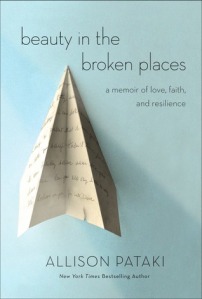 Beauty in the Broken Places by Allison Pataki: Ernest Hemingway wrote that we are strong at the broken places, and Allison Pataki found that to be true when her husband, David Levy, a third-year orthopedic surgery resident in Chicago, had a near-fatal stroke at age 30. On June 9, 2015, Dave and five-months-pregnant Allison were on a flight from Chicago to Hawaii for their babymoon, planning to stop in Seattle to visit Dave’s brothers. But they never made it there. On the plane Dave told her he couldn’t see out of his right eye.The plane made an emergency landing in Fargo, North Dakota and Dave was rushed to a hospital for testing. Doctors found he had suffered a bithalamic midbrain ischemic stroke, even though he’d had no risk factors and this stroke type was virtually unknown in patients of his age. Pataki goes back and forth between the details of this health crisis and her past with Dave. Hers is a relatable story of surviving the worst life can throw at you and finding the beauty in it.
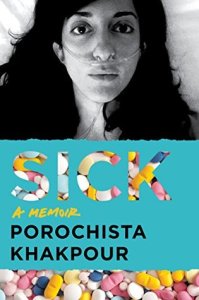 Sick by Porochista Khakpour: Khakpour can’t remember a time when she didn’t feel unwell and like she wanted to escape. “I had no idea what normal was. I never felt good,” she writes in her bracing memoir. Related to this sense of not being at home in her body was the feeling of not having a place where she fit in. Throughout Sick, she gives excellent descriptions of physical and mental symptoms. Her story is a powerful one of being mired in sickness and not getting the necessary help from medical professionals. Lyme disease has cost her $140,000 so far, and a lack of money and health insurance likely delayed her diagnosis by years. There is, unfortunately, some inherent repetition in a book of this nature. At times it feels like an endless cycle of doctors, appointments, and treatment strategies. However, the overall arc of struggling with one’s body and coming to terms with limitations will resonate widely.
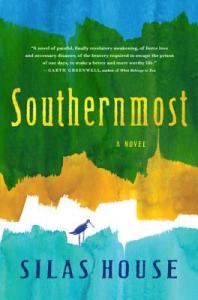 Southernmost by Silas House: In Silas House’s sixth novel, a Tennessee preacher’s family life falls apart when he accepts a gay couple into his church. We go on a long journey in Southernmost: not just a literal road trip from Tennessee to Florida, but also a spiritual passage from judgment to grace. Reconciliation is a major theme, but so is facing up to the consequences of poor decisions. I found the plotting decisions rewarding but also realistic. The pattern of a narrow religious worldview ebbing away to no faith at all and eventually surging back as a broader and more universal spirituality truly resonates. I loved House’s characters and setups, as well as his gentle evocation of the South. His striking metaphors draw on the natural world, like “She had the coloring of a whip-poor-will” and “The sky is the pink of grapefruit meat.” It’s a beautiful, quietly moving novel of redemption and openness to what life might teach us.
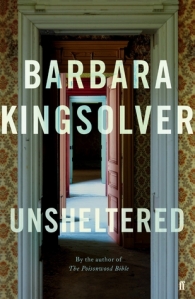 Unsheltered by Barbara Kingsolver: Kingsolver’s bold eighth novel has a dual timeline that compares the America of the 1870s and the recent past, revealing how they are linked by distrust and displacement. The book’s themes and structure emphasize similarities between two time periods that might initially appear very different. Chapters alternate between the story lines, and the last words of one chapter form the title of the next. It’s a clever and elegant connecting strategy, as is the habit of using variations on the title word as frequently as possible – something Jonathan Franzen also does in his novels. (I counted 22 instances of “shelter” and its variants in the text; how many can you spot?) Kingsolver can be heavy-handed with her messages about science, American politics and healthcare, etc. All the same, Unsheltered is a rich, rewarding novel and an important one for our time, with many issues worth pondering and discussing.
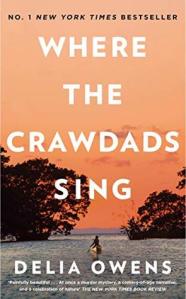 Where the Crawdads Sing by Delia Owens: It’s easy to see why so many have taken this debut novel into their hearts: it’s a gripping mystery but also a tender coming-of-age story about one woman’s desperately lonely upbringing and her rocky route to finding love and a vocation. Not only that, but its North Carolina marsh setting is described in lyrical language that evinces Delia Owens’s background in nature writing, tempered with folksy Southern dialect. The title refers to places where wild creatures do what comes naturally, and throughout the book we are invited to ponder how instinct and altruism interact and what impact human actions can have in the grand scheme of things. In Kya, Owens has created a truly outstanding character. The extremity of her situation makes her a sympathetic figure in spite of her oddities. Crawdads is a real treat.
Shiny New Books
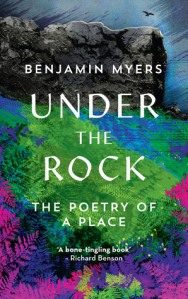 Under the Rock by Benjamin Myers: When Myers moved to the Calder Valley of West Yorkshire from London over a decade ago, he approached his new patch with admirable curiosity, and supplemented the observations he made from his study window with frequent long walks with his dog (“Walking is writing with your feet”) and research into the history of the area. The result is a divagating, lyrical book that ranges from literature and geology to true crime but has an underlying autobiographical vein. This isn’t old-style nature writing in search of unspoiled places. Instead, it’s part of a growing interest in the ‘edgelands’ where human impact is undeniable but nature is creeping back in. Interludes transcribe his field notes, which are stunning impromptu poems. I came away from this feeling that Myers could write anything – a thank-you note, a shopping list – and make it profound literature. Every sentence is well-crafted and memorable. “Writing is a form of alchemy,” he declares. “It’s a spell, and the writer is the magician.” I certainly fell under his spell here.
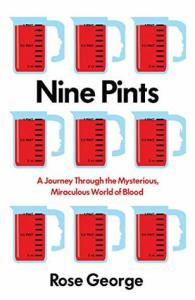 Nine Pints by Rose George: Nine Pints dives deep into the science and cultural history of blood. George’s journalistic tenacity keeps her pushing through the statistics to find the human stories that animate the book. In the first chapter we track the journey of a pint of blood that she donates in her hometown of Leeds. I was particularly interested, if morbidly so, in the chapter on leeches and bloodletting. Other sections journey further afield, chiefly to South Africa and India, to explore AIDS and menstruation taboos. The style can be choppy and repetitive, given to short sentences and identical paragraph openers, and there are a couple of places where the nine-chapter structure shows its weaknesses. While Nine Pints is quite uneven, it does convey a lot of important information about the past, present and future of our relationship to blood.
Times Literary Supplement
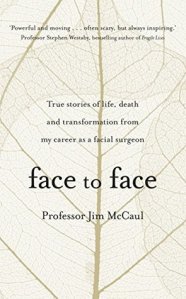 Face to Face: True stories of life, death and transformation from my career as a facial surgeon by Jim McCaul: Eighty percent of a facial surgeon’s work is the removal of face, mouth and neck tumors in surgeries lasting eight hours or more. McCaul also restores patients’ appearance as much as possible after disfiguring accidents. Here he pulls back the curtain on the everyday details of his work life: everything from his footwear (white Crocs that soon become stained with blood and other fluids) to his musical choices (pop for the early phases; classical for the more challenging microsurgery stage). Like neurosurgeon Henry Marsh, he describes the awe of the first incision – “an almost overwhelming sense of entering into a sanctuary.” There’s a vicarious thrill to being let into this insider zone, and the book’s prose is perfectly clear and conversational, with unexpectedly apt metaphors such as “Sometimes the blood vessels can be of such poor quality that it is like trying to sew together two damp cornflakes.” This is a book that inspires wonder at all that modern medicine can achieve.
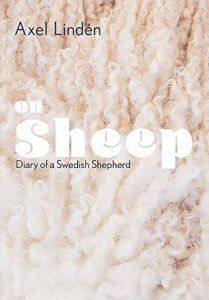 On Sheep: Diary of a Swedish Shepherd by Axel Lindén: Lindén left city life behind to take on his parents’ rural collective in southeast Sweden. This documents two years in his life as a shepherd aspiring to self-sufficiency and a small-scale model of food production. Published diaries can devolve into tedium, but the brevity and selectiveness of this one prevent its accounts of everyday tasks from becoming tiresome. Instead, the rural routines are comforting, even humbling, as the shepherd practices being present with these “quiet and unpretentious and stoical” creatures. The attention paid to slaughtering and sustainability issues – especially as the business starts scaling up and streamlining activities – lends the book a wider significance. It is thus more realistic and less twee than its stocking-stuffer dimensions and jolly title font seem to suggest.
 Bookish Beck = Rebecca Foster. American transplant to England. Freelance proofreader and book reviewer.
 Bookish Beck